EP0883013A2 - Filtre optique anti-crénelage passe-bas à bande large - Google Patents
Filtre optique anti-crénelage passe-bas à bande large Download PDFInfo
- Publication number
- EP0883013A2 EP0883013A2 EP98201597A EP98201597A EP0883013A2 EP 0883013 A2 EP0883013 A2 EP 0883013A2 EP 98201597 A EP98201597 A EP 98201597A EP 98201597 A EP98201597 A EP 98201597A EP 0883013 A2 EP0883013 A2 EP 0883013A2
- Authority
- EP
- European Patent Office
- Prior art keywords
- spots
- filter
- phase
- wavelength
- transparent
- Prior art date
- Legal status (The legal status is an assumption and is not a legal conclusion. Google has not performed a legal analysis and makes no representation as to the accuracy of the status listed.)
- Withdrawn
Links
Images




Classifications
-
- G—PHYSICS
- G02—OPTICS
- G02B—OPTICAL ELEMENTS, SYSTEMS OR APPARATUS
- G02B27/00—Optical systems or apparatus not provided for by any of the groups G02B1/00 - G02B26/00, G02B30/00
- G02B27/42—Diffraction optics, i.e. systems including a diffractive element being designed for providing a diffractive effect
- G02B27/46—Systems using spatial filters
-
- G—PHYSICS
- G02—OPTICS
- G02B—OPTICAL ELEMENTS, SYSTEMS OR APPARATUS
- G02B5/00—Optical elements other than lenses
- G02B5/18—Diffraction gratings
- G02B5/1866—Transmission gratings characterised by their structure, e.g. step profile, contours of substrate or grooves, pitch variations, materials
- G02B5/1871—Transmissive phase gratings
Definitions
- the present invention relates to an optical low-pass filter to reduce or eliminate high spatial frequencies over a broad spectral bandwidth in order to minimize aliasing artifacts due to discrete sampling of images in image capture devices, such as electronic still cameras with monochromatic or color sensors or single sensor element color video cameras, while at the same time maintaining highest possible resolution.
- Solid-state image capture devices such as electronic still cameras and the like rely on an array of discrete light sensitive elements or photosites known as pixels to spatially sample an image of the object and produce sampled output. Because the image is sampled in a discrete manner, images re-created contain false signal content not present in the original object. This phenomenon is known as aliasing and becomes noticeable for those spatial frequency components of the image which are equal to half the spatial sampling frequency along a particular direction of the pixel array, the so-called Nyquist frequency. Although aliasing begins to appear at Nyquist frequency, it is most pronounced at spatial frequencies that are close to the sampling frequency along the given direction of the solid state imager.
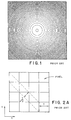
- FIG. 2A is a schematic representation of an array of discrete pixels of a typical solid-state imager.
- the array has a pixel pitch T along the directions of the x - and y -axes and T / ⁇ 2 along the diagonal directions If this target is imaged on the discrete array of pixels in the imager, the aliasing pattern shown schematically in FIG. 2B is obtained.
- FIGS. 3A and 3B illustrate the effects of aliasing for a typical color solid-state imager with discrete sampling.
- FIG. 3A is a schematic representation of an array of discrete pixels with green color filters (labeled "G” in FIG. 3A) on half of the pixels and red or blue color filters on the remaining half (labeled "R” or "B", respectively, in FIG.
- This particular color filter array pattern is often referred to as the Bayer pattern.
- the pitch of green pixels along the x - or y -axes, T G is the same as the pixel pitch T of the sensor while the pitches of the red or blue pixels along the x - or y -axes, T R and T B , respectively, are equal to 2 T .
- the pitches of the green, red, and blue pixels along diagonal directions are all equal to ⁇ 2 T .
- 3B is a schematic diagram indicating the positions of aliasing artifacts only (i.e. captured image minus the image of the test target) for the test target shown in FIG. 1.
- the most pronounced aliasing artifacts for red and blue pixels occur at spatial frequencies corresponding to the red and blue sampling frequencies along a given direction, whereas all three colors exhibit pronounced aliasing artifacts at spatial frequencies corresponding to the sampling frequency of the sensor.
- Phase noise optical low pass filters have been disclosed in the literature for applications as photographic softening filters as well as anti-aliasing filters in digital cameras. See “Optical Noise Filter” by K. Sayanagi, Journal of Applied Physics (Japan) , 26 , No. 10, 1958, pp 623-632; and "Optical Phase-Noise Filter for Color Portrait Photography” by Y. Okano, Proceedings of the International Commission for Optics, 13th Conference Digest - Sapporo, Japan , 1984, pp 104-105.
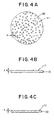
- FIGS. 4B and 4C show side views of the phase-type optical low-pass filters for cases where the randomly placed transparent spots are formed by projections from the surface of the transparent substrate (FIG. 4B) and alternatively by depressions in the surface of the transparent substrate (FIG. 4C).
- phase noise-type low-pass optical filter When positioned between the objective lens and the image plane of the imaging system (see FIG. 5A) or directly in front of the objective lens (see FIG. 5B), such a phase noise-type low-pass optical filter causes aberrations in the wave front of the light passing through it.
- the modulation transfer function (MTF) due to the blur filter alone i.e., excluding the effects of lens aberrations and finite aperture
- MTF ( f , ⁇ ) 1-[2 ⁇ ][1-cos ⁇ ( ⁇ )] 1- g ( ⁇ bf 2 )
- f the spatial frequency
- ⁇ the fractional area of the surface of the filter that is covered by the transparent spots
- ⁇ ( ⁇ ) 2 ⁇ n ( ⁇ )- n '( ⁇ ) ⁇ t
- n ( ⁇ ) the index of refraction of the material forming the spots at the specific wavelength ⁇
- n' ( ⁇ ) is the index of refraction of the medium surrounding the spots at the specific wavelength ⁇
- t is the physical thickness of the transparent spots.
- the function g depends implicitly on the phase spot diameter a in that the auto-correlation of the phase spots drops off more rapidly with spatial frequency when the phase spot diameter is smaller.
- the quantity b in EQN. (1A) is the distance between the spot-bearing surface of the phase noise filter and the image plane if the filter is placed in image space (i.e., the space between the imaging lens and the image plane). It becomes equal to the focal length of the imaging lens if the filter is placed in object space (i.e., the space between the imaging lens and the object) or within the imaging lens system itself.
- FIG. 6 shows a plot of MTF ( f , ⁇ ) for a particular wavelength.
- MTF ( f , ⁇ ) decreases monotonically with f until it reaches an intermediate spatial frequency region (second region) where the function begins a damped oscillation.
- MTF ( f , ⁇ ) M c ( ⁇ )
- This value of f marks the transition from the low (monotonically decreasing) to the intermediate (damped oscillatory) spatial frequency regions and is given by the expression F a ( ⁇ ) ⁇ a ⁇ b lp/mm where F a ( ⁇ ) is the canonical cut-off frequency of the filter. It should be appreciated that in order to reduce aliasing artifacts, it is desirable to design the phase noise filter so that the MTF is sufficiently small for spatial frequencies at or above the appropriate sampling frequency as discussed previously. From EQN.
- the quantity m in EQNS. 4A and 4B can be 0 or any positive or negative integer.
- the filter canonical cut-off frequency F a ( ⁇ ) is adjusted such that the MTF of the entire optical system (i.e., including lens) is sufficiently low at and above spatial frequencies where aliasing artifacts become problematic while simultaneously maintaining as high a value possible at spatial frequencies below Nyquist.
- US-A-2,959,105 is similar to the previously mentioned patent in that it discloses the use of a random spot phase noise filter in combination with an ordinary photographic lens to obtain soft focus in portrait photography.
- this patent mentions the use of the phase noise filter as a spatial frequency cut-off device to produce continuous tone photographic images from any optical images of periodic structures such as screen dots or of line structures in television images, etc.
- This patent does not anticipate the adaptation of the phase noise filter to solve problems specifically associated with elimination of aliasing artifacts in modern solid-state electronic cameras with discrete sampling.
- US-A-5,280,388 which describes a wavelength selective phase grating optical low-pass filter for use with electronic still cameras or other discretely sampling image capture devices. More specifically, the filter described in this patent is intended for use in color solid state image capture devices which incorporate color filter array patterns such as the Bayer pattern which sample more in the green portion of the visible spectrum than in the red or blue portions. In this patent, the randomly placed transparent spots are replaced by a regular two dimensional transparent phase grating pattern.
- Wavelength selectivity is accomplished by appropriately choosing the refractive indexes and the refractive index dispersions of the transparent phase grating material and the transparent material in which the phase grating is embedded such that the refractive indexes are matched for a particular wavelength in the green spectral band and mismatched in the red and blue spectral bands. That is to say n ( ⁇ G ) and n' ( ⁇ G ) in EQN. 1B are equal so that, according to EQN. 2, M c ( ⁇ G ) is equal to unity where ⁇ G is a particular wavelength in the green spectral band.
- the thickness of the stripes that form the phase grating is chosen so that, given the refractive index dispersion differences between the grating material and the material surrounding the grating, M c ( ⁇ ) is sufficiently close to zero for certain wavelengths in the red and blue portions of the visible spectrum.
- M c ( ⁇ ) is sufficiently close to zero for certain wavelengths in the red and blue portions of the visible spectrum.
- This patent also suffers several disadvantages. First of all, the gratings must be aligned precisely to the array axes of the pixels which comprise imaging area of the solid state image capture device. This invention has the further disadvantage that special conditions are placed on the physical properties (i.e., index of refraction and dispersion) of the materials used to fabricate the low-pass filter. These properties are restrictive and may result in conflicts with other requirements such as the desire for low manufacture costs. The need to form two separate gratings oriented perpendicularly to one another also complicates the fabrication and adds to the expense of fabricating the device.
- FIG. 7 This figure shows three hypothetical spectral sensitivity functions filters S R ( ⁇ ), S G ( ⁇ ), and S B ( ⁇ ) that characterize the red, green, and blue channels, respectively, of a typical color digital image capture device. These spectral sensitify curves represent the response of each of the individual color channels to incident light as a function of wavelength.
- these spectral sensitivity curves also include the spectrum of the incident illumination. Since each of the spectral sensitivity curves contains wavelengths over a broad spectral band, the proper MTF of the blur filter at cut-off for a particular color filter must be obtained by a weighted average over the spectrum of that color channel. In the case of the phase noise blur filter, EQN.
- M cR ⁇ S R ( ⁇ ) M c ( ⁇ ) d ⁇
- M cR is the spectrally averaged MTF cut-off function for the red channel.
- Similar expressions are obtained for M cG and M cB for the green and blue color channels, respectively.
- the larger the thickness t of the transparent spots the more the value of ⁇ ( ⁇ ) will vary over the wavelength band of a given channel.
- the values of M cR , M cG , and M cB will be significantly larger than zero.
- phase noise blur filter will not be effective in reducing aliasing artifacts present in the captured image as t becomes larger.
- Not one of the three prior art patents referenced above solves the problem of aliasing suppression over broad spectra in color solid state digital cameras.
- US-A-4,009,939 relates to a wavelength selective low-pass optical filter that is used to eliminate aliasing artifact in color television camera systems.
- This patent does disclose a way for solving the problem mentioned in connection with the previous prior art patents; that is, it addresses the problem of achieving aliasing suppression across broad spectral bandwidths.
- the filter is comprised of a first transparent phase grating, a second transparent phase grating, and a transparent substrate supporting the first and second phase gratings.
- Each phase grating is formed by a plurality of parallel transparent stripes or laminae such that the laminae of the respective first and second gratings are non-parallel to each other crossing at an angle between 90° and 160°.
- the thickness of the laminae in the first phase grating, t 1 , and the second phase grating, t 2 are selected independently and in such a way that the first phase grating attenuates high spatial frequencies in the red spectrum and the second phase grating attenuates high spatial frequencies in the blue spectrum. Accordingly, the phase retardation of the laminae in the first grating, ⁇ 1 , and the second grating, ⁇ 2 , are such that the MTF of the optical imaging system which includes such a low-pass optical filter is sufficiently close to zero for the respective design wavelengths.
- the thicknesses of the laminae of the first and second gratings are chosen to cause the MTF associated with each grating individually to cut-off high spatial frequency components in the red and blue images, respectively.
- a double layered optical low pass filter can be designed with spectral averages M cR and M cB that are both very low by choosing t 1 and t 2 such that ⁇ 1 and ⁇ 2 are each individually equal to ⁇ for specific wavelengths in the transmission spectra of the red and blue filters, respectively.
- all three cut off functions M cR , M cB , and M cG have low values and consequently are effective in suppressing aliasing artifacts.
- US-A-5,585,885 describes the use of an optical low pass filter for use in a photographic camera exposure control system.
- This low pass filter is comprised of circular phase components of randomly distributed convex and concave surfaces on a transparent substrate such that the height of the phase components represents a phase difference between the light passing through the phase components and the other areas of the filter that is 1 ⁇ 2 its wavelength.
- the specific value of the optical wavelength ⁇ which occurs in EQN.
- the object of the invention in US-A-5,585,885 is to provide a camera photometer that can precisely measure the light distribution of a secondary photo image regardless of the incidence of the light from the photographic subject when the photometric sensors have been divided into multiple units.
- This optical low pass filter is designed specifically to be used in a camera system whose primary image capture mechanism is not specified but whose secondary image capture system is an array of discrete photometric sensors. The filter is placed optically upstream of a secondary image-forming lens and is used to blur the image formed on the array of photometric sensors.
- US-A-5,585,885 makes no mention of an application involving suppression of aliasing artifacts across broad spectral bandwidths in digital electronic capture devices.
- the purpose of the prior art invention is to enable accurate measurement of the brightness distribution of the photographic subject and this information is used to set the camera exposure for capture of the primary image.
- the purpose of this invention is distinct from that of the present invention.
- f the focal length of the secondary photometric image-forming system
- T the photometric sensor spacing
- F S the sampling frequency associated with the photometric sensors
- ⁇ a wavelength of light that is characteristic of the light passing through the filter.
- the diameter of the phase spot is chosen to be very small in order to diffract light to very large angles thereby maximizing the possibility of collecting the light by the array of photometric sensors.
- Another object of the invention is to provide a low pass optical filter for use in an electronic digital capture device to suppress aliasing artifacts over a broad spectral range while at the same time causing as little reduction as possible in the system MTF for those spatial frequencies below the Nyquist frequency.
- an inexpensive low-pass optical filter is suitable for use in solid-state cameras with discrete image sampling.
- the present invention functions as a spectrally broadband low-pass optical filter in that high spatial frequencies are sufficiently attenuated to substantially reduce or eliminate entirely aliasing artifacts for incident light over the entire bandwidth of spectral sensitivity of the solid-state imaging system.
- the present invention has the following advantages.
- the low-pass filter according to the present invention is designed specifically to suppress aliasing artifacts in solid state imaging devices with discrete sampling over a broad spectral band in an inexpensive way while preserving the sharpness of captured images as much as possible.
- US-A-2,959,105 and US-A-4,480,896 describe low-pass filters which are intended primarily for use in photographic systems and are designed to attenuate the green high spatial frequencies while transmitting the red and blue high spatial frequencies.
- US-A-5,280,388 describes a color selective low-pass filter that attenuates high spatial frequencies in the red and blue portion of the visible spectrum while passing green high spatial frequencies.
- None of these patents address the problem of achieving high attenuation uniformly over the red and blue spectral bands. Consequently the present invention is better suited for use in solid state imagers compared to the three prior art patents.
- the present invention also avoids difficulties associated with US-A-4,009,939; and US-A-5,280,388.
- the low-pass filter described in the present invention is formed by a plurality of randomly positioned spots of random diameter. Accordingly, it is rotationally symmetric and is effective in eliminating or reducing aliasing artifacts in two dimensions regardless of the filter orientation with respect to the pixel array of the electronic image sensor.
- the present invention is better suited for use as an anti-aliasing filter in solid-state image capture devices than the aforementioned prior art patents which can perform low-pass filtering only along one axis and/or depend on precise alignment of the filter with the axes of the electronic imager pixel array.
- the broad spectral bandwidth anti-aliasing function of the present invention is accomplished with a relatively simple structure; namely, a single substrate with a multiplicity of randomly arrayed phase spots as shown in FIGS. 4A-C.
- the random spot pattern can be easily manufactured in several different ways.
- the spot pattern can be formed in a master mold and the mold used to cast or stamp replicate plastic low-pass filters.
- Another means of producing the low-pass filter according to the present invention is to spin-coat photoresist on a glass substrate (quartz, for example) and photolithographically pattern the photoresist according to the pattern of the random spots.
- the glass substrate is then placed in a buffered oxide etch solution which transfers the spot pattern in the photoresist to the substrate followed by the removal of the photoresist.
- a buffered oxide etch solution which transfers the spot pattern in the photoresist to the substrate followed by the removal of the photoresist.
- Yet another means is to deposit a thin layer of a transparent organic polymer such as PMMA onto the transparent substrate followed by evaporation of a thin inorganic etch-stop layer such as silicon dioxide. After patterning the etch-stop layer with the spot pattern using standard photolithographic processing techniques, the etch-stop pattern is transferred to the polymer using an oxygen plasma reactive ion etching technique. It will be furthermore appreciated that it is necessary to form the random spot pattern on a single surface of the transparent substrate.
- low-pass optical filters with regular or periodic phase gratings such as those mentioned in US-A-4,009,939 and US-A-5,280,388 exhibit an additional drawback.
- a spurious pattern may be produced in the image plane which is an artifact of the interference generated by light transmitted through the regular gratings. This artifact is especially pronounced in cases where bright points of light are to be imaged.
- the low-pass filter according to the present invention avoids this difficulty in that it is comprised of a random array of randomly sized spots whose interference pattern in the image plane is a nearly constant intensity halo about the image of the bright object.
- phase noise filter of the present invention is specifically designed to suppress broad spectral band aliasing artifacts in electronic digital capture devices.
- US-A-5,585,885 is designed to enable accurate measurement of brightness distributions using photometric sensor arrays for the purpose of exposure determination in photographic cameras.
- the present invention has advantage over the prior art invention in that it specifies a diameter of the phase spots which causes the least amount of diffraction of light consistent with the objective of aliasing suppression.
- US-A-5,585,885 specifies a phase noise blur filter with phase spot diameters specified according to EQN. 8.
- phase noise filter This diameter is much too small for the phase noise filter to be suitable for use as an anti-aliasing filter in an electronic digital image capture device since the small diameter of the phase spots causes excess diffraction of light and results in excessive blurring of the image (i.e., poor image quality).
- the criteria for the selection of the diameter of the phase spots and the design wavelength are quite different from those used to specify the invention in US-A-5,585,885, as will become clear in the detailed description of the invention.
- Another advantage of the present invention with respect to US-A-5,585,885 is that the present invention specifies the thickness of the phase spots in such a way that it is optimized for operation over a broad spectral bandwidth. Unfortunately EQN.
- the present invention has yet another advantage over US-A-5,585,885 in that it allows for placement of the phase noise blur filter either in object space (i.e., between the imaging lens and the object to be photographically captured) or in image space (i.e. between the imaging lens and the image plane).
- object space i.e., between the imaging lens and the object to be photographically captured
- image space i.e. between the imaging lens and the image plane.
- US-A-5,585,885 specifies that the blur filter must be placed in object space.
- the present invention allows additional flexibility in the use of the phase noise filter.
- phase spots of uniform thickness whereas the prior art patent describes convex and concave phase components. It is expected that uniformly thick phase spots would be more effective in diffracting the light and cheaper and easier to control and manufacture than would the phase components with variable thickness such as the convex and concave phase components described in the prior art patent.
- the preferred embodiment of the invention can be specified by optimal selection of the parameters associated with the phase noise filter illustrated in FIGS. 4A-C. These parameters include 1) ⁇ , the fractional area of the surface of the filter that is covered by the transparent spots; 2) t , the physical thickness of the phase spots (assuming that the indexes of refraction of the phase spots and the medium surrounding the phase spots are given); and 3) a , the diameter of the phase spots.
- ⁇ the fractional area of the surface of the filter that is covered by the transparent spots
- t the physical thickness of the phase spots (assuming that the indexes of refraction of the phase spots and the medium surrounding the phase spots are given)
- 3) a the diameter of the phase spots.
- the optimum blur filter for use in a color solid-state imaging device with a Bayer-type color filter array should exhibit values of M cR and M cB (defined in EQN. 5) that are low enough to suppress aliasing artifacts which occur at the red or blue sampling frequencies along the x - or y - axis of the pixel array as illustrated in FIG. 3B. It would also be desirable to design the blur filter such that the spectrally averaged values of MTF ( f , ⁇ ) over the red and blue transmission bands are approximately equal for any spatial frequency. All of these optimal features can be achieved by means of the following teaching.
- M c ( ⁇ ) the MTF of the phase noise filter for large spatial frequencies, to become as close to zero as possible over the entire spectral band of interest.
- condition b) can not be satisfied for all wavelengths simultaneously.
- FIG. 8 shows plots of M cR , M cG , and M cB each as a function of the thickness t of the phase spots for a typical phase noise filter.
- the spectral sensitivity curves for the red, green, and blue channels shown in FIG. 7 were used to obtain the spectral averages indicated in EQN. 5.
- M cR , M cG , and M cB all oscillate in such a way that the local maxima steadily decrease in value while the local minima steadily increase in value. Furthermore, the local maxima and minima of a given spectrally averaged MTF cut-off function occur at values of t which differ from those of the other two functions. For example, it can be seen that for t ⁇ 2.6 microns, M cR and M cB are at local minima and have values approximately equal to 0.22 and 0.42 respectively while M cG at a local maximum with a value of 0.78.
- phase spot thickness is approximately equal to 0.4 microns
- all three functions are very close to the first local minima with cut-off MTF values less than 0.1.
- the condition of lowest spectrally averaged MTF cut-off for the red and blue channels is clearly for t ⁇ 0.4 microns for this particular example.
- This feature is a direct result the relationship between t and ⁇ o shown in EQN. 12, the assumed dispersion relationship given in EQN. 14, and the fact that that S R ( ⁇ ), S G ( ⁇ ), and S B ( ⁇ ) all represent spectral distributions that have their peaks at different values of wavelength. If the objective of the design of the phase noise filter were to select a value of t according to EQN. 12 such that ( M cR + M cG + M cB )/3 ( i .
- the average value ( M cR + M cG + M cB )/3 is relatively small regardless of which of the three values t R , t G , or t B is chosen. It should be noted that these considerations apply to an anti-aliasing phase noise filter that would be used with a color sensor.
- the appropriate design wavelength clearly must be the wavelength ⁇ sys corresponding to the peak in the overall system spectral sensitivity S sys ( ⁇ ).
- a better design objective to be used in the determination of ⁇ o for phase noise filters in the case of Bayer-type color sensor applications is the requirement that the spectrally averaged MTF functions MTF R ( f ) ⁇ ⁇ MTF ( f , ⁇ ) S R ( ⁇ ) d ⁇ and MTF B ( f ) ⁇ ⁇ MTF ( f , ⁇ ) S B ( ⁇ ) d ⁇ must be approximately equal over the low spatial frequency range (i.e., from 0 lp/mm to the canonical cut-off frequency), where MTF ( f , ⁇ ) is as defined in EQN. 1A. Substituting EQN. 12 into EQN.
- the ratio ⁇ o / ⁇ in EQN. 19A will always be greater than or equal to one according to EQN. 10.
- the spectral bandwidth is such that the long wavelength ⁇ R limit is typically much less than twice the short wavelength ⁇ B . Therefore the value of the ratio ⁇ o / ⁇ will typically lie between 1.0 and 2.0 for all wavelengths in the spectral band ⁇ B to ⁇ R .
- the function C( f , ⁇ ) will therefore decrease monotonically as wavelength increases from ⁇ B to ⁇ R .
- the function G ( f , ⁇ ) increases monotonically with wavelength for a given spatial frequency since g ( ⁇ bf /2) decreases monotonically with wavelength for values of ⁇ bf less than a (see EQN. 3). Consequently, the product C ( f , ⁇ ) ⁇ G ( f , ⁇ ) is approximately independent of wavelength over the spectral band ⁇ B to ⁇ R for values of f between 0 and the canonical cut-off frequency. As a result, the two spectrally averaged functions MTF R ( f ) and MTF B ( f ) are approximately equal providing ⁇ o is taken to be equal to ⁇ B
- the last design parameter to be specified for the anti-aliasing phase noise filter is the phase spot diameter a .
- F a ( ⁇ o ) is set equal to F SR in EQN. 3 and simply solve for a .
- this procedure does not does not take into account the effects of the lens MTF nor does it account for the effects of spectral averaging.
- This optimum value for the phase spot diameter can be determined by one of two methods.
- the first method is the empirical method. If a phase noise filter with a specific spot diameter is placed in image space, the effect of increasing the distance b between the filter and the image plane is to cause g ( ⁇ o bf /2) to decrease for a given value of f since g ( x ) decreases monotonically as the argument x increases (for x ⁇ a /2). Therefore, the two spectrally averaged functions MTF R ( f ) and MTF B ( f ) both decrease more rapidly with spatial frequency f as the value of b increases. Conversely, small values of b cause these spectrally averaged functions to decrease less rapidly.
- Example 1 Empirical method for determination of phase spot diameter
- a phase noise filter was fabricated, inserted into the image space of a Bayer-type digital electronic image capture device, and images were captured in accordance with the procedures for the empirical method as outlined above.
- the experimental conditions were as follows
- ⁇ o bF SR The data from the empirical method suggests the relationship between ⁇ o bF SR and a to be of the form F a ( ⁇ o ) ⁇ a ⁇ o b ⁇ 2 F SR for the particular digital imaging device tested, where the definition for F a ( ⁇ o ) from EQN. 3 has been used.
- an advantage of the empirical method is that the entire optical imaging system consisting of components such as the imaging lens as well as the phase noise filter is included in the optimization of the phase noise filter without having to know anything about the MTF s of these components.
- the second method is the numerical method.
- the MTF of the entire optical system including the phase noise filter must be calculated or measured as a function of spatial frequency and a criterion for aliasing suppression must be specified.
- the criterion for aliasing suppression is that level, MTF crit , below which the MTF must fall in order that aliasing artifacts can be considered suppressed.
- the spatial frequency, F crit at which the measured or calculated MTF becomes equal to the criterion level is determined numerically. A relationship between b , ⁇ o , a , and F crit can then be determined.
- the MTF of the entire optical imaging system was measured for a Bayer-type digital image capture device with a phase noise filter.
- the numerical evaluation was carried out with the following conditions
- an anti-aliasing phase noise optical low-pass filter is designed for a Bayer-type color digital imaging device in accordance with the present invention.
- the design parameters are as follows:
- phase noise anti-aliasing optical low-pass filter is a color electronic digital imaging device of the Bayer type.
- phase noise filter of the present invention is not necessarily restricted to such an application.
- this invention can be used to suppress aliasing artifacts in monochrome sensors or color sensors other than the Bayer type if the assignment of discreet pixel pitch is made appropriately.
- the spectral bandwidth of the digital electronic capture device is limited to the visible portion of the spectrum.
- this invention applies to any portion of the optical spectrum in which the electronic digital capture device exhibits sensitivity where ⁇ R refers to an upper wavelength limit and ⁇ B refers to a lower wavelength limit of the spectral sensitivity band. It will be still further appreciated that although the preferred embodiment described herein makes specific reference to circular phase spots with common diameter, variations of the present invention to include arbitrarily shaped spots with arbitrary spot size distribution wherein the mean phase spot size replaces the common spot diameter can be recognized by those skilled in the art to be within the scope of the present invention.
Landscapes
- Physics & Mathematics (AREA)
- General Physics & Mathematics (AREA)
- Optics & Photonics (AREA)
- Color Television Image Signal Generators (AREA)
- Optical Filters (AREA)
Applications Claiming Priority (2)
| Application Number | Priority Date | Filing Date | Title |
|---|---|---|---|
| US863648 | 1992-04-03 | ||
| US08/863,648 US6040857A (en) | 1997-05-27 | 1997-05-27 | Phase-noise type broad spectral bandwidth optical low-pass anti-aliasing filter |
Publications (2)
| Publication Number | Publication Date |
|---|---|
| EP0883013A2 true EP0883013A2 (fr) | 1998-12-09 |
| EP0883013A3 EP0883013A3 (fr) | 1999-03-10 |
Family
ID=25341488
Family Applications (1)
| Application Number | Title | Priority Date | Filing Date |
|---|---|---|---|
| EP98201597A Withdrawn EP0883013A3 (fr) | 1997-05-27 | 1998-05-14 | Filtre optique anti-crénelage passe-bas à bande large |
Country Status (3)
| Country | Link |
|---|---|
| US (1) | US6040857A (fr) |
| EP (1) | EP0883013A3 (fr) |
| JP (1) | JPH10333099A (fr) |
Cited By (2)
| Publication number | Priority date | Publication date | Assignee | Title |
|---|---|---|---|---|
| EP1758404A4 (fr) * | 2004-05-26 | 2010-10-27 | Acutelogic Corp | Dispositif d'imagerie |
| WO2011018240A1 (fr) * | 2009-08-14 | 2011-02-17 | Fraunhofer-Gesellschaft zur Förderung der angewandten Forschung e.V. | Elément optique de diffraction pixelisé permettant de produire une distribution de phase ayant un quelconque écart de phase |
Families Citing this family (20)
| Publication number | Priority date | Publication date | Assignee | Title |
|---|---|---|---|---|
| US6639629B1 (en) * | 1997-04-25 | 2003-10-28 | Konica Corporation | Camera having photographing elements for photoelectrically converting optical image into image signals |
| US6326998B1 (en) * | 1997-10-08 | 2001-12-04 | Eastman Kodak Company | Optical blur filter having a four-feature pattern |
| US7006141B1 (en) | 1999-11-23 | 2006-02-28 | Panavision, Inc. | Method and objective lens for spectrally modifying light for an electronic camera |
| US6970201B1 (en) * | 2000-09-15 | 2005-11-29 | Panavision, Inc. | Method and lens system for modifying the modulation transfer function of light for a camera |
| US7405759B2 (en) | 2001-09-28 | 2008-07-29 | Mosaic Imaging, Inc. | Imaging with spectrally dispersive element for aliasing reducing |
| US20040012708A1 (en) * | 2002-07-18 | 2004-01-22 | Matherson Kevin James | Optical prefilter system that provides variable blur |
| US7171055B2 (en) * | 2003-04-24 | 2007-01-30 | Eastman Kodak Company | Parametric means for reducing aliasing artifacts |
| US7164807B2 (en) * | 2003-04-24 | 2007-01-16 | Eastman Kodak Company | Method and system for automatically reducing aliasing artifacts |
| US7400458B2 (en) * | 2005-08-12 | 2008-07-15 | Philips Lumileds Lighting Company, Llc | Imaging optics with wavelength dependent aperture stop |
| US7405834B1 (en) * | 2006-02-15 | 2008-07-29 | Lockheed Martin Corporation | Compensated coherent imaging for improved imaging and directed energy weapons applications |
| JP5178226B2 (ja) * | 2008-02-08 | 2013-04-10 | オリンパス株式会社 | 画像処理装置および画像処理プログラム |
| US8228418B2 (en) * | 2009-03-20 | 2012-07-24 | Eastman Kodak Company | Anti-aliasing spatial filter system |
| EP2306234A3 (fr) * | 2009-10-02 | 2011-06-22 | Fraunhofer-Gesellschaft zur Förderung der Angewandten Forschung e.V. | Filtre de repliement optique, agencement de capteur à pixels et dispositif de réception numérique |
| US8853604B1 (en) | 2009-12-10 | 2014-10-07 | Jeffrey D. Barchers | Target feature integrated laser field conjugation system |
| US8575528B1 (en) | 2010-03-03 | 2013-11-05 | Jeffrey D. Barchers | System and method for coherent phased array beam transmission and imaging |
| ES2726775T3 (es) | 2010-09-09 | 2019-10-09 | Red Com Llc | Aparato y método para reducir o evitar el aliasing temporal en cámaras cinematográficas |
| US9380220B2 (en) | 2013-04-05 | 2016-06-28 | Red.Com, Inc. | Optical filtering for cameras |
| KR20160032587A (ko) * | 2014-09-16 | 2016-03-24 | 삼성전자주식회사 | 영상 촬영 장치 및 이의 촬영 방법 |
| CN109716176B (zh) | 2016-06-07 | 2021-09-17 | 艾瑞3D 有限公司 | 用于深度采集和三维成像的光场成像装置和方法 |
| US12259563B2 (en) | 2019-06-05 | 2025-03-25 | Airy3D Inc. | Light field imaging device and method for 3D sensing |
Family Cites Families (10)
| Publication number | Priority date | Publication date | Assignee | Title |
|---|---|---|---|---|
| US2959105A (en) * | 1958-07-24 | 1960-11-08 | Canon Camera Co | Phase noise filter and its application to photography and photolithography |
| JPS5742849B2 (fr) * | 1974-06-05 | 1982-09-10 | ||
| JPS57119318A (en) * | 1981-01-16 | 1982-07-24 | Minolta Camera Co Ltd | Filter having special effect |
| US5189454A (en) * | 1989-02-28 | 1993-02-23 | Canon Kabushiki Kaisha | Phase-type focusing screen and process for manufacturing the same |
| US4989959A (en) * | 1989-06-12 | 1991-02-05 | Polaroid Corporation | Anti-aliasing optical system with pyramidal transparent structure |
| JP2800364B2 (ja) * | 1990-04-27 | 1998-09-21 | 松下電器産業株式会社 | 光学的ローパスフィルタ |
| JPH06258136A (ja) * | 1993-03-09 | 1994-09-16 | Nikon Corp | カメラの測光装置 |
| US5438366A (en) * | 1993-03-31 | 1995-08-01 | Eastman Kodak Company | Aspherical blur filter for reducing artifacts in imaging apparatus |
| JPH09121363A (ja) * | 1995-08-17 | 1997-05-06 | Eastman Kodak Co | エイリアシングを防止するための波長選択性を有する位相型低域通過光学フィルタおよびその製造方法 |
| US5684293A (en) * | 1995-11-29 | 1997-11-04 | Eastman Kodak Company | Anti-aliasing low-pass blur filter for reducing artifacts in imaging apparatus |
-
1997
- 1997-05-27 US US08/863,648 patent/US6040857A/en not_active Expired - Lifetime
-
1998
- 1998-05-14 EP EP98201597A patent/EP0883013A3/fr not_active Withdrawn
- 1998-05-20 JP JP10138615A patent/JPH10333099A/ja active Pending
Cited By (2)
| Publication number | Priority date | Publication date | Assignee | Title |
|---|---|---|---|---|
| EP1758404A4 (fr) * | 2004-05-26 | 2010-10-27 | Acutelogic Corp | Dispositif d'imagerie |
| WO2011018240A1 (fr) * | 2009-08-14 | 2011-02-17 | Fraunhofer-Gesellschaft zur Förderung der angewandten Forschung e.V. | Elément optique de diffraction pixelisé permettant de produire une distribution de phase ayant un quelconque écart de phase |
Also Published As
| Publication number | Publication date |
|---|---|
| EP0883013A3 (fr) | 1999-03-10 |
| JPH10333099A (ja) | 1998-12-18 |
| US6040857A (en) | 2000-03-21 |
Similar Documents
| Publication | Publication Date | Title |
|---|---|---|
| US6040857A (en) | Phase-noise type broad spectral bandwidth optical low-pass anti-aliasing filter | |
| US6326998B1 (en) | Optical blur filter having a four-feature pattern | |
| JP3821614B2 (ja) | 画像入力装置 | |
| US5438366A (en) | Aspherical blur filter for reducing artifacts in imaging apparatus | |
| EP1046075B1 (fr) | Appareil anti-crenelage et procedes d'imagerie optique | |
| KR100859036B1 (ko) | 촬상 시스템 및 관련 방법 | |
| JP5144841B1 (ja) | 撮像装置 | |
| US5299275A (en) | Optical fiber filter for reducing artifacts in imaging apparatus | |
| US5322998A (en) | Conical blur filter for reducing artifacts in imaging apparatus | |
| US11140311B2 (en) | Detecting apparatus and detecting method | |
| CN110914992B (zh) | 红外多光谱成像装置及方法 | |
| EP0618470B1 (fr) | Système optique de prise de vues | |
| JP2009157043A (ja) | 撮像装置及びそれを有する撮像機器 | |
| US5321251A (en) | Angled optical fiber filter for reducing artifacts in imaging apparatus | |
| US4650988A (en) | Image reading apparatus with an area-type beam splitter | |
| US4586786A (en) | Area beam type splitter | |
| EP0759573A2 (fr) | Filtre anti-crénelage optique sélectif en longueur d'onde du type changement de phase et procédés de fabrication | |
| US20040012708A1 (en) | Optical prefilter system that provides variable blur | |
| JP2002202455A (ja) | 撮影光学系および撮影装置 | |
| US5585885A (en) | Camera photometer | |
| JP7737732B2 (ja) | 分光機能付き撮像素子及びその製造方法、並びにピクセル化光フィルタアレイの製造方法及び分光機能付き撮像素子を備えた製品。 | |
| US5714284A (en) | Method for making wavelength-selective phase-type optical low-pass antialiasing filter | |
| JP2000209510A (ja) | 撮像装置 | |
| US20060289958A1 (en) | Color filter and image pickup apparatus including the same | |
| JPH06105168B2 (ja) | 薄膜パターンの検出装置 |
Legal Events
| Date | Code | Title | Description |
|---|---|---|---|
| PUAI | Public reference made under article 153(3) epc to a published international application that has entered the european phase |
Free format text: ORIGINAL CODE: 0009012 |
|
| AK | Designated contracting states |
Kind code of ref document: A2 Designated state(s): DE FR GB |
|
| AX | Request for extension of the european patent |
Free format text: AL;LT;LV;MK;RO;SI |
|
| PUAL | Search report despatched |
Free format text: ORIGINAL CODE: 0009013 |
|
| AK | Designated contracting states |
Kind code of ref document: A3 Designated state(s): AT BE CH CY DE DK ES FI FR GB GR IE IT LI LU MC NL PT SE |
|
| AX | Request for extension of the european patent |
Free format text: AL;LT;LV;MK;RO;SI |
|
| 17P | Request for examination filed |
Effective date: 19990828 |
|
| AKX | Designation fees paid |
Free format text: DE FR GB |
|
| 17Q | First examination report despatched |
Effective date: 20061102 |
|
| STAA | Information on the status of an ep patent application or granted ep patent |
Free format text: STATUS: THE APPLICATION HAS BEEN WITHDRAWN |
|
| 18W | Application withdrawn |
Effective date: 20080505 |