EP0883321A2 - Procédé pour le transport de données électroniques trans-network - Google Patents
Procédé pour le transport de données électroniques trans-network Download PDFInfo
- Publication number
- EP0883321A2 EP0883321A2 EP19980108474 EP98108474A EP0883321A2 EP 0883321 A2 EP0883321 A2 EP 0883321A2 EP 19980108474 EP19980108474 EP 19980108474 EP 98108474 A EP98108474 A EP 98108474A EP 0883321 A2 EP0883321 A2 EP 0883321A2
- Authority
- EP
- European Patent Office
- Prior art keywords
- subscriber
- connection
- network
- module
- setup message
- Prior art date
- Legal status (The legal status is an assumption and is not a legal conclusion. Google has not performed a legal analysis and makes no representation as to the accuracy of the status listed.)
- Withdrawn
Links
- 238000000034 method Methods 0.000 title claims abstract description 45
- 238000012546 transfer Methods 0.000 title description 2
- 230000011664 signaling Effects 0.000 claims abstract description 18
- 230000005540 biological transmission Effects 0.000 claims abstract description 11
- 239000011159 matrix material Substances 0.000 claims description 3
- 208000017547 Ectodermal dysplasia-syndactyly syndrome Diseases 0.000 description 2
- 239000000969 carrier Substances 0.000 description 2
- 230000010354 integration Effects 0.000 description 2
- 238000007630 basic procedure Methods 0.000 description 1
- 238000013461 design Methods 0.000 description 1
- 238000011161 development Methods 0.000 description 1
- 230000018109 developmental process Effects 0.000 description 1
- 238000012545 processing Methods 0.000 description 1
- 238000012549 training Methods 0.000 description 1
Images

Classifications
-
- H—ELECTRICITY
- H04—ELECTRIC COMMUNICATION TECHNIQUE
- H04Q—SELECTING
- H04Q11/00—Selecting arrangements for multiplex systems
- H04Q11/04—Selecting arrangements for multiplex systems for time-division multiplexing
- H04Q11/0428—Integrated services digital network, i.e. systems for transmission of different types of digitised signals, e.g. speech, data, telecentral, television signals
- H04Q11/0435—Details
- H04Q11/0457—Connection protocols
-
- H—ELECTRICITY
- H04—ELECTRIC COMMUNICATION TECHNIQUE
- H04M—TELEPHONIC COMMUNICATION
- H04M3/00—Automatic or semi-automatic exchanges
- H04M3/42—Systems providing special services or facilities to subscribers
- H04M3/48—Arrangements for recalling a calling subscriber when the wanted subscriber ceases to be busy
-
- H—ELECTRICITY
- H04—ELECTRIC COMMUNICATION TECHNIQUE
- H04M—TELEPHONIC COMMUNICATION
- H04M3/00—Automatic or semi-automatic exchanges
- H04M3/42—Systems providing special services or facilities to subscribers
- H04M3/42314—Systems providing special services or facilities to subscribers in private branch exchanges
- H04M3/42323—PBX's with CTI arrangements
-
- H—ELECTRICITY
- H04—ELECTRIC COMMUNICATION TECHNIQUE
- H04M—TELEPHONIC COMMUNICATION
- H04M7/00—Arrangements for interconnection between switching centres
- H04M7/006—Networks other than PSTN/ISDN providing telephone service, e.g. Voice over Internet Protocol (VoIP), including next generation networks with a packet-switched transport layer
-
- H—ELECTRICITY
- H04—ELECTRIC COMMUNICATION TECHNIQUE
- H04M—TELEPHONIC COMMUNICATION
- H04M7/00—Arrangements for interconnection between switching centres
- H04M7/12—Arrangements for interconnection between switching centres for working between exchanges having different types of switching equipment, e.g. power-driven and step by step or decimal and non-decimal
Definitions
- the present invention relates to a method for cross-network electronic Data transmission between an A subscriber (customer) and a B subscriber, in particular for the cross-network switching of telephone calls, at least two channels - data channel and signaling channel - are available stand.
- this is a process for connecting end customers ("last mile "), which is basically electronic data transmission of any kind and any content goes. This applies in particular to telecommunications in the broadest sense, especially telephony.
- a subscriber (customer) >>>>> Local network carrier >>>>> Switch if necessary in the local network >>>>> MFS / Worldcom >>>> B participants worldwide
- ISDN network A-participant (customer) ⁇ intl.
- ISDN network ⁇ switch (any location) >>>> intl.
- ISDN network >>>> B subscribers worldwide
- the large providers of private networks intend to use the "interconnect" process to use what you as a subscriber about the area code of a carrier code from any local exchange in the public telecommunications network (here the Weg) make calls or transfer data via the private telephone network can. No network access technology is required for this. You just close a contract with the carrier, i.e. with the Weg competitor and receives via the carrier access code.
- dial-in and call-back procedures used to connect end customers are in practice extremely problematic in so far as establishing the connection there one between a customer, the A-subscriber, and a B-subscriber takes a long time. In this respect, these procedures are in any case in commercial use only to a limited extent.
- the present invention is therefore based on the object of a method for to design electronic data transmission or for connecting end customers and further training, after which the time required for establishing the connection is reduced to a level that is also acceptable in the commercial sector.
- the method according to the invention achieves the above object through the features of claim 1.
- the generic type already discussed at the beginning Process for cross-network electronic data processing between an A subscriber (customer) and a B subscriber, especially for cross-network Mediation of telephone calls designed so that with the choice the B-subscriber number together with the A-subscriber dialing parameters a customer identification (setup message) concerning the A-subscriber the signaling channel are routed to a node computer and that the Node computer the connection via at least one specifiable network gateway builds up to B-participant.
- dialing the B subscriber number by the A-participant i.e. by the customer, at the same time choosing parameters together with a customer identification concerning the A-participant can transmit, with the "package" of choice parameters and customer identification as Setup message is called.
- This setup message is transmitted not via the data channel, but via a separate second channel, namely over the signaling channel and is routed to a node computer.
- the node computer then establishes the connection via at least one specifiable network gateway to the B-subscriber, whereby it is essential that the setup message transmitted to the node computer via the separate signaling channel becomes.
- the transmission of the setup message (dialing parameters and customer identification) via a between the A subscriber's telecommunications system (Customer) and intelligent or computer-aided switched to the public network Module, which is a kind of black box for the customer acts, which is also commonly used as a dialer, least cost routing module or as Router is called.
- a subscriber's telecommunications system Customer
- intelligent or computer-aided switched to the public network Module which is a kind of black box for the customer acts, which is also commonly used as a dialer, least cost routing module or as Router
- Speak NT Network Terminator
- PBX Public Branch Exchange
- PSTN Public Switched Telephone Network
- the "intelligent" module is a computer-aided one Module with storage capacity, which is based on the selected B subscriber number and taking into account the parameters that can be specified by the carrier decides whether the connection traditionally uses the available public Network or cross-network preferably via a private gateway will be produced.
- the cost situation is taken into account here as a decision criterion, so that always connected across networks via a private gateway if this brings a price advantage. This is mostly for interesting target areas abroad or in remote zones or in radio networks.
- connection setup message transmitted over the separate channel underlying.
- a subscriber selected B subscriber number saved in the module After the dial-in process is now in a very particularly advantageous manner A subscriber selected B subscriber number saved in the module. Then the nearest node computer selected, this in geographic proximity should lie to the A subscriber or to the customer, so that this selection to the local or City tariff can be made.
- the setup message (B subscriber number and customer identification) is transmitted over the signaling channel, this transmission all or part of the setup message is encrypted can.
- the node computer or switching computer now establishes the connection using the in the setup message contains data about the specifiable "private" gateway to the B participant.
- the node computer takes the connection request coming from the module and the local connection between the module and the network node becomes produced.
- the B-subscriber does not accept the connection or lifts it B-subscriber in the case of a telephone connection does not go off, so the local connection not produced by the module to the network node.
- connection could also be produced using the call-back process, and also under Use of the setup message transmitted via the separate signaling channel.
- the module would send the setup message to a network node for the gateway preferably transmit to packet-switching networks.
- the connection request of the A subscriber is then preferably carried out by a computer added to the private network.
- the connection request is in the computer of the A participant according to predefinable criteria, i.e. tested according to suitable criteria.
- the checked connection request is transmitted to a switching node.
- a data connection is then simultaneously established from the switching node or voice connection to the requesting module and to the B participant built up. Both connections are finally in a switching matrix of the switching node interconnected.
- connection between the switching node is also advantageous and the module to a one defined in the module in the telecommunication system of the A subscriber unused extension and with the connection on hold interconnected with the A-participant in the module. Thereby becomes Avoidance of connection conflicts for one data channel looped through the module assigned an extension number in the module.
- the necessary here Channels - data channel and signaling channel - around the B channel and D channel of the ISDN network or the Euro-ISDN network. So far the setup message via ISDN features such as sub-addressing, user-to-user data or X.31 is transmitted, the D-channel service "gateway to be packet-switched Networks "is set up at the customer.
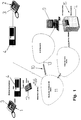
- Fig. 1 shows a schematic overview of the operation of the invention Method for cross-network electronic data transmission, wherein it is a telephone connection between a customer, the A-subscriber 1, and a B-subscriber 2. Both participants 1, 2 each have one Terminal or telephone 3 and a telecommunications system 4 for access to a digital network, which is the Euro-ISDN network.
- This network has two channels, namely the data channel (B channel) 5 and the Signaling channel (D channel) 6.
- dialing parameters With the choice of B-subscriber number 7 by A-subscriber 1, dialing parameters become 8 together with a customer identification relating to A subscriber 1 (Setup message) via the signaling channel 6 to a node computer 9 headed.
- the node computer 9 builds the via a predeterminable network gateway 10 Connection to B-subscriber 2 is open.
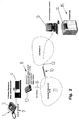
- Figures 1 to 3 together show that the transmission of the setup message or the selection parameter 8 via a between the telecommunications system 4 of the A participant 1 and the public network 11 switched intelligent module 12 he follows. Based on the selected B-participant number 7 and taking into account Predeterminable parameters, the module 12 decides whether the connection is conventional Way over the available public network 11 or across networks is preferably established via a private gateway 10. After A decision for a cross-network connection can be made according to 3 in accordance with the call-back method.
- the module 12 then transmits the setup message 8 to a network node 13 Network gateway to packet-switching networks.
- the connection request of the A subscriber 1 is recorded by a computer 14 in the private network.
- Computer 14 becomes the connection request of the A subscriber 1 according to predeterminable
- the criteria are checked and the checked connection request is sent to a switching node 15 transferred.
- a data connection or Voice connection established to the requesting module 12 and to the B-subscriber 2.
- the two connections are in a switching matrix of the switching node 15 interconnected, the connection between the switching node 15 and the module 12 to one defined in the module 12 in the telecommunication system 4 of the A subscriber 1 unused extension and with the held Connection with A-subscriber 1 interconnected in module 12 becomes.
- To avoid connection conflicts one is created by module 12 looped data channel in module 12 assigned an extension number.
Landscapes
- Engineering & Computer Science (AREA)
- Signal Processing (AREA)
- Computer Networks & Wireless Communication (AREA)
- Telephonic Communication Services (AREA)
Applications Claiming Priority (2)
| Application Number | Priority Date | Filing Date | Title |
|---|---|---|---|
| DE1997119820 DE19719820C2 (de) | 1997-05-13 | 1997-05-13 | Verfahren zur netzübergreifenden elektronischen Datenübertragung |
| DE19719820 | 1997-05-13 |
Publications (1)
| Publication Number | Publication Date |
|---|---|
| EP0883321A2 true EP0883321A2 (fr) | 1998-12-09 |
Family
ID=7829214
Family Applications (1)
| Application Number | Title | Priority Date | Filing Date |
|---|---|---|---|
| EP19980108474 Withdrawn EP0883321A2 (fr) | 1997-05-13 | 1998-05-09 | Procédé pour le transport de données électroniques trans-network |
Country Status (2)
| Country | Link |
|---|---|
| EP (1) | EP0883321A2 (fr) |
| DE (1) | DE19719820C2 (fr) |
Family Cites Families (4)
| Publication number | Priority date | Publication date | Assignee | Title |
|---|---|---|---|---|
| US5506894A (en) * | 1991-06-03 | 1996-04-09 | At&T Corp. | System for processing calling party information for international communications services |
| DE4210407C1 (de) * | 1992-03-30 | 1993-09-30 | Siemens Ag | Verfahren zur Rufnummernsignalisierung in einem Fernmeldenetz |
| DE4329172A1 (de) * | 1993-08-30 | 1995-03-02 | Sel Alcatel Ag | Verfahren zur Anruflenkung für ein privates, virtuelles Netz, sowie Dienstrechner und Vermittlungsstelle dafür |
| US5570417A (en) * | 1995-03-28 | 1996-10-29 | Lucent Technologies Inc. | System for automatically providing customer access to alternative telephony service providers |
-
1997
- 1997-05-13 DE DE1997119820 patent/DE19719820C2/de not_active Expired - Fee Related
-
1998
- 1998-05-09 EP EP19980108474 patent/EP0883321A2/fr not_active Withdrawn
Also Published As
| Publication number | Publication date |
|---|---|
| DE19719820A1 (de) | 1998-11-19 |
| DE19719820C2 (de) | 2000-11-30 |
Similar Documents
| Publication | Publication Date | Title |
|---|---|---|
| EP0731618B1 (fr) | Procédé pour commander un réseau d'accès et central avec un tel réseau d'accès | |
| DE69905807T2 (de) | Optimale Lenkung von Anrufen über das öffentliche Telefonnetz und über Internet | |
| EP1068744B1 (fr) | Procede permettant d'etablir une communication entre un reseau de radiophonie mobile et un numero destinataire d'un reseau de communication prive | |
| DE69729159T2 (de) | Kompatibilität zwischen einem Fernsprechdienst mit Anbieter und einem ISDN Anruferidentifikationsdienst | |
| EP1269766B1 (fr) | Systeme de telecommunication dote d'un reseau de communication a commutation de paquets et procede permettant de faire fonctionner un tel systeme | |
| DE19621718A1 (de) | Verfahren zum Aufbau einer Verbindung sowie Vermittlungsstelle, Dienstrechner und Kommunikationsnetz | |
| EP0886449A2 (fr) | Appels gratuits | |
| EP0817509B1 (fr) | Procédé pour la construction des connexions de communication automatique, et unité de réglement de service | |
| DE19720274C2 (de) | Kommunikationssystem, Verfahren und Verarbeitungseinrichtung zum Vermitteln von Anrufen über ein zwischen zwei lokalen Netzen angeordnetes Übertragungsnetz | |
| EP1051866B1 (fr) | Procede de commutation economique de communications telephoniques dans des reseaux publics de telecommunication | |
| DE19943742B4 (de) | Verfahren zum Zurverfügungstellen zusätzlicher Dienste an einem Teilnehmeranschluß | |
| DE19719820C2 (de) | Verfahren zur netzübergreifenden elektronischen Datenübertragung | |
| DE10021736A1 (de) | Rufnummernumwertung für private Rufnummernpläne | |
| EP1033847B1 (fr) | Procédé pour le choix d'un réseau de télécommunication pour la transmission d'information entre deux terminaux ainsi qu'un routeur pour la mise en oeuvre | |
| EP0817510B1 (fr) | Procédé pour la construction d'une connexion et unité de communication, avec calculateur et réseau de communication | |
| EP1033889B1 (fr) | Transmission du numéro d'appelant pour appels issus d'un réseau de télécommunication privé vers un réseau public | |
| DE19922266C2 (de) | Verfahren und Kommunikationssystem zum Management der Auslastung von Interconnectanschlüssen | |
| DE19623689C2 (de) | Verfahren zur Reduzierung der Anzahl von zum Aufbau einer Verbindung benötigten Rufnummerninformationen | |
| DE19964189B4 (de) | Routing-Einrichtung und TK-Einrichtung zum Management der Auslastung von Interconnectanschlüssen | |
| DE10133828B4 (de) | Verfahren zur Herstellung einer Telekommunikationsverbindung und Telekommunikationssystem | |
| EP1578096B1 (fr) | Procédé pour l'opération et la configuration d'un système de télécommunications avec logiciel de répartition pour l'identification de clients, et système de télécommunications | |
| DE19935759A1 (de) | Verfahren und Kommunikationssystem zum Management der Auslastung von Interconnectanschlüssen | |
| DE10011212A1 (de) | Verfahren zur Bereitstellung von für eine in einem Kommunikationsnetz festgelegten Teilnehmergruppe spezifischen Leistungs- und/oder Dienstmerkmalen | |
| DE10361778A1 (de) | Ortsnetz und Verfahren zum Herstellen einer Verbindung innerhalb eines Ortsnetzes | |
| DE10031424A1 (de) | Verfahren zum Übertragen von Nutzdaten eines ersten Netzes zumindest abschnittsweise in einem zweiten Netz |
Legal Events
| Date | Code | Title | Description |
|---|---|---|---|
| PUAI | Public reference made under article 153(3) epc to a published international application that has entered the european phase |
Free format text: ORIGINAL CODE: 0009012 |
|
| AK | Designated contracting states |
Kind code of ref document: A2 Designated state(s): AT BE CH CY DE DK ES FI FR GB GR IE IT LI LU MC NL PT SE |
|
| AX | Request for extension of the european patent |
Free format text: AL;LT;LV;MK;RO;SI |
|
| PUAJ | Public notification under rule 129 epc |
Free format text: ORIGINAL CODE: 0009425 |
|
| PUAJ | Public notification under rule 129 epc |
Free format text: ORIGINAL CODE: 0009425 |
|
| STAA | Information on the status of an ep patent application or granted ep patent |
Free format text: STATUS: THE APPLICATION IS DEEMED TO BE WITHDRAWN |
|
| 18D | Application deemed to be withdrawn |
Effective date: 20011204 |