EP0883940B1 - Procedes et systemes cdma a porteuses multiples et soustractives - Google Patents
Procedes et systemes cdma a porteuses multiples et soustractives Download PDFInfo
- Publication number
- EP0883940B1 EP0883940B1 EP97907723A EP97907723A EP0883940B1 EP 0883940 B1 EP0883940 B1 EP 0883940B1 EP 97907723 A EP97907723 A EP 97907723A EP 97907723 A EP97907723 A EP 97907723A EP 0883940 B1 EP0883940 B1 EP 0883940B1
- Authority
- EP
- European Patent Office
- Prior art keywords
- stations
- frame
- subchannel
- assigned
- station
- Prior art date
- Legal status (The legal status is an assumption and is not a legal conclusion. Google has not performed a legal analysis and makes no representation as to the accuracy of the status listed.)
- Expired - Lifetime
Links
Images


Classifications
-
- H—ELECTRICITY
- H04—ELECTRIC COMMUNICATION TECHNIQUE
- H04J—MULTIPLEX COMMUNICATION
- H04J13/00—Code division multiplex systems
-
- H—ELECTRICITY
- H04—ELECTRIC COMMUNICATION TECHNIQUE
- H04L—TRANSMISSION OF DIGITAL INFORMATION, e.g. TELEGRAPHIC COMMUNICATION
- H04L5/00—Arrangements affording multiple use of the transmission path
- H04L5/0001—Arrangements for dividing the transmission path
- H04L5/0014—Three-dimensional division
- H04L5/0016—Time-frequency-code
- H04L5/0021—Time-frequency-code in which codes are applied as a frequency-domain sequences, e.g. MC-CDMA
-
- H—ELECTRICITY
- H04—ELECTRIC COMMUNICATION TECHNIQUE
- H04B—TRANSMISSION
- H04B1/00—Details of transmission systems, not covered by a single one of groups H04B3/00 - H04B13/00; Details of transmission systems not characterised by the medium used for transmission
- H04B1/69—Spread spectrum techniques
- H04B1/707—Spread spectrum techniques using direct sequence modulation
- H04B1/7097—Interference-related aspects
- H04B1/7103—Interference-related aspects the interference being multiple access interference
- H04B1/7107—Subtractive interference cancellation
-
- H—ELECTRICITY
- H04—ELECTRIC COMMUNICATION TECHNIQUE
- H04B—TRANSMISSION
- H04B7/00—Radio transmission systems, i.e. using radiation field
- H04B7/24—Radio transmission systems, i.e. using radiation field for communication between two or more posts
- H04B7/26—Radio transmission systems, i.e. using radiation field for communication between two or more posts at least one of which is mobile
- H04B7/2618—Radio transmission systems, i.e. using radiation field for communication between two or more posts at least one of which is mobile using hybrid code-time division multiple access [CDMA-TDMA]
-
- H—ELECTRICITY
- H04—ELECTRIC COMMUNICATION TECHNIQUE
- H04J—MULTIPLEX COMMUNICATION
- H04J4/00—Combined time-division and frequency-division multiplex systems
-
- H—ELECTRICITY
- H04—ELECTRIC COMMUNICATION TECHNIQUE
- H04L—TRANSMISSION OF DIGITAL INFORMATION, e.g. TELEGRAPHIC COMMUNICATION
- H04L27/00—Modulated-carrier systems
- H04L27/26—Systems using multi-frequency codes
- H04L27/2601—Multicarrier modulation systems
-
- H—ELECTRICITY
- H04—ELECTRIC COMMUNICATION TECHNIQUE
- H04L—TRANSMISSION OF DIGITAL INFORMATION, e.g. TELEGRAPHIC COMMUNICATION
- H04L5/00—Arrangements affording multiple use of the transmission path
- H04L5/003—Arrangements for allocating sub-channels of the transmission path
- H04L5/0058—Allocation criteria
- H04L5/0073—Allocation arrangements that take into account other cell interferences
-
- H—ELECTRICITY
- H04—ELECTRIC COMMUNICATION TECHNIQUE
- H04L—TRANSMISSION OF DIGITAL INFORMATION, e.g. TELEGRAPHIC COMMUNICATION
- H04L5/00—Arrangements affording multiple use of the transmission path
- H04L5/02—Channels characterised by the type of signal
- H04L5/023—Multiplexing of multicarrier modulation signals, e.g. multi-user orthogonal frequency division multiple access [OFDMA]
- H04L5/026—Multiplexing of multicarrier modulation signals, e.g. multi-user orthogonal frequency division multiple access [OFDMA] using code division
Definitions
- the present invention relates generally to the field of mobile radio-communications systems, such as cellular systems, that employ Code Division Multiple Access (CDMA) and use interference subtraction or cancellation to raise multi-user capacity.
- CDMA Code Division Multiple Access
- CDMA Code Division Multiple Access
- the U.S. wideband cellular standard EIA/TIA IS-95 describes a CDMA system having instantaneous bandwidths on the order of 1 MHz that can support several conversations in the same bandwidth and location.
- the IS-95 standard further describes a CDMA system which employs continuous transmission and reception and requires an expensive diplexing filter to couple the transmitter and receiver to the same antenna.
- GSM Global System for Mobile communications
- GSM defines a Time Division Multiple Access (TDMA) system whereby time-slotted transmission is employed to accommodate eight users in the same 200KHz channel, and each uses a transmit timeslot that is offset from the receive timeslot to avoid needing a diplexing filter.
- TDMA Time Division Multiple Access
- T/R transmit/receive
- U.S. Patent No. 5,151,919 entitled “Subtractive CDMA Demodulation” (to Paul W. Dent, issued September 29, 1992), describes, among other things, a technique for overcoming the self-interference limit to CDMA capacity by demodulating overlapping CDMA signals iteratively in order of decreasing measured signal strength such that stronger signals are demodulated and subtracted away from the received composite signal before attempting demodulation of weaker signals.
- U.S. Patent No. 5,218,619 entitled “Re-Orthogonalization” (to Paul W. Dent, issued June 18, 1993), is a continuation-in-part of U.S. Patent 5,151,919 and discloses for example, further subtractions at a later stage in the process of signals already identified and subtracted a first time on an earlier occasion in order to reduce residual subtraction errors.
- the exemplary implementations described in the foregoing patents use digital signal processing for descrambling a signal by use of its known scrambling code, transforming the signal to the spectral domain, and then notching out the spectral component associated with that signal. After notching, the remaining, non-zero components represent the transform of the other signals which have been descrambled with the first signal's code. The remainder is then transformed back to the waveform domain and the descrambling code reapplied to restore the signals to their original domain with one of them now subtracted.
- U.S. Patent Application Serial No. 08/608,811 entitled “Subtractive CDMA/TDMA” discloses an interference-subtractive CDMA system wherein a narrowband CDMA signal is compressed in time into a timeslot increasing its bandwidth for transmission. Upon reception, the signal received in the timeslot is captured in buffer memory. The captured signal may then be played out of the memory at the original narrowband rate such that narrowband interference subtractive CDMA algorithms of acceptable complexity can be used to process the captured signals.
- Joint demodulators for simultaneously demodulating or decoding several overlapping CDMA signals are also known. These are sometimes described as multi-user detectors. See for example: "Optimum Multiuser Asymptotic Efficiency” (Sergio Verdhu, Trans IEEE on communications, Vol. COM-34 no. 9, Sept 1986). Joint demodulators tend to increase in complexity with at least the square of the number of users, and when using the optimum Maximum Likelihood Sequence Estimation algorithm, the increase is exponential. Thus, joint demodulation does not now provide an acceptable solution to the self-interference capacity limit of CDMA systems.
- EP 0210698 discloses a cellular digital radio transmission system wherein messages are transmitted from a base station to a plurality of mobile stations assigned to it by time-division multiplexing of time slots in respective TDM time frames, each mobile station being assigned by the base station to a respective time slot constituting a channel for receiving and transmitting information.
- the base station divides each TDM time frame into time slots of different durations, whereby a mobile station can be assigned by the base station to a time slot of a duration corresponding to the bandwidth required by that mobile station.
- EP 0680168 discloses a system and method for optimising usage of a communications transmission medium, the transmission medium may be sliced into time and frequency domains so as to create time-frequency slices for assignment to users having various access rates and user-applications requirements.
- the system and method is also applicable to code-division multiple access techniques by slicing the available code space along time-code domains, frequency-code domains or, in three dimensions, along time-frequency-code domains. Users may be efficiently scheduled based on code space requirements so as to optimize use of the communication medium.
- WO 92/06546 discloses a communications node that is capable of dynamically selecting frequency and time slot assignments for communications with remote communication devices having different communication protocols including different available frequencies and time slots in a TDMA system.
- a frequency agile transmitter and receiver combined with an adaptable time slot selector enables communications with remote devices utilising different protocols.
- each of the plurality of second stations is allocated a frequency band containing a first number of subchannels, at least one timeslot in a repeating time-division multiple access frame period, and an access code.
- Each of the second stations are assigned a frame in the repeating frame structure of each subchannel for transmitting overhead information from the first station, the assigned frame for one of the second stations being different to the assigned frame for another of the second stations. The overhead information is then transmitted by the first station.
- An exemplary first station is provided for communicating information to a plurality of second stations, the first station being adapted for use in a communications system in which:
- a wideband CDMA system in accordance with the present invention, is constructed by dividing an allocated channel bandwidth (e.g., 800KHz) into a number N of subchannels (e.g., eight subchannels each having a 100KHz bandwidth) and a number M (e.g., eight) of timeslots.
- N e.g., 800KHz
- M e.g., eight
- the total channel bandwidth may be shared by L users by allocating a fraction of the timeslots and a fraction of the subchannels to carry traffic for each user.
- L/M users may be allocated the same timeslot on all N subchannels.
- the allocation of timeslots and subchannels may be made in a variety of ways, this description focuses on the exemplary case where all subchannels are used by each user in a single timeslot, i.e., each user has the same data rate. This choice is made for brevity and simplicity of the description without restricting the scope of the invention.
- the present invention also includes all cases of providing variable data rates when employed with interference reduction, interference-subtractive or joint demodulation algorithms to enhance capacity.
- Figure 1 shows an exemplary signal comprised of eight 100KHz frequency channels within an 800KHz total receive bandwidth and divided into eight timeslots of a repeating TDMA frame period.
- a first user (USER 1) is allocated slot 1 on all eight carriers to receive signals from a base station.
- a second user (USER 2) is allocated slot 2 on all eight carriers.
- Other users could be allocated, for example, two slots on all eight carriers to receive twice the data rate or one slot on half the carriers to receive half the data rate.
- USER 1 processes eight 100KHz wide signals received for 1/8th of the time.
- the amount of processing needed by USER 1 is therefore equivalent to that needed for processing one 100KHz carrier continuously. This is 512 times less than processing one 800KHz carrier continuously and 64 times less than processing one 800KHz carrier for 1/8th of the time, given a cubic relationship between processing power and bandwidth.
- Each slot can contain a number of overlapping CDMA signals.
- USER 1 can be considered to be “USER GROUP 1" while USER 2 denotes “USER GROUP 2".
- Each group of overlapping users may contain, for example, up to 10 individual users of which five on average have signals transmitted to them while the other five traffic signals are temporarily silent due to the other party being the active speaker.
- One of the active signals in each subchannel and slot may be a permanently-transmitted Broadcast Control Channel (BCCH) which is used for alerting idle mobiles to a call from the network and for broadcasting various overhead information, e.g., network and station ID information and information on surrounding base stations.
- BCCH Broadcast Control Channel
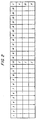
- An exemplary superframe structure composed of 4x26 TDMA frames is shown in Figure 2.
- This exemplary superframe structure allocates TDMA frame numbers 1 to 12 to traffic.
- Frame 13 is not used for transmitting traffic in this exemplary format and is an IDLE frame that the receiver can employ for other purposes such as scanning other base station frequencies to determine if it is desirable to listen to a different control channel.
- the next 12 frames are also used for traffic and the 26th frame is used to transmit one slot of Slow Associated Control Channel information (SACCH).
- SACCH Slow Associated Control Channel information
- the SACCH is used to convey less urgent overhead information which is repeated relatively less frequently than other overhead information, e.g., that broadcast on the BCCH.
- the above format applies to every subchannel in this exemplary embodiment.
- the format may be synchronized or staggered between the subchannels.
- the exemplary superframe repetition period of 104 TDMA frames spans 480mS. One complete SACCH message is therefore transmitted every 480mS.
- the above slot parameters and superframe formats are derived from the GSM digital cellular TDMA system with a view to simplifying the construction of mobile phones that can function in both GSM systems and systems operating in accordance with the present invention.
- the formats described above, and below, are merely exemplary and are not intended to limit the scope of the invention. They are instead provided to further describe exemplary format organizations in accordance with systems incorporating the present invention.
- the raw information rate is thus 1.2KB/S per subchannel, or 9.6KB/S when all eight subchannels are used.
- the raw information rate of 9.6KB/S or 192, 6-bit symbols per 120mS may be error protected using, for instance, Reed-Solomon codes to correct symbol errors or erasures.
- the 192 symbols can be divided into four groups for coding in the following ways:
- the 320 decoded bits per 40mS give a net decoded information rate of 8KB/S, and may be used, for example, to transmit digitally coded speech according to the ITU 8KB/S speech coder standard.
- the ITU coder transforms standard 64KB/S u-law companded PCM speech or linear PCM speech at eight kilosamples per second into the reduced data rate of 8KB/s.
- the coder operates on 10mS blocks of speech samples, taking in 80 speech samples at a time and compressing them to 80-bit blocks. Four successive blocks of 80 bits make up the 320 bits transmitted every time a 63,53 RS code is transmitted with two bits left over being transmitted by the rate 1/3rd code.
- the above coding is merely exemplary of methods for source and error-control coding speech for transmission according to the present invention, and is not meant to restrict or limit the types of systems in which the present invention may be applied.
- transformations may be performed using Walsh-Hadamard transforms.
- Transmitting an ITU coded block of 80 bits using all eight subcarriers and one slot in two consecutive frames introduces little transmission delay.
- This correlation is reduced by spacing the 63 RS coded symbols of one coded block (in the above example) over eight or more frames.
- 64, 6-bit symbols are decoded from the eight subcarriers.
- 63 are applied to the RS decoder while the remaining symbol is applied to the rate 1/3rd decoder.
- the rate 1/3rd decoder can, for example be configured as six, rate 1/3rd bitwise convolutional decoders operating on each bit of the symbol. The same decoder can be time-shared six times because of the very low information rate of individual bits.
- the SACCH and traffic symbols can be interleaved over 25 frames, excluding the IDLE frame.
- a distinct IDLE frame, in which the receiver receives neither traffic nor SACCH, is desirable so that the receiver has the freedom to perform various functions, e.g., to change which 800KHz block of eight 100KHz channels is received during that frame. It is also desirable, although not necessary, to restrict SACCH transmissions to the same frame (e.g., frame 26 in the repeating structure of Figure 2) so that, during periods of voice inactivity, the other 25 traffic frames need not be transmitted, without disturbing transmission and reception of the SACCH frame. If SACCHs are transmitted even when there is temporarily no traffic for a mobile, the number of SACCHs transmitted can be double the number of traffic frames transmitted in every slot. Thus it can be desirable to stagger the frame used for SACCH from one overlapping signal to another so that all SACCHs are not transmitted in the same frame.
- IDLE frames can be staggered so that one overlapping signal is silent in successive frames, rather than all being silent in the same frame, e.g., frame 13 in the example of Figure 2.
- the staggering of IDLE and SACCH frames evens out the co-channel interference in different frames.
- the staggering pattern can be coordinated with co-channel transmissions in neighboring cells or sectors, particularly the strongest of them, in order to extend the interference averaging over more than one cell or sector in the same site.
- each subcarrier would then likely contain one overlapping SACCH transmission for a different mobile, and this is perhaps not so convenient for the mobile receiver to handle as when the SACCH in a slot belongs to the same mobile on all eight carriers.
- SACCH staggering can be varied to accommodate the needs of a particular system.
- a mobile terminal containing an exemplary apparatus according to the present invention is shown in Figure 3.
- An antenna 10 is time-shared between transmit and receive functions by T/R switch 11 which is operated at appropriate times by a control and timing unit 25 alternatively to connect the receiver 13 or the transmitter 12 to the antenna 10.
- the receiver includes, for example, downconversion functionality provided by any suitable circuitry which converts a received signal to the complex baseband, whereupon the signal is digitized to form a stream of complex numbers for processing.
- the downconversion can be performed by a quadrature downconvertor including receive band select filter 14, low-noise RF amplifier 15, quadrature mixers 16a and 16b and quadrature local oscillator 17 to produce so-called I and Q signals which are low-pass filtered by filters 18a and 18b.
- the filters 18a,18b pass signals having a frequency range of 0 to 400KHz.
- the DC, or zero frequency, component from the mixers 16a and 16b corresponds to half way between two subchannels, and can be discarded. In this way the DC offset problem associated with direct conversion receivers can be circumvented.
- the I and Q signals from the mixers 16a and 16b are digitized using a dual-channel or complex A/D convertor 19.
- a dual-channel or complex A/D convertor 19 Many other ways of producing a stream of complex numbers representative of a composite received signal are known and may be used as an alternative to that described above.
- the logpolar technique disclosed in U.S. Patent No. 5,048,059 to Dent may be used.
- the digitized I,Q streams representative of the sum of the subchannels are processed by a frequency decimation processor 20 to separate the individual subchannels, e.g., eight in this example.
- the I,Q streams may first be captured in memory (not shown) over the receive timeslot so that subsequent processing by processors 20 and 21, respectively, need not operate in real time.
- the frequency decimation processor 20 operates in real time
- the output signals of individual subchannels may be memorized instead so that the decoding processor 21 does not have to operate in real time.
- the decoding processor 21 operates on the subchannel signals from the decimation processor 20 to decode symbols from designated subchannels.
- the decoding processor 21 may for each channel, implement, for example, an interference-subtractive, iterative CDMA decoding operation as described in U.S. Patent No. 5,151,919 and U.S. Patent No. 5,218,619.
- the first (i.e., strongest) signal to be decoded and subtracted by the decoding processor 21 may be a pilot signal modulated with a fixed access code.
- the first and strongest signal to be decoded may be a broadcast control channel (BCCH) which carries various overhead messages, e.g., paging or call alert messages directed to individual receivers.
- BCCH broadcast control channel
- the'pilot signal can be decoded first followed by the BCCH.
- the decoding processor 21 may implement a joint decoding technique in which several overlapping signals are decoded simultaneously.
- Known techniques for joint demodulation include, for example, decorrelation techniques that perform matrix multiply operations to remove the effect of each signal mutually upon the others.
- Another technique is a partial decorrelation algorithm in which the effect of weaker signals on the strongest is reduced by decorrelation, the strongest is quantized to a decoded symbol, the decoded symbol is subtracted from the remainder leaving the second strongest signal, and then the process iterates to decode the second strongest signal and so forth.
- Yet another technique which 'may be used is the Viterbi sequential maximum likelihood sequence estimation algorithm in which one symbol for each overlapping signal is hypothesized and all possible hypotheses are tested. The hypothesis which best predicts the received signal in a subchannel is then retained to yield a jointly decoded symbol for each of the overlapping signals.
- Output symbols from the decoding processor 21 that are intended for the mobile terminal (of Figure 3) in question may be further processed by an error correction coder 22 which may, for example, include Reed-Solomon decoding as discussed above.
- Reed-Solomon decoding is particularly appropriate when the symbols decoded by the first stage processor 21 are multi-bit symbols.
- a Reed-Solomon decoder can bridge a certain number of erroneous symbols that the decoding processor 21 is prone to output due to noise or co-channel interference, but can bridge twice as many "erased" symbols when decoding processor 21 provides an erasure or symbol reliability indication along with each symbol.
- Error corrected symbols from the coder 22 comprise either digitized voice, in which case they are fed to a speech coder/decoder 23, or signalling messages such as those found on the slow associated control channel (SACCH), which are fed to a control processor 25.
- the control processor also coordinates user inputs and outputs via keyboard and display 30, LEDs 32 and ringer 34.
- the speech coder/decoder 23 also codes speech for transmission.
- Coded speech can be error correction coded and converted to the transmit signal format in transmit signal generator unit 24, and then modulated and converted to the final frequency for transmission in transmitter 12.
- the control processor 25 controls phases of transmit and receive including switching the T/R switch 11 to connect the antenna 10 to the transmitter 12 and enabling the transmitter 12 during transmit slots.
- the waveform transmitted by the mobile unit according to this invention is not necessarily the same as that received.
- the multichannel CDMA/TDMA downlink method can be associated with an uplink access method having a TDMA element, so as to preserve the mobile unit's characteristic of not needing to transmit and receive at the same time, allowing the T/R switch 11 to be used to share the antenna 10.
- the transmitter could, for example, be implemented as an 800KHz CDMA/TDMA system having eight timeslots without using multicarrier decimation, a 400KHz subtractive CDMA system in which transmission occurs for four out of the eight downlink slots, or a 200KHz subtractive CDMA system in which transmission occurs for all of the seven downlink slots for which the receiver is not receiving.
- the uplink and downlink capacity should be the same, but it is not as important to minimize processing effort in the base station where power, size and cost are not as much at a premium as in a handportable, battery-operated mobile phone.
- Systems in accordance with the present invention relate principally to mobile communications in the base-to-mobile direction (downlink), but may also be used in the mobile-to-base direction (uplink).
- transmitter efficiency trade-offs, as well as factors mentioned in the incorporated patents and patent applications may suggest constant envelope modulation during mobile transmit bursts.
- a method incorporating the invention used for downlink is not limited to being associated with a particular uplink method and the invention when used as in the uplink is not limited to use with a particular downlink method.
Landscapes
- Engineering & Computer Science (AREA)
- Signal Processing (AREA)
- Computer Networks & Wireless Communication (AREA)
- Mobile Radio Communication Systems (AREA)
- Time-Division Multiplex Systems (AREA)
- Digital Transmission Methods That Use Modulated Carrier Waves (AREA)
Claims (6)
- Procédé de communication d'informations entre une première station et une pluralité de secondes stations, ledit procédé comprenant :caractérisé en ce que ladite trame affectée pour l'une de ladite pluralité de secondes stations est différente de ladite trame affectée pour une autre de ladite pluralité de secondes stations.la division d'une largeur de bande de canal allouée en une pluralité de canaux secondaires, chaque canal secondaire ayant une pluralité de créneaux temporels ;le groupage de ladite pluralité de créneaux temporels dans chaque canal secondaire en une structure de trame se répétant ;l'allocation à chacune de ladite pluralité de secondes stations d'au moins l'un de ladite pluralité de créneaux temporels sur au moins l'un de ladite pluralité de canaux secondaires et d'un code d'accès ;l'affectation, pour chacune de ladite pluralité de secondes stations, d'une trame dans ladite structure de trame se répétant de chaque canal secondaire pour une émission d'une information d'en-tête depuis ladite première station; etl'émission de ladite information d'en-tête dans lesdites trames affectées ;
- Procédé selon la revendication 1, dans lequel ladite information d'en-tête est une information de canal de commande associé lent (SACCH).
- Procédé selon la revendication 1, dans lequel lesdites trames affectées à chacune de ladite pluralité de secondes stations sont décalées à l'intérieur de ladite structure de trame se répétant.
- Procédé selon la revendication 1, dans lequel ladite trame affectée à l'une de ladite pluralité de secondes stations est différente pour chaque canal secondaire alloué à cette même station de ladite pluralités de secondes stations.
- Procédé selon la revendication 1, dans lequel ladite trame affectée à l'une de ladite pluralité de secondes stations est identique pour chaque canal secondaire alloué à cette même station de ladite pluralité de secondes stations.
- Première station pour communiquer une information à une pluralité de secondes stations, la première station étant conçue pour une utilisation dans un système de communications dans lequel :caractérisée en ce que ladite trame affectée pour l'une de ladite pluralité de secondes stations est différente de ladite trame affectée pour une autre de ladite pluralité de secondes stations.une largeur de bande de canal alloué est divisée en une pluralité de canaux secondaires, chaque canal secondaire ayant une pluralité de tranches temporelles ;ladite pluralité de tranches temporelles dans chaque canal secondaire est groupée en une structure de trame se répétant ;chacune de ladite pluralité de secondes stations est allouée, en au moins l'un de ladite pluralité de créneaux temporels, sur au moins l'un de ladite pluralité de canaux secondaires et d'un code d'accès ;la première station comportant :un moyen conçu pour affecter à chacune de ladite pluralité de secondes stations une trame dans ladite structure de trame se répétant de chaque canal secondaire pour une émission d'une information d'en-tête depuis ladite première station ; etun moyen destiné à émettre ladite information d'en-tête dans lesdites trames affectées ;
Applications Claiming Priority (3)
| Application Number | Priority Date | Filing Date | Title |
|---|---|---|---|
| US608809 | 1996-02-29 | ||
| US08/608,809 US5790549A (en) | 1996-02-29 | 1996-02-29 | Subtractive multicarrier CDMA access methods and systems |
| PCT/US1997/002661 WO1997032412A1 (fr) | 1996-02-29 | 1997-02-21 | Procedes et systemes cdma a porteuses multiples et soustractives |
Publications (2)
| Publication Number | Publication Date |
|---|---|
| EP0883940A1 EP0883940A1 (fr) | 1998-12-16 |
| EP0883940B1 true EP0883940B1 (fr) | 2005-04-27 |
Family
ID=24438102
Family Applications (1)
| Application Number | Title | Priority Date | Filing Date |
|---|---|---|---|
| EP97907723A Expired - Lifetime EP0883940B1 (fr) | 1996-02-29 | 1997-02-21 | Procedes et systemes cdma a porteuses multiples et soustractives |
Country Status (10)
| Country | Link |
|---|---|
| US (1) | US5790549A (fr) |
| EP (1) | EP0883940B1 (fr) |
| JP (1) | JP2000505630A (fr) |
| KR (1) | KR19990087404A (fr) |
| CN (1) | CN1217110A (fr) |
| AU (1) | AU735397B2 (fr) |
| BR (1) | BR9707801A (fr) |
| CA (1) | CA2247617C (fr) |
| DE (1) | DE69733128T2 (fr) |
| WO (1) | WO1997032412A1 (fr) |
Families Citing this family (47)
| Publication number | Priority date | Publication date | Assignee | Title |
|---|---|---|---|---|
| US6233272B1 (en) * | 1996-03-19 | 2001-05-15 | Yrp Mobile Telecommunications Key Technology Research Laboratories Co., Ltd. | Spread spectrum communication receiver |
| FI104142B1 (fi) * | 1996-10-25 | 1999-11-15 | Nokia Mobile Phones Ltd | Radioresurssien käytön ohjausmenetelmä |
| US6058397A (en) * | 1997-04-08 | 2000-05-02 | Mitsubishi Electric Information Technology Center America, Inc. | 3D virtual environment creation management and delivery system |
| US6097712A (en) * | 1997-06-20 | 2000-08-01 | Nortel Networks Limited | Multi-carrier CDMA communications systems |
| US6151332A (en) | 1997-06-20 | 2000-11-21 | Tantivy Communications, Inc. | Protocol conversion and bandwidth reduction technique providing multiple nB+D ISDN basic rate interface links over a wireless code division multiple access communication system |
| US6081536A (en) | 1997-06-20 | 2000-06-27 | Tantivy Communications, Inc. | Dynamic bandwidth allocation to transmit a wireless protocol across a code division multiple access (CDMA) radio link |
| US6542481B2 (en) | 1998-06-01 | 2003-04-01 | Tantivy Communications, Inc. | Dynamic bandwidth allocation for multiple access communication using session queues |
| US6286122B1 (en) * | 1997-07-03 | 2001-09-04 | Nokia Mobile Phones Limited | Method and apparatus for transmitting DTX—low state information from mobile station to base station |
| FR2767007B1 (fr) * | 1997-08-01 | 1999-11-05 | France Telecom | Procede d'acces multiple dans un reseau cellulaire de radiocommunication |
| US7936728B2 (en) | 1997-12-17 | 2011-05-03 | Tantivy Communications, Inc. | System and method for maintaining timing of synchronization messages over a reverse link of a CDMA wireless communication system |
| US7496072B2 (en) | 1997-12-17 | 2009-02-24 | Interdigital Technology Corporation | System and method for controlling signal strength over a reverse link of a CDMA wireless communication system |
| US9525923B2 (en) | 1997-12-17 | 2016-12-20 | Intel Corporation | Multi-detection of heartbeat to reduce error probability |
| US6222832B1 (en) * | 1998-06-01 | 2001-04-24 | Tantivy Communications, Inc. | Fast Acquisition of traffic channels for a highly variable data rate reverse link of a CDMA wireless communication system |
| US7394791B2 (en) | 1997-12-17 | 2008-07-01 | Interdigital Technology Corporation | Multi-detection of heartbeat to reduce error probability |
| US8175120B2 (en) | 2000-02-07 | 2012-05-08 | Ipr Licensing, Inc. | Minimal maintenance link to support synchronization |
| KR100407342B1 (ko) * | 1998-05-30 | 2003-11-28 | 삼성전자주식회사 | 부호분할다중접속 통신시스템의 통신장치 및 방법 |
| US7773566B2 (en) | 1998-06-01 | 2010-08-10 | Tantivy Communications, Inc. | System and method for maintaining timing of synchronization messages over a reverse link of a CDMA wireless communication system |
| US8134980B2 (en) | 1998-06-01 | 2012-03-13 | Ipr Licensing, Inc. | Transmittal of heartbeat signal at a lower level than heartbeat request |
| US7221664B2 (en) * | 1998-06-01 | 2007-05-22 | Interdigital Technology Corporation | Transmittal of heartbeat signal at a lower level than heartbeat request |
| US6498785B1 (en) * | 1998-10-02 | 2002-12-24 | Nokia Mobile Phones Ltd | Method and apparatus for power control on a common channel in a telecommunication system |
| EP1039662A1 (fr) | 1999-03-25 | 2000-09-27 | Alcatel | Perfectionnement apporté à un système de télécommunication avec accés multiple par code de repartition (AMCR) |
| US6965778B1 (en) | 1999-04-08 | 2005-11-15 | Ipr Licensing, Inc. | Maintenance of channel usage in a wireless communication system |
| US6526034B1 (en) | 1999-09-21 | 2003-02-25 | Tantivy Communications, Inc. | Dual mode subscriber unit for short range, high rate and long range, lower rate data communications |
| KR100585832B1 (ko) * | 1999-09-30 | 2006-06-01 | 에스케이 텔레콤주식회사 | 부호분할 다중접속 시스템의 채널 확장 장치 및 방법 |
| US6282231B1 (en) | 1999-12-14 | 2001-08-28 | Sirf Technology, Inc. | Strong signal cancellation to enhance processing of weak spread spectrum signal |
| AU2001225416A1 (en) * | 2000-01-20 | 2001-07-31 | Nortel Networks Limited | Adaptive frame structures for hybrid cdma/tdma system |
| US6963546B2 (en) * | 2000-03-15 | 2005-11-08 | Interdigital Technology Corp. | Multi-user detection using an adaptive combination of joint detection and successive interface cancellation |
| US6477502B1 (en) * | 2000-08-22 | 2002-11-05 | Qualcomm Incorporated | Method and apparatus for using non-symmetric speech coders to produce non-symmetric links in a wireless communication system |
| DE10043477B4 (de) * | 2000-09-04 | 2004-10-07 | Siemens Ag | Verfahren zur Verteilung von Signalisierungsdaten auf Übertragungskanälen in einem Mobilfunksystem |
| US6832080B1 (en) * | 2000-09-12 | 2004-12-14 | Ericsson, Inc. | Apparatus for and method of adapting a radio receiver using control functions |
| US8155096B1 (en) | 2000-12-01 | 2012-04-10 | Ipr Licensing Inc. | Antenna control system and method |
| US6771632B2 (en) * | 2000-12-19 | 2004-08-03 | Interdigital Technology Corporation | Sub-channels for the random access channel in time division duplex |
| US20020114310A1 (en) * | 2000-12-22 | 2002-08-22 | Molnar Karl J. | Methods, communication apparatus, and computer program products for detecting an information field in a signal by averaging symbol values across multiple time slot intervals |
| US20020122407A1 (en) * | 2000-12-22 | 2002-09-05 | Molnar Karl J. | Methods, communication apparatus, and computer program products for detecting an information field in a signal by averaging symbol values across multiple time slot intervals |
| US6954448B2 (en) | 2001-02-01 | 2005-10-11 | Ipr Licensing, Inc. | Alternate channel for carrying selected message types |
| US7551663B1 (en) | 2001-02-01 | 2009-06-23 | Ipr Licensing, Inc. | Use of correlation combination to achieve channel detection |
| US6853646B2 (en) | 2001-05-02 | 2005-02-08 | Ipr Licensing, Inc. | Fast switching of forward link in wireless system |
| CA2867406C (fr) | 2001-06-13 | 2016-08-02 | Apple Inc. | Transmission de signal de pulsation a un niveau inferieur a celui d'une demande de signal de pulsation |
| JP3700933B2 (ja) * | 2001-07-27 | 2005-09-28 | 松下電器産業株式会社 | 受信機および通信端末 |
| US8289933B2 (en) * | 2001-10-18 | 2012-10-16 | Alcatel Lucent | Hybrid transmission method for wireless communications |
| JP3640185B2 (ja) * | 2002-02-13 | 2005-04-20 | 日本電気株式会社 | マルチキャリア通信方式のサブキャリア間干渉低減方法及びそれを用いた受信機 |
| US8559406B2 (en) * | 2003-06-03 | 2013-10-15 | Qualcomm Incorporated | Method and apparatus for communications of data in a communication system |
| CN100359982C (zh) * | 2004-10-20 | 2008-01-02 | 中兴通讯股份有限公司 | 多载频小区系统中共享信道的配置及使用方法 |
| US7457588B2 (en) * | 2005-08-01 | 2008-11-25 | Motorola, Inc. | Channel quality indicator for time, frequency and spatial channel in terrestrial radio access network |
| CN100455068C (zh) * | 2005-09-28 | 2009-01-21 | 中兴通讯股份有限公司 | 一种通信系统中前向媒体流发送的方法 |
| KR101598246B1 (ko) * | 2008-08-12 | 2016-02-26 | 인터디지탈 패튼 홀딩스, 인크 | 직교 서브채널의 개념을 이용하여 geran에서 제어 채널 할당을 위한 방법 및 장치 |
| US8787873B1 (en) | 2011-11-04 | 2014-07-22 | Plusn Llc | System and method for communicating using bandwidth on demand |
Family Cites Families (12)
| Publication number | Priority date | Publication date | Assignee | Title |
|---|---|---|---|---|
| DE3527329A1 (de) * | 1985-07-31 | 1987-02-05 | Philips Patentverwaltung | Digitales funkuebertragungssystem mit variabler zeitschlitzdauer der zeitschlitze im zeitmultiplexrahmen |
| US5005171A (en) * | 1990-01-09 | 1991-04-02 | At&T Bell Laboratories | Telecommunication transmission format suited for network-independent timing environments |
| US5134615A (en) * | 1990-10-05 | 1992-07-28 | Motorola, Inc. | Frequency agile tdma communications system |
| US5218619A (en) * | 1990-12-17 | 1993-06-08 | Ericsson Ge Mobile Communications Holding, Inc. | CDMA subtractive demodulation |
| US5151919A (en) * | 1990-12-17 | 1992-09-29 | Ericsson-Ge Mobile Communications Holding Inc. | Cdma subtractive demodulation |
| SE470038B (sv) * | 1992-11-13 | 1993-10-25 | Televerket | Förfarande och anordning för dynamisk allokering av multipla bärvågskanaler för multipelaccess genom frekvensmultiplexering |
| JP3438918B2 (ja) * | 1992-11-27 | 2003-08-18 | コモンウェルス サイエンティフィック アンド インダストリアル リサーチ オーガニゼーション | ワイヤレスlan |
| US5412690A (en) * | 1993-03-08 | 1995-05-02 | Motorola, Inc. | Method and apparatus for receiving electromagnetic radiation within a frequency band |
| US5541963A (en) * | 1993-12-01 | 1996-07-30 | Hitachi, Ltd. | Diversity receiving apparatus |
| US6018528A (en) * | 1994-04-28 | 2000-01-25 | At&T Corp | System and method for optimizing spectral efficiency using time-frequency-code slicing |
| ZA95605B (en) * | 1994-04-28 | 1995-12-20 | Qualcomm Inc | Method and apparatus for automatic gain control and dc offset cancellation in quadrature receiver |
| US5642356A (en) * | 1995-02-24 | 1997-06-24 | Hughes Electronics | Optimal paging of one or two cellular mobile stations using a hard page slot |
-
1996
- 1996-02-29 US US08/608,809 patent/US5790549A/en not_active Expired - Lifetime
-
1997
- 1997-02-21 CA CA002247617A patent/CA2247617C/fr not_active Expired - Fee Related
- 1997-02-21 JP JP9531006A patent/JP2000505630A/ja active Pending
- 1997-02-21 KR KR1019980706820A patent/KR19990087404A/ko not_active Ceased
- 1997-02-21 BR BR9707801A patent/BR9707801A/pt unknown
- 1997-02-21 WO PCT/US1997/002661 patent/WO1997032412A1/fr not_active Ceased
- 1997-02-21 DE DE69733128T patent/DE69733128T2/de not_active Expired - Lifetime
- 1997-02-21 CN CN97194193A patent/CN1217110A/zh active Pending
- 1997-02-21 EP EP97907723A patent/EP0883940B1/fr not_active Expired - Lifetime
- 1997-02-21 AU AU19649/97A patent/AU735397B2/en not_active Ceased
Also Published As
| Publication number | Publication date |
|---|---|
| BR9707801A (pt) | 1999-07-27 |
| EP0883940A1 (fr) | 1998-12-16 |
| KR19990087404A (ko) | 1999-12-27 |
| DE69733128T2 (de) | 2005-10-06 |
| CA2247617A1 (fr) | 1997-09-04 |
| WO1997032412A1 (fr) | 1997-09-04 |
| CN1217110A (zh) | 1999-05-19 |
| US5790549A (en) | 1998-08-04 |
| CA2247617C (fr) | 2006-11-21 |
| AU1964997A (en) | 1997-09-16 |
| JP2000505630A (ja) | 2000-05-09 |
| AU735397B2 (en) | 2001-07-05 |
| DE69733128D1 (de) | 2005-06-02 |
Similar Documents
| Publication | Publication Date | Title |
|---|---|---|
| US5790549A (en) | Subtractive multicarrier CDMA access methods and systems | |
| FI110733B (fi) | Epäjatkuva CDMA-vastaanotto | |
| EP2106033B1 (fr) | Procédé et appareil de fonctionnement d'un système de communication à plusieurs canaux | |
| EP0507384B1 (fr) | Système de transmission TDMA ayant des intervals temporels de durées différentes | |
| JP3703002B2 (ja) | スペクトラム拡散多重接続無線システムの運用方法及び装置 | |
| US7760699B1 (en) | System and method for efficient transmission of electronic information | |
| US7421279B2 (en) | Method, system and apparatus for improving reception in multiple access communication systems | |
| KR20000006571A (ko) | 통신신호에파이롯심볼을삽입하는방법 | |
| IL110373A (en) | System and method for orthogonal spectrum sequence generation in variable data rate systems | |
| CA2299568A1 (fr) | Systeme d'acces multiple a spectre etale, a multiplexage par repartition orthogonale de la frequence et a antenne directionnelle | |
| WO2008079496A1 (fr) | Procédé et appareil d'émission de supertrame dans un réseau de communication | |
| US7031397B1 (en) | Communication system with reduced power variation and method therefor | |
| GB2330729A (en) | Communications System Using Different Transmission Schemes for Uplink and Downlink | |
| JP4509872B2 (ja) | 基地局、移動局及び方法 | |
| CN1130044C (zh) | 对多个用户的数据进行数字无线传输的方法 | |
| MXPA98006801A (en) | Methods and systems of access of cdma of multiple carrier sustract | |
| HK1135245B (en) | Method and apparatus for operating a multichannel communication system | |
| HK1154716B (en) | High-data-rate supplemental channel for cdma telecommunications systems | |
| HK1108980B (en) | Transmission of a plurality of channels for cdma telecommunications system | |
| HK1013378B (en) | Tdma transmission system with time slots of different durations |
Legal Events
| Date | Code | Title | Description |
|---|---|---|---|
| PUAI | Public reference made under article 153(3) epc to a published international application that has entered the european phase |
Free format text: ORIGINAL CODE: 0009012 |
|
| 17P | Request for examination filed |
Effective date: 19980925 |
|
| AK | Designated contracting states |
Kind code of ref document: A1 Designated state(s): DE FI FR GB IT NL SE |
|
| RIN1 | Information on inventor provided before grant (corrected) |
Inventor name: DENT, PAUL, W. |
|
| 17Q | First examination report despatched |
Effective date: 20030228 |
|
| RAP1 | Party data changed (applicant data changed or rights of an application transferred) |
Owner name: ERICSSON INC. |
|
| GRAP | Despatch of communication of intention to grant a patent |
Free format text: ORIGINAL CODE: EPIDOSNIGR1 |
|
| RIC1 | Information provided on ipc code assigned before grant |
Ipc: 7H 04L 5/02 B Ipc: 7H 04B 1/707 B Ipc: 7H 04B 7/26 B Ipc: 7H 04J 13/02 B Ipc: 7H 04J 4/00 A |
|
| GRAS | Grant fee paid |
Free format text: ORIGINAL CODE: EPIDOSNIGR3 |
|
| GRAA | (expected) grant |
Free format text: ORIGINAL CODE: 0009210 |
|
| AK | Designated contracting states |
Kind code of ref document: B1 Designated state(s): DE FI FR GB IT NL SE |
|
| PG25 | Lapsed in a contracting state [announced via postgrant information from national office to epo] |
Ref country code: NL Free format text: LAPSE BECAUSE OF FAILURE TO SUBMIT A TRANSLATION OF THE DESCRIPTION OR TO PAY THE FEE WITHIN THE PRESCRIBED TIME-LIMIT Effective date: 20050427 Ref country code: IT Free format text: LAPSE BECAUSE OF FAILURE TO SUBMIT A TRANSLATION OF THE DESCRIPTION OR TO PAY THE FEE WITHIN THE PRESCRIBED TIME-LIMIT;WARNING: LAPSES OF ITALIAN PATENTS WITH EFFECTIVE DATE BEFORE 2007 MAY HAVE OCCURRED AT ANY TIME BEFORE 2007. THE CORRECT EFFECTIVE DATE MAY BE DIFFERENT FROM THE ONE RECORDED. Effective date: 20050427 Ref country code: FI Free format text: LAPSE BECAUSE OF FAILURE TO SUBMIT A TRANSLATION OF THE DESCRIPTION OR TO PAY THE FEE WITHIN THE PRESCRIBED TIME-LIMIT Effective date: 20050427 |
|
| REG | Reference to a national code |
Ref country code: GB Ref legal event code: FG4D |
|
| REF | Corresponds to: |
Ref document number: 69733128 Country of ref document: DE Date of ref document: 20050602 Kind code of ref document: P |
|
| PG25 | Lapsed in a contracting state [announced via postgrant information from national office to epo] |
Ref country code: SE Free format text: LAPSE BECAUSE OF FAILURE TO SUBMIT A TRANSLATION OF THE DESCRIPTION OR TO PAY THE FEE WITHIN THE PRESCRIBED TIME-LIMIT Effective date: 20050727 |
|
| NLV1 | Nl: lapsed or annulled due to failure to fulfill the requirements of art. 29p and 29m of the patents act | ||
| PG25 | Lapsed in a contracting state [announced via postgrant information from national office to epo] |
Ref country code: GB Free format text: LAPSE BECAUSE OF NON-PAYMENT OF DUE FEES Effective date: 20060221 |
|
| PLBE | No opposition filed within time limit |
Free format text: ORIGINAL CODE: 0009261 |
|
| STAA | Information on the status of an ep patent application or granted ep patent |
Free format text: STATUS: NO OPPOSITION FILED WITHIN TIME LIMIT |
|
| 26N | No opposition filed |
Effective date: 20060130 |
|
| EN | Fr: translation not filed | ||
| GBPC | Gb: european patent ceased through non-payment of renewal fee |
Effective date: 20060221 |
|
| PG25 | Lapsed in a contracting state [announced via postgrant information from national office to epo] |
Ref country code: FR Free format text: LAPSE BECAUSE OF FAILURE TO SUBMIT A TRANSLATION OF THE DESCRIPTION OR TO PAY THE FEE WITHIN THE PRESCRIBED TIME-LIMIT Effective date: 20050427 |
|
| PGFP | Annual fee paid to national office [announced via postgrant information from national office to epo] |
Ref country code: DE Payment date: 20140227 Year of fee payment: 18 |
|
| REG | Reference to a national code |
Ref country code: DE Ref legal event code: R119 Ref document number: 69733128 Country of ref document: DE |
|
| PG25 | Lapsed in a contracting state [announced via postgrant information from national office to epo] |
Ref country code: DE Free format text: LAPSE BECAUSE OF NON-PAYMENT OF DUE FEES Effective date: 20150901 |