EP0884004B1 - Schuhwerk - Google Patents
Schuhwerk Download PDFInfo
- Publication number
- EP0884004B1 EP0884004B1 EP98107975A EP98107975A EP0884004B1 EP 0884004 B1 EP0884004 B1 EP 0884004B1 EP 98107975 A EP98107975 A EP 98107975A EP 98107975 A EP98107975 A EP 98107975A EP 0884004 B1 EP0884004 B1 EP 0884004B1
- Authority
- EP
- European Patent Office
- Prior art keywords
- sole
- adhesive
- footwear
- article
- set forth
- Prior art date
- Legal status (The legal status is an assumption and is not a legal conclusion. Google has not performed a legal analysis and makes no representation as to the accuracy of the status listed.)
- Expired - Lifetime
Links
- 230000001070 adhesive effect Effects 0.000 claims description 98
- 239000000463 material Substances 0.000 claims description 92
- 239000000853 adhesive Substances 0.000 claims description 79
- 239000010985 leather Substances 0.000 claims description 26
- 229920005989 resin Polymers 0.000 claims description 23
- 239000011347 resin Substances 0.000 claims description 23
- 230000007246 mechanism Effects 0.000 claims description 16
- 230000001351 cycling effect Effects 0.000 claims description 12
- 239000005038 ethylene vinyl acetate Substances 0.000 claims description 12
- 229920001200 poly(ethylene-vinyl acetate) Polymers 0.000 claims description 12
- 239000011152 fibreglass Substances 0.000 claims description 9
- 239000004677 Nylon Substances 0.000 claims description 8
- 229920001778 nylon Polymers 0.000 claims description 8
- 239000004753 textile Substances 0.000 claims description 5
- 229920002635 polyurethane Polymers 0.000 claims description 4
- 239000004814 polyurethane Substances 0.000 claims description 4
- 229920001971 elastomer Polymers 0.000 claims description 3
- 230000008275 binding mechanism Effects 0.000 description 11
- 230000033001 locomotion Effects 0.000 description 6
- 229920003023 plastic Polymers 0.000 description 4
- 239000004033 plastic Substances 0.000 description 4
- 239000002861 polymer material Substances 0.000 description 3
- 238000000034 method Methods 0.000 description 2
- 235000010829 Prunus spinosa Nutrition 0.000 description 1
- 240000004350 Prunus spinosa Species 0.000 description 1
- 230000004888 barrier function Effects 0.000 description 1
- 230000005540 biological transmission Effects 0.000 description 1
- 230000002401 inhibitory effect Effects 0.000 description 1
- 239000002184 metal Substances 0.000 description 1
- 229920002994 synthetic fiber Polymers 0.000 description 1
Images


Classifications
-
- A—HUMAN NECESSITIES
- A43—FOOTWEAR
- A43B—CHARACTERISTIC FEATURES OF FOOTWEAR; PARTS OF FOOTWEAR
- A43B17/00—Insoles for insertion, e.g. footbeds or inlays, for attachment to the shoe after the upper has been joined
-
- A—HUMAN NECESSITIES
- A43—FOOTWEAR
- A43B—CHARACTERISTIC FEATURES OF FOOTWEAR; PARTS OF FOOTWEAR
- A43B5/00—Footwear for sporting purposes
- A43B5/14—Shoes for cyclists
-
- A—HUMAN NECESSITIES
- A43—FOOTWEAR
- A43B—CHARACTERISTIC FEATURES OF FOOTWEAR; PARTS OF FOOTWEAR
- A43B13/00—Soles; Sole-and-heel integral units
- A43B13/02—Soles; Sole-and-heel integral units characterised by the material
-
- A—HUMAN NECESSITIES
- A43—FOOTWEAR
- A43B—CHARACTERISTIC FEATURES OF FOOTWEAR; PARTS OF FOOTWEAR
- A43B5/00—Footwear for sporting purposes
- A43B5/04—Ski or like boots
- A43B5/0401—Snowboard boots
-
- A—HUMAN NECESSITIES
- A43—FOOTWEAR
- A43B—CHARACTERISTIC FEATURES OF FOOTWEAR; PARTS OF FOOTWEAR
- A43B5/00—Footwear for sporting purposes
- A43B5/04—Ski or like boots
- A43B5/0401—Snowboard boots
- A43B5/0403—Adaptations for soles or accessories with soles for snowboard bindings
-
- A—HUMAN NECESSITIES
- A43—FOOTWEAR
- A43B—CHARACTERISTIC FEATURES OF FOOTWEAR; PARTS OF FOOTWEAR
- A43B5/00—Footwear for sporting purposes
- A43B5/04—Ski or like boots
- A43B5/0415—Accessories
- A43B5/0417—Accessories for soles or associated with soles of ski boots; for ski bindings
- A43B5/0421—Accessories for soles or associated with soles of ski boots; for ski bindings located underneath the sole
Definitions
- the present invention is directed to an article of footwear, like snowboard boots and cycling shoes and, more particularly, to a snowboard boot of the type which has a fastener affixed to a sole of the boot for fixing the boot to a snowboard and a cycling shoe having a fastener affixed to a sole of the shoe for fixing the shoe to a bicycle pedal.
- snowboarding has become a very popular sport.
- snowboards included straps, clasps and harnesses which surrounded portions of boots worn by a snowboard enthusiast, to fix the boots onto the snowboard securely.
- the snowboard is such that both boots (and the feet within them) are fixed to a single surface of the snowboard.
- Such restraints make it very difficult to maneuver the snowboard when not in motion.
- a person snowboarding will fall down occasionally. Getting upright again without removing the boots from the snowboard can be difficult in some situations. Further, simply attaching both boots to the snowboard can be a difficult operation in some circumstances.
- a recent innovation in snowboard technology has been the development of mechanisms and corresponding boots which engage one another without the use of straps and harnesses to secure the boots to the surface of the snowboard.
- Such boots and mechanisms are sold under the name ClickerTM and include a pair of mechanisms which are rigidly attached to one surface of the snowboard and a pair of specially constructed boots.
- Each of the mechanisms typically include a front fastener and a rear fastener.
- the rear fastener is supported on a release mechanism.
- the boots are constructed with front and rear engagement portions, the front engagement portion being configured to engage the front fastener and the rear engagement portion configured to engage the rear fastener.
- the release mechanism makes it possible to quickly release the boots from the mechanism and make it possible to quickly secure the boots in the mechanisms and hence quickly secure the boots to the snowboard.
- the straps, clasps and harnesses held the boot to the snowboard. Therefore, the straps, clasps and harnesses were required to have sufficient strength to hold the boots on to the snowboard.
- the front and rear engagement portions are formed within the sole portions of the boots. Therefore, there are no straps or the like which engage the boots.
- the boots themselves must provide sufficient strength to keep the snowboard enthusiast firmly attached to the snowboard so that the enthusiast's responses are properly transmitted through the boots to the snowboard.
- the adhesives which fix an upper portion of the boot to the sole portion of the boot may not be sufficient to ensure a long useful life of the boot.
- the upper portion of the boot is made of a leather or leather like material and the sole of the boot is made of a hardened resin or rubber-like materials.
- the adhesives used to adhere the upper portion of the boot to the sole of the boot currently provide a desired strength but are not considered to be ideal. For instance, adhesives that bond well to resin or rubber-like materials may not bond well to leather or leather-like materials. Further, adhesives that bond well to leather or leather-like materials may not bond well to resin or rubber-like materials. Therefore, the most suitable adhesives may not be used to their advantage in the above described snowboard shoes.
- a bicycle pedal which includes a means for engaging a cyclist's footwear.
- the bicyclist may use both a down stroke of the foot to produce forward motion and an upstroke to produce forward motion since the engaging means allows for such increase in power transmission.
- One footwear engaging means includes a cup-like cage formed on the bicycle pedals into which a bicyclist inserts the toe of each shoe.
- Another footwear engaging means includes a cleat attached to the sole of a bicycling shoe which engages a corresponding cleat engaging mechanism on a bicycle pedal, such as that disclosed in U.S. Patent No. 5,125,173 to Nagano et al.
- a cycling shoe of the type described in U.S. Patent No. 5,125,173 must be strong enough to withstand the forces produced by the upstroke of a bicyclist.
- Such bicycling shoes typically have an upper portion that is made of a leather or leather-like material and a sole made of a hardened resin or rubber-like materials.
- the adhesives used to adhere the upper portion of the shoe to the sole of the shoe currently provide a desired strength but are not considered to be ideal.
- Adhesives that bond well to resin or rubber-like materials may not bond well to leather or leather-like materials.
- adhesives that bond well to leather or leather-like materials may not bond well to resin or rubber-like materials. Therefore, the most suitable adhesives may not be used to their advantage in the above described cycling shoes.
- the object of the present invention is to provide an article of footwear using adhesives that adhere materials together where the adhesives are best suited for the materials they engage.
- an article of footwear includes a sole made of a sole forming material.
- a sole plate is disposed within an upper portion of the sole, the sole plate being fixed to a fastener, the fastener extending lengthwise in the sole and having fastener portions which extend out of a bottom portion of the sole.
- An intermediate portion is adhered to the sole and the sole plate.
- An upper portion is adhered to the intermediate portion.
- a first adhesive adheres the intermediate portion to the upper portion and a second adhesive adheres the intermediate portion to the sole and the sole plate, the first adhesive being an adhesive that exhibits strong adhesive properties in combination with leather materials and resin-based materials and the second adhesive exhibits strong adhesive properties in combination with resin-based materials and the sole forming material.
- the first adhesive is a polyurethane based adhesive.
- the intermediate portion is made of a hardened resin material.
- the intermediate portion is formed from ethylene vinyl acetate copolymer.
- the fastener is configured for connection to an attachment mechanism on a snowboard.
- the sole and the upper portion defines a snowboard boot.
- the sole forming material is a nylon reinforced fiberglass material.
- the fastener is configured for connection to an attachment mechanism on a pedal of a bicycle.
- the sole and the upper portion define a cycling shoe.
- the first adhesive exhibits strong adhesive characteristics bonding between an ethylene vinyl acetate copolymer and leather-like materials.
- the first adhesive exhibits strong adhesive characteristics bonding between an ethylene vinyl acetate copolymer and textile materials.
- the upper portion is make from leather like materials.
- the upper portion is make from textile materials.
- a snowboard boot in accordance with another aspect of the present invention, includes a sole made of a sole forming material and a sole plate disposed within a upper portion of the sole, the sole plate being fixed to a fastener, the fastener extending lengthwise in the sole and having fastener portions which extend out of a bottom portion of the sole, the fastener being configured for connection to an attachment mechanism on a snowboard.
- An intermediate portion is adhered to the sole and the sole plate.
- An upper portion is adhered to the intermediate portion.
- a first adhesive adheres the intermediate portion to the upper portion and a second adhesive adheres the intermediate portion to the sole and the sole plate.
- the first adhesive is an adhesive that exhibits strong adhesive properties in combination with leather materials and resin based materials and the second adhesive exhibits strong adhesive properties in combination with resin-based materials and the sole forming material.
- the intermediate portion is formed from ethylene vinyl acetate copolymer.
- the sole forming material is a nylon reinforced fiberglass material.
- the upper portion is make from leather-like materials.
- a cycling shoe in accordance with yet another aspect of the present invention, includes a sole made of a sole forming material and a sole plate disposed within a upper portion of the sole, the sole plate being fixed to an attachment means, the attachment means being configured for connection to an attachment portion on a pedal of a bicycle.
- An intermediate portion is adhered to the sole and the sole plate.
- An upper portion is adhered to the intermediate portion.
- a first adhesive adheres the intermediate portion to the upper portion and a second adhesive adheres the intermediate portion to the sole and the sole plate.
- the first adhesive is an adhesive that exhibits strong adhesive properties in combination with leather materials and resin-based materials and the second adhesive exhibits strong adhesive properties in combination with resin-based materials and the sole forming material.
- the intermediate portion is formed from ethylene vinyl acetate copolymer.
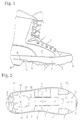
- a boot is shown in Figs. 1 and 2 in accordance with one embodiment of the present invention.
- the boot includes an upper portion 1 into which a foot may be secured by tightening a shoelace 2. Although only a shoelace 2 is shown, a strap and clasp mechanism may also be employed.
- the boot also includes a sole 3.
- the sole 3 includes an elastic outer sole 4 made of rubber, a plate sole 5 made from a generally hard plastic material, a toe 6 which is bent upward, nonskid ridges 7 located between the toe 6 and a non-contact part 9 and formed in the above elastic outer sole 4, and a heel 8 formed in the above elastic outer sole 4.
- the boot defines a bottom contact surface which contacts the ground when the sole 3 is placed over a flat ground surface.
- the bottom contact surface includes surfaces of the tips of the above nonskid ridges 7 and the heel 8.
- the sole 4 also is provided with a depression 10.
- the depression 10 is located on this bottom contact surface with a length extending from a point P1 on the sole 3, which is further towards the back of the boot than a non-contact part 9 to a point P2, which is slightly behind the 5 toe 6, thus forming a long depression between the front and back of the boot for attaching a fastener (described below).
- the snowboard boot is further formed with a recessed groove 11 which is defined between the depression 10 and 10 the toe 6 as an extension of the depression 10.
- the lateral sides of the depression 10 and recess 11 contact the ground when the bottom contact surface of sole 3 comes into contact with a flat ground surface.
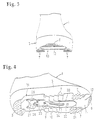
- the toe 6 usually does not contact the ground because of its upward-bent design, the result is a space 12 that has a structure that opens frontally to the boot as shown in Fig. 3.
- the snowboard boot has a fastener 20 attached at the depression 10, as shown in Fig. 4.
- the snowboard boot attaches to the snowboard 13 via a binding mechanism 30, as shown in Fig. 5.
- the attachment between the snowboard boot and the snowboard 13 is possible because of the configuration of the fastener 20 and the binding mechanism 30.
- the snowboard boot can be used for manipulating or steering the snowboard 13 in a manner well know due to the attachment of the snowboard boot to the binding mechanism 30.
- the binding mechanism 30 is shown in Fig. 6 attached to the snowboard 13. Details of the fastener 20 and the binding mechanism 30 are described in greater detail in co-pending U.S. Patent Application Serial No. 08/579,648 filed December 27, 1995 and corresponding document EP 719 505, published July 3, 1996.
- the fastener 20 is made from a metal plate material. As shown in Figs. 4 and 5, the fastener 20 includes a frontal engagement component 21, a rear engagement component 27 and a notch hole 24 located between the front and back ends thereof. The fastener 20 is fixed to the sole 3 via a fastening screws 22, 23 and 26.
- the fastener 20 and the depression 10 are configured such that the boot may be fastened to the snowboard 13 by sliding the sole 3 of the boot towards the front of the snowboard binding mechanism 30.
- a front fastener 31 of the binding mechanism 30 passes through the space 12, recessed groove 11, and engages frontal engagement component 21 of 20 the fastener 20.
- a rear fastener 32 of the binding mechanism 30 can engage the rear engagement component 27.
- the rear fastener 32 is mounted for pivotal movement in the binding mechanism 30.
- a spring 37 biases the rear fastener 32 into engagement with the rear 25 engagement component 27.
- a lock release lever 33 is connected to the rear fastener 32 may be pivoted to release the rear engagement component 27 from the binding mechanism 30.
- the snowboard boot Since the sole 3 of the snowboard boot connects to the binding mechanism 30, the upper portions of the snowboard boot must have a high degree of strength and some flexibility to accommodate the movements of a snowboard enthusiast. Therefore, in accordance with the present invention, the snowboard boot is assembled as described below with respect to Figs. 7 and 9.
- the upper portion 1 of the snowboard boot is formed of a leather material 50.
- the leather material 50 may be real leather, a synthetic leather-like material, or the like.
- the leather material 50 has some flexibility, but only that required by a snowboard enthusiast.
- a snowboard boot should have a relatively rigid upper portion 1.
- Leather like materials are ideal in that they can be made to be generally rigid with some small amount of flexibility.
- the sole 3 is made of a material suitable for forming the sole of a boot.
- the sole 3 may preferably be made of a nylon reinforced fiberglass material.
- the leather material 50 extends into a hollow portion 3a of the sole 3, and contacts the upper edges 3b of the sole 3.
- An appropriate adhesive material may be disposed between the upper edges 3b and the leather material 50 to adhere one to the other.
- the sole 3 includes a sole plate 5.
- the plate sole 5 is used for attaching the fastener 20 to the sole 3, and is constructed in a manner that tightens and fixes the fastener 20 by the force of tightening attachment screws 22 and 23 which extend through the fastener 20.
- the sole plate 5 is made of a generally rigid plastic, hardened resin or polymer material.
- the sole plate 5 covers a portion of the inner surface of the hollow portion 3a of the sole 3.
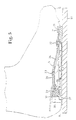
- An intermediate sole member 55 is disposed within the hollow portion 3a of the sole 3 covering the sole plate 5 and other portions of the surface of the hollow portion 3a of the sole, as is shown in Fig. 7.
- the intermediate sole member 55 is made of a hardened resin material and is generally rigid, but is far more flexible than the sole plate 5.
- the intermediate sole member 55 has different properties that that of the sole 3 in that it must be more flexible.
- the intermediate sole member 55 is made of a polymer material such as ethylene vinyl acetate copolymer or EVA. However other suitable materials may also be used.
- a first adhesive 65 is used to bond the leather material 50 to the intermediate sole member 55.
- a second adhesive 70 is used to bond the intermediate sole member 55 to the sole 3 and the sole plate 5.
- the first adhesive 65 may be, for instance, BOND ACE 5100A manufactured by DONGSUNG Chemical Co. Ltd., Pusan, South Korea.
- the first adhesive 65 is a polyurethane based adhesive. Such an adhesive is advantageous because it exhibits good adhesive properties when used with both plastic or resin based materials and leather or leather-like materials. Therefore, the first adhesive 65 provides good adhesive properties between the leather material 50 and the intermediate sole member 55.
- the second adhesive 70 may be any of a variety of adhesives that exhibit good adhesive properties between nylon reinforced fiberglass materials and resin based materials.
- the second adhesive 70 is preferably BOND ACE 8250, also manufactured by DONGSUNG Chemical Co. Ltd., Pusan, South Korea. It should be appreciated that alternate adhesives may be substituted for the second adhesive, providing the adhesive characteristics of the substituted adhesive produce the desired strength described herein.
- the intermediate member 55 is such that it may easily be adhered to another material using many different types of adhesives.
- the adhesives that display good adhesive properties with leather-like materials do not necessarily display good adhesive properties when used with a nylon reinforced fiberglass material.
- the adhesives that display good adhesive properties with nylon reinforced fiberglass materials do not necessarily display good adhesive properties when used with a leather-like material.
- the intermediate member 55 is such that it permits both types of adhesives described above to exhibit their good adhesive properties.
- the intermediate member 55 serves to enhance the structural strength of the snowboard boot of the present invention by enabling the use of adhesives which provide the snowboard boot with a high degree of strength to withstand the forces experienced while the snowboard is attached to the snowboard boots.
- the intermediate member 55 serves also as a moisture barrier inhibiting the movement of moisture.
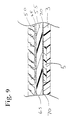
- the upper portion 1 of the snowboard boot is made of a leather material 50 having an aperture 50b formed at a bottom portion thereof.
- the leather material 50 has a engagement portion 50a which defines the aperture 50b.
- a pad 60 is disposed in the hollow portion 3a of the sole 3 covering the engagement portion 50a and the exposed portion of the intermediate pad 55.
- the alternate embodiment is generally the same as the embodiment depicted in Fig. 7 and in particular, utilizes the first and second adhesives in a manner described above.
- the pad 60 is provided for comfort rather than as a structural member and therefore any of a variety of adhesives may be used to adhere the pad 60 to the engagement portion 50a of the leather material 50.
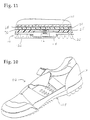
- a cycling shoe 100 shown in Fig. 10 is constructed in a manner similar to that described above with respect to the snowboard boot.
- the cycling shoe 100 may have any of a variety of sloes, such as the sole 105.
- the sole 105 may be of a type described in greater detail in U.S. Patent No. 5,125,173, to Nagano et al., and commonly assigned to Shimano Inc. U.S. Patent No. 5,125,173.
- the cycling shoe 100 includes the sole 105 and an upper 110 which is made of either a leather-like material or a textile material or may be a combination of the two and could be any of variety of natural and synthetic materials.
- the sole 105 includes a tread portion 120 made of a rubber or rubber-like material, a middle sole 125 made of a hard resin, resin-like material or nylon-fiberglass material and an intermediate sole member 130.
- the intermediate sole member 130 is similar to the intermediate layer 55 described above with respect to the snowboard boots.
- the intermediate sole member 130 is made of a polymer material such as ethylene vinyl acetate copolymer or EVA. However other suitable materials may also be used.
- the middle sole 125 supports a cleat 115.
- the cleat 115 is configured to engage a cleat engaging mechanism (not shown) in a bicycle pedal (not shown), such as that described in detail in U.S. Patent No. 5,125,173.
- the middle sole 125 is adhered to the tread portion 120 by a suitable adhesive.
- the first adhesive 65 is used to bond the upper 110 to the intermediate sole member 130 in a manner similar to that described above with respect to the snowboard boot.
- the second adhesive 70 is used to bond the intermediate sole member 130 to the middle sole 125.
- the first adhesive 65 as described above, may be BOND ACE 5100A manufactured by DONGSUNG Chemical Co. Ltd., Pusan, South Korea.
- BOND ACE 5100A is a polyurethane based adhesive. Such an adhesive is advantageous because it exhibits good adhesive properties when used with both plastic or resin based materials and leather or leather-like materials. Therefore, the first adhesive 65 provides good adhesive properties between the upper 110 and the intermediate sole member 130.
- the second adhesive 70 may be any of a variety of adhesives that exhibit good adhesive properties between materials typically used to form soles of shoes, such as nylon reinforced fiberglass materials and resin based materials.
- the second adhesive 70 is preferably BOND ACE 8250, also manufactured by DONGSUNG Chemical Co. Ltd., Pusan, South Korea. It should be appreciated that alternate adhesives may be substituted for the second adhesive, providing the adhesive characteristics of the substituted adhesive produce the desired strength described herein.
Landscapes
- Health & Medical Sciences (AREA)
- General Health & Medical Sciences (AREA)
- Physical Education & Sports Medicine (AREA)
- Chemical & Material Sciences (AREA)
- Engineering & Computer Science (AREA)
- Materials Engineering (AREA)
- Footwear And Its Accessory, Manufacturing Method And Apparatuses (AREA)
- Laminated Bodies (AREA)
Claims (15)
- Schuhwarenartikel, umfassend:wobei ein erster Klebstoff (65) den Zwischenabschnitt (55; 130) an den oberen Abschnitt (50) klebt und ein zweiter Klebstoff (70) den Zwischenabschnitt (55; 130) an die Sohle (3; 105) und die Sohlenplatte (5) klebt, wobei der erste Klebstoff (65) ein Klebstoff ist, der starke Hafteigenschaften in Kombination mit Ledermaterialien und auf Harz basierenden Materialien zeigt, und der zweite Klebstoff (70) starke Hafteigenschaften in Kombination mit auf Harz basierenden Materialien und dem Sohlenbildungsmaterial zeigt.eine Sohle (3; 105), die aus einem Sohlenbildungsmaterial hergestellt ist;eine Sohlenplatte (5), die innerhalb eines oberen Abschnitts der Sohle (3; 105) angeordnet ist, wobei die Sohlenplatte (5) an einem Befestigungsmittel (20; 115) fixiert ist;einen Zwischenabschnitt (55; 130), der an der Sohle (3; 105) und der Sohlenplatte (5) haftet;einen oberen Abschnitt (50), der an dem Zwischenabschnitt (55; 130) haftet;
- Schuhwarenartikel nach Anspruch 1, dadurch gekennzeichnet, dass das Befestigungsmittel (20; 115) sich in Längsrichtung in der Sohle (3; 105) erstreckt und Befestigungsabschnitte aufweist, die sich aus einem Bodenabschnitt der Sohle (3; 105) heraus erstrecken.
- Schuhwarenartikel nach Anspruch 1 oder 2, dadurch gekennzeichnet, dass der erste Klebstoff (65) ein auf Polyurethan basierender Klebstoff ist.
- Schuhwarenartikel nach einem der Ansprüche 1 bis 3, dadurch gekennzeichnet, dass der Zwischenabschnitt (55; 130) aus einem gehärteten Harzmaterial gefertigt ist.
- Schuhwarenartikel nach einem der Ansprüche 1 bis 4, dadurch gekennzeichnet, dass der Zwischenabschnitt (55; 130) aus einem Ethylen-Vinyl-Azetat-Kopolymer gebildet ist.
- Schuhwarenartikel nach einem der Ansprüche 1 bis 5, dadurch gekennzeichnet, dass das Befestigungsmittel (20) zur Verbindung mit einem Anbringmechanismus (30) auf einem Snowboard konfiguriert ist.
- Schuhwarenartikel nach Anspruch 6, dadurch gekennzeichnet, dass die Sohle (3) und der obere Abschnitt einen Snowboardstiefel definieren.
- Schuhwarenartikel nach einem der Ansprüche 1 bis 7, dadurch gekennzeichnet, dass das Sohlenbildungsmaterial ein durch Nylon verstärktes Fiberglasmaterial ist.
- Schuhwarenartikel nach einem der Ansprüche 1 bis 5 und 8, dadurch gekennzeichnet, dass das Befestigungsmittel (115) zur Verbindung mit einem Anbringmechanismus auf einem Fahrradpedal konfiguriert ist.
- Schuhwarenartikel nach Anspruch 9, dadurch gekennzeichnet, dass die Sohle (105) und der obere Abschnitt einen Fahrradschuh (100) definieren.
- Schuhwarenartikel nach einem der Ansprüche 1 bis 7, 9 und 10, dadurch gekennzeichnet, dass das Sohlenbildungsmaterial ein Gummimaterial ist.
- Schuhwarenartikel nach Anspruch 5, dadurch gekennzeichnet, dass der erste Klebstoff (65) starke Hafteigenschaften für die Verbindung zwischen einem Ethylen-Vinyl-Azetat-Kopolymer und lederartigen Materialien zeigt.
- Schuhwarenartikel nach Anspruch 5, dadurch gekennzeichnet, dass der erste Klebstoff (65) starke Hafteigenschaften für die Verbindung zwischen einem Ethylen-Vinyl-Azetat-Kopolymer und Textilmaterialien zeigt.
- Schuhwarenartikel nach einem der Ansprüche 1 bis 12, dadurch gekennzeichnet, dass der obere Abschnitt aus lederartigen Materialien gefertigt ist.
- Schuhwarenartikel nach einem der Ansprüche 1 bis 13, dadurch gekennzeichnet, dass der obere Abschnitt aus Textilmaterialien gefertigt ist.
Applications Claiming Priority (2)
| Application Number | Priority Date | Filing Date | Title |
|---|---|---|---|
| US874352 | 1997-06-13 | ||
| US08/874,352 US5845421A (en) | 1997-06-13 | 1997-06-13 | Snowboard shoes and cycle shoes having an intermediate sole layer |
Publications (2)
| Publication Number | Publication Date |
|---|---|
| EP0884004A1 EP0884004A1 (de) | 1998-12-16 |
| EP0884004B1 true EP0884004B1 (de) | 2004-03-24 |
Family
ID=25363560
Family Applications (1)
| Application Number | Title | Priority Date | Filing Date |
|---|---|---|---|
| EP98107975A Expired - Lifetime EP0884004B1 (de) | 1997-06-13 | 1998-04-30 | Schuhwerk |
Country Status (6)
| Country | Link |
|---|---|
| US (1) | US5845421A (de) |
| EP (1) | EP0884004B1 (de) |
| JP (1) | JP2874867B2 (de) |
| KR (1) | KR100267192B1 (de) |
| CN (1) | CN1108120C (de) |
| DE (1) | DE69822555T2 (de) |
Families Citing this family (24)
| Publication number | Priority date | Publication date | Assignee | Title |
|---|---|---|---|---|
| EP0991451B1 (de) * | 1997-04-18 | 2002-07-24 | The Burton Corporation | Verbindungselement zum kuppeln eines snowboard-stiefels mit einer bindung |
| US6394484B1 (en) * | 1997-04-18 | 2002-05-28 | The Burton Corporation | Snowboard boot and binding |
| FR2775424B1 (fr) * | 1998-03-02 | 2000-03-31 | Salomon Sa | Chaussure de cyclisme equipee d'une cale de verrouillage automatique sur une pedale |
| US6226897B1 (en) * | 1999-06-02 | 2001-05-08 | Vans, Inc. | Sports shoe interface |
| AT408711B (de) * | 1999-11-17 | 2002-02-25 | Atomic Austria Gmbh | Sportschuh, insbesondere schischuh |
| US6467795B1 (en) | 2000-12-29 | 2002-10-22 | Shimano Inc. | Snowboard binding with highback |
| US7073813B2 (en) * | 2001-01-18 | 2006-07-11 | K2 Corporation | Athletic boot with interface adjustment mechanism |
| FR2823077B1 (fr) * | 2001-04-06 | 2003-07-18 | Salomon Sa | Chaussure de marche comportant un renfort de tige amovible, et renfort pour une telle chaussure |
| FR2823484B1 (fr) * | 2001-04-12 | 2003-07-11 | Time Sport Int | Ensemble d'une pedale de bicyclette et d'une cale d'accrochage, pedale et cale de cet ensemble |
| US6722688B2 (en) | 2001-11-21 | 2004-04-20 | The Burton Corporation | Snowboard binding system |
| US6990752B2 (en) * | 2002-08-01 | 2006-01-31 | Louis Garneau Sports Inc. | Bicycle shoe with ventilating sole |
| FR2858184B1 (fr) * | 2003-07-30 | 2005-10-21 | Look Cycle Int | Chaussure de cycliste a cale de retenue de la chaussure sur une pedale a fixation automatique |
| PL1739002T3 (pl) | 2005-06-27 | 2014-03-31 | Motion Water Sports Inc | Zespół wiązania dla deski do wakeboardu oraz sposób tworzenia takiego zespołu |
| DE202007018332U1 (de) * | 2007-01-17 | 2008-04-24 | Deeluxe Sportartikel Handels Gmbh | Stiefel, insbesondere Ski- oder Snowboardstiefel |
| GB2500063A (en) * | 2012-03-09 | 2013-09-11 | Jason Mcinulty | Motorcycle footwear sole |
| CN203575748U (zh) * | 2012-09-28 | 2014-05-07 | 高伟业 | 多重防震吸湿透气鞋垫及防震吸湿透气鞋 |
| US9266007B2 (en) * | 2012-10-05 | 2016-02-23 | Michael A. Vaughn | Goalie skate |
| DE102015100435A1 (de) * | 2015-01-13 | 2016-07-14 | Marker Deutschland Gmbh | Aufstandsplatte mit starker Aufwölbung |
| DE102015100434A1 (de) * | 2015-01-13 | 2016-07-14 | Marker Deutschland Gmbh | Tourenskischuhsohle mit Vertiefung |
| US10342285B2 (en) * | 2015-02-26 | 2019-07-09 | Shimano Inc. | Bicycle shoe |
| US9844718B2 (en) | 2015-10-19 | 2017-12-19 | Mervin Manufacturing, Inc. | Interchangeable drive plates for snowboard bindings |
| CN106343654B (zh) * | 2016-10-26 | 2018-10-02 | 上海沃地生物技术工程有限公司 | 一种带有足底按摩功能的休闲鞋及其制作工艺 |
| KR102101884B1 (ko) * | 2018-10-04 | 2020-04-27 | 웰바이오텍 주식회사 | 쿠션기능과 보행기능이 강화된 신발밑창 |
| WO2022040629A1 (en) * | 2020-08-21 | 2022-02-24 | The Regents Of The University Of Colorado, A Body Corporate | Dual purpose running and cycling shoe |
Family Cites Families (11)
| Publication number | Priority date | Publication date | Assignee | Title |
|---|---|---|---|---|
| AT261443B (de) * | 1963-11-15 | 1968-04-25 | Robert Klima Lederbekleidung | Schuh, insbesondere Skischuh, und Laufsohle hiezu |
| US3512274A (en) * | 1968-07-26 | 1970-05-19 | B W Footwear Co Inc | Golf shoe |
| CN85102075B (zh) * | 1985-04-01 | 1987-09-02 | 安东尼奥·拉比沙达 | 特别适用于赛车的连接自行车用鞋和脚踏板的装置 |
| FR2653089B1 (fr) * | 1989-10-16 | 1994-04-08 | Jean Beyl | Dispositif de fixation d'une chaussure sur une pedale de bicyclette ou d'engin analogue, pedale de bicyclette, cale et semelle de chaussure pour un tel dispositif. |
| US5243773A (en) * | 1989-12-15 | 1993-09-14 | "Alpina" Tovarna Obutve, P.O. | Ski boot with shock-absorbing sole |
| US5125173A (en) * | 1990-01-16 | 1992-06-30 | Shimano Industrial Co., Ltd. | Cycling shoe |
| JP2931848B2 (ja) * | 1990-09-07 | 1999-08-09 | 株式会社シマノ | 自転車用靴製造用ラスト及びこれを用いる自転車用靴の製造方法 |
| DE4120136C2 (de) * | 1991-06-19 | 1995-03-16 | Uhl Sportartikel Karl | Schuhsohle, insbesondere Sportschuhsohle |
| JP2779138B2 (ja) | 1994-12-28 | 1998-07-23 | 株式会社シマノ | スノーボード用ブーツ |
| JP2793980B2 (ja) * | 1995-07-12 | 1998-09-03 | 株式会社シマノ | スノーボード用ブーツ |
| US5784809A (en) * | 1996-01-08 | 1998-07-28 | The Burton Corporation | Snowboarding boot |
-
1997
- 1997-06-13 US US08/874,352 patent/US5845421A/en not_active Expired - Fee Related
-
1998
- 1998-04-24 JP JP10115188A patent/JP2874867B2/ja not_active Expired - Fee Related
- 1998-04-30 KR KR1019980015519A patent/KR100267192B1/ko not_active Expired - Fee Related
- 1998-04-30 EP EP98107975A patent/EP0884004B1/de not_active Expired - Lifetime
- 1998-04-30 CN CN98107922A patent/CN1108120C/zh not_active Expired - Fee Related
- 1998-04-30 DE DE69822555T patent/DE69822555T2/de not_active Expired - Fee Related
Also Published As
| Publication number | Publication date |
|---|---|
| US5845421A (en) | 1998-12-08 |
| CN1108120C (zh) | 2003-05-14 |
| JP2874867B2 (ja) | 1999-03-24 |
| CN1202339A (zh) | 1998-12-23 |
| EP0884004A1 (de) | 1998-12-16 |
| KR19990006409A (ko) | 1999-01-25 |
| DE69822555D1 (de) | 2004-04-29 |
| JPH114701A (ja) | 1999-01-12 |
| KR100267192B1 (ko) | 2000-12-01 |
| DE69822555T2 (de) | 2004-08-05 |
Similar Documents
| Publication | Publication Date | Title |
|---|---|---|
| US5845421A (en) | Snowboard shoes and cycle shoes having an intermediate sole layer | |
| US4876808A (en) | Running and cycling shoe | |
| US4807372A (en) | Cleated shoe walking sole | |
| EP0749704B1 (de) | Sandale | |
| US4815222A (en) | Cleated cycling shoe with support straps | |
| JP3120175B2 (ja) | スノーボードブーツ | |
| US6722060B2 (en) | Snowboard boot | |
| US5701689A (en) | Snowboard boot | |
| JP2001516628A (ja) | スノーボード用の改良型ブーツ・ビンディング装置 | |
| US4932287A (en) | Combined shoe and pedal for sports bicycle | |
| EP0273891A2 (de) | Schlittschuh | |
| US20070063459A1 (en) | Interface system for retaining a foot or a boot on a sports article | |
| US6231066B1 (en) | Active highback system for a snowboard boot | |
| US6725742B2 (en) | Use of studs in a bicycle shoe and pedal system | |
| US7533478B2 (en) | Cycling shoe with an adjustable strap | |
| US7232148B2 (en) | Device for retaining a boot on a gliding, rolling, or walking board adapted to a sporting activity, and the boot therefor | |
| WO1991008683A1 (en) | Device for enabling walking and protecting cleats on cycling shoes for quick release (clipless) pedals | |
| US8226108B2 (en) | Snowboard binding | |
| TW202215999A (zh) | 運動鞋及卡踏系統與方法 | |
| US20200062338A1 (en) | Complex Cleat for Clipless Pedal | |
| US20030052473A1 (en) | Cleated overshoe and snowshoe with binding for accepting same | |
| WO2016063073A1 (en) | Cycle shoe cleat apparatus and shoe | |
| EP0964624A1 (de) | Beschlag für einen snowboardschuhgurt | |
| US20010001909A1 (en) | Sports shoe interface | |
| US20120066935A1 (en) | Retractable cleat protector for cleated bicycle shoes |
Legal Events
| Date | Code | Title | Description |
|---|---|---|---|
| PUAI | Public reference made under article 153(3) epc to a published international application that has entered the european phase |
Free format text: ORIGINAL CODE: 0009012 |
|
| AK | Designated contracting states |
Kind code of ref document: A1 Designated state(s): CH DE FR IT LI SE |
|
| AX | Request for extension of the european patent |
Free format text: AL;LT;LV;MK;RO;SI |
|
| 17P | Request for examination filed |
Effective date: 19981110 |
|
| AKX | Designation fees paid |
Free format text: CH DE FR IT LI SE |
|
| GRAP | Despatch of communication of intention to grant a patent |
Free format text: ORIGINAL CODE: EPIDOSNIGR1 |
|
| GRAS | Grant fee paid |
Free format text: ORIGINAL CODE: EPIDOSNIGR3 |
|
| GRAA | (expected) grant |
Free format text: ORIGINAL CODE: 0009210 |
|
| AK | Designated contracting states |
Kind code of ref document: B1 Designated state(s): CH DE FR IT LI SE |
|
| REG | Reference to a national code |
Ref country code: CH Ref legal event code: NV Representative=s name: TROESCH SCHEIDEGGER WERNER AG Ref country code: CH Ref legal event code: EP |
|
| PGFP | Annual fee paid to national office [announced via postgrant information from national office to epo] |
Ref country code: FR Payment date: 20040421 Year of fee payment: 7 |
|
| PGFP | Annual fee paid to national office [announced via postgrant information from national office to epo] |
Ref country code: SE Payment date: 20040426 Year of fee payment: 7 Ref country code: CH Payment date: 20040426 Year of fee payment: 7 |
|
| REF | Corresponds to: |
Ref document number: 69822555 Country of ref document: DE Date of ref document: 20040429 Kind code of ref document: P |
|
| REG | Reference to a national code |
Ref country code: SE Ref legal event code: TRGR |
|
| PGFP | Annual fee paid to national office [announced via postgrant information from national office to epo] |
Ref country code: DE Payment date: 20040629 Year of fee payment: 7 |
|
| ET | Fr: translation filed | ||
| PLBE | No opposition filed within time limit |
Free format text: ORIGINAL CODE: 0009261 |
|
| STAA | Information on the status of an ep patent application or granted ep patent |
Free format text: STATUS: NO OPPOSITION FILED WITHIN TIME LIMIT |
|
| 26N | No opposition filed |
Effective date: 20041228 |
|
| PG25 | Lapsed in a contracting state [announced via postgrant information from national office to epo] |
Ref country code: LI Free format text: LAPSE BECAUSE OF NON-PAYMENT OF DUE FEES Effective date: 20050430 Ref country code: IT Free format text: LAPSE BECAUSE OF NON-PAYMENT OF DUE FEES;WARNING: LAPSES OF ITALIAN PATENTS WITH EFFECTIVE DATE BEFORE 2007 MAY HAVE OCCURRED AT ANY TIME BEFORE 2007. THE CORRECT EFFECTIVE DATE MAY BE DIFFERENT FROM THE ONE RECORDED. Effective date: 20050430 Ref country code: CH Free format text: LAPSE BECAUSE OF NON-PAYMENT OF DUE FEES Effective date: 20050430 |
|
| PG25 | Lapsed in a contracting state [announced via postgrant information from national office to epo] |
Ref country code: SE Free format text: LAPSE BECAUSE OF NON-PAYMENT OF DUE FEES Effective date: 20050501 |
|
| PG25 | Lapsed in a contracting state [announced via postgrant information from national office to epo] |
Ref country code: DE Free format text: LAPSE BECAUSE OF NON-PAYMENT OF DUE FEES Effective date: 20051101 |
|
| REG | Reference to a national code |
Ref country code: CH Ref legal event code: PL |
|
| EUG | Se: european patent has lapsed | ||
| PG25 | Lapsed in a contracting state [announced via postgrant information from national office to epo] |
Ref country code: FR Free format text: LAPSE BECAUSE OF NON-PAYMENT OF DUE FEES Effective date: 20050430 |
|
| REG | Reference to a national code |
Ref country code: FR Ref legal event code: ST Effective date: 20110218 |