EP0884113A1 - Procédé et dispositif pour trier des objets, notamment des fruits et des plantes bulbeuses, suivant les dimensions de leur section transversale - Google Patents
Procédé et dispositif pour trier des objets, notamment des fruits et des plantes bulbeuses, suivant les dimensions de leur section transversale Download PDFInfo
- Publication number
- EP0884113A1 EP0884113A1 EP98201924A EP98201924A EP0884113A1 EP 0884113 A1 EP0884113 A1 EP 0884113A1 EP 98201924 A EP98201924 A EP 98201924A EP 98201924 A EP98201924 A EP 98201924A EP 0884113 A1 EP0884113 A1 EP 0884113A1
- Authority
- EP
- European Patent Office
- Prior art keywords
- cords
- pair
- objects
- another
- cord
- Prior art date
- Legal status (The legal status is an assumption and is not a legal conclusion. Google has not performed a legal analysis and makes no representation as to the accuracy of the status listed.)
- Withdrawn
Links
- 238000000034 method Methods 0.000 title claims abstract description 15
- 235000013399 edible fruits Nutrition 0.000 title claims abstract description 8
- 230000000694 effects Effects 0.000 description 2
- 238000005192 partition Methods 0.000 description 1
- 238000011144 upstream manufacturing Methods 0.000 description 1
Images

Classifications
-
- B—PERFORMING OPERATIONS; TRANSPORTING
- B07—SEPARATING SOLIDS FROM SOLIDS; SORTING
- B07B—SEPARATING SOLIDS FROM SOLIDS BY SIEVING, SCREENING, SIFTING OR BY USING GAS CURRENTS; SEPARATING BY OTHER DRY METHODS APPLICABLE TO BULK MATERIAL, e.g. LOOSE ARTICLES FIT TO BE HANDLED LIKE BULK MATERIAL
- B07B13/00—Grading or sorting solid materials by dry methods, not otherwise provided for; Sorting articles otherwise than by indirectly controlled devices
- B07B13/14—Details or accessories
- B07B13/18—Control
-
- B—PERFORMING OPERATIONS; TRANSPORTING
- B07—SEPARATING SOLIDS FROM SOLIDS; SORTING
- B07B—SEPARATING SOLIDS FROM SOLIDS BY SIEVING, SCREENING, SIFTING OR BY USING GAS CURRENTS; SEPARATING BY OTHER DRY METHODS APPLICABLE TO BULK MATERIAL, e.g. LOOSE ARTICLES FIT TO BE HANDLED LIKE BULK MATERIAL
- B07B13/00—Grading or sorting solid materials by dry methods, not otherwise provided for; Sorting articles otherwise than by indirectly controlled devices
- B07B13/04—Grading or sorting solid materials by dry methods, not otherwise provided for; Sorting articles otherwise than by indirectly controlled devices according to size
- B07B13/065—Apparatus for grading or sorting using divergent conveyor belts or cables
Definitions
- the invention relates to a method for sorting objects, in particular fruit and bulbous plants, with regard to their cross-sectional dimension, by placing these objects on at least one pair of cords which are situated next to one another and at a distance apart, diverge from one another in the direction of transport.
- a method of this kind in which the objects to be sorted therefore fall through between the diverging cords further downstream as their cross-sectional dimension increases, is e.g. known from German Patent Application DE-A-3,124,446.
- the known method therefore provides better sorting than if cords which move at the same velocity are used.
- the velocity ratio of the cords is constant. It may therefor happen that the objects which have been put on the cords do not change position to a desirable extent when being conveyed along the cords, and consequently are sorted with regard to an incorrect dimension.
- FR-A-1 076 299 describes a sorting method of the same kind.
- the ratio of the velocities of two diverging adjacent cords may be chosen from a limited number fixed ratios by a positional change of a drive belt when the sorter is in rest; said ratio is however constant during transport of the objects over the cords.
- the object of the present invention is to improve the abovementioned method in such a manner that objects can be sorted with regard to their cross-sectional dimension with increased accuracy, and to this end is characterized in that the ratio of the velocities of the cords of a pair is varied during the transport of the objects over the cords.
- a pair of cords means two cords which are positioned next to one another. It will be clear that if three or five cords are used, two or four pairs of cords, respectively, are formed.
- the said ratio can be defined at the quotient of V 1 /V 2 , V 1 being the velocity of one cord of the pair, and V 2 being the velocity of the other cord of the pair.
- this ratio is also referred to as "velocity ratio”.
- the velocity ratio may be kept constant during a certain period and may even equal 1; at least once during the transport of each object, a change in velocity ratio should take place.
- the objects which are subjected to the sorting method are provided with a varying rotational velocity, resulting in an improved rotation of the objects on the cords and as a result, the objects move more quickly into the desired sorting position.
- the velocity ratio does not equal 1 and that the ratio is varied a number of times during the transport of the objects.
- the velocity ratio between the cords of a pair is varied periodically.
- the minimum and maximum values of the velocities of all the cords are selected to be identical.
- the objects which are to be sorted using the method are rotated alternately to the left and to the right, thus achieving an optimum sorting action.
- objects which are difficult to rotate or are not positioned optimally on the cords are nevertheless rotated very quickly.
- the periods, as calculated over the effective sorting length of the cords may be advantageous to change the periods, as calculated over the effective sorting length of the cords, a number of times, preferably four to five times.
- the invention furthermore relates to a device for sorting objects, in particular fruit and bulbous plants, with regard to their cross-sectional dimension, at least comprising a pair of endless cords which run at a distance from one another over pulleys and diverge with respect to one another, and drive means, which are able to drive the cords at different velocities, as is known from DE-A-3,124,446.
- the device according to the invention is characterized in that the drive means are designed in such a way that in use, the ratio of velocities of the cords of a pair can be varied during transport of the object over the cords.
- a device of this kind can be used to sort objects in accordance with the method of the present invention.
- the velocity at least of the cords of a pair can be varied in relation to the other cord of the same pair.
- a drive means drives one of the cords of a pair with a constant power, leading to a constant velocity of said cord, whereas another drive means is present driving the other cord of the same pair in a sinusoidal fashion, so that the velocity of said second cord is continuously varied, leading to a varying ratio of the velocities of the cords of the pair during the use of the device.
- both cords of a pair can be driven at varying velocities in order, as has already been discussed above, to rotate the objects to be sorted better and more quickly, thus achieving improved sorting.
- adjustment means are present for periodically varying the velocity ratio of the cords.
- Means of this nature are used to make the velocities of the cords, as well as the duration of the periods in which the velocity of each cord is varied, adjustable.
- these means can always provide optimum sorting functions by applying the correct adjustments. It is preferable for these means to be electronic adjustment means, by means of which the drive means are controlled.
- the pulleys which guide the cords are equipped with a circumferential rib, which interacts in a guiding manner with a corresponding guide groove in the internal circumferential face of the cord running over the pulley, and a stationary guide rib is optionally arranged in the path of the active part of each cord, the rib interacting with the guide groove of the corresponding cord, the cords having a substantially roof-shaped cross-section, with the groove arranged in the base thereof.
- a stationary guide rib of the abovementioned kind prevents the cord in question from deviating laterally and hence prevents an object from passing prematurely through an opening between the cords which is actually too narrow.
- a cord having a substantially roof-shaped cross-section prevents the objects to be sorted to lie on the cords, but directs the objects to the space between the cords, preventing incorrect sorting.
- exerting a force which is directed laterally with respect to the direction of transport will lead to improved engagement of the cord on the pulley.
- the cords are of truncated roof-like design. This increases the flexibility of the cords in the radial direction, and also improves the correct guidance of the cord.
- Other cord forms for example with planar or convex cross-sections, may also be suitable.
- the invention furthermore relates to a device for sorting objects, in particular fruit and bulbous plants, with regard to their cross-sectional dimension, at least comprising a pair of endless cords which run at a distance from one another over pulleys delimiting the active part of the cords, the cords diverge with respect to one another, in which device of each cord at least one pulley is arranged so as to be axially adjustable in relation to the other axially adjustable pulleys, said pulleys delimiting the same side of the active part of the cords.
- both pulleys are axially adjustable at their respective edges.
- the device can be used for sorting various objects with regard to their cross-sectional dimension, and the accuracy of sorting can also be adapted.
- each cord may be provided with its own drive shaft and may be connected to its own drive motor.
- the change in the periods can be effected by actuating the motor by means of frequency regulators and time switches.
- a relatively lightweight and low powered drive motor is sufficient for each driven cord.
- the device it is also possible for the device to comprise, for example, two independent drive shafts, in which case one cord of each pair of cords is connected to one drive shaft and the other cord is connected to the other drive shaft, in such a manner that the cords are alternately driven in each case by the other drive shaft. This has the advantage that only one variable drive is required if only one of the cords of a pair of cords is to be driven at a periodically varying velocity.
- both cords of a pair of cords are driven at periodically varying velocities, this case only requires two drive motors, one motor being connected to one drive shaft and the other motor being connected to the other drive shaft. Obviously, in this case the two drive motors are heavier than if each cord is driven by a separate drive motor. In the case of two common motors, problems relating to synchronization of the cords will arise less quickly.
- the cords of each pair, or at least the active parts thereof, can also run in a common horizontal plane, which is not possible with the known devices, in view of the different diameters of the pulleys which are situated on a common shaft.
- the advantage of this is that the transverse forces which are exerted on the cords by the objects during sorting (see above) do not have a vertical, upwardly directed component, as in the known device. Moreover, the transverse forces are in this way taken up in an optimum manner by the guide rib in question, leading to improved engagement of the cord on the guide rib or pulley.
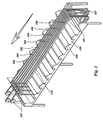
- the device shown in Fig. 1 comprises, by way of example, seven cords 100-106, which together form six pairs of cords (respectively 100-101, 101-102, 102-103, 103-104, 104-105 and 105-106).
- the cords are disposed so as to diverge in the direction of transport, which is indicated by an arrow.
- the cords 100-106 are guided over pulleys 107, which are provided with a circumferential guide rib. Further, the active parts of the cords 100-106 are each supported by a guide rib 110.
- the cords are each connected, via one of their pulleys, to a separate drive means (not shown), and can be driven at a variable rotational velocity, in such a manner that the cords 100, 102, 104 and 106, all at the same velocity, move more quickly than cords 101, 103 and 105, which also all move with a common, albeit lower velocity. With changing periods, however, the cords 100, 102, 104 and 106 will all move more slowly than the cords 101, 103 and 105.
- Belts 108 which move transversely to the direction of movement of the cords, are situated beneath the active part of the cords in order to collect objects which fall through between the cords during sorting, which moving belts 108 are in each case delimited on either side by partitions 109.
- Fig. 2 shows the cross-section through a preferred embodiment of a cord 200 which is in the shape of a truncated roof and the base of which is provided with a groove 201 which interacts with rib 202 of the pulley or guide rib 203.
- the base of the cord 200 will be pressed against the pulley or guide rib 203.
- Fig. 3 diagrammatically depicts a width adjustment device, which is situated in the region of one of the ends of the active part of the cords.
- the cords 300, 301, 302, 303, 304, 305 and 306, which are guided by pulleys 310, 311, 312, 313, 314, 315 and 316, respectively, are each connected to a frame 320, 321, 322, 323, 324, 325 and 326, respectively.
- a pulley 330, 331, 332, 333, 334, 335 and 336 is located for guiding back the cords 300, 301, 302, 303, 304, 305 and 306, respectively.
- Two of the frames, in this case frame 320 and frame 326, are each connected, via an internal screw thread 317 and 318, respectively, to a shaft 307 which is provided with an opposite external screw thread and is mounted fixedly in the axial direction in a bearing 350 in the frame 323.
- the adjacent frames 321, 325 are connected to the respective frames 320 and 326 by in each case two mutually intersecting arms 340, 341 and 342, 343, respectively.
- frames 321 and 325 are connected in the same way to adjacent frames, etc.
- the device At the start of the active part, i.e. at the location where the cords are situated closest together, the device is loaded with objects which are to be sorted with regard to their cross-sectional dimension.
- the objects are moved towards the other end of the active part by means of the moving cords, with the objects each being in contact with both cords of a pair of cords.
- the velocities of these cords are varied periodically with respect to one another.
- the objects are effectively rotated about a characteristic axis of rotation which is defined by the shape of these objects.
- the aligned objects will fall down between the diverging cords at that location where the distance between the cords first becomes larger than the cross-section of the object, which cross-section is situated substantially perpendicular to the said axis of rotation.
- the sorted objects are collected on the moving belts which are situated beneath the cords and convey the objects onwards to, for example, a container or processing device.
Landscapes
- Sorting Of Articles (AREA)
- Combined Means For Separation Of Solids (AREA)
Applications Claiming Priority (2)
| Application Number | Priority Date | Filing Date | Title |
|---|---|---|---|
| NL1006272A NL1006272C2 (nl) | 1997-06-10 | 1997-06-10 | Werkwijze en inrichting voor het op dwarsdoorsnede-afmeting sorteren van voorwerpen, in het bijzonder van fruit en bolgewassen. |
| NL1006272 | 1997-06-10 |
Publications (1)
| Publication Number | Publication Date |
|---|---|
| EP0884113A1 true EP0884113A1 (fr) | 1998-12-16 |
Family
ID=19765130
Family Applications (1)
| Application Number | Title | Priority Date | Filing Date |
|---|---|---|---|
| EP98201924A Withdrawn EP0884113A1 (fr) | 1997-06-10 | 1998-06-09 | Procédé et dispositif pour trier des objets, notamment des fruits et des plantes bulbeuses, suivant les dimensions de leur section transversale |
Country Status (2)
| Country | Link |
|---|---|
| EP (1) | EP0884113A1 (fr) |
| NL (1) | NL1006272C2 (fr) |
Cited By (6)
| Publication number | Priority date | Publication date | Assignee | Title |
|---|---|---|---|---|
| DE102004023060A1 (de) * | 2004-05-11 | 2005-12-08 | Siegwald Gerätebau GmbH | Vorrichtung zum Begutachten von Obst nach der Qualität |
| CN102349692A (zh) * | 2011-09-26 | 2012-02-15 | 张昊 | 一种果蔬分拣设备 |
| CN107051886A (zh) * | 2016-12-26 | 2017-08-18 | 桂林理工大学 | 一种水果分类设备 |
| KR20180017383A (ko) * | 2016-08-09 | 2018-02-21 | 최락경 | 과일 선별기 |
| CN111940359A (zh) * | 2020-08-14 | 2020-11-17 | 道真仡佬族苗族自治县万福农业综合开发有限公司 | 一种高品质党参加工设备 |
| CN112191534A (zh) * | 2020-09-10 | 2021-01-08 | 苏州金丝港智能发展股份有限公司 | 一种种子筛选装置及其使用方法 |
Citations (6)
| Publication number | Priority date | Publication date | Assignee | Title |
|---|---|---|---|---|
| FR1076299A (fr) * | 1953-03-05 | 1954-10-25 | Nervus Paris | Calibreuse |
| GB758347A (en) * | 1952-12-16 | 1956-10-03 | John Garth Coryn | Improvements in or relating to machines for grading apples or the like |
| US2776746A (en) * | 1951-10-06 | 1957-01-08 | Karl C Envoldsen | Shrimp grader |
| NL6511129A (fr) * | 1965-08-25 | 1967-02-27 | ||
| US3587854A (en) * | 1968-10-21 | 1971-06-28 | Milestone Inc | Sizing machine for potatoes and the like |
| DE3124446A1 (de) * | 1981-06-22 | 1982-12-30 | Felix 6712 Bobenheim-Roxheim Voll | Verfahren und vorrichtung zum sortieren und kalibrieren saemtlicher zwiebelgewaechse, von kartoffeln, moehren, roten beeten, gurken, rosenkohl, blumenkohl (gefrostet), radieschen und allen ballig geformten handelsguetern |
-
1997
- 1997-06-10 NL NL1006272A patent/NL1006272C2/nl not_active IP Right Cessation
-
1998
- 1998-06-09 EP EP98201924A patent/EP0884113A1/fr not_active Withdrawn
Patent Citations (6)
| Publication number | Priority date | Publication date | Assignee | Title |
|---|---|---|---|---|
| US2776746A (en) * | 1951-10-06 | 1957-01-08 | Karl C Envoldsen | Shrimp grader |
| GB758347A (en) * | 1952-12-16 | 1956-10-03 | John Garth Coryn | Improvements in or relating to machines for grading apples or the like |
| FR1076299A (fr) * | 1953-03-05 | 1954-10-25 | Nervus Paris | Calibreuse |
| NL6511129A (fr) * | 1965-08-25 | 1967-02-27 | ||
| US3587854A (en) * | 1968-10-21 | 1971-06-28 | Milestone Inc | Sizing machine for potatoes and the like |
| DE3124446A1 (de) * | 1981-06-22 | 1982-12-30 | Felix 6712 Bobenheim-Roxheim Voll | Verfahren und vorrichtung zum sortieren und kalibrieren saemtlicher zwiebelgewaechse, von kartoffeln, moehren, roten beeten, gurken, rosenkohl, blumenkohl (gefrostet), radieschen und allen ballig geformten handelsguetern |
Cited By (8)
| Publication number | Priority date | Publication date | Assignee | Title |
|---|---|---|---|---|
| DE102004023060A1 (de) * | 2004-05-11 | 2005-12-08 | Siegwald Gerätebau GmbH | Vorrichtung zum Begutachten von Obst nach der Qualität |
| DE102004023060B4 (de) * | 2004-05-11 | 2007-09-27 | Siegwald Gerätebau GmbH | Vorrichtung zum Begutachten von Obst nach der Qualität |
| CN102349692A (zh) * | 2011-09-26 | 2012-02-15 | 张昊 | 一种果蔬分拣设备 |
| KR20180017383A (ko) * | 2016-08-09 | 2018-02-21 | 최락경 | 과일 선별기 |
| KR101939610B1 (ko) | 2016-08-09 | 2019-01-17 | 최락경 | 과일 선별기 |
| CN107051886A (zh) * | 2016-12-26 | 2017-08-18 | 桂林理工大学 | 一种水果分类设备 |
| CN111940359A (zh) * | 2020-08-14 | 2020-11-17 | 道真仡佬族苗族自治县万福农业综合开发有限公司 | 一种高品质党参加工设备 |
| CN112191534A (zh) * | 2020-09-10 | 2021-01-08 | 苏州金丝港智能发展股份有限公司 | 一种种子筛选装置及其使用方法 |
Also Published As
| Publication number | Publication date |
|---|---|
| NL1006272C2 (nl) | 1998-12-16 |
Similar Documents
| Publication | Publication Date | Title |
|---|---|---|
| KR100328113B1 (ko) | 선별기계및장치 | |
| RU2000118806A (ru) | Конвейерное устройство для подачи продуктов, в частности, фруктов в установку сортировки этих продуктов | |
| EP0884113A1 (fr) | Procédé et dispositif pour trier des objets, notamment des fruits et des plantes bulbeuses, suivant les dimensions de leur section transversale | |
| WO2008037686A1 (fr) | Transporteur | |
| CA2110648A1 (fr) | Transporteur d'alignement et de separation, vibrant et a grande vitesse | |
| US4817744A (en) | Fruit sizing and weighing | |
| NL9200544A (nl) | Inrichting voor het op grootte sorteren van knolvormige vruchten. | |
| EP0412835A2 (fr) | Appareil pour convoyer et couper des produits | |
| US20020166431A1 (en) | Apparatus for sizing and halving food product | |
| US4485913A (en) | Conveyor drive system | |
| US6203006B1 (en) | Sheet-size and stacking direction adjustable accumulator with removable ramps and method | |
| RU2038015C1 (ru) | Машина для скручивания теста | |
| KR200480080Y1 (ko) | 벨트형 농산물 선별기 | |
| US4497233A (en) | Hotdog roll slicer | |
| US3269535A (en) | Shuffle feed sorting structure | |
| EP0094012A1 (fr) | Dispositif pour dériver des objets d'un transporteur | |
| US4046042A (en) | Circular shear cutting device | |
| US4194699A (en) | Apparatus for cutting up and conveying material | |
| KR100569301B1 (ko) | 과일 공급장치 | |
| SU1155235A1 (ru) | Устройство дл сортировани продолговатых плодов | |
| NL7903710A (nl) | Transportband. | |
| US4583644A (en) | Fruit sizer | |
| SU1497040A1 (ru) | Устройство дл отбора раскроенных заготовок | |
| SU1678447A1 (ru) | Измельчитель | |
| SU1553206A1 (ru) | Вибросепаратор дл очистки сем н от примесей |
Legal Events
| Date | Code | Title | Description |
|---|---|---|---|
| PUAI | Public reference made under article 153(3) epc to a published international application that has entered the european phase |
Free format text: ORIGINAL CODE: 0009012 |
|
| AK | Designated contracting states |
Kind code of ref document: A1 Designated state(s): BE CY DE DK ES FR GB GR IE IT NL PT SE |
|
| AX | Request for extension of the european patent |
Free format text: AL;LT;LV;MK;RO;SI |
|
| 17P | Request for examination filed |
Effective date: 19990615 |
|
| AKX | Designation fees paid |
Free format text: AT BE CH CY DE DK ES FI FR GB GR IE IT LI LU MC NL PT SE |
|
| RBV | Designated contracting states (corrected) |
Designated state(s): BE CY DE DK ES FR GB GR IE IT NL PT SE |
|
| 17Q | First examination report despatched |
Effective date: 20020610 |
|
| GRAH | Despatch of communication of intention to grant a patent |
Free format text: ORIGINAL CODE: EPIDOS IGRA |
|
| STAA | Information on the status of an ep patent application or granted ep patent |
Free format text: STATUS: THE APPLICATION IS DEEMED TO BE WITHDRAWN |
|
| 18D | Application deemed to be withdrawn |
Effective date: 20030628 |