EP0884603A2 - Procédé d'identification d'objets dans des données en trois dimensions à la technique de la logique floue - Google Patents
Procédé d'identification d'objets dans des données en trois dimensions à la technique de la logique floue Download PDFInfo
- Publication number
- EP0884603A2 EP0884603A2 EP98304577A EP98304577A EP0884603A2 EP 0884603 A2 EP0884603 A2 EP 0884603A2 EP 98304577 A EP98304577 A EP 98304577A EP 98304577 A EP98304577 A EP 98304577A EP 0884603 A2 EP0884603 A2 EP 0884603A2
- Authority
- EP
- European Patent Office
- Prior art keywords
- weight
- extracted feature
- feature
- storage device
- program storage
- Prior art date
- Legal status (The legal status is an assumption and is not a legal conclusion. Google has not performed a legal analysis and makes no representation as to the accuracy of the status listed.)
- Granted
Links
Images




Classifications
-
- G—PHYSICS
- G01—MEASURING; TESTING
- G01S—RADIO DIRECTION-FINDING; RADIO NAVIGATION; DETERMINING DISTANCE OR VELOCITY BY USE OF RADIO WAVES; LOCATING OR PRESENCE-DETECTING BY USE OF THE REFLECTION OR RERADIATION OF RADIO WAVES; ANALOGOUS ARRANGEMENTS USING OTHER WAVES
- G01S7/00—Details of systems according to groups G01S13/00, G01S15/00, G01S17/00
- G01S7/48—Details of systems according to groups G01S13/00, G01S15/00, G01S17/00 of systems according to group G01S17/00
- G01S7/4802—Details of systems according to groups G01S13/00, G01S15/00, G01S17/00 of systems according to group G01S17/00 using analysis of echo signal for target characterisation; Target signature; Target cross-section
-
- Y—GENERAL TAGGING OF NEW TECHNOLOGICAL DEVELOPMENTS; GENERAL TAGGING OF CROSS-SECTIONAL TECHNOLOGIES SPANNING OVER SEVERAL SECTIONS OF THE IPC; TECHNICAL SUBJECTS COVERED BY FORMER USPC CROSS-REFERENCE ART COLLECTIONS [XRACs] AND DIGESTS
- Y10—TECHNICAL SUBJECTS COVERED BY FORMER USPC
- Y10S—TECHNICAL SUBJECTS COVERED BY FORMER USPC CROSS-REFERENCE ART COLLECTIONS [XRACs] AND DIGESTS
- Y10S706/00—Data processing: artificial intelligence
- Y10S706/90—Fuzzy logic
Definitions
- the present invention pertains to identifying objects in three-dimensional data and, more particularly, an automatic target recognition system employing a fuzzy logic process to identify targets in LADAR data.
- ATR Automatic target recognition
- LADAR laser detection and ranging
- a laser signal is transmitted from a platform and, upon encountering an object, is reflected back to the platform.
- the platform can then process the reflected signal to obtain three-dimensional data regarding the object causing the reflection.
- this data includes a number of the object's features such as its height, length, and width.
- the platform typically transmits many laser signals across a general area that will contain a number of objects reflecting the signals. Thus, it is necessary for the ATR system to examine the data to see which reflecting objects might be of interest.
- ATR systems are often divided into four subsystems: detection, segmentation, feature extraction, and identification.
- Identification can be described as the final process which takes inputs such as the features discussed above and establishes an identity for the object based on previously determined features of known objects. The accuracy of the identification depends on several factors including the correctness of the object features used in the comparison and the number of known objects constituting potential identifications.
- the ATR system would ideally be able to compare completely accurate feature measurements against those of all known objects to establish the unknown object's identity.
- identification is frequently hampered by poor measurements such that, even if one of the potential identifications is correct, a complete match cannot be recognized.
- a length measurement might be compromised if part of the unknown object is obscured by a wall or fence and a width measurement might be affected by the orientation of the object relative to the platform.
- ATR system design constraints for size and speed may also affect performance.
- the present invention in one embodiment is a method employing fuzzy logic for identifying a detected object in LADAR data.
- the method includes extracting a feature of the object; determining a confidence level in the extracted feature; comparing the extracted feature to a corresponding feature of a potential identification using a fuzzy logic process, and identifying the object.
- the comparison includes weighting at least one rule according to the confidence level in the extracted feature employed by the rule; shifting a membership function for the extracted feature responsive to the confidence level for the extracted feature; and executing the fuzzy logic process to obtain an indication of whether the segmented object corresponds to the potential identification.
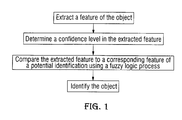
- Figure 1 is a flow diagram of one embodiment of a method for identifying an object as one of a plurality of potential identifications from a set of three-dimensional data employing a fuzzy logic process.
- the embodiment in Figure 1 generally presumes that acquiring three-dimensional data regarding a scanned field of view including an object within a surrounding environment; detecting the object within the acquired data; and segmenting the detected object from the surrounding environment have previously been performed in any manner known to those in the art and as discussed more fully below in connection with Figure 2.
- the embodiment of Figure 1 thus comprises extracting a feature from the segmented object, determining a confidence level in the extracted feature, comparing the extracted feature to a corresponding feature of a potential identification using a fuzzy logic process, and identifying the object.
- the fuzzy logic process is employed to compare the extracted feature of the segmented object to a corresponding, previously stored feature of a potential identification. More particularly, the fuzzy logic process outputs an indication of the likelihood that the object corresponds to the potential identification. This embodiment then identifies the object from the indication of likelihood.
- three-dimensional data regarding a scanned field of view including an object 12 within a surrounding environment 14 can be collected for use in the embodiment of Figure 1 as follows.
- the object 12 may be either airborne or, as shown, on the ground 16.
- the data is laser detection and ranging ("LADAR") data collected from a platform 18 that is airborne but platform 18 may also be on the ground 16.
- LADAR data is generally acquired by scanning the field of view to generate rows and columns of discrete units of information known as "pixels" that are used to generate a two-dimensional "image" of the scanned field of view.
- pixels discrete units of information
- the three-dimensional information is retained and correlated to the respective pixels.
- Data acquisition, and particularly LADAR data acquisition is well known in the art and any suitable technique may be employed. Suitable techniques are disclosed and claimed in United States Letters Patent 5,200,606; 5,224,109; and 5,285,461, each of which is hereby expressly incorporated by reference herein for all purposes as if fully set forth verbatim.
- the object 12 is detected from that data.
- the object 12 is detected by examining the acquired data for indications of an. identifying feature present in all potential identifications. Ascertaining what constitutes an "identifying feature" in this approach will necessarily depend on the potential identifications and it is possible that more than one identifying feature will be available. In some embodiments, it may be desirable to use more than one identifying feature to detect the object 12. Thus, the number of identifying features will necessarily depend on the particular embodiment implemented.
- the identifying feature from which the object 12 will be detected is preferably determined before the three-dimensional data is acquired, but some embodiments may make this determination dynamically.
- the detected object 12 must be segmented from the surrounding environment 14 within the scanned field of view.
- segmentation is performed by identifying which pixels in the two-dimensional image represent the object 12, and then discarding all other pixels in the image of the scanned field of view.
- segmentation techniques are well known in the art and any suitable segmentation technique may be applied.
- One such suitable technique is disclosed and claimed in application Serial No. 08/371,284, filed January 11, 1995, and entitled “Visual Recognition System for LADAR Systems," which is hereby expressly incorporated by reference herein as if set forth verbatim.
- Another technique involves determining from the three-dimensional data the relative spatial separation of the objects represented by adjacent pixels in the two-dimensional image. For instance, if a pixel represents part of the identifying feature of object 12 and if an adjacent pixel represents some surface that is less than a predetermined distance from the first pixel, then the two pixels are considered to represent different parts of the object 12 being segmented. Otherwise, the adjacent pixel is considered to represent some surface in the surrounding environment as opposed to the object 12 and is discarded.
- At least one feature is extracted from the segmented object 12.
- a value is ascertained for the extracted feature, typically by measuring it from the three-dimensional data associated with the pixels of the segmented object 12.
- Feature extraction is known to the art and any suitable technique may be employed.
- an obstacle such as a bush, fence, or wall
- One particular embodiment of the invention segments the object and extracts features by employing the range to the object 12 rotated by the aspect angle and a mask indicating which pixels are target pixels for a minimum enclosing rectangular window around the object 12.
- the window contains all target pixels and a one pixel wide boundary around the target to determine the confidence level.
- boundary pixels are identified in a one pixel wide band around the object 12 by examining background pixels that are four-way adjacent to a given target and flag them based on their four-way position with respect to the target pixel ( i.e. top, bottom, left, right).
- This border pixel identification procedure will return a border mask containing 4 bit flags per pixel denoting which pixels are border pixels and their position with respect to adjacent target pixels.
- Obscuring pixels are border pixels for which (1) the range to a potentially obscuring pixel will be less than the range to at least one pixel that is adjacent to it as defined in the border pixel mask, and (2) the rotated coordinates lie beyond the minimum or maximum extents thereof.
- the pixels that meet this first criteria must also lie beyond the minimum or maximum extents of the rotated two dimensional range to be respectively length and width obscuring.
- a statistic giving a likelihood of target length or width obscuration may be defined as the ratio of the number of actual obscuring pixels in length, width as defined by the above criteria to the number of potential obscuring pixels in length, width. Such a ratio can then be used as the determination of the confidence in the associated length or width measurement.
- the extracted feature of the segmented object 12 is then compared with a corresponding feature of a potential identification using a fuzzy logic process.
- Comparison with the fuzzy logic process in one embodiment of the invention is illustrated more particularly in Figure 3.
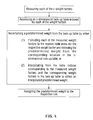
- Comparing the extracted feature, as shown in Figure 3, generally comprises weighting at least one rule according to the confidence level in the extracted feature employed by the rule, shifting a membership function for the extracted feature responsive to the confidence level in the extracted feature, and executing the fuzzy logic process to obtain an indication of whether the segmented object corresponds to the potential identification.
- fuzzy logic systems consist of: input variables, output variables, membership functions defined over the variables' ranges, and fuzzy rules or propositions relating inputs to outputs through the membership functions.
- the extracted feature is the input variable
- the indication of the likelihood is the output variable
- the rules relate the extracted feature to the likelihood that the feature corresponds to the potential identification.
- the aggregation of all rules is the basis for the fuzzy logic inferencing process.
- the fuzzy logic process of the particular embodiment of the invention disclosed herein also utilizes temporary variables defined as "weights" to weight the rules as described immediately below.
- Rules are weighted according to the extracted feature employed by the rule and according to n weight factors as is illustrated in Figure 4.
- Weights are values assigned to rules that range from zero to one where a weight of zero effectively eliminates that rule's contribution to the inferencing process.
- the predetermined weights themselves range in value from 0.0 to 1.0 and may be derived by any manner known to the art, including calculations from models and educated deduction, and represent an understanding of the limitations associated with measuring a particular feature under certain circumstances.
- a fuzzy logic system inferencing process that was temporally static can be made dynamic over time by adjusting rule weights.
- Weighting the rules in this particular embodiment generally includes measuring each of the n weight factors; accessing an n -dimensional look-up table indexed by each of the weight factors; and ascertaining a predetermined weight stored in the look-up table.
- the resolution of the indices must be traded with system resources and performance as will be appreciated by those of ordinary skill in the art having the benefit of this disclosure. For instance, indices having greater resolution will require a correspondingly larger memory to store all the values for the look-up table. On the other hand, lower resolution in some embodiments may require more processing although less memory. Still further, some indices might have better or poorer resolution in a given embodiment depending upon whether they generally indicate more or less reliability for an extracted feature.
- a predetermined weight is ascertained from the table by either (1) truncating each of the measured weight factors to the nearest table index for the respective weight factor and retrieving the predetermined weight from the corresponding location in the n -dimensional look-up table, or (2) interpolating from the table indices to the weight factors to obtain an interpolated predetermined weight.
- One particular embodiment uses successive applications of a four-point La Grangian interpolation, but other techniques might be suitable depending on system design constraints size. speed, and accuracy.
- the predetermined weight is then assigned to the respective rule.
- At least one membership function is then shifted responsive to the confidence in the feature measurement.
- the capacity for changed behavior can be achieved through the membership functions. Changing a membership function is analogous changing its definition.
- the fuzzy logic process generally includes the subprocesses known as “fuzzification,” “inference,” “composition,” and “defuzzification.” Essentially and generally, “fuzzification” involves scaling the input variables, “inferencing” involves executing the rulebase, “composition” involves the aggregation of all of the rule consequents into the fuzzy output, and “defuzzification” typically involves the determination of a single crisp output ( e.g., 0.85) from the fuzzy output.
- fuzzy output e.g. 0.25
- fuzzy logic process is not material to the practice of the invention provided that, (I) there is an ability to weight rules, and (2) there is a capability for shifting membership functions. Details of a particular fuzzy logic process can be found in either of the commercially available, off-the-shelf software packages or any other fuzzy logic tool that may be known to those skilled in the art.
- indication of the likelihood of whether the segmented object 12 corresponds to a potential identification is output from the fuzzy logic process.
- This indication may be the likelihood itself or some other indication suitable to the particular implementation of the invention.
- the defuzzified output of the fuzzy logic process corresponds to the likelihood that the detected, segmented object 12 corresponds to the potential identification under consideration.
- Figure 8 One particular alternative embodiment of that illustrated in Figures 1 and 3-4 is illustrated in Figure 8. Three-dimensional data acquisition, detection, and segmentation may be performed as is discussed above in connection with Figure 2. In the particular embodiment of the invention disclosed in Figure 8 and discussed below, the extracted features are the length, width, height, average height, and hull height of the object 12.
- the extracted features are variables in the fuzzy logic process.
- the variables utilized by the particular embodiment disclosed herein are set forth in Table 1.
- the fuzzy logic system of the particular embodiment also shifts membership functions. Fuzzy Logic System Variables Variable Name Variable Definition Variable Type Initial (Default) Value Length extracted feature-measured length of the object Input 0.00000 Chance indication of possibility that the object corresponds to a particular potential identification
- Table 1 lists the system variables in alphabetical order for convenience and the ordering has no significance to the invention. Note that the extracted features, Length, Width, Height, AverageHeight, and HullHeight in this embodiment, are inputs to the fuzzy logic process.
- the output variable Chance is used in identifying the object 12 as one of a plurality of potential identifications as will subsequently be explained in greater detail.
- Table 2 is the collection of all rules, used in the fuzzy logic system of the particular embodiment disclosed herein although the invention is not so limited. Table 2 thus constitutes the system's "rulebase” or “knowledge base.” Each quantity in parentheses is a weight, that may be changed from a default value of 1 as set forth below.
- the portion of each rule between the "if" and the “then” inclusive is the rule's "premise” or "antecedent.” In the particular embodiment disclosed, there are six premises applied to each input variable.
- the portion of the rule following the "then” is the rule's "conclusion” or "consequent.”
- the conclusion, or consequent of each rule actually assigns a membership function to the output value. In this particular embodiment, the conclusion assigns the value High, Low or ReallyLow to the variable Chance.
- the estimate of length may be very fragile or, alternatively, under these circumstances the length measurement derived from the LADAR data is not a robust feature.
- the weights lessen the influence of rules acting upon measurements known to be predicated on unreliable information. Conversely, the weights strengthen the influence of rules predicated on measurements known to be reliable. Thus, using rule weights to diminish inferences that rely on fragile information is a powerful mechanism for improving the identification process.
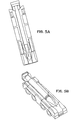
- the embodiment illustrated utilizes three weight factors-the depression angle from the sensor aboard the platform 18 to the object 12 (both shown in Figure 2), the object 12's orientation with respect to the sensor aboard platform 18, and the pixel resolution on the object 12.
- the first two of these factors are graphically illustrated in Figures 5A-5D from the vantage point of the airborne platform 18.
- Figures 5A-5D illustrate an object 12 from a 90°, 45°, 0°, and 0° depression angle, respectively, and a 30°, 30°, 30°, and 90° object aspect angle, respectively.
- the pixel resolution is the angular separation in radians between neighboring pixels multiplied by the range from the sensor aboard the platform 18.
- pixels separated by 0.005 radians at a range of 100 meters implies a pixel resolution of 0.50 meters.
- the scope of the invention is not limited to these particular weight factors. These weight factors were selected because it is known that they affect the accuracy. correctness, or reliability of measurements derived from the acquired data. Thus, in other contexts, other weight factors may be more desirable as more accurately reflecting the reliability of the extracted features and more or less than three weight factors might be employed.
- the three weight factors index a three-dimensional look-up table for the Length and Width extracted features but such a table can be used with any or all extracted features.
- Each table employs a resolution of four depression angles, five pixel resolutions, and seven object aspect angles for a 140 entry table.
- Each of the 140 entries is a predetermined weight associated with the three weight factors that index it.
- the particular embodiment illustrated employs one such three-dimensional table for each of the input variables Length and Width for each potential identification. Other embodiments might employ as many as one n -dimensional table per extracted feature per potential identification.
- the predetermined weights themselves range in value from 0.0 to 1.0 and may be derived by any manner known to the art, including calculations from models and educated deduction, and represent an understanding of the limitations associated with measuring a particular feature under certain circumstances.
- Figures 5A-5C depict an object approximately 13 meters long and 3 meters wide. Assuming a pixel resolution of 0.50 meters or less, the weight factors from the view in Figure 5A might yield a weight of 1.0 for rules employing length and width indicating a complete confidence in their reliability. In Figure 5D, however, weights associated with rules relying the width factor might be 0.0, indicating a complete absence of confidence in the reliability of the width measurement.
- the predetermined weight is then assigned to the respective rule.
- Reference to Table 2 shows that not every rule includes a weight indicated in parentheses. Such rules carry an implied weight of 1 and this may be true of other embodiments as well. However, it is generally desirable to weight the rules where possible to diminish the influence of unreliable features while bolstering the influence of reliable features. Thus, other embodiments might utilize rulebases in which all rules carry dynamic weights.
- membership functions may be shifted where desired.
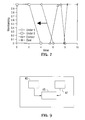
- there are three membership functions also referred to as "adjectives” in fuzzy speak) - these are: Under, Correct, and Over.
- the default definitions of these membership functions is set forth in Table 3.
- the criterion for identification is adjusted to take advantage of present circumstances.
- the membership function Bad is a penalty imposed when the value is not appropriate for the potential identification presently being evaluated.
- the fuzzy logic process is then executed on the weighted rules with shifted membership functions as set forth above to obtain a value of the output value Chance for each rule in the rulebase.
- the rule (WtLengthCor) if Length is Correct then Chance is High.
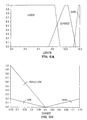
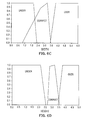
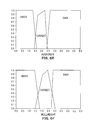
- the membership functions for the fuzzy input variable Length are illustrated in Figure 6A.
- the inferencing process evaluates the rule and to the degree that Length is Correct and including the scaling factor associated with the present value of the rule weight WtLengthCor the output fuzzy variable Chance is assigned the membership function High (shown in Figure 6B.)
- the inferencing process continues with all rules and rule weights in the rulebase.
- fuzzy output variable Chance the individual outcomes of each rule inference are combined in the "composition” process to form the completed fuzzy output variable Chance.
- "defuzzification” produces a single crisp output value (e.g., 0.85) from the fuzzy output variable, which is intended to represent the likelihood or possibility that the detected segmented object 12 from which the measured values for Length, Width, Height. AverageHeight, and HullHeight corresponds to the potential identification represented by the Correct membership functions.
- the indication is the likelihood itself and is the defuzzified output variable Chance in Table 1, Table 2, and in Table 3.
- the object is evaluated against a plurality of potential identifications and the process of weighting rules, shifting membership functions, and comparing the object 12 is performed for each of the potential identifications.
- the embodiment of Figure 8 will yield a plurality of likelihood indications, one for each potential identification.
- the object 12 is then identified from the output indications of likelihood in some embodiments of the invention.
- This identification may be performed in a number of ways depending on the particular implementation. For instance, the potential identification having the highest likelihood of match might be selected as the identification of the object 12. Alternatively, one might take a predetermined number of potential identifications having the highest likelihoods of match and then select one through a process known to the art as three-dimensional model matching. Three-dimensional model matching is well known in the art and may preferably be employed where two or more potential identifications have approximately the same likelihood of match. In such situations, three-dimensional modeling may reliably distinguish among the most likely candidates. Regardless, the scope of the invention is not limited as to how the identification is made from the indications of likelihood.
- the identification of the object 12 is acted upon. This may entail any number of actions and even omissions.
- the platform 18 in Figure 2 may relay the information to a command post (not shown) where it is stored for future reference, the object 12 may be targeted and attacked, or the object 12 may simply be ignored.
- the particular act will depend upon the particular implementation and object identification and the invention is not limited in this respect.
- the invention also takes knowledge of the circumstances needing broader or narrower tolerances and adapts the appropriate membership function(s) in the fuzzy logic system. Specifically, an assessment of the potential that the object may be partially obscured is used to influence inferencing in the fuzzy logic based identifier.
- Figure 9 illustrates how the invention in its various embodiments may be programmed on the program storage device 40.
- the program storage device 40 stores instructions that, when read and executed by processor 45, performs the method of the invention.
- the instructions and data necessary to perform the method are stored in program storage device 40, which is a non-volatile memory such as read-only memory (“ROM”), and loaded into a volatile storage device 47, which can be a random access memory (“RAM”), at startup.
- program storage device 40 and/or processor 45 may be stored aboard either of the platforms 18 shown in Figure 2 or at some remote point (not shown) to which platform 18 forwards data.
- processor 45 in various embodiments may be a microprocessor, a microcontroller, a digital signal processor ("DSP") or other type of programmable device and may constitute several processors, each designed to perform some portion of the programmed instructions.
- the program storage device 40 may be programmed with the method of any of the various embodiments disclosed herein.
- the present invention may include any or all of the following:
- a method for identifying an object from three-dimensional data comprising:
- extracting the feature includes ascertaining a value for the extracted feature.
- the extracted feature includes at least one of the length, width, height, hull height, and average height of the object.
- weight factors include at least one of the orientation of the object with respect to the data acquisition, depression angle from the data acquisition to the object, and the resolution of the data.
- the method above wherein the act of weighting includes: measuring each of the n weight factors;
- the predetermined weight is ascertained by at least one of the following:
- the object is identified by at least one of selecting the potential identification with the highest likelihood of correspondence and performing three-dimensional model matching on a plurality of potential identifications with the highest likelihoods of correspondence.
- the extracted features include at least one of the length, width, height, hull height, and average height of the object.
- weight factors include at least one of the orientation of the object with respect to the data acquisition. depression angle from the data acquisition to the object, and the resolution of the data.
- the method above wherein the act of weighting includes: measuring each of the n weight factors;
- the predetermined weight is ascertained by at least one of the following:
- the object is identified by at least one of selecting the potential identification with the highest likelihood of correspondence and performing three-dimensional model matching on a plurality of potential identifications with the highest likelihoods of correspondence.
- a method implementing an automatic target recognition system comprising:
- a program storage device readable by a computer the program storage device encoding statements for performing a method for identifying an object from three-dimensional data, the method comprising:
- extracting the feature in the programmed method includes ascertaining a value for the extracted feature.
- the program storage device above wherein the extracted feature in the programmed method includes at least one of the length, width, height, hull height, and average height of the object.
- each rule in the programmed method is weighted according to n weight factors where n is an integer greater than zero.
- weight factors in the programmed method include at least one of the orientation of the data acquisition with respect to the object, depression angle of the data acquisition with respect to the object, and the resolution of the data.
- the program storage device above wherein the act of weighting in the programmed method includes:
- the program storage device above wherein the membership functions in the programmed method include under, correct, and over.
- the program storage device above wherein the indication of whether the segmented object corresponds to the potential identification in the programmed method is a likelihood.
- the program storage device above wherein the object is identified in the programmed method by at least one of selecting the potential identification with the highest likelihood of correspondence and performing three-dimensional model matching on a plurality of potential identifications with the highest likelihoods of correspondence.
- a program storage device readable by a computer the program storage device encoding statements for performing a method implementing an automatic target recognition system identifying an object within a surrounding environment as one of a plurality of potential identifications, the object and the potential identifications having a plurality of predetermined features, the program storage device readable by a computer, the program storage device encoding statements for performing a method comprising:
- the program storage device above wherein the extracted features in the programmed method include at least one of the length, width, height, hull height, and average height of the object.
- each rule in the programmed method is weighted according to n weight factors where n is an integer greater than zero.
- weight factors in the programmed method include at least one of the orientation of the object with respect to the data acquisition, depression angle from the data acquisition to the object, and the resolution of the data.
- the program storage device above wherein the object is identified in the programmed method by at least one of selecting the potential identification with the highest likelihood of correspondence and performing three-dimensional model matching on a plurality of potential identifications with the highest likelihood of correspondence.
- a program storage device readable by a computer the program storage device encoding statements for performing a method implementing an automatic target recognition system, the program storage device readable by a computer, the program storage device encoding statements for performing a method comprising:
Landscapes
- Engineering & Computer Science (AREA)
- Computer Networks & Wireless Communication (AREA)
- Physics & Mathematics (AREA)
- General Physics & Mathematics (AREA)
- Radar, Positioning & Navigation (AREA)
- Remote Sensing (AREA)
- Image Analysis (AREA)
Applications Claiming Priority (2)
| Application Number | Priority Date | Filing Date | Title |
|---|---|---|---|
| US08/872,280 US5893085A (en) | 1997-06-10 | 1997-06-10 | Dynamic fuzzy logic process for identifying objects in three-dimensional data |
| US872280 | 1997-06-10 |
Publications (3)
| Publication Number | Publication Date |
|---|---|
| EP0884603A2 true EP0884603A2 (fr) | 1998-12-16 |
| EP0884603A3 EP0884603A3 (fr) | 2000-08-02 |
| EP0884603B1 EP0884603B1 (fr) | 2004-04-21 |
Family
ID=25359245
Family Applications (1)
| Application Number | Title | Priority Date | Filing Date |
|---|---|---|---|
| EP98304577A Expired - Lifetime EP0884603B1 (fr) | 1997-06-10 | 1998-06-09 | Procédé d'identification d'objets dans des données en trois dimensions à la technique de la logique floue |
Country Status (4)
| Country | Link |
|---|---|
| US (1) | US5893085A (fr) |
| EP (1) | EP0884603B1 (fr) |
| DE (1) | DE69823268T2 (fr) |
| IL (1) | IL124632A (fr) |
Cited By (1)
| Publication number | Priority date | Publication date | Assignee | Title |
|---|---|---|---|---|
| US6614917B1 (en) * | 1999-10-22 | 2003-09-02 | Lockheed Martin Corporation | Dynamic process for identifying objects in multi-dimensional data |
Families Citing this family (30)
| Publication number | Priority date | Publication date | Assignee | Title |
|---|---|---|---|---|
| US6714663B1 (en) | 1999-11-09 | 2004-03-30 | Lockheed Martin Corp. | Method and software-implemented apparatus for ground plane estimation in multi-dimensional data |
| AU2001243610A1 (en) | 2000-05-25 | 2001-12-11 | Manyworlds Consulting, Inc. | Fuzzy content network management and access |
| US8958654B1 (en) * | 2001-04-25 | 2015-02-17 | Lockheed Martin Corporation | Method and apparatus for enhancing three-dimensional imagery data |
| US6672534B2 (en) | 2001-05-02 | 2004-01-06 | Lockheed Martin Corporation | Autonomous mission profile planning |
| US6997097B2 (en) | 2001-05-02 | 2006-02-14 | Lockheed Martin Corporation | Autonomous mission profile planning |
| DE10145608B4 (de) * | 2001-09-15 | 2006-01-26 | Eads Deutschland Gmbh | Modellbasierte Objektklassifikation und Zielerkennung |
| DE10148064A1 (de) * | 2001-09-28 | 2003-04-10 | Ibeo Automobile Sensor Gmbh | Verfahren zur Erkennung und Verfolgung von Objekten |
| JP3545743B2 (ja) * | 2001-12-13 | 2004-07-21 | 株式会社東芝 | 特徴抽出システム及び半導体集積回路装置 |
| US7280696B2 (en) * | 2002-05-20 | 2007-10-09 | Simmonds Precision Products, Inc. | Video detection/verification system |
| CA2536864C (fr) * | 2002-08-29 | 2014-01-28 | Paul Rudolf | Dispositif de memoire associative et procede base sur la propagation d'onde |
| US7312856B2 (en) | 2002-09-12 | 2007-12-25 | Lockheed Martin Corporation | Programmable pulse capture device with automatic gain control |
| US7526459B2 (en) | 2003-11-28 | 2009-04-28 | Manyworlds, Inc. | Adaptive social and process network systems |
| US7606772B2 (en) | 2003-11-28 | 2009-10-20 | Manyworlds, Inc. | Adaptive social computing methods |
| US7526458B2 (en) | 2003-11-28 | 2009-04-28 | Manyworlds, Inc. | Adaptive recommendations systems |
| US7539652B2 (en) | 2003-11-28 | 2009-05-26 | Manyworlds, Inc. | Adaptive self-modifying and recombinant systems |
| US7493294B2 (en) * | 2003-11-28 | 2009-02-17 | Manyworlds Inc. | Mutually adaptive systems |
| US8566263B2 (en) * | 2003-11-28 | 2013-10-22 | World Assets Consulting Ag, Llc | Adaptive computer-based personalities |
| US8600920B2 (en) * | 2003-11-28 | 2013-12-03 | World Assets Consulting Ag, Llc | Affinity propagation in adaptive network-based systems |
| US20090018918A1 (en) | 2004-11-04 | 2009-01-15 | Manyworlds Inc. | Influence-based Social Network Advertising |
| US12093983B2 (en) | 2003-11-28 | 2024-09-17 | World Assets Consulting Ag, Llc | Adaptive and recursive system and method |
| USRE45770E1 (en) | 2003-11-28 | 2015-10-20 | World Assets Consulting Ag, Llc | Adaptive recommendation explanations |
| US20050157931A1 (en) * | 2004-01-15 | 2005-07-21 | Delashmit Walter H.Jr. | Method and apparatus for developing synthetic three-dimensional models from imagery |
| GB0616688D0 (en) * | 2006-08-23 | 2006-10-04 | Qinetiq Ltd | Target orientation |
| US7760334B1 (en) | 2007-02-27 | 2010-07-20 | Lockheed Martin Corporation | Optical multi-discriminant LADAR |
| WO2010036254A1 (fr) * | 2008-09-25 | 2010-04-01 | Sikorsky Aircraft Corporation | Dispositif d'affichage graphique pour enveloppe de déclenchement de munitions |
| JP5567908B2 (ja) * | 2009-06-24 | 2014-08-06 | キヤノン株式会社 | 3次元計測装置、その計測方法及びプログラム |
| US8923359B1 (en) | 2010-08-06 | 2014-12-30 | Lockheed Martin Corporation | Long cavity laser sensor for large FOV auto-tracking |
| US9940545B2 (en) * | 2013-09-20 | 2018-04-10 | Change Healthcare Llc | Method and apparatus for detecting anatomical elements |
| US10655936B2 (en) * | 2016-10-28 | 2020-05-19 | Rosemount Aerospace Inc. | Coordinating multiple missile targeting via optical inter-missile communications |
| US10591601B2 (en) * | 2018-07-10 | 2020-03-17 | Luminar Technologies, Inc. | Camera-gated lidar system |
Family Cites Families (9)
| Publication number | Priority date | Publication date | Assignee | Title |
|---|---|---|---|---|
| US5189619A (en) * | 1989-09-05 | 1993-02-23 | Toyota Jidosha Kabushiki Kaisha | AI-based adaptive vehicle control system |
| NZ239540A (en) * | 1990-09-24 | 1993-11-25 | Neurosearch As | 1-phenyl benzimidazole derivatives and medicaments |
| US5200422A (en) * | 1990-09-24 | 1993-04-06 | Neurosearch A/S | Benzimidazole derivatives, their preparation and use |
| US5222155A (en) * | 1991-03-26 | 1993-06-22 | Massachusetts Institute Of Technology | Computer apparatus and method for fuzzy template shape matching using a scoring function |
| US5234947A (en) * | 1991-11-07 | 1993-08-10 | New York University | Potassium channel activating compounds and methods of use thereof |
| US5631970A (en) * | 1993-05-21 | 1997-05-20 | Hsu; Shin-Yi | Process for identifying simple and complex objects from fused images and map data |
| US5640468A (en) * | 1994-04-28 | 1997-06-17 | Hsu; Shin-Yi | Method for identifying objects and features in an image |
| US5644386A (en) * | 1995-01-11 | 1997-07-01 | Loral Vought Systems Corp. | Visual recognition system for LADAR sensors |
| US5565483A (en) * | 1995-06-07 | 1996-10-15 | Bristol-Myers Squibb Company | 3-substituted oxindole derivatives as potassium channel modulators |
-
1997
- 1997-06-10 US US08/872,280 patent/US5893085A/en not_active Expired - Lifetime
-
1998
- 1998-05-25 IL IL12463298A patent/IL124632A/en not_active IP Right Cessation
- 1998-06-09 DE DE69823268T patent/DE69823268T2/de not_active Expired - Fee Related
- 1998-06-09 EP EP98304577A patent/EP0884603B1/fr not_active Expired - Lifetime
Cited By (1)
| Publication number | Priority date | Publication date | Assignee | Title |
|---|---|---|---|---|
| US6614917B1 (en) * | 1999-10-22 | 2003-09-02 | Lockheed Martin Corporation | Dynamic process for identifying objects in multi-dimensional data |
Also Published As
| Publication number | Publication date |
|---|---|
| DE69823268D1 (de) | 2004-05-27 |
| EP0884603A3 (fr) | 2000-08-02 |
| EP0884603B1 (fr) | 2004-04-21 |
| IL124632A (en) | 2001-09-13 |
| IL124632A0 (en) | 1998-12-06 |
| US5893085A (en) | 1999-04-06 |
| DE69823268T2 (de) | 2005-04-21 |
Similar Documents
| Publication | Publication Date | Title |
|---|---|---|
| EP0884603B1 (fr) | Procédé d'identification d'objets dans des données en trois dimensions à la technique de la logique floue | |
| CN114241448B (zh) | 障碍物航向角的获取方法、装置、电子设备、车辆及计算机可读存储介质 | |
| Izadi et al. | Three-dimensional polygonal building model estimation from single satellite images | |
| Leng et al. | Area ratio invariant feature group for ship detection in SAR imagery | |
| US6614917B1 (en) | Dynamic process for identifying objects in multi-dimensional data | |
| CN112766108B (zh) | 基于上下文信息的sar图像目标检测方法 | |
| US12442896B2 (en) | Hierarchical perception monitor for vehicle safety | |
| CN111667523A (zh) | 一种基于多模态多源的深度数据精炼方法及系统 | |
| CN119205750B (zh) | 基于雷视融合的目标检测方法、设备、存储介质及产品 | |
| CN120894696B (zh) | 基于可见光与红外融合的河道禁渔船只监测方法及系统 | |
| CN116964472A (zh) | 用于借助于雷达传感器系统的反射信号来探测环境的至少一个对象的方法 | |
| KR102697859B1 (ko) | 카메라에 오염이 발생했는지 여부를 실시간으로 판단하는 방법 및 이를 이용한 컴퓨팅 장치 | |
| CN117079265B (zh) | 单目3d目标检测的开放集领域泛化的方法、装置及设备 | |
| Jumanov et al. | Optimization of micro-object identification based on detection and correction of distorted image points | |
| CN117542008A (zh) | 一种融合语义点云的自动驾驶场景识别方法、存储介质 | |
| CN119107358A (zh) | 一种机器人的地图主方向检测方法、系统及应用 | |
| CN115761527B (zh) | 一种基于统计特性和结构特性融合的sar图像目标检测方法 | |
| CN116368535B (zh) | 推理装置、推理方法以及记录介质 | |
| CN116125440A (zh) | 用于确定激光雷达传感器的最大作用范围的方法以及设备 | |
| CN115790619A (zh) | 用于基于传感器可视性处理对象检测结果的处理系统、单元和方法 | |
| CN112015960A (zh) | 车载雷达测量数据的聚类方法、存储介质和电子装置 | |
| Lanterman | Jump-diffusion algorithm for multiple target recognition using laser radar range data | |
| Al-Temeemy et al. | Invariant chromatic descriptor for LADAR data processing | |
| CN121259494B (zh) | 一种模型安全性测试方法、装置、设备及存储介质 | |
| CN116520304B (zh) | 一种基于雷达与辐射计协同感知的目标探测方法及系统 |
Legal Events
| Date | Code | Title | Description |
|---|---|---|---|
| PUAI | Public reference made under article 153(3) epc to a published international application that has entered the european phase |
Free format text: ORIGINAL CODE: 0009012 |
|
| AK | Designated contracting states |
Kind code of ref document: A2 Designated state(s): DE FR GB |
|
| AX | Request for extension of the european patent |
Free format text: AL;LT;LV;MK;RO;SI |
|
| PUAL | Search report despatched |
Free format text: ORIGINAL CODE: 0009013 |
|
| AK | Designated contracting states |
Kind code of ref document: A3 Designated state(s): AT BE CH CY DE DK ES FI FR GB GR IE IT LI LU MC NL PT SE |
|
| AX | Request for extension of the european patent |
Free format text: AL;LT;LV;MK;RO;SI |
|
| 17P | Request for examination filed |
Effective date: 20000831 |
|
| AKX | Designation fees paid |
Free format text: DE FR GB |
|
| GRAP | Despatch of communication of intention to grant a patent |
Free format text: ORIGINAL CODE: EPIDOSNIGR1 |
|
| GRAS | Grant fee paid |
Free format text: ORIGINAL CODE: EPIDOSNIGR3 |
|
| GRAA | (expected) grant |
Free format text: ORIGINAL CODE: 0009210 |
|
| AK | Designated contracting states |
Kind code of ref document: B1 Designated state(s): DE FR GB |
|
| REG | Reference to a national code |
Ref country code: GB Ref legal event code: FG4D |
|
| REF | Corresponds to: |
Ref document number: 69823268 Country of ref document: DE Date of ref document: 20040527 Kind code of ref document: P |
|
| ET | Fr: translation filed | ||
| PLBE | No opposition filed within time limit |
Free format text: ORIGINAL CODE: 0009261 |
|
| STAA | Information on the status of an ep patent application or granted ep patent |
Free format text: STATUS: NO OPPOSITION FILED WITHIN TIME LIMIT |
|
| 26N | No opposition filed |
Effective date: 20050124 |
|
| PGFP | Annual fee paid to national office [announced via postgrant information from national office to epo] |
Ref country code: FR Payment date: 20060620 Year of fee payment: 9 |
|
| PGFP | Annual fee paid to national office [announced via postgrant information from national office to epo] |
Ref country code: GB Payment date: 20060626 Year of fee payment: 9 |
|
| PGFP | Annual fee paid to national office [announced via postgrant information from national office to epo] |
Ref country code: DE Payment date: 20060731 Year of fee payment: 9 |
|
| GBPC | Gb: european patent ceased through non-payment of renewal fee |
Effective date: 20070609 |
|
| REG | Reference to a national code |
Ref country code: FR Ref legal event code: ST Effective date: 20080229 |
|
| PG25 | Lapsed in a contracting state [announced via postgrant information from national office to epo] |
Ref country code: DE Free format text: LAPSE BECAUSE OF NON-PAYMENT OF DUE FEES Effective date: 20080101 |
|
| PG25 | Lapsed in a contracting state [announced via postgrant information from national office to epo] |
Ref country code: GB Free format text: LAPSE BECAUSE OF NON-PAYMENT OF DUE FEES Effective date: 20070609 |
|
| PG25 | Lapsed in a contracting state [announced via postgrant information from national office to epo] |
Ref country code: FR Free format text: LAPSE BECAUSE OF NON-PAYMENT OF DUE FEES Effective date: 20070702 |