EP0884870A2 - Dynamische Cache-Speicher-Vervielfältigung durch Erzeugung eines umgekehrten Baums in einem Netzwerk - Google Patents
Dynamische Cache-Speicher-Vervielfältigung durch Erzeugung eines umgekehrten Baums in einem Netzwerk Download PDFInfo
- Publication number
- EP0884870A2 EP0884870A2 EP98304028A EP98304028A EP0884870A2 EP 0884870 A2 EP0884870 A2 EP 0884870A2 EP 98304028 A EP98304028 A EP 98304028A EP 98304028 A EP98304028 A EP 98304028A EP 0884870 A2 EP0884870 A2 EP 0884870A2
- Authority
- EP
- European Patent Office
- Prior art keywords
- router
- server
- network
- region
- replica
- Prior art date
- Legal status (The legal status is an assumption and is not a legal conclusion. Google has not performed a legal analysis and makes no representation as to the accuracy of the status listed.)
- Granted
Links
Images




Classifications
-
- H—ELECTRICITY
- H04—ELECTRIC COMMUNICATION TECHNIQUE
- H04L—TRANSMISSION OF DIGITAL INFORMATION, e.g. TELEGRAPHIC COMMUNICATION
- H04L45/00—Routing or path finding of packets in data switching networks
- H04L45/02—Topology update or discovery
-
- G—PHYSICS
- G06—COMPUTING OR CALCULATING; COUNTING
- G06F—ELECTRIC DIGITAL DATA PROCESSING
- G06F16/00—Information retrieval; Database structures therefor; File system structures therefor
- G06F16/90—Details of database functions independent of the retrieved data types
- G06F16/95—Retrieval from the web
- G06F16/957—Browsing optimisation, e.g. caching or content distillation
- G06F16/9574—Browsing optimisation, e.g. caching or content distillation of access to content, e.g. by caching
-
- H—ELECTRICITY
- H04—ELECTRIC COMMUNICATION TECHNIQUE
- H04L—TRANSMISSION OF DIGITAL INFORMATION, e.g. TELEGRAPHIC COMMUNICATION
- H04L45/00—Routing or path finding of packets in data switching networks
- H04L45/02—Topology update or discovery
- H04L45/04—Interdomain routing, e.g. hierarchical routing
Definitions
- This invention relates to telecommunications, and more particularly to a method and apparatus for optimizing the distribution of replica caches of information among diverse regions of a network.
- This replicated cache mechanism may need an efficient tree building algorithm.
- Several examples of this are already used in internet protocols for static distributions of replica caches.
- the processor then computes an optimum assignment of a replica copy of the information, for storage in at least one newly assigned server in the network.
- the processor transmits a replication message to the newly assigned server, to enable it to store the replica copy of the information and provide service to user terminals in a newly assigned set of regions of the network.
- the processor also transmits an assignment message to the other routers in the network, to enable them to redirect traffic from their respective regions to either the newly assigned server or to the first server.
- Figs. 2A to 2C show message formats for router control for the example network of Figs. 1A to 1E.
- Fig. 7A and 7B show router tables for the network organizations of Figs. 5 and 6, respectively.
- Fig. 8A shows an assignment message and Fig. 8B shows a replication message for the second stage organization of the example network of Fig. 6.
- the network of Fig. 1A includes a plurality of regions: the northeast region 20, the north central region 22, the northwest region 24, the southeast region 26, the south central region 28, and the southwest region 29.
- Each of the respective regions includes a router 30, 32, 34, 36, 38, and 39 connected to the backbone network 10 by the respective path 30', 32', 34', 36', 38', and 39'.
- Each of the respective regions includes a server 40, 42, 44, 46, 48, and 49 connected to its respective router by the respective path 40', 42', 44', 46', 48', and 49'.
- Each of the respective regions includes a plurality of user terminals 50, 52, 54, 56, 58, and 59 connected to their respective router by the respective path 50', 52', 54', 56', 58', and 59'.
- the respective router couples the respective server and the respective plurality of user terminals to the internet backbone network 10, by means of the links 30', 32', 34', 36', 38', and 39'.
- Fig. 2D shows the existing router table 334 for the original organization of the network in Fig. 1A, where the server 40 in the northeast region 20 stores the sole copy of a data set as primary cache "P" that is accessed by users in all the regions of the network.
- Router table 334 is stored at each router 30, 32, 34, 36, 38, and 39 in the network.
- Fig. 1B shows the next stage of the network organizing itself for optimizing the distribution of replica caches of information among the regions.
- Router 30, or a processor associated with router 30, transmits a monitor request message to all of the other routers 32, 34, 36, 38, and 39 connected to the backbone network 10 requesting the other routers to monitor service requests originating in their regions, that are directed to the primary cache in server 40.
- Fig. 2A shows an example of a monitor request message 200 that is sent out by Router 30 to all of the other routers 32, 34, 36, 38, and 39 connected to the backbone network 10.
- the monitor request message 200 includes a field 202 specifying the destination router, a field 204 specifying the source router, and a field 206 specifying the monitor request.
- the monitor request message 200 is broadcast to all other routers 32, 34, 36, 38, and 39 in the network.
- the monitor request message 200 asks the destination routers 32, 34, 36, 38, and 39 to monitor all messages that they handle and to count the number of service requests directed to server 40 that request access to the data set stored as the primary cache "P".
- the monitor request message 200 asks the destination routers 32, 34, 36, 38, and 39 to respond to router 30 with a traffic value that is the accumulated count of such service requests over a given period of time.
- the memory 302 in Fig. 3 stores the optimum replica cache assignment program 330. It runs under the operating system program 320, with its instructions being executed on the processor 310.
- the assignment program 330 computes the optimum distribution of replicas of the data set stored as the primary cache "P". This is based on the traffic values in each remote region 22, 24, 26, 28, and 29 reported by each router 32, 34, 36, 38, and 39, and also as locally measured in region 20 by router 30.
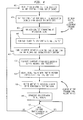
- the optimum replica cache assignment program 330 is described in the flow diagram of Fig. 4.
- the optimum replica cache assignment program 330 is based on an algorithm that performs a cost/benefit analysis of adding or deleting replica caches.
- the cost/benefit analysis algorithm will be described in greater detail below, in connection with an example of its application to a second network shown in Figs. 5 and 6.
- the assignment program 330 periodically updates this cost/benefit analysis based on updated traffic monitoring measurements from the remote regions of the network.
- the cost/benefit analysis algorithm determines if a critical threshold quantity of traffic has accumulated in a region that justifies setting up a replica cache on a new server.
- the cost/benefit analysis algorithm uses a minimum weight spanning tree analysis or a Steiner tree analysis to make that determination.
- the memory 302 in Fig. 3 stores the assignment message buffer 332 where the router 30 builds an assignment message 210, as shown in Fig. 2C.
- the assignment message 210 includes a field 212 specifying the destination router, a field 214 specifying the source router, and a field 216 specifying the new routing assignment computed by the cost/benefit analysis algorithm.
- Fig. 2F shows an example of the assignment message 210.
- the field 212 specifies a broadcast to destination routers 32, 34, 36, 38, and 39.
- the field 214 specified the source router as router 30.
- the assignment field 216 specifies an example of the new router table 336 shown in Fig. 2E.
- the assignment message 210 is broadcast to all other routers 32, 34, 36, 38, and 39 in the network.
- a replication message 802 shown in Fig. 2G is sent from the router 30 to the router 34, for example, to provide a copy of the data set as replica cache "A" to the new server 44 in region 24.
- the field 212 specifies a destination router 34.
- the field 214 specifies the source router as router 30.
- a corresponding replication message is sent from the router 30 to the router 38, for example, to provide a copy of the data set as replica cache "B" to the new server 48 in region 28.
- Fig. 1E shows the result of the reverse tree generation operation of the invention on the network of Fig. 1A, after the reassignment message 210 has been broadcast by router 30 to all other routers 32, 34, 36, 38, and 39 in the network.
- Fig. 2E shows the new router table for the updated organization of the network in Fig. 1E, where two additional replica caches have been created in the network.
- Replica cache "A" is a new copy of the data set stored in new server 44 in region 24.
- Router 34 handles all service requests to server 44.
- the service domain 60A for server 44 is the northwest region 24 and the southwest region 29.
- Router 34 in region 24 and router 39 in region 29 are controlled by the new router table 336 of Fig.
- Fig. 1F shows the result of the network periodically reorganizing itself into a primary cache and revised replica caches with revised service domains.
- router 30 periodically transmits a monitor request message to all of the other routers 32, 34, 36, 38, and 39 connected to the backbone network 10 requesting the other routers to monitor service requests originating in their regions, accessing the data set in either replica cache "A", replica cache "B", or primary cache "P".
- the routers 32, 34, 36, 38, and 39 receive the monitor request message 200 over their respective network adapters 308.
- the traffic monitoring program 329 reads the message 200 buffered in buffer 326 and performs the traffic monitoring operation.
- the traffic monitoring program 329 monitors all messages that the router handles and counts the number of service requests directed to server 40, or 44, or 48 that request access to the data set stored as the primary cache "P", the replica cache "A”, or the replica cache "B", respectively.
- the originating router 30 computes the optimum distribution of replicas of the data set stored as the primary cache "P". This is based on the traffic values in each remote region 22, 24, 26, 28, and 29 reported by each router 32, 34, 36, 38, and 39, and also as locally measured in region 20 by router 30.
- Fig. 1F shows the network of Fig.
- Router 39 handles all service requests to server 49.
- the service domain 60C for server 49 is the southwest region 292 and the south central region 28.
- Router 39 in region 29 and router 38 in region 28 are controlled by the new router table to redirect to the replica cache "C" on server 49, all of the service requests to access the data set that originate in regions 29 and 28.
- Primary cache "P" is the existing copy of the data set stored in original server 40 in region 20.
- Router 30 handles all service requests to server 40.
- the service domain 60 for server 40 is the northeast region 20 and the southeast region 26.
- Router 30 in region 20 and router 36 in region 26 are controlled by the new router table to redirect to the primary cache "P" on server 40, all of the service requests to access the data set that originate in regions 20 and 26.
- the network periodically reorganizes itself into a primary cache and revised replica caches with revised service domains to accommodate dynamically changing traffic patterns.
- the sum of the number of requests per unit times for all of the links is related to the bandwidth cost C[BW].
- the total cost C[T] of the existing distribution of caches includes the bandwidth cost C[BW] as a factor.
- the purpose of the optimum replica cache assignment program 330 is to find a distribution of replica caches storing the data set, that minimizes the total cost C[T].
- the cost/benefit analysis algorithm 415 is a type of minimum weight spanning tree analysis.
- Step 402 begins by calculating the total cost C[T] of the existing distribution of caches.
- a cost function is defined that takes into account the resources utilized and the various costs. This includes the opportunity cost in case a single server (or a series of servers) is overloaded and the potential customers drop out before being served.
- the bandwidth cost C[BW] is a function of the number of requests per unit times used on the individual links and is the product of a proportionality constant attributed to the number of requests per unit time, times the sum of the number of requests per unit times on each link.
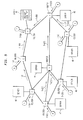
- the calculation of C[BW] can be illustrated with the example network shown in Fig. 5.
- Fig. 5 shows a second network with eight routers a, b, c, d, e, f, g, and h connecting eight user local access points 1, 2, 3, 4, 5, 6, 7, and 8 so that they can access a data set whose sole copy is stored as the primary cache "P" on server 40.
- Server 40 is connected by router “a” to the other routers b, c, d, e, f, g, and h in the network.
- Router "a” is currently handling 1000 requests per hour for a ten-megabyte file stored in primary cache "P" as part of the data set on server 40.
- reverse tree generation is used to dynamically reorganize the caches in the network in response to usage patterns.
- each user local access point makes a quantity of "T” requests for the ten-megabyte file stored in primary cache "P" as part of the data set on server 40.
- the value of "T” is the message traffic number of requests per unit time.
- each network link is monitored to pass a quantity of "T" requests for the ten-megabyte file stored in primary cache "P" as part of the data set on server 40.
- the eleven network links interconnecting the routers of Fig. 5 are monitored as follows.
- Step 410 finds the depth (the number of segments along the path to the link a-b) as three: segment d-h, segment h-b, and segment b-a. Then step 410 multiplies the depth value of three times the number of requests per unit time from router "d" of 250, resulting in a contribution of 750 from router "d". If router "d" were eliminated from contributing to the network link "a-b", then a cost of 750 could be avoided.
- server 49 is connected to router "d” in Fig. 5. If server 49 were made a replica server for the data set in primary cache "P”, then a cost of 750 would be avoided. However, this cost avoidance would have to be balanced against the cost of replicating the data set in server 49. This balancing is carried out in steps 414 and 416, as will be described later.
- Step 410 finds the depth (the number of segments along the path to the link) as two: segment h-b and segment b-a. Then step 410 multiplies the depth value of two times the number of requests per unit time from router "h" of 475, resulting in a contribution of 950 from router "h". If router "h" were eliminated from contributing to the network link "a-b", then a cost of 950 could be avoided.
- server 44 is connected to router "h” in Fig. 5. If server 44 were made a replica server for the data set in primary cache "P”, then a cost of 950 would be avoided. However, this cost avoidance would have to be balanced against the cost of replicating the data set in server 44. This balancing is carried out in steps 414 and 416, as will be described later.
- Step 410 finds the depth (the number of segments along the path to the link) as one: segment b-a. Then step 410 multiplies the depth value of one times the number of requests per unit time from the user local access point of 200, resulting in a contribution of 200 from user local access point 8. If user local access point 8 were eliminated from contributing to the network link "a-b", then a cost of 200 could be avoided.
- server 46 is connected to router "b" in Fig. 5. If server 46 were made a replica server for the data set in primary cache "P”, then a cost of 850 would be avoided. However, this cost avoidance would have to be balanced against the cost of replicating the data set in server 46. This balancing is carried out in steps 414 and 416, as will be described later.
- step 412 of Fig. 4 evaluates candidate server nodes based on the calculated depths and weights determined from steps 406, 408, and 410.
- Server 42 is connected by router "f” to the network.
- Server 44 is connected by router “h” to the network.
- Server 46 is connected by router “b” to the network.
- Server 47 is connected by router “e” to the network.
- Server 48 is connected by router "c” to the network.
- server 49 is connected by router "d” to the network.
- Step 412 uses the results of the loop performed by steps 406, 408, and 410, discussed above. If server 44 were made a replica server for the data set in primary cache "P”, then a cost of 950 would be avoided. If server 46 were made a replica server for the data set in primary cache "P”, then a cost of 850 would be avoided. If server 47 were made a replica server for the data set in primary cache "P”, then a cost of 675 would be avoided. If server 48 were made a replica server for the data set in primary cache "P”, then a cost of 350 would be avoided. If server 49 were made a replica server for the data set in primary cache "P”, then a cost of 750 would be avoided. Evaluating these results, step 412 determines that the best candidate for a replica cache is server 44 connected to router "h".
- step 414 of Fig. 4 creates a trial, new network traffic pattern. It does this by assigning the primary cache traffic previously directed from those routers near the candidate, replica cache server, to be redirected from going to the primary cache server, to going to the candidate server. Then step 414 calculates the total cost C[T] of the trial, new network traffic pattern.
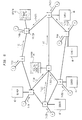
- Fig. 6 shows the network of Fig. 5, with the trial, new network traffic pattern directed to the candidate, replica cache "A" on server 44 and to the primary cache "P” on server 40.
- Step 414 assigns the primary cache traffic previously directed from those routers d, e, and f that are near the candidate, replica cache server 44, to be redirected from going to the primary cache server 40, to going to the candidate server 44.
- step 414 calculates the total cost C[T] of the trial, new network traffic pattern for the network of Fig. 6.
- the bandwidth cost C[BW] for the network of Fig. 6 is calculated in step 414 of Fig. 4, to be the product of a proportionality constant attributed to the number of requests per unit time, times the sum of the number of requests per unit times on each link.
- the number of requests per unit time cost per megabit is assumed to be 0.1.
- the sum of the values of "T" for the eleven network links is 1125.
- the bandwidth cost C[BW] calculated in step 414 for the network of Fig. 6 is 1125.
- Step 418 of Fig. 4 then loops back to step 402.
- the loop back to step 402 can be delayed at step 420 until new traffic monitoring data has been received by the router 30.
- the original existing router table 334 in Fig. 7A is discarded.
- the new router table 336 in Fig. 7B becomes the new existing router table.
- the optimum replica cache assignment program 330 of Fig. 4 periodically reassesses the traffic distribution in the network, thereby adapting it to changing traffic patterns.
- reverse tree generation is used to dynamically reorganize the caches in the network in response to usage patterns.
- This solves the problem of the dynamic nature of internet traffic, both over time and location. There are locations which are active at certain times of the day and at other times can be considered very inactive.
- the invention overcomes this by making its decision to replicate caches dynamically, based on usage patterns.
- the invention continuously updates "grow” decisions to add replica caches and "prune" decisions to delete them. This results a dynamic tree with servers at its dynamically changing core locations. Effectively, a minimum weight spanning tree is being built 'on the fly'. To avoid the accumulation of stale data at the replica cache servers, each of these servers will be continuously (if necessary) updated by using a protocol such as server cache synchronization protocol.
- One aspect in the implementation of the invention is the way users access the replicated cache server closest to them.
- One embodiment is to let users first reach their destination point and find out the tree structure for that application, and then establish connection to the node in the spanning tree that is most appropriate.
- An alternate embodiment is to treat each application as a multicast group, and users requesting to join the group be routed accordingly by Groupcast capable routers.
- Groupcast GC
- a GC router keeps track of an updated routing table, and under normal conditions will act as a regular router. As a new minimum weight spanning tree starts to be developed, the entries in the routing table are updated.
- the invention provides a way to change the distribution of replica caches, based on dynamic usage patterns.
- the invention accomplishes this by a reverse tree generation technique.
- the invention uses the opportunity cost of loosing unsuccessful customers, to dynamically optimize the distribution of replica caches.
- An additional feature of the monitoring process performed by the network routers is the collection of server hit information for the underlying data set application. This is useful for market research by the owner of the data set in the cache.
Landscapes
- Engineering & Computer Science (AREA)
- Computer Networks & Wireless Communication (AREA)
- Signal Processing (AREA)
- Databases & Information Systems (AREA)
- Theoretical Computer Science (AREA)
- General Engineering & Computer Science (AREA)
- Physics & Mathematics (AREA)
- General Physics & Mathematics (AREA)
- Data Mining & Analysis (AREA)
- Information Transfer Between Computers (AREA)
- Data Exchanges In Wide-Area Networks (AREA)
- Computer And Data Communications (AREA)
- Small-Scale Networks (AREA)
- Information Retrieval, Db Structures And Fs Structures Therefor (AREA)
Applications Claiming Priority (2)
| Application Number | Priority Date | Filing Date | Title |
|---|---|---|---|
| US08/871,106 US6189043B1 (en) | 1997-06-09 | 1997-06-09 | Dynamic cache replication in a internet environment through routers and servers utilizing a reverse tree generation |
| US871106 | 1997-06-09 |
Publications (3)
| Publication Number | Publication Date |
|---|---|
| EP0884870A2 true EP0884870A2 (de) | 1998-12-16 |
| EP0884870A3 EP0884870A3 (de) | 1999-12-01 |
| EP0884870B1 EP0884870B1 (de) | 2003-07-09 |
Family
ID=25356745
Family Applications (1)
| Application Number | Title | Priority Date | Filing Date |
|---|---|---|---|
| EP98304028A Expired - Lifetime EP0884870B1 (de) | 1997-06-09 | 1998-05-21 | Dynamische Cache-Speicher-Vervielfältigung durch Erzeugung eines umgekehrten Baums in einem Netzwerk |
Country Status (5)
| Country | Link |
|---|---|
| US (1) | US6189043B1 (de) |
| EP (1) | EP0884870B1 (de) |
| JP (1) | JP4344024B2 (de) |
| CA (1) | CA2237831C (de) |
| DE (1) | DE69816183T2 (de) |
Cited By (7)
| Publication number | Priority date | Publication date | Assignee | Title |
|---|---|---|---|---|
| WO2000041471A3 (de) * | 1999-01-11 | 2000-11-02 | Gailer Peter | Datenzugriffs- und -verwaltungssystem sowie verfahren zum datenzugriff und zur datenverwaltung für ein rechnersystem |
| EP1049028A3 (de) * | 1999-04-26 | 2001-01-31 | Sarnoff Corporation | Effiziente Endgebraucherinformationsverteilung |
| SG81307A1 (en) * | 1998-09-21 | 2001-06-19 | Ibm | Method and system in a computer network for the reliable and consistent ordering of client requests |
| GB2367393A (en) * | 2000-03-09 | 2002-04-03 | Avantis Ltd | Computer network |
| EP1298854A1 (de) * | 2001-10-01 | 2003-04-02 | Hewlett-Packard Company | Datenverteilung in einem gleichrangigen Netz |
| GB2385683A (en) * | 2002-02-22 | 2003-08-27 | Thirdspace Living Ltd | Distribution system with content replication |
| US7975042B2 (en) | 2001-05-01 | 2011-07-05 | International Business Machines Corporation | Method for adapting an internet web server to short-term changes in demand |
Families Citing this family (72)
| Publication number | Priority date | Publication date | Assignee | Title |
|---|---|---|---|---|
| SE507720C2 (sv) | 1997-06-12 | 1998-07-06 | Telia Ab | Arrangemang för lastbalansering i datornät |
| JPH1168795A (ja) * | 1997-08-26 | 1999-03-09 | Nec Corp | サーバボード方式 |
| US7035943B2 (en) * | 1998-05-29 | 2006-04-25 | Yahoo! Inc. | Web server content replication |
| US7143193B1 (en) * | 1998-05-29 | 2006-11-28 | Yahoo! Inc. | Content collection |
| US6976093B2 (en) | 1998-05-29 | 2005-12-13 | Yahoo! Inc. | Web server content replication |
| US7581006B1 (en) | 1998-05-29 | 2009-08-25 | Yahoo! Inc. | Web service |
| US6331984B1 (en) * | 1998-08-21 | 2001-12-18 | Nortel Networks Limited | Method for synchronizing network address translator (NAT) tables using the server cache synchronization protocol |
| US6477582B1 (en) * | 1998-12-16 | 2002-11-05 | Nortel Networks Limited | Method and apparatus for conservative link selection |
| US6438606B1 (en) * | 1998-12-23 | 2002-08-20 | Cisco Technology, Inc. | Router image support device |
| US6502175B1 (en) * | 1999-03-31 | 2002-12-31 | Lucent Technologies Inc. | Method and apparatus for locating caches in a network to optimize performance |
| US6751191B1 (en) | 1999-06-29 | 2004-06-15 | Cisco Technology, Inc. | Load sharing and redundancy scheme |
| US6457011B1 (en) * | 1999-07-23 | 2002-09-24 | Microsoft Corporation | Method of updating a shared database in a computer network |
| US7349979B1 (en) * | 1999-12-02 | 2008-03-25 | Cisco Technology, Inc. | Method and apparatus for redirecting network traffic |
| US6839829B1 (en) | 2000-01-18 | 2005-01-04 | Cisco Technology, Inc. | Routing protocol based redundancy design for shared-access networks |
| US7058007B1 (en) | 2000-01-18 | 2006-06-06 | Cisco Technology, Inc. | Method for a cable modem to rapidly switch to a backup CMTS |
| US20020163889A1 (en) * | 2000-02-02 | 2002-11-07 | Yechiam Yemini | Method and apparatus for providing services on a dynamically addressed network |
| US6735623B1 (en) * | 2000-02-09 | 2004-05-11 | Mitch Prust | Method and system for accessing a remote storage area |
| US7162539B2 (en) * | 2000-03-16 | 2007-01-09 | Adara Networks, Inc. | System and method for discovering information objects and information object repositories in computer networks |
| US7395348B1 (en) * | 2000-06-05 | 2008-07-01 | Cisco Technology, Inc. | Network cache-based content routing |
| US6950853B2 (en) * | 2000-06-27 | 2005-09-27 | The Regents Of The University Of California | Multisite coordination in shared multicast trees |
| US6708161B2 (en) | 2000-09-26 | 2004-03-16 | I2 Technologies Us, Inc. | System and method for selective database indexing |
| US20020111870A1 (en) * | 2000-09-26 | 2002-08-15 | I2 Technologies, Inc. | System and method for identifying a product |
| US7590558B2 (en) * | 2000-09-26 | 2009-09-15 | I2 Technologies Us, Inc. | System and method for facilitating electronic commerce transactions |
| US7299255B2 (en) * | 2000-09-26 | 2007-11-20 | I2 Technologies Us, Inc. | System and method for migrating data in an electronic commerce system |
| US7743125B1 (en) * | 2000-11-09 | 2010-06-22 | General Electric Company | Computer multiple communications port unit |
| US7146429B2 (en) * | 2001-03-16 | 2006-12-05 | The Aerospace Corporation | Cooperative adaptive web caching routing and forwarding web content data requesting method |
| US7555561B2 (en) * | 2001-03-19 | 2009-06-30 | The Aerospace Corporation | Cooperative adaptive web caching routing and forwarding web content data broadcasting method |
| US20020184403A1 (en) * | 2001-04-06 | 2002-12-05 | Dahlin Michael D. | Methods for near-optimal bandwidth-constrained placement in a wide-area network |
| US7349868B2 (en) * | 2001-05-15 | 2008-03-25 | I2 Technologies Us, Inc. | Pre-qualifying sellers during the matching phase of an electronic commerce transaction |
| US6983276B2 (en) * | 2001-05-15 | 2006-01-03 | I2 Technologies Us, Inc. | Facilitating electronic commerce transactions using buyer profiles |
| US7475030B1 (en) | 2001-05-16 | 2009-01-06 | I2 Technologies Us, Inc. | Facilitating electronic commerce transactions using a shared product data repository |
| US7263515B1 (en) * | 2001-06-18 | 2007-08-28 | I2 Technologies Us, Inc. | Content enhancement in an electronic marketplace |
| US7881208B1 (en) | 2001-06-18 | 2011-02-01 | Cisco Technology, Inc. | Gateway load balancing protocol |
| US7330829B1 (en) | 2001-06-26 | 2008-02-12 | I2 Technologies Us, Inc. | Providing market feedback associated with electronic commerce transactions to sellers |
| US7809672B1 (en) | 2001-06-28 | 2010-10-05 | I2 Technologies Us, Inc. | Association of data with a product classification schema |
| US8086643B1 (en) | 2001-06-28 | 2011-12-27 | Jda Software Group, Inc. | Translation between product classification schemas |
| US7346560B1 (en) | 2001-06-29 | 2008-03-18 | I2 Technologies Us, Inc. | Protecting content from unauthorized reproduction |
| US7162453B1 (en) | 2001-06-29 | 2007-01-09 | I2 Technologies Us, Inc. | Protecting content from unauthorized reproduction |
| US7290059B2 (en) * | 2001-08-13 | 2007-10-30 | Intel Corporation | Apparatus and method for scalable server load balancing |
| US7409396B2 (en) * | 2002-02-08 | 2008-08-05 | Pitts William M | Method for creating an extensible content distribution framework |
| US7412424B1 (en) | 2002-03-19 | 2008-08-12 | I2 Technologies Us, Inc. | Third party certification of content in electronic commerce transactions |
| US8516114B2 (en) * | 2002-03-29 | 2013-08-20 | International Business Machines Corporation | Method and apparatus for content pre-fetching and preparation |
| JP3729265B2 (ja) * | 2002-08-22 | 2005-12-21 | 日本電気株式会社 | ネットワークシステム、スパニングツリー構成方法、スパニングツリー構成ノード、及びスパニングツリー構成プログラム |
| US7111128B2 (en) * | 2002-12-19 | 2006-09-19 | Intel Corporation | Hierarchical virtual model of a cache hierarchy in a multiprocessor system |
| US7917646B2 (en) * | 2002-12-19 | 2011-03-29 | Intel Corporation | Speculative distributed conflict resolution for a cache coherency protocol |
| US6922756B2 (en) * | 2002-12-19 | 2005-07-26 | Intel Corporation | Forward state for use in cache coherency in a multiprocessor system |
| US20040260745A1 (en) * | 2003-06-18 | 2004-12-23 | Gage Christopher A. S. | Load balancer performance using affinity modification |
| US7593346B2 (en) | 2003-07-31 | 2009-09-22 | Cisco Technology, Inc. | Distributing and balancing traffic flow in a virtual gateway |
| US8655755B2 (en) * | 2003-10-22 | 2014-02-18 | Scottrade, Inc. | System and method for the automated brokerage of financial instruments |
| US7856493B1 (en) * | 2004-03-17 | 2010-12-21 | Cisco Technology, Inc. | Method and apparatus providing device-initiated network management |
| US20050240734A1 (en) * | 2004-04-27 | 2005-10-27 | Batson Brannon J | Cache coherence protocol |
| US20050262250A1 (en) * | 2004-04-27 | 2005-11-24 | Batson Brannon J | Messaging protocol |
| US7822929B2 (en) * | 2004-04-27 | 2010-10-26 | Intel Corporation | Two-hop cache coherency protocol |
| CA2595254C (en) * | 2005-01-06 | 2013-10-01 | Tervela, Inc. | Hardware-based messaging appliance |
| WO2006074109A2 (en) * | 2005-01-06 | 2006-07-13 | Tervela, Inc. | A caching engine in a messaging system |
| US8010644B1 (en) * | 2005-02-23 | 2011-08-30 | Sprint Communications Company L.P. | Method and system for deploying a network monitoring service within a communication network |
| US7395381B2 (en) * | 2005-03-18 | 2008-07-01 | Intel Corporation | Method and an apparatus to reduce network utilization in a multiprocessor system |
| US8589530B2 (en) * | 2005-03-28 | 2013-11-19 | Riverbed Technology, Inc. | Method and system for managing a distributed network of network monitoring devices |
| JP4635682B2 (ja) * | 2005-03-29 | 2011-02-23 | ブラザー工業株式会社 | 情報処理装置、情報処理方法及び情報処理用プログラム |
| US20060224773A1 (en) * | 2005-03-31 | 2006-10-05 | International Business Machines Corporation | Systems and methods for content-aware load balancing |
| US7849165B2 (en) | 2005-04-21 | 2010-12-07 | Fiducci Thomas E | Data backup, storage, transfer, and retrieval system, method and computer program product |
| US8126990B2 (en) | 2005-04-21 | 2012-02-28 | Fiducci Thomas E | Data backup and transfer system, method and computer program product |
| JP4786255B2 (ja) * | 2005-08-29 | 2011-10-05 | 株式会社日立製作所 | ストレージシステム及び記憶制御方法 |
| JP2007128371A (ja) * | 2005-11-04 | 2007-05-24 | Fujitsu Ltd | コンテンツ検索システム |
| US20070147376A1 (en) * | 2005-12-22 | 2007-06-28 | Sun Microsystems, Inc. | Router-assisted DDoS protection by tunneling replicas |
| CN101764833B (zh) * | 2008-12-24 | 2013-01-23 | 中国移动通信集团公司 | 一种资源节点信息通知方法及网络实体装置 |
| CN101778005B (zh) * | 2010-03-05 | 2014-03-12 | 中兴通讯股份有限公司 | 复杂网络配置方法和系统 |
| JP5419909B2 (ja) * | 2011-02-18 | 2014-02-19 | 日本電信電話株式会社 | キャッシュ設計装置、及びキャッシュ設計方法 |
| CN109558990B (zh) * | 2018-12-15 | 2022-11-08 | 国网福建省电力有限公司 | 一种基于斯坦纳树模型的配电网防灾骨干网架规划方法 |
| US12166624B1 (en) | 2021-12-10 | 2024-12-10 | Amazon Technologies, Inc. | Network endpoint with failure recovery and traffic redistribution |
| US12099519B1 (en) * | 2021-12-10 | 2024-09-24 | Amazon Technologies, Inc. | Replicated events in a multi-region network |
| US12500887B1 (en) | 2022-12-12 | 2025-12-16 | Amazon Technologies, Inc. | Automated authorization verification of events received for an event bus |
Family Cites Families (23)
| Publication number | Priority date | Publication date | Assignee | Title |
|---|---|---|---|---|
| US5475842A (en) * | 1993-08-11 | 1995-12-12 | Xerox Corporation | Method of compilation optimization using an N-dimensional template for relocated and replicated alignment of arrays in data-parallel programs for reduced data communication during execution |
| US5450313A (en) * | 1994-03-24 | 1995-09-12 | Xerox Corporation | Generating local addresses and communication sets for data-parallel programs |
| US5495419A (en) * | 1994-04-19 | 1996-02-27 | Lsi Logic Corporation | Integrated circuit physical design automation system utilizing optimization process decomposition and parallel processing |
| US5535195A (en) | 1994-05-06 | 1996-07-09 | Motorola, Inc. | Method for efficient aggregation of link metrics |
| US5608649A (en) | 1994-05-16 | 1997-03-04 | Gopinath; Bhaskarpillai | Directly programmable networks |
| EP0684716B1 (de) | 1994-05-25 | 2002-02-27 | International Business Machines Corporation | Datenübertragungsnetz und Verfahren zum Betreiben des Netzes |
| US5581753A (en) * | 1994-09-28 | 1996-12-03 | Xerox Corporation | Method for providing session consistency guarantees |
| US5758257A (en) * | 1994-11-29 | 1998-05-26 | Herz; Frederick | System and method for scheduling broadcast of and access to video programs and other data using customer profiles |
| US5774668A (en) * | 1995-06-07 | 1998-06-30 | Microsoft Corporation | System for on-line service in which gateway computer uses service map which includes loading condition of servers broadcasted by application servers for load balancing |
| US6181867B1 (en) * | 1995-06-07 | 2001-01-30 | Intervu, Inc. | Video storage and retrieval system |
| US6097882A (en) * | 1995-06-30 | 2000-08-01 | Digital Equipment Corporation | Method and apparatus of improving network performance and network availability in a client-server network by transparently replicating a network service |
| US5903723A (en) * | 1995-12-21 | 1999-05-11 | Intel Corporation | Method and apparatus for transmitting electronic mail attachments with attachment references |
| US5781901A (en) * | 1995-12-21 | 1998-07-14 | Intel Corporation | Transmitting electronic mail attachment over a network using a e-mail page |
| US5771355A (en) * | 1995-12-21 | 1998-06-23 | Intel Corporation | Transmitting electronic mail by either reference or value at file-replication points to minimize costs |
| US5864854A (en) * | 1996-01-05 | 1999-01-26 | Lsi Logic Corporation | System and method for maintaining a shared cache look-up table |
| US5805824A (en) * | 1996-02-28 | 1998-09-08 | Hyper-G Software Forchungs-Und Entwicklungsgesellschaft M.B.H. | Method of propagating data through a distributed information system |
| US5854899A (en) * | 1996-05-09 | 1998-12-29 | Bay Networks, Inc. | Method and apparatus for managing virtual circuits and routing packets in a network/subnetwork environment |
| US6061332A (en) * | 1996-06-25 | 2000-05-09 | Mci Communications Corporation | System and method for the automated configuration of network elements in a telecommunications network |
| US5920697A (en) * | 1996-07-11 | 1999-07-06 | Microsoft Corporation | Method of automatic updating and use of routing information by programmable and manual routing information configuration based on least lost routing |
| US6052718A (en) * | 1997-01-07 | 2000-04-18 | Sightpath, Inc | Replica routing |
| US5924116A (en) * | 1997-04-02 | 1999-07-13 | International Business Machines Corporation | Collaborative caching of a requested object by a lower level node as a function of the caching status of the object at a higher level node |
| US6011782A (en) * | 1997-05-08 | 2000-01-04 | At&T Corp. | Method for managing multicast addresses for transmitting and receiving multimedia conferencing information on an internet protocol (IP) network |
| US6070191A (en) * | 1997-10-17 | 2000-05-30 | Lucent Technologies Inc. | Data distribution techniques for load-balanced fault-tolerant web access |
-
1997
- 1997-06-09 US US08/871,106 patent/US6189043B1/en not_active Expired - Lifetime
-
1998
- 1998-05-19 CA CA002237831A patent/CA2237831C/en not_active Expired - Fee Related
- 1998-05-21 DE DE69816183T patent/DE69816183T2/de not_active Expired - Fee Related
- 1998-05-21 EP EP98304028A patent/EP0884870B1/de not_active Expired - Lifetime
- 1998-06-09 JP JP16046398A patent/JP4344024B2/ja not_active Expired - Fee Related
Cited By (14)
| Publication number | Priority date | Publication date | Assignee | Title |
|---|---|---|---|---|
| SG81307A1 (en) * | 1998-09-21 | 2001-06-19 | Ibm | Method and system in a computer network for the reliable and consistent ordering of client requests |
| USRE40521E1 (en) | 1999-01-11 | 2008-09-23 | Ac Technologies S.A. | Data access and management system as well as a method for data access and data management for a computer system |
| DE19900636B4 (de) * | 1999-01-11 | 2004-01-15 | Gailer, Peter | Datenzugriffs- und -verwaltungssystem sowie Verfahren zum Datenzugriff und zur Datenverwaltung für ein Rechnersystem sowie deren Verwendung |
| DE19900636B8 (de) * | 1999-01-11 | 2005-04-07 | Gailer, Peter | Datenzugriffs- und -verwaltungssystem sowie Verfahren zum Datenzugriff und zur Datenverwaltung für ein Rechnersystem sowie deren Verwendung |
| US7000084B2 (en) | 1999-01-11 | 2006-02-14 | Thomas Binzinger | Data access and management system as well as a method for data access and data management for a computer system |
| WO2000041471A3 (de) * | 1999-01-11 | 2000-11-02 | Gailer Peter | Datenzugriffs- und -verwaltungssystem sowie verfahren zum datenzugriff und zur datenverwaltung für ein rechnersystem |
| US7904680B2 (en) | 1999-01-11 | 2011-03-08 | Ac Technologies S.A. | Data access management system as well as a method for data access and data management for a computer system |
| US8656125B2 (en) | 1999-01-11 | 2014-02-18 | Ac Technologies, S.A. | Data access and management system as well as a method for data access and data management for a computer system |
| US9787771B2 (en) | 1999-01-11 | 2017-10-10 | Ac Technologies S.A. | Data access and management system as well as a method for data access and data management for a computer system |
| EP1049028A3 (de) * | 1999-04-26 | 2001-01-31 | Sarnoff Corporation | Effiziente Endgebraucherinformationsverteilung |
| GB2367393A (en) * | 2000-03-09 | 2002-04-03 | Avantis Ltd | Computer network |
| US7975042B2 (en) | 2001-05-01 | 2011-07-05 | International Business Machines Corporation | Method for adapting an internet web server to short-term changes in demand |
| EP1298854A1 (de) * | 2001-10-01 | 2003-04-02 | Hewlett-Packard Company | Datenverteilung in einem gleichrangigen Netz |
| GB2385683A (en) * | 2002-02-22 | 2003-08-27 | Thirdspace Living Ltd | Distribution system with content replication |
Also Published As
| Publication number | Publication date |
|---|---|
| JP4344024B2 (ja) | 2009-10-14 |
| EP0884870B1 (de) | 2003-07-09 |
| US6189043B1 (en) | 2001-02-13 |
| EP0884870A3 (de) | 1999-12-01 |
| CA2237831A1 (en) | 1998-12-09 |
| JPH1145204A (ja) | 1999-02-16 |
| DE69816183T2 (de) | 2004-06-03 |
| CA2237831C (en) | 2002-07-30 |
| DE69816183D1 (de) | 2003-08-14 |
Similar Documents
| Publication | Publication Date | Title |
|---|---|---|
| US6189043B1 (en) | Dynamic cache replication in a internet environment through routers and servers utilizing a reverse tree generation | |
| Genova et al. | Challenges in URL switching for implementing globally distributed web sites | |
| USRE44363E1 (en) | Arrangement for load sharing in computer networks | |
| US6377972B1 (en) | High quality streaming multimedia | |
| EP0599764B1 (de) | Verteilte Durchführung von Routenauswahl über Netzwerke und Teilnetzwerke | |
| US6484204B1 (en) | System and method for allocating requests for objects and managing replicas of objects on a network | |
| US7769823B2 (en) | Method and system for distributing requests for content | |
| EP0348327B1 (de) | Verfahren zur Auswahl eines optimalen Weges zwischen Knoten in einem Datenkommunikationsnetz | |
| US5101348A (en) | Method of reducing the amount of information included in topology database update messages in a data communications network | |
| US5987233A (en) | Comprehensive global information network broadcasting system and implementation thereof | |
| EP0921661B1 (de) | Weglenkungsverfahren unter Anwendung eines genetischen Algorithmus | |
| JPH0766835A (ja) | 通信ネットワークおよび該ネットワークでの経路選択方法 | |
| EP1723763A1 (de) | Cache-server-netzwerk und verfahren zur einteilung der verteilung von inhaltsdateien | |
| JPH1117704A (ja) | 通信網内の承認制御の実時間制御アーキテクチャ | |
| US20030028636A1 (en) | System and method for workload-aware request distribution in cluster-based network servers | |
| KR20010075542A (ko) | 협동 캐시 서버의 부하 조정 방법 | |
| Baker et al. | Distributed cooperative Web servers | |
| CA2320261A1 (en) | Subscriber-based server network | |
| EP0876034A3 (de) | Verfahren zum Inhaltswiederauffinden über ein Netzwerk | |
| WO2004073269A1 (ja) | 伝送システム,配信経路制御装置,負荷情報収集装置および配信経路制御方法 | |
| KR20020048399A (ko) | 인터넷워크에서의 로버스트 및 스칼라 서비스-노드 위치를위한 근접-기반 방향 전환 시스템 | |
| US20040199664A1 (en) | Method and system for improving a route along which data is sent using an ip protocol in a data communications network | |
| JP2003122658A (ja) | データ配送方法 | |
| EP1009130A1 (de) | Verteilte Verzeichnisdienste zur Ortung von Netzresourcen in einem sehr grossen Paketvermittlungsnetz | |
| JP2003085032A (ja) | 自己組織化キャッシュ方法およびその方法を利用可能なキャッシュサーバ |
Legal Events
| Date | Code | Title | Description |
|---|---|---|---|
| PUAI | Public reference made under article 153(3) epc to a published international application that has entered the european phase |
Free format text: ORIGINAL CODE: 0009012 |
|
| AK | Designated contracting states |
Kind code of ref document: A2 Designated state(s): DE FR GB IT SE |
|
| AX | Request for extension of the european patent |
Free format text: AL;LT;LV;MK;RO;SI |
|
| PUAL | Search report despatched |
Free format text: ORIGINAL CODE: 0009013 |
|
| RIC1 | Information provided on ipc code assigned before grant |
Free format text: 6H 04L 12/26 A, 6G 06F 17/30 B, 6H 04L 29/06 B, 6G 06F 9/46 B |
|
| AK | Designated contracting states |
Kind code of ref document: A3 Designated state(s): AT BE CH CY DE DK ES FI FR GB GR IE IT LI LU MC NL PT SE |
|
| AX | Request for extension of the european patent |
Free format text: AL;LT;LV;MK;RO;SI |
|
| 17P | Request for examination filed |
Effective date: 20000523 |
|
| AKX | Designation fees paid |
Free format text: DE FR GB IT SE |
|
| 17Q | First examination report despatched |
Effective date: 20011023 |
|
| GRAH | Despatch of communication of intention to grant a patent |
Free format text: ORIGINAL CODE: EPIDOS IGRA |
|
| GRAH | Despatch of communication of intention to grant a patent |
Free format text: ORIGINAL CODE: EPIDOS IGRA |
|
| GRAA | (expected) grant |
Free format text: ORIGINAL CODE: 0009210 |
|
| AK | Designated contracting states |
Designated state(s): DE FR GB IT SE |
|
| PG25 | Lapsed in a contracting state [announced via postgrant information from national office to epo] |
Ref country code: IT Free format text: LAPSE BECAUSE OF FAILURE TO SUBMIT A TRANSLATION OF THE DESCRIPTION OR TO PAY THE FEE WITHIN THE PRESCRIBED TIME-LIMIT;WARNING: LAPSES OF ITALIAN PATENTS WITH EFFECTIVE DATE BEFORE 2007 MAY HAVE OCCURRED AT ANY TIME BEFORE 2007. THE CORRECT EFFECTIVE DATE MAY BE DIFFERENT FROM THE ONE RECORDED. Effective date: 20030709 |
|
| REG | Reference to a national code |
Ref country code: GB Ref legal event code: FG4D |
|
| REF | Corresponds to: |
Ref document number: 69816183 Country of ref document: DE Date of ref document: 20030814 Kind code of ref document: P |
|
| PG25 | Lapsed in a contracting state [announced via postgrant information from national office to epo] |
Ref country code: SE Free format text: LAPSE BECAUSE OF FAILURE TO SUBMIT A TRANSLATION OF THE DESCRIPTION OR TO PAY THE FEE WITHIN THE PRESCRIBED TIME-LIMIT Effective date: 20031009 |
|
| ET | Fr: translation filed | ||
| PLBE | No opposition filed within time limit |
Free format text: ORIGINAL CODE: 0009261 |
|
| STAA | Information on the status of an ep patent application or granted ep patent |
Free format text: STATUS: NO OPPOSITION FILED WITHIN TIME LIMIT |
|
| 26N | No opposition filed |
Effective date: 20040414 |
|
| PGFP | Annual fee paid to national office [announced via postgrant information from national office to epo] |
Ref country code: DE Payment date: 20090529 Year of fee payment: 12 |
|
| PGFP | Annual fee paid to national office [announced via postgrant information from national office to epo] |
Ref country code: FR Payment date: 20100525 Year of fee payment: 13 |
|
| PGFP | Annual fee paid to national office [announced via postgrant information from national office to epo] |
Ref country code: GB Payment date: 20100401 Year of fee payment: 13 |
|
| PG25 | Lapsed in a contracting state [announced via postgrant information from national office to epo] |
Ref country code: DE Free format text: LAPSE BECAUSE OF NON-PAYMENT OF DUE FEES Effective date: 20101201 |
|
| GBPC | Gb: european patent ceased through non-payment of renewal fee |
Effective date: 20110521 |
|
| REG | Reference to a national code |
Ref country code: FR Ref legal event code: ST Effective date: 20120131 |
|
| PG25 | Lapsed in a contracting state [announced via postgrant information from national office to epo] |
Ref country code: FR Free format text: LAPSE BECAUSE OF NON-PAYMENT OF DUE FEES Effective date: 20110531 |
|
| PG25 | Lapsed in a contracting state [announced via postgrant information from national office to epo] |
Ref country code: GB Free format text: LAPSE BECAUSE OF NON-PAYMENT OF DUE FEES Effective date: 20110521 |