EP0884886A2 - Echokompensator mit Mehrschrittweitenfaktor - Google Patents
Echokompensator mit Mehrschrittweitenfaktor Download PDFInfo
- Publication number
- EP0884886A2 EP0884886A2 EP98107970A EP98107970A EP0884886A2 EP 0884886 A2 EP0884886 A2 EP 0884886A2 EP 98107970 A EP98107970 A EP 98107970A EP 98107970 A EP98107970 A EP 98107970A EP 0884886 A2 EP0884886 A2 EP 0884886A2
- Authority
- EP
- European Patent Office
- Prior art keywords
- background noise
- local background
- residual signal
- tap coefficients
- noise
- Prior art date
- Legal status (The legal status is an assumption and is not a legal conclusion. Google has not performed a legal analysis and makes no representation as to the accuracy of the status listed.)
- Withdrawn
Links
- 230000003044 adaptive effect Effects 0.000 claims abstract description 21
- 230000035945 sensitivity Effects 0.000 claims abstract description 7
- 238000000034 method Methods 0.000 claims description 18
- 238000000638 solvent extraction Methods 0.000 claims description 6
- 230000000694 effects Effects 0.000 description 7
- 238000004364 calculation method Methods 0.000 description 4
- 238000004891 communication Methods 0.000 description 4
- 238000010586 diagram Methods 0.000 description 4
- 238000009499 grossing Methods 0.000 description 4
- 230000008030 elimination Effects 0.000 description 3
- 238000003379 elimination reaction Methods 0.000 description 3
- 230000005540 biological transmission Effects 0.000 description 2
- 230000015572 biosynthetic process Effects 0.000 description 2
- 238000006243 chemical reaction Methods 0.000 description 2
- 238000003786 synthesis reaction Methods 0.000 description 2
- 230000009286 beneficial effect Effects 0.000 description 1
- 230000000295 complement effect Effects 0.000 description 1
- 230000007423 decrease Effects 0.000 description 1
- 238000001914 filtration Methods 0.000 description 1
- 230000006870 function Effects 0.000 description 1
- 238000012544 monitoring process Methods 0.000 description 1
- 230000003595 spectral effect Effects 0.000 description 1
Images


Classifications
-
- H—ELECTRICITY
- H04—ELECTRIC COMMUNICATION TECHNIQUE
- H04M—TELEPHONIC COMMUNICATION
- H04M9/00—Arrangements for interconnection not involving centralised switching
- H04M9/08—Two-way loud-speaking telephone systems with means for conditioning the signal, e.g. for suppressing echoes for one or both directions of traffic
- H04M9/082—Two-way loud-speaking telephone systems with means for conditioning the signal, e.g. for suppressing echoes for one or both directions of traffic using echo cancellers
Definitions
- the present invention relates to an echo canceler for removing echo from an input signal in which local background noise is also present.
- Echo cancelers are used in videoconferencing terminals, mobile telephone sets, and the like, to prevent the party at the far end from being distracted by hearing an echo of his or her own voice.
- the echo canceler has an adaptive filter that operates on the signal received from the far end to predict the echo that this signal will produce. The predicted echo is subtracted from the local input signal to remove the echo from the signal sent back to the far end.
- the tap coefficients of the adaptive filter are adjusted by a mathematical algorithm, such as the well-known normalized least mean squares (NLMS) algorithm, that forces the coefficients to converge to values matching the impulse response of the echo path.
- NLMS normalized least mean squares
- the best time to adjust the tap coefficients is when the party at the far end is speaking and the party at the near end is not speaking.
- Most echo cancelers confine tap-coefficient adjustments to this so-called single-talk state, which can be detected by monitoring the power of the signals involved.
- the local background noise has components that do not average out to zero. Examples of such components include engine noise in an automobile, ventilator noise inside buildings, and crowd noise in the outdoor environments in which portable telephone sets are often used.
- the summational NLMS algorithm fails to protect the adaptive filter from the effects of this type of local background noise.
- the summational NLMS algorithm works well only when the local background noise has certain statistical characteristics, such as the characteristics of white noise.
- the echo canceler may be combined with a noise canceler that removes at least some of the local background noise components from the outgoing signal. This makes the residual echo easier to detect, but the noise canceler's internal characteristics can affect the adjustment of the echo canceler's tap coefficients, and in any case, cancellation of the local background noise is rarely complete.
- a further object is to improve echo cancellation when local background noise is also canceled.
- the invented echo cancellation method employs an adaptive filter, and adjusts the tap coefficients of the adaptive filter according to a residual signal left after echo cancellation, using an algorithm in which a step gain determines the sensitivity of the adjustment to the residual signal.
- the echo cancellation method comprises the steps of:
- a preferred method of partitioning the tap coefficients calculates smoothed absolute values of the tap coefficients, calculates the noise power of the residual signal, and compares the smoothed absolute values of the tap coefficients with the noise power.
- An echo canceler comprises a partitioner for partitioning the tap coefficients, and a step gain generator for assigning step gains.
- An echo cancellation method comprises at least the first two, and preferably all four, of the following steps:
- An echo canceler comprises a noise level classifier for classifying the local background noise level, and a step gain generator for selecting step gains.
- the echo canceler may be combined with a noise canceler that cancels noise in the residual signal; in that case, the noise level classifier chooses between the input and output of the noise canceler for use in adjusting the tap coefficients.
- the first embodiment operates in a communication device, such as a videoconferencing device or mobile telephone set, having an input terminal 1 for receiving a signal transmitted from a distant communication terminal, an analog-to-digital converter (ADC) 2 for converting the received signal to a digital signal X(n), a digital-to-analog converter (DAC) 3 for converting X(n) back to an analog signal, and a loudspeaker 4 through which the analog signal output by the DAC 3 is reproduced as an acoustic signal.
- a microphone 5 picks up part of the reproduced acoustic signal as an acoustic echo signal E.
- the microphone 5 also picks up a local background noise signal N and, when the local party is speaking, a local speech signal S.
- the microphone 5 converts these local acoustic input signals E, S, and N to an analog electrical signal, which is converted by an ADC 6 to a digital signal, denoted Y(n).
- An adder 7 adds the two's complement of an echo replica signal Y'(n), thereby subtracting Y'(n) from Y(n), to create a first residual signal e 1 (n).
- Noise cancellation (described below) creates a second residual signal e 2 (n) from the first residual signal e 1 (n).
- a selected one of the two residual signals e 1 (n) and e 2 (n) is converted to an analog signal by a DAC 8, and provided to an output terminal 9 for transmission to the distant communication terminal, referred to below as the far end.
- the letter 'n' above is a discrete time variable, designating a particular sample of the digital signals.
- the echo replica signal Y'(n) is generated by an adaptive filter 10 comprising a tap coefficient register 11, a multiplier 12, a sample register 13, and an accumulator 14.
- the tap coefficient register 11 stores tap coefficients, which the multiplier 12 multiplies by a sequence of samples representing the most recent samples of the far-end signal X(n), which are stored in the sample register 13.
- the accumulator 14 sums the results to obtain the echo replica Y'(n).
- the tap coefficients are adjusted by means of a noise power calculator 15, a partitioner 16, an absolute smoother 17, and a step gain generator 18.
- the partitioner 16 divides the tap coefficients into two segments.
- the step gain generator 18 generates separate step gains for the two segments, and uses these step gains to adjust the tap coefficients in each segment according to the NLMS algorithm.
- a noise canceler 19 is inserted between the adder 7 and DAC 8, to estimate signal components due to the local background noise N, and remove these noise components from the outgoing signal.
- the input signal of the noise canceler 19 is the first residual signal e 1 (n).
- the output signal of the noise canceler 19 is the second residual signal e 2 (n).
- the noise canceler 19 can employ any of various well-known noise cancellation methods, such as spectral subtraction, bandsplitting attenuation, or adaptive filtering, descriptions of which will be omitted.
- the two residual signals e 1 (n) and e 2 (n) are supplied to a noise level classifier 20, which selects one or both of the two residual signals for use in adjusting the tap coefficients.
- the residual signal used in adjusting the tap coefficients denoted e 3 (n) in the drawing, is supplied to the step gain generator 18.
- the noise level classifier 20 also selects which of the two residual signals e 1 (n) and e 2 (n) is sent to the DAC 8.
- the residual signal sent to the DAC 8 is not necessarily the same as the residual signal e 3 (n) supplied to the step gain generator 18.
- the adder 7, adaptive filter 10, noise power calculator 15, partitioner 16, absolute smoother 17, step gain generator 18, and noise level classifier 20 constitute the echo canceler 21.
- the adder 7 and adaptive filter 10 operate at all times.
- a double-talk detector (not visible) disables the noise power calculator 15, partitioner 16, absolute smoother 17, step gain generator 18, and noise level classifier 20 while the local party is speaking, so that the tap coefficients are not adjusted during these times.
- the double-talk detector also halts adjustment of the tap coefficients when the speaker at the far end is completely silent.
- the tap coefficients stored in the tap coefficient register 11 at time n will be denoted H m (n).
- the number of tap coefficients will be denoted by the letter I, so the subscript m varies from one to I.
- X m (n) The sample values stored in the sample register 13 at time n will be denoted X m (n), where m again varies from one to I.
- X 1 (n) is the most recent sample, equal to X(n) itself.
- X 2 (n) is the next most recent sample, equal to X(n - 1), and so on.
- the noise power calculator 15 calculates the power Np of the first residual signal e 1 (n).
- Np is referred to as a noise power value because, when local speech S is absent, e 1 (n) consists of local background noise and residual echo, which is also a type of noise.
- Np is calculated as a weighted average of the absolute value of e 1 (n) over an interval of samples, referred to as a frame.
- the noise power calculation can be carried out by an iterative smoothing operation described by the equation below, in which a 1 is a smoothing factor disposed strictly between zero and one (0 ⁇ a 1 ⁇ 1). A typical value of a 1 is 0.5, although the first embodiment is not limited to this value.
- Np(j) a 1 Np(j - 1) + ABS(e 1 (j))(1 - a 1 )
- ABS denotes the absolute value
- j is the sample number in the frame.
- the oldest sample in the frame is e 1 (1).
- the most recent sample is e 1 (J), where J is the number of samples per frame.
- the initial power value Np(0) is zero.
- the final power value Np(J) is the noise power value Np determined by the noise power calculator 15.
- the first embodiment is not limited to this method of calculating Np.
- An alternative method is to take the simple arithmetic average of the absolute values of the J sample values e 1 (j) in the frame.
- the noise power calculator 15 compares the calculated noise power value Np(J) with a predetermined threshold value, and supplies Np(J) to the partitioner 16 if Np(J) exceeds the threshold.
- the absolute smoother 17 supplies the partitioner 16 with a set of smoothed absolute values calculated from the tap coefficients stored in the tap coefficient register 11.
- the absolute smoother 17 performs, for example, the following iterative calculation, in which ⁇ is a smoothing factor (0 ⁇ ⁇ ⁇ 1).
- ⁇ is a smoothing factor, although the first embodiment is not limited to this value.
- the value of m is an integer from 1 to I, where I is the number of tap coefficients.
- ah 1 (m) is the absolute value of the m-th tap coefficient H m (n)
- avah 1 (m) is a weighted average of the first m tap coefficients.
- the initial weighted average value avah 1 (0) is equal to zero.
- the absolute smoother 17 supplies the partitioner 16 with a complete set of weighted average values from avah 1 (1) to avah 1 (I).
- the first embodiment is not limited to this method of calculating avah 1 (m).
- An alternative method is to calculate avah 1 (m) as the simple arithmetic average of the absolute values from ah 1 (1) to ah 1 (m).
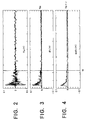
- FIG. 2 shows a typical example of the tap coefficients H m (n) at a time n.
- FIG. 3 shows the corresponding absolute values ah 1 (m).
- FIG. 4 shows the weighted average values avah 1 (m).
- the horizontal axis represents the tap number (m)
- the vertical axis represents the corresponding value of H m (n), ah 1 (m), or avah 1 (m).
- the calculation performed by the absolute smoother 17 can be seen to preserve the general trend of the absolute values of the tap coefficients, while smoothing out abrupt changes in these values.
- the partitioner 16 adds an offset ⁇ to the noise power value Np(J) and compares the result with the smoothed absolute values avah 1 (m), in descending order of the tap number m, starting from the I-th smoothed absolute value avah 1 (I).
- the tap number of the first smoothed tap coefficient that exceeds the sum of the noise power value Np(J) and offset ⁇ is set as a boundary tap number M.
- the partitioner 16 accordingly finds the maximum value of m for which the following inequality is satisfied. Np(J) + ⁇ ⁇ avah 1 (m)
- This boundary tap number M divides the tap coefficients into a first segment, from H 1 (n) to H M (n), and a second segment, from H M+1 (n) to H 1 (n).
- Np(J) and Np(J) + ⁇ are indicated as Np and Np + ⁇ in FIGs. 3 and 4, respectively.
- the step gain generator 18 uses the sample values of the far-end signal X m (n) stored in the sample register 13, the residual signal e 3 (n) supplied by the noise level classifier 20, the boundary value M supplied by the partitioner 16, and two step gain values ⁇ 1 and ⁇ 2 . Both step gain values are disposed in the interval from zero to one: for example, ⁇ 1 can be equal to 0.7, and ⁇ 2 to 0.125.
- the first embodiment is not limited to these particular values, but the first step gain ⁇ 1 must be greater than the second step gain ⁇ 2 .
- the first step gain ⁇ 1 is used only in the first segment of tap coefficients.
- the second step gain ⁇ 2 can be used in the second segment of tap coefficients, or in both segments.
- H m (n) denotes the value of the m-th tap coefficient H m (n) at time n
- H m (n + 1) denotes the adjusted value of the same tap coefficient H m (n) at time n + 1.
- the symbol ⁇ denotes summation over values of an index integer i from 1 to I.
- H m (n + 1) H m (n) + ⁇ 2 X m (n - d)e 3 (n)/( ⁇ X i (n - d)X i (n - d))
- the noise level classifier 20 classifies the local background noise on the basis of a pair of ratios, denoted NCANC and ACOM below.
- NCANC is a noise canceling ratio, equal to the magnitude ratio between the input e 1 (n) and output e 2 (n) of the noise canceler 19.
- ACOM is an acoustic echo attenuation ratio, equal to the magnitude ratio between the received signal X(n) and the output e 2 (n) of the noise canceler 19.
- the noise level classifier 20 compares NCANC with a predetermined threshold value ⁇ , and compares ACOM with another predetermined threshold value ⁇ .
- the noise level classifier 20 classifies the local background noise level as low, and selects the first residual signal e 1 (n) for input to both the DAC 8 and the step gain generator 18.
- the first residual signal e 1 (n) is used as e 3 (n) for adjusting all of the tap coefficients, and also becomes the signal transmitted from the output terminal 9, after digital-to-analog conversion by the DAC 8.
- the noise level classifier 20 classifies the local background noise level as high, and selects the second residual signal e 2 (n) for input to both the DAC 8 and the step gain generator 18.
- the second residual signal e 2 (n) is used as e 3 (n) for adjusting all of the tap coefficients, and also becomes the signal transmitted from the output terminal 9, after digital-to-analog conversion by the DAC 8. This selection is made regardless of the value of NCANC.
- the noise level classifier 20 classifies the local background noise level as intermediate, selects the second residual signal e 2 (n) for input to the DAC 8, and selects both residual signals for input to the step gain generator 18.
- the first residual signal e 1 (n) is used as e 3 (n) for adjusting the first segment of tap coefficlents.
- the second residual signal e 2 (n) is used as e 3 (n) for adjusting the second segment of tap coefficients.
- the echo canceler 21 can be implemented in hardware, as an application-specific integrated circuit, for example.
- the echo canceler 21 can also be implemented in software, by programming a general-purpose processor such as a digital signal processor to carry out the functions of the elements shown in FIG. 1.
- the echo canceler 21 is able to adjust the tap coefficients on the basis of a strong acoustic echo with comparatively little local interference, leading to accurate echo cancellation, so the condition ACOM ⁇ ⁇ will be satisfied. Since there is not much local background noise for the noise canceler 19 to remove, the condition NCANC ⁇ ⁇ will also be satisfied, and the noise level classifier 20 will classify the local background noise level as low. The noise canceler 19 is accordingly removed from the transmission path, and the first residual signal e 1 (n) is used for updating all of the tap coefficients. Echo cancellation is not affected by the internal characteristics of the noise canceler 19.
- the first M tap coefficients, constituting the first segment, are adjusted with the first step gain ⁇ 1 .
- most of these coefficients are larger in magnitude than the noise power value Np, so local background noise has a comparatively small effect on the adjustments made to these coefficients.
- Use of the comparatively large step gain ⁇ 1 allows the NLMS algorithm to converge quickly to the desired values of these tap coefficients, enabling rapid adjustment to changes in the echo path.
- the (M + 1)-th to I-th tap coefficients, constituting the second segment, are adjusted with the second step gain ⁇ 2 .
- These tap coefficients are more sensitive to noise effects, because their magnitude is generally comparable to, or less than, the noise level.
- Use of the comparatively small step gain ⁇ 2 prevents large, erratic adjustments from being made to these tap coefficients due to local background noise.
- the boundary M between the tap coefficients that are sensitive to local background noise and the tap coefflcients that are not sensitive to such noise may change, due to a change in the echo path, or due to an increase in the amount of local background noise. In either case, the result is an increase in the noise power Np calculated by the noise power calculator 15.
- the partitioner 16 recomputes the boundary M, by comparing Np plus the offset ⁇ with the smoothed tap coefficient values output by the absolute smoother 17. Adding the offset ⁇ to the noise power value Np prevents the echo canceler 21 from being overly sensitive to fluctuations in the noise level.
- the conditions NCANC ⁇ ⁇ and ACOM ⁇ ⁇ will be satisfied, causing the noise level classifier 20 to classify the local background noise level as intermediate.
- the second residual signal e 2 (n) in which the local background noise is reduced, is now sent to the far end.
- the tap coefficients in the second segment, which are more sensitive to noise, are now adjusted on the basis of the second residual signal e 2 (n), with the processing delay d of the noise canceler 19 included in the adjustment.
- Use of the second residual signal e 2 (n) and the comparatively small second step gain ⁇ 2 keeps large, erratic adjustments from being made.
- the tap coefficients in the first segment which are less sensitive to noise, continue to be adjusted on the basis of the first residual signal e 1 (n), using the comparatively large first step gain ⁇ 1 . Adjustments to changes in the echo path can therefore still be made comparatively rapidly. Since the first residual signal e 1 (n) contains the true residual echo, unmodified by the noise canceler 19, the adjustments can also be made accurately.
- the noise level classifier 20 detects an intermediate local background noise level
- the noise power Np detected by the noise power calculator 15 will exceed the threshold value for recomputing the boundary value M relatively frequently, and the partitioner 16 will keep the boundary positioned so that tap coefficients sensitive to local background noise are correctly placed in the second segment.
- the noise level classifier 20 classifies the local background noise level as high. This high classification means that the local background noise level is high in relation to the signal received from the far end. If the party at the far end is speaking, all tap coefficients are adjusted on the basis of the second residual signal e 2 (n), using the second step gain ⁇ 2 and delay d, and e 2 (n) is sent to the far end.
- the low echo attenuation ratio ACOM indicates that in the first residual signal e 1 (n), the residual echo is being disguised by local background noise, which is likely to prevent accurate adjustment of the tap coefficients. Beneficial adjustments may still be made using the second residual signal e 2 (n), however, in which the noise level is reduced.
- the comparatively small second step gain ⁇ 2 prevents the echo canceler 21 from being too strongly affected by the local background noise.
- the double-talk detector halts tap adjustment, as mentioned above.
- the noise canceler 19 When the party at the near end is speaking, since the noise canceler 19 must not remove the near-end speech component (S), the tap coefficients cannot be adjusted correctly, even using the second residual signal e 2 (n).
- the double-talk detector also prevents adjustment of the tap coefficients at these times. Echo cancellation continues, however, using the existing values of the tap coefficients.
- sensitive tap coefficients are protected from noise effects by use of a comparatively small step gain, and by use of the residual signal output from the noise canceler 19 when the local background noise level is classified as intermediate or high.
- tap coefficients which are not sensitive to noise are permitted to converge quickly, by use of a comparatively large step gain and use of the residual signal input to the noise canceler 19, unless the local background noise level is classified as high.
- the first embodiment adjusts the tap coefficients conservatively, using a small step gain and the residual signal output by the noise canceler 19 for all tap coefficients.
- the first embodiment can improve significantly on the performance of an echo canceler employing a single step gain for all tap coefficients. Moreover, unlike an echo canceler employing the summational NLMS algorithm, the first embodiment does not require the local background noise to have any particular statistical characteristics. A performance improvement is obtainable for all types of local background noise.
- FIG. 5 shows the second embodiment, using the same reference numerals as in FIG. 1 for equivalent elements.
- the second embodiment differs from the first embodiment in having no noise level classifier.
- the second residual signal e 2 (n) is always supplied to the DAC 8 and step gain generator 18, and is used for all tap-coefficient adjustments.
- the adaptive filter 10, noise power calculator 15, partitioner 16, and absolute smoother 17 operate as in the first embodiment.
- the step gain generator 18 adjusts the tap coefficients according to the following equation, using the comparatively large first step gain ⁇ 1 for the first segment of tap coefficients, using the comparatively small second step gain ⁇ 2 for the second segment of tap coefficients, and always using the quantity d to compensate for the processing delay of the noise canceler 19.
- the second embodiment protects sensitive tap coefficients from local background noise effects, by employing different step gains for the two segments, without relying on statistical properties of the local background noise.
- the second embodiment When implemented in hardware, the second embodiment is simpler than the first embodiment, due to the elimination of the noise level classifier. When implemented in software, the second embodiment can operate faster than the first embodiment, due to the elimination of computation required to calculate ACOM and NCANC. Further simplification and speed-up results from the elimination of the need to store data for these calculations.
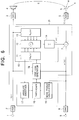
- FIG. 6 shows the third embodiment, using the same reference numerals as in FIGs. 1 and 5 for equivalent elements.
- the third embodiment differs from the preceding embodiments in having no noise canceler and no noise level classifier.
- the first residual signal e 1 (n) is always supplied to the DAC 8 and step gain generator 18, and is used for all tap-coefficient adjustments.
- the adaptive filter 10, noise power calculator 15, partitioner 16, absolute smoother 17, and step gain generator 18 operate as in the first embodiment.
- the step gain generator 18 adjusts the tap coefficients according to the equation given in the first embodiment for the case in which the first residual signal e 1 (n) was selected.
- This equation call be rewritten as follows.
- the third embodiment protects sensitive tap coefficients from local background noise effects, without relying on statistical properties of the local background noise.
- the third embodiment also shows that the invention can be practiced without noise cancellation.
- One variation divides the tap coefficients into more than two segments, by finding more than one boundary value, and uses a different step gain for each segment.
- Another variation uses an algorithm other than the NLMS algorithm to adjust the tap coefficients. Any algorithm having a step gain that determines the sensitivity of the adjustment to the residual signal can be employed.
- the noise power calculator 15 can calculate the noise power by summing squares of the residual signal values, instead of summing absolute values.
- the same two step gains ⁇ 1 and ⁇ 2 were used to cover all three levels of local background noise, but separate step gains can be provided for each level.
- ⁇ 1 and ⁇ 2 can be used at the low level
- a third step gain ⁇ 3 can be used at the high level
- a fourth step gain ⁇ 4 and fifth step gain ⁇ 5 can be used at the intermediate level.
- the number of different local background noise levels recognized by the noise level classifier is not limited to three.
- the noise level classifier can classify the local background noise into only two levels (high and low), for example, or into more than three levels.
- the noise level classifier classifies the local background noise level can also be varied.
- the acoustic echo attenuation ratio ACOM can be calculated from the first residual signal e 1 (n) instead of the second residual signal e 2 (n).
- ACOM can also be calculated as a power ratio instead of a magnitude ratio, or as a difference between absolute values instead of as a ratio.
- the step gain can be switched on the basis of the local background noise level alone, without dividing the tap coefficients into segments.
- This variation can be practiced by eliminating the noise power calculator, partitioner, and absolute smoother from the first embodiment.
- the step gain generator uses the same step gain for all tap coefficients, but generates different step gains according to the local background noise level as detected by the noise level classifier.
- the invention can be applied in automobile navigation equipment having a human interface that employs speech synthesis and speech recognition systems, to prevent the speech recognition system from being confused by the acoustic output of the speech synthesis system.
Landscapes
- Engineering & Computer Science (AREA)
- Signal Processing (AREA)
- Cable Transmission Systems, Equalization Of Radio And Reduction Of Echo (AREA)
- Telephone Function (AREA)
- Soundproofing, Sound Blocking, And Sound Damping (AREA)
- Circuit For Audible Band Transducer (AREA)
Applications Claiming Priority (3)
| Application Number | Priority Date | Filing Date | Title |
|---|---|---|---|
| JP15342897A JP3361724B2 (ja) | 1997-06-11 | 1997-06-11 | エコーキャンセラ装置 |
| JP15342897 | 1997-06-11 | ||
| JP153428/97 | 1997-06-11 |
Publications (2)
| Publication Number | Publication Date |
|---|---|
| EP0884886A2 true EP0884886A2 (de) | 1998-12-16 |
| EP0884886A3 EP0884886A3 (de) | 1999-08-04 |
Family
ID=15562307
Family Applications (1)
| Application Number | Title | Priority Date | Filing Date |
|---|---|---|---|
| EP98107970A Withdrawn EP0884886A3 (de) | 1997-06-11 | 1998-04-30 | Eckokompensator mit Mehrschrittweitenfaktor |
Country Status (5)
| Country | Link |
|---|---|
| US (2) | US6236725B1 (de) |
| EP (1) | EP0884886A3 (de) |
| JP (1) | JP3361724B2 (de) |
| KR (1) | KR19990006701A (de) |
| CN (1) | CN1223108C (de) |
Cited By (7)
| Publication number | Priority date | Publication date | Assignee | Title |
|---|---|---|---|---|
| WO2002005555A1 (en) * | 2000-07-11 | 2002-01-17 | Samsung Electronics Co., Ltd. | Repetitive-pn1023-sequence echo-cancellation reference signal for single-carrier digital television broadcast systems |
| US6597787B1 (en) | 1999-07-29 | 2003-07-22 | Telefonaktiebolaget L M Ericsson (Publ) | Echo cancellation device for cancelling echos in a transceiver unit |
| US6891948B2 (en) * | 2000-11-27 | 2005-05-10 | Oki Electric Industry Co., Ltd. | Echo canceller |
| EP1681899A1 (de) * | 2005-01-12 | 2006-07-19 | Yamaha Corporation | Audioverstärker mit Rückkopplungsunterdrückung |
| WO2009029605A1 (en) * | 2007-08-31 | 2009-03-05 | Motorola, Inc. | Acoustic echo cancellation based on noise environment |
| GB2515592A (en) * | 2013-12-23 | 2014-12-31 | Imagination Tech Ltd | Echo path change detector |
| DE112007003683B4 (de) * | 2007-10-12 | 2018-09-27 | Fujitsu Limited | Echounterdrückungssystem, Echounterdrückungsverfahren, Klangausgabevorrichtung, Audiosystem, Navigationssystem und mobiles Objekt |
Families Citing this family (35)
| Publication number | Priority date | Publication date | Assignee | Title |
|---|---|---|---|---|
| US7853024B2 (en) * | 1997-08-14 | 2010-12-14 | Silentium Ltd. | Active noise control system and method |
| IL121555A (en) * | 1997-08-14 | 2008-07-08 | Silentium Ltd | Active acoustic noise reduction system |
| JP2000040985A (ja) * | 1998-07-22 | 2000-02-08 | Oki Electric Ind Co Ltd | エコーキャンセラ |
| JP3211884B2 (ja) * | 1998-08-14 | 2001-09-25 | 日本電気株式会社 | 音響エコーキャンセラ |
| JP3241328B2 (ja) * | 1998-09-30 | 2001-12-25 | 沖電気工業株式会社 | エコーキャンセラ |
| JP3385221B2 (ja) * | 1998-11-16 | 2003-03-10 | 沖電気工業株式会社 | エコーキャンセラ |
| US6678254B1 (en) * | 1999-05-03 | 2004-01-13 | Nortel Networks Limited | Method and communication device for optimizing echo cancellation |
| US6570986B1 (en) * | 1999-08-30 | 2003-05-27 | Industrial Technology Research Institute | Double-talk detector |
| KR100500810B1 (ko) | 1999-10-29 | 2005-07-12 | 마츠시타 덴끼 산교 가부시키가이샤 | 파형 등화 제어 장치 |
| US20010040875A1 (en) * | 2000-01-25 | 2001-11-15 | Igor Tkachov | System and method for the application of an LMS method to updating an echo canceller in an ADSL modem |
| US6471413B1 (en) * | 2000-03-17 | 2002-10-29 | Lucent Technologies Inc. | Method and apparatus for protecting fiber optic connectors |
| DE10030926A1 (de) * | 2000-06-24 | 2002-01-03 | Alcatel Sa | Störsignalabhängige adaptive Echounterdrückung |
| JP4310926B2 (ja) | 2001-02-26 | 2009-08-12 | 沖電気工業株式会社 | エコーキャンセラ装置 |
| US20020181699A1 (en) * | 2001-03-23 | 2002-12-05 | Tien Pham | System for convolutional echo cancellation by iterative autocorrelation |
| US7333605B1 (en) * | 2002-04-27 | 2008-02-19 | Fortemedia, Inc. | Acoustic echo cancellation with adaptive step size and stability control |
| EP1414021B1 (de) * | 2002-10-21 | 2008-05-14 | Silentium Ltd. | Aktivsystem zur Reduktion des akustischen Rauschens |
| US7260209B2 (en) * | 2003-03-27 | 2007-08-21 | Tellabs Operations, Inc. | Methods and apparatus for improving voice quality in an environment with noise |
| GB2416971A (en) * | 2004-08-04 | 2006-02-08 | Mitel Networks Corp | Calculating an expected echo return loss enhancement (erle) in an echo canceller |
| US7433463B2 (en) * | 2004-08-10 | 2008-10-07 | Clarity Technologies, Inc. | Echo cancellation and noise reduction method |
| JP4622399B2 (ja) * | 2004-09-07 | 2011-02-02 | 沖電気工業株式会社 | エコーキャンセラ付き通信端末及びそのエコーキャンセル方法 |
| US7426270B2 (en) * | 2005-08-10 | 2008-09-16 | Clarity Technologies, Inc. | Method and system for clear signal capture |
| JP4752494B2 (ja) * | 2005-12-22 | 2011-08-17 | 沖電気工業株式会社 | エコーキャンセラ |
| US9058819B2 (en) * | 2006-11-24 | 2015-06-16 | Blackberry Limited | System and method for reducing uplink noise |
| WO2008090544A2 (en) | 2007-01-22 | 2008-07-31 | Silentium Ltd. | Quiet fan incorporating active noise control (anc) |
| JP4509126B2 (ja) * | 2007-01-24 | 2010-07-21 | 沖電気工業株式会社 | エコーキャンセラ及びエコーキャンセル方法 |
| CN101262530B (zh) * | 2008-04-29 | 2011-12-07 | 中兴通讯股份有限公司 | 一种消除移动终端回音的装置 |
| US8130941B2 (en) * | 2008-06-11 | 2012-03-06 | Mitsubishi Electric Corporation | Echo canceler |
| US9928824B2 (en) | 2011-05-11 | 2018-03-27 | Silentium Ltd. | Apparatus, system and method of controlling noise within a noise-controlled volume |
| WO2012153294A2 (en) | 2011-05-11 | 2012-11-15 | Silentium Ltd. | Device, system and method of noise control |
| CN103814584B (zh) * | 2011-10-14 | 2017-02-15 | 富士通株式会社 | 声音处理装置和声音处理方法 |
| WO2015139938A2 (en) * | 2014-03-17 | 2015-09-24 | Koninklijke Philips N.V. | Noise suppression |
| KR20170032603A (ko) | 2015-09-15 | 2017-03-23 | 삼성전자주식회사 | 전자 장치, 그의 반향 신호 제거 방법 및 비일시적 컴퓨터 판독가능 기록매체 |
| CN105261363A (zh) * | 2015-09-18 | 2016-01-20 | 深圳前海达闼科技有限公司 | 一种语音识别的方法、装置及终端 |
| JP6821126B2 (ja) * | 2017-05-19 | 2021-01-27 | 株式会社Jvcケンウッド | ノイズ除去装置、ノイズ除去方法およびノイズ除去プログラム |
| US11741926B2 (en) | 2021-06-15 | 2023-08-29 | Ford Global Technologies, Llc | Echo cancelation |
Family Cites Families (12)
| Publication number | Priority date | Publication date | Assignee | Title |
|---|---|---|---|---|
| US4605826A (en) * | 1982-06-23 | 1986-08-12 | Nec Corporation | Echo canceler with cascaded filter structure |
| US4628529A (en) * | 1985-07-01 | 1986-12-09 | Motorola, Inc. | Noise suppression system |
| US5267322A (en) * | 1991-12-13 | 1993-11-30 | Digital Sound Corporation | Digital automatic gain control with lookahead, adaptive noise floor sensing, and decay boost initialization |
| FI92535C (fi) * | 1992-02-14 | 1994-11-25 | Nokia Mobile Phones Ltd | Kohinan vaimennusjärjestelmä puhesignaaleille |
| CA2117035C (en) * | 1993-03-05 | 1997-02-18 | Akihiko Sugiyama | Method and apparatus for rapid identification of an unknown system based on an echo signal having a plurality of dispersive portions |
| JPH07202998A (ja) * | 1993-12-29 | 1995-08-04 | Nec Corp | 周囲ノイズ除去機能を備えた電話機 |
| DE4430189A1 (de) * | 1994-08-25 | 1996-02-29 | Sel Alcatel Ag | Verfahren zur adaptiven Echokompensation |
| FR2726392B1 (fr) | 1994-10-28 | 1997-01-10 | Alcatel Mobile Comm France | Procede et dispositif de suppression de bruit dans un signal de parole, et systeme avec annulation d'echo correspondant |
| US5727072A (en) * | 1995-02-24 | 1998-03-10 | Nynex Science & Technology | Use of noise segmentation for noise cancellation |
| US5764753A (en) * | 1995-09-29 | 1998-06-09 | Crystal Semiconductor Corp. | Half-duplex controller |
| US5937060A (en) * | 1996-02-09 | 1999-08-10 | Texas Instruments Incorporated | Residual echo suppression |
| JP3139405B2 (ja) * | 1997-02-28 | 2001-02-26 | 日本電気株式会社 | エコーキャンセラ |
-
1997
- 1997-06-11 JP JP15342897A patent/JP3361724B2/ja not_active Expired - Fee Related
-
1998
- 1998-04-07 US US09/056,000 patent/US6236725B1/en not_active Expired - Lifetime
- 1998-04-30 EP EP98107970A patent/EP0884886A3/de not_active Withdrawn
- 1998-06-05 KR KR1019980020878A patent/KR19990006701A/ko not_active Abandoned
- 1998-06-10 CN CN98109832.0A patent/CN1223108C/zh not_active Expired - Fee Related
-
2001
- 2001-01-12 US US09/758,363 patent/US6351532B1/en not_active Expired - Fee Related
Cited By (14)
| Publication number | Priority date | Publication date | Assignee | Title |
|---|---|---|---|---|
| US6597787B1 (en) | 1999-07-29 | 2003-07-22 | Telefonaktiebolaget L M Ericsson (Publ) | Echo cancellation device for cancelling echos in a transceiver unit |
| CN1309254C (zh) * | 2000-07-11 | 2007-04-04 | 三星电子株式会社 | 用于单载波数字电视广播系统的重复pn1023序列回波抵消基准信号 |
| WO2002005555A1 (en) * | 2000-07-11 | 2002-01-17 | Samsung Electronics Co., Ltd. | Repetitive-pn1023-sequence echo-cancellation reference signal for single-carrier digital television broadcast systems |
| US6891948B2 (en) * | 2000-11-27 | 2005-05-10 | Oki Electric Industry Co., Ltd. | Echo canceller |
| US7697696B2 (en) | 2005-01-12 | 2010-04-13 | Yamaha Corporation | Audio amplification apparatus with howling canceler |
| EP1681899A1 (de) * | 2005-01-12 | 2006-07-19 | Yamaha Corporation | Audioverstärker mit Rückkopplungsunterdrückung |
| WO2009029605A1 (en) * | 2007-08-31 | 2009-03-05 | Motorola, Inc. | Acoustic echo cancellation based on noise environment |
| US7809129B2 (en) | 2007-08-31 | 2010-10-05 | Motorola, Inc. | Acoustic echo cancellation based on noise environment |
| RU2464723C2 (ru) * | 2007-08-31 | 2012-10-20 | Моторола Мобилити, Инк. | Подавление акустического эха на основе шумовой среды |
| DE112007003683B4 (de) * | 2007-10-12 | 2018-09-27 | Fujitsu Limited | Echounterdrückungssystem, Echounterdrückungsverfahren, Klangausgabevorrichtung, Audiosystem, Navigationssystem und mobiles Objekt |
| GB2515592A (en) * | 2013-12-23 | 2014-12-31 | Imagination Tech Ltd | Echo path change detector |
| GB2515592B (en) * | 2013-12-23 | 2016-11-30 | Imagination Tech Ltd | Echo path change detector |
| US9648158B2 (en) | 2013-12-23 | 2017-05-09 | Imagination Technologies Limited | Echo path change detector |
| US10250740B2 (en) | 2013-12-23 | 2019-04-02 | Imagination Technologies Limited | Echo path change detector |
Also Published As
| Publication number | Publication date |
|---|---|
| JP3361724B2 (ja) | 2003-01-07 |
| US6351532B1 (en) | 2002-02-26 |
| JPH114288A (ja) | 1999-01-06 |
| CN1223108C (zh) | 2005-10-12 |
| CN1202051A (zh) | 1998-12-16 |
| EP0884886A3 (de) | 1999-08-04 |
| KR19990006701A (ko) | 1999-01-25 |
| US6236725B1 (en) | 2001-05-22 |
Similar Documents
| Publication | Publication Date | Title |
|---|---|---|
| US6236725B1 (en) | Echo canceler employing multiple step gains | |
| JP4697465B2 (ja) | 信号処理の方法、信号処理の装置および信号処理用プログラム | |
| CA2180065C (en) | Noise cancelling method and noise canceller | |
| USRE35867E (en) | Method and apparatus for controlling coefficients of adaptive filter | |
| US7035398B2 (en) | Echo cancellation processing system | |
| EP0661832B1 (de) | Verfahren und Vorrichtung zum Identifizieren eines Systems mittels eines adaptiven Filters | |
| US20070076898A1 (en) | Adaptive beamformer with robustness against uncorrelated noise | |
| US5247512A (en) | Echo canceller | |
| RU2180984C2 (ru) | Измерение сходимости адаптивных фильтров | |
| JP3159176B2 (ja) | 帯域分割適応フィルタによる未知システム同定方法及び装置 | |
| US6381224B1 (en) | Method and apparatus for controlling a full-duplex communication system | |
| EP0711035B1 (de) | Verfahren und Gerät zur Systemidentifizierung mit adaptivem Filter | |
| JPH1041859A (ja) | 音響エコーキャンセラ | |
| US20060147032A1 (en) | Acoustic echo devices and methods | |
| US6088445A (en) | Adaptive filter system having mixed fixed point or floating point and block scale floating point operators | |
| US5237562A (en) | Echo path transition detection | |
| US20050243995A1 (en) | Method and apparatus for canceling acoustic echo in a double-talk period | |
| US20070121926A1 (en) | Double-talk detector for an acoustic echo canceller | |
| US6937722B2 (en) | Method and apparatus for echo cancellation | |
| CN1607740B (zh) | 不稳定信号的改进型仿射投影算法 | |
| EP0715407B1 (de) | Verfahren und Vorrichtung zur Kontrolle der Koeffizienten eines adaptiven Filters | |
| JPH11154894A (ja) | 方向変換エコー・キャンセラおよび方法 | |
| KR100431965B1 (ko) | 시변 적응알고리즘이 적용된 음향반향 제거장치 및 그 방법 | |
| JP4324036B2 (ja) | エコーキャンセル装置 | |
| JPH11313014A (ja) | 帯域分割型エコーキャンセラ |
Legal Events
| Date | Code | Title | Description |
|---|---|---|---|
| PUAI | Public reference made under article 153(3) epc to a published international application that has entered the european phase |
Free format text: ORIGINAL CODE: 0009012 |
|
| AK | Designated contracting states |
Kind code of ref document: A2 Designated state(s): DE GB |
|
| AX | Request for extension of the european patent |
Free format text: AL;LT;LV;MK;RO;SI |
|
| PUAL | Search report despatched |
Free format text: ORIGINAL CODE: 0009013 |
|
| AK | Designated contracting states |
Kind code of ref document: A3 Designated state(s): AT BE CH CY DE DK ES FI FR GB GR IE IT LI LU MC NL PT SE |
|
| AX | Request for extension of the european patent |
Free format text: AL;LT;LV;MK;RO;SI |
|
| 17P | Request for examination filed |
Effective date: 20000114 |
|
| AKX | Designation fees paid |
Free format text: DE GB |
|
| 17Q | First examination report despatched |
Effective date: 20040128 |
|
| STAA | Information on the status of an ep patent application or granted ep patent |
Free format text: STATUS: THE APPLICATION IS DEEMED TO BE WITHDRAWN |
|
| 18D | Application deemed to be withdrawn |
Effective date: 20040608 |