EP0885548B1 - Vorrichtung und verfahren zur automatischen bestimmung von stimulationsparametern - Google Patents
Vorrichtung und verfahren zur automatischen bestimmung von stimulationsparametern Download PDFInfo
- Publication number
- EP0885548B1 EP0885548B1 EP96929128A EP96929128A EP0885548B1 EP 0885548 B1 EP0885548 B1 EP 0885548B1 EP 96929128 A EP96929128 A EP 96929128A EP 96929128 A EP96929128 A EP 96929128A EP 0885548 B1 EP0885548 B1 EP 0885548B1
- Authority
- EP
- European Patent Office
- Prior art keywords
- stimulation
- auditory prosthesis
- prosthesis according
- level
- auditory
- Prior art date
- Legal status (The legal status is an assumption and is not a legal conclusion. Google has not performed a legal analysis and makes no representation as to the accuracy of the status listed.)
- Expired - Lifetime
Links
- 230000000638 stimulation Effects 0.000 title claims abstract description 158
- 238000000034 method Methods 0.000 title claims abstract description 56
- 210000001088 stapedius Anatomy 0.000 claims abstract description 51
- 230000000694 effects Effects 0.000 claims abstract description 40
- 210000003205 muscle Anatomy 0.000 claims abstract description 40
- 230000008904 neural response Effects 0.000 claims abstract description 15
- 230000004044 response Effects 0.000 claims description 64
- 238000012545 processing Methods 0.000 claims description 52
- 230000000763 evoking effect Effects 0.000 claims description 15
- 210000000860 cochlear nerve Anatomy 0.000 claims description 12
- 210000000721 basilar membrane Anatomy 0.000 claims description 10
- 230000001965 increasing effect Effects 0.000 claims description 9
- 238000004891 communication Methods 0.000 claims description 5
- 210000001519 tissue Anatomy 0.000 claims description 5
- 230000006461 physiological response Effects 0.000 claims description 3
- 239000007943 implant Substances 0.000 abstract description 20
- 238000012360 testing method Methods 0.000 abstract description 11
- 230000008569 process Effects 0.000 abstract description 9
- 230000011514 reflex Effects 0.000 description 14
- 238000005259 measurement Methods 0.000 description 6
- 230000036982 action potential Effects 0.000 description 5
- 230000009466 transformation Effects 0.000 description 5
- 238000013459 approach Methods 0.000 description 4
- 230000003750 conditioning effect Effects 0.000 description 4
- 238000013500 data storage Methods 0.000 description 4
- 238000010586 diagram Methods 0.000 description 4
- 238000012544 monitoring process Methods 0.000 description 4
- 230000008447 perception Effects 0.000 description 4
- 230000003542 behavioural effect Effects 0.000 description 3
- 230000005540 biological transmission Effects 0.000 description 3
- 238000001914 filtration Methods 0.000 description 3
- 230000001537 neural effect Effects 0.000 description 3
- 239000000523 sample Substances 0.000 description 3
- 210000003454 tympanic membrane Anatomy 0.000 description 3
- 230000001143 conditioned effect Effects 0.000 description 2
- 230000008602 contraction Effects 0.000 description 2
- 230000000875 corresponding effect Effects 0.000 description 2
- 230000006870 function Effects 0.000 description 2
- 230000007246 mechanism Effects 0.000 description 2
- 210000005036 nerve Anatomy 0.000 description 2
- 230000005236 sound signal Effects 0.000 description 2
- 241000878128 Malleus Species 0.000 description 1
- 210000001015 abdomen Anatomy 0.000 description 1
- 230000006399 behavior Effects 0.000 description 1
- 230000002051 biphasic effect Effects 0.000 description 1
- 210000000133 brain stem Anatomy 0.000 description 1
- 210000003477 cochlea Anatomy 0.000 description 1
- 230000002596 correlated effect Effects 0.000 description 1
- 238000001514 detection method Methods 0.000 description 1
- 239000003814 drug Substances 0.000 description 1
- 229940079593 drug Drugs 0.000 description 1
- 238000003372 electrophysiological method Methods 0.000 description 1
- 238000005516 engineering process Methods 0.000 description 1
- 238000011156 evaluation Methods 0.000 description 1
- 238000002474 experimental method Methods 0.000 description 1
- 210000001785 incus Anatomy 0.000 description 1
- 230000001939 inductive effect Effects 0.000 description 1
- 230000016507 interphase Effects 0.000 description 1
- 210000002331 malleus Anatomy 0.000 description 1
- 230000027758 ovulation cycle Effects 0.000 description 1
- 238000007781 pre-processing Methods 0.000 description 1
- 230000036279 refractory period Effects 0.000 description 1
- 238000011160 research Methods 0.000 description 1
- 210000001079 scala tympani Anatomy 0.000 description 1
- 210000001050 stape Anatomy 0.000 description 1
- 239000013589 supplement Substances 0.000 description 1
- 238000001356 surgical procedure Methods 0.000 description 1
- 210000002435 tendon Anatomy 0.000 description 1
- 238000000844 transformation Methods 0.000 description 1
Images


Classifications
-
- A—HUMAN NECESSITIES
- A61—MEDICAL OR VETERINARY SCIENCE; HYGIENE
- A61N—ELECTROTHERAPY; MAGNETOTHERAPY; RADIATION THERAPY; ULTRASOUND THERAPY
- A61N1/00—Electrotherapy; Circuits therefor
- A61N1/18—Applying electric currents by contact electrodes
- A61N1/32—Applying electric currents by contact electrodes alternating or intermittent currents
- A61N1/36—Applying electric currents by contact electrodes alternating or intermittent currents for stimulation
- A61N1/36036—Applying electric currents by contact electrodes alternating or intermittent currents for stimulation of the outer, middle or inner ear
- A61N1/36038—Cochlear stimulation
-
- A—HUMAN NECESSITIES
- A61—MEDICAL OR VETERINARY SCIENCE; HYGIENE
- A61N—ELECTROTHERAPY; MAGNETOTHERAPY; RADIATION THERAPY; ULTRASOUND THERAPY
- A61N1/00—Electrotherapy; Circuits therefor
- A61N1/18—Applying electric currents by contact electrodes
- A61N1/32—Applying electric currents by contact electrodes alternating or intermittent currents
- A61N1/36—Applying electric currents by contact electrodes alternating or intermittent currents for stimulation
- A61N1/36036—Applying electric currents by contact electrodes alternating or intermittent currents for stimulation of the outer, middle or inner ear
- A61N1/36038—Cochlear stimulation
- A61N1/36039—Cochlear stimulation fitting procedures
Definitions
- the present invention relates to auditory prostheses, particularly but not exclusively cochlear implants.
- the present invention relates generally to auditory prostheses, but will be principally described in relation to multi-channel cochlear implants.
- Such an implant conventionally consists of three components - an implanted electrode array, an implanted receiver/stimulator unit (RSU) and an externally worn speech processor.
- the speech processor receives sound signals, for example via a microphone, processes them so as to produce a set of signals corresponding to stimuli, then communicates these signals to the RSU. Communication between the speech processor and the RSU may be by an inductive link, a direct cable, or any other suitable means.
- the RSU in accordance with the received signals, provides electrical stimulation signals to the electrode array.
- the dynamic range is generally set between two parameters - the threshold level (T), being the minimum amount of electrical stimulation that is required to elicit a perceived sound from the implantee, and the comfort (C) level, defined as the maximum amount of electrical stimulation which can be applied before the patient reports discomfort.
- T threshold level
- C comfort level
- the T and C levels typically vary for each channel in a multichannel implant.
- the stapedius muscle when contracted, acts as a dampening mechanism on the ossicular chain within the ear. In the normally functioning ear, contraction of the stapedius attenuates the vibration transmitted through the malleus, incus and stapes to the oval window, so as to prevent overstimulation of the auditory system.
- a survey of the prior art shows that the general approach to measuring the stapedius reflex has been to use an acoustic probe, placed in the ear contralateral to the applied stimulation, in order to measure the muscle's response via the mechanical impedance of the tympanic membrane. This approach allows for accurate measurement of the response of the stapedius but is not appropriate for implementation in an implanted device.
- Battmer et al. Electrode Elicited Stapedius Reflex in Cochlear Implant Patients - Ear and Hearing Vol. 11, No. 5, 1990
- the level of contraction of the stapedius muscle was used to determine both the T and C level.
- an auditory prosthesis including processing means for providing electrical stimulus signals to a stimulation means, said prosthesis including a sensor means adapted to electrically sense physiological response to applied stimulation, said sensor means communicating with said processing means, and memory means communicating with said processing means to provide values for stimulation parameters to said processing means so that said processing means can define appropriate stimulus signals, wherein signals from said sensor means are processed by said processing means in accordance with a predetermined algorithm, so as to determine at least one stimulation parameter for at least one stimulation mode of said prosthesis, said value being stored in said memory means.
- an auditory prosthesis including processing means for providing electrical stimulus signals to a stimulation means, said prosthesis including a sensor means adapted to sense electrical response of neural tissue correlating to an acoustic percept, said sensor means communicating with said processing means, and memory means communicating with said processing means to provide values for stimulation parameters to said processing means so that said processing means can define appropriate stimulus signals, wherein signals from said sensor means are processed by said processing means in accordance with a predetermined algorithm, so as to define a threshold stimulation level for at least one stimulation mode of said prosthesis, said value being stored in said memory means.
- the neural response sensed is the EAP response of the basilar membrane.
- the present invention provides an auditory prosthesis including processing means for providing electrical stimulus signals to a stimulation means, said prosthesis including sensor means adapted to sense activity of the stapedius muscle, said sensor means communicating with said processing means, and memory means communicating with said processing means to provide values for stimulation parameters to said processing means so that said processing means can define appropriate stimulus signals, wherein signals from said sensor means are processed by said processing means in accordance with a predetermined algorithm, so as to define a maximum comfortable stimulation level for at least one stimulation mode of said prosthesis, said value being stored in said memory means.
- the sensor means are arranged so as to electrically sense activity of the stapedius muscle.
- the sensor may be an electrode on or adjacent to the stapedius muscle.
- the present invention comprises an auditory prosthesis adapted to automatically derive threshold and maximum comfortable stimulation levels so as to determine a dynamic range for electrical stimuli
- said prosthesis including processing means for providing electrical stimulus signals to a stimulation means, first sensor means adapted to sense activity of the stapedius muscle, second sensor means adapted to sense a neural response correlating to an acoustic percept, and memory means communicating with said processing means to provide values for stimulation parameters to said processing means so that said processing means can define appropriate stimulus signals, said first and second sensor means communicating with said processing means, wherein signals from said sensor means are processed by said processing means in accordance with a predetermined algorithm, so as to define a threshold stimulation level and a maximum comfortable stimulation level for at least one stimulation mode of said device, said value being stored in said memory means.
- the present invention further relates to the methods for setting parameters in relation to the dynamic range of auditory prostheses, and to systems incorporating these methods.
- the present invention is concerned with providing an auditory prosthesis which includes sensors communicating with a processing means so that the stimulation parameters of the prosthesis can be modified in response to the sensed response to the stimuli presented. It is envisaged that various stimulation parameters could be controlled in this way, avoiding the need for subjective, labour intensive adjustment of the parameters, and allowing the patient to select when these parameters need adjustment and perform the adjustment on demand.
- the inventors proposes the use of electrically measured neural responses as a direct input to stimulation processor so as to define the dynamic range of an auditory prosthesis for a given patient.
- the inventive device uses a combination of evoked neural potentials and electrically measured activity of the stapedius muscle to determine dynamic range without subjective assessment.
- Various workers have examined the use of either the stapedius reflex or various evoked action potentials with a view to objectively setting speech processors. This work has not contemplated providing an automatic system for use by the patient alone.
- a method for automatically setting threshold stimulation levels and maximum comfortable stimulation levels in a multichannel auditory prosthesis said prosthesis including memory means, an implanted stimulation device including first sensor means for detecting electrical activity associated with the stapedius muscle, and second sensor means for detecting an electrical response of nervous tissue to stimulation, said method including the steps for each channel of said prothesis, which may be performed in any suitable order, of:
- the present invention is described in the context of a multichannel cochlear implant.
- the principle of the present invention is applicable to related devices, including totally implanted devices, direct neural stimulation, and other auditory prostheses which are intended to produce a neural response to stimulation.
- other or more stimulation parameters than dynamic range could be controlled using the principle of the present invention.
- Alternative sensors could be used to the stapedius activity and evoked response measurement via the electrode array which are proposed - for example, a separate evoked response array.
- the illustrative embodiment of the present invention makes use of an extracochlear electrode from a conventional receiver stimulator unit of a cochlear implant to monitor stapedius muscle activity.
- the intracochlear electrodes are used to monitor the electrical status of the auditory nerve.
- Both evoked action potential (EAP) of the auditory nerve and stapedius reflex information are telemetered back from the receiver stimulator to the wearable speech processor.
- the speech processor includes integral hardware and software to test for comfort and threshold setting levels by using the telemetered information, and applying a predefined algorithm, which will be discussed below. This enables levels to be set automatically by the patient at the press of a button.
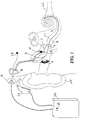
- the tympanic membrane 1 vibrates in response to ambient sound, and via the ossicular chain 2 the vibration is transferred to the oval window 3.
- the stapedius muscle 4 operates in the normal ear to contract and hence damp mechanically the transmission of vibrations to the oval window 3.
- An electrode array 5 is shown implanted via conventional surgical procedures, inserted within the scala tympani 6 via the round window 7, and connected to the implanted receiver stimulator unit 8.
- Receiver-stimulator unit 8 communicates via an RF link with RF coil 9 and hence the speech processor 10.
- a microphone 11, illustratively mounted behind the pinna 35, provides sound signals to the speech processor.
- the implant described to this point is essentially a conventional arrangement.
- a further stapedius monitoring electrode 12 is attached to the stapedius muscle 4. This provides signals indicative of stapedius reflex activity. It may be attached either to the belly of the muscle or to the tendon which is a surgically easier point of attachment, or to any suitable site which enables a signal indicative of stapedius activity to be detected.
- the neural response of the auditory nerve 26 and basilar membrane 27 evoked by stimulation may be monitored using the implanted electrode array 5.
- the implanted array 5 is used both to provide stimuli, and to measure the response to such stimuli during the period between stimuli.
- Such a monitoring arrangement and telemetering arrangement is described in Australian patent application No. 56898/94 by the present applicant, the disclosure of which is hereby incorporated by reference.
- the stimulations are delivered by means of a number of "channels".
- the delivery of a stimulation current between two particular electrodes of the array may be defined as a stimulation via channel 1.
- other combinations of electrodes involved in stimulation delivery will also define other stimulation channels.
- Extra-cochlear electrode 13 which is also used in some conventional arrangements, is used as the reference electrode in measuring the evoked action potential of the auditory nerve and the electrical activity of the stapedius.
- the EAP response, detected by the electrode array 5, and the response of the stapedius, monitored by the stapedius monitoring electrode 12, are detected by the receiver stimulator unit 8 relative to the reference electrode, and then telemetered back to the speech processor.
- speech processor 10 sends signals via the RF link to receiver stimulator unit 8, which then provides stimulus pulses via the electrode array in accordance with the commands sent by speech processor 10.
- T&C switch 14 is pressed by the patient to initiate the T&C level setting procedure.
- Figure 2 shows the components of the device in block form, including microphone 11, audio pre-processing 25, central processing unit (CPU) 22, and transcutaneuous link 15.
- the CPU 22 On pressing the T&C switch 16 the CPU 22 is directed to automatically calculate the patient's required T and C levels. Initially the Automatic T&C Level Program 17 is retrieved from program storage memory 28. The CPU then steps through the program. Firstly the system is put into a telemetry mode whereby the response of the auditory nerve to stimulation can be monitored. The CPU transmits the code for a stimulus pulse via the data transmitter 19 and transcutaneous link 15. The transmission contains information as to which electrodes are to deliver the stimulation and the stimulation amplitude and duration which are retrieved from the patient data storage memory 24. The received transmission is decoded by the receiver-stimulator 20 and the prescribed stimulation is applied.
- the evoked action potential of the auditory nerve in response to the stimulation is monitored by the receiver-stimulator and telemetered back to the telemetry receiver 21 via the transcutaneous link 15. This procedure is repeated several times and the recorded data is conditioned and tested for significance as will be explained subsequently. At the end of this procedure a figure is reached for the EAP response derived threshold level of the implantee. It has been found experimentally that the stimulus level which elicits a definite EAP response is significantly higher than the T level derived by subjectively testing patients. Accordingly the final T level value is derived from the final stimulation level after suitable adjustment and then stored as an entry in the patient data storage T&C level table 23. The entire procedure is then repeated for all stimulation channels.
- the CPU transmits the code for a stimulus pulse via the data transmitter 19 and transcutaneous link 15.
- the first stimulation pulse is transmitted with a stimulation level equal to the T level for the stimulation channel.
- the electrical activity of the stapedius muscle is measured both when there is and when there is not application of stimulation and by a method which will shortly be described in more detail the C level for each stimulation channel is determined.
- These levels are stored as entries in the patient data storage T&C level table 23.
- the system After startup 31 the system enters telemetry mode 32 as the information regarding the electrical activity of the auditory nerve and the stapedius muscle are to be sent to the speech processor.
- the T levels are then calculated for each channel and stored in the T&C level table at step 33.
- the C levels are then derived for each channel and similarly stored in the T&C level table 34.
- the cochlear implant then returns to normal operation 36 using the newly defined dynamic range.
- the T&C level setting program then ends 37.
- FIG. 4 is a flowchart of the process.
- relevant stimulation parameters including pulse width and inter-phase gap duration are retrieved from memory.
- the number of the channel whose T level is to be derived is set to one and the stimulation level that is to be applied is set to a minimum level which has been empirically found to be below that capable of evoking an auditory nerve response. Alternatively the minimum current level could simply be set to zero.
- a single stimulus pulse is then delivered at the minimum amplitude by channel 1. Any response to the stimulus pulse is telemetered back to the CPU 22 according to 44. The procedure then cycles through blocks 45, 43 and 44 until several responses have been measured. At the end of this process the average of the readings is stored according to 46.
- the values stored at 46 represent the EAP response to the stimulation but said response is also heavily affected by an artefact due to the evoking stimulation. This artefact must be removed in order to gain an accurate value for the EAP response.
- the amplitude of the EAP response is evaluated at 48 and stored in variable Delta.
- Decision box 49 tests Delta for significance against a preset value. If Delta is found to be insignificant then no T level is deemed to have been detected and so the current level of the applied stimuli is increased at 50. The process then loops until the current level is sufficiently high to enable the "Delta > Preset" threshold condition of decision block 49 to be met. In that case a stimulation level at which a significant EAP response is elicited is deemed to have been reached for the stimulation channel under test. However, as has been discussed previously it has been found experimentally that said stimulation level is significantly higher than the optimal T level and so the T level is found by reducing the value Stim_level either by means of known algorithms or by an empirically determined amount.
- the level is set at box 51 to 80% of the above threshold stimulation level.
- the final value of the T level is then stored as a table entry in the T&C Patient Data Storage table 23.
- the decision box 53 tests whether or not the T level has been found for all channels and if not then the previously described process is repeated until completion.
- FIG. 7 is a graph of the difference between the data depicted in Figure 7 and that of Figure 6. That is, it is the result of subtracting the recorded artefact from the data representing the combined EAP response and artefact. In practice, even after this subtraction, there remains a small though significant amount of artefact superimposed on the neural response.
- the artefact consists of an exponentially decaying low frequency signal.
- the signal is further conditioned to enhance the fidelity of the EAP signal by twice low pass filtering the combined signal depicted in Figure 8.
- the first filtering is shown in Figure 9 and is conveniently achieved by taking a seven point moving average of the data presented in Figure 8.
- the second filtering shown in Figure 10 is simply the seven point moving average of the data in 9.
- the signal depicted in Figure 10 consists largely of the residual artefact.
- This artefact signal is subtracted from the combined EAP response and residual artefact of Figure 8 and the resulting EAP response to the stimulation is plotted in Figure 11.
- This method of extracting the EAP response from the combined response and amplitude corresponds to the step described as box 47 of the flowchart depicted in Figure 4.
- the previously described procedure of calculating Delta is repeated with increasing stimulation levels as indicated by box 50 until Delta is deemed to be greater than an empirically measured threshold.
- Said threshold is derived by testing a population of cochlear implant patients and is factory set and stored in the system memory 24.
- the current level at which the first significant EAP response is detected is usually higher than the patient's actual T level and so the T level is determined to an adjusted value of Delta.
- This adjustment is shown at box 51 and an example is given there of simply setting the T level to 20% below the stimulation level that was found to generate a significant EAP response.
- Other transformations could also be used for this step and are known in the prior art, see for example Parkins and Colombo Hearing Research, 31 (1987) pp267-286.
- Boxes 72 to 78 describe a method for determining the magnitude of the muscle's response to the application of a current of amplitude set by the variable "Stim_level" delivered by means of stimulation channel "Stim_channel”. The steps dictated by each of those boxes will be described with reference to Figures 13 and 14.
- no stimulation is applied in accordance with box 72. This waiting period is included to ensure that the muscle has had sufficient time to emerge from any refractory period, Throughout the next 0.5 s the electrical activity of the stapedius muscle 4 is monitored via an extra-cochlear electrode 12 placed either on, in, or near to the muscle. During this period no stimulation is applied. The activity of the muscle is frequently sampled at periods of t s secs and the average of each of the samples taken in that time are used to form a set of envelope values A off1 ..A offn as shown in box 73. These values are represented as crosses in the A off range 91.
- the stimulation consists of high frequency biphasic current pulses, typically of the form depicted by item 95 which is intended to be an enlargement of two cycles of stimulation 94.
- the electrical activity of the stapedius muscle is as shown in sections 96, 97, 98.
- Section 96 exhibits behaviour in accordance with the "onset” effect of the stimulation whereby the electrical activity of the muscle "ramps-up" to the plateau of section 97.
- Upon cessation of stimulation at time 1.5s there is a decay of muscle activity 98 until a lower plateau region 99 is reached.
- the envelope of the recorded voltage 90 is detected and plotted at intervals as crosses 100.
- the portion of the envelope prior to cessation of the stimulation applied during period 94 is defined as the "A on range” 92.
- the average of the envelope values 100 during the A on range 92 is defined as A on .
- the portion of the envelope 100 during the period prior to application of a burst of stimulation 91 is defined as the "A off range” 91.
- the average of the A off range of values is defined as A off .
- the amplitude 114 of the applied stimulation is gradually increased until the difference 115 between A on and A off is found to exceed a preset threshold.
- Said preset threshold is an empirically determined value, which can be determined from studies on a population of cochlear implant patients.
- Items 72-78 comprise the steps of calculating a value A off for the average level of muscle activity during the period of no stimulation 91 and the average level of muscle activity, A on , during the period of stimulation 92 at an intensity of stimulation given by 'Stim_level'.
- the stimulation level is tested at box 79 for significance by comparing A on and A off . If the difference of the two is less than the empirically derived preset threshold then the parameter Stim_level is increased at box 80 and the procedure is repeated until the Stim_level reaches a magnitude where the muscle activity, represented by A on - A off , in response to stimulation is above the preset threshold. In that case the stimulation level transformation is applied at box 81.
- the transformation comprises setting the C_level to 10% above the first significant value of Stim_level.
- C_level is recorded as the C level for the stimulation channel under test and stored as part of the T&C level table in memory 23 of the processor. The whole procedure is then repeated until the C level has been derived and stored for all channels.
- the system as described so far facilitates the automatic recalibration of T&C levels for all channels.
- the time taken to perform said recalibration is of the order of twenty minutes. It may be though that the patient desires recalibration only of the T levels or of the C levels but not both. Furthermore it may be that only some stimulation channels require recalibration and that most are operating between comfortable and detectable levels of stimulation. Therefore, a further aspect of the invention is that the user may at his or her option request calibration of only certain selected channels and either T or C levels. By reducing the extent of the recalibration the time taken to perform the operation is reduced.
- the channels to be recalibrated may be designated by the user by means of a simple selection system. For example, on pressing T&C switch 14 the speech processor 10 may produce a sequential stimulation at each channel. The user could then again press switch 14 in order to request recalibration of the T and C levels for that channel. If the user did not press the switch within a short time frame then the processor would quickly move on to the next channel so that only selected channels would be recalibrated and the time taken for the overall procedure would be limited to only that needed to adjust problematic levels.
- the present invention contemplates either the T or C levels only being automatically set as described, with alternative techniques being used for the other of C and T levels. Preferably, however, both T and C levels are determined as set out above. It will be further understood that the present invention contemplates that the automatic procedures may be customised further by an audiologist or physician, for example to manually alter levels, fix levels for some channels independent of the automatic procedure, or utilise special rules for certain implantees.
Landscapes
- Health & Medical Sciences (AREA)
- Otolaryngology (AREA)
- Engineering & Computer Science (AREA)
- Biomedical Technology (AREA)
- Nuclear Medicine, Radiotherapy & Molecular Imaging (AREA)
- Radiology & Medical Imaging (AREA)
- Life Sciences & Earth Sciences (AREA)
- Animal Behavior & Ethology (AREA)
- General Health & Medical Sciences (AREA)
- Public Health (AREA)
- Veterinary Medicine (AREA)
- Prostheses (AREA)
- Electrotherapy Devices (AREA)
Claims (41)
- Hörprothese mit eine Verarbeitungseinrichtung (22) zum Vorsehen elekrischer Reizsignale (95) an eine Reiz- bzw. Stimulationseinrichtung (20), wobei die genannte Prothese eine Sensoreinrichtung (12, 5) aufweist, die in der Lage ist, das physiologische Ansprechverhalten auf eine ausgeübte Stimulierung bzw. einen Reiz elektrisch zu messen, wobei die genannte Sensoreinrichtung (12, 5) mit der genannten Verarbeitungseinrichtung (22) kommuniziert, und mit einer Speichereinrichtung (23), die mit der Verarbeitungseinrichtung kommuniziert, so daß Werte für Stimulationsparameter für die genannte Verarbeitungseinrichtung (22) vorgesehen werden, so daß die genannte Verarbeitungseinrichtung (22) entsprechende Reizsignale (95) definieren kann, wobei die Signale von der genannten Sensoreinrichtung (12, 5) von der genannten Verarbeitungseinrichtung gemäß einem vorbestimmten Algorithmus (17) verarbeitet werden, so daß zumindest ein Stimulationsparameter für mindestens einen Stimulationsmodus der genannten Prothese bestimmt wird, wobei der genannte Wert in der genannten Speichereinrichtung (23) gespeichert wird.
- Hörprothese nach Anspruch 1, wobei die genannte Stimulationseinrichtung (20) eine Vorrichtung darstellt, die implantiert werden kann, und wobei die genannte Sensoreinrichtung (12, 5) mit der genannten Vorrichtung kommuniziert.
- Hörprothese nach Anspruch 2, wobei die genannte Sensoreinrichtung (5) eine intrakochleare Mehrelektrodenanordnung (5) umfaßt.
- Hörprothese nach einem der Ansprüche 1 bis 3, wobei der genannte bestimmte Stimulationsparameter den Grenzreizwert darstellt.
- Hörprothese nach Anspruch 4, wobei der genannte Grenzreizwert als Teil eines Verfahrens der dynamischen Einstellung bestimmt wird, das durch den Träger das Prothese eingeleitet werden kann.
- Hörprothese nach Anspruch 5, wobei das genannte Verfahren der dynamischen Bereichseinstellung die Grenzwerte für eine Mehrzahl von Kanälen der Mehrelektrodenvorrichtung bestimmt.
- Hörprothese nach Anspruch 2, wobei die genannte Prothese einen externen Sprachprozessor (10) umfaßt sowie eine implantierte Vorrichtung (8), die sich in Übertragungsverbindung mit dem genannten Prozessor befindet, wobei die genannte implantierte Vorrichtung Telemetriedaten an den genannten Sprachprozessor sendet, einschließlich Daten von der genannten Sensoreinrichtung (12, 5), wobei der genannte Prozessor (10) Reizsignale an die genannte implantierte Vorrichtung (8) übermittelt.
- Hörprothese nach einem der Ansprüche 4 bis 6, wobei es sich bei dem genannten gemessenen elektrischen Ansprechverhalten um das Ansprechverhalten des Gehörnerves (26) und der Basilarmembran (27) handelt.
- Hörprothese nach Anspruch 1 oder 2, wobei es sich bei dem bestimmten Stimulationsparameter um den maximalen behaglichen Reizwert handelt.
- Hörprothese nach Anspruch 1, 2 oder 9, wobei die Sensoreinrichtungen (12) so angeordnet sind, daß sie die Aktivität des Steigbügelmuskels (4) elektrisch messen.
- Hörprothese nach Anspruch 9, wobei der genannte maximale behagliche Reizwert als Teil eines dynamischen Verfahrens für die Bereichseinstellung bestimmt wird, das durch den Träger der Prothese eingeleitet werden kann.
- Hörprothese nach Anspruch 11, wobei das genannte dynamische Verfahren für die Bereichseinstellung separat maximale behagliche Werte für eine Mehrzahl von Kanälen einer Mehrelektrodenvorrichtung bestimmt.
- Hörprothese nach Anspruch 1 oder 2, wobei eine Mehrzahl von Sensoreinrichtungen (12, 5) vorgesehen ist, um verschiedene physiologische Ansprechverhalten auf Reize zu messen.
- Hörprothese nach Anspruch 13, wobei die genannten Sensoreinrichtungen (12, 5) die genannte Stimulationseinrichtung (5) aufweisen.
- Hörprothese nach Anspruch 14, wobei die genannten Sensoreinrichtungen (12, 5) einen Sensor (12) aufweisen, der in der Lage ist, die Aktivität des Steigbügelmuskels (4) elektrisch zu messen.
- Hörprothese nach einem der Ansprüche 13 bis 15, wobei die bestimmten Stimulationsparameter den maximalen behaglichen Reizwert und den Grenzwert für jeden Stimulationsmodus oder Kanal aufweisen.
- Hörprothese nach Anspruch 16, wobei der genannte maximale behagliche Reizwert in Bezug auf ein Signal bestimmt wird, das durch den genannten Sensor (12, 5) vorgesehen wird, das die Aktivität des Steigbügelmuskels (4) elektrisch messen kann, und wobei der genannte Grenzwert in Bezug auf das durch die genannte Stimulationseinrichtung (5) gemessene hervorgerufene neurale Ansprechverhalten bestimmt wird.
- Hörprothese nach Anspruch 17, wobei der genannte Grenzreizwert und der genannte maximale behagliche Reizwert als Teil eines Verfahrens für die dynamische Bereichseinstellung bestimmt werden, das durch den Träger der Prothese eingeleitet werden kann.
- Hörprothese mit eine Verarbeitungseinrichtung (22) zum Vorsehen elektrischer Reizsignale (95) an eine Reiz- bzw. Stimulationseinrichtung (20), wobei die genannte Prothese eine Sensoreinrichtung (5) aufweist, die in der Lage ist, das elektrische Ansprechverhalten von Nervengewebe (26, 27) in Korrelation zu einer akustischen Wahrnehmung zu messen, wobei die genannte Sensoreirichtung (15) mit der genannten Verarbeitungseinrichtung (22) kommuniziert, und wobei eine Speichereinrichtung (23) mit der genannten Verarbeitungseinrichtung (22) kommuniziert, so daß Werte für Stimulationsparameter für die genannte Verarbeitungseinrichtung (22) vorgesehen werden, so daß die genannte Verarbeitungseinrichtung (22) entsprechende Reizsignale (95) definieren kann, wobei Signale von der genannten Sensoreinrichtung (5) von der genannten Verarbeitungseinrichtung (22) gemäß einem vorbestimmten Algorithmus (17) verarbeitet werden, um eine Grenzreizwert für mindestens einen Stimulationsmodus der genannten Prothese zu definieren, wobei der genannte Wert in der genannten Speichereinrichtung (23) gespeichert wird.
- Hörprothese nach Anspruch 19, wobei die genannte Sensoreinrichtung (5) mit der genannten Stimulationseinrichtung kommuniziert.
- Hörprothese nach Anspruch 19, wobei die genannte Stimulationseinrichtung (5) eine intrakochleare Mehrelektrodenanordnung (5) umfaßt.
- Hörprothese nach einem der Ansprüche 19 bis 21, wobei der genannte Grenzreizwert als Teil eines Verfahrens der dynamischen Bereichseinstellung bestimmt wird, das durch den Träger das Prothese eingeleitet werden kann.
- Hörprothese nach Anspruch 22, wobei das genannte Verfahren der dynamischen Bereichseinstellung die Grenzwerte für eine Mehrzahl von Kanälen der Mehrelektrodenvorrichtung bestimmt.
- Hörprothese nach Anspruch 21, wobei die genannte Prothese einen externen Sprachprozessor (10) umfaßt sowie eine implantierte Vorrichtung (8), die sich in Übertragungsverbindung mit dem genannten Prozessor befindet, wobei die genannte implantierte Vorrichtung Telemetriedaten an den genannten Sprachprozessor sendet, einschließlich Daten von der genannten Sensoreinrichtung (5), wobei der genannte Prozessor Reizsignale an die genannte implantierte Vorrichtung übermittelt.
- Hörprothese nach einem der Ansprüche 19 bis 24, wobei es sich bei dem gemessenen neuralen Ansprechverhalten um das Ansprechverhalten des Gehörnerves (26) und der Basilarmembran (27) handelt.
- Hörprothese mit eine Verarbeitungseinrichtung (22) zum Vorsehen elekrischer Reizsignale (95) an eine Reiz- bzw. Stimulationseinrichtung (20), wobei die genannte Prothese eine Sensoreinrichtung (12) aufweist, die in der Lage ist, die elektrische Aktivität des Steigbügelmuskels (4) zu messen, wobei die genannte Sensoreinrichtung (12) mit der genannten Verarbeitungseinrichtung (22) kommuniziert, und wobei eine Speichereinrichtung (23) mit der genannte Verarbeitungseinrichtung (22) kommuniziert, so daß Werte für die Stimulationsparameter für die genannte Verarbeitungsvorrichtung (22) vorgesehen werden, so daß die genannte Verarbeitungseinrichtung entsprechende Reizsignale definieren kann, wobei die Signale von der genannten Sensoreinrichtung (12) von der genannten Verarbeitungseinrichtung (22) gemäß einem vorbestimmten Algorithmus (17) verarbeitet werden, so daß ein maximaler behaglicher Reizwert für mindestens einen Stimulationsmodus der genannten Prothese definiert wird, wobei der genannte Wert in der genannten Speichereinrichtung gespeichert wird.
- Hörprothese nach Anspruch 26, wobei die genannte Sensoreinrichtung (12) mit der genannten implantierten Stimulationseinrichtung (20) kommuniziert.
- Hörprothese nach Anspruch 26 oder 27, wobei die Sensoreinrichtung so angeordnet ist, daß sie die Aktivität des Steigbügelmuskels (4) elektrisch mißt.
- Hörprothese nach einem der Ansprüche 26 bis 28, wobei der genannte maximale behagliche Reizwert als Teil eines Verfahrens der dynamischen Bereichseinstellung bestimmt wird, das durch den Träger das Prothese eingeleitet werden kann.
- Hörprothese nach Anspruch 29, wobei das genannte Verfahren der dynamischen Bereichseinstellung die Grenzwerte für eine Mehrzahl von Kanälen der Mehrelektrodenvorrichtung bestimmt.
- Hörprothese nach einem der Ansprüche 26 bis 30, wobei die genannte Prothese einen externen Sprachprozessor (10) umfaßt sowie eine implantierte Vorrichtung (8), die sich in Übertragungsverbindung mit dem genannten Prozessor befindet, wobei die genannte implantierte Vorrichtung (8) Telemetriedaten an den genannten Sprachprozessor (10) sendet, einschließlich Daten von der genannten Sensoreinrichtung (4), wobei der genannte Prozessor Reizsignale an die genannte implantierte Vorrichtung übermittelt.
- Hörprothese, die in der Lage ist, automatisch Grenzwerte und maximale behagliche Reizwerte abzuleiten, um einen dynamischen Bereich für die elektrische Stimulierung zu ermitteln, wobei die genannte Prothese eine Verarbeitungseinrichtung (22) aufweist, die dazu dient, einer Stimulationseinrichtung (5) elektrische Reizsignale zuzuführen, mit einer ersten Sensoreinrichtung (12), die die dem Steigbügelmuskel (4) zugeordnete elektrische Aktivität erfassen kann, mit einer zweiten Sensoreinrichtung (5), die in der Lage ist, das elektrische Ansprechverhalten von Nervengewebe (26, 27) in Korrelation zu einer akustischen Wahrnehmung zu messen, und mit einer Speichereinrichtung (23), die mit der genannten Verarbeitungseinrichtung (22) kommuniziert, so daß Werte für Stimulationsparameter für die genannte Verarbeitungseinrichtung vorgesehen werden, so daß die genannte Verarbeitungseinrichtung (22) entsprechende Reizsignale definieren kann, wobei die ersten und zweiten Sensoreinrichtungen (12, 5) mit der genannten Verarbeitungseinrichtung (22) kommunizieren, wobei die Signale von den genannten Sensoreinrichtungen (12, 5) durch die genannte Verarbeitungseinrichtung (22) gemäß einem vorbestimmten Algorithmus (17) verarbeitet werden, so daß ein Grenzreizwert und ein maximaler behaglicher Reizwert für mindestens einen Stimulationsmodus der Vorrichtung definiert werden, wobei der genannte Wert in der genannten Speichereinrichtung gespeichert wird.
- Hörprothese nach Anspruch 32, wobei die genannten ersten und zweiten Sensoreinrichtungen (12, 5) mit einem implantierten Abschnitt (8) der genannten Prothese kommunizieren.
- Hörprothese nach Anspruch 33, wobei der genannte implantierte Abschnitt (8) mit einer implantierten intrakochlearen Mehrelektrodenanordnung (5) der genannten Prothese gekoppelt ist.
- Hörprothese nach Anspruch 34, wobei die genannte zweite Sensoreinrichtung (5) die genannte intrakochleare Mehrelektrodenanordnung (5) umfaßt.
- Hörprothese nach einem der Ansprüche 32 bis 35, wobei der genannte Grenzreizwert und der genannte maximale behagliche Reizwert als Teil eines Verfahrens der dynamischen Bereichseinstellung bestimmt werden, das durch den Träger das Prothese eingeleitet werden kann.
- Hörprothese nach Anspruch 36, wobei das genannte Verfahren der dynamischen Bereichseinstellung die Grenzreizwerte und die maximalen behaglichen Reizwerte für eine Mehrzahl von Kanälen der Mehrelektrodenvorrichtung einzeln bestimmt.
- Hörprothese nach einem der Ansprüche 32 bis 37, wobei die genannte Prothese einen externen Sprachprozessor (10) umfaßt sowie eine implantierte Vorrichtung (8, 13, 5, 12), die sich in Übertragungsverbindung mit dem genannten Prozessor befindet, wobei die genannte implantierte Telemetriedaten an den genannten Sprachprozessor sendet, einschließlich Daten von den genannten ersten (12) und zweiten (5) Sensoreinrichtungen, wobei der genannte Prozessor Reizsignale an die genannte implantierte Vorrichtung übermittelt.
- Hörprothese nach einem der Ansprüche 32 bis 38, wobei das neurale Ansprechverhalten, das die genannte zweite Sensoreinrichtung messen kann, das Ansprechverhalten des Gehörnervs (26) und der Basilarmembran (27) darstellt.
- Hörprothese nach einem der Ansprüche 32 bis 39, wobei die genannte erste Sensoreinrichtung (12) so angeordnet ist, daß sie die Aktivität des Steigbügelmuskels (4) elektrisch mißt.
- Verfahren zur automatischen Einstellung von Grenzreizwerten und maximalen behaglichen Reizwerten in einer Mehrkanal-Hörprothese, wobei die genannte Prothese eine Speichereinrichtung (23) einer implantierten Stimulationsvorrichtung (8, 13, 5, 12) umfaßt, mit einer ersten Sensoreinrichtung (12) zur Erfassung der dem Steigbügelmuskel (4) zugeordneten elektrischen Aktivität, und mit einer zweiten Sensoreinrichtung (5) zur Erfassung des elektrischen Ansprechverhaltens von Nervengewebe (26, 27) auf die Stimulation, wobei das genannte Verfahren für jeden Kanal der genannten Prothese die folgenden Schritte umfaßt, die in jeder geeigneten Reihenfolge ausgeführt werden können:(a) Vorsehen von Reizsignalen von einem vordefinierten Wert und mit allmählich ansteigender Amplitude der genannten Signale, bis von der genannten zweiten Sensoreinrichtung ein vordefiniertes neurales Ansprechverhalten erfaßt wird, wobei die Amplitude an dieser Stelle für die Bestimmung eines Grenzreizwertes verwendet wird, und wobei dieser Wert in der Speichereinrichtung gespeichert wird; und(b) Vorsehen von Reizsignalen auf einem vordefinierten unteren Grenzniveau und mit allmählich ansteigender Amplitude der genannten Signale, bis von der genannten ersten Sensoreinrichtung ein vordefiniertes Ausmaß der Aktivität des Steigbügelmuskels erfaßt wird, wobei die Amplitude an dieser Stelle für die Bestimmung eines maximalen behaglichen Reizwertes verwendet wird, und wobei dieser Wert in der genannten Speichereinrichtung gespeichert wird.
Applications Claiming Priority (4)
| Application Number | Priority Date | Filing Date | Title |
|---|---|---|---|
| AUPN5331/95 | 1995-09-07 | ||
| AUPN533195 | 1995-09-07 | ||
| AUPN5331A AUPN533195A0 (en) | 1995-09-07 | 1995-09-07 | Derived threshold and comfort level for auditory prostheses |
| PCT/AU1996/000558 WO1997009863A1 (en) | 1995-09-07 | 1996-09-06 | Apparatus and method for automatically determining stimulation parameters |
Publications (3)
| Publication Number | Publication Date |
|---|---|
| EP0885548A1 EP0885548A1 (de) | 1998-12-23 |
| EP0885548A4 EP0885548A4 (de) | 1999-01-20 |
| EP0885548B1 true EP0885548B1 (de) | 2001-03-07 |
Family
ID=3789660
Family Applications (1)
| Application Number | Title | Priority Date | Filing Date |
|---|---|---|---|
| EP96929128A Expired - Lifetime EP0885548B1 (de) | 1995-09-07 | 1996-09-06 | Vorrichtung und verfahren zur automatischen bestimmung von stimulationsparametern |
Country Status (7)
| Country | Link |
|---|---|
| US (1) | US6205360B1 (de) |
| EP (1) | EP0885548B1 (de) |
| JP (1) | JP2992080B2 (de) |
| AU (2) | AUPN533195A0 (de) |
| CA (1) | CA2230603C (de) |
| DE (1) | DE69612020T2 (de) |
| WO (1) | WO1997009863A1 (de) |
Cited By (1)
| Publication number | Priority date | Publication date | Assignee | Title |
|---|---|---|---|---|
| RU2769058C1 (ru) * | 2021-01-22 | 2022-03-28 | Автономная некоммерческая организация дополнительного профессионального образования «Институт слуха и речи» | Способ оценки эффективности слухопротезирования и подбора слуховых аппаратов |
Families Citing this family (204)
| Publication number | Priority date | Publication date | Assignee | Title |
|---|---|---|---|---|
| AU709374B2 (en) * | 1996-05-16 | 1999-08-26 | Cochlear Limited | Calculating electrode frequency allocation in a cochlear implant |
| WO1997043871A1 (en) * | 1996-05-16 | 1997-11-20 | The University Of Melbourne | Calculating electrode frequency allocation in a cochlear implant |
| CA2258008A1 (en) * | 1996-06-20 | 1997-12-24 | Advanced Bionics Corporation | Self-adjusting cochlear implant system and method for fitting same |
| EP1084593B1 (de) * | 1997-09-29 | 2007-08-15 | Cochlear Limited | Vorrichtung und verfahren zur alarmdurchsage für cochleare implantate |
| WO1999017585A1 (en) * | 1997-09-29 | 1999-04-08 | Cochlear Limited | Public alarm apparatus and method for cochlear implants |
| US6289247B1 (en) | 1998-06-02 | 2001-09-11 | Advanced Bionics Corporation | Strategy selector for multichannel cochlear prosthesis |
| US6208882B1 (en) * | 1998-06-03 | 2001-03-27 | Advanced Bionics Corporation | Stapedius reflex electrode and connector |
| US6415185B1 (en) * | 1998-09-04 | 2002-07-02 | Advanced Bionics Corporation | Objective programming and operation of a Cochlear implant based on measured evoked potentials that precede the stapedius reflex |
| US6507755B1 (en) * | 1998-12-01 | 2003-01-14 | Neurometrix, Inc. | Apparatus and method for stimulating human tissue |
| US8260430B2 (en) | 2010-07-01 | 2012-09-04 | Cochlear Limited | Stimulation channel selection for a stimulating medical device |
| AUPQ249999A0 (en) * | 1999-08-27 | 1999-09-23 | Cochlear Limited | Optimizing cochlear implant electrode selection |
| EP1742510B1 (de) | 1999-03-03 | 2010-10-27 | Cochlear Limited | Gerät zur Optimierung der Funktion eines kochlearen Implantates |
| DE19914993C1 (de) * | 1999-04-01 | 2000-07-20 | Implex Hear Tech Ag | Vollimplantierbares Hörsystem mit telemetrischer Sensorprüfung |
| AUPQ261299A0 (en) * | 1999-09-02 | 1999-09-23 | Bionic Ear Institute, The | Improved sound processor for cochlear implants |
| EP1244496A1 (de) * | 1999-12-17 | 2002-10-02 | Advanced Bionics Corporation | Programmierung von stellgrössen für einen implantierbaren elektrischen stimulator |
| AU761251B2 (en) | 2000-01-05 | 2003-05-29 | Rolf-Dieter Battmer | Device for measuring or collecting auditory evoked potentials |
| FR2803186B1 (fr) * | 2000-01-05 | 2002-08-09 | Guy Charvin | Procede et dispositif de recueil de potentiels evoques auditif |
| US20030125786A1 (en) * | 2000-07-13 | 2003-07-03 | Gliner Bradford Evan | Methods and apparatus for effectuating a lasting change in a neural-function of a patient |
| US7010351B2 (en) * | 2000-07-13 | 2006-03-07 | Northstar Neuroscience, Inc. | Methods and apparatus for effectuating a lasting change in a neural-function of a patient |
| US7756584B2 (en) * | 2000-07-13 | 2010-07-13 | Advanced Neuromodulation Systems, Inc. | Methods and apparatus for effectuating a lasting change in a neural-function of a patient |
| US7146217B2 (en) * | 2000-07-13 | 2006-12-05 | Northstar Neuroscience, Inc. | Methods and apparatus for effectuating a change in a neural-function of a patient |
| US7831305B2 (en) * | 2001-10-15 | 2010-11-09 | Advanced Neuromodulation Systems, Inc. | Neural stimulation system and method responsive to collateral neural activity |
| US7305268B2 (en) | 2000-07-13 | 2007-12-04 | Northstar Neurscience, Inc. | Systems and methods for automatically optimizing stimulus parameters and electrode configurations for neuro-stimulators |
| US7672730B2 (en) * | 2001-03-08 | 2010-03-02 | Advanced Neuromodulation Systems, Inc. | Methods and apparatus for effectuating a lasting change in a neural-function of a patient |
| US7024247B2 (en) * | 2001-10-15 | 2006-04-04 | Northstar Neuroscience, Inc. | Systems and methods for reducing the likelihood of inducing collateral neural activity during neural stimulation threshold test procedures |
| US7236831B2 (en) * | 2000-07-13 | 2007-06-26 | Northstar Neuroscience, Inc. | Methods and apparatus for effectuating a lasting change in a neural-function of a patient |
| US7822478B2 (en) | 2000-08-21 | 2010-10-26 | Cochlear Limited | Compressed neural coding |
| US8285382B2 (en) | 2000-08-21 | 2012-10-09 | Cochlear Limited | Determining stimulation signals for neural stimulation |
| US9008786B2 (en) | 2000-08-21 | 2015-04-14 | Cochlear Limited | Determining stimulation signals for neural stimulation |
| AUPQ952800A0 (en) | 2000-08-21 | 2000-09-14 | Cochlear Limited | Power efficient electrical stimulation |
| US7299096B2 (en) * | 2001-03-08 | 2007-11-20 | Northstar Neuroscience, Inc. | System and method for treating Parkinson's Disease and other movement disorders |
| WO2002082982A1 (en) * | 2001-04-18 | 2002-10-24 | Cochlear Limited | Method and apparatus for measurement of evoked neural response |
| AUPR604801A0 (en) | 2001-06-29 | 2001-07-26 | Cochlear Limited | Multi-electrode cochlear implant system with distributed electronics |
| US7107101B1 (en) * | 2001-08-17 | 2006-09-12 | Advanced Bionics Corporation | Bionic ear programming system |
| US7076308B1 (en) | 2001-08-17 | 2006-07-11 | Advanced Bionics Corporation | Cochlear implant and simplified method of fitting same |
| US7292891B2 (en) | 2001-08-20 | 2007-11-06 | Advanced Bionics Corporation | BioNet for bilateral cochlear implant systems |
| WO2003026738A1 (en) * | 2001-09-28 | 2003-04-03 | Northstar Neuroscience, Inc. | Methods and apparatus for electrically stimulating cells implanted in the nervous system |
| US7317948B1 (en) | 2002-02-12 | 2008-01-08 | Boston Scientific Scimed, Inc. | Neural stimulation system providing auto adjustment of stimulus output as a function of sensed impedance |
| US20030153959A1 (en) * | 2002-02-12 | 2003-08-14 | Thacker James R. | Neural stimulation system providing auto adjustment of stimulus output as a function of sensed coupling efficiency |
| US7239920B1 (en) | 2002-02-12 | 2007-07-03 | Advanced Bionics Corporation | Neural stimulation system providing auto adjustment of stimulus output as a function of sensed pressure changes |
| EP1338301A1 (de) | 2002-02-21 | 2003-08-27 | Paul J. M. Govaerts | Verfahren zur automatischen Kalibrierung eines cochlearen Implantates, erhaltenes cochleares Implantat und Rechnerprogrammen dafür |
| US7881800B2 (en) * | 2002-03-08 | 2011-02-01 | Cochlear Limited | Cochlear implant having a repositionable implantable housing |
| US7221981B2 (en) * | 2002-03-28 | 2007-05-22 | Northstar Neuroscience, Inc. | Electrode geometries for efficient neural stimulation |
| US6978178B2 (en) * | 2002-04-30 | 2005-12-20 | Medtronic, Inc. | Method and apparatus for selecting an optimal electrode configuration of a medical electrical lead having a multiple electrode array |
| AUPS318202A0 (en) * | 2002-06-26 | 2002-07-18 | Cochlear Limited | Parametric fitting of a cochlear implant |
| US7043303B1 (en) * | 2002-08-30 | 2006-05-09 | Advanced Bionics Corporation | Enhanced methods for determining iso-loudness contours for fitting cochlear implant sound processors |
| US7496406B1 (en) | 2002-08-30 | 2009-02-24 | Advanced Bionics, Llc | System and method for fitting a cochlear implant sound processor using alternative signals |
| US7623929B1 (en) | 2002-08-30 | 2009-11-24 | Advanced Bionics, Llc | Current sensing coil for cochlear implant data detection |
| AU2002951218A0 (en) * | 2002-09-04 | 2002-09-19 | Cochlear Limited | Method and apparatus for measurement of evoked neural response |
| US7117038B1 (en) | 2002-09-20 | 2006-10-03 | Advanced Bionics Corporation | Method and system for obtaining stapedial reflexes in cochlear implant users using multiband stimuli |
| US6717804B1 (en) * | 2002-09-30 | 2004-04-06 | Hewlett-Packard Development Company, L.P. | Light-emitting lock device control element and electronic device including the same |
| US20050075679A1 (en) * | 2002-09-30 | 2005-04-07 | Gliner Bradford E. | Methods and apparatuses for treating neurological disorders by electrically stimulating cells implanted in the nervous system |
| US7236830B2 (en) * | 2002-12-10 | 2007-06-26 | Northstar Neuroscience, Inc. | Systems and methods for enhancing or optimizing neural stimulation therapy for treating symptoms of Parkinson's disease and/or other movement disorders |
| AU2002952675A0 (en) * | 2002-11-07 | 2002-11-28 | Cochlear Limited | Clinical assistant for cochlear implant care |
| US7206640B1 (en) * | 2002-11-08 | 2007-04-17 | Advanced Bionics Corporation | Method and system for generating a cochlear implant program using multi-electrode stimulation to elicit the electrically-evoked compound action potential |
| US20080221640A1 (en) * | 2002-11-08 | 2008-09-11 | Overstreet Edward H | Multi-electrode stimulation to elicit electrically-evoked compound action potential |
| US7317945B2 (en) * | 2002-11-13 | 2008-01-08 | Advanced Bionics Corporation | Method and system to convey the within-channel fine structure with a cochlear implant |
| US20050075680A1 (en) * | 2003-04-18 | 2005-04-07 | Lowry David Warren | Methods and systems for intracranial neurostimulation and/or sensing |
| US7302298B2 (en) * | 2002-11-27 | 2007-11-27 | Northstar Neuroscience, Inc | Methods and systems employing intracranial electrodes for neurostimulation and/or electroencephalography |
| US6959215B2 (en) * | 2002-12-09 | 2005-10-25 | Northstar Neuroscience, Inc. | Methods for treating essential tremor |
| AU2003297761A1 (en) * | 2002-12-09 | 2004-06-30 | Northstar Neuroscience, Inc. | Methods for treating neurological language disorders |
| US7251530B1 (en) | 2002-12-11 | 2007-07-31 | Advanced Bionics Corporation | Optimizing pitch and other speech stimuli allocation in a cochlear implant |
| US7171261B1 (en) * | 2002-12-20 | 2007-01-30 | Advanced Bionics Corporation | Forward masking method for estimating neural response |
| US7283877B1 (en) | 2002-12-20 | 2007-10-16 | Advanced Bionics Corporation | Method of measuring neural responses |
| US20040167586A1 (en) * | 2003-02-21 | 2004-08-26 | Overstreet Edward H. | Charge normalization for electrical stimulation of excitable tissue to facilitate the comparison of neural responses to behavioral measurements having different parameters |
| US8255059B2 (en) | 2003-03-11 | 2012-08-28 | Cochlear Limited | Using a genetic algorithm to fit a medical implant system to a patient |
| US8355794B2 (en) | 2003-03-11 | 2013-01-15 | Cochlear Limited | Using a genetic algorithm in mixed mode device |
| US6879860B2 (en) * | 2003-03-11 | 2005-04-12 | Gregory Howard Wakefield | Cochlear implant MAP optimization with use of a genetic algorithm |
| US7149583B1 (en) | 2003-04-09 | 2006-12-12 | Advanced Bionics Corporation | Method of using non-simultaneous stimulation to represent the within-channel fine structure |
| US7103417B1 (en) | 2003-04-18 | 2006-09-05 | Advanced Bionics Corporation | Adaptive place-pitch ranking procedure for optimizing performance of a multi-channel neural stimulator |
| US20040218767A1 (en) * | 2003-04-24 | 2004-11-04 | Doman G. Alexander | Surround sound methods and apparatus for improving auditory processing and increasing spatial awareness |
| US7039466B1 (en) | 2003-04-29 | 2006-05-02 | Advanced Bionics Corporation | Spatial decimation stimulation in an implantable neural stimulator, such as a cochlear implant |
| US20040255239A1 (en) * | 2003-06-13 | 2004-12-16 | Ankur Bhatt | Generating electronic reports of data displayed in a computer user interface list view |
| US7317944B1 (en) | 2003-07-08 | 2008-01-08 | Advanced Bionics Corporation | System and method for using a multi-contact electrode to stimulate the cochlear nerve or other body tissue |
| AU2003903576A0 (en) * | 2003-07-11 | 2003-07-24 | Cochlear Limited | Audio path diagnostics |
| EP1654032A2 (de) * | 2003-08-01 | 2006-05-10 | Northstar Neuroscience, Inc. | Gerät und verfahren für die neurale stimulation eines patienten |
| US7702396B2 (en) * | 2003-11-21 | 2010-04-20 | Advanced Bionics, Llc | Optimizing pitch allocation in a cochlear implant |
| EP1737533B1 (de) * | 2004-03-15 | 2014-07-16 | Med-El Elektromedizinische Geräte GmbH | Elektrode für cochleares implantat mit verstellbarer unterteilung für mittelohrfunktionen |
| NL1026137C2 (nl) * | 2004-05-07 | 2005-11-08 | Vanderlande Ind Nederland | Inrichting voor het sorteren van producten. |
| US7483751B2 (en) * | 2004-06-08 | 2009-01-27 | Second Sight Medical Products, Inc. | Automatic fitting for a visual prosthesis |
| US8180454B2 (en) * | 2005-12-01 | 2012-05-15 | Second Sight Medical Products, Inc. | Fitting a neural prosthesis using impedance and electrode height |
| US8190268B2 (en) | 2004-06-15 | 2012-05-29 | Cochlear Limited | Automatic measurement of an evoked neural response concurrent with an indication of a psychophysics reaction |
| US7801617B2 (en) | 2005-10-31 | 2010-09-21 | Cochlear Limited | Automatic measurement of neural response concurrent with psychophysics measurement of stimulating device recipient |
| CA2569724A1 (en) * | 2004-06-15 | 2005-12-29 | Cochlear Americas | Automatic determination of the threshold of an evoked neural response |
| AU2005254100B2 (en) * | 2004-06-15 | 2011-09-29 | Cochlear Americas | Automatic determination of the threshold of an evoked neural response |
| JP2008506464A (ja) | 2004-07-15 | 2008-03-06 | ノーススター ニューロサイエンス インコーポレイテッド | 神経刺激効率及び/又は効力の強化又はそれに影響を及ぼすためのシステム及び方法 |
| US7959577B2 (en) | 2007-09-06 | 2011-06-14 | Baxano, Inc. | Method, system, and apparatus for neural localization |
| US20090018507A1 (en) * | 2007-07-09 | 2009-01-15 | Baxano, Inc. | Spinal access system and method |
| US8430881B2 (en) | 2004-10-15 | 2013-04-30 | Baxano, Inc. | Mechanical tissue modification devices and methods |
| US7938830B2 (en) | 2004-10-15 | 2011-05-10 | Baxano, Inc. | Powered tissue modification devices and methods |
| US7738968B2 (en) * | 2004-10-15 | 2010-06-15 | Baxano, Inc. | Devices and methods for selective surgical removal of tissue |
| US8221397B2 (en) | 2004-10-15 | 2012-07-17 | Baxano, Inc. | Devices and methods for tissue modification |
| AU2005295589B2 (en) * | 2004-10-15 | 2009-12-03 | Baxano, Inc. | Devices and methods for tissue removal |
| US7578819B2 (en) | 2005-05-16 | 2009-08-25 | Baxano, Inc. | Spinal access and neural localization |
| US20060122458A1 (en) * | 2004-10-15 | 2006-06-08 | Baxano, Inc. | Devices and methods for tissue access |
| US7887538B2 (en) | 2005-10-15 | 2011-02-15 | Baxano, Inc. | Methods and apparatus for tissue modification |
| US20100331883A1 (en) | 2004-10-15 | 2010-12-30 | Schmitz Gregory P | Access and tissue modification systems and methods |
| US20110190772A1 (en) | 2004-10-15 | 2011-08-04 | Vahid Saadat | Powered tissue modification devices and methods |
| US7857813B2 (en) | 2006-08-29 | 2010-12-28 | Baxano, Inc. | Tissue access guidewire system and method |
| US8062300B2 (en) | 2006-05-04 | 2011-11-22 | Baxano, Inc. | Tissue removal with at least partially flexible devices |
| US8617163B2 (en) * | 2004-10-15 | 2013-12-31 | Baxano Surgical, Inc. | Methods, systems and devices for carpal tunnel release |
| US8048080B2 (en) | 2004-10-15 | 2011-11-01 | Baxano, Inc. | Flexible tissue rasp |
| US9101386B2 (en) | 2004-10-15 | 2015-08-11 | Amendia, Inc. | Devices and methods for treating tissue |
| US7738969B2 (en) * | 2004-10-15 | 2010-06-15 | Baxano, Inc. | Devices and methods for selective surgical removal of tissue |
| US9247952B2 (en) | 2004-10-15 | 2016-02-02 | Amendia, Inc. | Devices and methods for tissue access |
| US8257356B2 (en) | 2004-10-15 | 2012-09-04 | Baxano, Inc. | Guidewire exchange systems to treat spinal stenosis |
| US20080161809A1 (en) * | 2006-10-03 | 2008-07-03 | Baxano, Inc. | Articulating Tissue Cutting Device |
| US7277760B1 (en) | 2004-11-05 | 2007-10-02 | Advanced Bionics Corporation | Encoding fine time structure in presence of substantial interaction across an electrode array |
| US20060100672A1 (en) * | 2004-11-05 | 2006-05-11 | Litvak Leonid M | Method and system of matching information from cochlear implants in two ears |
| US8600515B2 (en) | 2004-11-05 | 2013-12-03 | Advanced Bionics Ag | Encoding fine time structure in presence of substantial interaction across an electrode array |
| US7565200B2 (en) * | 2004-11-12 | 2009-07-21 | Advanced Neuromodulation Systems, Inc. | Systems and methods for selecting stimulation sites and applying treatment, including treatment of symptoms of Parkinson's disease, other movement disorders, and/or drug side effects |
| US20060106430A1 (en) * | 2004-11-12 | 2006-05-18 | Brad Fowler | Electrode configurations for reducing invasiveness and/or enhancing neural stimulation efficacy, and associated methods |
| US7450994B1 (en) * | 2004-12-16 | 2008-11-11 | Advanced Bionics, Llc | Estimating flap thickness for cochlear implants |
| US20100292759A1 (en) * | 2005-03-24 | 2010-11-18 | Hahn Tae W | Magnetic field sensor for magnetically-coupled medical implant devices |
| CN100502819C (zh) * | 2005-05-24 | 2009-06-24 | 北京大学科技开发部 | 制造适合汉语语音编码策略的人工耳蜗的方法 |
| US8805547B2 (en) * | 2005-06-30 | 2014-08-12 | Domestic Legacy Limited Partnership | Extra-cochlear implanted hearing aid device |
| US20090222064A1 (en) * | 2005-07-08 | 2009-09-03 | Advanced Bionics, Llc | Autonomous Autoprogram Cochlear Implant |
| US8285383B2 (en) * | 2005-07-08 | 2012-10-09 | Cochlear Limited | Directional sound processing in a cochlear implant |
| US20080091227A1 (en) * | 2006-08-25 | 2008-04-17 | Baxano, Inc. | Surgical probe and method of making |
| US20080033465A1 (en) * | 2006-08-01 | 2008-02-07 | Baxano, Inc. | Multi-Wire Tissue Cutter |
| US8092456B2 (en) | 2005-10-15 | 2012-01-10 | Baxano, Inc. | Multiple pathways for spinal nerve root decompression from a single access point |
| US8062298B2 (en) | 2005-10-15 | 2011-11-22 | Baxano, Inc. | Flexible tissue removal devices and methods |
| US8366712B2 (en) | 2005-10-15 | 2013-02-05 | Baxano, Inc. | Multiple pathways for spinal nerve root decompression from a single access point |
| US7856264B2 (en) * | 2005-10-19 | 2010-12-21 | Advanced Neuromodulation Systems, Inc. | Systems and methods for patient interactive neural stimulation and/or chemical substance delivery |
| US8929991B2 (en) | 2005-10-19 | 2015-01-06 | Advanced Neuromodulation Systems, Inc. | Methods for establishing parameters for neural stimulation, including via performance of working memory tasks, and associated kits |
| US20070088403A1 (en) * | 2005-10-19 | 2007-04-19 | Allen Wyler | Methods and systems for establishing parameters for neural stimulation |
| US20070088404A1 (en) * | 2005-10-19 | 2007-04-19 | Allen Wyler | Methods and systems for improving neural functioning, including cognitive functioning and neglect disorders |
| US7729773B2 (en) | 2005-10-19 | 2010-06-01 | Advanced Neuromodualation Systems, Inc. | Neural stimulation and optical monitoring systems and methods |
| US8027733B1 (en) | 2005-10-28 | 2011-09-27 | Advanced Bionics, Llc | Optimizing pitch allocation in a cochlear stimulation system |
| US8265765B2 (en) | 2005-12-08 | 2012-09-11 | Cochlear Limited | Multimodal auditory fitting |
| US7650194B2 (en) * | 2006-03-22 | 2010-01-19 | Fritsch Michael H | Intracochlear nanotechnology and perfusion hearing aid device |
| US8571675B2 (en) * | 2006-04-21 | 2013-10-29 | Cochlear Limited | Determining operating parameters for a stimulating medical device |
| US8306624B2 (en) * | 2006-04-28 | 2012-11-06 | Medtronic, Inc. | Patient-individualized efficacy rating |
| US8380300B2 (en) | 2006-04-28 | 2013-02-19 | Medtronic, Inc. | Efficacy visualization |
| US8818517B2 (en) | 2006-05-05 | 2014-08-26 | Advanced Bionics Ag | Information processing and storage in a cochlear stimulation system |
| WO2007134048A2 (en) * | 2006-05-08 | 2007-11-22 | Cochlear Americas | Automated fitting of an auditory prosthesis |
| US8103354B2 (en) * | 2006-07-17 | 2012-01-24 | Advanced Bionics, Llc | Systems and methods for determining a threshold current level required to evoke a stapedial muscle reflex |
| US7925355B2 (en) * | 2006-07-17 | 2011-04-12 | Advanced Bionics, Llc | Systems and methods for determining a threshold current level required to evoke a stapedial muscle reflex |
| EP2865413A1 (de) | 2006-08-16 | 2015-04-29 | Second Sight Medical Products, Inc. | Automatische Anpassung für eine Sehprothese |
| US7792587B2 (en) * | 2006-09-12 | 2010-09-07 | Med-El Elektromedizinische Geraete Gmbh | Middle ear fixation structure |
| US7864968B2 (en) * | 2006-09-25 | 2011-01-04 | Advanced Bionics, Llc | Auditory front end customization |
| US7995771B1 (en) | 2006-09-25 | 2011-08-09 | Advanced Bionics, Llc | Beamforming microphone system |
| US9744354B2 (en) | 2008-12-31 | 2017-08-29 | Cyberonics, Inc. | Obstructive sleep apnea treatment devices, systems and methods |
| US8855771B2 (en) | 2011-01-28 | 2014-10-07 | Cyberonics, Inc. | Screening devices and methods for obstructive sleep apnea therapy |
| DE202007019439U1 (de) | 2006-10-13 | 2012-09-12 | Apnex Medical, Inc. | Geräte, Systeme und Methoden zur Behandlung von obstruktiver Schalfapnoe |
| US9913982B2 (en) * | 2011-01-28 | 2018-03-13 | Cyberonics, Inc. | Obstructive sleep apnea treatment devices, systems and methods |
| US9205262B2 (en) | 2011-05-12 | 2015-12-08 | Cyberonics, Inc. | Devices and methods for sleep apnea treatment |
| US9186511B2 (en) | 2006-10-13 | 2015-11-17 | Cyberonics, Inc. | Obstructive sleep apnea treatment devices, systems and methods |
| WO2008070867A2 (en) * | 2006-12-07 | 2008-06-12 | Baxano, Inc. | Tissue removal devices and methods |
| CN101244314B (zh) * | 2007-02-16 | 2013-02-27 | 上海塔瑞莎健康科技有限公司 | 用于设置治疗模式的电刺激平台系统 |
| DE102007008154A1 (de) * | 2007-02-19 | 2008-08-21 | Universität Rostock | Stapediusmuskelelektrode |
| US8165687B2 (en) * | 2008-02-26 | 2012-04-24 | Universidad Autonoma Metropolitana, Unidad Iztapalapa | Systems and methods for detecting and using an electrical cochlear response (“ECR”) in analyzing operation of a cochlear stimulation system |
| US8065017B2 (en) * | 2007-02-26 | 2011-11-22 | Universidad Autonoma Metropolitana Unidad Iztapalapa | Method and apparatus for obtaining and registering an Electrical Cochlear Response (“ECR”) |
| US20080249591A1 (en) * | 2007-04-06 | 2008-10-09 | Northstar Neuroscience, Inc. | Controllers for implantable medical devices, and associated methods |
| US8774892B2 (en) * | 2007-06-05 | 2014-07-08 | Med-El Elektromedizinische Geraete Gmbh | Electrode configuration and measuring device for measuring the electrical activity in electrically active tissue |
| DE102007026645A1 (de) | 2007-06-05 | 2008-12-18 | Universität Rostock | Elektrodenanordnung und Messvorrichtung zur Messung der elektrischen Aktivität in einem elektrisch aktiven Gewebe |
| WO2009025817A2 (en) | 2007-08-20 | 2009-02-26 | Medtronic, Inc. | Evaluating therapeutic stimulation electrode configurations based on physiological responses |
| WO2009025824A1 (en) | 2007-08-20 | 2009-02-26 | Medtronic, Inc. | Implantable medical lead with biased electrode |
| US20090054947A1 (en) * | 2007-08-20 | 2009-02-26 | Medtronic, Inc. | Electrode configurations for directional leads |
| WO2009055866A1 (en) * | 2007-10-31 | 2009-05-07 | Cochlear Limited | Implantable medical prothesis system capable of detecting symptoms of medical conditions |
| WO2009055865A1 (en) * | 2007-10-31 | 2009-05-07 | Cochlear Limited | Implantable prosthesis with sensor |
| US8192436B2 (en) | 2007-12-07 | 2012-06-05 | Baxano, Inc. | Tissue modification devices |
| WO2009076721A1 (en) * | 2007-12-18 | 2009-06-25 | Cochlear Limited | Method and system for fitting a cochlear implant |
| US8437938B2 (en) * | 2008-01-15 | 2013-05-07 | GM Global Technology Operations LLC | Axle torque based cruise control |
| EP2082779A3 (de) | 2008-01-22 | 2014-02-19 | Cochlear Limited | Vom Träger gesteuerte Anpassung einer Hörprothese |
| US8346368B2 (en) * | 2008-05-30 | 2013-01-01 | Cochlear Limited | Sound processing method and system |
| WO2010009093A2 (en) | 2008-07-14 | 2010-01-21 | Baxano, Inc | Tissue modification devices |
| US8409206B2 (en) | 2008-07-01 | 2013-04-02 | Baxano, Inc. | Tissue modification devices and methods |
| US8398641B2 (en) | 2008-07-01 | 2013-03-19 | Baxano, Inc. | Tissue modification devices and methods |
| US9314253B2 (en) | 2008-07-01 | 2016-04-19 | Amendia, Inc. | Tissue modification devices and methods |
| US8660657B2 (en) * | 2009-01-30 | 2014-02-25 | Advanced Bionics Ag | Systems and methods of facilitating manual adjustment of one or more cochlear implant system control parameters |
| EP2405823A4 (de) | 2009-03-13 | 2012-07-04 | Baxano Inc | Vorrichtungen und verfahren für flexible nervenortung |
| TWI397789B (zh) * | 2009-05-12 | 2013-06-01 | Univ Nat Chiao Tung | Parameter adjusting device and method thereof |
| US8394102B2 (en) | 2009-06-25 | 2013-03-12 | Baxano, Inc. | Surgical tools for treatment of spinal stenosis |
| US8825168B2 (en) | 2009-09-10 | 2014-09-02 | Cochlear Limited | Using a genetic algorithm employing dynamic mutation |
| US8401978B2 (en) | 2009-09-10 | 2013-03-19 | Cochlear Limited | Using a genetic algorithm employing an expedited convergence mechanism to at least partially fit a medical implant to a patient using patient feedback |
| EP2506923A1 (de) * | 2009-12-04 | 2012-10-10 | Advanced Bionics AG | Systeme und verfahren zur passung eines cochleaimplantatsystems bei einem patient auf der basis von stapediusverschiebung |
| US8909348B2 (en) | 2010-03-30 | 2014-12-09 | Domestic Legacy Limited Partnership | Cochlear implant stabilization and positioning device |
| US8625828B2 (en) | 2010-04-30 | 2014-01-07 | Cochlear Limited | Hearing prosthesis having an on-board fitting system |
| WO2011140313A1 (en) * | 2010-05-05 | 2011-11-10 | Med-Elektromedizinische Geraete Gmbh | Hearing treatment in patients with questionable cochlear nerve functionality |
| US9155886B2 (en) | 2010-10-28 | 2015-10-13 | Cochlear Limited | Fitting an auditory prosthesis |
| US9950162B2 (en) | 2011-03-01 | 2018-04-24 | Cochlear Limited | Distributed processing of electrophysiological signals |
| US9313589B2 (en) * | 2011-07-01 | 2016-04-12 | Cochlear Limited | Method and system for configuration of a medical device that stimulates a human physiological system |
| WO2013074085A1 (en) | 2011-11-15 | 2013-05-23 | Advanced Bionics Ag | Interface system for synchronizing the operation of a middle ear analyzer and a cochlear implant system |
| WO2013116161A1 (en) * | 2012-01-30 | 2013-08-08 | The Regents Of The University Of California | System and methods for closed-loop cochlear implant |
| EP2827945A1 (de) | 2012-03-22 | 2015-01-28 | Advanced Bionics AG | Programmiersysteme zur auslösung evozierter reaktionen bei einem patienten mit cochleaimplanat und zur durchführung vorbestimmter aktionen in übereinstimmung mit den evozierten reaktionen |
| US9100763B2 (en) * | 2012-08-02 | 2015-08-04 | Cochlear Limited | Determining stimulation signal strength in an auditory prosthesis |
| US9095708B2 (en) * | 2013-03-15 | 2015-08-04 | Cochlear Limited | Transitioning operating modes in a medical prosthesis |
| WO2015095665A1 (en) | 2013-12-20 | 2015-06-25 | Med-El Elektromedizinische Geraete Gmbh | Detecting neuronal action potentials using a convolutive compound action potential model |
| US10772563B2 (en) * | 2016-02-26 | 2020-09-15 | Med-El Elektromedizinische Geraete Gmbh | Detection of electrically evoked stapedius reflex |
| WO2017182931A1 (en) * | 2016-04-22 | 2017-10-26 | Cochlear Limited | Electrocochleography testing in hearing prostheses |
| US10357656B2 (en) * | 2016-07-12 | 2019-07-23 | Cochlear Limited | Hearing prosthesis programming |
| CN112351813B (zh) | 2018-06-21 | 2024-12-17 | 美敦力公司 | 电刺激治疗的基于ecap的控制 |
| JP7387650B2 (ja) | 2018-06-21 | 2023-11-28 | メドトロニック,インコーポレイテッド | 電気刺激療法のecapによる制御 |
| US11931582B2 (en) | 2019-10-25 | 2024-03-19 | Medtronic, Inc. | Managing transient overstimulation based on ECAPs |
| US11547855B2 (en) | 2019-10-25 | 2023-01-10 | Medtronic, Inc. | ECAP sensing for high frequency neurostimulation |
| US12357830B2 (en) | 2019-10-25 | 2025-07-15 | Medtronic, Inc. | Sub-threshold stimulation based on ECAP detection |
| WO2021138363A1 (en) * | 2019-12-31 | 2021-07-08 | Boston Scientific Neuromodulation Corporation | Automatic determination of inputs for closed-loop algorithms for optimization of stimulation parameters |
| US12128235B2 (en) | 2020-03-06 | 2024-10-29 | Medtronic, Inc. | Controlling electrical stimulation based on a sensed stimulation signal |
| US11857793B2 (en) | 2020-06-10 | 2024-01-02 | Medtronic, Inc. | Managing storage of sensed information |
| US12097373B2 (en) | 2020-06-10 | 2024-09-24 | Medtronic, Inc. | Control policy settings for electrical stimulation therapy |
| US11707626B2 (en) | 2020-09-02 | 2023-07-25 | Medtronic, Inc. | Analyzing ECAP signals |
| US11896828B2 (en) | 2020-10-30 | 2024-02-13 | Medtronic, Inc. | Implantable lead location using ECAP |
| CN121034327B (zh) * | 2025-10-31 | 2026-03-27 | 上海辉通晟智能科技有限公司 | 音频分析方法及装置 |
Family Cites Families (9)
| Publication number | Priority date | Publication date | Assignee | Title |
|---|---|---|---|---|
| US3784745A (en) * | 1971-04-12 | 1974-01-08 | Shalako Resource Systems | Method and apparatus for providing electronic sound clarification for aurally handicapped persons |
| US4532930A (en) * | 1983-04-11 | 1985-08-06 | Commonwealth Of Australia, Dept. Of Science & Technology | Cochlear implant system for an auditory prosthesis |
| US4577641A (en) * | 1983-06-29 | 1986-03-25 | Hochmair Ingeborg | Method of fitting hearing prosthesis to a patient having impaired hearing |
| US4992966A (en) * | 1988-05-10 | 1991-02-12 | Minnesota Mining And Manufacturing Company | Calibration device and auditory prosthesis having calibration information |
| FR2648698B1 (fr) * | 1989-06-23 | 1994-11-18 | Inst Nal Rech Secu Preven | Appareil destine a la mesure de la sensibilite d'un sujet a la perception d'une vibration |
| US5282858A (en) | 1991-06-17 | 1994-02-01 | American Cyanamid Company | Hermetically sealed implantable transducer |
| DE4128172C2 (de) * | 1991-08-24 | 2000-07-13 | Ascom Audiosys Ag Flamatt | Digitales Hörgerät |
| EP0676930B1 (de) * | 1992-12-22 | 2000-03-22 | Cochlear Limited | Vorrichtung und system für telemetrie |
| US5531787A (en) | 1993-01-25 | 1996-07-02 | Lesinski; S. George | Implantable auditory system with micromachined microsensor and microactuator |
-
1995
- 1995-09-07 AU AUPN5331A patent/AUPN533195A0/en not_active Abandoned
-
1996
- 1996-09-06 CA CA002230603A patent/CA2230603C/en not_active Expired - Fee Related
- 1996-09-06 JP JP9510706A patent/JP2992080B2/ja not_active Expired - Fee Related
- 1996-09-06 WO PCT/AU1996/000558 patent/WO1997009863A1/en not_active Ceased
- 1996-09-06 DE DE69612020T patent/DE69612020T2/de not_active Expired - Fee Related
- 1996-09-06 EP EP96929128A patent/EP0885548B1/de not_active Expired - Lifetime
- 1996-09-06 US US09/029,365 patent/US6205360B1/en not_active Expired - Lifetime
- 1996-09-06 AU AU68655/96A patent/AU700754B2/en not_active Ceased
Cited By (1)
| Publication number | Priority date | Publication date | Assignee | Title |
|---|---|---|---|---|
| RU2769058C1 (ru) * | 2021-01-22 | 2022-03-28 | Автономная некоммерческая организация дополнительного профессионального образования «Институт слуха и речи» | Способ оценки эффективности слухопротезирования и подбора слуховых аппаратов |
Also Published As
| Publication number | Publication date |
|---|---|
| DE69612020D1 (de) | 2001-04-12 |
| EP0885548A4 (de) | 1999-01-20 |
| JP2992080B2 (ja) | 1999-12-20 |
| CA2230603C (en) | 2001-02-27 |
| AU6865596A (en) | 1997-03-27 |
| AU700754B2 (en) | 1999-01-14 |
| US6205360B1 (en) | 2001-03-20 |
| JPH11513539A (ja) | 1999-11-16 |
| DE69612020T2 (de) | 2001-09-06 |
| CA2230603A1 (en) | 1997-03-13 |
| EP0885548A1 (de) | 1998-12-23 |
| AUPN533195A0 (en) | 1995-10-05 |
| WO1997009863A1 (en) | 1997-03-13 |
Similar Documents
| Publication | Publication Date | Title |
|---|---|---|
| EP0885548B1 (de) | Vorrichtung und verfahren zur automatischen bestimmung von stimulationsparametern | |
| US10449357B2 (en) | Automatic determination of the threshold of an evoked neural response | |
| US8190268B2 (en) | Automatic measurement of an evoked neural response concurrent with an indication of a psychophysics reaction | |
| US9008786B2 (en) | Determining stimulation signals for neural stimulation | |
| US8065017B2 (en) | Method and apparatus for obtaining and registering an Electrical Cochlear Response (“ECR”) | |
| US8103354B2 (en) | Systems and methods for determining a threshold current level required to evoke a stapedial muscle reflex | |
| US7925355B2 (en) | Systems and methods for determining a threshold current level required to evoke a stapedial muscle reflex | |
| US8244365B2 (en) | Simultaneous delivery of electrical and acoustical stimulation in a hearing prosthesis | |
| US6157861A (en) | Self-adjusting cochlear implant system and method for fitting same | |
| WO2017100866A1 (en) | Measurement of neural response | |
| CN107206238B (zh) | 经由传出神经纤维的耳蜗植入器适配 | |
| EP3337555B1 (de) | Cochleaimplantatsystem | |
| US9320896B2 (en) | Accelerated fitting of cochlear implants based on current spread | |
| EP2707092B1 (de) | Optimale modellkonstanten zur gleichzeitigen stimulation mit kanalinteraktionskompensation | |
| US20050192648A1 (en) | Compressed neural coding | |
| WO2025230847A1 (en) | Cochlear implant calibration and health indications based on middle ear pressure | |
| CN117042693A (zh) | 基于人体内bm延迟的优化声学啁啾 |
Legal Events
| Date | Code | Title | Description |
|---|---|---|---|
| PUAI | Public reference made under article 153(3) epc to a published international application that has entered the european phase |
Free format text: ORIGINAL CODE: 0009012 |
|
| 17P | Request for examination filed |
Effective date: 19980304 |
|
| AK | Designated contracting states |
Kind code of ref document: A1 Designated state(s): DE FR GB |
|
| A4 | Supplementary search report drawn up and despatched |
Effective date: 19981204 |
|
| AK | Designated contracting states |
Kind code of ref document: A4 Designated state(s): DE FR GB |
|
| 17Q | First examination report despatched |
Effective date: 19990505 |
|
| GRAG | Despatch of communication of intention to grant |
Free format text: ORIGINAL CODE: EPIDOS AGRA |
|
| GRAG | Despatch of communication of intention to grant |
Free format text: ORIGINAL CODE: EPIDOS AGRA |
|
| GRAH | Despatch of communication of intention to grant a patent |
Free format text: ORIGINAL CODE: EPIDOS IGRA |
|
| GRAH | Despatch of communication of intention to grant a patent |
Free format text: ORIGINAL CODE: EPIDOS IGRA |
|
| GRAA | (expected) grant |
Free format text: ORIGINAL CODE: 0009210 |
|
| AK | Designated contracting states |
Kind code of ref document: B1 Designated state(s): DE FR GB |
|
| REF | Corresponds to: |
Ref document number: 69612020 Country of ref document: DE Date of ref document: 20010412 |
|
| ET | Fr: translation filed | ||
| REG | Reference to a national code |
Ref country code: GB Ref legal event code: IF02 |
|
| PLBE | No opposition filed within time limit |
Free format text: ORIGINAL CODE: 0009261 |
|
| STAA | Information on the status of an ep patent application or granted ep patent |
Free format text: STATUS: NO OPPOSITION FILED WITHIN TIME LIMIT |
|
| 26N | No opposition filed | ||
| PGFP | Annual fee paid to national office [announced via postgrant information from national office to epo] |
Ref country code: DE Payment date: 20020903 Year of fee payment: 7 |
|
| PGFP | Annual fee paid to national office [announced via postgrant information from national office to epo] |
Ref country code: FR Payment date: 20020906 Year of fee payment: 7 |
|
| PGFP | Annual fee paid to national office [announced via postgrant information from national office to epo] |
Ref country code: GB Payment date: 20030908 Year of fee payment: 8 |
|
| PG25 | Lapsed in a contracting state [announced via postgrant information from national office to epo] |
Ref country code: DE Free format text: LAPSE BECAUSE OF NON-PAYMENT OF DUE FEES Effective date: 20040401 |
|
| PG25 | Lapsed in a contracting state [announced via postgrant information from national office to epo] |
Ref country code: FR Free format text: LAPSE BECAUSE OF NON-PAYMENT OF DUE FEES Effective date: 20040528 |
|
| REG | Reference to a national code |
Ref country code: FR Ref legal event code: ST |
|
| PG25 | Lapsed in a contracting state [announced via postgrant information from national office to epo] |
Ref country code: GB Free format text: LAPSE BECAUSE OF NON-PAYMENT OF DUE FEES Effective date: 20040906 |
|
| GBPC | Gb: european patent ceased through non-payment of renewal fee |
Effective date: 20040906 |