EP0885936A2 - Farbstoffmischungen - Google Patents
Farbstoffmischungen Download PDFInfo
- Publication number
- EP0885936A2 EP0885936A2 EP98110460A EP98110460A EP0885936A2 EP 0885936 A2 EP0885936 A2 EP 0885936A2 EP 98110460 A EP98110460 A EP 98110460A EP 98110460 A EP98110460 A EP 98110460A EP 0885936 A2 EP0885936 A2 EP 0885936A2
- Authority
- EP
- European Patent Office
- Prior art keywords
- dye
- disperse dyes
- alkyl
- synthetic
- dye mixtures
- Prior art date
- Legal status (The legal status is an assumption and is not a legal conclusion. Google has not performed a legal analysis and makes no representation as to the accuracy of the status listed.)
- Granted
Links
- 0 C*C(C=CC1C=C2c3nc(cccc4)c4[n]3C3O)=C[C@@]1OC2=C3C#N Chemical compound C*C(C=CC1C=C2c3nc(cccc4)c4[n]3C3O)=C[C@@]1OC2=C3C#N 0.000 description 2
Classifications
-
- C—CHEMISTRY; METALLURGY
- C09—DYES; PAINTS; POLISHES; NATURAL RESINS; ADHESIVES; COMPOSITIONS NOT OTHERWISE PROVIDED FOR; APPLICATIONS OF MATERIALS NOT OTHERWISE PROVIDED FOR
- C09B—ORGANIC DYES OR CLOSELY-RELATED COMPOUNDS FOR PRODUCING DYES, e.g. PIGMENTS; MORDANTS; LAKES
- C09B57/00—Other synthetic dyes of known constitution
- C09B57/14—Benzoxanthene dyes; Benzothioxanthene dyes
-
- C—CHEMISTRY; METALLURGY
- C09—DYES; PAINTS; POLISHES; NATURAL RESINS; ADHESIVES; COMPOSITIONS NOT OTHERWISE PROVIDED FOR; APPLICATIONS OF MATERIALS NOT OTHERWISE PROVIDED FOR
- C09B—ORGANIC DYES OR CLOSELY-RELATED COMPOUNDS FOR PRODUCING DYES, e.g. PIGMENTS; MORDANTS; LAKES
- C09B57/00—Other synthetic dyes of known constitution
-
- C—CHEMISTRY; METALLURGY
- C09—DYES; PAINTS; POLISHES; NATURAL RESINS; ADHESIVES; COMPOSITIONS NOT OTHERWISE PROVIDED FOR; APPLICATIONS OF MATERIALS NOT OTHERWISE PROVIDED FOR
- C09B—ORGANIC DYES OR CLOSELY-RELATED COMPOUNDS FOR PRODUCING DYES, e.g. PIGMENTS; MORDANTS; LAKES
- C09B57/00—Other synthetic dyes of known constitution
- C09B57/02—Coumarine dyes
-
- C—CHEMISTRY; METALLURGY
- C09—DYES; PAINTS; POLISHES; NATURAL RESINS; ADHESIVES; COMPOSITIONS NOT OTHERWISE PROVIDED FOR; APPLICATIONS OF MATERIALS NOT OTHERWISE PROVIDED FOR
- C09B—ORGANIC DYES OR CLOSELY-RELATED COMPOUNDS FOR PRODUCING DYES, e.g. PIGMENTS; MORDANTS; LAKES
- C09B67/00—Influencing the physical, e.g. the dyeing or printing properties of dyestuffs without chemical reactions, e.g. by treating with solvents grinding or grinding assistants, coating of pigments or dyes; Process features in the making of dyestuff preparations; Dyestuff preparations of a special physical nature, e.g. tablets, films
- C09B67/0033—Blends of pigments; Mixtured crystals; Solid solutions
-
- D—TEXTILES; PAPER
- D06—TREATMENT OF TEXTILES OR THE LIKE; LAUNDERING; FLEXIBLE MATERIALS NOT OTHERWISE PROVIDED FOR
- D06P—DYEING OR PRINTING TEXTILES; DYEING LEATHER, FURS OR SOLID MACROMOLECULAR SUBSTANCES IN ANY FORM
- D06P1/00—General processes of dyeing or printing textiles, or general processes of dyeing leather, furs, or solid macromolecular substances in any form, classified according to the dyes, pigments, or auxiliary substances employed
- D06P1/16—General processes of dyeing or printing textiles, or general processes of dyeing leather, furs, or solid macromolecular substances in any form, classified according to the dyes, pigments, or auxiliary substances employed using dispersed, e.g. acetate, dyestuffs
Definitions
- the present invention relates to new dye mixtures which essentially contain yellow and red disperse dyes and which, when measuring synthetic or semi-synthetic materials treated with them, their color locus in one by corner points with the following coordinates x and y x y 0.655 0.344 0.579 0.341 0.606 0.314 0.690 0.310 have a spanned color space and have a minimum luminance factor ⁇ > 0.25 ⁇ 0.40, their use for dyeing or printing synthetic or semi-synthetic materials, and a method for dyeing synthetic or semi-synthetic materials.
- the abnormality of signal or warning clothing is indicated by a high contrast between clothing and the background against which the clothes are seen, shaped. It is due to large areas of the eye-catching material.
- the user When selecting the signal or Warning colors, the user must have the predominant background, urban or rural environment where protection is sought, take into account and choose the colors so that the required contrast is achieved.
- the object of the present invention was now to develop new dye mixtures, containing disperse dyes to provide the is advantageous for the production of signal and warning clothing is suitable, the treated with the dye mixtures Material should no longer have the disadvantages mentioned above.
- Synthetic materials are e.g. Polyester, polyamide or Polycarbonates.
- Materials in textile are particularly worth mentioning Shape, such as fibers, yarns, threads, knitwear, woven goods or Non-wovens made of polyester, modified polyester, e.g. anionic modified polyester, blended fabric of polyester with cellulose, Cotton, viscose or wool (semi-synthetic materials), or polyamide.
- the red and yellow disperse dyes come in particular from the class of benzopyran and naphthalimide dyes.
- substituted alkyl groups in the formulas mentioned here occur, they usually have one or two, preferably a substituent.
- L 1 , L 2 , R 1 , R 2 , R 3 and R 4 are, for example, methyl, ethyl, propyl, isopropyl, butyl, isobutyl, sec-butyl, pentyl, isopentyl, neopentyl, tert-pentyl, hexyl or 2- Methylpentyl.
- R 1 and R 2 are, for example, heptyl, octyl, 2-ethylhexyl, isooctyl, nonyl, isononyl, decyl, isodecyl, undecyl, dodecyl, tridecyl or isotridecyl.
- the designations isooctyl, isononyl, isodecyl and isotridecyl are trivial designations and come from the alcohols obtained after the oxo synthesis (cf. Ullmann's Encyclopedia of Industrial Chemistry, 5th Edition, Vol. Al, pages 290 to 293, and Vol. A 10, pages 284 and 285).]
- R 3 radicals are furthermore, for example, methoxy, ethoxy, propoxy, isopropoxy, butoxy, isobutoxy, sec-butoxy, tert-butoxy, pentyloxy, isopentyloxy, neopentyloxy, tert-pentyloxy, hexyloxy, fluorine, chlorine, bromine, mono- or dimethylcarbamoyl, mono - or diethylcarbonyl, mono- or dipropylcarbamoyl, mono- or diisopropylcarbonyl, mono- or dibutylcarbamoyl, N-methyl-N-butylcarbamoyl, mono- or dimethylsulfamoyl, mono- or diethylsulfamoyl, mono- or dipropylsulfamoyl, mono- or diisopropylsulfam Dibutylsulfamoyl or N-methyl-N-ethy
- L 1 are furthermore, for example, 2-methoxyethyl, 2-ethoxyethyl, 2-propoxyethyl, 2-butoxyethyl, 2- or 3-methoxypropyl, 2- or 3-ethoxypropyl, 2- or 3-propoxypropyl, 2- or 3-butoxypropyl, 2- or 4-methoxybutyl, 2- or 4-ethoxybutyl, 2- or 4-butoxybutyl, 3,6-dioxaheptyl, 3,6-dioxaoctyl, 4,8-dioxanonyl, 3,7-dioxaoctyl, 3,7-dioxanonyl , 4,7-dioxaoctyl, 4,7-dioxanonyl, 4,8-dioxadecyl, 3,6,9-trioxadecyl, 3,6,9-trioxaundecyl, 2-hydroxyethyl, 2- or 3-hydroxyprop
- Residues X are e.g. Methylimino, ethylimino, propylimino, isopropylimino or butylimino.
- Preferred yellow disperse dyes are those of the formula I in which R 1 and R 2 are each C 1 -C 4 alkyl, in particular ethyl.
- Preferred yellow disperse dyes are furthermore those of the formula II in which L 1 is C 1 -C 4 -alkyl, which is optionally simply substituted by hydroxy, and L 2 is methyl or ethyl.
- Preferred yellow disperse dyes are also those of the formula Ia, Ib or Ic wherein R 1 , R 2 and R 3 each have the meaning given above and X is imino, oxygen or sulfur.
- Preferred red disperse dyes are those of the formula IIIa in which R 1 , R 2 and Y each have the meaning given above.
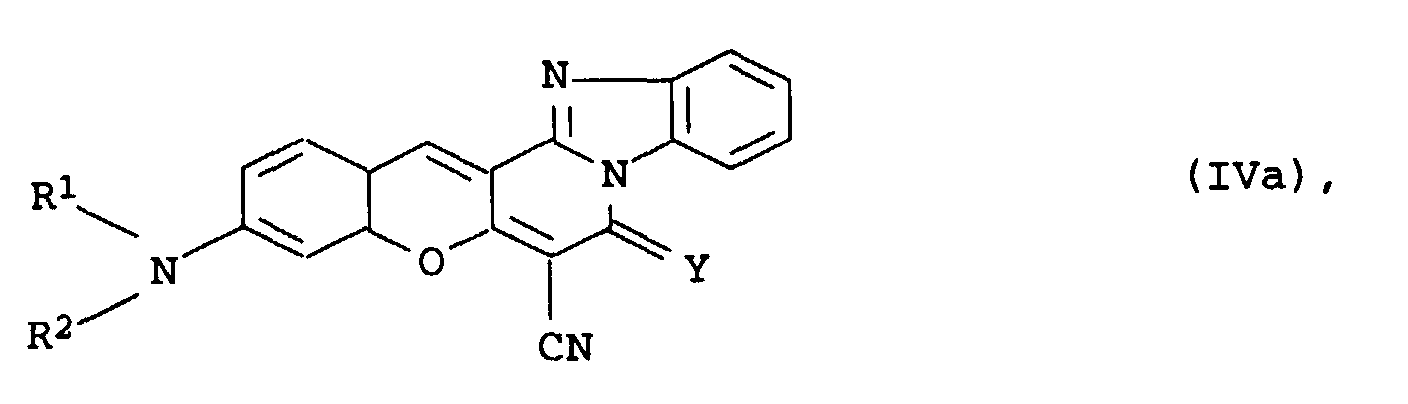
- Preferred red disperse dyes are also those of the formula IVa in which R 1 , R 2 and Y each have the meaning given above.
- Dye mixtures containing red disperse dyes are preferred at least one dye of the formula IV, preferably of the formula IVa, in which Y is oxygen.
- Dye mixtures containing red are also preferred Disperse dyes a dye of formula IV, preferably of the formula IVa, in which Y is oxygen and a dye of the formula IV, preferably of the formula IVa, in which Y is imino.
- Dye mixtures containing red are also preferred Disperse dyes a dye of formula IV, preferably of the formula IVa, in which Y is oxygen, a dye of Formula IV, preferably of formula IVa, in which Y is imino and a dye of the formula III, preferably of the formula IIIa.
- Dye mixtures containing red are particularly preferred Disperse dyes at least one dye of the formula IVa, in which Y means oxygen, and as yellow disperse dyes, at least one dye of the formula Ia, Ib and / or Ic.
- dye mixtures in which the mixture partners are preferred from a combination of the preferred listed above Components are selected.
- Dye mixtures in which the Weight fraction of the red disperse dyes of the formula IV, in which Y is oxygen, 45 to 80 wt .-%, that of the red disperse dyes of the formula IIIa 5 to 45 wt .-% and that of yellow disperse dyes 10 to 20 wt .-%, each based on the total weight of the red and yellow disperse dyes is, the total proportion of dyes of course 100% results.
- Further constituents of the dye mixtures according to the invention can e.g. usual auxiliaries, such as commercial dispersants, Agent or defoaming agent or water.
- Preferred dye mixtures are those which have a minimum luminance factor ⁇ > 0.30 ⁇ 0.40.
- the new dye mixtures are produced in themselves known way by mixing the mixing partners. You can the red and yellow disperse dyes in bulk can be mixed directly with one another. However, it is also possible the red and yellow disperse dyes in the form of dye preparations to mix with each other. Furthermore can also Mixtures by mixing dyes, at least of which one in substance and at least one as a dye preparation is present.
- Another subject of the present application is therefore a Process for dyeing synthetic or semi-synthetic Materials that are characterized in that the synthetic or semi-synthetic materials in the dye liquor treated the dye mixtures according to the invention, wherein either the dye mixtures are added to the dye liquor or the Dye mixtures by adding the red and yellow separately Disperse dyes are generated in situ in the dyeing liquor.
- Dyes are generally known per se Products. They are, for example, those cited in EP-A-42 090 Documents or described in US-A-3 880 869.
- the dye mixtures according to the invention are advantageously suitable Way of dyeing or printing synthetic or semi-synthetic materials (also using the ink jet process).
- the dyeing and printing conditions are known per se and include dyeing in supercritical carbon dioxide.
- the new dye mixtures have the particular advantage that in their application for the production of signal and warning clothing Produce products that have a pronounced luminosity.
- the individual test data can be found in the following tables 1 and 2.
- the values relating to the amount of dyes relate to the dye preparation used.
Landscapes
- Chemical & Material Sciences (AREA)
- Organic Chemistry (AREA)
- Chemical Kinetics & Catalysis (AREA)
- Dispersion Chemistry (AREA)
- Engineering & Computer Science (AREA)
- Textile Engineering (AREA)
- Coloring (AREA)
- Spectrometry And Color Measurement (AREA)
- Cosmetics (AREA)
- Non-Silver Salt Photosensitive Materials And Non-Silver Salt Photography (AREA)
Abstract
Description
| x | y |
| 0,655 | 0,344 |
| 0,579 | 0,341 |
| 0,606 | 0,314 |
| 0,690 | 0,310 |
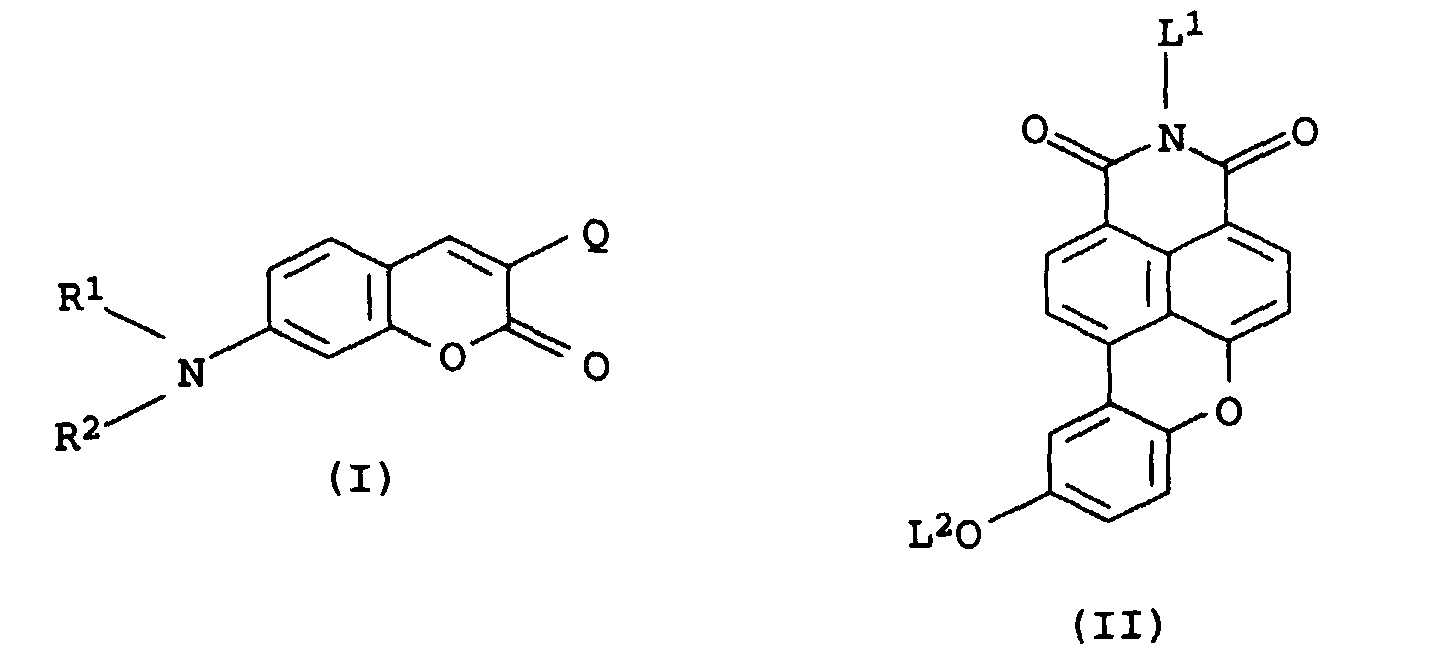
- R1 und R2
- unabhängig voneinander jeweils C1-C13-Alkyl,
- Q
- einen Rest der Formel
in der

- n
- für 1 oder 2,
- R3
- für Wasserstoff, C1-C6-Alkyl, C1-C6-Alkoxy, Halogen, Cyano, Nitro, Carbamoyl, C1-C4-Mono- oder Dialkylcarbamoyl, Sulfamoyl oder C1-C4-Mono- oder Dialkylsulfamoyl,
- R4
- für Wasserstoff oder C1-C6-Alkyl und
- X
- für Imino, C1-C4-Alkylimino, Sauerstoff oder Schwefel stehen,
- L1
- C1-C13-Alkyl, das gegebenenfalls durch ein bis drei Sauerstoffatome in Etherfunktion unterbrochen ist und durch Hydroxy substituiert sein kann, oder Phenyl und
- L2
- C1-C6-Alkyl bedeuten.
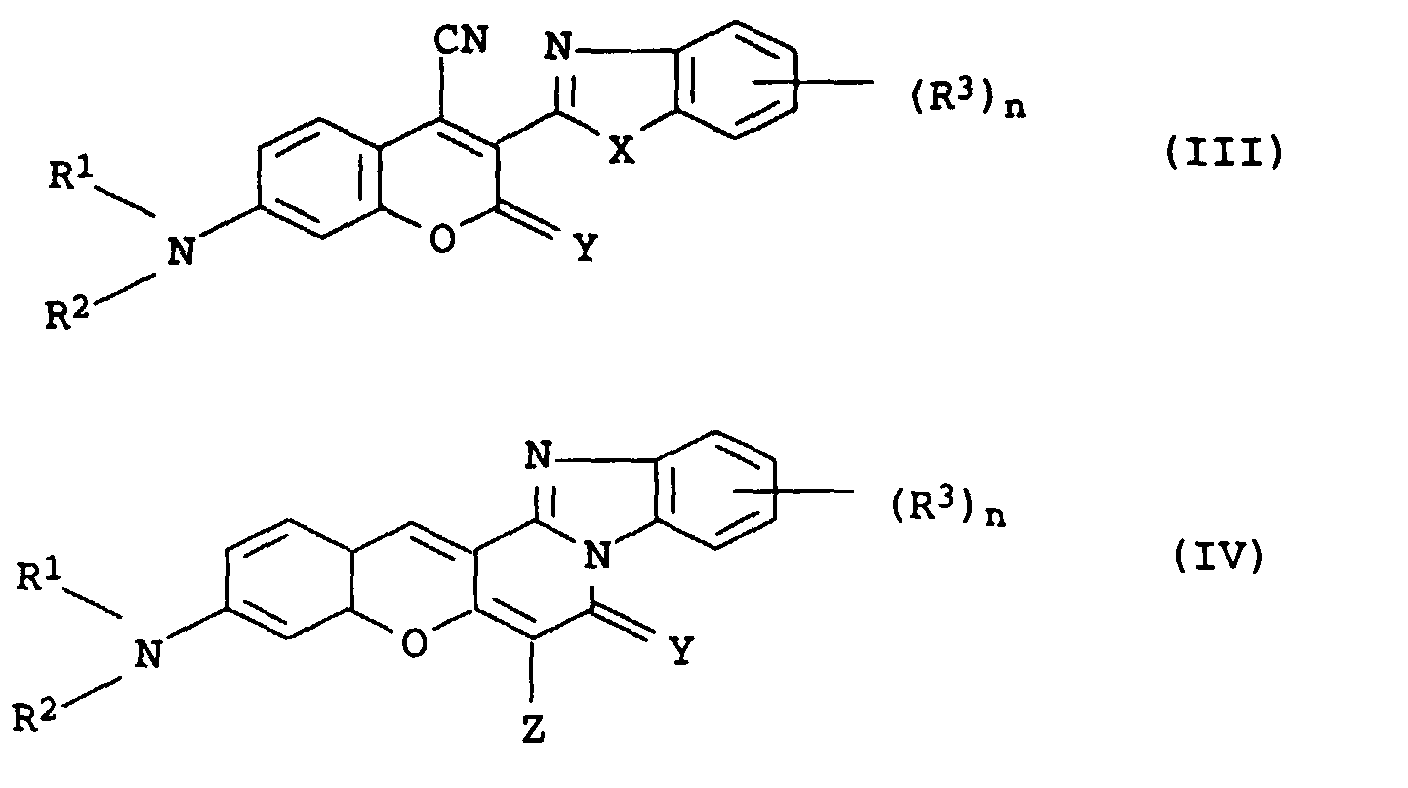
- R1, R2, R3, X und n
- jeweils die oben genannte Bedeutung besitzen und
- Y
- Sauerstoff oder Imino und
- Z
- Cyano oder Carbamoyl bedeuten.


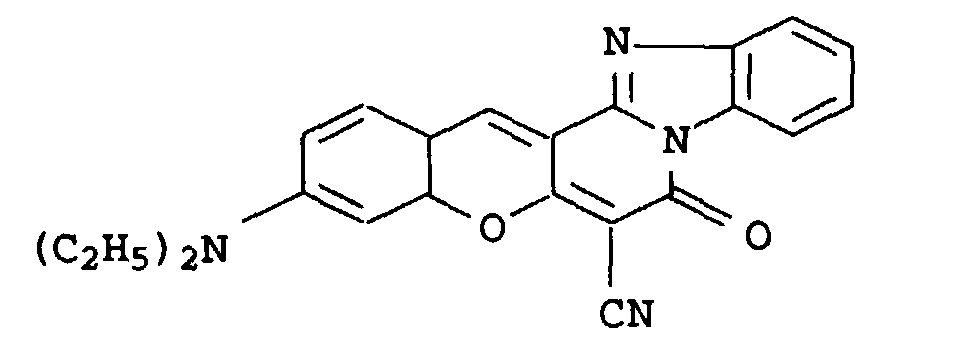
(Mitsubishi Kasei Corp., Tokyo)
(Handelsübliche Zubereitung)
(Bayer AG, Leverkusen)
(Handelsübliche Zubereitung)


(Bayer AG, Leverkusen)
(Handelsübliche Zubereitung)
- A1) HT-Verfahren
(in situ Erzeugung der Farbstoffmischung)
W1 Gew.-% roter Farbstoff (als Zubereitung), W2 Gew.-% gelber Farbstoff (als Zubereitung), jeweils bezogen auf das Gewicht des Polyestergewebes, und 10 g Polyestergewebe werden bei einer Temperatur von 50°C in 200 ml einer Färbeflotte gegeben, deren pH-Wert mittels Essigsäure auf 4,5 eingestellt ist. Man behandelt 5 min bei 50°C, steigert dann die Temperatur der Flotte innerhalb von 30 min auf 130°C, hält 60 min bei dieser Temperatur und läßt dann innerhalb von 20 min auf 60°C abkühlen.
Danach wird das ausgefärbte Polyestergewebe oxidativ gereinigt, indem man es 20 min in 200 ml einer Flotte, die 2 ml/l 50 gew.-%ige Natronlauge, 5 ml 30 gew.-%iges wässriges Wasserstoffperoxid und 1 ml/l eines handelsüblichen Peroxidstabilisators enthält, bei 90°C behandelt. Schließlich wird das Gewebe gespült, mit verdünnter Essigsäure neutralisiert, nochmals gespült und getrocknet. - A2) HT-Verfahren
(Farbstoffmischung wird zur Färbeflotte gegeben)
Man verfährt analog A1). Die Färbeflotte enthält W Gew.-%, bezogen auf das Polyestergewebe, Farbstoffmischung. - B1) Thermosol-Verfahren
(in situ Erzeugung der Farbstoffmischung)
Z1 g/l roter Farbstoff (als Zubereitung) und Z2 g/l gelber Farbstoff (als Zubereitung) werden in eine Klotzflotte gegeben, die 2 g/l eines handelsüblichen Netzmittels auf Basis eines Phosphorsäureesters und 10 g/l eines handelsüblichen Antimigrationsmittels auf Basis eines Acrylsäure/Acrylamid-Copolymerisats enthält. Diese Flotte wird mit einer Flottenaufnahme von 50 % auf Polyester-Baumwolle-Mischgewebe (80 : 20) mit Hilfe eines Foulards appliziert. Es folgt eine Zwischentrocknung mit Luftzirkulation bei 100°C. Danach wird 60 sec bei 220°C thermosoliert. - B2) Thermosol-Verfahren
(Farbstoffmischung wird zur Färbeflotte gegeben)
Man verfährt analog B1). Die Klotzflotte enthält Z g/l, bezogen auf das Polyestergewebe, Farbstoffmischung.


Claims (8)
- Farbstoffmischungen, die im wesentlichen rote und gelbe Dispersionsfarbstoffe enthalten und die, bei Vermessung von mit ihnen behandelten synthetischen oder halbsynthetischen Materialien, ihren Farbort in einem durch Eckpunkte mit den folgenden Koordinaten x und y
x y 0,655 0,344 0,579 0,341 0,606 0,314 0,690 0,310 - Farbstoffmischungen nach Anspruch 1, dadurch gekennzeichnet, daß sie einen Mindestleuchtdichtefaktor β > 0,30 < 0,40 aufweisen.
- Farbstoffmischungen nach Anspruch 1, dadurch gekennzeichnet, daß sie die Bedingungen für Farbort und Mindestleuchtdichtefaktor vor und nach Xenon-Bestrahlung erfüllen.
- Farbstoffmischungen nach Anspruch 1, dadurch gekennzeichnet, daß der Gewichtsanteil der roten Dispersionsfarbstoffe 50 bis 90 Gew.-% und der der gelben Dispersionsfarbstoffe 10 bis 50 Gew.-%, jeweils bezogen auf das Gesamtgewicht der roten und gelben Dispersionsfarbstoffe, beträgt.
- Farbstoffmischungen nach Anspruch 1, dadurch gekennzeichnet, daß sie gelbe Dispersionsfarbstoffe enthalten, die den Formeln I oder IIgehorchen, worin
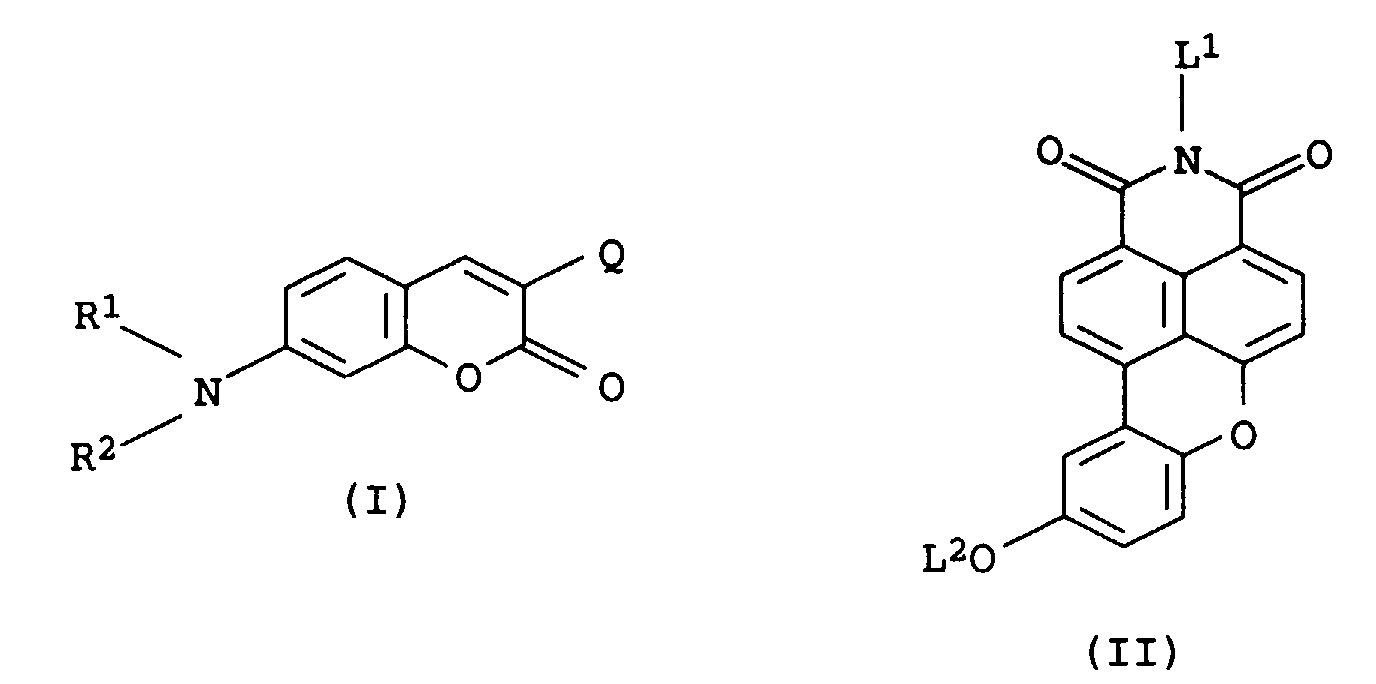
- R1 und R2
- unabhängig voneinander jeweils C1-C13-Alkyl,
- Q
- einen Rest der Formel
in der

- n
- für 1 oder 2,
- R3
- für Wasserstoff, C1-C6-Alkyl, C1-C6-Alkoxy, Halogen, Cyano, Nitro, Carbamoyl, C1-C4-Mono- oder Dialkylcarbamoyl, Sulfamoyl oder C1-C4-Mono- oder Dialkylsulfamoyl,
- R4
- für Wasserstoff oder C1-C6-Alkyl und
- X
- für Imino, C1-C4-Alkylimino, Sauerstoff oder Schwefel stehen,
- L1
- C1-C13-Alkyl, das gegebenenfalls durch ein bis drei Sauerstoffatome in Etherfunktion unterbrochen ist und durch Hydroxy substituiert sein kann, oder Phenyl und
- L2
- C1-C6-Alkyl bedeuten.
- Farbstoffmischung nach Anspruch 1, dadurch gekennzeichnet, daß sie rote Dispersionsfarbstoffe enthalten, die den Formeln III oder IVgehorchen, worin
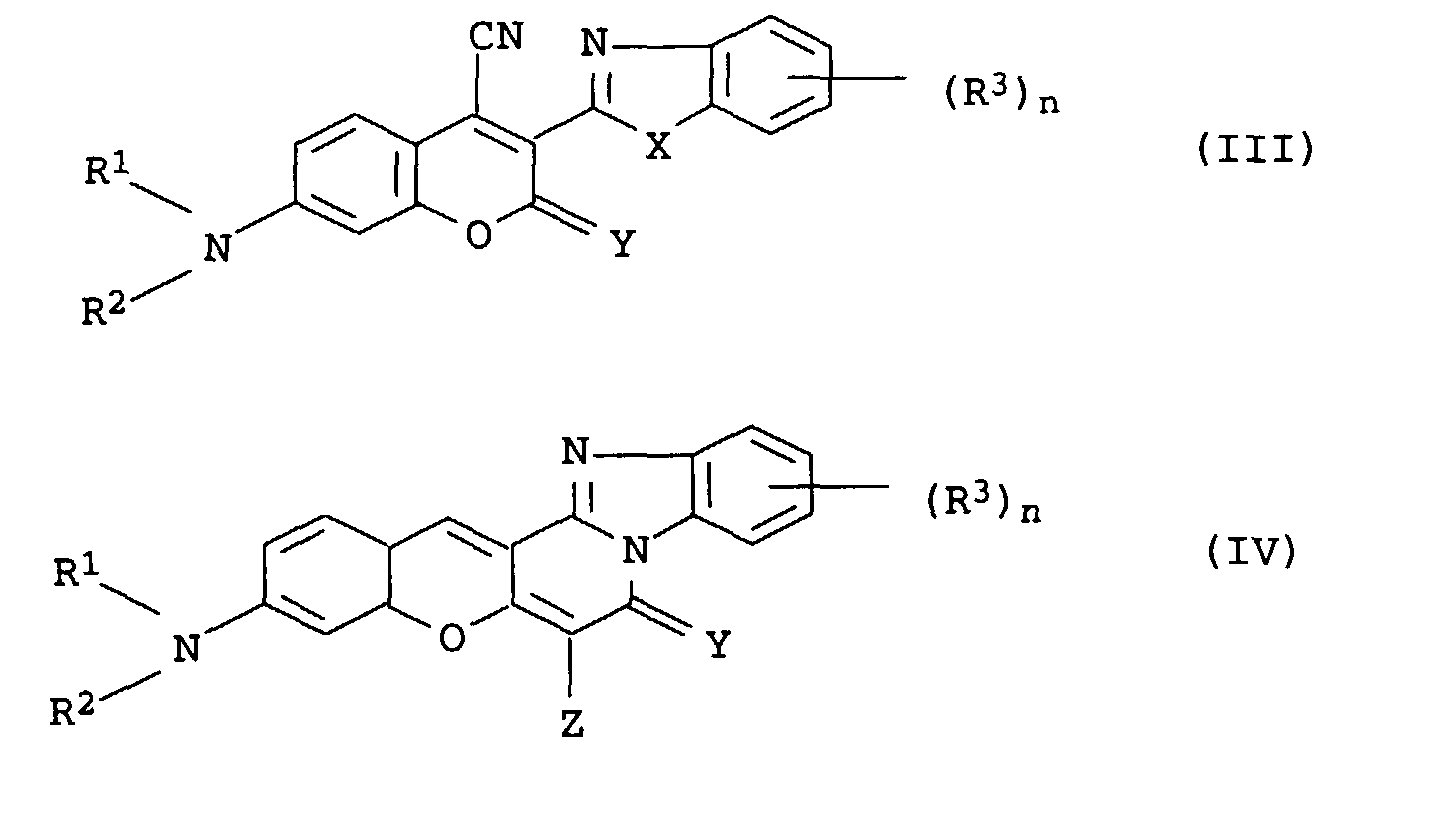
- n
- 1 oder 2,
- R1 und R2
- unabhängig voneinander jeweils C1-C13-Alkyl,
- R3
- Wasserstoff, C1-C6-Alkyl, C1-C6-Alkoxy, Halogen, Cyano, Nitro, Carbamoyl, C1-C4-Mono- oder Dialkylcarbamoyl, Sulfamoyl oder C1-C4-Mono- oder Dialkylsulfamoyl,
- Y
- Sauerstoff oder Imino und
- Z
- Cyano oder Carbamoyl bedeuten.
- Verfahren zum Färben von synthetischen oder halbsynthetischen Materialien, dadurch gekennzeichnet, daß man die synthetischen oder halbsynthetischen Materialien in der Färbeflotte mit den Farbstoffmischungen gemäß Anspruch 1 behandelt, wobei man entweder die Farbstoffmischungen in die Färbeflotte gibt oder die Farbstoffmischungen durch getrennte Zugabe der roten und gelben Dispersionsfarbstoffe in die Färbeflotte in situ erzeugt.
- Verwendung der Farbstoffmischungen gemäß Anspruch 1 zum Färben oder Bedrucken von synthetischen oder halbsynthetischen Materialien.
Applications Claiming Priority (4)
| Application Number | Priority Date | Filing Date | Title |
|---|---|---|---|
| DE19725946 | 1997-06-19 | ||
| DE1997125946 DE19725946A1 (de) | 1997-06-19 | 1997-06-19 | Farbstoffmischungen |
| DE1997142912 DE19742912A1 (de) | 1997-09-29 | 1997-09-29 | Farbstoffmischungen |
| DE19742912 | 1997-09-29 |
Publications (3)
| Publication Number | Publication Date |
|---|---|
| EP0885936A2 true EP0885936A2 (de) | 1998-12-23 |
| EP0885936A3 EP0885936A3 (de) | 1999-10-06 |
| EP0885936B1 EP0885936B1 (de) | 2002-05-29 |
Family
ID=26037576
Family Applications (1)
| Application Number | Title | Priority Date | Filing Date |
|---|---|---|---|
| EP98110460A Expired - Lifetime EP0885936B1 (de) | 1997-06-19 | 1998-06-08 | Farbstoffmischungen |
Country Status (5)
| Country | Link |
|---|---|
| EP (1) | EP0885936B1 (de) |
| AT (1) | ATE218157T1 (de) |
| DE (1) | DE59804219D1 (de) |
| ES (1) | ES2179402T3 (de) |
| PT (1) | PT885936E (de) |
Cited By (3)
| Publication number | Priority date | Publication date | Assignee | Title |
|---|---|---|---|---|
| FR2826669A1 (fr) * | 2001-06-28 | 2003-01-03 | Kermel | Fil composite |
| WO2006003125A1 (en) * | 2004-07-07 | 2006-01-12 | Huntsman Advanced Materials (Switzerland) Gmbh | Process for the production of high visibility markers or high visibility clothing |
| EP2063295A1 (de) * | 2000-04-11 | 2009-05-27 | Nippon Carbide Kogyo Kabushiki Kaisha | Fluoreszenz-retroreflektive Folie |
Family Cites Families (3)
| Publication number | Priority date | Publication date | Assignee | Title |
|---|---|---|---|---|
| DE3021947A1 (de) * | 1980-06-12 | 1982-01-14 | Bayer Ag, 5090 Leverkusen | Farbstoffpraeparation sowie deren verwendung als warn- und signalfarbe |
| DE3031326A1 (de) * | 1980-08-20 | 1982-04-01 | Bayer Ag, 5090 Leverkusen | Farbstoffpraeparation sowie deren verwendung als warn- und signalfarbe |
| DE3447794A1 (de) * | 1984-12-29 | 1986-07-10 | Gerhard Dipl.-Ing. Rost (FH), 4443 Schüttorf | Warn- oder signalfarbe und mit dieser versehene web- oder wirkstoffe |
-
1998
- 1998-06-08 PT PT98110460T patent/PT885936E/pt unknown
- 1998-06-08 ES ES98110460T patent/ES2179402T3/es not_active Expired - Lifetime
- 1998-06-08 AT AT98110460T patent/ATE218157T1/de not_active IP Right Cessation
- 1998-06-08 EP EP98110460A patent/EP0885936B1/de not_active Expired - Lifetime
- 1998-06-08 DE DE59804219T patent/DE59804219D1/de not_active Expired - Lifetime
Cited By (6)
| Publication number | Priority date | Publication date | Assignee | Title |
|---|---|---|---|---|
| EP2063295A1 (de) * | 2000-04-11 | 2009-05-27 | Nippon Carbide Kogyo Kabushiki Kaisha | Fluoreszenz-retroreflektive Folie |
| FR2826669A1 (fr) * | 2001-06-28 | 2003-01-03 | Kermel | Fil composite |
| WO2003002797A3 (fr) * | 2001-06-28 | 2003-02-27 | Kermel | Fil composite |
| US7107750B2 (en) | 2001-06-28 | 2006-09-19 | Kermel | Composite yarn |
| CN100489169C (zh) * | 2001-06-28 | 2009-05-20 | 盖尔麦公司 | 复合丝 |
| WO2006003125A1 (en) * | 2004-07-07 | 2006-01-12 | Huntsman Advanced Materials (Switzerland) Gmbh | Process for the production of high visibility markers or high visibility clothing |
Also Published As
| Publication number | Publication date |
|---|---|
| EP0885936B1 (de) | 2002-05-29 |
| ES2179402T3 (es) | 2003-01-16 |
| ATE218157T1 (de) | 2002-06-15 |
| EP0885936A3 (de) | 1999-10-06 |
| DE59804219D1 (de) | 2002-07-04 |
| PT885936E (pt) | 2002-10-31 |
Similar Documents
| Publication | Publication Date | Title |
|---|---|---|
| DE3314663C2 (de) | Verfahren zum Färben von Cellulosefasern oder Cellulosemischfasern nach der Ausschöpf-Färbemethode | |
| DE60112964T2 (de) | Trichromie-faerbeverfahren | |
| EP0601439B1 (de) | Farbstoffmischungen, enthaltend Azofarbstoffe mit einer Kupplungskomponente aus der Diaminopyridinreihe | |
| EP0347685A2 (de) | Mischungen blauer Dispersionsazofarbstoffe | |
| EP0425434B1 (de) | Farbstoffmischungen und deren Verwendung | |
| EP0591736B1 (de) | Verwendung von Pyridinfarbstoffen im textilen Bereich, Farbstoffmischungen, enthaltend Pyridinfarbstoffe, sowie Triazolopyridinfarbstoffe mit einem Thienylrest | |
| DE3844067A1 (de) | Mischungen von dispersionsazofarbstoffen | |
| EP0611808A2 (de) | Mischungen von Azofarbstoffen für marineblaue bis schwarze Farbtöne | |
| DD280329A1 (de) | Dispersionsfarbstoffpraeparate zum faerben und bedrucken von polyestermaterialien i | |
| EP0885936B1 (de) | Farbstoffmischungen | |
| DE4135846C1 (de) | ||
| DE69123031T2 (de) | Mischung von Dispersionsfarbstoffen und Färbemethode | |
| EP0535424B1 (de) | Blaue Farbstoffmischungen mit hoher Brillanz | |
| EP0042090B1 (de) | Farbstoffpräparation sowie deren Verwendung als Warn- und Signalfarbe | |
| EP0590438A2 (de) | Mischungen von Azofarbstoffen für marineblaue bis schwarze Farbtöne | |
| DE19742912A1 (de) | Farbstoffmischungen | |
| DE19725946A1 (de) | Farbstoffmischungen | |
| EP0330967A2 (de) | Verfahren zum Färben von synthetischen Fasermaterialien | |
| EP0137240B1 (de) | Mischungen von Dispersionsfarbstoffen | |
| DE3109954A1 (de) | Verfahren zum faerben von hydrophobem fasermaterial | |
| DE3216788A1 (de) | Farbstoffmischungen | |
| DE4209109A1 (de) | Blaue farbstoffmischungen | |
| EP0524148A2 (de) | Farbstoffmischungen und deren Verwendung | |
| DE2832011C2 (de) | Verfahren zum Färben und Bedrucken von Stoffen auf Kunstfaserbasis mit Dispersionsfarbstoffen und Färbemischungen | |
| EP0716671A1 (de) | Farbstoffmischungen, enthaltend gleichfarbige azofarbstoffe mit einer kupplungskomponente aus der diaminopyridinreihe |
Legal Events
| Date | Code | Title | Description |
|---|---|---|---|
| PUAI | Public reference made under article 153(3) epc to a published international application that has entered the european phase |
Free format text: ORIGINAL CODE: 0009012 |
|
| AK | Designated contracting states |
Kind code of ref document: A2 Designated state(s): AT BE CH DE DK ES FI FR GB GR IE IT LI NL PT SE |
|
| AX | Request for extension of the european patent |
Free format text: AL;LT;LV;MK;RO;SI |
|
| PUAL | Search report despatched |
Free format text: ORIGINAL CODE: 0009013 |
|
| AK | Designated contracting states |
Kind code of ref document: A3 Designated state(s): AT BE CH CY DE DK ES FI FR GB GR IE IT LI LU MC NL PT SE |
|
| AX | Request for extension of the european patent |
Free format text: AL;LT;LV;MK;RO;SI |
|
| 17P | Request for examination filed |
Effective date: 19991104 |
|
| AKX | Designation fees paid |
Free format text: AT BE CH DE DK ES FI FR GB GR IE IT LI NL PT SE |
|
| 17Q | First examination report despatched |
Effective date: 20000706 |
|
| RAP1 | Party data changed (applicant data changed or rights of an application transferred) |
Owner name: DYSTAR TEXTILFARBEN GMBH & CO. DEUTSCHLAND KG |
|
| GRAG | Despatch of communication of intention to grant |
Free format text: ORIGINAL CODE: EPIDOS AGRA |
|
| GRAG | Despatch of communication of intention to grant |
Free format text: ORIGINAL CODE: EPIDOS AGRA |
|
| GRAH | Despatch of communication of intention to grant a patent |
Free format text: ORIGINAL CODE: EPIDOS IGRA |
|
| GRAH | Despatch of communication of intention to grant a patent |
Free format text: ORIGINAL CODE: EPIDOS IGRA |
|
| GRAA | (expected) grant |
Free format text: ORIGINAL CODE: 0009210 |
|
| AK | Designated contracting states |
Kind code of ref document: B1 Designated state(s): AT BE CH DE DK ES FI FR GB GR IE IT LI NL PT SE |
|
| PG25 | Lapsed in a contracting state [announced via postgrant information from national office to epo] |
Ref country code: NL Free format text: LAPSE BECAUSE OF FAILURE TO SUBMIT A TRANSLATION OF THE DESCRIPTION OR TO PAY THE FEE WITHIN THE PRESCRIBED TIME-LIMIT Effective date: 20020529 Ref country code: IE Free format text: LAPSE BECAUSE OF FAILURE TO SUBMIT A TRANSLATION OF THE DESCRIPTION OR TO PAY THE FEE WITHIN THE PRESCRIBED TIME-LIMIT Effective date: 20020529 Ref country code: GR Free format text: LAPSE BECAUSE OF FAILURE TO SUBMIT A TRANSLATION OF THE DESCRIPTION OR TO PAY THE FEE WITHIN THE PRESCRIBED TIME-LIMIT Effective date: 20020529 Ref country code: FI Free format text: LAPSE BECAUSE OF FAILURE TO SUBMIT A TRANSLATION OF THE DESCRIPTION OR TO PAY THE FEE WITHIN THE PRESCRIBED TIME-LIMIT Effective date: 20020529 |
|
| REF | Corresponds to: |
Ref document number: 218157 Country of ref document: AT Date of ref document: 20020615 Kind code of ref document: T |
|
| REG | Reference to a national code |
Ref country code: GB Ref legal event code: FG4D Free format text: NOT ENGLISH |
|
| REG | Reference to a national code |
Ref country code: CH Ref legal event code: EP |
|
| PG25 | Lapsed in a contracting state [announced via postgrant information from national office to epo] |
Ref country code: AT Free format text: LAPSE BECAUSE OF NON-PAYMENT OF DUE FEES Effective date: 20020608 |
|
| REG | Reference to a national code |
Ref country code: IE Ref legal event code: FG4D Free format text: GERMAN |
|
| REF | Corresponds to: |
Ref document number: 59804219 Country of ref document: DE Date of ref document: 20020704 |
|
| GBT | Gb: translation of ep patent filed (gb section 77(6)(a)/1977) |
Effective date: 20020725 |
|
| PG25 | Lapsed in a contracting state [announced via postgrant information from national office to epo] |
Ref country code: SE Free format text: LAPSE BECAUSE OF FAILURE TO SUBMIT A TRANSLATION OF THE DESCRIPTION OR TO PAY THE FEE WITHIN THE PRESCRIBED TIME-LIMIT Effective date: 20020829 Ref country code: DK Free format text: LAPSE BECAUSE OF FAILURE TO SUBMIT A TRANSLATION OF THE DESCRIPTION OR TO PAY THE FEE WITHIN THE PRESCRIBED TIME-LIMIT Effective date: 20020829 |
|
| ET | Fr: translation filed | ||
| REG | Reference to a national code |
Ref country code: PT Ref legal event code: SC4A Free format text: AVAILABILITY OF NATIONAL TRANSLATION Effective date: 20020729 |
|
| NLV1 | Nl: lapsed or annulled due to failure to fulfill the requirements of art. 29p and 29m of the patents act | ||
| REG | Reference to a national code |
Ref country code: IE Ref legal event code: FD4D Ref document number: 0885936E Country of ref document: IE |
|
| REG | Reference to a national code |
Ref country code: ES Ref legal event code: FG2A Ref document number: 2179402 Country of ref document: ES Kind code of ref document: T3 |
|
| PLBE | No opposition filed within time limit |
Free format text: ORIGINAL CODE: 0009261 |
|
| STAA | Information on the status of an ep patent application or granted ep patent |
Free format text: STATUS: NO OPPOSITION FILED WITHIN TIME LIMIT |
|
| 26N | No opposition filed |
Effective date: 20030303 |
|
| REG | Reference to a national code |
Ref country code: GB Ref legal event code: 732E Free format text: REGISTERED BETWEEN 20110303 AND 20110309 |
|
| PGFP | Annual fee paid to national office [announced via postgrant information from national office to epo] |
Ref country code: PT Payment date: 20110606 Year of fee payment: 14 Ref country code: FR Payment date: 20110621 Year of fee payment: 14 |
|
| REG | Reference to a national code |
Ref country code: FR Ref legal event code: TP |
|
| PGFP | Annual fee paid to national office [announced via postgrant information from national office to epo] |
Ref country code: BE Payment date: 20110614 Year of fee payment: 14 |
|
| REG | Reference to a national code |
Ref country code: DE Ref legal event code: R081 Ref document number: 59804219 Country of ref document: DE Owner name: DYSTAR COLOURS DISTRIBUTION GMBH, DE Free format text: FORMER OWNER: DYSTAR COLOURS DEUTSCHLAND GMBH, 65929 FRANKFURT, DE Effective date: 20111216 |
|
| REG | Reference to a national code |
Ref country code: GB Ref legal event code: 732E Free format text: REGISTERED BETWEEN 20120726 AND 20120801 |
|
| REG | Reference to a national code |
Ref country code: CH Ref legal event code: PUE Owner name: DYSTAR COLOURS DISTRIBUTION GMBH Free format text: DYSTAR TEXTILFARBEN GMBH & CO. DEUTSCHLAND KG# #65926 FRANKFURT AM MAIN (DE) -TRANSFER TO- DYSTAR COLOURS DISTRIBUTION GMBH#INDUSTRIEPARK HOECHST#65926 FRANKFURT AM MAIN (DE) |
|
| REG | Reference to a national code |
Ref country code: ES Ref legal event code: PC2A Owner name: DYSTAR COLOURS DISTRIBUTION GMBH Effective date: 20121116 |
|
| REG | Reference to a national code |
Ref country code: PT Ref legal event code: MM4A Free format text: LAPSE DUE TO NON-PAYMENT OF FEES Effective date: 20121210 |
|
| BERE | Be: lapsed |
Owner name: DYSTAR COLOURS DEUTSCHLAND G.M.B.H. Effective date: 20120630 |
|
| PG25 | Lapsed in a contracting state [announced via postgrant information from national office to epo] |
Ref country code: PT Free format text: LAPSE BECAUSE OF NON-PAYMENT OF DUE FEES Effective date: 20121210 |
|
| REG | Reference to a national code |
Ref country code: FR Ref legal event code: ST Effective date: 20130228 |
|
| PG25 | Lapsed in a contracting state [announced via postgrant information from national office to epo] |
Ref country code: FR Free format text: LAPSE BECAUSE OF NON-PAYMENT OF DUE FEES Effective date: 20120702 Ref country code: BE Free format text: LAPSE BECAUSE OF NON-PAYMENT OF DUE FEES Effective date: 20120630 |
|
| REG | Reference to a national code |
Ref country code: DE Ref legal event code: R081 Ref document number: 59804219 Country of ref document: DE Owner name: DYSTAR COLOURS DISTRIBUTION GMBH, DE Free format text: FORMER OWNER: DYSTAR COLOURS DISTRIBUTION GMBH, 65929 FRANKFURT, DE Effective date: 20130709 |
|
| PGFP | Annual fee paid to national office [announced via postgrant information from national office to epo] |
Ref country code: DE Payment date: 20150630 Year of fee payment: 18 |
|
| REG | Reference to a national code |
Ref country code: DE Ref legal event code: R119 Ref document number: 59804219 Country of ref document: DE |
|
| PG25 | Lapsed in a contracting state [announced via postgrant information from national office to epo] |
Ref country code: DE Free format text: LAPSE BECAUSE OF NON-PAYMENT OF DUE FEES Effective date: 20170103 |
|
| PGFP | Annual fee paid to national office [announced via postgrant information from national office to epo] |
Ref country code: GB Payment date: 20170630 Year of fee payment: 20 Ref country code: CH Payment date: 20170627 Year of fee payment: 20 |
|
| PGFP | Annual fee paid to national office [announced via postgrant information from national office to epo] |
Ref country code: IT Payment date: 20170623 Year of fee payment: 20 |
|
| PGFP | Annual fee paid to national office [announced via postgrant information from national office to epo] |
Ref country code: ES Payment date: 20170724 Year of fee payment: 20 |
|
| REG | Reference to a national code |
Ref country code: CH Ref legal event code: PL |
|
| REG | Reference to a national code |
Ref country code: GB Ref legal event code: PE20 Expiry date: 20180607 |
|
| PG25 | Lapsed in a contracting state [announced via postgrant information from national office to epo] |
Ref country code: GB Free format text: LAPSE BECAUSE OF EXPIRATION OF PROTECTION Effective date: 20180607 |
|
| REG | Reference to a national code |
Ref country code: ES Ref legal event code: FD2A Effective date: 20200803 |
|
| PG25 | Lapsed in a contracting state [announced via postgrant information from national office to epo] |
Ref country code: ES Free format text: LAPSE BECAUSE OF EXPIRATION OF PROTECTION Effective date: 20180609 |