EP0885978B1 - Stahlblech für doppeltgewundenes rohr und verfahren zu dessen herstellung - Google Patents
Stahlblech für doppeltgewundenes rohr und verfahren zu dessen herstellung Download PDFInfo
- Publication number
- EP0885978B1 EP0885978B1 EP97913438A EP97913438A EP0885978B1 EP 0885978 B1 EP0885978 B1 EP 0885978B1 EP 97913438 A EP97913438 A EP 97913438A EP 97913438 A EP97913438 A EP 97913438A EP 0885978 B1 EP0885978 B1 EP 0885978B1
- Authority
- EP
- European Patent Office
- Prior art keywords
- less
- rolling
- steel sheet
- steel
- tube
- Prior art date
- Legal status (The legal status is an assumption and is not a legal conclusion. Google has not performed a legal analysis and makes no representation as to the accuracy of the status listed.)
- Expired - Lifetime
Links
Images
Classifications
-
- C—CHEMISTRY; METALLURGY
- C22—METALLURGY; FERROUS OR NON-FERROUS ALLOYS; TREATMENT OF ALLOYS OR NON-FERROUS METALS
- C22C—ALLOYS
- C22C38/00—Ferrous alloys, e.g. steel alloys
- C22C38/12—Ferrous alloys, e.g. steel alloys containing tungsten, tantalum, molybdenum, vanadium, or niobium
-
- C—CHEMISTRY; METALLURGY
- C21—METALLURGY OF IRON
- C21D—MODIFYING THE PHYSICAL STRUCTURE OF FERROUS METALS; GENERAL DEVICES FOR HEAT TREATMENT OF FERROUS OR NON-FERROUS METALS OR ALLOYS; MAKING METAL MALLEABLE, e.g. BY DECARBURISATION OR TEMPERING
- C21D8/00—Modifying the physical properties of ferrous metals or ferrous alloys by deformation combined with, or followed by, heat treatment
- C21D8/02—Modifying the physical properties of ferrous metals or ferrous alloys by deformation combined with, or followed by, heat treatment during manufacturing of plates or strips
- C21D8/0221—Modifying the physical properties of ferrous metals or ferrous alloys by deformation combined with, or followed by, heat treatment during manufacturing of plates or strips characterised by the working steps
- C21D8/0236—Cold rolling
-
- C—CHEMISTRY; METALLURGY
- C22—METALLURGY; FERROUS OR NON-FERROUS ALLOYS; TREATMENT OF ALLOYS OR NON-FERROUS METALS
- C22C—ALLOYS
- C22C38/00—Ferrous alloys, e.g. steel alloys
- C22C38/14—Ferrous alloys, e.g. steel alloys containing titanium or zirconium
-
- C—CHEMISTRY; METALLURGY
- C21—METALLURGY OF IRON
- C21D—MODIFYING THE PHYSICAL STRUCTURE OF FERROUS METALS; GENERAL DEVICES FOR HEAT TREATMENT OF FERROUS OR NON-FERROUS METALS OR ALLOYS; MAKING METAL MALLEABLE, e.g. BY DECARBURISATION OR TEMPERING
- C21D8/00—Modifying the physical properties of ferrous metals or ferrous alloys by deformation combined with, or followed by, heat treatment
- C21D8/02—Modifying the physical properties of ferrous metals or ferrous alloys by deformation combined with, or followed by, heat treatment during manufacturing of plates or strips
- C21D8/0221—Modifying the physical properties of ferrous metals or ferrous alloys by deformation combined with, or followed by, heat treatment during manufacturing of plates or strips characterised by the working steps
- C21D8/0226—Hot rolling
-
- C—CHEMISTRY; METALLURGY
- C21—METALLURGY OF IRON
- C21D—MODIFYING THE PHYSICAL STRUCTURE OF FERROUS METALS; GENERAL DEVICES FOR HEAT TREATMENT OF FERROUS OR NON-FERROUS METALS OR ALLOYS; MAKING METAL MALLEABLE, e.g. BY DECARBURISATION OR TEMPERING
- C21D8/00—Modifying the physical properties of ferrous metals or ferrous alloys by deformation combined with, or followed by, heat treatment
- C21D8/02—Modifying the physical properties of ferrous metals or ferrous alloys by deformation combined with, or followed by, heat treatment during manufacturing of plates or strips
- C21D8/0247—Modifying the physical properties of ferrous metals or ferrous alloys by deformation combined with, or followed by, heat treatment during manufacturing of plates or strips characterised by the heat treatment
- C21D8/0268—Modifying the physical properties of ferrous metals or ferrous alloys by deformation combined with, or followed by, heat treatment during manufacturing of plates or strips characterised by the heat treatment between cold rolling steps
Definitions
- the present invention relates to a steel sheet suitable for a double-rolled tube and a method for making the same, in which the surface of the steel sheet is plated with copper or a self-brazing metal, shaped into a pipe, and heated to a temperature higher than the melting point of the plating metal for a short duration to form the double-rolled tube.
- Double-rolled tubes having excellent appearances similar to those of copper tubes and excellent thermal characteristics, as well as high strength and toughness due to steel, have been used in the fields of connection tubes for various compressors and brake tubes of vehicles.
- Double-rolled tubes are described in detail in, for example, "TETSU-TO-HAGANE", No. 1, p. 130 (1980).
- a typical method for making a double-rolled tube will now be described in brief.
- the steel sheet is furled such that the rolling direction of the steel sheet is parallel to the central axis of the tube.
- the steel sheet is furled double so that the thickness of the tube is double that of the steel sheet.
- the tube is heated to a higher temperature than the melting point of copper for "self-brazing" which represents bonding of the steel sheet walls by means of filling the gap between the walls with molten copper.
- a double-rolled tube is prepared in such a manner.
- cold reforming and sizing are performed to obtain a final product.
- double-rolled tubes generally require reliability such as air-tightness in view of their usage.
- box-annealed low-carbon steel sheets generally have been used.
- box-annealed sheets are relatively soft materials and have excellent formability, these can be satisfactorily used as raw materials for double-rolled tubes.
- the sheet requires several days for production, and thus has an inferior production efficiency.
- Another disadvantage is non-uniformity of the mechanical properties in the longitudinal and transverse directions of the coil.
- softer materials having excellent formability, while maintaining high strength, are demanded.
- Ultra-low-carbon steel sheets having a significantly decreased carbon content have been noted in the field of general cold-rolled steel sheets.
- the ultra-low-carbon steel sheets are suitable for a continuous annealing process having a high production efficiency and creating excellent uniformity of the mechanical properties. Further, the steel sheets are soft and have excellent formability.
- the use of a continuously-annealed soft ultra-low-carbon steel sheet is in prospect for solving the above-mentioned problems.
- the tube In the production process of the double-rolled tube, however, a cold working of approximately 7% to 8% strain is applied to the steel sheet after tubing by drawing. Further, the tube is subjected to heat treatment for self-brazing at a higher temperature than the melting point (1,083 °C) of copper, although for a short duration. Thus, coarsening of the micro-structure in the steel during the forming and annealing is anticipated. When a double-rolled tube is formed of an ultra-low-carbon steel sheet, presence of coarse grains severely affecting the strength and toughness of the double-rolled tube are often observed.
- EP-A-0 295 697 discloses an extra-low carbon cold rolled steel sheet useful for use in automobiles and the like having an improved spot weldability, which steel sheet is obtained by combinedly adding Ti, Nb and B in predetermined amounts to the extra-low carbon steel so as to control the amount of fine Ti precipitate dispersed in steel to the specified reasonable range.
- the present inventors have discovered that containing a given amount or more of nonprecipitated Nb or Ti is effective for preventing the growth of grains contrary to conventional knowledge that control of the precipitates is effective, as a result of intensive experimentation and study for solving the above-mentioned problems.
- the present inventors have discovered that the given amount or more of nonprecipitated Nb or Ti is secured in a nonprecipitated state, that is, a solid solution state, that the crystal grain size is controllable within an optimum range, and that mechanical properties are stabilized after heat treatment in the tube production process, and the present inventors have completed the present invention.
- the present invention relates to a steel sheet for double-rolled tubes having excellent formability, and excellent strength and toughness after forming and heat treatment of a tube comprising:
- the present invention relates to a method for making a steel sheet for double-rolled tubes having excellent formability, and excellent strength and toughness after forming and heat treating of a tube comprising:
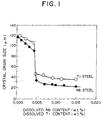
- Fig. 1 is a graph illustrating the correlation between the Nb or Ti content in a solid solution state and the ferrite grain size.
- An extremely reduced carbon content contributes to improved formability (decreased deformation stress and improved shape fixability) in the tube production process.
- a carbon content of less than 0.0005 wt% however, coarsening of grains is prominent, hence desirable strength and toughness are not achieved. Further, the possibility of the formation of rough surfaces like the so-called "orange peel phenomenon" will increases.
- a carbon content of more than 0.02 wt% causes a significant deterioration of ductility and shape fixability of the steel sheet, and thus deterioration of workability accompanied by thinning of the steel sheet is further prominent. Also, an excessive carbon content leads to decreases in the cold-rolling performance.
- the carbon content is set to a range of 0.0005 to 0.020 wt%. It is preferable that the range be 0.0010 to 0.015 wt% when requiring greater stability of the mechanical properties and excellent ductility.
- the upper limit is set to 0.02 wt% or less when requiring particularly excellent corrosion resistance.
- Manganese is an element effectively preventing hot cracking caused by sulphur.
- At least 0.1 wt% of manganese must be added in order to achieve these advantages. Since an excessive addition, however, leads to deterioration of corrosion resistance and cold rolling characteristics because of hardening of the steel sheet, the upper limit is set to 1.5 wt%. It is preferable that manganese be added within a range of 0.60 wt% or less when requiring more excellent corrosion resistance and formability.
- Phosphorus hardens the steel and causes deterioration of flange workability and shape fixability. Further, it is a harmful element which causes deterioration of corrosion resistance, hence the upper limit is set to 0.02 wt%. It is preferable that it be added in an amount of 0.01 wt% or less when these characteristics are particularly important.
- the upper limit of the sulphur content is set to 0.02 wt%. It is preferable that it be added in amount of 0.01 wt% or less when particularly excellent workability is demanded.
- Aluminum is an element which is effective for deoxidation in steel. Since an excessive content, however, causes deterioration of surface characteristics, the upper limit of the aluminum content is set to 0.100 wt%. It is preferable that aluminum be added in an amount in the range of 0.008 to 0.060 wt% in view of stability of the mechanical properties.
- N 0.0050 wt% or less.
- Nitrogen promotes occurrences of internal defects in the steel sheet as well as slab cracking in a continuous casting process as the content increases. Since nitrogen causes excessive hardening of the steel, the upper limit is set to 0.0050 wt%. It is preferable that the nitrogen content be 0.0030 wt% or less in view of stability of the mechanical properties and improvement in yield on account of the entire production process.
- Niobium is an element which is effective for making the micro-structure of the steel sheet finer, and such an effect is held after heat treatment after tube production. Such a finer micro-structure in the steel sheet causes significant improvement in secondary formability in the use as a tube, such as bending and stretching of the tube, and improvement in impact resistance. Such advantages due to niobium are noticeable in a content of 0.003 wt% or more; however, the addition of more than 0.040 wt% will cause hardening of the steel and slab cracking, as well as deteriorated ductility during hot-rolling and cold-rolling. The niobium content is therefore set to a range of 0.003 to 0.40 wt%. It is more preferable if the content be 0.020 wt% or less in view of mechanical properties.
- Titanium is also effective for making the micro-structure finer as with niobium. Although it is added in an amount of 0.005 wt% or more to achieve such an effect, the addition of more than 0.060 wt% causes an increase in the occurrence of surface defects.
- the titanium content is therefore set to a range of 0.005 to 0.060 wt%. It is more preferable that the content be 0.015 wt% or less in view of mechanical properties.
- Niobium and titanium may be added solely or in combination, since effects due to individual elements are not canceled by each other.
- Niobium and titanium in solid solution state are a significantly important feature in the present invention. Although the detailed mechanism has not been clarified, coarsening of the micro-structure after forming-heat-treatment of the double-rolled tube can be remarkably suppressed, as shown in Fig. 1, when at least one of niobium and titanium in solid solution state is present in an amount of 0.005 wt% or more.
- Nb 1 have the following compositions; 0.0025C - 0.02Si - 0.5Mn - 0.01P - 0.010S - 0.040A1 - 0.0020N - varied Nb or Ti, wherein the two levels of Nb contents, that is, 0.018% and 0.015%, and two levels of Ti contents, that is, 0.040 and 0.060% are employed.
- Conditions for hot-rolling and heat-treatment are as follows: the final temperature of hot-rolling is in the range of 950 - 870 °C, the coiling temperature is in the range of 720 - 540 °C, heat-treatment is performed at 750 °C for 20 sec, and second cold-rolling of 2% is performed after the heat-treatment.
- the dissolved niobium content can be varied within the range of 0 to 0.015%.
- niobium and titanium at least one element must be present, because the above-mentioned advantage is not achieved even if these two elements are present in a total amount of 0.005 wt% or more. If each of these elements is present in a amount of 0.005 wt% or more, individual effects due to these elements are not canceled by each other. Accordingly, it is important that at least one of niobium and titanium is present in an amount of 0.005 wt% or more in a solid solution state.
- the Nb or Ti content in a solid solution state is defined as the subtraction of the precipitated Nb or Ti content, which is determined by electrolytic analysis, from the total Nb or Ti content in the steel.
- the electrolytic analysis is defined as an analytical method by means of constant potential electrolysis in a nonaqueous electrolyte, wherein a sample is electrolyzed in a 10% acetylacetone - 1% tetramethylammonium chloride electrolyte, the residue is collected on a 0.2- ⁇ m nuclear pore filter, and the relevant elements are determined by an absorptiometric method.
- titanium and niobium are considered as elements which are desirable for improving formability, such as softening, and for improving the r value and ductility.
- an extremely high cold-rolling reduction rate is required in the production step (at least 70% and generally 80% or more in the current highest technology for thin hot-rolling), hence a large load occurs during cold rolling.
- the addition of an excessive amount of Nb or Ti therefore causes the deformation resistance to increase significantly during rolling and causes deterioration of surface characteristics. Changes in mechanical properties, such as strength, an r value, and ductility, between the working directions, that is, anisotropy are also increased.
- the addition of an excessive amount of Ti or Nb must be avoided to prevent the occurrence of the above-mentioned disadvantages. Further, it is preferable that the Ti and Nb contents be minimized within necessity in view of the material costs.
- the present inventors studied the upper limits of the Ti and Nb contents by the precipitation process, and discovered the following upper limits of the contents.
- Each of the excessive Nb and Ti contents which are calculated using the contents in the steel based on the assumption that TiN, TiS, TiC and NbC are formed as much as possible in that order, must be less than 0.005 wt%.
- Nb ex The excessive Nb content (hereinafter referred to as Nb ex ) is calculated as follows:
- the present invention is, however, characterized in that desirable contents of dissolved Ti and Nb are achieved, the problems in the steel sheet production are solved, and compatibility between the mechanical properties and a given strength and a given toughness after forming a double-rolled tube is achieved.
- the steel sheet may contain at least one component selected from a group or groups consisting of B: 0.0005 - 0.0020 wt% (group A), Cu: 0.5 wt% or less, Ni: 0.5 wt% or less, Cr: 0.5 wt% or less, and Mo: 0.5 wt% or less (group B, hereinafter the same).
- B is an element which is effective for maintaining strength because of a finer structure after making the tube. Such an advantage is recognized by the addition of 0.0005 wt% or more, whereas the addition of more than 0.0020 wt% causes undesirable increase in planar anisotropy of the steel sheet. Accordingly, the B content is added within the range of 0.0005 to 0.0020 wt%, and preferably 0.0005 to 0.0010 wt%.
- the group A element including B, and the group B elements including Cu, Ni, Cr and Mo, both being optional components, may be added solely or in combination, which consists of at least two elements from the same group or different groups.
- the grain size of the ferrite is set to 5 to 10 ⁇ m.
- the steel containing the crystals having a size of less than 5 ⁇ m is hardened, hence unsatisfactory phenomena, such as a poor shape after tubing and severe abrasion of tools, significantly occur.
- the grain size is more than 10 ⁇ m, a uniformly fine texture is barely maintained after forming-annealing, hence the strength and toughness of the product in use decrease. Accordingly, the crystal grain size in the steel sheet is controlled to within 5 to 10 ⁇ m.
- the hardness be T1 - T3.
- a temper grade of more than T3 evidently causes deterioration of formability and causes significant decrease in the life of the tools.
- the strength of the raw material be as low as possible if the strength after forming and heat treatment of the tube is sufficiently high.
- Toughness as well as the strength, after forming and heat treatment of the tube of the steel sheet for double-rolled tubes is also an important factor.
- the toughness is evaluated by tensile testing or high-speed tensile testing of a pipe with a notch.
- the final rolling temperature of the hot finish-rolling be within the range of 1,000 - 850 °C. It is preferable that the final temperature be within the range of 950 - 850 °C in view of hot-rolling characteristics.
- the steel sheet be quenched at a quenching rate of 30 °C/sec. or more within a second after the finish rolling.
- the coiling temperature after hot rolling is set to 750 °C or less, and preferably, 650 °C or less.
- Conditions of the following pickling and cold-rolling are not fixed and are determined according to a general method for making an ultra-thin steel sheet.
- annealing temperature is lower than 650 °C, most of the structure is occupied by a non-recrystallized structure, and thus the steel sheet is not softened. A target, that the load is reduced in the tube production process, is therefore not achieved.
- annealing at 650 °C or more does not form a perfect recrystallized structure, softening which is sufficient to the usage in the present invention is achieved.
- annealing temperature at 750 °C or more most of the structure is occupied by a recrystallized structure, and extremely superior workability is achieved.
- the annealing temperature is within the range of, preferably, 650 - 850 °C, and particularly, 700 - 800 °C in view of stability of the mechanical properties. It is more preferable that the temperature be 750 °C or less in economical view, in addition to stability of the mechanical properties.
- the soaking time during annealing is also an important factor.
- Conventional annealing is generally performed for at least 30 seconds in order to form a stable recrystallization texture.
- Such annealing does not form dissolved Ti or Nb, which is essential for the present invention, because of the precipitation of Ti and Nb during the annealing.
- the dissolved Ti or Nb can be formed by controlling the annealing temperature to 850 °C or less and the soaking time to 20 seconds or less, as described above.
- Second cold-rolling performed after annealing controls surface roughness and decreases the thickness of the sheet. It is preferable that the reduction rate of the second cold-rolling be 1.0% or more. If the second cold rolling is performed at a reduction rate of more than 20%, tube forming characteristics deteriorate because of increased yield stress among mechanical properties. Accordingly, the reduction rate of the second cold rolling after annealing is set to 20% or less. It is preferable that the reduction rate be within the range of 1.0 to 10%.
- a steel sheet in accordance with the present invention is manufactured by following the above-mentioned steps.
- the final thickness of the steel sheet is not limited, and the present invention is more effectively applied to a final thickness of 0.35 mm or less.
- a metal having a self-brazing property such as copper, is plated onto the above-mentioned steel sheet which is brazed by heat treatment after the tube production.
- a self-brazing property such as copper
- chemical or electrochemical treatment may be added to enhance the metal plating effect.
- a series of steels containing the components shown in Table 1 and the balance being Fe were melted in a converter, and each of the resulting steel slabs was hot rolled under the condition shown in Table 2 (rapid cooling at a rate of 50 °C/sec. within 0.5 seconds after finishing the hot-rolling.
- a slab having a thickness of 260 mm was rough-rolled with seven passes to form a sheet bar having a thickness of 30 mm, and a hot-rolled mother sheet coil was made from the sheet bar with a 7-stand tandem rolling mill.
- the mother sheet coil was pickled, cold-rolled with a tandem rolling mill, annealed and subjected to second cold-rolling.
- Copper with a thickness of 30 ⁇ m was electroplated onto the steel sheet, and a 3.45 mm ⁇ double-rolled tube was formed with the plated sheet by a conventional process, subjected to 5% drawing, and heat-treated at 1,120 °C for 20 seconds to braze the copper plating layer.
- Each of the steels 12, 13 and 14 is hard, a satisfactory shape is not achieved in the final cold-rolled steel sheet, with inferior bending characteristics.
- a series of slabs having a composition shown in No. 1 of Table 1 was hot-rolled, pickled, cold-rolled, and subjected to continuous annealing and second cold-rolling under the conditions shown in Table 4 (the cooling condition was the same as in Example 1) to form ultra-thin cold-rolled steel sheets.
- a conventional box-annealed low-carbon aluminum-killed steel was used for comparison.
- Example 2 Copper was plated onto the surface of each of these steel sheets as in Example 1 to form a double-rolled tube.
- Abrasion of the tools (life of the tools) used in the tubing was also evaluated in addition to the tests in Example 1.
- the relative ratio in which the life of the sample for comparison (box-annealed low-carbon aluminum-killed steel) was set to 1, was used.
- Table 4 demonstrates that each of the soft steel sheets in accordance with the present invention has a life of the tools which is approximately 1.5 times that in the sample for comparison. In the samples containing dissolved Nb and Ti within the range of the present invention, coarsening of the microstructure is effectively suppressed after tubing.
- the steel sheet in accordance with the present invention is soft, it has low deformation resistance, and reduces abrasion of the tools and thus prolongs their life.
- a double-rolled tube having excellent strength and toughness is produced due to reduced coarsening of the ferrite grains.
Landscapes
- Chemical & Material Sciences (AREA)
- Engineering & Computer Science (AREA)
- Materials Engineering (AREA)
- Mechanical Engineering (AREA)
- Metallurgy (AREA)
- Organic Chemistry (AREA)
- Physics & Mathematics (AREA)
- Thermal Sciences (AREA)
- Crystallography & Structural Chemistry (AREA)
- Heat Treatment Of Sheet Steel (AREA)
- Heat Treatment Of Steel (AREA)
Claims (2)
- Stahlblech für doppeltgewickelte Rohre mit hervorragender Formbarkeit und hervorragender Festigkeit und Zähigkeit nach der Bildung und Wärmebehandlung eines Rohrs, umfassend:und ferner einen oder zwei Bestandteile vonC: 0,0005-0,020 Gew.-%,Si: 0,02 Gew.-% oder weniger,Mn: 0,1-1,5 Gew.-%,P: 0,02 Gew.-% oder weniger,S: 0,02 Gew.-% oder weniger,Al: 0,100 Gew.-% oder weniger undN: 0,0050 Gew.-% oder weniger;und optional einen oder mehrere Bestandteile, die ausgewählt sind aus der Gruppe vonNb: 0,003-0,040 Gew.-% undTi: 0,005-0,060 Gew.-%;zum Rest Fe und beiläufige Verunreinigungen; wobei der Gehalt von überschüssigem Nb und Ti, der unter der Annahme berechnet wurde, dass TiN, TiS, TiC und NbC in dieser Reihenfolge soweit wie möglich gebildet werden, jeweils weniger als 0,005 Gew.-% beträgt, Nb und/oder Ti im Mischkristallzustand in einer Menge von 0,005 Gew.-% oder mehr vorhanden sind, und wobei die Kristallkorngröße in der Ferritstruktur im Bereich von 5 bis 10 µm liegt.B: 0,0005-0,0020 Gew.-%,Cu: 0,5 Gew.-% oder weniger,Ni: 0,5 Gew.-% oder weniger,Cr: 0,5 Gew.-% oder weniger undMo: 0,5 Gew.-% oder weniger; und
- Verfahren zur Herstellung eines Stahlblechs für doppeltgewickelte Rohre mit hervorragender Formbarkeit und hervorragender Festigkeit und Zähigkeit nach der Bildung und Wärmebehandlung eines Rohrs durch:
Warmfertigwalzen eines Stahlmaterials, das umfasstund ferner einen oder zwei Bestandteile vonC: 0,0005-0,020 Gew.-%,Si: 0,02 Gew.-% oder weniger,Mn: 0,1-1,5 Gew.-%,P: 0,02 Gew.-% oder weniger,S: 0,02 Gew.-% oder weniger,Al: 0,100 Gew.-% oder weniger undN: 0,0050 Gew.-% oder weniger;und optional einen oder mehrere Bestandteile, die ausgewählt sind aus der Gruppe vonNb: 0,003-0,040 Gew.-% undTi: 0,005-0,060 Gew.-%;zum Rest Fe und beiläufige Verunreinigungen; wobei in dem Stahlmaterial der Gehalt von überschüssigem Nb und Ti, der unter der Annahme berechnet wurde, dass TiN, TiS, TiC und NbC in dieser Reihenfolge soweit wie möglich gebildet werden, jeweils weniger als 0,005 Gew.-% beträgt, bei einer Endtemperatur von 1000 - 850 °C;B: 0,0005-0,0020 Gew.-%,Cu: 0,5 Gew.-% oder weniger,Ni: 0,5 Gew.-% oder weniger,Cr: 0,5 Gew.-% oder weniger undMo: 0,5 Gew.-% oder weniger; und
Aufwickeln bei 750 °C oder weniger;
Kaltwalzen;
kontinuierliches Glühen bei 650 °C - 800 °C während 20 s oder weniger; und
zweites Kaltwalzen bei einer Walzreduktionsrate von 20 % oder weniger.
Applications Claiming Priority (4)
| Application Number | Priority Date | Filing Date | Title |
|---|---|---|---|
| JP32669796 | 1996-12-06 | ||
| JP326697/96 | 1996-12-06 | ||
| JP32669796 | 1996-12-06 | ||
| PCT/JP1997/004289 WO1998024942A1 (fr) | 1996-12-06 | 1997-11-25 | Feuille d'acier pour tuyau a enroulement double et procede de production du tuyau |
Publications (3)
| Publication Number | Publication Date |
|---|---|
| EP0885978A1 EP0885978A1 (de) | 1998-12-23 |
| EP0885978A4 EP0885978A4 (de) | 2000-02-09 |
| EP0885978B1 true EP0885978B1 (de) | 2003-05-02 |
Family
ID=18190665
Family Applications (1)
| Application Number | Title | Priority Date | Filing Date |
|---|---|---|---|
| EP97913438A Expired - Lifetime EP0885978B1 (de) | 1996-12-06 | 1997-11-25 | Stahlblech für doppeltgewundenes rohr und verfahren zu dessen herstellung |
Country Status (8)
| Country | Link |
|---|---|
| US (1) | US6110299A (de) |
| EP (1) | EP0885978B1 (de) |
| KR (1) | KR100502040B1 (de) |
| CN (1) | CN1078911C (de) |
| DE (1) | DE69721509T2 (de) |
| ES (1) | ES2197338T3 (de) |
| TW (1) | TW467957B (de) |
| WO (1) | WO1998024942A1 (de) |
Families Citing this family (11)
| Publication number | Priority date | Publication date | Assignee | Title |
|---|---|---|---|---|
| WO1999063124A1 (fr) * | 1998-05-29 | 1999-12-09 | Toyo Kohan Co., Ltd. | Feuillard enduit de resine approprie pour une utilisation dans une boite en fer, a emboutissage profond, a paroi mince, et feuillard a utiliser a cet effet |
| FR2795742B1 (fr) * | 1999-07-01 | 2001-08-03 | Lorraine Laminage | Tole d'acier a moyen carbone calme a l'aluminium pour emballage |
| US6695201B2 (en) * | 2001-08-23 | 2004-02-24 | Scroll Technologies | Stress relieved lower shell for sealed compressors |
| JP3863818B2 (ja) * | 2002-07-10 | 2006-12-27 | 新日本製鐵株式会社 | 低降伏比型鋼管 |
| JP4341396B2 (ja) * | 2003-03-27 | 2009-10-07 | Jfeスチール株式会社 | 低温靱性および溶接性に優れた高強度電縫管用熱延鋼帯 |
| EP1665411A2 (de) * | 2003-08-13 | 2006-06-07 | Hille & Müller GmbH & Co. | Platte für gehäuse und/oder deckel für knopfzellen und herstellungsprozess für eine solche platte |
| JP4507851B2 (ja) * | 2003-12-05 | 2010-07-21 | Jfeスチール株式会社 | 高強度冷延鋼板およびその製造方法 |
| US20090104069A1 (en) * | 2005-02-21 | 2009-04-23 | Bluescope Steel Limited | Linepipe steel |
| AU2006214807B2 (en) * | 2005-02-21 | 2011-11-03 | Bluescope Steel Limited | Linepipe steel |
| CN103286156B (zh) * | 2013-06-08 | 2015-05-27 | 新兴铸管股份有限公司 | 双层钢管的斜轧成型工艺 |
| CN106755862A (zh) * | 2016-11-11 | 2017-05-31 | 合鸿新材科技有限公司 | 一种适用于冷变形工艺的低温软化方法 |
Family Cites Families (11)
| Publication number | Priority date | Publication date | Assignee | Title |
|---|---|---|---|---|
| US3849209A (en) * | 1972-02-01 | 1974-11-19 | Nippon Steel Corp | Manufacturing method of high tension, high toughness steel |
| US4504326A (en) * | 1982-10-08 | 1985-03-12 | Nippon Steel Corporation | Method for the production of cold rolled steel sheet having super deep drawability |
| JPS59150066A (ja) * | 1983-02-14 | 1984-08-28 | Sumitomo Metal Ind Ltd | 高靭性継目無鋼管 |
| JPS59232225A (ja) * | 1983-06-13 | 1984-12-27 | Nippon Kokan Kk <Nkk> | 高張力高靭性曲り管の製造方法 |
| US4675650A (en) * | 1985-04-22 | 1987-06-23 | Ibm Corporation | Run-length limited code without DC level |
| US4889566A (en) * | 1987-06-18 | 1989-12-26 | Kawasaki Steel Corporation | Method for producing cold rolled steel sheets having improved spot weldability |
| JPH0331423A (ja) * | 1989-06-29 | 1991-02-12 | Sumitomo Metal Ind Ltd | 低温靭性の優れた高張力電縫鋼管の製造法 |
| CA2067043C (en) * | 1991-04-26 | 1998-04-28 | Susumu Okada | High strength cold rolled steel sheet having excellent non-aging property at room temperature and suitable for drawing and method of producing the same |
| US5496420A (en) * | 1992-04-06 | 1996-03-05 | Kawasaki Steel Corporation | Can-making steel sheet |
| EP0565066B1 (de) * | 1992-04-06 | 1997-07-02 | Kawasaki Steel Corporation | Schwarz- oder Weissblech für die Fertigung von Dosen und Herstellungsverfahren |
| JP3508162B2 (ja) * | 1993-06-30 | 2004-03-22 | Jfeスチール株式会社 | 焼付硬化性と耐衝撃性に優れる薄鋼板の製造方法 |
-
1997
- 1997-11-25 EP EP97913438A patent/EP0885978B1/de not_active Expired - Lifetime
- 1997-11-25 ES ES97913438T patent/ES2197338T3/es not_active Expired - Lifetime
- 1997-11-25 WO PCT/JP1997/004289 patent/WO1998024942A1/ja not_active Ceased
- 1997-11-25 KR KR10-1998-0705160A patent/KR100502040B1/ko not_active Expired - Fee Related
- 1997-11-25 CN CN97191590A patent/CN1078911C/zh not_active Expired - Fee Related
- 1997-11-25 DE DE69721509T patent/DE69721509T2/de not_active Expired - Fee Related
- 1997-11-25 US US09/091,745 patent/US6110299A/en not_active Expired - Fee Related
- 1997-11-28 TW TW086117942A patent/TW467957B/zh not_active IP Right Cessation
Also Published As
| Publication number | Publication date |
|---|---|
| WO1998024942A1 (fr) | 1998-06-11 |
| US6110299A (en) | 2000-08-29 |
| EP0885978A4 (de) | 2000-02-09 |
| KR100502040B1 (ko) | 2005-09-26 |
| ES2197338T3 (es) | 2004-01-01 |
| KR19990077028A (ko) | 1999-10-25 |
| EP0885978A1 (de) | 1998-12-23 |
| DE69721509D1 (de) | 2003-06-05 |
| TW467957B (en) | 2001-12-11 |
| DE69721509T2 (de) | 2004-04-08 |
| CN1207142A (zh) | 1999-02-03 |
| CN1078911C (zh) | 2002-02-06 |
Similar Documents
| Publication | Publication Date | Title |
|---|---|---|
| US7959747B2 (en) | Method of making cold rolled dual phase steel sheet | |
| EP1195447B1 (de) | Warm-, kaltgewalzte und schmelz-galvanisierte stahlplatte mit exzellentem reckalterungsverhalten | |
| KR100611541B1 (ko) | 변형시효 경화특성이 우수한 냉연강판 및 그 제조방법 | |
| EP1264911B1 (de) | Hochduktiles Stahlblech mit exzellenter Pressbarkeit und Härtbarkeit durch Verformungsalterung sowie Verfahren zur dessen Herstellung | |
| EP1493832B1 (de) | Hochfestes warmgewalztes Stahlblech mit ausgezeichneten Reckalterungseigenschaften und Herstellungsverfahren dafür | |
| EP2415894B1 (de) | Stahlplatte mit herausragender Umformbarkeit und Verfahren zu deren Herstellung | |
| US6364968B1 (en) | High-strength hot-rolled steel sheet having excellent stretch flangeability, and method of producing the same | |
| CN113195755B (zh) | 钢板、构件和它们的制造方法 | |
| EP3859041A1 (de) | Hochfestes kaltgewalztes stahlblech mit hohem lochausdehnungsverhältnis, hochfestes feuerverzinktes stahlblech und herstellungsverfahren dafür | |
| EP2647730B1 (de) | Verfahren zur Herstellung eines hochfesten formbaren durchlaufgeglühten Stahlstreifens | |
| EP1616971B1 (de) | Hochfestes kaltgewalztes stahlblech und herstellungsverfahren dafür | |
| CN113227415B (zh) | 钢板、构件和它们的制造方法 | |
| EP4056724A1 (de) | Hochfester stahl, der eine hohe streckgrenze und eine ausgezeichnete haltbarkeit aufweist, und verfahren zur herstellung desselben | |
| US6110299A (en) | Steel sheet for double wound pipe and method of producing the pipe | |
| EP1937853B1 (de) | Durch bake-hardening härtbares kaltgewalztes stahlblech mit überlegener festigkeit und alterungsbeständigkeit und verfahren zur herstellung des kaltgewalzten stahlblechs | |
| EP0659890B1 (de) | Verfahren zum Herstellen von dünnen Stahlblechen mit niedriger planarer Anisotropie für Dosen | |
| EP4389926A1 (de) | Stahlmaterial zum warmformen, warmgeformtes element und herstellungsverfahren dafür | |
| JP2002053931A (ja) | 歪時効硬化特性に優れた冷延鋼板およびその製造方法 | |
| JP2002206138A (ja) | 成形性、歪時効硬化特性および耐常温時効性に優れた高張力冷延鋼板およびその製造方法 | |
| EP3862457A1 (de) | Legiertes feuerverzinktes stahlblech | |
| JP2003064446A (ja) | 歪時効硬化特性に優れるとともに室温時効劣化のない冷延鋼板および冷延めっき鋼板ならびにそれらの製造方法 | |
| JP3288620B2 (ja) | 2重巻パイプ用鋼板およびその製造方法 | |
| JP4094498B2 (ja) | 深絞り用高強度冷延鋼板およびその製造方法 | |
| JP2003089847A (ja) | 伸びフランジ加工性に優れた熱延鋼板および溶融亜鉛めっき鋼板とそれらの製造方法 | |
| JP3925063B2 (ja) | プレス成形性と歪時効硬化特性に優れた冷延鋼板およびその製造方法 |
Legal Events
| Date | Code | Title | Description |
|---|---|---|---|
| PUAI | Public reference made under article 153(3) epc to a published international application that has entered the european phase |
Free format text: ORIGINAL CODE: 0009012 |
|
| 17P | Request for examination filed |
Effective date: 19980706 |
|
| AK | Designated contracting states |
Kind code of ref document: A1 Designated state(s): BE DE ES FR GB |
|
| A4 | Supplementary search report drawn up and despatched |
Effective date: 19991223 |
|
| AK | Designated contracting states |
Kind code of ref document: A4 Designated state(s): BE DE ES FR GB |
|
| RIC1 | Information provided on ipc code assigned before grant |
Free format text: 7C 22C 38/00 A, 7C 22C 38/14 B, 7C 22C 38/54 B, 7C 21D 8/10 B, 7C 22C 38/12 B, 7C 21D 8/02 B |
|
| 17Q | First examination report despatched |
Effective date: 20000714 |
|
| GRAG | Despatch of communication of intention to grant |
Free format text: ORIGINAL CODE: EPIDOS AGRA |
|
| GRAG | Despatch of communication of intention to grant |
Free format text: ORIGINAL CODE: EPIDOS AGRA |
|
| GRAH | Despatch of communication of intention to grant a patent |
Free format text: ORIGINAL CODE: EPIDOS IGRA |
|
| GRAH | Despatch of communication of intention to grant a patent |
Free format text: ORIGINAL CODE: EPIDOS IGRA |
|
| GRAA | (expected) grant |
Free format text: ORIGINAL CODE: 0009210 |
|
| AK | Designated contracting states |
Designated state(s): BE DE ES FR GB |
|
| REG | Reference to a national code |
Ref country code: GB Ref legal event code: FG4D |
|
| REF | Corresponds to: |
Ref document number: 69721509 Country of ref document: DE Date of ref document: 20030605 Kind code of ref document: P |
|
| RAP2 | Party data changed (patent owner data changed or rights of a patent transferred) |
Owner name: JFE STEEL CORPORATION |
|
| REG | Reference to a national code |
Ref country code: ES Ref legal event code: FG2A Ref document number: 2197338 Country of ref document: ES Kind code of ref document: T3 |
|
| ET | Fr: translation filed | ||
| PLBE | No opposition filed within time limit |
Free format text: ORIGINAL CODE: 0009261 |
|
| STAA | Information on the status of an ep patent application or granted ep patent |
Free format text: STATUS: NO OPPOSITION FILED WITHIN TIME LIMIT |
|
| 26N | No opposition filed |
Effective date: 20040203 |
|
| PGFP | Annual fee paid to national office [announced via postgrant information from national office to epo] |
Ref country code: ES Payment date: 20041214 Year of fee payment: 8 |
|
| PGFP | Annual fee paid to national office [announced via postgrant information from national office to epo] |
Ref country code: BE Payment date: 20050215 Year of fee payment: 8 |
|
| PG25 | Lapsed in a contracting state [announced via postgrant information from national office to epo] |
Ref country code: ES Free format text: LAPSE BECAUSE OF NON-PAYMENT OF DUE FEES Effective date: 20051126 |
|
| PG25 | Lapsed in a contracting state [announced via postgrant information from national office to epo] |
Ref country code: BE Free format text: LAPSE BECAUSE OF NON-PAYMENT OF DUE FEES Effective date: 20051130 |
|
| REG | Reference to a national code |
Ref country code: ES Ref legal event code: FD2A Effective date: 20051126 |
|
| BERE | Be: lapsed |
Owner name: *KAWASAKI STEEL CORP. Effective date: 20051130 |
|
| PGFP | Annual fee paid to national office [announced via postgrant information from national office to epo] |
Ref country code: DE Payment date: 20071122 Year of fee payment: 11 |
|
| PGFP | Annual fee paid to national office [announced via postgrant information from national office to epo] |
Ref country code: GB Payment date: 20071121 Year of fee payment: 11 Ref country code: FR Payment date: 20071108 Year of fee payment: 11 |
|
| GBPC | Gb: european patent ceased through non-payment of renewal fee |
Effective date: 20081125 |
|
| REG | Reference to a national code |
Ref country code: FR Ref legal event code: ST Effective date: 20090731 |
|
| PG25 | Lapsed in a contracting state [announced via postgrant information from national office to epo] |
Ref country code: DE Free format text: LAPSE BECAUSE OF NON-PAYMENT OF DUE FEES Effective date: 20090603 |
|
| PG25 | Lapsed in a contracting state [announced via postgrant information from national office to epo] |
Ref country code: GB Free format text: LAPSE BECAUSE OF NON-PAYMENT OF DUE FEES Effective date: 20081125 |
|
| PG25 | Lapsed in a contracting state [announced via postgrant information from national office to epo] |
Ref country code: FR Free format text: LAPSE BECAUSE OF NON-PAYMENT OF DUE FEES Effective date: 20081130 |