EP0886185A2 - Verfahren zur Herstellung eines Prägezylinders - Google Patents
Verfahren zur Herstellung eines Prägezylinders Download PDFInfo
- Publication number
- EP0886185A2 EP0886185A2 EP98109121A EP98109121A EP0886185A2 EP 0886185 A2 EP0886185 A2 EP 0886185A2 EP 98109121 A EP98109121 A EP 98109121A EP 98109121 A EP98109121 A EP 98109121A EP 0886185 A2 EP0886185 A2 EP 0886185A2
- Authority
- EP
- European Patent Office
- Prior art keywords
- photoresist
- cylinder
- line
- image
- embossing
- Prior art date
- Legal status (The legal status is an assumption and is not a legal conclusion. Google has not performed a legal analysis and makes no representation as to the accuracy of the status listed.)
- Withdrawn
Links
Images

Classifications
-
- G—PHYSICS
- G03—PHOTOGRAPHY; CINEMATOGRAPHY; ANALOGOUS TECHNIQUES USING WAVES OTHER THAN OPTICAL WAVES; ELECTROGRAPHY; HOLOGRAPHY
- G03F—PHOTOMECHANICAL PRODUCTION OF TEXTURED OR PATTERNED SURFACES, e.g. FOR PRINTING, FOR PROCESSING OF SEMICONDUCTOR DEVICES; MATERIALS THEREFOR; ORIGINALS THEREFOR; APPARATUS SPECIALLY ADAPTED THEREFOR
- G03F7/00—Photomechanical, e.g. photolithographic, production of textured or patterned surfaces, e.g. printing surfaces; Materials therefor, e.g. comprising photoresists; Apparatus specially adapted therefor
- G03F7/26—Processing photosensitive materials; Apparatus therefor
- G03F7/40—Treatment after imagewise removal, e.g. baking
- G03F7/405—Treatment with inorganic or organometallic reagents after imagewise removal
-
- G—PHYSICS
- G03—PHOTOGRAPHY; CINEMATOGRAPHY; ANALOGOUS TECHNIQUES USING WAVES OTHER THAN OPTICAL WAVES; ELECTROGRAPHY; HOLOGRAPHY
- G03F—PHOTOMECHANICAL PRODUCTION OF TEXTURED OR PATTERNED SURFACES, e.g. FOR PRINTING, FOR PROCESSING OF SEMICONDUCTOR DEVICES; MATERIALS THEREFOR; ORIGINALS THEREFOR; APPARATUS SPECIALLY ADAPTED THEREFOR
- G03F7/00—Photomechanical, e.g. photolithographic, production of textured or patterned surfaces, e.g. printing surfaces; Materials therefor, e.g. comprising photoresists; Apparatus specially adapted therefor
- G03F7/0005—Production of optical devices or components in so far as characterised by the lithographic processes or materials used therefor
- G03F7/001—Phase modulating patterns, e.g. refractive index patterns
-
- G—PHYSICS
- G03—PHOTOGRAPHY; CINEMATOGRAPHY; ANALOGOUS TECHNIQUES USING WAVES OTHER THAN OPTICAL WAVES; ELECTROGRAPHY; HOLOGRAPHY
- G03H—HOLOGRAPHIC PROCESSES OR APPARATUS
- G03H1/00—Holographic processes or apparatus using light, infrared or ultraviolet waves for obtaining holograms or for obtaining an image from them; Details peculiar thereto
- G03H1/02—Details of features involved during the holographic process; Replication of holograms without interference recording
- G03H1/0276—Replicating a master hologram without interference recording
- G03H1/028—Replicating a master hologram without interference recording by embossing
Definitions
- the present invention relates to a method for producing an embossing cylinder.
- the cylinder is made of quartz on its outer surface a UV-hardened lacquer layer with the surface relief structure or the Image relief is located.
- a UV-hardened lacquer layer with the surface relief structure or the Image relief is located.
- This nickel matrix is then molded into a flexible acrylic film, which is brought into the inside of a cylinder as negative.
- the quartz cylinder is inserted and the space with UV curable Lacquer filled. By UV curing this filled in the space
- the relief structure is then applied to the lateral surface of the quartz cylinder molded. Then the outer cylinder together with the flexible one Acrylic film removed.
- the detachment is prepared the flexible negative film in the production of the outer relief of the cylinder Difficulties due to the UV curable materials used for this process consist of basic chemical components of the same class of compounds (resists based on acrylate).
- the object of the invention is therefore to provide a method with which a longer durability of an embossing cylinder for embossing diffractive-optical foils is possible.
- a method is now created with which the production of a a surface relief structure embossing cylinder compared to conventional Procedure is simplified.
- embossing cylinder has one against temperature loads and chemical influences very dimensionally stable surface structuring, so that the embossing cylinder can be used to produce stamping foils without any signs of wear can.
- diffractive-optical films as an endless pattern, d. H. without seams leading to one Impairment of the optical quality lead to manufacture.
- the exposure an interference pattern representing a hologram is generated on the photoresist.
- the exposure can be carried out by means of any exposure process which is used for the production of hologram interference structures can be used. Especially it is preferred that the exposure by means of a computer-controlled scanning method is carried out.
- a computer-controlled scanning method is carried out.
- a computer stored images can be read out on an LCD element, which then illuminated by an object radiation source and with a reference radiation source Generation of a hologram structure on the photoresist brought into interference becomes.
- Such exposure methods are described in DE 195 23 321 A1. All of the exposure methods described there can be used in the invention Process can be used advantageously.
- an image of an object line by line from one Image-storing computer is retrieved to generate the pixels each Line of computers a shutter arranged in the beam path of a laser beam or controls an aperture and that through the shutter or the aperture penetrating and controlled in its brightness beam from a mirror one Deflection unit reflected line by line onto the photoresist layer to form an image and is brought to interference with a reference beam.
- a shutter arranged in the beam path of a laser beam or controls an aperture and that through the shutter or the aperture penetrating and controlled in its brightness beam from a mirror one Deflection unit reflected line by line onto the photoresist layer to form an image and is brought to interference with a reference beam.
- Another advantageous development is characterized in that an image of an object in a spiral endless line from one that stores the image Computer is called and that to generate the pixels of the spiral Endless line of computers arranged in the beam path of a laser beam Cylinder controls rotation and feed so that the spiral endless line is exposed on the cylinder surface and here with a reference beam is brought to inference.
- the photoresist is expediently developed in a wet alkaline or aqueous alkaline developer.
- the surface structured by the development Photoresist layer of a treatment with organosilicon compounds is subjected to simultaneous annealing and UV radiation.
- this treatment makes it possible to withstand temperature loads and to maintain chemical influences very stable surface structuring, so that the embossing cylinder without any signs of wear for the production of embossing foils can be used.
- the treatment is carried out in such a way that the one Hologram representing photoresist layer has a dimensional stability up to about 170 ° C having.
- the treatment required for this is relatively easy perform (relatively short treatment time), with a dimensional stability of up to 170 ° C is sufficient for a wide range of applications.
- the organosilicon compound is hexamethyldisiloxane and / or fluoroalkyloxysilanes is used. With this connection are at simultaneous annealing and UV radiation very good curing results can be achieved.
- UV flood exposure of the resist surface under the action is particularly preferred of organosilicon compounds at temperatures between 100 ° C and 160 ° C. Such temperatures are easy to provide and manage sufficient hardness or chemical resistance of the surface-structured Photoresist layer.
- the temperature is continuous during the tempering is increased.
- the temperature is preferably continuously increased to 160 ° C increased.
- the hardening process can be caused by such an increase in temperature in an optimal way to the steadily growing during the hardening process Hardness of the photoresist can be adjusted. If you temper at one starting too high a temperature, this would lead to deliquescence or impairment of the surface relief structure. Through the continuous drive up The temperature avoids this, the higher temperatures towards the end of the curing process a very high hardness or chemical resistance ensure the photoresist treated in this way.
- the organosilicon compounds are in vapor form or act liquid on the photoresist surface. This makes it a very even one Distribution or uniform action of the organosilicon compounds guaranteed on the photoresist.
- the cylinder body is designed as a UV-permeable hollow cylinder and / or that the photoresist is UV-transparent after it has been developed and hardened is.
- Such an embossing cylinder permits UV curing of a film, in which is embossed on the surface relief structure of the cylinder, from the inside of the cylinder forth. This makes it possible to place one on an impermeable substrate (for example cardboard, paper) applied UV-curable lacquer from the inside of the embossing cylinder to harden.
- the cylinder body is advantageously made of glass or quartz-like material. Such materials are very hard and stable and also have a good UV permeability.
- the transparent embossing cylinder has a compared to organic materials, such as e.g. B. ketones, esters, ethers, alcohols, as well as against high temperatures up to about 170 ° C to 180 ° C high resistance and dimensional stability.
- organic materials such as e.g. B. ketones, esters, ethers, alcohols, as well as against high temperatures up to about 170 ° C to 180 ° C high resistance and dimensional stability.
- the invention seamless cylinder can either be used directly as an embossing matrix for manufacture of diffraction films without seam are used in the wet embossing process, or for the production of further seamless embossing cylinder generations in Rotative methods are used.
- Embossing cylinder for embossing diffracted relief structures without a seam in foils.
- Such films can now for the first time without one in the conventional Manufacture of diffractive-optical foils, which improves the optical quality of the foils.
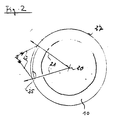
- a UV-transparent, hollow glass cylinder 10 (see FIG. 2) is included a photoresist of the naphthoquinonediazide / novolak type, dip-coated or spray-coated in this way, that on the cylinder outer surface a photoresist layer 27 of a thickness of 1 to 2, preferably 1.5 microns.
- Subsequent tempering takes place in a convection oven at 90 ° C to 100 ° C, preferably 95 ° C. It is also possible to carry out the tempering by means of IR drying.
- the photoresist layer prepared in this way is exposed in the scanning process to generate a hologram.
- An exposure arrangement to perform Such a scanning method is shown in Fig. 1.
- 4 is here Designated photosensitive photoresist layer. Since it is a schematic Principle sketch, the photoresist layer 4 is not cylindrical, but just shown.
- the computer 1 controls the closure line by line or the aperture 11, so that lines with light, and in grayscale to dark Pixels are formed.
- the correspondingly modulated and generated by the laser 12 laser beam onto one Mirror 13 of a deflection unit 14, so that the deflection unit successively the images are projected onto the photoresist layer 4.
- a holographic beam splitter 15 is arranged which is separated from the object beam zero order splits a first order reference beam, which then interferes with the object beam on the photoresist layer 4. It would also be possible deriving an interference beam from a second laser.
- the reference beam 21 is applied in the illustrated Way the holographic beam splitter 25, which is concentric to the holographic Recording layer or photoresist layer 27 is cylindrically curved.
- the Beam splitter 25 extends over a segment of the photoresist layer or Recording layer 27.
- a beam splitter 25 can be corresponding Beam splitters can be arranged outside the cylinder.
Landscapes
- Physics & Mathematics (AREA)
- General Physics & Mathematics (AREA)
- Chemical & Material Sciences (AREA)
- Inorganic Chemistry (AREA)
- Organic Chemistry (AREA)
- Holo Graphy (AREA)
- Photosensitive Polymer And Photoresist Processing (AREA)
- Shaping Of Tube Ends By Bending Or Straightening (AREA)
Abstract
Description
- Fig. 1
- schematisch eine Belichtungsanordnung zur zeilenweisen Belichtung einer lichtempfindlichen Photoresistschicht, und
- Fig. 2
- schematisch eine Belichtungsanordnung zur Belichtung einer Zylinderoberfläche von innen.
Claims (13)
- Verfahren zur Herstellung eines Prägezylinders, bei dem die Mantelfläche eines Zylinderkörpers mit Fotoresist beschichtet wird, die mit Fotoresist beschichtete Mantelfläche zur Erzeugung eines Bildes auf dem Fotoresist belichtet wird und das auf dem Fotoresist erzeugte Bild zur Erzeugung einer reliefartigen Oberflächenstruktur entwickelt wird,
dadurch gekennzeichnet,
daß der Fotoresist nach der Entwicklung einer Behandlung mit siliziumorganischen Verbindungen bei gleichzeitiger Temperung und UV-Bestrahlung unterzogen wird. - Verfahren nach Anspruch 1, dadurch gekennzeichnet, daß die Belichtung mittels eines rechnergesteuerten Scanning-Verfahrens durchgeführt wird.
- Verfahren nach Anspruch 2, dadurch gekennzeichnet, daß ein Bild eines Objektes zeilenweise von einem das Bild speichernden Rechner abgerufen wird, zur Erzeugung der Bildpunkte jeder Zeile der Rechner einen im Strahlengang eines Laserstahls angeordneten Verschluß oder eine Blende steuert, der durch den Verschluß oder die Blende durchtretende und in seiner Helligkeit gesteuerte Strahl von einem Spiegel einer Ablenkeinheit zeilenweise auf den zu belichtenden Fotoresist zur Erzeugung eines Bildes reflektiert und hierbei mit einem Referenzstrahl zur Interferenz gebracht wird.
- Verfahren nach Anspruch 2, dadurch gekennzeichnet, daß ein Bild eines Objekts in einer spiralförmigen Endloslinie von einem das Bild speichernden Rechner abgerufen wird und daß zur Erzeugung der Bildpunkte der spiralförmigen Endloslinie der Rechner einen im Strahlengang eines Laserstrahls angeordneten Zylinder in Rotation und Vorschub derart steuert, daß die spiralförmige Endloslinie auf die Zylinderoberfläche aufbelichtet wird und hierbei mit einem Referenzstrahl zur Interferenz gebracht wird.
- Verfahren nach einem der vorhergehenden Ansprüche, gekennzeichnet durch eine Behandlung der entwickelten, oberflächenstrukturierten Fotoresistschicht mit siliziumorganischen Verbindungen bei gleichzeitiger Temperung und UV-Bestrahlung.
- Verfahren nach Anspruch 5, dadurch gekennzeichnet, daß die Behandlung derart durchgeführt wird, daß die oberflächenstrukturierte Fotoresistschicht eine Formstabilität bis zu etwa 170° C aufweist.
- Verfahren nach einem der vorhergehenden Ansprüche, dadurch gekennzeichnet, daß als siliziumorganische Verbindungen Hexamethyldisiloxan und/oder Fluoralkyloxysilane verwendet werden.
- Verfahren nach einem der vorstehenden Ansprüche, dadurch gekennzeichnet, daß die Temperatur während der Temperung kontinuierlich bis auf 160° C erhöht wird.
- Verfahren nach einem der vorstehenden Ansprüche, dadurch gekennzeichnet, daß die siliziumorganischen Verbindungen dampfförmig oder flüssig auf die Fotoresistoberfläche einwirken.
- Verfahren nach einem der vorstehenden Ansprüche, dadurch gekennzeichnet, daß der Zylinderkörper als UV-durchlässiger Hohlzylinder ausgebildet ist und/oder daß der Photoresist nach seiner Entwicklung und Härtung UV-durchlässig ist.
- Verfahren nach einem der vorstehenden Ansprüche, dadurch gekennzeichnet, daß der Fotoresist vom Typ Naphtochinodiazid/Novolak ist.
- Verfahren nach einem der vorstehenden Ansprüche, dadurch gekennzeichnet, daß der Zylinder aus glasartigem oder quarzartigem Material hergestellt ist.
- Verwendung eines Prägezylinders nach einem der vorstehenden Ansprüche zum Prägen von diffraktischen Reliefstrukturen ohne Naht in Folien.
Applications Claiming Priority (2)
| Application Number | Priority Date | Filing Date | Title |
|---|---|---|---|
| DE1997121524 DE19721524A1 (de) | 1997-05-22 | 1997-05-22 | Verfahren zur Herstellung eines Prägezylinders |
| DE19721524 | 1997-05-22 |
Publications (2)
| Publication Number | Publication Date |
|---|---|
| EP0886185A2 true EP0886185A2 (de) | 1998-12-23 |
| EP0886185A3 EP0886185A3 (de) | 1999-09-01 |
Family
ID=7830235
Family Applications (1)
| Application Number | Title | Priority Date | Filing Date |
|---|---|---|---|
| EP98109121A Withdrawn EP0886185A3 (de) | 1997-05-22 | 1998-05-19 | Verfahren zur Herstellung eines Prägezylinders |
Country Status (3)
| Country | Link |
|---|---|
| EP (1) | EP0886185A3 (de) |
| JP (1) | JPH10333534A (de) |
| DE (1) | DE19721524A1 (de) |
Cited By (5)
| Publication number | Priority date | Publication date | Assignee | Title |
|---|---|---|---|---|
| WO2001084599A3 (en) * | 2000-05-01 | 2002-07-18 | Advanced Micro Devices Inc | Uv-enhanced silylation process to increase etch resistance of ultra thin resists |
| WO2002041080A3 (en) * | 2000-11-14 | 2003-01-16 | Axcelis Tech Inc | Process for reducing edge roughness in patterned photoresist |
| DE102004050984B3 (de) * | 2004-10-20 | 2006-07-06 | Hueck Folien Gmbh & Co. Kg | Verfahren zur Herstellung einer endlosen Nickelmatrize zum Prägen von strukturierten Oberflächen |
| US7309659B1 (en) | 2005-04-01 | 2007-12-18 | Advanced Micro Devices, Inc. | Silicon-containing resist to pattern organic low k-dielectrics |
| EP3569783A1 (de) | 2018-05-18 | 2019-11-20 | Schöck Bauteile GmbH | Bauelement zur thermischen isolierung |
Families Citing this family (2)
| Publication number | Priority date | Publication date | Assignee | Title |
|---|---|---|---|---|
| US6635409B1 (en) * | 2001-07-12 | 2003-10-21 | Advanced Micro Devices, Inc. | Method of strengthening photoresist to prevent pattern collapse |
| DE10324936A1 (de) * | 2003-06-03 | 2005-01-05 | Hueck Folien Gmbh & Co. Kg | Nahtlose 2D/3D Oberflächenstrukturen auf rotativen Prägeformen für UV Casting Verfahren |
Family Cites Families (8)
| Publication number | Priority date | Publication date | Assignee | Title |
|---|---|---|---|---|
| GB1225754A (de) * | 1967-06-09 | 1971-03-24 | ||
| SU938338A1 (ru) * | 1978-10-30 | 1982-06-23 | Предприятие П/Я Р-6707 | Фотошаблон и способ его изготовлени |
| US4259369A (en) * | 1979-12-13 | 1981-03-31 | International Business Machines Corporation | Image hardening process |
| US4751170A (en) * | 1985-07-26 | 1988-06-14 | Nippon Telegraph And Telephone Corporation | Silylation method onto surface of polymer membrane and pattern formation process by the utilization of silylation method |
| EP0451311B1 (de) * | 1990-04-12 | 1999-03-10 | Siemens Aktiengesellschaft | Verfahren zur Erzeugung einer Resiststruktur |
| AU8282691A (en) * | 1990-07-20 | 1992-02-18 | McGrew, Steven P. | Embossing tool |
| DE19523321A1 (de) * | 1994-12-20 | 1996-10-31 | Hsm Gmbh | Verfahren zur Herstellung autostereoskopisch betrachtbarer, holografischer Multistereogramme |
| DE19623352C2 (de) * | 1996-06-12 | 1999-11-11 | Kurz Leonhard Fa | Verfahren zur Herstellung von eine räumlich gemusterte Oberfläche aufweisenden Druck- oder Prägezylindern |
-
1997
- 1997-05-22 DE DE1997121524 patent/DE19721524A1/de not_active Withdrawn
-
1998
- 1998-05-19 EP EP98109121A patent/EP0886185A3/de not_active Withdrawn
- 1998-05-22 JP JP14073098A patent/JPH10333534A/ja active Pending
Cited By (5)
| Publication number | Priority date | Publication date | Assignee | Title |
|---|---|---|---|---|
| WO2001084599A3 (en) * | 2000-05-01 | 2002-07-18 | Advanced Micro Devices Inc | Uv-enhanced silylation process to increase etch resistance of ultra thin resists |
| WO2002041080A3 (en) * | 2000-11-14 | 2003-01-16 | Axcelis Tech Inc | Process for reducing edge roughness in patterned photoresist |
| DE102004050984B3 (de) * | 2004-10-20 | 2006-07-06 | Hueck Folien Gmbh & Co. Kg | Verfahren zur Herstellung einer endlosen Nickelmatrize zum Prägen von strukturierten Oberflächen |
| US7309659B1 (en) | 2005-04-01 | 2007-12-18 | Advanced Micro Devices, Inc. | Silicon-containing resist to pattern organic low k-dielectrics |
| EP3569783A1 (de) | 2018-05-18 | 2019-11-20 | Schöck Bauteile GmbH | Bauelement zur thermischen isolierung |
Also Published As
| Publication number | Publication date |
|---|---|
| JPH10333534A (ja) | 1998-12-18 |
| EP0886185A3 (de) | 1999-09-01 |
| DE19721524A1 (de) | 1998-11-26 |
Similar Documents
| Publication | Publication Date | Title |
|---|---|---|
| DE2522547B2 (de) | ||
| DE2060661A1 (de) | Verfahren und Einrichtung zum Herstellen von Reliefflaechen | |
| DE1924695A1 (de) | Holografisches Abbildungsverfahren | |
| EP0896260A2 (de) | Vorrichtung für die Herstellung von individuellen Hologrammen zum Sichern von Dokumenten | |
| DE2402385C2 (de) | Verfahren zur Bildung einer Prägung mit Hilfe eines konzentrierten Schreibstrahls sowie Vorrichtungen zur Durchführung des Verfahrens | |
| EP0896259A2 (de) | Verfahren und Vorrichtung zur Erzeugung einer Oberflächenstruktur, insbesondere einer holographischen Oberflächenstruktur, auf einem Substrat | |
| CH626181A5 (de) | ||
| DE19819571A1 (de) | Wertdokument mit Sicherheitselement | |
| DE2658623A1 (de) | Aufzeichnungstraeger zur wiedergabe von mustern mit hohem aufloesungsvermoegen und verfahren zu seiner herstellung | |
| EP1599763A2 (de) | Verfahren zur herstellung eines belichteten substrats | |
| EP3423288B1 (de) | Prägeplatte, herstellungsverfahren und geprägtes sicherheitselement | |
| EP0886185A2 (de) | Verfahren zur Herstellung eines Prägezylinders | |
| DE2152754A1 (de) | Verfahren zur Herstellung eines Oberflachenhologramms mit Brechungs eigenschaften | |
| DE2701218B1 (de) | Verfahren zur Erzeugung eines Oberflächenreliefbildes und Bildträger | |
| EP2593310B1 (de) | Sicherheitselement mit hologrammstrukturen | |
| EP0000571B1 (de) | Verfahren zum Herstellen eines Originals | |
| DE102004009422A1 (de) | Verfahren und Vorrichtung zum Aufbringen von diffraktiven Elementen auf Oberflächen | |
| DE10260878A1 (de) | Herstellung von Gravur- und Tiefdruckelementen unter Verwendung von direkt thermisch belichtbaren Medien | |
| EP0002043B1 (de) | Verfahren zum Herstellen eines Informationsträgers | |
| DE19544272A1 (de) | Verfahren zur Herstellung einer metallischen Druckform für den Tiefdruck | |
| DE3116654C2 (de) | Verfahren zum Herstellen einer Druckform für moiréfreien Tiefdruck mit scharf konturierter Beschriftung | |
| DE102024203384A1 (de) | Vorrichtung und Verfahren zur Aufnahme von Hologrammen | |
| DE557698C (de) | Verfahren zur unmittelbaren photographischen Herstellung von Kopiervorlagen in Vollton nach Hochdruckformen | |
| DE19638747C1 (de) | Verfahren zur Herstellung von Glasmastern mit grafischen Darstellungen | |
| DE2454673A1 (de) | Verfahren zur herstellung definierter komplexer muster |
Legal Events
| Date | Code | Title | Description |
|---|---|---|---|
| PUAI | Public reference made under article 153(3) epc to a published international application that has entered the european phase |
Free format text: ORIGINAL CODE: 0009012 |
|
| AK | Designated contracting states |
Kind code of ref document: A2 Designated state(s): AT CH DE ES FI FR GB IT LI NL |
|
| AX | Request for extension of the european patent |
Free format text: AL;LT;LV;MK;RO;SI |
|
| PUAL | Search report despatched |
Free format text: ORIGINAL CODE: 0009013 |
|
| AK | Designated contracting states |
Kind code of ref document: A3 Designated state(s): AT BE CH CY DE DK ES FI FR GB GR IE IT LI LU MC NL PT SE |
|
| AX | Request for extension of the european patent |
Free format text: AL;LT;LV;MK;RO;SI |
|
| RIC1 | Information provided on ipc code assigned before grant |
Free format text: 6G 03F 7/40 A, 6G 03C 9/00 B, 6G 03H 1/00 B, 6G 03F 7/24 B |
|
| AKX | Designation fees paid |
Free format text: AT CH DE ES FI FR GB IT LI NL |
|
| STAA | Information on the status of an ep patent application or granted ep patent |
Free format text: STATUS: THE APPLICATION IS DEEMED TO BE WITHDRAWN |
|
| 18D | Application deemed to be withdrawn |
Effective date: 20000302 |