EP0886405B1 - Korrektur von kalenderbasierter Planung von ATM Zellen für stromabwärtse Zelleneinfügung - Google Patents
Korrektur von kalenderbasierter Planung von ATM Zellen für stromabwärtse Zelleneinfügung Download PDFInfo
- Publication number
- EP0886405B1 EP0886405B1 EP98304617A EP98304617A EP0886405B1 EP 0886405 B1 EP0886405 B1 EP 0886405B1 EP 98304617 A EP98304617 A EP 98304617A EP 98304617 A EP98304617 A EP 98304617A EP 0886405 B1 EP0886405 B1 EP 0886405B1
- Authority
- EP
- European Patent Office
- Prior art keywords
- cell
- calendar
- scheduling device
- downstream
- traffic
- Prior art date
- Legal status (The legal status is an assumption and is not a legal conclusion. Google has not performed a legal analysis and makes no representation as to the accuracy of the status listed.)
- Expired - Lifetime
Links
- 238000003780 insertion Methods 0.000 title claims description 32
- 230000037431 insertion Effects 0.000 title claims description 32
- 238000012937 correction Methods 0.000 title description 4
- 238000007493 shaping process Methods 0.000 claims description 17
- 238000000034 method Methods 0.000 claims description 11
- 238000012546 transfer Methods 0.000 claims description 6
- 239000000872 buffer Substances 0.000 claims description 5
- 238000012423 maintenance Methods 0.000 claims description 2
- 238000011084 recovery Methods 0.000 claims 2
- 230000005540 biological transmission Effects 0.000 description 4
- 230000003111 delayed effect Effects 0.000 description 3
- 238000005516 engineering process Methods 0.000 description 3
- 230000001360 synchronised effect Effects 0.000 description 3
- 230000006727 cell loss Effects 0.000 description 2
- 238000012856 packing Methods 0.000 description 2
- 238000012545 processing Methods 0.000 description 2
- 238000004891 communication Methods 0.000 description 1
- 230000000694 effects Effects 0.000 description 1
- 238000013179 statistical model Methods 0.000 description 1
Images

Classifications
-
- H—ELECTRICITY
- H04—ELECTRIC COMMUNICATION TECHNIQUE
- H04L—TRANSMISSION OF DIGITAL INFORMATION, e.g. TELEGRAPHIC COMMUNICATION
- H04L12/00—Data switching networks
- H04L12/54—Store-and-forward switching systems
- H04L12/56—Packet switching systems
- H04L12/5601—Transfer mode dependent, e.g. ATM
- H04L12/5602—Bandwidth control in ATM Networks, e.g. leaky bucket
-
- H—ELECTRICITY
- H04—ELECTRIC COMMUNICATION TECHNIQUE
- H04Q—SELECTING
- H04Q11/00—Selecting arrangements for multiplex systems
- H04Q11/04—Selecting arrangements for multiplex systems for time-division multiplexing
- H04Q11/0428—Integrated services digital network, i.e. systems for transmission of different types of digitised signals, e.g. speech, data, telecentral, television signals
- H04Q11/0478—Provisions for broadband connections
-
- H—ELECTRICITY
- H04—ELECTRIC COMMUNICATION TECHNIQUE
- H04L—TRANSMISSION OF DIGITAL INFORMATION, e.g. TELEGRAPHIC COMMUNICATION
- H04L12/00—Data switching networks
- H04L12/54—Store-and-forward switching systems
- H04L12/56—Packet switching systems
- H04L12/5601—Transfer mode dependent, e.g. ATM
- H04L2012/5638—Services, e.g. multimedia, GOS, QOS
-
- H—ELECTRICITY
- H04—ELECTRIC COMMUNICATION TECHNIQUE
- H04L—TRANSMISSION OF DIGITAL INFORMATION, e.g. TELEGRAPHIC COMMUNICATION
- H04L12/00—Data switching networks
- H04L12/54—Store-and-forward switching systems
- H04L12/56—Packet switching systems
- H04L12/5601—Transfer mode dependent, e.g. ATM
- H04L2012/5678—Traffic aspects, e.g. arbitration, load balancing, smoothing, buffer management
- H04L2012/5679—Arbitration or scheduling
Definitions
- This invention relates to asynchronous transfer mode (ATM) technology and more particularly to an ATM telecommunications system having a traffic shaping entity to maintain accurate scheduling in the event of a cell insertion into the traffic stream by a downstream device.
- ATM asynchronous transfer mode
- ATM Asynchronous transfer mode
- An issue of great importance to users and developers of ATM switches is how to manage the traffic in an efficient manner in order to gain a high degree of bandwidth utilization on a wide area network.
- the ATM Forum sets out numerous criteria with respect to the nature and requirements of traffic management in ATM systems. Included in these criteria are several traffic descriptors which are basically a set of parameters used to capture the intrinsic characteristics of particular streams of network data. These standard traffic descriptors allow an ATM switch to use statistical models based on the traffic descriptors to efficiently allocate resources (bandwidth, buffers) amongst the various streams of traffic.
- the allocation of resources in an ATM network is based on some basic parameters that characterize traffic streams, it is important that the traffic streams behave as closely as possible to those traffic descriptor parameters. The more closely the traffic streams adhere to the traffic descriptors, the more accurate the allocation of network resources will be. If the allocation of network resource is very accurate then the usage of these resources will be very efficient while maintaining the required qualities of service for all traffic.
- One method of insuring that ATM traffic streams conform to the negotiated traffic contract is to police the data with a usage parameter control (UPC) algorithm.
- UPC usage parameter control
- a more desirable method of assuring traffic conformance is to employ traffic shaping. Traffic shaping takes a stream of data and reshapes its attributes so that it conforms to the traffic descriptor. Shaping allows a slightly non-conforming stream to become conforming with no cell loss.
- a problem can arise when a cell can be inserted into a traffic stream at a point that is downstream from a traffic shaping entity. This cell insertion can cause several problems including violation of the strict traffic descriptor parameters or an instantaneous and unrecoverable increase in cell transfer delay (CTD) for every traffic stream serviced by the shaper. The actual problem encountered depends on the specific details of implementation of the cell insertion and shaping devices.
- Document EP 669 777 discloses a shaping method in which cells (U1-U7, 01-06) of a cell stream (CS1) are mutually delayed to obtain a shaped cell stream (CS2). For this a shaping delay is used which depends upon the type of the cells which are so delayed in order for consecutive user cells (U1-U2, U2-U3, ...) to be mutually delayed over the inverse (TU) of the peak cell rate negotiated for these user cells (U1-U7).
- a shaping delay which depends upon the type of the cells which are so delayed in order for consecutive user cells (U1-U2, U2-U3, ...) to be mutually delayed over the inverse (TU) of the peak cell rate negotiated for these user cells (U1-U7).
- this shaping delay is obtained by making this shaping delay equal to the above inverse when adjacent cells are user cells (U1-U2), to a fraction (TU/3) of this inverse when the second one of these adjacent cells is an operation and maintenance or OAM cell (01-07) and to the difference between the above inverse and the number of consecutive OAM cells in-between two user cells (U5-U6) times the above fraction if the first one of said adjacent cells is an OAM cell (03) whilst the second one is a user cell (U6).
- Document WO 97/10653 discloses a transmission system for transmitting synchronous data portions and asynchronous data portions.
- the transmission frame comprises regularly spaced synchronous data portions interleaved with,asynchronous data portions.
- a problem in such a transmission system is that the packing density of asynchronous data portions is not optimal.
- the position of the synchronous data portions is allowed to deviate from its nominal value to increase the packing rate of the asynchronous data portions.
- an ATM communication system having a calendar scheduling device for shaping cell traffic flow in accordance with defined parameters, wherein the system has means to insert cells downstream of the scheduling device, the improvement comprising correction means to maintain cell traffic flow in accordance with defined parameters in the event of a cell insertion downstream of the scheduling device.
- the correction means has means to detect an occurrence of a downstream insertion; feedback means to signal the occurrence of a downstream cell insertion to the scheduling device; and means in the scheduling device to generate a calendar slip.
- an ATM telecommunication system having a calendar scheduling device for shaping cell traffic flow in accordance with defined parameters, the system having means to insert cells downstream of the scheduling device, a method of correcting the cell flow traffic in the event of a cell insertion downstream of the scheduling device.
- the method comprises: detecting the occurrence of a cell insertion downstream scheduling device, providing a feedback signal representing a downstream cell insertion to the scheduling device, and causing the scheduling device to generate a calendar slip.
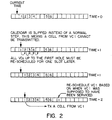
- Calendar scheduling is used in ATM applications to determine when to transmit a cell from a given connection. This scheduling is directly applicable to a shaping function. Time is generally referenced in cell times, where one cell time is the time from which the first bit of one cell passes a reference point until the time when the first bit of the next cell passes the same reference point. As an example, one cell time in an OC3 link operating at 149.76 Mb/s is about 2.83 us. As the current time, which is shown by the arrow in Figure 1, moves forward it will pass a connection's scheduled transmit time. In the present invention, the current time is based on a time reference such as an internal clock or is taken from the data stream.
- a time reference such as an internal clock or is taken from the data stream.
- the calendar includes virtual connections (VC) 1, 2 and 3 positioned in cell slots.
- VCs 1 and 2 are the same speed while VC 3 is slower than VCs 1 and 2.
- VCs 1, 2 and 3 are located in successive cell slots.
- a cell from virtual channel 1 is transmitted and channel 1 is rescheduled as illustrated.
- a cell is transmitted from virtual channel 2 and VC 2 is rescheduled immediately after VC 1.
- a cell from virtual channel 3 is transmitted and rescheduled in the calendar.
- VC 3 is slower than VCs 1 and 2
- VC 3 is placed in the calendar with gaps or holes between VC 3 and VC 2.
- no cells are transmitted.
- a concept that is important to the understanding of the present invention is what is referred to as a calendar slip.
- a calendar slip occurs when the current time is stepped forward but no cells are allowed to be transmitted at that particular time due to a cell insertion or the transmission of some higher priority cells.
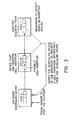
- Figure 3 is used to illustrate the scheduling correction mechanism according to the present invention.
- Figure 3 is a typical functional layout for ATM cell processing. It is to be understood that the devices may all be integrated or they may be separate.
- FIFO A represents the calendar scheduling device which has its own timing source to step the calendar.
- FIFO B represents a device that can perform cell insertion such as an OAM cell. It is to be understood, however, that the invention is not restricted to applications that insert only OAM cells.
- FIFO C represents another queuing point which includes a mechanism to detect when a cell insertion occurs.
- the calendar scheduling device will sometimes create a burst of back-to-back cell traffic. During this burst each of the three (this number may be less or more depending on the number of FIFO stages used in a specific implementation) FIFO's will be in a steady state where one cell will arrive for each cell sent on to the next FIFO. Whenever the scheduling process results in some holds or gaps (i.e. no cells to send during some cell times), then the FIFOs will begin to drain.
- a problem can occur when a cell insertion occurs, or is requested, during a period when the scheduling device is transmitting a burst of back-to-back cells. There is simply no room in the cell stream for the insertion. If an insertion occurs the FIFOs will fail further and additional insertions could cause the FIFOs to overflow resulting in cell loss.
- the calendar scheduling device generates a calendar slip when it is notified of, or detects itself, a downstream cell insertion.
- the timing reference is not lost because the current still moves forward correctly. Slipping the calendar means that CTD will be introduced but only for each scheduled connection until there is a hole or gap in the calendar. The CTD is recoverable on the connection because the connections can be rescheduled based on the time that they should have been serviced.
Landscapes
- Engineering & Computer Science (AREA)
- Computer Networks & Wireless Communication (AREA)
- Signal Processing (AREA)
- Data Exchanges In Wide-Area Networks (AREA)
Claims (12)
- ATM-Telekommunikationssystem mit einer Kalenderplanungsvorrichtung zum Formen von Zellenverkehrsfluss in Übereinstimmung mit definierten Parametern und mit Mitteln zum Einfügen von Zellen stromabseitig von der Planungsvorrichtung, dadurch gekennzeichnet, dass es ferner Wiederherstellungsmittel zum Wiederherstellen einer Zellenübertragungsverzögerung, CTD, die bei der Kalenderplanungsvorrichtung durch eine Zelleneinfügung stromabwärts von der Planungsvorrichtung eingeführt wird, während der Kalender einen Datenblock von Ende-zu-Ende-Zellenverkehr plant, umfasst, wobei die Wiederherstellungsmittel Mittel, um ein Auftreten einer stromabseitigen Zelleneinfügung zu erfassen, sowie Mittel umfassen, um ein Kalendergleiten zu erzeugen, die ihrerseits Mittel umfassen, um eine theoretische Dienstzeit, TST, für jede Zelle in der Kalenderplanungsvorrichtung aufrechtzuerhalten, wobei die TST den Zeitpunkt angibt, für den angenommen wurde, dass die entsprechende Zelle bedient worden ist; und Mittel umfassen, um sämtliche Zellen in der Kalenderplanungsvorrichtung bis zu einem ersten Loch, das einen Zeitschlitz später bedient werden soll, anhand der TST statt anhand der aktuellen Zeit neu zu planen.
- System nach Anspruch 1, das ferner Rückkopplungsmittel umfasst, um der Planungsvorrichtung das Auftreten einer stromabseitigen Zelleneinfügung zu melden.
- System nach Anspruch 1 oder 2, bei dem die Kalenderplanungsvorrichtung eine Taktgebungsquelle besitzt, um Zellenverkehr durch das System voranzutreiben.
- System nach einem der Ansprüche 1 bis 3, bei dem die Kalenderplanungsvorrichtung einen ersten First-in/Firstout- oder FIFO-Puffer mit Zellenschlitzen zum vorübergehenden Speichern von Zellenverkehr, der für identifizierte virtuelle Verbindungen bestimmt ist, umfasst.
- System nach Anspruch 4, bei dem das Kalendergleiten durch wahlweises Erzeugen eines offenen Zellenschlitzes in dem ersten FIFO-Puffer erzeugt wird.
- System nach einem der Ansprüche 1 bis 5, bei dem die Mittel zum Einfügen von Zellen stromabseitig von der Planungsvorrichtung einen zweiten FIFO-Puffer umfassen.
- System nach einem der Ansprüche 1 bis 6, bei dem die Mittel zum Erfassen des Auftretens einer stromabseitigen Zelleneinfügung einen dritten FIFO-Puffer mit Mitteln zum Überwachen von Zellenverkehr durch ihn hindurch umfassen.
- System nach einem der Ansprüche 1 bis 7, bei dem die Rückkopplungsmittel zum Melden des Auftretens einer stromabseitigen Zelleneinfügung an die Planungsvorrichtung außerdem Mittel umfassen, um eine Zelleneinfügungsgelegenheit von der Planungsvorrichtung anzufordern.
- System nach einem der Ansprüche 1 bis 8, bei dem die stromabseitig von der Kalenderplanungsvorrichtung eingefügten Zellen Operations-, Verwaltungs- und Wartungs- oder OAM-Zellen sind.
- Verfahren in einem ATM-Telekommunikationssystem mit einer Kalenderplanungsvorrichtung zum Formen von Zellenverkehrsfluss in Übereinstimmung mit definierten Parametern und mit Mitteln zum Einfügen von Zellen stromabseitig von der Planungsvorrichtung zum Wiederherstellen einer Zellenübertragungsverzögerung, CTD, die bei der Kalenderplanungsvorrichtung durch eine Zelleneinfügung stromabseitig von der Planungsvorrichtung eingeführt wird, während der Kalender einen Datenblock von Ende-zu-Ende-Zellenverkehr plant, dadurch gekennzeichnet, dass es umfasst Erfassen des Auftretens einer Zelleneinfügung stromabseitig von der Planungsvorrichtung und Erzeugen eines Kalendergleitens in Reaktion auf das Auftreten einer stromabseitigen Zelleneinfügung durch: Aufrechterhalten einer theoretischen Dienstzeit, TST, für jede Zelle in der Kalenderplanungsvorrichtung, wobei die TST den Zeitpunkt angibt, für den angenommen wird, dass die entsprechende Zelle bedient worden ist; und erneutes Planen sämtlicher Zellen in der Kalenderplanungsvorrichtung bis zu einem ersten Loch, das in einem Zeitschlitz später zu bedienen ist, anhand der TST statt anhand der aktuellen Zeit.
- Verfahren nach Anspruch 10, bei dem die stromabseitige Zelleneinfügung ein Rückkopplungssignal veranlasst.
- Verfahren nach Anspruch 11, bei dem das Kalendergleiten durch die Planungsvorrichtung erzeugt wird.
Applications Claiming Priority (2)
| Application Number | Priority Date | Filing Date | Title |
|---|---|---|---|
| US878959 | 1992-05-04 | ||
| US08/878,959 US6226262B1 (en) | 1997-06-19 | 1997-06-19 | Correction of calendar based ATM cell scheduling for downstream cell insertion |
Publications (3)
| Publication Number | Publication Date |
|---|---|
| EP0886405A2 EP0886405A2 (de) | 1998-12-23 |
| EP0886405A3 EP0886405A3 (de) | 1999-10-20 |
| EP0886405B1 true EP0886405B1 (de) | 2007-03-14 |
Family
ID=25373165
Family Applications (1)
| Application Number | Title | Priority Date | Filing Date |
|---|---|---|---|
| EP98304617A Expired - Lifetime EP0886405B1 (de) | 1997-06-19 | 1998-06-11 | Korrektur von kalenderbasierter Planung von ATM Zellen für stromabwärtse Zelleneinfügung |
Country Status (4)
| Country | Link |
|---|---|
| US (1) | US6226262B1 (de) |
| EP (1) | EP0886405B1 (de) |
| CA (1) | CA2239741A1 (de) |
| DE (1) | DE69837310T9 (de) |
Families Citing this family (7)
| Publication number | Priority date | Publication date | Assignee | Title |
|---|---|---|---|---|
| US6526062B1 (en) * | 1998-10-13 | 2003-02-25 | Verizon Corporate Services Group Inc. | System and method for scheduling and rescheduling the transmission of cell objects of different traffic types |
| US6526398B2 (en) * | 1999-05-28 | 2003-02-25 | Ricoh Co., Ltd. | Generating labels indicating gaps in retrieval of electronic documents |
| US6434155B1 (en) * | 1999-12-22 | 2002-08-13 | Alcatel Usa Sourcing, L.P. | Weighted round robin engine used in scheduling the distribution of ATM cells |
| US7126969B1 (en) * | 2000-07-06 | 2006-10-24 | Cisco Technology, Inc. | Scalable system and method for reliably sequencing changes in signaling bits in multichannel telecommunication lines transmitted over a network |
| DE10051146A1 (de) * | 2000-10-16 | 2002-04-25 | Siemens Ag | Skalierbares Zeiteinteilungsverfahren mit insbesondere Abstands- und Neueinteilungsfunktion beim Versand von ATM-Zellen sowie Zeiteinteilungsvorrichtung dafür |
| US7020657B2 (en) * | 2001-09-27 | 2006-03-28 | International Business Machines Corporation | Scalable hardware scheduler time based calendar search algorithm |
| US8031721B2 (en) | 2008-02-12 | 2011-10-04 | Alcatel Lucent | Method and apparatus for marking and scheduling packets for transmission |
Family Cites Families (9)
| Publication number | Priority date | Publication date | Assignee | Title |
|---|---|---|---|---|
| ES2162835T3 (es) | 1994-02-22 | 2002-01-16 | Cit Alcatel | Metodo de conformar un flujo de celdas que incluyen celdas usuario y celdas oam. |
| EP0702473A1 (de) * | 1994-09-19 | 1996-03-20 | International Business Machines Corporation | Verfahren und Vorrichtung zur Formung des Ausgangsverkehrs in einem Netzwerknoten zur Vermittung von Zellen fester Länge |
| US5535201A (en) * | 1995-05-10 | 1996-07-09 | Mitsubishi Electric Research Laboratories, Inc. | Traffic shaping system using two dimensional timing chains |
| WO1997010653A1 (en) | 1995-09-12 | 1997-03-20 | Philips Electronics N.V. | Transmission system for synchronous and asynchronous data portions |
| US5764626A (en) * | 1995-11-17 | 1998-06-09 | Telecommunications Techniques Corporation | Rate-matched cell identification and modification, replacement, or insertion for test and measurement of ATM network virtual connections |
| WO1997022195A1 (en) * | 1995-12-14 | 1997-06-19 | Cisco Systems, Inc. | Multi-level rate scheduler |
| US5946297A (en) * | 1996-05-31 | 1999-08-31 | International Business Machines Corporation | Scheduling method and apparatus for supporting ATM connections having a guaranteed minimun bandwidth |
| US5831971A (en) * | 1996-08-22 | 1998-11-03 | Lucent Technologies, Inc. | Method for leaky bucket traffic shaping using fair queueing collision arbitration |
| US5864540A (en) * | 1997-04-04 | 1999-01-26 | At&T Corp/Csi Zeinet(A Cabletron Co.) | Method for integrated traffic shaping in a packet-switched network |
-
1997
- 1997-06-19 US US08/878,959 patent/US6226262B1/en not_active Expired - Lifetime
-
1998
- 1998-06-05 CA CA002239741A patent/CA2239741A1/en not_active Abandoned
- 1998-06-11 DE DE69837310T patent/DE69837310T9/de active Active
- 1998-06-11 EP EP98304617A patent/EP0886405B1/de not_active Expired - Lifetime
Also Published As
| Publication number | Publication date |
|---|---|
| EP0886405A3 (de) | 1999-10-20 |
| US6226262B1 (en) | 2001-05-01 |
| DE69837310T9 (de) | 2008-04-10 |
| DE69837310T2 (de) | 2007-12-20 |
| EP0886405A2 (de) | 1998-12-23 |
| CA2239741A1 (en) | 1998-12-19 |
| DE69837310D1 (de) | 2007-04-26 |
Similar Documents
| Publication | Publication Date | Title |
|---|---|---|
| Aras et al. | Real-time communication in packet-switched networks | |
| Ohnishi et al. | Flow control schemes and delay/loss tradeoff in ATM networks | |
| EP0873037B1 (de) | Verkehrsformer für ATM Netzknoten und Verfahren dazu | |
| US5712851A (en) | Adaptive time slot scheduling apparatus and method utilizing a linked list mechanism | |
| JP2898914B2 (ja) | マルチメディア・データの送信のセグメント化および時間同期化のための装置および方法 | |
| USRE39103E1 (en) | Timing reference for scheduling data traffic on multiple ports | |
| US6198724B1 (en) | ATM cell scheduling method and apparatus | |
| US6603739B1 (en) | ATM adaption layer traffic scheduling for variable bit rate connections | |
| US6657983B1 (en) | Scheduling of upstream traffic in a TDMA wireless communications system | |
| EP0817428A2 (de) | Verkehrsformer mit virtuellen Pfaden mit mehrfachen Warteschlangen | |
| US5999533A (en) | ATM cell transmit priority allocator | |
| EP0886405B1 (de) | Korrektur von kalenderbasierter Planung von ATM Zellen für stromabwärtse Zelleneinfügung | |
| US7295558B2 (en) | ATM adaption layer traffic scheduling | |
| Mowbray et al. | Capacity reservation for multimedia traffic | |
| Mukherjee et al. | Dynamic time windows and generalized virtual clock: combined closed-loop/open-loop congestion control | |
| US6052389A (en) | Per-session pre-synchronized framing method for real-time services in ATM networks | |
| Chung et al. | Jitter analysis of homogeneous traffic in differentiated services networks | |
| Kim et al. | Three-level traffic shaper and its application to source clock frequency recovery for VBR video services in ATM networks | |
| JP3589260B2 (ja) | トラフィックシェーピング装置 | |
| Schulzrinne | Reducing and characterizing packet loss for high-speed computer networks with real-time services | |
| EP0952753B1 (de) | Verkehrsplanung in der ATM Anpassungsschicht, für Verbindungen mit variabeler Bitrate | |
| Knightly | Traffic models and admission control for integrated services networks | |
| Angelopoulos et al. | An ATM-friendly MAC for traffic concentration in HFC systems | |
| Tse et al. | Efficient distributed scheduling architecture for wireless atm networks | |
| Böcking | Communication performance models |
Legal Events
| Date | Code | Title | Description |
|---|---|---|---|
| PUAI | Public reference made under article 153(3) epc to a published international application that has entered the european phase |
Free format text: ORIGINAL CODE: 0009012 |
|
| AK | Designated contracting states |
Kind code of ref document: A2 Designated state(s): DE FR GB |
|
| AX | Request for extension of the european patent |
Free format text: AL;LT;LV;MK;RO;SI |
|
| RIN1 | Information on inventor provided before grant (corrected) |
Inventor name: VULETA, STANKO Inventor name: LEE, DENNY L.S. Inventor name: STERNE, JASON T. |
|
| PUAL | Search report despatched |
Free format text: ORIGINAL CODE: 0009013 |
|
| AK | Designated contracting states |
Kind code of ref document: A3 Designated state(s): AT BE CH CY DE DK ES FI FR GB GR IE IT LI LU MC NL PT SE |
|
| AX | Request for extension of the european patent |
Free format text: AL;LT;LV;MK;RO;SI |
|
| 17P | Request for examination filed |
Effective date: 20000417 |
|
| AKX | Designation fees paid |
Free format text: DE FR GB |
|
| RAP1 | Party data changed (applicant data changed or rights of an application transferred) |
Owner name: ALCATEL CANADA INC. |
|
| GRAP | Despatch of communication of intention to grant a patent |
Free format text: ORIGINAL CODE: EPIDOSNIGR1 |
|
| GRAS | Grant fee paid |
Free format text: ORIGINAL CODE: EPIDOSNIGR3 |
|
| GRAA | (expected) grant |
Free format text: ORIGINAL CODE: 0009210 |
|
| AK | Designated contracting states |
Kind code of ref document: B1 Designated state(s): DE FR GB |
|
| REG | Reference to a national code |
Ref country code: GB Ref legal event code: FG4D |
|
| REF | Corresponds to: |
Ref document number: 69837310 Country of ref document: DE Date of ref document: 20070426 Kind code of ref document: P |
|
| ET | Fr: translation filed | ||
| PLBE | No opposition filed within time limit |
Free format text: ORIGINAL CODE: 0009261 |
|
| STAA | Information on the status of an ep patent application or granted ep patent |
Free format text: STATUS: NO OPPOSITION FILED WITHIN TIME LIMIT |
|
| 26N | No opposition filed |
Effective date: 20071217 |
|
| REG | Reference to a national code |
Ref country code: FR Ref legal event code: CD Owner name: ALCATEL-LUCENT CANADA INC Effective date: 20130723 |
|
| REG | Reference to a national code |
Ref country code: FR Ref legal event code: GC Effective date: 20130820 |
|
| REG | Reference to a national code |
Ref country code: FR Ref legal event code: RG Effective date: 20141015 |
|
| REG | Reference to a national code |
Ref country code: FR Ref legal event code: PLFP Year of fee payment: 18 |
|
| PGFP | Annual fee paid to national office [announced via postgrant information from national office to epo] |
Ref country code: DE Payment date: 20150619 Year of fee payment: 18 Ref country code: GB Payment date: 20150618 Year of fee payment: 18 |
|
| PGFP | Annual fee paid to national office [announced via postgrant information from national office to epo] |
Ref country code: FR Payment date: 20150619 Year of fee payment: 18 |
|
| REG | Reference to a national code |
Ref country code: DE Ref legal event code: R119 Ref document number: 69837310 Country of ref document: DE |
|
| GBPC | Gb: european patent ceased through non-payment of renewal fee |
Effective date: 20160611 |
|
| REG | Reference to a national code |
Ref country code: FR Ref legal event code: ST Effective date: 20170228 |
|
| PG25 | Lapsed in a contracting state [announced via postgrant information from national office to epo] |
Ref country code: DE Free format text: LAPSE BECAUSE OF NON-PAYMENT OF DUE FEES Effective date: 20170103 Ref country code: FR Free format text: LAPSE BECAUSE OF NON-PAYMENT OF DUE FEES Effective date: 20160630 |
|
| PG25 | Lapsed in a contracting state [announced via postgrant information from national office to epo] |
Ref country code: GB Free format text: LAPSE BECAUSE OF NON-PAYMENT OF DUE FEES Effective date: 20160611 |