EP0886685B1 - Verbesserte wärmeschutz-beschichtung und verfahren zu ihrer herstellung - Google Patents
Verbesserte wärmeschutz-beschichtung und verfahren zu ihrer herstellung Download PDFInfo
- Publication number
- EP0886685B1 EP0886685B1 EP97906435A EP97906435A EP0886685B1 EP 0886685 B1 EP0886685 B1 EP 0886685B1 EP 97906435 A EP97906435 A EP 97906435A EP 97906435 A EP97906435 A EP 97906435A EP 0886685 B1 EP0886685 B1 EP 0886685B1
- Authority
- EP
- European Patent Office
- Prior art keywords
- bond coat
- weight percent
- substrate
- group
- mixtures
- Prior art date
- Legal status (The legal status is an assumption and is not a legal conclusion. Google has not performed a legal analysis and makes no representation as to the accuracy of the status listed.)
- Expired - Lifetime
Links
- 239000012720 thermal barrier coating Substances 0.000 title claims abstract description 51
- 238000000034 method Methods 0.000 title claims abstract description 31
- 239000000758 substrate Substances 0.000 claims abstract description 64
- 239000000203 mixture Substances 0.000 claims abstract description 48
- PXHVJJICTQNCMI-UHFFFAOYSA-N Nickel Chemical compound [Ni] PXHVJJICTQNCMI-UHFFFAOYSA-N 0.000 claims abstract description 45
- PNEYBMLMFCGWSK-UHFFFAOYSA-N aluminium oxide Inorganic materials [O-2].[O-2].[O-2].[Al+3].[Al+3] PNEYBMLMFCGWSK-UHFFFAOYSA-N 0.000 claims abstract description 42
- 239000000919 ceramic Substances 0.000 claims abstract description 42
- 229910000601 superalloy Inorganic materials 0.000 claims abstract description 35
- 229910052782 aluminium Inorganic materials 0.000 claims abstract description 31
- XAGFODPZIPBFFR-UHFFFAOYSA-N aluminium Chemical compound [Al] XAGFODPZIPBFFR-UHFFFAOYSA-N 0.000 claims abstract description 29
- XEEYBQQBJWHFJM-UHFFFAOYSA-N Iron Chemical compound [Fe] XEEYBQQBJWHFJM-UHFFFAOYSA-N 0.000 claims abstract description 28
- 229910052727 yttrium Inorganic materials 0.000 claims abstract description 28
- VWQVUPCCIRVNHF-UHFFFAOYSA-N yttrium atom Chemical compound [Y] VWQVUPCCIRVNHF-UHFFFAOYSA-N 0.000 claims abstract description 28
- 229910052759 nickel Inorganic materials 0.000 claims abstract description 22
- VYZAMTAEIAYCRO-UHFFFAOYSA-N Chromium Chemical compound [Cr] VYZAMTAEIAYCRO-UHFFFAOYSA-N 0.000 claims abstract description 19
- 229910052804 chromium Inorganic materials 0.000 claims abstract description 19
- 239000011651 chromium Substances 0.000 claims abstract description 19
- GUTLYIVDDKVIGB-UHFFFAOYSA-N cobalt atom Chemical compound [Co] GUTLYIVDDKVIGB-UHFFFAOYSA-N 0.000 claims abstract description 17
- 239000010941 cobalt Substances 0.000 claims abstract description 16
- 229910017052 cobalt Inorganic materials 0.000 claims abstract description 16
- 229910052742 iron Inorganic materials 0.000 claims abstract description 14
- QCWXUUIWCKQGHC-UHFFFAOYSA-N Zirconium Chemical compound [Zr] QCWXUUIWCKQGHC-UHFFFAOYSA-N 0.000 claims abstract description 13
- 229910052726 zirconium Inorganic materials 0.000 claims abstract description 13
- 229910052746 lanthanum Inorganic materials 0.000 claims abstract description 11
- FZLIPJUXYLNCLC-UHFFFAOYSA-N lanthanum atom Chemical compound [La] FZLIPJUXYLNCLC-UHFFFAOYSA-N 0.000 claims abstract description 11
- 229910052706 scandium Inorganic materials 0.000 claims abstract description 11
- SIXSYDAISGFNSX-UHFFFAOYSA-N scandium atom Chemical compound [Sc] SIXSYDAISGFNSX-UHFFFAOYSA-N 0.000 claims abstract description 11
- 239000000843 powder Substances 0.000 claims abstract description 7
- 238000007750 plasma spraying Methods 0.000 claims abstract description 5
- 238000005240 physical vapour deposition Methods 0.000 claims description 9
- 238000002485 combustion reaction Methods 0.000 claims description 6
- 238000000151 deposition Methods 0.000 claims description 3
- 230000008021 deposition Effects 0.000 abstract description 3
- 230000015572 biosynthetic process Effects 0.000 abstract description 2
- 230000002708 enhancing effect Effects 0.000 abstract 1
- 229910000951 Aluminide Inorganic materials 0.000 description 44
- 239000007789 gas Substances 0.000 description 24
- 238000000576 coating method Methods 0.000 description 18
- 229910045601 alloy Inorganic materials 0.000 description 17
- 239000000956 alloy Substances 0.000 description 17
- 238000009792 diffusion process Methods 0.000 description 17
- 239000011248 coating agent Substances 0.000 description 12
- 239000000470 constituent Substances 0.000 description 8
- 238000004519 manufacturing process Methods 0.000 description 8
- 230000003647 oxidation Effects 0.000 description 8
- 238000007254 oxidation reaction Methods 0.000 description 8
- 230000001627 detrimental effect Effects 0.000 description 6
- 230000007797 corrosion Effects 0.000 description 5
- 238000005260 corrosion Methods 0.000 description 5
- 230000007812 deficiency Effects 0.000 description 5
- 238000013461 design Methods 0.000 description 5
- 238000005269 aluminizing Methods 0.000 description 4
- 230000009286 beneficial effect Effects 0.000 description 4
- 238000007796 conventional method Methods 0.000 description 4
- 238000001816 cooling Methods 0.000 description 4
- 239000000463 material Substances 0.000 description 4
- BASFCYQUMIYNBI-UHFFFAOYSA-N platinum Chemical compound [Pt] BASFCYQUMIYNBI-UHFFFAOYSA-N 0.000 description 4
- 238000007792 addition Methods 0.000 description 3
- 238000005275 alloying Methods 0.000 description 3
- 230000008901 benefit Effects 0.000 description 3
- 238000005266 casting Methods 0.000 description 3
- 238000005524 ceramic coating Methods 0.000 description 3
- 125000004122 cyclic group Chemical group 0.000 description 3
- 230000006866 deterioration Effects 0.000 description 3
- 238000010894 electron beam technology Methods 0.000 description 3
- 238000012423 maintenance Methods 0.000 description 3
- 230000007246 mechanism Effects 0.000 description 3
- TWNQGVIAIRXVLR-UHFFFAOYSA-N oxo(oxoalumanyloxy)alumane Chemical compound O=[Al]O[Al]=O TWNQGVIAIRXVLR-UHFFFAOYSA-N 0.000 description 3
- 239000002245 particle Substances 0.000 description 3
- 239000011253 protective coating Substances 0.000 description 3
- 239000007921 spray Substances 0.000 description 3
- 239000000126 substance Substances 0.000 description 3
- YPFNIPKMNMDDDB-UHFFFAOYSA-K 2-[2-[bis(carboxylatomethyl)amino]ethyl-(2-hydroxyethyl)amino]acetate;iron(3+) Chemical compound [Fe+3].OCCN(CC([O-])=O)CCN(CC([O-])=O)CC([O-])=O YPFNIPKMNMDDDB-UHFFFAOYSA-K 0.000 description 2
- NPXOKRUENSOPAO-UHFFFAOYSA-N Raney nickel Chemical compound [Al].[Ni] NPXOKRUENSOPAO-UHFFFAOYSA-N 0.000 description 2
- XUIMIQQOPSSXEZ-UHFFFAOYSA-N Silicon Chemical compound [Si] XUIMIQQOPSSXEZ-UHFFFAOYSA-N 0.000 description 2
- MCMNRKCIXSYSNV-UHFFFAOYSA-N Zirconium dioxide Chemical compound O=[Zr]=O MCMNRKCIXSYSNV-UHFFFAOYSA-N 0.000 description 2
- -1 aluminum halide Chemical class 0.000 description 2
- QVGXLLKOCUKJST-UHFFFAOYSA-N atomic oxygen Chemical compound [O] QVGXLLKOCUKJST-UHFFFAOYSA-N 0.000 description 2
- 230000015556 catabolic process Effects 0.000 description 2
- 238000006243 chemical reaction Methods 0.000 description 2
- 239000013078 crystal Substances 0.000 description 2
- 238000006731 degradation reaction Methods 0.000 description 2
- 230000000694 effects Effects 0.000 description 2
- 239000000446 fuel Substances 0.000 description 2
- 238000010438 heat treatment Methods 0.000 description 2
- 238000012986 modification Methods 0.000 description 2
- 230000004048 modification Effects 0.000 description 2
- 229910000907 nickel aluminide Inorganic materials 0.000 description 2
- 239000001301 oxygen Substances 0.000 description 2
- 229910052760 oxygen Inorganic materials 0.000 description 2
- RVTZCBVAJQQJTK-UHFFFAOYSA-N oxygen(2-);zirconium(4+) Chemical compound [O-2].[O-2].[Zr+4] RVTZCBVAJQQJTK-UHFFFAOYSA-N 0.000 description 2
- 229910052697 platinum Inorganic materials 0.000 description 2
- 230000002028 premature Effects 0.000 description 2
- 230000008569 process Effects 0.000 description 2
- 230000001681 protective effect Effects 0.000 description 2
- 230000000979 retarding effect Effects 0.000 description 2
- 229910052710 silicon Inorganic materials 0.000 description 2
- 239000010703 silicon Substances 0.000 description 2
- 238000004901 spalling Methods 0.000 description 2
- 238000005382 thermal cycling Methods 0.000 description 2
- 229910001928 zirconium oxide Inorganic materials 0.000 description 2
- OYPRJOBELJOOCE-UHFFFAOYSA-N Calcium Chemical compound [Ca] OYPRJOBELJOOCE-UHFFFAOYSA-N 0.000 description 1
- 241000588731 Hafnia Species 0.000 description 1
- FYYHWMGAXLPEAU-UHFFFAOYSA-N Magnesium Chemical compound [Mg] FYYHWMGAXLPEAU-UHFFFAOYSA-N 0.000 description 1
- 229910000943 NiAl Inorganic materials 0.000 description 1
- RTAQQCXQSZGOHL-UHFFFAOYSA-N Titanium Chemical compound [Ti] RTAQQCXQSZGOHL-UHFFFAOYSA-N 0.000 description 1
- 229910000946 Y alloy Inorganic materials 0.000 description 1
- 230000001133 acceleration Effects 0.000 description 1
- 239000012190 activator Substances 0.000 description 1
- 230000001464 adherent effect Effects 0.000 description 1
- RFEISCHXNDRNLV-UHFFFAOYSA-N aluminum yttrium Chemical compound [Al].[Y] RFEISCHXNDRNLV-UHFFFAOYSA-N 0.000 description 1
- 230000003466 anti-cipated effect Effects 0.000 description 1
- 238000013459 approach Methods 0.000 description 1
- 229910052791 calcium Inorganic materials 0.000 description 1
- 239000011575 calcium Substances 0.000 description 1
- 238000012512 characterization method Methods 0.000 description 1
- 239000007795 chemical reaction product Substances 0.000 description 1
- 238000005229 chemical vapour deposition Methods 0.000 description 1
- AVWLPUQJODERGA-UHFFFAOYSA-L cobalt(2+);diiodide Chemical compound [Co+2].[I-].[I-] AVWLPUQJODERGA-UHFFFAOYSA-L 0.000 description 1
- 230000002301 combined effect Effects 0.000 description 1
- 230000000593 degrading effect Effects 0.000 description 1
- 230000032798 delamination Effects 0.000 description 1
- 230000007613 environmental effect Effects 0.000 description 1
- 239000003344 environmental pollutant Substances 0.000 description 1
- 230000007717 exclusion Effects 0.000 description 1
- 230000001747 exhibiting effect Effects 0.000 description 1
- 238000000605 extraction Methods 0.000 description 1
- 239000000945 filler Substances 0.000 description 1
- 229910052735 hafnium Inorganic materials 0.000 description 1
- VBJZVLUMGGDVMO-UHFFFAOYSA-N hafnium atom Chemical compound [Hf] VBJZVLUMGGDVMO-UHFFFAOYSA-N 0.000 description 1
- CJNBYAVZURUTKZ-UHFFFAOYSA-N hafnium(IV) oxide Inorganic materials O=[Hf]=O CJNBYAVZURUTKZ-UHFFFAOYSA-N 0.000 description 1
- 150000004820 halides Chemical class 0.000 description 1
- 229930195733 hydrocarbon Natural products 0.000 description 1
- 150000002430 hydrocarbons Chemical class 0.000 description 1
- 230000006872 improvement Effects 0.000 description 1
- 238000007689 inspection Methods 0.000 description 1
- 229910000765 intermetallic Inorganic materials 0.000 description 1
- 150000002500 ions Chemical class 0.000 description 1
- 238000011068 loading method Methods 0.000 description 1
- 229910052749 magnesium Inorganic materials 0.000 description 1
- 239000011777 magnesium Substances 0.000 description 1
- 230000008018 melting Effects 0.000 description 1
- 238000002844 melting Methods 0.000 description 1
- 229910052751 metal Inorganic materials 0.000 description 1
- 239000002184 metal Substances 0.000 description 1
- 238000013508 migration Methods 0.000 description 1
- 230000005012 migration Effects 0.000 description 1
- 230000001590 oxidative effect Effects 0.000 description 1
- SIWVEOZUMHYXCS-UHFFFAOYSA-N oxo(oxoyttriooxy)yttrium Chemical compound O=[Y]O[Y]=O SIWVEOZUMHYXCS-UHFFFAOYSA-N 0.000 description 1
- 231100000719 pollutant Toxicity 0.000 description 1
- 238000012545 processing Methods 0.000 description 1
- 239000000047 product Substances 0.000 description 1
- 230000009467 reduction Effects 0.000 description 1
- 238000011160 research Methods 0.000 description 1
- 239000006104 solid solution Substances 0.000 description 1
- 238000007711 solidification Methods 0.000 description 1
- 230000008023 solidification Effects 0.000 description 1
- 238000004544 sputter deposition Methods 0.000 description 1
- 229910002076 stabilized zirconia Inorganic materials 0.000 description 1
- 238000005486 sulfidation Methods 0.000 description 1
- 239000010936 titanium Substances 0.000 description 1
- 229910052719 titanium Inorganic materials 0.000 description 1
- RUDFQVOCFDJEEF-UHFFFAOYSA-N yttrium(III) oxide Inorganic materials [O-2].[O-2].[O-2].[Y+3].[Y+3] RUDFQVOCFDJEEF-UHFFFAOYSA-N 0.000 description 1
Images
Classifications
-
- C—CHEMISTRY; METALLURGY
- C23—COATING METALLIC MATERIAL; COATING MATERIAL WITH METALLIC MATERIAL; CHEMICAL SURFACE TREATMENT; DIFFUSION TREATMENT OF METALLIC MATERIAL; COATING BY VACUUM EVAPORATION, BY SPUTTERING, BY ION IMPLANTATION OR BY CHEMICAL VAPOUR DEPOSITION, IN GENERAL; INHIBITING CORROSION OF METALLIC MATERIAL OR INCRUSTATION IN GENERAL
- C23C—COATING METALLIC MATERIAL; COATING MATERIAL WITH METALLIC MATERIAL; SURFACE TREATMENT OF METALLIC MATERIAL BY DIFFUSION INTO THE SURFACE, BY CHEMICAL CONVERSION OR SUBSTITUTION; COATING BY VACUUM EVAPORATION, BY SPUTTERING, BY ION IMPLANTATION OR BY CHEMICAL VAPOUR DEPOSITION, IN GENERAL
- C23C28/00—Coating for obtaining at least two superposed coatings either by methods not provided for in a single one of groups C23C2/00 - C23C26/00 or by combinations of methods provided for in subclasses C23C and C25C or C25D
- C23C28/30—Coatings combining at least one metallic layer and at least one inorganic non-metallic layer
- C23C28/32—Coatings combining at least one metallic layer and at least one inorganic non-metallic layer including at least one pure metallic layer
- C23C28/321—Coatings combining at least one metallic layer and at least one inorganic non-metallic layer including at least one pure metallic layer with at least one metal alloy layer
-
- C—CHEMISTRY; METALLURGY
- C23—COATING METALLIC MATERIAL; COATING MATERIAL WITH METALLIC MATERIAL; CHEMICAL SURFACE TREATMENT; DIFFUSION TREATMENT OF METALLIC MATERIAL; COATING BY VACUUM EVAPORATION, BY SPUTTERING, BY ION IMPLANTATION OR BY CHEMICAL VAPOUR DEPOSITION, IN GENERAL; INHIBITING CORROSION OF METALLIC MATERIAL OR INCRUSTATION IN GENERAL
- C23C—COATING METALLIC MATERIAL; COATING MATERIAL WITH METALLIC MATERIAL; SURFACE TREATMENT OF METALLIC MATERIAL BY DIFFUSION INTO THE SURFACE, BY CHEMICAL CONVERSION OR SUBSTITUTION; COATING BY VACUUM EVAPORATION, BY SPUTTERING, BY ION IMPLANTATION OR BY CHEMICAL VAPOUR DEPOSITION, IN GENERAL
- C23C14/00—Coating by vacuum evaporation, by sputtering or by ion implantation of the coating forming material
- C23C14/06—Coating by vacuum evaporation, by sputtering or by ion implantation of the coating forming material characterised by the coating material
- C23C14/14—Metallic material, boron or silicon
- C23C14/16—Metallic material, boron or silicon on metallic substrates or on substrates of boron or silicon
-
- C—CHEMISTRY; METALLURGY
- C23—COATING METALLIC MATERIAL; COATING MATERIAL WITH METALLIC MATERIAL; CHEMICAL SURFACE TREATMENT; DIFFUSION TREATMENT OF METALLIC MATERIAL; COATING BY VACUUM EVAPORATION, BY SPUTTERING, BY ION IMPLANTATION OR BY CHEMICAL VAPOUR DEPOSITION, IN GENERAL; INHIBITING CORROSION OF METALLIC MATERIAL OR INCRUSTATION IN GENERAL
- C23C—COATING METALLIC MATERIAL; COATING MATERIAL WITH METALLIC MATERIAL; SURFACE TREATMENT OF METALLIC MATERIAL BY DIFFUSION INTO THE SURFACE, BY CHEMICAL CONVERSION OR SUBSTITUTION; COATING BY VACUUM EVAPORATION, BY SPUTTERING, BY ION IMPLANTATION OR BY CHEMICAL VAPOUR DEPOSITION, IN GENERAL
- C23C28/00—Coating for obtaining at least two superposed coatings either by methods not provided for in a single one of groups C23C2/00 - C23C26/00 or by combinations of methods provided for in subclasses C23C and C25C or C25D
- C23C28/30—Coatings combining at least one metallic layer and at least one inorganic non-metallic layer
- C23C28/34—Coatings combining at least one metallic layer and at least one inorganic non-metallic layer including at least one inorganic non-metallic material layer, e.g. metal carbide, nitride, boride, silicide layer and their mixtures, enamels, phosphates and sulphates
- C23C28/345—Coatings combining at least one metallic layer and at least one inorganic non-metallic layer including at least one inorganic non-metallic material layer, e.g. metal carbide, nitride, boride, silicide layer and their mixtures, enamels, phosphates and sulphates with at least one oxide layer
-
- C—CHEMISTRY; METALLURGY
- C23—COATING METALLIC MATERIAL; COATING MATERIAL WITH METALLIC MATERIAL; CHEMICAL SURFACE TREATMENT; DIFFUSION TREATMENT OF METALLIC MATERIAL; COATING BY VACUUM EVAPORATION, BY SPUTTERING, BY ION IMPLANTATION OR BY CHEMICAL VAPOUR DEPOSITION, IN GENERAL; INHIBITING CORROSION OF METALLIC MATERIAL OR INCRUSTATION IN GENERAL
- C23C—COATING METALLIC MATERIAL; COATING MATERIAL WITH METALLIC MATERIAL; SURFACE TREATMENT OF METALLIC MATERIAL BY DIFFUSION INTO THE SURFACE, BY CHEMICAL CONVERSION OR SUBSTITUTION; COATING BY VACUUM EVAPORATION, BY SPUTTERING, BY ION IMPLANTATION OR BY CHEMICAL VAPOUR DEPOSITION, IN GENERAL
- C23C28/00—Coating for obtaining at least two superposed coatings either by methods not provided for in a single one of groups C23C2/00 - C23C26/00 or by combinations of methods provided for in subclasses C23C and C25C or C25D
- C23C28/30—Coatings combining at least one metallic layer and at least one inorganic non-metallic layer
- C23C28/34—Coatings combining at least one metallic layer and at least one inorganic non-metallic layer including at least one inorganic non-metallic material layer, e.g. metal carbide, nitride, boride, silicide layer and their mixtures, enamels, phosphates and sulphates
- C23C28/345—Coatings combining at least one metallic layer and at least one inorganic non-metallic layer including at least one inorganic non-metallic material layer, e.g. metal carbide, nitride, boride, silicide layer and their mixtures, enamels, phosphates and sulphates with at least one oxide layer
- C23C28/3455—Coatings combining at least one metallic layer and at least one inorganic non-metallic layer including at least one inorganic non-metallic material layer, e.g. metal carbide, nitride, boride, silicide layer and their mixtures, enamels, phosphates and sulphates with at least one oxide layer with a refractory ceramic layer, e.g. refractory metal oxide, ZrO2, rare earth oxides or a thermal barrier system comprising at least one refractory oxide layer
-
- C—CHEMISTRY; METALLURGY
- C23—COATING METALLIC MATERIAL; COATING MATERIAL WITH METALLIC MATERIAL; CHEMICAL SURFACE TREATMENT; DIFFUSION TREATMENT OF METALLIC MATERIAL; COATING BY VACUUM EVAPORATION, BY SPUTTERING, BY ION IMPLANTATION OR BY CHEMICAL VAPOUR DEPOSITION, IN GENERAL; INHIBITING CORROSION OF METALLIC MATERIAL OR INCRUSTATION IN GENERAL
- C23C—COATING METALLIC MATERIAL; COATING MATERIAL WITH METALLIC MATERIAL; SURFACE TREATMENT OF METALLIC MATERIAL BY DIFFUSION INTO THE SURFACE, BY CHEMICAL CONVERSION OR SUBSTITUTION; COATING BY VACUUM EVAPORATION, BY SPUTTERING, BY ION IMPLANTATION OR BY CHEMICAL VAPOUR DEPOSITION, IN GENERAL
- C23C4/00—Coating by spraying the coating material in the molten state, e.g. by flame, plasma or electric discharge
- C23C4/02—Pretreatment of the material to be coated, e.g. for coating on selected surface areas
-
- Y—GENERAL TAGGING OF NEW TECHNOLOGICAL DEVELOPMENTS; GENERAL TAGGING OF CROSS-SECTIONAL TECHNOLOGIES SPANNING OVER SEVERAL SECTIONS OF THE IPC; TECHNICAL SUBJECTS COVERED BY FORMER USPC CROSS-REFERENCE ART COLLECTIONS [XRACs] AND DIGESTS
- Y02—TECHNOLOGIES OR APPLICATIONS FOR MITIGATION OR ADAPTATION AGAINST CLIMATE CHANGE
- Y02T—CLIMATE CHANGE MITIGATION TECHNOLOGIES RELATED TO TRANSPORTATION
- Y02T50/00—Aeronautics or air transport
- Y02T50/60—Efficient propulsion technologies, e.g. for aircraft
-
- Y—GENERAL TAGGING OF NEW TECHNOLOGICAL DEVELOPMENTS; GENERAL TAGGING OF CROSS-SECTIONAL TECHNOLOGIES SPANNING OVER SEVERAL SECTIONS OF THE IPC; TECHNICAL SUBJECTS COVERED BY FORMER USPC CROSS-REFERENCE ART COLLECTIONS [XRACs] AND DIGESTS
- Y10—TECHNICAL SUBJECTS COVERED BY FORMER USPC
- Y10S—TECHNICAL SUBJECTS COVERED BY FORMER USPC CROSS-REFERENCE ART COLLECTIONS [XRACs] AND DIGESTS
- Y10S428/00—Stock material or miscellaneous articles
- Y10S428/922—Static electricity metal bleed-off metallic stock
- Y10S428/9335—Product by special process
- Y10S428/937—Sprayed metal
-
- Y—GENERAL TAGGING OF NEW TECHNOLOGICAL DEVELOPMENTS; GENERAL TAGGING OF CROSS-SECTIONAL TECHNOLOGIES SPANNING OVER SEVERAL SECTIONS OF THE IPC; TECHNICAL SUBJECTS COVERED BY FORMER USPC CROSS-REFERENCE ART COLLECTIONS [XRACs] AND DIGESTS
- Y10—TECHNICAL SUBJECTS COVERED BY FORMER USPC
- Y10T—TECHNICAL SUBJECTS COVERED BY FORMER US CLASSIFICATION
- Y10T428/00—Stock material or miscellaneous articles
- Y10T428/12—All metal or with adjacent metals
- Y10T428/12493—Composite; i.e., plural, adjacent, spatially distinct metal components [e.g., layers, joint, etc.]
- Y10T428/12535—Composite; i.e., plural, adjacent, spatially distinct metal components [e.g., layers, joint, etc.] with additional, spatially distinct nonmetal component
- Y10T428/12542—More than one such component
- Y10T428/12549—Adjacent to each other
-
- Y—GENERAL TAGGING OF NEW TECHNOLOGICAL DEVELOPMENTS; GENERAL TAGGING OF CROSS-SECTIONAL TECHNOLOGIES SPANNING OVER SEVERAL SECTIONS OF THE IPC; TECHNICAL SUBJECTS COVERED BY FORMER USPC CROSS-REFERENCE ART COLLECTIONS [XRACs] AND DIGESTS
- Y10—TECHNICAL SUBJECTS COVERED BY FORMER USPC
- Y10T—TECHNICAL SUBJECTS COVERED BY FORMER US CLASSIFICATION
- Y10T428/00—Stock material or miscellaneous articles
- Y10T428/12—All metal or with adjacent metals
- Y10T428/12493—Composite; i.e., plural, adjacent, spatially distinct metal components [e.g., layers, joint, etc.]
- Y10T428/12535—Composite; i.e., plural, adjacent, spatially distinct metal components [e.g., layers, joint, etc.] with additional, spatially distinct nonmetal component
- Y10T428/12611—Oxide-containing component
-
- Y—GENERAL TAGGING OF NEW TECHNOLOGICAL DEVELOPMENTS; GENERAL TAGGING OF CROSS-SECTIONAL TECHNOLOGIES SPANNING OVER SEVERAL SECTIONS OF THE IPC; TECHNICAL SUBJECTS COVERED BY FORMER USPC CROSS-REFERENCE ART COLLECTIONS [XRACs] AND DIGESTS
- Y10—TECHNICAL SUBJECTS COVERED BY FORMER USPC
- Y10T—TECHNICAL SUBJECTS COVERED BY FORMER US CLASSIFICATION
- Y10T428/00—Stock material or miscellaneous articles
- Y10T428/12—All metal or with adjacent metals
- Y10T428/12493—Composite; i.e., plural, adjacent, spatially distinct metal components [e.g., layers, joint, etc.]
- Y10T428/12535—Composite; i.e., plural, adjacent, spatially distinct metal components [e.g., layers, joint, etc.] with additional, spatially distinct nonmetal component
- Y10T428/12611—Oxide-containing component
- Y10T428/12618—Plural oxides
Definitions
- the present invention relates to protective coatings for metallic articles and more particularly to an improved bond coat of a ceramic thermal barrier coating system for superalloy substrates.
- hot section components such as turbine blade and vane airfoils, combustors, and exhaust nozzles are subject to oxidizing and corrosive, high temperature combustion effluent gas. Because these components often are subjected concurrently to high magnitude thermally and mechanically induced stress, the art has developed a variety of techniques in the design and manufacture of these components to ensure maintenance of structural and metallurgical integrity throughout the operating range of the engine.
- components typically are manufactured from material compositions such as nickel- and cobalt-base superalloys having desirable properties at elevated, operating range temperatures.
- the selected alloy In the case of turbine airfoils, the selected alloy generally is formed by casting. For enhanced high temperature strength, grain structure advantageously may be controlled during solidification of the casting to produce a directionally solidified or single crystal form, thereby providing greater strength for a given alloy composition.
- both internal and external cooling schemes are employed extensively to maintain component temperatures below critical levels.
- Tailored film cooling of external surfaces and sophisticated turbulent flow cooling of serpentine shaped internal cavities in the cast airfoils are routinely utilized in advanced gas turbine engine designs respectively to decrease the thermal energy input to the component and reduce the temperature rise thereof.
- Ceramic coatings are prone to delamination at or near the ceramic/substrate interface due to differences in coefficients of thermal expansion between the relatively brittle ceramic and the more ductile superalloy substrate. Subsequently, the ceramic may spall or separate from the component surface. This failure mechanism is aggravated and accelerated under conditions of thermal cycling inherent in gas turbine engine operation.
- methods of providing strain tolerant ceramic coatings have been developed. Certain moderate service applications employ porous or pre-cracked ceramic layers. In more harsh operating environments, such as those found in advanced gas turbine engines, the art exploits strain tolerant open columnar ceramic crystal structures, such as those described in U.S. Pat. No. 4,321,311 to Strangman.
- the bond coat employs a composition designed both to enhance the chemical bond strength between the ceramic and metal substrate as well as to serve as a protective coating in the event of premature ceramic topcoat loss.
- MCrAlY alloy metallic bond coat typically specified by gas turbine engine designers
- M is iron, cobalt, nickel or mixtures thereof.
- PVD physical vapor deposition
- low pressure plasma spraying low pressure plasma spraying
- the MCrAlY class of alloys are characteristically very resistant to oxidation at the elevated temperatures experienced by hot section components due to their ability to form a thin adherent protective external film of aluminum oxide or alumina.
- the alumina film also provides a chemically compatible surface on which to grow the insulative ceramic topcoat.
- the ceramic topcoat most commonly employ zirconium oxide or zirconia, either partially or fully stabilized through the addition of oxides of yttrium, magnesium, or calcium.
- the multilayered coating By growing an open columnar structured stabilized zirconia on the alumina film, the multilayered coating exhibits improved integrity under cyclic thermal conditions over ceramic coatings disposed directly on the metallic substrate, thereby providing the intended insulative protection to the underlying component over an extended period.
- aluminides are popular compositions for gas turbine engine components and include nickel, cobalt, and iron modified aluminides as well as platinum modified aluminides.
- aluminides are intermediate phases or intermetallic compounds with physical, chemical, and mechanical properties substantially different from the more conventional MCrAlY bond coats.
- some aluminide compositions are known to be useful coatings in and of themselves for protecting iron-, cobalt-, and nickel-base alloys from oxidation and corrosion; however, some aluminides may be used as bond coats for ceramic topcoats in TBC systems.
- the aluminide-based TBC system is similar to the MCrAlY-based TBC system insofar as the aluminide bond coat is first formed on the substrate surface by conventional diffusion processes such as pack cementation as described by Duderstadt et al. in U.S. Pat. No. 5,238,752 and Strangman in published U.K. Patent Application GB 2,285,632A, the disclosures of which are incorporated herein by reference.
- the aluminide coated component also has a surface composition which readily forms a protective alumina film when oxidized.
- the weak link in the aluminide-based TBC is the strength of the bond between the aluminide bond coat and the intermediate alumina layer.
- the aluminide/alumina bond is inherently relatively weak.
- the failure mechanism for these conventional aluminide diffusion coatings is the repeated formation, spalling, and reformation of the alumina film under thermal cycling conditions of typical gas turbine engine service, with the eventual depletion of aluminum in the aluminide bond coat below a critical concentration.
- aluminide bond coats typically are applied by lower cost processes and do not include the expensive strategic constituent chromium required in MCrAlY bond coats.
- the aluminide bond coats have a substantially higher melting point and lower density. These are important considerations when coating parts such as turbine blade airfoils which operate at high temperatures and high rotational speeds. More important, however, aluminide bond coats exhibit substantially lower solubility for the substrate alloy solute elements, thereby retarding their diffusion in service to the critically important aluminide/alumina interfacial bond.
- Major deficiencies associated with aluminide bond coats are related to the inherent metallurgical characteristics resulting from creation of the bond coat by diffusion.
- Production of a conventional aluminide bond coat relies upon reaction of the substrate alloy with aluminum from an aluminum rich gaseous source and interdiffusion with the metallic substrate.
- the gaseous aluminum source may be produced by any of a variety of. conventional methods.
- Duderstadt et al. discusses production of an aluminide bond coat on a nickel- or cobalt-base superalloy substrate preferably by the pack cementation method. According to this method, aluminum from an aluminum halide gas in the pack mixture reacts and interdiffuses with the substrate surface over time at elevated temperature.
- Strangman discusses production of aluminide bond coats by reacting a nickel-, iron-, or cobalt-base superalloy component substrate with an aluminum rich vapor at elevated temperature. Strangman refers exclusively to the term "diffusion aluminide" as characteristic of the resultant bond coat. This characterization accurately corresponds to the method of aluminide bond coat production, namely by diffusion. As a result of the diffusion method, the aluminide bond coat contains nickel, iron, or cobalt from the substrate of the component being coated, depending on the primary constituent of the superalloy substrate. Further, many of the base alloying elements of the substrate which are ultimately detrimental to TBC system integrity are necessarily also contained in the reaction product aluminide forming on the component surface. These alloying elements therefore are present in the aluminide bond coat as produced, and are available to affect detrimentally the alumina film that eventually forms thereon.
- aluminide bond coats Another significant deficiency of aluminide bond coats is related to the aluminide composition as it affects adherence of the alumina film or scale.
- Strangman discloses the addition of silicon, hafnium, platinum, and oxides particles such as alumina, yttria, and hafnia to the aluminide composition to improve alumina film adherence.
- the beneficial effects of these elements are offset at least partially by the presence of the base alloy elements previously described which are detrimental to satisfactory alumina adherence.
- aluminide compositions are used not as bond coats in TBC systems, but rather solely as protective coatings without ceramic topcoats.
- a goal of those skilled in the art is to protect the underlying article substrate from chemically aggressive effluent gases by retarding environmental deterioration of the substrate alloy due to accelerated oxidation and hot corrosion.
- reactive element additions primarily to aluminide coatings used solely for coating purposes.
- thermal operating margin must be factored into the design of the gas turbine engine to preclude overtemperature and failure of hot section components.
- combustion parameters By limiting combustion parameters to less than stoichiometric, the realizable efficiency of the engine is reduced with increase in fuel consumption as well as levels of unburnt hydrocarbons and other pollutants.
- baseline engine operating parameters are premised on the existence of uniform ceramic topcoats, and ceramic topcoat life is often significantly less than underlying component life. This means engines must be removed from service for maintenance at predetermined intervals, based, for example, on operating hours or thermal cycles. Combustor, turbine, and exhaust modules are disassembled and the coated parts removed, stripped, inspected and recoated.
- a superalloy substrate is first coated with a bond coat having an MAlY composition where M is nickel, cobalt, iron or combinations thereof.
- An intermediate layer of alumina is formed on the MAlY bond coat and a ceramic topcoat is applied overall.
- Y signifies the use. of reactive elements such as yttrium.
- alumina signifies predominantly aluminum oxide which may be altered by the presence of reactive elements to contain, for example, yttrium or zirconium oxides.
- the bond strength or adherence between the MAlY bond coat and alumina film is enhanced over conventional aluminide and MCrAlY bond coats by substantially restricting the composition of the bond coat to between 20 to 30 weight percent aluminum, between trace and 3 weight percent yttrium or other reactive element such as zirconium, lanthanum, or scandium, either alone or in mixtures thereof, and balance selected from nickel, cobalt and iron, either alone or in mixtures thereof.
- chromium from the bond coat in the aforementioned compositional ranges in combination with the increase in aluminum content diffusional stability of the chromium-free MAlY bond coat is significantly improved over conventional MCrAlY bond coats.
- the invention provides a substantial reduction in diffusion of substrate alloy constituents through the MAlY bond coat, and maintenance of a strong MAlY/alumina bond resistant to degradation as a function of time at elevated temperature, with a concomitant enhancement in ceramic topcoat integrity.
- a further benefit from the exclusion of chromium from the bond coat relates to the high vapor pressure of chromium and chromium oxidation products.
- intermediate operational temperatures for example between about 700°C and about 950°C
- the beneficial effects of chromium for sulfidation or hot corrosion resistance typically dominate detrimental effects; however, at higher service temperatures, pure oxidation resistance and thermal protection are dominant goals of those skilled in the art. It is in this operating range, where advanced TBC systems are required to perform, that high chromium content in the bond coat can be detrimental.
- the MAlY/alumina bond is stronger than that of a conventional modified aluminide/alumina bond.
- the growth rate of the alumina film is reduced by the presence of yttrium or other reactive element and the combined effect exhibits improvement over conventional aluminide-based TBC systems.
- yttrium and/or other reactive element first is deposited on the substrate using electron beam PVD followed by gas phase or pack cementation aluminizing.
- this method has the deficiencies previously described with respect to diffusion aluminides, the presence of yttrium or other reactive element markedly improves the oxide scale adherence for the aforementioned reasons. Simple physical or chemical vapor deposition of reactive elements on the surface of a conventional aluminide coating could be effected to bring about the desired surface composition modification.
- ion PVD or sputtering may be employed to coat the substrate using a prealloyed MAlY cathode.
- Yet another preferred method employs vacuum or low pressure plasma spraying of prealloyed MAlY powder onto the substrate.
- One additional method involves the deposition of nickel and simultaneous deposition of an aluminum yttrium alloy powder.
- the coated component is subsequently subjected to a thermal processing cycle to metallurgically bond the coating to the component surface and in the last example to compositionally homogenize the coating.
- a heat treatment in vacuum for approximately two hours at about 1080°C would be employed to effect the metallurgical bond.
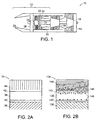
- FIG. 1 Depicted in FIG. 1 is a schematic, cross-sectional view of a typical turbofan gas turbine engine 10 depicting hot section components, shown generally at 12, suitable for application of a MAlY-base TBC system in accordance with a preferred embodiment of the present invention.
- the engine 10 includes, in serial flow relation from inlet to exhaust, a inlet frame 14, a two stage low pressure compressor (“LPC”) or fan 16, a three stage high pressure compressor ("HPC") 18, a combustor 20, a single stage high pressure turbine (“HPT”) 22, a two stage low pressure turbine (“LPT”) 24, a turbine frame 26, and an exhaust nozzle 28.
- LPC two stage low pressure compressor
- HPC three stage high pressure compressor
- HPC combustor
- HPT single stage high pressure turbine
- LPT two stage low pressure turbine
- Compressed air exiting the HPC 18 is mixed with fuel in the combustor 20 and ignited.
- the high temperature, high energy combustion effluent passes through both the HPT 22 and LPT 24 where energy is extracted to drive the HPC 18 and fan 16.
- Each turbine stage, for example HPT 22 includes a set of stationary turbine vanes 30 and rotating turbine blades 32 disposed in the effluent stream to optimize flow orientation and energy extraction.
- the effluent After passing through the turbine frame 24, which supports the rotating components of the engine 10, the effluent is mixed with the fan flow and passes through the exhaust nozzle 28, producing a net force or thrust which propels the engine 10 forward.
- Hot section components 12 exposed to the high temperature, corrosive combustion effluent may be coated with the MAlY bond coat TBC system, in accordance with the teachings of this invention, to protect the superalloy substrate from excessive temperature as well as oxidation during engine operation.
- FIG. 2A depicted is an enlarged schematic, cross-sectional view of a portion of a superalloy article 34, such as an airfoil wall of a turbine blade 32, coated with the MAlY bond coat TBC system in accordance with a preferred embodiment of the present invention.
- Schematic representation and relative thickness of each layer of the multilayered TBC systems depicted in FIGS. 2A and 2B are meant for illustrative purposes only and in no manner are intended to restrict the scope of the invention.
- the article 34 in FIG. 2A includes a substrate 36, a portion of which is depicted.
- the substrate 36 is preferably composed of a nickel- or cobalt-base superalloy; however, it is contemplated that the MAlY bond coat of the present invention may be suitable for use with any superalloy or other metallic substrates with which it may form an adequate bond.
- adequate bond may be characterized as adherence equal or superior to that between other layers in the TBC system.
- MAlY bond coat 38 having a composition of 20 to 30 weight percent aluminum, between trace and about 3 weight percent of a reactive element such as yttrium, zirconium, lanthanum, or scandium, or mixtures thereof, and balance being nickel, cobalt, iron or mixtures thereof.
- bond coat 38 includes 20 to 22 weight percent aluminum, about 0.25 to 0.4 weight percent yttrium, and balance nickel.
- chromium is purposely omitted from the bond coat 38, although some inconsequential, inadvertent trace amount might conceivably exist therein.
- the bond coat 38 is preferably produced by means of low pressure or vacuum plasma spray using a prealloyed powder, rather than conventional diffusion methods such as pack cementation.
- An exemplary plasma spray method is disclosed, for example, in U.S. Pat. No. Re. 33,876 to Goward et al., the disclosure of which is incorporated herein by reference.
- the composition of the bond coat 38 may be controlled better and the migration of base alloy elements from the substrate 36, which might otherwise pose a detriment to bond coat/alumina adherence, may be reduced markedly.
- a relatively thin diffusion zone 40 inherently forms between the bond coat 38 and substrate 36 supporting the bond therebetween.
- a ceramic topcoat 44 is disposed on the alumina film 42 to achieve the desired insulative properties of the TBC system. As depicted, the preferred ceramic topcoat 44 has a columnar microstructure, substantially consistent with that disclosed in U.S. Pat. No. 4,321,311 to Strangman, the disclosure of which is incorporated herein by reference.
- the columnar ceramic topcoat 44 preferably is produced by electron beam PVD, although other techniques consistent with the production of such columnar microstructure may be used as desired.
- An exemplary PVD method and apparatus is disclosed in U.S. Pat. No. 4,880,614 to Strangman et al., the disclosure of which is incorporated herein by reference.
- FIG. 2B depicted is an enlarged schematic, cross-sectional view of a portion of a superalloy article 134 coated with a TBC system in accordance with an alternative embodiment of the present invention.
- the article 134 includes a substrate 136, preferably composed of a nickel- or cobalt-base superalloy.
- the MAlY bond coat of the present embodiment of the invention also may be suitable for use with any superalloy or other metallic substrates with which it may form an adequate bond.
- a MAlY bond coat 138 having a composition of 20 to 30 weight percent aluminum, between trace and about 3 weight percent of a reactive element such as yttrium, zirconium, lanthanum, or scandium, or mixtures thereof, and balance being nickel, cobalt, iron or mixtures thereof.
- bond coat 138 includes 20 to 22 weight percent aluminum, 0.25 to 0.4 weight percent yttrium, and balance nickel.
- chromium is purposely omitted from the bond coat 138.
- the bond coat 138 is produced by first applying yttrium to the substrate 136 by any conventional method, such as electron beam PVD.
- the MAlY bond coat 138 may be produced by gas phase aluminizing.
- the superalloy substrate 136 is reacted with an aluminum halide gas at elevated temperature for a length of time sufficient to produce the desired bond coat thickness and composition in accordance with the aforementioned constituent ranges.
- the method is not restricted to gas phase aluminizing in that any source of aluminum may be employed to support the aluminizing step.
- the MAlY bond coat 138 includes both the aluminide coating and embedded yttrium rich intermetallic phase particles 148.
- the coating formed will be nickel aluminide.
- the substrate is a cobalt-base alloy, the coating formed will be cobalt aluminide.
- zirconium, lanthanum, or scandium were applied in sufficiently high concentration, the resultant particles 148 would be rich in the applied reactive element.
- a relatively thin diffusion zone 140 inherently forms between the bond coat 138 and substrate 136 supporting the bond therebetween.
- the diffusion zone 140 may contain the diffused reactive element first applied.
- a ceramic topcoat 144 is disposed on the alumina film 142 to achieve the desired insulative properties of the TBC system.
- the preferred ceramic topcoat 144 has a non-columnar but strain tolerant morphology produced by plasma spraying techniques, although other conventional methods of application may be employed as desired.
- the plasma sprayed ceramic topcoat 144 may be uniformly dense, or may exhibit controlled porosity as depicted generally at 146, having a substantially nonporous external surface and increasing porosity proximate the alumina layer 142.
- the average thickness of individual layers of the multilayered TBC systems depicted in FIGS. 2A and 2B may be selected by those skilled in the art to achieve a desired insulative result.
- the thickness of bond coat 38, 138 may be between about 40 and 120 microns; the thickness of the alumina film 42, 142 between about 0.1 and 3 microns; and the thickness of the ceramic topcoat 44, 144 between about 80 and 350 microns. These ranges are exemplary. Values outside these ranges, alone or in combination, are considered within the scope of the invention.
- the thickness of bond coat 38, 138 may be between about 50 and 80 microns; that of the alumina film 42, 142 may be between about 0.5 and 1.5 microns; and that of the ceramic topcoat 44, 144 may be between about 100 and 150 microns.
Landscapes
- Chemical & Material Sciences (AREA)
- Engineering & Computer Science (AREA)
- Organic Chemistry (AREA)
- Inorganic Chemistry (AREA)
- Chemical Kinetics & Catalysis (AREA)
- Materials Engineering (AREA)
- Mechanical Engineering (AREA)
- Metallurgy (AREA)
- Ceramic Engineering (AREA)
- Plasma & Fusion (AREA)
- Physics & Mathematics (AREA)
- Turbine Rotor Nozzle Sealing (AREA)
- Application Of Or Painting With Fluid Materials (AREA)
- Extrusion Moulding Of Plastics Or The Like (AREA)
- Coating By Spraying Or Casting (AREA)
- Paints Or Removers (AREA)
- Other Surface Treatments For Metallic Materials (AREA)
Claims (18)
- Bindeschicht für ein Wärmeschutzbeschichtungssystem auf einem Superlegierungssubstrat, wobei das Wärmeschutzbeschichtungssystem eine Keramikoberschicht enthält und die Bindeschicht folgendes aufweist:20 bis 30 Gewichtsprozent Aluminium,zwischen Spuren und 3 Gewichtsprozent eines reaktiven Elements, das aus der aus Yttrium, Zirkonium, Lanthan und Scandium und Mischungen davon bestehenden Gruppe ausgewählt ist, undeinen Rest bzw. eine Bilanz, der bzw. die aus der aus Nikkel, Kobalt, Eisen und Mischungen davon bestehenden Gruppe ausgewählt ist, wobei die Bindeschicht ferner durch die Abwesenheit von zugegebenem Chrom gekennzeichnet ist.
- Erfindung nach Anspruch 1, wobei die Bindeschicht aufweist:20 bis 22 Gewichtsprozent Aluminium,0,25 bis 0,4 Gewichtsprozent Yttrium und als Rest Nickel.
- Im wesentlichen chromfreie Bindeschicht für ein Wärmeschutzbeschichtungssystem auf einem Superlegierungssubstrat, wobei das Wärmeschutzbeschichtungssystem eine Keramikoberschicht aufweist und die Bindeschicht im wesentlichen aus folgendem besteht:20 bis 30 Gewichtsprozent Aluminium,zwischen Spuren und 3 Gewichtsprozent eines reaktiven Elements, das aus der aus Yttrium, Zirkonium, Lanthan und Scandium und Mischungen davon bestehenden Gruppe ausgewählt ist, undder Rest bzw. die Bilanz aus der aus Nickel, Kobalt, Eisen und Mischungen davon bestehenden Gruppe ausgewählt ist.
- Erfindung nach Anspruch 3, wobei die Bindeschicht im wesentlichen aus Folgendem besteht:20 bis 22 Gewichtsprozent Aluminium,0,25 bis 0,4 Gewichtsprozent Yttrium und der Rest aus Nikkel.
- Wärmeschutzbeschichtungssystem miteiner Bindeschicht, die folgendes aufweist:
20 bis 30 Gewichtsprozent Aluminium;zwischen Spuren und 3 Gewichtsprozent eines reaktiven Elements, das aus der aus Yttrium, Zirkonium, Lanthan und Scandium und Mischungen davon bestehenden Gruppe ausgewählt ist, undder Rest bzw. die Bilanz aus der aus Nickel, Kobalt, Eisen und Mischungen davon bestehenden Gruppe ausgewählt ist, wobei die Bindeschicht ferner durch die Abwesenheit von zugegebenem Chrom gekennzeichnet ist,einer Aluminiumschicht auf der Bindeschicht undeiner Keramikoberschicht auf der Aluminiumschicht. - Erfindung nach Anspruch 5, wobei die Bindeschicht folgendes aufweist:20 bis 22 Gewichtsprozent Aluminium,0,25 bis 0,4 Gewichtsprozent Yttrium und als Rest Nickel.
- Beschichteter Gegenstand miteinem Superlegierungssubstrat undeinem Wärmeschutzbeschichtungssystem auf dem Substrat, wobei das Wärmeschutzbeschichtungssystem folgendes aufweist:
eine Bindeschicht auf dem Substrat, wobei die Bindeschicht folgendes aufweist :20 bis 30 Gewichtsprozent Aluminium,zwischen Spuren und 3 Gewichtsprozent eines reaktiven Elements, das aus der aus Yttrium, Zirkonium, Lanthan und Scandium und Mischungen davon bestehenden Gruppe ausgewählt, undeinen Rest bzw. eine Bilanz, der bzw, die aus der aus Nickel, Kobalt, Eisen und Mischungen davon bestehenden Gruppen ausgewählt ist, wobei die Bindeschicht ferner durch die Abwesenheit von zugegebenem Chrom gekennzeichnet ist,einer Aluminiumschicht auf der Bindeschicht undeiner Keramikoberachicht auf der Aluminiumschicht. - Erfindung nach Anspruch 7, wobei die Bindeschicht folgendes aufweist;20 bis 22 Gewichtsprozent Aluminium,0,25 bis 0,4 Gewichtsprozent Yttrium undals Rest Nickel.
- Erfindung nach Anspruch 7, wobei das Superlegierungssubstrat eine Superlegierung aufweist, die aus der aus Superlegierungen auf Nickelbasis und Superlegierungen auf Kobaltbasis bestehenden Gruppe ausgewählt ist.
- Erfindung nach Anspruch 7, wobei der beschichtete Gegenstand ein Maschinenteil aufweist, zumindest einen Abschnitt davon, der dem Verbrennungsabgas während dem Betrieb ausgesetzt ist.
- Erfindung nach Anspruch 10, wobei das Maschinenteil aus der aus Brennkammern, Turbinenschaufeln, Turbinenleitschaufeln, Turbinenrahmen und Auslaßdüsen bestehenden Gruppe ausgewählt ist.
- Verfahren zur Herstellung eines Wärmeschutzbeschichtungssystem auf einem Superlegierungssubstrat, wobei das Wärmeschutzbeschichtungssystems eine Keramikoberschicht aufweist und das Verfahren die folgenden Schritte umfaßt:1. Bereitstellen eines Superlegierungssubstrats und2. Herstellen einer Bindeschicht auf dem Substrat durch Plasmaspritzen eines vorlegierten Pulvers mit20 bis 30 Gewichtsprozent Aluminium,zwischen Spuren und 3 Gewichtsprozent eines reaktiven Elements, das aus der aus Yttrium, Zirkonium, Lanthan und Scandium und Mischungen davon bestehenden Gruppe ausgewählt ist, undeinem Rest bzw. einer Bilanz, der bzw. die aus der aus Nikkel, Kobalt, Eisen und Mischungen davon bestehenden Gruppe ausgewählt ist, wobei das vorlegierte Pulver ferner durch die Abwesenheit von zugegebenem Chrom gekennzeichnet ist.
- Erfindung nach Anspruch 12, die ferner den Schritt des Bildens eines Aluminiumfilms auf der Bindeschicht umfaßt.
- Erfindung nach Anspruch 13, die ferner den Schritt des Herstellens einer Keramikoberschicht auf dem Aluminiumfilm umfaßt.
- Verfahren zur Herstellung eines Wärmeschutzbeschichtungssystems auf einem Superlegierungssubstrat, wobei das Wärmeschutzbeschichtungssystem eine Keramikoberschicht aufweist und das Verfahren die folgenden Schritte aufweist :1. Bereitstellen eines Superlegierungssubstrates und2. Herstellen einer Bindeschicht auf dem Substrat durcha. Ablagern eines reaktiven Elements auf dem Substrat durch physikalische Metallbedampfung, wobei das reaktive Element aus der aus Yttrium, Zirkonium, Lanthan und Scandium und Mischungen davon bestehenden Gruppe ausgewählt ist, undb. das Substrat danach mit einer Aluminiumquelle zur Reaktion bringen, wobei die hergestellte Bindeschicht folgendes aufweist:20 bis 30 Gewichtsprozent Aluminium,zwischen Spuren und 3 Gewichtsprozent des reaktiven Elements undeinen Rest bzw. eine Bilanz, der bzw. die aus der aus Nickel, Kobalt, Eisen und Mischungen davon bestehenden Gruppe ausgewählt ist, wobei die hergestellte Bindeschicht ferner durch die Abwesenheitvon zugegebenem Chrom gekennzeichnet ist.
- Erfindung nach Anspruch 15, die ferner den Schritt des Bildens eines Aluminiumfilms auf der Bindeschicht umfaßt.
- Erfindung nach Anspruch 16, die ferner den Schritt des Herstellens einer Keramikoberschicht auf dem Aluminiumfilm umfaßt.
- Erfindung nach Anspruch 1 wobei die Bindeschicht eine Dicke von etwa 40 bis etwa 80 Mikron aufweist.
Applications Claiming Priority (3)
| Application Number | Priority Date | Filing Date | Title |
|---|---|---|---|
| US597841 | 1996-02-07 | ||
| US08/597,841 US5824423A (en) | 1996-02-07 | 1996-02-07 | Thermal barrier coating system and methods |
| PCT/US1997/001368 WO1997029219A2 (en) | 1996-02-07 | 1997-01-31 | Improved thermal barrier coating system and methods |
Publications (2)
| Publication Number | Publication Date |
|---|---|
| EP0886685A2 EP0886685A2 (de) | 1998-12-30 |
| EP0886685B1 true EP0886685B1 (de) | 2001-05-02 |
Family
ID=24393140
Family Applications (1)
| Application Number | Title | Priority Date | Filing Date |
|---|---|---|---|
| EP97906435A Expired - Lifetime EP0886685B1 (de) | 1996-02-07 | 1997-01-31 | Verbesserte wärmeschutz-beschichtung und verfahren zu ihrer herstellung |
Country Status (6)
| Country | Link |
|---|---|
| US (1) | US5824423A (de) |
| EP (1) | EP0886685B1 (de) |
| AT (1) | ATE200915T1 (de) |
| AU (1) | AU2112897A (de) |
| DE (1) | DE69704703T2 (de) |
| WO (1) | WO1997029219A2 (de) |
Cited By (1)
| Publication number | Priority date | Publication date | Assignee | Title |
|---|---|---|---|---|
| US10443447B2 (en) | 2016-03-14 | 2019-10-15 | General Electric Company | Doubler attachment system |
Families Citing this family (34)
| Publication number | Priority date | Publication date | Assignee | Title |
|---|---|---|---|---|
| CA2165641C (en) * | 1994-12-24 | 2007-02-06 | David Stafford Rickerby | A method of applying a thermal barrier coating to a superalloy article and a thermal barrier coating |
| SG71151A1 (en) | 1997-09-17 | 2000-03-21 | Gen Electric | Bond coat for a thermal barrier coating system and method therefor |
| EP0985745B1 (de) * | 1998-09-08 | 2006-07-12 | General Electric Company | Haftbeschichtung für wärmedämmendes Beschichtungssystem |
| US6153313A (en) * | 1998-10-06 | 2000-11-28 | General Electric Company | Nickel aluminide coating and coating systems formed therewith |
| US6291084B1 (en) | 1998-10-06 | 2001-09-18 | General Electric Company | Nickel aluminide coating and coating systems formed therewith |
| ATE362555T1 (de) * | 1998-10-19 | 2007-06-15 | Sulzer Metco Coatings B V | Wärmeschutz-beschichtung und herstellungsverfahren |
| US6228510B1 (en) * | 1998-12-22 | 2001-05-08 | General Electric Company | Coating and method for minimizing consumption of base material during high temperature service |
| US6210812B1 (en) | 1999-05-03 | 2001-04-03 | General Electric Company | Thermal barrier coating system |
| US6190471B1 (en) | 1999-05-26 | 2001-02-20 | General Electric Company | Fabrication of superalloy articles having hafnium- or zirconium-enriched protective layer |
| US6485792B1 (en) * | 1999-08-27 | 2002-11-26 | General Electric Company | Endurance of NiA1 coatings by controlling thermal spray processing variables |
| US6294260B1 (en) | 1999-09-10 | 2001-09-25 | Siemens Westinghouse Power Corporation | In-situ formation of multiphase air plasma sprayed barrier coatings for turbine components |
| FR2813318B1 (fr) * | 2000-08-28 | 2003-04-25 | Snecma Moteurs | Formation d'un revetement aluminiure incorporant un element reactif, sur un substrat metallique |
| US6602356B1 (en) | 2000-09-20 | 2003-08-05 | General Electric Company | CVD aluminiding process for producing a modified platinum aluminide bond coat for improved high temperature performance |
| FR2814473B1 (fr) * | 2000-09-25 | 2003-06-27 | Snecma Moteurs | Procede de realisation d'un revetement de protection formant barriere thermique avec sous-couche de liaison sur un substrat en superalliage et piece obtenue |
| CH695689A5 (de) * | 2001-05-23 | 2006-07-31 | Sulzer Metco Ag | Verfahren zum Erzeugen eines wärmedämmenden Schichtsystems auf einem metallischen Substrat. |
| CA2482085C (en) * | 2002-04-12 | 2010-09-28 | Sulzer Metco Ag | A plasma spraying method |
| US6677064B1 (en) | 2002-05-29 | 2004-01-13 | Siemens Westinghouse Power Corporation | In-situ formation of multiphase deposited thermal barrier coatings |
| US6893750B2 (en) | 2002-12-12 | 2005-05-17 | General Electric Company | Thermal barrier coating protected by alumina and method for preparing same |
| US6884515B2 (en) | 2002-12-20 | 2005-04-26 | General Electric Company | Afterburner seals with heat rejection coats |
| US6884461B2 (en) | 2002-12-20 | 2005-04-26 | General Electric Company | Turbine nozzle with heat rejection coats |
| US6884460B2 (en) | 2002-12-20 | 2005-04-26 | General Electric Company | Combustion liner with heat rejection coats |
| US20040251008A1 (en) * | 2003-05-30 | 2004-12-16 | O'neill Patrick S. | Method for making brazed heat exchanger and apparatus |
| US6979498B2 (en) * | 2003-11-25 | 2005-12-27 | General Electric Company | Strengthened bond coats for thermal barrier coatings |
| US20050208337A1 (en) * | 2004-03-22 | 2005-09-22 | Ulion Nicholas E | Reduced thermal conductivity TBC by EB-PVD process to incorporate porosity |
| US7070866B2 (en) * | 2004-05-27 | 2006-07-04 | General Electric Company | Nickel aluminide coating with improved oxide stability |
| US7666515B2 (en) * | 2005-03-31 | 2010-02-23 | General Electric Company | Turbine component other than airfoil having ceramic corrosion resistant coating and methods for making same |
| US20060280955A1 (en) * | 2005-06-13 | 2006-12-14 | Irene Spitsberg | Corrosion resistant sealant for EBC of silicon-containing substrate and processes for preparing same |
| US20060280954A1 (en) * | 2005-06-13 | 2006-12-14 | Irene Spitsberg | Corrosion resistant sealant for outer EBL of silicon-containing substrate and processes for preparing same |
| US20090035485A1 (en) * | 2007-08-02 | 2009-02-05 | United Technologies Corporation | Method for forming active-element aluminide diffusion coatings |
| CH699312A1 (de) | 2008-08-15 | 2010-02-15 | Alstom Technology Ltd | Schaufelanordnung einer gasturbine. |
| US7927714B2 (en) * | 2008-08-20 | 2011-04-19 | The Trustees Of Princeton University | Barium-doped bond coat for thermal barrier coatings |
| KR20110096544A (ko) * | 2008-12-12 | 2011-08-30 | 비수비우스 크루서블 컴패니 | 시멘트 공장 내화물 앵커 |
| US11274828B2 (en) * | 2019-02-08 | 2022-03-15 | Raytheon Technologies Corporation | Article with bond coat layer and layer of networked ceramic nanofibers |
| US20230011769A1 (en) * | 2019-12-27 | 2023-01-12 | Kubota Corporation | Ni-BASED ALLOY, HEAT-RESISTANT AND CORROSION-RESISTANT COMPONENT, AND HEAT TREATMENT FURNACE COMPONENT |
Family Cites Families (35)
| Publication number | Priority date | Publication date | Assignee | Title |
|---|---|---|---|---|
| US3542530A (en) * | 1968-05-23 | 1970-11-24 | United Aircraft Corp | Nickel or cobalt base with a coating containing iron chromium and aluminum |
| US3754903A (en) * | 1970-09-15 | 1973-08-28 | United Aircraft Corp | High temperature oxidation resistant coating alloy |
| US3676085A (en) * | 1971-02-18 | 1972-07-11 | United Aircraft Corp | Cobalt base coating for the superalloys |
| US3928026A (en) * | 1974-05-13 | 1975-12-23 | United Technologies Corp | High temperature nicocraly coatings |
| USRE33876E (en) * | 1975-09-11 | 1992-04-07 | United Technologies Corporation | Thermal barrier coating for nickel and cobalt base super alloys |
| US4248940A (en) * | 1977-06-30 | 1981-02-03 | United Technologies Corporation | Thermal barrier coating for nickel and cobalt base super alloys |
| US4055705A (en) * | 1976-05-14 | 1977-10-25 | The United States Of America As Represented By The Administrator Of The National Aeronautics And Space Administration | Thermal barrier coating system |
| US4255495A (en) * | 1979-10-31 | 1981-03-10 | The United States Of America As Represented By The Administrator Of The National Aeronautics And Space Administration | Corrosion resistant thermal barrier coating |
| US4405659A (en) * | 1980-01-07 | 1983-09-20 | United Technologies Corporation | Method for producing columnar grain ceramic thermal barrier coatings |
| US4321311A (en) * | 1980-01-07 | 1982-03-23 | United Technologies Corporation | Columnar grain ceramic thermal barrier coatings |
| US4321310A (en) * | 1980-01-07 | 1982-03-23 | United Technologies Corporation | Columnar grain ceramic thermal barrier coatings on polished substrates |
| US4401697A (en) * | 1980-01-07 | 1983-08-30 | United Technologies Corporation | Method for producing columnar grain ceramic thermal barrier coatings |
| US4405660A (en) * | 1980-01-07 | 1983-09-20 | United Technologies Corporation | Method for producing metallic articles having durable ceramic thermal barrier coatings |
| US4414249A (en) * | 1980-01-07 | 1983-11-08 | United Technologies Corporation | Method for producing metallic articles having durable ceramic thermal barrier coatings |
| USRE32121E (en) * | 1981-08-05 | 1986-04-22 | United Technologies Corporation | Overlay coatings for superalloys |
| US4585481A (en) * | 1981-08-05 | 1986-04-29 | United Technologies Corporation | Overlays coating for superalloys |
| US5514482A (en) * | 1984-04-25 | 1996-05-07 | Alliedsignal Inc. | Thermal barrier coating system for superalloy components |
| GB2285632B (en) * | 1985-08-19 | 1996-02-14 | Garrett Corp | Thermal barrier coating system for superalloy components |
| US4835011A (en) * | 1986-11-03 | 1989-05-30 | United Technologies Corporation | Yttrium enriched aluminide coatings |
| US5262245A (en) * | 1988-08-12 | 1993-11-16 | United Technologies Corporation | Advanced thermal barrier coated superalloy components |
| US4880614A (en) * | 1988-11-03 | 1989-11-14 | Allied-Signal Inc. | Ceramic thermal barrier coating with alumina interlayer |
| US5015502A (en) * | 1988-11-03 | 1991-05-14 | Allied-Signal Inc. | Ceramic thermal barrier coating with alumina interlayer |
| US4916022A (en) * | 1988-11-03 | 1990-04-10 | Allied-Signal Inc. | Titania doped ceramic thermal barrier coatings |
| US5281487A (en) * | 1989-11-27 | 1994-01-25 | General Electric Company | Thermally protective composite ceramic-metal coatings for high temperature use |
| US5087477A (en) * | 1990-02-05 | 1992-02-11 | United Technologies Corporation | Eb-pvd method for applying ceramic coatings |
| US5238752A (en) * | 1990-05-07 | 1993-08-24 | General Electric Company | Thermal barrier coating system with intermetallic overlay bond coat |
| US5498484A (en) * | 1990-05-07 | 1996-03-12 | General Electric Company | Thermal barrier coating system with hardenable bond coat |
| US5254413A (en) * | 1991-01-31 | 1993-10-19 | General Electric Company | Method for repair and restoration of a ceramic thermal barrier-coated substrate by providing an intermetallic coating |
| DE4103994A1 (de) * | 1991-02-11 | 1992-08-13 | Inst Elektroswarki Patona | Schutzueberzug vom typ metall-keramik fuer einzelteile aus hitzebestaendigen legierungen |
| WO1993024672A1 (en) * | 1992-05-29 | 1993-12-09 | United Technologies Corporation | Ceramic thermal barrier coating for rapid thermal cycling applications |
| US5352540A (en) * | 1992-08-26 | 1994-10-04 | Alliedsignal Inc. | Strain-tolerant ceramic coated seal |
| US5455119A (en) * | 1993-11-08 | 1995-10-03 | Praxair S.T. Technology, Inc. | Coating composition having good corrosion and oxidation resistance |
| US5427866A (en) * | 1994-03-28 | 1995-06-27 | General Electric Company | Platinum, rhodium, or palladium protective coatings in thermal barrier coating systems |
| US5562998A (en) * | 1994-11-18 | 1996-10-08 | Alliedsignal Inc. | Durable thermal barrier coating |
| US5512382A (en) * | 1995-05-08 | 1996-04-30 | Alliedsignal Inc. | Porous thermal barrier coating |
-
1996
- 1996-02-07 US US08/597,841 patent/US5824423A/en not_active Expired - Lifetime
-
1997
- 1997-01-31 EP EP97906435A patent/EP0886685B1/de not_active Expired - Lifetime
- 1997-01-31 WO PCT/US1997/001368 patent/WO1997029219A2/en not_active Ceased
- 1997-01-31 AT AT97906435T patent/ATE200915T1/de not_active IP Right Cessation
- 1997-01-31 AU AU21128/97A patent/AU2112897A/en not_active Abandoned
- 1997-01-31 DE DE69704703T patent/DE69704703T2/de not_active Expired - Lifetime
Cited By (1)
| Publication number | Priority date | Publication date | Assignee | Title |
|---|---|---|---|---|
| US10443447B2 (en) | 2016-03-14 | 2019-10-15 | General Electric Company | Doubler attachment system |
Also Published As
| Publication number | Publication date |
|---|---|
| WO1997029219A3 (en) | 1998-01-29 |
| AU2112897A (en) | 1997-08-28 |
| WO1997029219A2 (en) | 1997-08-14 |
| EP0886685A2 (de) | 1998-12-30 |
| ATE200915T1 (de) | 2001-05-15 |
| DE69704703D1 (de) | 2001-06-07 |
| DE69704703T2 (de) | 2002-01-31 |
| US5824423A (en) | 1998-10-20 |
Similar Documents
| Publication | Publication Date | Title |
|---|---|---|
| EP0886685B1 (de) | Verbesserte wärmeschutz-beschichtung und verfahren zu ihrer herstellung | |
| US5876860A (en) | Thermal barrier coating ceramic structure | |
| US6291084B1 (en) | Nickel aluminide coating and coating systems formed therewith | |
| US6255001B1 (en) | Bond coat for a thermal barrier coating system and method therefor | |
| US6168874B1 (en) | Diffusion aluminide bond coat for a thermal barrier coating system and method therefor | |
| EP0987347B1 (de) | Wärmedämmschicht-System und Verfahren dazu | |
| EP0824606B1 (de) | Poröse wärmedämmschicht | |
| US6682827B2 (en) | Nickel aluminide coating and coating systems formed therewith | |
| EP1209247B1 (de) | CVD Aluminisierungsverfahren zur Herstellung einer modifizierten Platin-Aluminidbeschichtung für verbesserte Hochtemperaturleistung | |
| US20100021289A1 (en) | Method for applying a NiA1 based coating by an electroplating technique | |
| EP1852521A1 (de) | Wärmedämmbeschichtungen und Auftragungsverfahren dafür | |
| US6887589B2 (en) | Nickel aluminide coating and coating systems formed therewith | |
| US8293324B2 (en) | Coating systems containing rhodium aluminide-based layers | |
| US20060141283A1 (en) | Low cost inovative diffused MCrAIY coatings | |
| US6485844B1 (en) | Thermal barrier coating having a thin, high strength bond coat | |
| EP1927673A2 (de) | Nickel basierte Superlegierung mit einem Beschichtungsystem eine Stabilisierungschicht enthaltend | |
| JP4907072B2 (ja) | 選択的領域気相アルミナイズ方法 | |
| EP0995817B1 (de) | Wärmeschutz-Beschichtung und Herstellungsverfahren | |
| EP1491650B1 (de) | Verfahren für das Auftragen eines mehrschichtigen Systems |
Legal Events
| Date | Code | Title | Description |
|---|---|---|---|
| PUAI | Public reference made under article 153(3) epc to a published international application that has entered the european phase |
Free format text: ORIGINAL CODE: 0009012 |
|
| 17P | Request for examination filed |
Effective date: 19980909 |
|
| AK | Designated contracting states |
Kind code of ref document: A2 Designated state(s): AT BE CH DE DK ES FI FR GB GR IE IT LI LU MC NL PT SE |
|
| 17Q | First examination report despatched |
Effective date: 19990929 |
|
| GRAG | Despatch of communication of intention to grant |
Free format text: ORIGINAL CODE: EPIDOS AGRA |
|
| GRAG | Despatch of communication of intention to grant |
Free format text: ORIGINAL CODE: EPIDOS AGRA |
|
| GRAH | Despatch of communication of intention to grant a patent |
Free format text: ORIGINAL CODE: EPIDOS IGRA |
|
| GRAH | Despatch of communication of intention to grant a patent |
Free format text: ORIGINAL CODE: EPIDOS IGRA |
|
| GRAA | (expected) grant |
Free format text: ORIGINAL CODE: 0009210 |
|
| AK | Designated contracting states |
Kind code of ref document: B1 Designated state(s): AT BE CH DE DK ES FI FR GB GR IE IT LI LU MC NL PT SE |
|
| PG25 | Lapsed in a contracting state [announced via postgrant information from national office to epo] |
Ref country code: IT Free format text: LAPSE BECAUSE OF FAILURE TO SUBMIT A TRANSLATION OF THE DESCRIPTION OR TO PAY THE FEE WITHIN THE PRESCRIBED TIME-LIMIT;WARNING: LAPSES OF ITALIAN PATENTS WITH EFFECTIVE DATE BEFORE 2007 MAY HAVE OCCURRED AT ANY TIME BEFORE 2007. THE CORRECT EFFECTIVE DATE MAY BE DIFFERENT FROM THE ONE RECORDED. Effective date: 20010502 Ref country code: FI Free format text: LAPSE BECAUSE OF FAILURE TO SUBMIT A TRANSLATION OF THE DESCRIPTION OR TO PAY THE FEE WITHIN THE PRESCRIBED TIME-LIMIT Effective date: 20010502 Ref country code: BE Free format text: LAPSE BECAUSE OF FAILURE TO SUBMIT A TRANSLATION OF THE DESCRIPTION OR TO PAY THE FEE WITHIN THE PRESCRIBED TIME-LIMIT Effective date: 20010502 Ref country code: AT Free format text: LAPSE BECAUSE OF FAILURE TO SUBMIT A TRANSLATION OF THE DESCRIPTION OR TO PAY THE FEE WITHIN THE PRESCRIBED TIME-LIMIT Effective date: 20010502 |
|
| REF | Corresponds to: |
Ref document number: 200915 Country of ref document: AT Date of ref document: 20010515 Kind code of ref document: T |
|
| REG | Reference to a national code |
Ref country code: CH Ref legal event code: EP |
|
| REF | Corresponds to: |
Ref document number: 69704703 Country of ref document: DE Date of ref document: 20010607 |
|
| REG | Reference to a national code |
Ref country code: IE Ref legal event code: FG4D |
|
| PG25 | Lapsed in a contracting state [announced via postgrant information from national office to epo] |
Ref country code: SE Free format text: LAPSE BECAUSE OF FAILURE TO SUBMIT A TRANSLATION OF THE DESCRIPTION OR TO PAY THE FEE WITHIN THE PRESCRIBED TIME-LIMIT Effective date: 20010802 Ref country code: PT Free format text: LAPSE BECAUSE OF FAILURE TO SUBMIT A TRANSLATION OF THE DESCRIPTION OR TO PAY THE FEE WITHIN THE PRESCRIBED TIME-LIMIT Effective date: 20010802 Ref country code: DK Free format text: LAPSE BECAUSE OF FAILURE TO SUBMIT A TRANSLATION OF THE DESCRIPTION OR TO PAY THE FEE WITHIN THE PRESCRIBED TIME-LIMIT Effective date: 20010802 |
|
| PG25 | Lapsed in a contracting state [announced via postgrant information from national office to epo] |
Ref country code: GR Free format text: LAPSE BECAUSE OF FAILURE TO SUBMIT A TRANSLATION OF THE DESCRIPTION OR TO PAY THE FEE WITHIN THE PRESCRIBED TIME-LIMIT Effective date: 20010803 |
|
| ET | Fr: translation filed | ||
| PG25 | Lapsed in a contracting state [announced via postgrant information from national office to epo] |
Ref country code: ES Free format text: LAPSE BECAUSE OF FAILURE TO SUBMIT A TRANSLATION OF THE DESCRIPTION OR TO PAY THE FEE WITHIN THE PRESCRIBED TIME-LIMIT Effective date: 20011130 |
|
| REG | Reference to a national code |
Ref country code: GB Ref legal event code: IF02 |
|
| PG25 | Lapsed in a contracting state [announced via postgrant information from national office to epo] |
Ref country code: LU Free format text: LAPSE BECAUSE OF NON-PAYMENT OF DUE FEES Effective date: 20020131 Ref country code: IE Free format text: LAPSE BECAUSE OF NON-PAYMENT OF DUE FEES Effective date: 20020131 |
|
| PLBE | No opposition filed within time limit |
Free format text: ORIGINAL CODE: 0009261 |
|
| STAA | Information on the status of an ep patent application or granted ep patent |
Free format text: STATUS: NO OPPOSITION FILED WITHIN TIME LIMIT |
|
| 26N | No opposition filed | ||
| PG25 | Lapsed in a contracting state [announced via postgrant information from national office to epo] |
Ref country code: MC Free format text: LAPSE BECAUSE OF NON-PAYMENT OF DUE FEES Effective date: 20020801 |
|
| REG | Reference to a national code |
Ref country code: IE Ref legal event code: MM4A |
|
| REG | Reference to a national code |
Ref country code: CH Ref legal event code: PUE Owner name: N.V. INTERTURBINE TRANSFER- SULZER METCO COATINGS Ref country code: CH Ref legal event code: NV Representative=s name: A. BRAUN, BRAUN, HERITIER, ESCHMANN AG PATENTANWAE |
|
| REG | Reference to a national code |
Ref country code: GB Ref legal event code: 732E |
|
| NLS | Nl: assignments of ep-patents |
Owner name: SULZER METCO COATINGS B.V. |
|
| REG | Reference to a national code |
Ref country code: FR Ref legal event code: TP |
|
| REG | Reference to a national code |
Ref country code: CH Ref legal event code: PUE Owner name: SULZER METCO AG Free format text: SULZER METCO COATINGS B.V.#SPIKWEIEN 44#5943 AD LOMM (NL) -TRANSFER TO- SULZER METCO AG#RIGACKERSTRASSE 16#5610 WOHLEN (CH) Ref country code: CH Ref legal event code: NV Representative=s name: SULZER MANAGEMENT AG PATENTABTEILUNG/0067 |
|
| REG | Reference to a national code |
Ref country code: GB Ref legal event code: 732E |
|
| NLS | Nl: assignments of ep-patents |
Owner name: SULZER METCO AG Effective date: 20080117 |
|
| REG | Reference to a national code |
Ref country code: FR Ref legal event code: TP |
|
| REG | Reference to a national code |
Ref country code: CH Ref legal event code: NV Representative=s name: INTELLECTUAL PROPERTY SERVICES GMBH, CH |
|
| REG | Reference to a national code |
Ref country code: FR Ref legal event code: PLFP Year of fee payment: 19 |
|
| PGFP | Annual fee paid to national office [announced via postgrant information from national office to epo] |
Ref country code: NL Payment date: 20150129 Year of fee payment: 19 |
|
| PGFP | Annual fee paid to national office [announced via postgrant information from national office to epo] |
Ref country code: DE Payment date: 20150203 Year of fee payment: 19 Ref country code: CH Payment date: 20150213 Year of fee payment: 19 |
|
| PGFP | Annual fee paid to national office [announced via postgrant information from national office to epo] |
Ref country code: FR Payment date: 20150130 Year of fee payment: 19 Ref country code: GB Payment date: 20150204 Year of fee payment: 19 |
|
| REG | Reference to a national code |
Ref country code: DE Ref legal event code: R119 Ref document number: 69704703 Country of ref document: DE |
|
| REG | Reference to a national code |
Ref country code: CH Ref legal event code: PL |
|
| GBPC | Gb: european patent ceased through non-payment of renewal fee |
Effective date: 20160131 |
|
| REG | Reference to a national code |
Ref country code: NL Ref legal event code: MM Effective date: 20160201 |
|
| REG | Reference to a national code |
Ref country code: FR Ref legal event code: ST Effective date: 20160930 |
|
| PG25 | Lapsed in a contracting state [announced via postgrant information from national office to epo] |
Ref country code: DE Free format text: LAPSE BECAUSE OF NON-PAYMENT OF DUE FEES Effective date: 20160802 Ref country code: LI Free format text: LAPSE BECAUSE OF NON-PAYMENT OF DUE FEES Effective date: 20160131 Ref country code: GB Free format text: LAPSE BECAUSE OF NON-PAYMENT OF DUE FEES Effective date: 20160131 Ref country code: CH Free format text: LAPSE BECAUSE OF NON-PAYMENT OF DUE FEES Effective date: 20160131 |
|
| PG25 | Lapsed in a contracting state [announced via postgrant information from national office to epo] |
Ref country code: NL Free format text: LAPSE BECAUSE OF NON-PAYMENT OF DUE FEES Effective date: 20160201 Ref country code: FR Free format text: LAPSE BECAUSE OF NON-PAYMENT OF DUE FEES Effective date: 20160201 |