EP0886773B1 - Detektion von molekülen und molekülkomplexen - Google Patents
Detektion von molekülen und molekülkomplexen Download PDFInfo
- Publication number
- EP0886773B1 EP0886773B1 EP97919270A EP97919270A EP0886773B1 EP 0886773 B1 EP0886773 B1 EP 0886773B1 EP 97919270 A EP97919270 A EP 97919270A EP 97919270 A EP97919270 A EP 97919270A EP 0886773 B1 EP0886773 B1 EP 0886773B1
- Authority
- EP
- European Patent Office
- Prior art keywords
- process according
- measured
- molecules
- electrode
- electrodes
- Prior art date
- Legal status (The legal status is an assumption and is not a legal conclusion. Google has not performed a legal analysis and makes no representation as to the accuracy of the status listed.)
- Expired - Lifetime
Links
Images

Classifications
-
- G—PHYSICS
- G01—MEASURING; TESTING
- G01N—INVESTIGATING OR ANALYSING MATERIALS BY DETERMINING THEIR CHEMICAL OR PHYSICAL PROPERTIES
- G01N27/00—Investigating or analysing materials by the use of electric, electrochemical, or magnetic means
- G01N27/26—Investigating or analysing materials by the use of electric, electrochemical, or magnetic means by investigating electrochemical variables; by using electrolysis or electrophoresis
- G01N27/28—Electrolytic cell components
- G01N27/30—Electrodes, e.g. test electrodes; Half-cells
- G01N27/327—Biochemical electrodes, e.g. electrical or mechanical details for in vitro measurements
- G01N27/3275—Sensing specific biomolecules, e.g. nucleic acid strands, based on an electrode surface reaction
- G01N27/3276—Sensing specific biomolecules, e.g. nucleic acid strands, based on an electrode surface reaction being a hybridisation with immobilised receptors
-
- Y—GENERAL TAGGING OF NEW TECHNOLOGICAL DEVELOPMENTS; GENERAL TAGGING OF CROSS-SECTIONAL TECHNOLOGIES SPANNING OVER SEVERAL SECTIONS OF THE IPC; TECHNICAL SUBJECTS COVERED BY FORMER USPC CROSS-REFERENCE ART COLLECTIONS [XRACs] AND DIGESTS
- Y10—TECHNICAL SUBJECTS COVERED BY FORMER USPC
- Y10T—TECHNICAL SUBJECTS COVERED BY FORMER US CLASSIFICATION
- Y10T436/00—Chemistry: analytical and immunological testing
- Y10T436/14—Heterocyclic carbon compound [i.e., O, S, N, Se, Te, as only ring hetero atom]
- Y10T436/142222—Hetero-O [e.g., ascorbic acid, etc.]
- Y10T436/143333—Saccharide [e.g., DNA, etc.]
Definitions
- the invention relates to a method for detecting molecular species and an electrical sensor therefor.
- electrical sensors including ultra-microelectrode arrays are used for chemical analysis and process control different areas like healthcare, biotechnology, Environmental protection and chemical industry can be used. they provide a comparatively simple measuring system that the binding or attachment of molecules in the area near the electrodes detected.
- optical sensors which, among other things, operate on the principle of the Evanescent Wave [cf. Feldman, et al., Biosens. & Bioelectron., 10 (1995) 423] or light reflection [cf. Domenici et al., Biosen. & Bioelectron., 10 (1995) 371 or Brecht, Gauglitz, Biosen. & Bioelectron., 10 (1995), 923] or the surface plasmon resonance [cf. Häuseling et al., Langmuir, 7 (1991) 1837 or U. Jonsson et al., BioTechniques 11 (1991), 620] permit the detection of binding effects or the attachment of molecules in thin layers.
- Electrochemical measuring arrangements serve a wide range electrodes apart for the detection of molecules in the thin boundary layer close to the electrode, comparatively large amount of electrolytes and others Substances between the electrodes are negative in many ways to be influenced.
- EP-A-0299780 discloses a method for detecting gas or vapor molecules using an electrode array in the micro range.
- the invention is based on the object of proposing a method with the aid of an electrical sensor which enables the detection of molecules and molecular complexes in a diluent or solvent with higher detection sensitivity with a comparatively lower system outlay.
- the method for the detection of molecules and molecular complexes performed with an arrangement that Has ultramicroelectrode arrays, the electrode structures so closely spaced that they are larger in size Molecular complexes, e.g. B. of immunoproteins or DNA molecules, to come close.
- the effect is used that alternating electrical fields between neighboring electrodes generated and the resulting electricity mainly from the detected molecules and molecular complexes in the near the electrode is influenced.
- the shape and fine structure the electrodes are relatively free to choose, while the minimal distance of the electrodes themselves typically 3 ⁇ m, should preferably be less than 1 ⁇ m.
- impedance spectroscopy achieves that Electrolyte molecules and other substances in a test sample the electric field between the electrodes only influence slightly and therefore do not interfere with the measurement.
- the Ultramicroelectrode arrays can consist of thin layers of Precious metals like gold, platinum or iridium or also Carbon materials exist or contain these materials (Claim 16). They are particularly beneficial on planar insulating carrier materials such as silicon compounds, glass, Ceramic or organic polymers applied, but can also for planarization and mechanical support in this Materials are buried or inserted (claim 17).
- the optimal approximation of two isolated from each other Ultramicroelectrodes can, as shown in Fig. 1, e.g.
- the Ultramicroelectrode arrays can be provided that one Electrode array overlaid with a second or more and the crossing points through insulation layers from each other isolated (claim 19). In this way, electrodes in Distances of just a few nm from each other can be arranged, the insulation layer defining the minimum distance (Fig. 1e). All arrangements of the ultra microelectrode arrays common is that they must be well isolated from each other, with two, three or even more ultra-microelectrode arrays isolated supply on the chip electrically independent individually or in groups with direct and / or alternating current can be (claim 20).
- the used for the insulation Materials e.g.
- plastics or inorganic compounds such as Silicon oxides, nitrides and ceramic materials
- solvents used often water
- Reaction liquids are closed under "Solvent" understand in which a molecular bond, an attachment or diffusion is possible.
- the test sample does not have to must be liquid, other states are also possible. So the processes to be measured can also take place in a gel.
- the present method also enables detection complex reaction processes and therefore offers advanced Applications.
- the penetration of molecules into the area close to the electrode with the field built up (e.g. through Diffusion) or the arrangement of molecules in this area, e.g. by so-called "self assembling" or by Complexation can happen, change both the real as well also the imaginary sizes of the complex impedance and can independent of time - e.g. after the end of the events - if necessary just like the phase angle but also time-dependent, i.e. H. from Progress of the binding event or the diffusion, be measured (claims 3 and 4).
- the entire frequency range is measured and evaluated.
- the one according to the invention is particularly advantageous Use of only selected frequencies or Frequency ranges that are influenced to a maximum. This succeeds construct miniaturized detection systems.
- the method for the detection of molecules and molecular complexes are carried out by looking at the molecules, that you want to measure on the microelectrode surfaces themselves binds.
- This bond can be physical (adsorption) or be a chemical.
- the latter are particularly suitable for the latter known methods of self-assembly (English “self assembling ”) that allow it, e.g. monomolecular Bind and measure thiol compounds on gold electrodes.
- This process is universal for a large number of Molecules applicable, not only to those that have a thiol group own or can be provided with.
- a second selective method for attaching molecules or molecular complexes on the conductive microelectrode surfaces is the well-known method of electropolymerization (Claim 9).
- Each electrode can be individually, in groups or in parallel on their surface with electropolymer, e.g. B. from the monomeric molecules streptavidin, pyrrole, aniline, Vinyl ferrocene or other electrically polymerizable Substances to be modified.
- electropolymer e.g. B. from the monomeric molecules streptavidin, pyrrole, aniline, Vinyl ferrocene or other electrically polymerizable Substances to be modified.
- the binding of such connections in monomolecular or multimolecular layers on the Electrodes change the impedance spectrum or individual Frequencies in a very characteristic way and can be used measure time-dependent or after completion of the reaction.
- the impedance spectrum can also be measured in this way change that the molecules in instead of on the electrodes the electrode gaps positioned (claim 10).
- This Positioning can be achieved, for example, through chemical bonds (see above) e.g. on silicon dioxide) or by adhesion or by Reactions such as condensation reactions, e.g. silanizations, respectively.
- B. lipids or Phthalocyanines by mounting monomolecular films in Layers can be arranged.
- the method for the detection of molecules comprises and molecular complexes in a preferred embodiment Measure that the previously generated on the electrode arrays Molecule layers are provided with chemical adhesive groups or be caused by a chemical reaction or a Complex formation can bind other molecules (claim 11). It succeeds with such high sensitivity Track attachment events. For example, if a low molecular complexing agent such as biotin via a Thiol function is bound to the electrode, this can excluding with a higher molecular complexing partner, e.g. Streptavidin to which any other molecule can be bound, complexed.
- a low molecular complexing agent such as biotin via a Thiol function
- a particularly important and very widely applicable application of the The present method is immunodetection (claim 12).
- the structure of molecular layers on the Ultramicroelectrode array based on the sandwich principle Antibody / antigen immunoreaction made.
- Antibodies in the test sample can be used, for example Haptens (low molecular weight antigens) or other antigens (common Bind proteins) to the microelectrode arrays.
- Haptens low molecular weight antigens
- other antigens common Bind proteins
- the antigen can also be a high molecular weight virus protein be bound to the microelectrode array and Antibodies are allowed to be measured from the test sample. variants this method are the use of multivalent Antibodies with which three or more molecular complexes can be constructed and measured.
- the measuring principle and the change in the electric field in principle allows the molecular structure and type by means of a quantitative analysis of the impedance spectrum differ.
- a differentiation according to the type and size of the Molecules is through quantitative evaluation and in particular by calibrating the impedance spectra with known ones Molecular species possible.
- FIG. 1d The arrangement of FIG. 1d is very similar to the arrangement of FIG Electrodes as a parallel screw.
- the mutually insulated ultramicroelectrodes 1 and 1 'with their contacts for electrical connection 2 and the Isolation layers (e.g. silicon nitride) 3 are on the chip arranged on a planar carrier (e.g. a silicon chip) 4.
- a planar carrier e.g. a silicon chip
- An interdigital gold electrode array structured according to FIG. 1c, has an electrode width of 1 ⁇ m and an electrode spacing of 0.7 ⁇ m.
- the electrodes are modified with a 1 ml, 10 mmol / l SH-biotin solution using self-assembling.
- FIG. 2 shows the adsorption of 10 mmol / l SH-biotin in a 0.1 mol / l sodium buffer solution as capacity-time behavior with an applied potential of 50 mV and an additionally impressed amplitude of 10 mV on a pair of interdigital gold electrodes.
- the capacity of the electrode decreases after adding SH-Biotin to the solution. After about 2000 seconds, the gold surface is completely covered with - S-biotin. After 10 min. Washing the electrode in 0.1 mol / l sodium buffer solution, the adsorbed monomolecular molecular layer is complexed with streptavidin in a subsequent step by immersing the modified electrode in a 50 U / ml solution for 2 hours. After the ⁇ -galactosidase-streptavidin modification, the electrode was rinsed in 0.1 mol / l sodium buffer solution for 10 min and then clamped in a measuring cell.
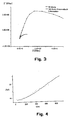
- FIG. 3 shows so-called Nyquist plots at a potential of 50 mV, an amplitude of 10 mV and a frequency range between 2x10 -3 Hz and 1x10 6 Hz, measured as a two-pole impedance.
- Curve I represents the electrode modified with SH-biotin
- curve II the same electrode after additional complexation of the SH-biotin with ⁇ -galactosidase streptavidin.
- the change in impedance shows the disturbance of the dielectric between the electrodes by the complexed molecule and also represents an accomplished bond between the biotin and the streptavidin-enzyme complex.
- the enzyme ⁇ -galactosidase on streptavidin is considered independent Combined amperometric detection of the binding of ⁇ -galactosidase streptavidin to the SH biotin.
- This Proof is provided with the function of the ⁇ -galactosidase, the enzymatic conversion of 5 mmol / l p-aminophenyl- ⁇ -D-galactopyranoside (p-APG) to p-aminophenol, via a amperometric oxidation-reduction of p-aminophenol carried out.
- FIG. 4 shows the amperometric detection of p-aminophenol on the same electrodes with an oxidation potential of 250 mV and a reduction potential of -50 mV against an Ag / AgCl reference electrode, after adding 5 mmol / l p-APG in 0.1 mol / l Sodium buffer solution in the measuring cell.
- the continuous conversion of p-APG to p-aminophenol which is represented by the linear increase in the current, indicates that the enzyme increases the p-aminophenol concentration in the measuring chamber.
Landscapes
- Health & Medical Sciences (AREA)
- Life Sciences & Earth Sciences (AREA)
- Chemical & Material Sciences (AREA)
- Molecular Biology (AREA)
- Physics & Mathematics (AREA)
- Chemical Kinetics & Catalysis (AREA)
- Spectroscopy & Molecular Physics (AREA)
- Electrochemistry (AREA)
- Analytical Chemistry (AREA)
- Biochemistry (AREA)
- General Health & Medical Sciences (AREA)
- General Physics & Mathematics (AREA)
- Immunology (AREA)
- Pathology (AREA)
- Investigating Or Analyzing Materials By The Use Of Electric Means (AREA)
Description
- Figur 1
- zeigt mögliche Anordnungen der Ultramikroelektrodenarrays;
- Figur 2
- zeigt die Adsorption von SH-Biotin;
- Figur 3
- zeigt Nyquist-Plots einer mit SH-Biotin modifizierten und einer zusätzlich mit Streptavidin komplexierten Elektrode;
- Figur 4
- zeigt den amperometrischen Nachweis von p-Aminophenol.
- 1a
- eine streifenförmige parallele Anordnung;
- 1b
- eine mäanderförmige parallele Anrodnung;
- 1c
- eine fingerartige interdigitale Anordnung;
- 1d
- eine kreisförmige parallele Anordnung;
- 1e
- eine kreuzförmig gestapelte und voneinander isolierte Anordnung;
Claims (20)
- Verfahren zum Detektieren von Molekülen oder Molekülkomplexen in einem Verdünnungs- oder Lösungsmittel, wobeieine Meßprobe mit einer Ultra-Mikroelektrodenanordnung in Kontakt gebracht wird, welche mindestens zwei Elektrodenstrukturen aufweist, die auf einem isolierenden Trägermaterial aufgebracht oder darin eingelegt sind und die zum Meßraum hin nicht abgedeckt und derartig zueinander angeordnet sind, daß die Abstände zwischen den verschiedenen Strukturen im Ultra-Mikrobereich liegen,durch Anlegen eines elektrischen Potentials an die Elektrodenstrukturen ein elektrisches Wechselfeld erzeugt wird unddie Strom- oder Potentialveränderungen gemessen werden, die durch in der Meßprobe vorhandene oder entstehende Spezies verursacht werden.
- Verfahren nach Anspruch 1, worin die Feldveränderungen mit Hilfe der Impedanzspektroskopie gemessen werden.
- Verfahren nach Anspruch 1 oder 2, worin die Verstimmung des elektrischen Feldes, die durch in der Meßprobe vorhandene oder entstehende Spezies entsteht, durch die Messung der kapazitiven und/oder der resistiven Anteile und/oder des Phasenwinkels zeitunabhängig oder zeitabhängig gemessen wird.
- Verfahren nach einem der Ansprüche 1 bis 3, worin die Detektion der Moleküle oder Molekülkomplexe anhand ihrer Bindung oder Anlagerung oder Diffusion erfolgt.
- Verfahren nach einem der Ansprüche 1 bis 4, wobei mehrere Elektrodenanordnungen überlagert angeordnet und die Kreuzungspunkte durch Isolationsschichten voneinander isoliert sind und die Messung sequentiell, parallel oder simultan erfolgt.
- Verfahren nach einem der Ansprüche 1 bis 5, dadurch gekennzeichnet, daß das elektrische Wechselfeld mit einem Gleichstromanteil überlagert oder angeregt wird.
- Verfahren nach Anspruch 6, wobei in der Meßprobe amperometrische Oxidationen oder Reduktionen oder Redox-Recycling von Molekülen mit elektrisch aktiven Gruppen oder von Redox-Mediatoren gemessen werden.
- Verfahren nach einem der Ansprüche 1 bis 7, worin zu messende Spezies sich auf den aktiven Elektrodenflächen selbst anordnen und in gebundenem Zustand gemessen werden.
- Verfahren nach einem der Ansprüche 1 bis 8, worin Moleküle auf den Elektrodenflächen durch Elektropolymerisation gebunden und in gebundenem Zustand gemessen werden.
- Verfahren nach einem der Ansprüche 1 bis 9, wobei Moleküle in den Elektrodenzwischenräumen und/oder auf der Gesamtoberfläche der Elektroden durch physikalische oder chemische Bindung fixiert und gemessen werden.
- Verfahren nach einem der Ansprüche 8 bis 10 wbei eine erste fixierte Molekülschicht eine Haftgruppe enthält, die selbst oder durch ein bifunktionelles Reagenz eine zweite Molekülschicht und diese gegebenenfalls weitere bindet und diese Ereignisse oder ihre Umkehr gemessen werden.
- Verfahren nach Anspruch 11, worin die erste Molekülschicht komplexbindende Gruppen enthält, die ihren komplementären Bindungspartner binden, wobei diese Ereignisse oder ihre Umkehr gemessen werden.
- Verfahren nach Anspruch 11 oder 12, worin die erste Molekülschicht ein Desoxyribonukleinsäure- oder ein Ribonukleinsäurebaustein ist, der durch Hybridisierung einen komplementären Molekülstrang bindet, wobei dieses Ereignis oder seine Umkehr gemessen werden.
- Verfahren nach Anspruch 13, worin die Molekülanordnung einen weiteren Nucleinsäurebaustein oder ein komplexierendes oder einlagerndes Molekül bindet und dieses Ereignis oder seine Umkehr gemessen wird.
- Verfahren nach einem der Ansprüche 1 bis 14, worin die Moleküle oder Molekülkomplexe detektiert werden, indem sie nach Größe und/oder Art unterschieden werden.
- Verfahren nach einem der Ansprüche 1 bis 15, worin die aktiven Elektrodenflächen aus Gold, Platin, Iridium oder anderen Edelmetallen, aus Kohlenstoffmaterialien oder aus anderen leitenden Materialien oder aus Kombinationen hieraus bestehen.
- Verfahren nach einem der Ansprüche 1 bis 16, worin das isolierende Trägermaterial ausgewählt ist unter Siliciumverbindungen, Glas, Keramik oder organischen Polymeren.
- Verfahren nach einem der Ansprüche 1 bis 17, worin die Elektroden durch Beschichtung auf einem Substrat oder Einbettung in ein solches als Bänder oder Streifen oder kreisförmige Strukturen oder interdigitale Anordnungen im Mikrometer- oder Submikrometerabstand zueinander angeordnet sind.
- Verfahren nach einem der Ansprüche 1 bis 18, worin die Elektroden zumindest teilweise als mehrlagige und voneinander isolierte und ggf. sich kreuzende Strukturen angeordnet sind.
- Verfahren nach einem der Ansprüche 1 bis 19, worin die aktiven Elektrodenflächen über isolierte Zuleitungen und/oder elektronische Komponenten einzeln oder in Gruppen mit Gleich- und/oder Wechselstrom beaufschlagt werden können.
Applications Claiming Priority (3)
| Application Number | Priority Date | Filing Date | Title |
|---|---|---|---|
| DE19610115A DE19610115C2 (de) | 1996-03-14 | 1996-03-14 | Detektion von Molekülen und Molekülkomplexen |
| DE19610115 | 1996-03-14 | ||
| PCT/DE1997/000494 WO1997034140A1 (de) | 1996-03-14 | 1997-03-12 | Detektion von molekülen und molekülkomplexen |
Publications (2)
| Publication Number | Publication Date |
|---|---|
| EP0886773A1 EP0886773A1 (de) | 1998-12-30 |
| EP0886773B1 true EP0886773B1 (de) | 2004-10-13 |
Family
ID=7788322
Family Applications (1)
| Application Number | Title | Priority Date | Filing Date |
|---|---|---|---|
| EP97919270A Expired - Lifetime EP0886773B1 (de) | 1996-03-14 | 1997-03-12 | Detektion von molekülen und molekülkomplexen |
Country Status (4)
| Country | Link |
|---|---|
| US (1) | US20020028441A1 (de) |
| EP (1) | EP0886773B1 (de) |
| DE (2) | DE19610115C2 (de) |
| WO (1) | WO1997034140A1 (de) |
Cited By (1)
| Publication number | Priority date | Publication date | Assignee | Title |
|---|---|---|---|---|
| DE102008027038A1 (de) | 2008-06-06 | 2009-12-17 | Fraunhofer-Gesellschaft zur Förderung der angewandten Forschung e.V. | Verfahren zum Detektieren von chemischen oder biologischen Species sowie Elektrodenanordnung hierfür |
Families Citing this family (47)
| Publication number | Priority date | Publication date | Assignee | Title |
|---|---|---|---|---|
| US6123819A (en) * | 1997-11-12 | 2000-09-26 | Protiveris, Inc. | Nanoelectrode arrays |
| US6762056B1 (en) | 1997-11-12 | 2004-07-13 | Protiveris, Inc. | Rapid method for determining potential binding sites of a protein |
| CA2333875C (en) | 1998-06-01 | 2005-10-11 | Roche Diagnostics Corporation | Redox reversible bipyridyl osmium complex conjugates |
| DE19860547C1 (de) * | 1998-12-23 | 2000-10-12 | Genetrix B V I O | Affinitätssensor für den Nachweis spezifischer molekularer Bindungsereignisse und dessen Verwendung |
| GB9908696D0 (en) * | 1999-04-17 | 1999-06-09 | Chandler Robert W | High impedance sensor apparatus and method for detecting fluids |
| DE19930104C1 (de) * | 1999-07-01 | 2001-02-15 | Fraunhofer Ges Forschung | Verfahren zur Herstellung einer Elektrodenanordnung |
| US20050103624A1 (en) | 1999-10-04 | 2005-05-19 | Bhullar Raghbir S. | Biosensor and method of making |
| DE19950378B4 (de) * | 1999-10-19 | 2005-07-21 | Fraunhofer-Gesellschaft zur Förderung der angewandten Forschung e.V. | Verfahren zur Herstellung eines impedimetrischen Sensors |
| DE10015547C2 (de) * | 2000-03-30 | 2002-02-14 | Aventis Res & Tech Gmbh & Co | Verfahren zur Detektion von Molekülen mittels Impedanzspektroskopie und Vorrichtung zur Durchführung dieser Verfahren |
| DE10015818A1 (de) * | 2000-03-30 | 2001-10-18 | Infineon Technologies Ag | Biosensor und Verfahren zum Ermitteln makromolekularer Biopolymere mit einem Biosensor |
| PL341922A1 (en) * | 2000-08-07 | 2002-02-11 | Kghm Polska Miedz Sa | Method of and system for measuring concentration of active bone glue in industrial electrolytes |
| AU8664901A (en) | 2000-08-22 | 2002-03-04 | Harvard College | Doped elongated semiconductors, growing such semiconductors, devices including such semiconductors and fabricating such devices |
| JP4053420B2 (ja) | 2000-10-16 | 2008-02-27 | シーメンス アクチエンゲゼルシャフト | 電子回路,センサー構造およびセンサー信号の処理方法 |
| US20030072549A1 (en) * | 2000-10-26 | 2003-04-17 | The Trustees Of Princeton University | Method and apparatus for dielectric spectroscopy of biological solutions |
| EP1736760A3 (de) * | 2000-12-11 | 2008-06-18 | President And Fellows Of Harvard College | Nanosensoren |
| ATE408140T1 (de) | 2000-12-11 | 2008-09-15 | Harvard College | Vorrichtung enthaltend nanosensoren zur ekennung eines analyten und verfahren zu ihrer herstellung |
| DE10113550A1 (de) * | 2001-03-20 | 2002-10-02 | Infineon Technologies Ag | Verfahren zum Erfassen von makromolekularen Biopolymeren mittels einer Elektrodenanordnung |
| DE10126341A1 (de) * | 2001-05-30 | 2002-12-12 | Siemens Ag | Elektrochemischer DNA-Sensor, Verfahren zur Herstellung und Betrieb eines solchen DNA-Sensors |
| GB0121155D0 (en) * | 2001-08-31 | 2001-10-24 | Isis Innovation | Treatment of substrates |
| US6843899B2 (en) | 2001-11-06 | 2005-01-18 | North Carolina State University | 2D/3D chemical sensors and methods of fabricating and operating the same |
| DE10161447A1 (de) * | 2001-12-14 | 2003-06-26 | Caesar Stiftung | Impedanzsensor |
| DE10321490B3 (de) * | 2002-02-05 | 2004-10-14 | Infineon Technologies Ag | Schaltkreis-Anordnung, elektrochemischer Sensor, Sensor-Anordnung und Verfahren zum Verarbeiten eines über eine Sensor-Elektrode bereitgestellten Stromsignals |
| DE10204652B4 (de) * | 2002-02-05 | 2004-07-22 | Infineon Technologies Ag | Schaltkreis-Anordnung, elektrochemischer Sensor, Sensor-Anordnung und Verfahren zum Verarbeiten eines über eine Sensor-Elektrode bereitgestellten Stromsignals |
| US20040073132A1 (en) * | 2002-05-07 | 2004-04-15 | Tracy Maahs | Systems and methods for detecting vulnerable plaque |
| AUPS267802A0 (en) * | 2002-05-30 | 2002-06-20 | Bio-Molecular Holdings Pty Limited | Improved dna amplification apparatus and method |
| DE10224567B4 (de) | 2002-06-03 | 2014-10-23 | Boehringer Ingelheim Vetmedica Gmbh | Sensor-Anordnung und Verfahren zum Betreiben einer Sensor-Anordnung |
| DE50305588D1 (de) | 2002-06-24 | 2006-12-14 | Siemens Ag | Biosensor-array und verfahren zum betreiben eines biosensor-arrays |
| US7244264B2 (en) | 2002-12-03 | 2007-07-17 | Roche Diagnostics Operations, Inc. | Dual blade lancing test strip |
| DE10259819B4 (de) | 2002-12-19 | 2006-07-13 | Siemens Ag | Verfahren zur PCR-Amplifikation und Detektion von Nucleotidsequenzen |
| DE10259820B4 (de) * | 2002-12-19 | 2006-05-24 | Siemens Ag | DNA-Chip |
| DE10259821B4 (de) | 2002-12-19 | 2006-03-09 | Siemens Ag | Bio-Chip |
| AT413214B (de) * | 2003-01-24 | 2005-12-15 | Sy Lab Vgmbh | Messanordnung und verfahren zur detektion einer dna-sequenz |
| DE10319155B4 (de) * | 2003-04-29 | 2008-02-14 | Bruker Daltonik Gmbh | Elektrisch auslesbare Bindungen von Analytmolekülen an immobilisierten Sondenmolekülen |
| US8288544B2 (en) | 2003-07-01 | 2012-10-16 | Roche Diagnostics Operations, Inc. | Electrochemical affinity biosensor system and methods |
| DE10330717A1 (de) * | 2003-07-03 | 2005-02-10 | Friedrich-Schiller-Universität Jena | Vorrichtung und Verfahren zum Nachweis von Analyt |
| CN1860366A (zh) * | 2003-09-29 | 2006-11-08 | 皇家飞利浦电子股份有限公司 | 免标记检测生物分子 |
| DE102004005710A1 (de) | 2004-02-05 | 2006-05-04 | Siemens Ag | Biosensor und Verfahren zu dessen Betrieb |
| DE102004005711A1 (de) * | 2004-02-05 | 2006-05-11 | Siemens Ag | Biosensor zur Bestimmung eines Allergenes mit Betriebsverfahren |
| DE102004025580A1 (de) * | 2004-05-25 | 2005-12-22 | Infineon Technologies Ag | Sensor-Anordnung, Sensor-Array und Verfahren zum Herstellen einer Sensor-Anordnung |
| DE102004031672A1 (de) | 2004-06-30 | 2006-01-19 | Infineon Technologies Ag | Planar-Sensor-Anordnung, Sensor-Array und Verfahren zum Herstellen einer Planar-Sensor-Anordnung |
| DE102004045210A1 (de) | 2004-09-17 | 2006-04-06 | Infineon Technologies Ag | Sensor-Anordnung und Verfahren zum Ermitteln eines Sensorereignisses |
| DE102005062159A1 (de) | 2005-11-29 | 2007-05-31 | Farco-Pharma Gmbh | Detektionseinheit, insbesondere Biosensor, und ihre Verwendung |
| WO2008033303A2 (en) | 2006-09-11 | 2008-03-20 | President And Fellows Of Harvard College | Branched nanoscale wires |
| WO2008127314A1 (en) | 2006-11-22 | 2008-10-23 | President And Fellows Of Harvard College | High-sensitivity nanoscale wire sensors |
| WO2011038228A1 (en) | 2009-09-24 | 2011-03-31 | President And Fellows Of Harvard College | Bent nanowires and related probing of species |
| ES2367615B1 (es) | 2009-12-15 | 2013-01-22 | Consejo Superior De Investigaciones Científicas (Csic) | Sistema y procedimiento multianalítico basado en mediciones impedimétricas. |
| DE102012018539A1 (de) | 2012-09-19 | 2014-03-20 | Seuffer Gmbh & Co.Kg | Verfahren und Vorrichtung zur Erfassung von Eigenschaften fluider Medien |
Family Cites Families (7)
| Publication number | Priority date | Publication date | Assignee | Title |
|---|---|---|---|---|
| DE3228542A1 (de) * | 1982-07-30 | 1984-02-02 | Siemens AG, 1000 Berlin und 8000 München | Verfahren zur bestimmung der konzentration elektrochemisch umsetzbarer stoffe |
| US4900405A (en) * | 1987-07-15 | 1990-02-13 | Sri International | Surface type microelectronic gas and vapor sensor |
| US5491097A (en) * | 1989-06-15 | 1996-02-13 | Biocircuits Corporation | Analyte detection with multilayered bioelectronic conductivity sensors |
| US5846708A (en) * | 1991-11-19 | 1998-12-08 | Massachusetts Institiute Of Technology | Optical and electrical methods and apparatus for molecule detection |
| DE4318519C2 (de) * | 1993-06-03 | 1996-11-28 | Fraunhofer Ges Forschung | Elektrochemischer Sensor |
| GB9412789D0 (en) * | 1994-06-24 | 1994-08-17 | Environmental Sensors Ltd | Improvements to electrodes |
| AU5459000A (en) * | 1999-06-03 | 2000-12-28 | Lockheed Martin Corporation | Highly sensitive biological agent probe |
-
1996
- 1996-03-14 DE DE19610115A patent/DE19610115C2/de not_active Expired - Fee Related
-
1997
- 1997-03-12 EP EP97919270A patent/EP0886773B1/de not_active Expired - Lifetime
- 1997-03-12 WO PCT/DE1997/000494 patent/WO1997034140A1/de not_active Ceased
- 1997-03-12 US US09/142,660 patent/US20020028441A1/en not_active Abandoned
- 1997-03-12 DE DE1997512012 patent/DE59712012D1/de not_active Expired - Lifetime
Cited By (2)
| Publication number | Priority date | Publication date | Assignee | Title |
|---|---|---|---|---|
| DE102008027038A1 (de) | 2008-06-06 | 2009-12-17 | Fraunhofer-Gesellschaft zur Förderung der angewandten Forschung e.V. | Verfahren zum Detektieren von chemischen oder biologischen Species sowie Elektrodenanordnung hierfür |
| US8900440B2 (en) | 2008-06-06 | 2014-12-02 | Fraunhofer-Gesellschaft Zur Foerderung Der Angewandten Forschung E.V. | Method for detecting chemical or biological species and electrode arrangement therefor |
Also Published As
| Publication number | Publication date |
|---|---|
| DE59712012D1 (de) | 2004-11-18 |
| US20020028441A1 (en) | 2002-03-07 |
| DE19610115C2 (de) | 2000-11-23 |
| DE19610115A1 (de) | 1997-09-18 |
| EP0886773A1 (de) | 1998-12-30 |
| WO1997034140A1 (de) | 1997-09-18 |
Similar Documents
| Publication | Publication Date | Title |
|---|---|---|
| EP0886773B1 (de) | Detektion von molekülen und molekülkomplexen | |
| EP1272842B1 (de) | Biosensor und verfahren zum ermitteln makromolekularer biopolymere mit einem biosensor | |
| EP1141378B1 (de) | Affinitätssensor für den nachweis spezifischer molekularer bindungsereignisse und dessen verwendung | |
| DE19916921A1 (de) | Elektrisches Sensorarray | |
| CA2393766A1 (en) | Column and row addressable high density biochip array | |
| DE10221799A1 (de) | Silicon-on-Insulator-Biosensor | |
| WO2002074985A2 (de) | Verfahren zum erfassen von makromolekularen biopolymeren mittels einer elektrodenanordnung | |
| DE10049901C2 (de) | Vorrichtung und Verfahren zur elektrisch beschleunigten Immobilisierung und zur Detektion von Molekülen | |
| EP1272672A2 (de) | Verfahren zum erfassen von makromolekularen biopolymeren mittels einer elektrodenanordnung | |
| EP1032826A1 (de) | Verfahren zur bildung lateral organisierter strukturen auf trägeroberflächen | |
| DE4132441C2 (de) | Dickschicht-Leitfähigkeitselektroden als Biosensor | |
| DE10211358B4 (de) | Vertikal-Impedanz-Sensor-Anordnung und Verfahren zum Herstellen einer Vertikal-Impedanz-Sensor-Anordnung | |
| WO2002031482A2 (de) | Vorrichtung und verfahren zur elektrisch beschleunigten immobilisierung von molekülen | |
| DE10319155B4 (de) | Elektrisch auslesbare Bindungen von Analytmolekülen an immobilisierten Sondenmolekülen | |
| WO1999042827A2 (de) | Vorrichtung zur detektion von oligo- und/oder polynukleotid-hybridisierungen | |
| EP1200817B1 (de) | Sensoranordnung mit elektrisch ansteuerbaren arrays | |
| DE10065278A1 (de) | Vorrichtung und Verfahren zur elektrisch beschleunigten Immobilisierung von Molekülen | |
| DE10049902A1 (de) | Vorrichtung und Verfahren zur elektrisch beschleunigten Immobilisierung von Molekülen und ihre Detektion | |
| WO2003095672A1 (de) | Secm zur detektion von nukleinsäure-oligomer-hybridisierungsereignissen | |
| DE10330717A1 (de) | Vorrichtung und Verfahren zum Nachweis von Analyt | |
| DE10221004A1 (de) | Detektion von Nukleinsäure-Oligomer-Hybridisierungsereignissen unter Verwendung im wesentlichen ungeladener Ligat-Oligonukleotide | |
| DE19807339A1 (de) | Sensitive Oberfläche für Biosensor - Systeme | |
| DE10242183A1 (de) | Elektrochemischer markierungsfreier Assay für die Detektion der DNA-Hybridisierung |
Legal Events
| Date | Code | Title | Description |
|---|---|---|---|
| PUAI | Public reference made under article 153(3) epc to a published international application that has entered the european phase |
Free format text: ORIGINAL CODE: 0009012 |
|
| 17P | Request for examination filed |
Effective date: 19981013 |
|
| AK | Designated contracting states |
Kind code of ref document: A1 Designated state(s): DE FR GB |
|
| RAP1 | Party data changed (applicant data changed or rights of an application transferred) |
Owner name: FRAUNHOFER-GESELLSCHAFT ZUR FOERDERUNG DERANGEWAND |
|
| GRAP | Despatch of communication of intention to grant a patent |
Free format text: ORIGINAL CODE: EPIDOSNIGR1 |
|
| GRAS | Grant fee paid |
Free format text: ORIGINAL CODE: EPIDOSNIGR3 |
|
| GRAA | (expected) grant |
Free format text: ORIGINAL CODE: 0009210 |
|
| AK | Designated contracting states |
Kind code of ref document: B1 Designated state(s): DE FR GB |
|
| PG25 | Lapsed in a contracting state [announced via postgrant information from national office to epo] |
Ref country code: FR Free format text: LAPSE BECAUSE OF FAILURE TO SUBMIT A TRANSLATION OF THE DESCRIPTION OR TO PAY THE FEE WITHIN THE PRESCRIBED TIME-LIMIT Effective date: 20041013 |
|
| REG | Reference to a national code |
Ref country code: GB Ref legal event code: FG4D Free format text: NOT ENGLISH |
|
| REF | Corresponds to: |
Ref document number: 59712012 Country of ref document: DE Date of ref document: 20041118 Kind code of ref document: P |
|
| GBT | Gb: translation of ep patent filed (gb section 77(6)(a)/1977) |
Effective date: 20050125 |
|
| PLBE | No opposition filed within time limit |
Free format text: ORIGINAL CODE: 0009261 |
|
| STAA | Information on the status of an ep patent application or granted ep patent |
Free format text: STATUS: NO OPPOSITION FILED WITHIN TIME LIMIT |
|
| 26N | No opposition filed |
Effective date: 20050714 |
|
| EN | Fr: translation not filed | ||
| PGFP | Annual fee paid to national office [announced via postgrant information from national office to epo] |
Ref country code: DE Payment date: 20160322 Year of fee payment: 20 |
|
| PGFP | Annual fee paid to national office [announced via postgrant information from national office to epo] |
Ref country code: GB Payment date: 20160322 Year of fee payment: 20 |
|
| REG | Reference to a national code |
Ref country code: DE Ref legal event code: R071 Ref document number: 59712012 Country of ref document: DE |
|
| REG | Reference to a national code |
Ref country code: GB Ref legal event code: PE20 Expiry date: 20170311 |
|
| PG25 | Lapsed in a contracting state [announced via postgrant information from national office to epo] |
Ref country code: GB Free format text: LAPSE BECAUSE OF EXPIRATION OF PROTECTION Effective date: 20170311 |