EP0889087A2 - Formmasse auf der Grundlage von ultrahochmolekularem Polythylen und Verfahren zur Herstellung - Google Patents
Formmasse auf der Grundlage von ultrahochmolekularem Polythylen und Verfahren zur Herstellung Download PDFInfo
- Publication number
- EP0889087A2 EP0889087A2 EP98110770A EP98110770A EP0889087A2 EP 0889087 A2 EP0889087 A2 EP 0889087A2 EP 98110770 A EP98110770 A EP 98110770A EP 98110770 A EP98110770 A EP 98110770A EP 0889087 A2 EP0889087 A2 EP 0889087A2
- Authority
- EP
- European Patent Office
- Prior art keywords
- mass
- percent
- molding composition
- mixture
- composition according
- Prior art date
- Legal status (The legal status is an assumption and is not a legal conclusion. Google has not performed a legal analysis and makes no representation as to the accuracy of the status listed.)
- Granted
Links
Classifications
-
- C—CHEMISTRY; METALLURGY
- C08—ORGANIC MACROMOLECULAR COMPOUNDS; THEIR PREPARATION OR CHEMICAL WORKING-UP; COMPOSITIONS BASED THEREON
- C08K—Use of inorganic or non-macromolecular organic substances as compounding ingredients
- C08K5/00—Use of organic ingredients
- C08K5/16—Nitrogen-containing compounds
- C08K5/20—Carboxylic acid amides
-
- B—PERFORMING OPERATIONS; TRANSPORTING
- B29—WORKING OF PLASTICS; WORKING OF SUBSTANCES IN A PLASTIC STATE IN GENERAL
- B29C—SHAPING OR JOINING OF PLASTICS; SHAPING OF MATERIAL IN A PLASTIC STATE, NOT OTHERWISE PROVIDED FOR; AFTER-TREATMENT OF THE SHAPED PRODUCTS, e.g. REPAIRING
- B29C48/00—Extrusion moulding, i.e. expressing the moulding material through a die or nozzle which imparts the desired form; Apparatus therefor
- B29C48/022—Extrusion moulding, i.e. expressing the moulding material through a die or nozzle which imparts the desired form; Apparatus therefor characterised by the choice of material
-
- C—CHEMISTRY; METALLURGY
- C08—ORGANIC MACROMOLECULAR COMPOUNDS; THEIR PREPARATION OR CHEMICAL WORKING-UP; COMPOSITIONS BASED THEREON
- C08K—Use of inorganic or non-macromolecular organic substances as compounding ingredients
- C08K5/00—Use of organic ingredients
- C08K5/04—Oxygen-containing compounds
- C08K5/13—Phenols; Phenolates
- C08K5/134—Phenols containing ester groups
- C08K5/1345—Carboxylic esters of phenolcarboxylic acids
-
- C—CHEMISTRY; METALLURGY
- C08—ORGANIC MACROMOLECULAR COMPOUNDS; THEIR PREPARATION OR CHEMICAL WORKING-UP; COMPOSITIONS BASED THEREON
- C08K—Use of inorganic or non-macromolecular organic substances as compounding ingredients
- C08K5/00—Use of organic ingredients
- C08K5/49—Phosphorus-containing compounds
- C08K5/51—Phosphorus bound to oxygen
- C08K5/52—Phosphorus bound to oxygen only
- C08K5/524—Esters of phosphorous acids, e.g. of H3PO3
- C08K5/526—Esters of phosphorous acids, e.g. of H3PO3 with hydroxyaryl compounds
-
- C—CHEMISTRY; METALLURGY
- C08—ORGANIC MACROMOLECULAR COMPOUNDS; THEIR PREPARATION OR CHEMICAL WORKING-UP; COMPOSITIONS BASED THEREON
- C08L—COMPOSITIONS OF MACROMOLECULAR COMPOUNDS
- C08L23/00—Compositions of homopolymers or copolymers of unsaturated aliphatic hydrocarbons having only one carbon-to-carbon double bond; Compositions of derivatives of such polymers
- C08L23/02—Compositions of homopolymers or copolymers of unsaturated aliphatic hydrocarbons having only one carbon-to-carbon double bond; Compositions of derivatives of such polymers not modified by chemical after-treatment
- C08L23/04—Homopolymers or copolymers of ethene
- C08L23/06—Polyethylene
-
- B—PERFORMING OPERATIONS; TRANSPORTING
- B29—WORKING OF PLASTICS; WORKING OF SUBSTANCES IN A PLASTIC STATE IN GENERAL
- B29C—SHAPING OR JOINING OF PLASTICS; SHAPING OF MATERIAL IN A PLASTIC STATE, NOT OTHERWISE PROVIDED FOR; AFTER-TREATMENT OF THE SHAPED PRODUCTS, e.g. REPAIRING
- B29C2948/00—Indexing scheme relating to extrusion moulding
- B29C2948/92—Measuring, controlling or regulating
- B29C2948/92504—Controlled parameter
- B29C2948/92704—Temperature
-
- C—CHEMISTRY; METALLURGY
- C08—ORGANIC MACROMOLECULAR COMPOUNDS; THEIR PREPARATION OR CHEMICAL WORKING-UP; COMPOSITIONS BASED THEREON
- C08L—COMPOSITIONS OF MACROMOLECULAR COMPOUNDS
- C08L27/00—Compositions of homopolymers or copolymers of compounds having one or more unsaturated aliphatic radicals, each having only one carbon-to-carbon double bond, and at least one being terminated by a halogen; Compositions of derivatives of such polymers
- C08L27/02—Compositions of homopolymers or copolymers of compounds having one or more unsaturated aliphatic radicals, each having only one carbon-to-carbon double bond, and at least one being terminated by a halogen; Compositions of derivatives of such polymers not modified by chemical after-treatment
- C08L27/12—Compositions of homopolymers or copolymers of compounds having one or more unsaturated aliphatic radicals, each having only one carbon-to-carbon double bond, and at least one being terminated by a halogen; Compositions of derivatives of such polymers not modified by chemical after-treatment containing fluorine atoms
-
- C—CHEMISTRY; METALLURGY
- C08—ORGANIC MACROMOLECULAR COMPOUNDS; THEIR PREPARATION OR CHEMICAL WORKING-UP; COMPOSITIONS BASED THEREON
- C08L—COMPOSITIONS OF MACROMOLECULAR COMPOUNDS
- C08L57/00—Compositions of unspecified polymers obtained by reactions only involving carbon-to-carbon unsaturated bonds
- C08L57/02—Copolymers of mineral oil hydrocarbons
Definitions
- the invention relates to a molding composition based on ultra-high molecular weight Polyethylene for the production of shaped bodies such as Plates or filter tubes and a method for producing this molding compound.
- ultra high molecular weight polyethylene is due to its high molecular weight due to very good material properties such as high toughness even at low temperatures, high wear resistance and distinguishes good sliding properties. Because of these very good material properties on the other hand, the processability of these polymers is strong limited. This generally has to do with manufacturing manufacturing processes guided by moldings, either based on powder Work material or from semi-finished products such as frame extruded profiles and Work out the finished part using mechanical manufacturing methods.
- Some processes are for the extrusion of ultra high molecular weight polyethylene known. This enables the production of extrudates from ultra high molecular weight Polyethylene, for example, through the use of specially developed extrusion devices and complicated temperature profiles (e.g. DE 3644521, DE 3915603, DE 4232988). This proves to be extremely disadvantageous that special for processing ultra high molecular weight polyethylene Extrusion equipment must be provided and not conventional Extruder can be used.
- compositions of ultra high molecular weight polyethylene known with an improved extrudability
- the special low molecular weight Require additions e.g. DE 3213948. This is particularly disadvantageous to show that the required high proportion of low molecular weight Components negatively affect the rigidity of the molded parts and for example leads to greatly reduced moduli of elasticity.
- the invention is therefore based on the object of a molding compound on the Basis of ultra high molecular weight polyethylene and a process for Production of this molding compound by extrusion to develop the above Does not have disadvantages, so that no special extrusion devices are required and the product properties are not adversely affected become.
- the molding composition can be 0.1 to 0.4 percent by mass contain thermo-oxidative stabilizer or a mixture.
- the molding composition can be 0.1 to 0.5 percent by mass contain a fatty acid salt or a mixture.
- a fatty acid salt Calcium stearate, zinc stearate or a mixture with one or more of these Serve components.
- a bisstearamide can be used as the amide wax Find.
- the molding composition as a paraffin can be 0 to 1.5 percent by mass contain a paraffin oil.
- the molding composition is produced on the basis of ultra high molecular weight polyethylene by extrusion in a single screw extruder or another facility operating in the same way with reduced shear at melting temperatures of the polymer melt from 200 to 250 ° C.
- the molding compound based on ultra high molecular weight polyethylene 99.5 mass percent a mixture of 50 mass percent of an ultra high molecular weight Polyethylene with a viscosity number J according to DIN 53728 at one temperature of 135 ° C in the solvent decalin (concentration: 0.2 g / l) of 2294 ml / g and 50% by mass of a high density polyethylene with a viscosity number of 374 ml / g used.
- thermo-oxidative stabilizer B 0.3 mass percent of a mixture served as thermo-oxidative stabilizer B) from 33.3% by mass of pentaerythrityl tetrakis [3- (3,5-di-tert-butyl-4-hydroxyphenyl) propionate] and 66.7 mass percent tris (2,4-di.-tert-butyl-phenyl) phosphite.
- Component D) was also in a proportion of 0.1 mass percent used and contained ethylene bisstearamide.
- the molding compound was produced after intensive mixing the components by homogenization and granulation on a twin screw extruder with a screw diameter of 25 mm and a Ratio of screw length to screw diameter of 32 with counter-rotating Screw revolutions. Had to be determined during this processing be that the melting temperature is not lowered below 270 ° C could what in connection with the relatively high shear effect of the twin-screw extruder stands.
- Example 1 the same basic component was used as the basic component A) as in Example 1 in an amount of 99.2% by mass.
- a thermo-oxidative Stabilizer also found 0.3 mass percent of that used in Example 1 Mixed application.
- Component F) contained 0.5 percent by mass a blend component of 15 mass percent of a fluoroelastomer based on hexafluoropropylene and tetrafluoroethylene with a fluorine content of 71.3 mass percent and 85 mass percent of a polyethylene lower Density.
- the procedure for producing the molding composition was analogous to Example 1, but for Homogenization of a single screw extruder with a screw diameter of 45 mm and a ratio of screw length to screw diameter used by 25.
- the screw speed was reduced the shear effect is chosen to be 90 rpm, the melting temperature being approximately 240 ° C was.
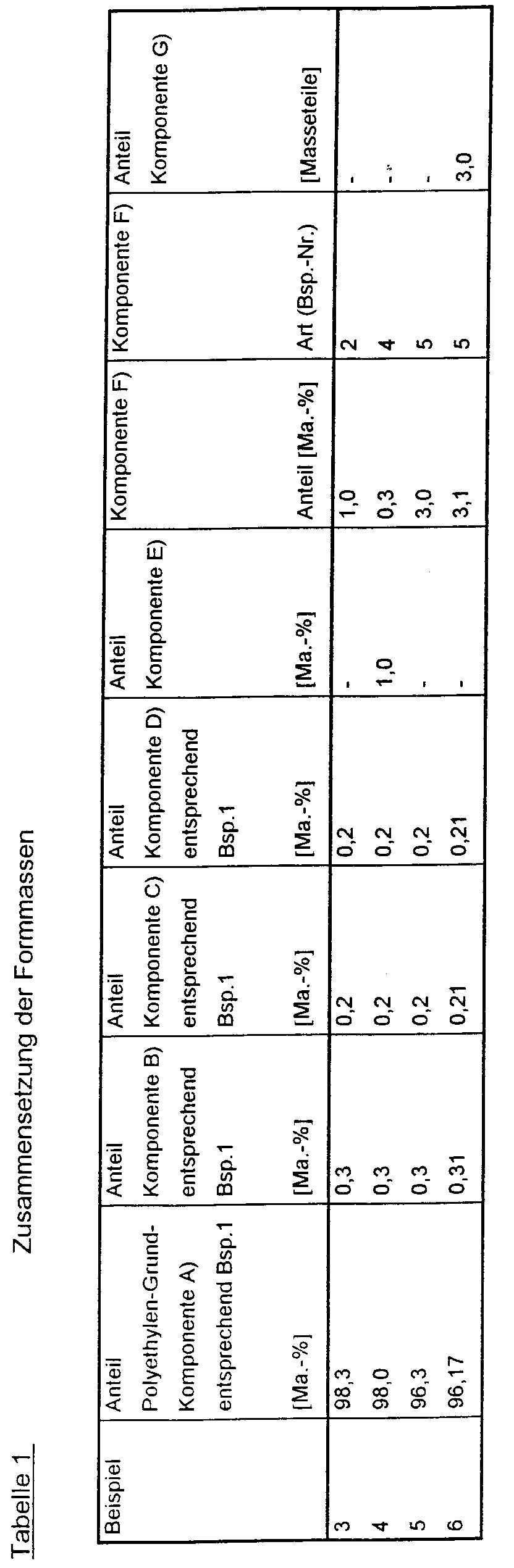
- Example 2 To produce this molding compound, the components and amounts were made accordingly the information in Table 1 selected.
- the blend component F) corresponded to the type and composition used in Example 2 Component.
- the procedure for granulating the product was carried out according to that set out in Example 2.
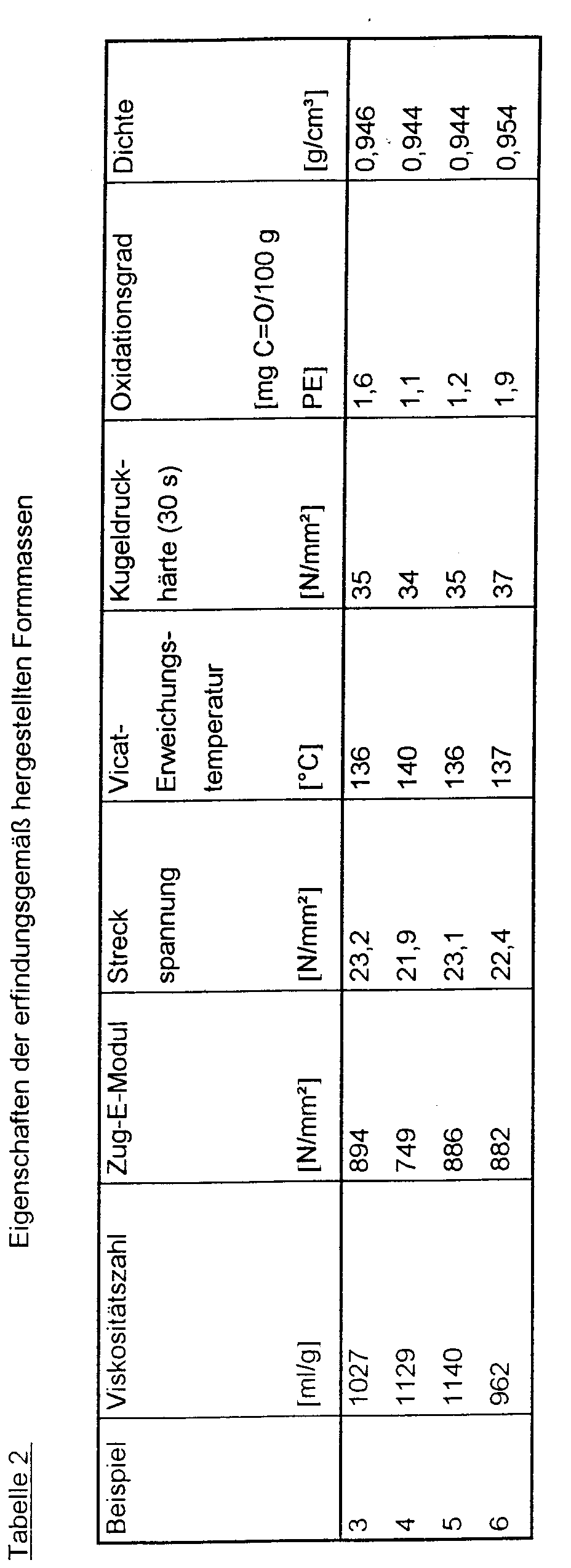
- test results on the molding composition are also listed in Table 2 regarding tensile modulus of elasticity according to DIN 53457 and yield stress according to DIN 53455, Vicat softening temperature according to ISO 306, ball pressure hardness according to DIN 53456 and density (press plate) according to ISO 118 and FT-IR spectroscopy certain degree of oxidation. All of these parameters confirm the very good ones Properties of the molding composition obtained, only by the inventive Procedure can be achieved.
- Example 3 The procedure in this example corresponded to that of example 3.
- the composition of the molding composition was determined according to the information in Table 1 selected, paraffin oil being used as component E).
- component E paraffin oil being used as component E.
- Example 3 a pure fluoroelastomer was used as blend component F) Based on vinylidene fluoride, hexafluoropropylene and tetrafluoroethylene with a fluorine content of 70.4% by mass and as a screw speed 80 rpm used.
- This example was based on the information in Example 4 and the table 1 process, but worked without component E) and another Component F) was used.
- the blend component F) contained in this Case 2% by mass of a fluoroelastomer based on tetrafluoroethylene with a fluorine content of 68 percent by mass and 98 percent by mass a linear low density polyethylene.
- the molding compound of this example was made using 3.0 parts by weight a color component, based on 100 parts by mass A) to F).
- This color component contained 40% by mass of carbon black and 60% by mass of a low-density polyethylene.
- the method of production and the other components of this molding composition corresponded to the information in Example 5, but at a screw speed of 90 rpm.
- the selected composition is based on the Table 1.
Landscapes
- Chemical & Material Sciences (AREA)
- Health & Medical Sciences (AREA)
- Chemical Kinetics & Catalysis (AREA)
- Medicinal Chemistry (AREA)
- Polymers & Plastics (AREA)
- Organic Chemistry (AREA)
- Engineering & Computer Science (AREA)
- Mechanical Engineering (AREA)
- Compositions Of Macromolecular Compounds (AREA)
- Extrusion Moulding Of Plastics Or The Like (AREA)
- Addition Polymer Or Copolymer, Post-Treatments, Or Chemical Modifications (AREA)
Abstract
Description
Tabelle 1 hervor.
Claims (10)
- Formmasse auf der Grundlage von ultrahochmolekularem Polyethylen, enthaltendA) 84,5 bis 99,87 Masseprozent einer Polyethylen-Grundkompenente bestehend ausa) 10 bis 90 Masseprozent eines ultrahochmolekularen Polyethylens mit einer Viskositätszahl von 1800 bis 4000 ml/g undb) 10 bis 90 Masseprozent eines Polyethylens hoher Dichte mit einer Viskositätszahl von 300 bis 1500 ml/g,B) 0,05 bis 0,5 Masseprozent eines thermooxidativen Stabilisators bzw. eines Gemisches,C) 0,02 bis 1 Masseprozent eines Fettsäuresalzes bzw. eines Gemisches,D) 0,05 bis 2 Masseprozent eines Amidwachses bzw. eines Gemisches,E) 0 bis 2,0 Masseprozent eines Paraffins,F) 0,001 bis 10 Masseprozent einer Blendkomponente, enthaltendc) 0,5 bis 100 Masseprozent eines Fluorelastomers bzw. eines Gemisches mit einem Fluorgehalt von über 60 Masseprozent undd) 0 bis 99,5 Masseprozent eines Polyethylens niederer Dichte, sowieG) ggf. 0,1 bis 10 Masseteile, bezogen auf 100 Masseteile A) bis F), einer Farbkomponente bzw. eines Batches.
- Formmasse nach Anspruch 1, enthaltend 0,1 bis 0,4 Masseprozent eines thermooxidativen Stabilisators bzw. eines Gemisches.
- Formmasse nach den Ansprüchen 1 und 2, enthaltend 0,1 bis 0,5 Masseprozent eines Fettsäuresalzes bzw. eines Gemisches.
- Formmasse nach den Ansprüchen 1 bis 3, enthaltend als Fettsäuresalz Calciumstearat, Zinkstearat bzw. ein Gemisch mit einer oder mehreren dieser Komponenten.
- Formmasse nach den Ansprüchen 1 und 4, enthaltend als Amidwachs ein Bisstearamid.
- Formmasse nach den Ansprüchen 1 bis 5, enthaltend als Paraffin 0 bis 1,5 Masseprozent eines Paraffinöls.
- Formmasse nach den Ansprüchen 1 bis 6, enthaltend 0,1 bis 10 Masseprozent einer Blendkomponente ause) 0,5 bis 50 Masseprozent eines Fluorelastomers bzw. eines Gemisches mit einem Fluorgehalt von über 60 Masseprozent undf) 50 bis 99,5 Masseprozent eines Polyethylens niederer Dichte.
- Formmasse nach den Ansprüchen 1 bis 7, enthaltend ein Fluorelastomer auf der Grundlage von Vinylidenfluorid, Hexafluorpropylen und/oder Tetrafluorethylen.
- Formmasse nach den Ansprüchen 1 bis 8, ggf. enthaltend 0,5 bis 7 Masseteile, bezogen auf 100 Masseteile A) bis F), einer Farbkomponente ausg) 2 bis 70 Masseprozent Farbmittel undh) 30 bis 98 Masseprozent eines Polyethylens niederer Dichte.
- Verfahren zur Herstellung einer Formmasse auf der Grundlage von ultrahochmolekularem Polyethylen durch Extrusion, dadurch gekennzeichnet, daß die Extrusion in einem Einschneckenextruder oder einer auf die gleiche Art und Weise arbeitenden anderen Einrichtung unter verminderter Scherwirkung bei Schmelzetemperaturen der Polymerschmelze von 200 bis 250 °C erfolgt.
Applications Claiming Priority (2)
| Application Number | Priority Date | Filing Date | Title |
|---|---|---|---|
| DE19727981 | 1997-07-01 | ||
| DE19727981A DE19727981A1 (de) | 1997-07-01 | 1997-07-01 | Formmasse auf der Grundlage von ultrahochmolekularem Polyethylen und Verfahren zur Herstellung |
Publications (3)
| Publication Number | Publication Date |
|---|---|
| EP0889087A2 true EP0889087A2 (de) | 1999-01-07 |
| EP0889087A3 EP0889087A3 (de) | 1999-10-27 |
| EP0889087B1 EP0889087B1 (de) | 2002-05-08 |
Family
ID=7834252
Family Applications (1)
| Application Number | Title | Priority Date | Filing Date |
|---|---|---|---|
| EP98110770A Expired - Lifetime EP0889087B1 (de) | 1997-07-01 | 1998-06-12 | Formmasse auf der Grundlage von ultrahochmolekularem Polythylen und Verfahren zur Herstellung |
Country Status (3)
| Country | Link |
|---|---|
| EP (1) | EP0889087B1 (de) |
| AT (1) | ATE217332T1 (de) |
| DE (2) | DE19727981A1 (de) |
Cited By (5)
| Publication number | Priority date | Publication date | Assignee | Title |
|---|---|---|---|---|
| EP1006149A4 (de) * | 1997-08-19 | 2001-10-04 | Idemitsu Petrochemical Co | Propylenpolymerzusammensetzung und daraus hegestellte filme |
| WO2003086724A1 (de) * | 2002-04-18 | 2003-10-23 | Ticona Gmbh | Gefüllte granulate aus polyethylenen hohen bzw. ultrahohen molekulargewichts und verfahren zu deren herstellung |
| CN100335550C (zh) * | 2004-12-24 | 2007-09-05 | 上海化工研究院 | 一种纳米超高分子量聚乙烯复合材料的制备方法 |
| CN111019209A (zh) * | 2018-10-10 | 2020-04-17 | 中国石油化工股份有限公司 | 用于制备衬管的超高分子量聚乙烯组合物及其制备方法 |
| CN116202981A (zh) * | 2023-02-24 | 2023-06-02 | 浙江方圆检测集团股份有限公司 | 红外光谱在鉴别超高分子量聚乙烯复合材料中的应用和方法 |
Families Citing this family (3)
| Publication number | Priority date | Publication date | Assignee | Title |
|---|---|---|---|---|
| CN102304248B (zh) * | 2011-08-31 | 2013-08-14 | 武汉富蒂亚新型材料有限公司 | 一种具有可发性高熔体强度聚丙烯树脂及其制备方法 |
| CN103524851B (zh) * | 2013-10-12 | 2016-01-20 | 浙江伟星新型建材股份有限公司 | 一种具有阻燃抗静电的煤矿井下输浆管及其制备方法 |
| CN112662111B (zh) * | 2020-12-21 | 2023-04-07 | 安徽瑞琦塑胶科技有限公司 | 一种增强聚乙烯管材料及其制备方法 |
Family Cites Families (16)
| Publication number | Priority date | Publication date | Assignee | Title |
|---|---|---|---|---|
| DE1778258B1 (de) * | 1968-04-11 | 1970-11-12 | Sued West Chemie Gmbh | Verfahren zur Herstellung von Formkoerpern aus hochmolekularem Niederdruckpolyaethylen |
| SE405012B (sv) * | 1977-09-19 | 1978-11-13 | Gustavsberg Ab | Sett for fornetning av polyeten |
| EP0115192B2 (de) * | 1982-12-28 | 1992-07-22 | Mitsui Petrochemical Industries, Ltd. | Verfahren zur Herstellung von verstreckten Filamenten aus Polyethylen mit sehr hohem Molekulargewicht |
| JPS59232164A (ja) * | 1983-06-16 | 1984-12-26 | Mitsui Petrochem Ind Ltd | 潜熱型蓄熱材 |
| JPS6055042A (ja) * | 1983-09-05 | 1985-03-29 | Sumitomo Chem Co Ltd | 押出成形性の改良された超高分子量ポリエチレン組成物 |
| US4670508A (en) * | 1984-01-06 | 1987-06-02 | Mitsui Petrochemical Industries Ltd. | Thermoplastic resin composition |
| CA1216119A (en) * | 1984-05-16 | 1987-01-06 | Mitsui Chemicals, Incorporated | Process for producing stretched article of ultrahigh- molecular weight polyethylene |
| JPS626211A (ja) * | 1985-02-06 | 1987-01-13 | Sumitomo Electric Ind Ltd | 高配向性樹脂製補強部材およびその製造方法 |
| DE3708384A1 (de) * | 1987-03-14 | 1988-09-22 | Hoechst Ag | Polyolefinformmasse |
| US4863983A (en) * | 1988-04-15 | 1989-09-05 | Minnesota Mining And Manufacturing Company | Extrudable thermoplastic hydrocarbon polymer composition |
| EP0343863B1 (de) * | 1988-05-25 | 1994-08-10 | Mitsui Petrochemical Industries, Ltd. | Polyolefin-Zusammensetzung mit hohem Molekulargewicht |
| US4904735A (en) * | 1988-07-08 | 1990-02-27 | E. I. Du Pont De Nemours And Company | Processing aid for polymers |
| KR0163021B1 (ko) * | 1988-08-22 | 1999-01-15 | 가타 야마 유타카 | 표면백화를 방지하는 난연성 올레핀 중합체 조성물 |
| US5602197A (en) * | 1989-05-30 | 1997-02-11 | Corning Incorporated | Reversible polymer gel binders for powder forming |
| IT1244619B (it) * | 1990-05-31 | 1994-08-08 | Greif Bros Corp | Composizione termoplastica per la riduzione della permeazione |
| DE19528647A1 (de) * | 1995-08-04 | 1997-02-06 | Basf Ag | Thermoplastische Formmassen auf der Basis von Ethylenpolymerisaten und thermoplastischen Polyestern |
-
1997
- 1997-07-01 DE DE19727981A patent/DE19727981A1/de not_active Withdrawn
-
1998
- 1998-06-12 AT AT98110770T patent/ATE217332T1/de not_active IP Right Cessation
- 1998-06-12 DE DE59804022T patent/DE59804022D1/de not_active Expired - Fee Related
- 1998-06-12 EP EP98110770A patent/EP0889087B1/de not_active Expired - Lifetime
Cited By (6)
| Publication number | Priority date | Publication date | Assignee | Title |
|---|---|---|---|---|
| EP1006149A4 (de) * | 1997-08-19 | 2001-10-04 | Idemitsu Petrochemical Co | Propylenpolymerzusammensetzung und daraus hegestellte filme |
| WO2003086724A1 (de) * | 2002-04-18 | 2003-10-23 | Ticona Gmbh | Gefüllte granulate aus polyethylenen hohen bzw. ultrahohen molekulargewichts und verfahren zu deren herstellung |
| CN100335550C (zh) * | 2004-12-24 | 2007-09-05 | 上海化工研究院 | 一种纳米超高分子量聚乙烯复合材料的制备方法 |
| CN111019209A (zh) * | 2018-10-10 | 2020-04-17 | 中国石油化工股份有限公司 | 用于制备衬管的超高分子量聚乙烯组合物及其制备方法 |
| CN111019209B (zh) * | 2018-10-10 | 2022-08-16 | 中国石油化工股份有限公司 | 用于制备衬管的超高分子量聚乙烯组合物及其制备方法 |
| CN116202981A (zh) * | 2023-02-24 | 2023-06-02 | 浙江方圆检测集团股份有限公司 | 红外光谱在鉴别超高分子量聚乙烯复合材料中的应用和方法 |
Also Published As
| Publication number | Publication date |
|---|---|
| EP0889087A3 (de) | 1999-10-27 |
| DE59804022D1 (de) | 2002-06-13 |
| EP0889087B1 (de) | 2002-05-08 |
| DE19727981A1 (de) | 1999-01-07 |
| ATE217332T1 (de) | 2002-05-15 |
Similar Documents
| Publication | Publication Date | Title |
|---|---|---|
| DE3688392T2 (de) | Mischungen aus fluorplastiken und fluorelastomeren. | |
| DE3211393C2 (de) | ||
| DE602004006489T2 (de) | Zusammensetzungen mit polyphenylenether und/oder polystyrol mit verbesserten tribologischen eigenschaften sowie verfahren zur verbesserung der tribologischen eigenschaften von polyphenylenether- und/oder polystyrolzusammensetzungen | |
| DE2063395C3 (de) | Wärmehärtbare Polyäthylenmischung mit einem organischen Silikonzusatz | |
| DE3850365T3 (de) | Thermoplastische elastomere Zusammensetzungen und Verfahren zu deren Herstellung. | |
| DE69323316T2 (de) | Plastifizierte fluoropolymere | |
| EP1826235B1 (de) | Wachszusammensetzung und deren Verwendung | |
| DE60204312T2 (de) | Verfahren zum compoundieren einer multimodalen polyäthylenzusammensetzung | |
| DE69212543T2 (de) | Thermoplastische Elastomer und Verfahren zu seiner Herstellung | |
| DE69119298T2 (de) | Zusammensetzung mit guten Gleiteigenschaften | |
| EP0362472B1 (de) | Polyblend aus thermoplastischem Polyurethan-Elastomer und Verfahren zu seiner Herstellung | |
| EP0889087B1 (de) | Formmasse auf der Grundlage von ultrahochmolekularem Polythylen und Verfahren zur Herstellung | |
| DE69306560T2 (de) | Polyoxymethylenzusammensetzungen enthaltend mindestens ein eingekapseltes nukleierungsmittel | |
| EP0014872A1 (de) | Mischungen aus Polypropylen und flüssigen, gesättigten Diorganopolysiloxanen | |
| DE2827396A1 (de) | Geschmierte thermoplastische massen auf der basis von polyvinylidenfluorid | |
| EP2736049A1 (de) | Lagerstabile vernetzbare Polymermischung auf Basis chlorierten Polymers | |
| EP0690095B1 (de) | Antistatische Polyethylenformmassen | |
| DE1569448C3 (de) | Form-, Imprägnier-, Klebe- oder Überzugsmassen | |
| DE4392144C2 (de) | Verwendung einer Harzzusammensetzung für ein Gleitstück | |
| DE69110936T2 (de) | Fluorpolymer enthaltende Polyolefin-Zusammensetzung. | |
| DE19823626B4 (de) | Teilvernetzter, thermoplastischer Polymerwerkstoff | |
| WO1999031165A2 (de) | Verfahren zur herstellung von staubarmen stabilisator-systemen zur thermischen stabilisierung von pvc | |
| EP0591829A1 (de) | Thermoplastische Formmasse mit hoher Verschleissfestigkeit auf Basis von Polyphenylensulfid und ihre Verwendung | |
| DE3520106A1 (de) | Vernetzte formkoerper mit erhoehter schlagzaehigkeit aus ternaeren polyolefin-formmassen | |
| DE69026692T2 (de) | Verfahren zur Herstellung von thermoplastischen elastomeren Zusammensetzungen |
Legal Events
| Date | Code | Title | Description |
|---|---|---|---|
| PUAI | Public reference made under article 153(3) epc to a published international application that has entered the european phase |
Free format text: ORIGINAL CODE: 0009012 |
|
| AK | Designated contracting states |
Kind code of ref document: A2 Designated state(s): AT BE CH DE ES FI FR GB IT LI NL SE |
|
| AX | Request for extension of the european patent |
Free format text: AL;LT;LV;MK;RO;SI |
|
| PUAL | Search report despatched |
Free format text: ORIGINAL CODE: 0009013 |
|
| AK | Designated contracting states |
Kind code of ref document: A3 Designated state(s): AT BE CH CY DE DK ES FI FR GB GR IE IT LI LU MC NL PT SE |
|
| AX | Request for extension of the european patent |
Free format text: AL;LT;LV;MK;RO;SI |
|
| RIC1 | Information provided on ipc code assigned before grant |
Free format text: 6C 08L 23/06 A, 6C 08K 5/00 B, 6C 08K 5/098 B, 6C 08K 5/20 B, 6C 08L 23/06 J, 6C 08L 23:06 J, 6C 08L 27:12 J, 6C 08K 5:20 J, 6C 08K 5:098 J, 6C 08K 5:00 J |
|
| 17P | Request for examination filed |
Effective date: 20000410 |
|
| AKX | Designation fees paid |
Free format text: AT BE CH DE ES FI FR GB IT LI NL SE |
|
| 17Q | First examination report despatched |
Effective date: 20000725 |
|
| GRAG | Despatch of communication of intention to grant |
Free format text: ORIGINAL CODE: EPIDOS AGRA |
|
| GRAG | Despatch of communication of intention to grant |
Free format text: ORIGINAL CODE: EPIDOS AGRA |
|
| GRAH | Despatch of communication of intention to grant a patent |
Free format text: ORIGINAL CODE: EPIDOS IGRA |
|
| GRAH | Despatch of communication of intention to grant a patent |
Free format text: ORIGINAL CODE: EPIDOS IGRA |
|
| REG | Reference to a national code |
Ref country code: GB Ref legal event code: IF02 |
|
| GRAA | (expected) grant |
Free format text: ORIGINAL CODE: 0009210 |
|
| AK | Designated contracting states |
Kind code of ref document: B1 Designated state(s): AT BE CH DE ES FI FR GB IT LI NL SE |
|
| PG25 | Lapsed in a contracting state [announced via postgrant information from national office to epo] |
Ref country code: NL Free format text: LAPSE BECAUSE OF FAILURE TO SUBMIT A TRANSLATION OF THE DESCRIPTION OR TO PAY THE FEE WITHIN THE PRESCRIBED TIME-LIMIT Effective date: 20020508 Ref country code: IT Free format text: LAPSE BECAUSE OF FAILURE TO SUBMIT A TRANSLATION OF THE DESCRIPTION OR TO PAY THE FEE WITHIN THE PRE;WARNING: LAPSES OF ITALIAN PATENTS WITH EFFECTIVE DATE BEFORE 2007 MAY HAVE OCCURRED AT ANY TIME BEFORE 2007. THE CORRECT EFFECTIVE DATE MAY BE DIFFERENT FROM THE ONE RECORDED.SCRIBED TIME-LIMIT Effective date: 20020508 Ref country code: GB Free format text: LAPSE BECAUSE OF FAILURE TO SUBMIT A TRANSLATION OF THE DESCRIPTION OR TO PAY THE FEE WITHIN THE PRESCRIBED TIME-LIMIT Effective date: 20020508 Ref country code: FR Free format text: LAPSE BECAUSE OF FAILURE TO SUBMIT A TRANSLATION OF THE DESCRIPTION OR TO PAY THE FEE WITHIN THE PRESCRIBED TIME-LIMIT Effective date: 20020508 Ref country code: FI Free format text: LAPSE BECAUSE OF FAILURE TO SUBMIT A TRANSLATION OF THE DESCRIPTION OR TO PAY THE FEE WITHIN THE PRESCRIBED TIME-LIMIT Effective date: 20020508 |
|
| REF | Corresponds to: |
Ref document number: 217332 Country of ref document: AT Date of ref document: 20020515 Kind code of ref document: T |
|
| REG | Reference to a national code |
Ref country code: CH Ref legal event code: EP |
|
| PG25 | Lapsed in a contracting state [announced via postgrant information from national office to epo] |
Ref country code: AT Free format text: LAPSE BECAUSE OF NON-PAYMENT OF DUE FEES Effective date: 20020612 |
|
| REF | Corresponds to: |
Ref document number: 59804022 Country of ref document: DE Date of ref document: 20020613 |
|
| PG25 | Lapsed in a contracting state [announced via postgrant information from national office to epo] |
Ref country code: LI Free format text: LAPSE BECAUSE OF NON-PAYMENT OF DUE FEES Effective date: 20020630 Ref country code: CH Free format text: LAPSE BECAUSE OF NON-PAYMENT OF DUE FEES Effective date: 20020630 Ref country code: BE Free format text: LAPSE BECAUSE OF NON-PAYMENT OF DUE FEES Effective date: 20020630 |
|
| PG25 | Lapsed in a contracting state [announced via postgrant information from national office to epo] |
Ref country code: SE Free format text: LAPSE BECAUSE OF FAILURE TO SUBMIT A TRANSLATION OF THE DESCRIPTION OR TO PAY THE FEE WITHIN THE PRESCRIBED TIME-LIMIT Effective date: 20020808 |
|
| NLV1 | Nl: lapsed or annulled due to failure to fulfill the requirements of art. 29p and 29m of the patents act | ||
| GBV | Gb: ep patent (uk) treated as always having been void in accordance with gb section 77(7)/1977 [no translation filed] |
Effective date: 20020508 |
|
| PG25 | Lapsed in a contracting state [announced via postgrant information from national office to epo] |
Ref country code: ES Free format text: LAPSE BECAUSE OF FAILURE TO SUBMIT A TRANSLATION OF THE DESCRIPTION OR TO PAY THE FEE WITHIN THE PRESCRIBED TIME-LIMIT Effective date: 20021128 |
|
| BERE | Be: lapsed |
Owner name: *BUNA SOW LEUNA OLEFINVERBUND G.M.B.H. Effective date: 20020630 |
|
| PG25 | Lapsed in a contracting state [announced via postgrant information from national office to epo] |
Ref country code: DE Free format text: LAPSE BECAUSE OF NON-PAYMENT OF DUE FEES Effective date: 20030101 |
|
| EN | Fr: translation not filed | ||
| REG | Reference to a national code |
Ref country code: CH Ref legal event code: PL |
|
| PLBE | No opposition filed within time limit |
Free format text: ORIGINAL CODE: 0009261 |
|
| STAA | Information on the status of an ep patent application or granted ep patent |
Free format text: STATUS: NO OPPOSITION FILED WITHIN TIME LIMIT |
|
| 26N | No opposition filed |
Effective date: 20030211 |