EP0889207B1 - Procédé de fabrication de soupapes de moteur diesel - Google Patents
Procédé de fabrication de soupapes de moteur diesel Download PDFInfo
- Publication number
- EP0889207B1 EP0889207B1 EP98112051A EP98112051A EP0889207B1 EP 0889207 B1 EP0889207 B1 EP 0889207B1 EP 98112051 A EP98112051 A EP 98112051A EP 98112051 A EP98112051 A EP 98112051A EP 0889207 B1 EP0889207 B1 EP 0889207B1
- Authority
- EP
- European Patent Office
- Prior art keywords
- diesel engine
- heat resistant
- alloy
- manufacturing
- engine valve
- Prior art date
- Legal status (The legal status is an assumption and is not a legal conclusion. Google has not performed a legal analysis and makes no representation as to the accuracy of the status listed.)
- Expired - Lifetime
Links
- 238000004519 manufacturing process Methods 0.000 title claims abstract description 17
- 239000000956 alloy Substances 0.000 claims abstract description 61
- 229910045601 alloy Inorganic materials 0.000 claims abstract description 61
- 238000005242 forging Methods 0.000 claims abstract description 32
- 239000000463 material Substances 0.000 claims abstract description 16
- 238000004881 precipitation hardening Methods 0.000 claims abstract description 11
- 229910052782 aluminium Inorganic materials 0.000 claims description 12
- 229910052804 chromium Inorganic materials 0.000 claims description 9
- 229910052748 manganese Inorganic materials 0.000 claims description 9
- 239000000203 mixture Substances 0.000 claims description 8
- 229910052759 nickel Inorganic materials 0.000 claims description 8
- 229910052799 carbon Inorganic materials 0.000 claims description 6
- 229910052710 silicon Inorganic materials 0.000 claims description 6
- 229910052719 titanium Inorganic materials 0.000 claims description 5
- 229910052758 niobium Inorganic materials 0.000 claims description 4
- 229910052750 molybdenum Inorganic materials 0.000 claims description 3
- 238000005260 corrosion Methods 0.000 abstract description 16
- 230000007797 corrosion Effects 0.000 abstract description 16
- 238000000034 method Methods 0.000 abstract description 7
- PXHVJJICTQNCMI-UHFFFAOYSA-N nickel Substances [Ni] PXHVJJICTQNCMI-UHFFFAOYSA-N 0.000 description 19
- 239000011572 manganese Substances 0.000 description 14
- 239000000243 solution Substances 0.000 description 12
- 238000003483 aging Methods 0.000 description 11
- 239000010936 titanium Substances 0.000 description 11
- 239000011651 chromium Substances 0.000 description 10
- VYZAMTAEIAYCRO-UHFFFAOYSA-N Chromium Chemical compound [Cr] VYZAMTAEIAYCRO-UHFFFAOYSA-N 0.000 description 6
- PWHULOQIROXLJO-UHFFFAOYSA-N Manganese Chemical compound [Mn] PWHULOQIROXLJO-UHFFFAOYSA-N 0.000 description 5
- 239000010941 cobalt Chemical group 0.000 description 5
- 229910017052 cobalt Chemical group 0.000 description 5
- GUTLYIVDDKVIGB-UHFFFAOYSA-N cobalt atom Chemical group [Co] GUTLYIVDDKVIGB-UHFFFAOYSA-N 0.000 description 5
- 239000000047 product Substances 0.000 description 5
- 238000002791 soaking Methods 0.000 description 5
- ZOXJGFHDIHLPTG-UHFFFAOYSA-N Boron Chemical compound [B] ZOXJGFHDIHLPTG-UHFFFAOYSA-N 0.000 description 4
- 229910052796 boron Inorganic materials 0.000 description 4
- 238000010273 cold forging Methods 0.000 description 4
- 230000000694 effects Effects 0.000 description 4
- 239000011159 matrix material Substances 0.000 description 4
- 239000002244 precipitate Substances 0.000 description 4
- 238000001556 precipitation Methods 0.000 description 4
- 229910052726 zirconium Inorganic materials 0.000 description 4
- XEEYBQQBJWHFJM-UHFFFAOYSA-N Iron Chemical group [Fe] XEEYBQQBJWHFJM-UHFFFAOYSA-N 0.000 description 3
- 101100440286 Mus musculus Cntrl gene Proteins 0.000 description 3
- RTAQQCXQSZGOHL-UHFFFAOYSA-N Titanium Chemical compound [Ti] RTAQQCXQSZGOHL-UHFFFAOYSA-N 0.000 description 3
- QCWXUUIWCKQGHC-UHFFFAOYSA-N Zirconium Chemical compound [Zr] QCWXUUIWCKQGHC-UHFFFAOYSA-N 0.000 description 3
- 239000013078 crystal Substances 0.000 description 3
- 238000010438 heat treatment Methods 0.000 description 3
- 239000010955 niobium Substances 0.000 description 3
- IJGRMHOSHXDMSA-UHFFFAOYSA-N Atomic nitrogen Chemical compound N#N IJGRMHOSHXDMSA-UHFFFAOYSA-N 0.000 description 2
- OKTJSMMVPCPJKN-UHFFFAOYSA-N Carbon Chemical compound [C] OKTJSMMVPCPJKN-UHFFFAOYSA-N 0.000 description 2
- 239000007832 Na2SO4 Substances 0.000 description 2
- PMZURENOXWZQFD-UHFFFAOYSA-L Sodium Sulfate Chemical compound [Na+].[Na+].[O-]S([O-])(=O)=O PMZURENOXWZQFD-UHFFFAOYSA-L 0.000 description 2
- FAPWRFPIFSIZLT-UHFFFAOYSA-M Sodium chloride Chemical compound [Na+].[Cl-] FAPWRFPIFSIZLT-UHFFFAOYSA-M 0.000 description 2
- NINIDFKCEFEMDL-UHFFFAOYSA-N Sulfur Chemical compound [S] NINIDFKCEFEMDL-UHFFFAOYSA-N 0.000 description 2
- XAGFODPZIPBFFR-UHFFFAOYSA-N aluminium Chemical compound [Al] XAGFODPZIPBFFR-UHFFFAOYSA-N 0.000 description 2
- 229910001651 emery Inorganic materials 0.000 description 2
- 229910052938 sodium sulfate Inorganic materials 0.000 description 2
- 238000005728 strengthening Methods 0.000 description 2
- 229910052717 sulfur Inorganic materials 0.000 description 2
- 239000011593 sulfur Substances 0.000 description 2
- 230000004580 weight loss Effects 0.000 description 2
- 229910017061 Fe Co Inorganic materials 0.000 description 1
- ZOKXTWBITQBERF-UHFFFAOYSA-N Molybdenum Chemical compound [Mo] ZOKXTWBITQBERF-UHFFFAOYSA-N 0.000 description 1
- 238000005299 abrasion Methods 0.000 description 1
- 230000032683 aging Effects 0.000 description 1
- 238000005275 alloying Methods 0.000 description 1
- -1 boron Chemical compound 0.000 description 1
- 238000005336 cracking Methods 0.000 description 1
- 230000006698 induction Effects 0.000 description 1
- 239000013067 intermediate product Substances 0.000 description 1
- 229910052742 iron Inorganic materials 0.000 description 1
- 238000002844 melting Methods 0.000 description 1
- 230000008018 melting Effects 0.000 description 1
- 150000001247 metal acetylides Chemical class 0.000 description 1
- 239000011733 molybdenum Substances 0.000 description 1
- 229910001235 nimonic Inorganic materials 0.000 description 1
- GUCVJGMIXFAOAE-UHFFFAOYSA-N niobium atom Chemical compound [Nb] GUCVJGMIXFAOAE-UHFFFAOYSA-N 0.000 description 1
- 229910052757 nitrogen Inorganic materials 0.000 description 1
- 239000010703 silicon Substances 0.000 description 1
- 239000011780 sodium chloride Substances 0.000 description 1
- 239000006104 solid solution Substances 0.000 description 1
- 230000006641 stabilisation Effects 0.000 description 1
- 238000011105 stabilization Methods 0.000 description 1
- 230000000087 stabilizing effect Effects 0.000 description 1
- 239000000126 substance Substances 0.000 description 1
- 230000009466 transformation Effects 0.000 description 1
- 238000000844 transformation Methods 0.000 description 1
- 229910052720 vanadium Inorganic materials 0.000 description 1
- LEONUFNNVUYDNQ-UHFFFAOYSA-N vanadium atom Chemical compound [V] LEONUFNNVUYDNQ-UHFFFAOYSA-N 0.000 description 1
- 238000005303 weighing Methods 0.000 description 1
Images
Classifications
-
- F—MECHANICAL ENGINEERING; LIGHTING; HEATING; WEAPONS; BLASTING
- F01—MACHINES OR ENGINES IN GENERAL; ENGINE PLANTS IN GENERAL; STEAM ENGINES
- F01L—CYCLICALLY OPERATING VALVES FOR MACHINES OR ENGINES
- F01L3/00—Lift-valve, i.e. cut-off apparatus with closure members having at least a component of their opening and closing motion perpendicular to the closing faces; Parts or accessories thereof
- F01L3/02—Selecting particular materials for valve-members or valve-seats; Valve-members or valve-seats composed of two or more materials
Definitions
- the present invention concerns a method of manufacturing diesel engine valves for both intake and exhaust having good corrosion resistance and strength.
- intake and exhaust valves for diesel engines are made of strong precipitation-hardening Ni-base heat resistant alloys represented by Nimonic 80A. It is a permanent problem to elongate valve lives, and there has been demand for further improvement in corrosion resistance and strength thereof.
- a typical process for manufacturing the valves conventionally practiced comprises hot forging at a temperature above 900°C to form valve blanks, and solution treatment followed by age-hardening.
- valves for marine diesel engines made by using a strong precipitation-hardening heat resistant alloy as the material, forming valve cone parts by forging at a temperature in the range of 700-900°C under a forging degree of 20% or higher, and subjecting the forged products to age-hardening. It is also known to manufacture valves by forging at a temperature of 700-900°C, and solution treatment followed by partial cold processing.
- the object of the present invention is to break through the above limit inherent in the conventional technology of manufacturing diesel engine valves and to provide an improved method of manufacturing which gives diesel engine valves having both higher strength and better corrosion resistance, and therefore, of longer lives.
- the method of manufacturing diesel engine valves according to the present invention comprises: using a strong precipitation-hardening heat resistant alloy as the material, hot forging the material to prepare blank forms of the diesel engine valves, cold processing the face parts of the blanks, and age-treating the cold processed parts to enhance hardness thereof.
- the present invention encompasses the method comprising the steps described above and further a step of solution treatment after the hot forging and before the cold processing.
- the hot forging which is carried out as the first step of the method of manufacturing valves from the strong precipitation-hardening heat resistant alloy
- the heating temperature and the forging degree In order to prevent coarsing of the crystal grains during heating it is preferable to carry out forging at a temperature as low as possible to process. In case where the forging is done at a temperature higher than a limit which resides in the range of 900-1100°C it is not necessary to carry out the solution treatment subsequent to the forging. On the other hand, in case of low temperature forging, the solution treatment is necessary.
- the solution treatment is done for the purpose of dissolving precipitates occurred during forging into the matrix and eliminating distortion formed during the processing. Usually, it is realized by soaking the work pieces at a temperature ranging from 1020 to 1080°C for 1-18 hours. The soaking conditions are determined in view of the amounts of the precipitates and the extent of distortion formed during processing. As noted above, in case of high temperature forging, these factors are slight, and therefore, the solution treatment can be omitted.
- the purpose of carrying out the partial cold processing is to promote precipitation hardening during the subsequent age-hardening by introducing transformations caused by processing.
- the effect of partial cold processing can be expected at a forging degree of 5% or higher and becomes more remarkable as the forging degree increases. At a forging degree exceeding 50% the effect saturates.
- the last step of the process is carried out by soaking the work pieces at a temperature of 600-800°C for 1-18 hours.
- Preferable temperature is in the range of 700-750°C.
- the strong precipitation-hardening heat resistant alloys used as the material of the diesel engine valves in the present invention are Ni-base and Fe-base heat resistant alloys having the following respective alloy compositions.
- the Ni-base heat resistant alloy consists essentially of, by weight %, C: up to 0.1%, Si: up to 1.0%, Mn: up to 1.0%, and Cr: 15-35%, and further, at least one of Ti: up to 3.0%, Al: up to 2.0% and Nb: up to 3.0%, and the balance of Ni.
- a preferable alloy in the above composition ranges essentially consists of Cr: 25% or more but up to 32%, Ti: 2.0% or more but up to 3.0%, Al: 1.0-2.0% and the balance of Ni.
- Silicon also contributes to increase of strength. Too much content thereof also lowers the ductility of the alloy, and therefore, the upper limit, 1.0%, is given.
- Mn up to 1.0%
- Manganese prevents embrittlement of the alloy caused by sulfur therein. However, manganese promotes precipitation of ⁇ -phase (Ni 3 Ti) which is harmful to the ductility, and the content should be limited to the upper limit, 1.0%. Cr: 15-35%, preferably, higher than 25 up to 32%
- Chromium is an essential element to heighten the corrosion resistance of the alloy, and to obtain this effect it is necessary to add 15% or higher of chromium. On the other hand, a content exceeding 35% will cause precipitation of the embrittling phase while the product valves are used. In case where the corrosion resistance is particularly important, it is recommended to choose a content of chromium higher than 25%. In order to avoid embrittlement during long period of use the content of chromium should be up to 32%. Thus, the above noted preferable range is decided.
- Ni-base heat resistant alloy further contain, in addition to any of the above described alloys, particularly of the preferable alloy compositions, one or both of B: up to 0.02% and Zr: up to 0.15%.
- B up to 0.02%
- Zr up to 0.15%
- Zirconium like boron, segregates at crystal boundaries and increases creep strength of the alloy. Too high a content of zirconium, however, rather damages the creep properties of the alloy, and therefore, addition amount should be up to 0.15%.
- Ni-base heat resistant alloy a part of nickel can be replaced with iron and/or cobalt.
- Chromium is added in an amount exceeding 25%, it is necessary to choose an Fe-content less than 3.0%, for the purpose of stabilizing austenitic phase, so that the Ni-content may be relatively high.
- Cobalt contributes to stabilization of the austenitic phase as nickel does. Because cobalt is an expensive materiel, it is not advantageous to add much amount to the alloy. The upper limit is thus set to be 2.0%.
- the alloy consists essentially of, by weight %, C: up to 0.1%, Si: up to 1.0%, Mn: up to 10%, Ni: up to 30% and Cr: 12-25%, and further, at least one of Ti: up to 3.0%, Al: up to 2.0% and Mo: up to 4.0%, and the balance of Fe.
- Another alloy which further contains N: up to 0.5% is also useful. It is preferable to arrange Mn+Ni: 10-30%.
- Mn up to 10%
- Ni up to 30%
- Mn+Ni 10-30%
- Manganese is added for realizing austenitic phase in the alloy. Too much manganese reduces ductility of the alloy, and 10% is the upper limit of addition. Nickel is also an austenite-forming element, and added together with manganese. Addition amount is chosen in the range up to 30%, because nickel is relatively expensive as an alloying element. To ensure austenitic phase in the alloy it is preferable that the alloy contains 10% or more of Mn+Ni. From the view point of costs it is advisable to choose an addition amount of Mn+Ni up to 30%. Ti: up to 3.0%, Al: up to 2.0%
- Molybdenum dissolves in the matrix of the alloy to strengthen it, therefore, a suitable amount thereof is added. Addition amount exceeding 4% may cause embrittlement of the alloy, and this is the upper limit. N: up to 0.5%
- Nitrogen is added with expectation of solid solution in the matrix and precipitation resulting in strengthening. Too much addition will cause embrittlement.
- the upper limit, 0.5%, is set from this view point.
- Addition of boron and/or zirconium to the Fe-base heat resistant alloy is preferable as is to the Ni-base alloy, and the same merits can be obtained.
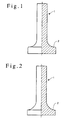
- the ingots were forged into round rods of a diameter 85mm, and the rods were hot forged under the conditions shown below to be valve blanks having the shape illustrated in Fig. 1.
- the blanks were subjected to the heat treatment, and some of them were further subjected to cold forging on the face parts, as described below to give the shape illustrated in Fig. 2.
- Hardness of the face parts was determined. Processing Conditions Example 1) hot forging forging temp. 700-1150°C 2) solution treatment 1050°C, 4 hours 3) face partial cold forging forging degree 40% 4) age-hardening 750°C, 16 hours Control 1 1) hot forging the same condition as above 2) solution treatment the same condition as above 3) age-hardening the same condition as above Control 2 1) hot forging forging temp.
- Test pieces were cut from the manufactured valves and subjected to V(vanadium)-Attack Test and S(sulfur)-Attack Test under the following conditions.
- Test pieces processed to length 25mm, width 15mm and thickness 5mm were subjected abrasion with #500 emery paper, and then placed in a corrosive ash (a mixture of V 2 O 5 : 85% + Na 2 SO 4 : 15%). After soaking at 800°C for 20 hours corrosion products on the test pieces were dissolved out and weight loss by corrosion was determined.
- a corrosive ash a mixture of V 2 O 5 : 85% + Na 2 SO 4 : 15%
- Test pieces of the same size as above were, after being abraded with the above emery paper, put in a mixed ash (Na 2 SO 4 : 90% + NaCl: 10%). Also, after soaking at 800°C for 20 hours corrosion products on the test pieces were removed off and weight loss by corrosion was determined.
Landscapes
- Engineering & Computer Science (AREA)
- Mechanical Engineering (AREA)
- General Engineering & Computer Science (AREA)
- Forging (AREA)
- Heat Treatment Of Steel (AREA)
- Heat Treatment Of Articles (AREA)
Claims (7)
- Procédé de fabrication d'une soupape de moteur diesel, caractérisé par l'utilisation d'un alliage résistant à la chaleur à fort durcissement par précipitation en tant que matériau, et par les étapes consistant à forger à chaud le matériau afin de préparer une forme brute de la soupape de moteur diesel, traiter à froid la partie de surface de la pièce brute et vieillir le produit traité à froid de manière à augmenter la dureté de la partie de surface.
- Procédé de fabrication d'une soupape de moteur diesel, caractérisé par l'utilisation d'un alliage résistant à la chaleur à fort durcissement par précipitation en tant que matériau, et par les étapes consistant à forger à chaud le matériau afin de préparer une forme brute de la soupape de moteur diesel, soumettre la pièce brute à un traitement de mise en solution, traiter à froid la partie de surface de la pièce brute et vieillir le produit traité à froid de manière à augmenter la dureté de la partie de surface.
- Procédé de fabrication d'une soupape de moteur diesel selon la revendication 1 ou 2, caractérisé en ce que le matériau utilisé est un alliage résistant à la chaleur à base de Ni du type à fort durcissement par précipitation, qui consiste essentiellement, en % en poids, en C : jusqu'à 0,1%, Si : jusqu'à 1,0%, Mn : jusqu'à 1,0% et Cr : 15 à 35% et, en outre, au moins l'un du Ti : jusqu'à 3,0%, Al : jusqu'à 2,0% et Nb : jusqu'à 3,0%, et le reste de Ni.
- Procédé de fabrication d'une soupape de moteur diesel selon la revendication 3, caractérisé en ce que l'alliage résistant à la chaleur à base de Ni utilisé contient, dans les plages de la composition d'alliage définie dans la revendication 3, du Cr : 25% ou plus mais jusqu'à 32%, Ti : 2,0% ou plus mais jusqu'à 3,0% et Al : 1,0 à 2,0%.
- Procédé de fabrication d'une soupape de moteur diesel selon la revendication 4, caractérisé en ce que l'alliage résistant à la chaleur à base de Ni utilisé contient, en plus des composants d'alliage présentés dans la revendication 4, l'un ou les deux du B : jusqu'à 0,02% et du Zr : jusqu'à 0,15%.
- Procédé de fabrication d'une soupape de moteur diesel selon la revendication 1 ou 2, caractérisé en ce que le matériau utilisé est un alliage résistant à la chaleur à base de Fe à fort durcissement par précipitation, qui consiste essentiellement, en % en poids, en C : jusqu'à 0,6%, Si : jusqu'à 1,0%, Mn : jusqu'à 10%, Ni : jusqu'à 30% et Cr : 12 à 25% et, en outre, au moins l'un du Ti : jusqu'à 3,0% , Al : jusqu'à 2,0% et Mo : jusqu'à 4,0%, et le reste de Fe.
- Procédé de fabrication d'une soupape de moteur diesel selon la revendication 6, caractérisé en ce que l'alliage résistant à la chaleur à base de Fe utilisé contient, en plus des composants d'alliage présentés dans la revendication 6, du N : jusqu'à 0,5%.
Applications Claiming Priority (3)
| Application Number | Priority Date | Filing Date | Title |
|---|---|---|---|
| JP9178113A JPH1122427A (ja) | 1997-07-03 | 1997-07-03 | ディーゼルエンジンバルブの製造方法 |
| JP17811397 | 1997-07-03 | ||
| JP178113/97 | 1997-07-03 |
Publications (2)
| Publication Number | Publication Date |
|---|---|
| EP0889207A1 EP0889207A1 (fr) | 1999-01-07 |
| EP0889207B1 true EP0889207B1 (fr) | 2002-12-18 |
Family
ID=16042893
Family Applications (1)
| Application Number | Title | Priority Date | Filing Date |
|---|---|---|---|
| EP98112051A Expired - Lifetime EP0889207B1 (fr) | 1997-07-03 | 1998-06-30 | Procédé de fabrication de soupapes de moteur diesel |
Country Status (5)
| Country | Link |
|---|---|
| US (1) | US6193822B1 (fr) |
| EP (1) | EP0889207B1 (fr) |
| JP (1) | JPH1122427A (fr) |
| AT (1) | ATE230066T1 (fr) |
| DE (1) | DE69810197T2 (fr) |
Cited By (1)
| Publication number | Priority date | Publication date | Assignee | Title |
|---|---|---|---|---|
| CN110814662A (zh) * | 2019-11-22 | 2020-02-21 | 重庆跃进机械厂有限公司 | 一种柴油机气门毛坯的加工方法 |
Families Citing this family (16)
| Publication number | Priority date | Publication date | Assignee | Title |
|---|---|---|---|---|
| DE10117519A1 (de) * | 2001-04-07 | 2002-10-17 | Volkswagen Ag | Brennkraftmaschine mit Direkteinspritzung und Verfahren zum Betreiben dieser |
| US6708507B1 (en) * | 2003-06-17 | 2004-03-23 | Thermo King Corporation | Temperature control apparatus and method of determining malfunction |
| JP4830466B2 (ja) * | 2005-01-19 | 2011-12-07 | 大同特殊鋼株式会社 | 900℃での使用に耐える排気バルブ用耐熱合金およびその合金を用いた排気バルブ |
| JP4972972B2 (ja) * | 2006-03-22 | 2012-07-11 | 大同特殊鋼株式会社 | Ni基合金 |
| CN100414553C (zh) * | 2006-11-01 | 2008-08-27 | 中国科学院金属研究所 | 大型船用曲轴曲拐弯曲锻造模具及预成形毛坯的设计方法 |
| DE102007062417B4 (de) * | 2007-12-20 | 2011-07-14 | ThyssenKrupp VDM GmbH, 58791 | Austenitische warmfeste Nickel-Basis-Legierung |
| CN102019534B (zh) * | 2009-09-22 | 2013-06-19 | 上海腾辉锻造有限公司 | 一种阀门零件的制造方法 |
| JP6011098B2 (ja) * | 2011-07-25 | 2016-10-19 | 大同特殊鋼株式会社 | 大型船舶用エンジン排気バルブの製造方法 |
| KR101426786B1 (ko) | 2012-06-14 | 2014-08-05 | 니탄 밸브 가부시키가이샤 | 포펫 밸브의 페이스부의 형성 방법 및 이 형성 방법에 의한 페이스부를 가지는 포펫 밸브 |
| WO2014014069A1 (fr) * | 2012-07-20 | 2014-01-23 | 大同特殊鋼株式会社 | Procédé de fabrication d'une soupape d'échappement de moteur pour gros navire |
| CN103341580B (zh) * | 2013-07-18 | 2015-06-24 | 东方电气集团东方汽轮机有限公司 | 超临界汽轮机中压联合调节阀杆毛坯的自由锻造方法 |
| DE102014001329B4 (de) * | 2014-02-04 | 2016-04-28 | VDM Metals GmbH | Verwendung einer aushärtenden Nickel-Chrom-Titan-Aluminium-Legierung mit guter Verschleißbeständigkeit, Kriechfestigkeit, Korrosionsbeständigkeit und Verarbeitbarkeit |
| DE102014001330B4 (de) | 2014-02-04 | 2016-05-12 | VDM Metals GmbH | Aushärtende Nickel-Chrom-Kobalt-Titan-Aluminium-Legierung mit guter Verschleißbeständigkeit, Kriechfestigkeit, Korrosionsbeständigkeit und Verarbeitbarkeit |
| JP5988008B2 (ja) * | 2014-09-19 | 2016-09-07 | 新日鐵住金株式会社 | オーステナイト系ステンレス鋼板 |
| US10557388B2 (en) * | 2015-01-26 | 2020-02-11 | Daido Steel Co., Ltd. | Engine exhaust valve for large ship and method for manufacturing the same |
| CN105506510A (zh) * | 2015-12-03 | 2016-04-20 | 浙江腾龙精线有限公司 | 一种不锈钢丝的生产工艺 |
Citations (1)
| Publication number | Priority date | Publication date | Assignee | Title |
|---|---|---|---|---|
| JPS59100259A (ja) * | 1982-11-30 | 1984-06-09 | Daido Steel Co Ltd | 舶用デイ−ゼルエンジンバルブ |
Family Cites Families (12)
| Publication number | Priority date | Publication date | Assignee | Title |
|---|---|---|---|---|
| US3319321A (en) * | 1964-01-10 | 1967-05-16 | Eaton Mfg Co | Method of making engine valve |
| US4019900A (en) * | 1976-04-01 | 1977-04-26 | Olin Corporation | High strength oxidation resistant nickel base alloys |
| US4652315A (en) * | 1983-06-20 | 1987-03-24 | Sumitomo Metal Industries, Ltd. | Precipitation-hardening nickel-base alloy and method of producing same |
| US4547229A (en) * | 1984-05-07 | 1985-10-15 | Eaton Corporation | Solution heat treating of engine poppet valves |
| EP0235075B1 (fr) * | 1986-01-20 | 1992-05-06 | Mitsubishi Jukogyo Kabushiki Kaisha | Alliage à base de nickel et procédé pour sa fabrication |
| US4741080A (en) * | 1987-02-20 | 1988-05-03 | Eaton Corporation | Process for providing valve members having varied microstructure |
| US5087305A (en) * | 1988-07-05 | 1992-02-11 | General Electric Company | Fatigue crack resistant nickel base superalloy |
| DE69202488T2 (de) * | 1991-02-18 | 1995-11-23 | Mitsubishi Materials Corp | Verfahren zur Herstellung von Schneidwerkstoff mit einer verbesserten Zähigkeit. |
| DE59206839D1 (de) * | 1991-07-04 | 1996-09-05 | New Sulzer Diesel Ag | Auslassventil einer Diesel-Brennkraftmaschine und Verfahren zum Herstellen des Ventils |
| US5257453A (en) * | 1991-07-31 | 1993-11-02 | Trw Inc. | Process for making exhaust valves |
| US5413752A (en) * | 1992-10-07 | 1995-05-09 | General Electric Company | Method for making fatigue crack growth-resistant nickel-base article |
| US5547523A (en) * | 1995-01-03 | 1996-08-20 | General Electric Company | Retained strain forging of ni-base superalloys |
-
1997
- 1997-07-03 JP JP9178113A patent/JPH1122427A/ja active Pending
-
1998
- 1998-06-18 US US09/099,205 patent/US6193822B1/en not_active Expired - Fee Related
- 1998-06-30 DE DE69810197T patent/DE69810197T2/de not_active Expired - Fee Related
- 1998-06-30 EP EP98112051A patent/EP0889207B1/fr not_active Expired - Lifetime
- 1998-06-30 AT AT98112051T patent/ATE230066T1/de not_active IP Right Cessation
Patent Citations (1)
| Publication number | Priority date | Publication date | Assignee | Title |
|---|---|---|---|---|
| JPS59100259A (ja) * | 1982-11-30 | 1984-06-09 | Daido Steel Co Ltd | 舶用デイ−ゼルエンジンバルブ |
Cited By (2)
| Publication number | Priority date | Publication date | Assignee | Title |
|---|---|---|---|---|
| CN110814662A (zh) * | 2019-11-22 | 2020-02-21 | 重庆跃进机械厂有限公司 | 一种柴油机气门毛坯的加工方法 |
| CN110814662B (zh) * | 2019-11-22 | 2021-08-17 | 重庆跃进机械厂有限公司 | 一种柴油机气门毛坯的加工方法 |
Also Published As
| Publication number | Publication date |
|---|---|
| DE69810197D1 (de) | 2003-01-30 |
| JPH1122427A (ja) | 1999-01-26 |
| EP0889207A1 (fr) | 1999-01-07 |
| DE69810197T2 (de) | 2003-10-09 |
| ATE230066T1 (de) | 2003-01-15 |
| US6193822B1 (en) | 2001-02-27 |
Similar Documents
| Publication | Publication Date | Title |
|---|---|---|
| EP0889207B1 (fr) | Procédé de fabrication de soupapes de moteur diesel | |
| EP1696108B1 (fr) | Alliage résistant aux températures élevées pour soupapes d'échappement durables à 900°C et soupapes d'échappement fabriquées dans cet alliage | |
| EP2038444B1 (fr) | Alliage haute température résistant à l'usure | |
| EP0639691A1 (fr) | Rotor pour turbine à vapeur et sa méthode de fabrication | |
| US6139660A (en) | High corrosion resisting alloy for diesel engine valve and method for producing the valve | |
| EP2371980A1 (fr) | Acier thermorésistant pour soupape d'échappement | |
| JPH09279309A (ja) | Fe−Cr−Ni系耐熱合金 | |
| CN114836682A (zh) | 通过氮化铝强化的马氏体耐磨合金 | |
| JP3671271B2 (ja) | エンジン排気バルブの製造方法 | |
| KR0151154B1 (ko) | 침전경화 페라이트-피얼라이트 강 | |
| JP3535112B2 (ja) | 耐溶損性・高温強度に優れた熱間工具鋼および該熱間工具鋼からなる高温用部材 | |
| EP1469095B1 (fr) | Alliage durcissable par precipitation à base de nickel-fer-chrome et procédé | |
| CN117363955B (zh) | 一种多类型析出相协同强化耐热合金及其制备方法 | |
| CN103764861B (zh) | 排气阀用耐热钢 | |
| JPS6339654B2 (fr) | ||
| JPS61238942A (ja) | 耐熱合金 | |
| JPH03177543A (ja) | 弁用鋼 | |
| JP2000204449A (ja) | 冷間加工性と高温加熱安定性に優れたFe基耐熱合金 | |
| JPH07197209A (ja) | 鋳造性の優れたフェライト系耐熱鋳鋼およびそれからなる排気系部品 | |
| JP2000328163A (ja) | ディーゼルエンジン用排気バルブ合金及び排気バルブの製造方法 | |
| JPH06228713A (ja) | 高温強度および被削性の優れたオーステナイト系耐熱鋳鋼およびそれからなる排気系部品 | |
| JP4203609B2 (ja) | 排気バルブの製造方法 | |
| JPS6013050A (ja) | 耐熱合金 | |
| JP3840762B2 (ja) | 冷間加工性に優れた耐熱鋼 | |
| HK40074086A (en) | Martensitic wear resistant alloy strengthened through aluminum nitrides |
Legal Events
| Date | Code | Title | Description |
|---|---|---|---|
| PUAI | Public reference made under article 153(3) epc to a published international application that has entered the european phase |
Free format text: ORIGINAL CODE: 0009012 |
|
| AK | Designated contracting states |
Kind code of ref document: A1 Designated state(s): AT DE FR GB SE |
|
| AX | Request for extension of the european patent |
Free format text: AL;LT;LV;MK;RO;SI |
|
| RIN1 | Information on inventor provided before grant (corrected) |
Inventor name: NODA, TOSHIHARU Inventor name: OKABE, MICHIO Inventor name: NAGASHIMA, TOMOTAKA |
|
| 17P | Request for examination filed |
Effective date: 19990609 |
|
| AKX | Designation fees paid |
Free format text: AT DE FR GB SE |
|
| GRAG | Despatch of communication of intention to grant |
Free format text: ORIGINAL CODE: EPIDOS AGRA |
|
| 17Q | First examination report despatched |
Effective date: 20020304 |
|
| GRAG | Despatch of communication of intention to grant |
Free format text: ORIGINAL CODE: EPIDOS AGRA |
|
| GRAH | Despatch of communication of intention to grant a patent |
Free format text: ORIGINAL CODE: EPIDOS IGRA |
|
| GRAH | Despatch of communication of intention to grant a patent |
Free format text: ORIGINAL CODE: EPIDOS IGRA |
|
| GRAA | (expected) grant |
Free format text: ORIGINAL CODE: 0009210 |
|
| AK | Designated contracting states |
Kind code of ref document: B1 Designated state(s): AT DE FR GB SE |
|
| REF | Corresponds to: |
Ref document number: 230066 Country of ref document: AT Date of ref document: 20030115 Kind code of ref document: T |
|
| REG | Reference to a national code |
Ref country code: GB Ref legal event code: FG4D |
|
| REF | Corresponds to: |
Ref document number: 69810197 Country of ref document: DE Date of ref document: 20030130 Kind code of ref document: P Ref document number: 69810197 Country of ref document: DE Date of ref document: 20030130 |
|
| ET | Fr: translation filed | ||
| PLBE | No opposition filed within time limit |
Free format text: ORIGINAL CODE: 0009261 |
|
| STAA | Information on the status of an ep patent application or granted ep patent |
Free format text: STATUS: NO OPPOSITION FILED WITHIN TIME LIMIT |
|
| 26N | No opposition filed |
Effective date: 20030919 |
|
| PGFP | Annual fee paid to national office [announced via postgrant information from national office to epo] |
Ref country code: AT Payment date: 20080612 Year of fee payment: 11 |
|
| PGFP | Annual fee paid to national office [announced via postgrant information from national office to epo] |
Ref country code: SE Payment date: 20080609 Year of fee payment: 11 Ref country code: DE Payment date: 20080703 Year of fee payment: 11 |
|
| PGFP | Annual fee paid to national office [announced via postgrant information from national office to epo] |
Ref country code: FR Payment date: 20080617 Year of fee payment: 11 |
|
| PGFP | Annual fee paid to national office [announced via postgrant information from national office to epo] |
Ref country code: GB Payment date: 20080702 Year of fee payment: 11 |
|
| GBPC | Gb: european patent ceased through non-payment of renewal fee |
Effective date: 20090630 |
|
| EUG | Se: european patent has lapsed | ||
| REG | Reference to a national code |
Ref country code: FR Ref legal event code: ST Effective date: 20100226 |
|
| PG25 | Lapsed in a contracting state [announced via postgrant information from national office to epo] |
Ref country code: FR Free format text: LAPSE BECAUSE OF NON-PAYMENT OF DUE FEES Effective date: 20090630 |
|
| PG25 | Lapsed in a contracting state [announced via postgrant information from national office to epo] |
Ref country code: GB Free format text: LAPSE BECAUSE OF NON-PAYMENT OF DUE FEES Effective date: 20090630 |
|
| PG25 | Lapsed in a contracting state [announced via postgrant information from national office to epo] |
Ref country code: DE Free format text: LAPSE BECAUSE OF NON-PAYMENT OF DUE FEES Effective date: 20100101 Ref country code: AT Free format text: LAPSE BECAUSE OF NON-PAYMENT OF DUE FEES Effective date: 20090630 |
|
| PG25 | Lapsed in a contracting state [announced via postgrant information from national office to epo] |
Ref country code: SE Free format text: LAPSE BECAUSE OF NON-PAYMENT OF DUE FEES Effective date: 20090701 |