EP0889433A2 - Verfahren und Gerät zur Online-erkennung handgeschriebener Zeichen und Speichermedium zur Ausführung dieses Verfahrens - Google Patents
Verfahren und Gerät zur Online-erkennung handgeschriebener Zeichen und Speichermedium zur Ausführung dieses Verfahrens Download PDFInfo
- Publication number
- EP0889433A2 EP0889433A2 EP98101007A EP98101007A EP0889433A2 EP 0889433 A2 EP0889433 A2 EP 0889433A2 EP 98101007 A EP98101007 A EP 98101007A EP 98101007 A EP98101007 A EP 98101007A EP 0889433 A2 EP0889433 A2 EP 0889433A2
- Authority
- EP
- European Patent Office
- Prior art keywords
- character
- strokes
- handwritten input
- input character
- dictionary
- Prior art date
- Legal status (The legal status is an assumption and is not a legal conclusion. Google has not performed a legal analysis and makes no representation as to the accuracy of the status listed.)
- Withdrawn
Links
Images






Classifications
-
- G—PHYSICS
- G06—COMPUTING OR CALCULATING; COUNTING
- G06V—IMAGE OR VIDEO RECOGNITION OR UNDERSTANDING
- G06V30/00—Character recognition; Recognising digital ink; Document-oriented image-based pattern recognition
- G06V30/10—Character recognition
- G06V30/32—Digital ink
- G06V30/333—Preprocessing; Feature extraction
- G06V30/347—Sampling; Contour coding; Stroke extraction
-
- G—PHYSICS
- G06—COMPUTING OR CALCULATING; COUNTING
- G06V—IMAGE OR VIDEO RECOGNITION OR UNDERSTANDING
- G06V30/00—Character recognition; Recognising digital ink; Document-oriented image-based pattern recognition
- G06V30/10—Character recognition
- G06V30/32—Digital ink
- G06V30/36—Matching; Classification
- G06V30/373—Matching; Classification using a special pattern or subpattern alphabet
Definitions
- the present invention relates to a method of and an apparatus for on-line handwritten input character recognition for recognizing an on-line handwritten input character according to its strokes or by the use of a fuzzy associated memory and a recording medium for executing the method.
- Handwritten input character recognition is broadly classified, according to the algorithm employed, into off-line character recognition, such as an OCR, in which character recognition is made after a character has been written and on-line character recognition in which information of the trajectory of handwriting is taken in to identify the character on a real time basis while a character is being written, as in the pen inputting.
- off-line character recognition such as an OCR
- on-line character recognition in which information of the trajectory of handwriting is taken in to identify the character on a real time basis while a character is being written, as in the pen inputting.
- information of the trajectory of handwriting i.e., directional information
- the directional information and directional information previously registered in a dictionary are compared with each other, and the character in the dictionary with the highest similarity is output as the result of the recognition.
- FIG. 24 is an explanatory drawing of 16-direction encoding of a stroke in a conventional system for on-line recognition of a handwritten input character.
- the stroke 1 of the handwritten input character "Z" is 16-direction encoded as shown in FIG. 24(c) according to the 16-direction codes shown in FIG. 24(b) and represented by a string of codes.
- the string of directional codes of the input handwritten character is matched with directional codes of characters registered in a Chinese character dictionary and, thereby, the character is recognized (refer to The Journal of Japan Society of Mechanical Engineers, Vol. 99, No. 926, pp. 11 - 14 (January 1996)).
- a first method of on-line handwritten input character recognition of the invention is characterized by that it comprises the steps of comparing ordinary strokes and transition strokes and/or s-e strokes of a handwritten input character sampled on-line with ordinary strokes and transition strokes and/or s-e strokes of dictionary's characters previously registered in a dictionary and recognizing the character corresponding to the handwritten input character on the basis of the result of the comparison.
- a second method of on-line handwritten input character recognition of the invention is characterized by that if comprises the steps of comparing ordinary strokes and transition strokes and/or s-e strokes of a handwritten input character sampled on-line with ordinary strokes and transition strokes and/or s-e strokes of dictionary's characters previously registered in a dictionary and identifying the handwritten input character, when the most similar dictionary's character thereto corresponds to a preset character, by using characteristic features of the corresponding character.
- a first apparatus for on-line handwritten input character recognition of the invention is characterized by that it comprises means for comparing ordinary strokes and transition strokes and/or s-e strokes of a handwritten input character sampled on-line with ordinary strokes and transition strokes and/or s-e strokes of dictionary's characters previously registered in a dictionary and means for recognizing the character corresponding to the handwritten input character on the basis of the result of the comparison.
- a recording medium readable by a computer for carrying out the first method has registered therein procedures for comparing ordinary strokes and transition strokes and/or s-e strokes of a handwritten input character sampled on-line with ordinary strokes and transition strokes and/or s-e strokes of dictionary's characters previously registered in a dictionary and a program for allowing procedures for recognizing the handwritten input character to be carried out on the basis of the result of the comparison.
- a third method of on-line handwritten input character recognition of the invention is characterized by that it comprises the steps of breaking down an ordinary stroke of a handwritten input character sampled on-line into a plurality of component vectors, converting each component vector into a fuzzy vector consisting of membership grades in a plurality of directions, comparing the fuzzy vector group as a collection of the obtained fuzzy vectors with the fuzzy vector group of each dictionary's character previously registered in a dictionary, and recognizing the character corresponding to the handwritten input character on the basis of the result of the comparison.
- a fourth method of on-line handwritten input character recognition is characterized by that it comprises the steps of converting each component vector of a plurality of component vectors obtained by breaking down ordinary strokes of a handwritten input character sampled on-line and of transition strokes and/or s-e strokes into a fuzzy vector consisting of membership grades in a plurality of directions, comparing the fuzzy vector group as a collection of the obtained fuzzy vectors with the fuzzy vector group of each dictionary's character previously registered in a dictionary, and recognizing the character corresponding to the handwritten input character on the basis of the result of the comparison.
- a second apparatus for on-line handwritten input character recognition is characterized by that it comprises a character inputting device, means for sampling on-line a character handwritten by the use of the character inputting device, means for breaking down an ordinary stroke of the handwritten input character into a plurality of component vectors, means for converting each component vector into a fuzzy vector consisting of membership grades in a plurality of directions, means for comparing the fuzzy vector group as a collection of the obtained fuzzy vectors with the fuzzy vector group of each dictionary's character previously registered in the dictionary, and means for recognizing the handwritten input character on the basis of the result of the comparison.
- a recording medium readable by a computer for carrying out the above third method has registered therein procedures for breaking down an ordinary stroke of a handwritten input character sampled on-line into a plurality of component vectors, procedures for converting each component vector into a fuzzy vector consisting of membership grades in a plurality of directions, procedures for comparing the fuzzy vector group as a collection of the obtained fuzzy vectors with the fuzzy vector group of each dictionary's character previously registered in a dictionary, and a program for allowing procedures for recognizing the handwritten input character to be carried out on the basis of the result of the comparison.
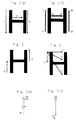
- FIG. 1(a) is an explanatory drawing of an ordinary stroke of a handwritten input character employed in the present invention.
- the ordinary stroke is the trajectory of handwriting extracted as continuous directional information from the movement of a pen made while a character is written with the pen kept in contact with paper.
- a handwritten character such as a numeral, HIRAGANA, KATAKANA, alphabetical letter, Chinese character, and symbol
- the information of the trajectory of handwriting representing pen's movement for writing each stroke is called the "ordinary stroke” and, in each handwritten character, there are ordinary strokes of the same number as that of the strokes of the character.
- a character has a point where writing it is started and, from there, the character is progressively formed with the direction of pen's movement changed. The manner of the change in the direction is characteristic feature of each character. Therefore, it is ver! y effective in character recognition to represent the ordinary strokes 1 - 3 by component vectors.
- the component vectors shown in FIG. 1(b) represent the movements of the pen in the course of writing a handwritten input character and all the ordinary strokes of the handwritten input character can be broken down into component vectors indicative of directional information.
- a method employing fuzzy vector will be described below as a system of the breaking down a stroke into vectors, the method is not limited to it but the conventional method employing 16 directional codes may also be used.
- the total number of the "component vectors" is the smallest number of units representing the trajectory of handwriting in forming a handwritten character, a number greater than the number of strokes of the handwritten character is required for extracting information of the trajectory of handwriting therefrom.
- the number into which a character is broken down should be the power of two for ease of digital processing and that the maximum number of a Chinese character is 30 strokes, it is preferred that 32 is used as the number of the minimum units.
- the number of the component vectors is not changed by the length of the total strokes, but the number of the component vectors per one stroke is univocally determined by the number of strokes.
- a problem of decimal fraction arises for representing the number of the component vectors. To avoid this problem, the following processing is made by the program.
- FIG. 2 is an explanatory drawing of a transition stroke employed in the invention.
- the transition stroke is a component vector obtained by extracting the direction of a floating movement of pen, off the paper, while a character is written. Although many handwritten input characters can be recognized by the ordinary strokes but some of them cannot be recognized thereby. Such unrecognizable characters are those having the same ordinary strokes but different shapes. This means that the handwritten character has characteristic features that cannot be represented by the ordinary strokes alone. By combining the ordinary strokes with the transition strokes, the rate of recognition of the handwritten input character is improved over that obtained when only the ordinary strokes are employed.
- the transition stroke exists in a character whose strokes is more than one and it is constituted of directional information of the imaginary handwritten stroke from the ending point of each stroke to the starting point of the next stroke.
- FIG. 3(a) and FIG. 3(b) are drawings showing transition strokes different from each other.
- FIG. 4 is an explanatory drawing of a start-end stroke (s-e stroke) employed in the invention.
- the s-e strokes of a handwritten input character are component vectors indicative of directional information from the starting point of the first stroke to the starting point and the ending point of each of the subsequent strokes.
- "H" shown in FIG. 4 there are:
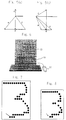
- the line constituting the handwritten input character written with the mouse 12 seems to be continuous, it, in reality, is formed of a string of dots as shown in FIG. 7. Since the data of these dots are all coordinate data, they include dot-to-dot distance data, i.e., information of the size of the character. Accordingly, even if the same characters are written, they may have various sizes depending on the persons who write the character and environmental conditions when the character is written. An example of a character having a different character size is shown in FIG. 8. In handwritten input character recognition, even if the character sizes are different, the same result of recognition must of course be output for the same character. In order to deduce the same result of recognition even if the character sizes are different, it becomes necessary to convert the coordinate data into angular data. The method to achieve it will be shown below.
- a handwritten input character formed of a string of dots is divided into a plurality, 32 in the present example, of segments so as to be replaced with 32 dots in all. Then, the absolute angle of the straight line connecting adjoining dots is calculated.
- the straight line connecting two dots is formed by obtaining ⁇ X and ⁇ Y (refer to FIG. 9) on the basis of the coordinate data of the dots.
- ⁇ arctan
- ⁇ 180° ⁇ arctan
- ⁇ 180° + arctan
- ⁇ 360° ⁇ arctan
- the calculated angle is divided into the fuzzy vector ("0" : in the direction of angle 0° , "1”: in the direction of angle 90° , "2”: in the direction of angle 180° , and "3”: in the direction of angle 270° ).
- the function representing the relationship between the membership grades in the four directions and ⁇ is called the membership function and it is shown in FIG. 10. Portions indicated by broken lines in FIG. 10 are duplicated and the function is continuously shown within the range of 0° ⁇ 360° .
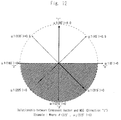
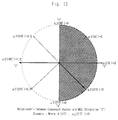
- An example of practically obtaining four fuzzy vectors from a component vector is shown in FIG. 11 - FIG. 14.
- FIG. 11 shows the relationship between the component vector and the membership grade in the case of the direction "0".
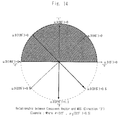
- the hatched portion expresses the region where the membership function becomes 0.
- FIG. 12 - FIG. 14 similarly show the relationships between the component vector and the membership grades in the directions "1", “2", and "3", respectively.
- the hatched portions express the regions where the membership grade becomes 0.
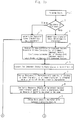
- FIG. 15 and FIG. 16 are flowcharts showing a system of handwritten input character recognition of the invention.
- the program is started.
- the handwritten input character is input as an input character.
- the handwritten input character is input as a character to be registered in the dictionary.
- Each of the extracted component vectors is converted into a fuzzy vector consisting of four membership grades.
- the membership grades of the handwritten input character obtained in step 6 are matched with membership grades of all of the dictionary's characters to thereby calculate similarity measure between the input character and the dictionary's characters.
- the similarity measure S is obtained through the following procedures.
- max is the larger of the two values compared
- min is the smaller of the two values compared.
- S CTR represents the similarity measure on the component vector of the ordinary stroke
- D is the number of strokes.
- the similarity measure S is obtained from the weighted average of the similarity measures on each of the strokes.
- the weighting factors of each of the strokes can be varied in 10 steps as shown in FIG. 17.
- S W1 ⁇ S OR +W2 ⁇ S TR +W3 ⁇ S SE W1+W2+W3
- Step 7 The calculation of the similarity measure in Step 7 is carried out for all of the dictionary's characters and the results are assigned to all of the dictionary's characters.
- Step 8 The one having the largest similarity measure in Step 8 is chosen.
- the largest similarity measure is extracted from the dictionary and the character with the largest similarity measure is output as an answer (the first candidate).
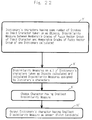
- FIG. 18 - FIG. 21 are explanatory drawings of special rules.
- FIG. 18 shows the case of "0" and "6", according to which, if the height h2 of the starting point from the ending point is greater than 1/4 of the height h1 of the character, the character is recognized as “6” and, if it is smaller than 1/4, the character is recognized as "0".
- FIG. 19 shows the case of "P", "D”, and "b", according to which, if the height h2 of the starting point of the second stroke from the starting point of the first stroke is greater than the height h1 of the character, the character is recognized as “b" and, if the height h4 of the ending point of the second stroke from the ending point of the first stroke is greater than 1/10 of the height of the character, the character is recognized as "P”, and otherwise, the character is recognized as "D".
- FIG. 20 shows the case of "9” and "a", according to which, if the distance (in the horizontal direction) w1 of the ending point referenced from the starting point is greater than +8 dots (the rightward direction is taken as the positive direction), the character is recognized as “a” and, if it is smaller than 8 dots, the character is recognized as "9". Also, when the value obtained by dividing the distance between the starting point and the ending point in the vertical direction by the distance between the starting point and the ending point in the horizontal direction is greater than 15, the character is recognized as "9".
- FIG. 21 shows the case of "n” and "h", according to which, the value obtained by dividing the distance h1 between the starting point and the ending point in the vertical direction by the distance w1 between the starting point and the ending point in the horizontal direction is greater than 1.5, the character is recognized as “h” and, if it is smaller than 1.5, the character is recognized as "n”.
- the correct character to be registered is input from the keyboard.
- the input character data (fuzzy vector group) and the character to be registered are registered by automatic writing.
- the component vector of a handwritten input character was converted into a fuzzy vector in four directions
- the component vector can be converted into a fuzzy vector in two, at least, directions.
- Membership functions indicating relationships of the absolute angle ⁇ , where fuzzy vector in two directions, in three directions, and five directions are used, to the membership grades are shown in FIG. 25.
- step 6 the same method as in the calculation with the use of the similarity measure is used.
- a dissimilarity measure between the membership grades of the fuzzy vector group of the input character and the membership grades of the fuzzy vector group of one of the dictionary's characters is calculated.
- the dissimilarity measure here means the degree of difference, i.e., according as it is closer to zero, the both are more alike.
- the dissimilarity measure there is the Hamming distance which is the integral of the differences between each set of the membership grades, the Euclidean distance which is the distance for each of the membership grades, or the DP matching.
- the dissimilarity measures on all of the dictionary's characters taken as the objects are calculated and the calculated dissimilarity measures are assigned to the dictionary's characters.
- the character having the smallest dissimilarity measure is chosen from the dictionary's characters.
- the dictionary's character having the smallest dissimilarity measure is output as the answer (first candidate).
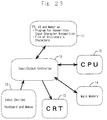
- FIG. 23 An example of the configuration of the apparatus for character recognition according to the invention is shown in FIG. 23.
- FIG. 23 is a block diagram showing the configuration of a computer for carrying out the above described procedures in FIG. 15 and FIG. 16.
- the apparatus comprises a recording medium (FD, HD, auxiliary memory, or the like) 11 in which a handwritten input character recognition program and a dictionary's character data file are recorded, an input device for inputting the handwritten input character (a mouse or pad and a keyboard) 12, a display (CRT) 13 for displaying thereon the input character and the dictionary's character recognized as the input character, a main memory 14 for temporarily storing stroke data of the handwritten input character, stroke data of the dictionary's characters, and the similarity measure on each of the dictionary's characters, a CPU 15 performing such operations as data conversion of stroke data into data of fuzzy vector group, calculation of similarity measures, and the like, and an input/output controller 16 for controlling data transmission between devices and issuance of program commands.
- FD recording medium
- HD auxiliary memory, or the like
- a general purpose personal computer For the recording medium 11, input device 12, memory 14, display 13, CPU 15, and the input/output controller 16, a general purpose personal computer may be used and, for the program, a general purpose program such as PASCAL may be used. Further, when a pad type device is used for the input device 12, a general purpose input pad for a personal computer capable of inputting coordinates on-line may be used.
Landscapes
- Engineering & Computer Science (AREA)
- Computer Vision & Pattern Recognition (AREA)
- Physics & Mathematics (AREA)
- General Physics & Mathematics (AREA)
- Multimedia (AREA)
- Theoretical Computer Science (AREA)
- Character Discrimination (AREA)
Applications Claiming Priority (6)
| Application Number | Priority Date | Filing Date | Title |
|---|---|---|---|
| JP17744797 | 1997-07-02 | ||
| JP177448/97 | 1997-07-02 | ||
| JP17744897 | 1997-07-02 | ||
| JP177447/97 | 1997-07-02 | ||
| JP09177447A JP3140989B2 (ja) | 1997-07-02 | 1997-07-02 | ストロークによるオンライン手書き入力文字認識方法及び装置並びにその方法を実行するための記録媒体 |
| JP09177448A JP3139701B2 (ja) | 1997-07-02 | 1997-07-02 | ファジィベクトルによるオンライン手書き入力文字認識方法及び装置並びにその方法を実行するための記録媒体 |
Publications (2)
| Publication Number | Publication Date |
|---|---|
| EP0889433A2 true EP0889433A2 (de) | 1999-01-07 |
| EP0889433A3 EP0889433A3 (de) | 2001-05-16 |
Family
ID=26497981
Family Applications (1)
| Application Number | Title | Priority Date | Filing Date |
|---|---|---|---|
| EP98101007A Withdrawn EP0889433A3 (de) | 1997-07-02 | 1998-01-21 | Verfahren und Gerät zur Online-erkennung handgeschriebener Zeichen und Speichermedium zur Ausführung dieses Verfahrens |
Country Status (5)
| Country | Link |
|---|---|
| US (1) | US6144764A (de) |
| EP (1) | EP0889433A3 (de) |
| KR (1) | KR19990013306A (de) |
| AU (1) | AU5270698A (de) |
| CA (1) | CA2224540A1 (de) |
Cited By (1)
| Publication number | Priority date | Publication date | Assignee | Title |
|---|---|---|---|---|
| WO2003063093A3 (en) * | 2002-01-19 | 2004-02-26 | Queen Mary & Westfield College | Authentication systems |
Families Citing this family (38)
| Publication number | Priority date | Publication date | Assignee | Title |
|---|---|---|---|---|
| KR100454541B1 (ko) * | 1998-04-27 | 2004-11-03 | 산요덴키가부시키가이샤 | 수기 문자 인식 방법 및 시스템 |
| US7821503B2 (en) | 2003-04-09 | 2010-10-26 | Tegic Communications, Inc. | Touch screen and graphical user interface |
| US6970599B2 (en) * | 2002-07-25 | 2005-11-29 | America Online, Inc. | Chinese character handwriting recognition system |
| US7030863B2 (en) | 2000-05-26 | 2006-04-18 | America Online, Incorporated | Virtual keyboard system with automatic correction |
| US7286115B2 (en) | 2000-05-26 | 2007-10-23 | Tegic Communications, Inc. | Directional input system with automatic correction |
| US7750891B2 (en) | 2003-04-09 | 2010-07-06 | Tegic Communications, Inc. | Selective input system based on tracking of motion parameters of an input device |
| US7610194B2 (en) | 2002-07-18 | 2009-10-27 | Tegic Communications, Inc. | Dynamic database reordering system |
| US6801190B1 (en) | 1999-05-27 | 2004-10-05 | America Online Incorporated | Keyboard system with automatic correction |
| US7564995B1 (en) * | 2000-03-07 | 2009-07-21 | Apple Inc. | Method and apparatus for acquiring and organizing ink information in pen-aware computer systems |
| US20020107885A1 (en) * | 2001-02-01 | 2002-08-08 | Advanced Digital Systems, Inc. | System, computer program product, and method for capturing and processing form data |
| US20020141643A1 (en) * | 2001-02-15 | 2002-10-03 | Denny Jaeger | Method for creating and operating control systems |
| US6721452B2 (en) * | 2001-09-12 | 2004-04-13 | Auburn University | System and method of handwritten character recognition |
| JP4061094B2 (ja) * | 2002-03-15 | 2008-03-12 | インターナショナル・ビジネス・マシーンズ・コーポレーション | 音声認識装置、その音声認識方法及びプログラム |
| CN1183436C (zh) * | 2002-04-03 | 2005-01-05 | 摩托罗拉公司 | 用于手写字符的方向确定及其识别 |
| SE0202446D0 (sv) * | 2002-08-16 | 2002-08-16 | Decuma Ab Ideon Res Park | Presenting recognised handwritten symbols |
| US7242805B1 (en) | 2003-04-18 | 2007-07-10 | Kamran Reihani | System and method for automated symbolic recognition including database modeling |
| US7236631B1 (en) | 2003-04-18 | 2007-06-26 | Kamran Reihani | System and method for automated symbolic recognition including logical symbols |
| US7239749B1 (en) | 2003-04-18 | 2007-07-03 | Kamran Reihani | System and method for automated symbolic recognition including evidence-based technique |
| US7218782B1 (en) | 2003-04-18 | 2007-05-15 | Kamran Reihani | System and method for automated symbolic recognition including multi-phase symbolic reshaping |
| US7227995B1 (en) | 2003-04-18 | 2007-06-05 | Kamran Reihani | System and method for automated symbolic recognition including spatial reasoning |
| US20050152600A1 (en) * | 2004-01-14 | 2005-07-14 | International Business Machines Corporation | Method and apparatus for performing handwriting recognition by analysis of stroke start and end points |
| US7574416B2 (en) * | 2004-01-16 | 2009-08-11 | Saffron Technology, Inc. | Distance-based spatial representation and prediction systems, methods and computer program products for associative memories |
| US7490033B2 (en) * | 2005-01-13 | 2009-02-10 | International Business Machines Corporation | System for compiling word usage frequencies |
| US7639876B2 (en) | 2005-01-14 | 2009-12-29 | Advanced Digital Systems, Inc. | System and method for associating handwritten information with one or more objects |
| US7720286B2 (en) | 2005-05-25 | 2010-05-18 | Advanced Digital Systems, Inc. | System and method for associating handwritten information with one or more objects via discontinuous regions of a printed pattern |
| US8225203B2 (en) | 2007-02-01 | 2012-07-17 | Nuance Communications, Inc. | Spell-check for a keyboard system with automatic correction |
| US8201087B2 (en) | 2007-02-01 | 2012-06-12 | Tegic Communications, Inc. | Spell-check for a keyboard system with automatic correction |
| JP5389241B1 (ja) * | 2012-09-26 | 2014-01-15 | 株式会社東芝 | 電子機器および手書き文書処理方法 |
| JP5991139B2 (ja) * | 2012-10-26 | 2016-09-14 | ブラザー工業株式会社 | 情報管理装置及びプログラム |
| JP2014086054A (ja) | 2012-10-26 | 2014-05-12 | Brother Ind Ltd | 情報管理装置、及び情報管理プログラム |
| JP6119395B2 (ja) * | 2013-04-18 | 2017-04-26 | ブラザー工業株式会社 | 情報処理装置、及びプログラム |
| JP6107361B2 (ja) | 2013-04-18 | 2017-04-05 | ブラザー工業株式会社 | 入力装置 |
| WO2015141260A1 (ja) * | 2014-03-17 | 2015-09-24 | 株式会社河合楽器製作所 | 手書き音楽記号認識装置およびプログラム |
| KR101585842B1 (ko) * | 2015-10-05 | 2016-01-15 | 주식회사 시큐브 | 세그먼트 블록 기반 수기서명 인증 시스템 및 방법 |
| US10163004B2 (en) | 2017-03-30 | 2018-12-25 | Konica Minolta Laboratory U.S.A., Inc. | Inferring stroke information from an image |
| US10579893B2 (en) * | 2017-02-28 | 2020-03-03 | Konica Minolta Laboratory U.S.A., Inc. | Inferring stroke information from an image |
| TWI676919B (zh) * | 2018-08-02 | 2019-11-11 | 義守大學 | 一種電腦化寫字評估與訓練方法 |
| CN111383505B (zh) * | 2020-03-04 | 2021-11-09 | 南京大学 | 一种基于笔交互的电路教学系统及方法 |
Family Cites Families (18)
| Publication number | Priority date | Publication date | Assignee | Title |
|---|---|---|---|---|
| JPS5975375A (ja) * | 1982-10-21 | 1984-04-28 | Sumitomo Electric Ind Ltd | 文字認識装置 |
| JPS61120231A (ja) * | 1984-11-16 | 1986-06-07 | Sharp Corp | 手書き入力装置 |
| US4764972A (en) * | 1985-05-23 | 1988-08-16 | Nec Corporation | Continuous characters recognition system |
| US4850026A (en) * | 1987-10-13 | 1989-07-18 | Telecommunications Laboratories Dir. Gen'l Of Telecom. Ministry Of Communications | Chinese multifont recognition system based on accumulable stroke features |
| JPH0381817A (ja) * | 1989-08-25 | 1991-04-08 | Hitachi Ltd | 手書入力情報処理装置およびこの手書入力情報処理装置を用いた手書入力情報システム |
| JP3143461B2 (ja) * | 1990-05-29 | 2001-03-07 | キヤノン株式会社 | 文字認識方法及び文字認識装置 |
| US5245674A (en) * | 1991-07-30 | 1993-09-14 | Xerox Corporation | Image processing using distance as a function of direction |
| JP3155577B2 (ja) * | 1991-10-16 | 2001-04-09 | キヤノン株式会社 | 文字認識方法及び装置 |
| JP3105967B2 (ja) * | 1991-11-14 | 2000-11-06 | キヤノン株式会社 | 文字認識方法及び装置 |
| US5333209A (en) * | 1992-03-24 | 1994-07-26 | At&T Bell Laboratories | Method of recognizing handwritten symbols |
| IT1265673B1 (it) * | 1993-03-22 | 1996-11-22 | Texas Instruments Italia Spa | Apparecchio e procedimento per il riconoscimento di caratteri manoscritti. |
| US5583946A (en) * | 1993-09-30 | 1996-12-10 | Apple Computer, Inc. | Method and apparatus for recognizing gestures on a computer system |
| US5544279A (en) * | 1994-10-13 | 1996-08-06 | United Microelectronics Corp. | Fuzzy logic recognition device which determines the mode of an unknown move using fuzzy set theory |
| JPH08249422A (ja) * | 1995-03-08 | 1996-09-27 | Canon Inc | 文字処理装置及び方法 |
| US5812698A (en) * | 1995-05-12 | 1998-09-22 | Synaptics, Inc. | Handwriting recognition system and method |
| US5802204A (en) * | 1995-06-07 | 1998-09-01 | Microchip Technology Incorporated | Handwritten character translator using fuzzy logic |
| US5835633A (en) * | 1995-11-20 | 1998-11-10 | International Business Machines Corporation | Concurrent two-stage multi-network optical character recognition system |
| US5889889A (en) * | 1996-12-13 | 1999-03-30 | Lucent Technologies Inc. | Method and apparatus for machine recognition of handwritten symbols from stroke-parameter data |
-
1998
- 1998-01-20 US US09/009,533 patent/US6144764A/en not_active Expired - Fee Related
- 1998-01-21 EP EP98101007A patent/EP0889433A3/de not_active Withdrawn
- 1998-01-22 CA CA002224540A patent/CA2224540A1/en not_active Abandoned
- 1998-01-22 AU AU52706/98A patent/AU5270698A/en not_active Abandoned
- 1998-01-24 KR KR1019980002196A patent/KR19990013306A/ko not_active Ceased
Cited By (2)
| Publication number | Priority date | Publication date | Assignee | Title |
|---|---|---|---|---|
| WO2003063093A3 (en) * | 2002-01-19 | 2004-02-26 | Queen Mary & Westfield College | Authentication systems |
| US7869634B2 (en) | 2002-01-19 | 2011-01-11 | Mcowan Peter William | Authentication of signatures using normalization of signature data |
Also Published As
| Publication number | Publication date |
|---|---|
| EP0889433A3 (de) | 2001-05-16 |
| KR19990013306A (ko) | 1999-02-25 |
| CA2224540A1 (en) | 1999-01-02 |
| AU5270698A (en) | 1999-02-04 |
| US6144764A (en) | 2000-11-07 |
Similar Documents
| Publication | Publication Date | Title |
|---|---|---|
| US6144764A (en) | Method and apparatus for on-line handwritten input character recognition and recording medium for executing the method | |
| Kim et al. | An architecture for handwritten text recognition systems | |
| Ghosh et al. | Script recognition—a review | |
| JP3176023B2 (ja) | 手書き入力照合方法および装置 | |
| EP0114250B1 (de) | Anordnung von Strichen in Undeutlichkeitsgruppen in einem Verfahren und eine Vorrichtung zur Mustererkennung | |
| US5768417A (en) | Method and system for velocity-based handwriting recognition | |
| EP1971957B1 (de) | Verfahren und vorrichtungen zur erweiterung von dynamischer handschrifterkennung zur erkennung statischer handgeschriebener und maschinell erstellter texte | |
| EP0151316B1 (de) | Verfahren und Anlage zur On-line-Erkennung handgeschriebener Muster | |
| CN101763516B (zh) | 一种基于拟合函数的文字识别方法 | |
| EP0436819A2 (de) | Handschrifterkennung mit Verwendung von jeweils zwischen zwei Klassen unterscheidenden Massnahmen | |
| Lehal et al. | Feature extraction and classification for OCR of Gurmukhi script | |
| US5659633A (en) | Character recognition method utilizing compass directions and torsion points as features | |
| JP3917349B2 (ja) | 文字認識結果を利用して情報を検索する検索装置および方法 | |
| Yoon et al. | An online signature verification system using hidden Markov model in polar space | |
| JP3046472B2 (ja) | 手書き図形認識装置 | |
| Tou et al. | Automatic recognition of handwritten characters via feature extraction and multi-level decision | |
| JP3139701B2 (ja) | ファジィベクトルによるオンライン手書き入力文字認識方法及び装置並びにその方法を実行するための記録媒体 | |
| JPH09114926A (ja) | オンライン文字認識における入力文字大分類方法および装置 | |
| JP3066530B2 (ja) | オンライン手書文字認識装置 | |
| Nagabhushan et al. | Recognition of Pitman shorthand text using tangent feature values at word level | |
| JP3140989B2 (ja) | ストロークによるオンライン手書き入力文字認識方法及び装置並びにその方法を実行するための記録媒体 | |
| JP3015137B2 (ja) | 手書文字認識装置 | |
| JPH09231314A (ja) | オンライン手書き文字認識装置 | |
| KR940007934B1 (ko) | 온라인 문자인식을 위한 획분할 및 문자분류방법 | |
| Izadi et al. | Incorporating a new relational feature in Arabic online handwritten character recognition |
Legal Events
| Date | Code | Title | Description |
|---|---|---|---|
| PUAI | Public reference made under article 153(3) epc to a published international application that has entered the european phase |
Free format text: ORIGINAL CODE: 0009012 |
|
| AK | Designated contracting states |
Kind code of ref document: A2 Designated state(s): DE FR GB |
|
| AX | Request for extension of the european patent |
Free format text: AL;LT;LV;MK;RO;SI |
|
| PUAL | Search report despatched |
Free format text: ORIGINAL CODE: 0009013 |
|
| AK | Designated contracting states |
Kind code of ref document: A3 Designated state(s): AT BE CH DE DK ES FI FR GB GR IE IT LI LU MC NL PT SE |
|
| AX | Request for extension of the european patent |
Free format text: AL;LT;LV;MK;RO;SI |
|
| 17P | Request for examination filed |
Effective date: 20010816 |
|
| AKX | Designation fees paid |
Free format text: DE FR GB |
|
| 17Q | First examination report despatched |
Effective date: 20020423 |
|
| STAA | Information on the status of an ep patent application or granted ep patent |
Free format text: STATUS: THE APPLICATION IS DEEMED TO BE WITHDRAWN |
|
| 18D | Application deemed to be withdrawn |
Effective date: 20020904 |