EP0889615A2 - Mehrträgerübertragung mit änderbarer Datenrate - Google Patents
Mehrträgerübertragung mit änderbarer Datenrate Download PDFInfo
- Publication number
- EP0889615A2 EP0889615A2 EP98112040A EP98112040A EP0889615A2 EP 0889615 A2 EP0889615 A2 EP 0889615A2 EP 98112040 A EP98112040 A EP 98112040A EP 98112040 A EP98112040 A EP 98112040A EP 0889615 A2 EP0889615 A2 EP 0889615A2
- Authority
- EP
- European Patent Office
- Prior art keywords
- data
- signal
- upstream
- rate
- analog
- Prior art date
- Legal status (The legal status is an assumption and is not a legal conclusion. Google has not performed a legal analysis and makes no representation as to the accuracy of the status listed.)
- Granted
Links
Images




Classifications
-
- H—ELECTRICITY
- H04—ELECTRIC COMMUNICATION TECHNIQUE
- H04L—TRANSMISSION OF DIGITAL INFORMATION, e.g. TELEGRAPHIC COMMUNICATION
- H04L5/00—Arrangements affording multiple use of the transmission path
- H04L5/14—Two-way operation using the same type of signal, i.e. duplex
- H04L5/1438—Negotiation of transmission parameters prior to communication
- H04L5/1446—Negotiation of transmission parameters prior to communication of transmission speed
-
- H—ELECTRICITY
- H04—ELECTRIC COMMUNICATION TECHNIQUE
- H04L—TRANSMISSION OF DIGITAL INFORMATION, e.g. TELEGRAPHIC COMMUNICATION
- H04L27/00—Modulated-carrier systems
- H04L27/26—Systems using multi-frequency codes
- H04L27/2601—Multicarrier modulation systems
-
- Y—GENERAL TAGGING OF NEW TECHNOLOGICAL DEVELOPMENTS; GENERAL TAGGING OF CROSS-SECTIONAL TECHNOLOGIES SPANNING OVER SEVERAL SECTIONS OF THE IPC; TECHNICAL SUBJECTS COVERED BY FORMER USPC CROSS-REFERENCE ART COLLECTIONS [XRACs] AND DIGESTS
- Y02—TECHNOLOGIES OR APPLICATIONS FOR MITIGATION OR ADAPTATION AGAINST CLIMATE CHANGE
- Y02D—CLIMATE CHANGE MITIGATION TECHNOLOGIES IN INFORMATION AND COMMUNICATION TECHNOLOGIES [ICT], I.E. INFORMATION AND COMMUNICATION TECHNOLOGIES AIMING AT THE REDUCTION OF THEIR OWN ENERGY USE
- Y02D30/00—Reducing energy consumption in communication networks
- Y02D30/50—Reducing energy consumption in communication networks in wire-line communication networks, e.g. low power modes or reduced link rate
Definitions
- the invention relates generally to an improved high-speed communications system which establishes a data link using only a selectable portion of the total available bandwidth of a channel.
- the present invention has particular applicability to systems which use rate adaptable techniques such as the discrete multi-tone modulation (DMT) technique and CAP for transmitting data in Digital Subscriber Lines and similar environments.
- DMT discrete multi-tone modulation
- CAP Digital Subscriber Lines and similar environments.
- Voice band modems operate at the subscriber premises end over a 3 kHz voice band lines and transmit signals through the core switching network, the phone company network treats them exactly like voice signals. These modems presently transmit up to 33.6 kbps over a 2-wire telephone line, even though the practical speed only twenty years ago was 1.2 kbps.
- the improvement in voice band modems over the past 20 years has resulted from significant advances in algorithms, digital signal processing, and semiconductor technology. Because such modems are limited to voice bandwidth (3.0 kHz), the rate is bound by the Shannon limit, around 30 kbps.
- a V.34 modem for example, achieves 10 bits per Hertz of bandwidth, a figure that approaches the theoretical Shannon limits.
- ADSL Asymmetric Digital Subscriber Line
- ADSL is "asymmetric" in that more data goes downstream (to the subscriber) than upstream (back from the subscriber).
- the reason for this is a combination of cost, demand, and performance.
- twisted pair wiring coupling increases with the frequency of the signal. If symmetric signals in many pairs are used within a cable, the data rate and line length become significantly limited by the coupling noise. Since the preponderance of target applications for digital subscriber services is asymmetric, asymmetric bit rate is not perceived to be a serious limitation at this time. Therefore, the ADSL standard proposes up to 6 Mbps for downstream, and up to 640 kbps for upstream.
- ADSL Advanced Driver Assistance Systems
- the proposed standard for ADSL divides the available transmission bandwidth into two parts.
- POTS ordinary
- the bulk of the rest bandwidth in the range from 4 kHz to about 1 MHz is for data transmission in the downstream direction, which is defined to be from the exchange to the subscriber.
- the upstream control channel uses a 160 kHz band in between. The signals in each channel can be extracted with an appropriate band -pass filter.
- a DMT implementation of ADSL uses the entire available 1 MHz range of a copper phone line. It merely splits the signal into 255 separate channels, and each 4 kHz channel can be made to provide a bit rate up to the best present day voice band (33.6 kbs) modems. This results essentially in overall performance which is equivalent to around two hundred V.34 modems used in parallel on the same line. Because each channel can be configured to a different bit rate according to the channel characteristics, it can be seen that DMT is inherently "rate-adaptive" and extremely flexible for interfacing with different subscriber equipment and line conditions.
- AFE analog front end
- ADSL digital signal processing
- AFE devices in modem applications provide the interface between analog wave forms and digital samples for digital hardware/software processing.
- AFE devices need to operate at a very high sampling rate and high accuracy.
- the DMT technology has a spectrum of 1 MHz and requires sampling above 50 MHz if a sigma-delta analog-to-digital (ADC) method is used. This thus requires the state-of-art ADC technology and imposes a high cost for end users.
- ADC analog-to-digital
- the time domain signal in ADSL/DMT transmissions is a summation of a large number of carriers modulated by quadrature amplitude modulation (QAM). This typically results in a large peak-to-peak deviation. As a result, even though a high speed AFE is made possible, a large dynamic range and high resolution AFE is required at the same time to minimize quantization errors.
- QAM quadrature amplitude modulation
- ADSL AFE Advanced Driver Assistance Systems
- the other hardware and software in ADSL environment also needs to operate at a much higher speed than current conventional modem counterparts.
- DSP digital signal process
- a custom and dedicated digital signal process (DSP) of a power of several hundred MIPS (millions instructions per second) is required to process many components such as error encoding and decoding, spectrum transforms, timing synchronization, etc.
- this high speed requirement for the signal processing portion of ADSL also results in less flexible, high component costs.
- a communications device such as a modem
- a communications device such as a modem
- a full-scale ADSL system may have the performance level of 200 times conventional V.34 modems, but it is apparent that even a performance improvement of 10 - 20 times than present day available analog modems would be sufficient for many consumer applications, such as Internet access and similar uses.
- unlike conventional analog modems which are available in various speeds varying generally from 14.4 to 56 Kbps, there are no known ADSL modems which offer scalable performance levels to users.
- the T1E1.4 ADSL standard does not specify the system interface and user model.
- various high level interface to support T1 /E1, ATM, etc. have been described, system integration with high level protocols such as TCP/IP and interface with computer operating systems have not yet been defined.
- ISP Internet service provider
- a mutually agreed protocol is required to set up a call and transfer data.
- Possible protocols available at various levels include ATM (asynchronous transfer mode), TCP/IP, ISDN, and current modem AT commands. Either one of these or a possibly new protocol needs to be defined to facilitate the adoption of ADSL technology.
- An object of the present invention therefore is to provide a communications system which is fully compatible with high speed, rate adaptable protocols such as are used with ADSL, but which system is nevertheless implementable with simpler analog font end receiving/transmitting circuitry and is thus reduced in cost and complexity;
- a further object of the present invention is to provide a communications system which is fully compatible with high speed, rate adaptable modulation protocols such as used with ADSL, but which system is nevertheless implementable with simpler digital signal processing circuitry and is thus reduced in cost and complexity;
- Another objective of the present invention is to provide a method for transmitting data within a fractional, desirable portion of available bandwidth in a channel by modulating only a limited number of desirable sub-channel data carriers, so that a high speed data link can be achieved that is faster, and has reduced computation and hardware demands;
- Yet a further objective of the present invention is to provide a communications system with smaller peak-to-peak deviation in the sub-channels signals, so as to reduce the dynamic range required for the front end ADC, and to minimize quantization errors.
- Another objective of the present invention is to provide a high speed communications system having a data throughput that is easily controllable and expandable, so that the performance range of such system can be configured to any fractional percentage of total bandwidth available in a transmission channel, up to and including full bandwidth use of the channel;
- a related objective of the present invention is to provide a h igh speed communications system that is modular so that forward compatible and expandable functionality can be incorporated flexibly and with a minimum of effort on the part of a user of such system;
- Yet a further objective is to provide a system that is compatible with high speed protocols used in ADSL, but which is also easily adaptable to support preexisting high level data protocols, including those presently used for controlling high speed voice band modems;
- a further object of the present invention is to provide a high speed communications system that self-calibrates its own performance level, based on the processing power available to such system;
- Another objective of the present invention is to provide a high speed communications system that permits a user to configure the performance parameters of such system using conventional personal computer hardware, software and operating systems;
- a further object of the present invention is to provide an interface between a host operating system and a high speed communications system that provide forward compatible and expandable functionality;
- An additional aim of the present invention is to provide an improved system for concurrent control of conventional voice data traffic on a POTS channel, and upstream/downstream communications on separate sub-channels;
- a communications system that permits a host processing device to receive selected data within a narrow bandwidth from an upstream transciever which can and normally transmits a large bandwidth analog data transmission signal through a connected channel.
- a channel interface circuit AFE samples the received analog signal to generate a digital signal. Only a limited portion of the bandwidth may be sampled, thus reducing front end complexity.
- a digital signal processing circuit then extracts the selected data from this limited digital signal, which is significantly easier to process than a full bandwidth digital signal.
- Feedback information is provided back to the upstream transmitter which causes the upstream transmitter to transmit downstream data thereafter only using the limited bandwidth of the front end, and not the full bandwidth. This feedback information contains information about the channel that suggests to the upstream transmitter that the other bandwidth in the channel is unusable. In this manner, the upstream transceiver is trained to accommodate the lower rate downstream transceiver in a manner that nevertheless preserves protocol integrity.
- the large bandwidth analog data transmission signal is comprised of a number of DMT modulated sub-channels, and an anti- aliasing filter on the front end of the the downstream transceiver ensures that only a limited number of such sub-channels are processed by a DMT signal processing core.
- the feedback information consists of non-zero SNR information for the selected sub-channels, and a sub-channel blackout "mask" to eliminate the potential use of other sub-channels.
- the feedback information is sent by way of a front end transmitting circuit which transmits an upstream data transmission using a second frequency range different from the downstream transmission.
- One implementation of the aforementioned high speed system is in a personal computer, so that the signal processing can be accomplished using a processor within such computer, which in a preferred embodiment is an X86 compatible processor.
- Another implementation of the aforementioned high speed system uses a dedicated signal processor for demodulating the selected sub-channels. This cuts down on processing overhead requirements for a host processing system incorporating the system.
- the portion of the downstream data transmission to be processed for data extraction can be configured by a user of such systems, or alternatively, it can be dynamically determined based on an evaluation by the digital signal processing circuit of performance characteristics of different portions of the frequency spectrum within the bandwidth potential of the upstream transceiver.
- the data rate of a system such as described above can be increased by processing data from an additional second limited frequency bandwidth portion of the total available downstream bandwidth.
- this can be done by including a number of anti- aliasing filters in a modular bank as part of the analog front end section, each of which passes a different frequency bandwidth portion.
- the data rate of the overall system can be scaled in a controllable and cost-effective fashion.
- each analog front end portion can be operated at a slower sampling clock and smaller dynamic range. This results in a more relaxed speed requirement and smaller quantization noise at a given number of bits per sample.
- the present disclosure also includes an interface to an operating system, to facilitate controlling the high speed communications system when it is incorporated in a personal computer system.
- This interface ensures that the operating system treats such communications system essentially the same as other prior art voice band modems, and in a preferred embodiment, is a device driver for the Windows NT operating shell.
- the present disclosure also describes an applications program which permits a user of a personal computer to control the performance characteristics of the high speed communications system by setting certain system parameters when such system is incorporated in a personal computer system.
- This program includes an auto calibration routine for setting such system parameters, or alternatively a user of such program can tailor the settings subject to confirmation of the efficacy of such settings based on an evaluation of the processing power available to such user.
- the data rate reduction in such modems is accomplished primarily by varying the number of bits per baud (hertz) at a fixed frequency, and nor by controlling the overall frequency spectrum of the downstream data transmission.
- no effort is made to measure, identify or use an optimal portion of the usable bandwidth or set of transmission sub-channels. Instead, such prior art systems typically use whatever available bandwidth or sub-channels happen to be usable at that instant in time.
- ADSL ADSL
- T1E1.4 ADSL standards specify an up to 255 channels for downstream transmission from the central office to subscribers and up to 31 channels for upstream transmission from subscribers to the central office.
- each carrier has a bandwidth of 4.3125 kHz.
- the total bandwidth is 1.1 MHz for a total of 255 channels.
- a "pilot" tone in the approximate range of 69 kHz, is used for maintaining timing synchronization.
- a similar pilot tone is transmitted in the downstream direction in the vicinity of 276 kHz.
- upstream and downstream transmissions are over the same 2-pair twisted wire, they need to be separated by either echo cancellation (EC) or frequency division multiplexing (FDM). Echo cancellation allows simultaneous transmissions in both directions but requires a complex echo canceler implementation.
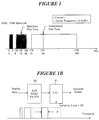
- FDM uses two different frequency bands for separate downstream and upstream transmissions. As shown in Figure 1, the upstream transmission uses subchannels from channel number 6 to 31, and the downstream transmission uses subchannels from channel number 41 to 255. While the remainder of the discussion below focuses on an system employing FDM, it will be appreciated by those skilled in the art that the present invention is adaptable and can be used beneficially with echo-cancellation approaches as well.
- the transmission bit rates for both upstream and downstream communications in ADSL are not fixed but instead are determined by the quality of the channel.
- a number of well-known techniques can be used advantageously for setting up the initial data link. In general, these techniques work as follows: during initialization, the channel quality is measured and a certain data rate (typically a number of bits) is assigned for each DMT subchannel; thereafter, a "hand-shaking" process is used to dynamically and adaptively change the bit loadings (and energy levels). The latter is often necessary because (among other things) changes may occur in the overall channel characteristics, changes in the target bit rate may be needed, or new bit distributions in the sub-channels may be required because of degradations in one of the sub-channels.
- the quality of the sub-channel response can be measured by the received signal to noise (SNR) ratio.
- SNR received signal to noise
- the upper limit of the number of bits per unit Hz that can be transmitted is log 2 (1+SNR). Therefore, by measuring the received SNR at the receiver end, one can determine the number of bits allocated for each subchannel modulation.
- the total data throughput race achieved by the system therefore, is simply the sum of all the data rates of all the usable subchannels.
- data bits are grouped and processed every 250 ⁇ sec.
- the number of bits that can be processed over one such time frame is the summation of the bits allocated for each subcharnel determined from the previous channel response measurement.
- quadrature amplitude modulation QAM is used to convert bits to a complex value, which is then modulated by the subchannel carrier at the corresponding frequency.
- the present invention permits a limited but extremely useful ADSL modem to be implemented with significantly less expense and complexity than previously possible.
- the present invention has modular characteristics, the proposed implementation of the present invention affords users an easy path to forward and upward expansion of the overall functionality of their system.
- the total accumulated bit race of an ADSL communications system using the present invention can be calculated as follows. Suppose a total number of k subchannels (out of a total of M possible) are to be supported and each channel is allocated b k bits for transmission.
- the benefits of this approach of the present invention are apparent.
- the overall performance and cost of a high speed communications system can be scaled and controlled in direct relationship to the particular needs of particular users.
- the data rate supportable by (and the relative cost of) any particular implementation of the present invention is generally determined by two factors: (1) the capacity of the AFE; and (2) the capacity of the hardware performing the DMT.
- the capacity of an AFE is generally measured by the maximum sampling speed it can achieve. As explained above, the sampling speed in turn determines the upper limit of the frequency band B (in kHz) that can be obtained. At the defined channel separation of 4.3125 kHz for ADSL, the total number of subchannels that can be supported is less than or equal to B/4.1325.
- a suitable ADC can be selected, therefore, based on the particular data rate and cost requirements of any particular user.
- the other factor that limi ts the number of subchannels (and achievable data rate) is the processing power available for DMT modulation and demodulation routines.
- DMT modulation and demodulation routines For example, a variety of performance levels (achievable data rates) are possible with well-known dedicated signal processing hardware, such as digital signal processors, as discussed in more detail below with reference to Figure 2.
- the required processing power MIPS
- the present invention makes use of a "calibration" routine for estimating the total available processing power of a users computing system in order to set an upper limit of the total subchannels that can be supported.
- the sub-channels with the largest signal to noise ratio (SNR) within the passband are selected for data transmission.
- SNR signal to noise ratio
- those k subchannels within the passband that support the largest number of bits are used for processing.
- a standard two-are subscriber line typically has a SNR curve that exhibits extensive attenuation with higher frequencies.
- the present invention permits an implementation for a high speed data communications system that makes use of the best portion of the channel, while still being upwardly compatible and forward expandable.
- a system constructed in accordance with the teachings herein is completely compatible with a fully implemented version ADSL DMT modem.
- appropriate modifications specific to the channel and data link protocols and standards can be made so that the present invention can be advantageously employed in non-ADSL environments as well.
- Upward compatibility and forward expandability refer to the fact that systems constructed with the present teachings can have data rates that are easily upgraded while still preserving and maintaining compatibility with existing standards. For example, lower end users desiring less bandwidth can achieve a satisfactory performance with a minimum of cost, and can then upgrade the performance levels of their systems at later time by suitable (and preferably modular) upgrades of the AFE and signal processing hardware/software.
- a system constructed in accordance with the present teachings is completely compatible with the full ADSL standard because of the following two aspects:
- the bit rate for each sub-channel is determined initially (and preferably dynamically on an ongoing basis) by the sub-channel SNR analysis.
- an ADSL downstream receiver can inform an upstream ADSL transmitter about the quality of the transmission; the receiver can also decide the bit rate for each sub-channel. Therefore, a downstream, partial-channel bandwidth receiver using the present invention can (based on the speed and passband of such receiver) supply an upstream, full-standard ADSL transmitter with information or control signals to effectuate a transmission only in selected sub-channels.
- the upstream ADSL transmitter is provided with SNR information for sub-channels outside the passband that is artificially contrived so as to suggest to the upstream transmitter that these sub-channels are not usable.
- the downstream transmission is limited to a certain number of subchannels within the AFE and signal processing capabilities of the receiver. It can be seen, nevertheless, that this scheme is completely transparent to the transmitter, thereby permitting a system built in accordance with the present teachings to be fully compatible with the ADSL standard. While not possible at this time within the ADSL standard, it is apparent that other high-speed data protocols may use a control signal, instead, to provide for express limiting and control of the identity of the sub-channels transmitting information.
- the number of subchannels supported by a system using the present invention can increase.
- such systems can upgrade completely to a full T1E1.4 ADSL implementation using a single higher end modular replacement APE devices, or alternatively, a number of lower end modular AFE devices.
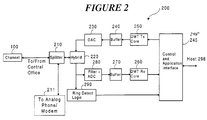
- Fig. 2 The basic structure of the present inve ntion is depicted generally in Fig. 2.
- the present invention can be embodied in different combinations of hardware and software.
- the primary difference between these embodiments is the specific implementation of the DMT core. These specific embodiments are described in more detail below with reference to Figs. 3A and 3B.
- a channel 100 is made of a regular copper wire "loop", and each such loop may have differing electrical properties, transmission lengths (sizes), varying attenuation characteristics, and a number of impairments or interferences.
- Splitter 210 a conventional and well-known circuit, separates a DMT signal occupying more than 200 sub-channels from a lower end 4 kHz POTS analog signal. The latter can be used for simultaneous voice or conventional analog modem.
- Hybrid circuit 220 is also well-known in the art, and consists primarily of conventional transformers and isolation circuitry used in a wide variety of high-speed devices interfacing to standard telephone lines.
- a ring detect logic circuit 290 can also be implemented using accepted techniques, to alert a Control Interface 295 to the existence of a transmission signal originating from an upstream transceiver (not shown).
- the full bandwidth signal is either low passed or bandpass limited to a frequency width B by suitable, well-known techniques as it passes through bandpass Filter and Analog/Digital Converter 280, so that only a fraction of the signal in the frequency domain is passed on to Buffer and DMT Receive Core 260.
- bandpass Filter and Analog/Digital Converter 280 the only important consideration for Subband Filter 280 is that it must constrain the bandwidth of the incoming signal to be ⁇ B, where the sampling rate of the Analog/Digital Converter is ⁇ 2B. This can be accomplished by using well-known filter designs.
- the signal passed through Filter and ADC 280 occupies a spectrum between approximately 200 and 400 kHz.
- an adaptive or tunable filter may be substituted, such that the target frequencies of the passband are adjustable uniquely for each new data link.
- the bandpass can be configured to coincide with the sub-channels having the highest achievable SNR, including the subchannels that must be supported for protocol or other system overhead reasons.
- the analog-to-digital conversion may be performed by a digital signal processor, or by the host computer and therefore, the sampling rate can be dynamically controlled and matched to the bandpass target frequency and frequency breadth. This feature, in turn, would assist dynamic scaling of the data throughput based on system computing power and overhead requirements.
- a pilot tone at 276 kHz must be allowed within the passband. It is apparent that other protocols may require similar pilot tones, and the design of comparable filters to achieve the functionality of Filter and ADC 280 is well within the ordinary skill of one in the art.
- DMT Receiver Core 260 is generally responsible for monitoring and measuring the SNR of the sub-channels falling within the frequency range passed by FILTER and ADC 280, and for extracting the original data stream from the numerous sub-carriers.
- Control Interface 295 receives system configuration information from a host 298. This information may contain such parameters as target throughput rare R, target error rate, target center frequencies F for FILTER and ADC 280, target frequency width B, etc.
- Control Interface 295 can select a number k of sub-channels up to and including the total available number M of sub-channels to carry the data stream from the upstream transmitter (not shown).
- the number of sub-channels that can be used for carrying data is directly related to the bandpass frequency B as described above.
- a "mask" or blackout control/feedback signal is generated and transmitted by DMT Tx Core 250, Buffer 260 and DAC 230 to the upstream transceiver. This ensures that any subsequent data transmissions by the upstream transceiver only use the selected k sub-channels. This feedback information is provided, therefore, irrespective of the transmitting capacity of the upstream transceiver, and even during times when the channel 100 is capable of supporting more than k sub-channels.
- the present system is perceived by upstream transceiver to be compatible with protocols and performance characteristics of the upstream transceiver, because the upstream transmitter receives feedback information indicating merely that the two systems are connected through a channel with substantial signal attenuation characteristics for data signals outside the k sub-channels.
- the upstream transceiver will automatically train itself to use orily the k sub-channels predetermined by the downstream transceiver.
- the DAC 230 and Buffer 240 in the front end transmitting circuit preferably transmit any upstream data transmissions using a second frequency bandwidth different from that of the downstream data transmission. However, this is not necessary in systems using echo-cancellation.
- the size of this bandwidth is considerably smaller, and uses only L sub-channels, where L ⁇ M. In other xDSL applications, L may be on the same order or larger than M.
- Controller Interface 295 may not constrained by any requirements of the present invention, and can be implemented in various ways well-known to those seed in the art.
- Control Interface 295 ensures that DMT Transmit Core 250 performs bit and energy loading only for those sub-carriers necessary to effectuate a selected host throughput rate/error rate combination.
- the circuitry for performing the functions of DAC 230 can be implemented in programmable form to allow for greater flexibility.
- the filter in block 280 can be eliminated entirely in some applications when the sub-channel or downstream transmission frequencies can be configured through appropriate handshaking or similar procedures.
- the upstream transmitter can be configured to transmit using only a portion of the bandwidth available in the channel, the advantages of the present invention can still be realized, because the ADC portion of block 280 can still be relatively less complex, since it will be processing at a much slower sampling rate than that required for a full spectrum implementation.
- such an implementation would also yield the same commensurate savings in the DMT processing core, and reduced quantization errors.
- Figure 3A illustrates an embodiment of the present invention that can be g enerally described as a dedicated hardware implementation.
- Fig. 3A it can be assumed that those circuits having like numbered references are the same and/or perform the same function as their counterpart in Fig. 2.
- Fig. 2 there is no material difference between Splitter 210 (Fig. 2) and Splitter 310 (Fig. 3A).
- DMT Receiver Core 260 typically includes a digital signal processor (DSP) (not shown) and including on-board program ROM (or other suitable memory) for storing executable microcode routines for performing bit, energy and SNR measurements of the carriers in the sub-channels.
- DSP digital signal processor
- ROM or other suitable memory
- a user of a system shown in Fig. 3A can expand the functionality (i.e., data throughput rate and modem features) of such system by upgrading the DMT Receiver Core 260, and where necessary, the AFE 280 as well.
- the system of Fig. 3A can be incorporated on a typical printed circuit board. By mounting or packaging the circuits used in such blocks in an accessible fashion, they can be replaced or supplemented much in the same way present users of personal computers can upgrade their motherboards to include additional DRAM.
- One practical alternative, for example, would be to have multiple available slots to accommodate new subband pass filters for passing a greater portion of the downstream transmission to be processed by the DMT core logic. Other practical and simple variations of this approach will be apparent to those skilled in the art.
- the overall speed (data throughput) can be maximized but with less flexibility for upgrades. This is because upgrades to such a system must take the form of hardware replacements, which can be more costly and difficult for the user to incorporate.
- a number of important functions of a communications system can be completely implemented in software, in an analogous fashion to what is commonly described in the art as a "software" modem. In this case, the overall speed of the system depends on the user's processor power available at host 398, and only the AFE portion need be implemented in hardware.
- DMT Receive Core 460 and DMT Transmit Core 450 are implemented in a data pump device driver by the host system 398.
- host system 398 includes some form of multi-purpose microprocessor (such as an x86 type processor) running a suitable operating system (such as Windows by Microsoft), and is capable of executing suitable low level drivers for the DMT modulation (Fig. 4), as well as high level application software for implementing Control Interface 500 (Fig. 5).
- Host processor system 398 communicates over a standard bus interface 385 (i.e., a PCI bus) to Front End circuitry 396 for implementing a high speed modem.
- a standard bus interface 385 i.e., a PCI bus
- this circuitry of the present invention can be effectively incorporated on a PC motherboard (i.e., Bus Interface 385 and Front End Circuitry 396 can be merged so that they are essentially part of host system 398) or on a separate printed circuit board , or as a stand-alone unit physically separated from host 398. While this approach may not provide as much throughput performance, it has the advantage of being less expensive than the pure hardware approach of Fig. 2, and much easier to upgrade.
- the DMT Tx core 450, Rx Core 460 and Control/Handshaking logic are implemented as a Windows Data Pump Device Driver 400, which consist of DMT routines, associated control and handshaking codes, and an interface to kernel 480.
- FIG. 4 illustrates a preferred embodiment of a device driver 400 as it would be constituted for a computer operating system shell 480.
- Microsoft Windows NT is considered, but it is understood that other comparable environments may be used, including UNIX, Windows 95, etc.
- operating system 480 is responsible for supervising and controlling the operation of processing system 398 and all of its associated peripheral devices.
- Operating system 480 also includes various interactive control and graphical application interfaces (Fig. 5) for permitting a user of processing system 398 to run various applications programs, and to set up, control, configure, monitor and utilize peripheral devices such as disk drives, printers, monitors, modems and the like.
- a device driver is a memory image file or executable file that contains all the code necessary to instruct a host processor to interface and drive a particular device within a computing system.
- Device driver 400 acts as an interface between an operating system 480 (in this case, Microsoft Windows NT) and hardware 396.
- operating system 480 in this case, Microsoft Windows NT
- hardware 396 in this case, for example, device driver 400 supports hardware 396 (see Fig. 3B), which is embodied in a typical printed circuit board (or external device).
- the teachings herein therefore provide for a new device driver that in combination with hardware 396 operates as a "software" modem. In this manner, operating system 480 classifies this combination as an ADSL modem, or in other words, another typical personal computer peripheral device, analogous to conventional voice-band modems.
- device driver 400 works as follows: a user of processing system 398 desiring to establish a data link to a remote site for transmitting/receiving data initiates such link through an application program (Fig. 5).
- Operating system 480 (Fig. 4) interprets and services this request by passing control of this task to device driver 400, which first generates appropriate instructions for a Device Initialization 440.
- Modem card 396 is initialized through Bus Interface 410 using conventional voice band modem control commands, so that the present invention is compatible with preexisting applications programs written for controlling modems using operating system 480.
- control and data signals are interpreted and transmitted by operating system 480 to a Serial Port Interface 475 so that conventional modem dialing instructions and handshaking signals can be imparted to Modem Card 396 to establish a link through channel 100 to an upstream conventional ADSL transciever (not shown).
- the upstream fully compatible ADSL transceiver will begin transmitting data on all available M usable sub-channels.
- an interrupt is generated by bus interface 385 and passed through device driver bus interface 410 to alert Interrupt Service Router 415 to the existence of downstream data requiring processing.
- DMT Receive Core 460 begins processing the downstream data stream in response to control information from ISR 415.
- a demultiplexer 465 extracts and correlates the data in the various sub-channels before passing it on to Serial Port Interface 470, and back to Operating System 480.
- Device Driver 400 coordinates with Modem card 396 to effectuate a sofware modem whose performance is directly correlated to the computing power of a processor contained within the host processing device.
- Device Driver 400 also contains control information for configuring the number and selection of sub-channels to be used in the particular data link established through channel 100 with the upstream transciever during an initialization process.
- this control information may be self-determined by a user of host processing system 398, or alternatively, automatically sensed and monitored by such processing system, based on a computing performance rating for such system determined in a calibration routine.
- the upstream transceiver is induced to use such sub-channels only for the ensuing data transmission. This is accomplished by transmitting SNR information that is interpreted by the upstream transceiver as zero for all but K ⁇ N of the sub-channels of the driver selection.
- This data is passed under control of Operating System 480 through Serial Port 475, Framing control 455 and DMT Transmit Core 450 before being sent out to Modem Card 396 and channel 100.
- ADSL Modem 396 can also respond to a request from a remote modem for initiating the data link.
- the process for initializing the link is essentially the same as that described above.
- Device driver 400 can also contain control logic for supporting typical dial-up modem operations and control codes from conventional modem application programs typically implemented in voice-band modems, such as setting up Originate/Answer modes, monitoring call progress, performing modem diagnostics, configuring receive/transmit buffer sizes, supporting facsimile transmissions, as well as performing enhanced error control, data compression and flow control between Modem Card 396 and Operating System 480.
- Device Driver 400 can also support other conventional "always-on" data link connections as desired, such as may be found in typical ethernet network connections, and other dedicated applications.
- the general design of the above Data Pump Device Driver 400 is a routine task well within the abilities of one skilled in the art.
- the specifics of such implementation are not critical or essential to the present inventions, and will vary from application to application according to system designer requirements, so they are not included here.
- this embodiment of the present invention is set out in the context of a PC based host processor running Windows, it will be apparent to those skilled in the art that above description is merely an exemplary implementation.
- the referenced DMT routines, associated control and handshaking codes can be employed in numerous host processing/operating system environments, and in a variety of different coding organizations (high level or low level processing forms) well-known in the
- Control/Application interface 500 includes Win32 codes which provide standard modem utility functions and interface with Data Pump Device Driver 400.
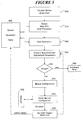
- Fig. 5 a flowchart of the operation of the Control/Application Interface 500 can be seen ., which interface is discussed in more detail below.
- Fig. 3B Another particularly beneficial aspect of the embodiment of Fig. 3B is the provision of a self-determining "performance" or calibration rating that can be used to determine an optimal or maximum data throughput rate.
- the system of Fig. 3B can automatically and adaptively configure a host system 398 to a particular throughput rate based on an evaluation of the available computing power.
- the performance rating is determined based on a calibration rouune executed by Data Pump Device Driver 400. This routine sets a timer, and counts how many DMT frames can be processed within the given time; this gives a relative figure of merit for the particular host system in question. For each sub-channel to be added, one DMT frame needs to be processed within a small fraction of 250 ⁇ s.
- Control/Application Interface 500 provides the user with control to set a threshold of available host power for implementing the high speed link. Based on this threshold of available power (which can be nominally set to 20%) the number of subchannels that can be supported can be gleaned very quickly.
- the host processing power is more likely to be the limiting factor than the frequency band of the subband filter 80 in Figure 1B.
- the present invention affords users an opportunity to realize a high speed data link with performance that is controllable, and which improves whenever there is an upgrade in the host processing system. Since many typical present day personal computer systems have easily accessible and replaceable host processors, users of the present invention can easily and flexibly expand and enhance the throughput and functionality of an ADSL modem.
- a user of host processing system 398 can, for the first time, dynamically control a forward compatible and expandable modem, such as an ADSL modem, using modem-control applications software that is analogous to that only previously available for voice band modems.
- ADSL Modem Card 396 is automatically detected by Operating System 480 and set up by initialization routine 505 by Modem Device Driver 400.
- a separate detection routine 510 determines whether or not ADSL Modem Card 396 has been upgraded with an additional AFE (as described generally with reference to Figure 6 below), or alternatively whether a processor used in a host system has changed.
- This step is primarily to determine whether entries in a Device Parameters Table 560 need to be updated because of changes in computing power, front end capabilities or other parameters that may necessitate a modification of the data throughput characterization of the overall system when used in a communications mode.
- a calibration routine 520 is then executed to determine the nominal setup parameters for the overall system in the manner described earlier.
- the results from this operation are stored in Device Paramater Table 560 where they then become accessible to vanous application programs that may make use of ADSL Modem Card 396 and Device Driver 400.
- the information stored in table 560 can include any or all of the following (a) measurements of the computing power available to the host processor; (b) measurements of the number of frames processable by the system within a particular time period; (c) estimations of the expected loading on the processing system based on demands of other applications programs and peripheral devices; (d) minimum and maximum data throughput estimations and/or targets; (e) data identifying the type of host processor; (f) data identifying the number and type of AFEs in ADSL Modem card 396; (g) estimations and/or target system loading rates available for a datalink (i.e., maximum available processing time to be used by the system during data transmission); (h) data transmit and receive buffer sizes; ( i) interrupt or similar priority data for the modem card; (j) estimations and/or target system sub-channel utilization; (k) estimations and/or target system sub-channel bit capacity information; etc. It will be apparent to skilled artisans that the above are just examples of the types of information that may be pertinent to the performance of a high speed communications
- a Manual Configuration routine 530 is executed.
- various system performance data can be presented to the user for review, along with a list of modifiable system options 532. If for example, the user elects to increase the desired throughput rate, a Verification routine 540 is then executed to determine whether such rate is reasonably sustainable within the other parameters of the system.
- the Device Parameter Table 560 is updated, and the setup routine again ends. Otherwise, the user is alerted by a Notification/Suggestion routine 550, which points out the failure of the proposed configuration, and, if possible, makes suggestions to the user for modifying the system options 532 so that overall compliance can be achieved within the performance capability of the host processing system. The program then loops back to Acceptance routine 525, and thereafter the process is repeated until an acceptable configuration has been achieved, and any changes have been incorporated into Device Parameter Table 560.
- Control/Application Interface 500 As with the design of the above Data Pump Device Driver 400, the general design of the Control/Application Interface 500 required to accomplish the above functions is a routine task well within the abilities of one skilled in the art given the teachings herein. The specifics of such implementation are not critical or essential to the present inventions, and will vary from application to application according to system designer requirements, so they are not included here. Again, while this embodiment of the present invention is set out in the context of a PC based host processor running Windows, it will be apparent to those skilled in the art that above description is merely an exemplary implementation.
- the referenced Control/Application Interface can be employed in numerous host processing/operating system environments, and in a variety of different coding organizations (high level or low level processing forms) well-known in the art.
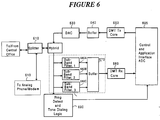
- FIG. 6 illustrates an example of the present invention wherein a user can achieve significantly increased data throughput using multiple low cost, low sampling speed AFEs, generally designated 680A, 680B, 680C, etc.
- these AFEs may be in separate, modular form and configured in a bank form so that they can be incorporated conveniently on a printed circuit board (or similar mounting) or integrated in a single IC chip.
- Each AFE can be implemented in a fixed hardware configuration, or individually programmed/controlled to pass a certain portion of the downstream data transmission. Assuming suitable processing power is available for DMT modulation/demodulation (either through a dedicated or software implementation as described above in connection with Figs. 3A and 3B) a user of such system can achieve substantially expanded functionality by upgrades having performance characteristics and costs of their choice.
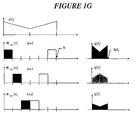
- Figs 1D and 1E The combined model that includes the channel response and the DMT receiver is shown below, where only one branch of band-pass filtering and sampling is shown for simplicity. To further simplify, the channel response and the SFIR are combined together.
- a time domain equalizer called SFIR 82 is used to reduce the combined discrete time impulse response to a duration smaller than c. If the SFIR response is h SFIR [ n ], we have
- H tot [ ⁇ ] H SFIR [ L ⁇ ] H BPF [ ⁇ ]
- H SFIR [ L ⁇ ] and H BPF [ ⁇ ] are the DFT's with period l( LT c ) and l/ T c , respectively.
- H tot [ n ] is a bandpass filter and nonzero only in the intervals [ k ( N/ 2 L ), ( k + l )( N/ 2 L )] and [(2 L - k - l )( N/ 2 L ) (2 L - k )( N /2 L )], where 0 ⁇ k ⁇ L , the possible values of m that is nonzero for 0 ⁇ n ⁇ ( N/L ) are as follows.
- Control/Application software 500 would provide a user with selectable control to effectuate a restricted upstream transmission on limited sub-channels.
- the upstream pilot tone must also be transmitted to establish a valid data link
- An optional limited "upstream" transmission can be effectuated in a variety of ways by the circuitry already described above in connection with Figs. 2 and 3. The exact details of such implementation will be apparent to those of skill in the art given the present teachings.
Landscapes
- Engineering & Computer Science (AREA)
- Signal Processing (AREA)
- Computer Networks & Wireless Communication (AREA)
- Quality & Reliability (AREA)
- Communication Control (AREA)
- Telephonic Communication Services (AREA)
- Data Exchanges In Wide-Area Networks (AREA)
Applications Claiming Priority (2)
| Application Number | Priority Date | Filing Date | Title |
|---|---|---|---|
| US884895 | 1997-06-30 | ||
| US08/884,895 US6252900B1 (en) | 1997-06-30 | 1997-06-30 | Forward compatible and expandable high speed communications system and method of operation |
Publications (3)
| Publication Number | Publication Date |
|---|---|
| EP0889615A2 true EP0889615A2 (de) | 1999-01-07 |
| EP0889615A3 EP0889615A3 (de) | 2001-04-18 |
| EP0889615B1 EP0889615B1 (de) | 2009-12-16 |
Family
ID=25385657
Family Applications (1)
| Application Number | Title | Priority Date | Filing Date |
|---|---|---|---|
| EP98112040A Expired - Lifetime EP0889615B1 (de) | 1997-06-30 | 1998-06-30 | Mehrträgerübertragung mit änderbarer Datenrate |
Country Status (4)
| Country | Link |
|---|---|
| US (2) | US6252900B1 (de) |
| EP (1) | EP0889615B1 (de) |
| JP (1) | JPH1188920A (de) |
| DE (1) | DE69841378D1 (de) |
Cited By (16)
| Publication number | Priority date | Publication date | Assignee | Title |
|---|---|---|---|---|
| DE19802600A1 (de) * | 1998-01-23 | 1999-08-05 | Siemens Ag | Verfahren zur digitalen Datenübertragung mit variabler Bandbreite |
| WO2000076115A1 (en) * | 1999-06-04 | 2000-12-14 | Telefonaktiebolaget Lm Ericsson (Publ) | Method and device in a multi-tone transmission system |
| EP0889614A3 (de) * | 1997-06-30 | 2001-04-18 | Integrated Telecom Express | Automatischer Datenratenanpassung |
| WO2001065793A1 (en) * | 2000-02-28 | 2001-09-07 | Advanced Micro Devices, Inc. | Method and apparatus for buffering data samples in a software based adsl modem |
| WO2001067757A3 (en) * | 2000-03-10 | 2001-11-29 | Elysium Broadband Inc | Audio/video and data signal redistribution system |
| WO2002013405A2 (en) | 2000-08-10 | 2002-02-14 | Aware, Inc. | Systems and methods for characterizing transmission lines in a multi-carrier dsl environment |
| WO2003013015A1 (en) | 2001-07-30 | 2003-02-13 | Catena Networks, Inc. | Loop diagnostic mode for adsl modems |
| EP1179937A4 (de) * | 1999-05-21 | 2003-09-10 | Fujitsu Ltd | Signalübertragungsvorrichtung |
| KR100402785B1 (ko) * | 2000-12-27 | 2003-10-22 | 한국전자통신연구원 | 가변 전송율을 가지는 큐에이엠 트랜시이버 장치 |
| US6658052B2 (en) | 2000-01-07 | 2003-12-02 | Aware, Inc. | Systems and methods for establishing a diagnostic transmission mode and communicating over the same |
| WO2004015914A1 (en) * | 2002-08-12 | 2004-02-19 | Smartlink Ltd. | High-speed analog modem |
| US6934368B2 (en) | 2002-08-12 | 2005-08-23 | Smartlink Ltd. | Multi-band modem |
| US6934325B2 (en) | 1996-01-08 | 2005-08-23 | Smart Link Ltd. | Multi-line distributed modem |
| US7151794B2 (en) | 2002-08-14 | 2006-12-19 | Smartlink Ltd. | Modem channel sharing based on frequency division |
| EP1143690A3 (de) * | 2000-04-03 | 2007-09-05 | Virata Corporation | Verfahren und Vorrichtung zur adaptiven Datenzuweisung in einem Mehrträgerübertragungssystem |
| CN120103034A (zh) * | 2025-05-08 | 2025-06-06 | 沈阳地铁集团有限公司 | 一种地铁信号兼容性测试系统 |
Families Citing this family (41)
| Publication number | Priority date | Publication date | Assignee | Title |
|---|---|---|---|---|
| US6442195B1 (en) * | 1997-06-30 | 2002-08-27 | Integrated Telecom Express, Inc. | Multiple low speed sigma-delta analog front ends for full implementation of high-speed data link protocol |
| US6466588B1 (en) * | 1997-09-18 | 2002-10-15 | Globespanvirata, Inc. | Apparatus for facilitating combined POTS and xDSL services at a customer premises |
| US20030026282A1 (en) * | 1998-01-16 | 2003-02-06 | Aware, Inc. | Splitterless multicarrier modem |
| US5999565A (en) * | 1997-10-15 | 1999-12-07 | Cisco Technology, Inc. | Data communication using a modifiable number of XDSL modems |
| GB2332602B (en) * | 1997-12-22 | 2000-03-08 | Lsi Logic Corp | Improvements relating to multidirectional communication systems |
| US6735245B1 (en) * | 1998-01-09 | 2004-05-11 | Panasonic Communications Co., Ltd. | Activation of multiple XDSL modems with channel probe |
| DE19805546C2 (de) * | 1998-02-11 | 2000-02-17 | Siemens Ag | Verfahren und Funkstation zur Datenübertragung |
| JP2001036499A (ja) * | 1999-07-23 | 2001-02-09 | Fujitsu Ltd | 通信帯域設定方法及び通信装置 |
| JP4008162B2 (ja) * | 1999-08-18 | 2007-11-14 | 富士通株式会社 | 通信方法、及び通信装置 |
| US6516290B1 (en) * | 1999-08-20 | 2003-02-04 | Winbond Electronics Corp. | Method for measuring the nonlinearity of an analog front end system |
| JP4260394B2 (ja) * | 1999-10-14 | 2009-04-30 | 富士通株式会社 | 回線終端方法及び回線終端装置 |
| US7747002B1 (en) * | 2000-03-15 | 2010-06-29 | Broadcom Corporation | Method and system for stereo echo cancellation for VoIP communication systems |
| CA2303631A1 (en) * | 2000-03-31 | 2001-09-30 | Catena Networks Canada Inc. | A system and method for programmable spectrum management |
| CA2406151C (en) | 2000-04-18 | 2010-04-13 | Aware, Inc. | Data allocation with variable snr margins |
| CA2314405A1 (en) * | 2000-07-24 | 2002-01-24 | Catena Networks Canada Inc. | An improved 8 bits/symbol messaging scheme for g.lite.bis and g.dmt.bis |
| US7260067B2 (en) * | 2001-05-22 | 2007-08-21 | Agere Systems Inc. | Spectrum and bin reassignment protocol for ADSL |
| US7295623B2 (en) * | 2001-07-11 | 2007-11-13 | Vativ Technologies, Inc. | High-speed communications transceiver |
| US7236757B2 (en) * | 2001-07-11 | 2007-06-26 | Vativ Technologies, Inc. | High-speed multi-channel communications transceiver with inter-channel interference filter |
| US20030112896A1 (en) * | 2001-07-11 | 2003-06-19 | Raghavan Sreen A. | Multi-channel communications transceiver |
| US20030053493A1 (en) * | 2001-09-18 | 2003-03-20 | Joseph Graham Mobley | Allocation of bit streams for communication over-multi-carrier frequency-division multiplexing (FDM) |
| US7336680B2 (en) * | 2001-09-18 | 2008-02-26 | Scientific-Atlanta, Inc. | Multi-carrier frequency-division multiplexing (FDM) architecture for high speed digital service |
| WO2003040736A1 (en) * | 2001-11-07 | 2003-05-15 | Aware, Inc. | Modeling and calibrating a three-port time-domain reflectometry system |
| US7406117B2 (en) | 2002-03-21 | 2008-07-29 | Westell Technologies, Inc. | XDSL multi-hybrid modem with power spectral density shaping |
| US7590145B2 (en) * | 2002-09-17 | 2009-09-15 | Scientific-Atlanta, Inc. | Multiplexing octets from a data flow over MPEG packets |
| US7640373B2 (en) * | 2003-04-25 | 2009-12-29 | Motorola, Inc. | Method and apparatus for channel quality feedback within a communication system |
| US7388904B2 (en) * | 2003-06-03 | 2008-06-17 | Vativ Technologies, Inc. | Near-end, far-end and echo cancellers in a multi-channel transceiver system |
| US7792122B2 (en) * | 2003-07-28 | 2010-09-07 | Nagra Thomson Licensing | Transmission protocol automatic detection method for a portable object such as a chip card or a chip key |
| US20050059366A1 (en) * | 2003-09-16 | 2005-03-17 | Atheros Communications, Inc. | Spur mitigation techniques |
| US20050129094A1 (en) * | 2003-12-11 | 2005-06-16 | Trutna William R.Jr. | Communication system using wavelength spread-spectrum coding |
| SE0303607D0 (sv) | 2003-12-30 | 2003-12-30 | Ericsson Telefon Ab L M | Brandwidth signalling |
| TWI276347B (en) * | 2005-11-18 | 2007-03-11 | Hon Hai Prec Ind Co Ltd | An xDSL modem and method for stabilizing the xDSL operation thereof |
| TWI298230B (en) * | 2005-12-16 | 2008-06-21 | Hon Hai Prec Ind Co Ltd | An xdsl modem and method for stabilizing xdsl operation thereof |
| GB2436416A (en) * | 2006-03-20 | 2007-09-26 | Nec Corp | Signal resource allocation in a communication system using a plurality of subcarriers |
| US7616568B2 (en) * | 2006-11-06 | 2009-11-10 | Ixia | Generic packet generation |
| US8190760B2 (en) * | 2008-01-15 | 2012-05-29 | Echostar Advanced Technologies L.L.C. | System and method of managing multiple video players |
| US9832442B2 (en) | 2008-01-15 | 2017-11-28 | Echostar Technologies Llc | System and method of managing multiple video players executing on multiple devices |
| CN101552755B (zh) * | 2008-04-03 | 2013-08-21 | 展讯通信(上海)有限公司 | 基于子载波的信号收发方法及收发信机 |
| US20090274226A1 (en) * | 2008-05-05 | 2009-11-05 | Motorola, Inc. | Sounding channel based feedback in a wireless communication system |
| CN102754521A (zh) * | 2011-04-20 | 2012-10-24 | 华为技术有限公司 | 数据传输方法、无线接入网设备、无线网关及系统 |
| US8855706B2 (en) * | 2011-11-10 | 2014-10-07 | Intel Mobile Communications GmbH | Communication terminals and methods for controlling a receiver of a communication terminal |
| KR102179237B1 (ko) | 2016-01-22 | 2020-11-16 | 주식회사 소니 인터랙티브 엔터테인먼트 | 하위 호환성을 위한 cpuid 스푸핑 |
Family Cites Families (35)
| Publication number | Priority date | Publication date | Assignee | Title |
|---|---|---|---|---|
| US5646983A (en) | 1993-03-25 | 1997-07-08 | U.S. Robotics Access Corp. | Host computer digital signal processing system for communicating over voice-grade telephone channels |
| US5479447A (en) * | 1993-05-03 | 1995-12-26 | The Board Of Trustees Of The Leland Stanford, Junior University | Method and apparatus for adaptive, variable bandwidth, high-speed data transmission of a multicarrier signal over digital subscriber lines |
| US5678059A (en) | 1994-02-18 | 1997-10-14 | Lucent Technologies Inc. | Technique for time-sharing a microprocessor between a computer and a modem |
| US5625651A (en) * | 1994-06-02 | 1997-04-29 | Amati Communications, Inc. | Discrete multi-tone data transmission system using an overhead bus for synchronizing multiple remote units |
| US5592470A (en) * | 1994-12-21 | 1997-01-07 | At&T | Broadband wireless system and network architecture providing broadband/narrowband service with optimal static and dynamic bandwidth/channel allocation |
| US5835536A (en) * | 1995-02-02 | 1998-11-10 | Motorola, Inc. | Method and apparatus for reducing peak-to-average requirements in multi-tone communication circuits |
| US5677905A (en) * | 1995-03-28 | 1997-10-14 | Bell Atlantic Network Services, Inc. | Access subnetwork controller for video dial tone networks |
| KR0155818B1 (ko) * | 1995-04-29 | 1998-11-16 | 김광호 | 다중 반송파 전송시스템에서 적응형 전력 분배 방법 및 장치 |
| US5812786A (en) * | 1995-06-21 | 1998-09-22 | Bell Atlantic Network Services, Inc. | Variable rate and variable mode transmission system |
| US5726978A (en) * | 1995-06-22 | 1998-03-10 | Telefonaktiebolaget L M Ericsson Publ. | Adaptive channel allocation in a frequency division multiplexed system |
| US5742527A (en) * | 1996-03-15 | 1998-04-21 | Motorola, Inc. | Flexible asymmetrical digital subscriber line (ADSL) receiver, central office using same, and method therefor |
| US5765021A (en) | 1996-03-27 | 1998-06-09 | Pc-Tel, Inc. | Computer system having second program for transferring data between second port connected to a first port and the software portion of a modem |
| US5666383A (en) | 1996-05-08 | 1997-09-09 | International Business Machines Corporation | Variable rate discrete multiple tone bidirectional transmission |
| US5987061A (en) * | 1996-05-09 | 1999-11-16 | Texas Instruments Incorporated | Modem initialization process for line code and rate selection in DSL data communication |
| US6002722A (en) | 1996-05-09 | 1999-12-14 | Texas Instruments Incorporated | Multimode digital modem |
| US6055268A (en) | 1996-05-09 | 2000-04-25 | Texas Instruments Incorporated | Multimode digital modem |
| US6044107A (en) | 1996-05-09 | 2000-03-28 | Texas Instruments Incorporated | Method for interoperability of a T1E1.4 compliant ADSL modem and a simpler modem |
| US5751716A (en) | 1996-06-19 | 1998-05-12 | Aware, Inc. | Multi-carrier transmission system adapted for packet data transfer |
| US5715280A (en) | 1996-06-20 | 1998-02-03 | Aware, Inc. | Method for partially modulating and demodulating data in a multi-carrier transmission system |
| US5982814A (en) | 1996-08-01 | 1999-11-09 | Pc-Tel, Inc. | Dynamic control of processor utilization by a host signal processing modem |
| SG99276A1 (en) | 1996-09-04 | 2003-10-27 | Texas Instruments Inc | A multiplexed approach to adsl atu-c concentration |
| EP0828363A3 (de) | 1996-09-04 | 2000-04-05 | Texas Instruments Incorporated | Mehrmodenmodem mit einer Mehrzahl von analogen Ein- und Ausgangsschaltungen |
| US6014425A (en) | 1997-02-26 | 2000-01-11 | Paradyne Corporation | Apparatus and method for qualifying telephones and other attached equipment for optimum DSL operation |
| US5925114A (en) | 1997-03-21 | 1999-07-20 | Motorola, Inc. | Modem implemented in software for operation on a general purpose computer having operating system with different execution priority levels |
| US6353857B2 (en) | 1997-03-31 | 2002-03-05 | Intel Corporation | Controllerless modem |
| US5931950A (en) | 1997-06-17 | 1999-08-03 | Pc-Tel, Inc. | Wake-up-on-ring power conservation for host signal processing communication system |
| US6647058B1 (en) | 1997-06-23 | 2003-11-11 | Paradyne Corporation | Performance customization system and process for optimizing XDSL performance |
| US6128335A (en) * | 1997-06-30 | 2000-10-03 | Integrated Telecom Express | Software rate adaptable modem with forward compatible and expandable functionality and method of operation |
| US6230118B1 (en) | 1997-06-30 | 2001-05-08 | Cirrus Logic, Inc. | DOS based application supports for a controllerless modem |
| US6138190A (en) | 1997-09-16 | 2000-10-24 | Cirrus Logic, Inc. | Analog front end and digital signal processing device and method |
| US6101216A (en) | 1997-10-03 | 2000-08-08 | Rockwell International Corporation | Splitterless digital subscriber line communication system |
| EP1021901B1 (de) | 1997-10-10 | 2009-11-25 | Daphimo Co. B.V., LLC | Teilerloses mehrträgermodem |
| US6065131A (en) | 1997-11-26 | 2000-05-16 | International Business Machines Corporation | Multi-speed DSP kernel and clock mechanism |
| US6112266A (en) | 1998-01-22 | 2000-08-29 | Pc-Tel, Inc. | Host signal processing modem using a software circular buffer in system memory and direct transfers of samples to maintain a communication signal |
| US6498806B1 (en) | 1998-08-17 | 2002-12-24 | International Business Machines Corporation | Shared asymmetric digital subscriber line modem |
-
1997
- 1997-06-30 US US08/884,895 patent/US6252900B1/en not_active Expired - Lifetime
-
1998
- 1998-06-30 JP JP10185423A patent/JPH1188920A/ja active Pending
- 1998-06-30 EP EP98112040A patent/EP0889615B1/de not_active Expired - Lifetime
- 1998-06-30 DE DE69841378T patent/DE69841378D1/de not_active Expired - Lifetime
-
2000
- 2000-12-19 US US09/741,748 patent/US20010007574A1/en not_active Abandoned
Cited By (39)
| Publication number | Priority date | Publication date | Assignee | Title |
|---|---|---|---|---|
| US6934325B2 (en) | 1996-01-08 | 2005-08-23 | Smart Link Ltd. | Multi-line distributed modem |
| EP0889614A3 (de) * | 1997-06-30 | 2001-04-18 | Integrated Telecom Express | Automatischer Datenratenanpassung |
| DE19802600A1 (de) * | 1998-01-23 | 1999-08-05 | Siemens Ag | Verfahren zur digitalen Datenübertragung mit variabler Bandbreite |
| EP1179937A4 (de) * | 1999-05-21 | 2003-09-10 | Fujitsu Ltd | Signalübertragungsvorrichtung |
| US6775524B2 (en) | 1999-05-21 | 2004-08-10 | Fujitsu Limited | Signal transmitting apparatus |
| WO2000076115A1 (en) * | 1999-06-04 | 2000-12-14 | Telefonaktiebolaget Lm Ericsson (Publ) | Method and device in a multi-tone transmission system |
| US10264119B2 (en) | 2000-01-07 | 2019-04-16 | Tq Delta, Llc | Systems and methods for establishing a diagnostic transmission mode and communicating over the same |
| US7570686B2 (en) | 2000-01-07 | 2009-08-04 | Aware, Inc. | Systems and methods for establishing a diagnostic transmission mode and communicating over the same |
| US8238412B2 (en) | 2000-01-07 | 2012-08-07 | Aware, Inc. | Multicarrier modulation messaging for power level per subchannel information |
| US9838531B2 (en) | 2000-01-07 | 2017-12-05 | Tq Delta, Llc | Systems and methods for establishing a diagnostic transmission mode and communicating over the same |
| US6658052B2 (en) | 2000-01-07 | 2003-12-02 | Aware, Inc. | Systems and methods for establishing a diagnostic transmission mode and communicating over the same |
| US8929423B2 (en) | 2000-01-07 | 2015-01-06 | Tq Delta, Llc | Systems and methods for establishing a diagnostic transmission mode and communicating over the same |
| US10623559B2 (en) | 2000-01-07 | 2020-04-14 | Tq Delta, Llc | Systems and methods for establishing a diagnostic transmission mode and communicating over the same |
| US8743931B2 (en) | 2000-01-07 | 2014-06-03 | Tq Delta, Llc | Systems and methods for a transceiver to transmit or receive test information over a communication channel using multicarrier modulation |
| US7889784B2 (en) | 2000-01-07 | 2011-02-15 | Aware, Inc. | Multicarrier modulation messaging for SNR per subchannel during showtime information |
| US9973624B2 (en) | 2000-01-07 | 2018-05-15 | Tq Delta, Llc | Systems and methods for establishing a diagnostic transmission mode and communicating over the same |
| US8634449B2 (en) | 2000-01-07 | 2014-01-21 | Tq Delta, Llc | Systems and methods for establishing a diagnostic transmission mode and communicating over the same |
| US7835430B2 (en) | 2000-01-07 | 2010-11-16 | Aware, Inc. | Multicarrier modulation messaging for frequency domain received idle channel noise information |
| US8432956B2 (en) | 2000-01-07 | 2013-04-30 | Tq Delta, Llc | Multicarrier modulation messaging for power level per subchannel information |
| US7076016B1 (en) | 2000-02-28 | 2006-07-11 | Advanced Micro Devices, Inc. | Method and apparatus for buffering data samples in a software based ADSL modem |
| WO2001065793A1 (en) * | 2000-02-28 | 2001-09-07 | Advanced Micro Devices, Inc. | Method and apparatus for buffering data samples in a software based adsl modem |
| KR100734532B1 (ko) * | 2000-02-28 | 2007-07-04 | 어드밴스드 마이크로 디바이시즈, 인코포레이티드 | 소프트웨어 기반 adsl 모뎀에서 데이터 샘플들을버퍼링하기 위한 방법과 장치 |
| WO2001067757A3 (en) * | 2000-03-10 | 2001-11-29 | Elysium Broadband Inc | Audio/video and data signal redistribution system |
| EP1143690A3 (de) * | 2000-04-03 | 2007-09-05 | Virata Corporation | Verfahren und Vorrichtung zur adaptiven Datenzuweisung in einem Mehrträgerübertragungssystem |
| US8559489B2 (en) | 2000-08-10 | 2013-10-15 | Aware, Inc. | Systems and methods for characterizing transmission lines using broadband signals in a multi-carrier DSL environment |
| US8903049B2 (en) | 2000-08-10 | 2014-12-02 | Broadcom Corporation | Systems and methods for characterizing transmission lines using broadband signals in a multi-carrier DSL environment |
| US7773666B2 (en) | 2000-08-10 | 2010-08-10 | Aware, Inc. | Systems and methods for characterizing transmission lines using broadband signals in a multi-carrier DSL environment |
| WO2002013405A2 (en) | 2000-08-10 | 2002-02-14 | Aware, Inc. | Systems and methods for characterizing transmission lines in a multi-carrier dsl environment |
| WO2002013405A3 (en) * | 2000-08-10 | 2003-01-30 | Aware Inc | Systems and methods for characterizing transmission lines in a multi-carrier dsl environment |
| US8743937B2 (en) | 2000-08-10 | 2014-06-03 | Aware, Inc. | Systems and methods for characterizing transmission lines using broadband signals in a multi-carrier DSL environment |
| US8208519B2 (en) | 2000-08-10 | 2012-06-26 | Aware, Inc. | Systems and methods for characterizing transmission lines using broadband signals in a multi-carrier DSL environment |
| EP2270997A3 (de) * | 2000-08-10 | 2014-06-25 | Aware, Inc. | Systeme und Verfahren zur Charakterisierung von Übertragunsleitern in einem DSL Mehrträgersystem |
| KR100402785B1 (ko) * | 2000-12-27 | 2003-10-22 | 한국전자통신연구원 | 가변 전송율을 가지는 큐에이엠 트랜시이버 장치 |
| WO2003013015A1 (en) | 2001-07-30 | 2003-02-13 | Catena Networks, Inc. | Loop diagnostic mode for adsl modems |
| EP1413065A4 (de) * | 2001-07-30 | 2007-12-19 | Ciena Corp | Schleifendiagnosemodus für adsl-modems |
| WO2004015914A1 (en) * | 2002-08-12 | 2004-02-19 | Smartlink Ltd. | High-speed analog modem |
| US6934368B2 (en) | 2002-08-12 | 2005-08-23 | Smartlink Ltd. | Multi-band modem |
| US7151794B2 (en) | 2002-08-14 | 2006-12-19 | Smartlink Ltd. | Modem channel sharing based on frequency division |
| CN120103034A (zh) * | 2025-05-08 | 2025-06-06 | 沈阳地铁集团有限公司 | 一种地铁信号兼容性测试系统 |
Also Published As
| Publication number | Publication date |
|---|---|
| EP0889615A3 (de) | 2001-04-18 |
| US20010007574A1 (en) | 2001-07-12 |
| US6252900B1 (en) | 2001-06-26 |
| EP0889615B1 (de) | 2009-12-16 |
| DE69841378D1 (de) | 2010-01-28 |
| JPH1188920A (ja) | 1999-03-30 |
Similar Documents
| Publication | Publication Date | Title |
|---|---|---|
| US6252900B1 (en) | Forward compatible and expandable high speed communications system and method of operation | |
| US6073179A (en) | Program for controlling DMT based modem using sub-channel selection to achieve scaleable data rate based on available signal processing resources | |
| US6092122A (en) | xDSL DMT modem using sub-channel selection to achieve scaleable data rate based on available signal processing resources | |
| US6065060A (en) | Modular multiplicative data rate modem and method of operation | |
| US6128335A (en) | Software rate adaptable modem with forward compatible and expandable functionality and method of operation | |
| US6400759B1 (en) | Device driver for rate adaptable modem with forward compatible and expandable functionality | |
| JP3897301B2 (ja) | 継ぎ目のないレート適合を使用する高速初期化 | |
| EP0981222B1 (de) | Empfängerabhängige Kodierung für diskrete Multitonmodulation | |
| US6522731B2 (en) | Data communication apparatus | |
| US6934254B2 (en) | Method and apparatus for dynamically allocating resources in a communication system | |
| EP0981242B1 (de) | Geteilter Modem für digitale Teilnehmerleitungen | |
| JP3883384B2 (ja) | 可変オーバヘッドレートを有するマルチキャリア通信 | |
| US6324212B1 (en) | Apparatus using low spectrum selectively for providing both ADSL and POTS service | |
| US6519280B1 (en) | Method and apparatus for inserting idle symbols | |
| EP1231733A1 (de) | Verfahren zur Übertragungleistungsregelung in einer Teilnehmerleitung | |
| US20160336992A1 (en) | Reconfigurable communication device and method | |
| US6788705B1 (en) | Transmitting DSL startup parameters over a voice channel | |
| EP2568637A1 (de) | Dynamische Interleaver/Deinterleaver Pufferpartitionierung | |
| US7076010B1 (en) | Method and apparatus for time domain equalization in an XDSL modem | |
| US20020075949A1 (en) | Variable bandwidth discrete multi-tone (DMT) rate-adaptive asymmetric digital subscriber line (RADSL) transceiver | |
| US8705676B2 (en) | Method and apparatus for clock recovery in XDSL transceivers | |
| JP3685756B2 (ja) | 加入者モデムを用いて伝送データを伝送する方法 | |
| HK1017793A (en) | Multicarrier transmission with variable data rate | |
| WO1999065218A1 (en) | Method and apparatus for scaling modem transfer capacity based on resource availability | |
| HK1017792A (en) | Automatic rate adaptation |
Legal Events
| Date | Code | Title | Description |
|---|---|---|---|
| PUAI | Public reference made under article 153(3) epc to a published international application that has entered the european phase |
Free format text: ORIGINAL CODE: 0009012 |
|
| AK | Designated contracting states |
Kind code of ref document: A2 Designated state(s): BE DE FR GB IT NL |
|
| AX | Request for extension of the european patent |
Free format text: AL;LT;LV;MK;RO;SI |
|
| K1C3 | Correction of patent application (complete document) published |
Effective date: 19990107 |
|
| PUAL | Search report despatched |
Free format text: ORIGINAL CODE: 0009013 |
|
| AK | Designated contracting states |
Kind code of ref document: A3 Designated state(s): AT BE CH CY DE DK ES FI FR GB GR IE IT LI LU MC NL PT SE |
|
| AX | Request for extension of the european patent |
Free format text: AL;LT;LV;MK;RO;SI |
|
| 17P | Request for examination filed |
Effective date: 20011016 |
|
| AKX | Designation fees paid |
Free format text: BE DE FR GB IT NL |
|
| REG | Reference to a national code |
Ref country code: HK Ref legal event code: WD Ref document number: 1017793 Country of ref document: HK |
|
| 17Q | First examination report despatched |
Effective date: 20050818 |
|
| GRAP | Despatch of communication of intention to grant a patent |
Free format text: ORIGINAL CODE: EPIDOSNIGR1 |
|
| GRAS | Grant fee paid |
Free format text: ORIGINAL CODE: EPIDOSNIGR3 |
|
| GRAA | (expected) grant |
Free format text: ORIGINAL CODE: 0009210 |
|
| AK | Designated contracting states |
Kind code of ref document: B1 Designated state(s): BE DE FR GB IT NL |
|
| REG | Reference to a national code |
Ref country code: GB Ref legal event code: FG4D |
|
| REF | Corresponds to: |
Ref document number: 69841378 Country of ref document: DE Date of ref document: 20100128 Kind code of ref document: P |
|
| REG | Reference to a national code |
Ref country code: NL Ref legal event code: VDEP Effective date: 20091216 |
|
| RAP2 | Party data changed (patent owner data changed or rights of a patent transferred) |
Owner name: REALTEK SEMICONDUCTOR CORPORATION |
|
| REG | Reference to a national code |
Ref country code: GB Ref legal event code: 732E Free format text: REGISTERED BETWEEN 20100422 AND 20100428 |
|
| PG25 | Lapsed in a contracting state [announced via postgrant information from national office to epo] |
Ref country code: NL Free format text: LAPSE BECAUSE OF FAILURE TO SUBMIT A TRANSLATION OF THE DESCRIPTION OR TO PAY THE FEE WITHIN THE PRESCRIBED TIME-LIMIT Effective date: 20091216 |
|
| PG25 | Lapsed in a contracting state [announced via postgrant information from national office to epo] |
Ref country code: BE Free format text: LAPSE BECAUSE OF FAILURE TO SUBMIT A TRANSLATION OF THE DESCRIPTION OR TO PAY THE FEE WITHIN THE PRESCRIBED TIME-LIMIT Effective date: 20091216 |
|
| PLBE | No opposition filed within time limit |
Free format text: ORIGINAL CODE: 0009261 |
|
| STAA | Information on the status of an ep patent application or granted ep patent |
Free format text: STATUS: NO OPPOSITION FILED WITHIN TIME LIMIT |
|
| 26N | No opposition filed |
Effective date: 20100917 |
|
| REG | Reference to a national code |
Ref country code: FR Ref legal event code: ST Effective date: 20110228 |
|
| PG25 | Lapsed in a contracting state [announced via postgrant information from national office to epo] |
Ref country code: IT Free format text: LAPSE BECAUSE OF FAILURE TO SUBMIT A TRANSLATION OF THE DESCRIPTION OR TO PAY THE FEE WITHIN THE PRESCRIBED TIME-LIMIT Effective date: 20091216 |
|
| PG25 | Lapsed in a contracting state [announced via postgrant information from national office to epo] |
Ref country code: FR Free format text: LAPSE BECAUSE OF NON-PAYMENT OF DUE FEES Effective date: 20100630 |
|
| REG | Reference to a national code |
Ref country code: DE Ref legal event code: R082 Ref document number: 69841378 Country of ref document: DE Representative=s name: HOEFER & PARTNER PATENTANWAELTE MBB, DE Ref country code: DE Ref legal event code: R082 Ref document number: 69841378 Country of ref document: DE Representative=s name: HOEFER & PARTNER, DE |
|
| PGFP | Annual fee paid to national office [announced via postgrant information from national office to epo] |
Ref country code: GB Payment date: 20170519 Year of fee payment: 20 |
|
| PGFP | Annual fee paid to national office [announced via postgrant information from national office to epo] |
Ref country code: DE Payment date: 20170630 Year of fee payment: 20 |
|
| REG | Reference to a national code |
Ref country code: DE Ref legal event code: R071 Ref document number: 69841378 Country of ref document: DE |
|
| REG | Reference to a national code |
Ref country code: GB Ref legal event code: PE20 Expiry date: 20180629 |
|
| PG25 | Lapsed in a contracting state [announced via postgrant information from national office to epo] |
Ref country code: GB Free format text: LAPSE BECAUSE OF EXPIRATION OF PROTECTION Effective date: 20180629 |