EP0890303B1 - Perfectionnement aux cornadis. - Google Patents
Perfectionnement aux cornadis. Download PDFInfo
- Publication number
- EP0890303B1 EP0890303B1 EP98112048A EP98112048A EP0890303B1 EP 0890303 B1 EP0890303 B1 EP 0890303B1 EP 98112048 A EP98112048 A EP 98112048A EP 98112048 A EP98112048 A EP 98112048A EP 0890303 B1 EP0890303 B1 EP 0890303B1
- Authority
- EP
- European Patent Office
- Prior art keywords
- control rod
- stop
- locking member
- axis
- locking
- Prior art date
- Legal status (The legal status is an assumption and is not a legal conclusion. Google has not performed a legal analysis and makes no representation as to the accuracy of the status listed.)
- Expired - Lifetime
Links
Images

Classifications
-
- A—HUMAN NECESSITIES
- A01—AGRICULTURE; FORESTRY; ANIMAL HUSBANDRY; HUNTING; TRAPPING; FISHING
- A01K—ANIMAL HUSBANDRY; AVICULTURE; APICULTURE; PISCICULTURE; FISHING; REARING OR BREEDING ANIMALS, NOT OTHERWISE PROVIDED FOR; NEW BREEDS OF ANIMALS
- A01K1/00—Housing animals; Equipment therefor
- A01K1/06—Devices for fastening animals, e.g. halters, toggles, neck-bars or chain fastenings
- A01K1/0606—Devices for fastening animals, e.g. halters, toggles, neck-bars or chain fastenings by means of grids with or without movable locking bars
Definitions
- the present invention relates to devices installed in front of a trough and intended to limit the movements of animals eating.
- head locks Such devices, called head locks, are commonly used.
- a headlock see e.g. document NL-A-9 000 107, in which the immobilization of the animal is obtained by lowering the head in a constituted frame, on the one hand, by a column of the gantry and, on the other part, by a pendulum mounted on a pivot and guided by the upper spar of said gantry.
- the fork upper of the balance contains a valve which enters in contact with a stop fixed on a tube located on the upper beam and which allows by a 90 ° swivel the locking position and unlocking.
- This system has the disadvantage of not ability to prevent strangulation of animals.
- each opening contains a pendulum formed of two elements articulated around an axis so as to make the element superior independent of the lower element.
- the element lower is connected at its lower end to a control rod mounted to slide along the lower spar.
- the upper end of the upper element is fitted with a sliding valve along a control rod that extends parallel to the upper beam.
- the feed lock according to the invention allows a second unlocking on the lower side member of the lock. This unlocking guarantees perfect security for animals when the mechanism is in the self-service open position. In addition, this head locks are quieter.
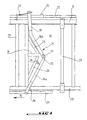
- Figure 1 is a partial view of a headlock according to the invention, in the open position.
- Figure 2 is a figure similar to that of the Figure 1, the headlock being in position closing.
- the stall portico partially shown on the drawings include, as is common, a upper spar 11, a lower spar 12 and vertical uprights 13 delimiting openings 10 to allow passage to the head of the animals.
- each opening 10 is provided with a balance 14 composed of two elements 14a and 14b pivoting on an axis 15.
- the pendulum 14 is suspended from a support 16 by through a pivot axis 17, located at a certain distance from the axis 15, above the latter.
- the support 16 is produced in the form of a bar substantially horizontal and integral at its end opposite the pivot axis 17, of the upright 13 which delimits the opening on the balance side, substantially at middle of the opening.
- slashes 25 and 26 Between the amount 13 and the support bar 16 are still attached, on both sides other of it, slashes 25 and 26 respectively.
- the lower slash 26 carries a stop 24 which limits the movement of pivoting of the element 14a around the axis 15.
- the lower end of the pendulum element 14a 14 is terminated by a fork 18 connected to a control rod 20 along the lower beam 12.
- the upper end of the element 14b is finished by a fork 19 which can slide along the upper spar 11.
- a valve 21 resting on a control rod 22 which runs along the upper side member 11.
- the control rod 22 is mounted to be able to pivot around its axis longitudinal and carries a stop 23.
- the valve and the stop are configured so that the valve can pass over the stop when the fork moves from left to right, but is blocked behind the stop after passing it. To free the fork then you have to rotate the rod command to clear the stop of the trajectory of the valve seen, for example from a 90 ° angle.
- the control rod 22 serves to disengage the valve 21 from stop 23 and puts the balance back in the open position.
- the opening movement is facilitated by the lower rod 20 and the stop 24 which allows at the same time the blocking of all mechanism.
- the headlock being in the closed position, it suffices to rotate the control rod 22 around its longitudinal axis to release the valve 21 from the stop 23. This allows the upper member 14b to pivot around the axis 15 and the animal to take out the head.
- the animal can push back the lower element 14a, this which puts the upper element 14b in vertical position closing (figure 2). Since in its open self-service position, pendulum 14 is blocked by the rod 20 and the stop 24 the headlock according to the invention provides an effective solution to noise and rapid wear problems inherent in known feeders.
Landscapes
- Life Sciences & Earth Sciences (AREA)
- Zoology (AREA)
- Environmental Sciences (AREA)
- Animal Husbandry (AREA)
- Biodiversity & Conservation Biology (AREA)
- Catching Or Destruction (AREA)
- Housing For Livestock And Birds (AREA)
- Refuge Islands, Traffic Blockers, Or Guard Fence (AREA)
- Fencing (AREA)
Description
Claims (3)
- Cornadis constitué d'un portique comprenant des longerons supérieur et inférieur et des montants qui délimitent des ouvertures (10) juxtaposées, le plan de chaque ouverture contenant un balancier suspendu à un support, caractérisé en ce que chaque balancier est constitué de deux éléments (14a, 14b) articulés autour d'un axe (15), l'élément inférieur (14a) étant relié à son extrémité inférieure à une tringle de commande (20) montée pour coulisser le long du longeron inférieur (12), et l'extrémité supérieure de l'élément supérieur (14b) étant munie d'un clapet (21) coulissant le long d'une tige de commande (22) qui s'étend parallèlement au longeron supérieur (11).
- Cornadis suivant la revendication 1, caractérisé en ce que la tige de commande (22) porte un arrêt (23) escamotable entre une position qui peut bloquer le clapet (21) et une position qui dégage le clapet (21).
- Cornadis suivant la revendication 1 ou 2, caractérisé en ce qu'il comporte une butée (24) pour bloquer le mécanisme lorsque l'élément inférieur (14a) se trouve en position inclinée.
Applications Claiming Priority (2)
| Application Number | Priority Date | Filing Date | Title |
|---|---|---|---|
| BE9700593A BE1011268A6 (fr) | 1997-07-09 | 1997-07-09 | Perfectionnement aux cornadis. |
| BE9700593 | 1997-07-09 |
Publications (2)
| Publication Number | Publication Date |
|---|---|
| EP0890303A1 EP0890303A1 (fr) | 1999-01-13 |
| EP0890303B1 true EP0890303B1 (fr) | 2000-06-14 |
Family
ID=3890626
Family Applications (1)
| Application Number | Title | Priority Date | Filing Date |
|---|---|---|---|
| EP98112048A Expired - Lifetime EP0890303B1 (fr) | 1997-07-09 | 1998-06-30 | Perfectionnement aux cornadis. |
Country Status (4)
| Country | Link |
|---|---|
| US (1) | US5970909A (fr) |
| EP (1) | EP0890303B1 (fr) |
| BE (1) | BE1011268A6 (fr) |
| CA (1) | CA2243037C (fr) |
Families Citing this family (2)
| Publication number | Priority date | Publication date | Assignee | Title |
|---|---|---|---|---|
| US20070047712A1 (en) * | 2003-03-07 | 2007-03-01 | Cirrus Logic, Inc. | Scalable, distributed architecture for fully connected network intercom system |
| CN109349144A (zh) * | 2018-10-26 | 2019-02-19 | 贵州大学 | 一种适用于不同年龄羊的可调节颈架 |
Family Cites Families (5)
| Publication number | Priority date | Publication date | Assignee | Title |
|---|---|---|---|---|
| US4377131A (en) * | 1981-05-15 | 1983-03-22 | August Vandenberg | Stanchion construction |
| IT1203884B (it) * | 1986-04-16 | 1989-02-23 | Lentzen Paul | Collaro snodato per mangiatoia |
| NL9000107A (nl) * | 1990-01-16 | 1991-08-16 | Johannes Martinus Willibrordus | Voerhek. |
| US4976224A (en) * | 1990-04-26 | 1990-12-11 | John Hatfield | Double hinged cattle stanchion apparatus |
| US5694887A (en) * | 1995-10-06 | 1997-12-09 | Vandenberg; August | Cattle stanchion with floating latch |
-
1997
- 1997-07-09 BE BE9700593A patent/BE1011268A6/fr not_active IP Right Cessation
-
1998
- 1998-06-30 EP EP98112048A patent/EP0890303B1/fr not_active Expired - Lifetime
- 1998-07-06 CA CA002243037A patent/CA2243037C/fr not_active Expired - Lifetime
- 1998-07-08 US US09/112,121 patent/US5970909A/en not_active Expired - Fee Related
Also Published As
| Publication number | Publication date |
|---|---|
| BE1011268A6 (fr) | 1999-07-06 |
| CA2243037C (fr) | 2001-05-29 |
| EP0890303A1 (fr) | 1999-01-13 |
| CA2243037A1 (fr) | 1999-01-09 |
| US5970909A (en) | 1999-10-26 |
Similar Documents
| Publication | Publication Date | Title |
|---|---|---|
| FR2700799A1 (fr) | Dispositif d'ancrage mobile permettant le déplacement en toute sécurité selon un axe horizontal. | |
| EP0890303B1 (fr) | Perfectionnement aux cornadis. | |
| EP0562991B1 (fr) | Système de fermeture de cases pour animaux notamment des porcs | |
| CA2343607A1 (fr) | Perfectionnement aux cornadis | |
| EP1040753B1 (fr) | Barrière à cornadis | |
| FR2597300A1 (fr) | Cornadis. | |
| LU82765A1 (fr) | Dispositif anti-chute a action de blocage instantanee | |
| BE1009126A6 (fr) | Perfectionnement aux cornadis. | |
| EP4258863B1 (fr) | Cornadis | |
| BE1005726A5 (fr) | Cornadis. | |
| LU87691A1 (fr) | Perfectionnement a un cornadis | |
| FR2611801A1 (fr) | Portillon du type a tourniquet et utilisation d'un tel portillon | |
| EP2023778B1 (fr) | Support sécurisé pour matelas à langer | |
| FR2685164A1 (fr) | Cornadis pour animaux encornes. | |
| EP0097406B1 (fr) | Dispositif pour attacher un animal | |
| FR2783134A1 (fr) | Cornadis | |
| BE904606A (fr) | Cornadis | |
| FR3116990A1 (fr) | Cornadis | |
| FR2790189A1 (fr) | Cornadis pour animaux encornes, en particulier pour des bovins | |
| FR2781120A1 (fr) | Dispositif pour guider et mettre en place automatiquement des animaux en position de traite et/ou d'alimentation et installation dotee d'au moins un tel dispositif | |
| FR2591846A1 (fr) | Perfectionnement au dispositif support de charrue reversible portable, du type a roue pendulaire. | |
| FR2611429A1 (fr) | Perfectionnement des installations de traite | |
| FR2761229A1 (fr) | Installation de cases adjacentes pour animaux, notamment de cases gestantes d'une porcherie | |
| FR2617529A1 (fr) | Mecanisme d'ouverture et de fermeture de portes, avec possibilite d'entrebaillement, notamment pour cabines de transports par cables | |
| FR2824232A1 (fr) | Cornadis double |
Legal Events
| Date | Code | Title | Description |
|---|---|---|---|
| PUAI | Public reference made under article 153(3) epc to a published international application that has entered the european phase |
Free format text: ORIGINAL CODE: 0009012 |
|
| AK | Designated contracting states |
Kind code of ref document: A1 Designated state(s): BE FR LU NL |
|
| AX | Request for extension of the european patent |
Free format text: AL;LT;LV;MK;RO;SI |
|
| 17P | Request for examination filed |
Effective date: 19990517 |
|
| GRAG | Despatch of communication of intention to grant |
Free format text: ORIGINAL CODE: EPIDOS AGRA |
|
| 17Q | First examination report despatched |
Effective date: 19990729 |
|
| AKX | Designation fees paid |
Free format text: BE FR LU NL |
|
| REG | Reference to a national code |
Ref country code: DE Ref legal event code: 8566 |
|
| GRAG | Despatch of communication of intention to grant |
Free format text: ORIGINAL CODE: EPIDOS AGRA |
|
| GRAH | Despatch of communication of intention to grant a patent |
Free format text: ORIGINAL CODE: EPIDOS IGRA |
|
| GRAH | Despatch of communication of intention to grant a patent |
Free format text: ORIGINAL CODE: EPIDOS IGRA |
|
| GRAA | (expected) grant |
Free format text: ORIGINAL CODE: 0009210 |
|
| AK | Designated contracting states |
Kind code of ref document: B1 Designated state(s): BE FR LU NL |
|
| PLBE | No opposition filed within time limit |
Free format text: ORIGINAL CODE: 0009261 |
|
| STAA | Information on the status of an ep patent application or granted ep patent |
Free format text: STATUS: NO OPPOSITION FILED WITHIN TIME LIMIT |
|
| RAP2 | Party data changed (patent owner data changed or rights of a patent transferred) |
Owner name: N.V. AGRINBO S.A. |
|
| RIN2 | Information on inventor provided after grant (corrected) |
Free format text: VANDEVELDE, NOEL |
|
| 26N | No opposition filed | ||
| NLT2 | Nl: modifications (of names), taken from the european patent patent bulletin |
Owner name: N.V. AGRINBO S.A. |
|
| NLS | Nl: assignments of ep-patents |
Owner name: N.V. AGRINBO S.A. |
|
| REG | Reference to a national code |
Ref country code: FR Ref legal event code: TP |
|
| PGFP | Annual fee paid to national office [announced via postgrant information from national office to epo] |
Ref country code: FR Payment date: 20050428 Year of fee payment: 8 |
|
| PGFP | Annual fee paid to national office [announced via postgrant information from national office to epo] |
Ref country code: LU Payment date: 20050520 Year of fee payment: 8 |
|
| PGFP | Annual fee paid to national office [announced via postgrant information from national office to epo] |
Ref country code: NL Payment date: 20050627 Year of fee payment: 8 |
|
| PGFP | Annual fee paid to national office [announced via postgrant information from national office to epo] |
Ref country code: BE Payment date: 20050707 Year of fee payment: 8 |
|
| PG25 | Lapsed in a contracting state [announced via postgrant information from national office to epo] |
Ref country code: BE Free format text: LAPSE BECAUSE OF NON-PAYMENT OF DUE FEES Effective date: 20060630 |
|
| PG25 | Lapsed in a contracting state [announced via postgrant information from national office to epo] |
Ref country code: NL Free format text: LAPSE BECAUSE OF NON-PAYMENT OF DUE FEES Effective date: 20070101 |
|
| NLV4 | Nl: lapsed or anulled due to non-payment of the annual fee |
Effective date: 20070101 |
|
| REG | Reference to a national code |
Ref country code: FR Ref legal event code: ST Effective date: 20070228 |
|
| BERE | Be: lapsed |
Owner name: S.A. *AGRINBO N.V. Effective date: 20060630 |
|
| PG25 | Lapsed in a contracting state [announced via postgrant information from national office to epo] |
Ref country code: FR Free format text: LAPSE BECAUSE OF NON-PAYMENT OF DUE FEES Effective date: 20060630 |
|
| PG25 | Lapsed in a contracting state [announced via postgrant information from national office to epo] |
Ref country code: LU Free format text: LAPSE BECAUSE OF NON-PAYMENT OF DUE FEES Effective date: 20060630 |