EP0891092A2 - Procédé pour la reconstruction d'un signal binaire de forme - Google Patents
Procédé pour la reconstruction d'un signal binaire de forme Download PDFInfo
- Publication number
- EP0891092A2 EP0891092A2 EP19970306621 EP97306621A EP0891092A2 EP 0891092 A2 EP0891092 A2 EP 0891092A2 EP 19970306621 EP19970306621 EP 19970306621 EP 97306621 A EP97306621 A EP 97306621A EP 0891092 A2 EP0891092 A2 EP 0891092A2
- Authority
- EP
- European Patent Office
- Prior art keywords
- lines
- segments
- interpolation
- target
- overlapping
- Prior art date
- Legal status (The legal status is an assumption and is not a legal conclusion. Google has not performed a legal analysis and makes no representation as to the accuracy of the status listed.)
- Granted
Links
Images


Classifications
-
- G—PHYSICS
- G06—COMPUTING OR CALCULATING; COUNTING
- G06T—IMAGE DATA PROCESSING OR GENERATION, IN GENERAL
- G06T9/00—Image coding
- G06T9/20—Contour coding, e.g. using detection of edges
-
- H—ELECTRICITY
- H04—ELECTRIC COMMUNICATION TECHNIQUE
- H04N—PICTORIAL COMMUNICATION, e.g. TELEVISION
- H04N19/00—Methods or arrangements for coding, decoding, compressing or decompressing digital video signals
- H04N19/50—Methods or arrangements for coding, decoding, compressing or decompressing digital video signals using predictive coding
- H04N19/59—Methods or arrangements for coding, decoding, compressing or decompressing digital video signals using predictive coding involving spatial sub-sampling or interpolation, e.g. alteration of picture size or resolution
-
- H—ELECTRICITY
- H04—ELECTRIC COMMUNICATION TECHNIQUE
- H04N—PICTORIAL COMMUNICATION, e.g. TELEVISION
- H04N19/00—Methods or arrangements for coding, decoding, compressing or decompressing digital video signals
- H04N19/20—Methods or arrangements for coding, decoding, compressing or decompressing digital video signals using video object coding
Definitions
- the present invention relates to a binary shape encoding and decoding method; and, more particularly, to a method for restoring a binary shape signal which is compressed by using a sub-sampling or a down-sampling technique.
- each video frame signal comprises a sequence of digital data referred to as pixel values. Since, however, the available frequency bandwidth of a conventional transmission channel is limited, in order to transmit the substantial amount of digital data therethrough, it is necessary to compress or reduce the volume of data through the use of various data compression techniques, especially, in the case of such low bit-rate video signal encoders as video-telephone and teleconference systems.
- One of such techniques for encoding video signals for a low bit-rate encoding system is an object-oriented analysis-synthesis coding technique wherein an input video image is divided into objects; and three sets of parameters for defining the motion, contour and pixel data of each object are processed through different encoding channels.
- MPEG-4 Motion Picture Experts Group
- MPEG-4 Video Verification Model Version 2.0, International Organisation for Standardisation, ISO/IEC JTC1/SC29/WG11 N1260, March 1996.
- an input video image is divided into a plurality of video object planes(VOP's), which correspond to entities in a bitstream that a user can access and manipulate.
- VOP can be referred to as an object and represented by a bounding rectangle whose width and height may be the smallest multiples of 16 pixels(a macroblock size) surrounding each object so that the encoder may process the input video image on a VOP-by-VOP basis, i.e., an object-by-object basis.
- a VOP described in MPEG-4 includes shape information and color information consisting of luminance and chrominance data, wherein the shape information is represented by, e.g., a binary mask and related to the luminance data.
- the binary mask one binary value, e.g., 0, is used to designate a pixel located outside the object in the VOP and the other binary value, e.g., 1, is used to indicate a pixel inside the object. Therefore, the shape of an object in a VOP may be made easily noticeable by employing a binary mask.
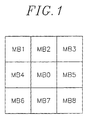
- a binary shape signal e.g., a binary mask representing a VOP, that contains one or more subblocks, as exemplarily described in Fig. 1, is downsized through, e.g., a known sub-sampling or a down-sampling technique.
- each of the subblock of MxM pixels is down-sampled to (MxCR)x(MxCR) pixels, and then up-sampled back to MxM pixels, M being a positive integer equal to or greater than 1/CR.
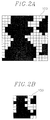
- each of the subblocks consisting of 16x16 pixels as described in Fig. 2A is downsized to a sample block of 8x8 pixels as shown in Fig. 2B.
- each binary pixel of the sample block is encoded by using a known encoding method, e.g., a context-based arithmetic encoding(CAE) algorithm(see, for example, MPEG-4 Video Verification Model Version 7.0, International Organisation for Standardisation, ISO/IEC JTC1/SC29/WG11 N1642, pp. 28-33, April 1997), and is transmitted through a conventional transmission channel.
- CAE context-based arithmetic encoding
- the encoder produces a reconstruction block of 16x16 pixels which is an up-sampled block of the downsized sample block so as to find a difference between the reconstruction block and the original subblock thereof.
- the difference representing the error due to the sampling process is also encoded and transmitted through the conventional transmission channel to thereby reproduce the original subblock at a decoder of a receiving end.
- the decoder also generates the reconstruction block by up-sampling the received sample block in the same manner as used at the encoder and combines the reconstruction block and the received error to thereby reproduce the original subblock.
- the error rate of the decoder depends on how close the reconstruction block is to the original subblock. Therefore, it is very important to find a method capable of effectively up-sampling the sample block in order to reduce the error rate and to enhance the effectiveness of the sampling process as well.
- a method for restoring a binary shape signal, downsized through the use of a sub-sampling or a down-sampling technique comprising the steps of: (a) receiving the downsized binary shape signal containing a plurality of reference lines, wherein each reference line includes one or more segments and non-segments, a segment being represented by one or more successive object pixels and a non-segment being defined by one or more successive background pixels; (b) producing interpolation lines based on the number of segments on each of the reference lines, positions of the segments, and the number of object pixels included in each of the segments; and (c) providing the restored binary shape signal by combining the interpolation lines and the reference lines.
- a binary shape signal containing a plurality of subblocks as shown in Fig. 1 is downsized on a block-by-block basis through the application of a sub-sampling or a down-sampling technique. Therefore, the sampled binary shape signal will be up-sampled on the block-by-block basis.
- a sample block constituting the sampled binary shape signal is up-sampled to an interpolation block having the same size as the subblock through vertical and/or horizontal interpolation processes.
- the vertical and the horizontal interpolation processes are sequentially applied one after the other or independently applied from each other depending on the characteristics of the sampling technique.
- a subblock and a corresponding sample block produced by the sampling process there are shown a subblock and a corresponding sample block produced by the sampling process.
- the subblock 100 of 16x16 pixels is downsized to a sample block 150 of 8x8 pixels by the use of the sampling process having CR of 1/2. Therefore, in order to extend the sample block 150 to an interpolation block of 16x16 pixels in accordance with the present invention, the vertical and horizontal interpolation processes should be sequentially performed as exemplarily described in Figs. 4A to 4F or Figs. 5A to 5F.
- the vertical interpolation process precedes the horizontal interpolation process, the order of the interpolation processes may be reversed. That is, the horizontal interpolation can be carried out prior to the vertical interpolation.
- a black part represents object pixels constituting an object and a white part indicates a background.
- the sample block is first vertically or horizontally divided into a plurality of reference lines. Then, segments and non-segments on each of the reference lines are detected, wherein each segment is represented by one or more successive object pixels and each non-segment is defined by one or more successive background pixels. Based on the segments on the reference lines, interpolation lines are generated to constitute the interpolation block together with the reference lines.
- Figs. 3A to 3D there are illustrated predetermined rules for producing corresponding interpolation lines based on the reference lines of the sample block.
- one interpolation line is produced based on two neighboring reference lines.
- a segment 30A on an interpolation line 30 resulted from the reference lines 10 and 20 is determined based on positions of starting and ending points of the overlapping segments 10A and 20A. Therefore, the starting point of the segment 30A is calculated by averaging the respective starting points 2 and 1 of the segments 10A and 20A and truncating the average value 1.5 to 1. Likewise, the ending point of the segment 30A is determined as 5 obtained by truncating the average value of the ending points 5 and 6 of the segments 10A and 20A.
- the overlapping segments 10A and 20A represent segments overlapped when the reference lines 10 and 20 are overlapped with each other. The overlap of the reference lines 10 and 20 is accomplished by comparing object pixel positions contained in segments on the reference lines 10 and 20.
- segments 40A and 50A on the reference lines 40 and 50 if there are non-overlapping segments 40A and 50A on the reference lines 40 and 50 and each of the non-overlapping segments 40A and 50A has a pixel located on a first or a last pixel position of the corresponding reference line as shown in Fig. 3B, wherein the non-overlapping segments 40A and 50A represent segments which do not overlap when the reference lines 40 and 50 are overlapped with each other, segments 60A and 60B on an interpolation line 60 are generated based on the number of pixels within the non-overlapping segments 40A and 50A, respectively. That is, the segment 60A has 2 object pixels which is a half of the number of object pixels on the non-overlapping segment 40A and starts from the first pixel position of the interpolation line 60. While the segment 60B contains one object pixel located on the last pixel position of the interpolation line 60 which is determined by dividing the number of object pixels on the non-overlapping segment 50A by 2 and truncating the division result.
- segments 90A and 90B on an interpolation line 90 are determined based on starting and ending points of the non-overlapping segments 70A and 80A, respectively.
- Starting and ending points of each of the segments 90A and 90B are calculated as follows: SP ⁇ (3 ⁇ P +1 ⁇ Q )/4 EP ⁇ (1 ⁇ P +3 ⁇ Q )/4 wherein SP and EP represent a starting and an ending points of a segment on the interpolation line, respectively; P and Q are a starting and an ending points of a segment on a reference line corresponding to the interpolation line, respectively; and, if a calculated value of the right part is not an integer, the SP or EP is obtained by truncating the calculated value.
- a first reference line 15 consists of one segment and a second reference line 25 has 3 number of segments.
- an interpolation line 35 is constructed by AND-operating on both of the reference lines 15 and 25. Therefore, the interpolation line 35 contains object pixels which are commonly included in segments of the reference lines 15 and 25.
- the interpolation line 35 has the same pixel pattern as the reference line 25 since all of the pixels on the reference line 15 are object pixels.
- the predetermined rules explained with reference to Figs. 3A to 3D can be applied to both of the vertical and the horizontal interpolation processes.
- the predetermined rules are practically adopted to the vertical and the horizontal interpolation processes.
- a procedure of up-sampling the sample block will be introduced in detail.
- the interpolation block corresponding to the sample block 150 is generated based on only the sample block 150.
- the interpolation block is provided based on the relationship between the sample block 150 and its neighboring blocks.
- FIG. 4A to 4F there is illustrated an interpolation process in accordance with the first embodiment.
- the sample block 150 in Fig. 2B is first separated into 8 number of vertical reference lines having assigned indices V2, V4, ..., V16 for each line as shown in Fig. 4A, each vertical reference line containing vertically connected 8 number of pixels.
- the number of segments on each of the vertical reference lines V2 to V16 is detected as 2, 1, 1, 1, 3, 1, 2, 2, starting from the most left vertical reference line V2.
- vertical interpolation lines e.g., V1, V3, ..., V15 in Fig.
- each of the vertical reference lines has an (i+1)st position index and each of the vertical interpolation line is represented by an ith position index, i being an odd number, i.e., 1, 3, ..., and 15. Therefore, for instance, each of the vertical interpolation lines V3 to V15 is determined by its two neighboring vertical reference lines, e.g., V2 and V4, V4 and V6, ..., and V14 and V16. However, since there is only one vertical reference line V2 corresponding to the vertical interpolation line V1, the vertical interpolation line V1 is determined by copying the vertical reference line V2.
- the vertical reference lines may be assigned by indices V1 to V15 and the vertical interpolation lines may be defined by indices V2 to V16.
- the vertical reference lines and the vertical interpolation lines are combined together by rearranging them in the order of increasing i of the index Vi assigned to the vertical reference and interpolation lines, to thereby produce a vertical interpolation block 200 as shown in Fig. 4C.
- the vertical interpolation block 200 of 16x8 pixels produced by the above vertical interpolation process is then horizontally divided into 8 number of horizontal reference lines of 16x1 pixels which are assigned by indices H2, H4, ..., H16 as depicted in Fig. 4D.
- horizontal interpolation lines which are to be inserted between the horizontal reference lines are determined as shown in Fig.
- the newly obtained horizontal interpolation lines H1, H3, ..., H15 are then combined together with the horizontal reference lines H2 to H14 by rearranging them in the order of increasing i of the index Hi thereof to thereby produce an interpolation block 300 of 16x16 pixels in Fig. 4F.
- the first horizontal interpolation line H1 is produced by copying the first horizontal reference line H2 as in the vertical interpolation process.
- a pixel on the left hand side of each horizontal reference line has preference over a pixel on the right hand side thereof.
- an interpolation block corresponding to the sample block 150 is determined based on the sample block 150 and its neighboring sample blocks.
- this embodiment produces the interpolation block of the sample block 150 by using results of interpolation processes of a left and an upper neighboring sample blocks of the sample block 150, wherein it is assumed that the left and the upper neighboring sample blocks have already been interpolated prior to the sample block 150.
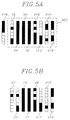
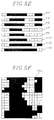
- the sample block 150 in Fig. 2B is first divided into 8 number of vertical reference lines defined by indices V2', V4', ..., V16' as shown in Fig. 5A to thereby provide a set of vertical reference lines 400, wherein each of the vertical reference lines V2' to V16' is identical to the corresponding vertical reference line in the first embodiment.
- This embodiment generates vertical interpolation lines V1', V3', ..., V15' based on the set of vertical reference lines 400 and a vertical reference line V16L belonging to the left neighboring sample block of the sample block 150.
- the vertical reference lines V16L and V2 are used as vertical reference lines for producing the vertical interpolation line V1' according to the predetermined rules.
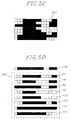
- the rest of vertical interpolation lines V3' to V15' are determined as shown in Fig. 5B by applying the same rules used in the first embodiment which is carried out by comparing the number of segments for each of the vertical reference lines with that for its neighboring vertical reference line. Then, the vertical reference lines V2' to V16' and the vertical interpolation lines V1' to V15' are alternately combined together by rearranging them in the increasing order of the index i of Vi's to thereby produce a vertical interpolation block 500 as shown in Fig. 5C.
- the vertical interpolation block 500 produced by the above vertical interpolation process is then horizontally divided into 8 number of horizontal reference lines which are represented by indices H2', H4', ..., H16' as depicted in Fig. 5D and provided as a set of horizontal reference lines 600.
- horizontal interpolation lines H1', H3', ..., H15' are determined as shown in Fig. 5E.
- the newly obtained horizontal interpolation lines H1' to H15' are then combined with the set of horizontal reference lines H2' to H14' in the same manner used in the first embodiment so that an interpolation block 700 in Fig. 5F is produced.
- the sample block 150 can be extended to the interpolation blocks 300 and 700 which are a little bit different from each other as can be seen from Figs. 4F and 5F.
- the vertical and horizontal interpolation processes illustrated in the embodiments of the present invention can be performed together or independently, and also may be performed more than once depending on the sizes of the sample block and its original subblock.
Landscapes
- Engineering & Computer Science (AREA)
- Multimedia (AREA)
- Physics & Mathematics (AREA)
- General Physics & Mathematics (AREA)
- Theoretical Computer Science (AREA)
- Signal Processing (AREA)
- Compression Or Coding Systems Of Tv Signals (AREA)
- Image Processing (AREA)
- Compression Of Band Width Or Redundancy In Fax (AREA)
- Facsimile Image Signal Circuits (AREA)
Applications Claiming Priority (2)
| Application Number | Priority Date | Filing Date | Title |
|---|---|---|---|
| KR9731655 | 1997-07-09 | ||
| KR1019970031655A KR100235354B1 (ko) | 1997-07-09 | 1997-07-09 | 샘플링된 이진 형상 신호를 복원하기 위한 인터폴레이션 방법 |
Publications (3)
| Publication Number | Publication Date |
|---|---|
| EP0891092A2 true EP0891092A2 (fr) | 1999-01-13 |
| EP0891092A3 EP0891092A3 (fr) | 2001-05-16 |
| EP0891092B1 EP0891092B1 (fr) | 2012-09-19 |
Family
ID=19513777
Family Applications (1)
| Application Number | Title | Priority Date | Filing Date |
|---|---|---|---|
| EP19970306621 Expired - Lifetime EP0891092B1 (fr) | 1997-07-09 | 1997-08-29 | Procédé pour la reconstruction d'un signal binaire de forme |
Country Status (5)
| Country | Link |
|---|---|
| US (1) | US6144409A (fr) |
| EP (1) | EP0891092B1 (fr) |
| JP (1) | JP3924052B2 (fr) |
| KR (1) | KR100235354B1 (fr) |
| CN (1) | CN1123977C (fr) |
Families Citing this family (6)
| Publication number | Priority date | Publication date | Assignee | Title |
|---|---|---|---|---|
| JP3349957B2 (ja) * | 1997-07-09 | 2002-11-25 | 株式会社ハイニックスセミコンダクター | コンテキスト確率表を利用した二進映像情報の内挿装置および方法 |
| US7142729B2 (en) * | 2001-09-10 | 2006-11-28 | Jaldi Semiconductor Corp. | System and method of scaling images using adaptive nearest neighbor |
| JP2006115078A (ja) * | 2004-10-13 | 2006-04-27 | Matsushita Electric Ind Co Ltd | 画像データの信号処理装置及びその方法 |
| US7899667B2 (en) | 2006-06-19 | 2011-03-01 | Electronics And Telecommunications Research Institute | Waveform interpolation speech coding apparatus and method for reducing complexity thereof |
| US9717440B2 (en) * | 2013-05-03 | 2017-08-01 | The Florida International University Board Of Trustees | Systems and methods for decoding intended motor commands from recorded neural signals for the control of external devices or to interact in virtual environments |
| US11087469B2 (en) * | 2018-07-12 | 2021-08-10 | Here Global B.V. | Method, apparatus, and system for constructing a polyline from line segments |
Family Cites Families (10)
| Publication number | Priority date | Publication date | Assignee | Title |
|---|---|---|---|---|
| US5414527A (en) * | 1991-08-14 | 1995-05-09 | Fuji Xerox Co., Ltd. | Image encoding apparatus sensitive to tone variations |
| WO1993014600A1 (fr) * | 1992-01-21 | 1993-07-22 | Supermac Technology | Procede et appareil de compression et de decompression de donnees d'images en couleurs |
| US5288986A (en) * | 1992-09-17 | 1994-02-22 | Motorola, Inc. | Binary code matrix having data and parity bits |
| DE69419439T2 (de) * | 1993-01-11 | 1999-12-16 | Canon K.K., Tokio/Tokyo | Gerät und Verfahren zur Bewegungserfassung |
| DE69512824T2 (de) * | 1994-04-22 | 2000-01-27 | Victor Company Of Japan, Ltd. | Kompressions- und Dekompressionsverfahren für mehrdimensionale mehrwertige Farbbilder |
| US5519436A (en) * | 1994-06-21 | 1996-05-21 | Intel Corporation | Static image background reference for video teleconferencing applications |
| US5691769A (en) * | 1995-09-07 | 1997-11-25 | Daewoo Electronics Co, Ltd. | Apparatus for encoding a contour of an object |
| US5883678A (en) * | 1995-09-29 | 1999-03-16 | Kabushiki Kaisha Toshiba | Video coding and video decoding apparatus for reducing an alpha-map signal at a controlled reduction ratio |
| KR100203656B1 (ko) * | 1996-04-09 | 1999-06-15 | 전주범 | 윤곽 영상신호 부호화 장치 |
| KR100209412B1 (ko) * | 1996-05-10 | 1999-07-15 | 전주범 | 비디오 신호의 유호 색차 성분 부호화 방법 |
-
1997
- 1997-07-09 KR KR1019970031655A patent/KR100235354B1/ko not_active Expired - Fee Related
- 1997-08-29 US US08/919,960 patent/US6144409A/en not_active Expired - Lifetime
- 1997-08-29 EP EP19970306621 patent/EP0891092B1/fr not_active Expired - Lifetime
- 1997-09-02 JP JP23711797A patent/JP3924052B2/ja not_active Expired - Fee Related
- 1997-09-03 CN CN97117949A patent/CN1123977C/zh not_active Expired - Fee Related
Non-Patent Citations (1)
| Title |
|---|
| None |
Also Published As
| Publication number | Publication date |
|---|---|
| US6144409A (en) | 2000-11-07 |
| KR19990009289A (ko) | 1999-02-05 |
| EP0891092B1 (fr) | 2012-09-19 |
| JP3924052B2 (ja) | 2007-06-06 |
| CN1123977C (zh) | 2003-10-08 |
| CN1204896A (zh) | 1999-01-13 |
| KR100235354B1 (ko) | 1999-12-15 |
| EP0891092A3 (fr) | 2001-05-16 |
| JPH1141597A (ja) | 1999-02-12 |
Similar Documents
| Publication | Publication Date | Title |
|---|---|---|
| US5822460A (en) | Method and apparatus for generating chrominance shape information of a video object plane in a video signal | |
| US5748789A (en) | Transparent block skipping in object-based video coding systems | |
| US6483521B1 (en) | Image composition method, image composition apparatus, and data recording media | |
| US5946419A (en) | Separate shape and texture coding of transparency data for video coding applications | |
| US5799113A (en) | Method for expanding contracted video images | |
| EP1589766A2 (fr) | Décompression vidéo basé sur les objets pour segments d'image de formes arbitraires | |
| US6128041A (en) | Method and apparatus for binary shape encoding | |
| EP0831655A2 (fr) | Méthode et appareil pour coder un signal vidéo du contour d'un objet | |
| AU762187B2 (en) | Method and apparatus for padding interlaced macroblock texture information | |
| WO2005055607A1 (fr) | Systeme et procede de codage et de decodage d'une image au moyen d'une carte de flux binaire et support d'enregistrement correspondant | |
| US6133955A (en) | Method for encoding a binary shape signal | |
| JPH08289294A (ja) | 適応量子化による動画像圧縮システム | |
| US5881175A (en) | Method and apparatus for encoding an image signal by using the contour signal thereof | |
| US6144409A (en) | Method for producing a restored binary shape signal based on an interpolation technique | |
| US6049567A (en) | Mode coding method in a binary shape encoding | |
| KR100303085B1 (ko) | 이진형상신호부호화장치및방법 | |
| US5978031A (en) | Method and apparatus for determining an optimum grid for use in a block-based video signal coding system | |
| Whybray et al. | Video coding—techniques, standards and applications | |
| KR100281322B1 (ko) | 이진 형상 신호 부호화 및 복호화 장치와 그 방법 | |
| EP0923250A1 (fr) | Méthode et dispositif de codage adaptatif d'un signal binaire de contour | |
| JPH11317909A (ja) | 画像合成方法,画像合成装置,及びデ―タ記録媒体 | |
| Garnham | Motion compensated video coding | |
| Whybray et al. | Video Coding—Techniques, Standards and Applications | |
| Whybray et al. | TECHNIQUES, STANDARDS | |
| Smolic et al. | Coding and Standardization |
Legal Events
| Date | Code | Title | Description |
|---|---|---|---|
| PUAI | Public reference made under article 153(3) epc to a published international application that has entered the european phase |
Free format text: ORIGINAL CODE: 0009012 |
|
| AK | Designated contracting states |
Kind code of ref document: A2 Designated state(s): CH DE FR GB IT LI NL |
|
| PUAL | Search report despatched |
Free format text: ORIGINAL CODE: 0009013 |
|
| AK | Designated contracting states |
Kind code of ref document: A3 Designated state(s): AT BE CH DE DK ES FI FR GB GR IE IT LI LU MC NL PT SE |
|
| 17P | Request for examination filed |
Effective date: 20011108 |
|
| AKX | Designation fees paid |
Free format text: CH DE FR GB IT LI NL |
|
| RAP1 | Party data changed (applicant data changed or rights of an application transferred) |
Owner name: DAEWOO ELECTRONICS CORPORATION |
|
| 17Q | First examination report despatched |
Effective date: 20060921 |
|
| GRAP | Despatch of communication of intention to grant a patent |
Free format text: ORIGINAL CODE: EPIDOSNIGR1 |
|
| GRAS | Grant fee paid |
Free format text: ORIGINAL CODE: EPIDOSNIGR3 |
|
| GRAA | (expected) grant |
Free format text: ORIGINAL CODE: 0009210 |
|
| AK | Designated contracting states |
Kind code of ref document: B1 Designated state(s): CH DE FR GB IT LI NL |
|
| REG | Reference to a national code |
Ref country code: GB Ref legal event code: FG4D |
|
| REG | Reference to a national code |
Ref country code: CH Ref legal event code: EP |
|
| REG | Reference to a national code |
Ref country code: DE Ref legal event code: R096 Ref document number: 69740477 Country of ref document: DE Effective date: 20121115 |
|
| REG | Reference to a national code |
Ref country code: NL Ref legal event code: VDEP Effective date: 20120919 |
|
| RAP2 | Party data changed (patent owner data changed or rights of a patent transferred) |
Owner name: MAPLE VISION TECHNOLOGIES INC. |
|
| PG25 | Lapsed in a contracting state [announced via postgrant information from national office to epo] |
Ref country code: NL Free format text: LAPSE BECAUSE OF FAILURE TO SUBMIT A TRANSLATION OF THE DESCRIPTION OR TO PAY THE FEE WITHIN THE PRESCRIBED TIME-LIMIT Effective date: 20120919 |
|
| REG | Reference to a national code |
Ref country code: GB Ref legal event code: 732E Free format text: REGISTERED BETWEEN 20130404 AND 20130410 |
|
| REG | Reference to a national code |
Ref country code: DE Ref legal event code: R081 Ref document number: 69740477 Country of ref document: DE Owner name: MAPLE VISION TECHNOLOGIES INC., CA Free format text: FORMER OWNER: DAEWOO ELECTRONICS CORP., SEOUL/SOUL, KR Effective date: 20130313 Ref country code: DE Ref legal event code: R081 Ref document number: 69740477 Country of ref document: DE Owner name: MAPLE VISION TECHNOLOGIES INC., CA Free format text: FORMER OWNER: DAEWOO ELECTRONICS CO., LTD., SEOUL/SOUL, KR Effective date: 20120919 |
|
| PLBE | No opposition filed within time limit |
Free format text: ORIGINAL CODE: 0009261 |
|
| STAA | Information on the status of an ep patent application or granted ep patent |
Free format text: STATUS: NO OPPOSITION FILED WITHIN TIME LIMIT |
|
| 26N | No opposition filed |
Effective date: 20130620 |
|
| PG25 | Lapsed in a contracting state [announced via postgrant information from national office to epo] |
Ref country code: IT Free format text: LAPSE BECAUSE OF FAILURE TO SUBMIT A TRANSLATION OF THE DESCRIPTION OR TO PAY THE FEE WITHIN THE PRESCRIBED TIME-LIMIT Effective date: 20120919 |
|
| REG | Reference to a national code |
Ref country code: DE Ref legal event code: R097 Ref document number: 69740477 Country of ref document: DE Effective date: 20130620 |
|
| REG | Reference to a national code |
Ref country code: CH Ref legal event code: PL |
|
| PG25 | Lapsed in a contracting state [announced via postgrant information from national office to epo] |
Ref country code: LI Free format text: LAPSE BECAUSE OF NON-PAYMENT OF DUE FEES Effective date: 20130831 Ref country code: CH Free format text: LAPSE BECAUSE OF NON-PAYMENT OF DUE FEES Effective date: 20130831 |
|
| REG | Reference to a national code |
Ref country code: FR Ref legal event code: PLFP Year of fee payment: 19 |
|
| PGFP | Annual fee paid to national office [announced via postgrant information from national office to epo] |
Ref country code: DE Payment date: 20150825 Year of fee payment: 19 Ref country code: GB Payment date: 20150826 Year of fee payment: 19 |
|
| PGFP | Annual fee paid to national office [announced via postgrant information from national office to epo] |
Ref country code: FR Payment date: 20150629 Year of fee payment: 19 |
|
| REG | Reference to a national code |
Ref country code: DE Ref legal event code: R119 Ref document number: 69740477 Country of ref document: DE |
|
| GBPC | Gb: european patent ceased through non-payment of renewal fee |
Effective date: 20160829 |
|
| REG | Reference to a national code |
Ref country code: FR Ref legal event code: ST Effective date: 20170428 |
|
| PG25 | Lapsed in a contracting state [announced via postgrant information from national office to epo] |
Ref country code: GB Free format text: LAPSE BECAUSE OF NON-PAYMENT OF DUE FEES Effective date: 20160829 Ref country code: FR Free format text: LAPSE BECAUSE OF NON-PAYMENT OF DUE FEES Effective date: 20160831 Ref country code: DE Free format text: LAPSE BECAUSE OF NON-PAYMENT OF DUE FEES Effective date: 20170301 |