EP0891861A1 - Verpackungs- und Deckelmaterial - Google Patents
Verpackungs- und Deckelmaterial Download PDFInfo
- Publication number
- EP0891861A1 EP0891861A1 EP97810503A EP97810503A EP0891861A1 EP 0891861 A1 EP0891861 A1 EP 0891861A1 EP 97810503 A EP97810503 A EP 97810503A EP 97810503 A EP97810503 A EP 97810503A EP 0891861 A1 EP0891861 A1 EP 0891861A1
- Authority
- EP
- European Patent Office
- Prior art keywords
- layer
- packaging
- lid
- thickness
- layers
- Prior art date
- Legal status (The legal status is an assumption and is not a legal conclusion. Google has not performed a legal analysis and makes no representation as to the accuracy of the status listed.)
- Granted
Links
- 239000000463 material Substances 0.000 title claims abstract description 145
- 238000004806 packaging method and process Methods 0.000 title claims abstract description 60
- 239000010410 layer Substances 0.000 claims abstract description 170
- 239000012790 adhesive layer Substances 0.000 claims abstract description 33
- 238000007789 sealing Methods 0.000 claims abstract description 22
- 238000004519 manufacturing process Methods 0.000 claims abstract description 14
- 238000000034 method Methods 0.000 claims abstract description 13
- 238000000576 coating method Methods 0.000 claims abstract description 11
- 239000011248 coating agent Substances 0.000 claims abstract description 8
- 239000011521 glass Substances 0.000 claims abstract description 7
- 238000007639 printing Methods 0.000 claims description 30
- -1 polyethylene terephthalate Polymers 0.000 claims description 24
- 239000002985 plastic film Substances 0.000 claims description 17
- 229920006255 plastic film Polymers 0.000 claims description 17
- 239000011888 foil Substances 0.000 claims description 16
- 229920000139 polyethylene terephthalate Polymers 0.000 claims description 15
- 239000005020 polyethylene terephthalate Substances 0.000 claims description 13
- 239000005022 packaging material Substances 0.000 claims description 12
- 239000002131 composite material Substances 0.000 claims description 10
- 238000000926 separation method Methods 0.000 claims description 9
- 229910052751 metal Inorganic materials 0.000 claims description 8
- 239000002184 metal Substances 0.000 claims description 8
- 239000012943 hotmelt Substances 0.000 claims description 5
- 239000005026 oriented polypropylene Substances 0.000 claims description 5
- 239000012188 paraffin wax Substances 0.000 claims description 5
- 239000001993 wax Substances 0.000 claims description 5
- 239000004922 lacquer Substances 0.000 claims description 3
- 238000001465 metallisation Methods 0.000 claims description 2
- 230000001464 adherent effect Effects 0.000 claims 1
- 239000000976 ink Substances 0.000 claims 1
- 239000000853 adhesive Substances 0.000 abstract description 32
- 230000001070 adhesive effect Effects 0.000 abstract description 32
- 235000013305 food Nutrition 0.000 abstract description 7
- 235000019506 cigar Nutrition 0.000 abstract 1
- 239000000123 paper Substances 0.000 description 31
- 239000010408 film Substances 0.000 description 14
- 229920005989 resin Polymers 0.000 description 9
- 239000011347 resin Substances 0.000 description 9
- 229920001155 polypropylene Polymers 0.000 description 8
- 238000004040 coloring Methods 0.000 description 7
- 229920003023 plastic Polymers 0.000 description 7
- 239000004033 plastic Substances 0.000 description 7
- 239000004952 Polyamide Substances 0.000 description 6
- 239000004743 Polypropylene Substances 0.000 description 6
- 229920002647 polyamide Polymers 0.000 description 6
- 229920000098 polyolefin Polymers 0.000 description 6
- 239000004698 Polyethylene Substances 0.000 description 5
- 229910052782 aluminium Inorganic materials 0.000 description 5
- XAGFODPZIPBFFR-UHFFFAOYSA-N aluminium Chemical compound [Al] XAGFODPZIPBFFR-UHFFFAOYSA-N 0.000 description 5
- 235000009508 confectionery Nutrition 0.000 description 5
- 239000006185 dispersion Substances 0.000 description 5
- 229920000573 polyethylene Polymers 0.000 description 5
- XEEYBQQBJWHFJM-UHFFFAOYSA-N Iron Chemical compound [Fe] XEEYBQQBJWHFJM-UHFFFAOYSA-N 0.000 description 4
- 239000004793 Polystyrene Substances 0.000 description 4
- PPBRXRYQALVLMV-UHFFFAOYSA-N Styrene Chemical compound C=CC1=CC=CC=C1 PPBRXRYQALVLMV-UHFFFAOYSA-N 0.000 description 4
- 229920002678 cellulose Polymers 0.000 description 4
- 235000013351 cheese Nutrition 0.000 description 4
- 229920001577 copolymer Polymers 0.000 description 4
- JHIVVAPYMSGYDF-UHFFFAOYSA-N cyclohexanone Chemical compound O=C1CCCCC1 JHIVVAPYMSGYDF-UHFFFAOYSA-N 0.000 description 4
- 229920000728 polyester Polymers 0.000 description 4
- 229920002223 polystyrene Polymers 0.000 description 4
- ZWEHNKRNPOVVGH-UHFFFAOYSA-N 2-Butanone Chemical compound CCC(C)=O ZWEHNKRNPOVVGH-UHFFFAOYSA-N 0.000 description 3
- CSCPPACGZOOCGX-UHFFFAOYSA-N Acetone Chemical compound CC(C)=O CSCPPACGZOOCGX-UHFFFAOYSA-N 0.000 description 3
- YMWUJEATGCHHMB-UHFFFAOYSA-N Dichloromethane Chemical compound ClCCl YMWUJEATGCHHMB-UHFFFAOYSA-N 0.000 description 3
- XEKOWRVHYACXOJ-UHFFFAOYSA-N Ethyl acetate Chemical compound CCOC(C)=O XEKOWRVHYACXOJ-UHFFFAOYSA-N 0.000 description 3
- 229920002472 Starch Polymers 0.000 description 3
- YXFVVABEGXRONW-UHFFFAOYSA-N Toluene Chemical compound CC1=CC=CC=C1 YXFVVABEGXRONW-UHFFFAOYSA-N 0.000 description 3
- 239000001913 cellulose Substances 0.000 description 3
- 238000005520 cutting process Methods 0.000 description 3
- 239000003292 glue Substances 0.000 description 3
- SWQJXJOGLNCZEY-UHFFFAOYSA-N helium atom Chemical compound [He] SWQJXJOGLNCZEY-UHFFFAOYSA-N 0.000 description 3
- 229920000642 polymer Polymers 0.000 description 3
- 238000006116 polymerization reaction Methods 0.000 description 3
- 229920002635 polyurethane Polymers 0.000 description 3
- 239000004814 polyurethane Substances 0.000 description 3
- 238000002360 preparation method Methods 0.000 description 3
- 238000004080 punching Methods 0.000 description 3
- 239000002904 solvent Substances 0.000 description 3
- 235000019698 starch Nutrition 0.000 description 3
- 239000008107 starch Substances 0.000 description 3
- 239000012815 thermoplastic material Substances 0.000 description 3
- 229920000298 Cellophane Polymers 0.000 description 2
- RYGMFSIKBFXOCR-UHFFFAOYSA-N Copper Chemical compound [Cu] RYGMFSIKBFXOCR-UHFFFAOYSA-N 0.000 description 2
- 229920001353 Dextrin Polymers 0.000 description 2
- 239000004375 Dextrin Substances 0.000 description 2
- 241001295925 Gegenes Species 0.000 description 2
- 239000004831 Hot glue Substances 0.000 description 2
- PXHVJJICTQNCMI-UHFFFAOYSA-N Nickel Chemical compound [Ni] PXHVJJICTQNCMI-UHFFFAOYSA-N 0.000 description 2
- 229910000831 Steel Inorganic materials 0.000 description 2
- QAOWNCQODCNURD-UHFFFAOYSA-N Sulfuric acid Chemical compound OS(O)(=O)=O QAOWNCQODCNURD-UHFFFAOYSA-N 0.000 description 2
- BZHJMEDXRYGGRV-UHFFFAOYSA-N Vinyl chloride Chemical compound ClC=C BZHJMEDXRYGGRV-UHFFFAOYSA-N 0.000 description 2
- XLOMVQKBTHCTTD-UHFFFAOYSA-N Zinc monoxide Chemical compound [Zn]=O XLOMVQKBTHCTTD-UHFFFAOYSA-N 0.000 description 2
- 238000004026 adhesive bonding Methods 0.000 description 2
- TZCXTZWJZNENPQ-UHFFFAOYSA-L barium sulfate Chemical compound [Ba+2].[O-]S([O-])(=O)=O TZCXTZWJZNENPQ-UHFFFAOYSA-L 0.000 description 2
- 235000013361 beverage Nutrition 0.000 description 2
- 230000001680 brushing effect Effects 0.000 description 2
- 239000000919 ceramic Substances 0.000 description 2
- 238000006243 chemical reaction Methods 0.000 description 2
- 238000005229 chemical vapour deposition Methods 0.000 description 2
- 235000016213 coffee Nutrition 0.000 description 2
- 235000013353 coffee beverage Nutrition 0.000 description 2
- 229910052802 copper Inorganic materials 0.000 description 2
- 239000010949 copper Substances 0.000 description 2
- 235000021185 dessert Nutrition 0.000 description 2
- 235000019425 dextrin Nutrition 0.000 description 2
- 239000000945 filler Substances 0.000 description 2
- 229920000554 ionomer Polymers 0.000 description 2
- 229910052742 iron Inorganic materials 0.000 description 2
- 238000007644 letterpress printing Methods 0.000 description 2
- 150000002739 metals Chemical class 0.000 description 2
- 239000000203 mixture Substances 0.000 description 2
- 229920001568 phenolic resin Polymers 0.000 description 2
- 238000005240 physical vapour deposition Methods 0.000 description 2
- 229920002689 polyvinyl acetate Polymers 0.000 description 2
- 229920000915 polyvinyl chloride Polymers 0.000 description 2
- 239000004800 polyvinyl chloride Substances 0.000 description 2
- GHMLBKRAJCXXBS-UHFFFAOYSA-N resorcinol Chemical compound OC1=CC=CC(O)=C1 GHMLBKRAJCXXBS-UHFFFAOYSA-N 0.000 description 2
- 239000012173 sealing wax Substances 0.000 description 2
- 235000014347 soups Nutrition 0.000 description 2
- 239000010959 steel Substances 0.000 description 2
- 239000000126 substance Substances 0.000 description 2
- 229920001169 thermoplastic Polymers 0.000 description 2
- 239000002966 varnish Substances 0.000 description 2
- XLYOFNOQVPJJNP-UHFFFAOYSA-N water Substances O XLYOFNOQVPJJNP-UHFFFAOYSA-N 0.000 description 2
- 235000013618 yogurt Nutrition 0.000 description 2
- UOCLXMDMGBRAIB-UHFFFAOYSA-N 1,1,1-trichloroethane Chemical compound CC(Cl)(Cl)Cl UOCLXMDMGBRAIB-UHFFFAOYSA-N 0.000 description 1
- DGXAGETVRDOQFP-UHFFFAOYSA-N 2,6-dihydroxybenzaldehyde Chemical compound OC1=CC=CC(O)=C1C=O DGXAGETVRDOQFP-UHFFFAOYSA-N 0.000 description 1
- RSWGJHLUYNHPMX-UHFFFAOYSA-N Abietic-Saeure Natural products C12CCC(C(C)C)=CC2=CCC2C1(C)CCCC2(C)C(O)=O RSWGJHLUYNHPMX-UHFFFAOYSA-N 0.000 description 1
- 229910000838 Al alloy Inorganic materials 0.000 description 1
- ZAMOUSCENKQFHK-UHFFFAOYSA-N Chlorine atom Chemical compound [Cl] ZAMOUSCENKQFHK-UHFFFAOYSA-N 0.000 description 1
- 239000004821 Contact adhesive Substances 0.000 description 1
- 244000043261 Hevea brasiliensis Species 0.000 description 1
- 239000013032 Hydrocarbon resin Substances 0.000 description 1
- 229920000877 Melamine resin Polymers 0.000 description 1
- 241001465754 Metazoa Species 0.000 description 1
- NTIZESTWPVYFNL-UHFFFAOYSA-N Methyl isobutyl ketone Chemical compound CC(C)CC(C)=O NTIZESTWPVYFNL-UHFFFAOYSA-N 0.000 description 1
- UIHCLUNTQKBZGK-UHFFFAOYSA-N Methyl isobutyl ketone Natural products CCC(C)C(C)=O UIHCLUNTQKBZGK-UHFFFAOYSA-N 0.000 description 1
- 239000004368 Modified starch Substances 0.000 description 1
- 229920000881 Modified starch Polymers 0.000 description 1
- 239000000020 Nitrocellulose Substances 0.000 description 1
- 229920000571 Nylon 11 Polymers 0.000 description 1
- 229920000299 Nylon 12 Polymers 0.000 description 1
- 229920002292 Nylon 6 Polymers 0.000 description 1
- 229920000572 Nylon 6/12 Polymers 0.000 description 1
- CTQNGGLPUBDAKN-UHFFFAOYSA-N O-Xylene Chemical compound CC1=CC=CC=C1C CTQNGGLPUBDAKN-UHFFFAOYSA-N 0.000 description 1
- 229920001944 Plastisol Polymers 0.000 description 1
- 229920001283 Polyalkylene terephthalate Polymers 0.000 description 1
- 239000004642 Polyimide Substances 0.000 description 1
- 239000004820 Pressure-sensitive adhesive Substances 0.000 description 1
- KHPCPRHQVVSZAH-HUOMCSJISA-N Rosin Natural products O(C/C=C/c1ccccc1)[C@H]1[C@H](O)[C@@H](O)[C@@H](O)[C@@H](CO)O1 KHPCPRHQVVSZAH-HUOMCSJISA-N 0.000 description 1
- BQCADISMDOOEFD-UHFFFAOYSA-N Silver Chemical compound [Ag] BQCADISMDOOEFD-UHFFFAOYSA-N 0.000 description 1
- GWEVSGVZZGPLCZ-UHFFFAOYSA-N Titan oxide Chemical compound O=[Ti]=O GWEVSGVZZGPLCZ-UHFFFAOYSA-N 0.000 description 1
- XSTXAVWGXDQKEL-UHFFFAOYSA-N Trichloroethylene Chemical group ClC=C(Cl)Cl XSTXAVWGXDQKEL-UHFFFAOYSA-N 0.000 description 1
- 229920001807 Urea-formaldehyde Polymers 0.000 description 1
- XTXRWKRVRITETP-UHFFFAOYSA-N Vinyl acetate Chemical compound CC(=O)OC=C XTXRWKRVRITETP-UHFFFAOYSA-N 0.000 description 1
- 239000002253 acid Substances 0.000 description 1
- 239000002318 adhesion promoter Substances 0.000 description 1
- 235000008452 baby food Nutrition 0.000 description 1
- 230000004888 barrier function Effects 0.000 description 1
- QDNBHWFDWXWFTG-UHFFFAOYSA-N benzene-1,3-diol;formaldehyde;phenol Chemical compound O=C.OC1=CC=CC=C1.OC1=CC=CC(O)=C1 QDNBHWFDWXWFTG-UHFFFAOYSA-N 0.000 description 1
- 238000004061 bleaching Methods 0.000 description 1
- IKZZIQXKLWDPCD-UHFFFAOYSA-N but-1-en-2-ol Chemical compound CCC(O)=C IKZZIQXKLWDPCD-UHFFFAOYSA-N 0.000 description 1
- MTAZNLWOLGHBHU-UHFFFAOYSA-N butadiene-styrene rubber Chemical compound C=CC=C.C=CC1=CC=CC=C1 MTAZNLWOLGHBHU-UHFFFAOYSA-N 0.000 description 1
- 239000005018 casein Substances 0.000 description 1
- 239000004832 casein glue Substances 0.000 description 1
- 235000021240 caseins Nutrition 0.000 description 1
- 229920003086 cellulose ether Polymers 0.000 description 1
- 239000000460 chlorine Substances 0.000 description 1
- 229910052801 chlorine Inorganic materials 0.000 description 1
- 235000019219 chocolate Nutrition 0.000 description 1
- 150000001875 compounds Chemical class 0.000 description 1
- 238000000151 deposition Methods 0.000 description 1
- 230000008021 deposition Effects 0.000 description 1
- 235000011850 desserts Nutrition 0.000 description 1
- 238000009792 diffusion process Methods 0.000 description 1
- 229920001971 elastomer Polymers 0.000 description 1
- 239000003822 epoxy resin Substances 0.000 description 1
- 150000002148 esters Chemical class 0.000 description 1
- 238000001125 extrusion Methods 0.000 description 1
- 239000000835 fiber Substances 0.000 description 1
- 239000002657 fibrous material Substances 0.000 description 1
- 239000003502 gasoline Substances 0.000 description 1
- 229920000578 graft copolymer Polymers 0.000 description 1
- 238000007646 gravure printing Methods 0.000 description 1
- LNEPOXFFQSENCJ-UHFFFAOYSA-N haloperidol Chemical compound C1CC(O)(C=2C=CC(Cl)=CC=2)CCN1CCCC(=O)C1=CC=C(F)C=C1 LNEPOXFFQSENCJ-UHFFFAOYSA-N 0.000 description 1
- 229920001903 high density polyethylene Polymers 0.000 description 1
- 239000004700 high-density polyethylene Substances 0.000 description 1
- 229920001519 homopolymer Polymers 0.000 description 1
- 238000007757 hot melt coating Methods 0.000 description 1
- 229920006270 hydrocarbon resin Polymers 0.000 description 1
- 238000007654 immersion Methods 0.000 description 1
- 229910052500 inorganic mineral Inorganic materials 0.000 description 1
- 235000014109 instant soup Nutrition 0.000 description 1
- 235000015094 jam Nutrition 0.000 description 1
- 238000010030 laminating Methods 0.000 description 1
- 239000012939 laminating adhesive Substances 0.000 description 1
- 229920000126 latex Polymers 0.000 description 1
- 235000015122 lemonade Nutrition 0.000 description 1
- 229920000092 linear low density polyethylene Polymers 0.000 description 1
- 239000004707 linear low-density polyethylene Substances 0.000 description 1
- 229920001179 medium density polyethylene Polymers 0.000 description 1
- 239000004701 medium-density polyethylene Substances 0.000 description 1
- 125000005397 methacrylic acid ester group Chemical group 0.000 description 1
- 229920000609 methyl cellulose Polymers 0.000 description 1
- 239000001923 methylcellulose Substances 0.000 description 1
- 235000010981 methylcellulose Nutrition 0.000 description 1
- 239000010445 mica Substances 0.000 description 1
- 229910052618 mica group Inorganic materials 0.000 description 1
- 239000011707 mineral Substances 0.000 description 1
- 235000019426 modified starch Nutrition 0.000 description 1
- 229920003052 natural elastomer Polymers 0.000 description 1
- 229920001194 natural rubber Polymers 0.000 description 1
- 229910052759 nickel Inorganic materials 0.000 description 1
- 150000004767 nitrides Chemical class 0.000 description 1
- 229920001220 nitrocellulos Polymers 0.000 description 1
- 238000007645 offset printing Methods 0.000 description 1
- 238000007591 painting process Methods 0.000 description 1
- WXZMFSXDPGVJKK-UHFFFAOYSA-N pentaerythritol Chemical compound OCC(CO)(CO)CO WXZMFSXDPGVJKK-UHFFFAOYSA-N 0.000 description 1
- 239000005011 phenolic resin Substances 0.000 description 1
- 239000004014 plasticizer Substances 0.000 description 1
- 239000004999 plastisol Substances 0.000 description 1
- 229920001200 poly(ethylene-vinyl acetate) Polymers 0.000 description 1
- 239000004417 polycarbonate Substances 0.000 description 1
- 229920000515 polycarbonate Polymers 0.000 description 1
- 238000006068 polycondensation reaction Methods 0.000 description 1
- 229920000647 polyepoxide Polymers 0.000 description 1
- 229920005644 polyethylene terephthalate glycol copolymer Polymers 0.000 description 1
- 229920001721 polyimide Polymers 0.000 description 1
- 229920001228 polyisocyanate Polymers 0.000 description 1
- 239000005056 polyisocyanate Substances 0.000 description 1
- 239000011118 polyvinyl acetate Substances 0.000 description 1
- 229920001290 polyvinyl ester Polymers 0.000 description 1
- 229920001289 polyvinyl ether Polymers 0.000 description 1
- 229920000131 polyvinylidene Polymers 0.000 description 1
- 229920000036 polyvinylpyrrolidone Polymers 0.000 description 1
- 239000001267 polyvinylpyrrolidone Substances 0.000 description 1
- 235000013855 polyvinylpyrrolidone Nutrition 0.000 description 1
- 235000021395 porridge Nutrition 0.000 description 1
- 235000014059 processed cheese Nutrition 0.000 description 1
- 235000018102 proteins Nutrition 0.000 description 1
- 102000004169 proteins and genes Human genes 0.000 description 1
- 108090000623 proteins and genes Proteins 0.000 description 1
- 239000010453 quartz Substances 0.000 description 1
- 239000004627 regenerated cellulose Substances 0.000 description 1
- 238000007763 reverse roll coating Methods 0.000 description 1
- 238000005096 rolling process Methods 0.000 description 1
- 239000005060 rubber Substances 0.000 description 1
- 238000007650 screen-printing Methods 0.000 description 1
- VYPSYNLAJGMNEJ-UHFFFAOYSA-N silicon dioxide Inorganic materials O=[Si]=O VYPSYNLAJGMNEJ-UHFFFAOYSA-N 0.000 description 1
- 239000013464 silicone adhesive Substances 0.000 description 1
- 229910052709 silver Inorganic materials 0.000 description 1
- 239000004332 silver Substances 0.000 description 1
- 238000005507 spraying Methods 0.000 description 1
- 238000004544 sputter deposition Methods 0.000 description 1
- 229920003051 synthetic elastomer Polymers 0.000 description 1
- 229920002994 synthetic fiber Polymers 0.000 description 1
- 239000012209 synthetic fiber Substances 0.000 description 1
- 239000005061 synthetic rubber Substances 0.000 description 1
- 239000000454 talc Substances 0.000 description 1
- 229910052623 talc Inorganic materials 0.000 description 1
- 239000004416 thermosoftening plastic Substances 0.000 description 1
- 239000010409 thin film Substances 0.000 description 1
- OGIDPMRJRNCKJF-UHFFFAOYSA-N titanium oxide Inorganic materials [Ti]=O OGIDPMRJRNCKJF-UHFFFAOYSA-N 0.000 description 1
- KHPCPRHQVVSZAH-UHFFFAOYSA-N trans-cinnamyl beta-D-glucopyranoside Natural products OC1C(O)C(O)C(CO)OC1OCC=CC1=CC=CC=C1 KHPCPRHQVVSZAH-UHFFFAOYSA-N 0.000 description 1
- JOYRKODLDBILNP-UHFFFAOYSA-N urethane group Chemical group NC(=O)OCC JOYRKODLDBILNP-UHFFFAOYSA-N 0.000 description 1
- 239000012808 vapor phase Substances 0.000 description 1
- 239000008096 xylene Substances 0.000 description 1
- 239000011787 zinc oxide Substances 0.000 description 1
Images
Classifications
-
- B—PERFORMING OPERATIONS; TRANSPORTING
- B32—LAYERED PRODUCTS
- B32B—LAYERED PRODUCTS, i.e. PRODUCTS BUILT-UP OF STRATA OF FLAT OR NON-FLAT, e.g. CELLULAR OR HONEYCOMB, FORM
- B32B7/00—Layered products characterised by the relation between layers; Layered products characterised by the relative orientation of features between layers, or by the relative values of a measurable parameter between layers, i.e. products comprising layers having different physical, chemical or physicochemical properties; Layered products characterised by the interconnection of layers
- B32B7/04—Interconnection of layers
- B32B7/06—Interconnection of layers permitting easy separation
-
- B—PERFORMING OPERATIONS; TRANSPORTING
- B32—LAYERED PRODUCTS
- B32B—LAYERED PRODUCTS, i.e. PRODUCTS BUILT-UP OF STRATA OF FLAT OR NON-FLAT, e.g. CELLULAR OR HONEYCOMB, FORM
- B32B27/00—Layered products comprising a layer of synthetic resin
- B32B27/06—Layered products comprising a layer of synthetic resin as the main or only constituent of a layer, which is next to another layer of the same or of a different material
- B32B27/08—Layered products comprising a layer of synthetic resin as the main or only constituent of a layer, which is next to another layer of the same or of a different material of synthetic resin
-
- B—PERFORMING OPERATIONS; TRANSPORTING
- B32—LAYERED PRODUCTS
- B32B—LAYERED PRODUCTS, i.e. PRODUCTS BUILT-UP OF STRATA OF FLAT OR NON-FLAT, e.g. CELLULAR OR HONEYCOMB, FORM
- B32B27/00—Layered products comprising a layer of synthetic resin
- B32B27/32—Layered products comprising a layer of synthetic resin comprising polyolefins
-
- B—PERFORMING OPERATIONS; TRANSPORTING
- B32—LAYERED PRODUCTS
- B32B—LAYERED PRODUCTS, i.e. PRODUCTS BUILT-UP OF STRATA OF FLAT OR NON-FLAT, e.g. CELLULAR OR HONEYCOMB, FORM
- B32B27/00—Layered products comprising a layer of synthetic resin
- B32B27/36—Layered products comprising a layer of synthetic resin comprising polyesters
-
- B—PERFORMING OPERATIONS; TRANSPORTING
- B32—LAYERED PRODUCTS
- B32B—LAYERED PRODUCTS, i.e. PRODUCTS BUILT-UP OF STRATA OF FLAT OR NON-FLAT, e.g. CELLULAR OR HONEYCOMB, FORM
- B32B29/00—Layered products comprising a layer of paper or cardboard
- B32B29/002—Layered products comprising a layer of paper or cardboard as the main or only constituent of a layer, which is next to another layer of the same or of a different material
- B32B29/005—Layered products comprising a layer of paper or cardboard as the main or only constituent of a layer, which is next to another layer of the same or of a different material next to another layer of paper or cardboard layer
-
- G—PHYSICS
- G09—EDUCATION; CRYPTOGRAPHY; DISPLAY; ADVERTISING; SEALS
- G09F—DISPLAYING; ADVERTISING; SIGNS; LABELS OR NAME-PLATES; SEALS
- G09F3/00—Labels, tag tickets, or similar identification or indication means; Seals; Postage or like stamps
- G09F3/02—Forms or constructions
-
- B—PERFORMING OPERATIONS; TRANSPORTING
- B32—LAYERED PRODUCTS
- B32B—LAYERED PRODUCTS, i.e. PRODUCTS BUILT-UP OF STRATA OF FLAT OR NON-FLAT, e.g. CELLULAR OR HONEYCOMB, FORM
- B32B2255/00—Coating on the layer surface
- B32B2255/10—Coating on the layer surface on synthetic resin layer or on natural or synthetic rubber layer
-
- B—PERFORMING OPERATIONS; TRANSPORTING
- B32—LAYERED PRODUCTS
- B32B—LAYERED PRODUCTS, i.e. PRODUCTS BUILT-UP OF STRATA OF FLAT OR NON-FLAT, e.g. CELLULAR OR HONEYCOMB, FORM
- B32B2255/00—Coating on the layer surface
- B32B2255/20—Inorganic coating
- B32B2255/205—Metallic coating
-
- B—PERFORMING OPERATIONS; TRANSPORTING
- B32—LAYERED PRODUCTS
- B32B—LAYERED PRODUCTS, i.e. PRODUCTS BUILT-UP OF STRATA OF FLAT OR NON-FLAT, e.g. CELLULAR OR HONEYCOMB, FORM
- B32B2323/00—Polyalkenes
- B32B2323/10—Polypropylene
-
- B—PERFORMING OPERATIONS; TRANSPORTING
- B32—LAYERED PRODUCTS
- B32B—LAYERED PRODUCTS, i.e. PRODUCTS BUILT-UP OF STRATA OF FLAT OR NON-FLAT, e.g. CELLULAR OR HONEYCOMB, FORM
- B32B2367/00—Polyesters, e.g. PET, i.e. polyethylene terephthalate
-
- B—PERFORMING OPERATIONS; TRANSPORTING
- B32—LAYERED PRODUCTS
- B32B—LAYERED PRODUCTS, i.e. PRODUCTS BUILT-UP OF STRATA OF FLAT OR NON-FLAT, e.g. CELLULAR OR HONEYCOMB, FORM
- B32B2435/00—Closures, end caps, stoppers
- B32B2435/02—Closures, end caps, stoppers for containers
-
- B—PERFORMING OPERATIONS; TRANSPORTING
- B32—LAYERED PRODUCTS
- B32B—LAYERED PRODUCTS, i.e. PRODUCTS BUILT-UP OF STRATA OF FLAT OR NON-FLAT, e.g. CELLULAR OR HONEYCOMB, FORM
- B32B2439/00—Containers; Receptacles
-
- B—PERFORMING OPERATIONS; TRANSPORTING
- B65—CONVEYING; PACKING; STORING; HANDLING THIN OR FILAMENTARY MATERIAL
- B65D—CONTAINERS FOR STORAGE OR TRANSPORT OF ARTICLES OR MATERIALS, e.g. BAGS, BARRELS, BOTTLES, BOXES, CANS, CARTONS, CRATES, DRUMS, JARS, TANKS, HOPPERS, FORWARDING CONTAINERS; ACCESSORIES, CLOSURES, OR FITTINGS THEREFOR; PACKAGING ELEMENTS; PACKAGES
- B65D2203/00—Decoration means, markings, information elements, contents indicators
-
- Y—GENERAL TAGGING OF NEW TECHNOLOGICAL DEVELOPMENTS; GENERAL TAGGING OF CROSS-SECTIONAL TECHNOLOGIES SPANNING OVER SEVERAL SECTIONS OF THE IPC; TECHNICAL SUBJECTS COVERED BY FORMER USPC CROSS-REFERENCE ART COLLECTIONS [XRACs] AND DIGESTS
- Y10—TECHNICAL SUBJECTS COVERED BY FORMER USPC
- Y10T—TECHNICAL SUBJECTS COVERED BY FORMER US CLASSIFICATION
- Y10T428/00—Stock material or miscellaneous articles
- Y10T428/14—Layer or component removable to expose adhesive
-
- Y—GENERAL TAGGING OF NEW TECHNOLOGICAL DEVELOPMENTS; GENERAL TAGGING OF CROSS-SECTIONAL TECHNOLOGIES SPANNING OVER SEVERAL SECTIONS OF THE IPC; TECHNICAL SUBJECTS COVERED BY FORMER USPC CROSS-REFERENCE ART COLLECTIONS [XRACs] AND DIGESTS
- Y10—TECHNICAL SUBJECTS COVERED BY FORMER USPC
- Y10T—TECHNICAL SUBJECTS COVERED BY FORMER US CLASSIFICATION
- Y10T428/00—Stock material or miscellaneous articles
- Y10T428/14—Layer or component removable to expose adhesive
- Y10T428/1438—Metal containing
-
- Y—GENERAL TAGGING OF NEW TECHNOLOGICAL DEVELOPMENTS; GENERAL TAGGING OF CROSS-SECTIONAL TECHNOLOGIES SPANNING OVER SEVERAL SECTIONS OF THE IPC; TECHNICAL SUBJECTS COVERED BY FORMER USPC CROSS-REFERENCE ART COLLECTIONS [XRACs] AND DIGESTS
- Y10—TECHNICAL SUBJECTS COVERED BY FORMER USPC
- Y10T—TECHNICAL SUBJECTS COVERED BY FORMER US CLASSIFICATION
- Y10T428/00—Stock material or miscellaneous articles
- Y10T428/14—Layer or component removable to expose adhesive
- Y10T428/1476—Release layer
-
- Y—GENERAL TAGGING OF NEW TECHNOLOGICAL DEVELOPMENTS; GENERAL TAGGING OF CROSS-SECTIONAL TECHNOLOGIES SPANNING OVER SEVERAL SECTIONS OF THE IPC; TECHNICAL SUBJECTS COVERED BY FORMER USPC CROSS-REFERENCE ART COLLECTIONS [XRACs] AND DIGESTS
- Y10—TECHNICAL SUBJECTS COVERED BY FORMER USPC
- Y10T—TECHNICAL SUBJECTS COVERED BY FORMER US CLASSIFICATION
- Y10T428/00—Stock material or miscellaneous articles
- Y10T428/14—Layer or component removable to expose adhesive
- Y10T428/1486—Ornamental, decorative, pattern, or indicia
-
- Y—GENERAL TAGGING OF NEW TECHNOLOGICAL DEVELOPMENTS; GENERAL TAGGING OF CROSS-SECTIONAL TECHNOLOGIES SPANNING OVER SEVERAL SECTIONS OF THE IPC; TECHNICAL SUBJECTS COVERED BY FORMER USPC CROSS-REFERENCE ART COLLECTIONS [XRACs] AND DIGESTS
- Y10—TECHNICAL SUBJECTS COVERED BY FORMER USPC
- Y10T—TECHNICAL SUBJECTS COVERED BY FORMER US CLASSIFICATION
- Y10T428/00—Stock material or miscellaneous articles
- Y10T428/14—Layer or component removable to expose adhesive
- Y10T428/149—Sectional layer removable
Definitions
- the present invention relates to a packaging material in film form for the production of Packaging or parts thereof, or cover material for vessels, containing at least two layers of material.
- Sweets e.g. to be filled in bags or e.g. Sweets such as yogurt, jam, Compote or creamy dessert dishes as well as dehydrated food preparations and drinks to be filled into cups or glasses and the cups or glasses with a To close the lidding film.
- Foodstuffs such as cheese, as fresh, soft, processed cheese etc.
- a Packaging such as a sack or pouch e.g. for coffee, instant soup, confectionery, etc. or an already covered glass or mug, can be wrapped with a banderole or a sealing strip be pasted.
- the object of the present invention is a packaging material for the production of film packaging or box packaging or a lid material for vessels, respectively.
- a packaging material for the production of parts of packaging such as banderoles or sealing strips, which create such a package to increase the attractiveness Product, for example a competition or a curiosity of the buyer Awakens the audience and hides information on the packaging material when purchasing
- the competition resolution or the information should only after the purchase, but then on one easy way to be available to buyers.
- the one that can be used in the specified sense Packaging material should meet the requirements of ease of manufacture and simple application and it should be in the acquisition of information the play instinct to accommodate.
- the packaging or lid material according to the present invention is in the form of a laminate or association.
- the packaging or lid material is appropriate in Form of sheets or as continuous or roll goods and the individual packaging units by cutting or punching etc. and sealing or gluing to Example processed into boxes, bags or sachets.
- the roll goods can also by Cutting or punching into wrappers for small goods or for wrapping General cargo, such as cheese, or for boxes etc. are processed.
- the lid material can be in In the form of continuous or roll goods and by punching or cutting the individual lids can be created before or after being sealed or glued to the vessel become.
- the packaging or lid material contains a first material layer a) and a second Material layer e).
- the first and second material layers contain - independently from each other - a paper, a plastic monofilm or a plastic composite or one Metal foil or composites of two or more of these materials with each other.
- the papers for the material layers and e) can be, for example, cellulose papers and printing papers made from them. It can also be newsprint, illustration printing paper, writing and drawing paper, label paper and office paper. Printing papers are preferred. These are, for example, papers for letterpress printing, for letterpress printing, newsprint papers, papers for planographic printing and papers for gravure printing. Printing papers with a basis weight of 18 to 250 g / m 2 are expedient. Papers with a basis weight of 18 to 120 g / m 2 are preferred. The papers are usually uncoated papers. The papers can be white or colored. the coloring can be achieved, for example, by mass coloring, by surface coloring in the size press, immersion coloring or surface coloring by brushing. The coloring can be a light or colorful coloring.
- the papers can also be produced in an environmentally friendly manner, ie without the use of acid, such as sulfuric acid, and / or without chlorine bleaching.
- acid such as sulfuric acid
- chlorine bleaching The use of recycled paper is also possible.
- papers made of synthetic fibers can also be used.
- So-called security papers containing security chemicals or security threads or fibers can also be used.
- the papers can be coated and / or laminated. Offer yourself for example as the coating process, the extruder coating, the dispersion coating, and painting processes.
- the coating can be a lacquer, a wax, a paraffin or a hot melt coating.
- Laminating processes can also be used to a paper web with, for example, a prefabricated plastic film unite.
- Other coating processes are processes for coatings from the Vapor phase in a vacuum (chemical vapor deposition or physical vapor deposition).
- the monofilms made of plastics or the composites made of foils can be made of thermoplastic Plastics, for example based on polyester, polyamides, polyolefins, polystyrenes, Polyvinylchloride, polycarbonate or cellulose, etc., or these materials contain.
- Suitable polyesters are e.g. Polyalkylene terephthalates, such as polyethylene terephthalate, or the Polyethylene terephthalate, known under the terms A-PET, PETP, PETG or G-PET. Preferred thicknesses are 6 to 50 microns and in particular 10 to 36 microns, respectively. 12 ⁇ m.
- polyamides examples are polyamide 6 and 6.6; Polyamide 11; Polyamide 12; polyamide 6,12 or polyamide 6-3-T etc.
- Polyolefins are, for example, polyethylenes, such as lower, medium or high polyethylenes Density, linear low, medium or high density polyethylene or polypropylenes such as amorphous, crystalline or highly crystalline polypropylene, oriented polypropylene, or Mixtures containing the polyolefins mentioned.
- Preferred thicknesses for polypropylenes are 6 to 50 microns and in particular 10 to 36 microns, respectively. 20 ⁇ m.
- polystyrenes examples include thermoplastic polystyrene, copolymers and polyblends of styrene, such as styrene / acrylonitrile copolymers or styrene / butadiene graft polymers etc.
- thermoplastic materials are available in thicknesses of, for example 6 to 200 ⁇ m, expediently 10 to 100 ⁇ m and, unless stated otherwise, preferably used from 20 to 80 microns.
- the foils made of the thermoplastic materials mentioned can be undrawn or axial or be biaxially stretched.
- the films can also contain fillers such as talc, glass, quartz, Mica, chalk, barium sulfate, zinc oxide, titanium oxide etc. in amounts of e.g. 2 to 60% by weight contain.
- Regenerated cellulose the so-called cellulose hydrate
- the cellophane films have a thickness of e.g. 8th up to 200 ⁇ m.
- thermoplastic materials mentioned can also be laminated, occasionally by means of Adhesion promoters and laminating adhesives or by coextrusion etc. connected to plastic films processed from two, three or more monofilms.
- the plastic film composites can e.g. have a thickness of 16 to 200 microns.
- the plastics can be clear, translucent or opaque and uncolored, stained or dyed through.
- the metal foil is, for example, an aluminum, iron or steel foil, the aluminum foil is preferred.
- the aluminum foil can be made of pure aluminum or an aluminum alloy AlFeMn, such as AlFe1.5Mn, AlFeSi or AlFeSiMn, for example in one Purity of 97.5 and higher, preferably in a purity of 98.5 and higher.
- the Metal foil can have a thickness of, for example, 6 to 100 ⁇ m, preferably 6 to 60 ⁇ m exhibit.
- the layers of material a) and e) independently of one another - multilayer composites, containing the mentioned papers, plastic films, plastic film composites, paper or plastic foils metallized on one or both sides, respectively. -Connections and / or use metal foils.
- the papers and plastics, resp. Multilayer composites from it, for the material layers a) and e) can be metallized, i.e. have metallic layers.
- Metallization can e.g. by a vacuum thin film process or by sputtering, etc., whereby metallic Layers in thicknesses of, for example, 10 to 60 nm, preferably 10 to 30 nm (Nanometers), thickness can be deposited on the respective surface.
- metals for the metallic deposition are e.g. Aluminum, iron, steel, nickel, copper, silver etc. suitable.
- Plastic composites and also papers can contain diffusion barrier layers, for example made of an ethyl vinyl alcohol film, a polyvinylidene film or a ceramic layer.
- the ceramic layer can be a 5 to 500 nm (nanometer) thick layer applied by means of a vacuum thin layer method (chemical vapor deposition, physical vapor deposition) of oxides or nitrides or mixtures thereof, of metals or semimetals, such as SiO x or Al y O z , where x is a number from 1.1 to 1.9, respectively.
- y / z represents a factor of 0.2 to 1.5.
- the material layer a) and the material layer e) can - independently of one another - on one or have a partial or full surface coating on both sides.
- the partial or full-surface coating can in particular be printed, such as an exterior and / or Counter pressure. It can e.g. high pressure, gravure, offset printing, Trade screen printing, helio printing or flexo printing.
- the printing can be on or be multicolored and preferably provides an advertising print or product information or - identification. Colored prints are preferred.
- the first layer of material a), and in some cases the second layer of material e), one inwards, i.e. have counter pressure directed against the adhesive layer d) and / or on the outward side of the material layer a), and occasionally the second material layer e), printing may be appropriate.
- the print pattern is on the material layer a), or, if available, on the counter print b) printed.
- Print pattern b) can be a character or a series of characters, like figurative or abstract graphic designs, numbers and letters, figures or any other font or pattern.
- the print pattern b) represents in particular initially hidden information for a competition, a task solution or the like. This information is only uncovered and therefore visible in the event of a separation, i.e. one Peeling or lifting off the first layer of material a) from the second layer of material e).
- the size of the printed sample b) is in relation to the intended packaging unit, such as an envelope or a box, chosen so that, for example, a top surface the wrapper or a box surface or, in the case of a bag, preferably at least one side of the bag, at least one complete print pattern b) comes to rest. At At least one complete print pattern is supposed to be within the limits of the provided seam between the lid and the vessel.
- the print pattern b) is overlaid by the separating layer c).
- the separating layer d) is in the Dimension chosen at least so large that the print pattern is completely covered or the printing pattern b) is surmounted by the separating layer c).
- the release layer c) can be a non-stick layer, e.g. made of polyamide, Varnishes, wax, paraffin or a hot melt.
- the separating layer c) and the Adhesive layer d) are not chemically compatible and therefore do not form one another Liability from.
- the packaging and lid material according to the present invention also contains a full-surface Adhesive layer d), wherein the adhesive layer d) contains or consists of an adhesive this exists.
- the adhesives can e.g. Starch, protein, casein glues, cellulose ethers and cellulose esters, such as methyl cellulose or nitrocellulose, natural rubber, synthetic rubber, polyethylene, such as ethylene-vinyl acetate copolymers, polypropylene, polyvinyl esters, such as polyvinyl acetates, Polyvinyl chloride homopolymers or copolymers, such as vinyl chloride and vinyl acetate or vinyl chloride and methacrylic acid ester polymers, polyvinyl ether, polyvinyl pyrrolidone, Polystyrene, polyamides, polyesters, polyurethanes, polyisocyanates, epoxy resins, phenolic resins, Resorcinol resins such as resorcinol-formaldehyde resins and resorcinol-phenol-formaldehyde resins, Urea resins, melamine-formaldehyde resins and non-reactive resins, such as
- the adhesives can also contain plasticizers.
- the adhesives can be solvent-free be or can be solvents, for example gasoline, toluene, xylene, methylene chloride, Trichlorethylene, trichloroethane, ethyl acetate, acetone, methyl ethyl ketone, methyl isobutyl ketone or contain cyclohexanone. It is also possible to use water-based or water-soluble adhesives to use.
- the adhesives can also contain fillers, such as silicas, Chalk, light and heavy spar or fibrous materials.
- Different adhesive systems can be used. For example without chemical reaction setting adhesives or solvent-free adhesive systems, in shape of hot melt adhesives or adhesive plastisols. It is also possible to find adhesive solutions whose Escape solvent before bonding, use contact adhesives or pressure sensitive adhesives. It is also possible to use glue solutions, their solvents during the gluing evaporate, use or aqueous starch and dextrin glues or other aqueous Adhesive solutions. Then there are aqueous dispersions of polymeric compounds, such as dispersion adhesives, to call. Reaction adhesives can also be used, such as polymerization adhesives, to which the two-component polymerization adhesives and include the one-part polymerization adhesives.
- Polyaddition adhesives like reactive polyurethane adhesives, and finally polycondensation adhesives, such as polymethylol compounds, silicone adhesives or polyimides and polybezimidazoles to be named.
- Other adhesives are starch and dextrin adhesives, polyvinyl acetate dispersion adhesives, modified starch adhesives or stabilized with casein Copolymer dispersions or rubber latices or polyacrylic ester solutions or polyurethane adhesives.
- the adhesive layer d) can also contain waxes, paraffins or hotmelts or from them consist of or an extrusion layer of polymers, such as polyolefins, Trade polyamides or polyesters.
- the adhesive is preferably in an amount of 1.4 to 12 g / m2 applied.
- the amount of adhesive is particularly preferably from 4 to 7 g / m 2.
- the adhesive layer d) can cover the entire surface be applied to the first layer of material a) and thereby also to the separating layer c).
- the second layer of material e) is preferably in the form of a roll or in sheet form and is coated with the adhesive to form the adhesive layer d).
- the one on the the first layer of material a) or the second layer of material e) can be adhesive if required to be activated. Then the second layer of material e) and the first Material layer a) brought together and glued to each other over the adhesive layer d) become.
- the second layer of material e) and the one with the printed pattern b) and Interface layer c) coated first layer of material continuously brought together and in the forming gap, the adhesive layer d) are introduced. E.g. through contact or the two layers of material a) and e) bond by heat and / or pressure treatment.
- the adhesive can be applied by spraying, brushing, rolling, with a squeegee, by applying with a glue disc, by applying in the reverse roll coating system, using the curtain coater principle or e.g. for hot melt adhesives, with a nozzle application unit, respectively.
- the sealing layer f) can be a sealing wax or a sealing film.
- the sealing varnishes or films usually contain polyolefins, such as polyethylene, polypropylene or ionomer resins.
- the packaging or lid materials can, for example instead of the sealing layer also contain external adhesive layers, which Form contact or pressure and / or heat to form seams on boxes or bags or cover foils connect to the shoulder area of a vessel.
- the sealing layers serve to form sealing seams for the design of a box, of a bag or sachet etc. or for tightly closing containers, such as cups, Tapestries, bowls, dinner bowls or jars with the lid material.
- the packaging or lidding film according to the present invention generally has the first layer of material a) in a wrapper, on a box, a bag or a covered Vessel to the outside, i.e. forms the outside, and the second layer of material e), resp. the sealing layer f) arranged thereon points inwards against the contents of the casing, the box, the bag or vessel, etc.
- the arrangement of the material layers and the sealing layer can also be exchanged, so that, for example, the sealing layer f) is on the free side of the first layer of material a) and accordingly first layer of material a) against the contents in the wrapping, the box, the bag or Vessel is directed
- the material layer a), the plastic film can be metallized on one or both sides. This results in further variants with the layer sequence printing ao) / metallized layer / material layer a) / material layer b) and the further specified layers c) to e 1 ) or with the layer sequence printing ao) / metalized layer / material layer a) / metallized layer / Material layer b) and the other layers indicated to e 1 ).
- a can be on the free side of the plastic film e) Sealing layer f) in the form of a sealing wax or a sealable film made of polyolefins, such as Polyethylene, polypropylene or an ionomer resin can be arranged.
- a sealing wax or a sealable film made of polyolefins such as Polyethylene, polypropylene or an ionomer resin
- polyolefins such as Polyethylene, polypropylene or an ionomer resin
- the present packaging material for the production of packaging units or parts of these, or of lid material for vessels, containing two layers of material can be of this kind be shown that on a printed or unprinted first material layer a) one-sided a printing pattern b) is applied, the limits of which are within the extent of the Packaging unit, e.g.
- a separating layer c) whose extent is equal to or is larger than the printed sample b) and is smaller than the limits of the packaging unit, is applied and a second layer of material e) is applied to the side of the separating layer c) is, with a between the first layer of material a) and the second layer of material e) full-surface adhesive layer d) is introduced.
- the full-surface adhesive layer can between the incoming layers of material a) with the Print pattern b) and with the separating layer c) and the material layer e) are given.
- the material layer a) with the print pattern b) and with the separating layer c) and / or the material layer e) are coated with the adhesive layer and after the layers of material a) and e) are brought together.
- the print pattern b) and the separating layer c) are advantageous, as are any prints on the material layer a), applied by means of a printing process.
- the printing of the material layer a) in the form of an external print and / or one Counter print, the print pattern b), and the separation layer c) can thus in the form of Print images are placed one after the other on the first layer of material a).
- the print pattern b) can be in the same or a replicated printing unit in which the outside Printing and / or the counter pressure is generated, applied to the material layer a) become.
- the printing processes are advantageously carried out in the same printing unit. It can also External pressure, respectively the reverse printing, and the printing pattern b) in the same or different Printing units and the separating layer c) applied in a separate readjusted printing unit become.
- the printing units can, for example according to the book, offset, flexo, screen, helio, gravure or copper gravure process, preferably work according to the flexographic or helio printing process.
- the Banderoles or sealing strips can be used in addition to the intended purpose Represent a decorative element or a tamper-evident seal.
- As a food and luxury food can all known preparations suitable for human and human consumption Animal, e.g.
- desserts are instantly more soluble, unground or ground coffee, ready-made soups, confectionery, etc.
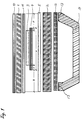
- Figure 1 shows an example of the structure of the inventive in an exploded view Packaging material in foil form and here as a lid material for a container.
- the first material layer a) (1) is imprinted (10) and counterprinted (11) Mistake.
- the Counterprint (11) is the print pattern b) (3), for example the resolution of one with the Printing (10) attached puzzle. So that the print pattern b) (3) is read can be exposed. Therefore the print pattern b) (3) is from a separating layer c) (4) covered.
- the separating layer c) (4) is covered with an extension (w) the entire surface of the print pattern b) (3) and projects beyond the print pattern b) (3) laterally around a range (x) and (y).
- the areas (x, y) can, depending on the design of the Print pattern b) (3), in their dimensions the same or different over the edge of print pattern b) (3) protrude.
- the adhesive layer d) (5) adheres to the Areas (z), occasionally via the counter pressure (11), on the first material layer a) (1) and the second layer of material e) (2) and thus connects the two layers of material over the areas (z). Due to the mutual incompatibility between the two layers between the adhesive layer d) (5) and the separating layer c) (4) in area (w) none Liability from.
- the second layer of material e) (5) is on the still free side with a sealing layer (12) covered.
- This sealing layer (12) can, for example, by accordingly applied seams, bags can be formed or over the sealing layer (12) Lid with the shoulder (13) of a vessel (14) are connected.
- the present packaging material for the production of packaging units can be in at least one place - e.g. in the area of a marking aid on a bag etc. or the lid on a vessel - in a narrow zone, the separation layer c) to the edge of a packaging unit, resp. the lid.
- This will make one narrow, e.g. finger width, zone created from which the two material layers a) and e) seized individually and by pulling apart or peeling the Material layers a) and e) the print pattern b) can be exposed.
Landscapes
- Physics & Mathematics (AREA)
- General Physics & Mathematics (AREA)
- Engineering & Computer Science (AREA)
- Theoretical Computer Science (AREA)
- Wrappers (AREA)
- Laminated Bodies (AREA)
- Table Devices Or Equipment (AREA)
- Printing Methods (AREA)
Abstract
Description
- a)
- eine erste Materiallage,
- b)
- ein Druckmuster, dessen Begrenzungen innerhalb der Ausdehnung der jeweiligen Verpackungseinheit oder des Deckels der Verpackungseinheit liegen,
- c)
- eine Trennschicht, deren Ausdehnung gleich oder grösser dem Druckmuster b) ist und kleiner ist als die Ausdehnung der Verpackungseinheit oder des Deckels der Verpackungseinheit,
- d)
- eine vollflächige Klebstoffschicht,
- e)
- eine zweite Materiallage,
wobei das Druckmuster b) durch Abheben der ersten Materiallage a) von der zweiten Matriallage e) sichtbar gemacht werden kann.
- a)
- eine Kunststoff-Folie auf Basis von orientiertem Polypropylen in einer Dicke von 18 bis 22 µm, vorzugsweise 20 µm, oder von Polyethylenterephthalat in einer Dicke von 10 bis 15 µm, vorzugsweise 12 µm,
- b)
- ein Druckmuster
- c)
- eine Trennschicht
- d)
- eine vollflächige Klebstoffschicht
- e)
- eine Kunststoff-Folie auf Basis von Polyethylenterephtalat in einer Dicke von 6 bis 36 µm, die auf der gegen die Klebstoffschicht d) weisenden Seite in der Dicke von 10 bis 60 nm (Nanometer), vorzugsweise 10 bis 30 nm, metallisiert ist.
- ao)
- eine Bedruckung, wie ein Werbedruck etc.,
- a)
- eine Kunststoff-Folie auf Basis von orientiertem Polypropylen in einer Dicke von 18 bis 22 µm, vorzugsweise 20 µm, oder von Polyethylenterephthalat in einer Dicke von 10 bis 15 µm, vorzugsweise 12 µm,
- a1)
- eine metallisierte Schicht in einer Dicke von 10 bis 60 nm, vorzugsweise 10 bis 30 nm,
- b)
- ein Druckmuster
- c)
- eine Trennschicht
- d)
- eine vollflächige Klebstoffschicht
- e)
- ein Papier mit einem Flächengewicht von 15 bis 40 g/m2,
- e1)
- eine nicht klebende Beschichtung als Feuchtigkeitsschutz, zweckmässig in Form von 0,5 bis 5 g/m2 und vorzugsweise 1 bis 3 g/m2, eines Lackes oder zweckmässig 2 bis 20 g/m2, vorzugsweise 4 bis 12 g/m2, Paraffin, Wachs oder Hotmelt.
- ao)
- eine Bedruckung, wie ein Werbedruck etc.,
- a)
- ein Papier mit einem Flächengewicht von 15 bis 40 g/m2,
- a1)
- eine metallisierte Schicht in einer Dicke von 10 bis 60 nm, vorzugsweise 10 bis 30 nm,
- b)
- ein Druckmuster
- c)
- eine Trennschicht
- d)
- eine vollflächige Klebstoffschicht
- e)
- eine Kunststoff-Folie auf Basis von Polyethylenterephtalat in einer Dicke von 6 bis 36 µm, die auf der gegen die Klebstoffschicht d) weisenden Seite in der Dicke von 10 bis 60 nm, vorzugsweise 10 bis 30 nm, metallisiert ist.
Claims (14)
- Verpackungsmaterial in Folienform zur Herstellung von Verpackungen oder Teilen davon, oder Deckelmaterial für Gefässe, enthaltend wenigstens zwei Materiallagen,
dadurch gekennzeichnet, dass
das Verpackungs- oder Deckelmaterial einer Verpackungseinheit nacheinander folgende Materialschichten enthält:- a)
- eine erste Materiallage,
- b)
- ein Druckmuster, dessen Begrenzungen innerhalb der Ausdehnung der jeweiligen Verpackungseinheit oder des Deckels der Verpackungseinheit liegen,
- c)
- eine Trennschicht, deren Ausdehnung gleich oder grösser dem Druckmuster b) ist und kleiner ist als die Ausdehnung der Verpackungseinheit oder des Deckels der Verpackungseinheit,
- d)
- eine vollflächige Klebstoffschicht,
- e)
- eine zweite Materiallage,
- Verpackungs- oder Deckelmaterial nach Anspruch 1, dadurch gekennzeichnet, dass die erste Materiallage a) eine ein- oder beidseitige Bedruckung und/oder eine ein oder beidseitige Metallisierung aufweist.
- Verpackungs- oder Deckelmaterial nach Anspruch 1, dadurch gekennzeichnet, dass die erste Materiallage a) und die zweite Materiallage e), unabhängig voneinander, ein Papier, eine Kunststoff-Folie oder eine Metall-Folie enthalten oder ein Verbund sind, die wenigstens eines dieser Materialien enthalten.
- Verpackungs- oder Deckelmaterial nach Anspruch 1, dadurch gekennzeichnet, dass das Druckmuster b) figürliche oder abstrakte graphische Gestaltungen, Zahlen, Buchstaben, und/oder Figuren aus einer oder mehreren Druckfarben ist.
- Verpackungs- oder Deckelmaterial nach Anspruch 1, dadurch gekennzeichnet, dass die Trennschicht c) eine gegenüber der Klebstoffschicht d) nicht haftende Schicht ist.
- Verpackungs- oder Deckelmaterial nach Anspruch 1, dadurch gekennzeichnet, dass die Klebstoffschicht d) in Mengen von 0,9 bis 12 g/m2 vorliegt und an den Materiallagen a) und e) haftet.
- Verpackungs- oder Deckelmaterial nach Anspruch 1, dadurch gekennzeichnet, dass die zweite Materiallage e) ein Papier, eine Kunststoff-Folie oder eine Metallfolie enthält oder ein Verbund ist, der wenigstens eines dieser Materialien enthält.
- Verpackungs- oder Deckelmaterial nach Anspruch 1, dadurch gekennzeichnet, dass, nach aussen weisend, auf der Schicht e) eine Siegelschicht f) angeordnet ist.
- Verpackungs- oder Deckelmaterial nach Anspruch 1, dadurch gekennzeichnet, dass das Verpackungs- und Deckelmaterial nacheinander folgende Materialschichten enthält:
- a)
- eine Kunststoff-Folie auf Basis von orientiertem Polypropylen in einer Dicke von 18 bis 22 µm oder von Polyethylenterephthalat in einer Dicke von 10 bis 15 µm
- b)
- ein Druckmuster
- c)
- eine Trennschicht
- d)
- eine vollflächige Klebstoffschicht
- e)
- eine Kunststoff-Folie auf Basis von Polyethylenterephtalat in einer Dicke von 6 bis 36 µm, die auf der gegen die Klebstoffschicht d) weisenden Seite in der Dicke von 10 bis 60 nm metallisiert ist.
- Verpackungs- oder Deckelmaterial nach Anspruch 1, dadurch gekennzeichnet, dass das Verpackungs- und Deckelmaterial nacheinander folgende Materialschichten enthält:
- ao)
- eine Bedruckung, wie ein Werbedruck etc.,
- a)
- eine Kunststoff-Folie auf Basis von orientiertem Polypropylen in einer Dicke von 18 bis 22 µm oder von Polyethylenterephthalat in einer Dicke von 10 bis 15 µm
- a1)
- eine metallisierte Schicht in einer Dicke von 10 bis 60 nm
- b)
- ein Druckmuster
- c)
- eine Trennschicht
- d)
- eine vollflächige Klebstoffschicht
- e)
- ein Papier mit einem Flächengewicht von 15 bis 40 g/m2
- e1)
- eine nicht klebende Beschichtung als Feuchtigkeitsschutz, zweckmässig in Form von 0,5 bis 5 g/m2 eines Lackes oder zweckmässig 2 bis 20 g/m2 Paraffin, Wachs oder Hotmelt.
- Verpackungs- oder Deckelmaterial nach Anspruch 1, dadurch gekennzeichnet, dass das Verpackungs- und Deckelmaterial nacheinander folgende Materialschichten enthält:
- ao)
- eine Bedruckung,
- a)
- ein Papier mit einem Flächengewicht von 15 bis 40 g/m2
- a1)
- eine metallisierte Schicht in einer Dicke von 10 bis 60 nm,
- b)
- ein Druckmuster
- c)
- eine Trennschicht
- d)
- eine vollflächige Klebstoffschicht
- e)
- eine Kunststoff-Folie auf Basis von Polyethylenterephtalat in einer Dicke von 6 bis 36 µm, die auf der gegen die Klebstoffschicht d) weisenden Seite in der Dicke von 10 bis 60 nm metallisiert ist.
- Verfahren zur Herstellung von Verpackungs- oder Deckelmaterial zur Herstellung von Verpackungseinheiten oder Teilen davon, oder von Deckelmaterial für Gefässe nach Anspruch 1, enthaltend wenigstens zwei Materiallagen,
dadurch gekennzeichnet, dassauf eine bedruckte oder unbedruckte, metallisierte oder nicht metallisierte erste Materiallage a)einseitig ein Druckmuster b) aufgebracht wird, dessen Begrenzungen innerhalb der Ausdehnung der Verpackungseinheit zu liegen kommen,darauf eine Trennschicht c), deren Ausdehnung gleich oder grösser dem Druckmuster b) ist und kleiner ist als die Begrenzungen der Verpackungseinheit, aufgebracht wird undauf die Materiallage a), auf der freien Seite der Trennschicht c), eine zweite Materiallage e) aufgebracht wird,wobei zwischen der ersten Materiallage a) und der zweiten Materiallage e) eine vollflächige Klebstoffschicht d) eingebracht wird. - Verfahren nach Anspruch 12, dadurch gekennzeichnet dass die Trennschicht c) mittels eines Druckverfahrens aufgebracht wird.
- Verwendung des Verpackungsmaterial in Folienform oder des Deckelmaterials für Gefässe nach Anspruch 1, als Verpackungseinheit oder für Teile davon, in Form von Schachteln, Faltschachteln, Folienverpackungen Beuteln, Säcken, Sachets, Taschen, Einwickler und Umhüllungen oder Deckelmaterial für die Bedeckelung von Bechern, Gobelets, Schalen, Menueschalen, Töpfen oder Gläsern oder als Banderolen oder Siegelstreifen.
Priority Applications (8)
| Application Number | Priority Date | Filing Date | Title |
|---|---|---|---|
| DE59711578T DE59711578D1 (de) | 1997-07-17 | 1997-07-17 | Verpackungs- und Deckelmaterial |
| AT97810503T ATE265319T1 (de) | 1997-07-17 | 1997-07-17 | Verpackungs- und deckelmaterial |
| ES97810503T ES2221028T5 (es) | 1997-07-17 | 1997-07-17 | Material para envases y tapas. |
| DK97810503.9T DK0891861T4 (da) | 1997-07-17 | 1997-07-17 | Indpaknings- og lågmateriale |
| EP97810503A EP0891861B2 (de) | 1997-07-17 | 1997-07-17 | Verpackungs- und Deckelmaterial |
| CA002243221A CA2243221C (en) | 1997-07-17 | 1998-07-14 | Packaging and lidding material |
| US09/116,208 US6258425B1 (en) | 1997-07-17 | 1998-07-16 | Packaging and lidding material |
| US09/757,571 US20010001282A1 (en) | 1997-07-17 | 2001-01-11 | Packaging and lidding material |
Applications Claiming Priority (1)
| Application Number | Priority Date | Filing Date | Title |
|---|---|---|---|
| EP97810503A EP0891861B2 (de) | 1997-07-17 | 1997-07-17 | Verpackungs- und Deckelmaterial |
Publications (3)
| Publication Number | Publication Date |
|---|---|
| EP0891861A1 true EP0891861A1 (de) | 1999-01-20 |
| EP0891861B1 EP0891861B1 (de) | 2004-04-28 |
| EP0891861B2 EP0891861B2 (de) | 2009-12-30 |
Family
ID=8230311
Family Applications (1)
| Application Number | Title | Priority Date | Filing Date |
|---|---|---|---|
| EP97810503A Expired - Lifetime EP0891861B2 (de) | 1997-07-17 | 1997-07-17 | Verpackungs- und Deckelmaterial |
Country Status (7)
| Country | Link |
|---|---|
| US (2) | US6258425B1 (de) |
| EP (1) | EP0891861B2 (de) |
| AT (1) | ATE265319T1 (de) |
| CA (1) | CA2243221C (de) |
| DE (1) | DE59711578D1 (de) |
| DK (1) | DK0891861T4 (de) |
| ES (1) | ES2221028T5 (de) |
Cited By (6)
| Publication number | Priority date | Publication date | Assignee | Title |
|---|---|---|---|---|
| WO2001014139A1 (de) * | 1999-08-20 | 2001-03-01 | Alcan Technology & Management Ltd. | Verpackungsmaterialien mit teilflächig angeordnetem materialauftrag und verfahren zur herstellung |
| US6374858B1 (en) | 1998-02-27 | 2002-04-23 | Hydro International Plc | Vortex valves |
| EP1203728A3 (de) * | 2000-10-31 | 2004-11-17 | Sonoco Development, Inc. | Verpackung mit temporärer Tätowierung |
| WO2019136142A1 (en) * | 2018-01-08 | 2019-07-11 | Sigma Technologies Int'l., Llc | Recyclable paper-containing packaging with radiant barrier insulation |
| DE202021100156U1 (de) | 2021-01-14 | 2022-05-10 | Bischof + Klein Se & Co. Kg | Verpackung aus einem Verbundmaterial |
| WO2025045822A1 (de) * | 2023-09-01 | 2025-03-06 | S & W Verpackungen GmbH | Folienfreie verpackung |
Families Citing this family (20)
| Publication number | Priority date | Publication date | Assignee | Title |
|---|---|---|---|---|
| EP1277664A1 (de) * | 2001-07-19 | 2003-01-22 | The Procter & Gamble Company | Verpackungsbeutel oder Deckel mit Aufkleber |
| US20030232213A1 (en) * | 2002-05-23 | 2003-12-18 | William Shepler | Multilayer storage container |
| FR2865432B1 (fr) * | 2004-01-26 | 2008-04-11 | Pechiney Emballage Flexible Eu | Materiau d'operculage ludique |
| EP1557285A1 (de) * | 2004-01-26 | 2005-07-27 | Amcor Flexibles Europe A/S | Verpackung mit einer abreibbaren Fläche |
| US20070218263A1 (en) * | 2006-03-17 | 2007-09-20 | General Binding Corporation | Thermal laminating film and method of manufacture |
| EP1849579A1 (de) * | 2006-04-26 | 2007-10-31 | Nordenia Deutschland Halle GmbH Werk Steinfeld | Verfahren zur Herstellung einer Folie für Aufreissverpackungen |
| US20080120935A1 (en) * | 2006-07-31 | 2008-05-29 | Certainteed Corporation | Vapor retarder fastening strip |
| US9624008B2 (en) | 2007-03-23 | 2017-04-18 | Selig Sealing Products, Inc. | Container seal with removal tab and security ring seal |
| US8522990B2 (en) * | 2007-03-23 | 2013-09-03 | Selig Sealing Products, Inc. | Container seal with removal tab and holographic security ring seal |
| US8703265B2 (en) * | 2007-03-23 | 2014-04-22 | Selig Sealing Products, Inc. | Container seal with removal tab and piercable holographic security seal |
| JP2009045767A (ja) * | 2007-08-15 | 2009-03-05 | Snow Brand Milk Prod Co Ltd | 包装用積層体 |
| EP2183106B1 (de) | 2007-08-24 | 2016-10-12 | Selig Sealing Products, Inc. | Mehrzweckabdeckung zur hygienischen abdeckung einer behälteroberseite |
| WO2013134665A1 (en) * | 2012-03-08 | 2013-09-12 | Selig Sealing Products, Inc. | Container sealing member with protected security component and removal tab |
| US8746490B2 (en) | 2012-11-06 | 2014-06-10 | Sonoco Development, Inc. | Resealable package film |
| US10363333B2 (en) | 2014-04-02 | 2019-07-30 | S.C. Johnson & Son, Inc. | Wax warmer |
| EP3193949A1 (de) | 2014-08-15 | 2017-07-26 | S.C. Johnson & Son, Inc. | Wachserwärmer |
| US10597202B2 (en) | 2017-10-16 | 2020-03-24 | Sonoco Development, Inc. | Resealable lidding with patterned adhesive |
| DE102018117071A1 (de) * | 2018-07-13 | 2020-01-16 | Mitsubishi Hitec Paper Europe Gmbh | Heißsiegelfähiges Barrierepapier |
| EP3623315A1 (de) * | 2018-09-17 | 2020-03-18 | Landgenossenschaft Ennstal LANDENA KG | Behälter zur aufnahme eines futtermittels |
| CN110400867B (zh) * | 2019-07-31 | 2022-12-06 | 太仓碧奇新材料研发有限公司 | 一种纸基热电薄膜的制备方法 |
Citations (6)
| Publication number | Priority date | Publication date | Assignee | Title |
|---|---|---|---|---|
| BE680450A (de) * | 1965-12-02 | 1966-10-17 | ||
| GB1265830A (de) * | 1969-02-11 | 1972-03-08 | ||
| FR2463468A1 (fr) * | 1979-08-06 | 1981-02-20 | Zweckform Werk | Couvercle comportant plusieurs epaisseurs pour fermer un recipient |
| EP0349670A1 (de) * | 1988-06-28 | 1990-01-10 | HAGEN & SORENSEN A/S | Etikett für Behälter, insbesondere für Flaschen aus Glas oder Kunststoff |
| WO1992007347A1 (en) * | 1990-10-16 | 1992-04-30 | Clopay Corporation | Scored synthetic in-mold labels and molded substrates labeled therewith |
| WO1997029968A1 (en) * | 1996-02-13 | 1997-08-21 | Pelliconi & C. S.P.A. | A lid, particularly for foodstuff containers, and the process used for its manufacture |
Family Cites Families (3)
| Publication number | Priority date | Publication date | Assignee | Title |
|---|---|---|---|---|
| US4479838A (en) * | 1982-06-22 | 1984-10-30 | Mid America Tag & Label Company, Inc. | Coupon structure and method of using the same |
| US5342684A (en) * | 1991-08-15 | 1994-08-30 | R. J. Reynolds Tobacco Company | Polymeric die-cuttable lidding materials |
| DE29701955U1 (de) † | 1997-02-05 | 1997-03-20 | Hueck Folien GmbH & Co. KG, 92637 Weiden | Abdeckung für eine Verpackungsanordnung |
-
1997
- 1997-07-17 DK DK97810503.9T patent/DK0891861T4/da active
- 1997-07-17 AT AT97810503T patent/ATE265319T1/de active
- 1997-07-17 ES ES97810503T patent/ES2221028T5/es not_active Expired - Lifetime
- 1997-07-17 EP EP97810503A patent/EP0891861B2/de not_active Expired - Lifetime
- 1997-07-17 DE DE59711578T patent/DE59711578D1/de not_active Expired - Lifetime
-
1998
- 1998-07-14 CA CA002243221A patent/CA2243221C/en not_active Expired - Fee Related
- 1998-07-16 US US09/116,208 patent/US6258425B1/en not_active Expired - Fee Related
-
2001
- 2001-01-11 US US09/757,571 patent/US20010001282A1/en not_active Abandoned
Patent Citations (6)
| Publication number | Priority date | Publication date | Assignee | Title |
|---|---|---|---|---|
| BE680450A (de) * | 1965-12-02 | 1966-10-17 | ||
| GB1265830A (de) * | 1969-02-11 | 1972-03-08 | ||
| FR2463468A1 (fr) * | 1979-08-06 | 1981-02-20 | Zweckform Werk | Couvercle comportant plusieurs epaisseurs pour fermer un recipient |
| EP0349670A1 (de) * | 1988-06-28 | 1990-01-10 | HAGEN & SORENSEN A/S | Etikett für Behälter, insbesondere für Flaschen aus Glas oder Kunststoff |
| WO1992007347A1 (en) * | 1990-10-16 | 1992-04-30 | Clopay Corporation | Scored synthetic in-mold labels and molded substrates labeled therewith |
| WO1997029968A1 (en) * | 1996-02-13 | 1997-08-21 | Pelliconi & C. S.P.A. | A lid, particularly for foodstuff containers, and the process used for its manufacture |
Cited By (7)
| Publication number | Priority date | Publication date | Assignee | Title |
|---|---|---|---|---|
| US6374858B1 (en) | 1998-02-27 | 2002-04-23 | Hydro International Plc | Vortex valves |
| WO2001014139A1 (de) * | 1999-08-20 | 2001-03-01 | Alcan Technology & Management Ltd. | Verpackungsmaterialien mit teilflächig angeordnetem materialauftrag und verfahren zur herstellung |
| EP1080880A1 (de) * | 1999-08-20 | 2001-03-07 | Alusuisse Technology & Management AG | Verpackungsmaterialien mit teilflächig angeordnetem Materialauftrag |
| EP1203728A3 (de) * | 2000-10-31 | 2004-11-17 | Sonoco Development, Inc. | Verpackung mit temporärer Tätowierung |
| WO2019136142A1 (en) * | 2018-01-08 | 2019-07-11 | Sigma Technologies Int'l., Llc | Recyclable paper-containing packaging with radiant barrier insulation |
| DE202021100156U1 (de) | 2021-01-14 | 2022-05-10 | Bischof + Klein Se & Co. Kg | Verpackung aus einem Verbundmaterial |
| WO2025045822A1 (de) * | 2023-09-01 | 2025-03-06 | S & W Verpackungen GmbH | Folienfreie verpackung |
Also Published As
| Publication number | Publication date |
|---|---|
| US20010001282A1 (en) | 2001-05-17 |
| DK0891861T3 (da) | 2004-06-01 |
| ES2221028T5 (es) | 2010-04-09 |
| DK0891861T4 (da) | 2010-05-10 |
| CA2243221A1 (en) | 1999-01-17 |
| US6258425B1 (en) | 2001-07-10 |
| DE59711578D1 (de) | 2004-06-03 |
| EP0891861B2 (de) | 2009-12-30 |
| ATE265319T1 (de) | 2004-05-15 |
| EP0891861B1 (de) | 2004-04-28 |
| CA2243221C (en) | 2004-11-23 |
| ES2221028T3 (es) | 2004-12-16 |
Similar Documents
| Publication | Publication Date | Title |
|---|---|---|
| EP0891861B1 (de) | Verpackungs- und Deckelmaterial | |
| EP0983947B1 (de) | Deckel und Verfahren zur Herstellung desselben | |
| EP1010641B2 (de) | Deckel zum Verschliessen von Behältern | |
| EP3077199B1 (de) | Streudose mit abziehbarem foliendeckel und folienbahn zur herstellung solcher abziehbaren foliendeckel | |
| DE60012016T2 (de) | Kunststoffbehälter mit mehrschichtiger abdichtfolie | |
| DE68915048T2 (de) | Behälter und Behälterverschluss mit Anzeige unbefugten Öffnens. | |
| US4763931A (en) | Adhesive material for preventing reuse | |
| US6706388B2 (en) | Self-closing packaging material | |
| EP2240387A1 (de) | Deckel und verfahren zu seiner herstellung | |
| WO1999043570A1 (de) | Verpackungsmaterial | |
| DE60122593T2 (de) | Hermetisch geschlossener behälter und verfahren zu seiner herstellung | |
| EP0967160A1 (de) | Verschlussmembrane mit Überdruckventil | |
| EP0847933B1 (de) | Verfahren zur Herstellung von Deckelmaterial sowie dessen Verwendung | |
| DE69113160T2 (de) | Vielschichtig bedruckter Verpackungsfilm, Verfahren zur Herstellung eines solchen Films, Deckel, der einen solchen Film gebraucht und Behälter mit diesem Deckel. | |
| WO2009118761A2 (en) | Metallized paper based lidding material for blister packaging & process thereof | |
| WO1998053115A1 (de) | Verpackungsmaterial | |
| JP4109035B2 (ja) | 隠蔽層付き包装材料およびその包装容器 | |
| EP1083043B1 (de) | Verpackungsmaterial für Nahrungsmittel | |
| JP4155426B2 (ja) | 紙容器用包材 | |
| EP1080880A1 (de) | Verpackungsmaterialien mit teilflächig angeordnetem Materialauftrag | |
| EP1277664A1 (de) | Verpackungsbeutel oder Deckel mit Aufkleber | |
| JPH0966578A (ja) | 包装用材料 | |
| EP1472010A2 (de) | Platine zum verschliessen eines behälters und herstellungsverfahren der platine | |
| JP2945874B2 (ja) | 紫外線カット用ラミネートフィルムの製造方法 | |
| CH700868A2 (de) | Behälterdeckel. |
Legal Events
| Date | Code | Title | Description |
|---|---|---|---|
| PUAI | Public reference made under article 153(3) epc to a published international application that has entered the european phase |
Free format text: ORIGINAL CODE: 0009012 |
|
| AK | Designated contracting states |
Kind code of ref document: A1 Designated state(s): AT BE CH DE DK ES FI FR GB GR IE IT LI NL PT SE |
|
| AX | Request for extension of the european patent |
Free format text: AL;LT;LV;RO;SI |
|
| 17P | Request for examination filed |
Effective date: 19990720 |
|
| AKX | Designation fees paid |
Free format text: AT BE CH DE DK ES FI FR GB GR IE IT LI NL PT SE |
|
| RAP1 | Party data changed (applicant data changed or rights of an application transferred) |
Owner name: ALCAN TECHNOLOGY & MANAGEMENT AG |
|
| 17Q | First examination report despatched |
Effective date: 20020816 |
|
| GRAP | Despatch of communication of intention to grant a patent |
Free format text: ORIGINAL CODE: EPIDOSNIGR1 |
|
| GRAS | Grant fee paid |
Free format text: ORIGINAL CODE: EPIDOSNIGR3 |
|
| GRAA | (expected) grant |
Free format text: ORIGINAL CODE: 0009210 |
|
| RBV | Designated contracting states (corrected) |
Designated state(s): AT BE DE DK ES FR GB IT |
|
| AK | Designated contracting states |
Kind code of ref document: B1 Designated state(s): AT BE DE DK ES FR GB IT |
|
| REG | Reference to a national code |
Ref country code: GB Ref legal event code: FG4D Free format text: NOT ENGLISH |
|
| GBT | Gb: translation of ep patent filed (gb section 77(6)(a)/1977) |
Effective date: 20040428 |
|
| REG | Reference to a national code |
Ref country code: DK Ref legal event code: T3 |
|
| REG | Reference to a national code |
Ref country code: IE Ref legal event code: FG4D Free format text: GERMAN |
|
| REF | Corresponds to: |
Ref document number: 59711578 Country of ref document: DE Date of ref document: 20040603 Kind code of ref document: P |
|
| REG | Reference to a national code |
Ref country code: IE Ref legal event code: FD4D |
|
| REG | Reference to a national code |
Ref country code: ES Ref legal event code: FG2A Ref document number: 2221028 Country of ref document: ES Kind code of ref document: T3 |
|
| ET | Fr: translation filed | ||
| PLBQ | Unpublished change to opponent data |
Free format text: ORIGINAL CODE: EPIDOS OPPO |
|
| PLBI | Opposition filed |
Free format text: ORIGINAL CODE: 0009260 |
|
| PLAX | Notice of opposition and request to file observation + time limit sent |
Free format text: ORIGINAL CODE: EPIDOSNOBS2 |
|
| 26 | Opposition filed |
Opponent name: HUECK FOLIEN GMBH & CO. KG Effective date: 20050127 |
|
| PLAF | Information modified related to communication of a notice of opposition and request to file observations + time limit |
Free format text: ORIGINAL CODE: EPIDOSCOBS2 |
|
| PLBB | Reply of patent proprietor to notice(s) of opposition received |
Free format text: ORIGINAL CODE: EPIDOSNOBS3 |
|
| PLBP | Opposition withdrawn |
Free format text: ORIGINAL CODE: 0009264 |
|
| PUAH | Patent maintained in amended form |
Free format text: ORIGINAL CODE: 0009272 |
|
| STAA | Information on the status of an ep patent application or granted ep patent |
Free format text: STATUS: PATENT MAINTAINED AS AMENDED |
|
| 27A | Patent maintained in amended form |
Effective date: 20091230 |
|
| AK | Designated contracting states |
Kind code of ref document: B2 Designated state(s): AT BE DE DK ES FR GB IT |
|
| REG | Reference to a national code |
Ref country code: ES Ref legal event code: DC2A Date of ref document: 20100204 Kind code of ref document: T5 |
|
| REG | Reference to a national code |
Ref country code: DK Ref legal event code: T4 |
|
| REG | Reference to a national code |
Ref country code: FR Ref legal event code: TP |
|
| PGFP | Annual fee paid to national office [announced via postgrant information from national office to epo] |
Ref country code: FR Payment date: 20110805 Year of fee payment: 15 Ref country code: DK Payment date: 20110725 Year of fee payment: 15 |
|
| PGFP | Annual fee paid to national office [announced via postgrant information from national office to epo] |
Ref country code: DE Payment date: 20110727 Year of fee payment: 15 Ref country code: ES Payment date: 20110726 Year of fee payment: 15 Ref country code: AT Payment date: 20110705 Year of fee payment: 15 Ref country code: GB Payment date: 20110725 Year of fee payment: 15 |
|
| PGFP | Annual fee paid to national office [announced via postgrant information from national office to epo] |
Ref country code: BE Payment date: 20110728 Year of fee payment: 15 |
|
| PGFP | Annual fee paid to national office [announced via postgrant information from national office to epo] |
Ref country code: IT Payment date: 20120724 Year of fee payment: 16 |
|
| BERE | Be: lapsed |
Owner name: *ALCAN TECHNOLOGY & MANAGEMENT A.G. Effective date: 20120731 |
|
| REG | Reference to a national code |
Ref country code: AT Ref legal event code: MM01 Ref document number: 265319 Country of ref document: AT Kind code of ref document: T Effective date: 20120717 |
|
| GBPC | Gb: european patent ceased through non-payment of renewal fee |
Effective date: 20120717 |
|
| REG | Reference to a national code |
Ref country code: DK Ref legal event code: EBP |
|
| REG | Reference to a national code |
Ref country code: FR Ref legal event code: ST Effective date: 20130329 |
|
| PG25 | Lapsed in a contracting state [announced via postgrant information from national office to epo] |
Ref country code: FR Free format text: LAPSE BECAUSE OF NON-PAYMENT OF DUE FEES Effective date: 20120731 Ref country code: DE Free format text: LAPSE BECAUSE OF NON-PAYMENT OF DUE FEES Effective date: 20130201 Ref country code: GB Free format text: LAPSE BECAUSE OF NON-PAYMENT OF DUE FEES Effective date: 20120717 |
|
| PG25 | Lapsed in a contracting state [announced via postgrant information from national office to epo] |
Ref country code: BE Free format text: LAPSE BECAUSE OF NON-PAYMENT OF DUE FEES Effective date: 20120731 |
|
| PG25 | Lapsed in a contracting state [announced via postgrant information from national office to epo] |
Ref country code: AT Free format text: LAPSE BECAUSE OF NON-PAYMENT OF DUE FEES Effective date: 20120717 |
|
| PG25 | Lapsed in a contracting state [announced via postgrant information from national office to epo] |
Ref country code: DK Free format text: LAPSE BECAUSE OF NON-PAYMENT OF DUE FEES Effective date: 20120731 |
|
| REG | Reference to a national code |
Ref country code: DE Ref legal event code: R119 Ref document number: 59711578 Country of ref document: DE Effective date: 20130201 |
|
| REG | Reference to a national code |
Ref country code: ES Ref legal event code: FD2A Effective date: 20131021 |
|
| PG25 | Lapsed in a contracting state [announced via postgrant information from national office to epo] |
Ref country code: ES Free format text: LAPSE BECAUSE OF NON-PAYMENT OF DUE FEES Effective date: 20120718 |
|
| PG25 | Lapsed in a contracting state [announced via postgrant information from national office to epo] |
Ref country code: IT Free format text: LAPSE BECAUSE OF NON-PAYMENT OF DUE FEES Effective date: 20130717 |