EP0891981A1 - Tylosin secomacrolide compounds - Google Patents

Tylosin secomacrolide compounds Download PDF

Info

Publication number
EP0891981A1
EP0891981A1 EP98112904A EP98112904A EP0891981A1 EP 0891981 A1 EP0891981 A1 EP 0891981A1 EP 98112904 A EP98112904 A EP 98112904A EP 98112904 A EP98112904 A EP 98112904A EP 0891981 A1 EP0891981 A1 EP 0891981A1
Authority
EP
European Patent Office
Prior art keywords
stands
stand
same
line
compound
Prior art date
Legal status (The legal status is an assumption and is not a legal conclusion. Google has not performed a legal analysis and makes no representation as to the accuracy of the status listed.)
Withdrawn
Application number
EP98112904A
Other languages
German (de)
French (fr)
Inventor
Nevenka M.Sc. Lopotar
Amalija M.Sc. Narandja
Zoran D.Sc. Mandic
Current Assignee (The listed assignees may be inaccurate. Google has not performed a legal analysis and makes no representation or warranty as to the accuracy of the list.)
Pliva Farmaceutika dd
Original Assignee
Pliva Farmaceutska Kemijska Prehrambena I Kozmeticka Industrija dd
Priority date (The priority date is an assumption and is not a legal conclusion. Google has not performed a legal analysis and makes no representation as to the accuracy of the date listed.)
Filing date
Publication date
Priority claimed from HRP970386 external-priority patent/HRP970386A2/en
Priority claimed from HR980276A external-priority patent/HRP980276A2/en
Application filed by Pliva Farmaceutska Kemijska Prehrambena I Kozmeticka Industrija dd filed Critical Pliva Farmaceutska Kemijska Prehrambena I Kozmeticka Industrija dd
Publication of EP0891981A1 publication Critical patent/EP0891981A1/en
Withdrawn legal-status Critical Current

Links

Classifications

    • CCHEMISTRY; METALLURGY
    • C07ORGANIC CHEMISTRY
    • C07HSUGARS; DERIVATIVES THEREOF; NUCLEOSIDES; NUCLEOTIDES; NUCLEIC ACIDS
    • C07H15/00Compounds containing hydrocarbon or substituted hydrocarbon radicals directly attached to hetero atoms of saccharide radicals
    • C07H15/02Acyclic radicals, not substituted by cyclic structures
    • C07H15/04Acyclic radicals, not substituted by cyclic structures attached to an oxygen atom of the saccharide radical
    • CCHEMISTRY; METALLURGY
    • C07ORGANIC CHEMISTRY
    • C07HSUGARS; DERIVATIVES THEREOF; NUCLEOSIDES; NUCLEOTIDES; NUCLEIC ACIDS
    • C07H17/00Compounds containing heterocyclic radicals directly attached to hetero atoms of saccharide radicals

Definitions

  • the reaction is carried out in a phosphate buffer pH 4.0 - 7.0 and at a constant potential between 1.2 - 1.6 V against saturated calomel electrode during 1 to 5 hours at room temperature in a nitrogem stream, whereby a compound of the general formula I is obtained, wherein R, R 1 , R 2 and R 4 are the same and stand for H, R 3 stands for NH 2 and the line - - - - stands for a double bond.
  • the compound 1 (0.5 g, 0.63 mmole) was dissolved in CHCl 3 (30 ml), formic acid (98-100%) (0.12 ml, 3.2 mmoles) and formaldehyde (36%) (0.12 ml, 1.48 mmole) were added and then it was refluxed for 2 hours under stirring. Upon addition of H 2 O (30 ml), a product was isolated by means of gradient extraction with CHCl 3 at pH 5.5 and 9.5.
  • the compound 1 (0.50 g, 0.63 mmole) was dissolved in ethanol (50 ml), 10% Pd/C (0,3 g) was added and it was hydrogenated for 8 hours at room temperature and at H 2 pressure 0.5 MPa.
  • the reaction mixture was filtered, the filtrate was evaporated to a dry residue, which was then chromatographed on a silica gel column using the solvent system CHCl 3 -CH 3 OH-conc.NH 4 OH, 90:15:1.5, yielding 0.34 g of the TLC homogeneous product ( 3 ).
  • the compound 1 (1.0 g, 1.26 mmole) was dissolved in 50% methanol (25 ml), NaHSO 3 (0.625 g) and formic acid (98-100%) (0.125 ml) were added and then under stirring refluxed for 6 hours. Upon addition of H 2 O (50 ml), a product was isolated by means of gradient extraction with CHCl 3 at pH 5.8 and 9.0. The combined chlorofom extracts at pH 9.0 were dried (K 2 CO 3 ) and evaporated at a reduced pressure, yielding 0,75 g (76.5%) of the TLC homogeneous product ( 4 ).
  • the compound 4 (0.60 g, 0.77 mmole) was dissolved in abs. CH 3 OH (20 ml), under stirring during 5 minutes NaBH 4 (0.06 g) was added and then the reaction mixture was kept stirring for 1 hour at room temperature. After evaporation of the solvent to one half of its volume, H 2 O (20 ml) and CHCl 3 (40 ml) were added to the reaction mixture and with 1 N HCl, the pH was adjusted to 9.0. The layers were separated and the aqueous part was extracted twice with CHCl 3 . The combined chloroform extracts were rinsed with saturated NaHCO 3 , dried (K 2 CO 3 ) and evaporated at a reduced pressure, yielding 0.59 g (98.08%) of the TLC homogeneous product (6).
  • the compound 4 (0.23 g, 0.3 mmole) was dissolved in dry pyridine (20 ml) and cooled to 0-5°C.
  • a solution of tosylchloride (0.2 g, 1.05 mmole) in dry pyridine (10 ml) was added dropwise during 5 minutes and it was stirred for further 2 hours at room temperature.
  • the reaction solution was diluted with H 2 O (120 ml), alkalized to 9.5 by addition of 10% w/v NaOH, evaporated at a reduced pressure to one third of its volume and extracted twice with CHCl 3 .
  • the compound 6 (0.60 g, 0.77 mmole) was dissolved in CH 2 Cl 2 (15 ml), acetic acid anhydride (0.36 ml) was added and it was stirred for 1 hour at room temperature.
  • the reaction mixture was poured onto ice (50 ml) and extracted with CH 2 Cl 2 at pH 8.0.
  • the combined organic extracts were rinsed with a saturated NaHCO 3 solution and water, dried (K 2 CO 3 ) and evaporated at a reduced pressure, yielding 0.65 g (93.3%) of the TLC homogeneous product ( 10 ).

Landscapes

  • Chemical & Material Sciences (AREA)
  • Organic Chemistry (AREA)
  • Engineering & Computer Science (AREA)
  • Health & Medical Sciences (AREA)
  • Biochemistry (AREA)
  • Biotechnology (AREA)
  • General Health & Medical Sciences (AREA)
  • Genetics & Genomics (AREA)
  • Molecular Biology (AREA)
  • Life Sciences & Earth Sciences (AREA)
  • Crystallography & Structural Chemistry (AREA)
  • Pharmaceuticals Containing Other Organic And Inorganic Compounds (AREA)
  • Saccharide Compounds (AREA)
  • Nitrogen Condensed Heterocyclic Rings (AREA)

Abstract

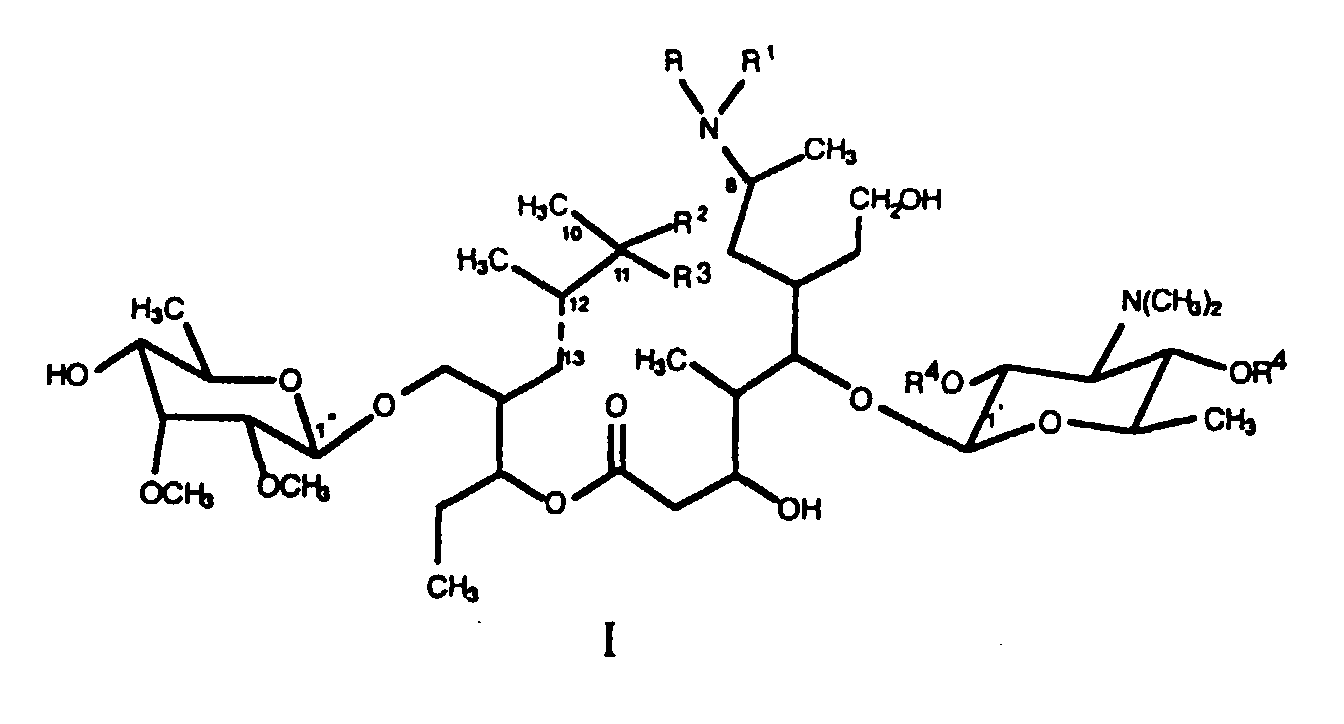
The invention relates to novel seco compounds from a class of tylosins represented by a general formula I
Figure 80000001
wherein
R
stands for H or CH3,
R1
stands for H, CH3, C1-C3 acyl or aryl sulfonyl,
R2
stands for H and R3 stands for NH2 or OH, or R2 and R3 together stand for O or NOH,
R4
stands for H or C1-C3 acyl,
and the line - - - -
stands for a double or a single bond,
and to a process for their preparation.
By the reaction of oximation of 4'-demicarosyl-8a-aza-8a-homorelomycin a breaking of lactams occurs and the obtained seco compound can optionally be subjected to reactions of reductive N-alkylation or to a conversion of hydroxyimino group into keto group and then optionally to N- or N,O-acylation, a catalytical hydrogenation of the double bond or a reduction of the ketone or a reduction of the hydroxyimino group into amino group.

Description

Technical Field of the Invention:
IPC:
A 61 K 31/70
C 07 H 17/08
Technical Problem
The invention relates to novel seco compounds from the class of tylosins, potential intermediates in the preparation of novel azalide antibiotics, as well as to processes for their preparation.
Specifically, the invention relates to linear 8a-secoazalides of the general formula I
Figure 00010001
wherein
R
stands for H or CH3,
R1
stands for H, CH3, C1-C3 acyl or aryl sulfonyl,
R2
stands for H and R3 stands for NH2 or OH, or R2 and R3 together stand for O or NOH,
R4
stands for H or C1-C3 acyl,
and the line - - - -
stands for a double or a single bond.
Prior Art
It is known that C-9 oximes of tylosine and of derivatives thereof have already been prepared (Narandja, A. et al., EP 0 287 082 B1). It is known as well that by a Beckmann rearrangement of oximes of tylosine and of derivatives thereof 8a-aza- and 9a-aza-regioisomeric lactams were obtained (Lopotar, N. et al., EP 0 410 433 B1). It is also known that by alkaline alcoholysis of tylosine derivatives a breaking of lactones and the formation of corresponding esters of secoacids takes place (Fishman, A.G. et al., J. Chem. Soc. Perkin Trans. I, 799-805, 1989).
It has been now found that by oximation of 8a-aza-derivatives of tylosine an opening of lactams takes place, whereby carbonyls are cleaved and novel hitherto not described 8a-secoazalides are formed.
Detailed Description of the Invention
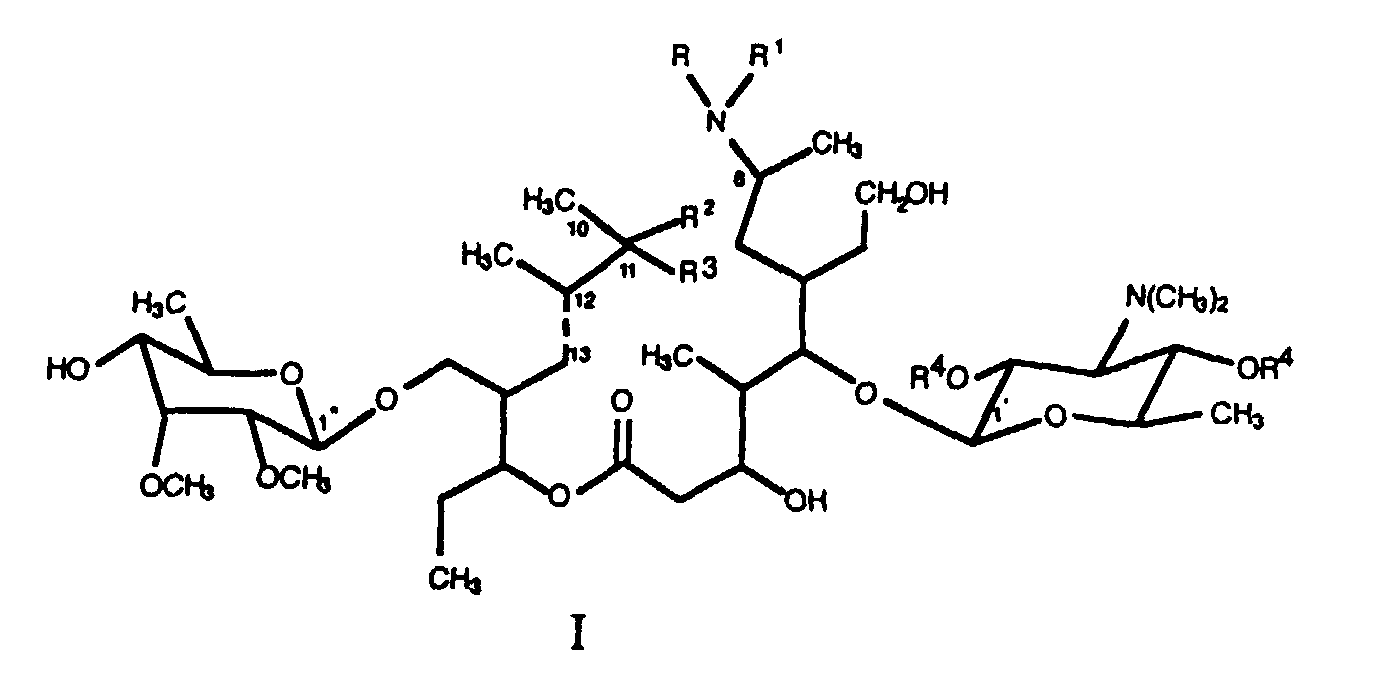
According to the present invention novel 8a-secoazalides of the general formula I,
Figure 00020001
wherein
R
stands for H or CH3
R1
stands for H, CH3, C1-C3 acyl or aryl sulfonyl,
R2
stands for H and R3 stands for NH2 or OH, or R2 and R3 together stand for O or NOH,
R4
stands for H or C1-C3 acyl,
and the line - - - -
stands for a double or a single bond,
can be prepared in such a way that 4'-demicarosyl-8a-aza-8a-homorelomycin of the formula II
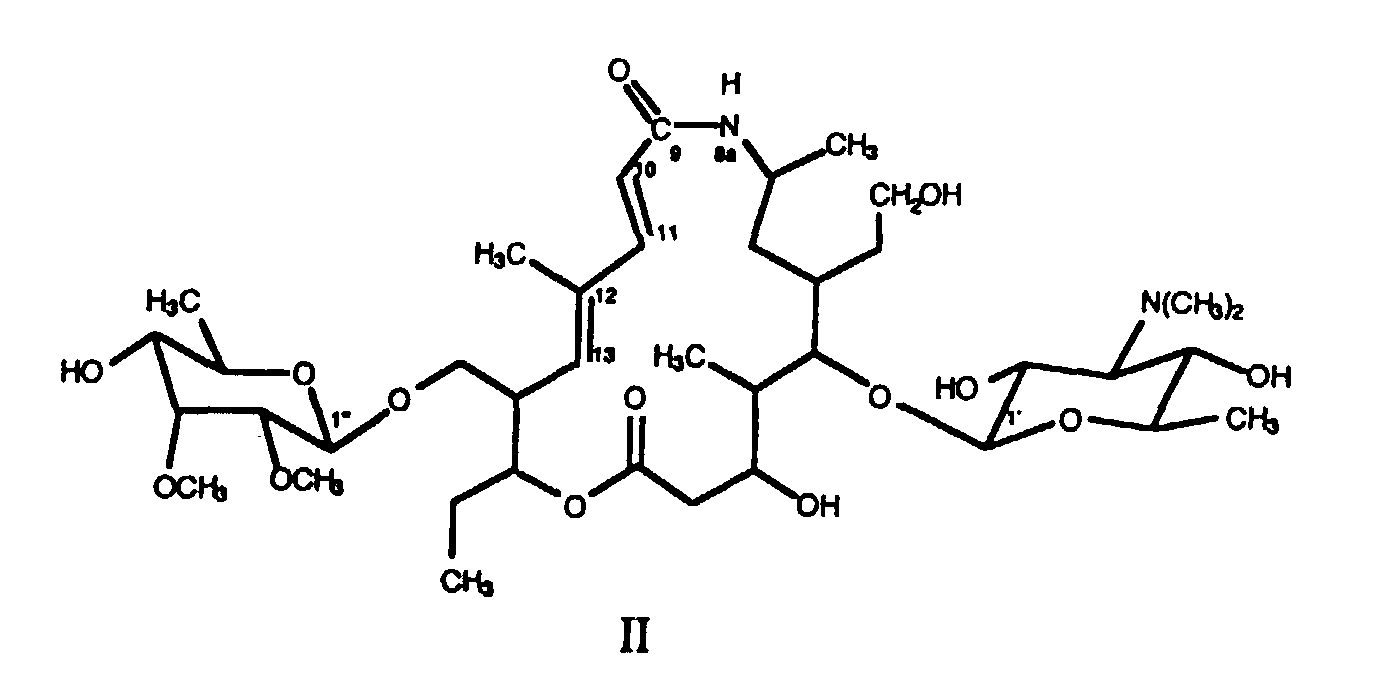
Figure 00030001
  • A/ is subjected to a reaction of oximation with hydroxylamine hydrochloride in the presence of organic bases which can simultaneously serve as a solvent and then, optionally,
  • A1/ reductively N-alkylated with a corresponding alkylplating agent in the presence of a corresponding reducing agent in a reaction-inert solvent,
    or, optionally,
  • A2/ subjected to catalytic hydrogenation in the presence of palladium-on-charcoal
    or, optionally,
  • B/ is subjected to a conversion of hydroxyimino group into keto group by means of corresponding agents in the presence of organic or inorganic acids and then,
    optionally,
  • B1/ N- or N,O-acylated with acids or their anhydrides or chlorides in a reaction-inert solvent,
    and then, optionally,
  • B1/1 subjected to solvolysis,
    or, optionally,
  • B2/ catalytically hydrogenated in the manner of A2
    or, optionally,
  • C/ is reduced by complex metallic hydrides and then, optionally,
  • C1/ N-acylated as described in B1, or
  • C2/ reductively N-alkylated as described in A1, or
  • C3/ catalytically hydrogenated in the manner of A2, and then, optionally,
  • C4/ reductively N-alkylated in the manner of A1,
    or optionally,
  • D/ is subjected to catalytical reduction with Pt (IV) oxide in a reaction-inert solvent,
    or optionally,
  • E/ a electrochemical reduction is performed.
The reaction of oximation of 4'-demicarosyl-8a-aza-8a-homorelomycin is carried out with 3 to 10 equivalents of hydroxlyamine hydrochloride in pyridine in a nitrogen stream at reflux temperature during 3 to 10 hours, whereby a compound of the general formula I is obtained, wherein R, R1 and R4 are the same and stand for H, R2 and R3 together stand for NOH and the line - - - - stands for a double bond.
The reaction of reductive N-alkylation of the above cited compound and of the compounds of the general formula I, wherein R, R1, R2 and R4 are the same and stand for H, R3 stands for OH and the line - - - - stands for a double or a single bond, is carried out with 1 to 4 equivalents of formaldehyde (36 %) in the presence of a 1-5 fold amount of formic acid (98-100 %) in halogenated hydrocarbons, preferably in chloroform or methylene chloride, at a temperature from 10°C to reflux temperature during 2 to 30 hours, whereby compounds of the general formula I are obtained, wherein R and R1 are the same and stand for CH3, R2 and R3 together stand for NOH, R4 stands for H and the line - - - - stands for a double bond, or R and R1 are the same and stand for CH3, R2 and R4 are the same and stand for H, R3 stands for OH and the line - - - - stands for a double or a single bond.
The reaction of conversion of hydroxyimino group of the compound of the general formula I, wherein R R1 and R4 are the same and stand for H, R2 and R3 together stand for NOH and the line - - - - stands for a double bond, is carried out with NaHSO3 in the presence of an acid, preferably formic acid (98-100%), in 50% ethanol at reflux temperature during 2 to 8 hours, whereby a compound of the general formula I is obtained, wherein R, R1 and R4 are the same and stand for H, R2 and R3 together stand for O and the line - - - - stands for a double bond.
The reaction of N- or N,O-acylation of the compounds of the general formula I, wherein R, R1 and R4 are the same and stand for H, R2 and R3 together stand for O, or R, R1, R2 and R4 are the same and stand for H, R3 stands for OH, and the line - - - - stands for a double bond, is carried out with C1-C3 carboxylic acids, preferably with formic acid (98-100%) and acid anhydrides, preferably with acetic acid anhydride in halogenated hydrocarbons, preferably in chloroform or methylene chloride or in acid chlorides, preferably with tosyl chloride in pyridine, at room temperature or reflux temperature during 1 to 20 hours, whereby the compounds of the general formula I are obtained, wherein R and R4 are the same and stand for H, R1 stands for CHO, R2 and R3 together stand for O, or R stands for H, R1 and R4 are the same and stand for COCH3, R2 and R3 together stand for O, or R, R2 and R4 are the same and stand for H, R1 stands for tosyl, R3 stands for OH and the line - - - - stands for a double bond.
The solvolysis of the compounds of the general formula I, wherein R stands for H, R1 and R4 are the same and stand for COCH3, R2 and R3 together stand for O, is carried out in methanol at room temperature during 3 days, whereby a compound of the general formula I is obtained, wherein R and R4 stand for H, R2 and R3 together stand for O, R1 stands for COCH3 and the line - - - - stands for a double bond.
The catalytical hydrogenation of the compounds of the general formula I, wherein R, R1 and R4 are the same and stand for H, R2 and R3 together stand for NOH or O, or R, R1, R2 and R4 are the same and stand for H, R3 stands for OH, and the line - - - - stands for a double bond, is carried out in a C1-C3 aliphatic alcohol in the presence of a noble metal on an inert carrier, preferably with palladium-on-characoal (2-5 w/w), at a hydrogen pressure from 0.2 to 0.5 MPa and at room temperature during 2 to 10 hours, whereby compounds of the general formula I are obtained, wherein R, R1 and R4 are the same and stand for H, R2 and R3 together stand for NOH or O, or R, R1, R2 and R4 are the same and stand for H, R3 stands for OH and the line - - - - stands for a single bond.
The reduction of the compounds of the general formula I, wherein R, R1 and R4 are the same and stand for H, R2 and R3 together stand for O and the line - - - - stands for a double bond, is carried out with complex metallic hydrides, preferably with NaBH4 in a C1-C3 aliphatic alcohol and at room temperature during 30 minutes to 2 hours, whereby a compound of the general formula I is obtained, wherein R, R1, R2 and R4 are the same and stand for H, R3 stands for OH and the line - - - - stands for a double bond.
The catalytical reduction of the compounds of the general formula I, wherein R, R1 and R4 are the same and stand for H, R2 and R3 together stand for NOH and the line - - - - stands for a double bond, is carried out in glacial acetic acid in the presence of noble metals and their oxides as catalysts, preferably with platinum (IV) oxide at a hydrogen pressure from 5.07 to 70.93 bars and at room temperature during 10 hours to 3 days, whereby a compound of the general formula I is obtained, wherein R, R1, R2 and R4 are the same and stand for H, R3 stands for NH2 and the line - - - - stands for a single bond.
The electrochemical reduction of the compound of the general formula I, wherein R, R1 and R4 are the same and stand for H, R2 and R3 together stand for NOH and the line - - - - stands for a double bond, is carried out in an electrolytic H-cell with the anode and cathode regions separated by a membrane. A Hg basin is used as the working electrode and graphite is used as the counter electrode. The reaction is carried out in a phosphate buffer pH 4.0 - 7.0 and at a constant potential between 1.2 - 1.6 V against saturated calomel electrode during 1 to 5 hours at room temperature in a nitrogem stream, whereby a compound of the general formula I is obtained, wherein R, R1, R2 and R4 are the same and stand for H, R3 stands for NH2 and the line - - - - stands for a double bond.
The structure of the novel compounds was established by spectrometrical mehtods and mass analysis. The newly prepared 8a-secoazalides contain various reactive terminal functional groups and in practice they are important as intermediates for the synthesis of novel azalide antibiotics with a modified macrocyclic ring.
The invention is illustrated by the following examples, which, however, do not limit the scope of the invention in any way.
Example 1 4'-Demicarosyl-10-hydro-11-dehydro-11-hydroxyimino-9-carbonyl-9-nor-8a, 9seco-8a-aza-8a-homorelomycin (1)
4'-Demycarosyl-8a-aza-8a-homorelomycin (4.0 g, 5.08 mmoles) was dissolved in dry pyridine (40 ml), NH2OH HCl (3.2 g, 46.04 mmoles) was added and it was stirred in a nitrogen stream at reflux temperature for 6 hours. The reaction solution was diluted with water (150 ml), alkalized with 10% w/v NaOH to pH 9.0 and evaporated at a reduced pressure to one third of the volume and extracted by means of gradient extraction with CHCl3 at pH 7.0 and 9.5. The combined chloroform extracts at pH 9.5 were dried (K2CO3) and evaporated under reduced pressure, yielding 2.5 g of a crude product. Chromatography on a silica gel column using the solvent system CH2Cl2-CH3OH-conc.NH4OH, 90:9:1.5 gave 1.5 g of the TLC homogeneous product (1).
  • M.p. 83-87 °C
  • TLC: CH2Cl2-CH3OH-conc. NH4OH (90:20:2), system A Rf 0.214
  • IR (CHCl3) cm-1: 1725, 1590, 1450, 1375, 1165, 1065, 960.
  • 1H NMR (CDCl3) δ ppm: 5.70 (H-13), 4.56 (H-1''), 4.41 (H-1'), 3.90 (Ha-20), 3.58 (Hb-20), 3.61 (3''-OCH3), 3.48 (2''-OCH3), 3.09 (H-8), 2.49 /3'-N(CH3)2/, 1.99 (H-10), 1.82 (H-22), 1.17 (H-21).
  • 13C NMR (CDCl3) δ ppm: 173.3 (C-1), 157.5 (C-11), 135.9 (C-12), 129.3 (C-13), 106.6 (C-1'), 101.0 (C-1''), 61.7 (3''-OCH3), 60.3 (C-20), 59.5 (2''-OCH3), 44.9 (C-8), 41.7 /3'-N(CH3)2/, 41.7 (C-7), 35.6 (C-6), 24.1 (C-21), 13.6 (C-22), 10.5 (C-10).
  • FAB (MH+) 794.
  • Analysis: calc.: found:
    N 5.29% 5.40%
    Example 2 4'-Demicarosyl-8a-dimethylamino-10-hydro-11-dehydro-11-hydroxyimino-9-carbonyl-9-nor-8a,9seco-8a-aza-8a-homorelomycin (2)
    The compound 1 (0.5 g, 0.63 mmole) was dissolved in CHCl3 (30 ml), formic acid (98-100%) (0.12 ml, 3.2 mmoles) and formaldehyde (36%) (0.12 ml, 1.48 mmole) were added and then it was refluxed for 2 hours under stirring. Upon addition of H2O (30 ml), a product was isolated by means of gradient extraction with CHCl3 at pH 5.5 and 9.5. The combined chloroform extracts at pH 9.5 were dried (K2CO3) and evaporated at a reduced pressure and the obtained product was chromatographed on a silica gel column using the solvent system CH2Cl2-CH3OH-conc.NH4OH, 90:9:1.5, yielding 0.4 g of the TLC homogenous product (2).
  • TLC: system A Rf 0.364
  • 1H NMR (CDCl3) δ ppm: 5.67 (H-13), 4.56 (H-1''), 4.39 (H-1'), 3.90 (Ha-20), 3.58 (Hb-20), 3.61 (3''-OCH3), 3.48 (2''-OCH3), 2.84 (H-8), 2.49 /3'-N(CH3)2/, 2.26 /8-N(CH3)2/, 1.97 (H-10), 1.81 (H-22), 1.00 (H-21).
  • 13C NMR (CDCl3) δ ppm: 173.3 (C-1), 157.5 (C-11), 136.0 (C-12), 129.2 (C-13), 106.0 (C-1'), 101.0 (C-1''), 61.8 (3''-OCH3), 60.8 (C-20), 59.6 (2''-OCH3), 57.2 (C-8), 41.8 /3'-N(CH3)2/, 39.6 /8-N(CH3)2/, 36.7 (C-7), 36.2 (C-6), 13.6 (C-22), 11.5 (C-21), 10.7 (C-10).
  • FAB (MH+) 822.
  • Example 3 4'-Demicarosyl-10,12,13-trihydro-11-dehydro-11-hydroxyimino-9-carbonyl-9-nor-8a,9seco-8a-aza-8a-homorelomycin (3)
    The compound 1 (0.50 g, 0.63 mmole) was dissolved in ethanol (50 ml), 10% Pd/C (0,3 g) was added and it was hydrogenated for 8 hours at room temperature and at H2 pressure 0.5 MPa. The reaction mixture was filtered, the filtrate was evaporated to a dry residue, which was then chromatographed on a silica gel column using the solvent system CHCl3-CH3OH-conc.NH4OH, 90:15:1.5, yielding 0.34 g of the TLC homogeneous product (3).
  • M.p. 78-83 °C
  • IR (KBr) cm-1: 1725, 1630, 1458, 1379, 1169, 1083, 960.
  • 1H NMR (DMSO) δ ppm: 10.34 (11-NOH) exchangeable with D2O, 4.41 (H-1''), 4.19 (H-1'), 3.45 (3''-OCH3), 3.41 (2''-OCH3), 3.11 (H-12), 2.75 (H-8), 2.41 /3'-N(CH3)2/, 1.66 (H-10), 0.99 (H-21).
  • 13C NMR (DMSO) δ ppm: 171.7 (C-1), 158.5 (C-11), 104.6 (C-1'), 100.3 (C-1''), 61.2 (3''-OCH3), 59.8 (C-20), 58.1 (2''-OCH3), 44.5 (C-8), 41.7 /3'-N(CH3)2/, 38.9 (C-12), 30.8 (C-13), 24.2 (C-21), 18.9 (C-22), 10.7 (C-10).
  • FAB (MH+) 796.
  • Example 4 4'-Demicarosyl-10-hydro-11-dehydro-11-oxo-9-carbonyl-9-nor-8a,9seco-8a-aza-8a-homorelomycin (4)
    The compound 1 (1.0 g, 1.26 mmole) was dissolved in 50% methanol (25 ml), NaHSO3 (0.625 g) and formic acid (98-100%) (0.125 ml) were added and then under stirring refluxed for 6 hours. Upon addition of H2O (50 ml), a product was isolated by means of gradient extraction with CHCl3 at pH 5.8 and 9.0. The combined chlorofom extracts at pH 9.0 were dried (K2CO3) and evaporated at a reduced pressure, yielding 0,75 g (76.5%) of the TLC homogeneous product (4).
  • M.p. 67-72 °C
  • TLC: system A Rf 0.254
  • IR (CHCl3) cm-1: 1730, 1660, 1455, 1380, 1170, 1070, 960.
  • 1H NMR (CDCl3) δ ppm: 6.57 (H-13), 4.55 (H-1''), 4.36 (H-1'), 3.82 (Ha-20), 3.58 (Hb-20), 3.61 (3''-OCH3), 3.44 (2''-OCH3), 3,00 (H-8), 2.50 /3'-N(CH3)2/, 2.34 (H-10), 1.81 (H-22), 1.15 (H-21).
  • 13C NMR (CDCl3) δ ppm: 200.0 (C-11), 172.2 (C-1), 140.2 (C-13), 140.1 (C-12), 105.4 (C-1'), 100.6 (C-1''), 61.4 (3''-OCH3), 60.0 (C-20), 59.0 (2''-OCH3), 44.0 (C-8), 41.4 /3'-N(CH3)2/, 40.4 (C-7), 33.7 (C-6), 25.4 (C-10), 24.9 (C-21), 11.4 (C-22).
  • FAB (MH+) 779.
  • Analysis: calc.: found:
    N 3.60% 3.16%
    Example 5 4'-Demicarosyl-8a-N-formyl-8a-amino-10-hydro-11-dehydro-11-oxo-9-carbonyl-9-nor-8a,9seco-8a-aza-8a-homorelomycin (5)
    The compound 4 (0.22 g, 0.28 mmole) was dissolved in CHCl3 (100 ml), formic acid (89-100%) (0.125 ml, 3.3 mmoles) was added and then it was refluxed under stirring for 16 hours. Upon addition of H2O (20 ml), a product was isolated by means of gradient extraction with CHCl3 at pH 5.0 and 8.5. The combined chloroform extracts at pH 8.5 were dried (K2CO3) and evaporated at a reduced pressure, the obtained product was chromatographed on a silica gel column using the solvent system CH2Cl2-CH3OH-conc.NH4OH, 90:20:2, yielding 0.12 g of the TLC homogeneous product (5).
  • M.p. 80-85 °C
  • TLC: system A Rf 0.538
  • CH2Cl2-CH3OH (85:15), system B Rf 0.071
  • IR (CHCl3) cm-1: 1715, 1660, 1530, 1445, 1375, 1160, 1060, 955.
  • 1H NMR (CDCl3) δ ppm: 8.13 (HCONH), 6.38 (CONH) exchangeable with D2O, 6.64 (H-13), 4.56 (H-1''), 4.33 (H-1'), 4.15 (H-8), 3.70 (Ha-20), 3.66 (Hb-20), 3.61 (3''-OCH3), 3.45 (2''-OCH3), 2.55 /3'-N(CH3)2/, 2.34 (H-10), 1.80 (H-22), 1.19 (H-21).
  • 13C NMR (CDCl3) δ ppm: 200.4 (C-11), 172.7 (C-1), 161.7 (HCONH), 141.2 (C-13), 140.0 (C-12), 104.9 (C-1'), 100.7 (C-1''), 61.5 (3''-OCH3), 59.8 (C-20), 59.1 (2''-OCH3), 41.9 (C-8), 41.5 /3'-N(CH3)2/, 37.0 (C-7), 32.2 (C-6), 25.6 (C-10), 21.7 (C-21), 11.4 (C-22).
  • FAB (MH+) 807.
  • Example 6 4'-Demicarosyl-10-hydro-11-hydroxy-9-carbonyl-9-nor-8a,9seco-8a-aza-8a-homorelomycin (6)
    The compound 4 (0.60 g, 0.77 mmole) was dissolved in abs. CH3OH (20 ml), under stirring during 5 minutes NaBH4 (0.06 g) was added and then the reaction mixture was kept stirring for 1 hour at room temperature. After evaporation of the solvent to one half of its volume, H2O (20 ml) and CHCl3 (40 ml) were added to the reaction mixture and with 1 N HCl, the pH was adjusted to 9.0. The layers were separated and the aqueous part was extracted twice with CHCl3. The combined chloroform extracts were rinsed with saturated NaHCO3, dried (K2CO3) and evaporated at a reduced pressure, yielding 0.59 g (98.08%) of the TLC homogeneous product (6).
  • M.p. 64-68 °C
  • TLC: system A Rf 0.159
  • IR (CHCl3) cm-1: 1730, 1600, 1455, 1380, 1170, 1070, 960.
  • 1H NMR (CDCl3) δ ppm: 5.34 (H-13), 4.49 (H-1''), 4.28 (H-1'), 4.08 (H-11), 3.74 (Ha-20), 3.60 (Hb-20), 3.53 (3''-OCH3), 3.41 (2''-OCH3), 2.90 (H-8), 2.78 (H-14), 2.42 /3'-N(CH3)2/, 1.56 (H-22), 1.14 (H-10), 1.06 (H-21).
  • 13C NMR (CDCl3) δ ppm: 171.9 (C-1), 142.9 (C-12), 119.8 (C-13), 105.3 (C-1'), 100.3 (C-1''), 72.4 (C-11), 61.4 (3''-OCH3), 59.8 (C-20), 59.2 (2''-OCH3), 43.9 (C-8), 41.5 /3'-N(CH3)2/, 41.3 (C-14), 39.9 (C-7), 33.2 (C-6), 32.2 (C-19), 25.5 (C-21), 21.4 (C-10), 13.1 (C-22).
  • FAB (MH+) 781.
  • Example 7 4'-Demicarosyl-8a-N-tosyl-10-hydro-11-hydroxy-9-carbonyl-9-nor-8a,9seco-8a aza-8a-homorelomycin (7)
    The compound 4 (0.23 g, 0.3 mmole) was dissolved in dry pyridine (20 ml) and cooled to 0-5°C. Into the reaction mixture under stirring a solution of tosylchloride (0.2 g, 1.05 mmole) in dry pyridine (10 ml) was added dropwise during 5 minutes and it was stirred for further 2 hours at room temperature. The reaction solution was diluted with H2O (120 ml), alkalized to 9.5 by addition of 10% w/v NaOH, evaporated at a reduced pressure to one third of its volume and extracted twice with CHCl3. The combined chloroform extracts were evaporated to a resin-like residue, which was chromatographed on a silica gel column using the solvent system CH2Cl2-CH3OH, 85:15, yielding 0.14 g of the TLC homogeneous product (7).
  • M.p. 78-83 °C
  • TLC:
  • system A Rf 0.671
  • system B Rf 0.077
  • IR (CHCl3) cm-1: 1720, 1600, 1645, 1450, 1380, 1325, 1170, 1070, 960.
  • 1H NMR (CDCl3) δ ppm: 7.76 (p-Ph), 7.32 (SO2 NH), 5.82 (H-13), 5.42 (H-1''), 4.56 (H-1'), 4.21 (H-11), 3.60 (3''-OCH3), 3.49 (2''-OCH3), 2.50 /3'-N(CH3)2/, 2.43 (p-Ph-CH3 ), 1.66 (H-22), 1.02 (H-21).
  • FAB (MH+) 935.
  • Example 8 4'-Demicarosyl-10,12,13-trihydro-11-dehydro-11-oxo-9-carbonyl-9-nor 8a,9seco-8a-aza-8a-homorelomycin (8)
    The compoud 4 (0.3 g, 0.39 mmole) was dissolved in ethanol (25 ml), 10% Pd/C (0.15 g) was added and it was hydrogenated for 8 hours at room temperature and at H2 pressure of 0.3 MPa. The reaction mixture was filtered, the filtrate was evaporated to a dry residue, which was then chromatographed on a silica gel column using the solvent system CH2Cl2-CH3OH-conc.NH4OH, 90:20:2, yielding 0.2 g of the TLC homogeneous product (8).
  • M.p. 69-73 °C
  • TLC: system A Rf 0.211
  • IR (CHCl3) cm-1: 1715, 1700, 1440, 1370, 1155, 1070, 950.
  • 1H NMR (CDCl3) δ ppm: 4.55 (H-1''), 4.38 (H-1'), 3.62 (3''-OCH3), 3.51 (2''-OCH3), 3.11 (H-12), 2.75 (H-8), 2.49 /3'-N(CH3)2/, 2.17 (H-10), 1.79 (H-14), 1.42 (Hb-13), 1.18 (H-22), 1.12 (H-21).
  • FAB (MH+) 781.
  • Example 9 4'-Demicarosyl-10,12,13-trihydro-11-hydroxy-9-carbonyl-9-nor-8a,9seco-8a-aza-8a-homorelomycin (9)
    The compound 6 (0.46 g, 0.59 mmole) was dissolved in ethanol (25 ml), 10% Pd/C (0.15 g) was added and it was hydrogenated for 4 hours at room temperature and at H2 pressure of 0.5 MPa. The isolation of the product was carried out as described in Example 8, yielding 0.34 g of the TLC homogeneous product (9).
  • M.p. 76-83 °C
  • TLC: system A Rf 0.176
  • IR (CHCl3) cm-1: 1725, 1600, 1455, 1380, 1265, 1170, 1070.
  • 1H NMR (CDCl3) δ ppm: 4.55 (H-1''), 4.36 (H-1'), 4.08 (H-11), 3.80 (Ha-20), 3.78 (H-12), 3.65 (Hb-20), 3.62 (3''-OCH3), 3.51 (2''-OCH3), 3.12 (H-8), 2.49 /3'-N(CH3)2/, 2.17 (H-10), 1.79 (H-14), 1.54 (Hb-13), 1.21 (H-10), 1.19 (H-21), 1.11 (H-22).
  • 13C NMR (CDCl3) δ ppm: 172.7 (C-1), 105.0 (C-1'), 100.5 (C-1''), 61.5 (3''-OCH3), 59.9 (C-20), 59.1 (2''-OCH3), 44.4 (C-8), 41.5 /3'-N(CH3)2/, 39.9 (C-13), 36.8 (C-12), 23.8 (C-21), 21.5 (C-10).
  • FAB (MH+) 783.
  • Example 10 4'-Demicarosyl-8a-N,2',4'-O-triacetyl-10-hydro-11-dehydro-11-oxo-9-carbonyl-9-nor-8a,9seco-8a-aza-8a-homorelomycin (10)
    The compound 6 (0.60 g, 0.77 mmole) was dissolved in CH2Cl2 (15 ml), acetic acid anhydride (0.36 ml) was added and it was stirred for 1 hour at room temperature. The reaction mixture was poured onto ice (50 ml) and extracted with CH2Cl2 at pH 8.0. The combined organic extracts were rinsed with a saturated NaHCO3 solution and water, dried (K2CO3) and evaporated at a reduced pressure, yielding 0.65 g (93.3%) of the TLC homogeneous product (10).
  • M.p. 74-78 °C.
  • TLC:
  • system A Rf 0.809
  • system B Rf 0.665
  • IR (KBr) cm-1: 1750, 1660, 1550, 1455, 1375, 1230, 1170, 1060, 960.
  • 1H NMR (CDCl3) δ ppm: 6.50 (H-13), 6.12 (CONH) exchangeable with D2O, 4.82 (H-2'), 4.68 (H-4'), 4.49 (H-1''), 4.38 (H-1'), 4.00 (H-8), 3.54 (3''-OCH3), 3.36 (2''-OCH3), 2.27 /3'-N(CH3)2/, 1.99, 1.99 and 1.97 (COCH3 ), 1.86 (H-10), 1.76 (H-22), 1.20 (H-21).
  • 13C NMR (CDCl3) δ ppm: 199.9 (C-11), 172.4 (C-1), 170.9, 169.8 and 169.4 (COCH3), 140.4 (C-13), 139.6 (C-12), 101.8 (C-1'), 100.6 (C-1''), 61.5 (3''-OCH3), 59.7 (C-20), 59.0 (2''-OCH3), 42.9 (C-8), 41.0 /3'-N(CH3)2/, 37.0 (C-7), 25.4 (C-10), 22.8 (C-21), 21.6, 21.0 and 20.9 (COCH3 ), 11.6 (C-22).
  • FAB (MH+) 905.
  • Example 11 4'-Demicarosyl-8a-N-acetyl-10-hydro-11-dehydro-11-oxo-9-carbonyl-9-nor-8a,9seco-8a-aza-8a-homorelomycin (11)
    The compound 10 (0.3 g, 0.33 mmole) was dissolved in CH3OH (15 ml) and stirred for 3 days at room temperature. By evaporation at a reduced pressure the solvent was removed and the obtained product was purified by chromatography on a silica gel column using the solvent system CH2Cl2-CH3OH-conc.NH4OH, 90:20:2, yielding 0.18 g of the TLC homogeneous product (11).
  • M.p. 70-74 °C
  • TLC:
  • system A Rf 0.540
  • system B Rf 0.077
  • 1H NMR (CDCl3) δ ppm: 6.59 (H-13), 6.17 (CONH) exchangeable with D2O, 4.56 (H-1''), 4.32 (H-1'), 4.08 (H-8), 3.61 (3''-OCH3), 3.56 (H-2'), 3.45 (2''-OCH3), 3.02 (H-4'), 2.53 /3'-N(CH3)2/, 2.34 (H-10), 1.96 (COCH3 ), 1.81 (H-22), 1.16 (H-21).
  • FAB (MH+) 821.
  • Example 12 4'-Demicarosyl-8a-dimethylamino-10,12,13-trihydro-11-hydroxy-9-carbonyl-9-nor-8a,9seco-8a-aza-8a-homorelomycin (12)
    To a solution of the compound 9 (0.20 g, 0.256 mmole) in chlorofom (40 ml) cooled to 15 °C, formic acid (98-100%) (0.02 ml, 0.52 mmole) and formaldehyde (36 %) (0.04 ml, 0.54 mmole) were added and the reaction mixture was stirred at the same temperature for 4 hours. After additon of H2O (80 ml), a product was isolated by gradient extraction with CHCl3 at pH 5.5 and 9.0. The combined chloroform extracts at pH 9.0 were dried (K2CO3) and evaporated at a reduced pressure, yielding 0.195 g (93.2%) of the TLC homogeneous product (12).
  • M.p. 56-61 °C
  • TLC: system A Rf 0.250
  • IR (KBr) cm-1: 1730, 1640, 1460, 1380, 1260, 1170, 1080, 960.
  • 1H NMR (CDCl3) δ ppm: 4.48 (H-1''), 4.28 (H-1'), 4.13 (H-11), 3.78 (H-12), 3.70 (Ha-20), 3.62 (Hb-20), 3.55 (3''-OCH3), 3.45 (2''-OCH3), 2.68 (H-8), 2.42 /3'-N(CH3)2/, 2.12 (H-10), 1.84 (H-14), 1.46 (Ha-13), 1.14 (Hb-13), 1.09 (H-10), 1.06 (H-22), 0.85 (H-21).
  • 13C NMR (CDCl3) δ ppm: 172.9 (C-1), 105.7 (C-1'), 100.5 (C-1''), 61.5 (3''-OCH3), 60.3 (C-20), 59.3 (2''-OCH3), 55.8 (C-8), 41.5 /3'-N(CH3)2/, 39.4 /8-N-(CH3)2/, 36.4 (C-7), 19.6 (C-22), 11.3 (C-21).
  • FAB (MH+) 811.
  • Example 13 4'-Demicarosyl-8a-dimethylamino-10-hydro-11-hydroxy-9-carbonyl-9-nor-8a,9seco-8a-aza-8a-homorelomycin (13)
    To a solution of the compound 6 (0.20 g, 0.256 mmole) in chloroform (40 ml) cooled to 15 °C, formic acid (98-100%) (0.02 ml, 0.52 mmole) and formaldehyde (36 %) (0.04 ml, 0.54 mmole) were added and the reaction mixture was stirred at the same temperature for 4 hours and then at room temperature for 20 hours. The isolation of the product was carried out as described in the Example 12, yielding 0.192 g (92.6%) of the TLC homogeneous product (13).
  • TLC: system A Rf 0.295
  • IR (KBr) cm-1: 1730, 1640, 1455, 1380, 1260, 1170, 1090.
  • 1H NMR (CDCl3) δ ppm: 5.37 (H-13), 4.49 (H-1''), 4.28 (H-1'), 4.11 (H-11), 3.72 (Ha-20), 3.60 (Hb-20), 3.53 (3''-OCH3), 3.41 (2''-OCH3), 2.75 (H-14), 2.42 /3'-N(CH3)2/, 2.11 /8-N(CH3)2/, 1.56 (H-22), 1.14 (H-10), 0.82 (H-21).
  • FAB (MH+) 810.
  • Example 14 4'-Demicarosyl-10,12,13-trihydro-11-dehydro-11-amino-9-carbonyl-9-nor-8a,9seco-8a-aza-8a-homorelomycin (14)
    The compound 1 (0.40 g, 0.5 mmole) was dissolved in glacial acetic acid (30 ml), PtO2 (83% Pt) (0.20 g) was added and then it was hydrogenated under stirring at room temperature and at the H2 pressure of 40.53 bars for 30 hours. The reaction suspension was filtered, the filtrate was evaporated at a reduced pressure to a thick oily residue, H2O (60 ml) and CHCl3 (30 ml) were added and it was extracted by gradient extraction at pH 5.5, 7.5 and 9.5. The combined chloroform extracts at pH 9.5 were dried (K2CO3) and evaporated at a reduced pressure, yielding 0.32 g (80.5%) of the TLC homogeneous product (14).
  • M.p. 85-89 °C
  • IR (KBr) cm-1: 1724, 1597, 1459, 1379, 1263, 1168, 1084.
  • 1H NMR (CDCl3) δ ppm: 4.52 (H-1''), 4.34 (H-1'), 3.62 (3''-OCH3), 3.51 (2''-OCH3), 3.35 (H-8), 3.11 (H-11), 2.49 /3'-N(CH3)2/, 1.72 (H-12), 1.48 (Hb-13), 1.19 (H-21), 1.12 (H-10), 0.94 (H-22).
  • 13C NMR (CDCl3) δ ppm: 173.7 (C-1), 105.0 (C-1'), 100.5 (C-1''), 61.5 (3''-OCH3), 59.9 (C-20), 59.1 (2''-OCH3), 50.3 (C-11), 45.0 (C-8), 41.5 /3'-N(CH3)2/, 36.9 (C-13), 35.9 (C-12), 17.5 (C-10), 14.9 (C-22).
  • FAB (MH+) 782.
  • Example 15 4'-Demicarosyl-10-hydro-11-dehydro-11-amino-9-carbonyl-9-nor-8a,9seco-8a-aza-8a-homorelomycin (15)
    The compund 1 (0.30 g, 0.38 mmole) was dissolved in a phosphate buffer pH 5.8 (50 ml) and electrolytically reduced in a 100 ml cell, whereat through a catholyte nitrogen was introduced, at a constant potential of 1.2 V at room temperature. The reaction was carried out on a mercury cathode placed on the bottom of the cell next to a graphite anode for 2 hours, whereat 3.4 Faradays were used.
    To the reaction mixture CHCl3 was added and a product was isolated by gradient pH extraction at pH 6.5 and 10.0. The combined chloroform extracts at pH 10.0 were dried (K2CO3) and evaporated at a reduced pressure, yielding 0.22 g (73.3%) of the TLC homogeneous product (15).
  • M.p. 64-68 °C
  • IR (KBr) cm-1: 1722, 1638, 1458, 1379, 1169, 1084.
  • 1H NMR (CDCl3) δ ppm: 5.28 (H-13), 4.55 (H-1''), 4.36 (H-1'), 3.62 (3''-OCH3), 3.51 (2''-OCH3), 3.01 (H-8), 2.49 /3'-N(CH3)2/, 2.88 (H-11), 1.64 (H-22), 1.12 (H-21), 1.01 (H-10).
  • 13C NMR (CDCl3) δ ppm: 172.5 (C-1), 143.4 (C-12), 120.6 (C-13), 105.5 (C-1'), 100.5 (C-1''), 61.4 (3''-OCH3), 60.0 (C-20), 59.1 (2''-OCH3), 53.9 (C-11), 44.4 (C-8), 41.4 /3'-N(CH3)2/, 21.8 (C-21), 12.1 (C-22).
  • FAB (MH+) 780.
  • Claims (17)

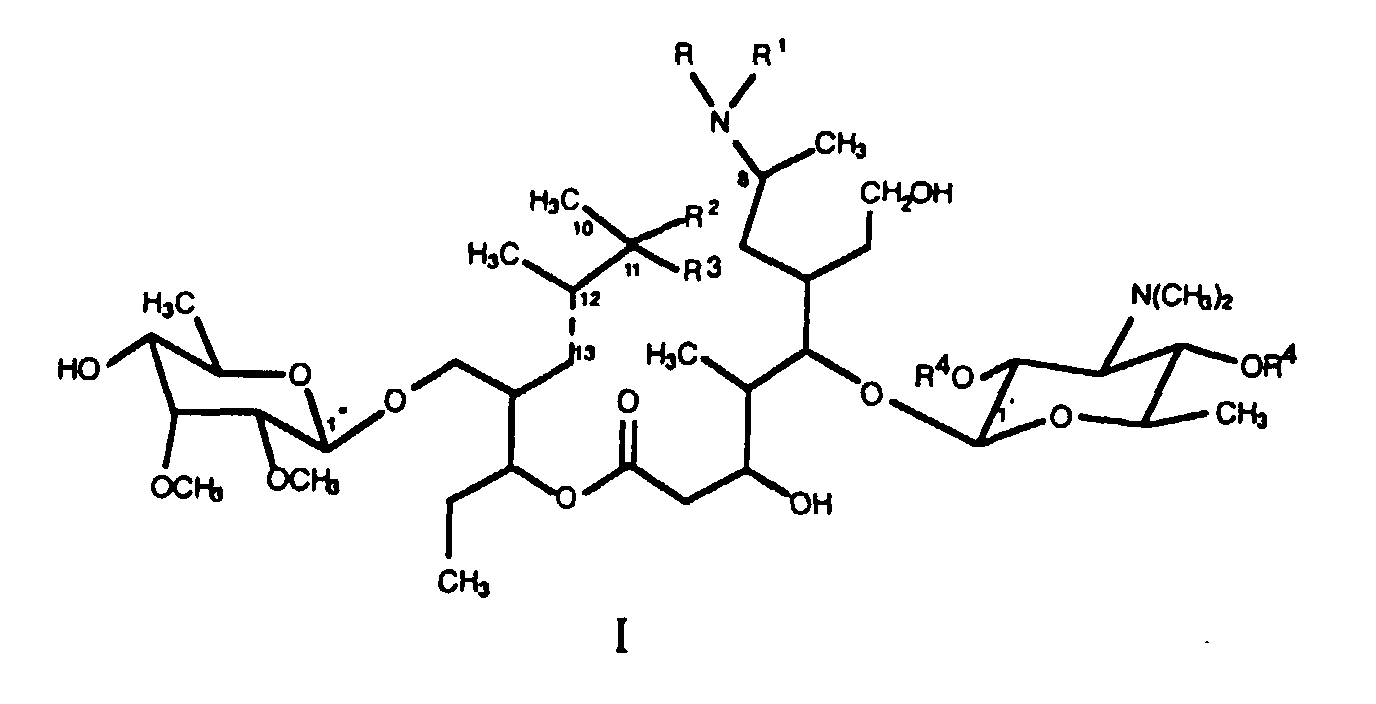
    1. Compounds represented by the general formula I
      Figure 00190001
      characterized in that,
      R
      stands for H or CH3,
      R1
      stands for H, CH3, C1-C3 acyl or aryl sulfonyl,
      R2
      stands for H and R3 stands for NH2 or OH, or R2 and R3 together stand for O or NOH,
      R4
      stands for H or C1-C3 acyl,
      and the line - - - -
      stands for a double or a single bond.
    2. A compound according to claim 1, characterized in that R, R1 and R4 are the same and stand for H, R2 and R3 together stand for NOH and the line - - - - stands for a double bond.
    3. A compound according to claim 1, characterized in that R and R1 are the same and stand for CH3, R2 and R3 together stand for NOH, R4 stands for H and the line - - - - stands for a double bond.
    4. A compound according to claim 1, characterized in that R and R1 are the same and stand for CH3, R2 and R3 together stand for NOH, R4 stands for H and the line - - - - stands for a single bond.
    5. A compound according to claim 1, characterized in that R, R1 and R4 are the same and stand for H, R2 and R3 together stand for O and the line - - - - stands for a double bond.
    6. A compound according to claim 1, characterized in that R and R4 are the same and stand for H, R1 stands for formyl group, R2 and R3 together stand for O and the line - - - - stands for a double bond.
    7. A compound according to claim 1, characterized in that R, R1, R2 and R4 are the same and stand for H, R3 stands for OH and the line - - - - stands for a double bond.
    8. A compound according to claim 1, characterized in that R, R2 and R4 are the same and stand for H, R1 stands for tosyl group, R3 stands for OH and the line - - - - stands for a double bond.
    9. A compound according to claim 1, characterized in that R, R1 and R4 are the same and stand for H, R2 and R3 together stand for O and the line - - - - stands for a single bond.
    10. A compound according to claim 1, characterized in that R, R1, R2 and R4 are the same and stand for H, R3 stands for OH and the line - - - - stands for a single bond.
    11. A compound according to claim 1, characterized in that R stands for H, R1 and R4 are the same and stand for an acetyl group, R2 and R3 together stand for O and the line - - - - stands for a double bond.
    12. A compound according to claim 1, characterized in that R and R4 are the same and stand for H, R1 stands for an acetyl group, R2 and R3 together stand for O and the line - - - - stands for a double bond.
    13. A compound according to claim 1, characterized in that R and R1 are the same and stand for CH3, R2 and R4 are the same and stand for H, R3 stands for OH and the line - - - - stands for a single bond.
    14. A compound according to claim 1, characterized in that R and R1 are the same and stand for CH3, R2 and R4 are the same and stand for H, R3 stands for OH and the line - - - - stands for a double bond.
    15. A compound according to claim 1, characterized in that R R1, R2 and R4 are the same and stand for H, R3 stands for NH2 and the line - - - - stands for a double bond.
    16. A compound according to claim 1, characterized in that R, R1, R2 and R4 are the same and stand for H, R3 stands for NH2 and the line - - - - stands for a single bond.
    17. Process for the preparation of compounds of the general formula I
      Figure 00210001
      wherein
      R
      stands for H or CH3,
      R1
      stands for H, CH3, C1-C3 acyl or aryl sulfonyl,
      R2
      stands for H and R3 stands for NH2 or OH, or R2 and R3 together stand for O or NOH,
      R4
      stands for H or C1-C3 acyl,
      and the line - - -
      - stands for a double or a single bond,

      characterized in that 4'-demicarosyl-8a-aza-8a-homorelomycin of the formula II
      Figure 00220001
      is subjected to
      A/ a reaction of oximation with 3-10 equivalents of hydroxlyamine hydrochloride in pyridine in a nitrogen stream at reflux temperature during 3 to 10 hours, whereby a compound of the general formula I is obtained, wherein R, R1 and R4 are the same and stand for H, R2 and R3 together stand for NOH and the line - - - - stands for a double bond, which is then optionally
      A1/ reductively N-alkylated with 1-4 equivalents of formaldehyde (36%) in the presence of the 1-5 equivalents of formic acid (98-100%) in halogenated hydrocarbons, such as chloroform or methylene chloride, at a temperature from 10°C to reflux temperature during 2 to 30 hours, whereby a compound of the general formula I is obtained, wherein R and R1 are the same and stand for CH3, R2 and R3 together stand for NOH, R4 stands for H and the line - - - - stands for a double bond;
      or, optionally,
      A2/ a catalytical hydrogenation in C1-C3 aliphatic alcohol is carried out in the presence of a noble metal on an inert carrier, preferably with palladium-on-characoal (2-5 w/w), at a hydrogen pressure from 0.2 to 0.5 MPa and at room temperature during 2 to 10 hours, whereby a compound of the general formula I is obtained, wherein R, R1 and R4 are the same and stand for H, R2 and R3 together stand for NOH and the line - - - - stands for a single bond;
      or is optionally subjected to
      B/ a conversion of hydroxyimino group into keto group with NaHSO3 in the presence of an acid, preferably formic acid (98-100%) in 50% ethanol, at reflux temperature during 2 to 8 hours, whereby a compound of the general formula I is obtained, wherein R, R1 and R4 are the same and stand for H, R2 and R3 together stand for O and the line - - - - stands for a double bond, which is then optionally subjected to
      B1/ a reaction of N- or N,O-acylation with C1-C3 carboxylic acids, preferably with formic acid (98-100%), and acid anhydrides, preferably with acetic acid anhydride, in halogenated hydrocarbons such as chloroform or methylene chloride, at room temperature or reflux temperature during 1 to 20 hours, whereby a compound of the general formula I is obtained, wherein R and R4 are the same and stand for H, R1 stands for CHO, R2 and R3 together stand for O and the line - - - - stands for a double bond, or a compound of the formula I, wherein R stands for H, R1 and R4 are the same and stand for COCH3, R2 and R3 together stand for O and the line - - - - stands for a double bond, which is then optionally subjected to
      B1/1 methanolysis at room temperature during 3 days, yielding a compound of the general formula I, wherein R1 and R4 are the same and stand for H, R1 stands for COCH3, R2 and R3 together stand for O and the line - - - - stands for a double bond;
      or is optionally
      B2/ catalytically hydrogenated in the manner described in A2, whereby a compound of the general formula I is obtained, wherein R R1 and R4 are the same and stand for H, R2 and R3 together stand for O and the line - - - - stands for a single bond;
      or, optionally,
      C/ a reduction with NaBH4 in a C1-C3 aliphatic alcohol is carried out at room temperature during 0.5 to 2 hours, whereby a compound of the general formula I is obtained, wherein R, R1, R2 and R4 are the same and stand for H, R3 stands for OH and the line - - - - stands for a double bond, which is optionally subjected to
      C1/ N-tosylation with p-toluene sulfochloride in pyridine at room temperature during 1 to 5 hours, whereby a compound of the general formula I is obtained, wherein R, R2 and R4 are the same and stand for H, R1 stands for tosyl, R3 stands for OH and the line - - - - stands for a double bond,
      or is, optionally,
      C2/ reductively N-alkylated in the manner described in A1, whereby a compound of the general formula I is obtained, wherein R and R1 are the same and stand for CH3, R2 and 4 are the same and stand for H, R3 stands for OH and the - - - - stands for a double bond;
      or is, optionally,
      C3/ catalytically hydrogenated in the manner described in A2, whereby a compound of the general formula I is obtained, wherein R, R1, R2 and R4 are the same and stand for H, R3 stands for OH and the line - - - - stands for a single bond, which is optionally
      C4/ N-alkylated in the manner described in A1, whereby a compound of the general formula I is obtained, wherein R and R1 are the same and stand for CH3, R2 and R4 are the same and stand for H, R3 stands for OH and the line - - - - stands for a single bond;
      or is optionally
      D/ subjected to catalytical reduction in glacial acetic acid in the presence of noble metals and their oxides as catalysts, preferably with platinum (IV) oxide, at a hydrogen pressure from 5.07 to 70.93 bars and at room temperature during 10 hours to 3 days, whereby a compound of the general formula I is obtained, wherein R, R1, R2 and R4 are the same and stand for H, R3 stands for NH2 and the line - - - - stands for a single bond;
      or optionally
      E/ an electrochemical reduction is carried out in an electrolytic H-cell with anode and cathode regions separated by a membrane, using a Hg basin as the working electrode and graphite as the counter electrode, in a phosphate buffer with pH 4.0 - 7.0 at a constant potential between 1.2 - 1.6 V against saturated calomel electrode during 1 to 5 hours at room temperature in a nitrogem stream, whereby a compound of the general formula I is obtained, wherein R, R1, R2 and R4 are the same and stand for H, R3 stands for NH2 and line - - - - stands for a double bond.
    EP98112904A 1997-07-16 1998-07-10 Tylosin secomacrolide compounds Withdrawn EP0891981A1 (en)

    Applications Claiming Priority (4)

    Application Number Priority Date Filing Date Title
    HR970386 1997-07-16
    HRP970386 HRP970386A2 (en) 1997-07-16 1997-07-16 Novel seco compounds from a class of tylosins
    HR980276A HRP980276A2 (en) 1998-05-22 1998-05-22 New secothylozine compounds
    HR980276 1998-05-22

    Publications (1)

    Publication Number Publication Date
    EP0891981A1 true EP0891981A1 (en) 1999-01-20

    Family

    ID=26317103

    Family Applications (1)

    Application Number Title Priority Date Filing Date
    EP98112904A Withdrawn EP0891981A1 (en) 1997-07-16 1998-07-10 Tylosin secomacrolide compounds

    Country Status (11)

    Country Link
    US (1) US5962661A (en)
    EP (1) EP0891981A1 (en)
    JP (1) JPH1192491A (en)
    CN (1) CN1218811A (en)
    BG (1) BG102631A (en)
    CA (1) CA2240976A1 (en)
    CZ (1) CZ211798A3 (en)
    HU (1) HUP9801594A3 (en)
    NO (1) NO983267D0 (en)
    PL (1) PL327389A1 (en)
    SK (1) SK94998A3 (en)

    Cited By (1)

    * Cited by examiner, † Cited by third party
    Publication number Priority date Publication date Assignee Title
    WO2000077016A1 (en) * 1999-06-11 2000-12-21 Pliva D.D. DERIVATIVES OF 4'-DEMYCAROSYL-8a-AZA-8a-HOMOTYLOSIN

    Citations (3)

    * Cited by examiner, † Cited by third party
    Publication number Priority date Publication date Assignee Title
    US5215980A (en) * 1992-01-17 1993-06-01 Merck & Co., Inc. 10-AZA-9-deoxo-11-deoxy-erythromycin A and derivatives thereof
    EP0735041A1 (en) * 1995-03-27 1996-10-02 PLIVA farmaceutska, kemijska, prehrambena i kozmeticka industrija, dionicko drustvo New compounds of the secomacrolide and secoazalide class and a process for the preparation thereof
    EP0864581A1 (en) * 1997-03-12 1998-09-16 PLIVA farmaceutska, kemijska, prehrambena i kozmeticka industrija, dionicko drustvo Secomacrolides and process for their preparation

    Family Cites Families (2)

    * Cited by examiner, † Cited by third party
    Publication number Priority date Publication date Assignee Title
    SI8710674B (en) * 1987-04-14 1998-06-30 Pliva Process for preparation of 10,11,12,13-tetrahydro derivatives of tylosin
    SI8911498B (en) * 1989-07-26 1998-10-31 Pliva Process for the preparation of tylosin derivatives

    Patent Citations (3)

    * Cited by examiner, † Cited by third party
    Publication number Priority date Publication date Assignee Title
    US5215980A (en) * 1992-01-17 1993-06-01 Merck & Co., Inc. 10-AZA-9-deoxo-11-deoxy-erythromycin A and derivatives thereof
    EP0735041A1 (en) * 1995-03-27 1996-10-02 PLIVA farmaceutska, kemijska, prehrambena i kozmeticka industrija, dionicko drustvo New compounds of the secomacrolide and secoazalide class and a process for the preparation thereof
    EP0864581A1 (en) * 1997-03-12 1998-09-16 PLIVA farmaceutska, kemijska, prehrambena i kozmeticka industrija, dionicko drustvo Secomacrolides and process for their preparation

    Non-Patent Citations (1)

    * Cited by examiner, † Cited by third party
    Title
    LAZAREVSKI G ET AL: "RING OPENING REACTIONS OF 6-DEOXY-9-DEOXO-9A-HOMOERYTHROMYCIN A 6,9-CYCLIC IMINO ETHER", JOURNAL OF ANTIBIOTICS, vol. 49, no. 10, October 1996 (1996-10-01), pages 1066 - 1069, XP002065871 *

    Cited By (1)

    * Cited by examiner, † Cited by third party
    Publication number Priority date Publication date Assignee Title
    WO2000077016A1 (en) * 1999-06-11 2000-12-21 Pliva D.D. DERIVATIVES OF 4'-DEMYCAROSYL-8a-AZA-8a-HOMOTYLOSIN

    Also Published As

    Publication number Publication date
    PL327389A1 (en) 1999-01-18
    BG102631A (en) 1999-09-30
    CZ211798A3 (en) 1999-02-17
    NO983267D0 (en) 1998-07-15
    SK94998A3 (en) 1999-02-11
    HUP9801594A3 (en) 2000-03-28
    HUP9801594A2 (en) 1999-02-01
    CA2240976A1 (en) 1999-01-16
    HU9801594D0 (en) 1998-09-28
    NO983267L (en) 1999-01-18
    JPH1192491A (en) 1999-04-06
    US5962661A (en) 1999-10-05
    CN1218811A (en) 1999-06-09

    Similar Documents

    Publication Publication Date Title
    EP0109253B1 (en) Epimeric azahomoerythromycin a derivative and intermediates therefor
    EP0879823B1 (en) Preparation of azithromycin
    US4526889A (en) Epimeric azahomoerythromycin A derivative, intermediates and method of use
    EP0287082B1 (en) Derivatives of tylosin and 10,11,12,13-tetrahydro tylosin, methods of manufacture thereof and their use in pharmaceuticals and in the manufacture thereof
    EP0410433B1 (en) Tylosin derivatives
    US5962661A (en) Seco compounds from the class of tylosins
    US5218098A (en) 5-(α-D-glucopyranosyloxymethyl)-furan-2-carboxaldehyde
    EP0136831A2 (en) Azahomoerythromycin B derivatives and intermediates thereof
    US5688924A (en) Derivatives of 12,13-Epoxy-tylosin and processes of manufacture thereof
    EP0985679B1 (en) New hydroxy derivatives of tylosin and process for their preparation
    HRP970386A2 (en) Novel seco compounds from a class of tylosins
    EP0735041A1 (en) New compounds of the secomacrolide and secoazalide class and a process for the preparation thereof
    HRP980276A2 (en) New secothylozine compounds
    EP1189914A1 (en) DERIVATIVES OF 4'-DEMYCAROSYL-8a-AZA-8a-HOMOTYLOSIN
    EP0433978B1 (en) New process for the preparation of nojirimycin and related compounds
    CA1250284A (en) Antibacterial epimeric azahomoerythromycin a derivative and production thereof
    US4469683A (en) 3"-Epistreptomycin and its dihydro derivative, pharmaceutical compositions and production of the same
    EP0394908A1 (en) Process for producing glucosaminyl-epi-podophyllotoxin derivatives
    EP0839827A1 (en) Novel polyhydro derivatives of tylosine and process for their preparation
    HU195229B (en) Process for preparing 11-aza-10-deoxo-10-dihydro-erythromycin a by means of electrochemical reduction
    HUT74073A (en) New compounds of the secomacrolide and secoazalide class and a process for the preparation thereof

    Legal Events

    Date Code Title Description
    PUAI Public reference made under article 153(3) epc to a published international application that has entered the european phase

    Free format text: ORIGINAL CODE: 0009012

    AK Designated contracting states

    Kind code of ref document: A1

    Designated state(s): AT BE CH DE DK ES FR GB IT LI NL PT SE

    AX Request for extension of the european patent

    Free format text: AL;LT;LV;MK PAYMENT 980710;RO PAYMENT 980710;SI PAYMENT 980710

    17P Request for examination filed

    Effective date: 19990521

    AKX Designation fees paid

    Free format text: AT BE CH DE DK ES FR GB IT LI NL PT SE

    AXX Extension fees paid

    Free format text: MK PAYMENT 19980710;RO PAYMENT 19980710;SI PAYMENT 19980710

    17Q First examination report despatched

    Effective date: 20010305

    STAA Information on the status of an ep patent application or granted ep patent

    Free format text: STATUS: THE APPLICATION IS DEEMED TO BE WITHDRAWN

    18D Application deemed to be withdrawn

    Effective date: 20010717