EP0892228A2 - Refrigerator with cool air distributing device - Google Patents

Refrigerator with cool air distributing device Download PDF

Info

Publication number
EP0892228A2
EP0892228A2 EP98305606A EP98305606A EP0892228A2 EP 0892228 A2 EP0892228 A2 EP 0892228A2 EP 98305606 A EP98305606 A EP 98305606A EP 98305606 A EP98305606 A EP 98305606A EP 0892228 A2 EP0892228 A2 EP 0892228A2
Authority
EP
European Patent Office
Prior art keywords
refrigerator
vertical
blade
cool air
dispersing
Prior art date
Legal status (The legal status is an assumption and is not a legal conclusion. Google has not performed a legal analysis and makes no representation as to the accuracy of the status listed.)
Withdrawn
Application number
EP98305606A
Other languages
German (de)
French (fr)
Other versions
EP0892228A3 (en
Inventor
Joon Dong Ji
Jae In Kim
Current Assignee (The listed assignees may be inaccurate. Google has not performed a legal analysis and makes no representation or warranty as to the accuracy of the list.)
Samsung Electronics Co Ltd
Original Assignee
Samsung Electronics Co Ltd
Priority date (The priority date is an assumption and is not a legal conclusion. Google has not performed a legal analysis and makes no representation as to the accuracy of the date listed.)
Filing date
Publication date
Priority claimed from KR1019970033264A external-priority patent/KR100208360B1/en
Priority claimed from KR1019970042267A external-priority patent/KR19990018973A/en
Priority claimed from KR1019970042278A external-priority patent/KR19990018984A/en
Priority claimed from KR1019970042263A external-priority patent/KR100229490B1/en
Application filed by Samsung Electronics Co Ltd filed Critical Samsung Electronics Co Ltd
Publication of EP0892228A2 publication Critical patent/EP0892228A2/en
Publication of EP0892228A3 publication Critical patent/EP0892228A3/en
Withdrawn legal-status Critical Current

Links

Images

Classifications

    • FMECHANICAL ENGINEERING; LIGHTING; HEATING; WEAPONS; BLASTING
    • F24HEATING; RANGES; VENTILATING
    • F24FAIR-CONDITIONING; AIR-HUMIDIFICATION; VENTILATION; USE OF AIR CURRENTS FOR SCREENING
    • F24F13/00Details common to, or for air-conditioning, air-humidification, ventilation or use of air currents for screening
    • F24F13/02Ducting arrangements
    • F24F13/06Outlets for directing or distributing air into rooms or spaces, e.g. ceiling air diffuser
    • F24F13/075Outlets for directing or distributing air into rooms or spaces, e.g. ceiling air diffuser having parallel rods or lamellae directing the outflow, e.g. the rods or lamellae being individually adjustable
    • FMECHANICAL ENGINEERING; LIGHTING; HEATING; WEAPONS; BLASTING
    • F25REFRIGERATION OR COOLING; COMBINED HEATING AND REFRIGERATION SYSTEMS; HEAT PUMP SYSTEMS; MANUFACTURE OR STORAGE OF ICE; LIQUEFACTION SOLIDIFICATION OF GASES
    • F25DREFRIGERATORS; COLD ROOMS; ICE-BOXES; COOLING OR FREEZING APPARATUS NOT OTHERWISE PROVIDED FOR
    • F25D17/00Arrangements for circulating cooling fluids; Arrangements for circulating gas, e.g. air, within refrigerated spaces
    • F25D17/04Arrangements for circulating cooling fluids; Arrangements for circulating gas, e.g. air, within refrigerated spaces for circulating air, e.g. by convection
    • F25D17/042Air treating means within refrigerated spaces
    • F25D17/045Air flow control arrangements
    • FMECHANICAL ENGINEERING; LIGHTING; HEATING; WEAPONS; BLASTING
    • F25REFRIGERATION OR COOLING; COMBINED HEATING AND REFRIGERATION SYSTEMS; HEAT PUMP SYSTEMS; MANUFACTURE OR STORAGE OF ICE; LIQUEFACTION SOLIDIFICATION OF GASES
    • F25DREFRIGERATORS; COLD ROOMS; ICE-BOXES; COOLING OR FREEZING APPARATUS NOT OTHERWISE PROVIDED FOR
    • F25D17/00Arrangements for circulating cooling fluids; Arrangements for circulating gas, e.g. air, within refrigerated spaces
    • F25D17/04Arrangements for circulating cooling fluids; Arrangements for circulating gas, e.g. air, within refrigerated spaces for circulating air, e.g. by convection
    • F25D17/06Arrangements for circulating cooling fluids; Arrangements for circulating gas, e.g. air, within refrigerated spaces for circulating air, e.g. by convection by forced circulation
    • F25D17/062Arrangements for circulating cooling fluids; Arrangements for circulating gas, e.g. air, within refrigerated spaces for circulating air, e.g. by convection by forced circulation in household refrigerators
    • F25D17/065Arrangements for circulating cooling fluids; Arrangements for circulating gas, e.g. air, within refrigerated spaces for circulating air, e.g. by convection by forced circulation in household refrigerators with compartments at different temperatures
    • FMECHANICAL ENGINEERING; LIGHTING; HEATING; WEAPONS; BLASTING
    • F25REFRIGERATION OR COOLING; COMBINED HEATING AND REFRIGERATION SYSTEMS; HEAT PUMP SYSTEMS; MANUFACTURE OR STORAGE OF ICE; LIQUEFACTION SOLIDIFICATION OF GASES
    • F25DREFRIGERATORS; COLD ROOMS; ICE-BOXES; COOLING OR FREEZING APPARATUS NOT OTHERWISE PROVIDED FOR
    • F25D2317/00Details or arrangements for circulating cooling fluids; Details or arrangements for circulating gas, e.g. air, within refrigerated spaces, not provided for in other groups of this subclass
    • F25D2317/06Details or arrangements for circulating cooling fluids; Details or arrangements for circulating gas, e.g. air, within refrigerated spaces, not provided for in other groups of this subclass with forced air circulation
    • F25D2317/065Details or arrangements for circulating cooling fluids; Details or arrangements for circulating gas, e.g. air, within refrigerated spaces, not provided for in other groups of this subclass with forced air circulation characterised by the air return
    • F25D2317/0653Details or arrangements for circulating cooling fluids; Details or arrangements for circulating gas, e.g. air, within refrigerated spaces, not provided for in other groups of this subclass with forced air circulation characterised by the air return through the mullion
    • FMECHANICAL ENGINEERING; LIGHTING; HEATING; WEAPONS; BLASTING
    • F25REFRIGERATION OR COOLING; COMBINED HEATING AND REFRIGERATION SYSTEMS; HEAT PUMP SYSTEMS; MANUFACTURE OR STORAGE OF ICE; LIQUEFACTION SOLIDIFICATION OF GASES
    • F25DREFRIGERATORS; COLD ROOMS; ICE-BOXES; COOLING OR FREEZING APPARATUS NOT OTHERWISE PROVIDED FOR
    • F25D2317/00Details or arrangements for circulating cooling fluids; Details or arrangements for circulating gas, e.g. air, within refrigerated spaces, not provided for in other groups of this subclass
    • F25D2317/06Details or arrangements for circulating cooling fluids; Details or arrangements for circulating gas, e.g. air, within refrigerated spaces, not provided for in other groups of this subclass with forced air circulation
    • F25D2317/067Details or arrangements for circulating cooling fluids; Details or arrangements for circulating gas, e.g. air, within refrigerated spaces, not provided for in other groups of this subclass with forced air circulation characterised by air ducts
    • F25D2317/0672Outlet ducts
    • FMECHANICAL ENGINEERING; LIGHTING; HEATING; WEAPONS; BLASTING
    • F25REFRIGERATION OR COOLING; COMBINED HEATING AND REFRIGERATION SYSTEMS; HEAT PUMP SYSTEMS; MANUFACTURE OR STORAGE OF ICE; LIQUEFACTION SOLIDIFICATION OF GASES
    • F25DREFRIGERATORS; COLD ROOMS; ICE-BOXES; COOLING OR FREEZING APPARATUS NOT OTHERWISE PROVIDED FOR
    • F25D2317/00Details or arrangements for circulating cooling fluids; Details or arrangements for circulating gas, e.g. air, within refrigerated spaces, not provided for in other groups of this subclass
    • F25D2317/06Details or arrangements for circulating cooling fluids; Details or arrangements for circulating gas, e.g. air, within refrigerated spaces, not provided for in other groups of this subclass with forced air circulation
    • F25D2317/068Details or arrangements for circulating cooling fluids; Details or arrangements for circulating gas, e.g. air, within refrigerated spaces, not provided for in other groups of this subclass with forced air circulation characterised by the fans
    • F25D2317/0682Two or more fans
    • FMECHANICAL ENGINEERING; LIGHTING; HEATING; WEAPONS; BLASTING
    • F25REFRIGERATION OR COOLING; COMBINED HEATING AND REFRIGERATION SYSTEMS; HEAT PUMP SYSTEMS; MANUFACTURE OR STORAGE OF ICE; LIQUEFACTION SOLIDIFICATION OF GASES
    • F25DREFRIGERATORS; COLD ROOMS; ICE-BOXES; COOLING OR FREEZING APPARATUS NOT OTHERWISE PROVIDED FOR
    • F25D2400/00General features of, or devices for refrigerators, cold rooms, ice-boxes, or for cooling or freezing apparatus not covered by any other subclass
    • F25D2400/04Refrigerators with a horizontal mullion

Definitions

  • the present invention relates to a refrigerator including a cooling compartment, a heat pump, means for driving cool air, produced by the heat pump, through an aperture into the cooling compartment, and flow directing means associated with the aperture for directing said cool air and which includes a vertical blade pivotable about a vertical axis.
  • a refrigerator has a cabinet in which there are a freezing compartment and a fresh food compartment. These compartments are separated by a partition wall. Doors are provided at the front of the freezing and cooling compartments.
  • a cooling system supplies the freezing compartment and the fresh food compartment with cool air and comprises a compressor, a condenser and an evaporator. The cool air generated by the evaporator flows along a supply duct formed at the back of each compartment, and is then supplied into each cooling compartment through cool air discharge ports opening thereinto by a fan.
  • Figures 1 through 3 are a side view, a partial enlarged sectional view, and an exploded perspective view of the main elements of a refrigerator having a device for dispersing cool air as disclosed in WO-A-95/27278.
  • a refrigerator comprises freezing and fresh food compartments 2, 3 in a cabinet 1, which are separated from each other by a partition wall 5. Respective doors 6, 7 are provided for closing the compartments 2, 3.
  • a cooling system comprising a compressor 11, a condenser (not shown), a freezing compartment evaporator 12a, and a fresh food compartment evaporator 12b, is installed in the cabinet 1. Cool air generated by the evaporators 12a, 12b is supplied to the corresponding compartments 2, 3 by a freezing compartment fan 13a and a fresh food compartment fan 13b respectively.
  • a partially cylindrical duct plate 9 is attached to an inner wall plate 23 forming the rear inner wall surface of the fresh food compartment 3.
  • the duct plate 9 has cool air discharge ports 16, opening into the fresh food compartment 3, formed in it.
  • a supply duct 15 and a return duct 17, separated from each other by a seal plate 25, are provided between the duct plate 9 and the rear wall 4 of the cabinet 1.
  • a duct member 21, for guiding downwards cool air blown by the fresh food compartment fan 13b, is installed in the supply duct 15. Cool air generated by the fresh food compartment evaporator 12b is blown by the fresh food compartment fan 13b and then supplied to the fresh food compartment 3 via the supply duct 15 and the cool air discharge ports 16.
  • a cool air dispersing device 130 is installed in the supply duct 15.
  • the cool air dispersing device 130 comprises a rotational shaft 131 having a vertical axis, cool air dispersing blades 132 assembled with the rotational shaft 131 in correspondence with respective cool air discharge ports 16, and a driving motor 135 for rotating the rotational shaft 131.
  • Each of the cool air dispersing blades 132 comprises three discs 136, 137, 138 disposed in parallel with each other along the shaft 131, and first and second blade parts 133, 134 disposed between pairs of the discs 136, 137, 138.
  • Each of the blade parts 133, 134 is curved so that its cross-section is loosely S-shaped.
  • the blade parts 133, 134 are bent in opposite directions to each other.
  • the blade parts 133, 134 of the cool air dispersing device 130 are S-shaped, the left or right sides of the fresh food compartment 3 may not be supplied with the cool air sufficiently and the smooth flow of cool air may be impeded by a vortices in the cool air formed about the cool air discharge ports 16.
  • a refrigerator according to the present invention is characterised in that the vertical blade is configured for being reciprocally pivoted, for instance by drive means.
  • the flow directing means comprises a plurality of vertical blades is configured for being reciprocally pivoted.
  • a motor and a crank mechanism are preferably provided for driving the or each vertical blade.
  • the flow directing mean includes one or more substantially horizontal blades pivotable about horizontal axes.
  • cam mean mounted for rotation with the or both of the vertical blades, and cam follower means for driving the or each horizontal blade when the or each vertical blade is being driven.
  • the or each horizontal blade has a cutout encompassing the area swept by one or both of the vertical blades. If there are two parallel vertical blades, the or each horizontal blade preferably has two cutouts, each encompassing the area swept by a vertical blade.
  • a refrigerator comprises a cabinet 1, a freezing compartment 2 and a fresh food compartment 3 formed within the cabinet 1 and separated by a partition wall 5.
  • the freezing compartment 2 is disposed above the fresh food compartment 3.
  • the compartments 2, 3 are provided with respective doors 6, 7.
  • Shelves 8 for supporting food and which divide the fresh food compartment 3 into three areas, i.e. an upper area, a middle area, and a lower area, are installed in fresh food compartment 3.
  • a special fresh chamber 18 for storing food which requires a specific temperature range is formed in the upper part of the fresh food compartment 3, and a vegetable chamber 19 for storing vegetables is formed at the bottom of the fresh food compartment 3.
  • a cooling system comprising a compressor 11, a condenser (not shown), a freezing compartment evaporator 12a, and a fresh food compartment evaporator 12b, is installed in the cabinet 1.
  • the cool air generated by the evaporators 12a, 12b is supplied into the corresponding cooling compartments 2, 3 by a freezing compartment fan 13a and a fresh food compartment fan 13b respectively.
  • a duct plate 9 is attached on the inner wall plate 23, forming the rear wall of the fresh food compartment 3.
  • the duct plate 9 is partially cylindrical in shape so that it protrudes in the form of an arc from the inner wall plate 23 into the fresh food compartment 3, and has cool air discharge ports 16 opening into respective storing areas of the fresh food compartment 3.
  • Another cool air discharge port 16', opening into the special fresh chamber 18 is provided in the upper area of the inner wall plate 23.
  • a supply duct 15 and a return duct 17 are provided, which are partitioned from each other by a seal plate 25.
  • a duct member 21 for guiding the cool air blown by the fresh food compartment fan 13b downwardly is installed in the supply duct 15.
  • the cool air generated by the fresh food compartment evaporator 12b is blown by the fresh food compartment fan 13b so as to be supplied into the fresh food compartment 3 via the supply duct 15 and the cool air discharge ports 16.
  • a device for dispersing the cool air horizontally is installed in the supply duct 15.
  • a supply duct 15 and a return duct 17 are provided between the duct plate 9 and the rear wall 4 of the cabinet 1. These ducts 15, 17 are partitioned from each other by a seal plate 25.
  • a duct member 21 for guiding cool air, blown downwards by the fresh food compartment fan 13b, is installed in the supply duct 15. The cool air generated by the fresh food compartment evaporator 12b is blown by the fresh food compartment fan 13b so as to be supplied into the fresh food compartment 3 via the supply duct 15 and the cool air discharge ports 16.
  • a device for dispersing the cool air horizontally is installed in the supply duct 15.
  • the refrigerator has a device 30 for dispersing cool air horizontally and a device 40 for dispersing the cool air vertically.
  • the horizontally dispersing device 30 has a vertical rotational shaft 31, three planar dispersing horizontally dispersing blades 33, a pivoting member 80 for pivoting the horizontally dispersing blades 33, and a driving motor 35 for rotating the pivoting member 80.
  • the horizontally dispersing blades 33 are spaced along the shaft 31 so as to be near respective cool air discharge ports 16.
  • the upper end of the rotational shaft 31 is supported by a supporting member (not shown).
  • a journal part 32 is formed at the bottom of the rotational shaft 31 and is inserted into a bearing hole 9g formed in the lower part of the duct plate 9.
  • the driving motor 35 is a stepping motor whose stationary angular position can be controlled.
  • a pivot guide 37 is provided along the upper edge of the uppermost horizontally dispersing blade 33.
  • the pivot guide 37 has a guide groove 39 formed transverse to the longitudinal direction of the rotational shaft 31.
  • the pivoting member 80 is coupled to the driving shaft 36 of the driving motor 35.
  • the pivoting member 80 has a pivot pin 81 which is eccentric with respect to the rotational axis thereof.
  • the pivot pin 81 is inserted into the guide groove 39.
  • the pivoting member 80 rotates causing the pivot pin 81 to reciprocate in the guide groove 39. Consequently, the horizontally dispersing blades 33 are rotated reciprocally about the rotational shaft 31. In this situation, the angular range of the rotation of the horizontally dispersing blades 33 depends on the radial length of the pivot pin 81. As the horizontally dispersing blades 33 reciprocate, the cool air discharged through the cool air discharge ports 16 is dispersed horizontally.
  • the vertically dispersing device 40 comprises a plurality of vertically dispersing blades 57 which are disposed near the cool air discharge ports 16 and which are capable of pivoting about respective horizontal axes, a link member 61 installed in the supply duct 15 so as to be capable of moving up and down, and a raising and lowering cam 63 for raising and lowering the link member 61.
  • Each vertically dispersing blade 57 comprises a generally arcuate plate so as to accommodate the horizontally dispersing blades 33 and horizontal stub shafts 53 extending from either end of the plate.
  • the duct plate 9 has a pair of flanges 9e which extend backward from the rear surface of both side margins of the duct plate 9.
  • the flanges 9e face each other and have a plurality of shaft holes 9f for receiving and rotatably supporting the stub shafts 53 of the vertically dispersing blades 57.
  • the vertical dispersing blades 57 are capable of pivoting when their stub shafts 53 are inserted into the shaft holes 9f.
  • the link member 61 is disposed parallel to the rotational shaft 31.
  • the link member 61 is rod-shaped and has a plurality of partially ring-shaped hinge assembly parts 62 which protrude toward the vertically dispersing blades 57.
  • each of the vertically dispersing blades 57 has a horizontal, cylindrical hinge part 55 at the middle of its forward edge.
  • the hinge assembly parts 62 are engaged with the hinge parts 73 so that there can be relative rotational movement therebetween.
  • a raising and lowering cam 63 is installed on the rotational shaft 31.
  • the raising and lowering cam 63 comprises a cylindrical cam body 66 and a cam groove 65 formed on the outer surface of the cam body 66.
  • the cam groove 65 is an inclined closed loop.
  • On the link member 61 is provided an operation part 67, protruding transversely of the longitudinal direction of the link member 61, and the free end of the operation part 67 is received by the cam groove 65.
  • the link member 61 also has a guiding piece 69 protruding towards the duct plate 9.
  • the guiding piece 69 is accommodated in a raising and lowering guiding part 49 formed on the inner wall of the duct plate 9.
  • the raising and lowering guiding part 49 accommodates the guiding piece 69 so that the link member 61 moves up and down without rotating.
  • the horizontally dispersing blades 33 are rotated reciprocally by the driving motor 35 and the pivoting member 80.
  • the horizontally dispersing blades 33 are directed directly to the front during the rotation of the rotational shaft 31 as shown in Figure 7, cool air in the supply duct 15 is discharged to the front along both sides of the horizontally dispersing blades 33.
  • the horizontally dispersing blades 33 are turned left or right as shown in Figures 8 and 9, cool air is discharged to the left or the right.
  • the discharging direction of the cool air changes as the angular position of the horizontally dispersing blades 33 changes so that cool air is dispersed in the fresh food compartment 3 uniformly. Moreover, since the horizontally dispersing blades 33 are planar, vortices are not caused by the horizontally dispersing blades 33.
  • the driving motor 35 is stopped when the horizontally dispersing blades 33 are directed to the specific area.
  • temperature sensors placed at a plurality of positions in the fresh food compartment 3, as well as a control part for controlling the driving motor 35 on the basis of the signals from the temperature sensors have to be provided.
  • the horizontally dispersing blades 33 are disposed in association with respective the cool air discharge ports 16. However, it is possible that only one long horizontally dispersing blade be provided for directing cool air through all of the cool air discharge ports 16.
  • the raising and lowering cam 63 rotates with the shaft 31 and the link member 61 is raised and lowered by the operation part 67 which is received in the cam groove 65.
  • the raising and lowering movement of the link member 61 causes pivoting of the vertically dispersing blades 57 by means of the hinge assembly part 62 and the hinge parts 55.
  • the raising and lowering motion of the link member 61 is guided vertically by the guiding piece 69 and the raising and lowering guiding part 49. Consequently, the link member 61 does not rotate but reciprocates in the vertical direction while the raising and lowering cam 63 rotates.
  • a horizontally dispersing device 90 comprises a pair of parallel horizontally dispersing blades 93, which extend past all of the cool air discharge ports 16.
  • Each of the horizontally dispersing blades 93 has its own rotational shaft 91.
  • the lower end of each rotational shaft 91 is inserted into a bearing hole 29 formed at the bottom of the duct plate 9, and its upper end thereof is supported by a supporting member which is not shown.
  • the horizontally dispersing blades 93 are supported on rotational shafts 91 for rotation therewith.
  • Each of the rotational shafts 91 has a rod 94 at its upper end which extends in a direction transverse to the axis of the respective rotational shaft 91, and a connecting pin 95 protruding upward at the end of the rod 94.
  • the rods 94 are connected to each other by a connecting bar 96. More specifically, the connecting bar 96 has holes 97 at either ends and the connecting pins 95 are inserted into these holes 97.
  • the horizontally dispersing blades 93 are connected to each other while being kept parallel with each other.
  • a driving motor 35 is installed above the connecting bar 96, and a cylindrical cam member 99 is disposed between the driving motor 35 and the connecting bar 96.
  • the cam member 99 is coupled with the driving shaft 36 of the driving motor 35.
  • a substantially elliptical cam groove 99a is formed on the underside of the cam member 99.
  • An operation pin 98, formed on the connecting bar 96, is received in the cam groove 99a.
  • the connecting bar 96 When the operation pin 98 is positioned where the cam groove 99a is narrow by the rotation of the cam member 99, the connecting bar 96 is moved left as shown in Figure 15 and the horizontally dispersing blades 93 are rotated to the right.
  • the connecting bar 96 When the operation pin 98 is positioned where the cam groove 99a is wide by the continued rotation of the cam member 99, the connecting bar 96 is moved right as shown in Figure 16 and the horizontally dispersing blades 93 are rotated to the left.
  • the horizontal dispersing blades 93 is rotated left and right reciprocally about the axes of their rotational shafts 91 and cool air discharged through the cool air discharge ports 16 is dispersed left and right.
  • the angular range of the reciprocal rotation depends on the range of the reciprocation of the connecting bar 96.
  • the construction of the horizontally dispersing device 90 is substantially the same with that of the above-described second embodiment but a vertically dispersing device 100 is provided.
  • the construction of the vertically dispersing device 100 is similar to that of the second embodiment shown in Figures 13 through 16.
  • the vertically dispersing device 100 has vertically dispersing blades 107 having horizontal rotational shafts 103 and hinge parts 102 respectively, and a link member 101 having hinge assembly parts 104 assembled with respective hinge parts 102.
  • the vertically dispersing blade 107 is formed with a cutout 108.
  • the cutout 108 accommodates the swept area of the horizontally dispersing blades 93 so as to allow the reciprocal rotation of the horizontally dispersing blades 93.
  • a cam member 109 is installed on the driving shaft 36 of the driving motor 35. As shown in Figure 18, on the underside of the cam member 109 is formed a cam groove 109a into which the operation pin 98 of the connecting bar 96 is inserted.
  • the cam groove 109a is substantially elliptical.
  • a raising and lowering cam groove 109b is formed in the outer surface of the cam member 109.
  • the cam groove 109b is a closed loop.
  • the upper end of the link member 101 is inserted into the raising and lowering gam groove 109b so that rotational movement of the cam member 109 is converted into vertical reciprocal movement of the link member 101.
  • the vertically dispersing blades 107 are vertically reciprocally rotated. That is, as shown in Figures 19 and 20, the vertically dispersing blades 107 are rotated upward and downward by the rising and falling of the link member 101.
  • the horizontally dispersing blades 93 are rotated left or right as shown in Figures 21 and 22 so that cool air is dispersed horizontally.
  • the construction of the horizontally dispersing device 90 and the vertically dispersing device 100 is substantially the same with that of the third embodiment except for the shape of the vertically dispersing blades 107.
  • Each of the vertically dispersing blades 107 has a pair of cutouts 108a formed at the rear left and rear right sides thereof.
  • the cutouts 108a correspond to the pair of horizontally dispersing blades 93. That is, each of the cut parts 108a accommodates the swept area of one of the horizontally dispersing blades 93 so at to allow the reciprocal rotation of the horizontally dispersing blades 93.
  • Each vertically dispersing blade 107 is formed with a hole 110 instead of the hinge part 102 shown in the third embodiment, and the link member 101 is formed with supporting protrusions 101a instead of the hinge assembly parts shown in the third embodiment.
  • the link member 101 passes through the vertically dispersing blades 107 through the holes 110, and the vertically dispersing blades 107 are supported by the supporting protrusions 101a.
  • the link member 101 moves up, the vertically dispersing blades 107 pivot upward, and when the link member 101 moves down, the vertical dispersing blades 107 pivot downward. Accordingly, the cool air is dispersed vertically by the vertically dispersing blades 107.
  • the cutout areas of the vertical dispersing blade 107 are smaller than that of the vertically dispersing blade of the third embodiment. Therefore, the cool air is dispersed in vertical direction more efficiently.
  • a stable cool air flow and a uniform distribution of the cool air can be achieved without vortices in the cool air near the cool air discharge ports. Furthermore, the uniform distribution of the cool air can be achieved not only horizontally but also in vertical direction when suitable blades are provided. Since the horizontally dispersing blades are reciprocally rotated in the angular range, the efficiency for dispersing cool air in the horizontal direction is more enhanced.

Landscapes

  • Engineering & Computer Science (AREA)
  • Chemical & Material Sciences (AREA)
  • Combustion & Propulsion (AREA)
  • Mechanical Engineering (AREA)
  • General Engineering & Computer Science (AREA)
  • Physics & Mathematics (AREA)
  • Thermal Sciences (AREA)
  • Cold Air Circulating Systems And Constructional Details In Refrigerators (AREA)

Abstract

A refrigerator has a cool air dispersing device (30) capable of distributing cool air horizontally into a ccoling compartment (3). The device includes a vertical blade that reciprocates about an axis and directs cool air through an aperture (16). In one embodiment, a separate vertical blade is provided for each of a plurality of apertures (16). In other embodiments, two parallel blades direct cool air through a plurality of apertures (16). Pivotable, horizontal blades may be provided for distributing cool air through the apertures (16) vertically.

Description

The present invention relates to a refrigerator including a cooling compartment, a heat pump, means for driving cool air, produced by the heat pump, through an aperture into the cooling compartment, and flow directing means associated with the aperture for directing said cool air and which includes a vertical blade pivotable about a vertical axis.
Generally, a refrigerator has a cabinet in which there are a freezing compartment and a fresh food compartment. These compartments are separated by a partition wall. Doors are provided at the front of the freezing and cooling compartments. A cooling system supplies the freezing compartment and the fresh food compartment with cool air and comprises a compressor, a condenser and an evaporator. The cool air generated by the evaporator flows along a supply duct formed at the back of each compartment, and is then supplied into each cooling compartment through cool air discharge ports opening thereinto by a fan.
In such a conventional refrigerator, however, cool air tends to be supplied into a particular area of the cooling compartment and other areas tend to be less well served. Consequently, a uniform temperature is not maintained throughout the cooling compartment.
This problem has been addressed by providing cool air discharge ports in the side walls of the cooling compartment as well as in its rear wall. However, there may be still a dead-zone at an edge area which is not supplied with the cool air sufficiently. Furthermore, the ducting required to supply cool air from the sides of the cooling compartment reduces the space available for food and increases the cost of manufacture.
The problem of adequately distributing cool air in a refrigerator is worse for larger refrigerators.
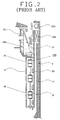
Figures 1 through 3 are a side view, a partial enlarged sectional view, and an exploded perspective view of the main elements of a refrigerator having a device for dispersing cool air as disclosed in WO-A-95/27278.
Referring to Figures 1 to 3, a refrigerator comprises freezing and fresh food compartments 2, 3 in a cabinet 1, which are separated from each other by a partition wall 5. Respective doors 6, 7 are provided for closing the compartments 2, 3. A cooling system, comprising a compressor 11, a condenser (not shown), a freezing compartment evaporator 12a, and a fresh food compartment evaporator 12b, is installed in the cabinet 1. Cool air generated by the evaporators 12a, 12b is supplied to the corresponding compartments 2, 3 by a freezing compartment fan 13a and a fresh food compartment fan 13b respectively.
A partially cylindrical duct plate 9 is attached to an inner wall plate 23 forming the rear inner wall surface of the fresh food compartment 3. The duct plate 9 has cool air discharge ports 16, opening into the fresh food compartment 3, formed in it. A supply duct 15 and a return duct 17, separated from each other by a seal plate 25, are provided between the duct plate 9 and the rear wall 4 of the cabinet 1. A duct member 21, for guiding downwards cool air blown by the fresh food compartment fan 13b, is installed in the supply duct 15. Cool air generated by the fresh food compartment evaporator 12b is blown by the fresh food compartment fan 13b and then supplied to the fresh food compartment 3 via the supply duct 15 and the cool air discharge ports 16.
A cool air dispersing device 130 is installed in the supply duct 15. The cool air dispersing device 130 comprises a rotational shaft 131 having a vertical axis, cool air dispersing blades 132 assembled with the rotational shaft 131 in correspondence with respective cool air discharge ports 16, and a driving motor 135 for rotating the rotational shaft 131. Each of the cool air dispersing blades 132 comprises three discs 136, 137, 138 disposed in parallel with each other along the shaft 131, and first and second blade parts 133, 134 disposed between pairs of the discs 136, 137, 138. Each of the blade parts 133, 134 is curved so that its cross-section is loosely S-shaped. The blade parts 133, 134 are bent in opposite directions to each other.
In a refrigerator having the above-described constitution, when the driving motor 131 rotates the rotational shaft 131 at a low speed, cool air flowing along the supply duct 15 changes its direction along the curved surfaces of the cool air dispersing blades 132, and is directed into the fresh food compartment 3 so as to disperse horizontally. When concentrated cooling in a specific area is needed, the driving motor 135 stops the rotational shaft 131 so that the cool air dispersing blades 132 direct cool air to the specific area. However, since the blade parts 133, 134 of the cool air dispersing device 130 are S-shaped, the left or right sides of the fresh food compartment 3 may not be supplied with the cool air sufficiently and the smooth flow of cool air may be impeded by a vortices in the cool air formed about the cool air discharge ports 16.
Moreover, although such a conventional cool air dispersing device 130 can achieve uniform distribution of cool air horizontally, the vertical distribution of cool air is not sufficiently uniform. Consequently, there is a limitation in realizing uniform cooling throughout the fresh food compartment 3.
A refrigerator according to the present invention is characterised in that the vertical blade is configured for being reciprocally pivoted, for instance by drive means.
Preferably, the flow directing means comprises a plurality of vertical blades is configured for being reciprocally pivoted.
A motor and a crank mechanism are preferably provided for driving the or each vertical blade.
Preferably, the flow directing mean includes one or more substantially horizontal blades pivotable about horizontal axes. In this case, there is preferably provided cam mean mounted for rotation with the or both of the vertical blades, and cam follower means for driving the or each horizontal blade when the or each vertical blade is being driven. More preferably, the or each horizontal blade has a cutout encompassing the area swept by one or both of the vertical blades. If there are two parallel vertical blades, the or each horizontal blade preferably has two cutouts, each encompassing the area swept by a vertical blade.
Embodiments of the present invention will now be described, by way of example, with reference to Figures 4 to 24 of the accompanying drawings, in which:-
  • Figure 1 is a side sectional view of a prior art refrigerator having cool air dispersing blades;
  • Figure 2 is a partial enlarged sectional view of Figure 1;
  • Figure 3 is an enlarged exploded perspective view of the main elements of Figure 2;
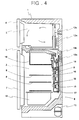
  • Figure 4 is a side sectional view of a first refrigerator according to the present invention;
  • Figure 5 is an exploded perspective view of the cool air dispersing device of Figure 4;
  • Figure 6 is a perspective view of the elements of Figure 5 in their assembled state;
  • Figures 7 through 9 are enlarged transverse sectional views showing the cool air dispersing process performed by the horizontal dispersing blades;
  • Figures 10 through 12 are enlarged side sectional views showing the cool air dispersing process performed by the vertical dispersing blades;
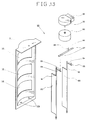
  • Figure 13 is an exploded perspective view of the cool air dispersing device of a second refrigerator according to the present invention;
  • Figure 14 is a side sectional view of the elements of Figure 12 in their assembled state;
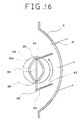
  • Figures 15 and 16 are sectional views of Figure 14 taken along the line I-I, which show the cool air dispersing operation of the horizontal dispersing blades;
  • Figure 17 is an exploded perspective view of the cool air dispersing device of a third refrigerator according to the present invention;
  • Figure 18 is an enlarged perspective view showing the bottom of the cam member shown in Figure 17;
  • Figures 19 and 20 are side sectional views of Figure 17 showing the operation of the vertical dispersing blades;
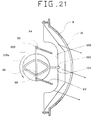
  • Figures 21 and 22 are enlarged transverse sectional views of Figure 17 showing the operation of the horizontal dispersing blade;
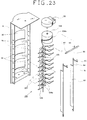
  • Figure 23 is a modification of the third embodiment shown in Figure 17; and
  • Figure 24 is an enlarged transverse sectional view of Figure 23.
  • Hereinafter, exemplary embodiments of the present invention will be described in detail with reference to the accompanying drawings. Parts that are the same as or similar to parts shown in Figures 1 through 3 will be identified with the same reference numerals. The description of the parts which are substantially the same as those of the prior art will in general be omitted.
    Referring to Figure 4, a refrigerator comprises a cabinet 1, a freezing compartment 2 and a fresh food compartment 3 formed within the cabinet 1 and separated by a partition wall 5. The freezing compartment 2 is disposed above the fresh food compartment 3. The compartments 2, 3 are provided with respective doors 6, 7. Shelves 8 for supporting food and which divide the fresh food compartment 3 into three areas, i.e. an upper area, a middle area, and a lower area, are installed in fresh food compartment 3. A special fresh chamber 18 for storing food which requires a specific temperature range is formed in the upper part of the fresh food compartment 3, and a vegetable chamber 19 for storing vegetables is formed at the bottom of the fresh food compartment 3.
    A cooling system, comprising a compressor 11, a condenser (not shown), a freezing compartment evaporator 12a, and a fresh food compartment evaporator 12b, is installed in the cabinet 1. The cool air generated by the evaporators 12a, 12b is supplied into the corresponding cooling compartments 2, 3 by a freezing compartment fan 13a and a fresh food compartment fan 13b respectively. A duct plate 9 is attached on the inner wall plate 23, forming the rear wall of the fresh food compartment 3. The duct plate 9 is partially cylindrical in shape so that it protrudes in the form of an arc from the inner wall plate 23 into the fresh food compartment 3, and has cool air discharge ports 16 opening into respective storing areas of the fresh food compartment 3. Another cool air discharge port 16', opening into the special fresh chamber 18 is provided in the upper area of the inner wall plate 23.
    Between the duct plate 9 and the rear wall 4 of the cabinet 1, a supply duct 15 and a return duct 17 are provided, which are partitioned from each other by a seal plate 25. In the supply duct 15, a duct member 21 for guiding the cool air blown by the fresh food compartment fan 13b downwardly is installed. The cool air generated by the fresh food compartment evaporator 12b is blown by the fresh food compartment fan 13b so as to be supplied into the fresh food compartment 3 via the supply duct 15 and the cool air discharge ports 16. A device for dispersing the cool air horizontally is installed in the supply duct 15.
    A supply duct 15 and a return duct 17 are provided between the duct plate 9 and the rear wall 4 of the cabinet 1. These ducts 15, 17 are partitioned from each other by a seal plate 25. A duct member 21 for guiding cool air, blown downwards by the fresh food compartment fan 13b, is installed in the supply duct 15. The cool air generated by the fresh food compartment evaporator 12b is blown by the fresh food compartment fan 13b so as to be supplied into the fresh food compartment 3 via the supply duct 15 and the cool air discharge ports 16. A device for dispersing the cool air horizontally is installed in the supply duct 15.
    Referring to Figure 5, the refrigerator has a device 30 for dispersing cool air horizontally and a device 40 for dispersing the cool air vertically.
    The horizontally dispersing device 30 has a vertical rotational shaft 31, three planar dispersing horizontally dispersing blades 33, a pivoting member 80 for pivoting the horizontally dispersing blades 33, and a driving motor 35 for rotating the pivoting member 80.
    The horizontally dispersing blades 33 are spaced along the shaft 31 so as to be near respective cool air discharge ports 16. The upper end of the rotational shaft 31 is supported by a supporting member (not shown). A journal part 32 is formed at the bottom of the rotational shaft 31 and is inserted into a bearing hole 9g formed in the lower part of the duct plate 9. It is preferable that the driving motor 35 is a stepping motor whose stationary angular position can be controlled.
    A pivot guide 37 is provided along the upper edge of the uppermost horizontally dispersing blade 33. The pivot guide 37 has a guide groove 39 formed transverse to the longitudinal direction of the rotational shaft 31.
    The pivoting member 80 is coupled to the driving shaft 36 of the driving motor 35. The pivoting member 80 has a pivot pin 81 which is eccentric with respect to the rotational axis thereof. The pivot pin 81 is inserted into the guide groove 39.
    When the driving motor 35 operates, the pivoting member 80 rotates causing the pivot pin 81 to reciprocate in the guide groove 39. Consequently, the horizontally dispersing blades 33 are rotated reciprocally about the rotational shaft 31. In this situation, the angular range of the rotation of the horizontally dispersing blades 33 depends on the radial length of the pivot pin 81. As the horizontally dispersing blades 33 reciprocate, the cool air discharged through the cool air discharge ports 16 is dispersed horizontally.
    The vertically dispersing device 40 comprises a plurality of vertically dispersing blades 57 which are disposed near the cool air discharge ports 16 and which are capable of pivoting about respective horizontal axes, a link member 61 installed in the supply duct 15 so as to be capable of moving up and down, and a raising and lowering cam 63 for raising and lowering the link member 61.
    Each vertically dispersing blade 57 comprises a generally arcuate plate so as to accommodate the horizontally dispersing blades 33 and horizontal stub shafts 53 extending from either end of the plate. The duct plate 9 has a pair of flanges 9e which extend backward from the rear surface of both side margins of the duct plate 9. The flanges 9e face each other and have a plurality of shaft holes 9f for receiving and rotatably supporting the stub shafts 53 of the vertically dispersing blades 57. The vertical dispersing blades 57 are capable of pivoting when their stub shafts 53 are inserted into the shaft holes 9f.
    The link member 61 is disposed parallel to the rotational shaft 31. The link member 61 is rod-shaped and has a plurality of partially ring-shaped hinge assembly parts 62 which protrude toward the vertically dispersing blades 57. Associated with a respective hinge assembly part 62, each of the vertically dispersing blades 57 has a horizontal, cylindrical hinge part 55 at the middle of its forward edge. The hinge assembly parts 62 are engaged with the hinge parts 73 so that there can be relative rotational movement therebetween.
    A raising and lowering cam 63 is installed on the rotational shaft 31. The raising and lowering cam 63 comprises a cylindrical cam body 66 and a cam groove 65 formed on the outer surface of the cam body 66. The cam groove 65 is an inclined closed loop. On the link member 61 is provided an operation part 67, protruding transversely of the longitudinal direction of the link member 61, and the free end of the operation part 67 is received by the cam groove 65.
    The link member 61 also has a guiding piece 69 protruding towards the duct plate 9. The guiding piece 69 is accommodated in a raising and lowering guiding part 49 formed on the inner wall of the duct plate 9. The raising and lowering guiding part 49 accommodates the guiding piece 69 so that the link member 61 moves up and down without rotating.
    The operation of the above-described refrigerator will now be described.
    Referring to Figures 7 to 9, the horizontally dispersing blades 33 are rotated reciprocally by the driving motor 35 and the pivoting member 80. When the horizontally dispersing blades 33 are directed directly to the front during the rotation of the rotational shaft 31 as shown in Figure 7, cool air in the supply duct 15 is discharged to the front along both sides of the horizontally dispersing blades 33. When the horizontally dispersing blades 33 are turned left or right as shown in Figures 8 and 9, cool air is discharged to the left or the right.
    As described, the discharging direction of the cool air changes as the angular position of the horizontally dispersing blades 33 changes so that cool air is dispersed in the fresh food compartment 3 uniformly. Moreover, since the horizontally dispersing blades 33 are planar, vortices are not caused by the horizontally dispersing blades 33.
    If a concentrated supply of cool air to a specific area such as the left side or the right side is required, the driving motor 35 is stopped when the horizontally dispersing blades 33 are directed to the specific area. In this situation, temperature sensors placed at a plurality of positions in the fresh food compartment 3, as well as a control part for controlling the driving motor 35 on the basis of the signals from the temperature sensors have to be provided.
    The horizontally dispersing blades 33 are disposed in association with respective the cool air discharge ports 16. However, it is possible that only one long horizontally dispersing blade be provided for directing cool air through all of the cool air discharge ports 16.
    While the horizontally dispersing device 30 operates, the raising and lowering cam 63 rotates with the shaft 31 and the link member 61 is raised and lowered by the operation part 67 which is received in the cam groove 65. The raising and lowering movement of the link member 61 causes pivoting of the vertically dispersing blades 57 by means of the hinge assembly part 62 and the hinge parts 55.
    The raising and lowering motion of the link member 61 is guided vertically by the guiding piece 69 and the raising and lowering guiding part 49. Consequently, the link member 61 does not rotate but reciprocates in the vertical direction while the raising and lowering cam 63 rotates.
    Referring to Figure 10, while the vertically dispersing blades 71 are kept horizontal, cool air is discharged horizontally. When the shaft 31 rotates clockwise by about 90 degrees, the vertically dispersing blades 57 are tilted upward as shown in Figure 11 and, in this situation, cool air is discharged upward to be supplied into the upper area of the fresh food compartment 3. As the shaft 31 then rotates anti-clockwise by about 90 degrees from the position shown in Figure 11, the vertically dispersing blades 57 are returned to the horizontal state as shown in Figure 10, and as it further rotates anti-clockwise by about 90 degrees, the vertically dispersing blades 57 are ilted downwards as shown in Figure 12. In this situation, cool air is discharged downward.
    The repetition of this process ensures that cool air is evenly dispersed in the fresh food compartment 3 both vertically and horizontally.
    Referring to Figures 13 to 17, in a second embodiment, a horizontally dispersing device 90 comprises a pair of parallel horizontally dispersing blades 93, which extend past all of the cool air discharge ports 16. Each of the horizontally dispersing blades 93 has its own rotational shaft 91. The lower end of each rotational shaft 91 is inserted into a bearing hole 29 formed at the bottom of the duct plate 9, and its upper end thereof is supported by a supporting member which is not shown. Thus, the horizontally dispersing blades 93 are supported on rotational shafts 91 for rotation therewith.
    Each of the rotational shafts 91 has a rod 94 at its upper end which extends in a direction transverse to the axis of the respective rotational shaft 91, and a connecting pin 95 protruding upward at the end of the rod 94. The rods 94 are connected to each other by a connecting bar 96. More specifically, the connecting bar 96 has holes 97 at either ends and the connecting pins 95 are inserted into these holes 97. Thus, the horizontally dispersing blades 93 are connected to each other while being kept parallel with each other.
    A driving motor 35 is installed above the connecting bar 96, and a cylindrical cam member 99 is disposed between the driving motor 35 and the connecting bar 96. The cam member 99 is coupled with the driving shaft 36 of the driving motor 35. A substantially elliptical cam groove 99a is formed on the underside of the cam member 99. An operation pin 98, formed on the connecting bar 96, is received in the cam groove 99a. Thus, when the cam member 99 is rotated by the driving motor 35, the operation pin 98 is guided by the cam groove 99a, causing the connecting bar 96 to reciprocate longitudinally.
    When the operation pin 98 is positioned where the cam groove 99a is narrow by the rotation of the cam member 99, the connecting bar 96 is moved left as shown in Figure 15 and the horizontally dispersing blades 93 are rotated to the right. When the operation pin 98 is positioned where the cam groove 99a is wide by the continued rotation of the cam member 99, the connecting bar 96 is moved right as shown in Figure 16 and the horizontally dispersing blades 93 are rotated to the left. According to such an operation, the horizontal dispersing blades 93 is rotated left and right reciprocally about the axes of their rotational shafts 91 and cool air discharged through the cool air discharge ports 16 is dispersed left and right. In such a situation, the angular range of the reciprocal rotation depends on the range of the reciprocation of the connecting bar 96.
    Referring to Figures 17 through 22, in a third embodiment, the construction of the horizontally dispersing device 90 is substantially the same with that of the above-described second embodiment but a vertically dispersing device 100 is provided. The construction of the vertically dispersing device 100 is similar to that of the second embodiment shown in Figures 13 through 16.
    The vertically dispersing device 100 has vertically dispersing blades 107 having horizontal rotational shafts 103 and hinge parts 102 respectively, and a link member 101 having hinge assembly parts 104 assembled with respective hinge parts 102.
    The vertically dispersing blade 107 is formed with a cutout 108. The cutout 108 accommodates the swept area of the horizontally dispersing blades 93 so as to allow the reciprocal rotation of the horizontally dispersing blades 93.
    A cam member 109 is installed on the driving shaft 36 of the driving motor 35. As shown in Figure 18, on the underside of the cam member 109 is formed a cam groove 109a into which the operation pin 98 of the connecting bar 96 is inserted. The cam groove 109a is substantially elliptical.
    A raising and lowering cam groove 109b is formed in the outer surface of the cam member 109. The cam groove 109b is a closed loop. The upper end of the link member 101 is inserted into the raising and lowering gam groove 109b so that rotational movement of the cam member 109 is converted into vertical reciprocal movement of the link member 101. As the link member 101 is moved up and down, the vertically dispersing blades 107 are vertically reciprocally rotated. That is, as shown in Figures 19 and 20, the vertically dispersing blades 107 are rotated upward and downward by the rising and falling of the link member 101. Furthermore, according to the rotation of the cam member 109, the horizontally dispersing blades 93 are rotated left or right as shown in Figures 21 and 22 so that cool air is dispersed horizontally.
    Referring to Figures 23 and 24, in a modified form, the construction of the horizontally dispersing device 90 and the vertically dispersing device 100 is substantially the same with that of the third embodiment except for the shape of the vertically dispersing blades 107.
    Each of the vertically dispersing blades 107 has a pair of cutouts 108a formed at the rear left and rear right sides thereof. The cutouts 108a correspond to the pair of horizontally dispersing blades 93. That is, each of the cut parts 108a accommodates the swept area of one of the horizontally dispersing blades 93 so at to allow the reciprocal rotation of the horizontally dispersing blades 93.
    Each vertically dispersing blade 107 is formed with a hole 110 instead of the hinge part 102 shown in the third embodiment, and the link member 101 is formed with supporting protrusions 101a instead of the hinge assembly parts shown in the third embodiment. The link member 101 passes through the vertically dispersing blades 107 through the holes 110, and the vertically dispersing blades 107 are supported by the supporting protrusions 101a. When the link member 101 moves up, the vertically dispersing blades 107 pivot upward, and when the link member 101 moves down, the vertical dispersing blades 107 pivot downward. Accordingly, the cool air is dispersed vertically by the vertically dispersing blades 107.
    According to the above-described modification, the cutout areas of the vertical dispersing blade 107 are smaller than that of the vertically dispersing blade of the third embodiment. Therefore, the cool air is dispersed in vertical direction more efficiently.
    As described above, according to the present invention, a stable cool air flow and a uniform distribution of the cool air can be achieved without vortices in the cool air near the cool air discharge ports. Furthermore, the uniform distribution of the cool air can be achieved not only horizontally but also in vertical direction when suitable blades are provided. Since the horizontally dispersing blades are reciprocally rotated in the angular range, the efficiency for dispersing cool air in the horizontal direction is more enhanced.
    Claims (23)

    1. A refrigerator including a cooling compartment (3), a heat pump (11, 12a, 12b), means (13b) for driving cool air, produced by the heat pump (11, 12a, 12b), through an aperture (16) into the cooling compartment (3), and flow directing means (30) associated with the aperture (16) for directing said cool air and which includes a vertical blade (33; 93) pivotable about a vertical axis, characterised in that the vertical blade (33; 93) is configured for being reciprocally pivoted.
    2. A refrigerator according to claim 1, wherein the flow directing means (30) comprises a plurality of vertical blades (33; 93) configured for being reciprocally pivoted.
    3. A refrigerator according to claim 1 or 2, including a motor (35) and a crank mechanism (81; 91, 94, 95) for driving the or each vertical blade.
    4. A refrigerator according to claim 1, 2 or 3, wherein the flow directing mean includes a substantially horizontal blade (57; 107) pivotable about a horizontal axis.
    5. A refrigerator according to claim 4, wherein the flow directing means includes a plurality of substantially horizontal blades (57; 107) pivotable about respective horizontal axes.
    6. A refrigerator according to claim 4 or 5, including cam mean (63; 109) mounted for rotation with the or each of the vertical blade (33; 93), and cam follower means (101) for driving the or each horizontal blade (57; 107) when the or each vertical blade (33; 93) is being driven.
    7. A refrigerator according to claim 4, 5 or 6, wherein the or each horizontal blade (57; 107) has a cutout encompassing the area swept by one or both of the vertical blades (33; 93).
    8. A refrigerator according to claim 7, wherein the or each horizontal blade (107) has two cutouts, each encompassing the area swept by a vertical blade (93).
    9. A refrigerator having a cooling compartment for storing food, and a duct being provided in a side wall of said cooling compartment, said duct for forming a cool air passage, said duct having at least one cool air discharge port opened into said cooling compartment, said refrigerator comprising:
      at least one horizontal dispersing blade of planar plate shape being installed near the cool air discharge port in said duct, said horizontal dispersing blade being disposed vertically according to a vertical axis;
      a rotational shaft being connected with said horizontal dispersing blade, said rotational shaft being extended along the vertical axis; and
      a means for driving said rotational shaft so that said rotational shaft is reciprocally rotated in a predetermined angular range.
    10. The refrigerator as claimed in claim 9, wherein said driving means comprises:
      a driving motor;
      a pivoting guide part being provided at an edge part of said horizontal dispersing blade, said pivoting guide part having a guide groove formed along a direction transverse to a longitudinal direction of said rotational shaft; and
      a pivoting member being rotated by said driving motor, said pivoting member having a pivoting pin which is eccentric from a rotational axis thereof and being inserted into said guide groove.
    11. The refrigerator as claimed in claim 9, further comprising:
      at least one vertical dispersing blade being installed near the cool air discharge port in said duct, said vertical dispersing blade being capable of pivoting about a horizontal axis; and
      a means for pivoting said vertical dispersing blade in a vertical direction.
    12. The refrigerator as claimed in claim 11, wherein said pivoting means comprises:
      a link member having a plurality of hinge assembly parts respectively assembled with said vertical dispersing blades at positions distanced from said horizontal axis, said link member being capable of moving up and down in the vertical direction; and
      a means for elevating/de-elevating said link member.
    13. The refrigerator as claimed in claim 12, wherein said elevating/de-elevating means comprises:
      an elevation/de-elevation cam being installed on said rotational shaft, said elevation/de-elevation cam rotating together with said rotational shaft; and
      an operation part formed in a body with said link member, said operation part interacting with said elevation/de-elevation cam so that a rotational movement of said elevation/de-elevation cam is transmitted to said link member as an elevational/de-elevational movement thereof.
    14. The refrigerator as claimed in claim 13, wherein said elevation/de-elevation cam has a cylindrical cam body coaxially installed on said rotational shaft, and a cam groove having an elevational/de-elevational cam profile at an outer surface of said cam body; and
         said operation part protrudes from said link member and is engaged with said cam groove.
    15. The refrigerator as claimed in claim 14, further comprising a means for guiding said link member so as to be capable of moving up and down vertically while preventing rotation of said link member.
    16. The refrigerator as claimed in claim 15, wherein said guiding means comprises:
      a guiding piece protruding along an axis of said link member; and
      a guiding part formed at an inner surface of said duct, said guiding part into which said guiding piece is inserted to be capable of moving up and down.
    17. The refrigerator as claimed in claim 9, wherein a pair of said horizontal dispersing blades and said rotational shafts are disposed in parallel with each other.
    18. The refrigerator as claimed in claim 17, wherein said driving means comprises:
      a pair of rods being respectively formed on said pair of horizontal dispersing blades, said rods being extended to a direction transverse to a longitudinal direction of said rotational shaft;
      a connecting bar for connecting ends of said pair of rods with each other; and
      a means for reciprocating said connecting bar along a longitudinal direction thereof.
    19. The refrigerator as claimed in claim 18, wherein said reciprocating means comprises:
      a driving motor; and
      a cam member for converting a rotation of said driving motor to a reciprocation of said connecting bar.
    20. The refrigerator as claimed in claim 19, wherein said cam member has a cam groove formed into an ellipse shape substantially, and said connecting bar has an operation pin inserted into said cam groove, said operation pin being reciprocated by a rotation of said cam member.
    21. The refrigerator as claimed in claim 17, further comprising:
      at least one vertical dispersing blade being installed near the cool air discharge port in said duct, said vertical dispersing blade being capable of pivoting about a horizontal axis; and
      a means for pivoting said vertical dispersing blade in a vertical direction.
    22. The refrigerator as claimed in claim 20, wherein said vertical dispersing blade is formed with a cut part for accommodating a pivoting area of said horizontal dispersing blades so as to allow a reciprocal rotation of said horizontal dispersing blades.
    23. The refrigerator as claimed in claim 22, wherein a pair of said cut part are formed, which correspond to said pair of horizontal dispersing blades.
    EP98305606A 1997-07-16 1998-07-15 Refrigerator with cool air distributing device Withdrawn EP0892228A3 (en)

    Applications Claiming Priority (8)

    Application Number Priority Date Filing Date Title
    KR1019970033264A KR100208360B1 (en) 1997-07-16 1997-07-16 Refrigerator with cooling air dispenser
    KR9733264 1997-07-16
    KR1019970042267A KR19990018973A (en) 1997-08-28 1997-08-28 Refrigerator with cold air distributor
    KR1019970042278A KR19990018984A (en) 1997-08-28 1997-08-28 Refrigerator with cold air distributor
    KR9742278 1997-08-28
    KR9742267 1997-08-28
    KR1019970042263A KR100229490B1 (en) 1997-08-28 1997-08-28 Refrigerator having air distribution apparatus
    KR9742263 1997-08-28

    Publications (2)

    Publication Number Publication Date
    EP0892228A2 true EP0892228A2 (en) 1999-01-20
    EP0892228A3 EP0892228A3 (en) 1999-09-22

    Family

    ID=27483222

    Family Applications (1)

    Application Number Title Priority Date Filing Date
    EP98305606A Withdrawn EP0892228A3 (en) 1997-07-16 1998-07-15 Refrigerator with cool air distributing device

    Country Status (3)

    Country Link
    EP (1) EP0892228A3 (en)
    JP (1) JPH1172283A (en)
    ID (1) ID20589A (en)

    Cited By (4)

    * Cited by examiner, † Cited by third party
    Publication number Priority date Publication date Assignee Title
    CN102147181A (en) * 2011-04-27 2011-08-10 合肥美的荣事达电冰箱有限公司 Split-door refrigerator and turning beam thereof
    EP3401136A1 (en) * 2017-05-03 2018-11-14 DENSO THERMAL SYSTEMS S.p.A. Air distribution device to control the diffusion of an air flow
    CN113932539A (en) * 2021-11-08 2022-01-14 中山市凯腾电器有限公司 Air supply system, air supply method and refrigerator
    CN114797153A (en) * 2022-05-16 2022-07-29 上海蕙黔化工科技有限公司 Condenser equipment for gas-phase carbonyl synthesis dimethyl carbonate process

    Families Citing this family (1)

    * Cited by examiner, † Cited by third party
    Publication number Priority date Publication date Assignee Title
    CN111023521A (en) * 2019-12-31 2020-04-17 广州华凌制冷设备有限公司 Operation method, device, air conditioner and computer readable storage medium

    Citations (1)

    * Cited by examiner, † Cited by third party
    Publication number Priority date Publication date Assignee Title
    WO1995027278A1 (en) 1994-03-30 1995-10-12 Harrison & Sons Limited Self-adhesive stamps

    Family Cites Families (10)

    * Cited by examiner, † Cited by third party
    Publication number Priority date Publication date Assignee Title
    US3257931A (en) * 1963-12-09 1966-06-28 Whirlpool Co Air conditioner louver mechanism
    US3330202A (en) * 1966-03-31 1967-07-11 Colle Dominic Del Air circulation control means
    US4653386A (en) * 1984-11-20 1987-03-31 Toyota Jidosha Kabushiki Kaisha Wind direction adjusting mechanism for air conditioner
    JPH0725258B2 (en) * 1987-05-27 1995-03-22 日産自動車株式会社 Bench rater for automobile
    JPH0420949U (en) * 1990-06-07 1992-02-21
    JPH04177074A (en) * 1990-11-13 1992-06-24 Hitachi Ltd refrigerator
    JPH04288442A (en) * 1991-03-13 1992-10-13 Nippon Plast Co Ltd Air direction control device
    KR0182533B1 (en) * 1994-11-15 1999-05-01 윤종용 Refrigerator and its temperature control method
    KR0162412B1 (en) * 1995-10-13 1999-02-18 구자홍 New regulation loading concentration cooling apparatus of a refrigerator
    JP2993412B2 (en) * 1995-11-20 1999-12-20 三菱電機株式会社 Air outlet and air conditioner provided with the air outlet

    Patent Citations (1)

    * Cited by examiner, † Cited by third party
    Publication number Priority date Publication date Assignee Title
    WO1995027278A1 (en) 1994-03-30 1995-10-12 Harrison & Sons Limited Self-adhesive stamps

    Cited By (6)

    * Cited by examiner, † Cited by third party
    Publication number Priority date Publication date Assignee Title
    CN102147181A (en) * 2011-04-27 2011-08-10 合肥美的荣事达电冰箱有限公司 Split-door refrigerator and turning beam thereof
    CN102147181B (en) * 2011-04-27 2012-12-12 合肥美的荣事达电冰箱有限公司 Split-door refrigerator and turning beam thereof
    EP3401136A1 (en) * 2017-05-03 2018-11-14 DENSO THERMAL SYSTEMS S.p.A. Air distribution device to control the diffusion of an air flow
    CN113932539A (en) * 2021-11-08 2022-01-14 中山市凯腾电器有限公司 Air supply system, air supply method and refrigerator
    CN114797153A (en) * 2022-05-16 2022-07-29 上海蕙黔化工科技有限公司 Condenser equipment for gas-phase carbonyl synthesis dimethyl carbonate process
    CN114797153B (en) * 2022-05-16 2024-02-27 上海蕙黔新材料科技有限公司 Condenser equipment for gas-phase oxo-synthesis process of dimethyl carbonate

    Also Published As

    Publication number Publication date
    JPH1172283A (en) 1999-03-16
    ID20589A (en) 1999-01-21
    EP0892228A3 (en) 1999-09-22

    Similar Documents

    Publication Publication Date Title
    EP0905461B1 (en) Refrigerator with cool air distributing apparatus
    EP0895043A2 (en) Refrigerator
    EP0898134B1 (en) Refrigerator
    EP0895040A2 (en) Refrigerator
    EP0907059A2 (en) Refrigerator with cool air directing means
    EP0892228A2 (en) Refrigerator with cool air distributing device
    EP0889293A2 (en) Refrigerator
    EP0892227B1 (en) Refrigerator with cool air distributing device
    EP0893661B1 (en) Refrigerator having a cool air distributing device
    EP0905462B1 (en) Method of cooling a space
    EP0899524B1 (en) Refrigerator with cool air distributing device
    EP0895042B1 (en) Refrigerator
    EP0899526A2 (en) Refrigerator with cool air distributing means
    EP0895041A2 (en) Refrigerator
    EP0893662A2 (en) Refrigerator with cool air directing device
    EP0899523A2 (en) Refrigerator with cool air distributing device
    EP0905460A2 (en) Refrigerator
    EP0899525A2 (en) Refrigerator having a cool air dispersing device
    KR100229490B1 (en) Refrigerator having air distribution apparatus
    CN1205425A (en) Refrigerators with horizontal distribution plates that reciprocate through an angular range
    KR19990012524A (en) Refrigerator with cold air distributor
    KR19990018973A (en) Refrigerator with cold air distributor

    Legal Events

    Date Code Title Description
    PUAI Public reference made under article 153(3) epc to a published international application that has entered the european phase

    Free format text: ORIGINAL CODE: 0009012

    AK Designated contracting states

    Kind code of ref document: A2

    Designated state(s): AT BE CH CY DE DK ES FI FR GB GR IE IT LI LU MC NL PT SE

    AX Request for extension of the european patent

    Free format text: AL;LT;LV;MK;RO;SI

    PUAL Search report despatched

    Free format text: ORIGINAL CODE: 0009013

    AK Designated contracting states

    Kind code of ref document: A3

    Designated state(s): AT BE CH CY DE DK ES FI FR GB GR IE IT LI LU MC NL PT SE

    AX Request for extension of the european patent

    Free format text: AL;LT;LV;MK;RO;SI

    AKX Designation fees paid
    REG Reference to a national code

    Ref country code: DE

    Ref legal event code: 8566

    STAA Information on the status of an ep patent application or granted ep patent

    Free format text: STATUS: THE APPLICATION IS DEEMED TO BE WITHDRAWN

    18D Application deemed to be withdrawn

    Effective date: 20000323