EP0892537A2 - Délivrance de service du type CLASS en bande par systèmes de communication fixe à accès sans fil - Google Patents
Délivrance de service du type CLASS en bande par systèmes de communication fixe à accès sans fil Download PDFInfo
- Publication number
- EP0892537A2 EP0892537A2 EP98302545A EP98302545A EP0892537A2 EP 0892537 A2 EP0892537 A2 EP 0892537A2 EP 98302545 A EP98302545 A EP 98302545A EP 98302545 A EP98302545 A EP 98302545A EP 0892537 A2 EP0892537 A2 EP 0892537A2
- Authority
- EP
- European Patent Office
- Prior art keywords
- signal
- analogue
- digital
- channel
- digitized
- Prior art date
- Legal status (The legal status is an assumption and is not a legal conclusion. Google has not performed a legal analysis and makes no representation as to the accuracy of the status listed.)
- Withdrawn
Links
Images



Classifications
-
- H—ELECTRICITY
- H04—ELECTRIC COMMUNICATION TECHNIQUE
- H04W—WIRELESS COMMUNICATION NETWORKS
- H04W84/00—Network topologies
- H04W84/02—Hierarchically pre-organised networks, e.g. paging networks, cellular networks, WLAN [Wireless Local Area Network] or WLL [Wireless Local Loop]
- H04W84/10—Small scale networks; Flat hierarchical networks
- H04W84/14—WLL [Wireless Local Loop]; RLL [Radio Local Loop]
-
- H—ELECTRICITY
- H04—ELECTRIC COMMUNICATION TECHNIQUE
- H04Q—SELECTING
- H04Q11/00—Selecting arrangements for multiplex systems
- H04Q11/04—Selecting arrangements for multiplex systems for time-division multiplexing
-
- H—ELECTRICITY
- H04—ELECTRIC COMMUNICATION TECHNIQUE
- H04Q—SELECTING
- H04Q2213/00—Indexing scheme relating to selecting arrangements in general and for multiplex systems
- H04Q2213/13034—A/D conversion, code compression/expansion
-
- H—ELECTRICITY
- H04—ELECTRIC COMMUNICATION TECHNIQUE
- H04Q—SELECTING
- H04Q2213/00—Indexing scheme relating to selecting arrangements in general and for multiplex systems
- H04Q2213/1307—Call setup
-
- H—ELECTRICITY
- H04—ELECTRIC COMMUNICATION TECHNIQUE
- H04Q—SELECTING
- H04Q2213/00—Indexing scheme relating to selecting arrangements in general and for multiplex systems
- H04Q2213/13091—CLI, identification of calling line
-
- H—ELECTRICITY
- H04—ELECTRIC COMMUNICATION TECHNIQUE
- H04Q—SELECTING
- H04Q2213/00—Indexing scheme relating to selecting arrangements in general and for multiplex systems
- H04Q2213/13098—Mobile subscriber
-
- H—ELECTRICITY
- H04—ELECTRIC COMMUNICATION TECHNIQUE
- H04Q—SELECTING
- H04Q2213/00—Indexing scheme relating to selecting arrangements in general and for multiplex systems
- H04Q2213/13103—Memory
-
- H—ELECTRICITY
- H04—ELECTRIC COMMUNICATION TECHNIQUE
- H04Q—SELECTING
- H04Q2213/00—Indexing scheme relating to selecting arrangements in general and for multiplex systems
- H04Q2213/13176—Common channel signaling, CCS7
-
- H—ELECTRICITY
- H04—ELECTRIC COMMUNICATION TECHNIQUE
- H04Q—SELECTING
- H04Q2213/00—Indexing scheme relating to selecting arrangements in general and for multiplex systems
- H04Q2213/13204—Protocols
-
- H—ELECTRICITY
- H04—ELECTRIC COMMUNICATION TECHNIQUE
- H04Q—SELECTING
- H04Q2213/00—Indexing scheme relating to selecting arrangements in general and for multiplex systems
- H04Q2213/13251—Restricted service, class of service
-
- H—ELECTRICITY
- H04—ELECTRIC COMMUNICATION TECHNIQUE
- H04Q—SELECTING
- H04Q2213/00—Indexing scheme relating to selecting arrangements in general and for multiplex systems
- H04Q2213/13292—Time division multiplexing, TDM
-
- H—ELECTRICITY
- H04—ELECTRIC COMMUNICATION TECHNIQUE
- H04Q—SELECTING
- H04Q2213/00—Indexing scheme relating to selecting arrangements in general and for multiplex systems
- H04Q2213/13298—Local loop systems, access network
-
- H—ELECTRICITY
- H04—ELECTRIC COMMUNICATION TECHNIQUE
- H04Q—SELECTING
- H04Q2213/00—Indexing scheme relating to selecting arrangements in general and for multiplex systems
- H04Q2213/13377—Recorded announcement
-
- H—ELECTRICITY
- H04—ELECTRIC COMMUNICATION TECHNIQUE
- H04Q—SELECTING
- H04Q2213/00—Indexing scheme relating to selecting arrangements in general and for multiplex systems
- H04Q2213/13396—Signaling in general, in-band signalling
Definitions
- the present invention relates to provision of central office switch services via in-voice band signals over a fixed wireless access system.
- POTS plain old telephone service
- CLASS Custom Local Area Special Services
- CLASS services emulate services known as "network services" often provided on a conventional PBX. In some cases these are accessed by a subscriber dialing pre-defined key sequences on his or her telephone handset. In other cases such services are bought services which are automatically generated by a service provider. Examples of such services include:
- Such services are specified in ITU international standard V5.2 [International Telecommunications Union ITU-T Recommendation V5.2, available from ITU Sales and Marketing Service, Place de Nations, CH-1211 Geneva 20, Switzerland, E-Mail Sales@itu.com].
- Various types of central office switches produced by different manufacturers may also support different selections of CLASS services, the selections differing from proprietor to proprietor.
- Nortel Limited Northern Telecom
- Nortel DMS type switches available from Nortel Limited (Northern Telecom).
- a prior art central office switch 100 comprising part of a prior art broad band network, the switch communicating with an item of customer premises equipment 101, over a hard wired transmission line 102, for example a coaxial cable or twisted copper wire pair, the customer premises equipment supporting a plurality of analogue terminal equipment 103, eg subscriber handsets.
- a subscriber line comprising a voice band channel which operates to carry voice or modem traffic, typically within a band of 300 Hz to 3400 Hz, and an out of voice band signaling channel which carries call set up signals, typically in the range 3800 Hz to 4200 Hz.
- the transmission line 102 supports a large number of such subscriber lines between the central office switch 100 and the plurality of subscriber handsets 103. Between the corresponding subscriber handsets 103 and the customer premises equipment 101, each subscriber line comprises an analogue channel which carries voice band data, and a digital channel which carries out of voice band signaling data. Between the central office switch and the customer premises equipment, the analogue data eg voice and/or modem traffic is digitally encoded by the central office switch and is sent down a multiplexed digital link of the transmission line 102 so producing a virtual analogue data channel, for carrying in band voice/modem data. On reaching the customer premises equipment the voice band data is sent over an analogue channel to the subscriber handset 103. Thus, for each subscriber line between central office switch and subscriber handset there exists an in voice band analogue data channel and an out of voice band signaling channel.
- CLASS signals giving caller number identification will be given.
- the B party subscriber handset receives digital call setup signals over an out of voice band digital signaling channel of a subscriber line.
- An associated voice band channel, over the same subscriber line carries voice and/or modem traffic once call set up has been established.
- Communication between the central office switch and the customer premises equipment on transmission line 102 is represented schematically in Fig 2 herein and comprises a serial burst of messaging commands in accordance with a standard protocol eg V5.2 or a proprietary protocol for example DMS-X.
- the messaging commands operate to provide to the customer premises equipment 101 information describing in which time slots of a plurality of time slots 201, information corresponding to a voice band channel of the subscriber line is to be carried.
- the V5.2 or DMS-X protocols may specify that in voice band data corresponding to a subscriber line telephone number 0183 682784 is being carried in a particular time slot within the plurality of time slots.
- the customer premises equipment interprets this message and proceeds to ring the connected subscriber telephone handset corresponding to number 0171 380 2992, and generates ringing tone signals at the particular subscriber telephone, connecting the voice band signals of the specified time slots to the handset of that number over the corresponding analogue channel.
- the conventional set of CLASS services make use of the parallel voice band channel between the central office switch 100 and the customer premises equipment 101 immediately after call set up. Whilst the central office switch 100 and the customer premises equipment 101 are making a connection using the out of band digital channel between the central office switch and the network access equipment and ringing a subscriber telephone handset, CLASS services are sent contained in modem bursts in band via the voice band channel. Signals representing calling line identification, and other CLASS services are sent in band along the voice channel to the customer premises apparatus whilst the subscriber handset is ringing, and before A party to B party connection is made. CLASS signals are sent from the customer premises equipment 101 to the subscriber analogue telephone handset 103 before, during or after an A party to B party connection is set up. Typically, the analogue user handset may indicate to a user that a service is available, eg calling line identification by a flashing light at the user handset.
- CLASS services may be forwarded by the customer premises equipment to the analogue subscriber handset, in band in analogue format in intervals between bursts of analogue ring tone signals.
- modem bursts carrying CLASS signals, eg a signal containing information that a calling line's identification number is 0183 682784.
- the modem burst is decoded by the analogue handset and may be used to generate a liquid crystal display of caller number at the handset.
- a fixed wireless access (FWA) system (otherwise known as fixed radio access FRA or wireless local loop WLL) in which the central office apparatus communicates with network terminal equipment at subscriber premises via a wireless link.
- FWA fixed wireless access
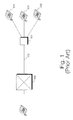
- a network terminal equipment radio transceiver 400 at a subscriber's premises communicates with a radio base station 401 which provides cellular coverage over typically a 5 to 20 kilometre radius in urban environments.
- the wireless link typically operates at a 3.5 GHz centred frequency band.
- Each base station is connected to a central office switch via a back haul link comprising a conventional hard wired transmission link, microwave link or fibre optic cable link.
- the conventional fixed wireless access link does not provide support for CLASS services.
- a method of supplying service signals carried in a voice channel of a subscriber line wherein the method is characterized by comprising the steps of:
- the analogue service signal is transmitted to a conventional analogue subscriber telephone handset.
- the analogue service signal is transmitted to a facsimile machine.
- the step of converting said digitized service signal to analogue format comprises re-modulating said service signal as a frequency shift keyed signal.
- a fixed wireless access network terminal apparatus characterized by comprising:
- analogue service signal is transmitted to a conventional analogue subscriber telephone handset.
- analogue service signal is transmitted to a facsimile machine.
- the digital to analogue converter capable of converting the digitized service signal to analogue service signal format comprises means for re-modulating the service signal as a frequency shift keyed signal.
- voice band path and “voice band channel” herein are used in relation to signal transmissions between central office switch 500, base station 504 and subscriber transceiver 503 to mean a path or channel allocated for transmission of voice band signals destined for receipt in analogue form within voice band at an analogue subscriber apparatus.
- voice band signals may originate in the range 300 Hz to 3400 Hz, and may comprise analogue data which has been converted to digitally encoded format and which may be sent along a multiplexed digital link.
- out of band path and “out of band channel” when used in relation to signal transmissions between central office switch 500, base station 504 and subscriber transceiver 503 are used herein to mean a digital channel allocated for transmission of signals destined for receipt out of voice band at an analogue subscriber apparatus.
- signaling data may originate in the range 3800 Hz to 4200 Hz, although the invention is not limited to such a range.
- voice band means a set of frequencies in the normal human audio range and as used conventionally to carry audio signals in a subscriber line of a telecommunications system.
- a voice band extends over a frequency bandwidth of around 3300 Hz, and typically in the range 300 Hz to 3600 Hz, and the terms “in band” and “in voice band” are construed as signals occupying a voice band.
- the term “out of band” will be construed accordingly as being signals outside the voice band.
- subscriber line is used to mean a communications channel connecting a central office switch to an item of subscriber apparatus capable of receiving analogue signals.
- item of subscriber apparatus may comprise a telephone handset or a facsimile machine.
- the signal path comprises a radio base station 504, the base station communicating with the central office switch via a back haul transmission link 505, the back haul transmission link comprising for example a hardwired copper line, a permanent microwave link or an optical fiber cable; the base station 504 being provided with a transceiver and antenna arrangement 506 communicating with a plurality of said network terminal equipment, each serving one or a plurality of subscriber handsets.
- each base station may communicate with a plurality of subscriber transceivers, over a plurality corresponding respective wireless transmission links 507, the transmission links being in a frequency band centered abut 3.5 GHz, and having a range of up to 20 kilometers.
- Base station 504 incorporates a conventional messaging interface supporting CLASS services, according to a conventional protocol, eg V5.2 or DMS-X protocols.
- the base station transceiver and antenna arrangement 506 communicates with the plurality of network terminal equipment 501, 502 using an air interface protocol, such as digital air interface protocol Q931.
- Signal path comprising the back haul transmission link 505, and the base station 504, replaces the hard wired transmission line 102 wireless transmission link 507 and subscriber transceiver 503 replaces the hard wire cable between the customer premises equipment 101 and telephone handsets 103 of the prior art hard wired system shown in Fig. 1 herein.
- Each subscriber line between the central office switch and the network terminal equipment comprises an out of band signaling path and a voice band data path along its whole length.
- a voice band path of a subscriber line ending at a subscriber handset 501 comprises a voice band data channel 513 between central office switch and the base station; a wireless voice band data channel 509 between radio base station 504 and network terminal equipment 503 and a voice band channel between network terminal equipment 503 and subscriber handset 501.
- An out of band path of the subscriber line comprises an out of band data channel 512 between central office switch 500 and radio base station 504; a wireless out of band data channel between radio base station 504 and network terminal equipment 503; and an out of band channel between network terminal equipment 503 and subscriber handset 501.
- the digital signaling channel 512 and the voice band channel 513 may be different elements of a same multiplexed signal channel, eg a TDMA or CDMA signal, and similarly digital signaling channel 508 and voice band channel 509 may be different elements of a same multiplexed signal channel.
- call set up is effected over the out of band signaling path as follows.
- Central office 500 sends a digital call set up signal over out of band digital channel 512 of back haul transmission line 505, and sends CLASS service signals within voice band time slots over back haul transmission line 505.
- the call set up signals and CLASS service signals are transmitted by the central office switch 500 substantially simultaneously.
- the digital call set up signals and in band CLASS service signals arrive at base station 504 substantially simultaneously.
- the digital call set up signals arrive at base station 504 with approximately the same time relationship compared to the in band CLASS signals, as they were transmitted from the central office switch 500.
- the out of band call set up signaling and the in-band service signals are retransmitted by transceiver antenna arrangement 506 across wireless link 507 to network terminal apparatus 503.
- the wireless link 507 supports both in band voice/modem data and out of band call set up data over corresponding in band channel 508 and out of band channel 509 respectively.
- the wireless digital link 507 uses a re-transmission process embedded in the air interface protocol (eg Q931) to ensure reliability and the wireless link 507 has characteristics of incurring high delay. Signals transmitted over the wireless link are acknowledged by network terminal equipment 503 on their receipt.
- base station 504 If an error occurs and acknowledgment is insufficient or absent, base station 504 re-transmits the signals.
- a disadvantage of this handshaking procedure is that there can be a significant delay in transmission over the wireless link, which may be of indeterminate duration depending upon whether errors occur in the wireless transmission or not.
- the transmission delay over the wireless link 507 may be of the order of tens of milliseconds, up to in a very bad case, of the order of 5 or 6 seconds.
- CLASS service signals transmitted by the central office switch 500 on the voice band path simultaneously with digital call set up signals on the out of band path cannot be guaranteed to arrive at the network terminal apparatus 503 within a short time of their transmission, due to the indeterminate, and potentially long delay incurred by the wireless link digital channel.
- a radio base station 504 on receipt of digital call set up signals and in band CLASS service signals from central office switch 500 converts the in band CLASS service signals to digital format suitable for local storage at the radio base station, and for multiplexing, and multiplexes the digitized in band CLASS service signals with the digital call set up signals and transmits the multiplexed signal over the air interface (Q931) wireless link. Because the in band CLASS service signals are time division multiplexed with the digital call set up signal prior to transmission to the network terminal equipment 503, the in band CLASS service signals arrive with the call set up signals at the network terminal equipment 503 in a timing relationship substantially preserved from their original relationship as transmitted from central office switch 500.
- Network terminal 503 de-multiplexes the received multiplexed signal and a digital to analogue converter at the network terminal equipment converts the digitized in band CLASS service signal to analogue format, the converted analogue in band CLASS service signal being sent to the subscriber telephone handset in analogue format.
- the specific implementation requires modification of the radio base station 504 and each network terminal equipment 503.
- step 600 the digital call set up signals and in band CLASS service signals are transmitted by the central office switch 500 along back haul transmission link 505 and arrive at radio base station 504 substantially simultaneously.
- the CLASS service signal is digitized and multiplexed with the digital call set up signal prior to transmission across the digital wireless link. Reliable communication of the multiplexed digital signal between radio base station 504 and network terminal equipment 503 may take an indeterminate time, typically of the order of tens of milliseconds, but potentially up to the order of a few seconds.
- band service signals Whilst reliable communication is being achieved over the wireless link 507, in band service signals continue to arrive at the radio base station 504, and hence before call set up is achieved, these in band signals are buffered or stored at radio base station 504 and may be delayed until reliable communication over the wireless link is achieved.
- the network terminal equipment may recover the digital call set up signal and in band CLASS service signals in preserved time relationship to each other, so that call set up signals can be sent to subscriber handset 501 from the network terminal equipment 503 before, or substantially simultaneously with sending of analogue CLASS service signals to the subscriber handset.
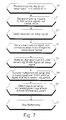
- step 700 digital call set up signals are received from the central office switch 500, along with incoming in band CLASS service signals in step 701.
- step 702 received in-band CLASS signals are converted to digitized format suitable for storage or buffering at the base station 504 in step 703 and may be delayed by storing or buffering and then multiplexed with the digital call set up signals in step 704.
- the multiplexed call set up and in band service signal is transmitted over wireless link 507 according to the air interface transmission protocol, eg Q931 to the network terminal equipment 503.
- Storage and multiplexing of the digital call set up signal and the in band CLASS service signal preserves the timing relationship between the call set up signal and the in band signal throughout the indeterminate length delay experienced in traversing the wireless link 507.
- network terminal equipment 503 On receipt of the multiplexed digital signal, network terminal equipment 503 transmits a call set up acknowledgment signal over wireless link 507, which is received by the base station 504.
- the base station 504 On detection of the call set up acknowledgment signal in step 706, the base station 504 ceases to store signals from the incoming out of band and in band channels received over back haul transmission link 505, and re-transmits them over wireless 507 without significant delay.
- Functional elements of a base station modified in accordance with the specific implementation.
- Functional elements provided in the base station include a call set up signal detection means 800 for detecting an incoming digital call set up signal; a codec 801 for decoding in band CLASS service signals received from central office switch 500; a zero crossing detector 802 for detecting zero crossings in the decoded in band signal; a digital buffer 803 for delaying the in band signals; and a multiplexer 804 for multiplexing the digital call set up signals with the digitized in band CLASS service signals, said multiplexer means forwarding said multiplexed digital call set up and digitized in band CLASS service signals over wireless link 507.
- Fig. 8 The functional elements described relation to Fig. 8 may be carried out by modification of coded control mechanisms within the radio base station 504.
- a demultiplexer receiving the multiplexed digital signal comprising the digital call set up signal and the digitized in band CLASS service signal, the demultiplexer inputting the demultiplexed digitized in band class service signals to a digital to analogue converter, which operates to reconstitute (that is remodulate) the in band CLASS service signals to analogue format, typically for example a 100 Hz, 1200 Hz frequency shift keyed (FSK) square wave signal, which is forwarded to the subscriber handset along an analogue portion of the subscriber line in a substantially preserved time relationship with the digital call set up signals.
- a digital to analogue converter which operates to reconstitute (that is remodulate) the in band CLASS service signals to analogue format, typically for example a 100 Hz, 1200 Hz frequency shift keyed (FSK) square wave signal, which is forwarded to the subscriber handset along an analogue portion of the subscriber line in a substantially preserved time relationship with the digital call set up signals.
Landscapes
- Engineering & Computer Science (AREA)
- Computer Networks & Wireless Communication (AREA)
- Signal Processing (AREA)
- Mobile Radio Communication Systems (AREA)
Applications Claiming Priority (2)
| Application Number | Priority Date | Filing Date | Title |
|---|---|---|---|
| GB9715142A GB2327569A (en) | 1997-07-18 | 1997-07-18 | Central office switch services for fixed wireless access communication systems |
| GB9715142 | 1997-07-18 |
Publications (1)
| Publication Number | Publication Date |
|---|---|
| EP0892537A2 true EP0892537A2 (fr) | 1999-01-20 |
Family
ID=10816051
Family Applications (1)
| Application Number | Title | Priority Date | Filing Date |
|---|---|---|---|
| EP98302545A Withdrawn EP0892537A2 (fr) | 1997-07-18 | 1998-04-01 | Délivrance de service du type CLASS en bande par systèmes de communication fixe à accès sans fil |
Country Status (4)
| Country | Link |
|---|---|
| US (1) | US6115603A (fr) |
| EP (1) | EP0892537A2 (fr) |
| GB (1) | GB2327569A (fr) |
| ZA (1) | ZA984120B (fr) |
Cited By (2)
| Publication number | Priority date | Publication date | Assignee | Title |
|---|---|---|---|---|
| GB2577186A (en) * | 2017-08-30 | 2020-03-18 | Metaswitch Networks Ltd | Establishing a telephony session |
| US10623579B2 (en) | 2017-08-30 | 2020-04-14 | Metaswitch Networks Ltd. | Establishing a telephony session |
Families Citing this family (11)
| Publication number | Priority date | Publication date | Assignee | Title |
|---|---|---|---|---|
| GB2332590B (en) * | 1997-12-16 | 2002-10-09 | Dsc Telecom Lp | Handling of signalling information within a telecommunications system |
| US6415150B1 (en) * | 1998-09-11 | 2002-07-02 | Ameritech Corporation | System and method for providing telecommunications service using a wireless link |
| US6621898B1 (en) * | 1999-02-11 | 2003-09-16 | Avaya Technology Corp. | Method of communication between an automatic branch exchange and a messaging system providing at least one voice service, automatic branch exchange and messaging system implementing a method of this kind |
| US7466978B1 (en) * | 2000-09-18 | 2008-12-16 | International Business Machines Corporation | Telephone network node device |
| US7539479B2 (en) * | 2001-01-26 | 2009-05-26 | Adtran, Inc. | Use of T1 facility data link to transport status and configuration data packets for loop-powered T1 radio |
| US7269181B2 (en) * | 2001-04-04 | 2007-09-11 | Telefonaktiebolaget Lm Ericsson (Publ) | Robust radio base station controller architecture |
| US7520077B2 (en) * | 2004-06-17 | 2009-04-21 | Laser Band, Llc | Cushioned wristband with self-laminating identity tag |
| US8891519B2 (en) * | 2004-04-05 | 2014-11-18 | Verizon Patent And Licensing Inc. | System and method for monitoring, controlling and provisioning a telecommunications access network |
| US7710888B2 (en) | 2004-04-05 | 2010-05-04 | Verizon Business Global Llc | Apparatus and method for testing and fault isolation in a communication network |
| US7658026B2 (en) * | 2006-10-27 | 2010-02-09 | Laser Band, Llc | Wristband with snap closure and patent id label |
| US8424115B2 (en) * | 2006-10-27 | 2013-04-23 | Laser Band, Llc | Wristband with contoured comfort sides |
Family Cites Families (20)
| Publication number | Priority date | Publication date | Assignee | Title |
|---|---|---|---|---|
| US4551581B1 (en) * | 1983-07-12 | 1995-06-20 | Bell Telephone Labor Inc | Method and apparatus for sending a data message to a selected station during a silent interval between ringing |
| US4884269A (en) * | 1988-06-20 | 1989-11-28 | Hayes Microcomputer Products, Inc. | Method and apparatus for connecting ISDN devices over an analog telephone line |
| JPH04345349A (ja) * | 1991-05-23 | 1992-12-01 | Toshiba Corp | 無線電話装置 |
| KR940012937A (ko) * | 1992-11-26 | 1994-06-24 | 정용문 | 일차군 다중화장치의 시그날링 채널 데이터 송수신회로 |
| US5444713A (en) * | 1993-09-14 | 1995-08-22 | At&T Corp. | Telephone information service system using digital and out-of-band signaling |
| US5371781A (en) * | 1993-09-30 | 1994-12-06 | At&T Corp. | System and method for identifying the incoming directory number when multiple directory numbers are assigned to one wireless device |
| WO1995015051A1 (fr) * | 1993-11-29 | 1995-06-01 | Greater Harris County 9-1-1 Emergency Network | Collecte et transmission integrees de donnees pour appels d'urgence |
| US5581599A (en) * | 1993-12-30 | 1996-12-03 | Northern Telecom Limited | Cordless telephone terminal |
| US5588009A (en) * | 1994-02-03 | 1996-12-24 | Will; Craig A. | Personal paging, communications, and locating system |
| US5703934A (en) * | 1994-02-24 | 1997-12-30 | Gte Mobile Communication Service | Cordless telephone with integral caller ID display |
| US5604789A (en) * | 1994-07-01 | 1997-02-18 | U S West Technologies, Inc. | Method and system for providing a digital wireless local loop |
| US5557605A (en) * | 1994-11-03 | 1996-09-17 | Motorola, Inc. | Method for providing caller data in a time division multiplexed wireless communication system |
| FI99187C (fi) * | 1994-11-24 | 1997-10-10 | Tecnomen Oy | Menetelmä ja laite älykkäiden toimintojen lisäämiseksi televerkkoon |
| US5812639A (en) * | 1994-12-05 | 1998-09-22 | Bell Atlantic Network Services, Inc. | Message communication via common signaling channel |
| US5802145A (en) * | 1995-08-03 | 1998-09-01 | Bell Atlantic Network Services, Inc. | Common channel signaling event detection and control |
| US5841853A (en) * | 1995-09-07 | 1998-11-24 | Matsushita Electric Industrial Co., Ltd. | Telephone apparatus with interrupt call processing capability |
| US5636266A (en) * | 1996-02-15 | 1997-06-03 | Mti International | Wireless caller information processing system |
| US5857016A (en) * | 1996-09-17 | 1999-01-05 | Lucent Technologies Inc. | System and method for automatically delivering an incoming calling line identification to a paging system |
| FI102706B (fi) * | 1996-11-04 | 1999-01-29 | Nokia Mobile Phones Ltd | Menetelmä tiedon käsittelemiseksi langattoman tilaajaliittymän päätela itteessa ja päätelaite |
| US5953399A (en) * | 1997-03-13 | 1999-09-14 | Bell Atlantic Network Services, Inc. | PBX selective caller identification authentication |
-
1997
- 1997-07-18 GB GB9715142A patent/GB2327569A/en not_active Withdrawn
- 1997-08-28 US US08/919,985 patent/US6115603A/en not_active Expired - Fee Related
-
1998
- 1998-04-01 EP EP98302545A patent/EP0892537A2/fr not_active Withdrawn
- 1998-05-15 ZA ZA9804120A patent/ZA984120B/xx unknown
Cited By (4)
| Publication number | Priority date | Publication date | Assignee | Title |
|---|---|---|---|---|
| GB2577186A (en) * | 2017-08-30 | 2020-03-18 | Metaswitch Networks Ltd | Establishing a telephony session |
| US10623579B2 (en) | 2017-08-30 | 2020-04-14 | Metaswitch Networks Ltd. | Establishing a telephony session |
| GB2577186B (en) * | 2017-08-30 | 2020-07-29 | Metaswitch Networks Ltd | Establishing a telephony session |
| US11070678B2 (en) | 2017-08-30 | 2021-07-20 | Metaswitch Networks Ltd. | Establishing a telephony session |
Also Published As
| Publication number | Publication date |
|---|---|
| GB2327569A (en) | 1999-01-27 |
| ZA984120B (en) | 2000-02-15 |
| US6115603A (en) | 2000-09-05 |
| GB9715142D0 (en) | 1997-09-24 |
Similar Documents
| Publication | Publication Date | Title |
|---|---|---|
| US5911123A (en) | System and method for providing wireless connections for single-premises digital telephones | |
| US6381472B1 (en) | TDD/TTY-digital access | |
| CA1187969A (fr) | Emetteur-recepteur a boucle numerique pour interfacer un pabx numerique a un poste d'abonne numerique via une ligne d'abonne | |
| EP0889630B1 (fr) | Systéme de réacheminement d'appel | |
| EP1062738B1 (fr) | Transport de signaux bandes vocales via un systeme de communication par le reseau de distribution electrique | |
| RU2195087C2 (ru) | Способ и устройство для одновременного проведения многочисленных вызовов | |
| US6075985A (en) | Wireless access system with DID and AIOD functions | |
| US6115603A (en) | Class in-band service delivery over fixed wireless access communication systems | |
| HUT71561A (en) | Method for direct signalling and signalling system in narrow band communication networks | |
| US20020068562A1 (en) | Isd wireless network | |
| CA2334213A1 (fr) | Systeme et procede de communication vocale et de donnees sur un reseau local a commutation par paquets | |
| MXPA97003804A (en) | Personal communication system inalambr | |
| US6014560A (en) | Call management services to telephone devices which are connected to afixed wireless access subscriber unit | |
| US5953676A (en) | Fixed wireless communication system and method for originating a call | |
| US20010010716A1 (en) | Premises gateway and premises network interfaces for accessing subscriber premises equipment and communication networks using ring suppression | |
| FI98182C (fi) | Menetelmä lähtevän ja päättyvän puhelun yhteentörmäyksen käsittelemiseksi, tilaajalaite ja tilaajaverkkoelementti | |
| EP0892538A2 (fr) | Délivrance de service du type CLASS en bande par systèmes de communication fixe à accès sans fil | |
| EP0912032B1 (fr) | Méthode et appareil de sélection automatique d'un service de données dans des réseaux de communication numérique et sans fil | |
| KR20010105042A (ko) | 통신단말기의 다중 통신 연결장치 | |
| US5754957A (en) | Method for performing a high speed automatic link transfer in a wireless personal communication system | |
| MXPA98004125A (en) | Supply of customs special services of local area, on communication systems of wireless access f | |
| EP0838121B1 (fr) | Etablissement d'une communication dans un systeme de communications sans fil | |
| JP3332685B2 (ja) | Catv網を用いた簡易型携帯電話システム | |
| WO1998038753A1 (fr) | Procede et systeme de fonctionnement de plusieurs unites d'equipement d'extremite de ligne a l'aide d'un terminal sans fil et fixe | |
| MXPA98004123A (en) | Delivery of service in band, of special services of local area to measure, on systems of communication of wireless access f |
Legal Events
| Date | Code | Title | Description |
|---|---|---|---|
| PUAI | Public reference made under article 153(3) epc to a published international application that has entered the european phase |
Free format text: ORIGINAL CODE: 0009012 |
|
| 17P | Request for examination filed |
Effective date: 19980414 |
|
| AK | Designated contracting states |
Kind code of ref document: A2 Designated state(s): AT BE CH CY DE DK ES FI FR GB GR IE IT LI LU MC NL PT SE |
|
| AX | Request for extension of the european patent |
Free format text: AL;LT;LV;MK;RO;SI |
|
| RAP3 | Party data changed (applicant data changed or rights of an application transferred) |
Owner name: NORTEL NETWORKS CORPORATION |
|
| RAP1 | Party data changed (applicant data changed or rights of an application transferred) |
Owner name: NORTEL NETWORKS LIMITED |
|
| STAA | Information on the status of an ep patent application or granted ep patent |
Free format text: STATUS: THE APPLICATION HAS BEEN WITHDRAWN |
|
| 18W | Application withdrawn |
Withdrawal date: 20020301 |