EP0892578A2 - Système téléphonique sans fil (DECT) capable de fournir un service de communication de données - Google Patents
Système téléphonique sans fil (DECT) capable de fournir un service de communication de données Download PDFInfo
- Publication number
- EP0892578A2 EP0892578A2 EP98305775A EP98305775A EP0892578A2 EP 0892578 A2 EP0892578 A2 EP 0892578A2 EP 98305775 A EP98305775 A EP 98305775A EP 98305775 A EP98305775 A EP 98305775A EP 0892578 A2 EP0892578 A2 EP 0892578A2
- Authority
- EP
- European Patent Office
- Prior art keywords
- terminal
- base station
- data
- signal
- isdn
- Prior art date
- Legal status (The legal status is an assumption and is not a legal conclusion. Google has not performed a legal analysis and makes no representation as to the accuracy of the status listed.)
- Withdrawn
Links
Images
Classifications
-
- H—ELECTRICITY
- H04—ELECTRIC COMMUNICATION TECHNIQUE
- H04L—TRANSMISSION OF DIGITAL INFORMATION, e.g. TELEGRAPHIC COMMUNICATION
- H04L12/00—Data switching networks
- H04L12/28—Data switching networks characterised by path configuration, e.g. LAN [Local Area Networks] or WAN [Wide Area Networks]
-
- H—ELECTRICITY
- H04—ELECTRIC COMMUNICATION TECHNIQUE
- H04M—TELEPHONIC COMMUNICATION
- H04M1/00—Substation equipment, e.g. for use by subscribers
- H04M1/253—Telephone sets using digital voice transmission
-
- H—ELECTRICITY
- H04—ELECTRIC COMMUNICATION TECHNIQUE
- H04M—TELEPHONIC COMMUNICATION
- H04M1/00—Substation equipment, e.g. for use by subscribers
- H04M1/72—Mobile telephones; Cordless telephones, i.e. devices for establishing wireless links to base stations without route selection
- H04M1/725—Cordless telephones
- H04M1/72502—Cordless telephones with one base station connected to a single line
-
- H—ELECTRICITY
- H04—ELECTRIC COMMUNICATION TECHNIQUE
- H04Q—SELECTING
- H04Q11/00—Selecting arrangements for multiplex systems
- H04Q11/04—Selecting arrangements for multiplex systems for time-division multiplexing
- H04Q11/0428—Integrated services digital network, i.e. systems for transmission of different types of digitised signals, e.g. speech, data, telecentral, television signals
- H04Q11/0435—Details
- H04Q11/0471—Terminal access circuits
-
- H—ELECTRICITY
- H04—ELECTRIC COMMUNICATION TECHNIQUE
- H04M—TELEPHONIC COMMUNICATION
- H04M2250/00—Details of telephonic subscriber devices
- H04M2250/08—Details of telephonic subscriber devices home cordless telephone systems using the DECT standard
Definitions
- the present invention relates to a cordless telecommunication system, and more particularly, to a DECT (Digital European Cordless Telecommunication) system.
- DECT Digital European Cordless Telecommunication
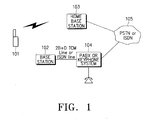
- FIG.1 shows a conventional DECT system providing a voice communication service only, and refers to a cordless telephone system used in connection with a PABX (Private Automatic Branch Exchange) or keyphone system 104 and a home base station 103.
- PABX Primary Automatic Branch Exchange
- keyphone system 104 and a home base station 103.
- a DECT terminal 101 being an advanced digital cordless telephone for voice communication, is cordlessly connected by a radio link to a DECT base station 102.
- DECT base station 102 is connected to a PSTN (Public Switched Telephone Network) or ISDN (Integrated Services Digital Network) 105 via a PABX (or a keyphone system) 104, to allow the user of the DECT terminal 101 to talk over the telephone with existing wired subscribers (i.e. PSTN or ISDN subscribers) .
- the home base station 103 is directly connected to the PSTN (or ISDN) 105, to allow the user of the DECT terminal 101 to talk with the wired subscribers without passing through the PABX or keyphone system 104.
- the DECT terminal 101 When the user of the DECT terminal 101 tries to make a call to a wired subscriber, the DECT terminal 101 sets up a radio link to the DECT base station 102 or the home base station 103 and then sets up a call via a signalling channel ('D' channel) of the radio link. Upon call set-up, the DECT terminal 101 is connected by radio link to the PSTN (or ISDN) 105 either through the DECT base station 102 or the home base station 103, and performs voice communication via a traffic channel ('B' channel) of the radio link.
- PSTN or ISDN
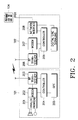
- FIG.2 shows a block diagram of a conventional DECT system providing a voice communication service, consisting of the DECT terminal 101 and the DECT base station 102.
- an analogue front-end processor 201 connected to a microphone (or a receiver), converts an analogue voice signal received from the microphone into ADPCM (adaptive Differential Pulse Code Modulation) data.
- a MODEM 202 converts the ADPCM data output from the analogue front-end processor 201 to an analogue baseband signal.
- An RF (Radio Frequency) transceiver 203 converts the analogue baseband signal output from the MODEM 202 to an RF signal and transmits the RF signal to the DECT base station 102 via the radio link.
- a controller 204 controls the overall operations of the DECT terminal 101.
- An OPE (Operating Panel Equipment) 205 comprised of a key matrix with a plurality of numeric keys, provides the controller 204 with key data generated by a key operation. Further, the OPE 205 includes an LCD (Liquid Crystal Display) to display the operating states of the DECT terminal 101 under the control of the controller 204.
- LCD Liquid Crystal Display
- an RF transceiver 206 down-converts the RF signal received from the DECT terminal 101 via the radio link to a baseband signal.
- a MODEM 207 demodulates the baseband signal output from the RF transceiver 206 into ADPCM data.
- a network interface 208 converts the ADPCM data to PCM data and outputs the PCM data to the PABX (or the keyphone system) 104 via the traffic channel (B channel).
- a digital line signalling device 210 is provided, in communication with network interface 208.
- a controller 209 controls the overall operations of the DECT base station 102.
- the conventional DECT system provides for voice communication only.
- a DECT system capable of providing a data communication service as well as the voice communication service.
- the present invention provides a telecommunication system for connection to an ISDN (Integrated Services Digital Network), comprising a terminal for transmitting and/or receiving packet data via a radio link; and a base station for converting packet data received from the terminal to a signal for transmission to the ISDN, and/or converting a signal received from the ISDN to packet data for transmission to the terminal.
- ISDN Integrated Services Digital Network
- the terminal is a DECT terminal and the base station is a DECT base station.
- the base station is connected to said ISDN via a U interface.
- the terminal includes an interface for connection to a computer for providing and/or receiving packet data.
- the terminal comprises an interface for interfacing data transmission between said terminal and a computer.
- the terminal comprises a packet formatter for packet formatting data input from said interface.
- the terminal comprises a modem for converting packet data output from the packet formatter to an analogue baseband signal.
- the terminal comprises an RF (Radio Frequency) transmitter for converting the analogue baseband signal to an RF signal and transmitting the RF signal to the base station.
- RF Radio Frequency
- the terminal comprises an RF (Radio Frequency) receiver for deriving an analogue baseband signal from an RF signal received from the base station.
- the terminal comprises a modem for converting the analogue baseband signal into a data signal.
- the terminal comprises a packet deformatter for packet deformatting the data signal.
- the terminal comprises an interface for interfacing the deformatted data signal to the computer.
- the base station comprises an RF receiver for down-converting an RF signal received from the terminal into an analogue baseband signal.
- the base station comprises a modem for demodulating the analogue baseband signal into packet data.
- the base station comprises a packet deformatter for deformatting the packet data.
- the base station comprises a network interface for converting said deformatted packet data to an ISDN signal and for sending said ISDN signal.
- the base station comprises a network interface for producing a data signal from a received ISDN signal.
- the base station comprises a packet formatter for formatting the data signal into packet data.
- the base station comprises a modem for modulating packet data into an analogue baseband signal.
- the base station comprises an RF transmitter for producing an RF signal for transmission to the terminal, from the analogue baseband signal.
- the packet formatter or deformatter preferably converts packet data from or into PCM (Pulse Code Modulation) data.
- PCM Pulse Code Modulation
- packet formatting or deformatting preferably respectively comprises adding or removing header, CRC (Cyclic Redundancy Check) and control data.
- CRC Cyclic Redundancy Check
- the invention also provides a method for operating a telecommunications system for connection to an ISDN, comprising the steps of packet formatting transmission data; transmitting the packet data from a terminal to a base station via a radio link; converting the packet data transmitted to the base station to an ISDN signal; and transmitting the IDSN signal to the ISDN.
- the method also comprises the step of receiving transmission data from an ISDN, in a base station.
- the method also comprises the step of packet formatting the transmission data; transmitting the packet data to a terminal from the base station via a radio link; and deformatting the packet data transmitted to the terminal.
- the telecommunications system is a DECT.
- the present invention provides a cordless telecommunications system capable of providing data communication service in addition to voice communication service, and a method for operating the same.
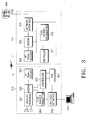
- FIG.3 shows a block diagram of a DECT system according to an embodiment of the present invention which can provide a data transmission service.
- the DECT system consists of a DECT terminal 313 and a DECT base station 314.
- a controller 305 controls the overall operations of the DECT terminal 313, including transmission of a call control signal to the DECT base station 314.
- An analogue front-end processor 301 connected to a microphone (or receiver), converts an analogue voice signal input from the microphone to ADPCM data, where ADPCM refers to a digital coding technique used for the voice signal.
- An OPE 307 comprising a key matrix with a plurality of numeric keys, provides the controller 305 with key data generated by a key operation. Further, the OPE 307, having an LCD display, displays the operating states of the DECT terminal 313 on the LCD under the control of the controller 305.
- An RS-232C interface 306 enables data transmission between the DECT terminal 313 and a computer 409 such as a portable or notebook computer.
- An X.25 packet formatter 304 packet formats the data input from a notebook computer 409 via RS-232C interface 306, that is, packet formatter 304 converts data input from the notebook computer 409 to packet data and adds header, cyclic redundancy check (CRC) and control data.
- CRC cyclic redundancy check
- the data is packet formatted in accordance with an X.25 Standard, under the ITUT (International Telecommunication Union-Telecommunication sector) Recommendation.
- a MODEM 302 converts the ADPCM data output from the analogue front-end processor 301 and the packet data output from the X.25 packet formatter 304 to analogue signals.
- An RF transceiver 303 converts the analogue signals input from the MODEM 302 to an RF signal and transmits the RF signal to the DECT base station 314 via a radio link.
- an RF transceiver 308 down-converts the RF signal received from the DECT terminal 313 to the baseband signal.
- a MODEM 309 demodulates the baseband signal output from the RF transceiver 308 into digital data.
- An X.25 packet deformatter 312 removes header, CRC (Cyclic Redundancy Check) and control data from the output data of the MODEM 309, and converts the remaining, 'pure' data to 64Kbps PCM (pulse code modulated) data in the V.110 format.
- CRC Cyclic Redundancy Check
- a network interface 310 convert the PCM data received from the X.25 packet deformatter 312 into the ISDN format, such as a U interface format, and transmits the converted ISDN format data over the traffic channel (B channel) to a PABX or keyphone system 404.
- the U interface format has a 2B+D structure consisting of two 64Kbps traffic channels and one 16Kbps signalling channel in a time sharing manner.
- the traffic channels are used for transmission of the voice traffic and the data traffic, and the D channel is used for transmission of the signalling data i.e. the control data.
- the network interface 310 converts received ADPCM data to PCM data and successively converts the PCM data to an ISDN format signal, such as a U interface format signal, and transmits the ISDN format signal via the B channel.
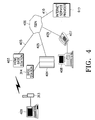
- FIG.4 shows a DECT system of the present invention connected to an ISDN 406.
- the data received from the connected notebook computer 409 is converted to X.25 format data.
- the MODEM 302 modulates the X.25 format data.
- the RF transceiver 303 converts the modulated data to an RF signal and transmits the RF signal to the DECT base station 314 (or the home base station 403) via a traffic channel of the radio link.
- the DECT base station 314 receives and demodulates the RF signal into a baseband signal, X.25-deformats the baseband signal, and converts the deformatted signal to the V.110 format, which is the standard format of a CCITT (International Telegraph and Telephone Consultative Committee) ISDN MODEM.
- the X.25 format signal in converted to an ISDN format signal by the network interface 310 and is transmitted to the ISDN 406 via PABX 404, through the traffic channel of an ISDN U interface 405.
- the ISDN line has 2B+D channel structure consisting two traffic channels (2B) for transmitting data and voice traffic and one signalling channel (D) for transmitting call set-up and call control signals.
- the ISDN 406 is connected to an Internet service provider 419.
- FIG. 4 also shows a computer 408 connected to a modem and telephone 407, providing a connection to ISDN 406.
- the present invention accordingly provides a cordless telecommunication system, in particular a DECT system, which can process data traffic as well as voice traffic.
- a preferred embodiment will include RF transceivers and bi-directional modems in each of terminal and base station. Both X.25 formatter and deformatter should be provided in each of base station and terminal to provide for X.25 formatting and deformatting in either direction. In such an embodiment, data may be transmitted in either or both directions between terminal and base station.
Landscapes
- Engineering & Computer Science (AREA)
- Computer Networks & Wireless Communication (AREA)
- Signal Processing (AREA)
- Mobile Radio Communication Systems (AREA)
- Telephonic Communication Services (AREA)
Applications Claiming Priority (2)
| Application Number | Priority Date | Filing Date | Title |
|---|---|---|---|
| KR1019970033507A KR19990010665A (ko) | 1997-07-18 | 1997-07-18 | 덱트 시스템의 데이터 전송을 위한 장치 및 방법 |
| KR9733507 | 1997-07-18 |
Publications (2)
| Publication Number | Publication Date |
|---|---|
| EP0892578A2 true EP0892578A2 (fr) | 1999-01-20 |
| EP0892578A3 EP0892578A3 (fr) | 1999-12-22 |
Family
ID=19514925
Family Applications (1)
| Application Number | Title | Priority Date | Filing Date |
|---|---|---|---|
| EP98305775A Withdrawn EP0892578A3 (fr) | 1997-07-18 | 1998-07-20 | Système téléphonique sans fil (DECT) capable de fournir un service de communication de données |
Country Status (3)
| Country | Link |
|---|---|
| EP (1) | EP0892578A3 (fr) |
| KR (1) | KR19990010665A (fr) |
| CN (1) | CN1171480C (fr) |
Cited By (1)
| Publication number | Priority date | Publication date | Assignee | Title |
|---|---|---|---|---|
| NL1019649C2 (nl) * | 2001-12-21 | 2003-06-24 | Tno | DECT (Digital Enhanced Cordless Telecommunications)-systeem voor draadloze communicatie van datasignalen. |
Families Citing this family (2)
| Publication number | Priority date | Publication date | Assignee | Title |
|---|---|---|---|---|
| KR100475179B1 (ko) * | 2002-11-12 | 2005-03-11 | 엘지전자 주식회사 | 키폰 시스템에서 무선 단말기의 통화방법 |
| KR102284766B1 (ko) | 2020-12-16 | 2021-08-02 | 주식회사 에이아이더뉴트리진 | 고농도의 dna 추출이 가능한 측방 분리 추출 기반의 dna 추출 키트 |
Family Cites Families (10)
| Publication number | Priority date | Publication date | Assignee | Title |
|---|---|---|---|---|
| DE4128811A1 (de) * | 1991-08-30 | 1993-03-04 | Standard Elektrik Lorenz Ag | Nebenstellenanlage |
| CA2053137C (fr) * | 1991-10-10 | 2001-08-21 | Rolf G. Meier | Interface sans fil numerique |
| WO1993021719A1 (fr) * | 1992-04-09 | 1993-10-28 | Siemens Aktiengesellschaft | Procede de structuration d'un format de champ b en norme dect |
| US5384807A (en) * | 1992-07-02 | 1995-01-24 | Motorola, Inc. | ADPCM transcoder with integral tone generation and method therefor |
| DE4309848C2 (de) * | 1993-03-26 | 1997-06-12 | Siemens Ag | Kommunikationssystem zum Anschluß an eine Basisstation eines mehrzellularen, drahtlosen Fernsprechsystems |
| DE4330704A1 (de) * | 1993-09-10 | 1995-03-16 | Sel Alcatel Ag | Telepoint-System |
| FI104870B (fi) * | 1994-12-12 | 2000-04-14 | Nokia Mobile Phones Ltd | Tiedonsiirtomenetelmä |
| DE19520024A1 (de) * | 1995-05-31 | 1996-12-05 | Siemens Ag | Universelles Mobil-Telekommunikationssystem |
| DE69635477T2 (de) * | 1995-12-01 | 2006-08-03 | Koninklijke Philips Electronics N.V. | Digitales schnurloses telefonsystem, funkbasisstation und kombination von funkbasisstation und schnurlosem handgerät |
| FI962312A7 (fi) * | 1996-05-31 | 1997-12-01 | Teleste Viestintae Oy | Puhelinjärjestelmä |
-
1997
- 1997-07-18 KR KR1019970033507A patent/KR19990010665A/ko not_active Ceased
-
1998
- 1998-07-15 CN CNB981160581A patent/CN1171480C/zh not_active Expired - Fee Related
- 1998-07-20 EP EP98305775A patent/EP0892578A3/fr not_active Withdrawn
Cited By (2)
| Publication number | Priority date | Publication date | Assignee | Title |
|---|---|---|---|---|
| NL1019649C2 (nl) * | 2001-12-21 | 2003-06-24 | Tno | DECT (Digital Enhanced Cordless Telecommunications)-systeem voor draadloze communicatie van datasignalen. |
| WO2003056793A1 (fr) * | 2001-12-21 | 2003-07-10 | Nederlandse Organisatie Voor Toegepast- Natuurwetenschappelijk Onderzoek Tno | Systeme dect destinee a la communication sans fil de donnees numeriques |
Also Published As
| Publication number | Publication date |
|---|---|
| EP0892578A3 (fr) | 1999-12-22 |
| KR19990010665A (ko) | 1999-02-18 |
| CN1209031A (zh) | 1999-02-24 |
| CN1171480C (zh) | 2004-10-13 |
Similar Documents
| Publication | Publication Date | Title |
|---|---|---|
| CA2176590C (fr) | Procede d'appel ou d'annulation de services vocaux ou de donnees a partir d'une station mobile | |
| US6151332A (en) | Protocol conversion and bandwidth reduction technique providing multiple nB+D ISDN basic rate interface links over a wireless code division multiple access communication system | |
| JP3862757B2 (ja) | 無線通信チャンネルで音声およびデータ信号を伝送する回路および方法 | |
| US6230010B1 (en) | Method and apparatus for transmission of analog and digital | |
| EP0661893A2 (fr) | Modem cellulaire bi-mode | |
| RU96111813A (ru) | Способ активации и отмены обслуживания с использованием речевых сигналов или сигналов данных с мобильного устройства | |
| JPH02224563A (ja) | 電話回線網に対する個人用コンピュータの接続装置 | |
| US5602837A (en) | Multiplex system for a personal handy phone system | |
| US7130291B1 (en) | Data control system in CDMA mobile communication system providing mobile data and voice service | |
| RU2303853C2 (ru) | Комплексная аппаратная связи | |
| JPH10229574A (ja) | Dect/gsmインターワーキングのための高速データサービス | |
| US6181953B1 (en) | Radio access system for a telematique service | |
| EP0892578A2 (fr) | Système téléphonique sans fil (DECT) capable de fournir un service de communication de données | |
| JP2758861B2 (ja) | デジタル移動体データ通信システム | |
| US6320862B1 (en) | Mobile communication system for communicating with an integrated services digital network | |
| SK101698A3 (en) | Voice and data terminal for a radiotelephone network | |
| JP3469246B2 (ja) | データ圧縮を用いる通信方法および装置 | |
| JP3268947B2 (ja) | 転送速度整合装置及び方法 | |
| KR100241913B1 (ko) | 씨티 투 시스템에서 패킷 통신장치 | |
| JP3451052B2 (ja) | データ信号の多重化方式を用いた通信システム | |
| JPH0965408A (ja) | Catv網を用いた簡易型携帯電話システム及びその通信方法 | |
| KR950022664A (ko) | Isdn망에 접속 가능한 디지탈 키폰시스템 | |
| JPH0927849A (ja) | 通信端末装置 | |
| KR100240280B1 (ko) | 발신전용 전화기를 이용한 데이터통신 방법 | |
| JPH08317077A (ja) | 携帯電話有線接続装置 |
Legal Events
| Date | Code | Title | Description |
|---|---|---|---|
| PUAI | Public reference made under article 153(3) epc to a published international application that has entered the european phase |
Free format text: ORIGINAL CODE: 0009012 |
|
| 17P | Request for examination filed |
Effective date: 19980731 |
|
| AK | Designated contracting states |
Kind code of ref document: A2 Designated state(s): DE FR GB IT |
|
| AX | Request for extension of the european patent |
Free format text: AL;LT;LV;MK;RO;SI |
|
| PUAL | Search report despatched |
Free format text: ORIGINAL CODE: 0009013 |
|
| AK | Designated contracting states |
Kind code of ref document: A3 Designated state(s): AT BE CH CY DE DK ES FI FR GB GR IE IT LI LU MC NL PT SE |
|
| AX | Request for extension of the european patent |
Free format text: AL;LT;LV;MK;RO;SI |
|
| AKX | Designation fees paid |
Free format text: DE FR GB IT |
|
| STAA | Information on the status of an ep patent application or granted ep patent |
Free format text: STATUS: THE APPLICATION HAS BEEN WITHDRAWN |
|
| 18W | Application withdrawn |
Effective date: 20050812 |