EP0892607B1 - Composes herbicides et phytoregulateurs de croissance et procede d'utilisation - Google Patents
Composes herbicides et phytoregulateurs de croissance et procede d'utilisation Download PDFInfo
- Publication number
- EP0892607B1 EP0892607B1 EP97920105A EP97920105A EP0892607B1 EP 0892607 B1 EP0892607 B1 EP 0892607B1 EP 97920105 A EP97920105 A EP 97920105A EP 97920105 A EP97920105 A EP 97920105A EP 0892607 B1 EP0892607 B1 EP 0892607B1
- Authority
- EP
- European Patent Office
- Prior art keywords
- glyphosate
- carbon atoms
- component
- composition
- range
- Prior art date
- Legal status (The legal status is an assumption and is not a legal conclusion. Google has not performed a legal analysis and makes no representation as to the accuracy of the status listed.)
- Expired - Lifetime
Links
- 239000000203 mixture Substances 0.000 title claims abstract description 96
- 230000008635 plant growth Effects 0.000 title claims abstract description 25
- 230000002363 herbicidal effect Effects 0.000 title claims description 34
- XDDAORKBJWWYJS-UHFFFAOYSA-N glyphosate Chemical compound OC(=O)CNCP(O)(O)=O XDDAORKBJWWYJS-UHFFFAOYSA-N 0.000 claims abstract description 70
- 239000005562 Glyphosate Substances 0.000 claims abstract description 63
- 229940097068 glyphosate Drugs 0.000 claims abstract description 63
- 125000004432 carbon atom Chemical group C* 0.000 claims abstract description 39
- 125000000217 alkyl group Chemical group 0.000 claims abstract description 31
- XLYOFNOQVPJJNP-UHFFFAOYSA-N water Substances O XLYOFNOQVPJJNP-UHFFFAOYSA-N 0.000 claims abstract description 24
- 150000003839 salts Chemical class 0.000 claims abstract description 19
- 150000001412 amines Chemical class 0.000 claims abstract description 15
- 239000000243 solution Substances 0.000 claims abstract description 15
- 229910052799 carbon Inorganic materials 0.000 claims abstract description 14
- 239000000843 powder Substances 0.000 claims abstract description 14
- 229910052783 alkali metal Inorganic materials 0.000 claims abstract description 11
- QECVIPBZOPUTRD-UHFFFAOYSA-N N=S(=O)=O Chemical compound N=S(=O)=O QECVIPBZOPUTRD-UHFFFAOYSA-N 0.000 claims abstract description 10
- 150000001340 alkali metals Chemical class 0.000 claims abstract description 8
- HAMNKKUPIHEESI-UHFFFAOYSA-N aminoguanidine Chemical class NNC(N)=N HAMNKKUPIHEESI-UHFFFAOYSA-N 0.000 claims abstract description 8
- 150000002148 esters Chemical class 0.000 claims abstract description 6
- 238000000034 method Methods 0.000 claims description 24
- 241000196324 Embryophyta Species 0.000 claims description 23
- 239000004009 herbicide Substances 0.000 claims description 22
- -1 amine salt Chemical class 0.000 claims description 15
- 239000000126 substance Substances 0.000 claims description 14
- 239000004094 surface-active agent Substances 0.000 claims description 12
- 239000007864 aqueous solution Substances 0.000 claims description 11
- 239000004615 ingredient Substances 0.000 claims description 11
- 238000002156 mixing Methods 0.000 claims description 10
- 125000001301 ethoxy group Chemical group [H]C([H])([H])C([H])([H])O* 0.000 claims description 9
- 239000012141 concentrate Substances 0.000 claims description 7
- QNMCWJOEQBZQHB-UHFFFAOYSA-N 2-Hexyl-1-octanol Polymers CCCCCCC(CO)CCCCCC QNMCWJOEQBZQHB-UHFFFAOYSA-N 0.000 claims description 6
- JJWLVOIRVHMVIS-UHFFFAOYSA-N isopropylamine Chemical class CC(C)N JJWLVOIRVHMVIS-UHFFFAOYSA-N 0.000 claims description 6
- 229910052751 metal Inorganic materials 0.000 claims description 6
- 239000002184 metal Substances 0.000 claims description 6
- 150000003138 primary alcohols Chemical class 0.000 claims description 6
- 229910052752 metalloid Inorganic materials 0.000 claims description 5
- 150000002738 metalloids Chemical class 0.000 claims description 5
- 239000008367 deionised water Substances 0.000 claims description 4
- 229910021641 deionized water Inorganic materials 0.000 claims description 4
- 239000000654 additive Substances 0.000 claims description 3
- 230000000996 additive effect Effects 0.000 claims description 3
- 230000012010 growth Effects 0.000 claims description 3
- 229910052698 phosphorus Inorganic materials 0.000 claims description 3
- 239000007921 spray Substances 0.000 claims description 3
- 238000010790 dilution Methods 0.000 claims description 2
- 239000012895 dilution Substances 0.000 claims description 2
- NRZWQKGABZFFKE-UHFFFAOYSA-N trimethylsulfonium Chemical class C[S+](C)C NRZWQKGABZFFKE-UHFFFAOYSA-N 0.000 claims description 2
- OAICVXFJPJFONN-UHFFFAOYSA-N Phosphorus Chemical compound [P] OAICVXFJPJFONN-UHFFFAOYSA-N 0.000 claims 2
- 230000001276 controlling effect Effects 0.000 claims 2
- 239000011574 phosphorus Substances 0.000 claims 2
- 230000001105 regulatory effect Effects 0.000 claims 2
- 239000000428 dust Substances 0.000 claims 1
- 238000009472 formulation Methods 0.000 abstract description 32
- LFQSCWFLJHTTHZ-UHFFFAOYSA-N Ethanol Chemical compound CCO LFQSCWFLJHTTHZ-UHFFFAOYSA-N 0.000 abstract 1
- 239000008187 granular material Substances 0.000 abstract 1
- 239000002671 adjuvant Substances 0.000 description 16
- WSFSSNUMVMOOMR-UHFFFAOYSA-N Formaldehyde Chemical compound O=C WSFSSNUMVMOOMR-UHFFFAOYSA-N 0.000 description 6
- 239000002253 acid Substances 0.000 description 6
- 150000001875 compounds Chemical class 0.000 description 6
- 235000008504 concentrate Nutrition 0.000 description 6
- 239000004480 active ingredient Substances 0.000 description 4
- 150000001298 alcohols Chemical class 0.000 description 4
- ZEKANFGSDXODPD-UHFFFAOYSA-N glyphosate-isopropylammonium Chemical class CC(C)N.OC(=O)CNCP(O)(O)=O ZEKANFGSDXODPD-UHFFFAOYSA-N 0.000 description 4
- 235000014666 liquid concentrate Nutrition 0.000 description 4
- 229910052708 sodium Inorganic materials 0.000 description 4
- 239000011734 sodium Substances 0.000 description 4
- DGAQECJNVWCQMB-PUAWFVPOSA-M Ilexoside XXIX Chemical compound C[C@@H]1CC[C@@]2(CC[C@@]3(C(=CC[C@H]4[C@]3(CC[C@@H]5[C@@]4(CC[C@@H](C5(C)C)OS(=O)(=O)[O-])C)C)[C@@H]2[C@]1(C)O)C)C(=O)O[C@H]6[C@@H]([C@H]([C@@H]([C@H](O6)CO)O)O)O.[Na+] DGAQECJNVWCQMB-PUAWFVPOSA-M 0.000 description 3
- 239000012736 aqueous medium Substances 0.000 description 3
- 238000006243 chemical reaction Methods 0.000 description 3
- 230000000694 effects Effects 0.000 description 3
- 239000000463 material Substances 0.000 description 3
- 230000003647 oxidation Effects 0.000 description 3
- 238000007254 oxidation reaction Methods 0.000 description 3
- 231100000208 phytotoxic Toxicity 0.000 description 3
- 230000000885 phytotoxic effect Effects 0.000 description 3
- 239000007787 solid Substances 0.000 description 3
- VTYYLEPIZMXCLO-UHFFFAOYSA-L Calcium carbonate Chemical compound [Ca+2].[O-]C([O-])=O VTYYLEPIZMXCLO-UHFFFAOYSA-L 0.000 description 2
- CURLTUGMZLYLDI-UHFFFAOYSA-N Carbon dioxide Chemical compound O=C=O CURLTUGMZLYLDI-UHFFFAOYSA-N 0.000 description 2
- RTZKZFJDLAIYFH-UHFFFAOYSA-N Diethyl ether Chemical compound CCOCC RTZKZFJDLAIYFH-UHFFFAOYSA-N 0.000 description 2
- 235000001602 Digitaria X umfolozi Nutrition 0.000 description 2
- 235000017898 Digitaria ciliaris Nutrition 0.000 description 2
- 235000005476 Digitaria cruciata Nutrition 0.000 description 2
- 235000006830 Digitaria didactyla Nutrition 0.000 description 2
- 235000005804 Digitaria eriantha ssp. eriantha Nutrition 0.000 description 2
- 235000010823 Digitaria sanguinalis Nutrition 0.000 description 2
- 244000058871 Echinochloa crus-galli Species 0.000 description 2
- 244000025670 Eleusine indica Species 0.000 description 2
- 235000014716 Eleusine indica Nutrition 0.000 description 2
- DHMQDGOQFOQNFH-UHFFFAOYSA-N Glycine Chemical compound NCC(O)=O DHMQDGOQFOQNFH-UHFFFAOYSA-N 0.000 description 2
- CPLXHLVBOLITMK-UHFFFAOYSA-N Magnesium oxide Chemical compound [Mg]=O CPLXHLVBOLITMK-UHFFFAOYSA-N 0.000 description 2
- 230000009471 action Effects 0.000 description 2
- 230000008901 benefit Effects 0.000 description 2
- 230000015572 biosynthetic process Effects 0.000 description 2
- 239000003795 chemical substances by application Substances 0.000 description 2
- 238000005260 corrosion Methods 0.000 description 2
- 230000007797 corrosion Effects 0.000 description 2
- 239000000975 dye Substances 0.000 description 2
- 239000012530 fluid Substances 0.000 description 2
- 239000003906 humectant Substances 0.000 description 2
- 239000003112 inhibitor Substances 0.000 description 2
- 239000007788 liquid Substances 0.000 description 2
- 238000004519 manufacturing process Methods 0.000 description 2
- 230000008569 process Effects 0.000 description 2
- 239000002689 soil Substances 0.000 description 2
- 241000894007 species Species 0.000 description 2
- 238000005507 spraying Methods 0.000 description 2
- 239000002562 thickening agent Substances 0.000 description 2
- 230000009466 transformation Effects 0.000 description 2
- 238000000844 transformation Methods 0.000 description 2
- QTBSBXVTEAMEQO-UHFFFAOYSA-M Acetate Chemical compound CC([O-])=O QTBSBXVTEAMEQO-UHFFFAOYSA-M 0.000 description 1
- 239000005995 Aluminium silicate Substances 0.000 description 1
- 241000722948 Apocynum cannabinum Species 0.000 description 1
- 244000277285 Cassia obtusifolia Species 0.000 description 1
- 235000006719 Cassia obtusifolia Nutrition 0.000 description 1
- 235000014552 Cassia tora Nutrition 0.000 description 1
- BDAGIHXWWSANSR-UHFFFAOYSA-M Formate Chemical compound [O-]C=O BDAGIHXWWSANSR-UHFFFAOYSA-M 0.000 description 1
- 241000537377 Fraxinus berlandieriana Species 0.000 description 1
- 239000004471 Glycine Substances 0.000 description 1
- 238000007869 Guerbet synthesis reaction Methods 0.000 description 1
- 240000001549 Ipomoea eriocarpa Species 0.000 description 1
- 235000005146 Ipomoea eriocarpa Nutrition 0.000 description 1
- WHXSMMKQMYFTQS-UHFFFAOYSA-N Lithium Chemical compound [Li] WHXSMMKQMYFTQS-UHFFFAOYSA-N 0.000 description 1
- 238000006683 Mannich reaction Methods 0.000 description 1
- 240000006959 Melochia corchorifolia Species 0.000 description 1
- 229910002651 NO3 Inorganic materials 0.000 description 1
- PXHVJJICTQNCMI-UHFFFAOYSA-N Nickel Chemical compound [Ni] PXHVJJICTQNCMI-UHFFFAOYSA-N 0.000 description 1
- NHNBFGGVMKEFGY-UHFFFAOYSA-N Nitrate Chemical compound [O-][N+]([O-])=O NHNBFGGVMKEFGY-UHFFFAOYSA-N 0.000 description 1
- MUBZPKHOEPUJKR-UHFFFAOYSA-N Oxalic acid Chemical compound OC(=O)C(O)=O MUBZPKHOEPUJKR-UHFFFAOYSA-N 0.000 description 1
- 229910019142 PO4 Inorganic materials 0.000 description 1
- 231100000674 Phytotoxicity Toxicity 0.000 description 1
- 241000533293 Sesbania emerus Species 0.000 description 1
- VYPSYNLAJGMNEJ-UHFFFAOYSA-N Silicium dioxide Chemical compound O=[Si]=O VYPSYNLAJGMNEJ-UHFFFAOYSA-N 0.000 description 1
- QAOWNCQODCNURD-UHFFFAOYSA-L Sulfate Chemical compound [O-]S([O-])(=O)=O QAOWNCQODCNURD-UHFFFAOYSA-L 0.000 description 1
- 230000001476 alcoholic effect Effects 0.000 description 1
- 229910052782 aluminium Inorganic materials 0.000 description 1
- 235000012211 aluminium silicate Nutrition 0.000 description 1
- 230000003042 antagnostic effect Effects 0.000 description 1
- 239000013011 aqueous formulation Substances 0.000 description 1
- 230000009286 beneficial effect Effects 0.000 description 1
- 239000000440 bentonite Substances 0.000 description 1
- 229910000278 bentonite Inorganic materials 0.000 description 1
- SVPXDRXYRYOSEX-UHFFFAOYSA-N bentoquatam Chemical compound O.O=[Si]=O.O=[Al]O[Al]=O SVPXDRXYRYOSEX-UHFFFAOYSA-N 0.000 description 1
- 229910000019 calcium carbonate Inorganic materials 0.000 description 1
- 239000001569 carbon dioxide Substances 0.000 description 1
- 229910002092 carbon dioxide Inorganic materials 0.000 description 1
- 125000002091 cationic group Chemical group 0.000 description 1
- 150000001768 cations Chemical class 0.000 description 1
- LXCYSACZTOKNNS-UHFFFAOYSA-N diethoxy(oxo)phosphanium Chemical compound CCO[P+](=O)OCC LXCYSACZTOKNNS-UHFFFAOYSA-N 0.000 description 1
- 238000007865 diluting Methods 0.000 description 1
- 239000003085 diluting agent Substances 0.000 description 1
- 239000006185 dispersion Substances 0.000 description 1
- 239000010459 dolomite Substances 0.000 description 1
- 229910000514 dolomite Inorganic materials 0.000 description 1
- 238000005516 engineering process Methods 0.000 description 1
- 230000002708 enhancing effect Effects 0.000 description 1
- NTNZTEQNFHNYBC-UHFFFAOYSA-N ethyl 2-aminoacetate Chemical compound CCOC(=O)CN NTNZTEQNFHNYBC-UHFFFAOYSA-N 0.000 description 1
- 238000001704 evaporation Methods 0.000 description 1
- 238000002474 experimental method Methods 0.000 description 1
- 238000001125 extrusion Methods 0.000 description 1
- 239000003337 fertilizer Substances 0.000 description 1
- 235000021588 free fatty acids Nutrition 0.000 description 1
- 238000005469 granulation Methods 0.000 description 1
- 230000003179 granulation Effects 0.000 description 1
- 239000010440 gypsum Substances 0.000 description 1
- 229910052602 gypsum Inorganic materials 0.000 description 1
- 229910052739 hydrogen Inorganic materials 0.000 description 1
- 125000004435 hydrogen atom Chemical group [H]* 0.000 description 1
- 230000007062 hydrolysis Effects 0.000 description 1
- 238000006460 hydrolysis reaction Methods 0.000 description 1
- NBZBKCUXIYYUSX-UHFFFAOYSA-N iminodiacetic acid Chemical compound OC(=O)CNCC(O)=O NBZBKCUXIYYUSX-UHFFFAOYSA-N 0.000 description 1
- NLYAJNPCOHFWQQ-UHFFFAOYSA-N kaolin Chemical compound O.O.O=[Al]O[Si](=O)O[Si](=O)O[Al]=O NLYAJNPCOHFWQQ-UHFFFAOYSA-N 0.000 description 1
- 229910052744 lithium Inorganic materials 0.000 description 1
- 239000000395 magnesium oxide Substances 0.000 description 1
- 150000007522 mineralic acids Chemical class 0.000 description 1
- 229910052757 nitrogen Inorganic materials 0.000 description 1
- 150000007524 organic acids Chemical class 0.000 description 1
- 239000003960 organic solvent Substances 0.000 description 1
- 229910052760 oxygen Inorganic materials 0.000 description 1
- 239000010452 phosphate Substances 0.000 description 1
- NBIIXXVUZAFLBC-UHFFFAOYSA-K phosphate Chemical compound [O-]P([O-])([O-])=O NBIIXXVUZAFLBC-UHFFFAOYSA-K 0.000 description 1
- 239000000049 pigment Substances 0.000 description 1
- XAEFZNCEHLXOMS-UHFFFAOYSA-M potassium benzoate Chemical compound [K+].[O-]C(=O)C1=CC=CC=C1 XAEFZNCEHLXOMS-UHFFFAOYSA-M 0.000 description 1
- 230000003389 potentiating effect Effects 0.000 description 1
- 238000002360 preparation method Methods 0.000 description 1
- 230000009467 reduction Effects 0.000 description 1
- 238000001694 spray drying Methods 0.000 description 1
- 230000007480 spreading Effects 0.000 description 1
- 238000003892 spreading Methods 0.000 description 1
- 230000009885 systemic effect Effects 0.000 description 1
- 239000000454 talc Substances 0.000 description 1
- 229910052623 talc Inorganic materials 0.000 description 1
- ISIJQEHRDSCQIU-UHFFFAOYSA-N tert-butyl 2,7-diazaspiro[4.5]decane-7-carboxylate Chemical compound C1N(C(=O)OC(C)(C)C)CCCC11CNCC1 ISIJQEHRDSCQIU-UHFFFAOYSA-N 0.000 description 1
- 239000000080 wetting agent Substances 0.000 description 1
Classifications
-
- A—HUMAN NECESSITIES
- A01—AGRICULTURE; FORESTRY; ANIMAL HUSBANDRY; HUNTING; TRAPPING; FISHING
- A01N—PRESERVATION OF BODIES OF HUMANS OR ANIMALS OR PLANTS OR PARTS THEREOF; BIOCIDES, e.g. AS DISINFECTANTS, AS PESTICIDES OR AS HERBICIDES; PEST REPELLANTS OR ATTRACTANTS; PLANT GROWTH REGULATORS
- A01N57/00—Biocides, pest repellants or attractants, or plant growth regulators containing organic phosphorus compounds
- A01N57/18—Biocides, pest repellants or attractants, or plant growth regulators containing organic phosphorus compounds having phosphorus-to-carbon bonds
- A01N57/20—Biocides, pest repellants or attractants, or plant growth regulators containing organic phosphorus compounds having phosphorus-to-carbon bonds containing acyclic or cycloaliphatic radicals
Definitions
- This invention relates to glyphosate formulations which are effective even when employed at dosages below the dosage currently recommended for post-emergent herbicidal use against undesired vegetation.
- Glyphosate N-(phosphonomethyl)glycine
- N-(phosphonomethyl)glycine is a well-known widely used herbicide. It is generally employed in the form of an agriculturally acceptable salt.
- glyphosate salts such as the amine, sodium, alkylsulfonium, alkylphosphonium, sulfonylamine, and aminoguanidine salts thereof by means of an environmentally friendly aqueous formulation made from a small number of ingredients, wherein the amounts of each of the components, including the glyphosate, can be kept very small, and wherein the resulting composition provides clearly observable herbicidal or plant regulant action. It would be particularly desirable if this need could be fulfilled by use of readily available, cost-effective materials while at the same time avoiding the inclusion of polyvalent metal-containing and metalloid-containing components in the formulation.
- This invention is deemed to fulfill the foregoing need in an effective and highly efficient manner.
- This invention involves the discovery, inter alia, that certain double-tailed alkanol polyethoxylates are effective as adjuvants for increasing the phytotoxic and plant growth regulant effectiveness of glyphosate against a certain plant species, particularly in control of certain undesirable broadleaf species.
- this invention makes it possible to achieve enhanced phytotoxic and plant growth regulant effectiveness in an aqueous solution formed from as few as two added ingredients, both of which are readily available in the marketplace.
- the adjuvants used in the practice of this invention are in themselves environmentally friendly. And in addition, the formulation requires no polyvalent metal or metalloid components in its formation. Indeed the preferred compositions are devoid of metal and metalloid additive content, and most preferably contain only the elements C, H, O, N, P, and optionally S. Moreover, the liquid concentrates are most preferably formed using deionized water.
- the adjuvants used in forming the formulations of this invention are one or more water-soluble polyethoxylated monohydric primary alcohols having a ⁇ -branched alkyl group having a total of at least 10 carbon atoms and at least 3 carbon atoms in the branch on the ⁇ -carbon atom (sometimes referred to herein as "double-tailed ethoxylate adjuvants").
- water-soluble is meant that the component is soluble to at least the extent of 1 % by weight in deionized water at 25 °C.
- the adjuvant should have a water solubility of at least 5% by weight in deionized water at 25°C.
- this invention provides a method of controlling vegetation by applying to plant foliage, preferably by spraying, a solution (preferably a polyvalent metal-free and metalloid-free solution) containing an effective herbicidal or plant growth regulant amount of a composition formed by intimately mixing the following ingredients with water:
- herbicide or plant growth regulant formulation which comprises a solution containing an effective herbicidal or plant growth regulant amount of a composition formed by intimately mixing components (a) and (b) above with water.
- one or more substances most preferably that are not herbicides, or plant growth regulants, or surfactants, such as dyes, humectants, corrosion inhibitors, stickers, spreaders and thickeners, can be included as component (c) in these formulations.
- Still another embodiment of this invention is a powder or granular herbicide or plant growth regulant formulation which comprises a mixture containing an effective herbicidal or plant growth regulant amount of a composition formed by intimately mixing together components (a) and (b), and optionally including one or more of (c) above.
- Such compositions can also be formed by evaporating to dryness (e.g., by spray drying, extrusion or pan granulation) a solution of components (a) and (b) above, and optionally (c) above.
- Application of the powder formulations to vegetation as foliar dusts for effecting control of the vegetation constitutes another embodiment of this invention.
- the herbicidal (phytotoxic) and the plant growth regulant compositions of this invention include aqueous concentrates which can be shipped and stored until diluted with more water on site to produce the final solution for application to the foliage as by spraying.
- the herbicidal and the plant growth regulant compositions of this invention include the more dilute aqueous solutions for use in application to the foliage.
- aqueous solutions are preferably formed simply by suitably diluting an aqueous concentrate of this invention with water (if a powder or granular concentrate) or with more water (if a liquid concentrate) to achieve the appropriate herbicidal or plant regulant dosage, but alternatively, can be formed on site by intimately mixing the separate ingredients or sub-combinations thereof with sufficient water on site to achieve the appropriate dosage.
- Use of the solid or liquid concentrates of this invention is preferable as it is a much simpler operation and minimizes the possibility of blending errors.
- other components such as fertilizers, penetrants, spreaders, and stickers, can be introduced into the final solution at the time the concentrate is blended with water to form the diluted solution for application to the foliage.
- the amine of the glyphosate amine salts has a molecular weight of less than 300.
- a preferred amine salt of glyphosate is a salt formed with isopropyl amine.
- sodium is the preferred cation.
- either or both of mono- and dialkali metal salts of glyphosate can be formed and used.
- the alkylsulfonium salts of glyphosate are described for example in U.S. Pat. No. 4,315,765 to G. B. Large, and analogous procedures can be used for producing alkylphosphonium salts.
- alkylsulfonium and alkylphosphonium salts the trimethylsulfonium salt of glyphosate is preferred.
- Sulfonylamine and aminoguanidine salts of glyphosate which are also suitable for use pursuant to this invention are disclosed in EP-A-0 088 180.
- the patent literature contains numerous additional references to various other methods for the production of glyphosate. See for example U.S. Pat. Nos. 4,851,159; 4,898,972; 4,937,376; 4,952,723; 5,061,820; and 5,072,033 to Fields Jr. et al.; 5,023,369 to Fields, Jr.; 4,853,159 to Riley et.
- This component in the form added to the water or aqueous solution is one or more water-soluble polyethoxylated monohydric alcohols having a ⁇ -branched alkyl group having a total of at least 10 carbon atoms and at least 3 carbon atoms in the branch on the ⁇ -carbon atom. Typically, they contain in the range of from 2 to 24 ethoxy groups per molecule.
- component b) can be a water-soluble agriculturally acceptable derivative of such polyethoxylates, such as an agriculturally acceptable univalent salt such as the lithium, sodium, or potassium salt, or an agriculturally acceptable ester of an inorganic acid (e.g., sulfate, phosphate, and nitrate), or an organic acid (e.g., an acetate, formate, and oxalate,).
- an agriculturally acceptable univalent salt such as the lithium, sodium, or potassium salt
- an agriculturally acceptable ester of an inorganic acid e.g., sulfate, phosphate, and nitrate
- an organic acid e.g., an acetate, formate, and oxalate,
- the ⁇ -branched alkyl group has a total of at least 12 carbon atoms, and at least 4 carbon atoms in the branch on the ⁇ -carbon atom.
- the ⁇ -branched alkyl group has a total of in the range of from 14 to 24 carbon atoms, and from 5 to 10 carbon atoms in the branch on the ⁇ -carbon atom. Still more preferably, the ⁇ -branched alkyl group has a total in the range of from 16 to 20 carbon atoms, and from 6 to 8 carbon atoms in the branch on the ⁇ -carbon atom. Most preferably, the alkyl group is bifurcated on the ⁇ -carbon atom into a pair of chains or tails, one of which has two more carbon atoms than the other. In all cases the number of ethoxy groups per molecule will be sufficient to render the compound water-soluble. Thus as a general rule, the higher the molecular weight of the alkanol, the higher the number of ethoxy groups in the ethoxylated alkanol.
- the double-tailed ethoxylate adjuvants when in ethoxylated alcoholic form can be represented by the following formula: where R 1 is an alkyl group (preferably a linear alkyl group) having in the range of 5 to 12 or more carbon atoms, R 2 is an alkyl group (preferably a linear alkyl group) having in the range of 3 to 10 or more carbon atoms (most preferably with R 1 having two carbon atoms more than R 2 ), n is an integer in the range of from 2 to 24 (which in most cases is an average number within this range).
- this component can be a single compound or a combination or mixture of two or more compounds.
- Table 1 sets forth general and preferred proportions for use in forming the liquid concentrate formulations of this invention.
- the percentages given in Table 1 are weight percentages, and represent weight percent of the total composition.
- the percentages for the amine, alkali metal, alkylsulfonium, alkylphosphonium, sulfonylamine, and/or aminoguanidine glyphosate salt ("Glyphosate Salt”) used in the practice of this invention as given in Table 1 are on an active ingredient basis and are in terms of glyphosate acid equivalent (i.e., the weight of the particular salt-forming portion of the product is excluded from the weight of the salt). Likewise the amount of any water associated with the salt as received is excluded from consideration as regards the percentages of the Glyphosate Salt shown in Table 1.
- Table 2 sets forth the proportions which can be used in forming the powder or granular compositions of this invention.
- the percentages given in Table 2 are weight percentages on an active ingredient basis, and represent weight percent of the total composition.
- the percentages for the amine, alkali metal, alkylsulfonium, alkylphosphonium, sulfonylamine, and/or aminoguanidine glyphosate salt ("Glyphosate Salt”) used in the practice of this invention as given in Table 2 are in terms of glyphosate acid equivalent.
- the diluted solutions for application to the plant foliage are typically formed prior to application using a tank mixer, spray tank or similar apparatus.
- the dosage level of the composition applied to the plant foliage will depend to some extent upon the plant species being treated, the extent of control desired, and the prevailing weather conditions. Generally speaking, however, the amount applied will be a herbicidally or plant growth regulant amount falling within the range of 50 to 1250 grams of glyphosate (on an acid equivalent basis, i.e., excluding the weight of the cationic salt associated therewith) per hectare. In terms of ounces avoirdupois per acre this range corresponds (on the same acid equivalent basis) to from 0.7 to 20 ounces of glyphosate per acre).
- a herbicidal or plant growth regulant amount (again on an acid equivalent basis) falling within the range of 200 to 830 grams of glyphosate per hectare which corresponds (on the same acid equivalent basis) to 3 to 12 ounces avoirdupois of glyphosate per acre), as this is generally sufficient to control most undesired plant species, is below the dosage currently recommended for herbicidal use of glyphosate formulations, and is thus more economical and environmentally friendly.
- the aqueous solutions are composed exclusively of one or more of the glyphosate salts, one or more double-tailed ethoxylate adjuvants of this invention, and water.
- the powder or granular mixtures adapted for dilution on site for application in liquid form and also the powder mixtures adapted for application as foliar dusts are composed exclusively of one or more of the glyphosate salts and one or more double-tailed ethoxylate adjuvants of this invention.
- test formulations of this invention consisted of the aqueous solution made from (a) N-(phosphonomethyl)glycine isopropyl amine salt, (b) a mixture of polyethoxylated 2-hexyl-1-octanol having an average of 15 ethoxy groups per molecule, and (c) water. No other component or ingredient was employed in forming these test formulations.
- the glyphosate used in forming these formulations was ROUND-UP® D-Pak from Monsanto, which is a 62.0% aqueous solution of the glyphosate isopropyl amine salt in water with no other component therein.
- the control formulation was an aqueous solution of N-(phosphonomethyl)glycine isopropyl amine salt and the commercial adjuvant INDUCE® (Helena Chemical Company) which, according to A Guide to Agricultural Spray Adjuvants Used in the United States , by T. L.
- the population of weed species in the plots included the following:
- one or more other substances can be employed in the formulations of this invention provided no such substance materially detracts from the effectiveness of the composition in combatting the particular plant species to be controlled by use of the formulation.
- materially in this context is meant that in tests conducted by concurrent application under identical conditions and using identical dosages of one or the other of two (2) test formulations to a plant species in three (3) identical pairs of test plots (each pair consisting of a Case I plot and a Case II plot) in the same substantially uniform test site, where in Case I the formulation of this invention does not contain such additional substance(s) whereas in Case II the identical formulation does additionally contain such additional substance(s), there is a reduction in the average percentages of the plant species controlled in the three (3) Case II plots as compared to the average percentages of the plant species controlled in the three (3) Case I plots, and the arithmetic difference between these averages exceeds 10%.
- Such other substances that may be used if they do not materially detract from the effectiveness of the composition include dyes, pigments, humectants, corrosion inhibitors, thickeners, adhering agents (stickers), spreading agents, other herbicides, and like materials.
- Such other substances can be introduced into the formulation in any sequence relative to components (a) and (b) hereof, i.e., such materials can be added before, after or at the same time as either or both of components (a) and (b).
- one or more additional herbicides can be used in the compositions of this invention
- most preferably the one or more glyphosate salts constitute(s) the only herbicide(s) or plant growth regulant(s) used in forming the compositions of this invention.
- one or more of the herein-described polyethoxylated monohydric alcohols constitute(s) the only surfactant(s) used in the practice of this invention. This ensures that the substantial benefits provided by this invention are realized in full.
- the powder or granular formulations of this invention may be mixed with a finely-divided solid diluent such as talc, gypsum, Fuller's earth, kaolin, kieselguhr, bentonite, dolomite, calcium carbonate, and powdered magnesia. They may also be formulated as dispersible powders or grains, and in this case it is desirable to include a wetting agent to facilitate the dispersion of powder or grains in the liquid carrier. Additionally, formulations in the form of powders can be applied to vegetation as foliar dusts.
- a finely-divided solid diluent such as talc, gypsum, Fuller's earth, kaolin, kieselguhr, bentonite, dolomite, calcium carbonate, and powdered magnesia. They may also be formulated as dispersible powders or grains, and in this case it is desirable to include a wetting agent to facilitate the dispersion of powder or grains in the
- the terms "ingredient” or “component” or “substance” as used anywhere in the specification or claims hereof, whether used in the singular or plural, are used in the sense that it is a substance employed in forming the powder or granular concentrate or aqueous solution, and thus at least prior to mixing with other ingredients or components and/or addition to an aqueous medium, the ingredient or component is in the chemical form specified. It matters not what chemical changes, transformations and/or reactions, if any, take place in the mixture or aqueous medium itself as such changes, transformations and/or reactions are the natural result of bringing the specified ingredients or components together as solids or in an aqueous medium.
Landscapes
- Life Sciences & Earth Sciences (AREA)
- Agronomy & Crop Science (AREA)
- Pest Control & Pesticides (AREA)
- Plant Pathology (AREA)
- Health & Medical Sciences (AREA)
- Engineering & Computer Science (AREA)
- Dentistry (AREA)
- General Health & Medical Sciences (AREA)
- Wood Science & Technology (AREA)
- Zoology (AREA)
- Environmental Sciences (AREA)
- Agricultural Chemicals And Associated Chemicals (AREA)
Abstract
Claims (33)
- Procédé pour contrôler la végétation, qui comprend l'application sur le feuillage des plantes d'une quantité efficace à titre d'herbicide ou de phytorégulateur d'une composition préparée en mélangeant intimement les composants suivants avec de l'eau:a) au moins un sel d'amine, de métal alcalin, d'alkylsulfonium, d'alkylphosphonium, de sulfonylamine, et/ou d'aminoguanidine du glyphosate acceptable pour l'agriculture; etb) au moins un alcool primaire monohydrique polyéthoxylé hydrosoluble, comportant un groupe alkyle ramifié en β qui a un total d'au moins 10 atomes de carbone et au moins 3 atomes de carbone dans la ramification située sur l'atome de carbone β, ou un sel ou ester de celui-ci acceptable pour l'agriculture.
- Procédé selon la revendication 1, dans lequel le composant a) est un sel d'amine ou d'alkylsulfonium du glyphosate.
- Procédé selon la revendication 1, dans lequel le composant a) est un sel d'isopropylamine du glyphosate.
- Procédé selon la revendication 1, dans lequel le composant a) est le seul herbicide utilisé pour préparer ladite composition.
- Procédé selon la revendication 1, dans lequel le composant b) est au moins un alcanol éthoxylé représenté par la formule suivante:dans laquelle R1 est un groupe alkyle ayant dans l'intervalle de 5 à 12 atomes de carbone, R2 est un groupe alkyle ayant dans l'intervalle de 3 à 10 atomes de carbone, n est un entier situé dans l'intervalle de 2 à 24.

- Procédé selon la revendication 5, dans lequel R1 et R2 sont tous les deux des groupes alkyle linéaires, où R1 comporte deux atomes de carbone de plus que R2, et où n est un nombre moyen situé dans l'intervalle de 2 à 24.
- Procédé selon la revendication 1, dans lequel le composant b) est constitué essentiellement d'un 2-hexyl-1-octanol polyéthoxylé ayant une moyenne d'environ 15 groupes éthoxy par molécule.
- Procédé selon la revendication 1, dans lequel le composant a) est un sel d'amine du glyphosate, et dans lequel le composant b) est au moins un alcanol éthoxylé représenté par la formule suivante:dans laquelle R1 est un groupe alkyle comportant dans l'intervalle de 5 à 12 atomes de carbone, R2 est un groupe alkyle comportant dans l'intervalle de 3 à 10 atomes de carbone, n est un entier situé dans l'intervalle de 2 à 24.

- Procédé selon la revendication 8, dans lequel R1 et R2 sont tous les deux des groupes alkyle linéaires, où R1 comporte deux atomes de carbone de plus que R2, et où n est un nombre moyen situé dans l'intervalle de 2 à 24.
- Procédé selon la revendication 9, dans lequel le sel d'isopropylamine du glyphosate est le seul herbicide utilisé pour préparer ladite composition.
- Procédé selon la revendication 1, dans lequel le composant a) est un sel d'amine du glyphosate et dans lequel le composant b) est constitué essentiellement d'un 2-hexyl-1-octanol polyéthoxylé ayant une moyenne d'environ 15 groupes éthoxy par molécule.
- Composition qui comprend une solution contenant au moins une quantité herbicide ou phytorégulatrice d'une composition préparée en mélangeant intimement les composants suivants avec de l'eau:a) au moins un sel d'amine, de métal alcalin, d'alkylsulfonium, d'alkylphosphonium, de sulfonylamine, et/ou d'aminoguanidine du glyphosate acceptable dans l'agriculture; etb) au moins un alcool primaire monohydrique polyéthoxylé hydrosoluble comportant un groupe alkyle ramifié en β qui a un total d'au moins 10 atomes de carbone et au moins 3 atomes de carbone dans la ramification située sur l'atome de carbone en β, ou un sel ou ester de celui-ci acceptable dans l'agriculture.
- Composition selon la revendication 12, dans laquelle le composant a) est un sel d'amine ou d'alkylsulfonium du glyphosate.
- Composition selon la revendication 12, dans laquelle le composant a) est le sel d'isopropylamine du glyphosate.
- Composition selon la revendication 12, dans laquelle le composant a) est le seul herbicide utilisé pour préparer ladite composition.
- Composition selon la revendication 12, dans laquelle le composant b) est au moins un alcanol éthoxylé représenté par la formule suivante:dans laquelle R1 est un groupe alkyle comportant dans l'intervalle d'environ 5 à environ 12 atomes de carbone, R2 est un groupe alkyle comportant dans l'intervalle de 3 à 10 atomes de carbone, n est un entier situé dans l'intervalle de 2 à 24.

- Composition selon la revendication 16, dans laquelle R1 et R2 sont tous les deux des groupes alkyle linéaires, où R1 comporte deux atomes de carbone de plus que R2, et où n est un nombre moyen situé dans l'intervalle de 2 à 24.
- Composition selon la revendication 12, dans laquelle le composant b) est constitué essentiellement d'un 2-hexyl-1-octanol polyéthoxylé comportant une moyenne d'environ 15 groupes éthoxy par molécule.
- Composition selon la revendication 12, dans laquelle le composant a) est un sel d'amine du glyphosate, et dans laquelle le composant b) est au moins un alcanol éthoxylé représenté par la formule suivante:dans laquelle R1 est un groupe alkyle comportant dans l'intervalle d'environ 5 à environ 12 atomes de carbone, R2 est un groupe alkyle comportant dans l'intervalle de 3 à 10 atomes de carbone, n est un entier situé dans l'intervalle de 2 à 24.
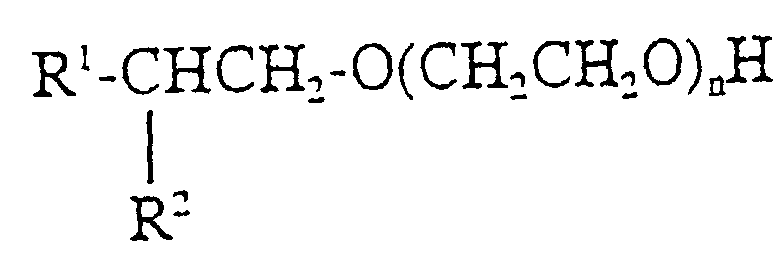
- Composition selon la revendication 19, dans laquelle R1 et R2 sont tous les deux des groupes alkyle linéaires, où R1 possède deux atomes de carbone de plus que R2, et où n est un nombre moyen situé dans l'intervalle de 2 à 24.
- Composition selon la revendication 20, dans laquelle le sel d'isopropylamine du glyphosate est le seul herbicide utilisé pour préparer ladite composition.
- Composition selon la revendication 12, dans laquelle le composant a) est un sel d'amine du glyphosate, et dans laquelle le composant b) est constitué essentiellement d'un 2-hexyl-1-octanol polyéthoxylé ayant une moyenne d'environ 15 groupes éthoxy par molécule.
- Composition selon la revendication 12, dans laquelle la solution (i) est dénuée de toute teneur en additif métallique et métalloïde autre que le phosphore de glyphosate, (ii) est un concentré aqueux adapté à une dilution avec de l'eau avant utilisation, et (iii) est préparée en utilisant de l'eau déionisée.
- Composition selon la revendication 12, dans laquelle la solution (i) est dénuée de toute teneur en additif métallique et métalloïde autre que le phosphore de glyphosate, (ii) est une solution aqueuse diluée adaptée à une application directe sur au moins une espèce végétale, et (iii) est dénuée de tout herbicide autre que ledit composant a).
- Composition qui comprend un mélange pulvérulent ou granulaire contenant au moins une quantité herbicide ou phytorégulatrice d'une composition préparée en mélangeant intimement ensemble les composants suivants:a) au moins un sel d'amine, de métal alcalin, d'alkylsulfonium, d'alkylphosphonium, de sulfonylamine et/ou d'aminoguanidine du glyphosate, acceptable pour l'agriculture; etb) au moins un alcool primaire monohydrique polyéthoxylé hydrosoluble, comportant un groupe alkyle ramifié en β qui a un total d'au moins 10 atomes de carbone et au moins 3 atomes de carbone dans la ramification située sur l'atome de carbone en β, ou un sel ou ester de celui-ci acceptable pour l'agriculture.
- Composition selon la revendication 25, dans laquelle l'ingrédient a) est un sel d'amine ou d'alkylsulfonium du glyphosate.
- Composition selon la revendication 25, dans laquelle le composant b) est au moins un alcanol éthoxylé représenté par la formule suivante:dans laquelle R1 est un groupe alkyle comportant dans l'intervalle de 5 à 12 atomes de carbone, R2 est un groupe alkyle comportant dans l'intervalle de 3 à 10 atomes de carbone, n est un entier situé dans l'intervalle de 2 à 24.

- Composition selon la revendication 27, dans laquelle R1 et R2 sont tous les deux des groupes alkyle linéaires, où R1 comporte deux atomes de carbone de plus que R2, et où n est un nombre moyen situé dans l'intervalle de 2 à 24.
- Composition selon la revendication 27, dans laquelle le composant a) est un sel d'amine ou d'alkylsulfonium du glyphosate, et est le seul herbicide utilisé pour former ladite composition.
- Composition selon la revendication 28, dans laquelle a) est le sel d'isopropylamine du glyphosate ou le sel de triméthylsulfonium du glyphosate, et dans laquelle le composant b) est constitué essentiellement d'un 2-hexyl-1-octanol polyéthoxylé ayant une moyenne d'environ 15 groupes éthoxy par molécule.
- Procédé pour contrôler la végétation qui comprend l'application sur le feuillage des plantes d'une quantité herbicide ou phytorégulatrice d'une composition polyvalente, dénuée de métaux et dénuée de métalloïdes, herbicide ou phytorégulatrice, préparée en mélangeant intimement ensemble les ingrédients suivants:a) au moins un sel d'amine, de métal alcalin, d'alkylsulfonium, d'alkylphosphonium, de sulfonylamine ou d'aminoguanidine du glyphosate, acceptable pour l'agriculture, comme seul(s) herbicide(s) ou phytorégulateur(s) utilisé(s) pour préparer ladite composition; etb) au moins un alcool primaire monohydrique polyéthoxylé hydrosoluble comportant un groupe alkyle ramifié en β qui a un total d'au moins 10 atomes de carbone et au moins 3 atomes de carbone dans la ramification située sur l'atome de carbone en β, ou un sel ou ester de celui-ci acceptable pour l'agriculture, comme seul(s) tensioactif(s) utilisé(s) pour préparer ladite composition; etc) éventuellement, une ou plusieurs substances acceptables pour l'agriculture, dont aucune n'est un herbicide, un phytorégulateur ou un tensioactif.
- Procédé selon la revendication 31, dans lequel ladite composition herbicide ou phytorégulatrice se présente sous la forme d'une solution aqueuse, et dans lequel ladite composition est appliquée sur le feuillage sous la forme d'une pulvérisation.
- Procédé selon la revendication 31, dans lequel ladite composition herbicide ou phytorégulatrice se présente sous la forme d'une poudre, et dans lequel ladite composition est appliquée sur le feuillage sous la forme d'une poudre pulvérulente foliaire.
Applications Claiming Priority (3)
| Application Number | Priority Date | Filing Date | Title |
|---|---|---|---|
| US08/628,567 US5710104A (en) | 1996-04-03 | 1996-04-03 | Glyphosate compositions comprising polyethoxylated monohydric primary alcohols |
| PCT/US1997/005576 WO1997036493A1 (fr) | 1996-04-03 | 1997-04-03 | Composes herbicides et phytoregulateurs de croissance et procede d'utilisation |
| US628567 | 2003-07-29 |
Publications (2)
| Publication Number | Publication Date |
|---|---|
| EP0892607A1 EP0892607A1 (fr) | 1999-01-27 |
| EP0892607B1 true EP0892607B1 (fr) | 2000-07-05 |
Family
ID=24519440
Family Applications (1)
| Application Number | Title | Priority Date | Filing Date |
|---|---|---|---|
| EP97920105A Expired - Lifetime EP0892607B1 (fr) | 1996-04-03 | 1997-04-03 | Composes herbicides et phytoregulateurs de croissance et procede d'utilisation |
Country Status (5)
| Country | Link |
|---|---|
| US (1) | US5710104A (fr) |
| EP (1) | EP0892607B1 (fr) |
| CA (1) | CA2250307A1 (fr) |
| DE (1) | DE69702445T2 (fr) |
| WO (1) | WO1997036493A1 (fr) |
Families Citing this family (14)
| Publication number | Priority date | Publication date | Assignee | Title |
|---|---|---|---|---|
| GB9703054D0 (en) * | 1997-02-14 | 1997-04-02 | Ici Plc | Agrochemical surfactant compositions |
| US6541424B2 (en) | 2000-08-07 | 2003-04-01 | Helena Chemical Company | Manufacture and use of a herbicide formulation |
| AUPR682201A0 (en) | 2001-08-03 | 2001-08-30 | Nufarm Limited | Glyphosate composition |
| US6675113B2 (en) * | 2002-03-26 | 2004-01-06 | Koninklijke Philips Electronics N.V. | Monobit-run frequency on-line randomness test |
| KR20040088125A (ko) * | 2003-04-08 | 2004-10-16 | 김우성 | 솔리토늄이 함유된 체중감량용 원단 및 그 용도 |
| DE10357682A1 (de) * | 2003-12-10 | 2005-07-07 | Goldschmidt Ag | Biozid-wirksame Kombination für landwirtschaftliche Anwendungen |
| EA018865B1 (ru) * | 2008-11-06 | 2013-11-29 | Сн Биотек Текнолоджис Сп. З О.О. Сп. К. | Жидкая однородная гербицидная композиция, способ борьбы с сорняками, способ получения жидкой однородной гербицидной композиции и применение жидкой однородной гербицидной композиции для борьбы с сорняками |
| US20110183941A1 (en) * | 2010-01-22 | 2011-07-28 | Pedro Brito Correia | Herbicide consisting of a glyphosate formulation containing a surfactant consisting in a branched alkyl alcohol polyethoxylated or polypropoxylated and a mixture of alkylamines |
| CN102802410B (zh) * | 2010-03-17 | 2015-07-22 | 巴斯夫欧洲公司 | 包含农药和支化壬基胺的烷氧基化物的组合物 |
| EP2654433B1 (fr) | 2010-12-21 | 2017-08-30 | Bayer Cropscience LP | Les mutants "papier émeri" de bacillus et des méthodes d'application pour la promotion de la croissance des plantes, de la santé des plants et pour le contrôl des maladies et des parasites |
| WO2012156770A2 (fr) * | 2011-05-18 | 2012-11-22 | Pedro Correia | Pesticide, agent nettoyant domestique ou industriel, produit cosmétique ou lubrifiant contenant un tensioactif constitué d'un alcool d'alkyle ramifié polyéthoxylé ou polypropoxylé, ou un tensioactif constitué d'une amine d'alkyle ramifiée polyéthoxylée ou polypropoxylée et leurs mélanges |
| MX2014002890A (es) | 2011-09-12 | 2015-01-19 | Bayer Cropscience Lp | Metodo para mejorar la salud y/o promover el crecimiento de una planta y/o mejorar la maduracion de frutos. |
| WO2013044449A1 (fr) * | 2011-09-27 | 2013-04-04 | Cognis Ip Management Gmbh | Compositions agricoles solides |
| CN109997869B (zh) * | 2019-04-10 | 2022-02-01 | 亳州职业技术学院 | 一种草甘膦诱导红薯增产的方法 |
Family Cites Families (7)
| Publication number | Priority date | Publication date | Assignee | Title |
|---|---|---|---|---|
| US3887624A (en) * | 1972-06-07 | 1975-06-03 | Jefferson Chem Co Inc | Vinylidene alcohol compositions |
| DE3035554A1 (de) * | 1980-09-20 | 1982-05-06 | Hoechst Ag, 6000 Frankfurt | Herbizide mittel |
| US4931080A (en) * | 1985-05-29 | 1990-06-05 | Chan Jimmy H | Solid, phytoactive compositions, methods of use and methods of preparation |
| US5047079A (en) * | 1986-08-18 | 1991-09-10 | Ici Americas Inc. | Method of preparation and use of solid, phytoactive compositions |
| EP0617894B1 (fr) * | 1993-04-02 | 1998-12-16 | Monsanto Europe S.A./N.V. | Compositions herbicides de glyphosate sous forme de concentrés liquides |
| EP0734206B1 (fr) * | 1993-12-17 | 1999-01-13 | Monsanto Company | Tensioactifs conferant, a des formulations de pesticides, une meilleure efficacite et/ou une meilleure resistance a l'entrainement par la pluie |
| GB9412722D0 (en) * | 1994-06-24 | 1994-08-17 | Zeneca Ltd | Herbicidal composition |
-
1996
- 1996-04-03 US US08/628,567 patent/US5710104A/en not_active Expired - Fee Related
-
1997
- 1997-04-03 WO PCT/US1997/005576 patent/WO1997036493A1/fr not_active Ceased
- 1997-04-03 DE DE69702445T patent/DE69702445T2/de not_active Expired - Fee Related
- 1997-04-03 CA CA002250307A patent/CA2250307A1/fr not_active Abandoned
- 1997-04-03 EP EP97920105A patent/EP0892607B1/fr not_active Expired - Lifetime
Also Published As
| Publication number | Publication date |
|---|---|
| WO1997036493A1 (fr) | 1997-10-09 |
| EP0892607A1 (fr) | 1999-01-27 |
| CA2250307A1 (fr) | 1997-10-09 |
| DE69702445D1 (de) | 2000-08-10 |
| US5710104A (en) | 1998-01-20 |
| DE69702445T2 (de) | 2000-12-14 |
Similar Documents
| Publication | Publication Date | Title |
|---|---|---|
| US5858921A (en) | Glyphosate herbicidal and plant growth regulant compositions and their use | |
| US5703016A (en) | Surfactant composition for use with glyphosate comprising dimethyl amine oxide, polyethoxylated alcohol, and pyridinium halide | |
| AU2008363855B2 (en) | A liquid, homogenous herbicide composition, a method of weed control, a method of production of liquid, homogenous herbicide composition and use of a liquid, homogenous herbicide composition for weed control | |
| AU2002325065C1 (en) | Glyphosate composition | |
| US5710104A (en) | Glyphosate compositions comprising polyethoxylated monohydric primary alcohols | |
| EP0483095A2 (fr) | Formulations améliorées | |
| EP0902622B1 (fr) | Composes herbicides et phytoregulateurs de croissance et procede d'utilisation | |
| WO2002011536A2 (fr) | Fabrication et utilisation d'une formulation herbicide | |
| EP0902621B1 (fr) | Composes herbicides et phytoregulateurs de croissance et procede d'utilisation | |
| EP0907319B1 (fr) | Compositions herbicides et phytoregulatrices et leur utilisation | |
| JP4323800B2 (ja) | 除草剤組成物 | |
| EP0891137B1 (fr) | Composes herbicides et phytoregulateurs de croissance et procede d'utilisation | |
| WO1997036494A1 (fr) | Composes herbicides et phytoregulateurs de croissance et procede d'utilisation | |
| CS257018B1 (cs) | Kapalný herbicidni prostředek |
Legal Events
| Date | Code | Title | Description |
|---|---|---|---|
| PUAI | Public reference made under article 153(3) epc to a published international application that has entered the european phase |
Free format text: ORIGINAL CODE: 0009012 |
|
| 17P | Request for examination filed |
Effective date: 19981028 |
|
| AK | Designated contracting states |
Kind code of ref document: A1 Designated state(s): BE DE FR GB IT |
|
| GRAG | Despatch of communication of intention to grant |
Free format text: ORIGINAL CODE: EPIDOS AGRA |
|
| 17Q | First examination report despatched |
Effective date: 19990521 |
|
| GRAG | Despatch of communication of intention to grant |
Free format text: ORIGINAL CODE: EPIDOS AGRA |
|
| GRAH | Despatch of communication of intention to grant a patent |
Free format text: ORIGINAL CODE: EPIDOS IGRA |
|
| GRAH | Despatch of communication of intention to grant a patent |
Free format text: ORIGINAL CODE: EPIDOS IGRA |
|
| GRAA | (expected) grant |
Free format text: ORIGINAL CODE: 0009210 |
|
| AK | Designated contracting states |
Kind code of ref document: B1 Designated state(s): BE DE FR GB IT |
|
| PG25 | Lapsed in a contracting state [announced via postgrant information from national office to epo] |
Ref country code: FR Free format text: THE PATENT HAS BEEN ANNULLED BY A DECISION OF A NATIONAL AUTHORITY Effective date: 20000705 |
|
| REF | Corresponds to: |
Ref document number: 69702445 Country of ref document: DE Date of ref document: 20000810 |
|
| ET | Fr: translation filed | ||
| ITF | It: translation for a ep patent filed | ||
| PG25 | Lapsed in a contracting state [announced via postgrant information from national office to epo] |
Ref country code: GB Free format text: LAPSE BECAUSE OF NON-PAYMENT OF DUE FEES Effective date: 20010403 |
|
| PG25 | Lapsed in a contracting state [announced via postgrant information from national office to epo] |
Ref country code: BE Free format text: LAPSE BECAUSE OF NON-PAYMENT OF DUE FEES Effective date: 20010430 |
|
| PLBE | No opposition filed within time limit |
Free format text: ORIGINAL CODE: 0009261 |
|
| STAA | Information on the status of an ep patent application or granted ep patent |
Free format text: STATUS: NO OPPOSITION FILED WITHIN TIME LIMIT |
|
| 26N | No opposition filed | ||
| BERE | Be: lapsed |
Owner name: ALBEMARLE CORP. Effective date: 20010430 |
|
| GBPC | Gb: european patent ceased through non-payment of renewal fee |
Effective date: 20010403 |
|
| PG25 | Lapsed in a contracting state [announced via postgrant information from national office to epo] |
Ref country code: DE Free format text: LAPSE BECAUSE OF NON-PAYMENT OF DUE FEES Effective date: 20020201 |
|
| REG | Reference to a national code |
Ref country code: FR Ref legal event code: ST |
|
| PG25 | Lapsed in a contracting state [announced via postgrant information from national office to epo] |
Ref country code: IT Free format text: LAPSE BECAUSE OF NON-PAYMENT OF DUE FEES;WARNING: LAPSES OF ITALIAN PATENTS WITH EFFECTIVE DATE BEFORE 2007 MAY HAVE OCCURRED AT ANY TIME BEFORE 2007. THE CORRECT EFFECTIVE DATE MAY BE DIFFERENT FROM THE ONE RECORDED. Effective date: 20050403 |