EP0892772B1 - Verfahren zur herstellung von calixarenen - Google Patents
Verfahren zur herstellung von calixarenen Download PDFInfo
- Publication number
- EP0892772B1 EP0892772B1 EP97908456A EP97908456A EP0892772B1 EP 0892772 B1 EP0892772 B1 EP 0892772B1 EP 97908456 A EP97908456 A EP 97908456A EP 97908456 A EP97908456 A EP 97908456A EP 0892772 B1 EP0892772 B1 EP 0892772B1
- Authority
- EP
- European Patent Office
- Prior art keywords
- phenolic
- reaction mixture
- linear
- reaction
- calixarenes
- Prior art date
- Legal status (The legal status is an assumption and is not a legal conclusion. Google has not performed a legal analysis and makes no representation as to the accuracy of the status listed.)
- Expired - Lifetime
Links
- 238000000034 method Methods 0.000 title claims abstract description 72
- VTJUKNSKBAOEHE-UHFFFAOYSA-N calixarene Chemical class COC(=O)COC1=C(CC=2C(=C(CC=3C(=C(C4)C=C(C=3)C(C)(C)C)OCC(=O)OC)C=C(C=2)C(C)(C)C)OCC(=O)OC)C=C(C(C)(C)C)C=C1CC1=C(OCC(=O)OC)C4=CC(C(C)(C)C)=C1 VTJUKNSKBAOEHE-UHFFFAOYSA-N 0.000 title claims abstract description 50
- 238000002360 preparation method Methods 0.000 title claims abstract description 24
- WSFSSNUMVMOOMR-UHFFFAOYSA-N Formaldehyde Chemical class O=C WSFSSNUMVMOOMR-UHFFFAOYSA-N 0.000 claims abstract description 48
- ISWSIDIOOBJBQZ-UHFFFAOYSA-N phenol group Chemical group C1(=CC=CC=C1)O ISWSIDIOOBJBQZ-UHFFFAOYSA-N 0.000 claims abstract description 43
- 239000011541 reaction mixture Substances 0.000 claims abstract description 29
- 238000007363 ring formation reaction Methods 0.000 claims abstract description 24
- XLYOFNOQVPJJNP-UHFFFAOYSA-N water Substances O XLYOFNOQVPJJNP-UHFFFAOYSA-N 0.000 claims abstract description 19
- 239000012429 reaction media Substances 0.000 claims abstract description 12
- 239000007788 liquid Substances 0.000 claims abstract description 11
- 150000002989 phenols Chemical class 0.000 claims abstract description 8
- 238000009835 boiling Methods 0.000 claims abstract description 7
- 239000000203 mixture Substances 0.000 claims description 33
- VEXZGXHMUGYJMC-UHFFFAOYSA-N Hydrochloric acid Chemical compound Cl VEXZGXHMUGYJMC-UHFFFAOYSA-N 0.000 claims description 16
- 230000015572 biosynthetic process Effects 0.000 claims description 16
- 238000003786 synthesis reaction Methods 0.000 claims description 16
- QHPQWRBYOIRBIT-UHFFFAOYSA-N 4-tert-butylphenol Chemical compound CC(C)(C)C1=CC=C(O)C=C1 QHPQWRBYOIRBIT-UHFFFAOYSA-N 0.000 claims description 14
- YXFVVABEGXRONW-UHFFFAOYSA-N Toluene Chemical compound CC1=CC=CC=C1 YXFVVABEGXRONW-UHFFFAOYSA-N 0.000 claims description 12
- CTQNGGLPUBDAKN-UHFFFAOYSA-N O-Xylene Chemical compound CC1=CC=CC=C1C CTQNGGLPUBDAKN-UHFFFAOYSA-N 0.000 claims description 11
- 239000008096 xylene Substances 0.000 claims description 10
- 239000007858 starting material Substances 0.000 claims description 8
- CXWXQJXEFPUFDZ-UHFFFAOYSA-N tetralin Chemical compound C1=CC=C2CCCCC2=C1 CXWXQJXEFPUFDZ-UHFFFAOYSA-N 0.000 claims description 8
- YQUQWHNMBPIWGK-UHFFFAOYSA-N 4-isopropylphenol Chemical compound CC(C)C1=CC=C(O)C=C1 YQUQWHNMBPIWGK-UHFFFAOYSA-N 0.000 claims description 6
- USIUVYZYUHIAEV-UHFFFAOYSA-N diphenyl ether Chemical compound C=1C=CC=CC=1OC1=CC=CC=C1 USIUVYZYUHIAEV-UHFFFAOYSA-N 0.000 claims description 6
- 230000007935 neutral effect Effects 0.000 claims description 6
- 230000002378 acidificating effect Effects 0.000 claims description 5
- 239000000126 substance Substances 0.000 claims description 4
- 125000001424 substituent group Chemical group 0.000 claims description 4
- 238000004821 distillation Methods 0.000 claims description 3
- 238000006384 oligomerization reaction Methods 0.000 claims description 3
- 230000035484 reaction time Effects 0.000 claims description 3
- 238000010908 decantation Methods 0.000 claims description 2
- 150000007529 inorganic bases Chemical group 0.000 claims 1
- 238000011068 loading method Methods 0.000 claims 1
- 150000007530 organic bases Chemical group 0.000 claims 1
- 238000009434 installation Methods 0.000 abstract description 10
- 238000004519 manufacturing process Methods 0.000 abstract description 3
- 238000006243 chemical reaction Methods 0.000 description 21
- KWYUFKZDYYNOTN-UHFFFAOYSA-M Potassium hydroxide Chemical compound [OH-].[K+] KWYUFKZDYYNOTN-UHFFFAOYSA-M 0.000 description 18
- 150000004945 aromatic hydrocarbons Chemical class 0.000 description 18
- 229960004279 formaldehyde Drugs 0.000 description 17
- 235000019256 formaldehyde Nutrition 0.000 description 16
- HEDRZPFGACZZDS-UHFFFAOYSA-N Chloroform Chemical compound ClC(Cl)Cl HEDRZPFGACZZDS-UHFFFAOYSA-N 0.000 description 14
- 150000001875 compounds Chemical class 0.000 description 13
- HEMHJVSKTPXQMS-UHFFFAOYSA-M Sodium hydroxide Chemical compound [OH-].[Na+] HEMHJVSKTPXQMS-UHFFFAOYSA-M 0.000 description 12
- 238000003756 stirring Methods 0.000 description 11
- 238000010586 diagram Methods 0.000 description 10
- 0 CCC(C[C@@](C1)C(CC2)C1(C1)CC1C(CC1)C2CCC2C1C=*1[C@@]2*(C)C1)C=O Chemical compound CCC(C[C@@](C1)C(CC2)C1(C1)CC1C(CC1)C2CCC2C1C=*1[C@@]2*(C)C1)C=O 0.000 description 7
- 239000002585 base Substances 0.000 description 7
- 239000002609 medium Substances 0.000 description 7
- 239000000178 monomer Substances 0.000 description 7
- 239000007787 solid Substances 0.000 description 7
- UOEYZAXKBKAKRO-UHFFFAOYSA-N 5,11,17,23,29,35-hexa-tert-butylcalix[6]arene-37,38,39,40,41,42-hexol Chemical compound C1C(C=2O)=CC(C(C)(C)C)=CC=2CC(C=2O)=CC(C(C)(C)C)=CC=2CC(C=2O)=CC(C(C)(C)C)=CC=2CC(C=2O)=CC(C(C)(C)C)=CC=2CC(C=2O)=CC(C(C)(C)C)=CC=2CC2=CC(C(C)(C)C)=CC1=C2O UOEYZAXKBKAKRO-UHFFFAOYSA-N 0.000 description 6
- 125000004122 cyclic group Chemical group 0.000 description 6
- 238000000921 elemental analysis Methods 0.000 description 6
- 238000001816 cooling Methods 0.000 description 5
- 238000001914 filtration Methods 0.000 description 5
- 125000001449 isopropyl group Chemical group [H]C([H])([H])C([H])(*)C([H])([H])[H] 0.000 description 5
- 239000002904 solvent Substances 0.000 description 5
- CSCPPACGZOOCGX-UHFFFAOYSA-N Acetone Chemical compound CC(C)=O CSCPPACGZOOCGX-UHFFFAOYSA-N 0.000 description 4
- OKKJLVBELUTLKV-UHFFFAOYSA-N Methanol Chemical group OC OKKJLVBELUTLKV-UHFFFAOYSA-N 0.000 description 4
- 239000000539 dimer Substances 0.000 description 4
- 239000007789 gas Substances 0.000 description 4
- 239000000543 intermediate Substances 0.000 description 4
- 238000006386 neutralization reaction Methods 0.000 description 4
- 239000000047 product Substances 0.000 description 4
- 238000000746 purification Methods 0.000 description 4
- 238000001953 recrystallisation Methods 0.000 description 4
- 238000003860 storage Methods 0.000 description 4
- 239000013638 trimer Substances 0.000 description 4
- NVKLTRSBZLYZHK-UHFFFAOYSA-N 4-tert-butylcalix[4]arene Chemical compound C1C(C=2O)=CC(C(C)(C)C)=CC=2CC(C=2O)=CC(C(C)(C)C)=CC=2CC(C=2O)=CC(C(C)(C)C)=CC=2CC2=CC(C(C)(C)C)=CC1=C2O NVKLTRSBZLYZHK-UHFFFAOYSA-N 0.000 description 3
- OLZFZIXORGGLLS-UHFFFAOYSA-N 4-tert-butylcalix[8]arene Chemical compound C1C(C=2O)=CC(C(C)(C)C)=CC=2CC(C=2O)=CC(C(C)(C)C)=CC=2CC(C=2O)=CC(C(C)(C)C)=CC=2CC(C=2O)=CC(C(C)(C)C)=CC=2CC(C=2O)=CC(C(C)(C)C)=CC=2CC(C=2O)=CC(C(C)(C)C)=CC=2CC(C=2O)=CC(C(C)(C)C)=CC=2CC2=CC(C(C)(C)C)=CC1=C2O OLZFZIXORGGLLS-UHFFFAOYSA-N 0.000 description 3
- WDYVUKGVKRZQNM-UHFFFAOYSA-N 6-phosphonohexylphosphonic acid Chemical compound OP(O)(=O)CCCCCCP(O)(O)=O WDYVUKGVKRZQNM-UHFFFAOYSA-N 0.000 description 3
- WEVYAHXRMPXWCK-UHFFFAOYSA-N Acetonitrile Chemical compound CC#N WEVYAHXRMPXWCK-UHFFFAOYSA-N 0.000 description 3
- UHOVQNZJYSORNB-UHFFFAOYSA-N Benzene Chemical compound C1=CC=CC=C1 UHOVQNZJYSORNB-UHFFFAOYSA-N 0.000 description 3
- XEKOWRVHYACXOJ-UHFFFAOYSA-N Ethyl acetate Chemical compound CCOC(C)=O XEKOWRVHYACXOJ-UHFFFAOYSA-N 0.000 description 3
- 229930040373 Paraformaldehyde Natural products 0.000 description 3
- 239000012736 aqueous medium Substances 0.000 description 3
- MMYYTPYDNCIFJU-UHFFFAOYSA-N calix[6]arene Chemical compound C1C(C=2)=CC=CC=2CC(C=2)=CC=CC=2CC(C=2)=CC=CC=2CC(C=2)=CC=CC=2CC(C=2)=CC=CC=2CC2=CC=CC1=C2 MMYYTPYDNCIFJU-UHFFFAOYSA-N 0.000 description 3
- 239000007795 chemical reaction product Substances 0.000 description 3
- 238000001704 evaporation Methods 0.000 description 3
- 230000008020 evaporation Effects 0.000 description 3
- 125000004029 hydroxymethyl group Chemical group [H]OC([H])([H])* 0.000 description 3
- VLKZOEOYAKHREP-UHFFFAOYSA-N n-Hexane Chemical compound CCCCCC VLKZOEOYAKHREP-UHFFFAOYSA-N 0.000 description 3
- 229920002866 paraformaldehyde Polymers 0.000 description 3
- -1 phenolic formaldehyde derivatives Chemical class 0.000 description 3
- 239000000843 powder Substances 0.000 description 3
- 238000010992 reflux Methods 0.000 description 3
- 239000000243 solution Substances 0.000 description 3
- 239000000725 suspension Substances 0.000 description 3
- 125000000999 tert-butyl group Chemical group [H]C([H])([H])C(*)(C([H])([H])[H])C([H])([H])[H] 0.000 description 3
- HTJNUHSOASZVHV-UHFFFAOYSA-N 4-tert-butylcalix[5]arene Chemical compound C1C(C=2O)=CC(C(C)(C)C)=CC=2CC(C=2O)=CC(C(C)(C)C)=CC=2CC(C=2O)=CC(C(C)(C)C)=CC=2CC(C=2O)=CC(C(C)(C)C)=CC=2CC2=CC(C(C)(C)C)=CC1=C2O HTJNUHSOASZVHV-UHFFFAOYSA-N 0.000 description 2
- OCKGFTQIICXDQW-ZEQRLZLVSA-N 5-[(1r)-1-hydroxy-2-[4-[(2r)-2-hydroxy-2-(4-methyl-1-oxo-3h-2-benzofuran-5-yl)ethyl]piperazin-1-yl]ethyl]-4-methyl-3h-2-benzofuran-1-one Chemical compound C1=C2C(=O)OCC2=C(C)C([C@@H](O)CN2CCN(CC2)C[C@H](O)C2=CC=C3C(=O)OCC3=C2C)=C1 OCKGFTQIICXDQW-ZEQRLZLVSA-N 0.000 description 2
- QEUBHEGFPPTWLY-UHFFFAOYSA-N 83933-03-3 Chemical compound OC1=C(CC=2C(=C(CC=3C(=C(CC=4C(=C(C5)C=CC=4)O)C=CC=3)O)C=CC=2)O)C=CC=C1CC1=C(O)C5=CC=C1 QEUBHEGFPPTWLY-UHFFFAOYSA-N 0.000 description 2
- 241001120493 Arene Species 0.000 description 2
- IAZDPXIOMUYVGZ-UHFFFAOYSA-N Dimethylsulphoxide Chemical compound CS(C)=O IAZDPXIOMUYVGZ-UHFFFAOYSA-N 0.000 description 2
- WMFOQBRAJBCJND-UHFFFAOYSA-M Lithium hydroxide Chemical compound [Li+].[OH-] WMFOQBRAJBCJND-UHFFFAOYSA-M 0.000 description 2
- VYPSYNLAJGMNEJ-UHFFFAOYSA-N Silicium dioxide Chemical compound O=[Si]=O VYPSYNLAJGMNEJ-UHFFFAOYSA-N 0.000 description 2
- VSCWAEJMTAWNJL-UHFFFAOYSA-K aluminium trichloride Chemical compound Cl[Al](Cl)Cl VSCWAEJMTAWNJL-UHFFFAOYSA-K 0.000 description 2
- 238000004458 analytical method Methods 0.000 description 2
- HUCVOHYBFXVBRW-UHFFFAOYSA-M caesium hydroxide Chemical compound [OH-].[Cs+] HUCVOHYBFXVBRW-UHFFFAOYSA-M 0.000 description 2
- 238000010438 heat treatment Methods 0.000 description 2
- 125000002887 hydroxy group Chemical group [H]O* 0.000 description 2
- 238000002955 isolation Methods 0.000 description 2
- 125000002496 methyl group Chemical group [H]C([H])([H])* 0.000 description 2
- 230000020477 pH reduction Effects 0.000 description 2
- 239000002244 precipitate Substances 0.000 description 2
- 239000000376 reactant Substances 0.000 description 2
- CPRMKOQKXYSDML-UHFFFAOYSA-M rubidium hydroxide Chemical compound [OH-].[Rb+] CPRMKOQKXYSDML-UHFFFAOYSA-M 0.000 description 2
- 238000002211 ultraviolet spectrum Methods 0.000 description 2
- 238000005406 washing Methods 0.000 description 2
- RYHBNJHYFVUHQT-UHFFFAOYSA-N 1,4-Dioxane Chemical compound C1COCCO1 RYHBNJHYFVUHQT-UHFFFAOYSA-N 0.000 description 1
- UHLRPXXFPYMCAE-UHFFFAOYSA-N 4-isopropylcalix[4]arene Chemical compound C1C(C=2O)=CC(C(C)C)=CC=2CC(C=2O)=CC(C(C)C)=CC=2CC(C=2O)=CC(C(C)C)=CC=2CC2=CC(C(C)C)=CC1=C2O UHLRPXXFPYMCAE-UHFFFAOYSA-N 0.000 description 1
- YBCYCPJHEXJDAN-UHFFFAOYSA-N 4-tert-butyl-2-(hydroxymethyl)phenol Chemical compound CC(C)(C)C1=CC=C(O)C(CO)=C1 YBCYCPJHEXJDAN-UHFFFAOYSA-N 0.000 description 1
- HUYWXTRCNXGJSG-UHFFFAOYSA-N 41,42-hexol Chemical compound C1C(C=2O)=CC(C(C)C)=CC=2CC(C=2O)=CC(C(C)C)=CC=2CC(C=2O)=CC(C(C)C)=CC=2CC(C=2O)=CC(C(C)C)=CC=2CC(C=2O)=CC(C(C)C)=CC=2CC2=CC(C(C)C)=CC1=C2O HUYWXTRCNXGJSG-UHFFFAOYSA-N 0.000 description 1
- 239000004215 Carbon black (E152) Substances 0.000 description 1
- SUAKHGWARZSWIH-UHFFFAOYSA-N N,N‐diethylformamide Chemical compound CCN(CC)C=O SUAKHGWARZSWIH-UHFFFAOYSA-N 0.000 description 1
- FUNVVCPIXASZKN-UHFFFAOYSA-N ac1mbg7c Chemical compound C1C(C=2O)=CC(C(C)C)=CC=2CC(C=2O)=CC(C(C)C)=CC=2CC(C=2O)=CC(C(C)C)=CC=2CC(C=2O)=CC(C(C)C)=CC=2CC(C=2O)=CC(C(C)C)=CC=2CC(C=2O)=CC(C(C)C)=CC=2CC(C=2O)=CC(C(C)C)=CC=2CC2=CC(C(C)C)=CC1=C2O FUNVVCPIXASZKN-UHFFFAOYSA-N 0.000 description 1
- 150000008044 alkali metal hydroxides Chemical class 0.000 description 1
- 125000000217 alkyl group Chemical group 0.000 description 1
- 239000011260 aqueous acid Substances 0.000 description 1
- 239000007864 aqueous solution Substances 0.000 description 1
- 125000003710 aryl alkyl group Chemical group 0.000 description 1
- 125000001797 benzyl group Chemical group [H]C1=C([H])C([H])=C(C([H])=C1[H])C([H])([H])* 0.000 description 1
- 125000000484 butyl group Chemical group [H]C([*])([H])C([H])([H])C([H])([H])C([H])([H])[H] 0.000 description 1
- 239000006227 byproduct Substances 0.000 description 1
- 239000003054 catalyst Substances 0.000 description 1
- 239000003795 chemical substances by application Substances 0.000 description 1
- 238000004587 chromatography analysis Methods 0.000 description 1
- 238000009833 condensation Methods 0.000 description 1
- 230000005494 condensation Effects 0.000 description 1
- 150000004292 cyclic ethers Chemical class 0.000 description 1
- 230000020335 dealkylation Effects 0.000 description 1
- 238000006900 dealkylation reaction Methods 0.000 description 1
- 238000004090 dissolution Methods 0.000 description 1
- 238000001035 drying Methods 0.000 description 1
- 125000001495 ethyl group Chemical group [H]C([H])([H])C([H])([H])* 0.000 description 1
- SLGWESQGEUXWJQ-UHFFFAOYSA-N formaldehyde;phenol Chemical compound O=C.OC1=CC=CC=C1 SLGWESQGEUXWJQ-UHFFFAOYSA-N 0.000 description 1
- 230000014509 gene expression Effects 0.000 description 1
- 239000013529 heat transfer fluid Substances 0.000 description 1
- 229930195733 hydrocarbon Natural products 0.000 description 1
- 150000002430 hydrocarbons Chemical class 0.000 description 1
- 239000011261 inert gas Substances 0.000 description 1
- GLXDVVHUTZTUQK-UHFFFAOYSA-M lithium;hydroxide;hydrate Chemical compound [Li+].O.[OH-] GLXDVVHUTZTUQK-UHFFFAOYSA-M 0.000 description 1
- 230000005923 long-lasting effect Effects 0.000 description 1
- 239000000463 material Substances 0.000 description 1
- 238000002844 melting Methods 0.000 description 1
- 230000008018 melting Effects 0.000 description 1
- 125000001570 methylene group Chemical group [H]C([H])([*:1])[*:2] 0.000 description 1
- 239000012452 mother liquor Substances 0.000 description 1
- 239000012299 nitrogen atmosphere Substances 0.000 description 1
- 238000005457 optimization Methods 0.000 description 1
- 239000012044 organic layer Substances 0.000 description 1
- 235000010603 pastilles Nutrition 0.000 description 1
- 230000000704 physical effect Effects 0.000 description 1
- LPNYRYFBWFDTMA-UHFFFAOYSA-N potassium tert-butoxide Chemical compound [K+].CC(C)(C)[O-] LPNYRYFBWFDTMA-UHFFFAOYSA-N 0.000 description 1
- 239000002243 precursor Substances 0.000 description 1
- 125000001436 propyl group Chemical group [H]C([*])([H])C([H])([H])C([H])([H])[H] 0.000 description 1
- 125000006239 protecting group Chemical group 0.000 description 1
- 238000005215 recombination Methods 0.000 description 1
- 230000006798 recombination Effects 0.000 description 1
- 238000011084 recovery Methods 0.000 description 1
- 229920005989 resin Polymers 0.000 description 1
- 239000011347 resin Substances 0.000 description 1
- 229920006395 saturated elastomer Polymers 0.000 description 1
- 239000000377 silicon dioxide Substances 0.000 description 1
- 150000003384 small molecules Chemical class 0.000 description 1
- 239000008259 solid foam Substances 0.000 description 1
- 241000894007 species Species 0.000 description 1
- 238000001308 synthesis method Methods 0.000 description 1
- 230000002194 synthesizing effect Effects 0.000 description 1
- 230000009885 systemic effect Effects 0.000 description 1
- 238000010792 warming Methods 0.000 description 1
- 239000002699 waste material Substances 0.000 description 1
- 150000003738 xylenes Chemical class 0.000 description 1
Images



Classifications
-
- C—CHEMISTRY; METALLURGY
- C07—ORGANIC CHEMISTRY
- C07D—HETEROCYCLIC COMPOUNDS
- C07D313/00—Heterocyclic compounds containing rings of more than six members having one oxygen atom as the only ring hetero atom
-
- C—CHEMISTRY; METALLURGY
- C07—ORGANIC CHEMISTRY
- C07C—ACYCLIC OR CARBOCYCLIC COMPOUNDS
- C07C37/00—Preparation of compounds having hydroxy or O-metal groups bound to a carbon atom of a six-membered aromatic ring
- C07C37/11—Preparation of compounds having hydroxy or O-metal groups bound to a carbon atom of a six-membered aromatic ring by reactions increasing the number of carbon atoms
- C07C37/20—Preparation of compounds having hydroxy or O-metal groups bound to a carbon atom of a six-membered aromatic ring by reactions increasing the number of carbon atoms using aldehydes or ketones
-
- C—CHEMISTRY; METALLURGY
- C07—ORGANIC CHEMISTRY
- C07C—ACYCLIC OR CARBOCYCLIC COMPOUNDS
- C07C2603/00—Systems containing at least three condensed rings
- C07C2603/92—Systems containing at least three condensed rings with a condensed ring system consisting of at least two mutually uncondensed aromatic ring systems, linked by an annular structure formed by carbon chains on non-adjacent positions of the aromatic system, e.g. cyclophanes
Definitions
- the present invention is related to the preparation of calixarenes. More specifically, it is directed to a new and useful method for the preparation of known as well as of new calixarenes.
- Calixarenes are cyclic phenolic oligomers wherein two adjacent phenol rings are linked together by an ortho-ortho CH 2 bridge or an analogous homo CH 2 bridge. Some calixarenes have already been known, in particular the tetramers, hexamers and octamers as well as several calixarenes having an odd number of rings in their molecule. It seems that calixarenes having less than three phenolic rings are not accessible.
- the calixarenes have found several applications in industry; they are for example used as starting materials for solid foams, as capturing agents for other, small molecules, as reactants for confining waste or dangerous solids, etc.
- Linear phenolic oligomers are at least two phenolic rings linked together in the ortho positions by a methylene group. In all cases, the syntheses are long-lasting and give very low yields only.
- a mixture containing p-tert -butylphenol, para formaldehyde, and potassium hydroxide in an approximate ratio of 45:75:1 is heated during 4 hours in a xylene solution that is approximately 1.3 M in phenol, using a Dean and Stark trap to remove water.
- a colorless, xylene insoluble product is obtained in about 75% yield.
- This product contains linear phenolic oligomers and p-tert -butylcalix[8]arene (45%) whereas the 6- and 4-calixarene homologues can be isolated in small amounts (i.e. 9.5% and 9%, respectively) from the mother liquor.
- the Zinke method comprises warming a mixture of the above mentioned starting materials during about 45 hours to 50-55 °C and then for about 2 hours to 110-120 °C. Then, the reaction mixture is acidified, the separated solids are removed, and the washed and dried solids are heated for about 2 hours in a high-boiling liquid to about 210-220 °C.
- This method principally yields cyclic tetramer and small amounts of hexamer and octamer. It has also been proposed by Gutsche, see the document cited in the preceding paragraph, to combine the first two steps of this method.
- U.S. Patent No. 4,098,717 discloses pre-formed phenolic compounds, substituted in one ortho position or in one ortho and in one meta position by a methylol group, as starting substances for a cyclization.
- the present invention does not use such starting compounds but para substituted phenols.
- the reference clearly describes that a cyclization of these preformed phenolic formaldehyde derivatives under neutral conditions does not yield calixarenes but cyclic ethers, and that under mildly basic conditions, cyclic resins are formed, thus no calixarenes.
- European patent application No. 0,447,977 discloses a method for the preparation of cyclic phenolic tetramers by heating a precondensate of p-alkylphenols and formaldehyde or an alkylcalix[8]arene together with an aqueous alkali metal hydroxide during about 1 to 10 hours at 217 to 257 °C in a hydrocarbon solvent.
- This variant of the Zinke method yields cyclic tetramer only in a yield of 50 to 60% only, and furthermore, the said precondensates are isolated prior to the final condensation.
- the object of the present invention is to provide a universal method which allows the manufacture of any desired calixarene on an industrial scale. Another object is to provide such a method which is simple, comprises relatively few process steps, and gives satisfactory yields of calixarene. Further, still another object of the invention is to provide a method which permits the preparation of any desired calixarene by appropriately selecting the respective starting materials without undue changes in reaction conditions and parameters.
- the process of the invention which is a two-step process although both steps need not be performed in separate reaction vessels.
- the first step of the process comprises the synthesis of linear phenolic oligomers in a basic reaction medium, starting from a para substituted, ortho unsubstituted phenol source and a formaldehyde source, and the second step comprises the cyclization of these linear oligomers in a substantially water-free, neutral or acidic medium, the linear oligomers obtained in the first step not being isolated.
- the linear phenolic oligomers obtained in the first step are generally not isolated from the reaction mixture for cyclization in the second step. However, it may sometimes be desirable to precipitate them from the reaction medium for purification or analysis purposes.
- the first step is conducted at temperatures in the range of from 40 to 150 °C, in most cases and when an aqueous medium is used, between 50 and 90 °C or at the boiling point of the medium.
- the second step is typically operated at temperatures well above 100 °C. It is preferred to carry out the cyclization in using an organic liquid as a reaction medium such as toluene, xylenes, tetraline, petrol fractions of appropriate boiling range, diphenyl ether, etc.
- the liquid may be a solvent or not; its nature is not at all critical as far as it does not impair the cyclization. Sometimes, it is advantageous to use polar liquids such as dimethylsulfoxide, diethylformamide, etc.
- the liquid is selected to have a boiling point as high as desired for the reaction temperature so that the reaction can easily be carried out at reflux of the liquid. This allows an easy and substantially automatic control of the reaction temperature.
- the second step of the process of the invention is carried out in the absence of water. Any water still present in the reaction mixture of the first process step, as well as water formed during the cyclization, is removed during the second step by distillation and decantation. Preferably, a Dean-Stark water trap is used for this purpose.
- a Dean-Stark water trap is used for this purpose.
- Starting materials for the process of this invention are the already known ones for the calixarene synthesis, namely a para substituted phenol.
- This para substituent is preferably an alkyl or aralkyl group such as methyl, ethyl, propyl, iso propyl, the butyls, tert -octyl, benzyl, etc. Specially preferred is tert-butyl.
- This substituent is before all, if it is not desired as such to be present in the final calixarene, a para protecting group in order to force oligomerization and cyclization reactions to occur in the ortho position(s) to the phenolic OH group.
- the expressions "phenol” and "calixarene”, as used in this document refer to the para substituted species as defined just above.
- the second starting material in the method of this invention is formaldehyde. Since the first step of the present process is often carried out in an aqueous medium, formalin or formol (an aqueous solution of formaldehyde at normally 37%) may be used. If it is desired to have a higher formaldehyde concentration in the reaction medium, paraformaldehyde may be used alone or together with formol. It will also possible to introduce gaseous formaldehyde into the reaction medium.
- the first step of the process requires a basic medium.
- a base should be added. Suitable bases are NaOH and KOH. In some cases, other bases, alone or mixed with others, will be used, such as LiOH, CsOH, RbOH, (CH 3 ) 3 COK, [CH 3 (CH 2 ) 3 ] 4 NOH or still others.
- bases such as LiOH, CsOH, RbOH, (CH 3 ) 3 COK, [CH 3 (CH 2 ) 3 ] 4 NOH or still others.
- the proper choice of the base depend on the optimization of the reaction in terms of yield and selectivity.
- linear phenolic oligomers are formed.
- a mixture is obtained containing oligomers comprising between 2 and 6 monomeric phenolic units and still momomeric phenol.
- the number of phenolic units in the oligomer is generally influenced by reaction conditions such as temperature, duration, relative concentration of the reactants, the nature and sometimes the amount of the base used.
- the chain of the oligomers will become longer when the reaction time is increased and also the formaldehyde-phenol ratio.
- the yield and the nature of the oligomers can be influenced when the reaction temperature is increased, in particular above 100 °C.
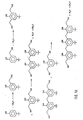
- FIG. 1A, 1B, 2A and 2B do not need any detailed explanation; it can easily be seen how a linear oligomer is first be formed which is then cyclized, see the last line of the diagrams.
- this cyclization runs the pseudocalixarene route whereas in FIG. 2A, 2B, the cyclization follows the hemicalixarene route.
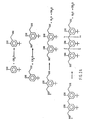
- FIG. 3 shows some examples of the possibilities of the syntheses and preparations disclosed herein; this diagram is by no way exhaustive.
- Starting from a para substituted phenol and a formaldehyde source different linear oligomers can be prepared.
- a great variety of calixarenes can be synthesized by cyclization from identical or different linear oligomers, with optional addition of monomeric phenolic compounds.
- FIG. 4 shows as an example the structural formula of three calixarene compounds that can be prepared according to the process of the present invention, together with their systemic nomenclature.
- FIG. 3 is not limitative nor exhaustive since, for example, the p-tert -butyl substituent shown may be replaced by any other one, e.g. iso propyl, and the diagram does not contain all possible reactions or products which can be prepared.
- the diagram rather shows that the present invention provides a process for the controlled and basically selective synthesis of any desired particular calixarene compound.
- the present invention provides also novel compounds. All oligomers and calixarenes that are para substituted by an iso propyl group have not yet been described. Most asymmetric calixarenes are also new compounds. Furthermore, all calixarenes comprising more than 8 phenolic units in their molecule are new compounds, be they even or odd calixarenes.
- FIG. 5 schematically shows an installation allowing the realization of the process of this invention.
- the dimensions of the individual parts of the installation may vary in order to adapt it to a preparation on a laboratory scale, an intermediate scale, or an industrial process.
- the installation comprises two substantially identical reaction units 10 and 20.
- unit 20 the parts bearing a reference numeral where an "A" has been added, are similar or identical to the corresponding parts of unit 10 and are described together.
- Each reaction unit 10; 20 comprises a reactor 32; 32A, respectively, having a double shell for heating and cooling by circulating an appropriate heat transfer fluid.
- the reactors 32, 32A are equipped with a temperature measuring and recording device 33; 33A, a storage tank 12; 12A for the phenol(s) and/or the precursors, a formol storage vessel 14; 14A, a catalyst storage vessel 16; 16A, a storage tank with preheating means 22; 22A for solvents, and a reservoir 18; 18A for inert gas.
- reactors 32; 32A are equipped with a motor driven stirring device 28; 28A and a Dean-Stark system for water removal; this system comprises a condenser 24; 24A connected by a pipe 26; 26A to the reactor 32; 32A, and by another conduit to a receptacle for condensed water 30; 30A.
- the reactors 32; 32A can be emptied into a collecting basin 36; 36A.
- a pump 38; 38A is provided for sending the product from the collecting basin 36A to a purification equipment (not shown) or to other post-treatment stages.
- the first collecting basin 36 has a conduit 37 that leads to the second reactor 32A.
- the reactor 32 of part 10 of the installation (see FIG. 5), is charged with 20 g (0.133 mole) of p - tert -butylphenol, 12.4 ml (0.166 mole) of 37% formol, and 0.24 g (0.006 mole) of solid 98% NaOH.
- the reaction mixture is heated to 110 °C under stirring for 2 hours, finally yielding a viscous mass containing about 40% of linear phenolic tetramers, namely the compounds 4 ⁇ and ⁇ 4 ⁇ , the remainder being dimers and the monomer.
- Example 1A The reaction mixture obtained in Example 1A above is transferred into reactor 32A of installation part 20. Dry HCl gas is pearled through the mixture until neutrality. Then, 200 ml of hot diphenyl ether are added under stirring. The reaction mixture is heated to reflux for about 2 hours. After cooling, allowing a precipitate to form, addition of ethyl acetate, filtering, washing, dissolution in toluene and concentration, virtually pure p - tert -butylcalix[4]arene is obtained in a 49% yield.
- the reactor 32 of part 10 of the installation (see FIG. 5), is charged with 20 g (0.133 mole) of p-tert -butylphenol, 27 ml (0.36 mole) of 37% formol, and 3 g (0.045 mole) of 84% KOH pastilles. This mixture is heated under stirring until the formation of a dry mass.
- the yellow dry residue in reactor 32, obtained in Example 2A, is treated with ortho-xylene, and the suspension obtained is transferred after neutralization into reactor 32A.
- the reaction mixture is refluxed for 3 hours while stirring and is filtered after cooling.
- the solid obtained on the filter is dissolved in chloroform, then treated by hydrochloric acid, and the organic layer is concentrated to 200 ml. 200 ml of hot acetone are added. After cooling and filtration, p-tert-butylcalix[6]arene is recovered in a 80 to 90% yield.
- the cyclization is effected as a second stage immediately after the oligomerization in the same reactor.
- the dihydroxymethylated linear oligomer ⁇ 6 ⁇ is prepared in reactor 32.
- This reactor is charged with 10 g (66.5 mmole) of p - tert -butylphenol, 18.83 ml (250.6 mmole) of 37% formol, and 0.63 g (15 mmole) of LiOH.H 2 O under stirring.
- This mixture is heated, the water is removed in the Dean-Stark trap 24 and 30, and a solid yellow dry crust is obtained comprising linear oligomer.
- the subsequent cyclization step is carried out in the same reactor 32 in the presence of an additional monomer.
- a solution of 1.792 g (11.95 mmole) of p - tert -butylphenol in 25 ml xylene is added to the crust in the reactor 32; then, 75 ml of more xylene, saturated with dry gaseous HCl, are added. This reaction mixture is refluxed for 3 hours. After purification, p-tert -butylcalix[7]arene is recovered in an 11% yield.
- This Example describes the synthesis of a compound of the p - iso propyl family and of a new calixarene.
- Example 7 This Example illustrates the preparation of a homooxacalixarene, useful as intermediate for the preparation of odd or higher calixarenes; see Example 7.
- reactor 32 33.33 g (0.22 mole) of p - tert -butylphenol, 11.67 g (0.389 mole) of p -formaldehyde, and 200 ml of xylene. After 20 minutes of stirring, 0.667 ml (0.0667 mole) of 10N NaOH is added. The reaction mixture is refluxed for 45 minutes under stirring, then transferred into reactor 32A, cooled and filtered. The filtered mixture is left standing at 10 °C for 2 to 3 days. After filtration and recrystallization, the p-tert -butyldihomooxacalix[4]arene is recovered in a 24% yield from this mixture.
- the mixture is further processed in the second step of the process according to the invention.
- a linear oligomer (4) is combined with a monomer, and the combination is cyclized.
- the linear (4) is obtained in opening the ring of compound 4O+ obtained by the method of Example 6. All reactions take place in the same reaction medium.
- the process of this invention allows for the first time a simple preparation, without exchanging side chain substituents as described by Boehmer et al. (see above), of asymmetric calixarenes, i.e. calixarenes wherein the ring members are not identical, in fairly good yields.
- Example 7 is repeated with the exception that, for making an asymmetric calix[5]arene, the 2.35 mmoles of p-tert -butylphenol added to the linear-4 oligomer, are replaced by equivalent amounts of other monomers unsubstituted in para position or substituted by another group than tert-butyl.
- This Example illustrates the preparation of another odd calixarene by combining the dihydroxymethylated linear hexamer with the linear trimer.
- p -tert-butylcalix[10]arene has been prepared.
- This compound is obtained by a cyclization of corresponding linear oligomers, e.g. starting from a mixture of the oligomers ⁇ 6 ⁇ and ⁇ 4 ⁇ , or passing through the intermediate which forms when the linear oligomer ⁇ 4 ⁇ is reacted with formaldehyde and phenol.
- the compound which has been obtained has a melting point of 300-305 °C, a molecular mass of 1621, and an ⁇ max of 44570 in the UV spectrum.
- the elemental analysis is C, 80.98; H, 8.77; and O, 10.00.
- the p-tert -butylcalix[11, 12, 13 and 14]arenes have been prepared.
- a mixture of these calixarenes is obtained starting from the oligomers ⁇ 6 ⁇ and 3 which, by disruption and recombination, yield cyclic structures comprising 11, 12, 13 and 14 phenolic units.
- the reaction mixture is treated on a silica column with chloroform/hexane. The fractions are recrystallized from a chloroform/acetonitrile mixture, and each of the 11, 12, 13 and 14 calixarenes is obtained in crystallized form.
- the physical properties are the following: M.P.,°C Elemental analysis molecular mass (negative electrospray) C H O 11+ 383-384 81.02 8.83 9.94 1784 12+ > 400 80.92 9.02 9.90 1947 13+ > 400 80.94 9.07 9.93 2109 14+ 350 81.17 8.81 9.76 2271
Landscapes
- Chemical & Material Sciences (AREA)
- Organic Chemistry (AREA)
- Chemical Kinetics & Catalysis (AREA)
- Organic Low-Molecular-Weight Compounds And Preparation Thereof (AREA)
Claims (15)
- Verfahren zur Herstellung von Calixarenen ausgehend von einem Phenol, das zumindest in para-Stellung substituiert und in beiden ortho-Stellungen unsubstituiert ist, und von einer Formaldehydquelle, wobei in einer ersten Stufe die Synthese mindestens eines linearen phenolischen Oligomers in einem basischen Reaktionsmedium bei einer Temperatur im Bereich von 40 bis 150°C und in einer zweiten Stufe die Cyclisierung dieser linearen phenolischen Oligomere in einem praktisch wasserfreien, neutralen oder sauren Medium bei einer höheren Temperatur von über 100°C ausgeführt wird, und wobei die in der ersten Stufe erhaltenen linearen Oligomere nicht isoliert werden.
- Verfahren nach Anspruch 1, worin die erste Stufe bei einer Temperatur im Bereich von 50 bis 90°C ausgeführt wird.
- Verfahren nach Anspruch 1, worin das in der ersten Stufe benutzte Reaktionsmedium ein wässriges, basisches Medium ist, welches mindestens eine anorganische oder organische Base enthält, und wobei dieses Reaktionsmedium vor oder während der zweiten Verfahrensstufe neutralisiert oder angesäuert wird.
- Verfahren nach Anspruch 1, worin dem in der ersten Stufe gebildetem Reaktionsgemisch weiterhin eine mit Wasser nicht mischbare organische Flüssigkeit mit einem Siedepunkt oberhalb 100°C zugesetzt wird, und Wasser, das im Reaktionsgemisch enthalten ist und sich bildet, wird im Verlauf der zweiten Stufe durch Destillation und Dekantierung aus dem Reaktionsgemisch entfernt.
- Verfahren nach Anspruch 4, worin die genannte Flüssigkeit aus Toluol, Xylol, Tetralin, Erdölfraktionen und Diphenylether ausgewählt wird.
- Verfahren nach Anspruch 1, worin aus dem Reaktionsgemisch der ersten Stufe vor der Verbereitung des Gemisches für die zweite Stufe, die Cyclisierung, Wasser entfernt wird.
- Verfahren nach Anspruch 1, worin die neutrale oder saure Einstellung des von der ersten Stufe kommenden Reaktionsgemisches durch Einleiten von trockenem HCl-Gas in das genannte Reaktionsgemisch vorgenommen wird.
- Verfahren nach den Ansprüchen 1 und 4, worin die neutrale oder saure Einstellung des von der ersten Stufe kommenden Reaktionsgemisches durch vorheriges Beladen der genannten organischen Flüssigkeit mit trockenem gasförmigem Chlorwasserstoff vorgenommen wird.
- Verfahren nach Anspruch 1, worin die Anzahl von Phenoleinheiten im linearen Oligomer durch Auswahl des Molverhältnisses zwischen Formaldehyd und Phenol und/oder der Reaktionsdauer eingestellt wird, wobei erhöhte Molverhältnisse und/oder höhere Temperaturen und/oder längere Reaktionszeiten zur Erhöhung der Anzahl der Phenoleinheiten im erhaltenen linearen Oligomer und schliesslich auch im Calixaren-Endprodukt führen.
- Verfahren nach Anspruch 1, worin p-tert.Butylphenol als phenolisches Ausgangsmaterial eingesetzt wird.
- Verfahren nach Anspruch 1, worin p-Isopropylphenol als phenolisches Ausgangsmaterial eingesetzt wird.
- Verfahren nach Anspruch 1 zur Herstellung von Calixarenen mit einer ungeraden Anzahl von Phenoleinheiten im Molekül, worin monomeres, parasubstituiertes Phenol und gegebenenfalls zusätzlicher Formaldehyd zum Reaktionsgemisch aus der ersten Verfahrensstufe, das ein lineares phenolisches Oligomer mit einer geraden Anzahl von Phenoleinheiten im Molekül enthält, zugegeben und dieses Gemisch dann in der zweiten Stufe cyclisiert wird.
- Verfahren nach Anspruch 1 zur Herstellung von Calixarenen mit mehr als acht Phenoleinheiten im Molekül, worin ein lineares phenolisches Oligomer mit mindestens fünf Phenoleinheiten im Molekül zum Reaktionsgemisch aus der ersten Verfahrensstufe, welches ein lineares phenolisches Oligomer mit mindestens vier Phenoleinheiten im Molekül enthält, zugesetzt wird, oder umgekehrt, und dieses Gemisch dann in der zweiten Stufe cyclisiert wird.
- Verfahren nach Anspruch 1, worin in einer weiteren Stufe der para-Substituent der Phenoleinheiten der Calixarene, die in der Cyclisierungsstufe erhalten wurden, entfernt wird.
- Verfahren nach Anspruch 1, worin die erste Stufe, nämlich die Oligomerisierung, unter basischen Bedingungen in einem ersten Reaktor ausgeführt wird, die darin erhaltene Reaktionsmischung in einen zweiten Reaktor überführt wird, zusätzliche Substanzen wenn nötig oder gewünscht zugesetzt werden und die zweite Stufe, nämlich die Cyclisierung, dann im zweiten Reaktor durchgeführt wird, wobei die Mischung vor oder während der Cyclisierungsreaktion neutralisiert oder angesäuert wird.
Applications Claiming Priority (4)
| Application Number | Priority Date | Filing Date | Title |
|---|---|---|---|
| CH85796 | 1996-04-09 | ||
| CH857/96 | 1996-04-09 | ||
| CH85796 | 1996-04-09 | ||
| PCT/IB1997/000357 WO1997037957A1 (en) | 1996-04-09 | 1997-04-07 | A process for the preparation of calixarenes, and new calixarene compounds |
Publications (2)
| Publication Number | Publication Date |
|---|---|
| EP0892772A1 EP0892772A1 (de) | 1999-01-27 |
| EP0892772B1 true EP0892772B1 (de) | 2001-08-29 |
Family
ID=4196815
Family Applications (1)
| Application Number | Title | Priority Date | Filing Date |
|---|---|---|---|
| EP97908456A Expired - Lifetime EP0892772B1 (de) | 1996-04-09 | 1997-04-07 | Verfahren zur herstellung von calixarenen |
Country Status (7)
| Country | Link |
|---|---|
| EP (1) | EP0892772B1 (de) |
| AT (1) | ATE204842T1 (de) |
| AU (1) | AU2041097A (de) |
| CA (1) | CA2251070A1 (de) |
| DE (1) | DE69706412T2 (de) |
| ES (1) | ES2160327T3 (de) |
| WO (1) | WO1997037957A1 (de) |
Families Citing this family (4)
| Publication number | Priority date | Publication date | Assignee | Title |
|---|---|---|---|---|
| AU2002318103A1 (en) * | 2002-04-17 | 2003-10-27 | Ketulee Corporation Pte Ltd. | Stationary phases for gas chromatography |
| FR2994970B1 (fr) | 2012-08-28 | 2015-12-18 | Univ Paris Sud Xi | Procede de preparation a hauts rendements de p-(r-oxy)calix[9-20] arenes |
| FR2994971B1 (fr) * | 2012-08-28 | 2016-01-08 | Univ Paris Sud Xi | Procede de preparation a hauts rendements de p-(r)calixarenes geants |
| FR3018074B1 (fr) | 2014-02-28 | 2016-04-01 | Univ Paris Sud Xi | Procede de preparation a hauts rendements de p-(r)calix[9-20]arenes |
Family Cites Families (2)
| Publication number | Priority date | Publication date | Assignee | Title |
|---|---|---|---|---|
| US4098717A (en) * | 1976-05-13 | 1978-07-04 | Petrolite Corporation | Process of demulsification employing oxyalkylated cyclic phenol-aldehyde resins |
| DD292904A5 (de) * | 1990-03-22 | 1991-08-14 | Veb Leuna-Werke,De | Verfahren zur herstellung von p-alkylcalix 4 arenen |
-
1997
- 1997-04-07 EP EP97908456A patent/EP0892772B1/de not_active Expired - Lifetime
- 1997-04-07 WO PCT/IB1997/000357 patent/WO1997037957A1/en not_active Ceased
- 1997-04-07 CA CA002251070A patent/CA2251070A1/en not_active Abandoned
- 1997-04-07 ES ES97908456T patent/ES2160327T3/es not_active Expired - Lifetime
- 1997-04-07 AU AU20410/97A patent/AU2041097A/en not_active Abandoned
- 1997-04-07 DE DE69706412T patent/DE69706412T2/de not_active Expired - Fee Related
- 1997-04-07 AT AT97908456T patent/ATE204842T1/de not_active IP Right Cessation
Also Published As
| Publication number | Publication date |
|---|---|
| WO1997037957A1 (en) | 1997-10-16 |
| EP0892772A1 (de) | 1999-01-27 |
| DE69706412T2 (de) | 2002-05-29 |
| ES2160327T3 (es) | 2001-11-01 |
| AU2041097A (en) | 1997-10-29 |
| ATE204842T1 (de) | 2001-09-15 |
| DE69706412D1 (de) | 2001-10-04 |
| CA2251070A1 (en) | 1997-10-16 |
Similar Documents
| Publication | Publication Date | Title |
|---|---|---|
| US3057928A (en) | Bis(2-hydroxy-meta-alkyl-phenol) alkanes | |
| EP0457911A1 (de) | Verfahren zur herstellung von alpha-beta-ungesättigten ketonen. | |
| US6271337B1 (en) | Process for the preparation of calixarenes and new calixarene compounds | |
| US4101558A (en) | Process for preparing thioxanthones | |
| NL7908847A (nl) | Werkwijze voor de bereiding van methacroleien. | |
| US5763675A (en) | Process for the preparation of 2-hydroxyarylaldehydes under reduced pressure | |
| JPH0124773B2 (de) | ||
| US4192824A (en) | Aromatic hydrocarbon resins | |
| US4701566A (en) | Method for preparing spirobiindane bisphenols | |
| CA2251070A1 (en) | A process for the preparation of calixarenes, and new calixarene compounds | |
| CA1200817A (en) | Process for the alkylation of phenolic compounds | |
| US3907837A (en) | Production of aromatic ketones | |
| EP0171216B1 (de) | Verfahren zur Herstellung von Tiglinaldehyd | |
| EP0241306B1 (de) | Herstellung von aromatischen Polyketonen | |
| EP0347835B1 (de) | Verfahren zur Herstellung von Arylethylphenolen mit einem (oder mehreren) Alkyl-Substituenten in der Ethylgruppe und deren Verwendung | |
| US5344980A (en) | Process for the preparation of 1,3,5-tris(4'-hydroxyaryl)benzene | |
| US5107029A (en) | Process for preparing diketones and keto-acids | |
| EP0148145B1 (de) | Verfahren zur Herstellung von Nitrodiarylaminen | |
| US3821317A (en) | Bisfluorenols | |
| US3978046A (en) | Preparation of octahydro-1,3,5,7-tetraalkanoyl-1,3,5,7-tetrazocines | |
| EP0193358B1 (de) | Verfahren zur Herstellung von 3,3'-Dinitrodiphenylether | |
| US5338881A (en) | Process for preparing diketones | |
| EP0266659B1 (de) | Verfahren zur Herstellung von tertiären Aralkylmonourethanen | |
| US1889347A (en) | Process for preparing organic acids and products | |
| US3098874A (en) | Process of preparing 1-(4-hydroxy phenyl)-butanone- |
Legal Events
| Date | Code | Title | Description |
|---|---|---|---|
| PUAI | Public reference made under article 153(3) epc to a published international application that has entered the european phase |
Free format text: ORIGINAL CODE: 0009012 |
|
| 17P | Request for examination filed |
Effective date: 19981001 |
|
| AK | Designated contracting states |
Kind code of ref document: A1 Designated state(s): AT BE CH DE ES FR GB IT LI LU NL SE |
|
| RIN1 | Information on inventor provided before grant (corrected) |
Inventor name: DUCHAMP, CHRISTIAN Inventor name: VOCANSON, FRANCIS Inventor name: MARCILLAC, ARNOLD Inventor name: CHOQUARD, PHILIPPE Inventor name: DUMAZET, ISABELLE Inventor name: LAMARTINE, ROGER |
|
| 17Q | First examination report despatched |
Effective date: 19990901 |
|
| GRAG | Despatch of communication of intention to grant |
Free format text: ORIGINAL CODE: EPIDOS AGRA |
|
| GRAG | Despatch of communication of intention to grant |
Free format text: ORIGINAL CODE: EPIDOS AGRA |
|
| GRAG | Despatch of communication of intention to grant |
Free format text: ORIGINAL CODE: EPIDOS AGRA |
|
| GRAH | Despatch of communication of intention to grant a patent |
Free format text: ORIGINAL CODE: EPIDOS IGRA |
|
| RTI1 | Title (correction) |
Free format text: A PROCESS FOR THE PREPARATION OF CALIXARENES |
|
| GRAH | Despatch of communication of intention to grant a patent |
Free format text: ORIGINAL CODE: EPIDOS IGRA |
|
| GRAA | (expected) grant |
Free format text: ORIGINAL CODE: 0009210 |
|
| AK | Designated contracting states |
Kind code of ref document: B1 Designated state(s): AT BE CH DE ES FR GB IT LI LU NL SE |
|
| REF | Corresponds to: |
Ref document number: 204842 Country of ref document: AT Date of ref document: 20010915 Kind code of ref document: T |
|
| REG | Reference to a national code |
Ref country code: CH Ref legal event code: EP |
|
| REF | Corresponds to: |
Ref document number: 69706412 Country of ref document: DE Date of ref document: 20011004 |
|
| RAP2 | Party data changed (patent owner data changed or rights of a patent transferred) |
Owner name: CAL-X INVESTMENT S.A |
|
| REG | Reference to a national code |
Ref country code: ES Ref legal event code: FG2A Ref document number: 2160327 Country of ref document: ES Kind code of ref document: T3 |
|
| NLT2 | Nl: modifications (of names), taken from the european patent patent bulletin |
Owner name: CAL-X INVESTMENT S.A |
|
| ET | Fr: translation filed | ||
| REG | Reference to a national code |
Ref country code: GB Ref legal event code: IF02 |
|
| PGFP | Annual fee paid to national office [announced via postgrant information from national office to epo] |
Ref country code: GB Payment date: 20020402 Year of fee payment: 6 |
|
| PGFP | Annual fee paid to national office [announced via postgrant information from national office to epo] |
Ref country code: ES Payment date: 20020405 Year of fee payment: 6 |
|
| REG | Reference to a national code |
Ref country code: CH Ref legal event code: NV Representative=s name: IPTO S.A. |
|
| PGFP | Annual fee paid to national office [announced via postgrant information from national office to epo] |
Ref country code: LU Payment date: 20020416 Year of fee payment: 6 |
|
| PGFP | Annual fee paid to national office [announced via postgrant information from national office to epo] |
Ref country code: AT Payment date: 20020425 Year of fee payment: 6 Ref country code: SE Payment date: 20020425 Year of fee payment: 6 |
|
| PGFP | Annual fee paid to national office [announced via postgrant information from national office to epo] |
Ref country code: BE Payment date: 20020514 Year of fee payment: 6 |
|
| PLBE | No opposition filed within time limit |
Free format text: ORIGINAL CODE: 0009261 |
|
| STAA | Information on the status of an ep patent application or granted ep patent |
Free format text: STATUS: NO OPPOSITION FILED WITHIN TIME LIMIT |
|
| 26N | No opposition filed | ||
| PG25 | Lapsed in a contracting state [announced via postgrant information from national office to epo] |
Ref country code: LU Free format text: LAPSE BECAUSE OF NON-PAYMENT OF DUE FEES Effective date: 20030407 Ref country code: GB Free format text: LAPSE BECAUSE OF NON-PAYMENT OF DUE FEES Effective date: 20030407 Ref country code: AT Free format text: LAPSE BECAUSE OF NON-PAYMENT OF DUE FEES Effective date: 20030407 |
|
| PG25 | Lapsed in a contracting state [announced via postgrant information from national office to epo] |
Ref country code: SE Free format text: LAPSE BECAUSE OF NON-PAYMENT OF DUE FEES Effective date: 20030408 Ref country code: ES Free format text: LAPSE BECAUSE OF NON-PAYMENT OF DUE FEES Effective date: 20030408 |
|
| PG25 | Lapsed in a contracting state [announced via postgrant information from national office to epo] |
Ref country code: BE Free format text: LAPSE BECAUSE OF NON-PAYMENT OF DUE FEES Effective date: 20030430 |
|
| PGFP | Annual fee paid to national office [announced via postgrant information from national office to epo] |
Ref country code: CH Payment date: 20031015 Year of fee payment: 7 |
|
| PGFP | Annual fee paid to national office [announced via postgrant information from national office to epo] |
Ref country code: DE Payment date: 20031016 Year of fee payment: 7 Ref country code: FR Payment date: 20031016 Year of fee payment: 7 |
|
| PGFP | Annual fee paid to national office [announced via postgrant information from national office to epo] |
Ref country code: NL Payment date: 20031022 Year of fee payment: 7 |
|
| BERE | Be: lapsed |
Owner name: S.A. *CAL-X INVESTMENT Effective date: 20030430 |
|
| GBPC | Gb: european patent ceased through non-payment of renewal fee |
Effective date: 20030407 |
|
| EUG | Se: european patent has lapsed | ||
| PG25 | Lapsed in a contracting state [announced via postgrant information from national office to epo] |
Ref country code: LI Free format text: LAPSE BECAUSE OF NON-PAYMENT OF DUE FEES Effective date: 20040430 Ref country code: CH Free format text: LAPSE BECAUSE OF NON-PAYMENT OF DUE FEES Effective date: 20040430 |
|
| REG | Reference to a national code |
Ref country code: ES Ref legal event code: FD2A Effective date: 20030408 |
|
| PG25 | Lapsed in a contracting state [announced via postgrant information from national office to epo] |
Ref country code: NL Free format text: LAPSE BECAUSE OF NON-PAYMENT OF DUE FEES Effective date: 20041101 |
|
| PG25 | Lapsed in a contracting state [announced via postgrant information from national office to epo] |
Ref country code: DE Free format text: LAPSE BECAUSE OF NON-PAYMENT OF DUE FEES Effective date: 20041103 |
|
| REG | Reference to a national code |
Ref country code: CH Ref legal event code: PL |
|
| PG25 | Lapsed in a contracting state [announced via postgrant information from national office to epo] |
Ref country code: FR Free format text: LAPSE BECAUSE OF NON-PAYMENT OF DUE FEES Effective date: 20041231 |
|
| NLV4 | Nl: lapsed or anulled due to non-payment of the annual fee |
Effective date: 20041101 |
|
| REG | Reference to a national code |
Ref country code: FR Ref legal event code: ST |
|
| PG25 | Lapsed in a contracting state [announced via postgrant information from national office to epo] |
Ref country code: IT Free format text: LAPSE BECAUSE OF NON-PAYMENT OF DUE FEES Effective date: 20050407 |