EP0893407B1 - Verfahren zur Wiederaufbereitung von Abfallmineralsäuren - Google Patents
Verfahren zur Wiederaufbereitung von Abfallmineralsäuren Download PDFInfo
- Publication number
- EP0893407B1 EP0893407B1 EP98113849A EP98113849A EP0893407B1 EP 0893407 B1 EP0893407 B1 EP 0893407B1 EP 98113849 A EP98113849 A EP 98113849A EP 98113849 A EP98113849 A EP 98113849A EP 0893407 B1 EP0893407 B1 EP 0893407B1
- Authority
- EP
- European Patent Office
- Prior art keywords
- process according
- waste
- acid
- waste mineral
- sulfuric acid
- Prior art date
- Legal status (The legal status is an assumption and is not a legal conclusion. Google has not performed a legal analysis and makes no representation as to the accuracy of the status listed.)
- Expired - Lifetime
Links
Images
Classifications
-
- B—PERFORMING OPERATIONS; TRANSPORTING
- B01—PHYSICAL OR CHEMICAL PROCESSES OR APPARATUS IN GENERAL
- B01J—CHEMICAL OR PHYSICAL PROCESSES, e.g. CATALYSIS OR COLLOID CHEMISTRY; THEIR RELEVANT APPARATUS
- B01J23/00—Catalysts comprising metals or metal oxides or hydroxides, not provided for in group B01J21/00
- B01J23/16—Catalysts comprising metals or metal oxides or hydroxides, not provided for in group B01J21/00 of arsenic, antimony, bismuth, vanadium, niobium, tantalum, polonium, chromium, molybdenum, tungsten, manganese, technetium or rhenium
- B01J23/20—Vanadium, niobium or tantalum
- B01J23/22—Vanadium
-
- Y—GENERAL TAGGING OF NEW TECHNOLOGICAL DEVELOPMENTS; GENERAL TAGGING OF CROSS-SECTIONAL TECHNOLOGIES SPANNING OVER SEVERAL SECTIONS OF THE IPC; TECHNICAL SUBJECTS COVERED BY FORMER USPC CROSS-REFERENCE ART COLLECTIONS [XRACs] AND DIGESTS
- Y02—TECHNOLOGIES OR APPLICATIONS FOR MITIGATION OR ADAPTATION AGAINST CLIMATE CHANGE
- Y02P—CLIMATE CHANGE MITIGATION TECHNOLOGIES IN THE PRODUCTION OR PROCESSING OF GOODS
- Y02P20/00—Technologies relating to chemical industry
- Y02P20/10—Process efficiency
- Y02P20/133—Renewable energy sources, e.g. sunlight
Definitions
- the invention relates to a process for the recycling of waste mineral acids by breaking down organic contaminants with light energy.
- the concentration has become thinner and lower, especially for cleaning contaminated waste acid or easily combustible contaminants, as well as for cases in which there are no high demands on the purity of the regrind (such as the sulfuric acid used to digest the ilmenite is used in titanium dioxide production).
- the regenerate, or should be highly contaminated waste acids prepared by concentration are also costly Cleaning measures required. This particularly includes organic contaminated waste sulfuric acid the use of strong oxidizing agents such as Hydrogen peroxide or nitric acid. Concentration procedures continue used for pre-concentration of highly diluted acids before the Acids are fed into the splitting plant.
- the high-temperature processing is, with cleavage of the sulfuric acid molecule, mainly used for the regeneration of strongly organically contaminated acid, as well as for cases in which high purity requirements for the regenerate must be provided or particularly toxic substances must be destroyed,
- the fission product sulfur dioxide, obtained from sulfur trioxide is mostly In a subsequent sulfuric acid factory to a concentrated, pollution-free Fresh acid processed further.
- oxidation-resistant inorganic ones Acids such as phosphoric acid, sulfuric acid and hydrofluoric acid, the organic Contain contaminants by oxidizing these contaminants cleaned with the help of an inorganic oxidizing agent.
- Oxidizing agent is particularly suitable for hydrogen peroxide.
- the oxidation is advantageously in the presence of a catalytically effective amount a water soluble vanadium compound or chromium compound carried out, usually at a temperature of 20 to 120 ° C.
- the Catalyst comes in the form of a low-concentration aqueous solution applied.
- No. 4,042,334 A discloses a reactor for a large number of inorganic and organic reactions, the reactants being exposed to direct radiation; the radiation flux density can be 0.02 to 100 MW / m 2 and the radiation itself can be in the visible range,
- DE 32 16 420 A1 discloses a method for splitting dilute Sulfuric acid.
- the document relates to a process for splitting sulfuric acid by pyrolysis at a temperature above 1000 ° C.
- DE 30 18 664 A1 relates to a method and a device for regeneration of sulfuric acid.
- the process of regenerating contaminated sulfuric acid with indirect heating in equipment from or at least coated with enamel is characterized in that the contaminated acid with a Concentration of 90 to 98.3% by weight sulfuric acid in a cleaning unit passed, there in a heating zone at temperatures between 140 to 330 ° C. concentrated at least 96 wt .-% sulfuric acid, then a reaction zone and then fed to a post-reaction zone in which temperatures maintained up to 330 ° C and the acid in the entire cleaning unit Normal pressure or reduced pressure is cleaned.
- Irradiation in an intermediate or post-treatment stage is used with UV light the generation of hydroxyl radicals with high oxidation potential in waste water.
- Wlassics I .; Alfieri, M .; Visentin, W . Hydrogen Peroxide with Cu 2+ Oxidises Chlorinated Wastes. In: Chemical Technology Europe (1995), No. 3, pp. 28-31 (Ausimont); Wlassics, I .; Alfieri, M .; Visentin, W .: Process for oxidizing organic materials with hydrogen peroxide under conditions of irradiation in aqueous phase, EP 0 540 972 A1; Wlassics, I .; Burzio, F .; Alfieri, M .: Process for the disposal of chlorinated organic products by sulfonation or nitration and subsequent oxidation EP 0 603 533; Wlassics, I .; Burzio, F .; Alfieri, M .: Process for the disposal of chlorinated organic products by oxidation treatment, EP 0 593 895; describe methods of oxidizing chlorinated organic products with aqueous
- the object of the present invention was to provide a method to put, with which in particular organically contaminated waste mineral acid be reprocessed and regenerated as simply and directly as possible can, so that the high temperature fission or high temperature combustion and the associated high energy consumption can be avoided can, nevertheless, a better cleaning than with previous treatment and Concentration process can be achieved.
- the amount more expensive supplied auxiliary materials must be kept as low as possible.
- the process aims to use solar energy for reprocessing and regeneration of waste mineral acid to allow the Reduce consumption of fossil fuels.
- the above object is achieved by a reprocessing method of waste mineral acid by breaking down organic contaminants in the temperature range up to the boiling point using light energy, whereby man the waste mineral acid transition metal catalysts and an oxidizing agent or the oxidizing agent alone and adds this to the light of a light source suspends, and the oxidizing agent is added continuously or discontinuously and the concentration of the catalyst is ⁇ 1%.
- the radiation from the lamp or of the solar concentrator causes the organic components to heat up and break down Ingredients.
- the oxidizing agent can in particular be a peroxide, for example a hydrogen peroxide, a peroxosulfate, a peroxodisulfate or to be a percarbonate.
- waste mineral acids produced industrially subject to the above-mentioned method, which in conventional Systems cannot be adequately cleaned by liquid phase oxidation.
- the properties dominate the waste mineral acids to be reprocessed the dilute acidity the acidity.
- waste sulfuric acid occurs at concentrations > 70% by weight the more the oxidation effect increases in the foreground.
- diluted Waste mineral acids for example waste sulfuric acid, with a concentration of at least 20% by weight by recycling.
- inventive Processes are the material properties of the mineral acid in the interest of the user.
- a very strong diluted mineral acid is an environmentally compatible waste water discharge in a receiving waterway in the interest of the user. He becomes this sewage usually treat in a neutralization system.
- This photochemical technology according to the invention thus leads to a Process in the treatment of waste mineral acid compared to conventional, purely thermal processing significantly shorter residence times in the Adjust reaction chamber or achieve better degradation rates.
- An increased Space-time sales result in lower specific plant costs.
- the method according to the invention is therefore particularly suitable, optically concentrated light radiation to accelerate the breakdown of organic contaminants to be used in waste mineral acid processing. That aspect also concerns the demand for the replacement of fossil primary energy sources by Renewable Energy.
- the Concentrated radiation advantageous through highly concentrated solar systems, such as Central receiver systems, paraboloid concentrators, fixed focus concentrators or Solar ovens or low-concentration solar systems, such as CPC collectors, elliptical or spherical mirrors, parabolic troughs or Fresnel lenses are provided become. Appropriate modifications to these systems make it possible fossil fuels also in waste mineral acid reprocessing replace.
- the reaction accelerating effect of concentrated radiation from high power density Use lamps advantageously. Accordingly, there is a special one Embodiment of the present invention in that as a radiation source artificial spotlights are used, whose light radiation with an optical Arrangement of mirrors and / or lenses in the directly absorbing receiver designed reaction chamber arrives.
- the waste mineral acid is selected from sulfuric acid and phosphoric acid.
- sulfuric acid and its reprocessing should be emphasized here even on a large scale.
- Waste mineral acid is particularly preferred for the purposes of the present invention exposed to the light of the sun in the translucent reactor.
- the sun is of course possible to light the sun with lenses or mirrors in to concentrate on known processes.
- the process of reprocessing by exposure to light from an artificial Perform light source is particularly preferred immersed in the waste mineral acid,
- transition metal catalysts Compounds available that break down organic contaminants cause.
- those are particularly preferred Transition metal catalysts selected from transition metal salts or ions.
- Particularly good results in the reduction of the organic components were found when the transition metal salts or ions were selected are made of iron, copper and / or vanadium salts or ions. It is not here absolutely necessary to add the metal salts or ions mentioned separately, if, for example, iron, copper and / or vanadium Waste mineral acids are used.
- Transition metal catalyst for example, titanium dioxide can also be used. It is also possible to add waste sulfuric acid containing titanium dioxide directly.
- Another preferred embodiment of the present invention exists in that you continuously add oxygen or oxygen-containing gas to the reactor or introduces discontinuously With this introduction of the gas, the reaction yield clearly improved. It is preferable to work as close as possible the boiling point of the dilute mineral acid. In the case of reprocessing Accordingly, it is special of dilute waste sulfuric acid preferred if the temperature is ⁇ 120 ° C, in particular ⁇ 110 ° C.
- An aqueous, dilute sulfuric acid was prepared in a round flask made of borosilicate glass (20 ml each).
- the round-bottom flask was in the immediate vicinity of the focus of a paraboloid solar concentrator (dish) with a 1.8 m 2 reflector size and 0.64 m focal length, the performance of which was reduced to 45% by shading.
- the waste sulfuric acid was heated to boiling by the concentrated radiation and boiled under reflux.
- the progress of the degradation of organic ingredients was determined by analysis of the total parameter TOC (total organic carbon).
- the initial TOC concentration in the waste sulfuric acid investigated was 1334 mg / l.
- 0.2 ml of a 1-molar solution of FeSo 4 or CuCl 2 2 ml of a 0.1-molar solution of NaVO 3 or 246 mg of TiO 2 of the catalyst and 425 ⁇ l of a 35% strength hydrogen peroxide solution were added in each case.
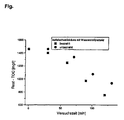
- the table above shows the measurement results, which show the influence of the radiation on the degradation depending on the addition of ions and of H 2 O 2 as oxidizing agent.
- the figure shows an example with the exclusive addition of H 2 O 2, the accelerated degradation by the concentrated solar radiation.
Landscapes
- Chemical & Material Sciences (AREA)
- Engineering & Computer Science (AREA)
- Materials Engineering (AREA)
- Organic Chemistry (AREA)
- Chemical Kinetics & Catalysis (AREA)
- Processing Of Solid Wastes (AREA)
- Treatment Of Water By Oxidation Or Reduction (AREA)
- Manufacture And Refinement Of Metals (AREA)
- Organic Low-Molecular-Weight Compounds And Preparation Thereof (AREA)
Description
| Beispiele | Zugabe | Versuchszeit [h] | Rest-TOC unbestrahlt | Rest-TOC bestrahlt |
| Vgl. 1 | - | 1,5 | 100% | 93 % |
| Vgl. 2 | FeSO4 | 1 | 100 % | 100 % |
| Vgl, 3 | FeSO4, CuCl2 | 1,5 | 100 % | 87 % |
| Vgl. 4 | NaVO3 | 1,5 | 94 % | 85 % |
| Vgl. 5 | TiO2 | 1,5 | 100 % | 94 % |
| 1 | FeSO4, H2O2 | 1,5 | 50 % | 46 % |
| 2 | FeSO4, CuCl2, H2O2 | 1,5 | 87 % | 68 % |
| 3 | NaVO3, H2O2 | 1,5 | 57 % | 25 % |
| 4 | TiO2. H2O2 | 1,5 | 89 % | 41 % |
| 5 | H2O2 | 1,5 | 100 % | 71 % |
Claims (14)
- Verfahren zur Wiederaufbereitung von Abfallmineralsäure durch Abbau organischer Verunreinigungen im Temperaturbereich bis zum Siedepunkt unter Einsatz von Lichtenergie, wobei man der Abfallmineralsäure Übergangsmetallkatalysatoren und ein Oxidationsmittel oder das Oxidationsmittel allein zusetzt und diese dem Licht einer Lichtquelle aussetzt, und man das Oxidationsmittel kontinuierlich oder diskontinuierlich zusetzt und die Konzentration des Katalysators < 1 % ist.
- Verfahren nach Anspruch 1, dadurch gekennzeichnet, daß die Abfallmineralsäure Schwefelsäure oder Phosphorsäure ist.
- Verfahren nach Anspruch 1, dadurch gekennzeichnet, daß man die Abfallmineralsäure im lichtdurchlässigen Reaktor dem Licht der Sonne aussetzt.
- Verfahren nach Anspruch 3, dadurch gekennzeichnet, daß man das Licht der Sonne mit Linsen oder Spiegeln konzentriert.
- Verfahren nach Anspruch 1, dadurch gekennzeichnet, daß man die Lichtquelle in die Abfallmineralsäure eintaucht.
- Verfahren nach Anspruch 1, dadurch gekennzeichnet, daß die Übergangsmetallkatalysatoren aus Übergangsmetallsalzen oder-lonen ausgewählt sind.
- Verfahren nach Anspruch 6, dadurch gekennzeichnet, daß die Übergangsmetallsalze oder -lonen ausgewählt sind aus Eisen-, Kupfer- und/oder Vanadiumsalzen oder-Ionen.
- Verfahren nach Anspruch 7, dadurch gekennzeichnet, daß man eisenhaltige, kupferhaltige und/oder vanadiumhaltige Abfallmineralsäure zusetzt.
- Verfahren nach einem der Ansprüche 1 bis 8, dadurch gekennzeichnet, daß Titandioxid als Übergangsmetallkatalysator zugesetzt wird.
- Verfahren nach Anspruch 9, dadurch gekennzeichnet, daß man titandioxidhaltige Abfallschwefelsäure zusetzt.
- Verfahren nach einem der Ansprüche 1 bis 10, dadurch gekennzeichnet, daß die Konzentration des Katalysators 1 bis 500 ppm beträgt.
- Verfahren nach einem oder mehreren der Ansprüche 1 bis 11, dadurch gekennzeichnet, daß das Oxidationsmittel ein Peroxid, insbesondere ein Wasserstoffperoxid, ein Peroxosulfat, ein Peroxodisulfat und/oder ein Percarbonat ist.
- Verfahren nach einem der Ansprüche 1 bis 12, dadurch gekennzeichnet, daß Sauerstoff oder sauerstoffhaltiges Gas in den Reaktor kontinuierlich oder diskontinuierlich eingeleitet wird.
- Verfahren nach einem der Ansprüche 1 bis 13, dadurch gekennzeichnet, daß die Temperatur < 120 °C, insbesondere < 110 °C beträgt.
Applications Claiming Priority (2)
| Application Number | Priority Date | Filing Date | Title |
|---|---|---|---|
| DE19732190 | 1997-07-26 | ||
| DE19732190A DE19732190C1 (de) | 1997-07-26 | 1997-07-26 | Verfahren zur Wiederaufbereitung von Abfallmineralsäuren |
Publications (3)
| Publication Number | Publication Date |
|---|---|
| EP0893407A2 EP0893407A2 (de) | 1999-01-27 |
| EP0893407A3 EP0893407A3 (de) | 1999-03-10 |
| EP0893407B1 true EP0893407B1 (de) | 2001-09-12 |
Family
ID=7836968
Family Applications (1)
| Application Number | Title | Priority Date | Filing Date |
|---|---|---|---|
| EP98113849A Expired - Lifetime EP0893407B1 (de) | 1997-07-26 | 1998-07-24 | Verfahren zur Wiederaufbereitung von Abfallmineralsäuren |
Country Status (3)
| Country | Link |
|---|---|
| EP (1) | EP0893407B1 (de) |
| DE (1) | DE19732190C1 (de) |
| ES (1) | ES2164397T3 (de) |
Families Citing this family (1)
| Publication number | Priority date | Publication date | Assignee | Title |
|---|---|---|---|---|
| CN115924860B (zh) * | 2023-02-07 | 2024-08-16 | 无锡中天固废处置有限公司 | 一种含有机污染物的硫酸再利用的方法 |
Family Cites Families (7)
| Publication number | Priority date | Publication date | Assignee | Title |
|---|---|---|---|---|
| US4042334A (en) * | 1972-07-13 | 1977-08-16 | Thagard Technology Company | High temperature chemical reactor |
| CH641126A5 (en) * | 1979-06-13 | 1984-02-15 | Bertrams Ag | Process and system for regenerating sulphuric acid |
| DE2942545A1 (de) * | 1979-10-20 | 1981-06-04 | Riedel-De Haen Ag, 3016 Seelze | Verfahren zur herstellung einer gereinigten oxidationsbestaendigen anorganischen saeure und danach erhaltene saeure |
| DE3216420A1 (de) * | 1982-05-03 | 1983-11-03 | Bayer Ag, 5090 Leverkusen | Verfahren zur spaltung von verduennter schwefelsaeure |
| AU569777B2 (en) * | 1984-03-23 | 1988-02-18 | C.I.L. Inc. | Purification of waste sulphuric acid using microwave radiation |
| DE4216499C2 (de) * | 1992-05-19 | 1996-03-21 | Deutsche Forsch Luft Raumfahrt | Verfahren zur Wiederaufbereitung von Abfallschwefelsäure |
| DE19614642C2 (de) * | 1996-02-22 | 2002-05-16 | Mcw Mueller Chemikalien Wertst | Verfahren zur Aufarbeitung von Abfall-Schwefelsäure |
-
1997
- 1997-07-26 DE DE19732190A patent/DE19732190C1/de not_active Expired - Fee Related
-
1998
- 1998-07-24 EP EP98113849A patent/EP0893407B1/de not_active Expired - Lifetime
- 1998-07-24 ES ES98113849T patent/ES2164397T3/es not_active Expired - Lifetime
Also Published As
| Publication number | Publication date |
|---|---|
| EP0893407A2 (de) | 1999-01-27 |
| ES2164397T3 (es) | 2002-02-16 |
| DE19732190C1 (de) | 1998-11-12 |
| EP0893407A3 (de) | 1999-03-10 |
Similar Documents
| Publication | Publication Date | Title |
|---|---|---|
| Boroski et al. | Combined electrocoagulation and TiO2 photoassisted treatment applied to wastewater effluents from pharmaceutical and cosmetic industries | |
| US5268104A (en) | Process for treating and regenerating spent caustic | |
| US3776856A (en) | Process for the wet chemical combustion of organic material | |
| DE4216499C2 (de) | Verfahren zur Wiederaufbereitung von Abfallschwefelsäure | |
| CN110523358A (zh) | 一种紫外耦合过一硫酸盐去除磷酸三丁酯的方法 | |
| DE3717784A1 (de) | Verfahren zur erzeugung von schwefeltrioxid aus oleum, vorrichtung zur durchfuehrung dieses verfahrens sowie verwendung des erzeugten schwefeltrioxids | |
| Kamal et al. | Comparative study of organics removal from refinery wastewater by photocatalytic Fenton reaction coupled with visible light and ultraviolet irradiation | |
| Lizama et al. | Reactive dyes decolouration by TiO2 photo-assisted catalysis | |
| DE4415911A1 (de) | Verfahren zur Behandlung eines organische Bestandteile enthaltenden Mediums | |
| EP0893407B1 (de) | Verfahren zur Wiederaufbereitung von Abfallmineralsäuren | |
| CN105152444A (zh) | 一种hbcd生产废水深度处理与废水中溴的回收综合处理工艺 | |
| DE2729760A1 (de) | Verfahren zur photooxydation von organisch belasteten abwaessern | |
| Hupka et al. | UV/VIS light-enhanced photocatalysis for water treatment and protection | |
| EP0730560A1 (de) | Verfahren zur behandlung von organische und anorganische verbindungen enthaltenden abwässern | |
| CN103964620A (zh) | 垃圾渗滤氨脱出净化超重力碱析藕合光微波处理方法 | |
| KR100343126B1 (ko) | 오수 및 산업폐수의 처리방법 | |
| Islam et al. | Optimization of photodegradation conditions of rhodamine B in water with dye-sensitized titanium dioxide | |
| DE3736928A1 (de) | Verfahren zum herstellen von hochgereinigter kohle | |
| DE3017547C2 (de) | ||
| CN111268779B (zh) | 一种将废液中磷酸三丁酯快速转化为多聚磷酸铁絮凝剂的方法 | |
| CN115849546A (zh) | 一种高污染废水处理的高级氧化方法 | |
| CN107417027A (zh) | 一种用于处理酸性工业废水的净化处理系统 | |
| US20040050716A1 (en) | Electrochemical oxidation of matter | |
| EP0022473B1 (de) | Verfahren und Vorrichtung zum Regenerieren von Schwefelsäure | |
| EP0759411B1 (de) | Verfahren zur oxidativen Behandlung einer Sulfite enthaltenden wässrigen Lösung |
Legal Events
| Date | Code | Title | Description |
|---|---|---|---|
| PUAI | Public reference made under article 153(3) epc to a published international application that has entered the european phase |
Free format text: ORIGINAL CODE: 0009012 |
|
| PUAL | Search report despatched |
Free format text: ORIGINAL CODE: 0009013 |
|
| AK | Designated contracting states |
Kind code of ref document: A2 Designated state(s): BE CH ES FR GB IT LI NL |
|
| AX | Request for extension of the european patent |
Free format text: AL;LT;LV;MK;RO;SI |
|
| AK | Designated contracting states |
Kind code of ref document: A3 Designated state(s): AT BE CH CY DE DK ES FI FR GB GR IE IT LI LU MC NL PT SE |
|
| AX | Request for extension of the european patent |
Free format text: AL;LT;LV;MK;RO;SI |
|
| 17P | Request for examination filed |
Effective date: 19990320 |
|
| AKX | Designation fees paid |
Free format text: BE CH ES FR GB IT LI NL |
|
| REG | Reference to a national code |
Ref country code: DE Ref legal event code: 8566 |
|
| 17Q | First examination report despatched |
Effective date: 20000426 |
|
| GRAG | Despatch of communication of intention to grant |
Free format text: ORIGINAL CODE: EPIDOS AGRA |
|
| GRAG | Despatch of communication of intention to grant |
Free format text: ORIGINAL CODE: EPIDOS AGRA |
|
| GRAH | Despatch of communication of intention to grant a patent |
Free format text: ORIGINAL CODE: EPIDOS IGRA |
|
| GRAH | Despatch of communication of intention to grant a patent |
Free format text: ORIGINAL CODE: EPIDOS IGRA |
|
| GRAA | (expected) grant |
Free format text: ORIGINAL CODE: 0009210 |
|
| AK | Designated contracting states |
Kind code of ref document: B1 Designated state(s): BE CH ES FR GB IT LI NL |
|
| REG | Reference to a national code |
Ref country code: CH Ref legal event code: EP |
|
| REG | Reference to a national code |
Ref country code: CH Ref legal event code: NV Representative=s name: RITSCHER & SEIFERT |
|
| ET | Fr: translation filed | ||
| REG | Reference to a national code |
Ref country code: GB Ref legal event code: IF02 |
|
| GBT | Gb: translation of ep patent filed (gb section 77(6)(a)/1977) |
Effective date: 20011201 |
|
| REG | Reference to a national code |
Ref country code: ES Ref legal event code: FG2A Ref document number: 2164397 Country of ref document: ES Kind code of ref document: T3 |
|
| PLBE | No opposition filed within time limit |
Free format text: ORIGINAL CODE: 0009261 |
|
| STAA | Information on the status of an ep patent application or granted ep patent |
Free format text: STATUS: NO OPPOSITION FILED WITHIN TIME LIMIT |
|
| 26N | No opposition filed | ||
| PGFP | Annual fee paid to national office [announced via postgrant information from national office to epo] |
Ref country code: ES Payment date: 20050721 Year of fee payment: 8 |
|
| PGFP | Annual fee paid to national office [announced via postgrant information from national office to epo] |
Ref country code: NL Payment date: 20060718 Year of fee payment: 9 |
|
| PGFP | Annual fee paid to national office [announced via postgrant information from national office to epo] |
Ref country code: FR Payment date: 20060719 Year of fee payment: 9 |
|
| PGFP | Annual fee paid to national office [announced via postgrant information from national office to epo] |
Ref country code: GB Payment date: 20060721 Year of fee payment: 9 |
|
| PGFP | Annual fee paid to national office [announced via postgrant information from national office to epo] |
Ref country code: CH Payment date: 20060724 Year of fee payment: 9 |
|
| PGFP | Annual fee paid to national office [announced via postgrant information from national office to epo] |
Ref country code: BE Payment date: 20060727 Year of fee payment: 9 |
|
| PGFP | Annual fee paid to national office [announced via postgrant information from national office to epo] |
Ref country code: IT Payment date: 20060731 Year of fee payment: 9 |
|
| BERE | Be: lapsed |
Owner name: DEUTSCHES ZENTRUM FUR LUFT- UND RAUMFAHRT E.V. *DL Effective date: 20070731 |
|
| REG | Reference to a national code |
Ref country code: CH Ref legal event code: PL |
|
| GBPC | Gb: european patent ceased through non-payment of renewal fee |
Effective date: 20070724 |
|
| NLV4 | Nl: lapsed or anulled due to non-payment of the annual fee |
Effective date: 20080201 |
|
| PG25 | Lapsed in a contracting state [announced via postgrant information from national office to epo] |
Ref country code: NL Free format text: LAPSE BECAUSE OF NON-PAYMENT OF DUE FEES Effective date: 20080201 Ref country code: LI Free format text: LAPSE BECAUSE OF NON-PAYMENT OF DUE FEES Effective date: 20070731 Ref country code: CH Free format text: LAPSE BECAUSE OF NON-PAYMENT OF DUE FEES Effective date: 20070731 |
|
| PG25 | Lapsed in a contracting state [announced via postgrant information from national office to epo] |
Ref country code: GB Free format text: LAPSE BECAUSE OF NON-PAYMENT OF DUE FEES Effective date: 20070724 |
|
| REG | Reference to a national code |
Ref country code: FR Ref legal event code: ST Effective date: 20080331 |
|
| PG25 | Lapsed in a contracting state [announced via postgrant information from national office to epo] |
Ref country code: BE Free format text: LAPSE BECAUSE OF NON-PAYMENT OF DUE FEES Effective date: 20070731 |
|
| PG25 | Lapsed in a contracting state [announced via postgrant information from national office to epo] |
Ref country code: FR Free format text: LAPSE BECAUSE OF NON-PAYMENT OF DUE FEES Effective date: 20070731 |
|
| REG | Reference to a national code |
Ref country code: ES Ref legal event code: FD2A Effective date: 20070725 |
|
| PG25 | Lapsed in a contracting state [announced via postgrant information from national office to epo] |
Ref country code: ES Free format text: LAPSE BECAUSE OF NON-PAYMENT OF DUE FEES Effective date: 20070725 |
|
| PG25 | Lapsed in a contracting state [announced via postgrant information from national office to epo] |
Ref country code: IT Free format text: LAPSE BECAUSE OF NON-PAYMENT OF DUE FEES Effective date: 20070724 |