EP0893462A2 - Kontinuierliches Verfahren zur Herstellung von Lactid und Lactid Polymeren - Google Patents
Kontinuierliches Verfahren zur Herstellung von Lactid und Lactid Polymeren Download PDFInfo
- Publication number
- EP0893462A2 EP0893462A2 EP98203427A EP98203427A EP0893462A2 EP 0893462 A2 EP0893462 A2 EP 0893462A2 EP 98203427 A EP98203427 A EP 98203427A EP 98203427 A EP98203427 A EP 98203427A EP 0893462 A2 EP0893462 A2 EP 0893462A2
- Authority
- EP
- European Patent Office
- Prior art keywords
- lactide
- lactic acid
- crude
- catalyst
- polylactic acid
- Prior art date
- Legal status (The legal status is an assumption and is not a legal conclusion. Google has not performed a legal analysis and makes no representation as to the accuracy of the status listed.)
- Granted
Links
- JJTUDXZGHPGLLC-UHFFFAOYSA-N lactide Chemical compound CC1OC(=O)C(C)OC1=O JJTUDXZGHPGLLC-UHFFFAOYSA-N 0.000 title claims abstract description 380
- 238000000034 method Methods 0.000 title claims abstract description 114
- 230000008569 process Effects 0.000 title claims abstract description 101
- 229920000642 polymer Polymers 0.000 title claims abstract description 93
- 238000004519 manufacturing process Methods 0.000 title claims abstract description 41
- 229920000747 poly(lactic acid) Polymers 0.000 claims abstract description 142
- 238000004821 distillation Methods 0.000 claims abstract description 141
- 239000000203 mixture Substances 0.000 claims abstract description 87
- 238000009835 boiling Methods 0.000 claims abstract description 74
- JJTUDXZGHPGLLC-IMJSIDKUSA-N 4511-42-6 Chemical compound C[C@@H]1OC(=O)[C@H](C)OC1=O JJTUDXZGHPGLLC-IMJSIDKUSA-N 0.000 claims abstract description 23
- JJTUDXZGHPGLLC-ZXZARUISSA-N (3r,6s)-3,6-dimethyl-1,4-dioxane-2,5-dione Chemical compound C[C@H]1OC(=O)[C@H](C)OC1=O JJTUDXZGHPGLLC-ZXZARUISSA-N 0.000 claims abstract description 16
- 238000001953 recrystallisation Methods 0.000 claims abstract description 10
- 238000000638 solvent extraction Methods 0.000 claims abstract description 5
- JVTAAEKCZFNVCJ-UHFFFAOYSA-N lactic acid Chemical compound CC(O)C(O)=O JVTAAEKCZFNVCJ-UHFFFAOYSA-N 0.000 claims description 532
- 235000014655 lactic acid Nutrition 0.000 claims description 265
- 239000004310 lactic acid Substances 0.000 claims description 263
- 239000003054 catalyst Substances 0.000 claims description 182
- 239000004626 polylactic acid Substances 0.000 claims description 109
- 150000002148 esters Chemical class 0.000 claims description 100
- XLYOFNOQVPJJNP-UHFFFAOYSA-N water Substances O XLYOFNOQVPJJNP-UHFFFAOYSA-N 0.000 claims description 49
- 230000005494 condensation Effects 0.000 claims description 33
- 238000009833 condensation Methods 0.000 claims description 32
- 238000006482 condensation reaction Methods 0.000 claims description 31
- 239000006227 byproduct Substances 0.000 claims description 28
- 230000000694 effects Effects 0.000 claims description 28
- 239000007788 liquid Substances 0.000 claims description 27
- 239000007787 solid Substances 0.000 claims description 16
- 238000001704 evaporation Methods 0.000 claims description 12
- 229910052751 metal Inorganic materials 0.000 claims description 11
- 239000002184 metal Substances 0.000 claims description 11
- 230000008020 evaporation Effects 0.000 claims description 10
- 150000002739 metals Chemical class 0.000 claims description 8
- 125000004122 cyclic group Chemical group 0.000 claims description 7
- 150000001875 compounds Chemical class 0.000 claims description 6
- 125000000217 alkyl group Chemical group 0.000 claims description 5
- 239000000356 contaminant Substances 0.000 claims description 5
- 230000000737 periodic effect Effects 0.000 claims description 2
- 230000018044 dehydration Effects 0.000 claims 8
- 238000006297 dehydration reaction Methods 0.000 claims 8
- 239000002609 medium Substances 0.000 claims 8
- 239000012736 aqueous medium Substances 0.000 claims 5
- 230000000379 polymerizing effect Effects 0.000 claims 2
- 238000009834 vaporization Methods 0.000 claims 1
- 230000008016 vaporization Effects 0.000 claims 1
- 239000000463 material Substances 0.000 description 68
- 238000006116 polymerization reaction Methods 0.000 description 51
- 238000006243 chemical reaction Methods 0.000 description 49
- OKKJLVBELUTLKV-UHFFFAOYSA-N Methanol Chemical compound OC OKKJLVBELUTLKV-UHFFFAOYSA-N 0.000 description 48
- LZCLXQDLBQLTDK-UHFFFAOYSA-N ethyl 2-hydroxypropanoate Chemical compound CCOC(=O)C(C)O LZCLXQDLBQLTDK-UHFFFAOYSA-N 0.000 description 44
- 239000012535 impurity Substances 0.000 description 40
- 230000003287 optical effect Effects 0.000 description 31
- LPEKGGXMPWTOCB-UHFFFAOYSA-N 8beta-(2,3-epoxy-2-methylbutyryloxy)-14-acetoxytithifolin Natural products COC(=O)C(C)O LPEKGGXMPWTOCB-UHFFFAOYSA-N 0.000 description 30
- ODQWQRRAPPTVAG-GZTJUZNOSA-N doxepin Chemical compound C1OC2=CC=CC=C2C(=C/CCN(C)C)/C2=CC=CC=C21 ODQWQRRAPPTVAG-GZTJUZNOSA-N 0.000 description 30
- 229940057867 methyl lactate Drugs 0.000 description 30
- 239000002904 solvent Substances 0.000 description 26
- 239000000047 product Substances 0.000 description 25
- LFQSCWFLJHTTHZ-UHFFFAOYSA-N Ethanol Chemical compound CCO LFQSCWFLJHTTHZ-UHFFFAOYSA-N 0.000 description 24
- 230000007246 mechanism Effects 0.000 description 23
- JVTAAEKCZFNVCJ-REOHCLBHSA-N L-lactic acid Chemical compound C[C@H](O)C(O)=O JVTAAEKCZFNVCJ-REOHCLBHSA-N 0.000 description 22
- 229940116333 ethyl lactate Drugs 0.000 description 22
- 238000012546 transfer Methods 0.000 description 22
- -1 cyclic ester Chemical class 0.000 description 21
- 230000008901 benefit Effects 0.000 description 20
- 238000000746 purification Methods 0.000 description 20
- 230000006340 racemization Effects 0.000 description 19
- 238000010438 heat treatment Methods 0.000 description 18
- QHGNHLZPVBIIPX-UHFFFAOYSA-N tin(II) oxide Inorganic materials [Sn]=O QHGNHLZPVBIIPX-UHFFFAOYSA-N 0.000 description 16
- 239000002253 acid Substances 0.000 description 15
- 239000000539 dimer Substances 0.000 description 14
- 238000002474 experimental method Methods 0.000 description 14
- 230000003068 static effect Effects 0.000 description 14
- 238000010926 purge Methods 0.000 description 13
- WYURNTSHIVDZCO-UHFFFAOYSA-N Tetrahydrofuran Chemical compound C1CCOC1 WYURNTSHIVDZCO-UHFFFAOYSA-N 0.000 description 12
- 239000012299 nitrogen atmosphere Substances 0.000 description 12
- 238000007142 ring opening reaction Methods 0.000 description 12
- 238000013461 design Methods 0.000 description 11
- 239000012071 phase Substances 0.000 description 11
- LRHPLDYGYMQRHN-UHFFFAOYSA-N N-Butanol Chemical compound CCCCO LRHPLDYGYMQRHN-UHFFFAOYSA-N 0.000 description 10
- 229920001577 copolymer Polymers 0.000 description 10
- 230000004044 response Effects 0.000 description 10
- 239000000126 substance Substances 0.000 description 10
- 238000007701 flash-distillation Methods 0.000 description 9
- 239000000178 monomer Substances 0.000 description 9
- MRABAEUHTLLEML-UHFFFAOYSA-N Butyl lactate Chemical compound CCCCOC(=O)C(C)O MRABAEUHTLLEML-UHFFFAOYSA-N 0.000 description 8
- 239000001191 butyl (2R)-2-hydroxypropanoate Substances 0.000 description 8
- 239000012141 concentrate Substances 0.000 description 8
- 238000012691 depolymerization reaction Methods 0.000 description 8
- 238000009826 distribution Methods 0.000 description 8
- 239000012530 fluid Substances 0.000 description 8
- 238000002156 mixing Methods 0.000 description 8
- 230000004048 modification Effects 0.000 description 8
- 238000012986 modification Methods 0.000 description 8
- 230000000704 physical effect Effects 0.000 description 8
- 238000010992 reflux Methods 0.000 description 8
- 229930182843 D-Lactic acid Natural products 0.000 description 7
- JVTAAEKCZFNVCJ-UWTATZPHSA-N D-lactic acid Chemical compound C[C@@H](O)C(O)=O JVTAAEKCZFNVCJ-UWTATZPHSA-N 0.000 description 7
- 229920001429 chelating resin Polymers 0.000 description 7
- 229940022769 d- lactic acid Drugs 0.000 description 7
- 125000002887 hydroxy group Chemical group [H]O* 0.000 description 7
- XEEYBQQBJWHFJM-UHFFFAOYSA-N Iron Chemical compound [Fe] XEEYBQQBJWHFJM-UHFFFAOYSA-N 0.000 description 6
- KFZMGEQAYNKOFK-UHFFFAOYSA-N Isopropanol Chemical compound CC(C)O KFZMGEQAYNKOFK-UHFFFAOYSA-N 0.000 description 6
- VYPSYNLAJGMNEJ-UHFFFAOYSA-N Silicium dioxide Chemical compound O=[Si]=O VYPSYNLAJGMNEJ-UHFFFAOYSA-N 0.000 description 6
- 238000004458 analytical method Methods 0.000 description 6
- 150000001735 carboxylic acids Chemical class 0.000 description 6
- 238000005227 gel permeation chromatography Methods 0.000 description 6
- ZXEKIIBDNHEJCQ-UHFFFAOYSA-N isobutanol Chemical compound CC(C)CO ZXEKIIBDNHEJCQ-UHFFFAOYSA-N 0.000 description 6
- 230000002829 reductive effect Effects 0.000 description 6
- 238000007086 side reaction Methods 0.000 description 6
- 239000011949 solid catalyst Substances 0.000 description 6
- JOXIMZWYDAKGHI-UHFFFAOYSA-N toluene-4-sulfonic acid Chemical compound CC1=CC=C(S(O)(=O)=O)C=C1 JOXIMZWYDAKGHI-UHFFFAOYSA-N 0.000 description 6
- 239000002699 waste material Substances 0.000 description 6
- HBAQYPYDRFILMT-UHFFFAOYSA-N 8-[3-(1-cyclopropylpyrazol-4-yl)-1H-pyrazolo[4,3-d]pyrimidin-5-yl]-3-methyl-3,8-diazabicyclo[3.2.1]octan-2-one Chemical class C1(CC1)N1N=CC(=C1)C1=NNC2=C1N=C(N=C2)N1C2C(N(CC1CC2)C)=O HBAQYPYDRFILMT-UHFFFAOYSA-N 0.000 description 5
- 230000002378 acidificating effect Effects 0.000 description 5
- 229920002988 biodegradable polymer Polymers 0.000 description 5
- 239000004621 biodegradable polymer Substances 0.000 description 5
- 230000001627 detrimental effect Effects 0.000 description 5
- 150000007517 lewis acids Chemical class 0.000 description 5
- 230000036961 partial effect Effects 0.000 description 5
- 238000012545 processing Methods 0.000 description 5
- 230000015572 biosynthetic process Effects 0.000 description 4
- 239000003795 chemical substances by application Substances 0.000 description 4
- 238000004587 chromatography analysis Methods 0.000 description 4
- PLONEVHFXDFSLA-UHFFFAOYSA-N ethyl hexanoate;tin(2+) Chemical compound [Sn+2].CCCCCC(=O)OCC PLONEVHFXDFSLA-UHFFFAOYSA-N 0.000 description 4
- 239000002815 homogeneous catalyst Substances 0.000 description 4
- 238000011084 recovery Methods 0.000 description 4
- 229920005989 resin Polymers 0.000 description 4
- 239000011347 resin Substances 0.000 description 4
- 239000007858 starting material Substances 0.000 description 4
- WBPAQKQBUKYCJS-UHFFFAOYSA-N 2-methylpropyl 2-hydroxypropanoate Chemical compound CC(C)COC(=O)C(C)O WBPAQKQBUKYCJS-UHFFFAOYSA-N 0.000 description 3
- 229920001730 Moisture cure polyurethane Polymers 0.000 description 3
- YXFVVABEGXRONW-UHFFFAOYSA-N Toluene Chemical compound CC1=CC=CC=C1 YXFVVABEGXRONW-UHFFFAOYSA-N 0.000 description 3
- 229940061720 alpha hydroxy acid Drugs 0.000 description 3
- 150000001280 alpha hydroxy acids Chemical class 0.000 description 3
- 125000002091 cationic group Chemical group 0.000 description 3
- 230000008859 change Effects 0.000 description 3
- 239000007795 chemical reaction product Substances 0.000 description 3
- 238000010924 continuous production Methods 0.000 description 3
- 238000000354 decomposition reaction Methods 0.000 description 3
- 230000007423 decrease Effects 0.000 description 3
- 238000011161 development Methods 0.000 description 3
- 239000010408 film Substances 0.000 description 3
- 239000007789 gas Substances 0.000 description 3
- 238000004817 gas chromatography Methods 0.000 description 3
- 229910052742 iron Inorganic materials 0.000 description 3
- 150000003903 lactic acid esters Chemical class 0.000 description 3
- 238000002844 melting Methods 0.000 description 3
- 230000008018 melting Effects 0.000 description 3
- 229910021645 metal ion Inorganic materials 0.000 description 3
- 229920000728 polyester Polymers 0.000 description 3
- 238000002360 preparation method Methods 0.000 description 3
- BDERNNFJNOPAEC-UHFFFAOYSA-N propan-1-ol Chemical compound CCCO BDERNNFJNOPAEC-UHFFFAOYSA-N 0.000 description 3
- KIWATKANDHUUOB-UHFFFAOYSA-N propan-2-yl 2-hydroxypropanoate Chemical compound CC(C)OC(=O)C(C)O KIWATKANDHUUOB-UHFFFAOYSA-N 0.000 description 3
- ILVGAIQLOCKNQA-UHFFFAOYSA-N propyl 2-hydroxypropanoate Chemical compound CCCOC(=O)C(C)O ILVGAIQLOCKNQA-UHFFFAOYSA-N 0.000 description 3
- 238000004064 recycling Methods 0.000 description 3
- 239000000377 silicon dioxide Substances 0.000 description 3
- 238000004448 titration Methods 0.000 description 3
- 230000032258 transport Effects 0.000 description 3
- 238000010977 unit operation Methods 0.000 description 3
- 239000012808 vapor phase Substances 0.000 description 3
- 238000004260 weight control Methods 0.000 description 3
- RKDVKSZUMVYZHH-UHFFFAOYSA-N 1,4-dioxane-2,5-dione Chemical compound O=C1COC(=O)CO1 RKDVKSZUMVYZHH-UHFFFAOYSA-N 0.000 description 2
- IJGRMHOSHXDMSA-UHFFFAOYSA-N Atomic nitrogen Chemical compound N#N IJGRMHOSHXDMSA-UHFFFAOYSA-N 0.000 description 2
- HEDRZPFGACZZDS-UHFFFAOYSA-N Chloroform Chemical compound ClC(Cl)Cl HEDRZPFGACZZDS-UHFFFAOYSA-N 0.000 description 2
- VYZAMTAEIAYCRO-UHFFFAOYSA-N Chromium Chemical compound [Cr] VYZAMTAEIAYCRO-UHFFFAOYSA-N 0.000 description 2
- DGAQECJNVWCQMB-PUAWFVPOSA-M Ilexoside XXIX Chemical compound C[C@@H]1CC[C@@]2(CC[C@@]3(C(=CC[C@H]4[C@]3(CC[C@@H]5[C@@]4(CC[C@@H](C5(C)C)OS(=O)(=O)[O-])C)C)[C@@H]2[C@]1(C)O)C)C(=O)O[C@H]6[C@@H]([C@H]([C@@H]([C@H](O6)CO)O)O)O.[Na+] DGAQECJNVWCQMB-PUAWFVPOSA-M 0.000 description 2
- JVTAAEKCZFNVCJ-UHFFFAOYSA-M Lactate Chemical compound CC(O)C([O-])=O JVTAAEKCZFNVCJ-UHFFFAOYSA-M 0.000 description 2
- 239000002841 Lewis acid Substances 0.000 description 2
- 239000004721 Polyphenylene oxide Substances 0.000 description 2
- 230000004913 activation Effects 0.000 description 2
- 150000001299 aldehydes Chemical class 0.000 description 2
- PNEYBMLMFCGWSK-UHFFFAOYSA-N aluminium oxide Inorganic materials [O-2].[O-2].[O-2].[Al+3].[Al+3] PNEYBMLMFCGWSK-UHFFFAOYSA-N 0.000 description 2
- 150000001413 amino acids Chemical class 0.000 description 2
- 230000009286 beneficial effect Effects 0.000 description 2
- 239000012620 biological material Substances 0.000 description 2
- 150000001720 carbohydrates Chemical class 0.000 description 2
- 235000014633 carbohydrates Nutrition 0.000 description 2
- 229910052804 chromium Inorganic materials 0.000 description 2
- 239000011651 chromium Substances 0.000 description 2
- 238000000576 coating method Methods 0.000 description 2
- 230000003750 conditioning effect Effects 0.000 description 2
- 238000011109 contamination Methods 0.000 description 2
- 238000012937 correction Methods 0.000 description 2
- 238000002425 crystallisation Methods 0.000 description 2
- 230000008025 crystallization Effects 0.000 description 2
- 238000010586 diagram Methods 0.000 description 2
- 238000005516 engineering process Methods 0.000 description 2
- 238000005886 esterification reaction Methods 0.000 description 2
- 230000008570 general process Effects 0.000 description 2
- 239000011521 glass Substances 0.000 description 2
- 229920006158 high molecular weight polymer Polymers 0.000 description 2
- 229920001519 homopolymer Polymers 0.000 description 2
- 239000011261 inert gas Substances 0.000 description 2
- 150000002576 ketones Chemical class 0.000 description 2
- 238000011031 large-scale manufacturing process Methods 0.000 description 2
- 238000005259 measurement Methods 0.000 description 2
- 238000010907 mechanical stirring Methods 0.000 description 2
- UQGPCEVQKLOLLM-UHFFFAOYSA-N pentaneperoxoic acid Chemical compound CCCCC(=O)OO UQGPCEVQKLOLLM-UHFFFAOYSA-N 0.000 description 2
- 238000005191 phase separation Methods 0.000 description 2
- 229920000570 polyether Polymers 0.000 description 2
- 229920001223 polyethylene glycol Polymers 0.000 description 2
- 229920002959 polymer blend Polymers 0.000 description 2
- 102000004169 proteins and genes Human genes 0.000 description 2
- 108090000623 proteins and genes Proteins 0.000 description 2
- 239000002994 raw material Substances 0.000 description 2
- 239000011541 reaction mixture Substances 0.000 description 2
- 150000003839 salts Chemical class 0.000 description 2
- 239000011734 sodium Substances 0.000 description 2
- 229910052708 sodium Inorganic materials 0.000 description 2
- 229910001220 stainless steel Inorganic materials 0.000 description 2
- 239000010935 stainless steel Substances 0.000 description 2
- 238000003756 stirring Methods 0.000 description 2
- XOLBLPGZBRYERU-UHFFFAOYSA-N tin dioxide Chemical compound O=[Sn]=O XOLBLPGZBRYERU-UHFFFAOYSA-N 0.000 description 2
- 229910001887 tin oxide Inorganic materials 0.000 description 2
- 238000005809 transesterification reaction Methods 0.000 description 2
- 238000011144 upstream manufacturing Methods 0.000 description 2
- 239000003643 water by type Substances 0.000 description 2
- OZZQHCBFUVFZGT-UHFFFAOYSA-N 2-(2-hydroxypropanoyloxy)propanoic acid Chemical compound CC(O)C(=O)OC(C)C(O)=O OZZQHCBFUVFZGT-UHFFFAOYSA-N 0.000 description 1
- BOZRCGLDOHDZBP-UHFFFAOYSA-N 2-ethylhexanoic acid;tin Chemical compound [Sn].CCCCC(CC)C(O)=O BOZRCGLDOHDZBP-UHFFFAOYSA-N 0.000 description 1
- 241000132028 Bellis Species 0.000 description 1
- 241001436672 Bhatia Species 0.000 description 1
- 229910021556 Chromium(III) chloride Inorganic materials 0.000 description 1
- UFHFLCQGNIYNRP-UHFFFAOYSA-N Hydrogen Chemical compound [H][H] UFHFLCQGNIYNRP-UHFFFAOYSA-N 0.000 description 1
- 229910021578 Iron(III) chloride Inorganic materials 0.000 description 1
- 239000004793 Polystyrene Substances 0.000 description 1
- VMHLLURERBWHNL-UHFFFAOYSA-M Sodium acetate Chemical compound [Na+].CC([O-])=O VMHLLURERBWHNL-UHFFFAOYSA-M 0.000 description 1
- ATJFFYVFTNAWJD-UHFFFAOYSA-N Tin Chemical compound [Sn] ATJFFYVFTNAWJD-UHFFFAOYSA-N 0.000 description 1
- HCHKCACWOHOZIP-UHFFFAOYSA-N Zinc Chemical compound [Zn] HCHKCACWOHOZIP-UHFFFAOYSA-N 0.000 description 1
- ZOIORXHNWRGPMV-UHFFFAOYSA-N acetic acid;zinc Chemical compound [Zn].CC(O)=O.CC(O)=O ZOIORXHNWRGPMV-UHFFFAOYSA-N 0.000 description 1
- 239000003377 acid catalyst Substances 0.000 description 1
- 230000003213 activating effect Effects 0.000 description 1
- 125000003545 alkoxy group Chemical group 0.000 description 1
- 230000004075 alteration Effects 0.000 description 1
- 238000000540 analysis of variance Methods 0.000 description 1
- 238000013459 approach Methods 0.000 description 1
- PEWNRQODUMGNCG-UHFFFAOYSA-N azanium;1,4-bis(8-methylnonoxy)-1,4-dioxobutane-2-sulfonate Chemical compound [NH4+].CC(C)CCCCCCCOC(=O)CC(S([O-])(=O)=O)C(=O)OCCCCCCCC(C)C PEWNRQODUMGNCG-UHFFFAOYSA-N 0.000 description 1
- 210000000988 bone and bone Anatomy 0.000 description 1
- VSGNNIFQASZAOI-UHFFFAOYSA-L calcium acetate Chemical compound [Ca+2].CC([O-])=O.CC([O-])=O VSGNNIFQASZAOI-UHFFFAOYSA-L 0.000 description 1
- 239000001639 calcium acetate Substances 0.000 description 1
- 235000011092 calcium acetate Nutrition 0.000 description 1
- 229960005147 calcium acetate Drugs 0.000 description 1
- 238000004364 calculation method Methods 0.000 description 1
- 125000004432 carbon atom Chemical group C* 0.000 description 1
- 239000012159 carrier gas Substances 0.000 description 1
- 238000006555 catalytic reaction Methods 0.000 description 1
- 238000003889 chemical engineering Methods 0.000 description 1
- QSWDMMVNRMROPK-UHFFFAOYSA-K chromium(3+) trichloride Chemical compound [Cl-].[Cl-].[Cl-].[Cr+3] QSWDMMVNRMROPK-UHFFFAOYSA-K 0.000 description 1
- 239000011636 chromium(III) chloride Substances 0.000 description 1
- 238000005345 coagulation Methods 0.000 description 1
- 230000015271 coagulation Effects 0.000 description 1
- 239000011248 coating agent Substances 0.000 description 1
- 238000010961 commercial manufacture process Methods 0.000 description 1
- 230000002860 competitive effect Effects 0.000 description 1
- 239000007859 condensation product Substances 0.000 description 1
- 239000000470 constituent Substances 0.000 description 1
- 238000013270 controlled release Methods 0.000 description 1
- 238000005260 corrosion Methods 0.000 description 1
- 230000007797 corrosion Effects 0.000 description 1
- 239000012043 crude product Substances 0.000 description 1
- 235000013365 dairy product Nutrition 0.000 description 1
- 230000007812 deficiency Effects 0.000 description 1
- 238000001514 detection method Methods 0.000 description 1
- JVLRYPRBKSMEBF-UHFFFAOYSA-K diacetyloxystibanyl acetate Chemical compound [Sb+3].CC([O-])=O.CC([O-])=O.CC([O-])=O JVLRYPRBKSMEBF-UHFFFAOYSA-K 0.000 description 1
- VDQVEACBQKUUSU-UHFFFAOYSA-M disodium;sulfanide Chemical compound [Na+].[Na+].[SH-] VDQVEACBQKUUSU-UHFFFAOYSA-M 0.000 description 1
- 239000000428 dust Substances 0.000 description 1
- 125000004185 ester group Chemical group 0.000 description 1
- 238000010931 ester hydrolysis Methods 0.000 description 1
- 238000013462 factorial design experiment Methods 0.000 description 1
- 239000011552 falling film Substances 0.000 description 1
- 238000000855 fermentation Methods 0.000 description 1
- 230000004151 fermentation Effects 0.000 description 1
- 230000009969 flowable effect Effects 0.000 description 1
- 235000013305 food Nutrition 0.000 description 1
- 150000004820 halides Chemical class 0.000 description 1
- 239000001257 hydrogen Substances 0.000 description 1
- 229910052739 hydrogen Inorganic materials 0.000 description 1
- 230000007062 hydrolysis Effects 0.000 description 1
- 238000006460 hydrolysis reaction Methods 0.000 description 1
- 229910052500 inorganic mineral Inorganic materials 0.000 description 1
- 239000013067 intermediate product Substances 0.000 description 1
- RBTARNINKXHZNM-UHFFFAOYSA-K iron trichloride Chemical compound Cl[Fe](Cl)Cl RBTARNINKXHZNM-UHFFFAOYSA-K 0.000 description 1
- BAUYGSIQEAFULO-UHFFFAOYSA-L iron(2+) sulfate (anhydrous) Chemical compound [Fe+2].[O-]S([O-])(=O)=O BAUYGSIQEAFULO-UHFFFAOYSA-L 0.000 description 1
- 229910000359 iron(II) sulfate Inorganic materials 0.000 description 1
- 230000000670 limiting effect Effects 0.000 description 1
- 238000003760 magnetic stirring Methods 0.000 description 1
- 238000007726 management method Methods 0.000 description 1
- 239000011572 manganese Substances 0.000 description 1
- 229940071125 manganese acetate Drugs 0.000 description 1
- UOGMEBQRZBEZQT-UHFFFAOYSA-L manganese(2+);diacetate Chemical compound [Mn+2].CC([O-])=O.CC([O-])=O UOGMEBQRZBEZQT-UHFFFAOYSA-L 0.000 description 1
- 229940127554 medical product Drugs 0.000 description 1
- 239000000155 melt Substances 0.000 description 1
- 150000002736 metal compounds Chemical class 0.000 description 1
- 229910001507 metal halide Inorganic materials 0.000 description 1
- 150000005309 metal halides Chemical class 0.000 description 1
- 229910044991 metal oxide Inorganic materials 0.000 description 1
- 150000004706 metal oxides Chemical class 0.000 description 1
- 235000013336 milk Nutrition 0.000 description 1
- 239000008267 milk Substances 0.000 description 1
- 210000004080 milk Anatomy 0.000 description 1
- 239000011707 mineral Substances 0.000 description 1
- 229910052757 nitrogen Inorganic materials 0.000 description 1
- 150000007524 organic acids Chemical class 0.000 description 1
- 235000005985 organic acids Nutrition 0.000 description 1
- 150000002894 organic compounds Chemical class 0.000 description 1
- 239000005022 packaging material Substances 0.000 description 1
- 238000004806 packaging method and process Methods 0.000 description 1
- 238000012856 packing Methods 0.000 description 1
- 239000003348 petrochemical agent Substances 0.000 description 1
- 239000003208 petroleum Substances 0.000 description 1
- 238000011020 pilot scale process Methods 0.000 description 1
- 229920001432 poly(L-lactide) Polymers 0.000 description 1
- 239000002952 polymeric resin Substances 0.000 description 1
- 229920002223 polystyrene Polymers 0.000 description 1
- 239000002244 precipitate Substances 0.000 description 1
- 230000002028 premature Effects 0.000 description 1
- 230000000717 retained effect Effects 0.000 description 1
- 238000007151 ring opening polymerisation reaction Methods 0.000 description 1
- 238000005070 sampling Methods 0.000 description 1
- 238000007127 saponification reaction Methods 0.000 description 1
- 239000001632 sodium acetate Substances 0.000 description 1
- 235000017281 sodium acetate Nutrition 0.000 description 1
- 229960004249 sodium acetate Drugs 0.000 description 1
- 229910001415 sodium ion Inorganic materials 0.000 description 1
- 229910052979 sodium sulfide Inorganic materials 0.000 description 1
- 239000011343 solid material Substances 0.000 description 1
- 238000007619 statistical method Methods 0.000 description 1
- 238000003786 synthesis reaction Methods 0.000 description 1
- 229920003002 synthetic resin Polymers 0.000 description 1
- 238000010998 test method Methods 0.000 description 1
- 238000012360 testing method Methods 0.000 description 1
- YLQBMQCUIZJEEH-UHFFFAOYSA-N tetrahydrofuran Natural products C=1C=COC=1 YLQBMQCUIZJEEH-UHFFFAOYSA-N 0.000 description 1
- CRHIAMBJMSSNNM-UHFFFAOYSA-N tetraphenylstannane Chemical compound C1=CC=CC=C1[Sn](C=1C=CC=CC=1)(C=1C=CC=CC=1)C1=CC=CC=C1 CRHIAMBJMSSNNM-UHFFFAOYSA-N 0.000 description 1
- 150000003606 tin compounds Chemical class 0.000 description 1
- KSBAEPSJVUENNK-UHFFFAOYSA-L tin(ii) 2-ethylhexanoate Chemical compound [Sn+2].CCCCC(CC)C([O-])=O.CCCCC(CC)C([O-])=O KSBAEPSJVUENNK-UHFFFAOYSA-L 0.000 description 1
- 238000007738 vacuum evaporation Methods 0.000 description 1
- 238000004457 water analysis Methods 0.000 description 1
- 239000011701 zinc Substances 0.000 description 1
- 229910052725 zinc Inorganic materials 0.000 description 1
- 239000004246 zinc acetate Substances 0.000 description 1
- 229960000314 zinc acetate Drugs 0.000 description 1
Images





Classifications
-
- C—CHEMISTRY; METALLURGY
- C08—ORGANIC MACROMOLECULAR COMPOUNDS; THEIR PREPARATION OR CHEMICAL WORKING-UP; COMPOSITIONS BASED THEREON
- C08G—MACROMOLECULAR COMPOUNDS OBTAINED OTHERWISE THAN BY REACTIONS ONLY INVOLVING UNSATURATED CARBON-TO-CARBON BONDS
- C08G63/00—Macromolecular compounds obtained by reactions forming a carboxylic ester link in the main chain of the macromolecule
- C08G63/78—Preparation processes
-
- C—CHEMISTRY; METALLURGY
- C08—ORGANIC MACROMOLECULAR COMPOUNDS; THEIR PREPARATION OR CHEMICAL WORKING-UP; COMPOSITIONS BASED THEREON
- C08G—MACROMOLECULAR COMPOUNDS OBTAINED OTHERWISE THAN BY REACTIONS ONLY INVOLVING UNSATURATED CARBON-TO-CARBON BONDS
- C08G63/00—Macromolecular compounds obtained by reactions forming a carboxylic ester link in the main chain of the macromolecule
- C08G63/02—Polyesters derived from hydroxycarboxylic acids or from polycarboxylic acids and polyhydroxy compounds
- C08G63/06—Polyesters derived from hydroxycarboxylic acids or from polycarboxylic acids and polyhydroxy compounds derived from hydroxycarboxylic acids
-
- C—CHEMISTRY; METALLURGY
- C08—ORGANIC MACROMOLECULAR COMPOUNDS; THEIR PREPARATION OR CHEMICAL WORKING-UP; COMPOSITIONS BASED THEREON
- C08G—MACROMOLECULAR COMPOUNDS OBTAINED OTHERWISE THAN BY REACTIONS ONLY INVOLVING UNSATURATED CARBON-TO-CARBON BONDS
- C08G63/00—Macromolecular compounds obtained by reactions forming a carboxylic ester link in the main chain of the macromolecule
- C08G63/02—Polyesters derived from hydroxycarboxylic acids or from polycarboxylic acids and polyhydroxy compounds
- C08G63/06—Polyesters derived from hydroxycarboxylic acids or from polycarboxylic acids and polyhydroxy compounds derived from hydroxycarboxylic acids
- C08G63/08—Lactones or lactides
Definitions
- the present invention relates to processes for the continuous production of lactide and lactide polymers from crude lactic acid and esters of lactic acid in the field of biodegradable polymers.
- step n of said polymerization reaction is represented by:
- the resulting polylactic acid is limited to a low molecular weight polymer of limited value, based on physical properties, due to a competing depolymerization reaction in which the cyclic dimer of lactic acid, lactide, is generated.
- the polymerization reaction rate decelerates until it reaches the rate of the depolymerization reaction, which effectively, limits the molecular weight of the resulting polymers.
- An example of this equilibrium reaction is represented below.
- lactic acid exists in two forms which are optical enantiomers, designated as D-lactic acid and L-lactic acid.
- D-lactic acid, L-lactic acid or mixtures thereof may be polymerized to form an intermediate molecular weight polylactic acid which, upon further polymerization, generates lactide as earlier disclosed.
- the lactide, or the cyclic dimer of lactic acid may have one of three types of optical activity depending on whether it consists of two L-lactic acid molecules, two D-lactic acid molecules or an L-lactic acid molecule and a D-lactic acid molecule combined to form the dimer. These three dimers are designated L-lactide, D-lactide and meso-lactide, respectively.
- a 50/50 mixture of L-lactide and D-lactide with a melting point of about 126°C is often referred to in the literature as D,L-lactide.
- DeVries U.S. Patent No. 4,797,468, recently disclosed a process for the manufacture of lactide polymers utilizing a solvent extraction process to purify lactide prior to polymerization.
- the inventor recognized that existing literature recommends purification of lactide by several recrystallization steps. It is believed that processes prior to DeVries solvent extraction method, have generally utilized a recrystallization step to purify the crude lactide in order to obtain a source of lactide suitable for polymerization.
- processes utilizing such recrystallization steps are known to have relatively poor yields due to significant losses of lactide during the recrystallization steps.
- the biogradable polylactide polymers must also possess physical properties suitable for application in non-medical products presently utilizing petrochemical-based polymers such as packaging materials, paper coatings and any other disposable articles.
- Nieuwenhuis et al. disclose that lactide polymers derived from polymerization of mixtures of the three lactides result in polymers with a variety of useful physical properties, including improved biodegradability.
- no commercially viable process for the large-scale manufacture of such lactide polymers is believed to have been disclosed to date.
- Lactic acid is commercially available and manufactured from several known processes. Representative examples of such processes are disclosed by Glassner et al. (European Patent Application, EP 393818, October 24, 1990), G. Machell, "Production and Applications of Lactic Acid", Industrial Chemist and Chemical Manufacturer , v. 35, pp. 283-90 (1959) and Kirk Othmer, Encyclopedia of Chemical Technology , "Lactic Acid", v. 12, pp. 177-78 (2nd ed. 1963).
- optical activity of either lactic acid or lactide is known to alter under certain conditions, with a tendency toward equilibrium at optical inactivity, where equal amounts of the D and L enantiomers are present.
- Relative concentrations of D and L in the starting materials, the presence of impurities or catalysts and time at varying temperatures and pressures are known to affect the rate of such racemization.
- Muller U.S. Patent No. 5,053,522 discloses that the preparation of optically pure lactide from an optically pure lactic acid feed is possible when utilizing appropriate conditions and catalysts.
- a process which controls the optical purity of the resulting lactide to desired degrees or minimizes overall costs and maximizes yield of the lactide product.
- a commercially-viable lactide purification system which allows production of polymer grade lactide, from crude lactic acid, which may subsequently be polymerized to produce a variety of non-medical-related polylactide polymers suitable for replacing existing petrochemical-based polymers.
- Bellis U.S. Patent No. 4,727,163 discloses the use of an ester of an alpha-hydroxy acid on a thermally-stable polyether core to manufacture highly pure cyclic esters such as lactide.
- Bhatia U.S. Patent No. 4,835,293 discloses a process for preparing highly pure cyclic esters such as lactide by heating a polymer of the corresponding alpha-hydroxy acid or its ester or a copolymer of the alpha-hydroxy acid or its ester and a thermally-stable polyether core in the presence of an inert gas with the cyclic ester being carried from this reaction with the inert gas to a solvent system.
- Bellis et al. PCT Application No.
- WO 92/00292 published January 9, 1992 disclose a continuous catalyzed vapor phase process for the production of dimeric cyclic esters such as lactide by converting the corresponding alpha-hydroxy carboxylic acid or ester in the vapor phase over a solid catalyst such as silica alumina and preferably silica alumina having a high silica content, in the presence of a carrier gas.
- a solid catalyst such as silica alumina and preferably silica alumina having a high silica content
- the present invention provides a continuous process for the production of lactide polymers from a crude lactic acid feed source.
- the crude lactic acid feed may be any available combination of the optical enantiomers D-lactic acid and L-lactic acid in solution with a hydroxylic medium such as water or other solvent such as methanol, ethanol, propanol, butanol, isopropanol, isobutanol, or the like, or mixtures thereof.
- the crude lactic acid or source of lactic acid could also be an ester of lactic acid, such as methyl lactate, ethyl lactate, propyl lactate, butyl lactate, isopropyl lactate, isobutyl lactate or the like, or mixtures thereof.
- the crude lactic acid may also be a mixture of lactic acid and esters of lactic acid.
- An ester of lactic acid suitable for use in the present invention may generally be defined by the formula: wherein R is a C 1 -C 8 linear or branched alkyl.
- polymer chains may contain an ester end group wherein said polymer would be defined as a polylactic ester polymer.
- polylactic acid or polylactic acid molecules to include the polymer chains disclosed above with an ester end group or end cap as formed from the polymerization of an ester of lactic acid.
- condensation reaction by-products include both water and chemical compounds of the general formula ROH wherein R is a C 1 -C 8 linear or branched alkyl.
- the composition of the crude lactic acid feed source and the design and operating conditions of the process disclosed herein will affect the optical purity of the final polylactide polymer product.
- the process disclosed herein provides for the control of racemization to advantageously produce a polymer grade lactide of selected optical purity and composition. Because racemization can be controlled, it is possible to project the optical purity and composition of the resulting product based on that of the starting material and on processing conditions. When polymerized, the resulting polylactide can have desirable physical properties for a wide variety of non-medical related applications.
- impurities such as color bodies, carbohydrates, proteins, amino acids, salts, metal ions, aldehydes, ketones, carboxylic acids, esters of carboxylic acids, esters of carboxylic acids or other organic acids, may be present in the crude lactic acid feed.
- Applicant's process disclosed herein overcomes problems associated with producing a polymer grade lactide when such contaminants are present.
- the crude lactic acid is first fed to an evaporator, continuously.
- a portion of the water or solvent or any condensation reaction by-product is removed from the crude lactic acid.
- the water or solvent or any condensation reaction by-product is removed as a vapor from the evaporator and discarded or recycled.
- the evaporator thus concentrates the lactic acid in the crude feed. It is believed there will be some condensation reaction occurring and the lactic acid may start to form oligomers and low molecular weight polymers during the evaporation step, producing a condensation reaction by-product. A small quantity of lactide may also form.
- This concentrated lactic acid is next fed to a prepolymer reactor, which in reality is a further evaporator.
- evaporation and prepolymerization stages may be combined into one step.
- Applicants have discovered the benefit of utilizing two steps that allow first removing uncontaminated water or solvent in the evaporation step which is readily discarded or reused without treatment.
- the vapor stream from the prepolymerization reactor is greatly reduced in volume, yet contains some lactic acid. Recycling back through the initial evaporation step allows recovery of any lactic acid carryover, thus preventing loss of any valuable feed material.
- the prepolymer product from the prepolymer reactor, polylactic acid or PLA, is fed to a lactide reactor.
- a catalyst is simultaneously and continuously fed to the lactide reactor.
- catalysts are known, such as metal oxides, metal halides, metal dusts and organic metal compounds derived from carboxylic acids or the like. It is believed, any such catalyst may be utilized in the process disclosed herein. Polymer properties will, however, vary.
- the prepolymer and catalyst are mixed together in a static mixer to facilitate an even distribution of catalyst within the prepolymer.
- the solution within the lactide reactor would quickly come to an equilibrium distribution of lactide and polylactic acid with the temperature and catalyst employed.
- a portion of the purge stream of unreactive high-boiling polylactic acid or other non-volatile impurities in the solution within the lactide reactor may be recycled to a point prior to the lactide reactor system or fed to polymerization. Based on experimental data which will follow hereinbelow, it is believed that any long chain lactic acid polymers will undergo transesterification to form lower molecular weight polylactic acids which may be utilized as a feed source to the lactide reactor. This allows further maximization of yield due to reduced loss of valuable feed material.
- the crude lactide vapor is composed of a mixture of all three possible lactides: L-lactide, D-lactide, and meso-lactide, in various combinations. Along with the lactide, there is residual water, lactic acid and condensation reaction byproducts.
- This crude lactide may be fed directly to a distillation system as a vapor for purification. In a preferred embodiment, this stream is fed to a partial condenser in which the lactide condenses and the majority of the water and other impurities remain as vapors and are recycled back to the lactide reactor or other upstream process equipment such as the evaporator or prepolymer reactor.
- the condensed crude lactide is fed directly to a distillation system for purification.
- the distillation system of the present invention may be any conventional distillation column. However, in a preferred embodiment of the present invention the distillation column is utilized to separate the crude lactide into at least three component streams.
- the overhead low-boiling stream or distillate stream contains those components which have a lower boiling point than lactide, such as lactic acid, water or other solvent and condensation reaction by-products which may be present within the system.
- the second stream is a high-boiling bottoms stream which contains those components which are higher boiling than a lactide, such as oligomers of lactic acid having at least two lactic acid units in the polymer chain. Both of these streams may contain lactide in various concentrations depending upon equipment design and operation.
- the third component stream would be the substantially purified lactide which would be removed from the column as an intermediate-boiling sidedraw stream.
- Substantially purified lactide is any lactide suitable for polymerization to form useful polylactide for application in non-medical related products.
- Substantially purified lactide is a mixture of lactide and other constituents with a concentration of lactide of about 75% by weight lactide, more preferably about 85% to 95% by weight lactide and most preferably about 99% by weight or greater lactide.
- the intermediate boiling sidedraw stream as removed from the distillation column may not be pure enough to be substantially purified lactide, thus in an alternative embodiment, the intermediate-boiling sidedraw stream upon concentration in the distillation system may be fed to a second distillation system within which the lactide is concentrated to form a substantially purified lactide.
- the overhead low-boiling stream may also contain the linear dimer of lactic acid and the linear dimer of lactate esters collectively referred to herein as DP2, or alternatively, such stream may be extracted from the distillation column as a second intermediate-boiling sidedraw stream at a point in the distillation column wherein said DP2 concentration is maximum at steady state.
- DP2 has a higher boiling point than lactide and should be concentrated in the high boiling bottoms stream, however, applicants recognized DP2 may be formed by ring-opening decomposition of lactide during distillation.
- An alternative to a standard distillation column could be incorporated in a preferred embodiment which would include a reactor vessel with a distillation column mounted directly on top of such vessel to create a single enclosed area within which reactions and distillation to purify the lactide take place.
- catalyst and prepolymer are fed directly to the reactor wherein crude lactide is generated.
- the crude lactide is vaporized as it is generated and flows directly up into the distillation column mounted on top of the lactide reactor.
- the lactide is purified.
- the top-mounted distillation column would be utilized in the same manner as a conventional distillation system, however, the physical structure of said column varies.
- an overhead low-boiling distillate stream, and an intermediate-boiling sidedraw stream are formed.
- the high-boiling bottoms stream flows down the distillation column back to the lactide reactor for subsequent depolymerization to form more lactide.
- the same effect may be accomplished by recycling the high-boiling bottoms stream from the conventional distillation system to the lactide reactor.
- the crude lactic acid feed to the process disclosed herein may include a source such as lactic acid, but also the crude lactic acid may be the ester of a lactic acid such as methyl lactate or ethyl lactate.
- the crude lactic acid feed may also be a mixture of an ester of lactic acid and lactic acid.
- the first such modification includes addition of a catalyst or reacting in the presence of a catalyst the ester of lactic acid to form the condensation product or prepolymer, polylactic acid (as defined herein).
- catalysts which may be used include soluble homogeneous catalysts or insoluble solid, supported catalysts.
- the key to selection of such catalyst is necessity of having acid functionality to provide the necessary protons in the case of an acid or a positive charge density in the case of a Lewis acid; to catalyze the condensation of the ester of lactic acid to form a prepolymer polylactic acid.
- These catalysts are referred to herein as having acid functionality.
- Applicants have also discovered that when a catalyst is added to promote the condensation of the ester of lactic acid to form a prepolymer polylactic acid, the same catalyst also promotes depolymerization of the formed polylactic acid to generate crude lactide.
- the benefits include downsizing of equipment with the need for less surface area and the ability to conduct the condensation reaction to form the prepolymer and the depolymerization reaction to form lactide within the same reactor or reaction vessel.
- the soluble catalyst remains with the higher boiling material which includes prepolymer and some of the lactide which was generated, this bottoms stream is recycled back to the lactide reactor.
- applicants utilize an insoluble supported catalyst which is contained within a catalyst bed reactor or catalyst bed reactor system. The ester of lactic acid is fed to this catalyst bed reactor system wherein prepolymer and lactide are both generated in the presence of the solid, supported catalyst. Also generated is condensation reaction by-product. The fact that the supported catalyst is insoluble eliminates the ring-opening reaction problems within the distillation system as mentioned above because it is retained in the catalyst bed reactor.
- the preferred overall process disclosed herein allows for the continuous manufacture of lactide polymers from a crude lactic acid with little or no waste of raw material lactic acid feed or ester of lactic acid feed. This is accomplished by maintaining the crude lactide which was generated in the lactide reactor as a liquid or vapor and avoiding the yield loss associated with the recrystallization step traditionally used to purify the lactide. The purified lactide leaving the distillation system is further maintained as a liquid and fed into a polymerization process.
- this system allows recovery of any meso-lactide which may be present or formed within the disclosed process and which is normally lost in a recrystallization process. Further, the problems associated with handling solid materials are eliminated. These problems are well-documented by D. D. Deane and E. G. Hammond in "Coagulation of Milk for Cheese-Making by Ester Hydrolysis", J. Dairy Science , v. 43, pp. 1421-1429 (1960) and Nieuwenhuis et al. (U.S. Patent 5,053,485) which are incorporated herein by reference. The problems of storing such solids for any time period are also disclosed by Deprospero et al. (U.S. Patent 3,597,449) and F. E.
- the present system also allows use of crude lactic acid streams which contain impurities. As designed, the present system allows for removal of both low-boiling and high-boiling impurities prior to distillation of the crude lactide stream which is subsequently polymerized.
- the prior art fails to disclose a process with such advantages. Further, Applicants have found that impurities may prevent catalyst activation. In a preferred embodiment, this problem is overcome by first activating the catalyst by heating a mixture of the catalyst and purified lactic acid or lactide, then feeding such activated catalyst with the crude lactic acid feed. It is believed the prior art contains no such teaching.
- the present system further allows use of a crude lactic acid which is comprised of esters of lactic acid.
- Applicants have designed an overall process which allows processing of commercially-available esters of lactic acid to polymers of lactide which is commercially feasible as a cost-competitive replacement for petroleum-based polymers.
- Applicants have found it is necessary to utilize a catalyst with acid functionality to promote the condensation of the ester of lactic acid to form a prepolymer.
- Applicants have also found that such catalysts promote the depolymerization of the prepolymer to form lactide.
- the detrimental effects of using a catalyst with acid functionality are also disclosed by applicants along with process modifications to overcome such detriments.
- the acid- functional catalyst creates instability within the distillation system, in that such catalyst causes the ring-opening reaction of lactide to form linear dimers and other oligomers of higher degree of polymerization while the lactide is being purified in the distillation column of the present system.
- Applicants have disclosed the use of a flash distillation system with short residence time to separate the lactide from a soluble acid-functional catalyst.
- applicants have disclosed the use of a solid, insoluble catalyst alone or on a support with said catalyst contained within a catalyst bed reactor system. The insolubility of the catalyst overcomes the stability problems within the distillation system. It is believed the prior art contains no such teachings.
- FIG. 2 represents an overall schematic flowchart encompassing the preferred process disclosed herein.
- a crude lactic acid feed (2) is provided.
- the crude lactic acid feed may be of various grades. This could include USP, food grade, or any other solution in a hydroxylic medium.
- a hydroxylic medium is a medium which contains molecules having a hydroxyl group, mediums such as water, methanol, ethanol, propanol, butanol, isopropanol, isobutanol and the like, preferably having a number of carbon atoms in a range from 0-4, more preferably in a range from 0-2.
- the crude lactic acid can include from about 1% to about 99% by weight lactic acid, preferably, from about 1% to about 85%, more preferably from about 5% to about 50%.
- the crude lactic acid feed is a solution of about 15% lactic acid and about 85% water which is commercially produced.
- Many manufacturing processes for producing crude lactic acid are known in the art, such as Glassner et al., (European Patent Application, EP 393818, October 24, 1990); G. Machell, "Production and Applications of Lactic Acid", Industrial Chemist and Chemical Manufacturer, v. 35, pp. 283-90 (1959) and Kirk Othmer, Encyclopedia of Chemical Technology, "Lactic Acid", v. 12, pp. 177-78 (2nd ed.
- the source of crude lactic acid (2) could be in the form of the ester of lactic acid of the general formula: wherein R is a C 1 -C 8 linear or branched alkyl.
- Preferred esters are methyl lactate, ethyl lactate, propyl lactate, butyl lactate, isopropyl lactate or isobutyl lactate or mixtures thereof. These esters are known intermediate products of the lactic acid process disclosed above and incorporated herein by reference.
- the crude lactic acid may be a mixture of these esters of lactic acid or a mixture of these esters of lactic acid or a mixture of one or more esters of lactic acid with lactic acid.
- lactic acid includes two optical isomers, the L and D enantiomers. Either optical isomer or any combination thereof may be utilized as a crude lactic acid feed to the present reactor system.
- the crude lactic acid feed (2) may contain other impurities, such as color bodies, carbohydrates, proteins, amino acids, salts, metal ions, aldehydes, ketones, other carboxylic acids and esters of carboxylic acids.
- the overall system incorporated in the present invention includes outlets for such impurities so that their impact on final polymer products is limited. These outlets are designated as (10), (28), (99), (71) and (66) on Figure 2. Each will be discussed in greater detail below.
- the need for a more costly purified crude lactic acid feed is eliminated.
- a fluid transfer mechanism (4) is provided to transport the crude lactic acid feed (2) through an optional in-line mixer (6) in a pipeline (8) to an evaporator system (22).
- the evaporator system (22) is utilized to concentrate the crude lactic acid feed (2) by removing water or any other solvent or hydroxylic medium which is used as a carrier for the lactic acid, such as methanol, ethanol or the like and any condensation reaction by-products.
- the evaporator system (22) may be of any conventional type known in the art, such as a multiple effect evaporator, a wiped film evaporator, a falling film evaporator, or any other conventional system.
- vacuum evaporation is utilized to reduce racemization.
- Water vapor or solvent vapor in reference to the hydroxylic medium or condensation reaction by-product, is removed from the evaporator via a transfer line (18), and condensed in a condenser (16).
- the condensed liquid is transferred in a pipeline (14) to a fluid transfer mechanism (12), such as a pump or the like.
- the fluid transfer mechanism (12) transports the condensed water or solvent via pipeline (10) as a waste stream and is discarded.
- the lactic acid may be concentrated to a weight percent lactic acid of about 50% to about 99%, preferably from about 75% to about 99% and more preferably from about 85% to about 99%.
- the evaporator system (22) is utilized to concentrate the crude lactic acid feed from about 15% lactic acid up to about 85% lactic acid.
- the concentrated lactic acid is transferred via a fluid transfer mechanism (24) through a pipeline (26) to a prepolymer reactor (38).
- the prepolymer reactor (38) is essentially a second evaporator system of any conventional type which is utilized to further remove water or solvent from the crude lactic acid feed.
- a portion of the water or solvent vapor now also includes such water or solvent produced from the lactic acid polymerization reaction previously disclosed, the condensation reaction by-product.
- the water or solvent vapor leaves the prepolymer reactor (38) via line (32) and is condensed in a condenser (30).
- the condensed liquid is transferred via pipeline (36) to a transfer mechanism (34), with the transferred liquid comprising water or solvent with small amounts of lactic acid and other impurities present.
- This liquid may be discarded through line (28) or may be recycled through line (29) back to a static mixer or other mixing mechanism and fed once again through line (8) to the evaporator (22).
- the remaining liquid in the prepolymer reactor is continuously transferred via transfer mechanism (40) through line (42) to a hold tank (44).
- the prepolymer reactor (38) is utilized to remove adequate water or solvent and condensation reaction by-product from the lactic acid to cause polymerization up to a molecular weight of about 100 to about 5000, preferably about 200 to about 3000, and more preferably about 400 to about 2500.
- the molecular weight of the polylactic acid leaving the prepolymer reactor impacts the chemical purity as well as the optical purity of the crude lactide. This in turn will affect the distillation and the properties of the final polymer product
- the evaporator system (22) and the prepolymer reactor (38) could be combined into a single system which provided removal of water or solvent sufficient to concentrate the lactic acid feed and also to polymerize such lactic acid.
- the systems are separate to take advantage of recognized differences in the composition of the vapor leaving the evaporator (22) at line (18) and the vapor leaving the prepolymer reactor (38) in line (32).
- the first step of concentrating the crude lactic acid in the evaporator (22) from 15% lactic acid to 85% lactic acid results in substantially pure water or solvent leaving the evaporator in line (18), which may be readily discarded without treatment.
- the vapor in line (32) leaving the prepolymer reactor (38) will necessarily contain lactic acid and other impurities which are carried over in the evaporation process. These impurities will preferably need to be recycled or treated before discarded.
- Applicants take advantage of the economic benefits of removing nearly pure water (or solvent) in the evaporator (22) and reduced recycle or waste treatment of the vapor leaving the prepolymer reactor (38).
- evaporator system (22) and pre-polymer reactor (38) may be replaced by a series of batch evaporators that concentrate the lactic acid and produce pre-polymer.
- the series of batch systems may be operated to provide a net continuous supply of pre-polymer.
- the hold tank (44) is maintained at a temperature sufficient to keep the polylactic acid in a flowable liquid state.
- the hold tank (44) is, however, only a feature of the preferred embodiment, recognizing the control problems which may result from direct feed to the lactide reactor (60).
- This liquid is transferred via transfer mechanism (46) through a pipeline (48) to a static in-line mixer or other mixing mechanism (50).
- a catalyst is added to the polylactic acid.
- any means of adding the catalyst to the polylactic acid would be appropriate; however, the static mixer (50) utilized in the preferred embodiment allows more even distribution of the catalyst within the liquid.
- the catalyzed polylactic acid is transferred via transfer line (54) to the lactide reactor (60). It is well recognized in the art that polylactic acid maintains a dynamic equilibrium with its depolymerization product, lactide, as represented by the reaction below:
- this reaction is catalyzed by such compounds as tin dust, tin halide, tin oxide, and organic tin compounds derived from C 1 -C 20 carboxylic acids, as disclosed by Muller in U.S. Patent No. 5,053,522, which is incorporated herein by reference.
- Other metals such as zinc, and their halides, oxides and organic compounds thereof, have been recognized by the art as possible catalysts for the lactide reaction. It is believed any metals of Groups IV, V or VIII of the Periodic Table and compounds thereof, are possible catalysts for generating lactide.
- tin oxide is utilized as catalyst.
- the catalyst is activated prior to feed.
- lactide As lactide is generated within the lactide reactor (60), it is removed as a vapor continuously through line (58). The removal of lactide further drives the depolymerization reaction. It is believed that some high-boiling or non-volatile contaminants present in the feed to the entire system will concentrate in the lactide reactor and necessitate inclusion of a purge stream (62).
- Example 1 below details the effect of cationic impurities and Example 11, the detrimental effects of concentrating metal ions in the lactide reactor (60). It is believed other impurities would have a similar effect and necessitate the purge stream (62). A portion of this purge stream (56) may be recycled back to the static mixer (50) and recatalyzed and fed to the lactide reactor (60).
- the purge stream may be fed to the polymerization reactor (110) via line (68), if such polymer is desired.
- a transfer mechanism (64) is provided to transport the purge stream optionally to a point prior to the evaporator (22) such as the static mixer (6) or to the feed line (26) to the prepolymer reactor (38) or to waste through line (66) or to a static mixer (104) for polymerization in a polymerization reactor (110).
- the lactide vapor leaving the lactide reactor (60) in line (58) is partially condensed in a condenser (72).
- the uncondensed vapor consists of residual lactic acid and water or solvent, along with some lactide which remains uncondensed.
- This vapor stream leaves the system through line (90) and is condensed in a condenser (92), the liquid thus being transferred by transfer mechanism (96) through line (94).
- This liquid may optionally be discarded through line (99) or recycled through line (98) back to the crude lactic acid static mixer (6). In the preferred embodiment, this stream is recycled in order to recover and utilize any lactic acid or lactide which is not condensed in partial condenser (72).
- the condensed crude lactide leaving condenser (72) via line (74) is transferred via fluid transfer mechanism (76) through line (78) to a distillation system (80) for purification of the lactide.
- a distillation system (80) for purification of the lactide.
- partial condensation may not be necessary and the crude lactide vapor may be fed directly to the distillation system (80).
- the distillate leaving the distillation system (80) in line (82) is composed of water or solvent, some residual lactic acid, and some lactide carryover.
- This stream is condensed in condenser (84) and transferred via fluid transfer mechanism (88), in line (86), and may be discarded or recycled back to a point prior to the evaporator (22), such as the static mixer (6) or the feed line (26) to the prepolymer reactor (38) through line (71), or more preferably recycled in line (70) back to the static mixer (50) to be recatalyzed and re-fed to the lactide reactor (60).
- This preferred embodiment allows minimization of waste by preventing loss of lactic acid or converted lactic acid to lactide from the feedstock.
- the refined lactide is removed from the distillation system (80) via transfer mechanism (100) in line (102) and fed toga polymerization reactor (110).
- the distillation system (80) may include more than one distillation column or a flash drum.
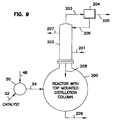
- a preferred combination reactor/top-mounted distillation column is depicted schematically.
- the prepolymer is fed to a static in-line mixer or other mixing mechanism (50) through a pipeline (48).
- a catalyst is added to the polylactic acid or prepolymer through a pipeline (52).
- the catalyzed prepolymer is then fed to the combined reactor/top-mounted distillation column (200) through a pipeline (54).
- lactide results in an approximate concentration of 5 weight % lactide within the reactor portion of the reactor with top-mounted distillation column (200).
- the lactide In the presence of heat, the lactide is vaporized within the lactide reactor with top-mounted distillation column (200) and travels directly as a vapor into the top-mounted distillation column indicated by (202). Within such distillation column (202) the crude lactide is refined and purified.
- a low-boiling overhead stream leaves the distillation column in a pipeline (203) to a condenser (204). A portion of the condensed low-boiling overhead stream is removed from the system via a pipeline (205) while a second portion of said stream is refluxed back to the distillation column through a pipeline (206).
- the low-boiling overhead stream is composed of water or solvent, some residual lactic acid and some lactide carry over.
- Components within the distillation column that boil at a temperature higher than lactide create a high-boiling bottoms stream which, in the present configuration, travels down distillation column (202) directly into the reactor with top-mounted distillation column (200) as generally indicated by (208) where it is further reacted to form additional lactide.
- a re-boil tray may optionally be located in the bottom portion of the top-mounted distillation column (202) to facilitate purification.
- the substantially purified lactide stream is removed as an intermediate-boiling sidedraw stream from distillation column (202) through a line (201).
- the substantially purified lactide may be cooled and/or fed to a polymerization process as disclosed above.
- a sidedraw stream may be withdrawn from the column in a pipeline (207) at a point where lactic acid and linear dimer are high in concentration.
- This stream may be recycled back to the reactor with top-mounted distillation column (200) or, alternatively, fed back to the catalyst-mixing mechanism (50) through a pipeline (48).
- the presence of dimer at a point above the point at which lactide is withdrawn as a sidedraw stream is due to ring-opening decomposition reactions.
- the polymerization process may be of any conventional design known to the art, such as that disclosed by J. Leenslag and A. Pennings, "Synthesis of High Molecular Weight Poly (L-lactide) Initiated with Tin 2-Ethylhexanoate", Makromol. Chem . , v. 188, pp. 1809-14 (1987) and F. Kohn et al., "The Ring-Opening Polymerization of D,L-Lactide in the Melt Initiated with Tetraphenyltin, J. Applied Polymer Science, v. 29, pp. 4265-77 (1984), which are incorporated herein by reference.
- An alternative source of crude lactic acid for the process disclosed above is an ester of lactic acid.
- Applicants have discovered that processing an ester of lactic acid to form a polylactide polymer requires alterations of the above-disclosed general process. These modifications or alternative processing steps are described below in detail. It is recognized, however, that the general disclosure utilizing lactic acid as the crude feed to the general overall process as disclosed in Figure 2 and Figure 9 and described in detail above, is equally applicable to the processes disclosed below with the modifications incorporated therein.
- esters of lactic acid suitable for use in the process of the present invention may generally be described by the formula: wherein R is a C 1 -C 8 linear or branched alkyl.
- Preferred esters of lactic acid include methyl lactate, ethyl lactate, propyl lactate, butyl lactate, isopropyl lactate, isobutyl lactate and mixtures thereof.
- the condensation of an ester of lactic acid results in formation of a low molecular weight prepolymer.
- the polymerization reaction is generally indicated by the formula below: While step n of said polymerization reaction is represented by:
- polymer chains may contain an ester end group wherein said polymer may be defined as a polylactic ester polymer.
- polylactic acid or polylactic acid molecules are defined herein to include polylactic acid molecules formed from the polymerization of lactic acid as disclosed previously and polylactic ester polymers as disclosed above produced from an ester of lactic acid feed.
- Catalysts such as those used in other polyester condensation and esterification reactions are also useful.
- Specific catalysts would include tin(II) ethylhexanoate, p-toluene sulfonic acid, Fascat® 9100 and Fascat® 9102 (Fascat® catalysts available commercially from Atochem North America Inc, Philadelphia, PA).
- Supported catalysts or solid catalysts with some acid functionality or Lewis acid functionality would also be useful. These would include the solid catalysts disclosed by Bellis et al. in PCT Application No. WO 92/00292, which is incorporated herein by reference.
- a preferred catalyst is, however, the supported polymeric resin catalysts available from Rohm and Haas commercially under the tradename Amberlyst® as a series of catalysts. Specific examples utilizing such Amberlyst® catalysts are outlined below. Also useful are the solid catalysts of the type described by Sir John Meurig Thomas in Scientific American , April 1992, pp. 112-118. Mineral acid catalysts are also known to catalyze the above esterification reactions and would be useful in these applications.
- an ester of lactic acid is fed to an evaporator (260) in a pipeline (250).
- a soluble homogeneous catalyst such as those outlined above is fed to the evaporator through a pipeline (251).
- the catalyst and ester of lactic acid could be fed together into a static mixer prior to being fed to the evaporator (260).
- the ester of lactic acid is heated, and the hydroxylic medium, within which the ester of lactic acid may be in solution, is evaporated.
- the ester of lactic acid may be without a hydroxylic medium.
- the evaporator (260) may be operated at atmospheric pressure or more preferably under reduced pressure to allow for lower temperature of operation and evaporation.
- the reactions to form lactide are continued, preferably under conditions of elevated temperature and reduced pressure.
- the mixture of lactide and polylactic acid within the lactide reactor (270) is removed through a pipeline (271) and fed to a distillation system (280).
- the mixture of lactide and polylactic acid is a crude lactide.
- the crude lactide will also contain low molecular weight oligomers of lactic acid or the ester of lactic acid, including DP2 and DP3.
- the crude lactide is purified.
- the purified lactide is removed as an intermediate-boiling sidedraw stream from the distillation system (280) through a pipeline (282). As disclosed in Figure 2, this purified lactide may be fed to a polymerization process.
- a low-boiling overhead stream leaves distillation system (280) through a pipeline (281) where it is condensed in a condenser (288) with a portion of the condensed low-boiling overhead stream being removed from the system through a pipeline (289) and the remainder utilized as a reflux stream back to distillation system (280) through a pipeline (290).
- the low-boiling overhead stream will contain components that are lower-boiling than lactide. They may include water, dimer of lactic acid and other oligomers, and a concentration of lactide. The concentration of lactide in the overhead stream will be varied depending on distillation system (280) operation.
- a high-boiling bottoms stream is removed from the distillation system (280) through a pipeline (283).
- This high-boiling bottoms stream will generally include those materials higher-boiling than lactide, along with a concentration of lactide which will vary depending upon the operation of distillation system (280).
- the high-boiling bottoms stream may be recycled back to the lactide reactor (270) via a pipeline (286) or, alternatively, to the evaporator (260) through a pipeline (287).
- other sidedraw streams may be removed from the distillation system (280). These are generally indicated by a pipeline (284) and a pipeline (285).
- these sidedraw streams may be located at a point in the distillation column where a component such as DP2 or the dimer of lactic acid is in high concentration and may be withdrawn from the distillation system (280) and recycled back to the lactide reactor (270) or evaporator (260).
- Figures 11 and 12 are directed to process modifications to remove catalysts from the crude lactide stream prior to purification.
- FIG 11 a preferred overall system utilizing an ester of lactic acid feed and a soluble homogeneous catalyst with the crude lactide being subjected to a flash distillation to remove said homogeneous catalyst prior to distillation of the lactide.
- An ester of lactic acid is fed to a combined evaporator/reactor (300) through a pipeline (302).
- the ester of lactic acid may be any mixture of esters of lactic acid and may also be in a hydroxylic medium as a solution.
- a catalyst is fed to the combined evaporator reactor (300) through a pipeline (301).
- This catalyst may be any acid-functional or Lewis acid-functional soluble catalyst as detailed above.
- the ester of lactic acid and soluble catalyst may be combined in a mixing mechanism or static mixer prior to being fed to the combined evaporator/reactor (300).
- sufficient residence time is allowed to both condense the ester of lactic acid to form a polylactic acid and to depolymerize the polylactic acid to form lactide.
- concentrations of the polylactic acid and lactide will depend upon temperature and residence time as the system approaches equilibrium as outlined above.
- Condensation reaction by-product of the general formula ROH is removed from the combined evaporator/reactor (300) through a pipeline (303) as a vapor and condensed in a condenser (304) with subsequent removal from the system in a pipeline (305).
- the lactide and polylactide reaction product or crude lactide which was formed in the combined evaporator reactor (300) is removed from said reactor (300) in a pipeline (306) and fed to a flash distillation system (310).
- the flash distillation system (310) is designed with minimum residence time and preferably low pressure operation to quickly flash a quantity of the lactide from the mixture.
- the soluble catalyst remains with the liquid stream which is removed from the bottom of the flash distillation system through a pipeline (328) and recycled back to the combined evaporator/reactor (300).
- the lactide which is flashed as a vapor in the flash distillation system (310) is removed through a pipeline (311) and fed to a distillation system (320). This stream contains lactide and some polylactic acid of low degree of polymerization and low boiling impurities.
- the distillation system (320) may be any distillation system as disclosed above as, for example, in Figure 10.
- the mixture of lactide and polylactic acid is a crude lactide.
- the crude lactide will also contain low molecular weight oligomers of lactic acid or the ester of lactic acid including DP2 and DP3.
- the crude lactide is purified.
- the purified lactide is removed as an intermediate-boiling sidedraw stream from the distillation system (320) through a pipeline (326). As disclosed in Figure 2, this purified lactide may be fed to a polymerization process.
- a low-boiling overhead stream leaves distillation system (320) through a pipeline (321) where it is condensed in a condenser (322) with a portion of the condensed low-boiling overhead stream being removed from the system through a pipeline (323) and the remainder utilized as a reflux stream back to distillation system (320) through a pipeline (324).
- the low-boiling overhead stream will contain components that are lower-boiling than lactide. They may include water, dimer of lactic acid and other oligomers, and a concentration of lactide. The concentration of lactide in the overhead stream will be varied depending on distillation system (280) operation.
- a high-boiling bottoms stream is removed from the distillation system (320) through a pipeline (327).
- This high-boiling bottoms stream will generally include those materials higher-boiling than lactide, along with a concentration of lactide which will vary depending upon the operation of distillation system (320).
- the high-boiling bottoms stream may be recycled back to the combined evaporator/reactor (300) via a pipeline (327).
- other sidedraw streams may be removed from the distillation system (320). These are generally indicated by a pipeline (329).
- these sidedraw streams may be located at a point in the distillation column where a component such as DP2 or the dimer of lactic acid is in high concentration and may be withdrawn from the distillation system (320) and recycled back to the combined evaporator/reactor (320).
- FIG. 12 is a preferred embodiment for utilizing an ester of lactic acid feed material to form polylactide without the instability created by the presence of a catalyst within the distillation system.
- a solid supported catalyst or solid catalyst is utilized in a catalyst bed reactor system (350).
- the catalyst bed reactor system may be filled with any solid supported catalyst or solid, insoluble catalyst as disclosed above which has an acid functionality or Lewis acid functionality.
- There are many ways in which to operate the catalyst bed reactor system which are generally known in the art and include a fixed bed, an ebbulated bed, or a fluidized bed system. Key to operation is preventing the catalyst from leaving the catalyst bed reactor (350) and entering the distillation system (360) as indicated in Figure 12. This is generally known in the art and may be accomplished utilizing screens and filters on the outlet from said catalyst bed reactor (350).
- the ester of lactic acid or the ester of lactic acid in hydroxylic medium is fed to the catalyst bed reactor system (350) through a pipeline (352).
- This material may be fed either as a liquid or a vapor.
- the above-stated reactions are allowed to occur in the presence of a solid supported or solid catalyst.
- the concentration of lactide and polylactide will vary, depending upon residence time within the catalyst bed system, the removal of condensation reaction by-product, the catalyst selected, along with temperature and pressure.
- the condensation reaction by-product may be flashed and removed through a pipeline (368) from the catalyst bed reactor system or, alternatively, may remain a liquid and be fed to the distillation system (360) through a pipeline (351).
- the mixture of lactide and polylactic acid leaving catalyst bed reactor (350) is a crude lactide.
- the crude lactide will also contain low molecular weight oligomers of lactic acid or the ester of lactic acid including DP2 and DP3, which are collectively referred to as, and included in, the definition of polylactic acid. It may also contain condensation reaction by-product.
- This material is fed to distillation system (360). Within the distillation system (360) the crude lactide is purified.
- the purified lactide is removed as an intermediate-boiling sidedraw stream from the distillation system (360) through a pipeline (365). As disclosed in Figure 2, this purified lactide may be fed to a polymerization process.
- a low-boiling overhead stream leaves distillation system (360) through a pipeline (361) where it is condensed in a condenser (362) with a portion of the condensed low-boiling overhead stream being removed from the system through a pipeline (367) and the remainder utilized as a reflux stream back to distillation system (360) through a pipeline (363).
- the low-boiling overhead stream will contain components that are lower-boiling than lactide. They may include water, dimer of lactic acid and other oligomers, and a concentration of lactide. The concentration of lactide in the overhead stream will be varied depending on distillation system (360) operation.
- a high-boiling bottoms stream is removed from the distillation system (360) through a pipeline (366).
- This high-boiling bottoms stream will generally include those materials higher-boiling than lactide, along with a concentration of lactide which will vary depending upon the operation of distillation system (360).
- the high-boiling bottoms stream may be recycled back to the catalyst bed reactor (350) via a pipeline (366).
- other sidedraw streams may be removed from the distillation system (360). These are generally indicated by a pipeline (369).
- these sidedraw streams may be located at a point in the distillation column where a component such as DP2 or the dimer of lactic acid is in high concentration and may be withdrawn from the distillation system (360) and recycled back to the catalyst bed reactor (350).
- a non-lactide monomer to the purified lactide leaving the distillation system (80).
- This co-monomer may be added via line (101).
- the co-monomers are fed to the polymerization reactor (110) and polymerized to form a co-polymer.
- Many co-polymers of polylactide are known to the art. These include P. Dave, N. Ashar, R. Gross, S. McCarthy, "Survey of Polymer Blends Containing Poly (3-hydroxybutyrate-co-16% hydroxyvalerate), Polymer Preparation, American Chemical Society, v. 31 (1), pp. 442-3 (1990); B. Riedl and R.
- Prud'ans Prud'ans, "Thermodynamic Study of Poly(vinyl chloride)-Polyester Blends by Inverse Gas Phase Chromatography", J. Polymer Science, Part B, vol. 24(11), pp. 2565-82 (1986); H. Younes and D. Cohn, "Phase Separation in Poly(ethylene glycol)/Poly(lactic acid) Blends, European Polymer J., v. 24(8), pp. 765-73 (1988); Smith et al. (European Patent Application, EP 209371, January 21, 1987); Pines et al. (European Patent Application EP 109197, May 23, 1984); J. Zhu, Y. Shao, W. Sui, S. Zhang, H. Xiao and X.
- Fluid transfer mechanisms disclosed throughout this detailed description would normally be a pump. However, Applicants recognize that through design choices other mechanisms for transfer, such as gravitational flow, may also be utilized.
- the crude lactic acids fed to this process (2) may be made up of L-lactic acid or D-lactic acid, or combinations thereof.
- the composition of the feed does not translate directly through the entire process to define the composition of the polymer product leaving the polymerization reactor (110) through line (108).
- the degree of racemization is defined herein by the percent conversion of the optical enantiomer that is present in excess of 50%.
- the optical composition of the lactide mixture is determined by the relative abundance of D- and L-lactic acid sub-units in the polylactic acid within the lactide reactor.
- the blend of lactide isomers used to produce the polymer affects the physical properties of the polymer, including the biodegradability.
- the evaporator (22) is operated to minimize residence time so that there is little or no effect on optical purity.
- the prepolymer reactor (38) is also operated to minimize racemization. This includes reducing the residence time within the reactor.
- the crude lactide produced in the lactide reactor (60) will be a mixture of the three possible lactides which may be generated from L- and D-lactic acid. These include L-lactide, D-lactide, and mesolactide.
- the concentration of catalyst added to static mixer (50) also affects the degree of racemization and composition of the crude lactide product.
- the catalyst concentration level is adjusted based on desired properties of the final polymer product.
- Example 12 Applicants have discovered, and detailed in Example 12, that the quality of the crude lactide charged to the distillation system has a significant effect on the operation of said system.
- acidic impurities such as lactic acid and low molecular weight oligomers, which are formed by ring opening reactions of lactic acid or water with lactide, can cause premature polymerization in the distillation system.
- side reactions may be controlled by partially condensing the crude vapor prior to feeding to distillation to remove impurities.
- the distillation system (80) may also be operated to control racemization of the lactide and other side reactions.
- this system is designed to minimize racemization by utilizing a packed column distillation system which minimizes liquid holdup, along with a thermal-siphon reboiler which limits residence time of the bottom liquids, and utilizing a minimum reflux ratio to further reduce holdup time in the column. It is, however, recognized that other distillation systems may be utilized with varying impact on the optical purity of the purified lactide and resultant polymer product.
- the distillation system (80) is utilized as a purification step for the lactide so that crystallization of the crude lactide is unnecessary in order to produce a lactide product of suitable purity for polymerization.
- the lactide reactor (60) is also designed in a preferred embodiment, maximizing surface area between liquid and vapor so that liquid lactide can more easily vaporize. This allows for rapid removal of the generated lactide, which in turn further drives the reaction.
- a system which utilizes purification steps other than crystallization increases yield.
- the use of distillation as a purification step also prevents the need to handle solids with the problems with equipment and contamination inherent in such operations.
- a catalyst with acid functionality whether in terms of a true acid which is a source of protons, or a Lewis acid which is a source of positive charge density, is used to facilitate the condensation reaction.
- the presence of the catalyst with acid functionality renders the crude lactide relatively unstable during purification by distillation.
- the decomposition of the lactide during purification is avoided by utilizing an insoluble, solid supported catalyst.
- a soluble homogenous catalyst may be utilized in forming the crude lactide, however, the crude lactide is then subjected to a flash distillation with the catalyst being removed in the bottoms high-boiling stream.
- Na 2 S was added at levels of 20, 200, and 1000 ppm to purified lactic acid (Purac heat stable grade) of composition 85% L-lactic acid and 15% water.
- the lactic acid was then polymerized to form PLA with a number average molecular weight of about 650 g/mol.
- H 2 S was removed under vacuum while the PLA was being formed, leaving Na + ions in solution.
- the PLA was then used to generate lactide at 10 mm Hg with 0.05 wt.% SnO catalyst (Aldrich cat. no. 24,464-3, Tin (II) oxide, 99 + %) and a constant heat input, allowing reactor temperature to float.
- the results are shown in the following table and in Figure 3: The table shows that although the addition of sodium had no effect on the lactide production rate or on the reaction temperature, it did have a pronounced effect on the amount of meso-lactide present in the crude product.
- a practical implication of this example is that it will be necessary in any continuous process, where management of optical composition is desired, to provide a mechanism for removing ionic impurities from the reactor.
- the ionic impurities will be present in all sources of lactic acid to some extent, and will concentrate in the liquid within the lactide reactor (reactor bottoms) over time.
- a purge stream is provided to accomplish this objective.
- An alternative would be to shut the system down periodically and dump or recycle the reactor bottoms.
- Lactide was generated from several samples of PLA (also known as polylactic acid or prepolymer) each sample having a different average molecular weight.
- the conditions under which the lactide was generated in each experiment include: 10 mm Hg pressure, 0.05 wt.% SnO as catalyst (same catalyst as Example 1), run to approximately 73% conversion of PLA to lactide, constant heat input and stirring speed.
- the reaction temperature was allowed to float, reaching the value necessary to dissipate the heat input. This method of running tends to give a constant lactide production rate, within limits.
- Lactide was produced using SnO catalyst (catalyst of Example 1) from PLA with a molecular weight of 650 g/mol at several catalyst levels and two pressures. The power input was held constant (Variac setting of 75) and the reaction temperature was allowed to seek an equilibrium level. The percentage meso in the crude lactide for each experiment is shown in the table below and graphically in Figure 5.
- catalyst levels above 0.1 wt.% lead to an increase in the content of meso-lactide, for both pressures studied. The increase occurs even though the overall lactide generation rate increases and the reaction temperature decreases. The content of meso-lactide also increases at very low concentrations of catalyst, resulting in a minimum for 0.02-0.10 wt.% SnO. In a preferred embodiment, catalyst concentrations may be varied depending on desired final polymer physical properties.
- Example 1 demonstrated that some form of purge of the liquid in the reactor (reactor bottoms) would probably be necessary for a continuous operation. This example demonstrates a surprising benefit if such purge stream is recycled back to the catalyst addition stage.
- PLA was produced from the same lactic acid used in Example 1, utilizing the same method. This was used to generate lactide at 1 mm Hg with 0.05 wt.% SnO as catalyst (catalyst of Example 1). The reaction was run to 72% conversion, at which point the lactide production rate had begun to decline significantly. The heat was turned off and the flask was cooled to 150°C under a nitrogen atmosphere. 390 gms of 88% L-lactic acid was added to the 80 gms of residue. The flask was adapted to generate a new batch of PLA, simulating the recycle of reactor bottoms to the evaporator section. The new PLA was heated under vacuum until the molecular weight was about 650 g/mol (by end group titration).
- a GPC (gel permeation chromatography) analysis showed that the reactor bottoms had been completely broken down and been reabsorbed into the PLA, with no sign of high molecular weight reactor bottoms.
- the lactide generation was rerun using the same conditions as before, and it was surprisingly found that the lactide production rate increased: from 0.86 hr -1 for the first run (prior to recycle) to 1.03 hr -1 for the second run (recycle, no additional catalyst).
- the reaction temperature was 213°C for the first run and 215°C for the second run.
- the composition of the crude lactide and of the reactor bottoms were similar for the two cases.
- the reactor bottoms is recycled to a point prior to the lactide reactor to increase overall yield from the lactic acid feed.
- the lactide is a mixture of 80% L- and 20% D,L-lactide, recrystallized to high purity.
- 40 gm of lactide is charged to a flask with magnetic stirring.
- a THF (Tetrahydrofuran, Burdick and Jackson, high purity, non-spectro) solution containing L-lactic acid, water, or both is added to the lactide.
- the flask is lowered into an oil bath at 140-160°C to melt and mix the monomer. This is held for five minutes after complete melting (about 15 minutes total).
- a starting sample is pulled for GC and/or water analysis.
- a catalyst solution of 10 wt. % tin(II) 2-ethylhexanoate Johnson Mathey Electronics, Tech.
- the samples are prepared for analysis by breaking the polymer out of the vials and dissolving in THF at room temperature on an orbital shaker (about 1-6 hours for 5 grams of polymer in 125 mls THF). The mixture is then diluted to 1% in THF and analyzed utilizing GPC analysis to determine the molecular weight and percent conversion.
- hydroxyl impurities are controlled to desired levels to control the physical properties of the resulting polymer product.
- PLA of 650 MW was heated at atmospheric pressure with either 0.00, 0.05, or 0.15 wt% SnO as a catalyst (Catalyst of Example 1).
- the mixtures were held at three different desired temperature for 20 minutes, at which time 10 wt% of purified L-lactide was added to the mixture with stirring.
- the vessel was fitted with a condenser to prevent the loss of water or other volatile components. Samples were removed from the reaction vessel at times ranging from 5 minutes to 450 minutes and were analyzed using an Ultrastyragel® 100A GPC column (Waters Chromatography, a division of Millipore Corp.) with THF as the mobile phase to determine the concentration of lactide.
- the concentration data were fit to a simple first order decay model using a non-linear regression software package (SAS Institute, Inc.) to determine the equilibrium values.
- the resulting projected values for the equilibrium concentrations of lactide are shown in the table below and plotted graphically in Figure 8. The results show the beneficial effect of rapid removal of lactide from the lactide reactor in preferred embodiments to further drive the lactide generation reaction.
- racemization occurs fastest in PLA which is exposed to catalyst.
- racemization is controlled in the lactide generating reactor.
- another area of racemization control will be the evaporators which are used to prepare PLA, because of the long residence times and the possible inclusion of catalyst and catalyzing impurities.
- the residence time of the lactide in the distillation column will be kept low, minimizing the potential for racemization.
- Lactide was produced from PLA at several catalyst levels and at two pressures to determine the effect of mass transfer.
- the catalyst was SnO (catalyst of Example 1) with constant heat input at a power setting on the Variac of 75%.
- the increased mass transfer efficiency at 1 mm Hg vs 10 mm Hg results in significantly higher net lactide production rates and a lower concentration of meso-lactide.
- the lactide reactor is operated under vacuum to facilitate mass transfer.
- Lactic acid was concentrated and polymerized to form low molecular weight polylactic acid (MW range of about 600-2200) and fed to a continuous pilot scale reactor for the production of lactide. At the end of 1-week of operation a sample of the reactor liquid was taken and analyzed for metals. The results are shown below.
- the metals profile clearly shows corrosion of the stainless steel reaction system, either in the formation of the prepolymer or in the lactide generating reactor.
- Lactide was produced in a continuous pilot plant at rates of 2-5 kg/hr.
- the starting materials were Purac lactic acid of about 85% concentration.
- a PLA prepolymer having a range of molecular weights from about 400-2000 MW was made batchwise by heating first at atmospheric pressure and then under vacuum. The prepolymer was used to supply the continuous feed to the lactide reactor. The reactor was run at a temperature of 220-240 °C and pressure of about 35 mm Hg.
- the sources of the PLA were: A) Purac heat stable grade lactic acid, B) a test sample of lactic acid from Lactech, Inc. which was produced by fermentation, and A/B) a 50/50 mix of the PLA produced from each of the previous two sources.
- Lactide was generated in a laboratory apparatus (three-neck flask with mechanical stirring, primary condenser operated at 85-100°C, and receiving flasks and traps) at constant temperature of 230°C and constant pressure of 10 mm Hg.
- Initial PLA charge was 360 gms of material having an average molecular weight of about 650.
- the catalyst charge was 0.045 wt% as Sn for each type of catalyst.
- PLA B is not as reactive toward lactide production as is PLA A.
- the effect is particularly pronounced with SnO catalyst.
- lactide can be produced from PLA B as fast as from PLA A if the SnO catalyst is pretreated by first producing a batch of lactide from PLA A.
- the table also shows that if the catalyst is pretreated by producing a batch of lactide from the blend A/B PLA then it is rendered ineffective and does not promote lactide production at high rates even from PIA A.
- the overhead fraction from example 12 was collected in three receivers, containing 14%, 36%, and 28% of the crude lactide charge, respectively.
- the first fraction contained over 5 wt% lactic acid and was discarded.
- Fractions 2 and 3 were combined and redistilled, yielding a lactide fraction with total acidic impurities of 4.4 milliequivalents/mol of lactide.
- This fraction was polymerized using the polymerization technique of example 5 (temperature 180°C, catalyst/monomer ratio 1:5000), yielding a polymer with number average molecular weight of 42,100 at 100% conversion and weight average molecular weight of 76,300. Actual conversion was 84.6% at 2 hours.
- Examples 22 and 23 give additional data on the course of a reaction and indicate that the distributions observed probably correspond to equilibrium.
- Example 24 demonstrates probable control of polymer molecular weight when utilizing a lactate ester by controlling impurities as was previously shown above when utilizing lactic acid and accompanying impurities.
- Examples 25-27 demonstrate the use of heterogenous or solid, supported catalysts for the production of lactide from an ester of lactic acid.
- Methyl lactate, ethyl lactate, and butyl lactate were supplied by PURAC America, Inc. under the tradename PURASOLV and used without further purification.
- lactic acid (heat-stable grade), supplied by PURAC, was heated at atmospheric pressure under a nitrogen atmosphere to a temperature of 180°C. No catalyst was added. 600 grams of overhead, greater than 99% water, was removed during this phase. The material was allowed to cool. Heating was resumed with the flask at a pressure of 50 mm Hg. A slight boil was maintained as the material was heated to 180°C, removing another 135 grams of material. The lactic acid content of the second overhead is estimated to be about 2%, with the remaining material being water. Total heating time for the atmospheric phase was 5.5 hours, and for the vacuum phase was 3.5 hours. The material was a light tan color. Titration of the acid group content showed the material to have an average number average molecular weight of 650 g/mol, corresponding to 9 repeat units. Several samples made following the same procedure were tested and shown to have a lactide concentration of less than 5 weight percent.
- ethyl lactate 250 grams were heated with 0.5% p-toluene sulfonic acid catalyst at atmospheric pressure under a nitrogen atmosphere to a temperature of 145°C, for 3 hours. The material initially boiled at 140°C. The overhead consisted primarily of ethyl lactate and the expected condensation byproduct ethanol. The pot material was colorless and contained 45% ethyl lactate, undetermined oligomers, and 2.0% D- and/or L-lactide.
- the material was heated to 200°C and the pressure reduced to 10 mm Hg.
- the distillate was partially condensed to form a product fraction and the remaining vapors were further condensed to form an overhead fraction.
- the methyl lactate content of the second overhead is estimated to be about 40%, with the remaining material being methanol. Total heating time for this phase was 11.25 hours. The material was allowed to cool, and the catalyst exchanged with fresh Amberlyst® 36 resin at 5.5 wt.%. Heating was resumed with the flask at a pressure of 25 mm Hg. A slight boil was maintained as the material was heated to 115°C, removing another 120 ml of material. The methyl lactate content of the third overhead is estimated to be about 50%, with the remaining material being methanol. Total heating time for this phase was 6 hours. The material was a dark orange color.
- composition of the pot was monitored as a function of time, with the results shown below. These concentrations are calculated upon correction for response factors as detailed above.
- a ring-opening reaction was performed using the heterogenous catalyst, Amberlyst® 36.
- the conditions are similar to those of Example 23, which used a homogenous catalyst.
Landscapes
- Chemical & Material Sciences (AREA)
- Health & Medical Sciences (AREA)
- Chemical Kinetics & Catalysis (AREA)
- Medicinal Chemistry (AREA)
- Polymers & Plastics (AREA)
- Organic Chemistry (AREA)
- Polyesters Or Polycarbonates (AREA)
- Heterocyclic Compounds That Contain Two Or More Ring Oxygen Atoms (AREA)
Applications Claiming Priority (11)
| Application Number | Priority Date | Filing Date | Title |
|---|---|---|---|
| US825059 | 1992-01-24 | ||
| US07/825,059 US5142023A (en) | 1992-01-24 | 1992-01-24 | Continuous process for manufacture of lactide polymers with controlled optical purity |
| US926901 | 1992-08-07 | ||
| US07/927,149 US5247058A (en) | 1992-01-24 | 1992-08-07 | Continuous process for manufacture of lactide polymers with controlled optical purity |
| US927149 | 1992-08-07 | ||
| US07/926,901 US5258488A (en) | 1992-01-24 | 1992-08-07 | Continuous process for manufacture of lactide polymers with controlled optical purity |
| US07/935,566 US5247059A (en) | 1992-01-24 | 1992-08-24 | Continuous process for the manufacture of a purified lactide from esters of lactic acid |
| US07/935,059 US5274073A (en) | 1992-01-24 | 1992-08-24 | Continuous process for manufacture of a purified lactide |
| US935566 | 1992-08-24 | ||
| EP93903632A EP0623153A1 (de) | 1992-01-24 | 1993-01-22 | Kontinuierliches verfahren zur herstellung von lactidpolymeren mit verbesserten reinigungsprozessen |
| US935059 | 1997-09-22 |
Related Parent Applications (2)
| Application Number | Title | Priority Date | Filing Date |
|---|---|---|---|
| EP93903632A Division EP0623153A1 (de) | 1992-01-24 | 1993-01-22 | Kontinuierliches verfahren zur herstellung von lactidpolymeren mit verbesserten reinigungsprozessen |
| EP93903632.3 Division | 1993-08-08 |
Related Child Applications (1)
| Application Number | Title | Priority Date | Filing Date |
|---|---|---|---|
| EP08159767.6 Division-Into | 2008-07-04 |
Publications (3)
| Publication Number | Publication Date |
|---|---|
| EP0893462A2 true EP0893462A2 (de) | 1999-01-27 |
| EP0893462A3 EP0893462A3 (de) | 1999-10-20 |
| EP0893462B1 EP0893462B1 (de) | 2010-05-05 |
Family
ID=27542241
Family Applications (2)
| Application Number | Title | Priority Date | Filing Date |
|---|---|---|---|
| EP93903632A Ceased EP0623153A1 (de) | 1992-01-24 | 1993-01-22 | Kontinuierliches verfahren zur herstellung von lactidpolymeren mit verbesserten reinigungsprozessen |
| EP98203427A Expired - Lifetime EP0893462B1 (de) | 1992-01-24 | 1993-01-22 | Kontinuierliches Verfahren zur Herstellung von Lactid und Lactid Polymeren |
Family Applications Before (1)
| Application Number | Title | Priority Date | Filing Date |
|---|---|---|---|
| EP93903632A Ceased EP0623153A1 (de) | 1992-01-24 | 1993-01-22 | Kontinuierliches verfahren zur herstellung von lactidpolymeren mit verbesserten reinigungsprozessen |
Country Status (14)
| Country | Link |
|---|---|
| EP (2) | EP0623153A1 (de) |
| JP (1) | JP3258324B2 (de) |
| KR (1) | KR100261850B1 (de) |
| AT (1) | ATE466897T1 (de) |
| AU (1) | AU677174B2 (de) |
| BR (1) | BR9305788A (de) |
| CA (1) | CA2128509C (de) |
| DE (1) | DE69334330D1 (de) |
| ES (1) | ES2345307T3 (de) |
| FI (1) | FI113661B (de) |
| MX (1) | MX9300333A (de) |
| NO (1) | NO309530B1 (de) |
| NZ (1) | NZ249033A (de) |
| WO (1) | WO1993015127A1 (de) |
Cited By (6)
| Publication number | Priority date | Publication date | Assignee | Title |
|---|---|---|---|---|
| EP2031009A1 (de) * | 2007-09-03 | 2009-03-04 | Uhde Inventa-Fischer GmbH | Reinigungsvorrichtung zur Abtrennung von Dilactid aus Stoffgemischen, Polymerisationsvorrichtung, Verfahren zur Abtrennung von Dilactid aus Stoffgemischen sowie Verwendung |
| EP2128152A1 (de) | 2008-04-16 | 2009-12-02 | Jungbunzlauer Austria Ag | Verfahren zur Reinigung zyklischer Diester der L-bzw. D-Milchsäure |
| CN101696203B (zh) * | 2009-10-26 | 2013-02-06 | 江苏科技大学 | 从粗l-丙交酯连续精制l-丙交酯的方法 |
| EP2725019A1 (de) | 2012-10-26 | 2014-04-30 | Uhde Inventa-Fischer GmbH | Verfahren zur Herstellung cyclischer Diester, insbesondere Dilactid |
| WO2016174161A1 (en) | 2015-04-30 | 2016-11-03 | Purac Biochem Bv | Method and device for manufacturing lactide |
| CN110652946A (zh) * | 2019-09-24 | 2020-01-07 | 安徽神剑新材料股份有限公司 | 一种聚酯树脂生产过程中顶温控制系统及方法 |
Families Citing this family (118)
| Publication number | Priority date | Publication date | Assignee | Title |
|---|---|---|---|---|
| US6326458B1 (en) * | 1992-01-24 | 2001-12-04 | Cargill, Inc. | Continuous process for the manufacture of lactide and lactide polymers |
| JP2909873B2 (ja) | 1993-08-30 | 1999-06-23 | 株式会社巴川製紙所 | 電子写真用トナーおよびその製造方法 |
| US5521278A (en) * | 1994-08-18 | 1996-05-28 | Ecological Chemical Products | Integrated process for the manufacture of lactide |
| JP3301311B2 (ja) * | 1996-05-24 | 2002-07-15 | 株式会社神戸製鋼所 | 2−ヒドロキシカルボン酸オリゴマーの連続製造方法 |
| JPH10109983A (ja) * | 1996-10-04 | 1998-04-28 | Mitsubishi Gas Chem Co Inc | 環状エステルの製造方法および精製方法 |
| JP4284709B2 (ja) * | 1996-12-25 | 2009-06-24 | トヨタ自動車株式会社 | 乳酸系副産物の再生利用法 |
| DE60014408T2 (de) | 1999-06-18 | 2005-11-17 | Toray Industries, Inc. | Polymilchsäureharz, daraus enthaktene Textilprodukte und Verfahren zur Herstellung von Textilprodukten |
| FR2802923B1 (fr) | 1999-12-28 | 2002-03-08 | Roquette Freres | Procede de preparation d'une composition d'ester d'acide lactique et son utilisation en tant que solvant |
| CA2423727C (en) * | 2001-01-31 | 2007-06-05 | Toyota Jidosha Kabushiki Kaisha | Process for producing lactide and process for producing polylactic acid from fermented lactic acid employed as starting material |
| US7080688B2 (en) | 2003-08-14 | 2006-07-25 | Halliburton Energy Services, Inc. | Compositions and methods for degrading filter cake |
| US7168489B2 (en) | 2001-06-11 | 2007-01-30 | Halliburton Energy Services, Inc. | Orthoester compositions and methods for reducing the viscosified treatment fluids |
| US7140438B2 (en) | 2003-08-14 | 2006-11-28 | Halliburton Energy Services, Inc. | Orthoester compositions and methods of use in subterranean applications |
| US7343973B2 (en) | 2002-01-08 | 2008-03-18 | Halliburton Energy Services, Inc. | Methods of stabilizing surfaces of subterranean formations |
| US7216711B2 (en) | 2002-01-08 | 2007-05-15 | Halliburton Eenrgy Services, Inc. | Methods of coating resin and blending resin-coated proppant |
| US7267171B2 (en) | 2002-01-08 | 2007-09-11 | Halliburton Energy Services, Inc. | Methods and compositions for stabilizing the surface of a subterranean formation |
| BE1015060A3 (fr) * | 2002-08-06 | 2004-09-07 | Brussels Biotech Nv Sa | Procede de production de polylactide au depart d'une solution d'acide lactique ou d'un de ses derives. |
| US7622546B2 (en) * | 2002-10-08 | 2009-11-24 | Kureha Corporation | Production process of aliphatic polyester |
| US20040211561A1 (en) | 2003-03-06 | 2004-10-28 | Nguyen Philip D. | Methods and compositions for consolidating proppant in fractures |
| US7114570B2 (en) | 2003-04-07 | 2006-10-03 | Halliburton Energy Services, Inc. | Methods and compositions for stabilizing unconsolidated subterranean formations |
| US6978836B2 (en) | 2003-05-23 | 2005-12-27 | Halliburton Energy Services, Inc. | Methods for controlling water and particulate production |
| US7413010B2 (en) | 2003-06-23 | 2008-08-19 | Halliburton Energy Services, Inc. | Remediation of subterranean formations using vibrational waves and consolidating agents |
| US7114560B2 (en) | 2003-06-23 | 2006-10-03 | Halliburton Energy Services, Inc. | Methods for enhancing treatment fluid placement in a subterranean formation |
| US7013976B2 (en) | 2003-06-25 | 2006-03-21 | Halliburton Energy Services, Inc. | Compositions and methods for consolidating unconsolidated subterranean formations |
| US7178596B2 (en) | 2003-06-27 | 2007-02-20 | Halliburton Energy Services, Inc. | Methods for improving proppant pack permeability and fracture conductivity in a subterranean well |
| US7032663B2 (en) | 2003-06-27 | 2006-04-25 | Halliburton Energy Services, Inc. | Permeable cement and sand control methods utilizing permeable cement in subterranean well bores |
| US7228904B2 (en) | 2003-06-27 | 2007-06-12 | Halliburton Energy Services, Inc. | Compositions and methods for improving fracture conductivity in a subterranean well |
| US7044224B2 (en) | 2003-06-27 | 2006-05-16 | Halliburton Energy Services, Inc. | Permeable cement and methods of fracturing utilizing permeable cement in subterranean well bores |
| US7036587B2 (en) | 2003-06-27 | 2006-05-02 | Halliburton Energy Services, Inc. | Methods of diverting treating fluids in subterranean zones and degradable diverting materials |
| US7044220B2 (en) | 2003-06-27 | 2006-05-16 | Halliburton Energy Services, Inc. | Compositions and methods for improving proppant pack permeability and fracture conductivity in a subterranean well |
| US7021379B2 (en) | 2003-07-07 | 2006-04-04 | Halliburton Energy Services, Inc. | Methods and compositions for enhancing consolidation strength of proppant in subterranean fractures |
| US7066258B2 (en) | 2003-07-08 | 2006-06-27 | Halliburton Energy Services, Inc. | Reduced-density proppants and methods of using reduced-density proppants to enhance their transport in well bores and fractures |
| US7497278B2 (en) | 2003-08-14 | 2009-03-03 | Halliburton Energy Services, Inc. | Methods of degrading filter cakes in a subterranean formation |
| US7017665B2 (en) | 2003-08-26 | 2006-03-28 | Halliburton Energy Services, Inc. | Strengthening near well bore subterranean formations |
| US7237609B2 (en) | 2003-08-26 | 2007-07-03 | Halliburton Energy Services, Inc. | Methods for producing fluids from acidized and consolidated portions of subterranean formations |
| US7059406B2 (en) | 2003-08-26 | 2006-06-13 | Halliburton Energy Services, Inc. | Production-enhancing completion methods |
| US7156194B2 (en) | 2003-08-26 | 2007-01-02 | Halliburton Energy Services, Inc. | Methods of drilling and consolidating subterranean formation particulate |
| US6997259B2 (en) | 2003-09-05 | 2006-02-14 | Halliburton Energy Services, Inc. | Methods for forming a permeable and stable mass in a subterranean formation |
| US7032667B2 (en) | 2003-09-10 | 2006-04-25 | Halliburtonn Energy Services, Inc. | Methods for enhancing the consolidation strength of resin coated particulates |
| US7021377B2 (en) | 2003-09-11 | 2006-04-04 | Halliburton Energy Services, Inc. | Methods of removing filter cake from well producing zones |
| US7674753B2 (en) | 2003-09-17 | 2010-03-09 | Halliburton Energy Services, Inc. | Treatment fluids and methods of forming degradable filter cakes comprising aliphatic polyester and their use in subterranean formations |
| US7829507B2 (en) | 2003-09-17 | 2010-11-09 | Halliburton Energy Services Inc. | Subterranean treatment fluids comprising a degradable bridging agent and methods of treating subterranean formations |
| US7833944B2 (en) | 2003-09-17 | 2010-11-16 | Halliburton Energy Services, Inc. | Methods and compositions using crosslinked aliphatic polyesters in well bore applications |
| US7345011B2 (en) | 2003-10-14 | 2008-03-18 | Halliburton Energy Services, Inc. | Methods for mitigating the production of water from subterranean formations |
| US7063150B2 (en) | 2003-11-25 | 2006-06-20 | Halliburton Energy Services, Inc. | Methods for preparing slurries of coated particulates |
| US7195068B2 (en) | 2003-12-15 | 2007-03-27 | Halliburton Energy Services, Inc. | Filter cake degradation compositions and methods of use in subterranean operations |
| US7131493B2 (en) | 2004-01-16 | 2006-11-07 | Halliburton Energy Services, Inc. | Methods of using sealants in multilateral junctions |
| US7096947B2 (en) | 2004-01-27 | 2006-08-29 | Halliburton Energy Services, Inc. | Fluid loss control additives for use in fracturing subterranean formations |
| US7036586B2 (en) | 2004-01-30 | 2006-05-02 | Halliburton Energy Services, Inc. | Methods of cementing in subterranean formations using crack resistant cement compositions |
| US7204312B2 (en) | 2004-01-30 | 2007-04-17 | Halliburton Energy Services, Inc. | Compositions and methods for the delivery of chemical components in subterranean well bores |
| US7156174B2 (en) | 2004-01-30 | 2007-01-02 | Halliburton Energy Services, Inc. | Contained micro-particles for use in well bore operations |
| US7211547B2 (en) | 2004-03-03 | 2007-05-01 | Halliburton Energy Services, Inc. | Resin compositions and methods of using such resin compositions in subterranean applications |
| US7063151B2 (en) | 2004-03-05 | 2006-06-20 | Halliburton Energy Services, Inc. | Methods of preparing and using coated particulates |
| US7172022B2 (en) | 2004-03-17 | 2007-02-06 | Halliburton Energy Services, Inc. | Cement compositions containing degradable materials and methods of cementing in subterranean formations |
| US7541318B2 (en) | 2004-05-26 | 2009-06-02 | Halliburton Energy Services, Inc. | On-the-fly preparation of proppant and its use in subterranean operations |
| US7299875B2 (en) | 2004-06-08 | 2007-11-27 | Halliburton Energy Services, Inc. | Methods for controlling particulate migration |
| US7073581B2 (en) | 2004-06-15 | 2006-07-11 | Halliburton Energy Services, Inc. | Electroconductive proppant compositions and related methods |
| US7547665B2 (en) | 2005-04-29 | 2009-06-16 | Halliburton Energy Services, Inc. | Acidic treatment fluids comprising scleroglucan and/or diutan and associated methods |
| US7621334B2 (en) | 2005-04-29 | 2009-11-24 | Halliburton Energy Services, Inc. | Acidic treatment fluids comprising scleroglucan and/or diutan and associated methods |
| US7475728B2 (en) | 2004-07-23 | 2009-01-13 | Halliburton Energy Services, Inc. | Treatment fluids and methods of use in subterranean formations |
| US7299869B2 (en) | 2004-09-03 | 2007-11-27 | Halliburton Energy Services, Inc. | Carbon foam particulates and methods of using carbon foam particulates in subterranean applications |
| US7255169B2 (en) | 2004-09-09 | 2007-08-14 | Halliburton Energy Services, Inc. | Methods of creating high porosity propped fractures |
| US7281580B2 (en) | 2004-09-09 | 2007-10-16 | Halliburton Energy Services, Inc. | High porosity fractures and methods of creating high porosity fractures |
| US7413017B2 (en) | 2004-09-24 | 2008-08-19 | Halliburton Energy Services, Inc. | Methods and compositions for inducing tip screenouts in frac-packing operations |
| US7553800B2 (en) | 2004-11-17 | 2009-06-30 | Halliburton Energy Services, Inc. | In-situ filter cake degradation compositions and methods of use in subterranean formations |
| US7281581B2 (en) | 2004-12-01 | 2007-10-16 | Halliburton Energy Services, Inc. | Methods of hydraulic fracturing and of propping fractures in subterranean formations |
| US7398825B2 (en) | 2004-12-03 | 2008-07-15 | Halliburton Energy Services, Inc. | Methods of controlling sand and water production in subterranean zones |
| US7273099B2 (en) | 2004-12-03 | 2007-09-25 | Halliburton Energy Services, Inc. | Methods of stimulating a subterranean formation comprising multiple production intervals |
| US7334635B2 (en) | 2005-01-14 | 2008-02-26 | Halliburton Energy Services, Inc. | Methods for fracturing subterranean wells |
| US8030249B2 (en) | 2005-01-28 | 2011-10-04 | Halliburton Energy Services, Inc. | Methods and compositions relating to the hydrolysis of water-hydrolysable materials |
| US20060169182A1 (en) | 2005-01-28 | 2006-08-03 | Halliburton Energy Services, Inc. | Methods and compositions relating to the hydrolysis of water-hydrolysable materials |
| US7267170B2 (en) | 2005-01-31 | 2007-09-11 | Halliburton Energy Services, Inc. | Self-degrading fibers and associated methods of use and manufacture |
| US7497258B2 (en) | 2005-02-01 | 2009-03-03 | Halliburton Energy Services, Inc. | Methods of isolating zones in subterranean formations using self-degrading cement compositions |
| US7353876B2 (en) | 2005-02-01 | 2008-04-08 | Halliburton Energy Services, Inc. | Self-degrading cement compositions and methods of using self-degrading cement compositions in subterranean formations |
| US7334636B2 (en) | 2005-02-08 | 2008-02-26 | Halliburton Energy Services, Inc. | Methods of creating high-porosity propped fractures using reticulated foam |
| US7506689B2 (en) | 2005-02-22 | 2009-03-24 | Halliburton Energy Services, Inc. | Fracturing fluids comprising degradable diverting agents and methods of use in subterranean formations |
| US7216705B2 (en) | 2005-02-22 | 2007-05-15 | Halliburton Energy Services, Inc. | Methods of placing treatment chemicals |
| US7318473B2 (en) | 2005-03-07 | 2008-01-15 | Halliburton Energy Services, Inc. | Methods relating to maintaining the structural integrity of deviated well bores |
| US7448451B2 (en) | 2005-03-29 | 2008-11-11 | Halliburton Energy Services, Inc. | Methods for controlling migration of particulates in a subterranean formation |
| US7608567B2 (en) | 2005-05-12 | 2009-10-27 | Halliburton Energy Services, Inc. | Degradable surfactants and methods for use |
| US7662753B2 (en) | 2005-05-12 | 2010-02-16 | Halliburton Energy Services, Inc. | Degradable surfactants and methods for use |
| US7318474B2 (en) | 2005-07-11 | 2008-01-15 | Halliburton Energy Services, Inc. | Methods and compositions for controlling formation fines and reducing proppant flow-back |
| US7484564B2 (en) | 2005-08-16 | 2009-02-03 | Halliburton Energy Services, Inc. | Delayed tackifying compositions and associated methods involving controlling particulate migration |
| US7595280B2 (en) | 2005-08-16 | 2009-09-29 | Halliburton Energy Services, Inc. | Delayed tackifying compositions and associated methods involving controlling particulate migration |
| US7461697B2 (en) | 2005-11-21 | 2008-12-09 | Halliburton Energy Services, Inc. | Methods of modifying particulate surfaces to affect acidic sites thereon |
| US7431088B2 (en) | 2006-01-20 | 2008-10-07 | Halliburton Energy Services, Inc. | Methods of controlled acidization in a wellbore |
| US7407010B2 (en) | 2006-03-16 | 2008-08-05 | Halliburton Energy Services, Inc. | Methods of coating particulates |
| US7608566B2 (en) | 2006-03-30 | 2009-10-27 | Halliburton Energy Services, Inc. | Degradable particulates as friction reducers for the flow of solid particulates and associated methods of use |
| US7237610B1 (en) | 2006-03-30 | 2007-07-03 | Halliburton Energy Services, Inc. | Degradable particulates as friction reducers for the flow of solid particulates and associated methods of use |
| US7500521B2 (en) | 2006-07-06 | 2009-03-10 | Halliburton Energy Services, Inc. | Methods of enhancing uniform placement of a resin in a subterranean formation |
| US8329621B2 (en) | 2006-07-25 | 2012-12-11 | Halliburton Energy Services, Inc. | Degradable particulates and associated methods |
| US7455112B2 (en) | 2006-09-29 | 2008-11-25 | Halliburton Energy Services, Inc. | Methods and compositions relating to the control of the rates of acid-generating compounds in acidizing operations |
| US7686080B2 (en) | 2006-11-09 | 2010-03-30 | Halliburton Energy Services, Inc. | Acid-generating fluid loss control additives and associated methods |
| NL2000454C1 (nl) | 2006-11-28 | 2008-01-02 | Purac Biochem Bv | Stabiele lactidedeeltjes. |
| US20080146822A1 (en) | 2006-11-28 | 2008-06-19 | Purac Biochem B.V. | Stable lactide particles |
| JP4427571B2 (ja) * | 2007-11-07 | 2010-03-10 | 株式会社日立プラントテクノロジー | ポリマー合成に関する装置および方法 |
| AT506038B1 (de) | 2007-11-14 | 2015-02-15 | Jungbunzlauer Austria Ag | Verfahren zur herstellung zyklischer diester von l-, d- und d,l-milchsäure |
| US8006760B2 (en) * | 2008-04-10 | 2011-08-30 | Halliburton Energy Services, Inc. | Clean fluid systems for partial monolayer fracturing |
| US7906464B2 (en) | 2008-05-13 | 2011-03-15 | Halliburton Energy Services, Inc. | Compositions and methods for the removal of oil-based filtercakes |
| KR101012483B1 (ko) * | 2008-07-08 | 2011-02-09 | 김용환 | 효소 전환반응을 이용한 광학순수형 락티드 제조방법 및광학순수형 유산 또는 알킬 락테이트의 분리방법 |
| JP5077170B2 (ja) | 2008-09-22 | 2012-11-21 | 株式会社日立プラントテクノロジー | ポリヒドロキシカルボン酸の製造方法 |
| US7833943B2 (en) | 2008-09-26 | 2010-11-16 | Halliburton Energy Services Inc. | Microemulsifiers and methods of making and using same |
| EP2406245B1 (de) * | 2009-03-13 | 2014-01-08 | NatureWorks LLC | Rückgewinnung von milchsäurewerten aus einem meso-lactidstrom |
| US8082992B2 (en) | 2009-07-13 | 2011-12-27 | Halliburton Energy Services, Inc. | Methods of fluid-controlled geometry stimulation |
| JP5548271B2 (ja) * | 2009-09-14 | 2014-07-16 | ハギンズ,バリー | 湿式排煙脱硫方法 |
| BRPI1004962A2 (pt) * | 2010-08-20 | 2012-05-29 | Companhia Refinadora Da Amazonia | processo de produção de poli (ácido lático ) e reatores para utilização no referido processo |
| JP2012097224A (ja) | 2010-11-04 | 2012-05-24 | Hitachi Plant Technologies Ltd | ポリヒドロキシカルボン酸の製造装置および製造方法 |
| ES2981179T3 (es) | 2011-08-19 | 2024-10-07 | Uhde Inventa Fischer Gmbh | Procedimiento y dispositivo para la recuperación de lactida de polilactida o glicolida de poliglicolida |
| KR101434462B1 (ko) * | 2012-12-26 | 2014-08-26 | 한국화학연구원 | 락타이드의 회분식 증류정제장치 및 이를 이용한 락타이드의 증류정제방법 |
| EP2876124B1 (de) * | 2013-11-20 | 2019-01-09 | Uhde Inventa-Fischer GmbH | Verfahren sowie vorrichtung zur herstellung einer kristallisierbaren polymilchsäuremischung sowie polymilchsäuremischung |
| CN106414547B (zh) * | 2013-12-10 | 2018-09-04 | 富特罗股份有限公司 | 用于生产聚丙交酯的改进方法 |
| EP3056490A1 (de) * | 2015-02-13 | 2016-08-17 | PURAC Biochem BV | Verfahren zur Herstellung von Lactid |
| KR101780779B1 (ko) | 2015-09-24 | 2017-09-21 | 롯데케미칼 주식회사 | 고순도 락타이드의 제조 방법 |
| KR101704563B1 (ko) | 2015-10-12 | 2017-02-08 | 한국화학연구원 | 락타이드 정제공정을 이용한 락타이드 제조방법 및 제조장치 |
| KR20190018715A (ko) * | 2016-06-20 | 2019-02-25 | 토탈 리서치 앤드 테크놀로지 펠루이 | 회수된 물에 의한 올리고머 및 촉매의 가수분해를 이용한 단일 단계 락티드 제조 방법 |
| EP3406605B1 (de) * | 2017-05-22 | 2022-04-20 | NatureWorks LLC | Verfahren zur herstellung von lactid mit rekristallisierung und wiederverwendung von meso-lactid |
| US20240043397A1 (en) * | 2020-12-24 | 2024-02-08 | Polywin Pte., Ltd. | Process for the production of lactide |
| AU2021428925B2 (en) * | 2021-02-22 | 2024-06-13 | Polywin Pte. Ltd. | Method and device for the production of lactide |
| KR102855131B1 (ko) | 2021-10-15 | 2025-09-03 | 주식회사 엘지화학 | 아크릴산 제조방법 |
Citations (2)
| Publication number | Priority date | Publication date | Assignee | Title |
|---|---|---|---|---|
| EP0275581A1 (de) | 1986-12-19 | 1988-07-27 | Akzo N.V. | Herstellung von Polymilchsäure und Copolymeren daraus |
| US5053485A (en) | 1987-10-28 | 1991-10-01 | C.C.A. Biochem B.V. | Polymer lactide, method for preparing it and a composition containing it |
Family Cites Families (4)
| Publication number | Priority date | Publication date | Assignee | Title |
|---|---|---|---|---|
| US1995970A (en) * | 1931-04-04 | 1935-03-26 | Du Pont | Polymeric lactide resin |
| DE3708915C2 (de) * | 1987-03-19 | 1996-04-04 | Boehringer Ingelheim Kg | Verfahren zur Herstellung von Lactid |
| EP0261572A1 (de) * | 1986-09-20 | 1988-03-30 | Boehringer Ingelheim Kg | Verfahren zur Herstellung von Lactid |
| WO1988010260A1 (fr) * | 1987-06-16 | 1988-12-29 | Boehringer Ingelheim Kg | ''meso-lactide'' et son procede de preparation |
-
1993
- 1993-01-22 AT AT98203427T patent/ATE466897T1/de not_active IP Right Cessation
- 1993-01-22 EP EP93903632A patent/EP0623153A1/de not_active Ceased
- 1993-01-22 KR KR1019940702555A patent/KR100261850B1/ko not_active Expired - Fee Related
- 1993-01-22 JP JP51333593A patent/JP3258324B2/ja not_active Expired - Fee Related
- 1993-01-22 NZ NZ249033A patent/NZ249033A/en not_active IP Right Cessation
- 1993-01-22 CA CA002128509A patent/CA2128509C/en not_active Expired - Fee Related
- 1993-01-22 WO PCT/US1993/000568 patent/WO1993015127A1/en not_active Ceased
- 1993-01-22 EP EP98203427A patent/EP0893462B1/de not_active Expired - Lifetime
- 1993-01-22 ES ES98203427T patent/ES2345307T3/es not_active Expired - Lifetime
- 1993-01-22 AU AU34821/93A patent/AU677174B2/en not_active Ceased
- 1993-01-22 DE DE69334330T patent/DE69334330D1/de not_active Expired - Lifetime
- 1993-01-22 MX MX9300333A patent/MX9300333A/es unknown
- 1993-01-22 BR BR9305788A patent/BR9305788A/pt not_active IP Right Cessation
-
1994
- 1994-07-21 NO NO942728A patent/NO309530B1/no not_active IP Right Cessation
- 1994-07-22 FI FI943487A patent/FI113661B/fi not_active Application Discontinuation
Patent Citations (3)
| Publication number | Priority date | Publication date | Assignee | Title |
|---|---|---|---|---|
| EP0275581A1 (de) | 1986-12-19 | 1988-07-27 | Akzo N.V. | Herstellung von Polymilchsäure und Copolymeren daraus |
| US4797468A (en) | 1986-12-19 | 1989-01-10 | Akzo N.V. | Preparation of polylactic acid and copolymers of lactic acids |
| US5053485A (en) | 1987-10-28 | 1991-10-01 | C.C.A. Biochem B.V. | Polymer lactide, method for preparing it and a composition containing it |
Non-Patent Citations (1)
| Title |
|---|
| LIPINSKY, E.S.; SINCLAIR, R.G.: "is a lactic acid a commodity chemical?", CHEM. ENG. PROGRESS, August 1986 (1986-08-01), pages 26 - 32, XP002097228 |
Cited By (15)
| Publication number | Priority date | Publication date | Assignee | Title |
|---|---|---|---|---|
| US8569517B2 (en) | 2007-09-03 | 2013-10-29 | Uhde Inventa-Fischer Gmbh | Cleaning device for separating dilactide from mixtures, polymerisation device, method for separating dilactide from mixtures and use thereof |
| KR101499276B1 (ko) * | 2007-09-03 | 2015-03-05 | 우데 인벤타-피셔 게엠바하 | 재료 혼합물로부터 디락티드를 분리하기 위한 세척장치, 중합장치, 재료 혼합물로부터 디락티드를 분리하기 위한 방법 및 이들의 용도 |
| CN101821315B (zh) * | 2007-09-03 | 2012-10-31 | 乌德伊万塔-费希尔有限公司 | 用于从材料混合物分离丙交酯的清洁装置、聚合装置、用于从材料混合物分离丙交酯的方法和用途 |
| WO2009030395A1 (de) * | 2007-09-03 | 2009-03-12 | Uhde Inventa-Fischer Gmbh | Reinigungsvorrichtung zur abtrennung von dilactid aus stoffgemischen, polymerisationsvorrichtung, verfahren zur abtrennung von dilactid aus stoffgemischen sowie verwendung |
| US8940910B2 (en) | 2007-09-03 | 2015-01-27 | Uhde Inventa-Fischer Gmbh | Cleaning device for separating dilactide from mixtures, polymerisation device, method for separating dilactide from mixtures and use thereof |
| EP2031009A1 (de) * | 2007-09-03 | 2009-03-04 | Uhde Inventa-Fischer GmbH | Reinigungsvorrichtung zur Abtrennung von Dilactid aus Stoffgemischen, Polymerisationsvorrichtung, Verfahren zur Abtrennung von Dilactid aus Stoffgemischen sowie Verwendung |
| EP2128152A1 (de) | 2008-04-16 | 2009-12-02 | Jungbunzlauer Austria Ag | Verfahren zur Reinigung zyklischer Diester der L-bzw. D-Milchsäure |
| AT506768B1 (de) * | 2008-04-16 | 2013-10-15 | Jungbunzlauer Austria Ag | Verfahren zur reinigung zyklischer diester der l- bzw. d-milchsäure |
| CN101696203B (zh) * | 2009-10-26 | 2013-02-06 | 江苏科技大学 | 从粗l-丙交酯连续精制l-丙交酯的方法 |
| US9428484B2 (en) | 2012-10-26 | 2016-08-30 | Uhde Inventa-Fischer Gmbh | Method for the production of cyclic diesters, in particular dilactide |
| EP2725019A1 (de) | 2012-10-26 | 2014-04-30 | Uhde Inventa-Fischer GmbH | Verfahren zur Herstellung cyclischer Diester, insbesondere Dilactid |
| WO2016174161A1 (en) | 2015-04-30 | 2016-11-03 | Purac Biochem Bv | Method and device for manufacturing lactide |
| US10023553B2 (en) | 2015-04-30 | 2018-07-17 | Purac Biochem Bv | Method and device for manufacturing lactide |
| CN110652946A (zh) * | 2019-09-24 | 2020-01-07 | 安徽神剑新材料股份有限公司 | 一种聚酯树脂生产过程中顶温控制系统及方法 |
| CN110652946B (zh) * | 2019-09-24 | 2021-11-09 | 安徽神剑新材料股份有限公司 | 一种聚酯树脂生产过程中顶温控制系统及方法 |
Also Published As
| Publication number | Publication date |
|---|---|
| KR100261850B1 (ko) | 2000-08-01 |
| WO1993015127A1 (en) | 1993-08-05 |
| JPH07503490A (ja) | 1995-04-13 |
| BR9305788A (pt) | 1997-02-18 |
| NO309530B1 (no) | 2001-02-12 |
| EP0893462A3 (de) | 1999-10-20 |
| NZ249033A (en) | 1996-05-28 |
| AU3482193A (en) | 1993-09-01 |
| FI943487L (fi) | 1994-09-21 |
| FI113661B (fi) | 2004-05-31 |
| FI943487A0 (fi) | 1994-07-22 |
| ES2345307T3 (es) | 2010-09-20 |
| CA2128509A1 (en) | 1993-08-05 |
| AU677174B2 (en) | 1997-04-17 |
| JP3258324B2 (ja) | 2002-02-18 |
| ATE466897T1 (de) | 2010-05-15 |
| MX9300333A (es) | 1993-07-01 |
| CA2128509C (en) | 2006-09-19 |
| DE69334330D1 (de) | 2010-06-17 |
| EP0623153A1 (de) | 1994-11-09 |
| NO942728D0 (no) | 1994-07-21 |
| NO942728L (no) | 1994-09-23 |
| EP0893462B1 (de) | 2010-05-05 |
Similar Documents
| Publication | Publication Date | Title |
|---|---|---|
| US5274073A (en) | Continuous process for manufacture of a purified lactide | |
| US5247059A (en) | Continuous process for the manufacture of a purified lactide from esters of lactic acid | |
| EP0893462B1 (de) | Kontinuierliches Verfahren zur Herstellung von Lactid und Lactid Polymeren | |
| US5258488A (en) | Continuous process for manufacture of lactide polymers with controlled optical purity | |
| US6326458B1 (en) | Continuous process for the manufacture of lactide and lactide polymers | |
| US5247058A (en) | Continuous process for manufacture of lactide polymers with controlled optical purity | |
| US6005067A (en) | Continuous process for manufacture of lactide polymers with controlled optical purity | |
| EP0632807B1 (de) | Verfahren zur herstellung von cyclischen estern aus hydroxysäuren und deren derivaten | |
| EP2406246B1 (de) | Verfahren zur herstellung von lactid mit recyceln von meso-lactid | |
| CA2698288C (en) | Cleaning device for separating dilactide from material mixtures, polymerisation device, method for separating dilactide from material mixtures and also use | |
| JP5030585B2 (ja) | 残留環状エステルの少ない脂肪族ポリエステルの製造方法 | |
| JP4672554B2 (ja) | 脂肪族ポリエステルの製造方法 | |
| US20250100991A1 (en) | Method for processing lactides | |
| US6060622A (en) | Methods of reproducing lactic acid components by using lactic acid based by-products | |
| US5342969A (en) | Recovery of hydroxycarboxylic acid values from poly(hydroxycarboxylic acids) | |
| JPH1192475A (ja) | ラクチドの迅速な製造方法 | |
| WO2022139675A1 (en) | Process for the production of lactide | |
| EP4613742A1 (de) | Verfahren und anlage zur herstellung einer rohlactidzusammensetzung unter verwendung eines lactidsynthesereaktors mit einer destillationssäule und einem schlaufenreaktor | |
| EP4658643A1 (de) | Verfahren zur herstellung eines polymesolactids | |
| EP2128152B1 (de) | Verfahren zur Reinigung zyklischer Diester der L-bzw. D-Milchsäure | |
| JPH10287668A (ja) | 乳酸アンモニウムからラクチド及びポリ乳酸を製造する方法 | |
| WO2025238038A1 (en) | A flexible and economical process and plant for producing polylactic acid |
Legal Events
| Date | Code | Title | Description |
|---|---|---|---|
| PUAI | Public reference made under article 153(3) epc to a published international application that has entered the european phase |
Free format text: ORIGINAL CODE: 0009012 |
|
| 17P | Request for examination filed |
Effective date: 19981110 |
|
| AC | Divisional application: reference to earlier application |
Ref document number: 623153 Country of ref document: EP |
|
| AK | Designated contracting states |
Kind code of ref document: A2 Designated state(s): AT BE CH DE DK ES FR GB GR IE IT LI LU MC NL PT SE |
|
| RIN1 | Information on inventor provided before grant (corrected) |
Inventor name: BORCHARDT, RONALD L. Inventor name: BENSON, RICHARD D. Inventor name: IWEN, MATTHEW LEE Inventor name: KOLSTAD, JEFFREY J. Inventor name: HALL, ERIC S. Inventor name: GRUBER, PATRICK R. |
|
| PUAL | Search report despatched |
Free format text: ORIGINAL CODE: 0009013 |
|
| AK | Designated contracting states |
Kind code of ref document: A3 Designated state(s): AT BE CH DE DK ES FR GB GR IE IT LI LU MC NL PT SE |
|
| RIN1 | Information on inventor provided before grant (corrected) |
Inventor name: BORCHARDT, RONALD L. Inventor name: BENSON, RICHARD D. Inventor name: IWEN, MATTHEW LEE Inventor name: KOLSTAD, JEFFREY J. Inventor name: HALL, ERIC S. Inventor name: GRUBER, PATRICK R. |
|
| 17Q | First examination report despatched |
Effective date: 20000824 |
|
| APAZ | Date of receipt of statement of grounds of appeal deleted |
Free format text: ORIGINAL CODE: EPIDOSDNOA3E |
|
| APBN | Date of receipt of notice of appeal recorded |
Free format text: ORIGINAL CODE: EPIDOSNNOA2E |
|
| APBR | Date of receipt of statement of grounds of appeal recorded |
Free format text: ORIGINAL CODE: EPIDOSNNOA3E |
|
| APBR | Date of receipt of statement of grounds of appeal recorded |
Free format text: ORIGINAL CODE: EPIDOSNNOA3E |
|
| APAF | Appeal reference modified |
Free format text: ORIGINAL CODE: EPIDOSCREFNE |
|
| APBT | Appeal procedure closed |
Free format text: ORIGINAL CODE: EPIDOSNNOA9E |
|
| GRAP | Despatch of communication of intention to grant a patent |
Free format text: ORIGINAL CODE: EPIDOSNIGR1 |
|
| RTI1 | Title (correction) |
Free format text: CONTINUOUS PROCESS FOR THE MANUFACTURE OF LACTIDE AND LACTIDE POLYMERS |
|
| GRAS | Grant fee paid |
Free format text: ORIGINAL CODE: EPIDOSNIGR3 |
|
| GRAA | (expected) grant |
Free format text: ORIGINAL CODE: 0009210 |
|
| AC | Divisional application: reference to earlier application |
Ref document number: 0623153 Country of ref document: EP Kind code of ref document: P |
|
| AK | Designated contracting states |
Kind code of ref document: B1 Designated state(s): AT BE CH DE DK ES FR GB GR IE IT LI LU MC NL PT SE |
|
| REG | Reference to a national code |
Ref country code: GB Ref legal event code: FG4D |
|
| REG | Reference to a national code |
Ref country code: CH Ref legal event code: EP |
|
| REG | Reference to a national code |
Ref country code: IE Ref legal event code: FG4D |
|
| REF | Corresponds to: |
Ref document number: 69334330 Country of ref document: DE Date of ref document: 20100617 Kind code of ref document: P |
|
| REG | Reference to a national code |
Ref country code: NL Ref legal event code: T3 |
|
| REG | Reference to a national code |
Ref country code: ES Ref legal event code: FG2A Ref document number: 2345307 Country of ref document: ES Kind code of ref document: T3 |
|
| PG25 | Lapsed in a contracting state [announced via postgrant information from national office to epo] |
Ref country code: SE Free format text: LAPSE BECAUSE OF FAILURE TO SUBMIT A TRANSLATION OF THE DESCRIPTION OR TO PAY THE FEE WITHIN THE PRESCRIBED TIME-LIMIT Effective date: 20100505 |
|
| PG25 | Lapsed in a contracting state [announced via postgrant information from national office to epo] |
Ref country code: AT Free format text: LAPSE BECAUSE OF FAILURE TO SUBMIT A TRANSLATION OF THE DESCRIPTION OR TO PAY THE FEE WITHIN THE PRESCRIBED TIME-LIMIT Effective date: 20100505 |
|
| PG25 | Lapsed in a contracting state [announced via postgrant information from national office to epo] |
Ref country code: PT Free format text: LAPSE BECAUSE OF FAILURE TO SUBMIT A TRANSLATION OF THE DESCRIPTION OR TO PAY THE FEE WITHIN THE PRESCRIBED TIME-LIMIT Effective date: 20100906 Ref country code: DK Free format text: LAPSE BECAUSE OF FAILURE TO SUBMIT A TRANSLATION OF THE DESCRIPTION OR TO PAY THE FEE WITHIN THE PRESCRIBED TIME-LIMIT Effective date: 20100505 |
|
| PLBI | Opposition filed |
Free format text: ORIGINAL CODE: 0009260 |
|
| 26 | Opposition filed |
Opponent name: UHDE INVENTA-FISCHER GMBH Effective date: 20110204 |
|
| PLAX | Notice of opposition and request to file observation + time limit sent |
Free format text: ORIGINAL CODE: EPIDOSNOBS2 |
|
| PG25 | Lapsed in a contracting state [announced via postgrant information from national office to epo] |
Ref country code: IT Free format text: LAPSE BECAUSE OF FAILURE TO SUBMIT A TRANSLATION OF THE DESCRIPTION OR TO PAY THE FEE WITHIN THE PRESCRIBED TIME-LIMIT Effective date: 20100505 |
|
| REG | Reference to a national code |
Ref country code: DE Ref legal event code: R026 Ref document number: 69334330 Country of ref document: DE Effective date: 20110204 |
|
| PG25 | Lapsed in a contracting state [announced via postgrant information from national office to epo] |
Ref country code: GR Free format text: LAPSE BECAUSE OF FAILURE TO SUBMIT A TRANSLATION OF THE DESCRIPTION OR TO PAY THE FEE WITHIN THE PRESCRIBED TIME-LIMIT Effective date: 20100806 |
|
| PLAF | Information modified related to communication of a notice of opposition and request to file observations + time limit |
Free format text: ORIGINAL CODE: EPIDOSCOBS2 |
|
| PG25 | Lapsed in a contracting state [announced via postgrant information from national office to epo] |
Ref country code: MC Free format text: LAPSE BECAUSE OF NON-PAYMENT OF DUE FEES Effective date: 20110131 |
|
| REG | Reference to a national code |
Ref country code: CH Ref legal event code: PL |
|
| GBPC | Gb: european patent ceased through non-payment of renewal fee |
Effective date: 20110122 |
|
| PLBB | Reply of patent proprietor to notice(s) of opposition received |
Free format text: ORIGINAL CODE: EPIDOSNOBS3 |
|
| REG | Reference to a national code |
Ref country code: FR Ref legal event code: ST Effective date: 20110930 |
|
| REG | Reference to a national code |
Ref country code: IE Ref legal event code: MM4A |
|
| PG25 | Lapsed in a contracting state [announced via postgrant information from national office to epo] |
Ref country code: CH Free format text: LAPSE BECAUSE OF NON-PAYMENT OF DUE FEES Effective date: 20110131 Ref country code: FR Free format text: LAPSE BECAUSE OF NON-PAYMENT OF DUE FEES Effective date: 20110131 Ref country code: LI Free format text: LAPSE BECAUSE OF NON-PAYMENT OF DUE FEES Effective date: 20110131 |
|
| PG25 | Lapsed in a contracting state [announced via postgrant information from national office to epo] |
Ref country code: GB Free format text: LAPSE BECAUSE OF NON-PAYMENT OF DUE FEES Effective date: 20110122 |
|
| REG | Reference to a national code |
Ref country code: DE Ref legal event code: R119 Ref document number: 69334330 Country of ref document: DE Effective date: 20110802 |
|
| PG25 | Lapsed in a contracting state [announced via postgrant information from national office to epo] |
Ref country code: IE Free format text: LAPSE BECAUSE OF NON-PAYMENT OF DUE FEES Effective date: 20110122 |
|
| PGFP | Annual fee paid to national office [announced via postgrant information from national office to epo] |
Ref country code: BE Payment date: 20120125 Year of fee payment: 20 |
|
| PGFP | Annual fee paid to national office [announced via postgrant information from national office to epo] |
Ref country code: NL Payment date: 20120130 Year of fee payment: 20 |
|
| TPAC | Observations filed by third parties |
Free format text: ORIGINAL CODE: EPIDOSNTIPA |
|
| REG | Reference to a national code |
Ref country code: NL Ref legal event code: V4 Effective date: 20130122 |
|
| BE20 | Be: patent expired |
Owner name: CARGILL, INC. Effective date: 20130122 |
|
| PLCK | Communication despatched that opposition was rejected |
Free format text: ORIGINAL CODE: EPIDOSNREJ1 |
|
| PLBN | Opposition rejected |
Free format text: ORIGINAL CODE: 0009273 |
|
| STAA | Information on the status of an ep patent application or granted ep patent |
Free format text: STATUS: OPPOSITION REJECTED |
|
| PG25 | Lapsed in a contracting state [announced via postgrant information from national office to epo] |
Ref country code: LU Free format text: LAPSE BECAUSE OF NON-PAYMENT OF DUE FEES Effective date: 20110122 |
|
| 27O | Opposition rejected |
Effective date: 20130222 |
|
| PG25 | Lapsed in a contracting state [announced via postgrant information from national office to epo] |
Ref country code: DE Free format text: LAPSE BECAUSE OF NON-PAYMENT OF DUE FEES Effective date: 20110802 |
|
| PGFP | Annual fee paid to national office [announced via postgrant information from national office to epo] |
Ref country code: ES Payment date: 20120126 Year of fee payment: 20 |
|
| REG | Reference to a national code |
Ref country code: ES Ref legal event code: FD2A Effective date: 20130702 |
|
| PG25 | Lapsed in a contracting state [announced via postgrant information from national office to epo] |
Ref country code: ES Free format text: LAPSE BECAUSE OF EXPIRATION OF PROTECTION Effective date: 20130123 |