EP0893465A2 - Selbsthärtende wässrige Bindemittel für flächige Beschichtungen, Verklebungen und Abdichtungen - Google Patents
Selbsthärtende wässrige Bindemittel für flächige Beschichtungen, Verklebungen und Abdichtungen Download PDFInfo
- Publication number
- EP0893465A2 EP0893465A2 EP98112965A EP98112965A EP0893465A2 EP 0893465 A2 EP0893465 A2 EP 0893465A2 EP 98112965 A EP98112965 A EP 98112965A EP 98112965 A EP98112965 A EP 98112965A EP 0893465 A2 EP0893465 A2 EP 0893465A2
- Authority
- EP
- European Patent Office
- Prior art keywords
- coatings
- polyamines
- hardenining
- sealings
- adhesives
- Prior art date
- Legal status (The legal status is an assumption and is not a legal conclusion. Google has not performed a legal analysis and makes no representation as to the accuracy of the status listed.)
- Granted
Links
- 0 CC(*C(C)=NN*O)=NN*O Chemical compound CC(*C(C)=NN*O)=NN*O 0.000 description 1
Classifications
-
- C—CHEMISTRY; METALLURGY
- C07—ORGANIC CHEMISTRY
- C07D—HETEROCYCLIC COMPOUNDS
- C07D271/00—Heterocyclic compounds containing five-membered rings having two nitrogen atoms and one oxygen atom as the only ring hetero atoms
- C07D271/02—Heterocyclic compounds containing five-membered rings having two nitrogen atoms and one oxygen atom as the only ring hetero atoms not condensed with other rings
- C07D271/10—1,3,4-Oxadiazoles; Hydrogenated 1,3,4-oxadiazoles
- C07D271/113—1,3,4-Oxadiazoles; Hydrogenated 1,3,4-oxadiazoles with oxygen, sulfur or nitrogen atoms, directly attached to ring carbon atoms, the nitrogen atoms not forming part of a nitro radical
-
- C—CHEMISTRY; METALLURGY
- C08—ORGANIC MACROMOLECULAR COMPOUNDS; THEIR PREPARATION OR CHEMICAL WORKING-UP; COMPOSITIONS BASED THEREON
- C08G—MACROMOLECULAR COMPOUNDS OBTAINED OTHERWISE THAN BY REACTIONS ONLY INVOLVING UNSATURATED CARBON-TO-CARBON BONDS
- C08G73/00—Macromolecular compounds obtained by reactions forming a linkage containing nitrogen with or without oxygen or carbon in the main chain of the macromolecule, not provided for in groups C08G12/00 - C08G71/00
- C08G73/02—Polyamines
- C08G73/0233—Polyamines derived from (poly)oxazolines, (poly)oxazines or having pendant acyl groups
-
- C—CHEMISTRY; METALLURGY
- C09—DYES; PAINTS; POLISHES; NATURAL RESINS; ADHESIVES; COMPOSITIONS NOT OTHERWISE PROVIDED FOR; APPLICATIONS OF MATERIALS NOT OTHERWISE PROVIDED FOR
- C09D—COATING COMPOSITIONS, e.g. PAINTS, VARNISHES OR LACQUERS; FILLING PASTES; CHEMICAL PAINT OR INK REMOVERS; INKS; CORRECTING FLUIDS; WOODSTAINS; PASTES OR SOLIDS FOR COLOURING OR PRINTING; USE OF MATERIALS THEREFOR
- C09D179/00—Coating compositions based on macromolecular compounds obtained by reactions forming in the main chain of the macromolecule a linkage containing nitrogen, with or without oxygen, or carbon only, not provided for in groups C09D161/00 - C09D177/00
- C09D179/02—Polyamines
-
- C—CHEMISTRY; METALLURGY
- C09—DYES; PAINTS; POLISHES; NATURAL RESINS; ADHESIVES; COMPOSITIONS NOT OTHERWISE PROVIDED FOR; APPLICATIONS OF MATERIALS NOT OTHERWISE PROVIDED FOR
- C09J—ADHESIVES; NON-MECHANICAL ASPECTS OF ADHESIVE PROCESSES IN GENERAL; ADHESIVE PROCESSES NOT PROVIDED FOR ELSEWHERE; USE OF MATERIALS AS ADHESIVES
- C09J179/00—Adhesives based on macromolecular compounds obtained by reactions forming in the main chain of the macromolecule a linkage containing nitrogen, with or without oxygen, or carbon only, not provided for in groups C09J161/00 - C09J177/00
- C09J179/02—Polyamines
-
- Y—GENERAL TAGGING OF NEW TECHNOLOGICAL DEVELOPMENTS; GENERAL TAGGING OF CROSS-SECTIONAL TECHNOLOGIES SPANNING OVER SEVERAL SECTIONS OF THE IPC; TECHNICAL SUBJECTS COVERED BY FORMER USPC CROSS-REFERENCE ART COLLECTIONS [XRACs] AND DIGESTS
- Y10—TECHNICAL SUBJECTS COVERED BY FORMER USPC
- Y10T—TECHNICAL SUBJECTS COVERED BY FORMER US CLASSIFICATION
- Y10T428/00—Stock material or miscellaneous articles
- Y10T428/31504—Composite [nonstructural laminate]
- Y10T428/31551—Of polyamidoester [polyurethane, polyisocyanate, polycarbamate, etc.]
Definitions
- the present invention relates to plastic precursors in the aqueous phase, that at high temperature and evaporation of the water to cross-linked plastics Harden.
- Plastics present in the aqueous phase and also plastic extenders are known. Examples include aqueous polyurethane dispersions or aqueous polymer emulsions and dispersions. They can be dried up to plastic films and possibly also by adding cross-linking hardeners Cure to water and solvent resistant plastic bodies. Disadvantageous all known aqueous systems of this type have a limited processing time, if a crosslinker has been added or organic cleavage Components that the crosslinker molecule contains. From blocked polyisocyanates the blocking agent becomes free in the crosslinking reaction, for example set. From etherified melamine formaldehyde resins, which are also large-scale are used during curing, among other things. a mono alcohol.
- the object of the invention was to avoid these disadvantages. It becomes a networkable system of plastic precursors dissolved in water up to 30 ° C, i.e. ambient temperature, is at least stable and at elevated temperature crosslinked with film formation without the volatile organic components Leave movie. This task was accomplished using mixtures of certain oxadiazoline derivatives and dissolved polyamines.
- the starting products of formula (I) are known, their preparation, for example from carboxylic acid hydrazides and phosgene is described. (Journal of the Chemical Society of Japan 1973, 10, 1987 - 1992). In the same reference, too Reactions of substances (I) with diamines are described. Because the substances (I) are high-melting and extremely difficult to dissolve, for example carried out at 160 to 300 ° C in an evacuated tube or in a stream of nitrogen.
- the substances of formula (I) can be mixed with polyamines in water dissolve and react at elevated temperature and become very valuable React plastics and coatings. This is very surprising because of that Compounds (I) are completely insoluble in water and so are those in question Polyamines are also not or only slightly soluble in water. Likewise surprisingly, the aqueous solutions of compounds of formula (I) and Polyamines e.g. at 20 - 100 ° C and above are film-forming, although the substances are low molecular weight and high melting.
- the bis-oxadiazolinones of formula (I) are known and are made in known ways manufactured.
- the polyamines in question are also known and in technical Amounts accessible.
- triamines such as diethylene triamine and nonanetriamine, but also reaction products of triplets with acrylonitrile by hydrogenation the nitrile groups are converted into polyamines in a known manner.
- Well suited are also polyamines, e.g. manufactured according to DE-A 39 12 266 and 39 39 699 become.
- polyamines with an amino functionality of 3 and larger can in general mixed with diamines. Worth mentioning are hexamethylenediamine, IPDA, 4,4'-diamino-dicyclohexylmethane.
- Diamines and polyamines with aliphatically bound amino groups are preferably used.
- the ratio of compounds of formula (I) to the polyamines is in one wide range freely selectable.
- 0.5 to 5 NH or NH 2 groups can be used for a 1,3,4-oxadiazoline group.
- the properties of the hardened plastic film can be varied within certain limits.
- 0.5 to 10, particularly preferably 2 to 3 NH or NH 2 groups are preferably used for a compound of the formula (I).
- aqueous mixtures of compounds of formula (I) with polyamines clear, low-viscosity solutions with a solids content of 20 - 70%. They are colorless or light yellow in color and are stable up to approx. By your When applied to a substrate such as glass, they dry above 50 ° C clear, colorless, trouble-free films that adhere very firmly to the substrate.
- aqueous solutions are therefore primarily for paints and coatings of a wide variety of substrates, e.g. of metal, glass, wood, textile and leather suitable and can be processed with any conventional tools. she can also be used for bonding due to their excellent adhesive properties and seals can be used.
- aqueous preparations are preferably used as a clear topcoat.
- the substance is insoluble in water.
- Example 1 of DE-A 39 12 266 The procedure is as described in Example 1 of DE-A 39 12 266 and is obtained by Formylation of a polyisocyanate and subsequent transfer of the resulting N-formyl groups in amino groups a colorless polyamine of 7.8%.
- the polyamine is very viscous or wax-like in the cold and almost alone in water insoluble.
- 454.5 g of the polyamine from Example 2 are at about 60 ° C with 453.5 g of water stirred. 226 g of the substance from Example 1 are then added at about 30 ° C. and stir with a good effective stirrer at high shear forces until one Solution. This solution is poured over a filter to reduce slight turbidity remove. A clear, slightly yellowish aqueous solution with a Solid content of approx. 60%, which has a viscosity of 250 mPas / 23 ° C.
- the approx. 50% mixture is clear and has a viscosity of 200 mPas / 23 ° C.
- aqueous samples from Examples 3 to 5 are applied using a 120 ⁇ doctor blade painted clean glass plates and after a short flash off at 60 ° C, 80 ° C and 100 ° C in 30 min. hardened. Completely colorless films are formed at all 3 temperatures. After exposure to water, water / ethanol in 5 min. is none for all films To watch change. With a pencil of hardness 5H none of the Scratch samples. The films dried at 80 and 100 ° C also show against acetone no change.
Landscapes
- Chemical & Material Sciences (AREA)
- Organic Chemistry (AREA)
- Chemical Kinetics & Catalysis (AREA)
- Life Sciences & Earth Sciences (AREA)
- Medicinal Chemistry (AREA)
- Polymers & Plastics (AREA)
- Health & Medical Sciences (AREA)
- Engineering & Computer Science (AREA)
- Materials Engineering (AREA)
- Wood Science & Technology (AREA)
- Paints Or Removers (AREA)
- Polyurethanes Or Polyureas (AREA)
- Sealing Material Composition (AREA)
- Adhesives Or Adhesive Processes (AREA)
- Compositions Of Macromolecular Compounds (AREA)
Abstract
Description

- R
- eine einfache Bindung oder einen bivalenten organischen Rest mit 1 bis 18 C-Atomen bedeutet, der aliphatisch, araliphatisch oder aromatisch sein kann,
in welchem
- n
- für eine Zahl von 0 bis 18 steht,

Claims (4)
- Mischungen aus Bis (1.3.4-Oxadiazolin-5-onen) der Formel (I)in der
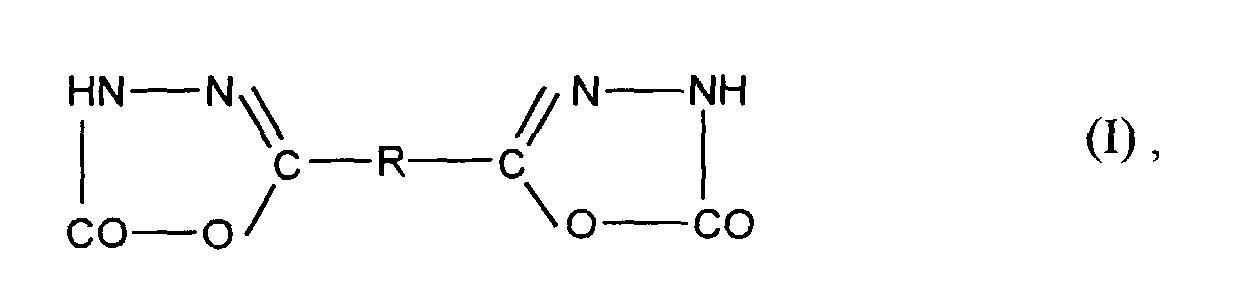
- R
- eine einfache Bindung oder einen bivalenten organischen Rest mit 1 bis 18 C-Atomen bedeutet, der aliphatisch, araliphatisch oder aromatisch sein kann,
- Verwendung der Mischungen nach Anspruch 1 zur Lackierung von Substraten.
- Verwendung nach Anspruch 2 als klarer Decklack.
- Verwendung nach Anspruch 2 zur Automobillackierung.
Applications Claiming Priority (2)
| Application Number | Priority Date | Filing Date | Title |
|---|---|---|---|
| DE19731863 | 1997-07-24 | ||
| DE19731863A DE19731863A1 (de) | 1997-07-24 | 1997-07-24 | Selbsthärtende, abspalterfreie wäßrige Bindemittel für flächige Beschichtungen, Verklebungen und Abdichtungen |
Publications (3)
| Publication Number | Publication Date |
|---|---|
| EP0893465A2 true EP0893465A2 (de) | 1999-01-27 |
| EP0893465A3 EP0893465A3 (de) | 1999-06-09 |
| EP0893465B1 EP0893465B1 (de) | 2004-10-06 |
Family
ID=7836770
Family Applications (1)
| Application Number | Title | Priority Date | Filing Date |
|---|---|---|---|
| EP98112965A Expired - Lifetime EP0893465B1 (de) | 1997-07-24 | 1998-07-13 | Selbsthärtende wässrige Bindemittel für flächige Beschichtungen, Verklebungen und Abdichtungen |
Country Status (7)
| Country | Link |
|---|---|
| US (1) | US6054528A (de) |
| EP (1) | EP0893465B1 (de) |
| JP (1) | JPH11228847A (de) |
| AT (1) | ATE278730T1 (de) |
| CA (1) | CA2243391A1 (de) |
| DE (2) | DE19731863A1 (de) |
| ES (1) | ES2230638T3 (de) |
Family Cites Families (3)
| Publication number | Priority date | Publication date | Assignee | Title |
|---|---|---|---|---|
| US3585200A (en) * | 1966-06-09 | 1971-06-15 | Pennwalt Corp | 4,4'-alkylene bis(semicarbazide) and derivatives thereof |
| DK0392299T3 (da) * | 1989-04-14 | 1993-06-21 | Bayer Ag | Fremgangsmåde til fremstilling af organiske aminer, polyaminblandinger og deres anvendelse som hærdnere for kunststofforstadier |
| EP0548930A1 (de) * | 1991-12-26 | 1993-06-30 | Takeda Chemical Industries, Ltd. | Verfahren zur Herstellung von schmelzbaren Harzen für Prepreg |
-
1997
- 1997-07-24 DE DE19731863A patent/DE19731863A1/de not_active Withdrawn
-
1998
- 1998-07-13 EP EP98112965A patent/EP0893465B1/de not_active Expired - Lifetime
- 1998-07-13 AT AT98112965T patent/ATE278730T1/de not_active IP Right Cessation
- 1998-07-13 DE DE59812066T patent/DE59812066D1/de not_active Expired - Lifetime
- 1998-07-13 ES ES98112965T patent/ES2230638T3/es not_active Expired - Lifetime
- 1998-07-17 US US09/118,244 patent/US6054528A/en not_active Expired - Fee Related
- 1998-07-20 CA CA002243391A patent/CA2243391A1/en not_active Abandoned
- 1998-07-22 JP JP10221126A patent/JPH11228847A/ja active Pending
Also Published As
| Publication number | Publication date |
|---|---|
| EP0893465B1 (de) | 2004-10-06 |
| EP0893465A3 (de) | 1999-06-09 |
| ATE278730T1 (de) | 2004-10-15 |
| JPH11228847A (ja) | 1999-08-24 |
| DE19731863A1 (de) | 1999-01-28 |
| CA2243391A1 (en) | 1999-01-24 |
| ES2230638T3 (es) | 2005-05-01 |
| DE59812066D1 (de) | 2004-11-11 |
| US6054528A (en) | 2000-04-25 |
Similar Documents
| Publication | Publication Date | Title |
|---|---|---|
| DE2560030C2 (de) | Verwendung von 13-Propandiol-dip-Aminobenzoat als Härter für Urethan-Vorpolymerisate | |
| DE60004872T2 (de) | Blockiertes isocyanat aufweisende verbindungen und diese enthaltende zusammensetzungen | |
| DE2221751C3 (de) | Polyurethanharnstoff elastomere | |
| DE2308015A1 (de) | Verfahren zur herstellung von polyisocyanaten mit biuretstruktur | |
| DE2136308A1 (de) | Hitzehärtende Überzugsmasse | |
| DE2550796A1 (de) | Verfahren zur herstellung von stabilen dispersionen | |
| DE1215365B (de) | Verfahren zur Herstellung von hoehermolekularen Polyisocyanaten mit Biuret-Struktur | |
| DE2655836C2 (de) | ||
| DE1694237B2 (de) | Verfahren zur Herstellung von vernetzten Kunststoffen, einschließlich Flächengebilden, nach dem Isocyanatpolyadditionsverfahren | |
| DE2719720C2 (de) | Verfahren zur Herstellung von Verklebungen | |
| DE2645779A1 (de) | Verfahren zur herstellung emulgatorfreier, anionischer polyurethandispersionen | |
| DE2633396A1 (de) | Verfahren zur herstellung einer anionischen waessrigen polyurethanemulsion | |
| DE69913564T2 (de) | Modifizierte polyisocyanate | |
| DE69907269T2 (de) | Beschichtungszusammensetzung | |
| EP0629664B1 (de) | Wässrige Polyurethandispersionen | |
| EP0844261A1 (de) | Dispersionen enthaltend Polyurethane mit Carbonylgruppen in Ketofunktion | |
| DE1227003B (de) | Verfahren zur Herstellung von Polyisocyanaten mit Carbamylbiuret-Struktur | |
| DE2359929A1 (de) | Thixotropierte waermehaertende polymermassen, insbesondere einbrennlacke | |
| DE69827547T2 (de) | Härtungsmittel für Pulverbeschichtungen, Pulverbeschichtungszusammensetzung, dieses Härtungsmittel beinhaltend und Pulverbeschichtungsfilm | |
| EP0893465B1 (de) | Selbsthärtende wässrige Bindemittel für flächige Beschichtungen, Verklebungen und Abdichtungen | |
| EP0006204A1 (de) | Wässrige Dispersionen von oligomeren oder polymeren Kunststoffen, ein Verfahren zu ihrer Herstellung sowie ihre Verwendung | |
| DE2609995B2 (de) | Verfahren zur Herstellung von biuretgruppenhaltigen Polyisocyanaten | |
| DE69218997T2 (de) | Dispersion eines vernetzten Urethan-Harnstoff-Harzes sowie Verfahren zu deren Herstellung | |
| EP0030594A1 (de) | Pulverförmige Beschichtungsmaterialien und deren Verwendung | |
| DE69526633T2 (de) | Auf 2-methyl-1,5-pentandiamin basierenden Aldiminen und ihre Verwendung zur Herstellung von Polyharnstoffbeschichtungen |
Legal Events
| Date | Code | Title | Description |
|---|---|---|---|
| PUAI | Public reference made under article 153(3) epc to a published international application that has entered the european phase |
Free format text: ORIGINAL CODE: 0009012 |
|
| AK | Designated contracting states |
Kind code of ref document: A2 Designated state(s): AT BE CH DE ES FR GB IT LI NL SE |
|
| AX | Request for extension of the european patent |
Free format text: AL;LT;LV;MK;RO;SI |
|
| PUAL | Search report despatched |
Free format text: ORIGINAL CODE: 0009013 |
|
| AK | Designated contracting states |
Kind code of ref document: A3 Designated state(s): AT BE CH CY DE DK ES FI FR GB GR IE IT LI LU MC NL PT SE |
|
| AX | Request for extension of the european patent |
Free format text: AL;LT;LV;MK;RO;SI |
|
| 17P | Request for examination filed |
Effective date: 19991209 |
|
| AKX | Designation fees paid |
Free format text: AT BE CH DE ES FR GB IT LI NL SE |
|
| GRAP | Despatch of communication of intention to grant a patent |
Free format text: ORIGINAL CODE: EPIDOSNIGR1 |
|
| RAP1 | Party data changed (applicant data changed or rights of an application transferred) |
Owner name: BAYER MATERIALSCIENCE AG |
|
| GRAS | Grant fee paid |
Free format text: ORIGINAL CODE: EPIDOSNIGR3 |
|
| GRAA | (expected) grant |
Free format text: ORIGINAL CODE: 0009210 |
|
| AK | Designated contracting states |
Kind code of ref document: B1 Designated state(s): AT BE CH DE ES FR GB IT LI NL SE |
|
| REG | Reference to a national code |
Ref country code: GB Ref legal event code: FG4D Free format text: NOT ENGLISH |
|
| REG | Reference to a national code |
Ref country code: CH Ref legal event code: NV Representative=s name: E. BLUM & CO. PATENTANWAELTE Ref country code: CH Ref legal event code: EP |
|
| REF | Corresponds to: |
Ref document number: 59812066 Country of ref document: DE Date of ref document: 20041111 Kind code of ref document: P |
|
| REG | Reference to a national code |
Ref country code: SE Ref legal event code: TRGR |
|
| GBT | Gb: translation of ep patent filed (gb section 77(6)(a)/1977) |
Effective date: 20050201 |
|
| REG | Reference to a national code |
Ref country code: ES Ref legal event code: FG2A Ref document number: 2230638 Country of ref document: ES Kind code of ref document: T3 |
|
| PLBE | No opposition filed within time limit |
Free format text: ORIGINAL CODE: 0009261 |
|
| STAA | Information on the status of an ep patent application or granted ep patent |
Free format text: STATUS: NO OPPOSITION FILED WITHIN TIME LIMIT |
|
| ET | Fr: translation filed | ||
| 26N | No opposition filed |
Effective date: 20050707 |
|
| REG | Reference to a national code |
Ref country code: CH Ref legal event code: PFA Owner name: BAYER MATERIALSCIENCE AG Free format text: BAYER MATERIALSCIENCE AG# #51368 LEVERKUSEN (DE) -TRANSFER TO- BAYER MATERIALSCIENCE AG# #51368 LEVERKUSEN (DE) |
|
| PGFP | Annual fee paid to national office [announced via postgrant information from national office to epo] |
Ref country code: ES Payment date: 20090812 Year of fee payment: 12 |
|
| PGFP | Annual fee paid to national office [announced via postgrant information from national office to epo] |
Ref country code: SE Payment date: 20090708 Year of fee payment: 12 Ref country code: NL Payment date: 20090705 Year of fee payment: 12 Ref country code: GB Payment date: 20090708 Year of fee payment: 12 Ref country code: CH Payment date: 20090721 Year of fee payment: 12 Ref country code: AT Payment date: 20090715 Year of fee payment: 12 |
|
| PGFP | Annual fee paid to national office [announced via postgrant information from national office to epo] |
Ref country code: BE Payment date: 20090805 Year of fee payment: 12 |
|
| PGFP | Annual fee paid to national office [announced via postgrant information from national office to epo] |
Ref country code: IT Payment date: 20090721 Year of fee payment: 12 |
|
| BERE | Be: lapsed |
Owner name: *BAYER MATERIALSCIENCE A.G. Effective date: 20100731 |
|
| REG | Reference to a national code |
Ref country code: NL Ref legal event code: V1 Effective date: 20110201 |
|
| REG | Reference to a national code |
Ref country code: CH Ref legal event code: PL |
|
| GBPC | Gb: european patent ceased through non-payment of renewal fee |
Effective date: 20100713 |
|
| PG25 | Lapsed in a contracting state [announced via postgrant information from national office to epo] |
Ref country code: CH Free format text: LAPSE BECAUSE OF NON-PAYMENT OF DUE FEES Effective date: 20100731 Ref country code: LI Free format text: LAPSE BECAUSE OF NON-PAYMENT OF DUE FEES Effective date: 20100731 |
|
| PG25 | Lapsed in a contracting state [announced via postgrant information from national office to epo] |
Ref country code: NL Free format text: LAPSE BECAUSE OF NON-PAYMENT OF DUE FEES Effective date: 20110201 Ref country code: IT Free format text: LAPSE BECAUSE OF NON-PAYMENT OF DUE FEES Effective date: 20100713 Ref country code: AT Free format text: LAPSE BECAUSE OF NON-PAYMENT OF DUE FEES Effective date: 20100713 |
|
| PG25 | Lapsed in a contracting state [announced via postgrant information from national office to epo] |
Ref country code: BE Free format text: LAPSE BECAUSE OF NON-PAYMENT OF DUE FEES Effective date: 20100731 |
|
| PG25 | Lapsed in a contracting state [announced via postgrant information from national office to epo] |
Ref country code: GB Free format text: LAPSE BECAUSE OF NON-PAYMENT OF DUE FEES Effective date: 20100713 |
|
| REG | Reference to a national code |
Ref country code: ES Ref legal event code: FD2A Effective date: 20110818 |
|
| PG25 | Lapsed in a contracting state [announced via postgrant information from national office to epo] |
Ref country code: ES Free format text: LAPSE BECAUSE OF NON-PAYMENT OF DUE FEES Effective date: 20100714 |
|
| PG25 | Lapsed in a contracting state [announced via postgrant information from national office to epo] |
Ref country code: SE Free format text: LAPSE BECAUSE OF NON-PAYMENT OF DUE FEES Effective date: 20100714 |
|
| PGFP | Annual fee paid to national office [announced via postgrant information from national office to epo] |
Ref country code: DE Payment date: 20120711 Year of fee payment: 15 Ref country code: FR Payment date: 20120719 Year of fee payment: 15 |
|
| REG | Reference to a national code |
Ref country code: DE Ref legal event code: R119 Ref document number: 59812066 Country of ref document: DE |
|
| REG | Reference to a national code |
Ref country code: DE Ref legal event code: R119 Ref document number: 59812066 Country of ref document: DE Effective date: 20140201 Ref country code: DE Ref legal event code: R081 Ref document number: 59812066 Country of ref document: DE Owner name: BAYER INTELLECTUAL PROPERTY GMBH, DE Free format text: FORMER OWNER: BAYER MATERIALSCIENCE AKTIENGESELLSCHAFT, 51373 LEVERKUSEN, DE Effective date: 20140317 |
|
| REG | Reference to a national code |
Ref country code: FR Ref legal event code: ST Effective date: 20140331 |
|
| PG25 | Lapsed in a contracting state [announced via postgrant information from national office to epo] |
Ref country code: DE Free format text: LAPSE BECAUSE OF NON-PAYMENT OF DUE FEES Effective date: 20140201 |
|
| PG25 | Lapsed in a contracting state [announced via postgrant information from national office to epo] |
Ref country code: FR Free format text: LAPSE BECAUSE OF NON-PAYMENT OF DUE FEES Effective date: 20130731 |