EP0893518A2 - Procédé pour réduire la recirculation de déchets dans les métiers à filer à bout ouvert - Google Patents
Procédé pour réduire la recirculation de déchets dans les métiers à filer à bout ouvert Download PDFInfo
- Publication number
- EP0893518A2 EP0893518A2 EP98305841A EP98305841A EP0893518A2 EP 0893518 A2 EP0893518 A2 EP 0893518A2 EP 98305841 A EP98305841 A EP 98305841A EP 98305841 A EP98305841 A EP 98305841A EP 0893518 A2 EP0893518 A2 EP 0893518A2
- Authority
- EP
- European Patent Office
- Prior art keywords
- trash
- belt
- speed
- yarn
- low speed
- Prior art date
- Legal status (The legal status is an assumption and is not a legal conclusion. Google has not performed a legal analysis and makes no representation as to the accuracy of the status listed.)
- Withdrawn
Links
Images


Classifications
-
- D—TEXTILES; PAPER
- D01—NATURAL OR MAN-MADE THREADS OR FIBRES; SPINNING
- D01H—SPINNING OR TWISTING
- D01H4/00—Open-end spinning machines or arrangements for imparting twist to independently moving fibres separated from slivers; Piecing arrangements therefor; Covering endless core threads with fibres by open-end spinning techniques
- D01H4/30—Arrangements for separating slivers into fibres; Orienting or straightening fibres, e.g. using guide-rolls
- D01H4/36—Arrangements for separating slivers into fibres; Orienting or straightening fibres, e.g. using guide-rolls with means for taking away impurities
Definitions
- This invention relates to methods of reducing trash recirculation in open-end spinning machines.
- the fibers to be spun into a yarn on the machine are removed from a sliver supplied to the machine, separated, and then spun into a yarn in the rotor or other yarn-producing mechanism.
- Each machine contains numerous adjacent stations.
- the opening of the sliver into individual fibers occurs in opening devices of varying types which reside in upstream fiber-flow proximity to the rotor.
- an opening roller having spikes or sawteeth on its circumference rotates in the opening device. It is these spikes or sawteeth that comb or tease the fibers out of the sliver.
- the sliver is drawn from a sliver can or bobbin into the opening device by a feed roller.
- An intake opening guide plate is pressed against the feed roller with a predetermined spring force.
- the trash contained in the sliver which may include dust, seeds, insect fragments and neps, is forced out of the sliver by the opening roller and is physically separated from the fibers.
- Trash content varies in type and quantity depending on where the cotton was grown, the growing season and the price of cotton.
- Heavy trash sometimes known as “pepper trash” usually comprises crushed cotton seeds, plant stems, and any other hard raw material which might be processed in the early cleaning stages of the cotton. Usually, some quantity will remain up carding.
- Medium trash comprises pulverized leaves, dirt and twigs.
- Light trash is made up of dust, short and immature fibers, smaller variations of both heavy and medium trash and other natural impurities.
- the density of the trash is relatively high in comparison with the density of the fibers.
- the trash therefore gains greater kinetic energy than the fibers as the fibers and trash are carried into the radial outer region of the gap between the opening roller and housing wall. This tends to separate the trash from the fiber by centrifugal force as the trash moves outwardly at a greater rate and with greater energy than the fibers.
- a discharge opening is located below the opening roller through which the trash falls.
- the trash is collected on a moving endless trash belt which is intended to carry the trash to one end of the machine, where a cleaning element, such as a brush roller, removes the trash from the belt.
- the cleaned belt rotates continually, so that each area of the belt alternates through successive trash-accumulating and trash-cleaning cycles.
- the belt has a fibrous nap to which the trash clings until it reaches the trash removal area at one end of the machine.
- the belt becomes worn and progressively less able to physically retain the trash on its surface along the length of the machine. Vibration, air currents and other conditions can therefore cause some of this loose trash on the belt to be sucked back into the discharge opening or other access opening of a downstream station as the trash is carried along the length of the machine towards the trash removal area.
- the invention according to this application represents a satisfactory and cost-effective solution to the problems described above.
- the practice of the invention can be varied within wide parameters to take into account mill conditions, sliver quality and trash content, machine and trash belt age and condition.
- Empirical use of the invention permits optimized operation of the open-end machine and high quality yarn without increased cost.
- the low speed of the trash belt is between 15 and 40 percent of conventional trash belt speed, with the low speed increasing as the proportion of heavy to light trash in the trash mixture increases.
- the low speed of the trash belt may be varied a further plus or minus 10 percent of the conventional trash belt speed, the low speed being increased up to 10 percent for heavy yarn containing heavy trash and the low speed being decreased up to 10- percent for fine yarns containing light trash with proportional variation in the percentage of increase of decrease proportional to the range of yarn size.
- the low speed of the trash belt may be altered when needed to accommodate changes in trash mixture content, yarn size and yarn trash content being processed on the machine. The trash may be cleaned from the trash belt as the trash belt moves at the low trash belt speed.
- the low speed of the trash belt may be between 5 and 50 percent of the conventional trash belt speed.
- the low speed of the trash belt is preferably between 20-30 percent of the conventional trash belt speed. More preferably the low speed of the trash belt is between 15-25 percent of the conventional trash belt speed.
- the low speed of the trash belt may be between 25-35 percent of the conventional trash belt speed.
- the said low speed of the trash belt is between 30-40 percent of the conventional trash belt speed.
- the method may also include the steps of providing a motor for controlling the rate of movement of the trash belt.
- the step of providing a motor for controlling the rate of movement of the trash belt comprises the step of controlling the speed of rotation of the motor by applying a variable frequency to the motor.
- the preferred embodiments of this invention concern low-speed trash belts for open-end spinning machines and methods of controlling the speed of the trash belt of open-end spinning machines. As described below, careful control of the rate of movement of the trash belt improves both machine efficiency and yarn quality.
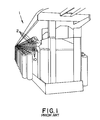
- FIG. 1 a conventional open-end spinning machine according to the present invention is illustrated in Figure 1 and shown generally at reference numeral 1.
- the invention is described with reference to a Schlafhorst Model SE-9 open-end spinning machine, broadly illustrated in Figure 1.
- the invention is equally applicable to other machines which utilize trash belts to carry away trash removed from the sliver during yarn formation on the machine.
- Spinning machine 1 includes numerous adjacent spinning stations 2 along the length of both sides of the machine.
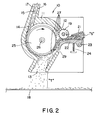
- each station 2 includes an opening device 10, which includes a housing 11 with an intake opening 12 for the sliver being formed into yarn.
- a trash discharge passage 13 and a fiber feeding opening 14 for feeding the separated fibers to the spinning rotor, not shown, through a fiber guide passage 15 is formed within walls 16 and 17.
- the trash discharge passage 13 extends downwardly and opens directly above a trash belt 18.
- Trash belt 18 is an endless conveyer-type belt which moves successively through a cycle where trash is deposited onto its surface and a cleaning cycle where a brush or other device, not shown, removes the trash for disposal.
- the trash belt 18 may be driven by its own motor, as in the Schlafhorst SE-9, or may be driven by the main machine drive, as in the Schlafhorst SE-8.
- the intake opening guide plate 22 is pivotally supported on the housing wall by a pin 23 and urged by a spring 24 against the sliver feed roller 19.
- an opening roller 25 rotates in a counterclockwise direction on a shaft 26 which is supported in the housing 11.
- the opening roller 25 On its circumference, the opening roller 25 has an array of sawtooth-like combing elements 27 formed in a predetermined pattern on its outer circumference. These combing elements 27 comb individual fibers out of the sliver "S" as it is passed from under the sliver feed roller 19 into contact with the opening roller 25.
- the separated fibers are entrained by the air flow and carried through the fiber guide passage 15 to the spinning unit.
- the trash "T” expelled from the stream of individual fibers normally has a greater density than the fibers and is therefore expelled centrifugally from the fibers into the trash discharge passage 13.
- Trash types and quantity in the cotton determines the speed at which the trash belt is optimally moved in order to obtain the highest practicable efficiency.
- the efficiency is also affected by having to remove yarn slubs or thick yarn sections, and having end breaks due to thin yarn with low tensile strength. Yarn trash is by far the leading factor in these inconsistencies.
- the trash belt 18 is controlled in several ways calculated to minimize reintroduction of trash into the fiber formation areas of the opening device 10.
- the trash belts 18 of the open-end spinning machine 1 extend down the length of the machine frame from one end to the other.
- both belts 18 are driven by a single motor 30 through drive and driven pulleys 31 and 32 rotatably connected by a drive belt 33.
- the other belt 18 is rotated by a solid concentric shaft 35 extending from one belt 18 to the other.
- a typical motor 30 used for this application is a 1/3 HP constant frequencv, 1750 rpm, 60 Hz, 3-phase AC motor.
- Figure 4 illustrates that an adjustable frequency drive, or inverter, 37, is wired to the motor 30.
- a suitable inverter 37 is the General Electric AF-300 family of inverters, selected according to conventional selection criteria to match the particular motor 30 being controlled.
- Inverter 37 is equipped with a control keypad which permits frequency selection, timing values and other status conditions. Such inverters 37 can dwell for up to 6,000 seconds, or 100 minutes. This permits a very wide range of speeds and time intervals between belt 18 movement cycles.
- motor 30 can be controlled by controlling only voltage to the motor, or with a combination of voltage and frequency variation.
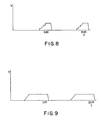
- Inverter 37 can thus control the belts 18 in various ways. Several of these are shown in Figures 5-9, where time is plotted horizontally and velocity of the belts 18 vertically. For example, in Figure 5 a "soft start” and “soft stop” profile is shown, where the inverter 37 "dwells” ,for example, 50-55 minutes each hour, and then gradually increases in speed from standstill to 15--20 meters/minute. The belts 18 move for from 5 to 10 minutes, or whatever other time empirical study has indicated will adequately clean the trash belts 18. The inverter 37 then gradually slows and finally stops for another 50-55 minutes.
- Figure 6 illustrates that the belt 18 need not be started gradually, but can rapidly increase to the desired belt velocity.
- Figure 7 illustrates that it may be desirable to start the belts 18 gradually, as in Figure 5, but need not be stopped gradually.
- Gradual start-up reduces the tendency of the sudden belt movement to shake loose or vibrate the trash off of the belts 18 and back into the air where it can be sucked into the yarn forming mechanisms, as described above.
- the belts 18 are clean after the cleaning cycle, it makes little difference whether the belts 18 are stopped gradually or in the normal manner.
- Figure 8 illustrates that the start-up can be made incrementally, with pauses at two or more intermediate belt velocities. This is another form of "soft start.”
- Figure 9 illustrates that the predetermined rates of belt velocity and the predetermined periods of time can vary considerably.
- the belt 18 is rotated for 30 minutes and stopped for 30 minutes, using the velocity profile shown in Figure 5.
- the appropriate time interval of belt movement is determined by first observing the number of revolutions of the belt 18 necessary to adequately clean it. This is then converted into time and input through the keypad on the inverter 37.
- Applicants have determined that in most cases the conventional belt velocity is approximately three times too high without regard to the particular velocity profile used. Applicants have successfully designed and installed systems wherein the belts 18 are operated at approximately one-third the conventional belt velocity continuously with increased machine efficiency and yarn quality. This was accomplished by removing the belt pulley where the speed sensor is located and adding two more pick-up points. This causes the speed sensor to believe that the belts 18 are still rotating at the original speed.
- the GE AF-300M$ inverter is a 380/460 V, 1HP Drive.
- the invention took place on Schlafhorst SE-8 and SE-9 open-end spinning machines.
- the Schlafhorst SE-8 has a trash belt speed of approximately 40-45 m/m
- the Schlafhorst SE-9 has a trash belt speed of approximately 60-65 m/m.
- trash belt speeds can be reduced as follows, based upon trash content: Mostly heavy trash approx. 30-40% of normal speed Usually medium trash approx. 25-35% of normal speed Usually light trash approx. 15-25% of normal speed Evenly mixture of trash approx. 20-30% of normal speed
- yarn count also affects the speed at which the trash belts 18 most efficiently operate.
- the majority of yarn counts range from a 5-6 heavy count, for example, denim used in manufacturing jeans, to a 35-40 light count used, for example, for the production of fine linens. Denim is usually woven of relatively cheap, dirty fiber, and this "roughness" is generally portrayed as desirable by the manufacturer. Linens, on the other hand, are generally produced from a much higher quality fiber, which has less trash in it to begin with. Therefore, the most efficient trash belt speed is determined by a further modification of the belt speed to take into account the yarn count. This has been determined to be in the range of 5-10%. To process heavier yarn counts, i.e., 5-6, belt speed would be increased by approximately 10%. Lighter yarn counts, i.e., 35-40, would process most efficiently by slowing the belt speed by up to 10%. Trials on counts between these ranges would suggest empirically an appropriate percentage increase or decrease in belt speed.
Landscapes
- Engineering & Computer Science (AREA)
- Mechanical Engineering (AREA)
- Textile Engineering (AREA)
- Spinning Or Twisting Of Yarns (AREA)
Applications Claiming Priority (2)
| Application Number | Priority Date | Filing Date | Title |
|---|---|---|---|
| US898453 | 1992-06-15 | ||
| US08/898,453 US5911676A (en) | 1996-09-12 | 1997-07-24 | Low-speed trash belt for open-end spinning machine and method |
Publications (2)
| Publication Number | Publication Date |
|---|---|
| EP0893518A2 true EP0893518A2 (fr) | 1999-01-27 |
| EP0893518A3 EP0893518A3 (fr) | 1999-09-29 |
Family
ID=25409482
Family Applications (1)
| Application Number | Title | Priority Date | Filing Date |
|---|---|---|---|
| EP98305841A Withdrawn EP0893518A3 (fr) | 1997-07-24 | 1998-07-22 | Procédé pour réduire la recirculation de déchets dans les métiers à filer à bout ouvert |
Country Status (2)
| Country | Link |
|---|---|
| US (1) | US5911676A (fr) |
| EP (1) | EP0893518A3 (fr) |
Cited By (1)
| Publication number | Priority date | Publication date | Assignee | Title |
|---|---|---|---|---|
| WO2001079595A1 (fr) * | 2000-04-14 | 2001-10-25 | Maschinenfabrik Rieter Ag | Procede et dispositif de fabrication d'un fil de type fil de continu a anneaux |
Families Citing this family (2)
| Publication number | Priority date | Publication date | Assignee | Title |
|---|---|---|---|---|
| CN106948044A (zh) * | 2017-03-28 | 2017-07-14 | 苏州市朗润纺织科技有限公司 | 气流纺纱设备的分梳装置 |
| DE102021117812A1 (de) * | 2021-07-09 | 2023-01-12 | Maschinenfabrik Rieter Ag | Auflösewalzengehäuse für eine Auflösewalze einer Offenend-Spinnvorrichtung sowie Offenend-Spinnvorrichtung mit einem Auflösewalzengehäuse |
Family Cites Families (11)
| Publication number | Priority date | Publication date | Assignee | Title |
|---|---|---|---|---|
| DE2231578B2 (de) * | 1972-06-28 | 1979-09-06 | Fritz 7347 Bad Ueberkingen Stahlecker | Vorrichtung zur Reinigung von Fasern an Offenend-Spinnaggregaten |
| US3961666A (en) * | 1972-11-24 | 1976-06-08 | Sony Corporation | Heat dispersion device for use in an electronic apparatus |
| DE2354967C2 (de) * | 1973-11-02 | 1982-07-29 | Fritz 7347 Bad Überkingen Stahlecker | Vorrichtung zum kontinuierlichen Abtransport von an Spinnstellen abgeschiedenen Verunreinigungen |
| DE2356180C2 (de) * | 1973-11-09 | 1984-02-02 | Stahlecker, Fritz, 7347 Bad Überkingen | Vorrichtung zum Abscheiden von Verunreinigungen aus Fasermaterial |
| US4098065A (en) * | 1975-05-30 | 1978-07-04 | Fritz Stahlecker | Feeding and opening apparatus for a open-end spinning machine |
| DE2634770B2 (de) * | 1976-08-03 | 1979-12-13 | Schubert & Salzer Maschinenfabrik Ag, 8070 Ingolstadt | Vorrichtung zum Abführen von Verunreinigungen bei einer OE-Spinnmaschine mit mehreren Spinnstellen |
| DE2658437C2 (de) * | 1976-12-23 | 1986-04-24 | Stahlecker, Fritz, 7347 Bad Überkingen | Offenend-Spinnmaschine mit einer Vielzahl von Spinnaggregaten |
| JPS5988934A (ja) * | 1982-11-05 | 1984-05-23 | Toyoda Autom Loom Works Ltd | オ−プンエンド精紡機の除塵装置 |
| DE19508095A1 (de) * | 1995-03-08 | 1996-09-12 | Rieter Ingolstadt Spinnerei | Vorrichtung und Verfahren zur Wartung von Spinnvorrichtungen |
| US5694758A (en) * | 1996-09-12 | 1997-12-09 | Cimtec Control Solutions, Inc. | Variable-speed trash belt for open-end spinning machine and method |
| US5723543A (en) * | 1996-09-26 | 1998-03-03 | Shell Oil Company | Block copolymers with improved overmolding adhesion |
-
1997
- 1997-07-24 US US08/898,453 patent/US5911676A/en not_active Expired - Fee Related
-
1998
- 1998-07-22 EP EP98305841A patent/EP0893518A3/fr not_active Withdrawn
Cited By (1)
| Publication number | Priority date | Publication date | Assignee | Title |
|---|---|---|---|---|
| WO2001079595A1 (fr) * | 2000-04-14 | 2001-10-25 | Maschinenfabrik Rieter Ag | Procede et dispositif de fabrication d'un fil de type fil de continu a anneaux |
Also Published As
| Publication number | Publication date |
|---|---|
| US5911676A (en) | 1999-06-15 |
| EP0893518A3 (fr) | 1999-09-29 |
Similar Documents
| Publication | Publication Date | Title |
|---|---|---|
| US4135276A (en) | Apparatus for removing impurities from fibrous material | |
| EP1262580B1 (fr) | Ouvreuse et méthode d'ouverture pour matériau fibreux | |
| US4219908A (en) | Process and apparatus for treating fibrous materials for subsequent processing | |
| US4773208A (en) | Thread or roving fragment removal for a spinning machine | |
| US4831691A (en) | Compact carding apparatus with sliver thread-up and method | |
| US4524492A (en) | Carding apparatus and method | |
| CN101113537A (zh) | 用于在纺织机器上抽吸和过滤含有灰尘和/或纤维的空气的设备和方法 | |
| WO1998035077A2 (fr) | Procede de production de fibres et dispositif pour mettre en oeuvre le procede | |
| US3895483A (en) | Apparatus for cleaning spinning rotors | |
| US5839266A (en) | Variable speed trash belt for open-end spinning machine and method | |
| CN105155043B (zh) | 一种开清棉机 | |
| US5911676A (en) | Low-speed trash belt for open-end spinning machine and method | |
| US4102017A (en) | Cotton lint cleaner | |
| US5901543A (en) | Independently controlled-brush motor for open-end spinning machine and method | |
| US4020622A (en) | Method and apparatus for a joint start-up and stopping of the spinning positions of an open-end spinning machine | |
| US5123145A (en) | Method and apparatus for the fine cleaning of textile fibers | |
| AU2017202132B2 (en) | Improved lint cleaner | |
| US4625506A (en) | Open-end spinning process and device | |
| MXPA98005965A (en) | Low speed cleaning band for centrifugal machine open end and met | |
| US4407047A (en) | Cotton ginning system embodying a lint cleaner and process of operating the same | |
| US5016321A (en) | Compact carding apparatus with silver thread-up and method | |
| US4563794A (en) | Self-cleaning roller gin | |
| US4612763A (en) | Pressurized air cleaning arrangement for an open-end friction spinning machine | |
| CN115369525A (zh) | 一种提高除杂、梳理效果的气流纺纱工艺及其系统 | |
| US3307227A (en) | Method and apparatus for cleaning cotton |
Legal Events
| Date | Code | Title | Description |
|---|---|---|---|
| PUAI | Public reference made under article 153(3) epc to a published international application that has entered the european phase |
Free format text: ORIGINAL CODE: 0009012 |
|
| AK | Designated contracting states |
Kind code of ref document: A2 Designated state(s): CH DE FR GB IT LI |
|
| AX | Request for extension of the european patent |
Free format text: AL;LT;LV;MK;RO;SI |
|
| PUAL | Search report despatched |
Free format text: ORIGINAL CODE: 0009013 |
|
| AK | Designated contracting states |
Kind code of ref document: A3 Designated state(s): AT BE CH CY DE DK ES FI FR GB GR IE IT LI LU MC NL PT SE |
|
| AX | Request for extension of the european patent |
Free format text: AL;LT;LV;MK;RO;SI |
|
| 17P | Request for examination filed |
Effective date: 20000410 |
|
| AKX | Designation fees paid |
Free format text: CH DE FR GB IT LI |
|
| 17Q | First examination report despatched |
Effective date: 20000906 |
|
| GRAG | Despatch of communication of intention to grant |
Free format text: ORIGINAL CODE: EPIDOS AGRA |
|
| GRAG | Despatch of communication of intention to grant |
Free format text: ORIGINAL CODE: EPIDOS AGRA |
|
| GRAH | Despatch of communication of intention to grant a patent |
Free format text: ORIGINAL CODE: EPIDOS IGRA |
|
| GRAH | Despatch of communication of intention to grant a patent |
Free format text: ORIGINAL CODE: EPIDOS IGRA |
|
| GRAH | Despatch of communication of intention to grant a patent |
Free format text: ORIGINAL CODE: EPIDOS IGRA |
|
| STAA | Information on the status of an ep patent application or granted ep patent |
Free format text: STATUS: THE APPLICATION IS DEEMED TO BE WITHDRAWN |
|
| 18D | Application deemed to be withdrawn |
Effective date: 20020503 |