EP0894067B1 - Lageraufbau mit rillendaube - Google Patents
Lageraufbau mit rillendaube Download PDFInfo
- Publication number
- EP0894067B1 EP0894067B1 EP97926360A EP97926360A EP0894067B1 EP 0894067 B1 EP0894067 B1 EP 0894067B1 EP 97926360 A EP97926360 A EP 97926360A EP 97926360 A EP97926360 A EP 97926360A EP 0894067 B1 EP0894067 B1 EP 0894067B1
- Authority
- EP
- European Patent Office
- Prior art keywords
- bearing
- shaft
- bearing assembly
- thermoplastic
- protuberances
- Prior art date
- Legal status (The legal status is an assumption and is not a legal conclusion. Google has not performed a legal analysis and makes no representation as to the accuracy of the status listed.)
- Expired - Lifetime
Links
Images

Classifications
-
- F—MECHANICAL ENGINEERING; LIGHTING; HEATING; WEAPONS; BLASTING
- F16—ENGINEERING ELEMENTS AND UNITS; GENERAL MEASURES FOR PRODUCING AND MAINTAINING EFFECTIVE FUNCTIONING OF MACHINES OR INSTALLATIONS; THERMAL INSULATION IN GENERAL
- F16C—SHAFTS; FLEXIBLE SHAFTS; ELEMENTS OR CRANKSHAFT MECHANISMS; ROTARY BODIES OTHER THAN GEARING ELEMENTS; BEARINGS
- F16C17/00—Sliding-contact bearings for exclusively rotary movement
- F16C17/12—Sliding-contact bearings for exclusively rotary movement characterised by features not related to the direction of the load
- F16C17/14—Sliding-contact bearings for exclusively rotary movement characterised by features not related to the direction of the load specially adapted for operating in water
-
- B—PERFORMING OPERATIONS; TRANSPORTING
- B63—SHIPS OR OTHER WATERBORNE VESSELS; RELATED EQUIPMENT
- B63H—MARINE PROPULSION OR STEERING
- B63H23/00—Transmitting power from propulsion power plant to propulsive elements
- B63H23/32—Other parts
- B63H23/321—Bearings or seals specially adapted for propeller shafts
-
- B—PERFORMING OPERATIONS; TRANSPORTING
- B63—SHIPS OR OTHER WATERBORNE VESSELS; RELATED EQUIPMENT
- B63H—MARINE PROPULSION OR STEERING
- B63H23/00—Transmitting power from propulsion power plant to propulsive elements
- B63H23/32—Other parts
- B63H23/321—Bearings or seals specially adapted for propeller shafts
- B63H23/326—Water lubricated bearings
-
- F—MECHANICAL ENGINEERING; LIGHTING; HEATING; WEAPONS; BLASTING
- F16—ENGINEERING ELEMENTS AND UNITS; GENERAL MEASURES FOR PRODUCING AND MAINTAINING EFFECTIVE FUNCTIONING OF MACHINES OR INSTALLATIONS; THERMAL INSULATION IN GENERAL
- F16C—SHAFTS; FLEXIBLE SHAFTS; ELEMENTS OR CRANKSHAFT MECHANISMS; ROTARY BODIES OTHER THAN GEARING ELEMENTS; BEARINGS
- F16C17/00—Sliding-contact bearings for exclusively rotary movement
- F16C17/02—Sliding-contact bearings for exclusively rotary movement for radial load only
-
- F—MECHANICAL ENGINEERING; LIGHTING; HEATING; WEAPONS; BLASTING
- F16—ENGINEERING ELEMENTS AND UNITS; GENERAL MEASURES FOR PRODUCING AND MAINTAINING EFFECTIVE FUNCTIONING OF MACHINES OR INSTALLATIONS; THERMAL INSULATION IN GENERAL
- F16C—SHAFTS; FLEXIBLE SHAFTS; ELEMENTS OR CRANKSHAFT MECHANISMS; ROTARY BODIES OTHER THAN GEARING ELEMENTS; BEARINGS
- F16C27/00—Elastic or yielding bearings or bearing supports, for exclusively rotary movement
- F16C27/06—Elastic or yielding bearings or bearing supports, for exclusively rotary movement by means of parts of rubber or like materials
- F16C27/063—Sliding contact bearings
-
- F—MECHANICAL ENGINEERING; LIGHTING; HEATING; WEAPONS; BLASTING
- F16—ENGINEERING ELEMENTS AND UNITS; GENERAL MEASURES FOR PRODUCING AND MAINTAINING EFFECTIVE FUNCTIONING OF MACHINES OR INSTALLATIONS; THERMAL INSULATION IN GENERAL
- F16C—SHAFTS; FLEXIBLE SHAFTS; ELEMENTS OR CRANKSHAFT MECHANISMS; ROTARY BODIES OTHER THAN GEARING ELEMENTS; BEARINGS
- F16C33/00—Parts of bearings; Special methods for making bearings or parts thereof
- F16C33/02—Parts of sliding-contact bearings
- F16C33/04—Brasses; Bushes; Linings
- F16C33/06—Sliding surface mainly made of metal
- F16C33/10—Construction relative to lubrication
- F16C33/1025—Construction relative to lubrication with liquid, e.g. oil, as lubricant
- F16C33/106—Details of distribution or circulation inside the bearings, e.g. details of the bearing surfaces to affect flow or pressure of the liquid
- F16C33/1065—Grooves on a bearing surface for distributing or collecting the liquid
-
- F—MECHANICAL ENGINEERING; LIGHTING; HEATING; WEAPONS; BLASTING
- F16—ENGINEERING ELEMENTS AND UNITS; GENERAL MEASURES FOR PRODUCING AND MAINTAINING EFFECTIVE FUNCTIONING OF MACHINES OR INSTALLATIONS; THERMAL INSULATION IN GENERAL
- F16C—SHAFTS; FLEXIBLE SHAFTS; ELEMENTS OR CRANKSHAFT MECHANISMS; ROTARY BODIES OTHER THAN GEARING ELEMENTS; BEARINGS
- F16C33/00—Parts of bearings; Special methods for making bearings or parts thereof
- F16C33/02—Parts of sliding-contact bearings
- F16C33/04—Brasses; Bushes; Linings
- F16C33/20—Sliding surface consisting mainly of plastics
- F16C33/201—Composition of the plastic
-
- F—MECHANICAL ENGINEERING; LIGHTING; HEATING; WEAPONS; BLASTING
- F16—ENGINEERING ELEMENTS AND UNITS; GENERAL MEASURES FOR PRODUCING AND MAINTAINING EFFECTIVE FUNCTIONING OF MACHINES OR INSTALLATIONS; THERMAL INSULATION IN GENERAL
- F16C—SHAFTS; FLEXIBLE SHAFTS; ELEMENTS OR CRANKSHAFT MECHANISMS; ROTARY BODIES OTHER THAN GEARING ELEMENTS; BEARINGS
- F16C33/00—Parts of bearings; Special methods for making bearings or parts thereof
- F16C33/02—Parts of sliding-contact bearings
- F16C33/04—Brasses; Bushes; Linings
- F16C33/26—Brasses; Bushes; Linings made from wire coils; made from a number of discs, rings, rods, or other members
-
- F—MECHANICAL ENGINEERING; LIGHTING; HEATING; WEAPONS; BLASTING
- F16—ENGINEERING ELEMENTS AND UNITS; GENERAL MEASURES FOR PRODUCING AND MAINTAINING EFFECTIVE FUNCTIONING OF MACHINES OR INSTALLATIONS; THERMAL INSULATION IN GENERAL
- F16C—SHAFTS; FLEXIBLE SHAFTS; ELEMENTS OR CRANKSHAFT MECHANISMS; ROTARY BODIES OTHER THAN GEARING ELEMENTS; BEARINGS
- F16C2208/00—Plastics; Synthetic resins, e.g. rubbers
- F16C2208/20—Thermoplastic resins
- F16C2208/76—Polyolefins, e.g. polyproylene [PP]
- F16C2208/78—Polyethylene [PE], e.g. ultra-high molecular weight polyethylene [UHMWPE]
-
- F—MECHANICAL ENGINEERING; LIGHTING; HEATING; WEAPONS; BLASTING
- F16—ENGINEERING ELEMENTS AND UNITS; GENERAL MEASURES FOR PRODUCING AND MAINTAINING EFFECTIVE FUNCTIONING OF MACHINES OR INSTALLATIONS; THERMAL INSULATION IN GENERAL
- F16C—SHAFTS; FLEXIBLE SHAFTS; ELEMENTS OR CRANKSHAFT MECHANISMS; ROTARY BODIES OTHER THAN GEARING ELEMENTS; BEARINGS
- F16C23/00—Bearings for exclusively rotary movement adjustable for aligning or positioning
- F16C23/02—Sliding-contact bearings
-
- F—MECHANICAL ENGINEERING; LIGHTING; HEATING; WEAPONS; BLASTING
- F16—ENGINEERING ELEMENTS AND UNITS; GENERAL MEASURES FOR PRODUCING AND MAINTAINING EFFECTIVE FUNCTIONING OF MACHINES OR INSTALLATIONS; THERMAL INSULATION IN GENERAL
- F16C—SHAFTS; FLEXIBLE SHAFTS; ELEMENTS OR CRANKSHAFT MECHANISMS; ROTARY BODIES OTHER THAN GEARING ELEMENTS; BEARINGS
- F16C2326/00—Articles relating to transporting
- F16C2326/30—Ships, e.g. propelling shafts and bearings therefor
-
- Y—GENERAL TAGGING OF NEW TECHNOLOGICAL DEVELOPMENTS; GENERAL TAGGING OF CROSS-SECTIONAL TECHNOLOGIES SPANNING OVER SEVERAL SECTIONS OF THE IPC; TECHNICAL SUBJECTS COVERED BY FORMER USPC CROSS-REFERENCE ART COLLECTIONS [XRACs] AND DIGESTS
- Y10—TECHNICAL SUBJECTS COVERED BY FORMER USPC
- Y10S—TECHNICAL SUBJECTS COVERED BY FORMER USPC CROSS-REFERENCE ART COLLECTIONS [XRACs] AND DIGESTS
- Y10S384/00—Bearings
- Y10S384/90—Cooling or heating
- Y10S384/907—Bearing material or solid lubricant
Definitions
- This invention relates to a bearing assembly and more particularly to a new and novel bearing assembly for use in supporting a water lubricated propeller shaft as in large naval ships.
- Bearing assemblies with elastomeric bearing elements are particularly suited for this purpose because of their excellent ability to withstand the effects of corrosive fluids and to abrasion resulting from particles of foreign matter carried in suspension in the sea water in which the shaft and bearing assembly operates.
- Such bearing assemblies with their elastomeric bearing elements have been made and are still being made with outer non-corrosive support or shell with a plurality of circumferentially evenly spaced elastomeric staves therein.
- a bearing assembly for holding a shaft, as specified in Claim 1.
- the present invention is directed to a novel bearing assembly utilizing an outer shell and a plurality of circumferentially spaced bearing elements in contact with the shaft, the bearing elements having transverse grooves or a hydrodynamic pattern provided therein to thereby reduce the bearing friction torque thus enhancing the performance of the bearing.
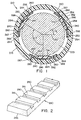
- Fig. 1 is a cross sectional view of a bearing assembly in accordance with the present invention.
- Fig. 2 is an isometric view of a bearing stave in accordance with the present invention.
- Figs. 3a-3b are isometric views of alternate embodiments for bearing material for use in a bearing assembly in accordance with the present invention.
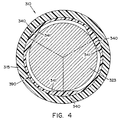
- Fig. 4 is a cross sectional view of a second embodiment of a bearing assembly in accordance with the present invention.
- a bearing assembly 210 in accordance with the present invention includes a housing 215 having three staves 240 provided around the radial inner portion thereof. Each stave 240 is held in place by a pair of elastomeric members 260. A rigid plate or bar 264 is disposed on top of each elastomeric member 260. A screw or bolt 266 extends through a clearance shaft (not shown) in each bar 264 and elastomeric member 260 and engages with threaded hole 267 in housing 215. Tightening screw 266 pulls rigid plate 264 toward housing 215, thereby compressing and deforming each elastomeric member 260 to expand sideways and put compression on each stave 240 and hold them in place.
- Each stave 240 has a grooved bearing surface 241, a substantially flat back side 282 and is supported by one or more shims or pads 284, 286.
- each stave 240 backside 282 is in contact with a top shim 284 comprised of a hard material, (such as metal, composite material or other hard plastic), which is supported by a bottom pad 286 comprised of a resilient or compressible material, (such as soft plastic, rubber or other elastomer).
- Flat backed staves are more economical to produce compared with round backed staves.
- Lower stave 240 supports drive shaft 223, and the two upper staves 240 tangentially engage the drive shaft 223 in cooperative action with the lower stave 240 to prevent extraneous flexing of the shaft 223.
- Housing 215 is preferably made from a metallic structure such as brass, a plastic shell or a composite non-metallic structure. Housing 215 is most preferably comprised of fiberglass reinforced epoxy, with a glass content on the order of 70% by weight.
- Staves 240 are preferably made from an elastomeric/plastic composite, such as that described in commonly owned US Patent 3,993,371 or a homogeneous slippery polymer alloy (SPA) such as is disclosed in US Patent 4,725,151 and 4,735,982, all of which are hereby fully incorporated herein by reference.
- SPA is a thermoplastic and a thermoset rubber compound, along with a smaller amount of a lubricant.
- SPA is a heterogeneous composition wherein the thermoplastic exists in a continuous phase and the thermoset is dispersed therein as a discontinuous phase. In other words a thermoplastic matrix is formed, having the thermoset compound and the lubricant dispersed therein, as opposed to an admixture.
- the thermoplastic compound can be any polymer which exhibits tough, low friction and good wear resistant properties.
- a specific group of such polymers are the various ultra high molecular weight polyethylenes (UHMWPE) which are known to the art as well as to the literature.
- Ultra high molecular weight polyethylene are generally classified as those having a weight average molecular weight of greater than 2.5 million, that is from about 3.0 million to about 7.0 million using the solution viscosity method.
- a desired range is from about 4 million to about 6.5 million with a preferred range being from about 5 million to about 6 million.
- Such polyethylene are commercially available from Hoechst Celanese Corporation under the name GUR 413.
- the ultra high molecular weight polyethylene as well as other polymers generally suitable for use in the present invention typically have low friction properties such as a breakaway coefficient of static friction at 0 rpm of 0.25 or less, desirably 0.20 or less and preferably 0.15 or less.
- the desired thermoplastic material of the present invention also have a toughness as measured by a Izod notch impact test (ASTM D256) of 20 or greater and preferably of 30 or greater. However, unnotched test samples did not fail.
- the thermoplastic material of the present invention also have good wear resistance as measured by a sand slurry abrasion test.
- the sand slurry abrasion test is a test of Hoechst Celanese Corporation wherein generally a test specimen (25.4 mm x 76.2 mm x 6.4 mm) (1" X 3" X 1 ⁇ 4") is rotated at 1200 RPM over a 24 hour period in a slurry containing 2 parts of water and 3 parts of sand.
- an effective amount of the ultra high molecular polyethylene is utilized such that it forms a continuous phase in the SPA.
- the amount of a thermoplastic compound is sufficient to coat the thermoset rubber compound which generally exist in the form of particles and more desirably an amount in excess of that required to coat the rubber particles.
- the amount of the thermoplastic often utilized is from about 25% to about 90% by weight, desirably from about 40% to about 75% by weight and preferably from about 55% to about 65% by weight.
- thermoset compound is a cured rubber compound which typically has low friction as well as good oil and water resistant properties.
- low friction it is meant that rubber bearings of a desired thickness range, when water lubricated, develop hydrodynamic lubrication at normal journal (shaft) operating speeds. Thin rubber bearings develop hydrodynamic friction at lower shaft speeds than any other known bearing material due to the Plasto-Elastohydrodynamic effect. Hydrodynamic lubrication is the developing of a fluid film between the bearing and a rotating shaft.
- oil and water resistant it is meant that the elastomer is unaffected (not dissolved or softened) and the volume increase caused by swell in water is under 5%, and preferably under 3%.
- any rubber compound having such friction and water resistant properties can be utilized.
- a specific group of such compounds are various nitrile rubbers which are known to the art and to the literature.
- the various Hycar nitrile rubber compounds manufactured by the BFGoodrich Company can be utilized.
- the various harder nitrile rubber compounds are generally preferred.
- a specific example of such;a rubber is compound H-201 (85 +/- 5 Shore A hardness) manufactured by the BFGoodrich Company.
- Another example is a softer nitrile rubber such as compound H-203, also manufactured by the BFGoodrich Company which has a Shore A hardness of about 65 ⁇ 5.
- Rubbers include Butyl rubber, EPDM, that is rubber made from ethylene-propylene-diene monomers, and fluorelastomers based on the copolymer of vinylidene fluoride and hexafluoropropylene thought to have the following repeating structure -CF -CH -CF - CF(CF)-.
- EPDM butyl rubber
- fluorelastomers based on the copolymer of vinylidene fluoride and hexafluoropropylene thought to have the following repeating structure -CF -CH -CF - CF(CF)-.
- Such copolymers are sold under the Trademark "Viton" by DuPont. Although these other rubber compounds can be utilized, the nitrile rubbers are highly preferred.
- the rubber compound can be initially dry blended or mixed with the thermoplastic compound before the alloy is formed.
- the rubber compound is cured and in order to mix the two components, it is ground to a suitable size.
- Conventional grinding methods can be utilized such as mechanical or cryogenic grinding.
- Particle size of the cured rubber compound is generally important.
- the particle size is generally measured as being finer, that is being able to pass through, a specific Tyler mesh screen.
- the cured rubber compounds thus generally have a particle size smaller than 35 mesh, desirably smaller than 65 mesh, and preferably smaller than 100 mesh.
- the amount of the cured rubber in the SPA is generally from about 10% to about 70% by weight, desirably from about 12% to about 40% by weight and preferably from about 15% to about 30% by weight based upon the total weight of the SPA.
- the lubricant is generally added in the form of a solid and hence is non-liquid.
- the lubricant typically is in the form of a powder.
- powder it is meant that a majority, and at least 70%, 80% or 90% and more desirably at least 95% of the particles are smaller than a Tyler 100 mesh screen, that is 150 ⁇ m.
- a majority of the powder, typically 80%, 90%, or even 95% is smaller than 200 mesh, that is 75 ⁇ m.
- a majority of the graphite powder, that is 70%, 80%, or 90% is smaller than 325 meshes, that is 44 ⁇ m.
- any lubricant known to the art as well as to the literature can be utilized which imparts lubricating properties to the SPA.
- lubricating properties it is meant that the coefficient of friction of the surface of the formed SPA is reduced, as for example, on the order of at least 10% and more desirably at least 20% or 30% when wear starts.
- the lubricant also should be nonabrasive.
- Graphite constitutes a preferred lubricant.
- An example of a specific graphite is grade 117-A, manufactured by Asbury Graphite Mills, Inc.
- Another specific lubricant is molybdenum disulfide. Although not generally preferred, molybdenum disulfide is desirable in dry end use applications where moisture is not available, even as atmospheric moisture vapor.
- Silicone oils can also be utilized in an amount of from about 2% to about 10% by weight and desirably from about 3% to about 6% by weight based upon the total weight of the SPA. Examples of specific silicone oils include 200
- the amount of the lubricant generally is from about 0.5% or 3% by weight to about 25% by weight, desirably from about 1.0% to about 20% by weight, and preferably from about 2% to about 10% by weight based upon the total weight of the SPA.
- staves 240 certain material factors for staves 240 are important.
- hydrophobic materials are preferred.
- the elastomer hardness should be about 70 shore A.
- the ratio of journal diameter of the shaft to the top width of the stave should be about 4 to 7.
- the elastomer thickness should be about 3.175 mm to 7.92 mm (0.125 inch to 0.312 inch).
- the surface finish of the stave should be under 508 nm (20 micro inches).
- Sixth, harder polymer alloy bearing contact material, such as the SPA material described above provides preferable wear and friction characteristics.
- Elastomeric members 260 are preferably comprised of natural or nitrile rubber compounds, and are preferably 19.05 to 38.1 mm (0.75 to 1.5 inches) wide before compression.
- Rigid plates 264 are preferably comprised of a metal, such as stainless steel, or a hard plastic, such as fiber reinforced epoxy.
- the compressed elastomeric members 260 expand to grip the sides of the staves 240. They also distort around the ends of the staves to provide an axial locking feature.
- Bottom pads 286 offer alignment capability.
- Top shim 284 is utilized to control the operating clearance between the bearing bore and the shaft 223 to eliminate the grinding of critical stave surface and to simplify the bearing renewal and replacement process.
- Each stave in a stave type bearing functions as an individual and independent bearing surface.
- the deflection capability of bearing 210 provides for a zero clearance bearing (ZCB) -ZCB's are more stable because, among other things, the unloaded staves can be depressed by the rotating shaft 223 as it develops hydrodynamically pressurized lift-off pressure on the load carrying staves.
- ZCB zero clearance bearing
- the three staves are preferably located approximately 120° apart (angle A), with the two upper staves located approximately 30° (angle B) above horizontal line 280 and the lower stave located approximately 90° below horizontal 280.
- Staves 240 have a plurality of transverse grooves 290 provided therein and distributed along the axial length of the stave thereby leaving a plurality of lands or protrusions 241 protruding towards the axial centerline.
- the grooves may be either molded into the material or machined into the material, with machining the preferred method. The particular dimensions for the staves will differ for each application.
- the grooves 290 are preferably on the order of 6.35 mm (0.25 inches) deep and 8.38 mm (0.33 inches) wide, with a separation between grooves of on the order of 25.4 mm (1 inch). Machining grooves in the staves increases the amount of contact pressure in between grooves.
- the stave dimensions and groove dimensions must be picked such that the applied load is high enough for low friction and wear to occur, but the bulge ratio must be also low enough for the staves to adjust and form a lubricant trapping pocket.
- the bearing material is molded in large flexible slabs.
- the material is molded and shaped against a plate or rough fabric with many protuberances lands, or contact points, 414, 424 wherein the protuberances can each individually become hydrodynamic bearing surfaces when fluid lubricated.
- the material is molded and shaped against a rough fabric (Fig. 3a) or plate with many protuberances.
- the molded staves consist of an elastomeric/plastic composite, such as that described in commonly owned US Patent 3,993,371 or most preferably a homogeneous slippery polymer alloy (SPA) such as is disclosed in US Patent 4,725,151 and 4,735,982, all of which are hereby fully incorporated herein by reference.
- SPA bearing material layer is preferably on the order of 3.175 mm (0.125 inches) thick. It is then adhered during slab cure to a nitrile rubber backing sheet. The rubber backing makes the slab flexible and when abraded, is easy to bond to the metal or composite bearing housing using room temperature curing epoxy adbesives or contact cement.
- the rubber backing is rapidly and easily sanded or ground by means of a machine to give the correct overall slab thickness for the particular bearing size.
- the adhesive layer adds around 25.4 ⁇ m (0.001 inches) to the bearing total wall thickness. There is therefore no need to grind or machine the bearing surface. Grinding the bearing surface increases friction and wear.
- the full stave thickness is preferably 15.88 to 27.94 mm (0.625 inches to 1.1 inches).
- the staves in Figs. 3a-3b may be made completely from the aforementioned SPA material. That is, the staves 240 may not have a bottom layer 410 and therefore would be comprised of a single layer comprised of the material for layer 412.
- an alternate stave material 240 may be manufactured by providing a patterned bottom layer 410 of elastomer in a mold.
- the preferred elastomer is catalog number H-201 available from the BFGoodrich Company.
- a top layer 412 of slippery polymer alloy (SPA) is provided on the elastomer.
- a thermoplastic and a thermoset rubber compound, along with a smaller amount of a lubricant form the SPA.
- the SPA is a heterogeneous composition wherein the thermoplastic exists in a continuous phase and the thermoset is dispersed therein as a discontinuous phase. In other words a thermoplastic matrix is formed, having the thermoset compound and the lubricant dispersed therein, as opposed to an admixture.
- the thermoplastic compound can be any polymer which exhibits tough, low friction and good wear resistant properties.
- a specific group of such polymers are the various ultra high molecular weight polyethylenes (UHMWPE) which are known to the art as well as to the literature.
- Ultra high molecular weight polyethylene are generally classified as those having a weight average molecular weight of greater than 2.5 million, that is from about 3.0 million to about 7.0 million using the solution viscosity method.
- a desired range is from about 4 million to about 6.5 million with a preferred range being from about 5 million to about 6 million.
- Such polyethylene are commercially available from Hoechst Celanese Corporation under the name GUR 413.
- the ultra high molecular weight polyethylene as well as other polymers generally suitable for use in the present invention typically have low friction properties such as a breakaway coefficient of static friction at 0 rpm shaft speed of 0.25 or less, desirably 0.20 or less and preferably 0.15 or less.
- the desired thermoplastic material of the present invention also have a toughness as measured by a Izod notch impact test (ASTM D256) of 20 or greater and preferably of 30 or greater. However, unnotched test samples did not fail.
- the thermoplastic material of the present invention also have good wear resistance as measured by a sand slurry abrasion test.
- the sand slurry abrasion test is a test of Hoechst Celanese Corporation wherein generally a test specimen (25.4 mm x 76.2 mm x 6.4 mm) (1" X 3" X 1 ⁇ 4'') is rotated at 1200 RPM over a 24 hour period in a slurry containing 2 parts of water and 3 parts of sand.
- an effective amount of the ultra high molecular polyethylene is utilized such that it forms a continuous phase in the SPA.
- the amount of a thermoplastic compound is sufficient to coat the thermoset rubber compound which generally exist in the form of particles and more desirably an amount in excess of that required to coat the rubber particles.
- the amount of the thermoplastic often utilized is from about 25% to about 90% by weight, desirably from about 40% to about 75% by weight and preferably from about 55% to about 65% by weight.
- thermoset compound is a cured rubber compound which typically has low friction as well as good oil and water resistant properties.
- low friction it is meant that rubber bearings of a desired thickness range, when water lubricated, develop hydrodynamic lubrication at normal journal (shaft) operating speeds. Thin rubber bearings develop hydrodynamic friction at lower shaft speeds than any other known bearing material due to the Plasto-Elastohydrodynamic effect. Hydrodynamic lubrication is the developing of a fluid film between the bearing and a rotating shaft.
- oil and water resistant it is meant that the elastomer is unaffected (not dissolved or softened) and the volume increase caused by swell in water is under 5%, and preferably under 3%.
- any rubber compound having such friction and water resistant properties can be utilized.
- a specific group of such compounds are various nitrile rubber compounds which are known to the art and to the literature.
- the various nitrile rubber compounds manufactured by the BFGoodrich Company can be utilized.
- the various harder nitrile rubber compounds are generally preferred.
- a specific example of such a rubber is compound H-201 (85 ⁇ 5 Shore A hardness) manufactured by the BFGoodrich Company.
- Another example is a softer nitrile rubber such as compound H-203, also manufactured by the BFGoodrich Company which has a Shore A hardness of about 65 ⁇ 5.
- Rubbers include Butyl rubber, EPDM, that is rubber made from ethylene-propylene-diene monomers, and fluorelastomers based on the copolymer of vinylidene fluoride and hexafluoropropylene thought to have the following repeating structure -CF -CH -CF -CF(CF)-.
- EPDM butyl rubber
- fluorelastomers based on the copolymer of vinylidene fluoride and hexafluoropropylene thought to have the following repeating structure -CF -CH -CF -CF(CF)-.
- Such copolymers are sold under the Trademark "Viton" by DuPont. Although these other rubber compounds can be utilized, the nitrile rubbers are highly preferred.
- the cured rubber compound can be initially easily dry blended or mixed with the thermoplastic compound before the alloy is formed.
- the rubber compound is cured and in order to mix the two components, it is ground to a suitable size.
- Conventional grinding methods can be utilized such as mechanical or cryogenic grinding.
- Particle size of the cured rubber compound is generally important.
- the particle size is generally measured as being finer, that is being able to pass through, a specific Tyler mesh screen.
- the cured rubber compounds thus generally have a particle size smaller than 35 mesh, desirably smaller than 65 mesh, and preferably smaller than 100 mesh.
- the amount of the cured rubber in the SPA is generally from about 10% to about 70% by weight, desirably from about 12% to about 40% by weight and preferably from about 15% to about 30% by weight based upon the total weight of the SPA.
- the lubricant is generally added in the form of a solid and hence is non-liquid.
- the lubricant typically is in the form of a powder.
- powder it is meant that a majority, and at least 70%, 80% or 90% and more desirably at least 95% of the particles are smaller than a Tyler 100 mesh screen, that is 150 ⁇ m.
- a majority of the powder, typically 80%, 90%, or even 95% is smaller than 200 mesh, that is 75 ⁇ m.
- a majority of the graphite powder, that is 70%, 80%, or 90% is smaller than 325 meshes, that is 44 ⁇ m.
- any lubricant known to the art as well as to the literature can be utilized which imparts lubricating properties to the SPA.
- lubricating properties it is meant that the coefficient of friction of the surface of the formed SPA is reduced, as for example, on the order of at least 10% and more desirably at least 20% or 30% when wear starts.
- the lubricant also should be nonabrasive.
- Graphite constitutes a preferred lubricant.
- An example of a specific graphite is grade 117-A, manufactured by Asbury Graphite Mills, Inc.
- Another specific lubricant is molybdenum disulfide. Although not generally preferred, molybdenum disulfide is desirable in dry end use applications where moisture is not available, even as atmospheric moisture vapor.
- Silicone oils can also be utilized in an amount of from about 2% to about 10% by weight and desirably from about 3% to about 6% by weight based upon the total weight of the SPA. Examples of specific silicone oils include 200
- the amount of the lubricant generally is from about 0.5% or 3% by weight to about 25% by weight, desirably from about 1.0% to about 20% by weight, and preferably from about 2% to about 10% by weight based upon the total weight of the SPA.
- a pattern is transferred into the top layer of the bearing surface of bearing material 22.
- the preferred method of transferring this pattern is to place a polyester sheet between a piece of heavy, loose knit or loose weave fabric which presses the polyester sheet and fabric into the surface of SPA bearing material 22 before melting and molding takes place.
- the fabric is preferably catalog no.8708 available from Georgia Duck.
- the polyester release sheet is preferably 76.2 ⁇ m (0.003 inch) thick Mylar. The polyester sheet smooths out the resultant SPA layer and rounds the edges so the protuberances, lands, or contact points 414 can each individually become hydrodynamic bearing surfaces when fluid lubricated. It is to be noted that prior to pressing the polyester and fabric into the material, the fabric should be sprayed with a mold release, such as catalog no.
- RTC 9110 manufactured by Chem-Trend, in a manner well known in the art to ensure the fabric can be removed after curing.
- the material is then cured for approximately 4.5 hrs. under pressure of approximately 6.89 to 10.34 Mpa (1000 to 1500 psi) at approximately 176.7°C (350°F).
- the temperature of the mold is allowed to return to ambient while the pressure is maintained.
- the mold should be allowed to cool down for approximately 1 hr. after curing. It has been found that cooling the composite under pressure helps to prevent warping of the final article.
- Application of water to the outside of mold may also be utilized to reduce the mold cooling time to 1 hour to prevent warping of the finished product.
- an alternate bearing material may be manufactured in accordance with the procedure for the composite illustrated in Fig. 3a, thereby yielding a composite having a bottom layer 420 of elastomer and a top layer 422 of SPA having diamond shaped protuberances, lands, or contact points 424 provided therein.
- the protuberances 424 protrude axially inward and can each individually become hydrodynamic bearing surfaces when fluid lubricated.
- the diamond shaped pattern in the top layer 422, however, is provided by utilizing a rubber mold having the appropriate impression or pattern provided therein.
- a polyester sheet, such as Mylar may be placed between the rubber mold and the SPA before curing. The polyester sheet is preferably on the order of 76.2 ⁇ m (0.003 inches) thick. The polyester sheet smooths out the resultant SPA layer and rounds the corners of the protuberances.
- a bearing assembly 310 in accordance with an alternate embodiment of the present invention is generally similar to the bearing assemblies illustrated hereinbefore in the previous figures and is thus indicated by reference numerals corresponding to those discussed above, except that a 300 "prefix" is utilized.
- a housing 315 has three staves or lands 340 provided around the radial inner portion thereof.
- Staves 340 are formed as a unitary or integral inner housing or lining 390, which is preferably made from the SPA elastomeric/plastic composite described hereinbefore.
- Housing 315 is preferably made from the housing materials also described hereinbefore.
- Lining 390 is preferably manufactured in the manner described in U.S. Patent No. 4,735,982 referenced hereinbefore, and installed in the housing 315 while it is still hot from the transfer molding process. Lining 390 is attached to the housing preferably utilizing an adhesion promoter and crosslinking agent, such as Vanchem HM-50 available from R.T.Vanderbilt Co.. The prime advantage of this adhesive over others is it's hot strength. Other attachment means, however, may be utilized to secure the lining into the housing.
- the length to diameter ratio (L/D) of prior elastomer landed stave type bearings is required to be on the order of four to one for wear and life reasons.
- Bearing 310 permits much lower L/D, possibly on the order of two to one or even one to one, thereby reducing manufacturing costs.
- lining 390 is relatively simple to manufacture and alleviates the need for machine finishing of the bore of housing 315.
- the bearing surface 341 of each land 340 has either grooves or a pattern provided therein in accordance with the staves shown and described hereinbefore in Figs. 2 and 3a-3c.
Landscapes
- Engineering & Computer Science (AREA)
- General Engineering & Computer Science (AREA)
- Mechanical Engineering (AREA)
- Chemical & Material Sciences (AREA)
- Combustion & Propulsion (AREA)
- Ocean & Marine Engineering (AREA)
- Oil, Petroleum & Natural Gas (AREA)
- Sliding-Contact Bearings (AREA)
- Excavating Of Shafts Or Tunnels (AREA)
- Shafts, Cranks, Connecting Bars, And Related Bearings (AREA)
- Turbine Rotor Nozzle Sealing (AREA)
- Support Of The Bearing (AREA)
Claims (10)
- Lageraufbau (210, 310) zum Halten einer Welle (223), umfassend:dadurch gekennzeichnet, dass die Lagerkomponente (240, 340) eine diskontinuierliche Fläche mit Kontaktelementen (241, 414, 424, 341) für den tangentiellen Kontakt mit der Welle (223) und Zwischenräume (290) zwischen den Kontaktelementen (241, 414, 424, 341) aufweist, wobei die Zwischenräume (290) zusammen mit der Welle (223) Gleitmittel-aufnehmende Taschen bilden.eine äußere Buchse (215, 315), die eine zentrale Öffnung mit einer Mittelachse und eine innere Fläche, welche durch die zentrale Öffnung definiert wird, aufweist; undwenigstens eine Lagerkomponente (240, 340), die an der inneren Fläche angeordnet ist, um mit der Welle (223) in Kontakt zu stehen und diese zu stützen, wobei die Lagerkomponente (240, 340) aus einem Thermoplast-Kautschuk/Gummi-Polymerverbundstoff besteht, wobei der Verbundstoff ein thermoplastisches Polymer mit Zähigkeit, niedriger Reibung und guter Verschleißfestigkeit sowie eine duroplastische Kautschuk-/Gummimischung umfasst, um der Lagerkomponente (240, 340) die Eigenschaft der Elastizität zu verleihen und somit die Lagerkomponente (240, 340) in die Lage zu versetzen, mit der Welle (223) in Kontakt zu bleiben;
- Lageraufbau (210, 310) nach Anspruch 1, bei dem der Thermoplast-Kautschuk/Gummi-Polymerverbundstoff ein schlüpfriger Polymerverbundstoff ist, der eine heterogene Zusammensetzung aus einem Thermoplasten in einer kontinuierlichen Phase und aus einer duroplastischen Kautschuk-/Gummimischung, die in dem Thermoplasten als disperse Phase dispergiert ist, sowie ein in dem Thermoplasten dispergiertes Gleitmittel umfasst.
- Lageraufbau (210, 310) nach Anspruch 2, bei dem die thermoplastische Kautschuk-/Gummimischung eine vorher gehärtete Gummimischung ist, die eine geringe Reibung aufweist und gegen Öl und Wasser beständig ist.
- Lageraufbau (210, 310) nach Anspruch 2, bei dem das Gleitmittel aus der Gruppe bestehend aus Graphit, Molybdändisulfid und Siliconöl ausgewählt ist.
- Lageraufbau (210, 310) nach Anspruch 1, bei dem die Lagerkomponente (240) mit der diskontinuierlichen Fläche einen Satz Stege (241) umfasst, die quer zur Mittelachse verlaufen, wobei die Stege (241) von einem benachbarten Steg (241) beabstandet sind und Nuten (290) bilden, die zwischen den Stegen (241) quer zur Mittelachse verlaufen.
- Lageraufbau (210, 310) nach Anspruch 1, bei dem die Lagerkomponente (240, 340) wenigstens eine Lagerdaube ist.
- Lageraufbau (210) nach Anspruch 6, bei dem die Innenfläche eine zylindrische Konfiguration aufweist und die Daube (240) auf dem radialen inneren Bereich der Innenfläche vorgesehen ist, wobei die Komponente durch elastomere Elemente (260), die mit gegenüberliegenden Seiten der Lagerkomponente (240) in Eingriff sind, und durch Haltevorrichtungen (266), welche die elastomeren Elemente (260) mit der äußeren Buchse (215, 315) verbinden, an Ort und Stelle gehalten wird.
- Lageraufbau (210, 310) nach Anspruch 1, bei dem die diskontinuierlichen Flächen eine Mehrzahl von Wänden auf der Lagerkomponente (240, 340) umfassen, die nach innen auf eine in dem Lageraufbau (210, 310) angeordnete Welle (223) zu verlaufen, wobei die Wände die Kontaktelemente (241, 414, 424, 341) definieren, die Kontaktelemente (241, 414, 424, 341) eine Mehrzahl von erhabenen Stellen für den Kontakt mit der Welle (223) aufweisen und die erhabenen Stellen als hydrodynamische Lagerflächen fungieren, wenn die Welle (223) flüssigkeitsgeschmiert ist.
- Lageraufbau (210, 310) nach Anspruch 1, bei dem die diskontinuierliche Fläche eine Mehrzahl von erhabenen Stellen auf der Lagerkomponente (240, 340) umfasst, die nach innen zu einer in dem Lageraufbau (210, 310) angeordneten Welle (223) hin verlaufen, wobei die erhabenen Stellen die Kontaktelemente (241, 414, 424, 341) definieren, die Kontaktelemente (241, 414, 424, 341) eine Mehrzahl von erhabenen Stellen für den Kontakt mit der Welle (223) aufweisen und die erhabenen Stellen als hydrodynamische Lagerflächen fungieren, wenn die Welle (223) flüssigkeitsgeschmiert ist.
- Lageraufbau (210, 310) nach Anspruch 1, bei dem die Lagerkomponente (240, 340) drei Lagerdauben umfasst, die um etwa 120° voneinander beabstandet angeordnet sind, wobei zwei obere Dauben etwa 30° oberhalb einer horizontalen Linie sind und die untere Daube etwa 90° unterhalb der horizontalen Linie angeordnet ist.
Applications Claiming Priority (5)
| Application Number | Priority Date | Filing Date | Title |
|---|---|---|---|
| US1557196P | 1996-04-18 | 1996-04-18 | |
| US15571P | 1996-04-18 | ||
| US83435297A | 1997-04-16 | 1997-04-16 | |
| US834352 | 1997-04-16 | ||
| PCT/US1997/006441 WO1997038899A1 (en) | 1996-04-18 | 1997-04-18 | Grooved staved bearing assembly |
Publications (2)
| Publication Number | Publication Date |
|---|---|
| EP0894067A1 EP0894067A1 (de) | 1999-02-03 |
| EP0894067B1 true EP0894067B1 (de) | 2002-08-14 |
Family
ID=26687564
Family Applications (1)
| Application Number | Title | Priority Date | Filing Date |
|---|---|---|---|
| EP97926360A Expired - Lifetime EP0894067B1 (de) | 1996-04-18 | 1997-04-18 | Lageraufbau mit rillendaube |
Country Status (14)
| Country | Link |
|---|---|
| US (4) | US6626573B2 (de) |
| EP (1) | EP0894067B1 (de) |
| JP (1) | JP2002504208A (de) |
| CN (1) | CN1086987C (de) |
| AU (1) | AU733160B2 (de) |
| BR (1) | BR9708727A (de) |
| CA (1) | CA2252233C (de) |
| DE (1) | DE69714716T2 (de) |
| ES (1) | ES2182093T3 (de) |
| NO (1) | NO984673L (de) |
| NZ (1) | NZ332152A (de) |
| PL (1) | PL329527A1 (de) |
| TR (1) | TR199802073T2 (de) |
| WO (1) | WO1997038899A1 (de) |
Families Citing this family (19)
| Publication number | Priority date | Publication date | Assignee | Title |
|---|---|---|---|---|
| EP0894067B1 (de) * | 1996-04-18 | 2002-08-14 | Duramax Marine, LLC | Lageraufbau mit rillendaube |
| US7082864B1 (en) * | 2005-04-21 | 2006-08-01 | International Paper Company | Tool with protective sheath |
| DE102006005602B4 (de) * | 2006-02-06 | 2010-12-23 | Minebea Co., Ltd. | Fluiddynamisches Lagersystem |
| CN101858385B (zh) * | 2010-06-08 | 2012-08-29 | 江苏大学 | 一种金属基镶嵌式弹性自润滑滑动轴承 |
| DE102010054106A1 (de) * | 2010-12-10 | 2012-06-14 | Voith Patent Gmbh | Radiallager zum Lagern einer Welle |
| DE202013101374U1 (de) * | 2013-03-28 | 2013-04-12 | Igus Gmbh | Axial-Radial-Gleitlager mit Polymergleitelementen und entsprechendes Gleitelement |
| CN104235174B (zh) * | 2013-06-17 | 2018-06-05 | 博世汽车部件(长沙)有限公司 | 滑动轴承以及具有所述滑动轴承的 abs 电机 |
| CN105874230B (zh) * | 2013-12-27 | 2018-06-22 | 株式会社荏原制作所 | 滑动轴承装置 |
| US9233447B2 (en) | 2014-05-12 | 2016-01-12 | Robert Alan Shortridge, SR. | Stave hone assembly for use with rotating shafts |
| CN105864296B (zh) * | 2015-01-21 | 2018-04-13 | 株洲时代新材料科技股份有限公司 | 聚酯材料滑动轴承及其制备方法 |
| CN105292098B (zh) * | 2015-11-19 | 2019-02-12 | 上海大陆汽车制动系统销售有限公司 | 一种汽车制动软管橡胶索环 |
| DE102016216396A1 (de) | 2016-08-31 | 2018-03-01 | Robert Bosch Gmbh | Kippsegmentlager |
| DE102016224094A1 (de) * | 2016-12-05 | 2018-06-07 | Bosch Mahle Turbo Systems Gmbh & Co. Kg | Lagerbuchse und zugehörige Ladeeinrichtung |
| JP6725438B2 (ja) * | 2017-02-23 | 2020-07-15 | 三菱日立パワーシステムズ株式会社 | 軸受装置及び回転機械 |
| JP6899235B2 (ja) * | 2017-03-24 | 2021-07-07 | 三菱重工業株式会社 | ティルティングパッド軸受用の軸受パッド、ティルティングパッド軸受及び回転機械 |
| CN110637167B (zh) * | 2017-04-06 | 2021-12-07 | 沃喀莎轴承公司 | 改进效率的轴颈轴承 |
| CN107202067A (zh) * | 2017-05-29 | 2017-09-26 | 苏州固特斯电子科技有限公司 | 一种衬套 |
| JP6664541B2 (ja) * | 2017-09-29 | 2020-03-13 | サンコール株式会社 | 軸受体 |
| CN117161414B (zh) * | 2023-08-31 | 2025-11-25 | 中国舰船研究设计中心 | 一种拼接型水润滑轴承板条外圆加工方法 |
Family Cites Families (15)
| Publication number | Priority date | Publication date | Assignee | Title |
|---|---|---|---|---|
| US1299799A (en) * | 1918-06-08 | 1919-04-08 | Bound Brook Oil Less Bearing Company | Self-lubricating bearing. |
| US1379043A (en) | 1919-06-26 | 1921-05-24 | Theodore J Reed | Tire |
| US1376043A (en) | 1920-02-24 | 1921-04-26 | Sherwood Charles Frederic | Shaft-bearing |
| US1416988A (en) * | 1920-02-24 | 1922-05-23 | Sherwood Charles Frederic | Bearing |
| US1510804A (en) | 1921-06-23 | 1924-10-07 | Charles F Sherwood | Shaft lining |
| GB578318A (en) * | 1944-01-03 | 1946-06-24 | Sir George Godfrey & Partners | Improvements in or relating to bearings |
| US3743306A (en) | 1971-08-09 | 1973-07-03 | Goodrich Co B F | Seal for rotary oscillating shaft |
| JPS554964B2 (de) | 1974-01-18 | 1980-02-02 | ||
| US4137618A (en) * | 1974-12-20 | 1979-02-06 | Erma-Werke Waffen- Und Maschinenfabrik Gmbh | Friction bearing and method of making such a bearing |
| US4626112A (en) | 1984-01-27 | 1986-12-02 | The B.F. Goodrich Company | Propeller bearing |
| US4568056A (en) | 1984-07-02 | 1986-02-04 | At&T Teletype Corporation | Tilt mechanism for a stand-alone keyboard |
| US4737688A (en) | 1986-07-22 | 1988-04-12 | Applied Electron Corporation | Wide area source of multiply ionized atomic or molecular species |
| US4735982A (en) * | 1986-07-25 | 1988-04-05 | The B. F. Goodrich Company | Thermoplastic-rubber polymer alloys and method for producing the same |
| US5518318A (en) | 1988-04-15 | 1996-05-21 | The Bf Goodrich Company | Bearing assembly |
| EP0894067B1 (de) * | 1996-04-18 | 2002-08-14 | Duramax Marine, LLC | Lageraufbau mit rillendaube |
-
1997
- 1997-04-18 EP EP97926360A patent/EP0894067B1/de not_active Expired - Lifetime
- 1997-04-18 ES ES97926360T patent/ES2182093T3/es not_active Expired - Lifetime
- 1997-04-18 PL PL97329527A patent/PL329527A1/pl unknown
- 1997-04-18 JP JP53737597A patent/JP2002504208A/ja active Pending
- 1997-04-18 AU AU31143/97A patent/AU733160B2/en not_active Ceased
- 1997-04-18 BR BR9708727A patent/BR9708727A/pt active Search and Examination
- 1997-04-18 CA CA002252233A patent/CA2252233C/en not_active Expired - Lifetime
- 1997-04-18 TR TR1998/02073T patent/TR199802073T2/xx unknown
- 1997-04-18 DE DE69714716T patent/DE69714716T2/de not_active Expired - Lifetime
- 1997-04-18 WO PCT/US1997/006441 patent/WO1997038899A1/en not_active Ceased
- 1997-04-18 NZ NZ332152A patent/NZ332152A/xx unknown
- 1997-04-18 CN CN97193853A patent/CN1086987C/zh not_active Expired - Lifetime
-
1998
- 1998-10-07 NO NO984673A patent/NO984673L/no not_active Application Discontinuation
-
2001
- 2001-05-04 US US09/849,802 patent/US6626573B2/en not_active Expired - Lifetime
-
2003
- 2003-05-13 US US10/437,216 patent/US6921206B2/en not_active Expired - Fee Related
-
2005
- 2005-04-29 US US11/118,049 patent/US7290932B2/en not_active Expired - Fee Related
-
2007
- 2007-11-02 US US11/982,497 patent/US7490992B2/en not_active Expired - Fee Related
Also Published As
| Publication number | Publication date |
|---|---|
| JP2002504208A (ja) | 2002-02-05 |
| US6626573B2 (en) | 2003-09-30 |
| NZ332152A (en) | 2000-05-26 |
| US6921206B2 (en) | 2005-07-26 |
| US20080063327A1 (en) | 2008-03-13 |
| ES2182093T3 (es) | 2003-03-01 |
| WO1997038899A1 (en) | 1997-10-23 |
| US7490992B2 (en) | 2009-02-17 |
| US20030198412A1 (en) | 2003-10-23 |
| US20010017952A1 (en) | 2001-08-30 |
| CA2252233A1 (en) | 1997-10-23 |
| US7290932B2 (en) | 2007-11-06 |
| TR199802073T2 (xx) | 1999-03-22 |
| AU3114397A (en) | 1997-11-07 |
| CN1086987C (zh) | 2002-07-03 |
| CA2252233C (en) | 2005-12-27 |
| AU733160B2 (en) | 2001-05-10 |
| NO984673L (no) | 1998-12-03 |
| NO984673D0 (no) | 1998-10-07 |
| US20050207683A1 (en) | 2005-09-22 |
| DE69714716D1 (de) | 2002-09-19 |
| DE69714716T2 (de) | 2005-03-17 |
| EP0894067A1 (de) | 1999-02-03 |
| CN1216509A (zh) | 1999-05-12 |
| BR9708727A (pt) | 1999-08-03 |
| PL329527A1 (en) | 1999-03-29 |
Similar Documents
| Publication | Publication Date | Title |
|---|---|---|
| US7490992B2 (en) | Integral bearing unit made from a slippery/polymer alloy | |
| CA1308842C (en) | Thermoplastic-rubber polymer alloys and method for producing the same | |
| RU2211384C2 (ru) | Пластина подшипникового материала, применяемого в конструкции подшипника с дугообразными секционными вкладышами | |
| CN1105834C (zh) | 自润滑轴承 | |
| US6648510B2 (en) | SPA super demountable bearing | |
| CA1120982A (en) | Water lubricated sleeve bearing | |
| US6406184B2 (en) | Partial arc bearing slab | |
| CA2526142C (en) | Method of making bearing components and bearing assemblies | |
| KR100473411B1 (ko) | 홈이파진가로대를구비하는베어링조립품 | |
| RU2222723C2 (ru) | Подшипник, содержащий планки с пазами | |
| AU748072B2 (en) | Bearing slab and method of making the same | |
| NZ505482A (en) | A bearing assembly and housing in water lubricated propeller shaft | |
| KR100636894B1 (ko) | 부분원호형베어링조립체,베어링조립체용베어링슬랩및베어링조립체의제조방법 | |
| MXPA98008547A (en) | Partial arc bearing unit and method for elabora |
Legal Events
| Date | Code | Title | Description |
|---|---|---|---|
| PUAI | Public reference made under article 153(3) epc to a published international application that has entered the european phase |
Free format text: ORIGINAL CODE: 0009012 |
|
| 17P | Request for examination filed |
Effective date: 19981020 |
|
| AK | Designated contracting states |
Kind code of ref document: A1 Designated state(s): BE DE DK ES FI FR GB GR IE IT NL PT SE |
|
| 17Q | First examination report despatched |
Effective date: 20001204 |
|
| RAP1 | Party data changed (applicant data changed or rights of an application transferred) |
Owner name: DURAMAX MARINE, LLC |
|
| GRAG | Despatch of communication of intention to grant |
Free format text: ORIGINAL CODE: EPIDOS AGRA |
|
| GRAH | Despatch of communication of intention to grant a patent |
Free format text: ORIGINAL CODE: EPIDOS IGRA |
|
| GRAG | Despatch of communication of intention to grant |
Free format text: ORIGINAL CODE: EPIDOS AGRA |
|
| GRAH | Despatch of communication of intention to grant a patent |
Free format text: ORIGINAL CODE: EPIDOS IGRA |
|
| GRAH | Despatch of communication of intention to grant a patent |
Free format text: ORIGINAL CODE: EPIDOS IGRA |
|
| GRAA | (expected) grant |
Free format text: ORIGINAL CODE: 0009210 |
|
| AK | Designated contracting states |
Kind code of ref document: B1 Designated state(s): BE DE DK ES FI FR GB GR IE IT NL PT SE |
|
| PG25 | Lapsed in a contracting state [announced via postgrant information from national office to epo] |
Ref country code: GR Free format text: LAPSE BECAUSE OF FAILURE TO SUBMIT A TRANSLATION OF THE DESCRIPTION OR TO PAY THE FEE WITHIN THE PRESCRIBED TIME-LIMIT Effective date: 20020814 Ref country code: FI Free format text: LAPSE BECAUSE OF FAILURE TO SUBMIT A TRANSLATION OF THE DESCRIPTION OR TO PAY THE FEE WITHIN THE PRESCRIBED TIME-LIMIT Effective date: 20020814 Ref country code: BE Free format text: LAPSE BECAUSE OF FAILURE TO SUBMIT A TRANSLATION OF THE DESCRIPTION OR TO PAY THE FEE WITHIN THE PRESCRIBED TIME-LIMIT Effective date: 20020814 |
|
| REG | Reference to a national code |
Ref country code: GB Ref legal event code: FG4D |
|
| REG | Reference to a national code |
Ref country code: IE Ref legal event code: FG4D |
|
| REF | Corresponds to: |
Ref document number: 69714716 Country of ref document: DE Date of ref document: 20020919 |
|
| PG25 | Lapsed in a contracting state [announced via postgrant information from national office to epo] |
Ref country code: SE Free format text: LAPSE BECAUSE OF FAILURE TO SUBMIT A TRANSLATION OF THE DESCRIPTION OR TO PAY THE FEE WITHIN THE PRESCRIBED TIME-LIMIT Effective date: 20021114 Ref country code: DK Free format text: LAPSE BECAUSE OF FAILURE TO SUBMIT A TRANSLATION OF THE DESCRIPTION OR TO PAY THE FEE WITHIN THE PRESCRIBED TIME-LIMIT Effective date: 20021114 |
|
| PG25 | Lapsed in a contracting state [announced via postgrant information from national office to epo] |
Ref country code: PT Free format text: LAPSE BECAUSE OF FAILURE TO SUBMIT A TRANSLATION OF THE DESCRIPTION OR TO PAY THE FEE WITHIN THE PRESCRIBED TIME-LIMIT Effective date: 20021129 |
|
| REG | Reference to a national code |
Ref country code: ES Ref legal event code: FG2A Ref document number: 2182093 Country of ref document: ES Kind code of ref document: T3 |
|
| ET | Fr: translation filed | ||
| PG25 | Lapsed in a contracting state [announced via postgrant information from national office to epo] |
Ref country code: IE Free format text: LAPSE BECAUSE OF NON-PAYMENT OF DUE FEES Effective date: 20030418 |
|
| PLBE | No opposition filed within time limit |
Free format text: ORIGINAL CODE: 0009261 |
|
| STAA | Information on the status of an ep patent application or granted ep patent |
Free format text: STATUS: NO OPPOSITION FILED WITHIN TIME LIMIT |
|
| 26N | No opposition filed |
Effective date: 20030515 |
|
| REG | Reference to a national code |
Ref country code: IE Ref legal event code: MM4A |
|
| PGFP | Annual fee paid to national office [announced via postgrant information from national office to epo] |
Ref country code: ES Payment date: 20100426 Year of fee payment: 14 |
|
| REG | Reference to a national code |
Ref country code: ES Ref legal event code: FD2A Effective date: 20130605 |
|
| PG25 | Lapsed in a contracting state [announced via postgrant information from national office to epo] |
Ref country code: ES Free format text: LAPSE BECAUSE OF NON-PAYMENT OF DUE FEES Effective date: 20110419 |
|
| REG | Reference to a national code |
Ref country code: FR Ref legal event code: PLFP Year of fee payment: 20 |
|
| PGFP | Annual fee paid to national office [announced via postgrant information from national office to epo] |
Ref country code: NL Payment date: 20160426 Year of fee payment: 20 |
|
| PGFP | Annual fee paid to national office [announced via postgrant information from national office to epo] |
Ref country code: GB Payment date: 20160427 Year of fee payment: 20 Ref country code: DE Payment date: 20160427 Year of fee payment: 20 |
|
| PGFP | Annual fee paid to national office [announced via postgrant information from national office to epo] |
Ref country code: FR Payment date: 20160425 Year of fee payment: 20 Ref country code: IT Payment date: 20160421 Year of fee payment: 20 |
|
| REG | Reference to a national code |
Ref country code: DE Ref legal event code: R071 Ref document number: 69714716 Country of ref document: DE |
|
| REG | Reference to a national code |
Ref country code: NL Ref legal event code: MK Effective date: 20170417 |
|
| REG | Reference to a national code |
Ref country code: GB Ref legal event code: PE20 Expiry date: 20170417 |
|
| PG25 | Lapsed in a contracting state [announced via postgrant information from national office to epo] |
Ref country code: GB Free format text: LAPSE BECAUSE OF EXPIRATION OF PROTECTION Effective date: 20170417 |