EP0894796B1 - Durch einen heterocyclischen Ring substituierte Imidazoline als alpha-2 Antagonisten - Google Patents
Durch einen heterocyclischen Ring substituierte Imidazoline als alpha-2 Antagonisten Download PDFInfo
- Publication number
- EP0894796B1 EP0894796B1 EP98401919A EP98401919A EP0894796B1 EP 0894796 B1 EP0894796 B1 EP 0894796B1 EP 98401919 A EP98401919 A EP 98401919A EP 98401919 A EP98401919 A EP 98401919A EP 0894796 B1 EP0894796 B1 EP 0894796B1
- Authority
- EP
- European Patent Office
- Prior art keywords
- formula
- dihydro
- compound
- branched
- linear
- Prior art date
- Legal status (The legal status is an assumption and is not a legal conclusion. Google has not performed a legal analysis and makes no representation as to the accuracy of the status listed.)
- Expired - Lifetime
Links
- 0 CCCCc1c(*)c(N(*)C(*)(*)C(C)(*2)*=C)c2c(*)c1C Chemical compound CCCCc1c(*)c(N(*)C(*)(*)C(C)(*2)*=C)c2c(*)c1C 0.000 description 10
- PYSXCISDOZYQHZ-UHFFFAOYSA-N CN(C1)c2cc(CCCC3)c3cc2OC1C1=NCCN1 Chemical compound CN(C1)c2cc(CCCC3)c3cc2OC1C1=NCCN1 PYSXCISDOZYQHZ-UHFFFAOYSA-N 0.000 description 1
- SMWJTQPKFSNWSX-UHFFFAOYSA-N CNCCN=N Chemical compound CNCCN=N SMWJTQPKFSNWSX-UHFFFAOYSA-N 0.000 description 1
Classifications
-
- C—CHEMISTRY; METALLURGY
- C07—ORGANIC CHEMISTRY
- C07D—HETEROCYCLIC COMPOUNDS
- C07D413/00—Heterocyclic compounds containing two or more hetero rings, at least one ring having nitrogen and oxygen atoms as the only ring hetero atoms
- C07D413/02—Heterocyclic compounds containing two or more hetero rings, at least one ring having nitrogen and oxygen atoms as the only ring hetero atoms containing two hetero rings
- C07D413/04—Heterocyclic compounds containing two or more hetero rings, at least one ring having nitrogen and oxygen atoms as the only ring hetero atoms containing two hetero rings directly linked by a ring-member-to-ring-member bond
-
- A—HUMAN NECESSITIES
- A61—MEDICAL OR VETERINARY SCIENCE; HYGIENE
- A61P—SPECIFIC THERAPEUTIC ACTIVITY OF CHEMICAL COMPOUNDS OR MEDICINAL PREPARATIONS
- A61P25/00—Drugs for disorders of the nervous system
-
- A—HUMAN NECESSITIES
- A61—MEDICAL OR VETERINARY SCIENCE; HYGIENE
- A61P—SPECIFIC THERAPEUTIC ACTIVITY OF CHEMICAL COMPOUNDS OR MEDICINAL PREPARATIONS
- A61P25/00—Drugs for disorders of the nervous system
- A61P25/18—Antipsychotics, i.e. neuroleptics; Drugs for mania or schizophrenia
-
- A—HUMAN NECESSITIES
- A61—MEDICAL OR VETERINARY SCIENCE; HYGIENE
- A61P—SPECIFIC THERAPEUTIC ACTIVITY OF CHEMICAL COMPOUNDS OR MEDICINAL PREPARATIONS
- A61P25/00—Drugs for disorders of the nervous system
- A61P25/24—Antidepressants
-
- A—HUMAN NECESSITIES
- A61—MEDICAL OR VETERINARY SCIENCE; HYGIENE
- A61P—SPECIFIC THERAPEUTIC ACTIVITY OF CHEMICAL COMPOUNDS OR MEDICINAL PREPARATIONS
- A61P25/00—Drugs for disorders of the nervous system
- A61P25/26—Psychostimulants, e.g. nicotine, cocaine
-
- A—HUMAN NECESSITIES
- A61—MEDICAL OR VETERINARY SCIENCE; HYGIENE
- A61P—SPECIFIC THERAPEUTIC ACTIVITY OF CHEMICAL COMPOUNDS OR MEDICINAL PREPARATIONS
- A61P25/00—Drugs for disorders of the nervous system
- A61P25/28—Drugs for disorders of the nervous system for treating neurodegenerative disorders of the central nervous system, e.g. nootropic agents, cognition enhancers, drugs for treating Alzheimer's disease or other forms of dementia
-
- A—HUMAN NECESSITIES
- A61—MEDICAL OR VETERINARY SCIENCE; HYGIENE
- A61P—SPECIFIC THERAPEUTIC ACTIVITY OF CHEMICAL COMPOUNDS OR MEDICINAL PREPARATIONS
- A61P3/00—Drugs for disorders of the metabolism
- A61P3/04—Anorexiants; Antiobesity agents
-
- A—HUMAN NECESSITIES
- A61—MEDICAL OR VETERINARY SCIENCE; HYGIENE
- A61P—SPECIFIC THERAPEUTIC ACTIVITY OF CHEMICAL COMPOUNDS OR MEDICINAL PREPARATIONS
- A61P3/00—Drugs for disorders of the metabolism
- A61P3/08—Drugs for disorders of the metabolism for glucose homeostasis
-
- A—HUMAN NECESSITIES
- A61—MEDICAL OR VETERINARY SCIENCE; HYGIENE
- A61P—SPECIFIC THERAPEUTIC ACTIVITY OF CHEMICAL COMPOUNDS OR MEDICINAL PREPARATIONS
- A61P43/00—Drugs for specific purposes, not provided for in groups A61P1/00-A61P41/00
-
- A—HUMAN NECESSITIES
- A61—MEDICAL OR VETERINARY SCIENCE; HYGIENE
- A61P—SPECIFIC THERAPEUTIC ACTIVITY OF CHEMICAL COMPOUNDS OR MEDICINAL PREPARATIONS
- A61P9/00—Drugs for disorders of the cardiovascular system
-
- A—HUMAN NECESSITIES
- A61—MEDICAL OR VETERINARY SCIENCE; HYGIENE
- A61P—SPECIFIC THERAPEUTIC ACTIVITY OF CHEMICAL COMPOUNDS OR MEDICINAL PREPARATIONS
- A61P9/00—Drugs for disorders of the cardiovascular system
- A61P9/12—Antihypertensives
-
- C—CHEMISTRY; METALLURGY
- C07—ORGANIC CHEMISTRY
- C07D—HETEROCYCLIC COMPOUNDS
- C07D413/00—Heterocyclic compounds containing two or more hetero rings, at least one ring having nitrogen and oxygen atoms as the only ring hetero atoms
- C07D413/02—Heterocyclic compounds containing two or more hetero rings, at least one ring having nitrogen and oxygen atoms as the only ring hetero atoms containing two hetero rings
- C07D413/06—Heterocyclic compounds containing two or more hetero rings, at least one ring having nitrogen and oxygen atoms as the only ring hetero atoms containing two hetero rings linked by a carbon chain containing only aliphatic carbon atoms
Definitions
- the invention relates to new heterocyclic derivatives, their preparation process and the pharmaceutical compositions containing them.
- the derivatives of the present invention have a very great affinity for imidazoline receptors, which is particularly interesting for the development new pharmacologically active substances.
- ligands for imidazoline receptors can be of particular interest in the treatment of psychiatric and neurological disorders (DS Nutt et al., Annals New York Academy of Sciences, 1995, 125).
- the compounds of the invention have an original structure which surprisingly gives them a very high affinity for imidazoline receptors. They are therefore likely to be used for the treatment of pathologies linked to disturbances in the functioning of these receptors, such as cardiovascular diseases and high blood pressure, diabetes, obesity, psychiatric and neurological disorders such as depression. , Parkinson's disease, anorexia, Alzheimer's disease, etc ...
- the compounds of the invention will be used in the treatment of cardiovascular disease and high blood pressure.
- optionally substituted amino group is meant substituted by one or two groups, identical or different, chosen from linear or branched (C 1 -C 6 ) alkyl, optionally substituted phenyl, optionally substituted benzyl.
- phenyloxy, benzyloxy, phenyl and benzyl groups as well as to the expression "5- or 6-chain ring”, mean that these groups can be substituted by one or more substituents, identical or different, chosen from halogen, alkyl (C 1 -C 6) linear or branched alkoxy (C 1 -C 6) linear or branched, hydroxy and trihalo (C 1 -C 6) linear or branched.
- hydrochloric hydrobromic, sulfuric, phosphonic, acetic, trifluoroacetic acids, lactic, pyruvic, malonic, succinic, glutaric, fumaric, tartaric, maleic, citric, ascorbic, methanesulfonic, camphoric, oxalic etc ...
- non-limiting examples that may be mentioned sodium hydroxide, potassium hydroxide, triethylamine, tertbutylamine, etc.
- the invention preferably relates to the compounds of formula (I) for which n is equal to 0.
- the preferred compounds of the invention are those for which Y represents an atom oxygen.
- Other preferred compounds of the invention are those for which Y represents a sulfur atom.
- R 6 , R 7 and R 8 each preferably represent a hydrogen atom.
- R 1 , R 2 , R 3 and R 4 are identical and each represents a hydrogen atom, the remaining group being as defined in formula (I) .
- a preferred group for R 8 is the linear or branched (C 1 -C 6 ) alkyl group.
- a preferred group for R 5 is the linear or branched (C 1 -C 6 ) alkyl group.
- R 4 and R 5 together form a 5, 6 or 7-chain ring, saturated or unsaturated, optionally substituted.
- the invention relates to the compounds of formula (I) for which Y represents an oxygen atom, n is 0, R 6 , R 7 and R 8 each represent a hydrogen atom, R 1 , R 2 , R 3 , R 4 , identical or different, represent a hydrogen or halogen atom, a linear or branched (C 1 -C 6 ) alkyl, cycloalkyl (C 3 -C 7 ), alkoxy (C 1 -C) group 6 ) linear or branched, hydroxy, hydroxyalkyl (C 1 -C 6 ) linear or branched, trihaloalkyl (C 1 -C 6 ) linear or branched, alkyl (C 1 -C 6 ) carbonyl linear or branched, formyl, cyano, carboxy , linear or branched (C 1 -C 6 ) alkoxy, optionally substituted nitro, amino, or alternatively, (R 1 -R 2 ) or (R 2 ) or (
- the invention also extends to pharmaceutical compositions containing as active ingredient at least one compound of formula (I) alone or in combination with one or several non-toxic inert excipients or vehicles.
- compositions according to the invention more may be mentioned particularly those suitable for oral, parenteral, nasal administration, single or coated tablets, sublingual tablets, capsules, tablets, suppositories, creams, ointments, dermal gels, etc.
- the useful dosage varies according to the age and weight of the patient, the nature and severity of the condition and the route of administration. This can be nasal, rectal, parenteral or oral. Generally, the unit dosage ranges from 1 to 500 mg for a treatment in 1 to 3 taken per 24 hours.
- the expected product is obtained according to the method described in J. Heterocyclic. Chem., 1985, 22 , 177, from the compound described in the previous stage.
- the expected product is obtained according to the process described in Preparation A using as starting material 4-trifluoromethyl-2-nitrophenol.
- the expected product is obtained according to the process described in Preparation A using as starting material 6-trifluoromethyl-2-nitrophenol.
- the expected product is obtained according to the process described in Preparation A using as starting material 4-methoxy-2-nitrophenol.
- Stage b 2- (4 , 5-Dihydro-1H-2-imidazolyl) -4-propyl-3 , 4-dihydro-2H-1 , 4-benzoxazine
- the expected product is obtained according to the process described in Example 1, stage a, replacing iodopropane with iodomethane and using 2-ethoxycarbonyl-6-methyl-3,4-dihydro-2 as the starting product.
- H -1,4-benzoxazine prepared according to the method described in J. Heterocyclic Chem., 1985, 22 , 177, from 2-hydroxy-5-methylaniline).
- Stage b 2- (4 , 5-Dihydro-1H-2-imidazolyl) -4 , 6-dimethyl-3 , 4-dihydro-2H-1 , 4-benzoxazine , oxolate
- the expected product is obtained according to the process described in Example 1, stage a, replacing iodopropane with iodomethane and using 2-ethoxycarbonyl-5-methyl-3,4-dihydro-2 as the starting product.
- H -1,4-benzoxazine prepared according to the method described in J. Heterocyclic Chem., 1985, 22 , 177, from 2-hydroxy-4-methylaniline).
- Stage b 2- (4 , 5-Dihydro-1H-2-imidazolyl) -4 , 5-dimethyl-3 , 4-dihydro-2H-1 , 4-benzoxazine , oxalate
- the expected product is obtained according to the process described in Example 1, stage a, replacing iodopropane with iodomethane and using 6-chloro-2-ethoxycarbonyl-3,4-dihydro- 2H as the starting product.
- -1,4-benzoxazine prepared according to the method described in J. Heterocyclic Chem., 1985, 22 , 177, from 2-hydroxy-4-chloroaniline).
- Stage b 6-Chloro-2- (4,5-dihydro-1H-2-imidazolyl) -4-methyl-3,4-dihydro-2H-1 , 4-benzoxazine , oxalate
- Stage a 2 , 4-Dimethyl-2-methoxycarbonyl-3 , 4-dihydro-2H-1 , 4-benzoxazine
- Stage b 2- (4 , 5-Dihydro-1H-2-imidazolyl) -2 , 4-dimethyl-3 , 4-dihydro-2H-1 , 4-benzoxazine , oxalate
- the expected product is obtained according to the process described in Example 5, stage a, in replacing iodomethane with 1-iodopropane.
- Stage b 2- (4 , 5-Dihydro-1H-2-imidazolyl) -4-methyl-2-propyl-3 , 4-dihydro-2H-1 , 4-benzoxazine , oxalate
- Stage a 2 , 4-Dimethyl-2-ethoxycarbonyl-3 , 4-dihydro-2H-1 , 4-benzoxazin-3-one
- Stage b 2- (4,5-Dihydro-1H-2-imidazolyl) -2 , 4-dimethyl-3 , 4-dihydro-2H-1 , 4-benzoxazin-3-one
- the expected product is obtained according to the process described in Example 1, stage b, from the compound obtained in the preceding stage, stopping at the stage of the free base. Melting point : 152-154 ° C
- the expected product is obtained according to the process described in Example 8, stage a, from the 2-ethoxycarbonyl-6-methyl-3,4-dihydro-2H-1,4-benzoxazine.
- the expected product is obtained according to the process described in Example 8, stage b, from the compound described in the previous stage.
- Stage c 2- (4 , 5-Dihydro-1H-2-imidazolyl) -8-methyl-2,3,6,7-tetrahydro-5H [ 1,4] oxazino [2,3,4-i, j ] quinoline , oxalate
- the expected product is obtained according to the process described in Example 8, stage b, from the compound described in the previous stage.
- Stage c 2- (4 , 5-Dihydro-1H-2-imidazolyl) -7-hydroxy-2 , 3-dihydro-5H [1,4] oxazino [2 , 3 , 4-i, j] quinolin-5 -one
- the expected product is obtained according to the process described in Example 1, stage b, from the compound described in the previous stage. stopping at the free base stage.
- the expected product is obtained according to the process described in Example 10, stage a, using as starting material 2-ethoxycarbonyl-6-methyl -3,4-dihydro-2 H -1,4-benzoxazine.
- Step b 2-Ethoxycarbonyl-7-hydroxy-8-methyl-2, 3-dihydro-5H [1,4] oxazino [2, 3, 4-i, j] quinolin-5-one
- the expected product is obtained according to the process described in Example 8, stage b, from the compound described in the previous stage.
- the expected product is obtained according to the process described in Example 1, stage b, from the compound described in the previous stage, stopping at the base stage.
- Stage b 2- (4 , 5-Dihydro-1H-2-imidazolyl) -7-methoxy-2,3-dihydro-5H [1,4] oxazino [2 , 3 , 4-i , j] quinolin-5 -one
- the expected product is obtained according to the process described in Example 1, stage b, from the compound described in the preceding stage, stopping at the stage of the free base. Melting point : 228-230 ° C
- the expected product is obtained according to the process described in Example 12, stage a, from the compound described in Example 11, stage b.
- Stage b 2- (4 , 5-Dihydro-1H-2-imidazolyl) -7-methoxy-8-methyl-2 , 3-dihydro-5H [1 , 4] oxazino [2 , 3 , 4-i, j ] quinolin-5-one
- Stage a 4- [3- (Benzyloxycarbonyl) -propionyl] -2-ethoxycarbonyl-3 , 4-dihydro-2H-1 , 4- benzoxazine
- the expected product is obtained according to the process described in Example 10, stage a, in replacing benzyl 3-chloro-3-oxopropanoate by 4-chloro-4-oxobutanoate benzyl.
- Stage b 4- [3- (Benzyloxycarbonyl) -propyl] -2-ethoxycarbonyl-3 , 4-dihydro-2H-1 , 4-benzoxazine
- the expected product is obtained according to the process described in Example 8, stage b, from the compound described in the previous stage.
- the expected product is obtained according to the process described in Example 8, stage c, from the compound described in the previous stage.
- Stage e 2- (4 , 5-Dihydro-1H-2-imidazolyl) -1 , 2 , 7 , 8 , 9 , 10-hexahydro-3-oxa-10a-azacyclohepta [d , e] naphthalene, oxalate .
- Stage c 2- (4 , 5-Dihydro-1H-2-imidazolyl) -2,3,5,6-tetrahydro [1 , 4] oxazino [2 , 3 , 4-h , i] indole , oxalate
- Stage b 2- (4,5-Dihydro-1H-2-imidazolyl) -2,3-dihydro [1 , 4] oxazino [2 , 3 , 4-h , i] indole , oxalate
- the expected product is obtained according to the method described in Example 1, stage b, from the compound described in the preceding stage. Melting point : 190-192 ° C
- the expected product is obtained according to the process described in Example 1, stage a, replacing iodopropane with iodomethane and using 2-ethoxycarbonyl-7-methyl-3,4-dihydro-2 as the starting product.
- H -1,4-benzoxazine prepared according to the method described in J. Heterocyclic, Chem., 1985, 22 , 177, from 2-amino-5-methylphenol.
- Stage b 2- (4 , 5-Dihydro-1H-2-imidazolyl) -4 , 7-dimethyl-3 , 4-dihydro-2H-1 , 4-benzoxazine , oxalate
- the expected product is obtained according to the process described in Example 1, stage b, using as starting material the compound described in the preceding stage. Melting point (base): 106-108 ° C
- the expected product is obtained according to the process described in Example 1, stage a, by replacing iodopropane with iodomethane, and using as starting material 2-ethoxycarbonyl-8-methyl-3,4-dihydro- 2 H -1,4-benzoxazine, prepared according to the method described in J. Heterocyclic. Chem., 1985, 22 , 177, from 2-amino-6-methylphenol (described in J. Org. Chem., 1996, 3289).
- Stage b 2- (4 , 5-Dihydro-1H-2-imidazolyl) -4 , 8-dimethyl-3 , 4-dihydro-2H-1 , 4-benzoxazine , oxalate
- the expected product is obtained according to the process described in Example 1, step a, by replacing iodopropane with iodomethane, and using as starting material 2-ethoxycarbonyl-6-methoxy-2,3-dihydro- 2 H -1,4-benzoxazine, prepared according to the method described in J. Heterocyclic. Chem., 1985, 22 , 177, from 2-amino-4-methoxyphenol (described in J. Org. Chem., 1996, 3289).
- Stage b 2- (4 , 5-Dihydro-1H-2-imidazolyl) -6-methoxy-4-methyl-3 , 4-dihydro-2H-1 , 4-benzoxazine , oxalate
- the expected product is obtained according to the method described in Example 1, stage b, from the compound described in the preceding stage. Melting point : 202-204 ° C
- the expected product is obtained according to the process described in Example 1, stage a, by replacing iodopropane with iodomethane, and using as starting material 2-ethoxycarbonyl-6-fluoro-2,3-dihydro- 2 H -1,4-benzoxazine described in preparation A.
- Stage b 2- ( 4,5-Dihydro-1H-2-imidazolyl) -6-fluoro-4-methyl-3,4,4 -dihydro-2H-1,4-benzoxazine, oxalate
- the expected product is obtained according to the method described in Example 1, stage b, from the compound described in the preceding stage. Melting point : 198-200 ° C
- the expected product is obtained according to the process described in Example 1, stage a, replacing iodopropane with iodomethane and using 2-ethoxycarbonyl-6-trifluoromethyl-3,4-dihydro-2 as the starting product.
- Stage b 2- (4,5-Dihydro-1H-2-imidazolyl) -4-methyl-6 - trifluoromethyl-3 , 4-dihydro-2H-1 , 4-benzoxazine , oxalate
- the expected product is obtained according to the process described in Example 1, stage b, from the compound described in the previous stage.
- the expected product is obtained according to the process described in Example 1, stage a, in replacing iodopropane with iodomethane and using as starting material 2-ethoxycarbonyl-8-trifluoromethyl-3,4-dihydro-2H-1,4-benzoxazine described in the preparation C.
- Stage b 2- (4 , 5-Dihydro-1H-2-imidazolyl) -4-methyl-8-trifluoromethyl-3 , 4-dihydro-2H-1,4-benzoxazine, oxalate
- the expected product is obtained according to the process described in Example 1, stage b, from the compound described in the previous stage.
- Stage b 6-Acetyl-2- (4 , 5-dihydro-1H-2-imidazolyl) -4-methyl-3,4-dihydro-2H-1 , 4-benzoxazine , oxalate
- the expected product is obtained according to the process described in Example 1, stage b, from the compound described in the previous stage.
- the expected product is obtained according to the process described in Example 1, stage b, using as starting material 7-acetyl-2-ethoxycarbonyl-4-methyl-3,4-dihydro-2 H -1,4- benzoxazine, isolated in stage a of example 24
- Stage b 2- (4,5-Dihydro-1H-2-imidazolyl) -6-formyl-4-methyl-3 , 4-dihydro-2H-1,4-benzoxazine, oxalate
- the expected product is obtained according to the process described in Example 1, stage b, from the compound described in the previous stage.
- the expected product is obtained according to the method described in Example 1, stage b, using as starting material 2-ethoxycarbonyl-7-formyl-4-methyl-3,4-dihydro-2H-1,4-benzoxazine isolated in stage a of example 26.
- the expected product is obtained according to the process described in Example 1, stage a, replacing iodopropane with iodomethane and using 2-ethoxycarbonyl-7-methoxy-3,4-dihydro-2 as the starting product.
- Stage b 2- (4 , 5-Dihydro-1H-2-imidazolyl) -7-methoxy-4-methyl-3 , 4-dihydro-2H-1,4-benzoxazine , oxalate
- the expected product is obtained according to the process described in Example 1, stage b, from the compound described in the previous stage.
- the expected product is obtained according to the process described in Example 1, stage a, replacing iodopropane with iodomethane and using 7-chloro-2-ethoxycarbonyl-3,4-dihydro-2 as the starting product.
- H -1,4-benzoxazine obtained according to the method described in J. Heterocyclic. Chem., 1985, 22, 177, from 5-chloro-2-hydroxyaniline).
- Stage b 7-Chloro-2- (4 , 5-dihydro-1H-2-imidazolyl) -4-methyl-3 , 4-dihydro-2H-1 , 4-benzoxazine , oxalate
- the expected product is obtained according to the process described in Example 1, stage b, from the compound described in the previous stage.
- the expected product is obtained according to the process described in Example 1, stage a, by replacing iodopropane with iodomethane and using 2-ethoxycarbonyl-3,4,6,7,8,9 as starting material.
- -hexahydro-2 H -naphtho [2,3-b] [1,4] oxazine prepared according to the method described in J. Heterocyclic. Chem., 1985, 22 , 177, starting from 3-amino-5,6,7,8-tetrahydro-2-naphthol (described in Chem. Pharm. Bull., 1991, 39 , 2896).
- Stage b 2- (4 , 5-Dihydro-1H-2-imidazolyl) -4-methyl-3 , 4 , 6 , 7 , 8 , 9-hexahydro-2H-naphtho [2 , 3-b] [1 , 4] oxazine , oxalate
- the expected product is obtained according to the process described in Example 1, stage a, replacing iodopropane with iodomethane and using 2-ethoxycarbonyl-3,4-dihydro-2 H -naphto as starting material [ 1,2-b] [1,4] oxazine, prepared according to the method described in J. Heterocyclic. Chem., 1985, 22 , 177, from 2-amino-1-naphthol.
- Stage b 2- (4 , 5-Dihydro-1H-2-imidazolyl) -4-methyl-3,4-dihydro-2H-naptho [1 , 2-b] [1 , 4] oxazine , oxalate
- the expected product is obtained according to the process described in Example 2, replacing, at stage a, iodopropane with cyclobutyl chloride.
- the expected product is obtained according to the process described in Example 2, replacing, at stage a, iodopropane by bromomethylcyclopropane.
- the expected product is obtained according to the process described in Example 2, replacing, at stage a, iodopropane with benzyl bromide.
- the expected product is obtained according to the process described in Example 5 by replacing, at stage a, iodomethane by allyl bromide.
- the expected product is obtained according to the process described in Example 5 by replacing, at stage a, iodomethane with iodopropane.
- the expected product is obtained according to the process described in Example 1, stage b, from the compound described in the previous stage.
- Stage b 2- (4 , 5-Dihydro-1H-2-imidazolyl) -2-methoxy-4 , 6-dimethyl-3 , 4-dihydro-2H-1,4-benzoxazine, oxalate
- the expected product is obtained according to the process described in Example 1, stage b, from the compound described in the previous stage.
- the expected product is obtained according to the process described in Example 38 by replacing, at stage a, methanol by benzyl alcohol.
- the expected product is obtained according to the process described in Tetrahedron Lett., 1978, 1059, using as starting material the compound described in example 2, stage a.
- the expected product is obtained according to the process described in Example 1, stage b, from the compound described in the previous stage.
- the compound described in the preceding stage dissolved in a 10% sodium hydroxide solution is heated at reflux for 50 minutes. After cooling, the medium is acidified by a 2N hydrochloric acid solution and extracted with dichloromethane. The organic phase is dried over magnesium sulfate and concentrated. The residue is dissolved in ethanol in presence of a catalytic amount of paratoluene sulfonic acid. The reaction is heated at reflux for 18 hours. After cooling, the solvent is evaporated, the residue is taken up in an ethyl acetate-water mixture and extracted. The organic phase is dried, concentrated and purified by chromatography on silica gel using as eluent a petroleum ether / ethyl acetate mixture, 7/8, to yield the expected product.
- the expected product is obtained according to the process described in Example 1, stage b, from the compound described in the previous stage.
- Examples 68 to 75 are obtained according to a process identical to that described in Example 67 using as substrate the appropriate derivatives described in examples 1 to 66.
- the binding profile for the imidazoline I 1 and I 2 receptors was determined for the compounds of the invention by evaluating the capacity of these derivatives to displace specific radioligands from the receptors concerned.
- the following table indicates the radioligand used to mark each receptor, the product and the concentration used to determine the non-specific fraction and the tissue chosen.
- Receiver or site Radioligand Not specific Fabrics I 1 [ 3 H] clonidine + 10 ⁇ M noradrenaline 10 -5 M clonidine Side Reticulated Beef Core I 2 [ 3 H] idazoxan + 10 ⁇ m noradrenaline 10 -5 M idazoxan rabbit renal cortex
- the results obtained reveal for the compounds of the invention a very high affinity for the receptors I 1 and I 2 , varying from a few nanomoles to a few tens of nanomoles.
- the compound of Example 2 has Ki 2,2,10 -8 M and 9 M 2,0.10- for receptors I 1 and I 2 respectively.
- the experiments were carried out in the 18-week-old male SHR rat.
- the rats are anesthetized with pentobarbital (50 mg / kg ip).
- a catheter is inserted into the left carotid artery to record systolic and diastolic blood pressure, as well as heart rate. Only animals whose blood pressure is greater than or equal to 170 mmHg are included in the study.
- the parameters to be measured are allowed to stabilize for a period of at least 30 minutes.
- the compound to be studied, or the vehicle is administered intraperitoneally, at a dose of 25 mg / kg (the product is suspended in distilled water containing 0.5% of carboxymethylcellulose, the injection volume being 0.25 ml / 100 g), the control animals receiving only the vehicle.
- the measurements taken are expressed in mmHg for blood pressure and in bpm for heart rate and are compared with the basal values.
- a compound is considered active if the effect recorded on blood pressure or heart rate is greater than 25
- the compounds of the invention are capable of significantly reducing blood pressure and heart rate.
- the experiments are carried out in the male normotensive rabbit.
- the rabbits are anesthetized with pentobarbital (40 mg / kg; iv), artificially ventilated and then curarized.
- Blood pressure and heart rate are measured using a catheter inserted into the right femoral artery.
- an equal volume of vehicle is administered, and the parameters to be measured are allowed to stabilize.
- the test compound or the vehicle are then administered, either intracisternally or intravenously, in increasing and cumulative doses of between 1 and 300 ⁇ g / kg.
- Measurements of instantaneous systolic and diastolic blood pressure, as well as heart rate, are made between 5 and 10 minutes after the injections.
- Results The results are expressed as a percentage change from the baseline values.
- the compounds of the invention significantly decrease blood pressure and heart rate, with a dose-dependent effect.
- the compound of Example 2 induces a drop of between 19 and 30% for blood pressure and between 9 and 22% for heart rate.
- the experiments are carried out in the SHR rat.
- the animals are anesthetized.
- a heparinized catheter is introduced into the left carotid artery and connected to a recording device to measure systolic and diastolic blood pressure, as well as heart rate.
- the animals are replaced in their cage and the experiments are carried out after 24 hours.
- the parameters to be measured stabilize for a period of at least 30 minutes, during which a maximum of 1.5 ml of saline solution is injected so as to optimize the measurements.
- Only animals whose blood pressure is greater than or equal to 170 mmHg are included in the study.
- the products to be tested or the vehicle are administered orally and the measurements are carried out before and every ten minutes after the treatment, for 4 hours, then 8 and 24 hours after the treatment.
- the compounds of the invention are capable of significantly reducing blood pressure and heart rate.
- the compound of Example 2 administered at a dose of 15 mg / kg allows to observe a normalization of blood pressure.
- Acute toxicity was assessed after oral administration to groups of 8 mice (26 ⁇ 2 grams) with a dose of 650 mg.kg -1 .
- the animals were observed at regular intervals during the first day and daily during the two weeks following the treatment. It appears that most of the compounds of the invention are completely non-toxic. Most of them do not cause any death after administration at a dose of 650 mg.kg -1 and there is generally no disorder after administration of this dose.
- Preparation formula for 1000 tablets dosed at 10 mg. Composed of Example 2 10 g Hydroxypropylcellulose 2 g Wheat starch 10 g Corn starch 10 g Lactose 100g Magnesium stearate 3 g Talc 3 g
Landscapes
- Health & Medical Sciences (AREA)
- Chemical & Material Sciences (AREA)
- Organic Chemistry (AREA)
- Engineering & Computer Science (AREA)
- Bioinformatics & Cheminformatics (AREA)
- Veterinary Medicine (AREA)
- General Chemical & Material Sciences (AREA)
- Medicinal Chemistry (AREA)
- Nuclear Medicine, Radiotherapy & Molecular Imaging (AREA)
- Chemical Kinetics & Catalysis (AREA)
- Pharmacology & Pharmacy (AREA)
- Life Sciences & Earth Sciences (AREA)
- Animal Behavior & Ethology (AREA)
- General Health & Medical Sciences (AREA)
- Public Health (AREA)
- Biomedical Technology (AREA)
- Neurosurgery (AREA)
- Neurology (AREA)
- Psychiatry (AREA)
- Diabetes (AREA)
- Hematology (AREA)
- Obesity (AREA)
- Heart & Thoracic Surgery (AREA)
- Cardiology (AREA)
- Child & Adolescent Psychology (AREA)
- Emergency Medicine (AREA)
- Hospice & Palliative Care (AREA)
- Endocrinology (AREA)
- Pain & Pain Management (AREA)
- Pharmaceuticals Containing Other Organic And Inorganic Compounds (AREA)
- Nitrogen Condensed Heterocyclic Rings (AREA)
- Nitrogen And Oxygen Or Sulfur-Condensed Heterocyclic Ring Systems (AREA)
- Heterocyclic Carbon Compounds Containing A Hetero Ring Having Nitrogen And Oxygen As The Only Ring Hetero Atoms (AREA)
- Plural Heterocyclic Compounds (AREA)
Claims (18)
- Verbindungen der Formel (I):in der:
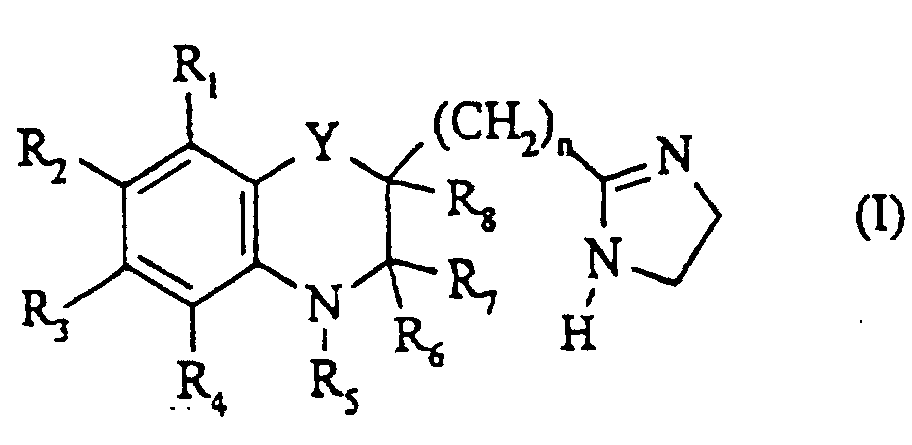 mit der Maßgabe, daß:n 0 oder 1 bedeutet,Y ein Sauerstoffatom, ein Schwefelatom oder eine Gruppe CH2 darstellt,R1, R2, R3, R4, die gleichartig oder verschieden sind, Wasserstoffatome, Halogenatome, geradkettige oder verzweigte (C1-C6)-Alkylgruppen, (C3-C7)-Cycloalkylgruppen, geradkettige oder verzweigte (C1-C6)-Alkoxygruppen, Hydroxygruppen, geradkettige oder verzweigte (C1-C6)-Hydroxyalkylgruppen, geradkettige oder verzweigte (C1-C6)-Trihalogenalkylgruppen, geradkettige oder verzweigte (C1-C6)-Alkyl-carbonylgruppen, Formylgruppen, Cyanogruppen, Carboxygruppen, geradkettige oder verzweigte (C1-C6)-Alkoxy-carbonylgruppen, Nitrogruppen oder gegebenenfalls substituierte Aminogruppen bedeuten,
oder (R1-R2) oder (R2-R3) oder (R3-R4) zusammen mit den Kohlenstoffatomen, an die sie gebunden sind, einen gesättigten oder ungesättigten, gegebenenfalls substituierten Ring mit 5 oder 6 Kettengliedern bilden,R5 ein Wasserstoffatom, eine (C3-C7)-Cycloalkylgruppe oder eine geradkettige oder verzweigte (C1-C6)-Alkylgruppe, die gegebenenfalls durch eine Gruppe ausgewählt aus (C3-C7)-Cycloalkyl und gegebenenfalls substituiertem Phenyl substituiert ist, bedeutet,
oder mit R4 einen gesättigten oder ungesättigten, gegebenenfalls mit einer oder mehreren gleichartigen oder verschiedenen Gruppen ausgewählt aus geradkettigem oder verzweigtem (C1-C6)-Alkyl, geradkettigem oder verzweigtem (C1-C6)-Alkoxy, Hydroxy, Oxo und gegebenenfalls substituiertem Amino substituierten Ring mit 5, 6 oder 7 Kettengliedern bildet,R6 und R7 jeweils ein Wasserstoffatom bedeuten oder gemeinsam eine Oxogruppe bilden,R8 ein Halogenatom, ein Wasserstoffatom oder eine geradkettige oder verzweigte (C1-C6)-Alkylgruppe, geradkettige oder verzweigte (C2-C6)-Alkenylgruppe, Hydroxygruppe, geradkettige oder verzweigte (gegebenenfalls durch eine Aminogruppe, Pyrrolylgruppe oder Piperidinylgruppe substituierte) (C1-C6)-Alkoxygruppe, (C3-C7)-Cycloalkoxygruppe, gegebenenfalls substituierte Phenyloxygruppe oder gegebenenfalls substituierte Benzyloxygruppe darstellt,
oder mit R7 eine Bindung bildet,deren N-Oxide, deren Enantiomere, Diastereoisomere sowie deren Additionssalze mit einer pharmazeutisch annehmbaren Säure oder Base.wenn n 0 ist, Y ein Sauerstoffatom darstellt und R1, R2, R3, R4, R6, R7 und R8 jeweils ein Wasserstoffatom bedeuten, R5 von einem Wasserstoffatom, einer Methylgruppe, einer Ethylgruppe oder einer Benzylgruppe verschieden ist,wenn n 0 ist, Y ein Schwefelatom darstellt und R1, R2, R3, R4, R6, R7 und R8 jeweils ein Wasserstoffatom bedeuten, R5 von einem Wasserstoffatom verschieden ist,unter einer gegebenenfalls substituierten Aminogruppe eine Substitution durch eine oder zwei gleichartige oder verschiedene Gruppen ausgewählt aus geradkettigem oder verzweigtem (C1-C6)-Alkyl, gegebenenfalls substituiertem Phenyl und gegebenenfalls substituiertem Benzyl zu verstehen ist,die Begriffe gegebenenfalls substituiert in bezug auf Phenyloxy-, Benzyloxy-, Phenyl- und Benzylgruppen sowie bezüglich des Begriffs "Ring mit 5 oder 6 Kettengliedern" bedeuten, daß diese Gruppen durch eine oder mehrere gleichartige oder verschiedene Substituenten ausgewählt aus Halogen, geradkettigem oder verzweigtem (C1-C6)-Alkyl, geradkettigem oder verzweigtem (C1-C6)-Alkoxy, Hydroxy und geradkettigem oder verzweigtem (C1-C6)-Trihalogenalkyl substituiert sein können, - Verbindungen der Formel (I) nach Anspruch 1, worin n 0 bedeutet, deren N-Oxide, deren Enantiomere, Diastereoisomere sowie deren Additionssalze mit einer pharmazeutisch annehmbaren Säure oder Base.
- Verbindungen der Formel (I) nach Anspruch 1, worin Y ein Sauerstoffatom bedeutet, deren N-Oxide, deren Enantiomere, Diastereoisomere sowie deren Additionssalze mit einer pharmazeutisch annehmbaren Säure oder Base.
- Verbindungen der Formel (I) nach Anspruch 1, worin Y ein Schwefelatom bedeutet, deren N-Oxide, deren Enantiomere, Diastereoisomere sowie deren Additionssalze mit einer pharmazeutisch annehmbaren Säure oder Base.
- Verbindungen der Formel (I) nach Anspruch 1, worin R6, R7 und R8 jeweils ein Wasserstoffatom bedeuten, deren N-Oxide, deren Enantiomere, Diastereoisomere sowie deren Additionssalze mit einer pharmazeutisch annehmbaren Säure.
- Verbindungen der Formel (I) nach Anspruch 1, worin R5 eine geradkettige oder verzweigte (C1-C6)-Alkylgruppe darstellt, deren N-Oxide, deren Enantiomere, Diastereoisomere sowie deren Additionssalze mit einer pharmazeutisch annehmbaren Säure.
- Verbindungen der Formel (I) nach Anspruch 1, worin drei der Gruppen R1, R2, R3 und R4 identisch sind und jeweils ein Wasserstoffatom bedeuten, während die verbleibende Gruppe die bezüglich der Formel (I) angegebenen Bedeutungen besitzt, deren N-Oxide, deren Enantiomere, Diastereoisomere sowie deren Additionssalze mit einer pharmazeutisch annehmbaren Säure.
- Verbindungen der Formel (I) nach Anspruch 1, worin (R1-R2) oder (R2-R3) oder (R3-R4) mit den Kohlenstoffatomen, an die sie gebunden sind, einen gesättigten oder ungesättigten, gegebenenfalls substituierten Ring mit 5 oder 6 Kettengliedern bilden, deren N-Oxide, deren Enantiomere, Diastereoisomere sowie deren Additionssalze mit einer pharmazeutisch annehmbaren Säure.
- Verbindungen der Formel (I) nach Anspruch 1, worin R4 und R5 gemeinsam einen gesättigten oder ungesättigten, gegebenenfalls durch eine oder mehrere gleichartige oder verschiedene Gruppen ausgewählt aus geradkettigem oder verzweigtem (C1-C6)-Alkyl, geradkettigem oder verzweigtem (C1-C6)-Alkoxy, Hydroxy, Oxo und gegebenenfalls substituiertem Amino substituierten Ring mit 5, 6 oder 7 Kettengliedern bilden, deren N-Oxide, deren Enantiomere, Diastereoisomere sowie deren Additionssalze mit einer pharmazeutisch annehmbaren Säure oder Base.
- Verbindungen der Formel (I) nach Anspruch 1, worin Y ein Sauerstoffatom darstellt, n den Wert 0 besitzt, R6, R7 und R8 jeweils ein Wasserstoffatom darstellen, R1, R2, R3 und R4, die gleichartig oder verschieden sind, Wasserstoffatome, Halogenatome, geradkettige oder verzweigte (C1-C6)-Alkylgruppen, (C3-C7)-Cycloalkylgruppen, geradkettige oder verzweigte (C1-C6)-Alkoxygruppen, Hydroxygruppen, geradkettige oder verzweigte (C1-C6)-Hydroxyalkylgruppen, geradkettige oder verzweigte (C1-C6)-Trihalogenalkylgruppen, geradkettige oder verzweigte (C1-C6)-Alkyl-carbonylgruppen, Formylgruppen, Cyanogruppen, Carboxygruppen, geradkettige oder verzweigte (C1-C6)-Alkoxy-carbonylgruppen, Nitrogruppen und gegebenenfalls substituierte Aminogruppen bedeuten, oder (R1-R2) oder (R2-R3) oder (R3-R4) zusammen mit den Kohlenstoffatomen, an die sie gebunden sind, einen gesättigten oder ungesättigten, gegebenenfalls substituierten Ring mit 5 oder 6 Kettengliedern bilden, während R5 eine geradkettige oder verzweigte (C1-C6)-Alkylgruppe darstellt oder zusammen mit R4 einen gesättigten oder ungesättigten Ring mit 5, 6 oder 7 Kettengliedern bildet, deren N-Oxide, deren Enantiomere, Diastereoisomere sowie deren Additionssalze mit einer pharmazeutisch annehmbaren Säure oder Base.
- Verbindungen der Formel (I) nach Anspruch 1, nämlich:deren N-Oxide, deren Enantiomere, Diastereoisomere sowie deren Additionssalze mit einer pharmazeutisch annehmbaren Säure.2-(4,5-Dihydro-1H-2-imidazolyl)-4,6-dimethyl-3,4-dihydro-2H-1,4-benzoxazin,2-(4,5-Dihydro-1H-2-imidazolyl)-4,7-dimethyl-3,4-dihydro-2H-1,4-benzoxazin,2-(4,5-Dihydro-1H-2-imidazolyl)-4,8-dimethyl-3,4-dihydro-2H-1,4-benzoxazin,
- Verbindung der Formel (I) nach Anspruch 1, nämlich 6-Chlor-2-(4,5-dihydro-1H-2-imidazolyl)-4-methyl-3,4-dihydro-2H-1,4-benzoxazin, dessen N-Oxide, dessen Enantiomere, Diastereoisomere sowie dessen Additionssalze mit einer pharmazeutisch annehmbaren Säure.
- Verbindungen der Formel (I) nach Anspruch 1, nämlich:deren N-Oxide, deren Enantiomere, Diastereoisomere sowie deren Additionssalze mit einer pharmazeutisch annehmbaren Säure.2-(4,5-Dihydro-1H-2-imidazolyl)-2,3,5,6-tetrahydro[1,4]oxazino[2,3,4-h,i]indol,2-(4,5-Dihydro-1H-2-imidazolyl)-2,3-dihydro[1,4]oxazino[2,3,4-h,i]indol,
- Verfahren zur Herstellung der Verbindungen der Formel (I), dadurch gekennzeichnet, daß:welche manwenn in der herzustellenden Verbindung der Forme (I) R4 und R5 nicht gemeinsam einen Ring bilden, man als Ausgangsmaterial eine Verbindung der Formel (II/a) verwendet:in der R"8 ein Wasserstoffatom darstellt oder mit R7 eine Bindung bildet und Y, R1, R2, R3, R4, R6 und R7 die bezüglich der Formel (I) angegebenen Bedeutungen besitzen,
 oderentweder mit einem Derivat der Formel (III) behandelt:

zur Bildung einer Verbindung der Formel (II/b):in der Y, R1, R2, R3, R4, R'5, R6, R7 und R"8 die oben angegebenen Bedeutungen besitzen,
welche, wenn R"8 ein Wasserstoffatom bedeutet, der Einwirkung eines Halogenierungsmittels unterworfen werden kann oder der Einwirkung einer starken Base, gefolgt von einer Behandlung mit einem Derivat der Formel (IV):
zur Bildung einer Verbindung der Formel (II/c):in der Y, R1, R2, R3, R4, R'5, R6 und R7 und R'8 die oben angegebenen Bedeutungen besitzen,
zur Bildung einer Verbindung der Formel (II/d):in der Y, R1, R2, R3, R4, R6, R7, und R'8 die oben angegebenen Bedeutungen besitzen,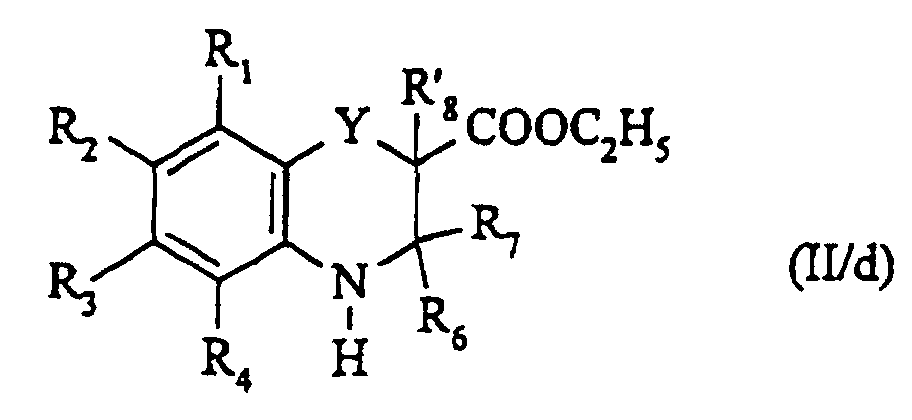
welche Verbindungen (II/a), (II/b), (II/c) und (II/d), welche die Gesamtheit der Verbindungen der Formel (II) bilden:in der Y, R1, R2, R3, R4, R5, R6, R7 und R8 die oben angegebenen Bedeutungen besitzen,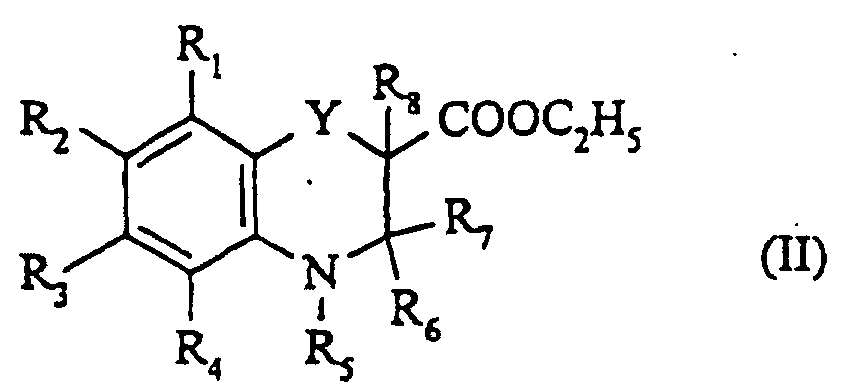
man, gegebenenfalls nach der Homologierung eines Kohlenstoffatoms der die Esterfunktion tragenden Kette, mit Ethylendiamin behandelt zur Bildung einer Verbindung der Formel (I/a):einem Sonderfall der Verbindungen der Formel I, worin Y, R1, R2, R3, R4, R5, R6, R7, R8 und n die bezüglich der Formel (I) angegebenen Bedeutungen besitzen, mit der Maßgabe, daß R4 und R5 nicht gemeinsam einen Ring bilden, welche Verbindung (VIII/a)wenn in der herzustellenden Verbindung der Formel (I) R4 und R5 gemeinsam einen Ring bilden, man als Ausgangsmaterial eine Verbindung der Formel (II/e) verwendet:in der R1, R2, R3, R6, R7 und R"8 die oben angegebenen Bedeutungen besitzen,

welche man mit einem Derivat der Formel (V) oder (VI) behandelt: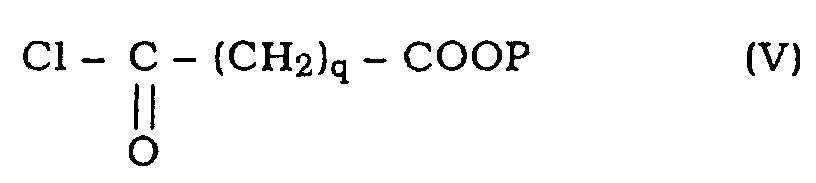
zur Bildung einer Verbindung der Formel (VII):in der G1 eine Gruppe CH2 oder CO darstellt und q, P, Y, R1, R2, R3, R6, R7 und R"8 die oben angegebenen Bedeutungen besitzen,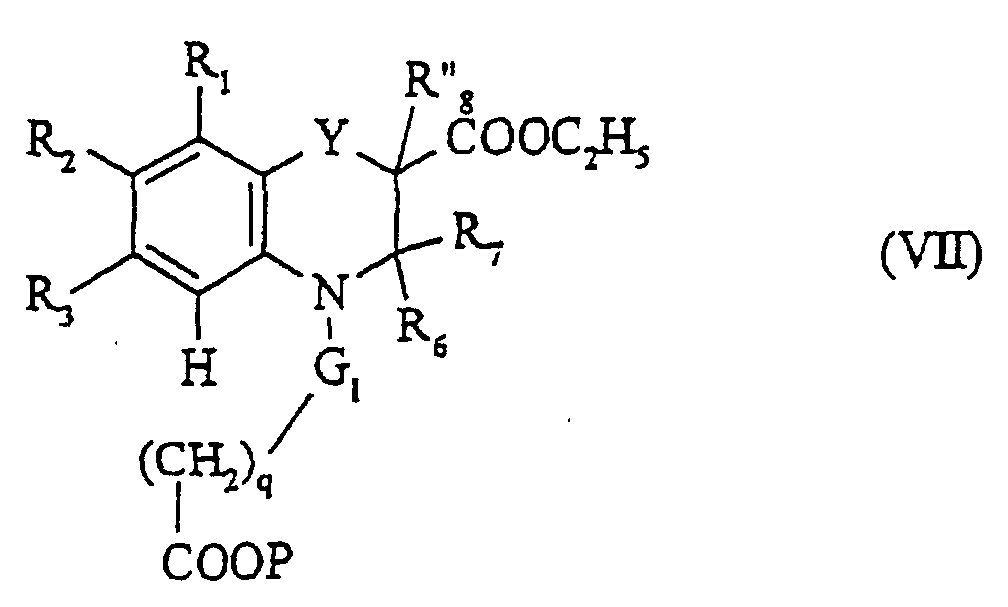
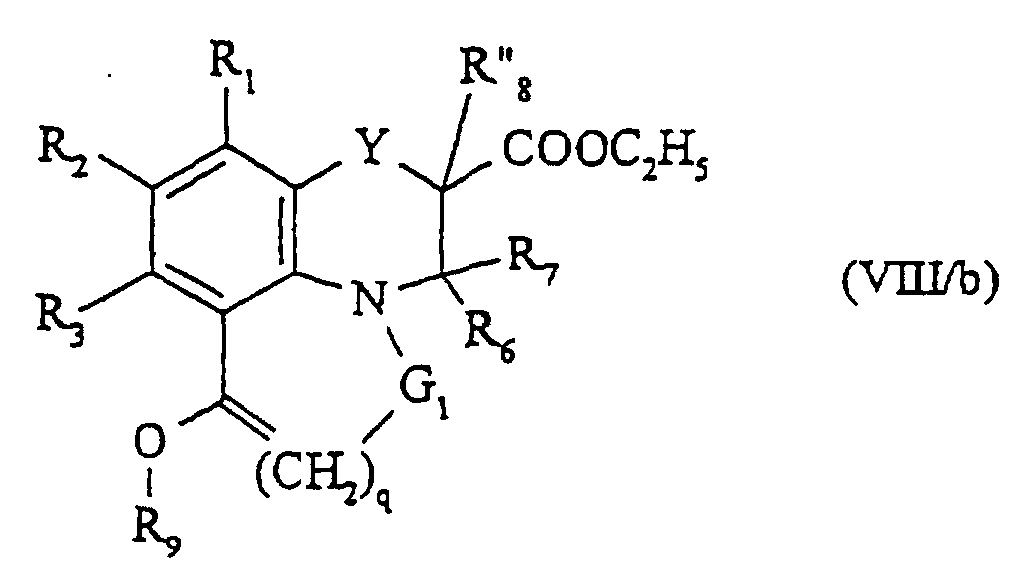
welche, nach der Freisetzung der Säurefunktion und der Cyclisierung zu der Verbindung der Formel (VIII/a) führt:in der Y, R1, R2, R3, R6, R7, R"8, G1 und q die oben angegebenen Bedeutungen besitzen,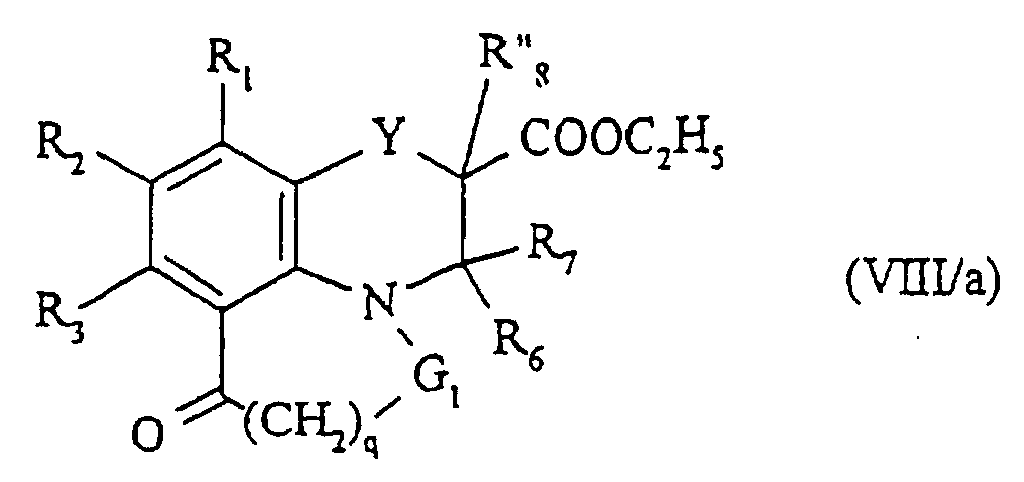 wobei jede der Verbindungen (VIII/a), (VIII/b) und (VIII/c), wenn dies mit den an dem Molekül vorhandenen Substituenten verträglich ist, mit einer starken Base und dann mit einem Derivat der oben definierten Formel (IV) behandelt werden können zur Bildung einer Verbindung der Formel (VIII/d):nach der Behandlung mit einem Alkylhalogenid in eine Verbindung der Formel (VIII/b) umgewandelt werden kann:in der R9 eine geradkettige oder verzweigte (C1-C6)-Alkylgruppe darstellt und Y, R1, R2, R3, R5, R7, R"8, G1 und q die oben angegebenen Bedeutungen besitzen,
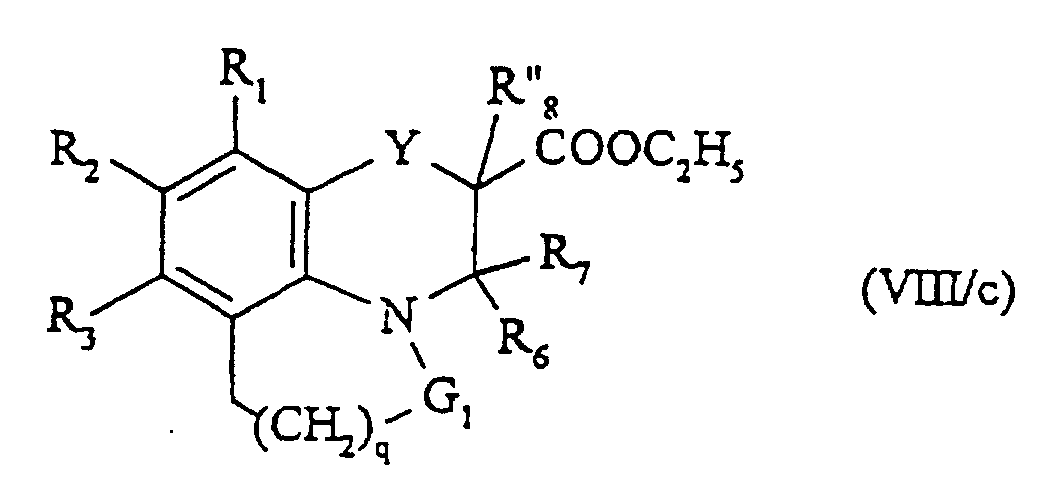
 oder reduziert werden kann zur Bildung einer Verbindung der Formel (VIII/c):in der Y, R1, R2, R3, R6, R7, R"8, G1 und q die oben angegebenen Bedeutungen besitzen,
 in der G2 eine Gruppe CH2 oder CO darstellt oder gemeinsam mit dem benachbarten Methylenkohlenstoff eine Gruppe der Formel bildet:
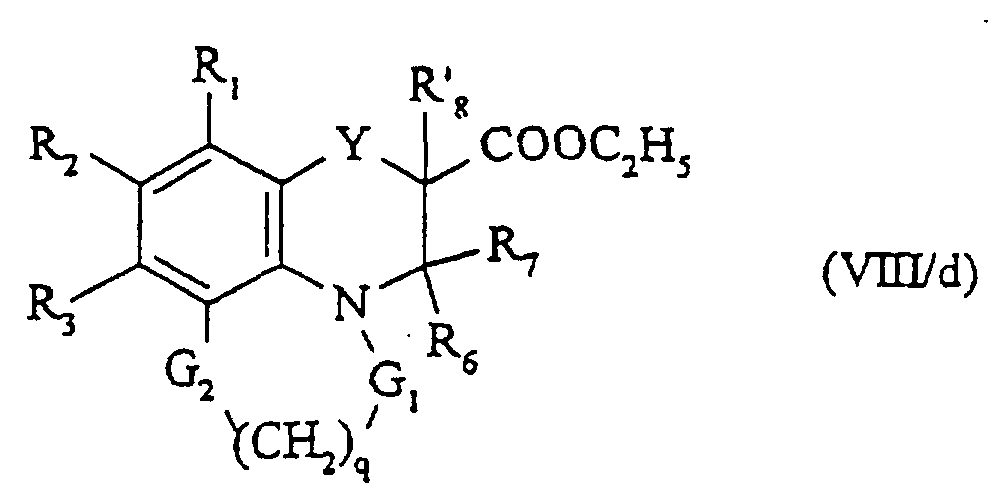 und Y, R1, R2, R3, R6, R7, R'8, R9, G1 und q die oben angegebenen Bedeutungen besitzen,

welche Verbindungen der (VIII/a), (VIII/b), (VIII/c) und (VIII/d) die Gesamtheit der Verbindungen der Formel (VIII) bilden:in der R1, R2, R3, R6, R7, R8, G1, G2 und q die oben angegebenen Bedeutungen besitzen,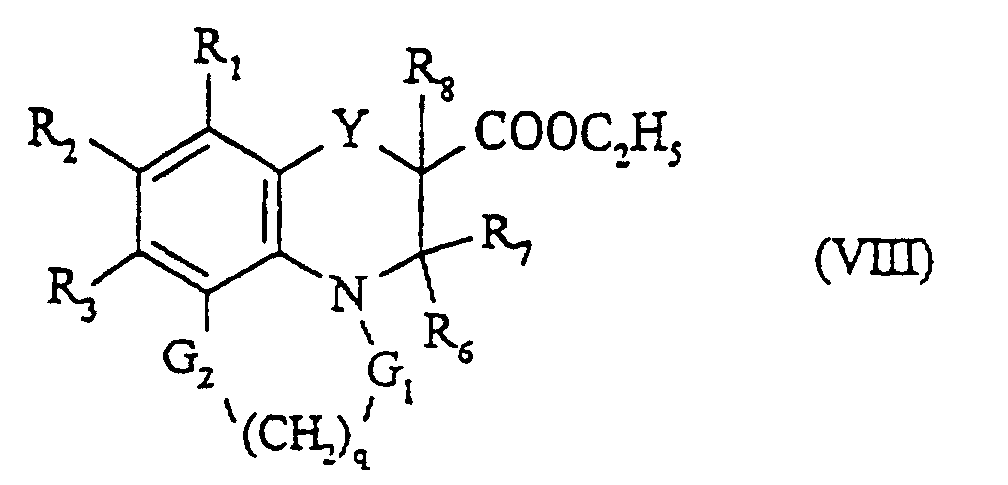
und die, gegebenenfalls nach der Homologierung eines Kohlenstoffatoms der die Esterfunktion tragenden Kette, mit Ethylendiamin behandelt werden zur Bildung einer Verbindung der Formel (I/b):einem Sonderfall der Verbindungen der Formel (I), worin Y, R1, R2, R3, R6, R7, R8, G1, G2, n und q die oben angegebenen Bedeutungen besitzen,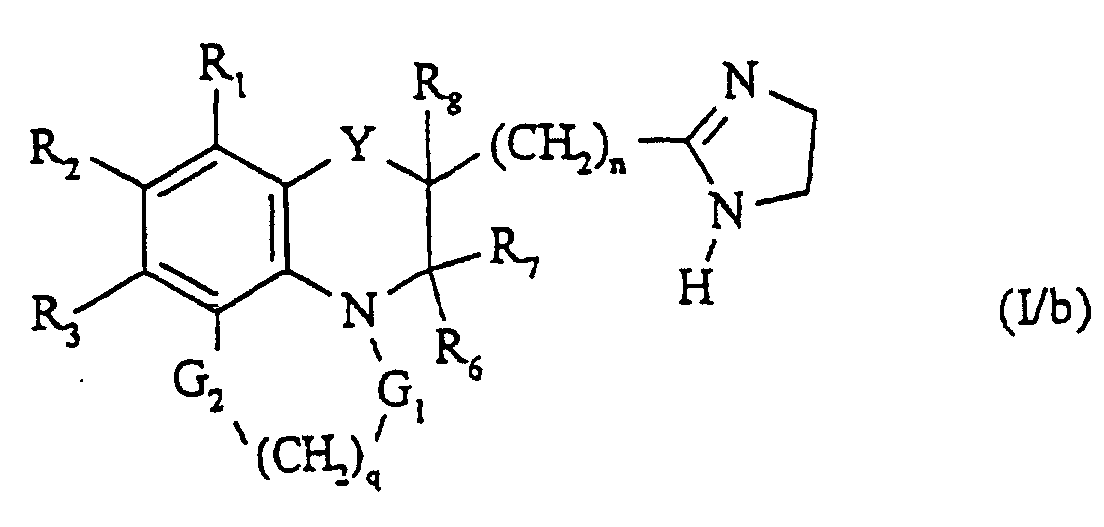
welche Verbindungen (I/a) und (I/b) man:gegebenenfalls mit Hilfe einer klassischen Reinigungsmethode reinigt,gegebenenfalls mit Hilfe einer klassischen Trennmethode in ihre Isomeren auftrennt,und gegebenenfalls in ihre N-Oxide oder ihre Additionssalze mit einer pharmazeutisch annehmbaren Säure oder Base umwandelt. - Verfahren zur Herstellung der Verbindungen der Formel (I), dadurch gekennzeichnet, daß man als Ausgangsmaterial eine Verbindung der Formel (IX) verwendet:in der R10 und R11 gleichzeitig Wasserstoff bedeuten oder gemeinsam eine Bindung bilden und R1, R2 und R3 die bezüglich der Formel (I) angegebenen Bedeutungen besitzen,

welche nach der Abspaltung der Schutzgruppe von dem Indolstickstoffatom mit 2,3-Dibrompropionsäuremethylester in basischem Medium behandelt werden zur Bildung der Verbindung der Formel (X/a):in der R1, R2, R3, R10 und R11 die oben angegebenen Bedeutungen besitzen, welche man mit einer starken Base und einem Derivat der Formel (IV) umsetzt: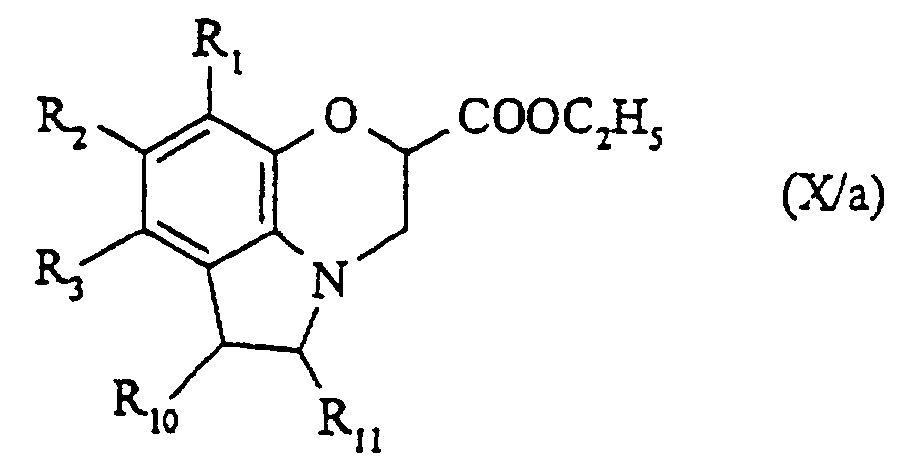
zur Bildung der Verbindung der Formel (X/b):in der R1, R2, R3, R'8, R10 und R11 die oben angegebenen Bedeutungen besitzen,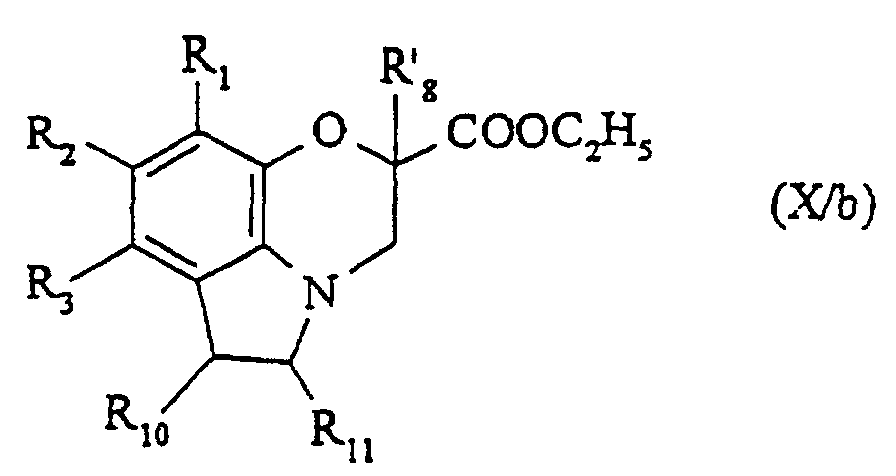
welche Verbindungen (X/a) und (X/b) die Gesamtheit der Verbindungen der Formel (X) bilden:in der R1, R2, R3, R8, R10 und R11 die oben angegebenen Bedeutungen besitzen,
welche man, nach einer eventuellen Homologierung eines Kohlenstoffatoms der die Esterfunktion tragenden Kette, mit Ethylendiamin behandelt zur Bildung einer Verbindung der Formel (I/c):einem Sonderfall der Verbindungen der Formel (I), worin R1, R2, R3, R8, R10, R11 und n die oben angegebenen Bedeutungen besitzen,
welche Verbindung (I/c) man:wobei es sich versteht, daß, wenn R10 und R11 jeweils ein Wasserstoffatom bedeuten, sie in irgendeinem Augenblick des Verfahrens mit Hilfe einer klassischen Aromatisierungsmethode in eine Bindung umgewandelt werden können.gegebenenfalls mit Hilfe einer klassischen Reinigungsmethode reinigt,gegebenenfalls mit Hilfe einer klassischen Trennmethode in ihre Isomeren auftrennt,und gegebenenfalls in ihr N-Oxid oder ihr Additionssalz mit einer pharmazeutisch annehmbaren Säure oder Base umwandelt, - Pharmazeutische Zubereitungen enthaltend als Wirkstoff mindestens eine Verbindung nach einem der Ansprüche 1 bis 13 allein oder in Kombination mit einem oder mehreren inerten, nichttoxischen, pharmazeutisch annehmbaren Trägermaterialien oder Bindemitteln.
- Pharmazeutische Zubereitungen nach Anspruch 16 enthaltend mindestens einen Wirkstoff nach einem der Ansprüche 1 bis 8 zur Behandlung von Erkrankungen, die mit Störungen der Funktion von Imidazolin-Rezeptoren verknüpft sind, wie kardiovaskulären Krankheiten und arterieller Hypertonie, Diabetes, Fettsucht, psychiatrische und neurologische Störungen, wie Depressionen, Parkinsonsche Krankheit, Anorexie und Alzheimersche Krankheit.
- Pharmazeutische Zubereitungen nach Anspruch 16 zur Behandlung von kardiovaskulären Erkrankungen und der arteriellen Hypertonie enthaltend einen Wirkstoff nach einem der Ansprüche 1 bis 13.
Applications Claiming Priority (2)
| Application Number | Priority Date | Filing Date | Title |
|---|---|---|---|
| FR9709709 | 1997-07-30 | ||
| FR9709709A FR2766824B1 (fr) | 1997-07-30 | 1997-07-30 | Nouveaux composes heterocycliques, leur procede de preparation et les compositions pharmaceutiques qui les contiennent |
Publications (2)
| Publication Number | Publication Date |
|---|---|
| EP0894796A1 EP0894796A1 (de) | 1999-02-03 |
| EP0894796B1 true EP0894796B1 (de) | 2001-06-06 |
Family
ID=9509815
Family Applications (1)
| Application Number | Title | Priority Date | Filing Date |
|---|---|---|---|
| EP98401919A Expired - Lifetime EP0894796B1 (de) | 1997-07-30 | 1998-07-28 | Durch einen heterocyclischen Ring substituierte Imidazoline als alpha-2 Antagonisten |
Country Status (19)
| Country | Link |
|---|---|
| US (1) | US6057317A (de) |
| EP (1) | EP0894796B1 (de) |
| JP (1) | JPH1192476A (de) |
| CN (1) | CN1090631C (de) |
| AT (1) | ATE201871T1 (de) |
| AU (1) | AU736460B2 (de) |
| BR (1) | BR9802803A (de) |
| CA (1) | CA2244435A1 (de) |
| DE (1) | DE69800883T2 (de) |
| DK (1) | DK0894796T3 (de) |
| ES (1) | ES2159921T3 (de) |
| FR (1) | FR2766824B1 (de) |
| GR (1) | GR3036474T3 (de) |
| HU (1) | HUP9801713A1 (de) |
| NO (1) | NO311256B1 (de) |
| NZ (1) | NZ331154A (de) |
| PL (1) | PL327747A1 (de) |
| PT (1) | PT894796E (de) |
| ZA (1) | ZA986815B (de) |
Families Citing this family (9)
| Publication number | Priority date | Publication date | Assignee | Title |
|---|---|---|---|---|
| FR2799757B1 (fr) * | 1999-10-15 | 2001-12-14 | Adir | Nouveaux derives polycycliques azaindoliques, leur procede de preparation et les compositions pharmaceutiques qui les contiennent |
| ZA200601423B (en) * | 2003-09-01 | 2007-04-25 | Ono Pharmaceutical Co | Condensed ring compound and use thereof |
| AU2004268865B8 (en) * | 2003-09-01 | 2011-01-06 | Ono Pharmaceutical Co., Ltd. | Condensed ring compound and use thereof |
| US20070197512A1 (en) * | 2006-01-27 | 2007-08-23 | Japan Tobacco Inc. | Carboxylic Acid Compounds and Use Thereof |
| WO2007086504A1 (ja) * | 2006-01-27 | 2007-08-02 | Japan Tobacco Inc. | カルボン酸化合物及びその用途 |
| TWI469965B (zh) * | 2008-12-22 | 2015-01-21 | Ono Pharmaceutical Co | 乙炔基吲哚化合物 |
| KR20130112715A (ko) | 2010-06-21 | 2013-10-14 | 오노 야꾸힝 고교 가부시키가이샤 | 4,4''-[4-플루오로-7-({4-[4-(3-플루오로-2-메틸페닐)부톡시]페닐}에티닐)-2-메틸-1h-인돌-1,3-디일]디부탄산, 4,4''-[2-메틸-7-({4-[4-(펜타플루오로페닐)부톡시]페닐}에티닐)-1h-인돌-1,3-디일]디부탄산 및 4,4''-[4-플루오로-2-메틸-7-({4-[4-(2,3,4,6-테트라플루오로페닐)부톡시]페닐}에티닐)-1h-인돌-1,3-디일]디부탄산의 신규 결정형 |
| US9216998B2 (en) * | 2012-02-15 | 2015-12-22 | Janssen Pharmaceutica Nv | Tricyclic indole derivatives useful endothelial lipase inhibitors |
| RU2687979C1 (ru) * | 2018-03-19 | 2019-05-17 | Федеральное государственное автономное образовательное учреждение высшего образования "Белгородский государственный национальный исследовательский университет" (НИУ "БелГУ") | Способ коррекции стрептозотоцин-индуцированного сахарного диабета у крыс с использованием лекарственного средства на основе амида гетероциклических кислот |
Family Cites Families (3)
| Publication number | Priority date | Publication date | Assignee | Title |
|---|---|---|---|---|
| NZ199469A (en) * | 1981-01-30 | 1984-03-16 | Reckitt & Colmann Prod Ltd | Benzodioxanyl-2-imidazoline derivatives and pharmaceutical compositions |
| US4436914A (en) * | 1981-08-03 | 1984-03-13 | Kluge Arthur F | Benzodioxane-imidazoline compounds as antihypertensives |
| NZ203680A (en) * | 1982-04-17 | 1985-08-16 | Reckitt & Colmann Prod Ltd | Imidazolines and pharmaceutical compositions |
-
1997
- 1997-07-30 FR FR9709709A patent/FR2766824B1/fr not_active Expired - Fee Related
-
1998
- 1998-07-20 US US09/119,423 patent/US6057317A/en not_active Expired - Fee Related
- 1998-07-28 NO NO19983478A patent/NO311256B1/no not_active IP Right Cessation
- 1998-07-28 DE DE69800883T patent/DE69800883T2/de not_active Expired - Fee Related
- 1998-07-28 PT PT98401919T patent/PT894796E/pt unknown
- 1998-07-28 AT AT98401919T patent/ATE201871T1/de not_active IP Right Cessation
- 1998-07-28 EP EP98401919A patent/EP0894796B1/de not_active Expired - Lifetime
- 1998-07-28 DK DK98401919T patent/DK0894796T3/da active
- 1998-07-28 ES ES98401919T patent/ES2159921T3/es not_active Expired - Lifetime
- 1998-07-29 NZ NZ331154A patent/NZ331154A/xx unknown
- 1998-07-29 PL PL98327747A patent/PL327747A1/xx unknown
- 1998-07-29 JP JP10213603A patent/JPH1192476A/ja active Pending
- 1998-07-29 CN CN98116645A patent/CN1090631C/zh not_active Expired - Fee Related
- 1998-07-29 HU HU9801713A patent/HUP9801713A1/hu unknown
- 1998-07-29 CA CA002244435A patent/CA2244435A1/fr not_active Abandoned
- 1998-07-30 ZA ZA986815A patent/ZA986815B/xx unknown
- 1998-07-30 AU AU78609/98A patent/AU736460B2/en not_active Ceased
- 1998-07-30 BR BR9802803A patent/BR9802803A/pt not_active IP Right Cessation
-
2001
- 2001-08-30 GR GR20010401333T patent/GR3036474T3/el not_active IP Right Cessation
Non-Patent Citations (1)
| Title |
|---|
| Michel, M. C., Ernsberger, P.; 'Keeping an eye on the I site: imidazoline-preferring receptors' Trends Pharmacol. Sci. 1992, 253, 408 * |
Also Published As
| Publication number | Publication date |
|---|---|
| DK0894796T3 (da) | 2001-09-03 |
| CN1090631C (zh) | 2002-09-11 |
| HU9801713D0 (en) | 1998-09-28 |
| BR9802803A (pt) | 2000-03-21 |
| NZ331154A (en) | 1999-05-28 |
| HK1017685A1 (en) | 1999-11-26 |
| PL327747A1 (en) | 1999-02-01 |
| FR2766824A1 (fr) | 1999-02-05 |
| NO311256B1 (no) | 2001-11-05 |
| GR3036474T3 (en) | 2001-11-30 |
| JPH1192476A (ja) | 1999-04-06 |
| CN1206712A (zh) | 1999-02-03 |
| US6057317A (en) | 2000-05-02 |
| NO983478L (no) | 1999-02-01 |
| DE69800883T2 (de) | 2002-03-28 |
| AU736460B2 (en) | 2001-07-26 |
| FR2766824B1 (fr) | 1999-09-10 |
| ES2159921T3 (es) | 2001-10-16 |
| HUP9801713A1 (hu) | 1999-12-28 |
| PT894796E (pt) | 2001-09-28 |
| CA2244435A1 (fr) | 1999-01-30 |
| ATE201871T1 (de) | 2001-06-15 |
| EP0894796A1 (de) | 1999-02-03 |
| AU7860998A (en) | 1999-02-11 |
| ZA986815B (en) | 1999-02-02 |
| DE69800883D1 (de) | 2001-07-12 |
| NO983478D0 (no) | 1998-07-28 |
Similar Documents
| Publication | Publication Date | Title |
|---|---|---|
| EP0995743B1 (de) | Dihydro- und Tetrahydrochinolinderivate als medizinisches Antioxydans | |
| EP0711280B1 (de) | Perhydroisoindolderivate als substanz p antagonisten | |
| EP0389352B1 (de) | 4-Fluorbenzolderivate, Herstellungsverfahren und diese enthaltende pharmazeutische Zusammensetzungen | |
| EP1560826B1 (de) | Pyridopyrimidinon-derivate, verfahren zu ihrer herstellung und diese enthaltende pharmazeutische zusammensetzungen | |
| EP0478446A1 (de) | Heterozyklische Alkylamine, Verfahren zu ihrer Herstellung und pharmazeutische Zusammensetzungen die sie enthalten | |
| EP0669331B1 (de) | Benzodioxan Derivate, Verfahren zu deren Herstellung und diese enthaltende pharmazeutische Zusammenstellungen | |
| FR2767827A1 (fr) | Nouveaux derives de l'indole et de l'indazole, leur procede de preparation et les compositions pharmaceutiques qui les contiennent | |
| EP0894796A1 (de) | Durch einen heterocyclischen Ring substituierte Imidazoline als alpha-2 Antagonisten | |
| EP0841330B1 (de) | Aminomethylheterozyclischederivate, Verfahren zur ihrer Herstellung und diese enthaltende pharmazeutische Zusammensetzungen | |
| EP0906912B1 (de) | Indanol-Derivate, Verfahren zu deren Herstellung und diese enthaltende pharmazeutische Zusammensetzungen | |
| EP0004494A1 (de) | 1,3-Dihydro-3-(1-(2-(2,3-dihydro-1,4-benzodioxin-2-yl)2-hydroxy-äthyl)piperidin-4-yl)2H-indol-2-on Derivate, Verfahren zu ihrer Herstellung, ihre Verwendung als Arzneimittel und diese enthaltende pharmazeutische Zubereitungen | |
| EP0638568B1 (de) | Substituierte Piperazine, ihre Verfahrensherstellung und die enthaltenen pharmazeutischen Zusammenfassungen | |
| WO1997028157A1 (fr) | Nouveaux derives de la piperidine substitues en position 4 par un groupe imidazolidin-2-on-1-yl-ethyl, tetrahydropyrimidin-2-on-1-yl-ethyl, et 1,3-dia-zepin-2-on-1-yl-ethyl, et leurs applications comme antagonistes des recepteurs alpha-2 adrenergiques | |
| JP2744224B2 (ja) | ビス−アザ−二環式抗不安薬の製法 | |
| FR2822153A1 (fr) | Nouveaux derives d'indenoindolones, leur procede de preparation et les compositions pharmaceutiques qui les contiennent | |
| EP1125940B1 (de) | Derivate von Aryl- oder Heteroaryl-Quinolinylphosphonsäuren, Verfahren zu ihrer Herstellung und sie enthaltende Arzneimittel | |
| EP1192152A1 (de) | Fluorierte benzodioxan imidazolin derivate, deren herstellung und deren therapeutische verwendung | |
| FR2647451A1 (fr) | Derives d'imidazo(1,2-a)pyridine, procede de preparation, compositions pharmaceutiques les contenant | |
| FR2639944A1 (fr) | Nouveaux derives de l'indole, leur procede de preparation et les compositions pharmaceutiques qui les contiennent | |
| EP2277882A1 (de) | Pipéridinische Verbindungen, Verfahren zu ihrer Herstellung und die sie enhaltende pharmazeutische Zusammensetzungen | |
| EP1476433B1 (de) | Trizyklo-imidazolinen derivaten, verfahren zu deren herstellung und deren verwendung als heilmitteln | |
| EP1905775B1 (de) | Tetrazykline, ihr Herstellungsverfahren, deren pharmazeutischen Zusammensetzungen, die sie enthalten und deren Verwendung als Dopamin-Rezeptoren Liganden | |
| WO2012168368A1 (fr) | Derives benzoquinolizidines, leur procede de preparation et leurs applications en therapeutique |
Legal Events
| Date | Code | Title | Description |
|---|---|---|---|
| PUAI | Public reference made under article 153(3) epc to a published international application that has entered the european phase |
Free format text: ORIGINAL CODE: 0009012 |
|
| 17P | Request for examination filed |
Effective date: 19980810 |
|
| AK | Designated contracting states |
Kind code of ref document: A1 Designated state(s): AT BE CH DE DK ES FI FR GB GR IE IT LI LU NL PT SE |
|
| AX | Request for extension of the european patent |
Free format text: AL;LT;LV;MK;RO;SI |
|
| AKX | Designation fees paid |
Free format text: AT BE CH DE DK ES FI FR GB GR IE IT LI LU NL PT SE |
|
| 17Q | First examination report despatched |
Effective date: 20000511 |
|
| GRAG | Despatch of communication of intention to grant |
Free format text: ORIGINAL CODE: EPIDOS AGRA |
|
| GRAG | Despatch of communication of intention to grant |
Free format text: ORIGINAL CODE: EPIDOS AGRA |
|
| GRAH | Despatch of communication of intention to grant a patent |
Free format text: ORIGINAL CODE: EPIDOS IGRA |
|
| GRAH | Despatch of communication of intention to grant a patent |
Free format text: ORIGINAL CODE: EPIDOS IGRA |
|
| GRAA | (expected) grant |
Free format text: ORIGINAL CODE: 0009210 |
|
| AK | Designated contracting states |
Kind code of ref document: B1 Designated state(s): AT BE CH DE DK ES FI FR GB GR IE IT LI LU NL PT SE |
|
| ITF | It: translation for a ep patent filed | ||
| REF | Corresponds to: |
Ref document number: 201871 Country of ref document: AT Date of ref document: 20010615 Kind code of ref document: T |
|
| REF | Corresponds to: |
Ref document number: 69800883 Country of ref document: DE Date of ref document: 20010712 |
|
| REG | Reference to a national code |
Ref country code: CH Ref legal event code: NV Representative=s name: A. BRAUN, BRAUN, HERITIER, ESCHMANN AG PATENTANWAE |
|
| REG | Reference to a national code |
Ref country code: IE Ref legal event code: FG4D Free format text: FRENCH |
|
| REG | Reference to a national code |
Ref country code: DK Ref legal event code: T3 |
|
| REG | Reference to a national code |
Ref country code: PT Ref legal event code: SC4A Free format text: AVAILABILITY OF NATIONAL TRANSLATION Effective date: 20010627 |
|
| GBT | Gb: translation of ep patent filed (gb section 77(6)(a)/1977) |
Effective date: 20010906 |
|
| REG | Reference to a national code |
Ref country code: ES Ref legal event code: FG2A Ref document number: 2159921 Country of ref document: ES Kind code of ref document: T3 |
|
| REG | Reference to a national code |
Ref country code: CH Ref legal event code: PFA Free format text: ADIR ET COMPAGNIE TRANSFER- LES LABORATOIRES SERVIER |
|
| REG | Reference to a national code |
Ref country code: FR Ref legal event code: TP |
|
| REG | Reference to a national code |
Ref country code: GB Ref legal event code: 732E |
|
| BECA | Be: change of holder's address |
Free format text: 20010606 LES LABORATOIRES *SERVIER:1 RUE CARLE HEBERT, 92415 COURBEVOIE CEDEX |
|
| BECH | Be: change of holder |
Free format text: 20010606 LES LABORATOIRES *SERVIER |
|
| REG | Reference to a national code |
Ref country code: GB Ref legal event code: IF02 |
|
| NLS | Nl: assignments of ep-patents |
Owner name: LES LABORATOIRES SERVIER |
|
| REG | Reference to a national code |
Ref country code: PT Ref legal event code: PC4A Free format text: LES LABORATOIRES SERVIER FR Effective date: 20011105 |
|
| PLBE | No opposition filed within time limit |
Free format text: ORIGINAL CODE: 0009261 |
|
| STAA | Information on the status of an ep patent application or granted ep patent |
Free format text: STATUS: NO OPPOSITION FILED WITHIN TIME LIMIT |
|
| 26N | No opposition filed | ||
| PGFP | Annual fee paid to national office [announced via postgrant information from national office to epo] |
Ref country code: SE Payment date: 20020531 Year of fee payment: 5 |
|
| PGFP | Annual fee paid to national office [announced via postgrant information from national office to epo] |
Ref country code: DK Payment date: 20020716 Year of fee payment: 5 |
|
| PGFP | Annual fee paid to national office [announced via postgrant information from national office to epo] |
Ref country code: IE Payment date: 20030425 Year of fee payment: 6 |
|
| PGFP | Annual fee paid to national office [announced via postgrant information from national office to epo] |
Ref country code: PT Payment date: 20030430 Year of fee payment: 6 |
|
| PGFP | Annual fee paid to national office [announced via postgrant information from national office to epo] |
Ref country code: AT Payment date: 20030506 Year of fee payment: 6 |
|
| PGFP | Annual fee paid to national office [announced via postgrant information from national office to epo] |
Ref country code: GR Payment date: 20030522 Year of fee payment: 6 |
|
| PGFP | Annual fee paid to national office [announced via postgrant information from national office to epo] |
Ref country code: LU Payment date: 20030708 Year of fee payment: 6 |
|
| PGFP | Annual fee paid to national office [announced via postgrant information from national office to epo] |
Ref country code: FI Payment date: 20030709 Year of fee payment: 6 |
|
| PGFP | Annual fee paid to national office [announced via postgrant information from national office to epo] |
Ref country code: FR Payment date: 20030717 Year of fee payment: 6 |
|
| PGFP | Annual fee paid to national office [announced via postgrant information from national office to epo] |
Ref country code: GB Payment date: 20030723 Year of fee payment: 6 |
|
| PGFP | Annual fee paid to national office [announced via postgrant information from national office to epo] |
Ref country code: NL Payment date: 20030724 Year of fee payment: 6 |
|
| PGFP | Annual fee paid to national office [announced via postgrant information from national office to epo] |
Ref country code: DE Payment date: 20030728 Year of fee payment: 6 |
|
| PG25 | Lapsed in a contracting state [announced via postgrant information from national office to epo] |
Ref country code: SE Free format text: LAPSE BECAUSE OF NON-PAYMENT OF DUE FEES Effective date: 20030729 |
|
| PG25 | Lapsed in a contracting state [announced via postgrant information from national office to epo] |
Ref country code: DK Free format text: LAPSE BECAUSE OF NON-PAYMENT OF DUE FEES Effective date: 20030731 |
|
| PGFP | Annual fee paid to national office [announced via postgrant information from national office to epo] |
Ref country code: BE Payment date: 20030812 Year of fee payment: 6 |
|
| PGFP | Annual fee paid to national office [announced via postgrant information from national office to epo] |
Ref country code: CH Payment date: 20030818 Year of fee payment: 6 |
|
| PGFP | Annual fee paid to national office [announced via postgrant information from national office to epo] |
Ref country code: ES Payment date: 20030821 Year of fee payment: 6 |
|
| EUG | Se: european patent has lapsed | ||
| REG | Reference to a national code |
Ref country code: DK Ref legal event code: EBP |
|
| PG25 | Lapsed in a contracting state [announced via postgrant information from national office to epo] |
Ref country code: LU Free format text: LAPSE BECAUSE OF NON-PAYMENT OF DUE FEES Effective date: 20040728 Ref country code: IE Free format text: LAPSE BECAUSE OF NON-PAYMENT OF DUE FEES Effective date: 20040728 Ref country code: GB Free format text: LAPSE BECAUSE OF NON-PAYMENT OF DUE FEES Effective date: 20040728 Ref country code: FI Free format text: LAPSE BECAUSE OF NON-PAYMENT OF DUE FEES Effective date: 20040728 Ref country code: AT Free format text: LAPSE BECAUSE OF NON-PAYMENT OF DUE FEES Effective date: 20040728 |
|
| PG25 | Lapsed in a contracting state [announced via postgrant information from national office to epo] |
Ref country code: ES Free format text: LAPSE BECAUSE OF NON-PAYMENT OF DUE FEES Effective date: 20040729 |
|
| PG25 | Lapsed in a contracting state [announced via postgrant information from national office to epo] |
Ref country code: LI Free format text: LAPSE BECAUSE OF NON-PAYMENT OF DUE FEES Effective date: 20040731 Ref country code: CH Free format text: LAPSE BECAUSE OF NON-PAYMENT OF DUE FEES Effective date: 20040731 Ref country code: BE Free format text: LAPSE BECAUSE OF NON-PAYMENT OF DUE FEES Effective date: 20040731 |
|
| PG25 | Lapsed in a contracting state [announced via postgrant information from national office to epo] |
Ref country code: PT Free format text: LAPSE BECAUSE OF NON-PAYMENT OF DUE FEES Effective date: 20050128 |
|
| BERE | Be: lapsed |
Owner name: LES LABORATOIRES *SERVIER Effective date: 20040731 |
|
| PG25 | Lapsed in a contracting state [announced via postgrant information from national office to epo] |
Ref country code: NL Free format text: LAPSE BECAUSE OF NON-PAYMENT OF DUE FEES Effective date: 20050201 Ref country code: DE Free format text: LAPSE BECAUSE OF NON-PAYMENT OF DUE FEES Effective date: 20050201 |
|
| PG25 | Lapsed in a contracting state [announced via postgrant information from national office to epo] |
Ref country code: GR Free format text: LAPSE BECAUSE OF NON-PAYMENT OF DUE FEES Effective date: 20050203 |
|
| REG | Reference to a national code |
Ref country code: CH Ref legal event code: PL |
|
| GBPC | Gb: european patent ceased through non-payment of renewal fee |
Effective date: 20040728 |
|
| PG25 | Lapsed in a contracting state [announced via postgrant information from national office to epo] |
Ref country code: FR Free format text: LAPSE BECAUSE OF NON-PAYMENT OF DUE FEES Effective date: 20050331 |
|
| REG | Reference to a national code |
Ref country code: PT Ref legal event code: MM4A Free format text: LAPSE DUE TO NON-PAYMENT OF FEES Effective date: 20050128 |
|
| NLV4 | Nl: lapsed or anulled due to non-payment of the annual fee |
Effective date: 20050201 |
|
| REG | Reference to a national code |
Ref country code: FR Ref legal event code: ST |
|
| REG | Reference to a national code |
Ref country code: IE Ref legal event code: MM4A |
|
| PG25 | Lapsed in a contracting state [announced via postgrant information from national office to epo] |
Ref country code: IT Free format text: LAPSE BECAUSE OF NON-PAYMENT OF DUE FEES;WARNING: LAPSES OF ITALIAN PATENTS WITH EFFECTIVE DATE BEFORE 2007 MAY HAVE OCCURRED AT ANY TIME BEFORE 2007. THE CORRECT EFFECTIVE DATE MAY BE DIFFERENT FROM THE ONE RECORDED. Effective date: 20050728 |
|
| REG | Reference to a national code |
Ref country code: ES Ref legal event code: FD2A Effective date: 20040729 |
|
| BERE | Be: lapsed |
Owner name: LES LABORATOIRES *SERVIER Effective date: 20040731 |