EP0894832B1 - Procédé de préparation de solutions solides de quinacridones - Google Patents
Procédé de préparation de solutions solides de quinacridones Download PDFInfo
- Publication number
- EP0894832B1 EP0894832B1 EP98810713A EP98810713A EP0894832B1 EP 0894832 B1 EP0894832 B1 EP 0894832B1 EP 98810713 A EP98810713 A EP 98810713A EP 98810713 A EP98810713 A EP 98810713A EP 0894832 B1 EP0894832 B1 EP 0894832B1
- Authority
- EP
- European Patent Office
- Prior art keywords
- dihydroquinacridone
- quinacridone
- salt
- weight
- solid solution
- Prior art date
- Legal status (The legal status is an assumption and is not a legal conclusion. Google has not performed a legal analysis and makes no representation as to the accuracy of the status listed.)
- Expired - Lifetime
Links
- NRCMAYZCPIVABH-UHFFFAOYSA-N Quinacridone Chemical compound N1C2=CC=CC=C2C(=O)C2=C1C=C1C(=O)C3=CC=CC=C3NC1=C2 NRCMAYZCPIVABH-UHFFFAOYSA-N 0.000 title claims description 93
- 239000006104 solid solution Substances 0.000 title claims description 54
- 238000000034 method Methods 0.000 title claims description 48
- 230000008569 process Effects 0.000 title claims description 39
- 238000002360 preparation method Methods 0.000 title claims description 9
- SNDAOXYSCAWUFQ-UHFFFAOYSA-N 5,6,12,13-tetrahydroquinolino[2,3-b]acridine-7,14-dione Chemical compound N1C2=CC=CC=C2C(=O)C2=C1CC(C(=O)C1=CC=CC=C1N1)=C1C2 SNDAOXYSCAWUFQ-UHFFFAOYSA-N 0.000 claims description 126
- MHAJPDPJQMAIIY-UHFFFAOYSA-N Hydrogen peroxide Chemical compound OO MHAJPDPJQMAIIY-UHFFFAOYSA-N 0.000 claims description 66
- 239000000049 pigment Substances 0.000 claims description 55
- 239000002245 particle Substances 0.000 claims description 30
- 239000013078 crystal Substances 0.000 claims description 29
- 238000007254 oxidation reaction Methods 0.000 claims description 24
- AZQWKYJCGOJGHM-UHFFFAOYSA-N 1,4-benzoquinone Chemical compound O=C1C=CC(=O)C=C1 AZQWKYJCGOJGHM-UHFFFAOYSA-N 0.000 claims description 22
- -1 aromatic nitro compound Chemical class 0.000 claims description 21
- 239000002585 base Substances 0.000 claims description 21
- 239000003054 catalyst Substances 0.000 claims description 20
- HEMHJVSKTPXQMS-UHFFFAOYSA-M Sodium hydroxide Chemical compound [OH-].[Na+] HEMHJVSKTPXQMS-UHFFFAOYSA-M 0.000 claims description 18
- 239000000203 mixture Substances 0.000 claims description 18
- 230000003647 oxidation Effects 0.000 claims description 18
- XLYOFNOQVPJJNP-UHFFFAOYSA-N water Substances O XLYOFNOQVPJJNP-UHFFFAOYSA-N 0.000 claims description 17
- 238000010992 reflux Methods 0.000 claims description 16
- 150000003839 salts Chemical class 0.000 claims description 16
- OKKJLVBELUTLKV-UHFFFAOYSA-N Methanol Chemical compound OC OKKJLVBELUTLKV-UHFFFAOYSA-N 0.000 claims description 15
- 239000012429 reaction media Substances 0.000 claims description 13
- LFQSCWFLJHTTHZ-UHFFFAOYSA-N Ethanol Chemical compound CCO LFQSCWFLJHTTHZ-UHFFFAOYSA-N 0.000 claims description 11
- 239000012071 phase Substances 0.000 claims description 11
- 239000007800 oxidant agent Substances 0.000 claims description 10
- 239000002253 acid Substances 0.000 claims description 9
- 230000001590 oxidative effect Effects 0.000 claims description 9
- QAOWNCQODCNURD-UHFFFAOYSA-N sulfuric acid Substances OS(O)(=O)=O QAOWNCQODCNURD-UHFFFAOYSA-N 0.000 claims description 8
- 239000007791 liquid phase Substances 0.000 claims description 7
- 239000007864 aqueous solution Substances 0.000 claims description 6
- 239000003966 growth inhibitor Substances 0.000 claims description 6
- 229910052751 metal Inorganic materials 0.000 claims description 6
- 239000002184 metal Substances 0.000 claims description 6
- MMNWSHJJPDXKCH-UHFFFAOYSA-N 9,10-dioxoanthracene-2-sulfonic acid Chemical group C1=CC=C2C(=O)C3=CC(S(=O)(=O)O)=CC=C3C(=O)C2=C1 MMNWSHJJPDXKCH-UHFFFAOYSA-N 0.000 claims description 4
- PYKYMHQGRFAEBM-UHFFFAOYSA-N anthraquinone Natural products CCC(=O)c1c(O)c2C(=O)C3C(C=CC=C3O)C(=O)c2cc1CC(=O)OC PYKYMHQGRFAEBM-UHFFFAOYSA-N 0.000 claims description 4
- 239000000463 material Substances 0.000 claims description 4
- 239000002002 slurry Substances 0.000 claims description 4
- LSNNMFCWUKXFEE-UHFFFAOYSA-M Bisulfite Chemical compound OS([O-])=O LSNNMFCWUKXFEE-UHFFFAOYSA-M 0.000 claims description 3
- QXNVGIXVLWOKEQ-UHFFFAOYSA-N Disodium Chemical class [Na][Na] QXNVGIXVLWOKEQ-UHFFFAOYSA-N 0.000 claims description 3
- DGAQECJNVWCQMB-PUAWFVPOSA-M Ilexoside XXIX Chemical compound C[C@@H]1CC[C@@]2(CC[C@@]3(C(=CC[C@H]4[C@]3(CC[C@@H]5[C@@]4(CC[C@@H](C5(C)C)OS(=O)(=O)[O-])C)C)[C@@H]2[C@]1(C)O)C)C(=O)O[C@H]6[C@@H]([C@H]([C@@H]([C@H](O6)CO)O)O)O.[Na+] DGAQECJNVWCQMB-PUAWFVPOSA-M 0.000 claims description 3
- 150000004056 anthraquinones Chemical class 0.000 claims description 3
- 230000000485 pigmenting effect Effects 0.000 claims description 3
- 229910052708 sodium Inorganic materials 0.000 claims description 3
- 239000011734 sodium Substances 0.000 claims description 3
- HWTDMFJYBAURQR-UHFFFAOYSA-N 80-82-0 Chemical class OS(=O)(=O)C1=CC=CC=C1[N+]([O-])=O HWTDMFJYBAURQR-UHFFFAOYSA-N 0.000 claims description 2
- 150000008044 alkali metal hydroxides Chemical class 0.000 claims description 2
- 150000005338 nitrobenzoic acids Chemical class 0.000 claims description 2
- RBXVOQPAMPBADW-UHFFFAOYSA-N nitrous acid;phenol Chemical class ON=O.OC1=CC=CC=C1 RBXVOQPAMPBADW-UHFFFAOYSA-N 0.000 claims description 2
- XAEFZNCEHLXOMS-UHFFFAOYSA-M potassium benzoate Chemical compound [K+].[O-]C(=O)C1=CC=CC=C1 XAEFZNCEHLXOMS-UHFFFAOYSA-M 0.000 claims description 2
- KAESVJOAVNADME-UHFFFAOYSA-N 1H-pyrrole Natural products C=1C=CNC=1 KAESVJOAVNADME-UHFFFAOYSA-N 0.000 claims 1
- PTKWYSNDTXDBIZ-UHFFFAOYSA-N 9,10-dioxoanthracene-1,2-disulfonic acid Chemical compound C1=CC=C2C(=O)C3=C(S(O)(=O)=O)C(S(=O)(=O)O)=CC=C3C(=O)C2=C1 PTKWYSNDTXDBIZ-UHFFFAOYSA-N 0.000 claims 1
- 229920005989 resin Chemical class 0.000 description 17
- 239000011347 resin Chemical class 0.000 description 17
- 238000002441 X-ray diffraction Methods 0.000 description 15
- IJGRMHOSHXDMSA-UHFFFAOYSA-N Atomic nitrogen Chemical compound N#N IJGRMHOSHXDMSA-UHFFFAOYSA-N 0.000 description 14
- 239000011541 reaction mixture Substances 0.000 description 14
- GWEVSGVZZGPLCZ-UHFFFAOYSA-N Titan oxide Chemical compound O=[Ti]=O GWEVSGVZZGPLCZ-UHFFFAOYSA-N 0.000 description 12
- 239000006185 dispersion Substances 0.000 description 10
- 239000002609 medium Substances 0.000 description 10
- 239000000047 product Substances 0.000 description 10
- 239000004129 EU approved improving agent Substances 0.000 description 7
- 229910052757 nitrogen Inorganic materials 0.000 description 7
- 239000000725 suspension Substances 0.000 description 7
- WSFSSNUMVMOOMR-UHFFFAOYSA-N Formaldehyde Chemical compound O=C WSFSSNUMVMOOMR-UHFFFAOYSA-N 0.000 description 6
- 230000015572 biosynthetic process Effects 0.000 description 6
- 238000002156 mixing Methods 0.000 description 6
- 229920000915 polyvinyl chloride Polymers 0.000 description 6
- 239000004800 polyvinyl chloride Substances 0.000 description 6
- 229920003023 plastic Polymers 0.000 description 5
- 239000004033 plastic Substances 0.000 description 5
- KSLLMGLKCVSKFF-UHFFFAOYSA-N 5,12-dihydroquinolino[2,3-b]acridine-6,7,13,14-tetrone Chemical compound N1C2=CC=CC=C2C(=O)C2=C1C(=O)C(C(=O)C1=CC=CC=C1N1)=C1C2=O KSLLMGLKCVSKFF-UHFFFAOYSA-N 0.000 description 4
- 150000001875 compounds Chemical class 0.000 description 4
- 239000007789 gas Substances 0.000 description 4
- 238000010348 incorporation Methods 0.000 description 4
- 239000003960 organic solvent Substances 0.000 description 4
- 239000003973 paint Substances 0.000 description 4
- 239000001054 red pigment Substances 0.000 description 4
- 239000007787 solid Substances 0.000 description 4
- 239000000243 solution Substances 0.000 description 4
- 238000003756 stirring Methods 0.000 description 4
- 238000005406 washing Methods 0.000 description 4
- IAZDPXIOMUYVGZ-UHFFFAOYSA-N Dimethylsulphoxide Chemical compound CS(C)=O IAZDPXIOMUYVGZ-UHFFFAOYSA-N 0.000 description 3
- 239000004743 Polypropylene Substances 0.000 description 3
- RSWGJHLUYNHPMX-ONCXSQPRSA-N abietic acid Chemical compound C([C@@H]12)CC(C(C)C)=CC1=CC[C@@H]1[C@]2(C)CCC[C@@]1(C)C(O)=O RSWGJHLUYNHPMX-ONCXSQPRSA-N 0.000 description 3
- 239000006096 absorbing agent Substances 0.000 description 3
- 239000003570 air Substances 0.000 description 3
- 230000001476 alcoholic effect Effects 0.000 description 3
- 238000001914 filtration Methods 0.000 description 3
- 239000008187 granular material Substances 0.000 description 3
- 229920001903 high density polyethylene Polymers 0.000 description 3
- 239000004700 high-density polyethylene Substances 0.000 description 3
- 239000004615 ingredient Substances 0.000 description 3
- 239000011368 organic material Substances 0.000 description 3
- 229920001155 polypropylene Polymers 0.000 description 3
- 238000001953 recrystallisation Methods 0.000 description 3
- VZCYOOQTPOCHFL-OWOJBTEDSA-N Fumaric acid Chemical compound OC(=O)\C=C\C(O)=O VZCYOOQTPOCHFL-OWOJBTEDSA-N 0.000 description 2
- VEXZGXHMUGYJMC-UHFFFAOYSA-N Hydrochloric acid Chemical compound Cl VEXZGXHMUGYJMC-UHFFFAOYSA-N 0.000 description 2
- 239000004640 Melamine resin Substances 0.000 description 2
- 229920000877 Melamine resin Polymers 0.000 description 2
- LRHPLDYGYMQRHN-UHFFFAOYSA-N N-Butanol Chemical compound CCCCO LRHPLDYGYMQRHN-UHFFFAOYSA-N 0.000 description 2
- ISWSIDIOOBJBQZ-UHFFFAOYSA-N Phenol Chemical compound OC1=CC=CC=C1 ISWSIDIOOBJBQZ-UHFFFAOYSA-N 0.000 description 2
- NBIIXXVUZAFLBC-UHFFFAOYSA-N Phosphoric acid Chemical compound OP(O)(O)=O NBIIXXVUZAFLBC-UHFFFAOYSA-N 0.000 description 2
- 150000007513 acids Chemical class 0.000 description 2
- 239000011230 binding agent Substances 0.000 description 2
- 230000008859 change Effects 0.000 description 2
- 238000000576 coating method Methods 0.000 description 2
- 238000004040 coloring Methods 0.000 description 2
- 239000002270 dispersing agent Substances 0.000 description 2
- 239000002612 dispersion medium Substances 0.000 description 2
- 238000009826 distribution Methods 0.000 description 2
- UKMSUNONTOPOIO-UHFFFAOYSA-N docosanoic acid Chemical compound CCCCCCCCCCCCCCCCCCCCCC(O)=O UKMSUNONTOPOIO-UHFFFAOYSA-N 0.000 description 2
- 229920001971 elastomer Polymers 0.000 description 2
- 238000011156 evaluation Methods 0.000 description 2
- 239000000835 fiber Substances 0.000 description 2
- 239000012467 final product Substances 0.000 description 2
- 238000005187 foaming Methods 0.000 description 2
- 238000010438 heat treatment Methods 0.000 description 2
- 238000004519 manufacturing process Methods 0.000 description 2
- 238000003801 milling Methods 0.000 description 2
- LQNUZADURLCDLV-UHFFFAOYSA-N nitrobenzene Chemical compound [O-][N+](=O)C1=CC=CC=C1 LQNUZADURLCDLV-UHFFFAOYSA-N 0.000 description 2
- GLDOVTGHNKAZLK-UHFFFAOYSA-N octadecan-1-ol Chemical compound CCCCCCCCCCCCCCCCCCO GLDOVTGHNKAZLK-UHFFFAOYSA-N 0.000 description 2
- 230000002572 peristaltic effect Effects 0.000 description 2
- 229920000058 polyacrylate Polymers 0.000 description 2
- 229920000728 polyester Polymers 0.000 description 2
- 229920000137 polyphosphoric acid Polymers 0.000 description 2
- KWYUFKZDYYNOTN-UHFFFAOYSA-M potassium hydroxide Inorganic materials [OH-].[K+] KWYUFKZDYYNOTN-UHFFFAOYSA-M 0.000 description 2
- 238000001556 precipitation Methods 0.000 description 2
- 238000005086 pumping Methods 0.000 description 2
- 238000000518 rheometry Methods 0.000 description 2
- 238000005096 rolling process Methods 0.000 description 2
- 229920006395 saturated elastomer Polymers 0.000 description 2
- LJRGBERXYNQPJI-UHFFFAOYSA-M sodium;3-nitrobenzenesulfonate Chemical compound [Na+].[O-][N+](=O)C1=CC=CC(S([O-])(=O)=O)=C1 LJRGBERXYNQPJI-UHFFFAOYSA-M 0.000 description 2
- 238000002798 spectrophotometry method Methods 0.000 description 2
- 239000012258 stirred mixture Substances 0.000 description 2
- 239000000126 substance Substances 0.000 description 2
- 239000000758 substrate Substances 0.000 description 2
- 229920002803 thermoplastic polyurethane Polymers 0.000 description 2
- VZCYOOQTPOCHFL-UHFFFAOYSA-N trans-butenedioic acid Natural products OC(=O)C=CC(O)=O VZCYOOQTPOCHFL-UHFFFAOYSA-N 0.000 description 2
- 238000012546 transfer Methods 0.000 description 2
- 230000009466 transformation Effects 0.000 description 2
- 239000002966 varnish Substances 0.000 description 2
- IGPFDBHTWKTPFD-UHFFFAOYSA-N 1,4-diphenylpyrrolo[3,4-c]pyrrole-3,6-dione Chemical compound C=1C=CC=CC=1C1=NC(=O)C2=C1C(=O)N=C2C1=CC=CC=C1 IGPFDBHTWKTPFD-UHFFFAOYSA-N 0.000 description 1
- ZJQZWNLKRBUEKX-UHFFFAOYSA-N 2,5-dianilinoterephthalic acid Chemical compound OC(=O)C=1C=C(NC=2C=CC=CC=2)C(C(=O)O)=CC=1NC1=CC=CC=C1 ZJQZWNLKRBUEKX-UHFFFAOYSA-N 0.000 description 1
- WKLOSXKZASUWLB-UHFFFAOYSA-N 2,9-dimethoxy-5,12-dihydroquinolino[2,3-b]acridine-7,14-dione Chemical compound N1C2=CC=C(OC)C=C2C(=O)C2=C1C=C(C(=O)C=1C(=CC=C(C=1)OC)N1)C1=C2 WKLOSXKZASUWLB-UHFFFAOYSA-N 0.000 description 1
- TXWSZJSDZKWQAU-UHFFFAOYSA-N 2,9-dimethyl-5,12-dihydroquinolino[2,3-b]acridine-7,14-dione Chemical compound N1C2=CC=C(C)C=C2C(=O)C2=C1C=C(C(=O)C=1C(=CC=C(C=1)C)N1)C1=C2 TXWSZJSDZKWQAU-UHFFFAOYSA-N 0.000 description 1
- BFEJTCHFLJECJN-UHFFFAOYSA-N 4,11-Dichloro-5,12-dihydroquino[2,3-b]acridine-7,14-dione Chemical compound N1C2=C(Cl)C=CC=C2C(=O)C2=C1C=C(C(C=1C=CC=C(C=1N1)Cl)=O)C1=C2 BFEJTCHFLJECJN-UHFFFAOYSA-N 0.000 description 1
- BTXXTMOWISPQSJ-UHFFFAOYSA-N 4,4,4-trifluorobutan-2-one Chemical compound CC(=O)CC(F)(F)F BTXXTMOWISPQSJ-UHFFFAOYSA-N 0.000 description 1
- WSSSPWUEQFSQQG-UHFFFAOYSA-N 4-methyl-1-pentene Chemical compound CC(C)CC=C WSSSPWUEQFSQQG-UHFFFAOYSA-N 0.000 description 1
- JAJIPIAHCFBEPI-UHFFFAOYSA-N 9,10-dioxoanthracene-1-sulfonic acid Chemical class O=C1C2=CC=CC=C2C(=O)C2=C1C=CC=C2S(=O)(=O)O JAJIPIAHCFBEPI-UHFFFAOYSA-N 0.000 description 1
- ONMOULMPIIOVTQ-UHFFFAOYSA-N 98-47-5 Chemical compound OS(=O)(=O)C1=CC=CC([N+]([O-])=O)=C1 ONMOULMPIIOVTQ-UHFFFAOYSA-N 0.000 description 1
- BQACOLQNOUYJCE-FYZZASKESA-N Abietic acid Natural products CC(C)C1=CC2=CC[C@]3(C)[C@](C)(CCC[C@@]3(C)C(=O)O)[C@H]2CC1 BQACOLQNOUYJCE-FYZZASKESA-N 0.000 description 1
- RSWGJHLUYNHPMX-UHFFFAOYSA-N Abietic-Saeure Natural products C12CCC(C(C)C)=CC2=CCC2C1(C)CCCC2(C)C(O)=O RSWGJHLUYNHPMX-UHFFFAOYSA-N 0.000 description 1
- 235000021357 Behenic acid Nutrition 0.000 description 1
- OYPRJOBELJOOCE-UHFFFAOYSA-N Calcium Chemical class [Ca] OYPRJOBELJOOCE-UHFFFAOYSA-N 0.000 description 1
- MQIUGAXCHLFZKX-UHFFFAOYSA-N Di-n-octyl phthalate Natural products CCCCCCCCOC(=O)C1=CC=CC=C1C(=O)OCCCCCCCC MQIUGAXCHLFZKX-UHFFFAOYSA-N 0.000 description 1
- 239000001856 Ethyl cellulose Substances 0.000 description 1
- ZZSNKZQZMQGXPY-UHFFFAOYSA-N Ethyl cellulose Chemical compound CCOCC1OC(OC)C(OCC)C(OCC)C1OC1C(O)C(O)C(OC)C(CO)O1 ZZSNKZQZMQGXPY-UHFFFAOYSA-N 0.000 description 1
- 239000004594 Masterbatch (MB) Substances 0.000 description 1
- 229920000459 Nitrile rubber Polymers 0.000 description 1
- CTQNGGLPUBDAKN-UHFFFAOYSA-N O-Xylene Chemical compound CC1=CC=CC=C1C CTQNGGLPUBDAKN-UHFFFAOYSA-N 0.000 description 1
- 239000002033 PVDF binder Substances 0.000 description 1
- URLKBWYHVLBVBO-UHFFFAOYSA-N Para-Xylene Chemical group CC1=CC=C(C)C=C1 URLKBWYHVLBVBO-UHFFFAOYSA-N 0.000 description 1
- 239000004952 Polyamide Substances 0.000 description 1
- 239000004698 Polyethylene Substances 0.000 description 1
- 239000004642 Polyimide Substances 0.000 description 1
- 239000004721 Polyphenylene oxide Substances 0.000 description 1
- 239000004793 Polystyrene Substances 0.000 description 1
- 229920001328 Polyvinylidene chloride Polymers 0.000 description 1
- ZLMJMSJWJFRBEC-UHFFFAOYSA-N Potassium Chemical compound [K] ZLMJMSJWJFRBEC-UHFFFAOYSA-N 0.000 description 1
- BUGBHKTXTAQXES-UHFFFAOYSA-N Selenium Chemical compound [Se] BUGBHKTXTAQXES-UHFFFAOYSA-N 0.000 description 1
- 235000021355 Stearic acid Nutrition 0.000 description 1
- NINIDFKCEFEMDL-UHFFFAOYSA-N Sulfur Chemical compound [S] NINIDFKCEFEMDL-UHFFFAOYSA-N 0.000 description 1
- XSQUKJJJFZCRTK-UHFFFAOYSA-N Urea Chemical compound NC(N)=O XSQUKJJJFZCRTK-UHFFFAOYSA-N 0.000 description 1
- FZEYVTFCMJSGMP-UHFFFAOYSA-N acridone Chemical compound C1=CC=C2C(=O)C3=CC=CC=C3NC2=C1 FZEYVTFCMJSGMP-UHFFFAOYSA-N 0.000 description 1
- 230000004913 activation Effects 0.000 description 1
- AZDRQVAHHNSJOQ-UHFFFAOYSA-N alumane Chemical class [AlH3] AZDRQVAHHNSJOQ-UHFFFAOYSA-N 0.000 description 1
- 229910000147 aluminium phosphate Inorganic materials 0.000 description 1
- 150000001408 amides Chemical class 0.000 description 1
- 150000001412 amines Chemical class 0.000 description 1
- MSSUFHMGCXOVBZ-UHFFFAOYSA-N anthraquinone-2,6-disulfonic acid Chemical compound OS(=O)(=O)C1=CC=C2C(=O)C3=CC(S(=O)(=O)O)=CC=C3C(=O)C2=C1 MSSUFHMGCXOVBZ-UHFFFAOYSA-N 0.000 description 1
- 239000003963 antioxidant agent Substances 0.000 description 1
- 230000003078 antioxidant effect Effects 0.000 description 1
- QVGXLLKOCUKJST-UHFFFAOYSA-N atomic oxygen Chemical compound [O] QVGXLLKOCUKJST-UHFFFAOYSA-N 0.000 description 1
- 229910052788 barium Inorganic materials 0.000 description 1
- DSAJWYNOEDNPEQ-UHFFFAOYSA-N barium atom Chemical compound [Ba] DSAJWYNOEDNPEQ-UHFFFAOYSA-N 0.000 description 1
- 229940116226 behenic acid Drugs 0.000 description 1
- QRUDEWIWKLJBPS-UHFFFAOYSA-N benzotriazole Chemical compound C1=CC=C2N[N][N]C2=C1 QRUDEWIWKLJBPS-UHFFFAOYSA-N 0.000 description 1
- 239000012964 benzotriazole Substances 0.000 description 1
- BJQHLKABXJIVAM-UHFFFAOYSA-N bis(2-ethylhexyl) phthalate Chemical compound CCCCC(CC)COC(=O)C1=CC=CC=C1C(=O)OCC(CC)CCCC BJQHLKABXJIVAM-UHFFFAOYSA-N 0.000 description 1
- 230000001680 brushing effect Effects 0.000 description 1
- 239000006227 byproduct Substances 0.000 description 1
- 229910052793 cadmium Inorganic materials 0.000 description 1
- RDVQTQJAUFDLFA-UHFFFAOYSA-N cadmium Chemical compound [Cd][Cd][Cd][Cd][Cd][Cd][Cd][Cd][Cd] RDVQTQJAUFDLFA-UHFFFAOYSA-N 0.000 description 1
- 239000011575 calcium Substances 0.000 description 1
- 229910052791 calcium Inorganic materials 0.000 description 1
- 238000003490 calendering Methods 0.000 description 1
- 239000004202 carbamide Substances 0.000 description 1
- 125000004432 carbon atom Chemical group C* 0.000 description 1
- 238000005266 casting Methods 0.000 description 1
- 230000003197 catalytic effect Effects 0.000 description 1
- 229920002678 cellulose Polymers 0.000 description 1
- 229920003086 cellulose ether Polymers 0.000 description 1
- 239000000919 ceramic Substances 0.000 description 1
- 238000006243 chemical reaction Methods 0.000 description 1
- 239000007795 chemical reaction product Substances 0.000 description 1
- 239000003795 chemical substances by application Substances 0.000 description 1
- 239000008199 coating composition Substances 0.000 description 1
- 239000003086 colorant Substances 0.000 description 1
- 235000014113 dietary fatty acids Nutrition 0.000 description 1
- 150000002009 diols Chemical group 0.000 description 1
- KCIDZIIHRGYJAE-YGFYJFDDSA-L dipotassium;[(2r,3r,4s,5r,6r)-3,4,5-trihydroxy-6-(hydroxymethyl)oxan-2-yl] phosphate Chemical class [K+].[K+].OC[C@H]1O[C@H](OP([O-])([O-])=O)[C@H](O)[C@@H](O)[C@H]1O KCIDZIIHRGYJAE-YGFYJFDDSA-L 0.000 description 1
- ZITKDVFRMRXIJQ-UHFFFAOYSA-N dodecane-1,2-diol Chemical compound CCCCCCCCCCC(O)CO ZITKDVFRMRXIJQ-UHFFFAOYSA-N 0.000 description 1
- 238000001035 drying Methods 0.000 description 1
- 230000000694 effects Effects 0.000 description 1
- 239000000806 elastomer Substances 0.000 description 1
- 239000003822 epoxy resin Substances 0.000 description 1
- 229920001249 ethyl cellulose Polymers 0.000 description 1
- 235000019325 ethyl cellulose Nutrition 0.000 description 1
- 239000000194 fatty acid Substances 0.000 description 1
- 229930195729 fatty acid Natural products 0.000 description 1
- 150000004665 fatty acids Chemical class 0.000 description 1
- 239000000706 filtrate Substances 0.000 description 1
- 230000004907 flux Effects 0.000 description 1
- IVJISJACKSSFGE-UHFFFAOYSA-N formaldehyde;1,3,5-triazine-2,4,6-triamine Chemical compound O=C.NC1=NC(N)=NC(N)=N1 IVJISJACKSSFGE-UHFFFAOYSA-N 0.000 description 1
- 238000009472 formulation Methods 0.000 description 1
- 239000001530 fumaric acid Substances 0.000 description 1
- 239000011521 glass Substances 0.000 description 1
- 238000000227 grinding Methods 0.000 description 1
- LNEPOXFFQSENCJ-UHFFFAOYSA-N haloperidol Chemical compound C1CC(O)(C=2C=CC(Cl)=CC=2)CCN1CCCC(=O)C1=CC=C(F)C=C1 LNEPOXFFQSENCJ-UHFFFAOYSA-N 0.000 description 1
- 239000012760 heat stabilizer Substances 0.000 description 1
- 239000011261 inert gas Substances 0.000 description 1
- 238000002347 injection Methods 0.000 description 1
- 239000007924 injection Substances 0.000 description 1
- 238000001746 injection moulding Methods 0.000 description 1
- 239000001023 inorganic pigment Substances 0.000 description 1
- PNDPGZBMCMUPRI-UHFFFAOYSA-N iodine Chemical compound II PNDPGZBMCMUPRI-UHFFFAOYSA-N 0.000 description 1
- 238000002955 isolation Methods 0.000 description 1
- 239000004611 light stabiliser Substances 0.000 description 1
- 239000007788 liquid Substances 0.000 description 1
- 159000000003 magnesium salts Chemical class 0.000 description 1
- QUIOHQITLKCGNW-ODZAUARKSA-L magnesium;(z)-but-2-enedioate Chemical compound [Mg+2].[O-]C(=O)\C=C/C([O-])=O QUIOHQITLKCGNW-ODZAUARKSA-L 0.000 description 1
- 230000005012 migration Effects 0.000 description 1
- 238000013508 migration Methods 0.000 description 1
- 150000007522 mineralic acids Chemical class 0.000 description 1
- 238000012986 modification Methods 0.000 description 1
- 230000004048 modification Effects 0.000 description 1
- GOQYKNQRPGWPLP-UHFFFAOYSA-N n-heptadecyl alcohol Natural products CCCCCCCCCCCCCCCCCO GOQYKNQRPGWPLP-UHFFFAOYSA-N 0.000 description 1
- 150000005181 nitrobenzenes Chemical class 0.000 description 1
- QIQXTHQIDYTFRH-UHFFFAOYSA-N octadecanoic acid Chemical compound CCCCCCCCCCCCCCCCCC(O)=O QIQXTHQIDYTFRH-UHFFFAOYSA-N 0.000 description 1
- OQCDKBAXFALNLD-UHFFFAOYSA-N octadecanoic acid Natural products CCCCCCCC(C)CCCCCCCCC(O)=O OQCDKBAXFALNLD-UHFFFAOYSA-N 0.000 description 1
- 239000012860 organic pigment Substances 0.000 description 1
- 229910052760 oxygen Inorganic materials 0.000 description 1
- 239000001301 oxygen Substances 0.000 description 1
- OJMIONKXNSYLSR-UHFFFAOYSA-N phosphorous acid Chemical compound OP(O)O OJMIONKXNSYLSR-UHFFFAOYSA-N 0.000 description 1
- 239000004014 plasticizer Chemical class 0.000 description 1
- 229920001084 poly(chloroprene) Polymers 0.000 description 1
- 229920001643 poly(ether ketone) Polymers 0.000 description 1
- 229920002492 poly(sulfone) Polymers 0.000 description 1
- 229920002239 polyacrylonitrile Polymers 0.000 description 1
- 229920002647 polyamide Polymers 0.000 description 1
- 229920001748 polybutylene Polymers 0.000 description 1
- 239000004417 polycarbonate Substances 0.000 description 1
- 229920000515 polycarbonate Polymers 0.000 description 1
- 229920000647 polyepoxide Polymers 0.000 description 1
- 229920000570 polyether Polymers 0.000 description 1
- 229920000573 polyethylene Polymers 0.000 description 1
- 229920001721 polyimide Polymers 0.000 description 1
- 229920000193 polymethacrylate Polymers 0.000 description 1
- 229920000098 polyolefin Polymers 0.000 description 1
- 229920006380 polyphenylene oxide Polymers 0.000 description 1
- 229920002223 polystyrene Polymers 0.000 description 1
- 239000004810 polytetrafluoroethylene Substances 0.000 description 1
- 229920001343 polytetrafluoroethylene Polymers 0.000 description 1
- 229920002635 polyurethane Polymers 0.000 description 1
- 239000004814 polyurethane Substances 0.000 description 1
- 229920001291 polyvinyl halide Polymers 0.000 description 1
- 239000005033 polyvinylidene chloride Substances 0.000 description 1
- 229920002981 polyvinylidene fluoride Polymers 0.000 description 1
- 159000000001 potassium salts Chemical class 0.000 description 1
- 238000003825 pressing Methods 0.000 description 1
- 150000004053 quinones Chemical class 0.000 description 1
- 238000007363 ring formation reaction Methods 0.000 description 1
- 239000005060 rubber Substances 0.000 description 1
- 229910052711 selenium Inorganic materials 0.000 description 1
- 239000011669 selenium Substances 0.000 description 1
- 238000007086 side reaction Methods 0.000 description 1
- 229920005573 silicon-containing polymer Polymers 0.000 description 1
- GGCZERPQGJTIQP-UHFFFAOYSA-M sodium 2-anthraquinonesulfonate Chemical compound [Na+].C1=CC=C2C(=O)C3=CC(S(=O)(=O)[O-])=CC=C3C(=O)C2=C1 GGCZERPQGJTIQP-UHFFFAOYSA-M 0.000 description 1
- 159000000000 sodium salts Chemical class 0.000 description 1
- 239000002904 solvent Substances 0.000 description 1
- 239000011877 solvent mixture Substances 0.000 description 1
- 235000012424 soybean oil Nutrition 0.000 description 1
- 239000003549 soybean oil Substances 0.000 description 1
- 239000007921 spray Substances 0.000 description 1
- 239000003381 stabilizer Substances 0.000 description 1
- 239000007858 starting material Substances 0.000 description 1
- 229920003048 styrene butadiene rubber Polymers 0.000 description 1
- 229910052717 sulfur Inorganic materials 0.000 description 1
- 239000011593 sulfur Substances 0.000 description 1
- 238000003786 synthesis reaction Methods 0.000 description 1
- 239000004753 textile Substances 0.000 description 1
- 229920001169 thermoplastic Polymers 0.000 description 1
- 229920001187 thermosetting polymer Polymers 0.000 description 1
- 239000004416 thermosoftening plastic Substances 0.000 description 1
- VLCQZHSMCYCDJL-UHFFFAOYSA-N tribenuron methyl Chemical compound COC(=O)C1=CC=CC=C1S(=O)(=O)NC(=O)N(C)C1=NC(C)=NC(OC)=N1 VLCQZHSMCYCDJL-UHFFFAOYSA-N 0.000 description 1
- 229920006305 unsaturated polyester Polymers 0.000 description 1
- 239000002699 waste material Substances 0.000 description 1
- 239000001993 wax Chemical class 0.000 description 1
- 239000012463 white pigment Substances 0.000 description 1
- 239000008096 xylene Substances 0.000 description 1
Classifications
-
- C—CHEMISTRY; METALLURGY
- C09—DYES; PAINTS; POLISHES; NATURAL RESINS; ADHESIVES; COMPOSITIONS NOT OTHERWISE PROVIDED FOR; APPLICATIONS OF MATERIALS NOT OTHERWISE PROVIDED FOR
- C09B—ORGANIC DYES OR CLOSELY-RELATED COMPOUNDS FOR PRODUCING DYES, e.g. PIGMENTS; MORDANTS; LAKES
- C09B67/00—Influencing the physical, e.g. the dyeing or printing properties of dyestuffs without chemical reactions, e.g. by treating with solvents grinding or grinding assistants, coating of pigments or dyes; Process features in the making of dyestuff preparations; Dyestuff preparations of a special physical nature, e.g. tablets, films
- C09B67/0033—Blends of pigments; Mixtured crystals; Solid solutions
- C09B67/0034—Mixtures of two or more pigments or dyes of the same type
- C09B67/0036—Mixtures of quinacridones
-
- C—CHEMISTRY; METALLURGY
- C09—DYES; PAINTS; POLISHES; NATURAL RESINS; ADHESIVES; COMPOSITIONS NOT OTHERWISE PROVIDED FOR; APPLICATIONS OF MATERIALS NOT OTHERWISE PROVIDED FOR
- C09B—ORGANIC DYES OR CLOSELY-RELATED COMPOUNDS FOR PRODUCING DYES, e.g. PIGMENTS; MORDANTS; LAKES
- C09B48/00—Quinacridones
Definitions
- quinacridones starting from 6,13-dihydroquinacridones by oxidation with various oxidants like, for example, nitrobenzene derivatives, such as m-nitrobenzene sulfonic acid sodium salt, selenium, sulfur, iodine, oxygen or air.
- nitrobenzene derivatives such as m-nitrobenzene sulfonic acid sodium salt, selenium, sulfur, iodine, oxygen or air.
- quinacridone is obtained by cyclization of 2,5-diphenylamino terephthalic acid in polyphosphoric acid.
- These processes are not environmentally friendly because they generally require large quantities of organic solvents, strong bases or strong acids.
- they often employ environmentally unfriendly oxidants which afford large quantities of waste materials, such as the reduced organic by-products.
- ⁇ quinacridone pigments for example, starting from quinacridone crude by milling, followed by recrystallization in certain organic solvents or by using precipitation processes such as, for example, precipitation from basic DMSO or polyphosphoric acid.
- the present invention is based on the discovery that a high chroma quinacridone / 6,13-dihydroquinacridone solid solution having the crystal structure of a ⁇ I quinacridone is obtained by oxidation of 6,13-dihydroquinacridone in an aqueous basic alcoholic medium in the presence of a quinone catalyst and using hydrogen peroxide as the oxidant if a special form of a 6,13-dihydroquinacridone salt is generated prior to the addition of the oxidant.
- the inventive process is valuable because two different quinacridone high performance pigments having different hues can be made by practically the same environmentally friendly process route.
- the inventive process is also a single-pot process which is easier to control for obtaining a consistent product and which does not requires expensive milling and synthesis equipment for manufacturing.
- the quinacridone / 6,13-dihydroquinacridone solid solution in the ⁇ I crystal phase prepared according to this invention contains from about 75 to 95%, preferably from 78 to 94% and most preferably from 80 to 92% by weight, of quinacridone, based on the combined weights of the quinacridone and 6,13-dihydroquinacridone, and 5 to 25%, preferably 6 to 22%, and most preferably 8 to 20% by weight of 6,13-dihydroquinacridone.
- the oxidation reaction is preferably carried out under an inert gas flow, for example a nitrogen flow.
- the reaction medium is thus more preferably maintained at a temperature of 50°C or above, most preferably at reflux temperature, for from 5 minutes to 5 hours, especially 10 minutes to 2 hours, optionally under pressure.
- the pigment is then isolated by filtration, washing with an alcohol or hot water and drying.
- the base and the alcohol can be easily regenerated from the filtrate.
- the same alcohol is used in the reaction medium and for the washing.
- the presence of the aromatic nitro compound also directs the crystal phase of the resulting quinacridone / 6,13-dihydroquinacridone solid solution into a ⁇ II form.
- the aromatic nitro compound should be present in the reaction medium in an amount which is effective to induce the transformation to the ⁇ II form of quinacridone, for example from 0.004 to 0.04 times the weight of 6,13-dihydroquinacridone, and most preferably 0.01 to 0.03 times the weight of 6,13-dihydroquinacridone.
- substituted quinacridones for example, 2,9- or 4,11-dichloroquinacridone, 2,9-dimethylquinacridone or 2,9-dimethoxyquinacridone can be tolerated as long they do not impair the formation of the quinacridone / 6,13-dihydroquinacridone solid solution in its ⁇ I or ⁇ II crystal form, respectively.
- the substituted quinacridones are generated from the corresponding 6,13-dihydroquinacridone derivatives. They are preferably added at the beginning of the process, i.e. prior to the 6,13-dihydroquinacridone salt formation at step (a).
- the inventive quinacridone / 6,13-dihydroquinacridone solid solutions manifest a high color strength, and particularly a highly saturated, attractive masstone color. Additionally, they show outstanding heat, light and weather stability.
- Suitable rheology improving agents are for example the above mentioned antiflocculating agents, which are added preferably in amounts of 2 to 10% by weight, most preferably of 3 to 8% by weight, based on the final product.
- the high molecular weight organic materials are pigmented with the pigments of the present invention by mixing the pigments, if desired in the form of a masterbatch, into substrates using high shear techniques including roll mills or a mixing or grinding apparatus.
- the pigmented material is then brought into the desired final form by known methods, such as calendering, pressing, extruding, brushing, casting or injection molding.
- the total transfer time for the hydrogen peroxide is around 3 h 50 min.
- the 6,13-dihydroquinacridone is oxidized continuously. The oxidation is practically complete at the end of the hydrogen peroxide addition.
- the reaction mixture is thick in the beginning but easily stirrable. Generally, the suspension gets thinner as a function of time. No foaming is observed, even where the hydrogen peroxide hits the reaction mixture.
- the pigment suspension is stirred at reflux under nitrogen flow for another 10 min. Then it is diluted with 70 ml cold water and vacuum filtered hot. The press cake is washed with 5 l of hot water to a pH of 8.0 to 8.5. The filtration and washing is relatively fast. The product is dried over night in an oven at 90°C yielding 48.8 g red pigment.
- the X-ray diffraction pattern which displays the pattern of a ⁇ I quinacridone, with no peaks of the 6,13-dihydroquinacridone present, is characterized by the following diffraction lines: scattering angle [°2 ⁇ ] relative intensity [%] 6.84 92 13.35 57 13.70 60 14.16 82 17.36 16 20.63 19 23.84 23 25.45 26 26.49 100 28.68 24
- Example 2 A one liter flask, equipped with thermometer, stirrer, condenser and gas inlet tube is charged with 50.0 g 6,13-dihydroquinacridone and 250 ml methanol. To the stirred mixture nitrogen is slowly introduced with the gas flow outlet well above the reaction mixture; then 29.8 g 50% sodium hydroxide are added, followed by heating to 50 to 55°C. The gray suspension is stirred at 50 to 55°C for one hour, yielding a 6,13-dihydroquinacridone salt with a particle size of up to 25 ⁇ m. Then 5.0 g concentrated sulfuric acid are added followed by 40 ml water.
- a 150 ml beaker is charged with 44.0 g 35% hydrogen peroxide and 40 ml cold water, resulting in 84 g 18.33% aqueous hydrogen peroxide solution.
- the hydrogen peroxide solution is transferred from the beaker to the stirred reaction mixture in the flask, which is under reflux and nitrogen flow, using a Cole-Parmer Masterflex® peristaltic pump, with tubing type 6404-14, at a pumping rate of 0.3 ml/min.
- the pigment suspension is stirred at reflux under nitrogen flow for another 10 min. It is then diluted with 70 ml cold water and vacuum filtered hot. The press cake is washed with 51 of hot water to a pH of 8.0 to 8.5. The filtration and washing is relatively fast. The product is dried over night in an oven at 90°C yielding 48.8 g red pigment.
- the X-ray diffraction pattern displays the characteristic pattern of a ⁇ II quinacridone, with no peaks of the 6,13-dihydroquinacridone present. It is characterized by the following diffraction lines: scattering angle [°2 ⁇ ] relative intensity [%] 6.54 100 13.24 (overlapped) 66 13.86 86 17.15 13 20.32 16 23.56 22 25.18 26 26.23 92 28.31 23
- the pigment By rubout according to ASTM method D-387-60 in a lithographic varnish, the pigment shows an opaque bluish-red masstone and a strong red color in TiO 2 extension. When incorporated into plastics or paints, the pigment imparts a bluish-red color with excellent fastness properties.
- Example 3 This Example illustrates the incorporation of the quinacridone / 6,13-dihydroquinacridone solid solution in its ⁇ II crystal form, obtained according to Example 2, into an automotive paint system.
- the pigment is dispersed by rolling the above mixture for 64 h.
- the pigment dispersion is separated from the dispersion media providing a homogenous "millbase dispersion" containing 16.0% quinacridone pigment solid solution having a total solids content of 48.0%, and a pigment to binder ratio of 0.5.
- a 10/90 tint shade is prepared by mixing the following ingredients: 15.7 g mill base, 33.4 g white base, 20.0 g of resin solution containing a melamine resin catalyst, a non-aqueous dispersion resin, a UV absorber and 30.9 g of a resin solution containing a polyester urethane resin.
- the paint contains 25.1% pigment with a pigment/binder ratio of 0.7 and a total non-volatile content of 60.9%.
- the mixture is formed into a soft PVC sheet with a thickness of about 0.4 mm by rolling for 8 min on a two roll laboratory mill at a temperature of 160°C, a roller speed of 25 rpm and friction of 1:1.2 by constant folding, removal and feeding.
- the resulting soft PVC sheet is colored in an attractive yellowish-red shade with excellent fastness to heat, light and migration.
- Example 4b A PVC sheet having a bluish-red colored shade is achieved following the procedure of Example 4a, however using the ⁇ II crystal phase quinacridone /6,13-dihydroquinacridone solid solution pigment of Example 2.
- the fluxed pigmented resin is chopped up while warm and malleable, and then fed through a granulator.
- the resulting granules are molded on an injection molder with a 5 min dwell time and a 30 s cycle time at temperatures of 204, 260 and 316°C. Homogeneously colored chips are obtained which show a bright yellowish-red color with similar color shades at each of the temperatures and with an excellent light stability.
Landscapes
- Chemical & Material Sciences (AREA)
- Organic Chemistry (AREA)
- Chemical Kinetics & Catalysis (AREA)
- Nitrogen Condensed Heterocyclic Rings (AREA)
Claims (15)
- Procédé pour la préparation d'une solution de quinacridone/6,13-dihydroquinacridone dans la forme cristalline γI ou γII comprenant une quinacridone de formule(I)et la 6,13-dihydroquinacridone de la formule(II)
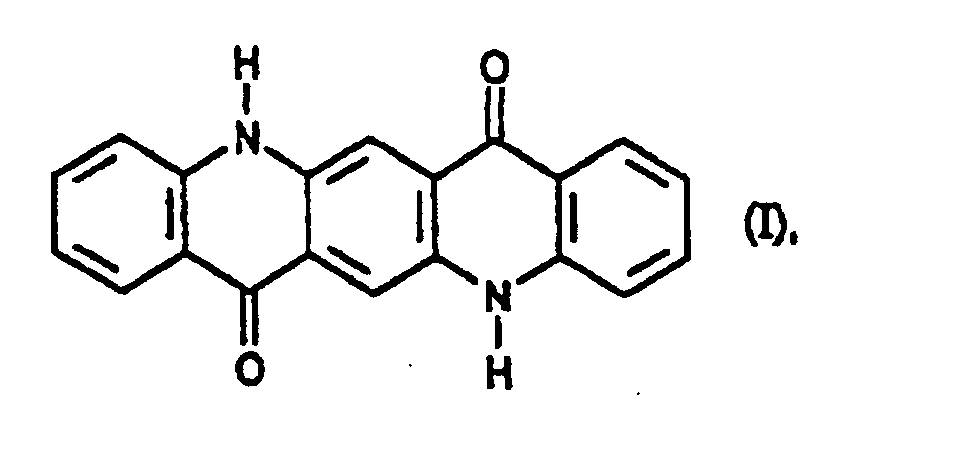 qui consiste
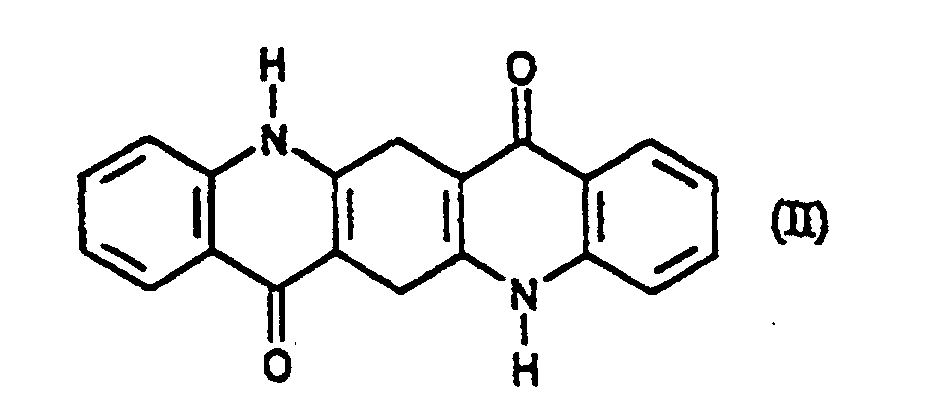 (a) à préparer un sel de 6,13-dihydroquinacridone(b) à transformer le sel de 6,13-dihydroquinacridone ayant une granulométrie allant jusqu'à 25 µm en un sel de 6,13-dihydroquinacridone ayant une granulométrie de 0,05 à 2 µm par l'addition d'un acide, de préférence de l'acide sulfurique concentré(c) éventuellement, à ajouter une quantité catalytiquement efficace de composé nitro-aromatique si la forme cristalline γII est désirée(d) à oxyder le sel de 6,13-dihydroquinacridone d'une granulométrie de 0,05 à 2 µm en ajoutant du peroxyde d'hydrogène, en présence d'une quantité catalytiquement efficace d'un catalyseur de quinone, et(e) à isoler le pigment en solution solide γI ou γII de quinacridone/6, 13-dihydroquinacridone.
- Procédé selon la revendication 1, dans lequel la solution solide de quinacridone/6,13-dihydroquinacridone possède la phase cristalline d'une quinacridone γI et se compose de 80 à 92% de quinacridone et de 8 à 20% de 6,13-dihydroquinacridone par rapport aux poids combinés de la quinacridone et de la 6,13-dihydroquinacridone.
- Procédé selon la revendication 1, dans lequel la solution solide de quinacridone/6,13-dihydroquinacridone possède la phase cristalline de la quinacridone γII et se compose de 93 à 98% de quinacridone et de 2 à 7% de 6,13-dihydroquinacridone par rapport aux poids combinés de la quinacridone et de la 6,13-dihydroquinacridone.
- Procédé selon la revendication 1, dans lequel le sel de 6,13-dihydroquinacridone est un sel mono- ou di-métal alcalin, de préférence le sel disodique, et dans lequel on utilise de 2,2 à 4 moles d'un hydroxyde de métal alcalin, de préférence de 2,3 à 3 moles d'hydroxyde de sodium par mole de 6,13-dihydroquinacridone afin de préparer le sel de 6,13-dihydroquinacridone de granulométrie élevée.
- Procédé selon la revendication 1, dans lequel l'étape d'oxydation est réalisée par combinaison d'une suspension comprenant le sel de 6,13-dihydroquinacridone, le catalyseur de quinone, le composé nitro-aromatique, si présent, la base et une phase liquide, avec une solution aqueuse de peroxyde d'hydrogène à une température supérieure à 60°C.
- Procédé selon la revendication 5, dans lequel la phase liquide se compose de 150 à 500 parties en poids d'eau et de 250 à 750 parties en poids d'un alcool alkylique en C1 à C8 pour 100 parties en poids de 6,13-dihydroquinacridone de préférence il se compose principalement de 200 à 350 parties en poids d'eau et de 300 à 600 parties en poids d'alcool pour 100 parties en poids de 6,13-dihydroquinacridone.
- Procédé selon la revendication 6, dans lequel l'alcool est un alcool alkylique en C1 à C3, de préférence le méthanol.
- Procédé selon la revendication 1, dans lequel le catalyseur de quinone est présent à raison de 0,005 à 0,1 fois le poids de la 6,13-dihydroquinacridone et est sélectionné de préférence dans le groupe formé par l'anthraquinone, l'acide anthraquinone-monosulfonique et l'acide anthraquinone-disulfonique, ou un de leur sel, et de façon tout particulièrement préférée le sel potassique ou sodique de l'acide anthraquinone-2-sulfonique,.
- Procédé selon la revendication 5, dans lequel l'étape d'oxydation est réalisée avec 5 à 30% en poids d'une solution aqueuse de peroxyde d'hydrogène, et dans lequel 1,1 à 5 moles de peroxyde d'hydrogène sont combinées par mole de 6,13-dihydroquinacridone.
- Procédé selon la revendication 5, dans lequel on ajoute la solution aqueuse de peroxyde d'hydrogène à la suspension pendant une durée de 5 minutes à 8 heures à une température de 60°C à reflux et on mélange par la suite le milieu réactionnel à une température de 50°C à reflux pendant 10 minutes à 2 heures.
- Procédé selon la revendication 3, dans lequel on ajoute une quantité de 0,01 à 0,03 fois le poids de la 6,13-dihydroquinacridone d'un composé nitro-aromatique avant l'addition du catalyseur de quinone et de l'oxydant de peroxyde d'hydrogène.
- Procédé selon la revendication 11, dans lequel on sélectionne le composé nitro-aromatique dans le groupe formé par les nitrophénols, les acides nitrobenzoïques, les acides nitrobenzène-monosulfoniques, et leurs sels.
- Procédé selon la revendication 1, dans lequel l'étape d'oxydation est réalisée en présence de 0,05 à 8% en poids basé sur la 6,13-dihydroquinacridone d'un inhibiteur de croissance de particules, de préférence d'un inhibiteur de croissance de particules choisi parmi la phtalimidométhyl-, l'imidazolylméthyl- ou la pyrazolylméthyl-quinacridone, l'acide quinacridone-monosulfonique ou un sel de ceux-ci, et l'acide 1,4-dicéto-3,6-diarylpyrrolo[3,4-c]pyrrolsulfonique, ou un sel de celui-ci.
- Composition comprenant une matière de masse moléculaire élevée et une quantité pigmentaire efficace d'un pigment en solution solide de quinacridone/6,13-dihydroquinacridone selon la revendication 1, à condition que ladite solution solide possède la phase cristalline de quinacridone γI.
- Composition selon la revendication 14, dans laquelle ladite solution solide de quinacridone/6,13-dihydroquinacridone dans la phase cristalline γI se compose de 80 à 92% de quinacridone et de 8 à 20% de 6,13-dihydroquinacridone par rapport aux poids combinés de la quinacridone et de la 6,13-dihydroquinacridone.
Applications Claiming Priority (2)
| Application Number | Priority Date | Filing Date | Title |
|---|---|---|---|
| US5452097P | 1997-08-01 | 1997-08-01 | |
| US54520P | 1997-08-01 |
Publications (3)
| Publication Number | Publication Date |
|---|---|
| EP0894832A2 EP0894832A2 (fr) | 1999-02-03 |
| EP0894832A3 EP0894832A3 (fr) | 1999-02-10 |
| EP0894832B1 true EP0894832B1 (fr) | 2001-08-08 |
Family
ID=21991661
Family Applications (1)
| Application Number | Title | Priority Date | Filing Date |
|---|---|---|---|
| EP98810713A Expired - Lifetime EP0894832B1 (fr) | 1997-08-01 | 1998-07-23 | Procédé de préparation de solutions solides de quinacridones |
Country Status (9)
| Country | Link |
|---|---|
| US (1) | US6013127A (fr) |
| EP (1) | EP0894832B1 (fr) |
| JP (1) | JP4369539B2 (fr) |
| KR (1) | KR100566838B1 (fr) |
| CN (1) | CN1105154C (fr) |
| BR (1) | BR9802832A (fr) |
| CZ (1) | CZ240898A3 (fr) |
| DE (1) | DE69801302T2 (fr) |
| TW (1) | TW523530B (fr) |
Families Citing this family (9)
| Publication number | Priority date | Publication date | Assignee | Title |
|---|---|---|---|---|
| MX236708B (es) | 2001-03-22 | 2006-05-09 | Ciba Sc Holding Ag | Uso de compuestos aromaticos como directores de fase y reductores del tamano de particula papa pigmentos de quinacridona. |
| WO2004007623A1 (fr) * | 2002-07-17 | 2004-01-22 | Ciba Specialty Chemicals Holding Inc. | Procede d'oxydation pour preparation de pigments quinacridone |
| JP2006503418A (ja) * | 2002-10-18 | 2006-01-26 | アイファイア テクノロジー コーポレーション | カラー・エレクトロルミネセンス表示装置 |
| WO2004039899A1 (fr) * | 2002-11-01 | 2004-05-13 | Seiko Epson Corporation | Jeu d'encres, procede d'impression, dispositif d'impression, systeme d'impression et objet imprime |
| US6864371B2 (en) | 2002-11-27 | 2005-03-08 | Ciba Specialty Chemicals Corporation | Preparation of beta quinacridone pigments |
| AU2003303667A1 (en) * | 2003-01-14 | 2004-08-10 | Ciba Specialty Chemicals Holding Inc. | Oxidation process for preparing highly dispersible quinacridone pigments |
| EP1587879A1 (fr) * | 2003-01-28 | 2005-10-26 | Ciba SC Holding AG | Synthese d'une phase cristalline beta de quinacridone de faible granulometrie |
| KR20120086377A (ko) * | 2003-07-18 | 2012-08-02 | 시바 홀딩 인크 | 비대칭으로 치환된 성분을 포함하는 퀴나크리돈 안료 조성물 |
| CN115368629B (zh) | 2014-11-20 | 2025-09-02 | 塞特工业公司 | 稳定剂组合物以及使用该稳定剂组合物保护有机材料免受uv光和热降解的方法 |
Family Cites Families (8)
| Publication number | Priority date | Publication date | Assignee | Title |
|---|---|---|---|---|
| US3160510A (en) * | 1960-04-25 | 1964-12-08 | Du Pont | Quinacridone pigment compositions |
| FR1346126A (fr) * | 1963-01-31 | 1963-12-13 | Cassella Farbwerke Mainkur Ag | Procédé de préparation de quinacridones |
| US3748162A (en) * | 1971-03-19 | 1973-07-24 | Du Pont | Light stable quinacridonequinone yellow pigment |
| DE3834748A1 (de) * | 1988-10-12 | 1990-04-19 | Bayer Ag | Verfahren zur herstellung eines gegebenenfalls substituierten chinacridons |
| US5229515A (en) * | 1991-06-07 | 1993-07-20 | Ciba-Geigy Corporation | Process for preparing modified β-quinacridone pigment |
| US5223624A (en) * | 1991-08-22 | 1993-06-29 | Baebler Fridolin | Modified gamma-quinacridone pigment |
| US5502192A (en) * | 1994-08-08 | 1996-03-26 | Ciba-Geigy Corporation | Process for the preparation of quinacridones from dihydroquinacridones in an aqueous medium |
| EP0806456B1 (fr) * | 1996-05-10 | 2001-07-25 | Ciba SC Holding AG | Procédé d'oxydation pour préparer des pigments de quinacridone |
-
1998
- 1998-07-23 DE DE69801302T patent/DE69801302T2/de not_active Expired - Lifetime
- 1998-07-23 EP EP98810713A patent/EP0894832B1/fr not_active Expired - Lifetime
- 1998-07-24 US US09/122,553 patent/US6013127A/en not_active Expired - Lifetime
- 1998-07-30 TW TW087112539A patent/TW523530B/zh not_active IP Right Cessation
- 1998-07-30 JP JP21494798A patent/JP4369539B2/ja not_active Expired - Fee Related
- 1998-07-30 CZ CZ982408A patent/CZ240898A3/cs unknown
- 1998-07-31 KR KR1019980031143A patent/KR100566838B1/ko not_active Expired - Fee Related
- 1998-07-31 CN CN98116750A patent/CN1105154C/zh not_active Expired - Fee Related
- 1998-08-03 BR BR9802832-4A patent/BR9802832A/pt not_active Application Discontinuation
Also Published As
| Publication number | Publication date |
|---|---|
| JPH11100522A (ja) | 1999-04-13 |
| KR100566838B1 (ko) | 2006-05-25 |
| EP0894832A2 (fr) | 1999-02-03 |
| EP0894832A3 (fr) | 1999-02-10 |
| DE69801302D1 (de) | 2001-09-13 |
| JP4369539B2 (ja) | 2009-11-25 |
| DE69801302T2 (de) | 2002-03-14 |
| TW523530B (en) | 2003-03-11 |
| CZ240898A3 (cs) | 1999-03-17 |
| KR19990023273A (ko) | 1999-03-25 |
| US6013127A (en) | 2000-01-11 |
| BR9802832A (pt) | 2000-05-09 |
| CN1207402A (zh) | 1999-02-10 |
| CN1105154C (zh) | 2003-04-09 |
Similar Documents
| Publication | Publication Date | Title |
|---|---|---|
| EP0530142B1 (fr) | Procédé d'oxydation pour préparer des pigments de quinacridone | |
| EP0829523B1 (fr) | Procédé d'oxydation pour préparer des pigments de quinacridone | |
| US6013127A (en) | Process for the preparation of quinacridone solid solutions | |
| CA2076493C (fr) | Pigment gamma-quinacridone modifie | |
| EP1521809B1 (fr) | Procede d'oxydation pour preparation de pigments quinacridone | |
| US5856488A (en) | Oxidation process for preparing quinacridone pigments | |
| EP1083176B1 (fr) | Procédé catalythique d'oxidation pour la préparation de pigments de quinacridones utilisant un milieu a base de polyalkylène glycols | |
| EP1565530B1 (fr) | Preparation de pigments de beta quinacridone |
Legal Events
| Date | Code | Title | Description |
|---|---|---|---|
| PUAI | Public reference made under article 153(3) epc to a published international application that has entered the european phase |
Free format text: ORIGINAL CODE: 0009012 |
|
| PUAL | Search report despatched |
Free format text: ORIGINAL CODE: 0009013 |
|
| AK | Designated contracting states |
Kind code of ref document: A2 Designated state(s): CH DE FR GB IT LI |
|
| AX | Request for extension of the european patent |
Free format text: AL;LT;LV;MK;RO;SI |
|
| AK | Designated contracting states |
Kind code of ref document: A3 Designated state(s): AT BE CH CY DE DK ES FI FR GB GR IE IT LI LU MC NL PT SE |
|
| AX | Request for extension of the european patent |
Free format text: AL;LT;LV;MK;RO;SI |
|
| 17P | Request for examination filed |
Effective date: 19990702 |
|
| AKX | Designation fees paid |
Free format text: CH DE FR GB IT LI |
|
| 17Q | First examination report despatched |
Effective date: 20000703 |
|
| GRAG | Despatch of communication of intention to grant |
Free format text: ORIGINAL CODE: EPIDOS AGRA |
|
| GRAG | Despatch of communication of intention to grant |
Free format text: ORIGINAL CODE: EPIDOS AGRA |
|
| GRAH | Despatch of communication of intention to grant a patent |
Free format text: ORIGINAL CODE: EPIDOS IGRA |
|
| GRAH | Despatch of communication of intention to grant a patent |
Free format text: ORIGINAL CODE: EPIDOS IGRA |
|
| GRAA | (expected) grant |
Free format text: ORIGINAL CODE: 0009210 |
|
| AK | Designated contracting states |
Kind code of ref document: B1 Designated state(s): CH DE FR GB IT LI |
|
| REG | Reference to a national code |
Ref country code: CH Ref legal event code: EP |
|
| REF | Corresponds to: |
Ref document number: 69801302 Country of ref document: DE Date of ref document: 20010913 |
|
| ET | Fr: translation filed | ||
| REG | Reference to a national code |
Ref country code: GB Ref legal event code: IF02 |
|
| PLBE | No opposition filed within time limit |
Free format text: ORIGINAL CODE: 0009261 |
|
| STAA | Information on the status of an ep patent application or granted ep patent |
Free format text: STATUS: NO OPPOSITION FILED WITHIN TIME LIMIT |
|
| 26N | No opposition filed | ||
| PGFP | Annual fee paid to national office [announced via postgrant information from national office to epo] |
Ref country code: GB Payment date: 20030703 Year of fee payment: 6 |
|
| PG25 | Lapsed in a contracting state [announced via postgrant information from national office to epo] |
Ref country code: FR Free format text: LAPSE BECAUSE OF NON-PAYMENT OF DUE FEES Effective date: 20040331 |
|
| REG | Reference to a national code |
Ref country code: FR Ref legal event code: ST |
|
| PGFP | Annual fee paid to national office [announced via postgrant information from national office to epo] |
Ref country code: CH Payment date: 20040617 Year of fee payment: 7 |
|
| PG25 | Lapsed in a contracting state [announced via postgrant information from national office to epo] |
Ref country code: GB Free format text: LAPSE BECAUSE OF NON-PAYMENT OF DUE FEES Effective date: 20040723 |
|
| GBPC | Gb: european patent ceased through non-payment of renewal fee |
Effective date: 20040723 |
|
| PG25 | Lapsed in a contracting state [announced via postgrant information from national office to epo] |
Ref country code: IT Free format text: LAPSE BECAUSE OF NON-PAYMENT OF DUE FEES Effective date: 20050723 |
|
| PG25 | Lapsed in a contracting state [announced via postgrant information from national office to epo] |
Ref country code: LI Free format text: LAPSE BECAUSE OF NON-PAYMENT OF DUE FEES Effective date: 20050731 Ref country code: CH Free format text: LAPSE BECAUSE OF NON-PAYMENT OF DUE FEES Effective date: 20050731 |
|
| REG | Reference to a national code |
Ref country code: CH Ref legal event code: PL |
|
| PG25 | Lapsed in a contracting state [announced via postgrant information from national office to epo] |
Ref country code: FR Free format text: LAPSE BECAUSE OF NON-PAYMENT OF DUE FEES Effective date: 20020731 |
|
| PGFP | Annual fee paid to national office [announced via postgrant information from national office to epo] |
Ref country code: DE Payment date: 20160930 Year of fee payment: 19 |
|
| REG | Reference to a national code |
Ref country code: DE Ref legal event code: R119 Ref document number: 69801302 Country of ref document: DE |
|
| PG25 | Lapsed in a contracting state [announced via postgrant information from national office to epo] |
Ref country code: DE Free format text: LAPSE BECAUSE OF NON-PAYMENT OF DUE FEES Effective date: 20180201 |