EP0895727A1 - Chaussure de sport à flexibilité déterminée - Google Patents
Chaussure de sport à flexibilité déterminée Download PDFInfo
- Publication number
- EP0895727A1 EP0895727A1 EP98112267A EP98112267A EP0895727A1 EP 0895727 A1 EP0895727 A1 EP 0895727A1 EP 98112267 A EP98112267 A EP 98112267A EP 98112267 A EP98112267 A EP 98112267A EP 0895727 A1 EP0895727 A1 EP 0895727A1
- Authority
- EP
- European Patent Office
- Prior art keywords
- shoe
- rod
- shell
- flexible
- base
- Prior art date
- Legal status (The legal status is an assumption and is not a legal conclusion. Google has not performed a legal analysis and makes no representation as to the accuracy of the status listed.)
- Granted
Links
- 238000005452 bending Methods 0.000 claims description 19
- 239000000463 material Substances 0.000 claims description 13
- 238000013519 translation Methods 0.000 claims description 3
- 230000006378 damage Effects 0.000 claims description 2
- 210000002683 foot Anatomy 0.000 description 9
- 238000010276 construction Methods 0.000 description 5
- 230000000694 effects Effects 0.000 description 5
- 229920003023 plastic Polymers 0.000 description 5
- 238000013461 design Methods 0.000 description 4
- 210000003423 ankle Anatomy 0.000 description 3
- 230000006866 deterioration Effects 0.000 description 3
- 235000005921 Cynara humilis Nutrition 0.000 description 2
- 240000002228 Cynara humilis Species 0.000 description 2
- 230000008901 benefit Effects 0.000 description 2
- 239000000470 constituent Substances 0.000 description 2
- 230000005489 elastic deformation Effects 0.000 description 2
- 238000000034 method Methods 0.000 description 2
- 230000008569 process Effects 0.000 description 2
- 238000004026 adhesive bonding Methods 0.000 description 1
- 210000000544 articulatio talocruralis Anatomy 0.000 description 1
- 230000000903 blocking effect Effects 0.000 description 1
- 230000008859 change Effects 0.000 description 1
- 230000003247 decreasing effect Effects 0.000 description 1
- 230000001419 dependent effect Effects 0.000 description 1
- 238000011161 development Methods 0.000 description 1
- 239000013013 elastic material Substances 0.000 description 1
- 229920002457 flexible plastic Polymers 0.000 description 1
- 230000002452 interceptive effect Effects 0.000 description 1
- 230000004807 localization Effects 0.000 description 1
- 230000004048 modification Effects 0.000 description 1
- 238000012986 modification Methods 0.000 description 1
- 238000000465 moulding Methods 0.000 description 1
- 238000010137 moulding (plastic) Methods 0.000 description 1
- 230000002787 reinforcement Effects 0.000 description 1
- 238000007789 sealing Methods 0.000 description 1
- 230000008719 thickening Effects 0.000 description 1
- 238000005303 weighing Methods 0.000 description 1
- 238000003466 welding Methods 0.000 description 1
Images

Classifications
-
- A—HUMAN NECESSITIES
- A43—FOOTWEAR
- A43B—CHARACTERISTIC FEATURES OF FOOTWEAR; PARTS OF FOOTWEAR
- A43B5/00—Footwear for sporting purposes
- A43B5/04—Ski or like boots
- A43B5/0427—Ski or like boots characterised by type or construction details
- A43B5/0452—Adjustment of the forward inclination of the boot leg
-
- A—HUMAN NECESSITIES
- A43—FOOTWEAR
- A43B—CHARACTERISTIC FEATURES OF FOOTWEAR; PARTS OF FOOTWEAR
- A43B5/00—Footwear for sporting purposes
- A43B5/04—Ski or like boots
-
- A—HUMAN NECESSITIES
- A43—FOOTWEAR
- A43B—CHARACTERISTIC FEATURES OF FOOTWEAR; PARTS OF FOOTWEAR
- A43B5/00—Footwear for sporting purposes
- A43B5/04—Ski or like boots
- A43B5/0427—Ski or like boots characterised by type or construction details
- A43B5/0476—Front-entry skiboots
Definitions
- the subject of the invention is a sports shoe of the front entry type with a variable volume. having a shell consisting of at least one overlapping rod and shell base partially and which are pivotally connected to one another and relates to a bending means intended to determine the flexibility characteristics of the rod relative to the base of the shell.
- the area of overlap of the rod with the shell base extends approximately over the entire region corresponding to the ankle of the user for a question obvious sealing.
- the shell base present in the dorsal region of the shoe a more or less thin and flexible vertical extension which came in one piece with its wall and which fits under the lower edge of the rod.
- This vertical extension which forms the equivalent of half a tube, is split by a vertical notch open upwards whose edges which the delimit extend freely under the rod and at a level situated above that of the axes of pivoting of the latter.
- the pivoting of the rod is therefore made possible on the condition of overcome the elastic resistance of the vertical extension and therefore of its split part, which translates moreover by a relative approximation of the opposite edges which delimit the notch.
- the capacity in bending of the vertical extension consequently determines the flexibility characteristics in bending of the shoe.
- the vertical extension being obtained in one piece with the shell base, it is the nature of the material constituting the shell base which, ultimately, predisposes the shoe to be more or less flexible, that is to say which gives it its initial flexibility.
- the known solution to obtain optimum initial flexibility suitable for each relevant region of the shoe therefore consists, from a given material, the more often plastic, also playing on the thickness of the wall of the shell base.
- the wall is made thin in the region of the closing flaps of the shell base and markedly thicker in the region of the split portion of the vertical extension as well as in the low region extending to the tread.
- Shoes thus designed that is to say with excess wall thickness, in particular on the stretched part of the vertical extension ultimately give relatively satisfaction in terms of functional because the flexibility of the upper then results from a pulling effect on the dorsal area of the base of shell without blocking during the whole period when the opposite edges of the notch remain free to to bring together.
- the force that the user applies to the rod is distributed on a large wrap area extending over the entire lower anterior area of his leg which avoids the localization of significant pressures.
- this shoe design has the disadvantage of weighing them down considerably and of not allowing the development of a basic structure which can be common or even standard for several models of shoes for which are sought different initial flexibility characteristics. Indeed, in such perspective it is necessary to realize, for each model, or for each level of flexibility initial sought, a specific shell base by playing on the choice of plastic material and / or playing on the thickness of its wall.
- shoe adjustment devices described in European documents EP 350 023, EP 666 036 and EP 671 133 operate on the opposite edges of the notch of the extension vertical coming from the shell base while that of the shoe described in a document German G 92 17 787.5 interacts directly between the rod and the hull base.
- So flexibility stem initial can very easily be modified and controlled both in effort and in amplitude simply playing on the value of the space left free between the opposite edges of the notch and / or on the height of the notch allowed to flex.
- this last adjustment simultaneously results in a modification of the level of the forces to be produced because it modifies the height of the support of the rod on the slotted part of the vertical extension with respect to the connecting and pivot axes of the rod.
- the present invention proposes to overcome the drawbacks of the aforementioned shoes very simple and effective while retaining the benefits of achieving an extension vertical split in the dorsal area of the hull base.
- An object of the invention is in particular to allow the realization of a basic structure of the shell of a shoe which is common and / or standard for several shoe models which must have flexibility characteristics differentiated initial.
- Another object is to produce a light shoe which, while being obtained at from a relatively flexible plastic material to ensure optimum fit and support of the user's foot, can provide, if necessary, a high initial resistance to the flexion of the rod forward.
- the invention also aims to not significantly change the volume outside of the boot shell by prominent parts.
- the shoe according to the invention of the type with front entry with volume variable having a shell consisting of an overlapping rod and shell base at the at least partially in the region corresponding to the back region of the shoe, the upper being connected at the base of the hull by means of pivot axes, is characterized by the fact that a means of bending intended to determine its flexibility characteristics is sandwiched between the rod and the shell base on which it is attached and fixed rigidly and by the fact that this means of bending is formed by a flexible strip split over a portion of its length by an open vertical notch upwards, the edges of which delimit it extend freely under the stem.
- the notch is positioned in the dorsal region of the shell of the shoe and the edges which delimit it extend at a level situated above that of the axes pivoting rod.
- the flexible strip constitutes an extension of the hull base equivalent in its function to a split vertical extension which would have come from a part with it but which has the advantage of being able to be produced in a material different from that of the base of shell. Therefore depending on whether the material chosen for this flexible strip is more or less resistant to bending, the flexibility of the shoe is modified either in the direction of decreasing it or in the sense of increasing it.
- the flexible strip therefore makes it possible to determine the initial basic flexibility which is desired for a shoe model without being dependent on the choice of material used for the base hull. It also allows to stiffen the wall for the hull base on the area where it is attached and rigidly attached, without interfering with the flexibility it gives to the shoe upper.
- the shell including the shell base
- the bending means according to the invention thus makes it possible to design a basic structure of the shoe, "shell-to-rod base” or shell base only, which is common, until the time of final assembly, to several models of shoes. Indeed, it In this perspective, it suffices to provide a range of more or less flexible bands to realize all models of shoes which have different initial flexibility characteristics.
- the flexible strip which constitutes the means intended to determine the flexibility of the rod is in the form of a relatively thin piece which closely fits at least a portion of the dorsal region of the shell base and which extends laterally on the sides of the latter for example up to the area of the connecting and pivot axes of the rod.
- the flexible strip thus produced fits perfectly into the external volume of the shell and surrounds approximately the entire region corresponding to the user's ankle, leaving the area free of the instep where, in a conventional manner, the shell base must, on the one hand, allow passage at the foot of the user when putting on and taking off, and on the other hand, being particularly well adjusted at the foot of the user to hold it without injuring it while allowing the bending of the rod towards the front.
- the flexible strip is obtained with at least one lateral extension which extends over a side of the hull base in the direction of the anterior region thereof and beyond the axis of connection and pivoting of the rod.
- This extension has a slide in which a movable cursor is adjustable in translation.
- This cursor is provided with a shoulder which is projecting from the lower edge. corresponding side of the rod and the slide is oriented approximately parallel to this edge lower side.
- the rod is more or less hampered in pivoting, forwardly, by the intermediary of the cursor and this, in addition to the elastic resistance which the split portion of the flexible strip.
- these provisions make the shoe more or less stiff as a whole because the rod can hardly bend forward any more except under the condition to be able to deform elastically between the support of its lower lateral edge on the slider and its pivot axes.
- the slide of the lateral extension of the flexible strip can be oriented, from the level of the rod connecting axes, diverging from the lateral lower edge of the latter.
- the rod can then bend forward in contrast to the opposite elastic resistance in the dorsal area of the shoe by the flexible split strip and this until it finds a press on the cursor with which the slide is fitted. From this position where the rod can no longer pivot on its axes, this is the elastic deformation capacity of the rod that plays to allow the continuation of a forward movement.
- the slide can itself be designed to be able to deform elastically under the effect of a force applied to the slider and directed forward via the lower lateral edge of the rod.
- the slide may have a flexible portion located between its ends which define its length, fixing elements which can advantageously be located at the location of these ends.
- the level of effort to be produced on the rod to cause it to flex forward depends on the elastic resistance opposed by the notched part of the flexible strip and the elastic resistance of the slide.
- the flexing means, the flexible strip is thus capable under a small volume to oppose an extremely high overall elastic resistance because the flexibility of the rod forwards results from both a pulling effect on the dorsal area of the hull base and a pushing effect on the anterior zone of the latter, on at least one of its flanks.
- the flexible strip constituting the means intended to determine the flexibility characteristics of the rod relative to the shell base
- this is obtained in the back area of the shoe with a rim which projects outwards from the shoe and against which the rod is mounted in abutment by its rear lower edge.
- the shoe thus constructed has a rod only allowed to flex forward from the mounting position. It goes from so that the height position of the rim in the dorsal area of the shell base can be determined according to several values depending on the inclination that we want to impose on the rod in its position mounting supported on the back.
- the shell base of the shoe is preferably made with a housing which extends at least over the entire area where the flexible strip covers it so that this last can take place.
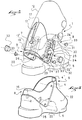
- the shoe shown schematically in Figure 1 by way of example is of the entry type from the front and with variable volume. It has a shell 2 consisting of a rod 12 and a base of shell 22 provided with a sole 5, the constituent parts 12-22 of shell 2 being connected so pivoting between them by means of axes 32 of connection and pivoting preferably located in a region roughly corresponding to that of the ankle joint of the foot of the user (not shown).
- the shoeing-heaving takes place traditionally by opening the upper front part 1 of the shell 2 to leave the passage of the user's foot, and the adjustment on the foot of the latter results from a deformation of the shell 2; more precisely, this deformation is caused in a conventional manner using devices clamp 3 which pull on transverse flaps 4, 4 ', which extend the wall of the shell base 22 and of the rod 12, these flaps 4, 4 ′, ensuring the proper closing of the shell 2.
- a flexing means 7 intended to determine the flexibility characteristics of the shoe is integrated into the dorsal area 8 thereof. This means 7 is for this purpose sandwiched between the rod 12 and the shell base 22 on which it is attached and rigidly fixed, for example, by assembly means 33 such as rivets or bolts.
- the flexing means 7 is formed by a relatively thin flexible strip which is split over a portion of its length by a notch vertical 17 open upwards so that the edges 17 'which delimit it extend freely under the rod 12 and at a distance from the shell base 22.
- This vertical notch 17 is preferably positioned in correspondence of the dorsal zone 8 of the shoe so that the resistance to flexion which the flexible strip 7 can oppose when the rod 12 is urged to pivot forward either approximately centered relative to the pivot axes 32 thereof.
- the flexible strip 7 closely follows at least a portion of the shell base 22, located in the area dorsal 8 of the shoe, and then extends laterally on the sides 22 'of the latter by two extensions 23 and 26 as far as the region of the pivot axes 32 where it is fixed using the assembly means 33, leaving free the anterior zone 9 corresponding to the instep. More specifically, one, 23, of its extensions is provided, beyond the pivot axis 32 with a slide 24 in which a cursor 25 slides. This slide 24 is fixed to these two ends 24 ′ on the shell base 22 using the assembly means 33 and oriented parallel to the edge lower side 13 of the rod 12 which is in correspondence, and the cursor 25 has a shoulder 25 ' which is presented in the hall vis-à-vis this edge 13.
- the rod 12 is prevented from any pivoting forward and it is its only elastic deformation capacity which then plays for allow forward movement.
- the cursor 25 is adjustable in translation in the slide 24 and immobilizable in position through a succession of socket cavities 30 made on one edge of the slide and with which cooperate a boss 31 with which the cursor 25 is provided, as visible in particular in FIG. 4.
- the bending means 7 thus arranged constitutes a means adjustable stiffening of the shoe allowing the upper 12 to deform more or less in function of the position of the cursor 25.
- the bending means 7 also a reinforcement function of the shell base 22 at the point where it is most stressed by the rod 12, that is to say in the dorsal zone 8 where there is overlap.
- the shell base 22, illustrated in FIG. 3 is produced with a housing 35 in which said means takes place there.
- This housing 35 preferably extends at least over the area where the means of bending 7 covers it and its outline, as in the present embodiment, is advantageously contiguous to that of the bending means 7.
- the slide 24 is embedded on the base of the shell 22 without any possibility of bending between its assembly means 33 fixing it to the latter.
- a portion 27 of the slide 24 which is located between its two ends 24 'which delimit it can be provided flexible.
- the contour of the housing 35 produced in the wall of the shell base 22 is then provided at the location of the slide 24, relatively larger than the latter so that its portion 27 can flex between these two ends 24 '.
- the latter is obtained with a flange 19 which protrudes outward from the dorsal region of the shoe and against which the upper 12 is mounted in abutment by its rear lower edge 13 '.
- the rod 12 is thus prevented from tilting towards the rear from the moment it bears on the rim 19.
- the elastic thrust edges 17 'of the notch 17 on the wall of the rod 12 the latter is urged and recalled in permanently against this ledge 19.
Landscapes
- Health & Medical Sciences (AREA)
- General Health & Medical Sciences (AREA)
- Physical Education & Sports Medicine (AREA)
- Footwear And Its Accessory, Manufacturing Method And Apparatuses (AREA)
- Acyclic And Carbocyclic Compounds In Medicinal Compositions (AREA)
Abstract
Description
Claims (10)
- Chaussure du type à entrée par l'avant à volume variable présentant une coque (2) constituée d'une tige (12) et d'une base de coque (22) qui se chevauchent au moins partiellement dans la région correspondant à la zone dorsale (8) de la chaussure, la tige (12) étant reliée à la base de coque (22) par l'intermédiaire d'axes de pivotement (32), caractérisée par le fait qu'un moyen de flexion (7), destiné à déterminer ses caractéristiques de flexibilité est intégré dans la zone dorsale (8), ce moyen (7) étant partiellement pris en sandwich entre la tige (12) et la base de coque (22) sur laquelle il est rapporté et fixé rigidement et par le fait que ce moyen de flexion (7) est formé par une bande flexible (7) fendue sur une portion de sa longueur par une entaille verticale (17) ouverte vers le haut dont les bords (17') qui la délimitent s'étendent librement sous la tige (12).
- Chaussure selon la revendication 1 caractérisée par le fait que l'entaille (17) réalisée sur une portion de bande flexible (7) est positionnée pour s'étendre verticalement dans la zone dorsale (8) de la chaussure.
- Chaussure seon la revendication 2 caractérisée par le fait que la bande flexible (7) se présente sous la forme d'une pièce relativement mince qui épouse étroitement au moins une portion de la base de coque (22) dans la zone dorsale (8) de la chaussure et qui s'étend ensuite latéralement sur ses flancs (22').
- Chaussure selon la revendication 3 caractérisée par le fait que la bande flexible (7) s'étend sur les flancs (22') de la base de coque (22) jusque dans la zone des axes de pivotement (32) de la tige (12), laissant libre la zone antérieure (9) correspondant au cou-de-pied de l'utilisateur.
- Chaussure selon l'une quelconque des revendications 3 ou 4 caractérisée par le fait que la bande flexible (7) est obtenue avec au moins un prolongement latéral (23) (26) qui s'étend sur un flanc (22') de la base de coque (22) au-delà de l'axe de pivotement (32) de la tige (12), ce prolongement (23) étant doté d'une glissière (24) dans laquelle un curseur mobile (25), réglable en translation, présente un épaulement (25') en saillie vis-à-vis du bord inférieur latéral (13) correspondant de la tige (12).
- Chaussure selon la revendication 5 caractérisée par le fait que la glissière (24) comporte une portion flexible (27) située entre ses extrémités (24') qui délimitent sa longueur.
- Chaussure selon l'une quelconque des revendications 1 à 6 caractérisée par le fait que la bande flexible (7) est obtenue avec un rebord (19) qui fait saillie vers l'extérieur de la zone dorsale (8) de la chaussure et contre lequel la tige (121) est montée en butée par son bord inférieur postérieur (13').
- Chaussure selon l'une quelconque des revendications 1 à 7 caractérisée par le fait que la base de coque (22) est réalisée avec un logement en creux (35) qui s'étend au moins sur toute la zone où la bande flexible (7) la recouvre.
- Chaussure selon l'une quelconque des revendications 1 à 8 caractérisée par le fait que la bande flexible (7) est fixée sur la base de coque (22) à l'aide de moyens d'assemblage (33) démontables sans destruction.
- Chaussure selon l'une quelconque des revendications 1 à 9 caractérisé par le fait que la bande flexible (7) est réalisée dans un matériau différent de celui de la base de coque (22).
Applications Claiming Priority (2)
| Application Number | Priority Date | Filing Date | Title |
|---|---|---|---|
| FR9710185 | 1997-08-05 | ||
| FR9710185A FR2767034B1 (fr) | 1997-08-05 | 1997-08-05 | Chaussure de sport a flexibilite determinee |
Publications (2)
| Publication Number | Publication Date |
|---|---|
| EP0895727A1 true EP0895727A1 (fr) | 1999-02-10 |
| EP0895727B1 EP0895727B1 (fr) | 2004-03-31 |
Family
ID=9510169
Family Applications (1)
| Application Number | Title | Priority Date | Filing Date |
|---|---|---|---|
| EP98112267A Expired - Lifetime EP0895727B1 (fr) | 1997-08-05 | 1998-07-02 | Chaussure de sport à flexibilité déterminée |
Country Status (6)
| Country | Link |
|---|---|
| US (1) | US5979082A (fr) |
| EP (1) | EP0895727B1 (fr) |
| JP (1) | JP3056294U (fr) |
| AT (1) | ATE262804T1 (fr) |
| DE (1) | DE69822722T2 (fr) |
| FR (1) | FR2767034B1 (fr) |
Cited By (1)
| Publication number | Priority date | Publication date | Assignee | Title |
|---|---|---|---|---|
| EP0948912A3 (fr) * | 1998-04-10 | 2001-08-01 | HTM SPORT S.p.A. | Chaussure de ski |
Families Citing this family (17)
| Publication number | Priority date | Publication date | Assignee | Title |
|---|---|---|---|---|
| US6557865B1 (en) | 1998-10-09 | 2003-05-06 | The Burton Corporation | Highback with adjustable stiffness |
| US6231057B1 (en) | 1998-10-09 | 2001-05-15 | The Burton Corporation | Highback with an adjustable shape |
| US6231066B1 (en) * | 1999-03-03 | 2001-05-15 | Shimano Inc. | Active highback system for a snowboard boot |
| CH693432A5 (fr) * | 1999-10-29 | 2003-08-15 | Lange Int Sa | Chaussure de ski. |
| US6554296B1 (en) | 2000-04-28 | 2003-04-29 | The Burton Corporation | Highback with independent forward lean adjustment |
| US20060237920A1 (en) * | 2005-04-25 | 2006-10-26 | K-2 Corporation | Virtual forward lean snowboard binding |
| ITUD20060176A1 (it) * | 2006-07-14 | 2008-01-15 | Calzaturificio Dal Bello Spa | Calzatura sportiva,quale uno scarpone da sci, da snowboard, a trekking, o simile |
| US7992888B2 (en) * | 2007-12-07 | 2011-08-09 | K-2 Corporation | Blockless highback binding |
| US8469372B2 (en) | 2008-10-23 | 2013-06-25 | Bryce M. Kloster | Splitboard binding apparatus |
| EP2572599B1 (fr) * | 2011-09-26 | 2015-04-22 | Rossignol Lange S.R.L. | Coque de chaussure de ski avec spoiler |
| US9238168B2 (en) * | 2012-02-10 | 2016-01-19 | Bryce M. Kloster | Splitboard joining device |
| US9266010B2 (en) | 2012-06-12 | 2016-02-23 | Tyler G. Kloster | Splitboard binding with adjustable leverage devices |
| US9604122B2 (en) | 2015-04-27 | 2017-03-28 | Bryce M. Kloster | Splitboard joining device |
| US10029165B2 (en) | 2015-04-27 | 2018-07-24 | Bryce M. Kloster | Splitboard joining device |
| ES2906567T3 (es) * | 2015-05-06 | 2022-04-19 | Ober Alp Spa | Bota de esquí provista de un mecanismo de selección de esquí-marcha mejorado |
| US11117042B2 (en) | 2019-05-03 | 2021-09-14 | Bryce M. Kloster | Splitboard binding |
| US11938394B2 (en) | 2021-02-22 | 2024-03-26 | Bryce M. Kloster | Splitboard joining device |
Citations (4)
| Publication number | Priority date | Publication date | Assignee | Title |
|---|---|---|---|---|
| EP0350023A2 (fr) * | 1988-07-07 | 1990-01-10 | TECNICA SpA | Dispositif d'ajustement de la flexibilité des chaussures de ski |
| DE9217787U1 (de) | 1992-12-29 | 1993-02-25 | Alpina Tovarna Obutve, Ziri | Skischuh |
| EP0666036A1 (fr) * | 1994-02-01 | 1995-08-09 | HTM Sport- und Freizeitgeräte Aktiengesellschaft | Chaussure de ski |
| EP0671133A2 (fr) * | 1994-03-09 | 1995-09-13 | HTM Sport- und Freizeitgeräte Gesellschaft m.b.H. | Chaussure de ski |
Family Cites Families (10)
| Publication number | Priority date | Publication date | Assignee | Title |
|---|---|---|---|---|
| FR2590129B1 (fr) * | 1985-11-15 | 1989-05-05 | Salomon Sa | Dispositif de reglage de la flexion de la tige d'une chaussure de ski |
| FR2600867B1 (fr) * | 1986-07-04 | 1988-09-09 | Salomon Sa | Dispositif de rembourrage d'une chaussure de ski. |
| US4839973A (en) * | 1987-04-09 | 1989-06-20 | Lange International S.A. | Ski boot |
| FR2625079B1 (fr) * | 1987-12-28 | 1990-06-08 | Salomon Sa | Dispositif a curseur pour le reglage de la position relative de deux organes, notamment pour chaussure de ski |
| ATE106200T1 (de) * | 1988-12-13 | 1994-06-15 | Salomon Sa | Alpinskischuh der bauart mit rückwärtigem einstieg |
| CH677864A5 (fr) * | 1988-12-19 | 1991-07-15 | Lange Int Sa | |
| FR2657504B1 (fr) * | 1990-01-26 | 1992-04-03 | Salomon Sa | Chaussure de ski alpin, a collier de serrage arriere articule. |
| FR2674106A1 (fr) * | 1991-03-21 | 1992-09-25 | Salomon Sa | Chaussure de ski alpin a etrier d'energie articule sur le capot arriere. |
| IT228031Y1 (it) * | 1992-05-15 | 1998-02-05 | Calzaturificio Tecnica Spa | Regolatore di inclinazione laterale migliorato |
| FR2732562B1 (fr) * | 1995-04-06 | 1997-05-23 | Salomon Sa | Chaussure de sport a tige reglable |
-
1997
- 1997-08-05 FR FR9710185A patent/FR2767034B1/fr not_active Expired - Fee Related
-
1998
- 1998-07-02 DE DE1998622722 patent/DE69822722T2/de not_active Expired - Lifetime
- 1998-07-02 EP EP98112267A patent/EP0895727B1/fr not_active Expired - Lifetime
- 1998-07-02 AT AT98112267T patent/ATE262804T1/de not_active IP Right Cessation
- 1998-07-30 JP JP1998005714U patent/JP3056294U/ja not_active Expired - Lifetime
- 1998-08-05 US US09/129,421 patent/US5979082A/en not_active Expired - Fee Related
Patent Citations (4)
| Publication number | Priority date | Publication date | Assignee | Title |
|---|---|---|---|---|
| EP0350023A2 (fr) * | 1988-07-07 | 1990-01-10 | TECNICA SpA | Dispositif d'ajustement de la flexibilité des chaussures de ski |
| DE9217787U1 (de) | 1992-12-29 | 1993-02-25 | Alpina Tovarna Obutve, Ziri | Skischuh |
| EP0666036A1 (fr) * | 1994-02-01 | 1995-08-09 | HTM Sport- und Freizeitgeräte Aktiengesellschaft | Chaussure de ski |
| EP0671133A2 (fr) * | 1994-03-09 | 1995-09-13 | HTM Sport- und Freizeitgeräte Gesellschaft m.b.H. | Chaussure de ski |
Cited By (1)
| Publication number | Priority date | Publication date | Assignee | Title |
|---|---|---|---|---|
| EP0948912A3 (fr) * | 1998-04-10 | 2001-08-01 | HTM SPORT S.p.A. | Chaussure de ski |
Also Published As
| Publication number | Publication date |
|---|---|
| FR2767034A1 (fr) | 1999-02-12 |
| EP0895727B1 (fr) | 2004-03-31 |
| US5979082A (en) | 1999-11-09 |
| ATE262804T1 (de) | 2004-04-15 |
| DE69822722D1 (de) | 2004-05-06 |
| FR2767034B1 (fr) | 1999-09-10 |
| JP3056294U (ja) | 1999-02-12 |
| DE69822722T2 (de) | 2005-01-13 |
Similar Documents
| Publication | Publication Date | Title |
|---|---|---|
| EP0895727B1 (fr) | Chaussure de sport à flexibilité déterminée | |
| EP0278281B1 (fr) | Chaussure de ski | |
| CH650386A5 (fr) | Chaussure de ski. | |
| FR2848388A1 (fr) | Article chaussant notamment pour l'ecalade | |
| CH645000A5 (fr) | Chaussure de ski. | |
| CA1136850A (fr) | Procede de fabrication d'une chaussure de sport et chaussure obtenue | |
| FR2583272A1 (fr) | Chaussure de ski alpin | |
| EP0813824B1 (fr) | Chaussure de sport | |
| FR2480575A1 (fr) | Dispositif de reglage de la flexion de la tige d'une chaussure de ski | |
| EP0933100B1 (fr) | Dispositif de retenue d'une chaussure sur une planche de glisse | |
| EP1254684B1 (fr) | Perfectionnement pour dispositif de retenue d'une chaussure sur une planche de glisse sur neige du type surf | |
| CA2204833A1 (fr) | Chaussure de sport munie d'une voute plantaire reglable | |
| EP0473898A1 (fr) | Ski de fond, notamment pour la pratique du pas alternatif | |
| EP1050325B1 (fr) | Dispositif de retenue d'chaussure sur une planche de glisse | |
| EP0504769B1 (fr) | Chaussure de ski alpin à volet d'énergie articulé sur le bas de coque | |
| CH667977A5 (fr) | Chaussure de ski a entree arriere. | |
| FR2834475A1 (fr) | Dispositif de retenue d'une chaussure sur un engin de sport | |
| FR2975605A1 (fr) | Talonniere de fixation de securite pour chaussure de ski | |
| FR2484800A1 (fr) | Dispositif de flexion pour chaussure de ski | |
| FR2556187A1 (fr) | Chaussure de ski a ouverture arriere | |
| EP0664968A1 (fr) | Chaussure de ski à capot avant suspendu | |
| FR2652754A1 (fr) | Dispositif de guidage lateral d'une chaussure de ski de fond. | |
| FR2745475A1 (fr) | Chaussure avec renfort de transmission des efforts | |
| EP1433504A1 (fr) | Dispositif de retenue d'une chaussure sur un engin de sport | |
| EP1025768A1 (fr) | Chaussure de ski |
Legal Events
| Date | Code | Title | Description |
|---|---|---|---|
| PUAI | Public reference made under article 153(3) epc to a published international application that has entered the european phase |
Free format text: ORIGINAL CODE: 0009012 |
|
| AK | Designated contracting states |
Kind code of ref document: A1 Designated state(s): AT CH DE FR IT LI |
|
| AX | Request for extension of the european patent |
Free format text: AL;LT;LV;MK;RO;SI |
|
| 17P | Request for examination filed |
Effective date: 19990602 |
|
| AKX | Designation fees paid |
Free format text: AT CH DE FR IT LI |
|
| 17Q | First examination report despatched |
Effective date: 20020411 |
|
| GRAP | Despatch of communication of intention to grant a patent |
Free format text: ORIGINAL CODE: EPIDOSNIGR1 |
|
| GRAS | Grant fee paid |
Free format text: ORIGINAL CODE: EPIDOSNIGR3 |
|
| GRAA | (expected) grant |
Free format text: ORIGINAL CODE: 0009210 |
|
| AK | Designated contracting states |
Kind code of ref document: B1 Designated state(s): AT CH DE FR IT LI |
|
| REG | Reference to a national code |
Ref country code: CH Ref legal event code: EP |
|
| REF | Corresponds to: |
Ref document number: 69822722 Country of ref document: DE Date of ref document: 20040506 Kind code of ref document: P |
|
| PG25 | Lapsed in a contracting state [announced via postgrant information from national office to epo] |
Ref country code: LI Free format text: LAPSE BECAUSE OF NON-PAYMENT OF DUE FEES Effective date: 20040731 Ref country code: CH Free format text: LAPSE BECAUSE OF NON-PAYMENT OF DUE FEES Effective date: 20040731 |
|
| PLBE | No opposition filed within time limit |
Free format text: ORIGINAL CODE: 0009261 |
|
| STAA | Information on the status of an ep patent application or granted ep patent |
Free format text: STATUS: NO OPPOSITION FILED WITHIN TIME LIMIT |
|
| REG | Reference to a national code |
Ref country code: CH Ref legal event code: PL |
|
| 26N | No opposition filed |
Effective date: 20050104 |
|
| PGFP | Annual fee paid to national office [announced via postgrant information from national office to epo] |
Ref country code: AT Payment date: 20050622 Year of fee payment: 8 |
|
| PG25 | Lapsed in a contracting state [announced via postgrant information from national office to epo] |
Ref country code: AT Free format text: LAPSE BECAUSE OF NON-PAYMENT OF DUE FEES Effective date: 20060702 |
|
| PGFP | Annual fee paid to national office [announced via postgrant information from national office to epo] |
Ref country code: IT Payment date: 20060731 Year of fee payment: 9 |
|
| PG25 | Lapsed in a contracting state [announced via postgrant information from national office to epo] |
Ref country code: IT Free format text: LAPSE BECAUSE OF NON-PAYMENT OF DUE FEES Effective date: 20070702 |
|
| REG | Reference to a national code |
Ref country code: FR Ref legal event code: CJ Ref country code: FR Ref legal event code: CA |
|
| PGFP | Annual fee paid to national office [announced via postgrant information from national office to epo] |
Ref country code: FR Payment date: 20110727 Year of fee payment: 14 |
|
| PGFP | Annual fee paid to national office [announced via postgrant information from national office to epo] |
Ref country code: DE Payment date: 20110629 Year of fee payment: 14 |
|
| REG | Reference to a national code |
Ref country code: FR Ref legal event code: ST Effective date: 20130329 |
|
| PG25 | Lapsed in a contracting state [announced via postgrant information from national office to epo] |
Ref country code: FR Free format text: LAPSE BECAUSE OF NON-PAYMENT OF DUE FEES Effective date: 20120731 Ref country code: DE Free format text: LAPSE BECAUSE OF NON-PAYMENT OF DUE FEES Effective date: 20130201 |
|
| REG | Reference to a national code |
Ref country code: DE Ref legal event code: R119 Ref document number: 69822722 Country of ref document: DE Effective date: 20130201 |