EP0895964A1 - Système déoxo compact - Google Patents
Système déoxo compact Download PDFInfo
- Publication number
- EP0895964A1 EP0895964A1 EP98114752A EP98114752A EP0895964A1 EP 0895964 A1 EP0895964 A1 EP 0895964A1 EP 98114752 A EP98114752 A EP 98114752A EP 98114752 A EP98114752 A EP 98114752A EP 0895964 A1 EP0895964 A1 EP 0895964A1
- Authority
- EP
- European Patent Office
- Prior art keywords
- stream
- oxygen
- hydrogen
- reactor
- nitrogen
- Prior art date
- Legal status (The legal status is an assumption and is not a legal conclusion. Google has not performed a legal analysis and makes no representation as to the accuracy of the status listed.)
- Withdrawn
Links
- IJGRMHOSHXDMSA-UHFFFAOYSA-N Atomic nitrogen Chemical compound N#N IJGRMHOSHXDMSA-UHFFFAOYSA-N 0.000 claims abstract description 75
- 239000001257 hydrogen Substances 0.000 claims abstract description 42
- 229910052739 hydrogen Inorganic materials 0.000 claims abstract description 42
- UFHFLCQGNIYNRP-UHFFFAOYSA-N Hydrogen Chemical compound [H][H] UFHFLCQGNIYNRP-UHFFFAOYSA-N 0.000 claims abstract description 38
- 229910052757 nitrogen Inorganic materials 0.000 claims abstract description 37
- 239000001301 oxygen Substances 0.000 claims abstract description 34
- 229910052760 oxygen Inorganic materials 0.000 claims abstract description 34
- QVGXLLKOCUKJST-UHFFFAOYSA-N atomic oxygen Chemical compound [O] QVGXLLKOCUKJST-UHFFFAOYSA-N 0.000 claims abstract description 33
- 230000003197 catalytic effect Effects 0.000 claims abstract description 30
- 239000000047 product Substances 0.000 claims description 33
- 239000012528 membrane Substances 0.000 claims description 24
- 239000003054 catalyst Substances 0.000 claims description 16
- XLYOFNOQVPJJNP-UHFFFAOYSA-N water Substances O XLYOFNOQVPJJNP-UHFFFAOYSA-N 0.000 claims description 16
- 238000000926 separation method Methods 0.000 claims description 13
- 239000007789 gas Substances 0.000 claims description 12
- 229910000510 noble metal Inorganic materials 0.000 claims description 9
- 238000001035 drying Methods 0.000 claims description 8
- 239000000919 ceramic Substances 0.000 claims description 7
- 238000000034 method Methods 0.000 claims description 5
- 239000012466 permeate Substances 0.000 claims description 5
- 238000004519 manufacturing process Methods 0.000 claims description 4
- BASFCYQUMIYNBI-UHFFFAOYSA-N platinum Chemical compound [Pt] BASFCYQUMIYNBI-UHFFFAOYSA-N 0.000 description 6
- 150000002431 hydrogen Chemical class 0.000 description 4
- PNEYBMLMFCGWSK-UHFFFAOYSA-N aluminium oxide Inorganic materials [O-2].[O-2].[O-2].[Al+3].[Al+3] PNEYBMLMFCGWSK-UHFFFAOYSA-N 0.000 description 3
- 238000006243 chemical reaction Methods 0.000 description 3
- 229910052697 platinum Inorganic materials 0.000 description 3
- 238000001179 sorption measurement Methods 0.000 description 3
- CPLXHLVBOLITMK-UHFFFAOYSA-N Magnesium oxide Chemical compound [Mg]=O CPLXHLVBOLITMK-UHFFFAOYSA-N 0.000 description 2
- KDLHZDBZIXYQEI-UHFFFAOYSA-N Palladium Chemical compound [Pd] KDLHZDBZIXYQEI-UHFFFAOYSA-N 0.000 description 2
- VYPSYNLAJGMNEJ-UHFFFAOYSA-N Silicium dioxide Chemical compound O=[Si]=O VYPSYNLAJGMNEJ-UHFFFAOYSA-N 0.000 description 2
- GWEVSGVZZGPLCZ-UHFFFAOYSA-N Titan oxide Chemical compound O=[Ti]=O GWEVSGVZZGPLCZ-UHFFFAOYSA-N 0.000 description 2
- MCMNRKCIXSYSNV-UHFFFAOYSA-N Zirconium dioxide Chemical compound O=[Zr]=O MCMNRKCIXSYSNV-UHFFFAOYSA-N 0.000 description 2
- -1 air Chemical compound 0.000 description 2
- 238000012512 characterization method Methods 0.000 description 2
- 229910052751 metal Inorganic materials 0.000 description 2
- 239000002184 metal Substances 0.000 description 2
- 230000003647 oxidation Effects 0.000 description 2
- 238000007254 oxidation reaction Methods 0.000 description 2
- 229910052703 rhodium Inorganic materials 0.000 description 2
- 239000010948 rhodium Substances 0.000 description 2
- MHOVAHRLVXNVSD-UHFFFAOYSA-N rhodium atom Chemical compound [Rh] MHOVAHRLVXNVSD-UHFFFAOYSA-N 0.000 description 2
- 239000000523 sample Substances 0.000 description 2
- 229910000851 Alloy steel Inorganic materials 0.000 description 1
- KJTLSVCANCCWHF-UHFFFAOYSA-N Ruthenium Chemical compound [Ru] KJTLSVCANCCWHF-UHFFFAOYSA-N 0.000 description 1
- 229910000831 Steel Inorganic materials 0.000 description 1
- 239000003463 adsorbent Substances 0.000 description 1
- 238000004458 analytical method Methods 0.000 description 1
- 230000009286 beneficial effect Effects 0.000 description 1
- 238000006555 catalytic reaction Methods 0.000 description 1
- 239000000498 cooling water Substances 0.000 description 1
- 230000002939 deleterious effect Effects 0.000 description 1
- 229910001873 dinitrogen Inorganic materials 0.000 description 1
- 238000010438 heat treatment Methods 0.000 description 1
- 239000002638 heterogeneous catalyst Substances 0.000 description 1
- 229910052741 iridium Inorganic materials 0.000 description 1
- GKOZUEZYRPOHIO-UHFFFAOYSA-N iridium atom Chemical compound [Ir] GKOZUEZYRPOHIO-UHFFFAOYSA-N 0.000 description 1
- 239000000314 lubricant Substances 0.000 description 1
- 239000000395 magnesium oxide Substances 0.000 description 1
- 239000000203 mixture Substances 0.000 description 1
- 231100000252 nontoxic Toxicity 0.000 description 1
- 230000003000 nontoxic effect Effects 0.000 description 1
- 239000003921 oil Substances 0.000 description 1
- 229910052762 osmium Inorganic materials 0.000 description 1
- SYQBFIAQOQZEGI-UHFFFAOYSA-N osmium atom Chemical compound [Os] SYQBFIAQOQZEGI-UHFFFAOYSA-N 0.000 description 1
- 229910052763 palladium Inorganic materials 0.000 description 1
- 229920005597 polymer membrane Polymers 0.000 description 1
- 229910052707 ruthenium Inorganic materials 0.000 description 1
- 239000000377 silicon dioxide Substances 0.000 description 1
- 239000010959 steel Substances 0.000 description 1
- 239000002699 waste material Substances 0.000 description 1
Images
Classifications
-
- C—CHEMISTRY; METALLURGY
- C21—METALLURGY OF IRON
- C21D—MODIFYING THE PHYSICAL STRUCTURE OF FERROUS METALS; GENERAL DEVICES FOR HEAT TREATMENT OF FERROUS OR NON-FERROUS METALS OR ALLOYS; MAKING METAL MALLEABLE, e.g. BY DECARBURISATION OR TEMPERING
- C21D1/00—General methods or devices for heat treatment, e.g. annealing, hardening, quenching or tempering
- C21D1/74—Methods of treatment in inert gas, controlled atmosphere, vacuum or pulverulent material
- C21D1/76—Adjusting the composition of the atmosphere
- C21D1/763—Adjusting the composition of the atmosphere using a catalyst
-
- C—CHEMISTRY; METALLURGY
- C01—INORGANIC CHEMISTRY
- C01B—NON-METALLIC ELEMENTS; COMPOUNDS THEREOF; METALLOIDS OR COMPOUNDS THEREOF NOT COVERED BY SUBCLASS C01C
- C01B21/00—Nitrogen; Compounds thereof
- C01B21/04—Purification or separation of nitrogen
- C01B21/0405—Purification or separation processes
- C01B21/0411—Chemical processing only
- C01B21/0422—Chemical processing only by reduction
Definitions
- This invention relates to the production of an oxygen-free stream of nitrogen, optionally containing hydrogen, such as may be used in a heat treating furnace.
- Nitrogen or nitrogen/hydrogen atmospheres are used in many heat treating systems. It is important that oxygen not be present in the heat treating atmosphere as this will have a deleterious effect on the articles being treated.
- One way of providing a nitrogen or nitrogen/hydrogen stream into a heat treating furnace which is free of oxygen is to provide pure nitrogen, or mix pure hydrogen with pure nitrogen, produced by the cryogenic separation of air, and pass this stream to the heat treating system. While this method is effective, it is also quite expensive.
- Nitrogen having a modest oxygen concentration can be produced at somewhat lower cost using non-cryogenic air separation methods such as adsorption or membrane separation systems.
- the oxygen is removed by reacting it with hydrogen in a catalytic reactor to form water.
- Excess hydrogen is used to establish a nitrogen/hydrogen stream if such is desired.
- such systems operate efficiently only at flowrates exceeding about 10,000 standard cubic feet per hour (SCFH) because for small systems having capacities less than about 10,000 SCFH, the advantages of using relatively inexpensive impure nitrogen are nullified by the expense of the deoxo system.
- Typical heat treating systems have atmosphere flowrate requirements within the range of from 1,000 to 8,000 SCFH.
- a method for producing an oxygen-free nitrogen product stream comprising:
- Another aspect of the invention is:
- Apparatus for producing an oxygen-free nitrogen product stream comprising:
- the term "specific surface area” means (a) for the carrier, the surface area in m 2 per gram of catalyst; the surface area being measured by the physical adsorption of nitrogen gas on the catalyst surface using the conventional BET analysis as described in "Characterization of Catalysts" by J. M. Thomas and R. M. Lambert published by John Wiley, 1980 see p. 17 ff; and (b) for the noble metal, the surface area in m 2 per gram of catalyst; the noble metal surface area being measured by the chemisorption of hydrogen on the metal surface as described in “Characterization of Heterogeneous Catalysts" by Francis Delannay published by Marcel Dekker, 1984 see p. 310 ff.
- non-noble metal means one or more of platinum, rhodium, ruthenium, iridium, osmium and palladium. Platinum and rhodium are preferred.
- ceramic means one or more of alumina, zirconia, titania, magnesia and silica. Gamma-alumina is preferred.
- oxygen-free means having an oxygen concentration less than 10 parts per million (ppm).
- space velocity means the flowrate in SCFH of gas exiting a catalytic reactor per cubic foot of catalyst bed in the catalytic reactor.
- initial stream 1 comprises nitrogen in a concentration of at least 98 mole percent and generally in a concentration within the range of from 98 to 99.9 mole percent, and oxygen in a concentration within the range of from 0.1 to 2.0 mole percent.
- initial stream 1 has a flowrate within the range of from 500 to 10,000 SCFH.
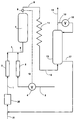
- Initial stream 1 is preferably the product of a membrane separation unit, such as unit 20 shown in the Figure, wherein a feed stream 21 comprising oxygen and nitrogen, e.g. air, is passed through polymer membrane bundles. The nitrogen and oxygen diffuse through the membranes at different rates resulting in the production of a nitrogen-enriched product and an oxygen-enriched waste stream.
- a feed stream 21 comprising oxygen and nitrogen, e.g. air
- the nitrogen and oxygen diffuse through the membranes at different rates resulting in the production of a nitrogen-enriched product and an oxygen-enriched waste stream.
- Those skilled in the art of air separation are familiar with membrane air separation units and their operation.
- Initial stream 1 may also be from any other suitable source
- Initial stream 1 is passed through metering device or flow meter 2.
- Hydrogen stream 3 is passed through valve 4 and then through metering device or flow meter 5 and combined with initial stream 1 to form reactor feed stream 6.
- Hydrogen stream 3 may be from any suitable source of hydrogen and generally has a hydrogen purity of at least 99 mole percent.
- Hydrogen stream 3 is passed into initial stream 1 at a flowrate so as to provide reactor feed stream 6 with a hydrogen concentration within the range of from 2 to 20 times, preferably from 2 to 6 times, that of the oxygen concentration in reactor feed stream 6, provided that the mole percent of hydrogen in the reactor feed stream does not exceed twice the oxygen concentration plus 4 mole percent. This ensures that the hydrogen concentration in the product stream will not exceed 4 mole percent and that the flow streams into and out of the reactor remain in the non-flammable range.
- Reactor feed stream 6 is passed into catalytic reactor 7 which contains a catalyst bed comprising noble metal on a ceramic carrier.
- the catalyst bed generally has a volume less than 0.2 cubic feet and preferably has a volume within the range of from 0.0025 to 0.01 cubic feet for a reactor output rating of 500 SCFH, and within the range of from 0.05 to 0.2 cubic feet for a reactor output rating of 10,000 SCFH.
- the noble metal has a specific surface area exceeding 1m 2 /gram and preferably has a specific surface area up to 2 m 2 /gram.
- the ceramic carrier has a specific surface area exceeding 100m 2 /gram and preferably has a specific surface area up to 300 m 2 /gram.
- catalytic reactor 7 hydrogen reacts with essentially all of the oxygen in the reactor feed stream to form water.
- the temperature of reactor feed stream 6 should be at least 70°F to ensure efficient catalytic reaction of the hydrogen with the oxygen.
- a product stream is withdrawn from catalytic reactor 7 in line 8 at a space velocity of at least 50,000/hour and generally within the range of from 50,000 to 200,000/hour.
- the very high space velocities that are achievable with this invention enable a reactor design or deoxo unit that is very compact and inexpensive.
- an operating space velocity of 100,000/hour uses a catalyst volume of only 0.02 cubic foot. This catalyst volume can be easily fitted in a 2 inch diameter pipe less than 1 foot long. The reactor can therefore be readily inserted in the nitrogen piping with minimal cost. If the reactor is located outside, the required 70°F startup temperature may be achieved using a small band heater around the reactor.
- the operating temperature of the reactor is higher than this startup temperature since, at the high space velocities used, the reactor operates adiabatically and the hydrogen-oxygen reaction is highly exothermic.
- the exact operating temperature will depend on the oxygen concentration in the reactor feed. The following lists the observed temperature rise in the reactor for certain oxygen concentrations in the reactor feed stream:
- the product stream in line 8 comprises nitrogen, and water and is oxygen-free. It may also contain hydrogen.
- oxygen probe 9 is inserted in line 8 to measure the oxygen concentration in line 8.
- Oxygen probe 9 operates valve 4 by means of electrical signal line 10 and will adjust valve 4 to be mare open or more closed to ensure a hydrogen flow into the catalytic reactor which will result in oxygen-free effluent in line 8 from catalytic reactor 7.
- the nitrogen in product stream 8 is the nitrogen which was passed into catalytic reactor 7 in reactor feed stream 6.
- Hydrogen, if any, in product stream 8 is excess hydrogen which was passed into catalytic reactor 7 in reactor feed stream 6 and which did not react with the oxygen within catalytic reactor 7.
- the water in product stream 8 is the water formed by the reaction of oxygen and hydrogen within catalytic reactor 7. If desired, product stream 8 may then be passed directly to a use point such as a heat treating furnace.
- An atmosphere of nitrogen with small amounts of hydrogen, generally less than 4 mole percent, constitutes an ideal, non-toxic and non-flammable atmosphere for many heat treating applications. Nitrogen is the inert component and protects steel alloys and other non-ferrous metals from oxidation during heat treatment cycles.
- Hydrogen is a reactive component in the atmosphere and has many beneficial effects, such as protecting steels from oxidation in the event of small inleaks of air into industrial furnaces because the oxygen in the air will immediately react with the hydrogen to form water. Moreover, hydrogen in the furnace atmosphere will generally result in a cleaner, brighter product because the hydrogen reduces residual oxides on the parts being heat treated and also aids the removal of residual oils and lubricants on the parts.
- product stream 8 which is at an elevated temperature owing to the exothermic nature of the reaction of the hydrogen and oxygen in catalytic reactor 7, is cooled to about 100°F by passage through cooler 11 such as by indirect heat exchange with cooling water.
- Resulting cooled stream 12 is passed into membrane dryer 13 wherein water vapor within stream 12 diffuses through membranes and is swept away by sweep gas passing on the other side of the membrane to form a permeate gas stream.
- the remaining dry nitrogen or nitrogen/hydrogen product stream 14 is then passed on to the use point.
- Those skilled in the art of removing moisture from gas streams are familiar with membrane dryers and their operation.
- Other drying systems such as adsorbent drying systems, may also be used to dry the product gas stream in the practice of this invention.
- the Figure illustrates a preferred embodiment of the invention wherein a portion of the dry product gas from the membrane dryer is used as the sweep gas.
- a portion 15 of dry product stream 14 is passed through valve 16 and then as sweep gas into membrane dryer 13.
- the sweep gas passes through dryer 13, it picks up the moisture which diffuses through the membrane.
- permeate stream 17 is passed into the feed stream 21 of the membrane separation unit 20 which serves to produce initial stream 1.
- Catalytic reactor 7 typically operates at a pressure of 100 pounds per square inch gauge (psig) or higher.
- Nitrogen produced by a membrane separation unit is produced at about 170 psig and high pressure operation is advantageous in keeping pipe sizes small and is also advantageous if a membrane drying unit is used because the higher is the partial pressure difference of water across the drying membrane, the higher is the drying efficiency.
- Table 1 lists the results of four examples of the invention carried out with a system similar to that illustrated in the Figure.
- the catalyst bed had a volume of 0.014 cubic feet and comprised platinum having a specific surface area of 1.85 m 2 /gram on alumina carrier having a specific surface area of 165 m 2 /gram.
- the product was withdrawn from the catalytic reactor at a space velocity of 62,500/hr.
- the stream numerals in Table 1 correspond to those of the Figure.
- the examples are provided for illustrative purposes are not intended to be limiting.
Landscapes
- Chemical & Material Sciences (AREA)
- Organic Chemistry (AREA)
- Chemical Kinetics & Catalysis (AREA)
- Analytical Chemistry (AREA)
- Engineering & Computer Science (AREA)
- Thermal Sciences (AREA)
- Mechanical Engineering (AREA)
- Materials Engineering (AREA)
- Metallurgy (AREA)
- Crystallography & Structural Chemistry (AREA)
- General Chemical & Material Sciences (AREA)
- Physics & Mathematics (AREA)
- Inorganic Chemistry (AREA)
- Separation Using Semi-Permeable Membranes (AREA)
- Catalysts (AREA)
Applications Claiming Priority (2)
| Application Number | Priority Date | Filing Date | Title |
|---|---|---|---|
| US908166 | 1997-08-07 | ||
| US08/908,166 US6168774B1 (en) | 1997-08-07 | 1997-08-07 | Compact deoxo system |
Publications (1)
| Publication Number | Publication Date |
|---|---|
| EP0895964A1 true EP0895964A1 (fr) | 1999-02-10 |
Family
ID=25425307
Family Applications (1)
| Application Number | Title | Priority Date | Filing Date |
|---|---|---|---|
| EP98114752A Withdrawn EP0895964A1 (fr) | 1997-08-07 | 1998-08-05 | Système déoxo compact |
Country Status (3)
| Country | Link |
|---|---|
| US (2) | US6168774B1 (fr) |
| EP (1) | EP0895964A1 (fr) |
| BR (1) | BR9802845A (fr) |
Families Citing this family (6)
| Publication number | Priority date | Publication date | Assignee | Title |
|---|---|---|---|---|
| US6526658B1 (en) | 2000-05-23 | 2003-03-04 | Silverbrook Research Pty Ltd | Method of manufacture of an ink jet printhead having a moving nozzle with an externally arranged actuator |
| AU4731400A (en) | 2000-05-24 | 2001-12-03 | Silverbrook Res Pty Ltd | Method of manufacture of an ink jet printhead having a moving nozzle with an externally arranged actuator |
| US20030039596A1 (en) * | 2001-08-16 | 2003-02-27 | Johnson Michael Clinton | Gas purification apparatus and process |
| US7468173B2 (en) * | 2004-02-25 | 2008-12-23 | Sunstone Corporation | Method for producing nitrogen to use in under balanced drilling, secondary recovery production operations and pipeline maintenance |
| WO2006100987A1 (fr) * | 2005-03-18 | 2006-09-28 | Nippon Shokubai Co., Ltd. | Catalyseur pour l’elimination de l’oxygene et procede l'utilisant |
| US20070107818A1 (en) * | 2005-11-16 | 2007-05-17 | Bowe Donald J | Deoxygenation of furnaces with hydrogen-containing atmoshperes |
Citations (6)
| Publication number | Priority date | Publication date | Assignee | Title |
|---|---|---|---|---|
| CN85102710A (zh) * | 1985-04-01 | 1986-09-17 | 中国科学院大连化学物理研究所 | 铂、钯/氧化钛脱氧催化剂 |
| EP0454531A1 (fr) * | 1990-04-20 | 1991-10-30 | L'air Liquide, Societe Anonyme Pour L'etude Et L'exploitation Des Procedes Georges Claude | Procédé et dispositif d'élaboration d'azote ultra-pur |
| US5077029A (en) * | 1990-07-23 | 1991-12-31 | Union Carbide Industrial Gases Technology Corporation | Membrane/deoxo control method and system |
| EP0516401A1 (fr) * | 1991-05-30 | 1992-12-02 | The Boc Group, Inc. | Purification des courants de gaz |
| FR2729583A1 (fr) * | 1995-01-25 | 1996-07-26 | Air Liquide | Procede pour l'elimination d'impuretes contenues dans un compose gazeux |
| EP0732303A1 (fr) * | 1995-03-16 | 1996-09-18 | L'air Liquide, Societe Anonyme Pour L'etude Et L'exploitation Des Procedes Georges Claude | Procédé et installation de génération d'azote pour traitement thermique |
Family Cites Families (18)
| Publication number | Priority date | Publication date | Assignee | Title |
|---|---|---|---|---|
| US1588258A (en) * | 1926-01-15 | 1926-06-08 | Air Reduction | Production of oxygen-free nitrogen |
| US2384065A (en) * | 1941-07-18 | 1945-09-04 | Air Reduction | Purification of gases |
| US2582285A (en) | 1948-05-07 | 1952-01-15 | R W Cramer Company Inc | Timer for causing brief actuations at prolonged intervals |
| US2582885A (en) * | 1948-08-23 | 1952-01-15 | Baker & Co Inc | Method of removing free oxygen or free hydrogen from a gaseous medium |
| US4472528A (en) * | 1982-12-27 | 1984-09-18 | Lloyd Berg | Catalyst for hydrotreating solvent refined coals and lignites |
| CA1200540A (fr) * | 1983-10-24 | 1986-02-11 | Atomic Energy Of Canada Limited - Energie Atomique Du Canada, Limitee | Methode de fabrication d'un catalyseur au silice cristallin et au platine |
| JPS6222923A (ja) | 1985-07-22 | 1987-01-31 | Matsushita Seiko Co Ltd | 加湿装置付電気スト−ブ |
| US4859435A (en) * | 1988-06-10 | 1989-08-22 | Air Products And Chemicals, Inc. | Deoxygenation of inert gas streams with methanol |
| US5202057A (en) * | 1988-09-14 | 1993-04-13 | Air Products And Chemicals, Inc. | Production of ammonia synthesis gas |
| US5004482A (en) | 1989-05-12 | 1991-04-02 | Union Carbide Corporation | Production of dry, high purity nitrogen |
| US4931070A (en) | 1989-05-12 | 1990-06-05 | Union Carbide Corporation | Process and system for the production of dry, high purity nitrogen |
| FR2649123B1 (fr) | 1989-06-30 | 1991-09-13 | Air Liquide | Procede de traitement thermique de metaux |
| FR2649124A1 (fr) | 1989-07-03 | 1991-01-04 | Air Liquide | Procede de traitement thermique de metaux sous atmosphere |
| ATE265528T1 (de) * | 1989-10-27 | 2004-05-15 | Salk Inst For Biological Studi | Rezeptorverbindungen von glutamin und herstellung |
| US5078798A (en) * | 1989-12-28 | 1992-01-07 | Ciba-Geigy Corporation | Buoyancy mediated control of catalytic reaction |
| US5122355A (en) | 1990-06-06 | 1992-06-16 | Union Carbide Industrial Gases Technology Corporation | Membrane nitrogen process and system |
| JPH06222923A (ja) | 1993-01-27 | 1994-08-12 | Nec Corp | 並行オブジェクト指向言語実行方法および装置 |
| US5348592A (en) | 1993-02-01 | 1994-09-20 | Air Products And Chemicals, Inc. | Method of producing nitrogen-hydrogen atmospheres for metals processing |
-
1997
- 1997-08-07 US US08/908,166 patent/US6168774B1/en not_active Expired - Fee Related
-
1998
- 1998-08-05 BR BR9802845-6A patent/BR9802845A/pt unknown
- 1998-08-05 EP EP98114752A patent/EP0895964A1/fr not_active Withdrawn
-
2000
- 2000-09-18 US US09/664,391 patent/US6274102B1/en not_active Expired - Fee Related
Patent Citations (6)
| Publication number | Priority date | Publication date | Assignee | Title |
|---|---|---|---|---|
| CN85102710A (zh) * | 1985-04-01 | 1986-09-17 | 中国科学院大连化学物理研究所 | 铂、钯/氧化钛脱氧催化剂 |
| EP0454531A1 (fr) * | 1990-04-20 | 1991-10-30 | L'air Liquide, Societe Anonyme Pour L'etude Et L'exploitation Des Procedes Georges Claude | Procédé et dispositif d'élaboration d'azote ultra-pur |
| US5077029A (en) * | 1990-07-23 | 1991-12-31 | Union Carbide Industrial Gases Technology Corporation | Membrane/deoxo control method and system |
| EP0516401A1 (fr) * | 1991-05-30 | 1992-12-02 | The Boc Group, Inc. | Purification des courants de gaz |
| FR2729583A1 (fr) * | 1995-01-25 | 1996-07-26 | Air Liquide | Procede pour l'elimination d'impuretes contenues dans un compose gazeux |
| EP0732303A1 (fr) * | 1995-03-16 | 1996-09-18 | L'air Liquide, Societe Anonyme Pour L'etude Et L'exploitation Des Procedes Georges Claude | Procédé et installation de génération d'azote pour traitement thermique |
Non-Patent Citations (1)
| Title |
|---|
| CHEMICAL ABSTRACTS, vol. 108, no. 10, 7 March 1988, Columbus, Ohio, US; abstract no. 82855, LOU, HUIQING ET AL: "Platinum-palladium-titanium dioxide deoxygenation catalyst" XP002083534 * |
Also Published As
| Publication number | Publication date |
|---|---|
| BR9802845A (pt) | 1999-11-03 |
| US6168774B1 (en) | 2001-01-02 |
| US6274102B1 (en) | 2001-08-14 |
Similar Documents
| Publication | Publication Date | Title |
|---|---|---|
| EP0240270B1 (fr) | Procédé de purification de gaz inerte en une étape | |
| CA2291388C (fr) | Epuration de gaz | |
| US6093379A (en) | Purification of gases | |
| EP0197717A1 (fr) | Procédé et dispositif pour purifier des courants de gaz inertes | |
| CA2114206A1 (fr) | Methode de production d'atmospheres azote-hydrogene pour le traitement de metaux | |
| EP1084744B1 (fr) | Procédé de purification de dioxyde de carbone dans une installation de production d'ethylèneglycol | |
| US6168774B1 (en) | Compact deoxo system | |
| JP2015140281A (ja) | シリコン単結晶製造装置からのアルゴンガス回収精製方法及びアルゴンガス回収精製装置 | |
| NL8601692A (nl) | Zuiveringsinrichting voor stikstof en werkwijze voor het zuiveren daarvan. | |
| US8280554B2 (en) | System for preventing unnecessary shutdown of a high-purity gas production plant | |
| EP0606081A1 (fr) | Système de purification utilisant la chaleur à compression | |
| EP0866141A1 (fr) | Procédé pour la production d'atmosphères protectrices à bas point de rosée exempt d'oxygène, pour usage dans les traitements thermiques | |
| JP2009506966A (ja) | ガスから不純物を除去する方法 | |
| EP1060774A1 (fr) | Purification de gaz | |
| US4859435A (en) | Deoxygenation of inert gas streams with methanol | |
| JP3977501B2 (ja) | 酸素ガスの精製方法および精製装置 | |
| JP4169820B2 (ja) | 酸素ガス中の不純物の除去方法 | |
| JP2000211904A (ja) | ガスの精製方法 | |
| JPH11209117A (ja) | 液化炭酸製造用粗製炭酸ガスの精製方法及び精製装置 | |
| JP2872631B2 (ja) | 窒素・酸素製造システム | |
| JPH05220319A (ja) | ガスから炭化水素不純物を除去する装置 | |
| KR19990014226A (ko) | 고순도의 비활성 가스를 제조하는 방법 및 장치 | |
| US4865822A (en) | Process for purifying hydrogen selenide and hydrogen telluride, to remove moisture and oxidant impurities therefrom | |
| JPH03166343A (ja) | 金属の熱処理 | |
| JP4162713B2 (ja) | 気体組成物に含有されている不純物を除去するための方法 |
Legal Events
| Date | Code | Title | Description |
|---|---|---|---|
| PUAI | Public reference made under article 153(3) epc to a published international application that has entered the european phase |
Free format text: ORIGINAL CODE: 0009012 |
|
| AK | Designated contracting states |
Kind code of ref document: A1 Designated state(s): DE ES FR IT |
|
| AX | Request for extension of the european patent |
Free format text: AL;LT;LV;MK;RO;SI |
|
| 17P | Request for examination filed |
Effective date: 19990219 |
|
| 17Q | First examination report despatched |
Effective date: 19990713 |
|
| AKX | Designation fees paid |
Free format text: DE ES FR IT |
|
| STAA | Information on the status of an ep patent application or granted ep patent |
Free format text: STATUS: THE APPLICATION IS DEEMED TO BE WITHDRAWN |
|
| 18D | Application deemed to be withdrawn |
Effective date: 20030301 |