EP0896218A2 - Capteurs d'oxygène à base d'une transformation de phase dans un oxyde de métal - Google Patents
Capteurs d'oxygène à base d'une transformation de phase dans un oxyde de métal Download PDFInfo
- Publication number
- EP0896218A2 EP0896218A2 EP98306142A EP98306142A EP0896218A2 EP 0896218 A2 EP0896218 A2 EP 0896218A2 EP 98306142 A EP98306142 A EP 98306142A EP 98306142 A EP98306142 A EP 98306142A EP 0896218 A2 EP0896218 A2 EP 0896218A2
- Authority
- EP
- European Patent Office
- Prior art keywords
- sensing material
- sensor
- oxygen
- sensing
- boundary line
- Prior art date
- Legal status (The legal status is an assumption and is not a legal conclusion. Google has not performed a legal analysis and makes no representation as to the accuracy of the status listed.)
- Granted
Links
- QVGXLLKOCUKJST-UHFFFAOYSA-N atomic oxygen Chemical compound [O] QVGXLLKOCUKJST-UHFFFAOYSA-N 0.000 title claims abstract description 82
- 239000001301 oxygen Substances 0.000 title claims abstract description 82
- 229910052760 oxygen Inorganic materials 0.000 title claims abstract description 82
- 229910044991 metal oxide Inorganic materials 0.000 title claims abstract description 18
- 150000004706 metal oxides Chemical class 0.000 title claims abstract description 17
- 230000009466 transformation Effects 0.000 title description 4
- 239000011540 sensing material Substances 0.000 claims abstract description 68
- 239000000463 material Substances 0.000 claims abstract description 56
- 230000008859 change Effects 0.000 claims abstract description 39
- 239000002184 metal Substances 0.000 claims abstract description 26
- 229910052751 metal Inorganic materials 0.000 claims abstract description 25
- 230000004044 response Effects 0.000 claims abstract description 24
- 239000007789 gas Substances 0.000 claims abstract description 20
- 230000000704 physical effect Effects 0.000 claims abstract description 15
- 238000000034 method Methods 0.000 claims abstract description 14
- 238000010438 heat treatment Methods 0.000 claims abstract description 11
- 239000000758 substrate Substances 0.000 claims description 17
- KDLHZDBZIXYQEI-UHFFFAOYSA-N Palladium Chemical compound [Pd] KDLHZDBZIXYQEI-UHFFFAOYSA-N 0.000 claims description 10
- 230000003287 optical effect Effects 0.000 claims description 8
- 238000010521 absorption reaction Methods 0.000 claims description 7
- 150000001875 compounds Chemical class 0.000 claims description 5
- 150000002739 metals Chemical class 0.000 claims description 5
- 229910052761 rare earth metal Inorganic materials 0.000 claims description 5
- 229910052763 palladium Inorganic materials 0.000 claims description 4
- 239000004020 conductor Substances 0.000 claims description 3
- 229910052723 transition metal Inorganic materials 0.000 claims description 3
- 150000003624 transition metals Chemical class 0.000 claims description 3
- RYGMFSIKBFXOCR-UHFFFAOYSA-N Copper Chemical compound [Cu] RYGMFSIKBFXOCR-UHFFFAOYSA-N 0.000 claims description 2
- KJTLSVCANCCWHF-UHFFFAOYSA-N Ruthenium Chemical compound [Ru] KJTLSVCANCCWHF-UHFFFAOYSA-N 0.000 claims description 2
- 229910052802 copper Inorganic materials 0.000 claims description 2
- 239000010949 copper Substances 0.000 claims description 2
- 229910052738 indium Inorganic materials 0.000 claims description 2
- APFVFJFRJDLVQX-UHFFFAOYSA-N indium atom Chemical compound [In] APFVFJFRJDLVQX-UHFFFAOYSA-N 0.000 claims description 2
- 229910052703 rhodium Inorganic materials 0.000 claims description 2
- 239000010948 rhodium Substances 0.000 claims description 2
- MHOVAHRLVXNVSD-UHFFFAOYSA-N rhodium atom Chemical compound [Rh] MHOVAHRLVXNVSD-UHFFFAOYSA-N 0.000 claims description 2
- 229910052707 ruthenium Inorganic materials 0.000 claims description 2
- UBEWDCMIDFGDOO-UHFFFAOYSA-N cobalt(II,III) oxide Inorganic materials [O-2].[O-2].[O-2].[O-2].[Co+2].[Co+3].[Co+3] UBEWDCMIDFGDOO-UHFFFAOYSA-N 0.000 abstract description 15
- MCMNRKCIXSYSNV-UHFFFAOYSA-N Zirconium dioxide Chemical compound O=[Zr]=O MCMNRKCIXSYSNV-UHFFFAOYSA-N 0.000 description 15
- BASFCYQUMIYNBI-UHFFFAOYSA-N platinum Chemical compound [Pt] BASFCYQUMIYNBI-UHFFFAOYSA-N 0.000 description 9
- 230000035945 sensitivity Effects 0.000 description 9
- GWEVSGVZZGPLCZ-UHFFFAOYSA-N Titan oxide Chemical compound O=[Ti]=O GWEVSGVZZGPLCZ-UHFFFAOYSA-N 0.000 description 8
- 229910000428 cobalt oxide Inorganic materials 0.000 description 8
- IVMYJDGYRUAWML-UHFFFAOYSA-N cobalt(ii) oxide Chemical compound [Co]=O IVMYJDGYRUAWML-UHFFFAOYSA-N 0.000 description 8
- 239000000919 ceramic Substances 0.000 description 6
- 239000010941 cobalt Substances 0.000 description 6
- 229910017052 cobalt Inorganic materials 0.000 description 6
- GUTLYIVDDKVIGB-UHFFFAOYSA-N cobalt atom Chemical compound [Co] GUTLYIVDDKVIGB-UHFFFAOYSA-N 0.000 description 6
- 230000007423 decrease Effects 0.000 description 6
- 230000015572 biosynthetic process Effects 0.000 description 5
- 229910020647 Co-O Inorganic materials 0.000 description 4
- 229910020704 Co—O Inorganic materials 0.000 description 4
- 238000002485 combustion reaction Methods 0.000 description 4
- 238000009826 distribution Methods 0.000 description 4
- 239000000446 fuel Substances 0.000 description 4
- 150000002500 ions Chemical class 0.000 description 4
- 238000005259 measurement Methods 0.000 description 4
- 230000006911 nucleation Effects 0.000 description 4
- 238000010899 nucleation Methods 0.000 description 4
- 238000010587 phase diagram Methods 0.000 description 4
- 230000008569 process Effects 0.000 description 4
- 239000003570 air Substances 0.000 description 3
- 239000000203 mixture Substances 0.000 description 3
- 229910052697 platinum Inorganic materials 0.000 description 3
- 239000007787 solid Substances 0.000 description 3
- 230000007704 transition Effects 0.000 description 3
- IJGRMHOSHXDMSA-UHFFFAOYSA-N Atomic nitrogen Chemical compound N#N IJGRMHOSHXDMSA-UHFFFAOYSA-N 0.000 description 2
- XEEYBQQBJWHFJM-UHFFFAOYSA-N Iron Chemical compound [Fe] XEEYBQQBJWHFJM-UHFFFAOYSA-N 0.000 description 2
- PXHVJJICTQNCMI-UHFFFAOYSA-N Nickel Chemical compound [Ni] PXHVJJICTQNCMI-UHFFFAOYSA-N 0.000 description 2
- VYPSYNLAJGMNEJ-UHFFFAOYSA-N Silicium dioxide Chemical compound O=[Si]=O VYPSYNLAJGMNEJ-UHFFFAOYSA-N 0.000 description 2
- 229910002370 SrTiO3 Inorganic materials 0.000 description 2
- 239000012080 ambient air Substances 0.000 description 2
- 239000011248 coating agent Substances 0.000 description 2
- 238000000576 coating method Methods 0.000 description 2
- 238000009792 diffusion process Methods 0.000 description 2
- 230000000694 effects Effects 0.000 description 2
- 238000012544 monitoring process Methods 0.000 description 2
- 239000011224 oxide ceramic Substances 0.000 description 2
- HBEQXAKJSGXAIQ-UHFFFAOYSA-N oxopalladium Chemical compound [Pd]=O HBEQXAKJSGXAIQ-UHFFFAOYSA-N 0.000 description 2
- 239000002245 particle Substances 0.000 description 2
- 238000005086 pumping Methods 0.000 description 2
- 238000012546 transfer Methods 0.000 description 2
- OYPRJOBELJOOCE-UHFFFAOYSA-N Calcium Chemical compound [Ca] OYPRJOBELJOOCE-UHFFFAOYSA-N 0.000 description 1
- UGFAIRIUMAVXCW-UHFFFAOYSA-N Carbon monoxide Chemical compound [O+]#[C-] UGFAIRIUMAVXCW-UHFFFAOYSA-N 0.000 description 1
- 229910052684 Cerium Inorganic materials 0.000 description 1
- VYZAMTAEIAYCRO-UHFFFAOYSA-N Chromium Chemical compound [Cr] VYZAMTAEIAYCRO-UHFFFAOYSA-N 0.000 description 1
- 229910052691 Erbium Inorganic materials 0.000 description 1
- 229910052693 Europium Inorganic materials 0.000 description 1
- 229910052688 Gadolinium Inorganic materials 0.000 description 1
- FYYHWMGAXLPEAU-UHFFFAOYSA-N Magnesium Chemical compound [Mg] FYYHWMGAXLPEAU-UHFFFAOYSA-N 0.000 description 1
- 229910002829 PrFeO3 Inorganic materials 0.000 description 1
- 229910052772 Samarium Inorganic materials 0.000 description 1
- 229910052581 Si3N4 Inorganic materials 0.000 description 1
- -1 TiO2 Chemical class 0.000 description 1
- 229910010252 TiO3 Inorganic materials 0.000 description 1
- RTAQQCXQSZGOHL-UHFFFAOYSA-N Titanium Chemical compound [Ti] RTAQQCXQSZGOHL-UHFFFAOYSA-N 0.000 description 1
- PNEYBMLMFCGWSK-UHFFFAOYSA-N aluminium oxide Inorganic materials [O-2].[O-2].[O-2].[Al+3].[Al+3] PNEYBMLMFCGWSK-UHFFFAOYSA-N 0.000 description 1
- 229910052791 calcium Inorganic materials 0.000 description 1
- 239000011575 calcium Substances 0.000 description 1
- 229910002091 carbon monoxide Inorganic materials 0.000 description 1
- 229910002090 carbon oxide Inorganic materials 0.000 description 1
- 239000003054 catalyst Substances 0.000 description 1
- 230000003197 catalytic effect Effects 0.000 description 1
- 238000006243 chemical reaction Methods 0.000 description 1
- 238000005229 chemical vapour deposition Methods 0.000 description 1
- 229910052804 chromium Inorganic materials 0.000 description 1
- 239000011651 chromium Substances 0.000 description 1
- 230000007547 defect Effects 0.000 description 1
- 230000007812 deficiency Effects 0.000 description 1
- 230000001419 dependent effect Effects 0.000 description 1
- 238000001514 detection method Methods 0.000 description 1
- 238000005566 electron beam evaporation Methods 0.000 description 1
- 239000010408 film Substances 0.000 description 1
- 229930195733 hydrocarbon Natural products 0.000 description 1
- 150000002430 hydrocarbons Chemical class 0.000 description 1
- 238000003780 insertion Methods 0.000 description 1
- 230000037431 insertion Effects 0.000 description 1
- 229910052742 iron Inorganic materials 0.000 description 1
- 229910052746 lanthanum Inorganic materials 0.000 description 1
- 238000000608 laser ablation Methods 0.000 description 1
- 229910052749 magnesium Inorganic materials 0.000 description 1
- 239000011777 magnesium Substances 0.000 description 1
- WPBNNNQJVZRUHP-UHFFFAOYSA-L manganese(2+);methyl n-[[2-(methoxycarbonylcarbamothioylamino)phenyl]carbamothioyl]carbamate;n-[2-(sulfidocarbothioylamino)ethyl]carbamodithioate Chemical compound [Mn+2].[S-]C(=S)NCCNC([S-])=S.COC(=O)NC(=S)NC1=CC=CC=C1NC(=S)NC(=O)OC WPBNNNQJVZRUHP-UHFFFAOYSA-L 0.000 description 1
- 238000004519 manufacturing process Methods 0.000 description 1
- 239000007769 metal material Substances 0.000 description 1
- 238000012986 modification Methods 0.000 description 1
- 230000004048 modification Effects 0.000 description 1
- 229910052759 nickel Inorganic materials 0.000 description 1
- 229910052757 nitrogen Inorganic materials 0.000 description 1
- 229910003445 palladium oxide Inorganic materials 0.000 description 1
- 238000004886 process control Methods 0.000 description 1
- 230000001105 regulatory effect Effects 0.000 description 1
- 229910052594 sapphire Inorganic materials 0.000 description 1
- 239000010980 sapphire Substances 0.000 description 1
- 238000000926 separation method Methods 0.000 description 1
- 239000000377 silicon dioxide Substances 0.000 description 1
- HQVNEWCFYHHQES-UHFFFAOYSA-N silicon nitride Chemical compound N12[Si]34N5[Si]62N3[Si]51N64 HQVNEWCFYHHQES-UHFFFAOYSA-N 0.000 description 1
- 239000007784 solid electrolyte Substances 0.000 description 1
- 238000004544 sputter deposition Methods 0.000 description 1
- 229910052712 strontium Inorganic materials 0.000 description 1
- CIOAGBVUUVVLOB-UHFFFAOYSA-N strontium atom Chemical compound [Sr] CIOAGBVUUVVLOB-UHFFFAOYSA-N 0.000 description 1
- 239000010409 thin film Substances 0.000 description 1
- 229910052719 titanium Inorganic materials 0.000 description 1
- 239000010936 titanium Substances 0.000 description 1
- 238000000844 transformation Methods 0.000 description 1
- 229910052720 vanadium Inorganic materials 0.000 description 1
- GPPXJZIENCGNKB-UHFFFAOYSA-N vanadium Chemical compound [V]#[V] GPPXJZIENCGNKB-UHFFFAOYSA-N 0.000 description 1
Images

Classifications
-
- G—PHYSICS
- G01—MEASURING; TESTING
- G01N—INVESTIGATING OR ANALYSING MATERIALS BY DETERMINING THEIR CHEMICAL OR PHYSICAL PROPERTIES
- G01N27/00—Investigating or analysing materials by the use of electric, electrochemical, or magnetic means
- G01N27/02—Investigating or analysing materials by the use of electric, electrochemical, or magnetic means by investigating impedance
- G01N27/04—Investigating or analysing materials by the use of electric, electrochemical, or magnetic means by investigating impedance by investigating resistance
- G01N27/12—Investigating or analysing materials by the use of electric, electrochemical, or magnetic means by investigating impedance by investigating resistance of a solid body in dependence upon absorption of a fluid; of a solid body in dependence upon reaction with a fluid, for detecting components in the fluid
Definitions
- This invention is directed to oxygen sensors which detect changes in oxygen partial pressure in an ambient atmosphere based on phase changes of a material, e.g., cobalt oxide which can change from one phase of cobalt oxide, Co 3 O 4 , to another, CoO.
- a material e.g., cobalt oxide which can change from one phase of cobalt oxide, Co 3 O 4 , to another, CoO.
- Oxygen sensors have received widespread attention particularly for applications like combustion control, process control, and medical applications.
- oxygen sensors are used to control the Air-to-Fuel Ratio (A/F) of internal combustion engines.
- A/F Air-to-Fuel Ratio
- the great majority of present day automobiles employ an electrochemical-type oxygen sensor to control the A/F ratio.
- this ratio is controlled at the stoichiometric value, about 14.4 - 14.7, where the so-called three-way catalysts have the greatest efficiency for eliminating regulated emissions (hydrocarbons, carbon monoxide, and oxides of nitrogen) from the exhaust gas.
- a conventional automotive oxygen sensor sometimes called a lambda sensor, includes an oxygen-ion-conducting solid electrolyte, generally ZrO 2 , in the form of a thimble with porous platinum electrodes deposited on the outside and the inside surfaces of the thimble.
- the inside of the thimble is exposed to ambient air as a reference atmosphere, whereas the outside of the thimble is exposed to the exhaust gas.
- the thimble is heated (e.g.
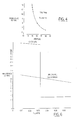
- the sensor emf When the sensor is placed in the exhaust gas of a vehicle, and the A/F is varied, the sensor emf shows a large and abrupt change at the stoichiometric A/F value as shown in Fig. 1. The reason is that the thermodynamic equilibrium oxygen partial pressure in the exhaust gas changes by many orders of magnitude at the stoichiometric A/F ratio. Away from stoichiometry, the emf varies only slowly with A/F because the partial oxygen pressure also changes only slowly with A/F.
- a resistive-type sensor based on TiO 2 .
- the electrical resistivity of metal oxides like TiO 2 , SrTiO 3 and CoO depends on the oxygen partial pressure P o2 in the ambient gas atmosphere. This dependence is, however, generally weak. For example, for TiO 3 , SrTiO 3 and CoO, this dependence is only a positive or negative 1 ⁇ 4 to 1/6 power dependence.
- TiO 2 sensors are useful for stoichiometric A/F control because they also exhibit a large and abrupt electrical resistance change at the stoichiometric A/F value as the result of the large change in exhaust gas P o2 near stoichiometry.
- a ZrO 2 based sensor operating in the oxygen pumping mode has much higher sensitivity (e.g. 1st-power P o2 dependence) away from stoichiometry.
- UEGO Universal Exhaust Gas Oxygen Sensor
- LEGO Lean Exhaust Gas Oxygen Sensor
- metal oxides change to another metal oxide phase when the temperature or the P o2 are changed appropriately.
- CoO is stable at low P o2 , but at higher P o2 , it transforms to Co 3 O 4 as shown in Fig. 2.
- Such metal-oxide to metal-oxide phase transitions are also generally accompanied by large changes in their electrical resistivity which can make these materials useful for oxygen sensors.
- the resistance decreases by almost two orders of magnitude when CoO changes to Co 3 O 4 .
- Fig. 3 shows results of the large stepwise changes in the resistance of a porous cobalt oxide ceramic as a function of P o2 at several temperatures associated with the phase change from CoO to Co 3 O 4 .
- the resistance of CoO can be used to measure changes in the P o2 of ambient air, or chances in the A/F ratio of internal combustion engines, e.g., gasoline and diesel, in the lean region.
- This type of prior art sensor consisted of a porous CoO ceramic with two Pt wires embedded into the ceramic, and inserted into a miniature cylindrical furnace to maintain the temperature of the CoO element at a constant high temperature.
- the large change in the resistance of a ceramic due to the conversion of the material from one oxide phase to the other may be used to make a more sensitive oxygen sensor.
- the oxygen partial pressure in the ambient gas can be determined, for example, by ramping the sample temperature between two appropriate values and monitoring the temperature for which the resistance changes by a large amount and then using the phase diagram of Fig. 2 to determine the ambient P o2 .
- the temperature of the sample is kept constant at the value T c for which the sample converts from one oxide phase to the other at that specific oxygen partial pressure.
- US Patent 4,351,182 to Schmidberger discloses a sensor for monitoring the oxygen content in oxygen rich exhaust gases from furnaces based on material phase transformations, more particularly from metal to metal oxide and vice versa.
- the oxygen sensitive material is a palladium layer maintained at a specific high temperature, e.g. 700°C, whereby palladium metal (Pd) changes phase to palladium oxide (PdO) when the oxygen partial pressure exceeds a specific "critical" value, P o2,c . It is disclosed that the phase change from Pd to PdO, and back, causes a change in the material's conductivity by a factor of about 20 which is used to provide a sensor output signal.
- Phase transitions from a metal to metal oxide, or from a metal oxide to another metal oxide are known to be generally accompanied by significant hysteresis unless the P o2 is changed to a value substantially larger (or smaller) than P o2,c .
- Hysteresis is related to the time that it takes for the material to change from one phase to another and is believed to be associated with a necessary nucleation process, i.e., formation of critical size nuclei of the new phase.
- the presence of hysteresis in phase transformation type sensors would negatively impact their usefulness since they would have relatively long response time.
- the present invention overcomes the deficiencies of prior sensors and provides an oxygen sensor useful for automotive applications having excellent sensitivity and response time in a variety of A/F ratios, including lean-burn engines.
- the present invention is a sensor for detecting a change of oxygen partial pressure in an ambient atmosphere.
- the sensor includes a sensing material which is selected from metal or its oxides and which, when at an elevated temperature and exposed to a gas containing a changing partial pressures of oxygen, is capable of changing from one metal or metal oxide phase to another such oxide phase and vice versa and associated therewith a change in a measurable physical property thereof.
- the sensor also includes a heating means connectable to a power source able to maintain a temperature gradient across the sensing material whereby the material exists, during active sensing operation, in at least two of said phases defining a boundary line therebetween generally perpendicular to the axis of the temperature gradient.
- the boundary line traverses longitudinally along the axis in response to changes in the oxygen partial pressure of the ambient atmosphere.
- Exemplary of these measurable physical properties are electrical resistivity, optical absorption, and mass.
- the sensor also includes a means for furnishing an output signal in response to the traversal of the boundary line across a fixed detecting location of the sensing material.
- a means for furnishing an output signal in response to the traversal of the boundary line across a fixed detecting location of the sensing material.
- the means may involve spaced apart electrical means at the detecting location for measuring changes in electrical resistance (or alternately conductivity) of the material therebetween, the means being located within the sensing material or on the same or opposing sides of the sensing material surfaces and optimally being generally centrally located along the axis of the temperature gradient.
- the present invention is a method for detecting a change of oxygen partial pressure in an ambient atmosphere.
- This method includes the steps of locating a sensor, as described above, in contact with an ambient atmosphere containing oxygen.
- the sensing material is present according to the method in at least two phases, during active sensing operation, defining a boundary line therebetween, the phases being selected from metal and oxides thereof wherein at least one of the phases is an oxide phase as defined above.
- the method further comprises the steps of maintaining a temperature gradient across the sensing material so as to maintain the material, during active sensing operation, in at least two phases defining a boundary line therebetween generally perpendicular to the longitudinal axis of the temperature gradient wherein the boundary line traverses longitudinally along this axis in response to changes in the oxygen partial pressure of the ambient atmosphere, and furnishing an output signal in response to traversal of the boundary line across a fixed detecting location of the sensing material.
- the furnishing step comprises furnishing such signal based on detecting a change of electric resistance of the material at the fixed detecting location between spaced apart electrical means affixed within or on the surface of the same or opposing sides of the sensing material.
- the fixed detecting location of the sensing material optimally is generally centrally located along the axis of the temperature gradient.
- the output signal would thus be furnished in response to the traversal of the boundary along the longitudinal axis of the temperature gradient in a region between the spaced apart electrical means.
- the oxygen sensor of the present invention advantageously provides a relatively low cost sensor with excellent sensitivity and response time.
- the sensor is much less complex to fabricate than many present sensors because it does not need the high quality seal between exhaust gas and air.
- the oxygen sensor disclosed herein is useful for detecting a change of oxygen partial pressure in an ambient atmosphere. It includes a sensing material which is selected from metal or its oxides which, when at an elevated temperature and exposed to a gas containing a changing partial pressures of oxygen, is capable of changing from one metal or metal oxide phase to another such oxide phase and vice versa. Associated with such phase changes are changes in a measurable physical property, such as electrical resistance.
- the sensing material may be a single metal, oxide thereof, or a compound of two or more metals or oxides thereof. It may also be a mixture of such materials.
- Preferred metals include, but are not limited to, metals like copper, palladium, indium, ruthenium, and rhodium; 3d transition metals; and rare earth elements. Exemplary of such 3d transition metals are titanium, vanadium, chromium, manganese, iron, cobalt, and nickel to name a few. Exemplary rare earth elements include La, Ce, Pr, Ni, Sm, Eu, Gd, Er etc.
- the sensing material may be a ternary and higher order compounds of the above metals with other elements like alkaline earth elements, e.g., calcium, strontium, or magnesium or oxide thereof such as CoMgO and SrFeO, or such compounds formed with rare earth elements such as La 2 CuO 3 , La 2 CuO 3 , PrFeO 3 . Still other ternary and higher order compounds or oxides thereof of rare earth elements with other elements, e.g., Y m Ba n Cu k O x may also be employed herein. Mixtures of any of these materials would also be useful.
- the sensing materials useful in this invention are not limited to those listed above but may be any metal material or oxide thereof which undergoes a phase change in response to changing partial oxygen pressures and has associated therewith a change in a measurable physical property.
- the sensing material may be cobalt, which can convert to cobalt oxide (CoO or Co 3 O 4 ) depending on the temperature and partial pressure of the oxygen. That is, as seen in Fig. 2, the particular phase of the Co-O material depends on the temperature and partial oxygen pressure to which the material is exposed.
- Fig. 2 shows a part of the P o2 -T phase diagram for this system, the solid and the dotted lines separate the Co, CoO, and Co 3 O 4 phases.
- T, P o2 cobalt oxide
- the sensing material exists only as metallic cobalt.
- the material exists as CoO; whereas, to the right of the dotted line, the material exists only as Co 3 O 4 .
- the material is a mixture of the two adjacent phases.
- the sensing material may be present in bulk form or as a layer on a substrate, wherein for example the substrate is planar.
- the layer may be one having a longer length than width.
- the substrate may be selected from any suitable material, electrically insulating or non-insulating, which will be dependent on the particular use of the sensor as will be described in further detail below.
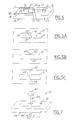
- Figure 5 shows an embodiment of the present invention oxygen sensor 10 which is based on resistance measurement.
- a layer 12 of the metal (e.g. Co) or the metal oxide (CoO) is deposited on an electrically insulating substrate 11.
- the layer 12 in this embodiment is longer than it is wide. If electrical resistance of the layer is the property being monitored, then the substrate must be electrically insulating.
- Substrate 11 can be one of many materials known in the art such as alumina, silica, sapphire, and silicon nitride. Still others will be apparent in view of the present disclosure.
- Layer 12 can be deposited by one of many methods known in the art such as sputtering, electron-beam evaporation, laser ablation, chemical vapour deposition, sol-gel techniques, and thick film printing.
- this layer would preferably be a few microns thick.
- Thin layers minimise sensor response time limitations arising from the need of P o2 -related lattice defects in the material (e.g., Co ions in CoO, or O vacancies in TiO 2 ) to diffuse throughout the entire layer.
- thick layers tend to increase the longevity of the sensors.
- the sensing material of the present invention preferably has a density which is at least 60% of theoretical. If the layer is relatively thin (a few microns or less), 100% density is acceptable.
- the layer is thick (e.g., several tens of microns or more) substantial porosity and small grain size (e.g., a few microns) are generally needed in order to decrease the distance over which the ions need to diffuse and thus to decrease the sensor response.
- the sensing material has an average particle diameter less than 10 microns.
- the senor also includes a heating means, connectable to a power source, so that a temperature gradient is maintained across the sensing material during its operation.
- the sensing material exists in at least two of the materials phases defining a boundary line therebetween generally perpendicular to the longitudinal axis of the temperature gradient. This temperature gradient is necessary in order to maintain the presence of the at least two different phases, which may be, e.g., cobalt metal and cobalt oxide, or two forms of cobalt oxide in the material.
- the material may exist in more than two separate phases during operation, for example for a Co-O material, the concurrent phases may be Co/CoO/Co 3 O 4 , with boundary lines between adjacent two phases. It is to be understood in this invention, that these phases exist at different places in the material with contact between the phases being only at the boundary line between phases. That is, these phases are not intermingled at locations in the material as will be further explained and understood from the figures. For example, in Fig. 5, the phases are designated A and B with boundary line 22 therebetween. These phases are kept separate from one another by means of the use of the heating means which critically maintains a temperature gradient across the sensing material. When the partial pressure of oxygen changes in the ambient atmosphere to which the material is exposed, phase formation takes place.
- One phase increases in size and the other correspondingly decreases in size.
- the boundary line traverses along the longitudinal axis of the temperature gradient in response to the change in the oxygen partial pressure.
- CoO and Co 3 O 4 as the sensor is exposed to changes in oxygen partial pressure, one of the phase increases in size and the other correspondingly decreases so that the boundary line between the phases moves to a different location on the sensing material.
- hysteresis effect When materials such as cobalt change from one phase to another phase, there is an associated hysteresis effect. This hysteresis effect is usually associated with the nucleation process required for phase transformation, i.e., the initial formation of critical size nuclei of the new phase. Thus in a system wherein the material is in one phase and then changes to another phase, hysteresis would result in a delay of formation of the new phase until critical size nuclei of the new phase form. The length of delay would be tied to the particular material. However, by maintaining a temperature gradient across the material the material is maintained in at least two forms in the material and slow response time associated with hysteresis can be avoided.
- the senor comprised of a metal like cobalt to oxygen to initiate formation of an oxide phase or phases prior to actual operation of the sensor, i.e., to pre-condition the sensor, e.g., prior to insertion in an automotive exhaust gas system as described in more detail below.
- This may be done, e.g., by exposing the deposited material to a temperature distribution in the range 700-1000°C in air.
- the sensor would also include a means for furnishing an output signal in response to the traversal of the boundary line across a fixed detecting location of the sensing material. Since the phase change has associated therewith a change in a measurable physical property, the furnishing means detects the change in the physical property of the material at the fixed detecting location and hence the traversal of the boundary line past this fixed detecting location.
- this detecting location on the sensing material is of limited small size and optimally generally centrally located along the longitudinal axis of the temperature gradient and in some detecting embodiments, perpendicular thereto. While it is preferred that the detecting location is centrally located, it is only necessary that the detecting location not be at the ends near the extremes of the temperature gradient. Exemplary of these measurable physical properties are electrical resistivity, optical absorption, and mass. Still other will be apparent to those skilled in the art in view of the present disclosure.
- planar oxygen sensor shown in Fig. 5
- two electrical contacts 13 and 14 for resistance measurement are deposited on the two opposing narrow surfaces of material layer 12 along a line perpendicular to the length of the layer (which corresponds also to the longitudinal axis of the temperature gradient in this embodiment) and generally in the middle of the layer.
- These contacts 13 and 14 could alternately be deposited, e.g., as relatively closely spaced parallel strips 26 and 28 on one of the planar faces as shown in Fig. 5A, or one side as shown in Fig.
- the fixed detecting location defined by contacts 13 and 14 could be located at different places along the longitudinal axis of material 12 closer to either end of the material layer. Nearer the centre (“generally centrally located”) is however preferred because it is easier then to optimise sensor sensitivity and wide P o2 range of operation as will be discussed later in this invention. Thus, by “generally centrally located” is meant that the detecting location is not at the ends of the sensing material at the extreme temperatures but located somewhere along the temperature gradient axis through which the boundary is expected to traverse during sensor operation.
- These contacts 13 and 14 in the configuration of Fig. 5 would optimally be generally along a line perpendicular to the temperature gradient axis, but this need not be exact.
- Electrical leads 15 and 16 are also deposited on the substrate 11 to connect contacts 13 and 14 to the electrical pads 17 and 18 where a voltage or a current is connected from an external source for the resistance measurement. Electrical contacts, leads and pads are made from a high temperature conductor such as platinum. These electrical means are able to furnish an output signal in response to the traversal of the boundary line corresponding to a phase change of the sensing material effected by the changing oxygen partial pressure of the sensing material in a region between the electrical means.
- Heater 19 is constructed in such a way that it delivers different electrical power to different parts of the substrate so that a temperature gradient is established along the length of sensing material layer 12.
- the criticality of maintaining a temperature gradient across the sensing material has been discussed in detail previously. Consequently, the temperature T 2 at one end 20 of the sensing material layer is higher than the temperature T 1 at the other end 21 of layer 12.
- the temperature of the two contacts 13 and 14 can be measured and controlled with any temperature sensing element, many being well known in the art. For example, a thermistor can be deposited on the substrate 11 near contacts 13 and 14. If needed, more temperature sensing elements can be deposited on substrate 11 to better monitor and control the temperature gradient across sensor layer 12.
- sensing material layer 12 contains at least two distinct phase sections, such as metal oxide phases A and B, e.g. CoO and Co 3 O 4 , respectively, one to the left of and another to the right of the boundary line 22, which is seen as the division or separation of the two phases.
- This boundary line 22 is generally perpendicular to the temperature gradient (in this embodiment, perpendicular to the longitudinal axis of material layer 12). As can be seen from Fig. 5, these phases A and B exist concurrently, i.e., at the same time, in the material but at distinct places in the sensing material.
- the boundary line 22 will move to the left as more of phase B (Co 3 O 4 ) forms. If the resistance between contacts 13 and 14 is monitored, the resistance shows a large jump as the boundary line 22 passes by the two contacts which happens whenever the ambient P o2 is varied through the value P o2,c . This jump is shown in Fig. 6 for the CoO/Co 3 O 4 system.
- the resistance of the sensing element between contacts 13 and 14 can be measured by methods well known in the art. For example, a current can be sent through contacts 13 and 14 and the measured voltage drop between these contacts can be used to calculate the resistance of the sensing material between these contacts; or a voltage can be applied to the sensing material element through a voltage divider circuit; or the resistance between 13 and 14 can be one leg of a conventional resistance bridge. Still other configuration may be used as would be apparent to those skilled in the art in view of the present disclosure. For example, two additional contacts can be deposited one on each end of the sensing material and used to apply a voltage or the current. Contacts 13 and 14 are then used only to measure the voltage drop across them. The contacts 13 and 14 in this later embodiment would have to be offset relative to one another, i.e., not along the same perpendicular to the temperature gradient.
- the type and magnitude of the temperature gradient in the sensor 10 depends on the application. In general, the smaller is the T-gradient, the higher is the accuracy of the sensor. If the T-gradient is constant along the sensing material layer 12, a smaller T-gradient means that the difference between T 1 and T 2 is smaller. In that case, the range of allowable variation of P o2 that preserves both phases in the layer is smaller. A typical P o2 range is one that covers an order of magnitude, that is the ratio of the maximum and minimum P o2 is 10.
- the temperatures T 1 and T 2 at the two ends of layer 12 corresponding to these maximum and minimum P o2 can be determined from the T-P o2 phase diagram (e.g., Fig. 2 for Co-O system).
- the material may become a single phase, i.e., so that one of the other two phases in sensing layer 12 disappears and the sensor is not able to actively sense.
- the sensor needs some extra time for the second phase to again form. Nevertheless, after this delay, the sensor will become fully operational and return to active sensing.
- a high accuracy around the desired value P o2,c combined with a wide range of allowable P o2 may be achieved by generating a special non-constant T-gradient along sensing material layer 12.
- the heater and the structure can be designed so that the T-gradient is small near the centre of layer 12 and very large at the two ends of layer 12. From this discussion, it is apparent that the centre of layer 12 is a convenient location for the contact pads 13 and 14.
- the '182 patent sensor, as well as the present invention disclosed herein, can not be conveniently used to measure any value of a varying ambient oxygen pressure. Instead these sensors can monitor whether the ambient oxygen pressure is higher or lower than a selected specific value P o2,c (Fig. 6).
- the sensor of this invention behaves similarly to the lambda sensor of the prior art (Fig. 1) used for stoichiometric A/F control, except that the "switch point" of the present sensor can be adjusted to be at any A/F value. That is, a new value of P o2,c or of (A/F) c can be selected by changing the temperature of layer 12 at the location of contacts 13 and 14 to the appropriate value.
- the feedback control is of the "limit-cycle" type rather than proportional control, similar to the stoichiometric A/F control systems based on the lambda sensor.
- the A/F ratio is ramped from a value lower than (A/F) c , to a value higher than (A/F) c or vice versa, with the direction of the ramping depending on the sensor output.
- A/F passes through (A/F) c , the sensor signal changes from a low to a high value or from a high to a low value as the boundary line 22 traverses (Fig.
- the electronic feedback system is ordered to change direction of the A/F sweep. Consequently, the A/F oscillates between two A/F values, one lower and the other higher than (A/F) c , at a certain frequency called "limit-cycle frequency".
- the device of the present invention can be made in planar configurations other than the one shown in Fig. 5.
- a planar structure can be fabricated similarly to the so-called planar ZrO 2 sensors, both the stoichiometric Nernst-type and O 2 -pumping-based UEGO and LEGO sensors.
- a series of ceramic tapes made from ZrO 2 (and possibly also from other materials) having appropriate geometry (shape and thickness) together with planar heater and electrodes are pressed together and sintered at high temperatures to form the planar sensor element.
- planar geometry is a most convenient geometry for establishing a temperature gradient
- more 3-dimensional embodiments can also be used.
- temperature distributions other than along a length of the sensing material may be used. Such other distributions are acceptable as long as they are such that both phases of the sensing material exist, during active sensing operation, in the sensing material separated by a phase boundary line which moves through the detecting location, in the Fig. 5 embodiment being defined by spaced contacts 13 and 14 which detect the transversal of the phase boundary line.
- Fig. 7 shows another embodiment 30 according to the present invention where the changing physical property of the sensing material being measured is its optical absorption.
- Embodiment 30 is similar to embodiment 10 except that electrical leads, pads, and contacts (used therein for measuring electrical resistance) are not needed in this embodiment 30 for operation of a sensor based on changing optical absorption.
- a small size circular or rectangular light beam 44 of the proper wavelength from a light source 45 is directed upon and through this small area of the sensing material layer 32 preferably near the centre of layer 32.
- the light transmitted through the sensing material layer 32 and the substrate 31 is detected with a light detector 46.
- substrate 31 must be transparent to the light beam 46 but the substrate does not have to be electrically insulating as with the first (resistivity measuring) embodiment described above.
- the heating means 39 for providing the temperature gradient across the layer comprises a metal coating, e.g., a printed metallic coating as might be used as heating means 19 in the prior Fig. 5 embodiment above, it would still be necessary to provide an electrically insulating substrate. It is also desirable that the heating means 39 does not interfere with the optical detection of the associated sensor material phase change.
- Limitations due to ion diffusion in the material can be overcome by operating at sufficiently high temperatures where the diffusion process is fast; and by using ceramics with high porosity and very small grain size or by using thin films. Limitations in the speed of this phase change due to slow surface processes affecting the transfer of oxygen between the material and the ambient gas can be minimised by, again, operating at high temperatures or by adding on the surface of the materials catalytic particles (e.g., Pt) which help the oxygen transfer.
- the materials catalytic particles e.g., Pt
- the limitations due to the nucleation process can be minimised by operating the sensor so that both phases are always present in the sensing material. This is accomplished by establishing a temperature distribution along the material instead of maintaining the material at a constant temperature as in prior art sensors.
Landscapes
- Chemical & Material Sciences (AREA)
- Chemical Kinetics & Catalysis (AREA)
- Electrochemistry (AREA)
- Physics & Mathematics (AREA)
- Health & Medical Sciences (AREA)
- Life Sciences & Earth Sciences (AREA)
- Analytical Chemistry (AREA)
- Biochemistry (AREA)
- General Health & Medical Sciences (AREA)
- General Physics & Mathematics (AREA)
- Immunology (AREA)
- Pathology (AREA)
- Investigating Or Analyzing Materials By The Use Of Fluid Adsorption Or Reactions (AREA)
Applications Claiming Priority (4)
| Application Number | Priority Date | Filing Date | Title |
|---|---|---|---|
| US08/906,237 US5942674A (en) | 1997-08-04 | 1997-08-04 | Method for detecting oxygen partial pressure using a phase-transformation sensor |
| US08/905,372 US5783153A (en) | 1997-08-04 | 1997-08-04 | Metal oxide oxygen sensors based on phase transformation |
| US906237 | 1997-08-04 | ||
| US905372 | 1997-08-04 |
Publications (3)
| Publication Number | Publication Date |
|---|---|
| EP0896218A2 true EP0896218A2 (fr) | 1999-02-10 |
| EP0896218A3 EP0896218A3 (fr) | 1999-02-24 |
| EP0896218B1 EP0896218B1 (fr) | 2002-03-13 |
Family
ID=27129429
Family Applications (1)
| Application Number | Title | Priority Date | Filing Date |
|---|---|---|---|
| EP19980306142 Expired - Lifetime EP0896218B1 (fr) | 1997-08-04 | 1998-07-31 | Capteurs d'oxygène à base d'une transformation de phase dans un oxyde de métal |
Country Status (2)
| Country | Link |
|---|---|
| EP (1) | EP0896218B1 (fr) |
| DE (1) | DE69804174T2 (fr) |
Families Citing this family (1)
| Publication number | Priority date | Publication date | Assignee | Title |
|---|---|---|---|---|
| CN110672669B (zh) * | 2019-10-14 | 2022-03-29 | 武汉工程大学 | 四氧化三钴气敏器件、其制备方法、应用以及臭氧辅助正丁醇气体测试方法 |
Family Cites Families (6)
| Publication number | Priority date | Publication date | Assignee | Title |
|---|---|---|---|---|
| DE2916178C2 (de) * | 1979-04-21 | 1982-04-22 | Dornier System Gmbh, 7990 Friedrichshafen | Sonde zur Messung des Sauerstoffpartialdrucks in Gasen |
| US4764343A (en) * | 1986-11-14 | 1988-08-16 | General Motors Corporation | Oxygen sensor based on optical detection |
| US5406193A (en) * | 1993-06-23 | 1995-04-11 | Western Research Institute | Hot gas in-situ monitoring probe |
| US5397541A (en) * | 1993-09-10 | 1995-03-14 | National Research Council Of Canada | Thin film oxygen sensor |
| GB9525823D0 (en) * | 1995-12-18 | 1996-02-21 | Protimeter Plc | Apparatus for dewpoint determination |
| US5783153A (en) * | 1997-08-04 | 1998-07-21 | Ford Global Technologies, Inc. | Metal oxide oxygen sensors based on phase transformation |
-
1998
- 1998-07-31 DE DE1998604174 patent/DE69804174T2/de not_active Expired - Fee Related
- 1998-07-31 EP EP19980306142 patent/EP0896218B1/fr not_active Expired - Lifetime
Also Published As
| Publication number | Publication date |
|---|---|
| EP0896218A3 (fr) | 1999-02-24 |
| DE69804174T2 (de) | 2002-10-02 |
| DE69804174D1 (de) | 2002-04-18 |
| EP0896218B1 (fr) | 2002-03-13 |
Similar Documents
| Publication | Publication Date | Title |
|---|---|---|
| US4487680A (en) | Planar ZrO2 oxygen pumping sensor | |
| US6514397B2 (en) | Gas sensor | |
| KR100337102B1 (ko) | 질소산화물을검출하기위한센서 | |
| US4510036A (en) | Limiting electric current type oxygen sensor with heater and limiting electric current type oxygen concentration detecting device using the same | |
| US4902400A (en) | Gas sensing element | |
| EP0001510A1 (fr) | Détecteur de gaz | |
| US5942674A (en) | Method for detecting oxygen partial pressure using a phase-transformation sensor | |
| US5783153A (en) | Metal oxide oxygen sensors based on phase transformation | |
| JPH11326255A (ja) | ガスを貯蔵する触媒の充填度又は品質を求める方法 | |
| CA1128610A (fr) | Capteur a element ceramique | |
| WO1998004907A1 (fr) | Detecteur d'oxygene a semi-conducteur | |
| EP0059933B1 (fr) | Elément pour sonde à oxygène en électrolyte solide à structure laminée avec couche pour diffusion de gaz sur électrode externe | |
| JP4743375B2 (ja) | 可燃性ガス濃度測定方法 | |
| US5876673A (en) | High sensitivity phase transformation-based oxygen sensors for proportional control | |
| EP0962765B1 (fr) | Détermination d'oxygène dans des gaz d'échappement | |
| JP2002513930A (ja) | 水素センサ | |
| US5798269A (en) | Method for detecting change in oxygen partial pressure based on metal/metal oxide phase transformations | |
| EP0896218B1 (fr) | Capteurs d'oxygène à base d'une transformation de phase dans un oxyde de métal | |
| Pribat et al. | Microionic gas sensor for pollution and energy control in the consumer market | |
| CN101027549A (zh) | 抗硫传感器 | |
| EP0896217A1 (fr) | Capteur d'oxygène à haute sensibilité à base d'une transformation de phase pour commande proportionnelle | |
| JP2948124B2 (ja) | 酸素センサー | |
| JP2815125B2 (ja) | 接触燃焼式ガス検知素子 | |
| JP3647492B2 (ja) | ガスセンサ | |
| JP3669807B2 (ja) | 一酸化炭素検出センサー |
Legal Events
| Date | Code | Title | Description |
|---|---|---|---|
| PUAI | Public reference made under article 153(3) epc to a published international application that has entered the european phase |
Free format text: ORIGINAL CODE: 0009012 |
|
| PUAL | Search report despatched |
Free format text: ORIGINAL CODE: 0009013 |
|
| AK | Designated contracting states |
Kind code of ref document: A2 Designated state(s): DE FR GB |
|
| AX | Request for extension of the european patent |
Free format text: AL;LT;LV;MK;RO;SI |
|
| AK | Designated contracting states |
Kind code of ref document: A3 Designated state(s): AT BE CH CY DE DK ES FI FR GB GR IE IT LI LU MC NL PT SE |
|
| AX | Request for extension of the european patent |
Free format text: AL;LT;LV;MK;RO;SI |
|
| 17P | Request for examination filed |
Effective date: 19990628 |
|
| AKX | Designation fees paid |
Free format text: DE FR GB |
|
| 17Q | First examination report despatched |
Effective date: 20000405 |
|
| GRAG | Despatch of communication of intention to grant |
Free format text: ORIGINAL CODE: EPIDOS AGRA |
|
| GRAG | Despatch of communication of intention to grant |
Free format text: ORIGINAL CODE: EPIDOS AGRA |
|
| GRAH | Despatch of communication of intention to grant a patent |
Free format text: ORIGINAL CODE: EPIDOS IGRA |
|
| REG | Reference to a national code |
Ref country code: GB Ref legal event code: IF02 |
|
| GRAH | Despatch of communication of intention to grant a patent |
Free format text: ORIGINAL CODE: EPIDOS IGRA |
|
| GRAA | (expected) grant |
Free format text: ORIGINAL CODE: 0009210 |
|
| AK | Designated contracting states |
Kind code of ref document: B1 Designated state(s): DE FR GB |
|
| REF | Corresponds to: |
Ref document number: 69804174 Country of ref document: DE Date of ref document: 20020418 |
|
| ET | Fr: translation filed | ||
| PLBE | No opposition filed within time limit |
Free format text: ORIGINAL CODE: 0009261 |
|
| STAA | Information on the status of an ep patent application or granted ep patent |
Free format text: STATUS: NO OPPOSITION FILED WITHIN TIME LIMIT |
|
| 26N | No opposition filed |
Effective date: 20021216 |
|
| REG | Reference to a national code |
Ref country code: GB Ref legal event code: 732E |
|
| PGFP | Annual fee paid to national office [announced via postgrant information from national office to epo] |
Ref country code: GB Payment date: 20040615 Year of fee payment: 7 |
|
| PGFP | Annual fee paid to national office [announced via postgrant information from national office to epo] |
Ref country code: FR Payment date: 20040702 Year of fee payment: 7 |
|
| PGFP | Annual fee paid to national office [announced via postgrant information from national office to epo] |
Ref country code: DE Payment date: 20040730 Year of fee payment: 7 |
|
| REG | Reference to a national code |
Ref country code: FR Ref legal event code: TP |
|
| PG25 | Lapsed in a contracting state [announced via postgrant information from national office to epo] |
Ref country code: GB Free format text: LAPSE BECAUSE OF NON-PAYMENT OF DUE FEES Effective date: 20050731 |
|
| PG25 | Lapsed in a contracting state [announced via postgrant information from national office to epo] |
Ref country code: DE Free format text: LAPSE BECAUSE OF NON-PAYMENT OF DUE FEES Effective date: 20060201 |
|
| GBPC | Gb: european patent ceased through non-payment of renewal fee |
Effective date: 20050731 |
|
| PG25 | Lapsed in a contracting state [announced via postgrant information from national office to epo] |
Ref country code: FR Free format text: LAPSE BECAUSE OF NON-PAYMENT OF DUE FEES Effective date: 20060331 |
|
| REG | Reference to a national code |
Ref country code: FR Ref legal event code: ST Effective date: 20060331 |