EP0896453A2 - Procédé de chiffrage ou de déchiffrage d'une séquence de données - Google Patents
Procédé de chiffrage ou de déchiffrage d'une séquence de données Download PDFInfo
- Publication number
- EP0896453A2 EP0896453A2 EP98113474A EP98113474A EP0896453A2 EP 0896453 A2 EP0896453 A2 EP 0896453A2 EP 98113474 A EP98113474 A EP 98113474A EP 98113474 A EP98113474 A EP 98113474A EP 0896453 A2 EP0896453 A2 EP 0896453A2
- Authority
- EP
- European Patent Office
- Prior art keywords
- indices
- words
- values
- algorithm
- data
- Prior art date
- Legal status (The legal status is an assumption and is not a legal conclusion. Google has not performed a legal analysis and makes no representation as to the accuracy of the status listed.)
- Granted
Links
- 238000000034 method Methods 0.000 title claims abstract description 39
- 230000005540 biological transmission Effects 0.000 claims description 5
- 238000011423 initialization method Methods 0.000 description 2
- 229910052710 silicon Inorganic materials 0.000 description 1
- 239000010703 silicon Substances 0.000 description 1
Images

Classifications
-
- H—ELECTRICITY
- H03—ELECTRONIC CIRCUITRY
- H03M—CODING; DECODING; CODE CONVERSION IN GENERAL
- H03M1/00—Analogue/digital conversion; Digital/analogue conversion
- H03M1/12—Analogue/digital converters
- H03M1/14—Conversion in steps with each step involving the same or a different conversion means and delivering more than one bit
-
- H—ELECTRICITY
- H04—ELECTRIC COMMUNICATION TECHNIQUE
- H04L—TRANSMISSION OF DIGITAL INFORMATION, e.g. TELEGRAPHIC COMMUNICATION
- H04L9/00—Cryptographic mechanisms or cryptographic arrangements for secret or secure communications; Network security protocols
- H04L9/06—Cryptographic mechanisms or cryptographic arrangements for secret or secure communications; Network security protocols the encryption apparatus using shift registers or memories for block-wise or stream coding, e.g. DES systems or RC4; Hash functions; Pseudorandom sequence generators
- H04L9/065—Encryption by serially and continuously modifying data stream elements, e.g. stream cipher systems, RC4, SEAL or A5/3
- H04L9/0656—Pseudorandom key sequence combined element-for-element with data sequence, e.g. one-time-pad [OTP] or Vernam's cipher
- H04L9/0662—Pseudorandom key sequence combined element-for-element with data sequence, e.g. one-time-pad [OTP] or Vernam's cipher with particular pseudorandom sequence generator
- H04L9/0668—Pseudorandom key sequence combined element-for-element with data sequence, e.g. one-time-pad [OTP] or Vernam's cipher with particular pseudorandom sequence generator producing a non-linear pseudorandom sequence
-
- H—ELECTRICITY
- H04—ELECTRIC COMMUNICATION TECHNIQUE
- H04L—TRANSMISSION OF DIGITAL INFORMATION, e.g. TELEGRAPHIC COMMUNICATION
- H04L2209/00—Additional information or applications relating to cryptographic mechanisms or cryptographic arrangements for secret or secure communication H04L9/00
- H04L2209/12—Details relating to cryptographic hardware or logic circuitry
Definitions
- the invention relates to a method for encrypting or decrypting one Data sequence of successive data words of length M in one Data transmission device.
- the invention is based on the object of a method for encrypting or To decrypt a sequence of data that is difficult to decrypt and not too much storage space is required and can be implemented on silicon with little effort.
- This object is achieved by a method for encrypting or decrypting a data sequence of successive data words of length M in a data transmission device, in which an algorithm is executed in which a sequence of predetermined starting values is performed by operations in a finite body GF (2 N ) quasi-random encryption words of length M are generated, and one of the encryption words is linked to a data word.
- the length M of the data words is equal to the dimension N of the finite body. This allows the algorithm to perform simple operations be carried out. It is also advantageous if the algorithm is based on a finite field of O state variables x and O constant, predetermined Factors p based, which are addressed by L indices, where L is less than O. The algorithm is advantageously run through cyclically, with one per cycle Encryption word is generated. By combining state variables and constant predetermined factors, a sufficiently high randomness of the Encryption words are reached and storage space is saved.
- L 3 state variables x are quasi randomly selected by the three indices, the Encryption word by linking the selected state variables x formed and used only for linking to the respective data word. Since the State variables are no longer used in the process and therefore not used Traceability procedures are not effective in locating the saved State variable can be used. So there is an additional, great security against decryption of the encryption words guaranteed.
- Two of the state variables can advantageously be selected by that they are interchanged and then with the indices of the State variables x (i) given constant factors p (i) are multiplied.
- the Galois arithmetic makes different cycles per cycle predetermined constant factors p (i) are selected virtually at random.
- the result is as follows of the indices by going through and advancing a feedback Shift registers with maximum cycle length.
- the number of indices i for addressing the state variable x (i) can be modified by a modulo operation Addressing specified number can be limited. This is a quasi random noise generated so that the indices i, which are used to address the State variables are used, are almost statistically evenly distributed.
- the initial values for the state variables x and the indices i for the algorithm are uniquely determined by means of an initialization method.
- the starting values are expediently generated by operations in a finite body GF ( 2Q ) from predetermined initialization values k quasi randomly.
- quasi-random start values are already entered into the algorithm, so that the probability that the key can be inferred from the encrypted data words or that the data words can be decrypted without knowledge of the input values is further reduced.
- the initialization values k can be equally weighted in the operations for the determination of the starting values. This ensures that in the Initial distribution of the starting values no statistical uneven distribution occurs, through which the encryption process would be more easily attacked.
- the start values for the state variables x can be determined in each case Multiplication by one of the constant factors p (i) can be performed.
- the Starting values of the indices i can be linked by linking equally weighted ones Initialization values k with a state variable x or with one of the constant ones Factors p (i) are linked.
- the starting values of the indices can each be entered using a Modulo operation limited to the number specified for the algorithm become.
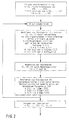
- a algorithm according to the invention for generating encryption words, with to which a data sequence of successive data words is encrypted or can be decrypted, explained.
- the algorithm according to the invention is described in a finite body, i.e. performed in a Galois field.
- the algorithm is based on 16 state variables x and 16 constant, predetermined factors p, which are addressed by three indices i. Of the The algorithm is run through cyclically, with one encryption word per cycle is produced.
- the number of state variables, the constant factors and the Indices is one embodiment and it is left to the skilled person to choose one appropriate other number to use.
- values for the indices i1, i2, i3 determines that the sequence of indices is a feedback shift register run through with the maximum cycle length, which is switched on in cycles. Due to the selection of the indices using the shift register, a quasi arises random counting sequence that changes each time the shift register is advanced. This operation is not linear and it creates a quasi-random noise.
- the number is determined using a modulo operation in the Galois field the value ranges of the indices i1, i2, i3 reduced to 16 values. This is the number that is required to address the state variable x (i).
- the state variables x (i2r), x (i3r) addressed and then exchanged with each other, so that the random part in the Procedure is increased.
- the state variables x (i2r), x (i3r) thus obtained are over a Galois multiplication with a constant factor p (i2r), p (i3r) connected. This progressively modifies the state variables, which is essential for the statistical distribution of the encryption values.
- the constant factors are given array elements and thus in a fixed one Storage space saved.
- the constant factors p are given by the indices iir, the are assigned to the state variables.
- An encryption word is then formed by the State variables x (i2r), x (i3r) with each other and with another state variable x (i1r), which is quasi randomly selected by an index i.
- the encryption word thus formed is sent to the station for the entry of start values is returned and the cycle is repeated. The entire cycle is run through until all possible states of the Indices i1, i2, i3, i.e. all states of the maximum sequence have been run through. If all States have passed through, a quasi-random encryption word has arisen, which is output in order to encrypt a data word of a data sequence or to decrypt. Then the following encryption word is used accordingly formed by going through the algorithm again.
- a sequence of quasi-random encryption words one with one Data word of a data sequence can be linked. Because of the quasi-random Scrambling the encryption words wins the encryption process a high level of security. It cannot be done with reasonable effort from the result of the encrypted data can be deduced from the key. Tracing in this case, the creation of the data words is more complex than trying them out all sorts of keys. Even if the algorithm or the generator, which one contains the algorithm is known, the key is not due to the encrypted data predictable. This also results when the algorithm is known of the encryption words cannot be predicted. Thus, the process gets a big one Security against decryption.
- the algorithm of the initialization process is in a finite body or in a Galois field field with finite body arithmetic Galois operations carried out.
- an initialization word k is entered, which may refer to the Dimension k (0, ..., 15) is dimensioned. Then start values for the indices i1, i2, i3 determined. To determine the index i1, a random one is used selected value of the starting values k (i) and a state variable x (i) is selected and linked together. To determine the index i2, a starting value k (i1) and a state variable x (i1) is selected, linked with one another and with a randomly selected constant factor p (j) linked. To determine the index i3 a starting value k (i2) and a state variable x (i2) are selected, together linked and linked with a randomly selected constant factor p (k).
- the Constant factors are made up of values specified in a memory location selected.
- the stored values can be the same as for the Act algorithm of the encryption process.
- the start values of the indices i1, i2, i3 each by a modulo operation on the for the algorithm predetermined number 16 limited. It is essential that the initialization values k enter the operations for determining the starting values with equal weight. Thereby a statistical imbalance in the initial distribution is prevented which would lead to the key of the procedure being more easily deduced could be.
- the start values for the state variable x are determined by one Multiplication of a constant selected using the starting values for the indices Factor p (ii) with a random, also using the starting values for the indices selected state variables x (ij) are multiplied in the Galois field. After this the initialization process has been completed, the start values are entered for input output the algorithm for performing the encryption process.
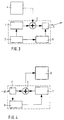
- FIG. 3 is a possible application for carrying out the invention Method for encrypting a data sequence from successive ones Data words shown.
- an encryption sequence generator 1 both Initialization procedure as well as the algorithm performed.
- keywords are generated which are sent to the Encryption sequence generator 1 are supplied. These are called Initialization words entered in the encryption sequence generator 1.
- the latter provides a sequence of encryption words that a link unit 3 be fed.
- the link unit 3 is also data words from a Audio data source 4 supplied.
- the linking unit 3 are each one Data word and an encryption word linked together. For this, a XOR operation can be performed.
- the encrypted data words delivered to a multiplexer 5 in which further key data is superimposed on them become.
- the latter are delivered from a key encryption unit 6, which the key data of the key generator 2 for further encryption be fed.
- the multiplexer 5 sends out the encrypted data words.
- FIG. 4 shows how the data words encrypted by the transmitting device of FIG. 3 can be received and decrypted.
- 4 is the receiving device constructed essentially symmetrically to the device of FIG. 3.
- Demultiplexers 7 convert the data words into the encrypted keywords a key decryption unit 8 are fed, and in the with the Encryption words encrypted data words, which the link unit 3 are fed, divided.
- the key decryption unit 8 separates the encrypted keywords from the data supplied to it and passes them on to the Encryption sequence generator 1 further. In this it will Initialization procedure and the algorithm for decrypting the data sequence run through.
- the encryption sequence generator 1 determines the Encryption words and passes them to the link unit 3. There the Data stream coming from the demultiplexer is decoded, and the data words are given to the audio data receiver 9.
Landscapes
- Engineering & Computer Science (AREA)
- Physics & Mathematics (AREA)
- Nonlinear Science (AREA)
- Computer Security & Cryptography (AREA)
- Computer Networks & Wireless Communication (AREA)
- Signal Processing (AREA)
- Theoretical Computer Science (AREA)
- Storage Device Security (AREA)
- Compression, Expansion, Code Conversion, And Decoders (AREA)
- Facsimile Transmission Control (AREA)
- Two-Way Televisions, Distribution Of Moving Picture Or The Like (AREA)
- Signal Processing For Digital Recording And Reproducing (AREA)
Applications Claiming Priority (2)
| Application Number | Priority Date | Filing Date | Title |
|---|---|---|---|
| DE19733829 | 1997-08-05 | ||
| DE19733829A DE19733829C2 (de) | 1997-08-05 | 1997-08-05 | Verfahren zum Verschlüsseln bzw. Entschlüsseln einer Datenfolge |
Publications (3)
| Publication Number | Publication Date |
|---|---|
| EP0896453A2 true EP0896453A2 (fr) | 1999-02-10 |
| EP0896453A3 EP0896453A3 (fr) | 2000-12-06 |
| EP0896453B1 EP0896453B1 (fr) | 2005-10-19 |
Family
ID=7838041
Family Applications (1)
| Application Number | Title | Priority Date | Filing Date |
|---|---|---|---|
| EP98113474A Expired - Lifetime EP0896453B1 (fr) | 1997-08-05 | 1998-07-20 | Procédé de chiffrage ou de déchiffrage d'une séquence de données |
Country Status (6)
| Country | Link |
|---|---|
| US (1) | US6314187B1 (fr) |
| EP (1) | EP0896453B1 (fr) |
| JP (1) | JP4298010B2 (fr) |
| KR (1) | KR100628280B1 (fr) |
| DE (2) | DE19733829C2 (fr) |
| TW (1) | TW411682B (fr) |
Cited By (1)
| Publication number | Priority date | Publication date | Assignee | Title |
|---|---|---|---|---|
| WO2001084766A3 (fr) * | 2000-04-28 | 2002-04-11 | Ky Quy Vu | Systeme et procede de cryptage au moyen de cles transparentes |
Families Citing this family (36)
| Publication number | Priority date | Publication date | Assignee | Title |
|---|---|---|---|---|
| US7430670B1 (en) * | 1999-07-29 | 2008-09-30 | Intertrust Technologies Corp. | Software self-defense systems and methods |
| US6968493B1 (en) * | 1999-09-14 | 2005-11-22 | Maxtor Corporation | Randomizer systems for producing multiple-symbol randomizing sequences |
| FR2853424B1 (fr) * | 2003-04-04 | 2005-10-21 | Atmel Corp | Architecture de multiplicateurs polynomial et naturel combines |
| BRPI0318492B1 (pt) * | 2003-09-05 | 2019-12-10 | Telecom Italia Spa | rede dependente de chave combinatória e método para criptografia/decifração de dados digitais de entrada |
| DE102007002230A1 (de) * | 2007-01-10 | 2008-07-17 | Benecke-Kaliko Ag | Thermoplastische Folie |
| US8312551B2 (en) | 2007-02-15 | 2012-11-13 | Harris Corporation | Low level sequence as an anti-tamper Mechanism |
| US8611530B2 (en) | 2007-05-22 | 2013-12-17 | Harris Corporation | Encryption via induced unweighted errors |
| KR100842042B1 (ko) | 2007-07-16 | 2008-06-30 | 충남대학교산학협력단 | 암호화된 실행코드에 대하여 동적으로 복호화할 수 있게 한코드블록 암호화 방법 |
| US7713145B2 (en) * | 2008-01-10 | 2010-05-11 | Acushnet Company | Multi-layer core golf ball |
| US8180055B2 (en) * | 2008-02-05 | 2012-05-15 | Harris Corporation | Cryptographic system incorporating a digitally generated chaotic numerical sequence |
| US8363830B2 (en) | 2008-02-07 | 2013-01-29 | Harris Corporation | Cryptographic system configured to perform a mixed radix conversion with a priori defined statistical artifacts |
| US8139764B2 (en) * | 2008-05-06 | 2012-03-20 | Harris Corporation | Closed galois field cryptographic system |
| US8320557B2 (en) * | 2008-05-08 | 2012-11-27 | Harris Corporation | Cryptographic system including a mixed radix number generator with chosen statistical artifacts |
| US8145692B2 (en) | 2008-05-29 | 2012-03-27 | Harris Corporation | Digital generation of an accelerated or decelerated chaotic numerical sequence |
| US8064552B2 (en) * | 2008-06-02 | 2011-11-22 | Harris Corporation | Adaptive correlation |
| US8068571B2 (en) * | 2008-06-12 | 2011-11-29 | Harris Corporation | Featureless coherent chaotic amplitude modulation |
| US8325702B2 (en) | 2008-08-29 | 2012-12-04 | Harris Corporation | Multi-tier ad-hoc network in which at least two types of non-interfering waveforms are communicated during a timeslot |
| US8165065B2 (en) | 2008-10-09 | 2012-04-24 | Harris Corporation | Ad-hoc network acquisition using chaotic sequence spread waveform |
| US8406276B2 (en) | 2008-12-29 | 2013-03-26 | Harris Corporation | Communications system employing orthogonal chaotic spreading codes |
| US8351484B2 (en) * | 2008-12-29 | 2013-01-08 | Harris Corporation | Communications system employing chaotic spreading codes with static offsets |
| US8457077B2 (en) | 2009-03-03 | 2013-06-04 | Harris Corporation | Communications system employing orthogonal chaotic spreading codes |
| US8428102B2 (en) | 2009-06-08 | 2013-04-23 | Harris Corporation | Continuous time chaos dithering |
| US8509284B2 (en) | 2009-06-08 | 2013-08-13 | Harris Corporation | Symbol duration dithering for secured chaotic communications |
| US8428103B2 (en) | 2009-06-10 | 2013-04-23 | Harris Corporation | Discrete time chaos dithering |
| US8406352B2 (en) * | 2009-07-01 | 2013-03-26 | Harris Corporation | Symbol estimation for chaotic spread spectrum signal |
| US8385385B2 (en) * | 2009-07-01 | 2013-02-26 | Harris Corporation | Permission-based secure multiple access communication systems |
| US8379689B2 (en) | 2009-07-01 | 2013-02-19 | Harris Corporation | Anti-jam communications having selectively variable peak-to-average power ratio including a chaotic constant amplitude zero autocorrelation waveform |
| US8428104B2 (en) | 2009-07-01 | 2013-04-23 | Harris Corporation | Permission-based multiple access communications systems |
| US8340295B2 (en) | 2009-07-01 | 2012-12-25 | Harris Corporation | High-speed cryptographic system using chaotic sequences |
| US8363700B2 (en) | 2009-07-01 | 2013-01-29 | Harris Corporation | Rake receiver for spread spectrum chaotic communications systems |
| US8369376B2 (en) | 2009-07-01 | 2013-02-05 | Harris Corporation | Bit error rate reduction in chaotic communications |
| US8848909B2 (en) | 2009-07-22 | 2014-09-30 | Harris Corporation | Permission-based TDMA chaotic communication systems |
| US8369377B2 (en) * | 2009-07-22 | 2013-02-05 | Harris Corporation | Adaptive link communications using adaptive chaotic spread waveform |
| US8345725B2 (en) | 2010-03-11 | 2013-01-01 | Harris Corporation | Hidden Markov Model detection for spread spectrum waveforms |
| US10103877B2 (en) * | 2015-09-24 | 2018-10-16 | Intel Corporation | SMS4 acceleration processors having round constant generation |
| US9449189B1 (en) * | 2015-11-03 | 2016-09-20 | International Business Machines Corporation | Protection of state data in computer system code |
Family Cites Families (3)
| Publication number | Priority date | Publication date | Assignee | Title |
|---|---|---|---|---|
| GB1597218A (en) * | 1976-12-11 | 1981-09-03 | Nat Res Dev | Apparatus for electronic encypherment of digital data |
| US4797921A (en) * | 1984-11-13 | 1989-01-10 | Hitachi, Ltd. | System for enciphering or deciphering data |
| US4890252A (en) * | 1987-10-29 | 1989-12-26 | The United States Of America As Represented By The Administrator Of The National Aeronautics And Space Administration | Long period pseudo random number sequence generator |
-
1997
- 1997-08-05 DE DE19733829A patent/DE19733829C2/de not_active Expired - Fee Related
-
1998
- 1998-07-20 DE DE59813117T patent/DE59813117D1/de not_active Expired - Fee Related
- 1998-07-20 EP EP98113474A patent/EP0896453B1/fr not_active Expired - Lifetime
- 1998-08-03 TW TW087112764A patent/TW411682B/zh not_active IP Right Cessation
- 1998-08-05 KR KR1019980031838A patent/KR100628280B1/ko not_active Expired - Fee Related
- 1998-08-05 US US09/129,499 patent/US6314187B1/en not_active Expired - Fee Related
- 1998-08-05 JP JP22178398A patent/JP4298010B2/ja not_active Expired - Fee Related
Non-Patent Citations (4)
| Title |
|---|
| KNUTH D. E. : "THE ART OF COMPUTER PROGRAMMING. Volume 2 /SEMINUMERICAL ALGORITHMS. " 1980 , ADDISON WESLEY , USA; XP000951421 * Seite 31 - Seite 32 * * |
| MIHALJEVIC M ET AL: "A FAST AND SECURE STREAM CIPHER BASED ON CELLULAR AUTOMATA OVER GF (Q)" IEEE GLOBAL TELECOMMUNICATIONS CONFERENCE,US,NEW YORK, NY: IEEE, 1998, Seiten 3250-3255, XP000805240 ISBN: 0-7803-4985-7 * |
| SCHNEIER, BRUCE: "Applied Cryptography" 1996 , JOHN WILEY & SONS, INC. , USA XP002148994 ISBN: 0-471-12845-7 * Seite 397 - Seite 398 * * Seite 420 * * |
| SHAHEEN K M: "CODE BOOK CIPHER SYSTEM" PROCEEDINGS OF THE ANNUAL INTERNATIONAL CARNAHAN CONFERENCE ON SECURITY TECHNOLOGY,US,NEW YORK, IEEE, Bd. CONF. 28, 12. Oktober 1994 (1994-10-12), Seiten 66-71, XP000492104 ISBN: 0-7803-1925-7 * |
Cited By (2)
| Publication number | Priority date | Publication date | Assignee | Title |
|---|---|---|---|---|
| WO2001084766A3 (fr) * | 2000-04-28 | 2002-04-11 | Ky Quy Vu | Systeme et procede de cryptage au moyen de cles transparentes |
| US6640303B1 (en) | 2000-04-28 | 2003-10-28 | Ky Quy Vu | System and method for encryption using transparent keys |
Also Published As
| Publication number | Publication date |
|---|---|
| JP4298010B2 (ja) | 2009-07-15 |
| TW411682B (en) | 2000-11-11 |
| US6314187B1 (en) | 2001-11-06 |
| DE59813117D1 (de) | 2005-11-24 |
| EP0896453A3 (fr) | 2000-12-06 |
| DE19733829A1 (de) | 1999-03-18 |
| JPH11136232A (ja) | 1999-05-21 |
| EP0896453B1 (fr) | 2005-10-19 |
| DE19733829C2 (de) | 2000-02-24 |
| KR19990023369A (ko) | 1999-03-25 |
| KR100628280B1 (ko) | 2007-01-31 |
Similar Documents
| Publication | Publication Date | Title |
|---|---|---|
| DE19733829C2 (de) | Verfahren zum Verschlüsseln bzw. Entschlüsseln einer Datenfolge | |
| DE69222090T2 (de) | Einrichtung und Verfahren zum blockweisen Verschlüsseln von Daten | |
| DE60315700T2 (de) | Verfahren zum erzeugen einer stromverschlüsselung mit mehreren schlüsseln | |
| DE69118977T2 (de) | Verschlüsselungssystem auf Grundlage der Chaostheorie | |
| DE69424437T2 (de) | Verfahren zur verbesserten sicherheit eines crc verschlüsselungssystems | |
| DE69731470T2 (de) | Spiral-verwürfelungsverfahren | |
| DE69721439T2 (de) | Kryptographisches verfahren und einrichtung zum nichtlinearen zusammenfugen eines datenblocks und eines schlussels | |
| DE69825171T2 (de) | Verfahren und vorrichtung zur erzeugung eines bitstromverschlüsselungsschlüssels | |
| DE69736148T2 (de) | Verfahren und Einrichtung zur Datenverschlüsselung | |
| DE69929251T2 (de) | Verschlüsselungssystem mit einem schlüssel veränderlicher länge | |
| DE60217260T2 (de) | Datenverarbeitungs- und Verschlüsselungseinheit | |
| DE2231835B2 (de) | Verfahren zur in mehreren Stufen erfolgenden Ver- und Entschlüsselung binärer Daten | |
| DE10347455B4 (de) | Pseudozufallszahlengenerator für einen Stream Cipher | |
| CH660822A5 (de) | Zufallsprimzahlen-erzeugungsmittel in einer mit oeffentlichem schluessel arbeitenden daten-verschluesselungsanlage. | |
| EP1298834B1 (fr) | Procédé et dispositif de chiffrement et de déchiffrement des données | |
| EP3218894A1 (fr) | Procédé pour tester et durcir des applications logicielles | |
| DE19827904A1 (de) | Blockchiffrieralgorithmus mit robuster Sicherheit gegen eine differentielle Kryptoanalyse, eine lineare Kryptoanalyse und eine differentielle Kryptoanalyse höherer Ordnung | |
| DE19924986A1 (de) | Verschlüsselungs-Konversionsvorrichtung, Entschlüsselungs-Konversionsvorrichtung, kryptografisches Kommunikationssystem und elektronische Gebühren-Sammelvorrichtung | |
| DE69729297T2 (de) | Verschlüsselungsvorrichtung für binärkodierte nachrichten | |
| DE102004042826B4 (de) | Verfahren und Vorrichtung zur Datenverschlüsselung | |
| DE60116195T2 (de) | Vorrichtung und Verfahren zur Verschleierung von Eingangsparametern | |
| DE3883057T2 (de) | Verfahren und Anordnung zur Verschlüsselung eines digitalen Signals. | |
| EP0189734B1 (fr) | Procédé et dispositif pour convertir une séquence de données numériques dans une forme chiffrée | |
| DE19831347C2 (de) | Initialisierungsprogramm für einen Codierdatengenerator | |
| DE10110049A1 (de) | Verfahren und Vorrichtung zur Datenverschlüsselung bei der Programmierung von Steuergeräten |
Legal Events
| Date | Code | Title | Description |
|---|---|---|---|
| PUAI | Public reference made under article 153(3) epc to a published international application that has entered the european phase |
Free format text: ORIGINAL CODE: 0009012 |
|
| AK | Designated contracting states |
Kind code of ref document: A2 Designated state(s): DE FR GB IT NL |
|
| AX | Request for extension of the european patent |
Free format text: AL;LT;LV;MK;RO;SI |
|
| RAP1 | Party data changed (applicant data changed or rights of an application transferred) |
Owner name: MICRONAS GMBH |
|
| PUAL | Search report despatched |
Free format text: ORIGINAL CODE: 0009013 |
|
| AK | Designated contracting states |
Kind code of ref document: A3 Designated state(s): AT BE CH CY DE DK ES FI FR GB GR IE IT LI LU MC NL PT SE |
|
| AX | Request for extension of the european patent |
Free format text: AL;LT;LV;MK;RO;SI |
|
| 17P | Request for examination filed |
Effective date: 20010606 |
|
| AKX | Designation fees paid |
Free format text: DE FR GB IT NL |
|
| 17Q | First examination report despatched |
Effective date: 20040802 |
|
| GRAP | Despatch of communication of intention to grant a patent |
Free format text: ORIGINAL CODE: EPIDOSNIGR1 |
|
| GRAS | Grant fee paid |
Free format text: ORIGINAL CODE: EPIDOSNIGR3 |
|
| GRAA | (expected) grant |
Free format text: ORIGINAL CODE: 0009210 |
|
| AK | Designated contracting states |
Kind code of ref document: B1 Designated state(s): DE FR GB IT NL |
|
| REG | Reference to a national code |
Ref country code: GB Ref legal event code: FG4D Free format text: NOT ENGLISH |
|
| REF | Corresponds to: |
Ref document number: 59813117 Country of ref document: DE Date of ref document: 20051124 Kind code of ref document: P |
|
| GBT | Gb: translation of ep patent filed (gb section 77(6)(a)/1977) |
Effective date: 20060126 |
|
| ET | Fr: translation filed | ||
| PLBE | No opposition filed within time limit |
Free format text: ORIGINAL CODE: 0009261 |
|
| STAA | Information on the status of an ep patent application or granted ep patent |
Free format text: STATUS: NO OPPOSITION FILED WITHIN TIME LIMIT |
|
| 26N | No opposition filed |
Effective date: 20060720 |
|
| PGFP | Annual fee paid to national office [announced via postgrant information from national office to epo] |
Ref country code: DE Payment date: 20070831 Year of fee payment: 10 |
|
| PG25 | Lapsed in a contracting state [announced via postgrant information from national office to epo] |
Ref country code: DE Free format text: LAPSE BECAUSE OF NON-PAYMENT OF DUE FEES Effective date: 20090203 |
|
| PGFP | Annual fee paid to national office [announced via postgrant information from national office to epo] |
Ref country code: NL Payment date: 20100728 Year of fee payment: 13 |
|
| PGFP | Annual fee paid to national office [announced via postgrant information from national office to epo] |
Ref country code: IT Payment date: 20100730 Year of fee payment: 13 Ref country code: FR Payment date: 20100809 Year of fee payment: 13 |
|
| PGFP | Annual fee paid to national office [announced via postgrant information from national office to epo] |
Ref country code: GB Payment date: 20100819 Year of fee payment: 13 |
|
| REG | Reference to a national code |
Ref country code: NL Ref legal event code: V1 Effective date: 20120201 |
|
| GBPC | Gb: european patent ceased through non-payment of renewal fee |
Effective date: 20110720 |
|
| REG | Reference to a national code |
Ref country code: FR Ref legal event code: ST Effective date: 20120330 |
|
| PG25 | Lapsed in a contracting state [announced via postgrant information from national office to epo] |
Ref country code: FR Free format text: LAPSE BECAUSE OF NON-PAYMENT OF DUE FEES Effective date: 20110801 |
|
| PG25 | Lapsed in a contracting state [announced via postgrant information from national office to epo] |
Ref country code: IT Free format text: LAPSE BECAUSE OF NON-PAYMENT OF DUE FEES Effective date: 20110720 Ref country code: NL Free format text: LAPSE BECAUSE OF NON-PAYMENT OF DUE FEES Effective date: 20120201 |
|
| PG25 | Lapsed in a contracting state [announced via postgrant information from national office to epo] |
Ref country code: GB Free format text: LAPSE BECAUSE OF NON-PAYMENT OF DUE FEES Effective date: 20110720 |