EP0897148A1 - Verfahren zur Fehlerbehandlung in einem Fachwerk - Google Patents
Verfahren zur Fehlerbehandlung in einem Fachwerk Download PDFInfo
- Publication number
- EP0897148A1 EP0897148A1 EP98112465A EP98112465A EP0897148A1 EP 0897148 A1 EP0897148 A1 EP 0897148A1 EP 98112465 A EP98112465 A EP 98112465A EP 98112465 A EP98112465 A EP 98112465A EP 0897148 A1 EP0897148 A1 EP 0897148A1
- Authority
- EP
- European Patent Office
- Prior art keywords
- framework
- error
- class
- replacement text
- translatable
- Prior art date
- Legal status (The legal status is an assumption and is not a legal conclusion. Google has not performed a legal analysis and makes no representation as to the accuracy of the status listed.)
- Withdrawn
Links
Images

Classifications
-
- G—PHYSICS
- G06—COMPUTING OR CALCULATING; COUNTING
- G06F—ELECTRIC DIGITAL DATA PROCESSING
- G06F9/00—Arrangements for program control, e.g. control units
- G06F9/06—Arrangements for program control, e.g. control units using stored programs, i.e. using an internal store of processing equipment to receive or retain programs
- G06F9/44—Arrangements for executing specific programs
- G06F9/451—Execution arrangements for user interfaces
- G06F9/454—Multi-language systems; Localisation; Internationalisation
Definitions
- the present invention relates to a method of developing a software system using Object Oriented Technology and frameworks, in particular relates to a method for handling errors.
- OOT Object Oriented Technology
- Object Oriented Technology describes a method for the development of operating software as well as application software for a computer system. Contrary to the traditional, non object oriented ways of developing software, Object Oriented Technology comprises and uses preengineered "methods" and "objects” for the development of software, comparable to tools and parts for the development of an automobile.
- Object Oriented Technology provides a "class” as a kind of software template from which individual "objects" can be instantiated. These classes are usually stored in a software library or a so called “class library”.
- a class library is simply a collection of several classes stored together in a special filing format called a library.
- an "object” is a self-contained piece of software consisting of related data and procedures.
- Data means information or space in a computer program where information can be stored, e.g. a name or an inventory part number.
- Procedures are parts of a program that cause the computer to actually do something, e.g. the parts of a program which perform calculations or the part of a program that stores something on a computer disk.
- an object's procedures are called "methods”.
- interface will not be changed, the code or methods inside the object can be changed without disrupting other objects' ability to interact with that object.
- a TAX CALCULATION object would have a predictable interface for use by PAYCHECK objects.
- the detailed program code inside the TAX CALCULATION object could be changed whenever the tax laws changed, and no other objects in the payroll system would have to know anything about such changes.
- an EMPLOYEE object In Object Oriented Technology the term "inheritance" is used to communicate the concept that one object can inherit part of its behavior and data from another object, e.g. since an employee is a type of person, an EMPLOYEE object might inherit the characteristics of a PERSON object, such as having name, birth date, and address data, as well as an EMPLOYEE object might inherit methods for updating and displaying these data.
- an object can, and usually would, also have its own non-inherited characteristics, e.g. whereas a PERSON object would have an inheritable method to display a person's address, a PERSON object would probably not have a method for displaying paycheck history, since not all persons get paychecks. Because an EMPLOYEE object could not inherit this method from a PERSON object, an EMPLOYEE object would have to define its own method for displaying paycheck history.
- framework In Object Oriented Technology the term "framework" is used to describe a reusable set or collection of classes which work together to provide a commonly needed piece of functionality not provided by any of the individual classes inside the framework.
- a framework defines a specific way in which multiple objects can be used together to perform one or more tasks which no single object performs.
- a framework is a reusable, predefined and preengineered bundle of several objects which address a recurring programming problem.
- Frameworks provide a way of capturing a reusable relationship between objects, so that those objects do not have to be reassembled in that same relationship every time they are needed. Frameworks provide a way of grouping multiple objects together to perform some function which should not have to be thought through each time at the underlying object level. For example, a PRINT framework would consist of all the objects necessary for a programmer to easily print something on any printer, and would probably include objects for printer selection, spooling to disk or error detection as "out of paper”. Frameworks can be regarded as an group of software objects which contain a technical foundation for a software application. For example in the business field of Financial, Logistic and Distribution or Production. Although a framework represents a skeleton of a software application, usually a framework is not an executable software program.
- Applications have to support all hardware platforms and related software operating systems relevant on the market. Applications have to fulfill the requirements related to client/server configurations including the requirement for graphical user interfaces and windowing techniques.
- applications have to offer internet compatibility and access on demand. Furthermore applications have to provide integrated solutions with respect to installed software.
- the first problem involved the translation of the messages associated with errors into an appropriate natural language for the end user.
- the common approach for handling translatable error message text in a national language system (NLS) environment is to associated message identifiers (Ids) rather than the text of the message itself with an error.
- Ids message identifiers
- This scheme is usually enhanced by associating replacement parameters with the error that on translation are inserted into marked positions in the actual translated message text string.
- One problem encountered is that the requirements called for the replacement parameters themselves to be translatable. This means that Ids, class names, enum values, etc. should be translated appropriately when placed into the translated message. The standard scheme described above does not allow this.
- the second problem encountered with error handling in a framework was adding runtime flexibility in the degree of error checking done for a given operation.
- the second approach is to continue checking for other errors after the first error is encountered and to stop checking only when all error conditions are checked or when previous errors make all remaining errors meaningless.
- the caller is made aware of all errors that were found.
- This approach is similar to the approach a compiler uses when it processes a unit of source code. For the rest of this application, this approach is refered to as "bundling" of errors, where the first approach did not allow "bundling".
- Known error handling schemes require that a choice between whether errors will be bundled or not be made at design time, thus there is no possibility to change between the two approaches at runtime.
- the present invention provides a framework to be used for developing a software system, e.g. for a business application, said framework supporting translatable replacement text within a translatable error message, characterised in that a hierarchy of replacement text classes is defined to represent replaceable and non-replaceable types of replacement text, wherein the root of said hierarchy is a base class representing any type of replacement text, said base class provides a format-method to return said replacement text in form of a translated string.
- the present invention provides a framework that allows enabling and disabling error bundling at runtime, wherein an error message collection class is defined holding a collection of error messages and providing methods for adding, removing and accessing the contained error messages, an instance of said error message collection class is created during the validation phase of a framework method, and an error message object is created and added via the "addErrorMessage" interface on the error message collection object with each error found.
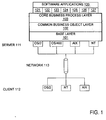
- the lowest layer is the base layer 101.
- the base layer 101 provides and manages the interface with the server hardware 111 which is potentially running under different operation systems such as OS/2, OS/400, AIX, and NT.
- the server hardware 111 is connected with client hardware 112 via a communication network 113.
- the client hardware 112 may also potentially running under different operation systems such as OS/2, NT, and AIX.
- the embodiment shown in Figure 1 shows the development of the server portion of a client/server application only.
- the Base layer 101 represents the technical foundation for the higher level objects including many functions near to an operating system such as finding objects, keeping track of their names, controlling access to them, resolving conflicts, security administration, and installation.
- the Base layer 101 also includes the so called Object Model Classes which provide a consistent model for building objects while hiding the complexity of the underlying infrastructure form the software application developer.
- the Base layer 101 can be regarded as a kind of lower middleware necessary for the application of the Object Technology above it using the interface functionality provided by the Base layer 101.
- This Common Business Object layer 102 provides a large number of objects which perform functions commonly needed within a business application, e.g. date and time, currency, address, units of measure, and calendar. These Common Business Objects represent the building blocks from which software application developers can select and create business applications, e.g. these Common Business Objects can be copied and extended to perform new functions as for example the date and time object can be extended to handle the Chinese calendar.
- the layer 103 above the Common Business Objects layer 102 already comprises Core Business Processes and can be regarded as the Core Business Process layer 103. Although this layer 103 usually does not provide executable code, within this layer 103 the business software applications developed using the present invention begin to take shape.
- Each Core Business Process layer is built for one specific type of application, as for example General Ledger or Warehouse Management.
- This Core Business Process layer 103 can be regarded as an upper middleware which - although not a complete software application program - already contains the basic funtions which all of the application programs of this type require. It is the Core Business Process layer 103 which creates the application frameworks, wherein some of the Common Business Objects are linked to a large number of objects specific to the type of framework being built, e.g. Warehouse Management. The resulting framework is constructed in a way to contain commonly used functions as well as to be easy to extend.
- the application software is located, created by the software application developer and representing executable code. It is the choice of a software application developer whether to use only the base layer 101, the base layer 101 and the Common Business Object layer 102, or all three layers 101, 102, and 103 for the development of his software application. In every case he has to develop a remaining part of the application by himself and therefore every resulting software application program will be a completley unique product.
- the subject of the present invention is represented within the three layer model 101, 102, and 103 and is not represented by the executable code of the software application 121 developed using the present invention.
- the common approach to provide replacement parameters in translatable messages is to limit the replacement parameters to being strings or some other non-translatable primitive types.
- the solution to the problem of providing translatable replacement text was to define a hierarchy of replacement text classes to represent replaceable and non-replaceable types of replacement text as shown in Figure 2.
- the root of this hierarchy is a base class representing any type of replacement text 701. This class provides a "format" method to return the replacement text in the form of a translated string.
- Inheriting from the base class are concrete replacement text classes for translatable replacement text 703, non-translatable replacement text 702, and a class for holding translation sensitive objects 704 such as dates and currencies.
- the translatable replacement text class 703 holds an Id 710 of a translatable message.
- the ID and the language being used is mapped to actual text in the appropriate language.
- the ID used in a translatable replacement text object is often a class name, or an enum value that, when resolved, will produce the proper name of Id in the language matching the containing message text.
- the non-translatable replacement text class 702 holds a string 711 that will be placed directly into the message text without translation such as a business object ID. This class provides the equivalent functionality to the common replacement text approach described earlier.
- a third concrete class holds translatable objects 704. This is implemented in the framework by introducing an abstract interface for objects 705 that are themselves translatable.
- the abstract interface in the present framework is called “Translatable” and also introduces a "format” method to produce a formatted representation of the object.
- Classes in the framework such as date, currency value, and decimal implement the translatable interface.
- the translatable object replacement text concrete class holds an object of type Translatable and implements the "format” method by calling format on the contained translatable object.
- a class 708 was defined that holds a collection of error messages 707 and provides methods for adding, removing and accessing the contained error messages.
- a validation phase of a framework method an instance of the error message collection class is created and with each error found (each validation step that fails) an error message object is created and added via the "addErrorMessage" interface on the error message collection object.
- the code in the framework method is written such that all error checking steps are performed. If, at the end of the validation phase of the method, it is determined that one or more error messages have been created, an exception object is created to which the error message collection object is attached. Finally the exception object is thrown.
- a flag is added to the context 709 or environment of the user's process (in the present embodiment of a framework it is added to the Distributed Process Context object) that determines whether error bundling is enabled or disabled for the process.
- a static method is provided to allow the user to set the flag. The behaviour of the "addErrorMessage" on the error message collection class varies depending on the value of the bundling flag.
- the bundling flag is set to "bundling enabled”
- the "addErrorMessage” method will simply add the given error message to its internal collection. This allows all error messages from a given framework method to be entered into the collection before it is attached to an exception and thrown back to the caller. If the bundling flag is set to "bundling disabled”, the “addErrorMessage” method will add the error message to its internal collection, then create an exception object to which it attaches itself as the error collection object and then throw the exception. Thus, when framework code adds the first error message to the error message collection, an exception is thrown containing the error message collection and the single contained error message, stopping further processing of the method. In the example of Figure 7, the bundling flag is set to FALSE (bundling disabled).
- bundling behaviour is completely encapsulated in the "addErrorMessage” method which enables the code of the framework method to be written in such a way that is completely independent of whether bundling is enabled or disabled. Therefore, bundling can be enabled or disabled at runtime without requiring changes to framework design or code.
Landscapes
- Engineering & Computer Science (AREA)
- Software Systems (AREA)
- Theoretical Computer Science (AREA)
- Human Computer Interaction (AREA)
- Physics & Mathematics (AREA)
- General Engineering & Computer Science (AREA)
- General Physics & Mathematics (AREA)
- Stored Programmes (AREA)
Priority Applications (1)
| Application Number | Priority Date | Filing Date | Title |
|---|---|---|---|
| EP98112465A EP0897148A1 (de) | 1997-08-14 | 1998-07-06 | Verfahren zur Fehlerbehandlung in einem Fachwerk |
Applications Claiming Priority (3)
| Application Number | Priority Date | Filing Date | Title |
|---|---|---|---|
| EP97114036 | 1997-08-14 | ||
| EP97114036 | 1997-08-14 | ||
| EP98112465A EP0897148A1 (de) | 1997-08-14 | 1998-07-06 | Verfahren zur Fehlerbehandlung in einem Fachwerk |
Publications (1)
| Publication Number | Publication Date |
|---|---|
| EP0897148A1 true EP0897148A1 (de) | 1999-02-17 |
Family
ID=26145713
Family Applications (1)
| Application Number | Title | Priority Date | Filing Date |
|---|---|---|---|
| EP98112465A Withdrawn EP0897148A1 (de) | 1997-08-14 | 1998-07-06 | Verfahren zur Fehlerbehandlung in einem Fachwerk |
Country Status (1)
| Country | Link |
|---|---|
| EP (1) | EP0897148A1 (de) |
Cited By (2)
| Publication number | Priority date | Publication date | Assignee | Title |
|---|---|---|---|---|
| WO2001008002A3 (en) * | 1999-07-23 | 2001-11-08 | Codagen Technologies Corp | Hierarchically structured control information editor |
| US6769095B1 (en) | 1999-07-23 | 2004-07-27 | Codagen Technologies Corp. | Hierarchically structured control information editor |
Citations (3)
| Publication number | Priority date | Publication date | Assignee | Title |
|---|---|---|---|---|
| EP0121071A2 (de) * | 1983-03-30 | 1984-10-10 | International Business Machines Corporation | Simultaner Gebrauch mehrerer Sprachen in Datenverarbeitungssystemen |
| EP0398646A2 (de) * | 1989-05-15 | 1990-11-22 | International Business Machines Corporation | Anwenderschnittstellenwerkzeug |
| US5613122A (en) * | 1994-11-14 | 1997-03-18 | Object Technology Licensing Corp. | Object-oriented operating system |
-
1998
- 1998-07-06 EP EP98112465A patent/EP0897148A1/de not_active Withdrawn
Patent Citations (3)
| Publication number | Priority date | Publication date | Assignee | Title |
|---|---|---|---|---|
| EP0121071A2 (de) * | 1983-03-30 | 1984-10-10 | International Business Machines Corporation | Simultaner Gebrauch mehrerer Sprachen in Datenverarbeitungssystemen |
| EP0398646A2 (de) * | 1989-05-15 | 1990-11-22 | International Business Machines Corporation | Anwenderschnittstellenwerkzeug |
| US5613122A (en) * | 1994-11-14 | 1997-03-18 | Object Technology Licensing Corp. | Object-oriented operating system |
Non-Patent Citations (1)
| Title |
|---|
| "SMALLTALK/V PM OFFICEVISION/2 ERROR MANAGER", IBM TECHNICAL DISCLOSURE BULLETIN, vol. 34, no. 4B, 1 September 1991 (1991-09-01), pages 310 - 312, XP000189474 * |
Cited By (2)
| Publication number | Priority date | Publication date | Assignee | Title |
|---|---|---|---|---|
| WO2001008002A3 (en) * | 1999-07-23 | 2001-11-08 | Codagen Technologies Corp | Hierarchically structured control information editor |
| US6769095B1 (en) | 1999-07-23 | 2004-07-27 | Codagen Technologies Corp. | Hierarchically structured control information editor |
Similar Documents
| Publication | Publication Date | Title |
|---|---|---|
| US6052525A (en) | Method of error handling in a framework | |
| US6134706A (en) | Software business objects in a multi-level organizational structure | |
| US6070152A (en) | Framework for business applications providing financial integration | |
| Ambler | The elements of UML (TM) 2.0 style | |
| US5237688A (en) | Software packaging structure having hierarchical replaceable units | |
| Bisschop et al. | Aimms-User's Guide | |
| US5752245A (en) | Object-oriented system for configuration history management with a project workspace and project history database for draft identification | |
| US7600182B2 (en) | Electronic data capture and verification | |
| US7577934B2 (en) | Framework for modeling and providing runtime behavior for business software applications | |
| US7089583B2 (en) | Method and apparatus for a business applications server | |
| AU705926B2 (en) | Automated enforcement of behavior in application program | |
| US11169784B2 (en) | Computing expression medium, development environment, and device communication and control architecture | |
| US20060074737A1 (en) | Interactive composition of workflow activities | |
| US20050065942A1 (en) | Enhancing object-oriented programming through tables | |
| WO2002073404A1 (en) | Application development method | |
| US6499064B1 (en) | Method of using decoupled chain of responsibility | |
| US6092075A (en) | Framework for business applications using cached aggregate and specification key | |
| EP0897149B1 (de) | Framework zur finanziellen Integration von Geschäftsapplikationen | |
| Roelofs | AIMMS 3. 10 User's Guide | |
| Cheong et al. | Frame-based method for customizing generic software architectures | |
| Juric et al. | Integrating legacy systems in distributed object architecture | |
| Oliveira et al. | On the specification of extract, transform, and load patterns behavior: A domain‐specific language approach | |
| US20020002632A1 (en) | Method of locating software objects in different containers | |
| Lano et al. | Software design using Java 2 | |
| Robbins et al. | Integrating C2 with the unified modeling language |
Legal Events
| Date | Code | Title | Description |
|---|---|---|---|
| PUAI | Public reference made under article 153(3) epc to a published international application that has entered the european phase |
Free format text: ORIGINAL CODE: 0009012 |
|
| AK | Designated contracting states |
Kind code of ref document: A1 Designated state(s): DE FR GB |
|
| AX | Request for extension of the european patent |
Free format text: AL;LT;LV;MK;RO;SI |
|
| 17P | Request for examination filed |
Effective date: 19990609 |
|
| AKX | Designation fees paid |
Free format text: DE FR GB |
|
| 17Q | First examination report despatched |
Effective date: 20031204 |
|
| STAA | Information on the status of an ep patent application or granted ep patent |
Free format text: STATUS: THE APPLICATION IS DEEMED TO BE WITHDRAWN |
|
| 18D | Application deemed to be withdrawn |
Effective date: 20050503 |