EP0897190A2 - Elektrodenlose Projektionslampe hoher Lichtstärke - Google Patents
Elektrodenlose Projektionslampe hoher Lichtstärke Download PDFInfo
- Publication number
- EP0897190A2 EP0897190A2 EP98113269A EP98113269A EP0897190A2 EP 0897190 A2 EP0897190 A2 EP 0897190A2 EP 98113269 A EP98113269 A EP 98113269A EP 98113269 A EP98113269 A EP 98113269A EP 0897190 A2 EP0897190 A2 EP 0897190A2
- Authority
- EP
- European Patent Office
- Prior art keywords
- lamp
- envelope
- ehid
- accordance
- cooling
- Prior art date
- Legal status (The legal status is an assumption and is not a legal conclusion. Google has not performed a legal analysis and makes no representation as to the accuracy of the status listed.)
- Withdrawn
Links
Images


Classifications
-
- H—ELECTRICITY
- H01—ELECTRIC ELEMENTS
- H01J—ELECTRIC DISCHARGE TUBES OR DISCHARGE LAMPS
- H01J61/00—Gas-discharge or vapour-discharge lamps
- H01J61/02—Details
- H01J61/12—Selection of substances for gas fillings; Specified operating pressure or temperature
-
- H—ELECTRICITY
- H01—ELECTRIC ELEMENTS
- H01J—ELECTRIC DISCHARGE TUBES OR DISCHARGE LAMPS
- H01J61/00—Gas-discharge or vapour-discharge lamps
- H01J61/02—Details
- H01J61/30—Vessels; Containers
-
- H—ELECTRICITY
- H01—ELECTRIC ELEMENTS
- H01J—ELECTRIC DISCHARGE TUBES OR DISCHARGE LAMPS
- H01J65/00—Lamps without any electrode inside the vessel; Lamps with at least one main electrode outside the vessel
- H01J65/04—Lamps in which a gas filling is excited to luminesce by an external electromagnetic field or by external corpuscular radiation, e.g. for indicating plasma display panels
- H01J65/042—Lamps in which a gas filling is excited to luminesce by an external electromagnetic field or by external corpuscular radiation, e.g. for indicating plasma display panels by an external electromagnetic field
Definitions
- the invention pertains to projection lamps and, more particularly, to a projection lamp comprising an electrodeless, high intensity discharge (EHID) lamp having a high luminance and good color.
- EHID electrodeless, high intensity discharge
- Modern projection systems display video and digital information for business, commercial, technical and residential use.
- One form of display system can be a plasma display, which generates its own light.
- HID lamps have a problem known as “meltback”, and deteriorate over time.
- the throughput or screen illuminance of an optical system is highly dependent on the compactness of the light source, its luminance (lumens per steradian-mm 2 or candela/mm 2 ), or brilliance.
- HID lamps having electrodes are currently used in projection display systems.
- a drawback of these electrode HID lamps is that they are prone to electrode meltback due to the high power and aggressive chemistry used to generate appropriate colors.
- the advantage of these lamps is high lumen output, high luminance, good color, and small arc gap.
- a small arc gap is essential for coupling the light through the optical system. Luminances in these lamps approach 500 cd/mm 2 .
- electrode HID lamps are the OSRAM Model No. HTI 150 W. and the Model No. HTI 250 W/22,32, manufactured by the assignee.
- the highest luminance point of these HID lamps is at their ends in front of the electrodes. Consequently, there are two hot spots.
- the projection or optical system can accommodate only one luminance point, and therefore a portion of the light must be discarded. As the electrodes melt, or burn back, the hot spot is moved from the optical focus, thus causing throughput deterioration.
- the present invention is a new electrodeless high intensity discharge (EHID) lamp for photo optical applications.
- the new EHID lamp has a unique construction that provides high luminance.
- the current invention reflects the discovery that constricting the mid-portion of the lamp capsule will yield a higher luminance output.
- the invention also features an improved cooling arrangement for the lamp capsule, which provides longer operative life.
- the present invention has its highest luminance point away from the ends of the capsule (i.e., in the center of the tube). This center luminance stays in the same place over time.
- a second disadvantage of this lamp is that it is primarily a surface emitter and does not couple well to the optical system.
- the surface emitter of this lamp is a large (5mm diameter) ball of light at the focus of the optic.
- the lamp is cooled with jets of air because of the high loading, as taught in United States Patent No. 4,532,427, issued to Matthews et. al.; No. 4,695,757, issued to Ury et. al.; No. 5,021,704, issued to Walker et. al.; and No. 4,894,592, issued to Ervin et. al.
- the lamp must be rotated to provide a uniform discharge and uniform cooling.
- the rotation is undesirable, however, since it contributes to wiggle in the optics and audible noise.
- Audible noise is an important concern, of course, since it interferes with the audio system of video projection systems.
- a shaped arc tube is shown for locally heating the arc tube to prevent fill condensation.
- a feature of the present invention uses a constricted central area for cooling. Thus, this feature is for a diametrically opposite purpose.
- Philips ultra high pressure mercury lamp This lamp has a luminance of about 500 cd/mm and is not as prone to electrode meltback because it lacks the aggressive chemistry of the metal halide lamps. This lamp is described in an article by E. Schnedler and H. Wijngaarde, entitled, "Ultrahigh-intensity Short Arc Long Life Lamp System", Invited Paper 11.1, Soc. for Information Display, Vol. XXVI, Orlando, Fla. 1995, pp. 131-134.
- this lamp has a relatively low general color rendering index and lacks the red content of metal halide lamps. It simply does not provide true red colors.
- HID lamps that contain only inert gas, such as xenon, are also employed in video projectors. These lamps have the advantage of essentially no chemical interaction between the electrode and fill (xenon). However, they suffer from high waste heat, due to the intrinsic low efficacy of the xenon in converting electrical power into usable light. Another problem affecting these lamps is the turbulence caused by density changes in the index of refraction, as the light from the arc passes through the high density xenon gas. This turbulence causes flicker.
- an Electrodeless High Intensity Discharge Lamp for projection applications.
- the lamp comprises a small (nominal dimensions: 2mm I.D., 3mm O.D., 6mm internal length) capsule, which is constricted at a mid-portion thereof.
- the constriction squeezes the plasma within the capsule and provides a higher power density. This in turn produces a higher luminance in the center of the arc.
- This focal point of the projection system is constant over the life of the lamp, owing to the fact that the system is electrodeless.
- the arc tube or capsule is thickened in the vicinity of the constriction to permit heat transfer through vitreous silica (commonly called quartz). The thickening carries the heat away from the now hotter mid-portion area. This thickening cools by virtue of increasing the thermal conduction through the glass.
- the lamp is provided with a high power density.
- EHID lamps have been run in the range of 1,000 to 9,000 W/cm 3 .
- lamps of the size of the capsule mentioned above run at power densities of about 3,000 W/cm 3 .
- these lamps must be cooled to prolong life; otherwise, the surface temperature would exceed the melting temperature of the lamp envelope. This would typically occur at power densities of about 4,000 W/cm 3 .
- the required high luminance is achieved by running the lamps at the higher density (about 9,000 W/cm 3 ). Cooling is provided by a fan or a source of compressed air and a nozzle arrangement. Lamp life is adequate if the surface temperature is maintained below 1000° C, and preferably below 900° C.
- a single nozzle is directed towards the top of a horizontally burning lamp. This causes the arc to bend less, due to cooling of the outer and inner wall. The gas density redistributes itself, reducing the buoyant force on the arc.
- the capsule of the lamp is cooled by a series of jets disposed about the lateral periphery of the lamp envelope.
- the invention features an electrodeless high intensity discharge lamp of improved luminance.
- the lamp has a constricted capsule about a mid-portion thereof.
- the capsule is thickened about a mid-portion to provide increased heat conduction and, hence, cooling of the lamp capsule.
- a lamp 10 having a light transmissive capsule 12 with constricted region 14 about its mid-portion.
- the ends 16 of the capsule chamber are expanded.
- the capsule has nominal dimensions: 2mm I.D., 3mm O.D., and 6mm internal length.
- the center constriction region has a nominal diameter of about 1 mm.
- the capsule 12 is carried by a support stem 18.
- the constricted region 14 has a thickened wall 21, as shown.
- the thickened wall 21 allows for increased heat conductance to permit heat transfer through the vitreous silica (commonly called quartz) of lamp 10.
- a small lamp 20 which is an alternate embodiment of lamp 10 (FIG. 1), is shown having a constricted center channel 22 for the lamp envelope 24.
- the constricted channel 22 has a thickened wall 26, similar to wall 21 of FIG. 1.
- the thickened wall 26 allows for increased heat conductance to permit heat transfer through the vitreous silica of lamp 20.
- the envelope 24 is carried by support stem 28.
- the lamp 10 is provided with a high power density.
- EHID lamps have been run in the range of 1,000 to 9,000 W/cm 3 .
- lamps of the size of capsule mentioned above run at power densities of about 3,000 W/cm 3 .
- these lamps must be cooled to prolong life; otherwise, the surface temperature would exceed the melting temperature of the lamp envelope. This would typically occur at power densities of about 4,000 W/cm 3 .
- the high luminance needed is achieved by running the lamps at the higher density of about 9,000 W/cm 3 . Cooling is provided by a fan or a source of compressed air and a nozzle arrangement. Lamp life is adequate if the surface temperature is maintained below 1000° C and preferably below 900° C.
- a lamp 30 is shown with a bowed arc 32 and a hot spot 34 in the capsule wall 36, that results from the contact of bowed arc 32 therewith.
- Hot spots can develop in the normal operation of a lamp 30 if cooling is uneven, or if there are momentary instabilities during start-up.
- the lamp 30 is shown being cooled at a mid-portion 35 of the envelope 37, by an air flow nozzle or cooling jet 33. It will be observed that the bowed arc 32 has now become a straightened arc 38.
- the cooling jet 40 forces the arc 32 away from the wall 36, and so reduces the thermal transport to the wall from the contiguous arc. Hence, a lower flow of air is required than would be expected.
- the air jet is directed on the top of the horizontally burning arc 32.
- multiple nozzles 40 are disposed about the lateral circumference of the lamp 30 at approximately equal angles, as shown in FIG. 3.
- the nozzles 40 provide uniform cooling and prevent transient, hot spot development.
- the nozzle ends 42 are shaped into ovals as shown in FIG.S 4c and 4d.
- the end shaping is needed to spread the air into a fan 44 that cools the entire length of the capsule or envelope of the lamp.
- the fan 44 of air is directed onto the lamp so that the elongated part of the fan is parallel to the long axis of the lamp. This ensures uniform cooling along the lamp length.
- This is an improvement over prior art, which uses circular nozzles 46, as shown in FIG.S 4a and 4b.
- the circular nozzles 46 produce conical air flows 48.
- the spreadout flow of the fan eliminates the prior art need to continuously rotate the capsule to achieve uniform cooling.
- the oval end 42 of the nozzle 40 also has a radius, so as to avoid turbulence near sharp corners.
- the fluid flow pattern from such nozzles is planar, as compared to the circular nozzle. When placed near the lamp, the distance to the nozzle can be adjusted to provide planar flow which completely engages the small EHID lamp capsule.
- a stagnation pressure of 20 psi with flow limiter set to 10 liters per minute (l/min) is used with a stainless steel tube of 0.052" inner diameter, and 0.065" outer diameter.
- the oval orifice is about 0.016" by 0.075". It is important that the orifice be free of any burrs which would disrupt the fluid flow.
- the nozzles 40 are polished with grit silicon carbide paper to achieve a smooth finish. The ends are rounded with a radius of curvature of about 0.040".
- the tubing can be of steel, nickel and almost any metal. Also, ceramic and glass work equally well.
- the glass nozzles can be formed from vitreous silica, and the ceramic nozzles can be machined or pressed green and then fired into shape, as with polycrystalline alumina.
- the elongated flow is directed to be parallel to the long axis of the lamp, ensuring uniform cooling. Sufficient spread in the orthogonal direction, and the use of three nozzles (as shown in FIG. 3, for example) ensure uniform cooling in the azimuthal direction as well.
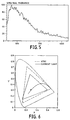
- FIG. 5 A spectrum of such lamps filled with a chemistry taught and disclosed in a copending application, Serial No. (Docket No. 96-1-252), is shown in FIG. 5.
- An example of an appropriate chemistry can be a fill consisting of aluminum triiodide, indium iodide, and thorium tetraiodide with mercury and an inert gas selected from a group of inert gases such as argon, krypton, xenon, and mixtures thereof.
- This chemistry can be modified so as to replace the typical thorium tetraiodide with such materials as hafnium or zirconium iodide, as taught in the aforementioned copending application.
- the contribution to the spectrum from the hafnium or zirconium is similar to the thorium in producing multiple spectral lines throughout the visible range.
- Thorium is the preferred additive and the luminance observed at approximately 100 W of microwave power is 325 cd/mm 2 .
- a fan-shaped cooling jet on an EHID lamp has produced the color coordinates, as shown.
- the spectral power distribution has been passed through suitable RGB filters.
- Such filters are interference filters defining the R (red) band between approximately 610-720 nm, the G (green) band between approximately 500-580 nm, and the B (blue) band between approximately 410-500 nm.
- the bands can be defined only approximately because the cutoff wavelength of typical interference filters is not infinitely sharp, but rolls off with wavelength.
- the chromaticity points are shown in relation to the NTSC standard for television.
- the instant invention with appropriate volatizable fill chemistry can closely match the phosphor emission from a CRT, which is the basis of the NTSC specification.
- the color coordinate of the unfiltered lamp is next to the black body curve.
- the highest luminance zone is in the center of the capsule or envelope, and is less prone to wander over life.
Landscapes
- Physics & Mathematics (AREA)
- Electromagnetism (AREA)
- Engineering & Computer Science (AREA)
- Plasma & Fusion (AREA)
- Discharge Lamps And Accessories Thereof (AREA)
Applications Claiming Priority (2)
| Application Number | Priority Date | Filing Date | Title |
|---|---|---|---|
| US08/909,323 US6016031A (en) | 1997-08-11 | 1997-08-11 | High luminance electrodeless projection lamp |
| US909323 | 1997-08-11 |
Publications (2)
| Publication Number | Publication Date |
|---|---|
| EP0897190A2 true EP0897190A2 (de) | 1999-02-17 |
| EP0897190A3 EP0897190A3 (de) | 2000-07-12 |
Family
ID=25427031
Family Applications (1)
| Application Number | Title | Priority Date | Filing Date |
|---|---|---|---|
| EP98113269A Withdrawn EP0897190A3 (de) | 1997-08-11 | 1998-07-16 | Elektrodenlose Projektionslampe hoher Lichtstärke |
Country Status (5)
| Country | Link |
|---|---|
| US (1) | US6016031A (de) |
| EP (1) | EP0897190A3 (de) |
| JP (1) | JPH11111238A (de) |
| CA (1) | CA2241501C (de) |
| HU (1) | HUP9801852A3 (de) |
Cited By (7)
| Publication number | Priority date | Publication date | Assignee | Title |
|---|---|---|---|---|
| EP1089322A1 (de) * | 1999-10-01 | 2001-04-04 | Ushiodenki Kabushiki Kaisha | Hochfrequenzangeregte Punktlichtquellelampenvorrichtung |
| WO2003060379A3 (en) * | 2001-12-21 | 2004-03-04 | Musco Corp | Apparatus and method for increasing light output over operational life of arc lamp |
| WO2003056605A3 (de) * | 2002-01-02 | 2004-06-03 | Philips Intellectual Property | Gekühlte hochdruckgasentladungslampe |
| EP1876633A1 (de) | 2006-07-05 | 2008-01-09 | Solaronix Sa | Plasmalampe, in deren Kolben eine resonante Ultraschallschwingung erzeugt wird |
| CN100375225C (zh) * | 2003-08-13 | 2008-03-12 | Lg电子株式会社 | 无电极灯 |
| GB2468580A (en) * | 2009-03-10 | 2010-09-15 | Osram Ges Mit Beschrankter | Electrodeless high pressure discharge lamp with cage wire support structure |
| GB2472486A (en) * | 2009-07-30 | 2011-02-09 | Osram Gmbh | Electrodeless high pressure discharge lamp with cage wire support structure |
Families Citing this family (8)
| Publication number | Priority date | Publication date | Assignee | Title |
|---|---|---|---|---|
| US6559607B1 (en) | 2002-01-14 | 2003-05-06 | Fusion Uv Systems, Inc. | Microwave-powered ultraviolet rotating lamp, and process of use thereof |
| DE10231258A1 (de) * | 2002-07-11 | 2004-01-22 | Philips Intellectual Property & Standards Gmbh | Entladungslampe mit Kühleinrichtung |
| KR100498307B1 (ko) * | 2002-10-24 | 2005-07-01 | 엘지전자 주식회사 | 무전극 조명 시스템의 재발광 촉진 장치 |
| DE60321599D1 (de) * | 2002-12-11 | 2008-07-24 | Philips Intellectual Property | Beleuchtungseinheit |
| JP4725499B2 (ja) * | 2006-12-06 | 2011-07-13 | セイコーエプソン株式会社 | マイクロ波無電極ランプ、照明装置、プロジェクタ |
| EP2094814A2 (de) * | 2006-12-18 | 2009-09-02 | Koninklijke Philips Electronics N.V. | Lichtquelle und verfahren für den betrieb eines beleuchtungssystems |
| JP2017058087A (ja) * | 2015-09-17 | 2017-03-23 | 本田技研工業株式会社 | 乾燥装置 |
| US9968804B2 (en) * | 2016-01-14 | 2018-05-15 | Reliance Industries, Llc | Nozzle for retractable fall arrest |
Family Cites Families (20)
| Publication number | Priority date | Publication date | Assignee | Title |
|---|---|---|---|---|
| US3689793A (en) * | 1970-10-20 | 1972-09-05 | Alfred Walz | Electrode arrangement for direct current fed gas discharge lamps |
| US3778662A (en) * | 1972-10-31 | 1973-12-11 | Gen Electric | High intensity fluorescent lamp radiating ionic radiation within the range of 1,600{14 2,300 a.u. |
| US4340264A (en) * | 1979-07-05 | 1982-07-20 | The Perkin-Elmer Corporation | Manufacture of glass base lamp |
| AU528293B2 (en) * | 1980-02-06 | 1983-04-21 | Ngk Insulators, Ltd. | Discharge lamp tube |
| US4532427A (en) * | 1982-03-29 | 1985-07-30 | Fusion Systems Corp. | Method and apparatus for performing deep UV photolithography |
| US4695757A (en) * | 1982-05-24 | 1987-09-22 | Fusion Systems Corporation | Method and apparatus for cooling electrodeless lamps |
| US4504768A (en) * | 1982-06-30 | 1985-03-12 | Fusion Systems Corporation | Electrodeless lamp using a single magnetron and improved lamp envelope therefor |
| JPS60235353A (ja) * | 1984-05-08 | 1985-11-22 | Mitsubishi Electric Corp | 無電極放電ランプ |
| US4736134A (en) * | 1984-12-06 | 1988-04-05 | Gte Products Corporation | Discharge lamp having multiple constrictions |
| CA1246658A (en) * | 1984-12-06 | 1988-12-13 | Robert Y. Pai | Compact fluorescent lamp assembly |
| US4825125A (en) * | 1984-12-06 | 1989-04-25 | Gte Products Corporation | Discharge lamp having multiple constrictions |
| US4894592A (en) * | 1988-05-23 | 1990-01-16 | Fusion Systems Corporation | Electrodeless lamp energized by microwave energy |
| US5021704A (en) * | 1990-02-21 | 1991-06-04 | Fusion Systems Corporation | Method and apparatus for cooling electrodeless lamps |
| US5216322A (en) * | 1990-06-12 | 1993-06-01 | Vector Related Physics (Consultants) Ltd. | Method of producing a gas discharge light source |
| US5404076A (en) * | 1990-10-25 | 1995-04-04 | Fusion Systems Corporation | Lamp including sulfur |
| DE69204517T2 (de) * | 1991-04-16 | 1996-05-02 | Philips Electronics Nv | Hochdruckentladungslampe. |
| DE4120730C2 (de) * | 1991-06-24 | 1995-11-23 | Heraeus Noblelight Gmbh | Elektrodenlose Niederdruck-Entladungslampe |
| JP3198549B2 (ja) * | 1991-08-23 | 2001-08-13 | 岩崎電気株式会社 | 送風機構を備えたメタルハライドランプ装置 |
| DE4241911A1 (en) * | 1991-12-13 | 1993-06-17 | Fusion Systems Corp | Cooling system for plasma discharge lamp stimulated by microwaves - uses jets to provide cooling air stream directed onto lamp flask during simultaneous rotation |
| DE19547813C2 (de) * | 1995-12-20 | 1997-10-16 | Heraeus Noblelight Gmbh | Elektrodenlose Entladungslampe mit Blendenkörper |
-
1997
- 1997-08-11 US US08/909,323 patent/US6016031A/en not_active Expired - Lifetime
-
1998
- 1998-06-22 CA CA002241501A patent/CA2241501C/en not_active Expired - Fee Related
- 1998-07-16 EP EP98113269A patent/EP0897190A3/de not_active Withdrawn
- 1998-08-10 HU HU9801852A patent/HUP9801852A3/hu unknown
- 1998-08-11 JP JP10226665A patent/JPH11111238A/ja active Pending
Cited By (11)
| Publication number | Priority date | Publication date | Assignee | Title |
|---|---|---|---|---|
| EP1089322A1 (de) * | 1999-10-01 | 2001-04-04 | Ushiodenki Kabushiki Kaisha | Hochfrequenzangeregte Punktlichtquellelampenvorrichtung |
| US6486603B1 (en) | 1999-10-01 | 2002-11-26 | Ushiodenki Kabushiki Kaisha | High-frequency excitation point light source lamp device |
| WO2003060379A3 (en) * | 2001-12-21 | 2004-03-04 | Musco Corp | Apparatus and method for increasing light output over operational life of arc lamp |
| US6929385B2 (en) | 2001-12-21 | 2005-08-16 | Musco Corporation | Apparatus and method for increasing light output over operational life of arc lamp |
| WO2003056605A3 (de) * | 2002-01-02 | 2004-06-03 | Philips Intellectual Property | Gekühlte hochdruckgasentladungslampe |
| CN100375225C (zh) * | 2003-08-13 | 2008-03-12 | Lg电子株式会社 | 无电极灯 |
| EP1876633A1 (de) | 2006-07-05 | 2008-01-09 | Solaronix Sa | Plasmalampe, in deren Kolben eine resonante Ultraschallschwingung erzeugt wird |
| CH699540B1 (fr) * | 2006-07-05 | 2010-03-31 | Solaronix S A | Lampe à plasma. |
| GB2468580A (en) * | 2009-03-10 | 2010-09-15 | Osram Ges Mit Beschrankter | Electrodeless high pressure discharge lamp with cage wire support structure |
| US8022627B2 (en) | 2009-03-10 | 2011-09-20 | Osram Ag | Electrodeless high pressure discharge lamp |
| GB2472486A (en) * | 2009-07-30 | 2011-02-09 | Osram Gmbh | Electrodeless high pressure discharge lamp with cage wire support structure |
Also Published As
| Publication number | Publication date |
|---|---|
| EP0897190A3 (de) | 2000-07-12 |
| JPH11111238A (ja) | 1999-04-23 |
| HUP9801852A2 (hu) | 1999-04-28 |
| CA2241501A1 (en) | 1999-02-11 |
| HUP9801852A3 (en) | 2001-02-28 |
| HU9801852D0 (en) | 1998-10-28 |
| US6016031A (en) | 2000-01-18 |
| CA2241501C (en) | 2006-08-01 |
Similar Documents
| Publication | Publication Date | Title |
|---|---|---|
| US6016031A (en) | High luminance electrodeless projection lamp | |
| JP3216877B2 (ja) | 高圧放電ランプ、この高圧放電ランプを光源とした照明光学装置、およびこの照明光学装置を用いた画像表示装置 | |
| JP4261795B2 (ja) | キセノンショートアークランプおよびその点灯方法 | |
| KR100886500B1 (ko) | 고압 가스 방전 램프 및 조명 장치 | |
| US6759793B2 (en) | Lamp unit for a projector and a process for the light control thereof | |
| JPH09320526A (ja) | 環形蛍光ランプおよび照明器具 | |
| US5689154A (en) | Metal halide gas discharge lamp for projection purposes | |
| US4557700A (en) | Metal halide discharge lamp gas fill process to provide minimal color separation | |
| EP0134426B1 (de) | Einseitig mit Elektroden versehene Metallhalogenid-Entladungslampe mit minimaler Farbenzerlegung | |
| US6570303B2 (en) | Light unit with improved heat dissipation | |
| JP2001076505A (ja) | 照明装置 | |
| JPH0268850A (ja) | 高圧ナトリウム放電灯 | |
| EP1862729A1 (de) | Lichtquellenvorrichtung | |
| JP3640458B2 (ja) | 光源、光源部及び投射型表示装置 | |
| JP4214826B2 (ja) | ショートアーク型超高圧放電ランプ | |
| JPH1040874A (ja) | マイクロ波放電ランプ装置 | |
| JP3952901B2 (ja) | 高圧水銀ランプ | |
| JP2000311657A (ja) | 高圧放電ランプおよびその駆動方法 | |
| JPH07235281A (ja) | 直流放電灯および該放電灯を用いた半導体露光装置並びに映写装置 | |
| JPS63292561A (ja) | 無電極放電灯装置 | |
| JP2006019150A (ja) | 光源装置 | |
| JPS63292562A (ja) | 無電極放電灯装置 | |
| JPH087623A (ja) | ショートアークメタルハライドランプ装置 | |
| JPH09320525A (ja) | 環形蛍光ランプ | |
| JP2004063222A (ja) | 高圧放電ランプ、光源ユニット及びプロジェクタ |
Legal Events
| Date | Code | Title | Description |
|---|---|---|---|
| PUAI | Public reference made under article 153(3) epc to a published international application that has entered the european phase |
Free format text: ORIGINAL CODE: 0009012 |
|
| AK | Designated contracting states |
Kind code of ref document: A2 Designated state(s): BE DE FR GB IT NL |
|
| AX | Request for extension of the european patent |
Free format text: AL;LT;LV;MK;RO;SI |
|
| RIC1 | Information provided on ipc code assigned before grant |
Free format text: 6H 01J 65/04 A, 6H 01J 61/30 B, 6H 01J 61/12 B, 6H 01J 61/33 B, 6H 01J 61/52 B |
|
| PUAL | Search report despatched |
Free format text: ORIGINAL CODE: 0009013 |
|
| AK | Designated contracting states |
Kind code of ref document: A3 Designated state(s): AT BE CH CY DE DK ES FI FR GB GR IE IT LI LU MC NL PT SE |
|
| AX | Request for extension of the european patent |
Free format text: AL;LT;LV;MK;RO;SI |
|
| 17P | Request for examination filed |
Effective date: 20001106 |
|
| AKX | Designation fees paid |
Free format text: BE DE FR GB IT NL |
|
| 17Q | First examination report despatched |
Effective date: 20031118 |
|
| STAA | Information on the status of an ep patent application or granted ep patent |
Free format text: STATUS: THE APPLICATION IS DEEMED TO BE WITHDRAWN |
|
| 18D | Application deemed to be withdrawn |
Effective date: 20040330 |