EP0897649B1 - Gerät und verfahren zum senden und empfangen einer signalisierungsnachricht in einem kommunikationssystem - Google Patents
Gerät und verfahren zum senden und empfangen einer signalisierungsnachricht in einem kommunikationssystem Download PDFInfo
- Publication number
- EP0897649B1 EP0897649B1 EP97924627A EP97924627A EP0897649B1 EP 0897649 B1 EP0897649 B1 EP 0897649B1 EP 97924627 A EP97924627 A EP 97924627A EP 97924627 A EP97924627 A EP 97924627A EP 0897649 B1 EP0897649 B1 EP 0897649B1
- Authority
- EP
- European Patent Office
- Prior art keywords
- paging channel
- mobile radio
- radio telephone
- mobile
- paging
- Prior art date
- Legal status (The legal status is an assumption and is not a legal conclusion. Google has not performed a legal analysis and makes no representation as to the accuracy of the status listed.)
- Expired - Lifetime
Links
Images


Classifications
-
- H—ELECTRICITY
- H04—ELECTRIC COMMUNICATION TECHNIQUE
- H04W—WIRELESS COMMUNICATION NETWORKS
- H04W68/00—User notification, e.g. alerting and paging, for incoming communication, change of service or the like
- H04W68/02—Arrangements for increasing efficiency of notification or paging channel
Definitions
- the present invention relates generally to the transmitting and receiving of a signaling message in a communication system and, in particular, to a communication system including a control unit for transmitting a signaling message at varying margin levels and a plurality of mobile radio telephones which provide a signal to alert a user thereof when a signaling message is received through a paging channel having a margin level greater than a specified margin level.
- a satellite communication system will generally include a land-based control unit for formatting a signaling message and a land earth station (known as an LES) which receives the signaling message from the control unit.
- the LES then transmits the signaling message to a mobile satellite phone by means of a paging channel via an intermediate satellite.
- the mobile satellite phone is able to acquire synchronization to the paging channel.
- the mobile satellite phone is unable to acquire synchronization.
- a paging channel While it is possible for a paging channel to be provided which has a higher than normal margin level, this generally stems from an increase in power which consumes valuable resources of the satellite communication system.
- Another disadvantage of using such a high margin paging channel is that the mobile satellite phone is usually unable to reliably acknowledge any signaling message received because of insufficient link margin. This results from the limited peak transmit power of the mobile satellite phone, which is inadequate to provide the reverse-link equivalent of such a high margin paging channel.
- a primary objective of the present invention is to provide a mobile radio telephone which generates a signal to alert the user thereof when a message is received other than through a standard paging channel.
- Another object of the present invention is to provide a mobile radio telephone which generates a variety of different signals to alert the user thereof when a signaling message is received other than through a standard paging channel.
- a further object of the present invention is to provide a mobile radio telephone which permits the user thereof to select the type of alerting signal generated when a signaling message is received other than through a standard paging channel.
- Yet another object of the present invention is to provide a mobile radio telephone which transmits an acknowledgment signal when it receives a signaling message through the standard paging channel.
- Still another object of the present invention is to provide a mobile radio telephone which generates a signal to alert the user thereof when it receives a signaling message through a paging channel having a higher margin level than the standard paging channel.
- An object of the present invention is to provide a mobile radio telephone which generates a signal to alert a user thereof when it receives a signaling message through a paging channel having a margin level greater than a specified margin level.
- Another object of the present invention is to provide a method of alerting a user of a mobile radio telephone when a signaling message is received through a paging channel other than the standard paging channel.
- a further object of the present invention is to provide a method of alerting a user of a mobile radio telephone when a signaling message is received through a paging channel having a margin level greater than a specified margin level.
- Another object of the present invention is to provide a control unit for a communication system which exchanges messages with a mobile radio telephone upon receipt of an acknowledgment signal from the mobile radio telephone indicating receipt of a signaling message from the control unit at a specified margin level.
- Still another object of the present invention is to provide a control unit for a communication system which is able to transmit a signaling message at varying margin levels to a mobile radio telephone via a single paging channel.
- Yet another object of the present invention is to provide a control unit for a communication system which is able to transmit a signaling message at varying margin levels to a mobile radio telephone via a plurality of paging channels in which each paging channel has a distinct margin level.
- Another object of the present invention is to provide a method of transmitting a signaling message between a control unit of a communication system and a mobile radio telephone at increasing margin levels until the mobile radio telephone receives the signaling message.
- a further object of the present invention is to provide a communication system including a control unit for transmitting a signalling message at increasing margin levels to a mobile radio telephone thereof until the mobile radio telephone receives the signalling message.
- a mobile radio telephone according to independent claim 1 which includes means for synchronizing the mobile radio telephone to a standard paging channel and at least one additional paging channel, means for monitoring messages on the paging channel to which the mobile radio telephone is synchronized, means for receiving messages on the synchronized paging channel, and means for providing a signal to alert a user of the mobile radio telephone when a message is received through a paging channel other than the standard paging channel.
- the alert signal providing means includes a transducer driver connected to a visual indicator, an audible indicator, and/or a vibration mechanism.
- the standard paging channel preferably will have a lower margin level than the additional paging channels.
- a mobile radio telephone which includes means for synchronizing the mobile radio telephone to a paging channel of a communication system having varying levels of margin, means for monitoring messages on the paging channel at the margin level in which the mobile radio telephone is synchronized thereto, means for receiving messages through the paging channel at the synchronized margin level, and means for providing a signal to alert a user of the mobile radio telephone when a signalling message is received through the paging channel at a synchronized margin level greater than a specified margin level.
- the alert signal providing means includes a transducer driver connected to a visual indicator, an audible indicator, and/or a vibration mechanism.
- a mobile satellite phone according to independent claim 27 is disclosed as having a main housing, a signal processing circuit located inside the main housing, and an antenna coupled to the signal processing circuit for receiving signals from and transmitting signals to a paging channel.
- the signal processing circuit is utilized to operate the mobile satellite phone in a satellite mode of communication and includes means for synchronizing the mobile satellite phone to a first paging channel and at least one alternative paging channel having a higher margin level than the first paging channel, means for monitoring messages on the first paging channel and the alternative paging channel when the mobile satellite phone is synchronized with one of such respective paging channels, means for receiving messages through the first paging channel and the alternative paging channel when monitoring such respective paging channels, and means for providing a signal to alert a user of the mobile satellite phone that a signalling message is received through the alternative paging channel.
- the signal processing circuit of the mobile satellite phone also may include means for transmitting an acknowledgment signal when the mobile satellite phone receives the signalling message through the first paging channel.
- a method according to independent claim 33 which alerts a user of a mobile radio telephone when a signalling message is received other than through a specified paging channel.
- the method includes the steps of synchronizing the mobile radio telephone to one of a plurality of paging channels, monitoring messages on the paging channel to which the mobile radio telephone is synchronized, receiving messages on the synchronized paging channel, and alerting the user of the mobile radio telephone when the signalling message is received through a paging channel other than the specified paging channel.
- the user of the mobile radio telephone is alerted by a visual indicator, an audible indicator, and/or a vibration mechanism.
- the specified paging channel is a paging channel having a designated margin level, with the margin level of all other paging channels having a margin level greater than the designated margin level.
- the method may also include the step of attempting to acquire synchronization to the specified paging channel subsequent to synchronization to any other of the paging channels.
- mobile radio telephone encompasses telephones which operate in a cellular and/or satellite mode of communication, as well as land mobile radios.
- the principal type of information communicated will generally be voice, but other kinds of information include data, paging, and high power paging. Therefore, while the invention will be described in greater detail herein with regard to voice communication in a satellite communication system, it should not be deemed limited thereby.
- Fig. 1 depicts schematically a satellite communication system (designated generally by the numeral 5) which includes a land-based control unit 10 for formatting and transmitting a signaling message 12 to a land earth station (LES) 14. LES 14 then transmits signaling message 12 to a mobile satellite phone 16 by means of a satellite 18.
- a satellite communication system designated generally by the numeral 5
- LES land earth station
- LES 14 transmits signaling message 12 to a mobile satellite phone 16 by means of a satellite 18.
- LES 14 transmits signaling message 12 through a standard paging channel 20 (defined as a paging channel having a margin level to which mobile satellite phone 16 is able to synchronize during normal operating and environmental conditions---approximately 8 dB or less) or an alternative paging channel 22.
- a standard paging channel 20 defined as a paging channel having a margin level to which mobile satellite phone 16 is able to synchronize during normal operating and environmental conditions---approximately 8 dB or less
- alternative paging channel 22 are distinguished from standard paging channel 20 by a relatively higher margin level, thereby providing improved signal reception by mobile satellite phone 16 (e.g., on the order of 5-40 dB).
- margin it is meant the amount of link margin available through a paging channel.
- margin stem from such factors as distinctions in power level, format, and modulation technique, as well as variations in antennas or patterns thereof.
- the type of repeater device in the communication system and the manner in which it apportions its resources is an additional factor. Accordingly, the way in which different margin levels are attributed to the various paging channels is not imperative in the present invention, but merely the fact that such margin differences exist between such paging channels.
- the protocol utilized by control unit 10 involves transmitting signaling message 12 at a low power level as indicated by box 21. In this way, communication with mobile satellite phone 16 is attempted first by means of standard paging channel 20. Signaling message 12 will be transmitted a predetermined number of times in this manner, as indicated by feedback loop 24 and the designation N max .
- an acknowledgment signal 26 will preferably be transmitted from mobile satellite phone 16 back to control unit 10 (as discussed in more detail herein). Subsequent to the transmission of signaling message 12, then, control unit 10 continuously inquires as to whether it has received acknowledgment signal 26 (represented by decision block 23). Provided acknowledgment signal 26 is received by control unit 10, subsequent messages will be exchanged between control unit 10 and mobile satellite phone 16 (as seen in block 25).
- control unit 10 will attempt to signal mobile satellite phone 16 by means of high power signaling (indicated by box 27) through alternative paging channel 22 or some other paging channel that provides higher link margin than standard paging channel 20. These higher margin transmissions of signaling message 12 from control unit 10 are also made only a predetermined number of times M max , as indicated in feedback loop 28 in Fig. 3.
- control unit 10 If acknowledgment signal 26 still is not received by control unit 10, it will either abort further attempts to transmit signaling message 12 or retry later (see block 33).
- acknowledgment signal 26 still is not received by control unit 10
- control unit 10 may utilize only a single paging channel in which the margin level may be varied.
- a signal processing circuit 30 is provided to operate mobile satellite phone 16 in a satellite mode of communication.
- Signal processing circuit 30 is located within a main housing 17 (see Fig. 1) of mobile satellite phone 16 and coupled to an antenna 32 by means of a duplexor or transmit-receive switch 34.
- Appropriate receiving circuitry 36 and transmitting circuitry 38 are provided in mobile satellite phone 16 and connected to duplexor 34, enabling mobile satellite phone 16 to both receive and transmit signals through antenna 32.
- signal processing circuit 30 is also connected to a keypad 40, a memory device 42, and a display 44 associated with mobile satellite phone 16.
- signal processing circuit 30 enables mobile satellite phone 16 to synchronize to standard paging channel 20 and alternative paging channel 22 when sufficient link margin is available.
- the ability of mobile satellite phone 16 to obtain synchronization to standard paging channel 20 depends on the physical location of mobile satellite phone 16, as well as the orientation of antenna 32.
- mobile satellite phone 16 attempts to initially synchronize to standard paging channel 20 (indicated by block 37).
- signal processing circuit 30 in mobile satellite phone 16 constantly determines whether synchronization has occurred (see decision block 39). If successful, mobile satellite phone 16 monitors standard paging channel 20 for signaling messages 12 (block 41). It will also be determined by mobile satellite phone 16 if such synchronization is maintained (decision block 43). If so, mobile satellite phone 16 continues to monitor standard paging channel 20 for messages via a feedback loop 45; otherwise, it attempts to synchronize to alternative paging channel 22 or some other higher margin paging channel (represented in block 47).
- an inquiry preferably is made regarding whether a signaling message is received or not (shown in decision block 49). If the answer is positive, then acknowledgment signal 26 will be transmitted (indicated by block 51) and mobile satellite phone 16 will continue to monitor standard paging channel 20. Should a signaling message not be incoming, no acknowledgment signal is transmitted and mobile satellite phone 16 merely verifies that synchronization to standard paging circuit 20 has been maintained (pursuant to decision block 43 identified previously herein). It will be noted that mobile satellite phone also will attempt to synchronize to alternative paging channel 22 (see block 47 identified above) after a given number of unsuccessful attempts to synchronize to standard paging channel 20 (indicated by the designation I max in feedback loop 46).
- mobile satellite phone 16 constantly determines whether synchronization occurs in this manner (decision block 53). If so, then mobile satellite phone 16 monitors alternative paging channel 22 for further messages and verifies whether the synchronization is maintained (represented by block 55 and decision block 57, respectively). When synchronization to alternative paging channel 22 does not occur or is not maintained, mobile satellite phone 16 again attempts synchronization to alternative paging channel 22 as provided for by feedback loop 59.
- mobile satellite phone 16 next determines whether any messages are received from alternative paging channel 22 (see decision block 61). If answered in the negative, mobile satellite phone 16 continues to monitor paging channel 22 (block 55). If mobile satellite phone 16 finds that messages are received on alternative paging channel 22, it then sends a signal 50 to the user of mobile satellite phone 16 which alerts him to this fact (as represented by block 63). In particular, it will be seen in Fig.
- signal 50 is sent to a transducer driver 52, which is connected to a visual indicator 54 (e.g., a light emitting diode of a specified color), an audible indicator 56 (e.g., an alarm), and/or a vibration mechanism 48 (i.e., a device causing housing 17 of mobile satellite phone 16 to vibrate).
- a signal 58 may also be sent to display 44 so that an alerting icon 60 appears thereon.
- the alert signal given the user of mobile satellite phone 16 by any or all of the above-enumerated ways indicates that mobile satellite phone 16 and/or antenna 32 thereof are in a disadvantageous position (i.e., one in which synchronization with standard paging channel 20 cannot be obtained).
- This will signify to the user that some remedial action on his part is required to obtain synchronization to such standard paging channel 20, such as reorienting antenna 32 into a favorable position or moving mobile satellite phone 16 adjacent the window of a building.
- the user may choose which type (s) of alerting signal to be received through signal 50 and transducer driver 52 by programming signal processing circuit 30 with keypad 40.
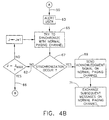
- mobile satellite phone 16 will again attempt to synchronize to standard paging channel 20 (shown in block 65 in Fig. 4B) a specified number of times (indicated by J max in feedback loop 62). Mobile satellite phone 16 determines whether such synchronization has occurred, as indicated by decision block 67. If synchronization with standard paging channel 20 occurs, mobile satellite phone 16 transmits acknowledgment signal 26 to control unit 10 (per block 69) and subsequent messages are exchanged on standard paging channel 20 (block 71). If synchronization with low power paging channel 20 is not accomplished within the prescribed number of iterations, however, then a return loop 66 causes mobile satellite phone 16 to again attempt synchronization to alternative paging channel 22 (block 47).
- a user thereof is alerted when messages are received on a paging channel other than standard paging channel 20.
- the margin levels at which standard paging channel 20 and alternative paging channel 22 operate are determined by a number of factors relating to satellite 18 and mobile satellite phone 16. Nevertheless, it will be recognized by those skilled in the art that a distinct difference in link margin will exist between standard paging channel 20 and alternative paging channel 22.
- any number of alternative paging channels may be implemented in addition to alternative paging channel 22, with mobile satellite phone 16 being designed to determine when an alert signal should be provided to the user thereof due to receipt of messages other than through standard paging channel 20.
- Mobile satellite phone 16 may also be programmed so that acknowledgment signal 26 will be transmitted to control unit 10 only when it receives signaling message 12 at (or below) a specified margin level. In this way, a single paging channel having a variable margin level may be used. Also, alternative paging channels having a higher margin level than standard paging channel 20, but less than the specified margin level, may initiate transmission of acknowledgment signal 26.
- control unit 10 and mobile satellite phone 16 can be accomplished by appropriate modifications by one of ordinary skill in the art without departing from the scope of the invention.
- mobile satellite phone 16 may provide the alerting signal when synchronization has occurred with a paging channel having a specified link margin level.
- adaptations may be made in the steps of the method for alerting a mobile satellite phone user and the method for transmitting a signaling message as described by the present invention.
Landscapes
- Engineering & Computer Science (AREA)
- Computer Networks & Wireless Communication (AREA)
- Signal Processing (AREA)
- Mobile Radio Communication Systems (AREA)
- Radio Relay Systems (AREA)
Claims (44)
- Mobilfunktelefon (16) mit einer Vorrichtung (30) zum Synchronisieren des Mobilfunktelefons (16) mit einem Standardrufkanal (20), der ein Rufkanal mit einem Randpegel ist, zu dem sich das Mobilfunktelefon während einem Normalbetrieb und bei Umfeldbedingungen synchronisieren kann, und mit zumindest einem zusätzlichen Rufkanal (22) eines Kommunikationssystems (5), einer Vorrichtung (30) zum Überwachen von Meldungen auf dem Rufkanal (20/22), zu dem das Mobilfunktelefon (16) synchronisiert ist, und eine Vorrichtung (36) zum Empfangen von Meldungen über den synchronisierten Rufkanal (20/22), wobei das Mobilfunktelefon (16) charakterisiert ist durch:eine Vorrichtung zum Bereitstellen eines Signals (50) zum Warnen eines Anwenders des Mobilfunktelefons (16), wenn eine Signalgebungsmeldung (12) über einen Rufkanal (22) empfangen wird, die einen höheren Randabstand als der Standardrufkanal (20) aufweist.
- Mobilfunktelefon (16) mit einer Vorrichtung (30) zum Synchronisieren des Mobilfunktelefons (16) zu einem einzelnen Rufkanal (22) eines Kommunikationssystems (5) mit variierenden Randpegeln, zu dem sich das Mobilfunktelefon während einem Normalbetrieb und bei Umfeldbedingungen synchronisieren kann, einer Vorrichtung (30) zum Überwachen von Meldungen auf dem Rufkanal (20/22), zu dem das Mobilfunktelefon (16) synchronisiert ist, und eine Vorrichtung (36) zum Empfangen von Meldungen über den synchronisierten Rufkanal (20/22), wobei das Mobilfunktelefon (16) charakterisiert ist durch:eine Vorrichtung zum Bereitstellen eines Signals (50) zum Warnen eines Anwenders des Mobilfunktelefons (16), wenn eine Signalgebungsmeldung (12) über den Rufkanal (22) mit einem synchronisierten Randpegel größer als der spezifizierte Randpegel empfangen wird.
- Mobilfunktelefon nach Anspruch 1 oder 2, wobei die Warnsignal-Bildungsvorrichtung einen Wandlertreiber (52) enthält, der mit einer Visuell-Anzeigeeinheit (54) verbunden ist.
- Mobilfunktelefon (16) nach Anspruch 1 oder 2, wobei die Warnsignal-Bereitstellungsvorrichtung einen Wandlertreiber (52) enthält, der mit einer hörbaren Anzeige (56) verbunden ist.
- Mobilfunktelefon (16) nach Anspruch 1 oder 2, wobei die Warnsignal-Bereitstellungsvorrichtung einen Wandlertreiber (52) enthält, der mit einem Vibriermechanismus (58) verbunden ist.
- Mobilfunktelefon (16) nach Anspruch 1 oder 2, ferner enthaltend eine Vorrichtung (58) zum Bereitstellen eines Warnpiktogramms (60) bei einer Anzeige (44) des Mobilfunktelefons (16), wenn die Warnsignal-Bereitstellungsvorrichtung aktiviert ist.
- Mobilfunktelefon (16) nach Anspruch 1, ferner enthaltend eine Vorrichtung (38) zum Übertragen eines Bestätigungssignals (26) über den synchrdnisierten Rufkanal (20/22) zum Anzeigen des Empfangs der Signalgebungsmeldung (12) von dem Kommunikationssystem (12) über den Standard-Rufkanal (20).
- Mobilfunktelefon (16) nach Anspruch 1, wobei der Standard-Rufkanal (20) einen niedrigeren Randpegel als der zusätzliche Rufkanal (22) aufweist.
- Mobilfunktelefon (16) nach Anspruch 1, wobei die Synchronisiervorrichtung angepasst ist, um kontinuierlich das Erfassen einer Synchronisation zu einem der Rufkanäle (20, 22) zu versuchen.
- Mobilfunktelefon (16) nach Anspruch 1, ferner enthaltend eine Vorrichtung (30) zum fortlaufenden Verifizieren, ob die Synchronisierung zu einem der Rufkanäle (20, 22) beibehalten ist.
- Mobilfunktelefon (16) nach Anspruch 1, wobei die Überwachungsvorrichtung (30) angepasst ist, um bei Synchronisierung zu einem der Rufkanäle (20, 22) aktiviert zu sein.
- Mobilfunktelefon (16) nach Anspruch 1, wobei das Mobilfunktelefon (16) angepasst ist, um zu dem zusätzlichen Rufkanal (22) während einer begrenzten Zeitperiode synchronisiert zu bleiben.
- Mobilfunktelefon (16) nach Anspruch 1, wobei die Synchronisiervorrichtung (30) angepasst ist, um anfänglich eine vorgegebene Zahl von Versuchen zum Erfassen einer Synchronisation zu dem Standard-Rufkanal (20) auszuführen.
- Mobilfunktelefon (16) nach Anspruch 12, wobei die Synchronisiervorrichtung (30) angepasst ist, um eine vorgegebene Zahl (NMAX) von Versuchen auszuführen, zum Erlangen einer Synchronisierung zu dem zusätzlichen Rufkanal (22), nach der vorgegebenen Zahl von Versuchen (NMAX) zum Synchronisieren zu dem Standard-Rufkanal (20).
- Mobilfunktelefon (16) nach Anspruch 13, wobei die Synchronisiervorrichtung (30) angepasst ist, um erneut das Erlangen einer Synchronisation zu dem Standard-Rufkanal (20) zu versuchen, nach der Synchronisierung zu dem zusätzlichen Rufkanal (22).
- Mobilfunktelefon (16) nach Anspruch 1 oder 2, wobei das Mobilfunktelefon (16) angepasst ist, um in einem Zellularmodus der Kommunikation zu arbeiten.
- Mobilfunktelefon (16) nach Anspruch 1 oder 2, wobei das Mobilfunktelefon (16) angepasst ist, um in einem Satellitenmodus der Kommunikation zu arbeiten.
- Mobilfunktelefon nach Anspruch 1 oder 2, wobei das Mobilfunktelefon eine Landmobilfunkeinheit ist.
- Mobilfunktelefon (16) nach Anspruch 2, ferner enthaltend eine Vorrichtung (38) zum Übertragen eines Bestätigungssignals (26) über den Rufkanal (22) zum Anzeigen des Empfangs der Signalgebungsmeldung (12) bei einem Randpegel nicht größer als die spezifizierte Größe.
- Mobilfunktelefon (16) nach Anspruch 2, wobei die Synchronisiervorrichtung (30) angepasst ist, um fortlaufend das Erlangen der Synchronisierung zu dem Rufkanal (22) zu versuchen.
- Mobilfunktelefon (16) nach Anspruch 2, ferner enthaltend eine Vorrichtung (30), angepasst zum fortlaufenden Verifizieren, ob die Synchronisierung zu dem Rufkanal (22) beibehalten ist.
- Mobilfunktelefon (16) nach Anspruch 2, wobei die Überwachungsvorrichtung (30) angepasst ist, um bei Synchronisierung zu dem Rufkanal (22) aktiviert zu sein.
- Mobilfunktelefon (16) nach Anspruch 2, wobei das Mobilfunktelefon (16) angepasst ist, zu dem Rufkanal (22) mit einem Randpegel größer als dem spezifizierten Randpegel während einer begrenzten Zeitperiode synchronisiert zu bleiben.
- Mobilfunktelefon (16) nach Anspruch 2, wobei die Synchronisiervorrichtung (30) angepasst ist, anfänglich eine vorgegebene Zahl von Versuchen zum Erlangen der Synchronisierung zu dem Rufkanal (22) bei dem spezifizierten Randpegel auszuführen.
- Mobilfunktelefon (16) nach Anspruch 24, wobei die Synchronisiervorrichtung (30) angepasst ist, eine vorgegebene Zahl von Versuchen zum Erlangen einer Synchronisierung zu dem Rufkanal (22) auszuführen, mit Randpegeln, die inkrementell größer als der spezifizierte Randpegel sind, nach der vorgegebenen Zahl der Versuche zum Synchronisieren zu dem Rufkanal (22) bei dem spezifizierten Randpegel.
- Mobilfunktelefon (16) nach Anspruch 25, wobei die Synchronisiervorrichtung (30) angepasst ist, um erneut das Erlangen einer Synchronisierung zu dem Rufkanal (22) bei dem spezifizierten Randpegel zu erlangen, nach der Synchronisierung zu dem Rufkanal (22) bei dem Randpegel größer als dem spezifizierten Randpegel.
- Mobilsatellitentelefon (16) mit einem Hauptgehäuse (17), einer Signalverarbeitungsschaltung (30), die in dem Hauptgehäuse (17) für den Betrieb des Satellitentelefons (16) in einem Satellitenmodus der Kommunikation angeordnet ist, wobei die Signalverarbeitungsschaltung (30) ferner eine Vorrichtung zum Synchronisieren des Moilsatellitentelefons (16) zu einem ersten Rufkanal (20) und zumindest einem alternativen Rufkanal (22) mit einem höheren Randpegel als demjenigen des ersten Rufkanals (20) enthält, eine Vorrichtung (30) zum Überwachen der Meldungen auf dem ersten Rufkanal (20) und dem alternativen Rufkanal (22), bei einer Synchronisierung zu einem derartigen jeweiligen Rufkanal (20/22), und eine Vorrichtung (36) zum Empfangen von Meldungen über den ersten Rufkanal (22) und dem alternativen Rufkanal (22), bei Überwachung eines derartigen jeweiligen Rufkanals (20/22), und eine mit der Signalverarbeitungsschaltung (30) gekoppelte Antenne (32) zum Empfangen von Signalen von und zum Senden von Signalen zu den Rufkanälen (20, 22), wobei das Mobilsatellitentelefon (16) charakterisiert ist durch:eine Vorrichtung zum Bereitstellen eines Signals (50) zum Warnen eines Anwenders des Mobilsatellitentelefons (16), wenn eine Signalgebungsmeldung (12) über den alternativen Rufkanal (22) empfangen wird.
- Mobilsatellitentelefon (16) nach Anspruch 27, wobei die Signalverarbeitungsschaltung (30) ferner eine Vorrichtung (38) zum Senden eines Bestätigungssignals (26) dann enthält, wenn das Mobilsatellitentelefon (16) die Signalgebungsmeldung (12) über den ersten Rufkanal (20) empfängt.
- Mobilsatellitentelefon (16) nach Anspruch 27, wobei die Warnsignal-Erzeugungsvorrichtung einen Wandlertreiber (52) enthält, der mit einer visuellen Anzeige (54) verbunden ist.
- Mobilsatellitentelefon (16) nach Anspruch 27, wobei die Warnsignal-Erzeugungsvorrichtung einen Wandlertreiber (52) enthält, der mit einer hörbaren Anzeige (56) verbunden ist.
- Mobilsatellitentelefon (16) nach Anspruch 27, wobei die Warnsignal-Erzeugungsvorrichtung einen Wandlertreiber (52) enthält, der mit einem Vibriermechanismus (48) verbunden ist.
- Mobilsatellitentelefon (16) nach Anspruch 27, ferner enthaltend eine Vorrichtung (58) zum Bereitstellen eines Warnpiktogramms (60) bei einer Anzeige (44) des Mobilsatellitentelefons (16), wenn die Alarmsignal-Bereitstellungsvorrichtung aktiviert ist.
- Verfahren zum Warnen eines Anwenders eines Mobilfunktelefons (16) in einem Kommunikationssystem (5) mit einer Vielzahl von Rufkanälen (20/22) mit variierenden Randpegeln, wenn eine Signalgebungsmeldung (12) empfangen wird, anders als über einen spezifizierten Rufkanal (20), enthaltend die Schritte zum Synchronisieren (37/47) des Mobilfunktelefons (16) zu einem der Vielzahl der Rufkanäle (20/22), Überwachen (41/55) von Meldungen auf dem Rufkanal (20/22), zu dem das Mobilfunktelefon (16) synchronisiert ist, und Empfangen (49/61) von Meldungen auf dem synchronisierten Rufkanal (20/22), wobei das Verfahren charakterisiert ist durch den folgenden Schritt:Warnen (63) des Anwenders des Mobilfunktelefons (16), wenn die Signalgebungsmeldung (12) über einen Rufkanal (22) mit einem höheren Randpegel als demjenigen des spezifizierten Rufkanals (20) empfangen wird.
- Verfahren nach Anspruch 33, wobei der Anwender durch eine visuelle Anzeige (54) bei dem Mobilfunktelefon (16) gewarnt wird.
- Verfahren nach Anspruch 33, wobei der Anwender durch eine hörbare Anzeige (56) von dem Mobilfunktelefon (16) gewarnt wird.
- Verfahren nach Anspruch 33, wobei der Anwender durch eine Vibration des Mobilfunktelefons (16) gewarnt wird.
- Verfahren nach Anspruch 33, wobei der Anwender durch ein Warnpiktrogramm (60) gewarnt wird, das bei einer Anzeige (44) des Mobilfunktelefons (16) erscheint.
- Verfahren nach Anspruch 33, ferner enthaltend den Schritt zum Senden (51/59) eines Bestätigungssignals (26), wenn das Mobilfunktelefon (16) zu dem spezifizierten Rufkanal (20) synchronisiert ist.
- Verfahren nach Anspruch 33, ferner enthaltend den Schritt (43/57) zum fortlaufenden Verifizieren, ob die Synchronisierung zu einem der Rufkanäle (20/22) beibehalten wird.
- Verfahren nach Anspruch 33, wobei der Überwachungsschritt (41/45) bei Synchronisierung zu einem der Rufkanäle (20/22) aktiviert wird.
- Verfahren nach Anspruch 33, wobei das Mobilfunktelefon (16) zu einem Rufkanal (22) anders als dem spezifizierten Rufkanal (20) während einer begrenzten Zeitperiode synchronisiert bleibt.
- Verfahren nach Anspruch 33, wobei anfänglich eine vorgegebene Zahl von Versuchen zum Erlangen einer Synchronisierung zu dem spezifizierten Rufkanal (20) ausgeführt wird.
- Verfahren nach Anspruch 33, wobei eine vorgegebene Zahl von Versuchen zum Erlangen einer Synchronisation zu einem Rufkanal (22) anders als dem spezifizierten Rufkanal (20) dann erfolgt, wenn die vorgegebene Zahl von Versuchen zum Synchronisieren zu dem spezifizierten Rufkanal (20) nicht erfolgreich ist.
- Verfahren nach Anspruch 43, ferner enthaltend den Schritt (65), um zu versuchen, eine Synchronisierung zu dem spezifizierten Rufkanal (20) zu erlangen, nach der Synchronisierung zu irgendeinem der anderen Rufkanäle (22).
Applications Claiming Priority (3)
| Application Number | Priority Date | Filing Date | Title |
|---|---|---|---|
| US646431 | 1996-05-07 | ||
| US08/646,431 US5930718A (en) | 1996-05-07 | 1996-05-07 | Apparatus and method for transmitting and receiving a signaling message in a communication system |
| PCT/US1997/007820 WO1997042787A2 (en) | 1996-05-07 | 1997-05-06 | Apparatus and method for transmitting and receiving a signaling message in a communication system |
Publications (2)
| Publication Number | Publication Date |
|---|---|
| EP0897649A2 EP0897649A2 (de) | 1999-02-24 |
| EP0897649B1 true EP0897649B1 (de) | 2002-11-27 |
Family
ID=24593043
Family Applications (1)
| Application Number | Title | Priority Date | Filing Date |
|---|---|---|---|
| EP97924627A Expired - Lifetime EP0897649B1 (de) | 1996-05-07 | 1997-05-06 | Gerät und verfahren zum senden und empfangen einer signalisierungsnachricht in einem kommunikationssystem |
Country Status (14)
| Country | Link |
|---|---|
| US (1) | US5930718A (de) |
| EP (1) | EP0897649B1 (de) |
| JP (1) | JP2000510298A (de) |
| KR (2) | KR100359977B1 (de) |
| CN (1) | CN1155280C (de) |
| AR (1) | AR007023A1 (de) |
| AU (1) | AU717509B2 (de) |
| BR (1) | BR9708923A (de) |
| CO (1) | CO4600755A1 (de) |
| DE (1) | DE69717432T2 (de) |
| EE (1) | EE9800385A (de) |
| ID (1) | ID18814A (de) |
| PL (1) | PL183514B1 (de) |
| WO (1) | WO1997042787A2 (de) |
Families Citing this family (11)
| Publication number | Priority date | Publication date | Assignee | Title |
|---|---|---|---|---|
| GB2319696B (en) | 1996-11-20 | 2001-08-01 | Internat Mobile Satellite Orga | Communication method and apparatus |
| JP3983818B2 (ja) * | 1997-05-30 | 2007-09-26 | クゥアルコム・インコーポレイテッド | ワイヤレス通信システムにおけるワイヤレスターミナルをページングするための装置及び方法 |
| SE514139C2 (sv) * | 1998-10-13 | 2001-01-08 | Ericsson Telefon Ab L M | Förfarande och arrangemang i ett radiokommunikationssystem |
| KR20010055775A (ko) * | 1999-12-13 | 2001-07-04 | 윤종용 | 이동 통신 시스템에서 무선 단말기의 호출음 제어 방법 |
| US7142853B2 (en) * | 2000-05-02 | 2006-11-28 | Globalstar, Inc. | Low performance warning system and method for mobile satellite service user terminals |
| US7373105B2 (en) * | 2001-11-07 | 2008-05-13 | The Aerospace Corporation | Method of determining communication link quality employing beacon signals |
| US8565715B2 (en) | 2006-05-19 | 2013-10-22 | Alcatel Lucent | Mobile-initiated location measurement |
| US8897818B2 (en) * | 2010-11-11 | 2014-11-25 | Blackberry Limited | System and method for reducing energy consumption of mobile devices using early paging indicator |
| US9173190B2 (en) * | 2012-06-29 | 2015-10-27 | Qualcomm Incorporated | System and method for controlling paging delay |
| JP7387636B2 (ja) * | 2018-05-10 | 2023-11-28 | ソニーグループ株式会社 | Drx動作中のアイドルモードでの同期シグナリング方法 |
| KR102820077B1 (ko) | 2024-09-30 | 2025-06-13 | 메트로티엔씨 주식회사 | 건물 실내 바닥의 층간소음을 저감시키기 위한 탄성매트가 결합된 저소음 마루바닥재 패널 |
Family Cites Families (13)
| Publication number | Priority date | Publication date | Assignee | Title |
|---|---|---|---|---|
| GB2177244B (en) * | 1985-06-26 | 1988-08-17 | Multitone Electronics Plc | Paging system |
| CA1292781C (en) * | 1987-11-16 | 1991-12-03 | Victoria Ann Leonardo | Paging terminal apparatus with message storage and retransmission capability and method therefor |
| EP0325839B1 (de) * | 1987-11-16 | 1996-04-10 | Seiko Corporation | Verfahren und Vorrichtung zur Übertragung von Datenpakete aus einer Mehrzahl von Stationen in einem Zeitmultiplexkommunikationsssytem |
| KR930002881B1 (ko) * | 1988-06-14 | 1993-04-12 | 가부시끼가이샤 도시바 | 무선전화 원격통신장치 |
| FI894371A7 (fi) * | 1989-09-15 | 1991-03-16 | Nokia Mobile Phones Ltd | Telefonsystem. |
| US5239668A (en) * | 1989-11-06 | 1993-08-24 | Motorola, Inc. | Satellite signalling system |
| DE69031687T2 (de) * | 1989-12-14 | 1998-04-02 | Motorola Inc | Satellitengebundenes personenrufmeldesystem mit rückquittierung |
| US5119397A (en) * | 1990-04-26 | 1992-06-02 | Telefonaktiebolaget L M Ericsson | Combined analog and digital cellular telephone system having a secondary set of control channels |
| JP2643619B2 (ja) * | 1991-02-19 | 1997-08-20 | 日本電気株式会社 | 無線選択呼出受信機 |
| GB2253972B (en) * | 1991-03-04 | 1995-02-15 | Motorola Inc | Apparatus and method for paging a remote subscriber |
| US5258751A (en) * | 1991-11-04 | 1993-11-02 | Motorola, Inc. | Method of presenting messages for a selective call receiver |
| US5465399A (en) * | 1992-08-19 | 1995-11-07 | The Boeing Company | Apparatus and method for controlling transmitted power in a radio network |
| US5594776A (en) * | 1994-09-14 | 1997-01-14 | Ericsson Inc. | Efficient paging system |
-
1996
- 1996-05-07 US US08/646,431 patent/US5930718A/en not_active Expired - Lifetime
-
1997
- 1997-05-06 BR BR9708923A patent/BR9708923A/pt not_active IP Right Cessation
- 1997-05-06 EE EE9800385A patent/EE9800385A/xx unknown
- 1997-05-06 CO CO97024184A patent/CO4600755A1/es unknown
- 1997-05-06 KR KR1020027006969A patent/KR100359977B1/ko not_active Expired - Fee Related
- 1997-05-06 JP JP09540214A patent/JP2000510298A/ja not_active Abandoned
- 1997-05-06 DE DE69717432T patent/DE69717432T2/de not_active Expired - Fee Related
- 1997-05-06 EP EP97924627A patent/EP0897649B1/de not_active Expired - Lifetime
- 1997-05-06 PL PL97329733A patent/PL183514B1/pl not_active IP Right Cessation
- 1997-05-06 KR KR10-1998-0708864A patent/KR100364517B1/ko not_active Expired - Fee Related
- 1997-05-06 WO PCT/US1997/007820 patent/WO1997042787A2/en not_active Ceased
- 1997-05-06 ID IDP971513A patent/ID18814A/id unknown
- 1997-05-06 AU AU30006/97A patent/AU717509B2/en not_active Ceased
- 1997-05-06 CN CNB971962170A patent/CN1155280C/zh not_active Expired - Fee Related
- 1997-05-06 AR ARP970101881A patent/AR007023A1/es active IP Right Grant
Also Published As
| Publication number | Publication date |
|---|---|
| KR20000010749A (ko) | 2000-02-25 |
| EP0897649A2 (de) | 1999-02-24 |
| BR9708923A (pt) | 1999-08-03 |
| DE69717432D1 (de) | 2003-01-09 |
| AU717509B2 (en) | 2000-03-30 |
| JP2000510298A (ja) | 2000-08-08 |
| DE69717432T2 (de) | 2003-07-17 |
| CO4600755A1 (es) | 1998-05-08 |
| WO1997042787A2 (en) | 1997-11-13 |
| PL329733A1 (en) | 1999-04-12 |
| CN1155280C (zh) | 2004-06-23 |
| US5930718A (en) | 1999-07-27 |
| AU3000697A (en) | 1997-11-26 |
| PL183514B1 (pl) | 2002-06-28 |
| KR100359977B1 (ko) | 2002-11-11 |
| ID18814A (id) | 1998-05-14 |
| AR007023A1 (es) | 1999-10-13 |
| WO1997042787A3 (en) | 1998-02-26 |
| EE9800385A (et) | 1999-04-15 |
| CN1225228A (zh) | 1999-08-04 |
| KR100364517B1 (ko) | 2003-02-17 |
Similar Documents
| Publication | Publication Date | Title |
|---|---|---|
| EP1892868B1 (de) | CDMA Übertragungsverfahren zur Regelung der Übertragungszeit von Signalen zwischen Mobilstation and Basisstation, und Basisstation dafür | |
| US5848357A (en) | Method and apparatus in a radio communication system for implementing a frequency reuse plan | |
| EP1211910B1 (de) | System und Verfahren zur Verhinderung von Anrufverlusten | |
| NZ500505A (en) | Systems and methods for identifying emergency calls in radiocommunication systems | |
| RU2153229C2 (ru) | Способ и устройство для улучшения приема сообщений стационарным системным приемником | |
| JPH09509801A (ja) | セルラーネットワークにおいて異なる優先順位の呼びを送信する方法 | |
| KR100247315B1 (ko) | 전력 시프트 송신기를 이용한 페이징 방법 | |
| US5930718A (en) | Apparatus and method for transmitting and receiving a signaling message in a communication system | |
| NO308979B1 (no) | Radiolinkfeil | |
| WO1998048576A2 (en) | Systems and methods for increasing emergency call access speed in radiocommunication systems | |
| EP0831615A2 (de) | Empfänger mit auf Nachrichttyp und - Inhalt basierendem einstellbarem Fehlerschwellenwert | |
| WO1997006603A2 (en) | Method and apparatus for flexible response messaging in a radio communication system | |
| US20020077075A1 (en) | Method and apparatus for providing emergency position report | |
| US5826172A (en) | Mobile communications system for repeatedly transmitting paging signals | |
| EP0574455A4 (de) | ||
| EP0890286B1 (de) | Verfahren und vorrichtung zur ermittlung einer zufälligen referenzzahl aus einem personenruf- und herkunftssignal | |
| US6131037A (en) | Method for transmitting local area/wide area messages and selective call receiver for use therewith | |
| HK1018377A (en) | Apparatus and method for transmitting and receiving a signaling message in a communication system | |
| HK1018377B (en) | Apparatus and method for transmitting and receiving a signaling message in a communication system | |
| GB2348339A (en) | A mobile station comprising a control section for switching to a calling mode when reception from a satellite is below a threshold. | |
| EP0695101B1 (de) | Mobiles funkkommunikationssystem und funkempfänger | |
| EP1123628B1 (de) | Verfahren zur verarbeitung und übertragung der seiten eingehender anrufe einschliesslich informationen, die eine ermittlung der zeit ermöglicht, die zur beantwortung zur verfügung steht, sowie das entsprechende gerät und das kommunikationssystem | |
| WO1997005750A1 (en) | Method and apparatus for facilitating location tracking of a portable subscriber unit | |
| WO1996035297A1 (en) | A radio communication system for delivering a message | |
| GB2396528A (en) | Transmitting current communication service availability in a control signal |
Legal Events
| Date | Code | Title | Description |
|---|---|---|---|
| PUAI | Public reference made under article 153(3) epc to a published international application that has entered the european phase |
Free format text: ORIGINAL CODE: 0009012 |
|
| 17P | Request for examination filed |
Effective date: 19981106 |
|
| AK | Designated contracting states |
Kind code of ref document: A2 Designated state(s): BE DE DK ES FI FR GB GR IT SE |
|
| 17Q | First examination report despatched |
Effective date: 19991213 |
|
| GRAG | Despatch of communication of intention to grant |
Free format text: ORIGINAL CODE: EPIDOS AGRA |
|
| GRAG | Despatch of communication of intention to grant |
Free format text: ORIGINAL CODE: EPIDOS AGRA |
|
| GRAH | Despatch of communication of intention to grant a patent |
Free format text: ORIGINAL CODE: EPIDOS IGRA |
|
| GRAH | Despatch of communication of intention to grant a patent |
Free format text: ORIGINAL CODE: EPIDOS IGRA |
|
| GRAA | (expected) grant |
Free format text: ORIGINAL CODE: 0009210 |
|
| AK | Designated contracting states |
Kind code of ref document: B1 Designated state(s): BE DE DK ES FI FR GB GR IT SE |
|
| PG25 | Lapsed in a contracting state [announced via postgrant information from national office to epo] |
Ref country code: IT Free format text: LAPSE BECAUSE OF FAILURE TO SUBMIT A TRANSLATION OF THE DESCRIPTION OR TO PAY THE FEE WITHIN THE PRESCRIBED TIME-LIMIT;WARNING: LAPSES OF ITALIAN PATENTS WITH EFFECTIVE DATE BEFORE 2007 MAY HAVE OCCURRED AT ANY TIME BEFORE 2007. THE CORRECT EFFECTIVE DATE MAY BE DIFFERENT FROM THE ONE RECORDED. Effective date: 20021127 Ref country code: GR Free format text: LAPSE BECAUSE OF FAILURE TO SUBMIT A TRANSLATION OF THE DESCRIPTION OR TO PAY THE FEE WITHIN THE PRESCRIBED TIME-LIMIT Effective date: 20021127 Ref country code: FR Free format text: LAPSE BECAUSE OF FAILURE TO SUBMIT A TRANSLATION OF THE DESCRIPTION OR TO PAY THE FEE WITHIN THE PRESCRIBED TIME-LIMIT Effective date: 20021127 Ref country code: FI Free format text: LAPSE BECAUSE OF FAILURE TO SUBMIT A TRANSLATION OF THE DESCRIPTION OR TO PAY THE FEE WITHIN THE PRESCRIBED TIME-LIMIT Effective date: 20021127 Ref country code: BE Free format text: LAPSE BECAUSE OF FAILURE TO SUBMIT A TRANSLATION OF THE DESCRIPTION OR TO PAY THE FEE WITHIN THE PRESCRIBED TIME-LIMIT Effective date: 20021127 |
|
| REG | Reference to a national code |
Ref country code: GB Ref legal event code: FG4D |
|
| REF | Corresponds to: |
Ref document number: 69717432 Country of ref document: DE Date of ref document: 20030109 |
|
| PG25 | Lapsed in a contracting state [announced via postgrant information from national office to epo] |
Ref country code: SE Free format text: LAPSE BECAUSE OF FAILURE TO SUBMIT A TRANSLATION OF THE DESCRIPTION OR TO PAY THE FEE WITHIN THE PRESCRIBED TIME-LIMIT Effective date: 20030227 Ref country code: DK Free format text: LAPSE BECAUSE OF FAILURE TO SUBMIT A TRANSLATION OF THE DESCRIPTION OR TO PAY THE FEE WITHIN THE PRESCRIBED TIME-LIMIT Effective date: 20030227 |
|
| PG25 | Lapsed in a contracting state [announced via postgrant information from national office to epo] |
Ref country code: GB Free format text: LAPSE BECAUSE OF NON-PAYMENT OF DUE FEES Effective date: 20030506 |
|
| PG25 | Lapsed in a contracting state [announced via postgrant information from national office to epo] |
Ref country code: ES Free format text: LAPSE BECAUSE OF FAILURE TO SUBMIT A TRANSLATION OF THE DESCRIPTION OR TO PAY THE FEE WITHIN THE PRESCRIBED TIME-LIMIT Effective date: 20030529 |
|
| EN | Fr: translation not filed | ||
| PLBE | No opposition filed within time limit |
Free format text: ORIGINAL CODE: 0009261 |
|
| 26N | No opposition filed |
Effective date: 20030828 |
|
| GBPC | Gb: european patent ceased through non-payment of renewal fee |
Effective date: 20030506 |
|
| PGFP | Annual fee paid to national office [announced via postgrant information from national office to epo] |
Ref country code: DE Payment date: 20080630 Year of fee payment: 12 |
|
| PG25 | Lapsed in a contracting state [announced via postgrant information from national office to epo] |
Ref country code: DE Free format text: LAPSE BECAUSE OF NON-PAYMENT OF DUE FEES Effective date: 20091201 |