EP0897691A2 - Verfahren und Gerät zur Organismusmessung - Google Patents
Verfahren und Gerät zur Organismusmessung Download PDFInfo
- Publication number
- EP0897691A2 EP0897691A2 EP98115291A EP98115291A EP0897691A2 EP 0897691 A2 EP0897691 A2 EP 0897691A2 EP 98115291 A EP98115291 A EP 98115291A EP 98115291 A EP98115291 A EP 98115291A EP 0897691 A2 EP0897691 A2 EP 0897691A2
- Authority
- EP
- European Patent Office
- Prior art keywords
- temperature
- probe
- organism
- measuring
- physical quantity
- Prior art date
- Legal status (The legal status is an assumption and is not a legal conclusion. Google has not performed a legal analysis and makes no representation as to the accuracy of the status listed.)
- Withdrawn
Links
Images





Classifications
-
- A—HUMAN NECESSITIES
- A61—MEDICAL OR VETERINARY SCIENCE; HYGIENE
- A61B—DIAGNOSIS; SURGERY; IDENTIFICATION
- A61B5/00—Measuring for diagnostic purposes; Identification of persons
- A61B5/145—Measuring characteristics of blood in vivo, e.g. gas concentration or pH-value ; Measuring characteristics of body fluids or tissues, e.g. interstitial fluid or cerebral tissue
- A61B5/1455—Measuring characteristics of blood in vivo, e.g. gas concentration or pH-value ; Measuring characteristics of body fluids or tissues, e.g. interstitial fluid or cerebral tissue using optical sensors, e.g. spectral photometrical oximeters
-
- A—HUMAN NECESSITIES
- A61—MEDICAL OR VETERINARY SCIENCE; HYGIENE
- A61B—DIAGNOSIS; SURGERY; IDENTIFICATION
- A61B5/00—Measuring for diagnostic purposes; Identification of persons
- A61B5/145—Measuring characteristics of blood in vivo, e.g. gas concentration or pH-value ; Measuring characteristics of body fluids or tissues, e.g. interstitial fluid or cerebral tissue
- A61B5/14532—Measuring characteristics of blood in vivo, e.g. gas concentration or pH-value ; Measuring characteristics of body fluids or tissues, e.g. interstitial fluid or cerebral tissue for measuring glucose, e.g. by tissue impedance measurement
Definitions
- the present invention relates to a contact type non-invasive measuring method for making measurements by bringing a probe for physical quantity measurements into contact with an organism and an apparatus therefor. Specifically, it relates to a non-invasive measuring method for irradiating a human body with light of a near infrared region and measuring a physical quantity in the human body such as hematic glucose concentration or hemal oxygen saturation for example, through output light (including all light outputted from an organism such as transmitted light, scattered light or reflected light) from the human body resulting from the light and an apparatus employed therefor.
- a non-invasive measuring method of irradiating an organism with light and measuring hemal oxygen saturation or a blood-sugar level from resultant output light has been undertaken in the field of clinical tests.
- a physical quantity such as hemal component concentration for example
- a living body such as a human body
- Some interaction with the measured object also exists when employing a measuring method other than the irradiation with light.
- a measurement error is increased unless influence exerted on the measured object by the probe coming into contact with the same is suppressed to a minimum.
- physical or mental influence exerted by the measuring method varies with the difference between an equilibrium state of the human body and the state of the probe.
- an adjusting function for changing to a new equilibrium state acts to change the measured value regardless of whether the human himself is conscious or unconscious. It is conceivable that disturbance is caused in the measurement of the physical quantity through the adjusting process, to exert influence on the measured value.
- the temperature of a probe is different from both the surrounding temperature and temperature of a measured person, i.e., a human body.
- a human body When the probe comes into contact with the human body in this state, it is conceivable that an adjusting function of temperature-controlling the measured portion acts through the mechanism of heat conduction or the like in the humanbody, in order to attain equilibration in the new surroundings.
- the surface temperature of the human body varies depending on the ability of temperature control, regardless of the surroundings. It is conceivable that the process of heat conduction as well as the time required for stabilization varies with the temperature difference between the human body and the probe coming into contact with the measured portion and the surroundings. Furthermore, it is also conceivable that, if the temperature of the probe coming into contact with the human body is different from the surrounding temperature which is familiar to him, he may feel cold and be mentally influenced, resulting in conscious or unconscious influence on physiological phenomena.
- Table 1 shows exemplary measured data on fat of a human hand.
- Surface Temperature of Hand (°C) Fatty Ratio (%) Fat Quantity (Kg) Tissue Quantity (Kg) 25.5 19.8 14.8 60.1 32.7 15.8 11.8 63.1 34.0 17.3 12.9 62.0 36.0 19.0 14.2 60.7
- PCT International Laying-Open Gazette No. WO95-06431 describes means of increasing the blood flow of a part in contact with a measuring apparatus, by increasing the temperature of the measuring apparatus beyond the body temperature on page 24.
- the temperature is forcibly increased in such a manner, the organism is changed from a general stable state to a different state as understood from the fact that the blood flow increases, and this is unpreferable in view of reproducibility of measured data.
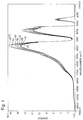
- Fig. 1 shows data obtained by investigating how much light absorption of water varies with the temperature.
- a cell having an optical path length of 1 mm has been employed for measuring an absorption spectrum of water by changing a water temperature from 20°C to 48°C and indicating the results in transmission energy.
- an energy change ratio at a wavenumber of 6000 cm -1 is 0.93 %/°C.
- Fig. 2 shows results of a transmission absorption measurement of a glucose solution performed for inferring how much light quantity change results from an optical measurement of a blood-sugar level.
- relative change of light intensity corresponding to a concentration change of 10000 mg/dl is about 2.5 % at an absorption wavenumber of 1679 nm (about 6000 cm -1 ) for glucose.
- the change range of glucose concentration in a biological change range of a human body is 400 mg/dl, it comes to that there is only a relative change of light quantity of 0.1 % in terms of relative change of light absorption intensity by glucose.
- relative light quantity change of absorption resulting from a temperature change of 1°C is 9.3 times that through a general change range of glucose concentration.
- Figs. 3A to 3D show results of scattered light quantity changes based on the temperature change of an organism, under the same measuring scale. A finger of a hand was irradiated with light for measuring scattered light quantities.
- Fig. 3A shows a result in the case of arranging the finger in the air allowing a non-contact state.
- the surrounding temperature was 24.8°C.
- the finger was in an equilibrium state with the surrounding temperature, and heat exchange with the surroundings was slow. Fluctuation of the scattered light quantity is small.
- Fig. 3B shows a result of bringing the finger into contact with a metal block of 24.8°C, which was not temperature-controlled. In this case, heat flew from the finger to the metal block, to change the temperature of the finger. While the measurement was made twice, fluctuation of the scattered light quantity was large in both cases.
- Fig. 3C shows a result of bringing the finger into contact with a metal block of 38.6°C, which was temperature-controlled. In this case, movement of heat was small since the temperature of the metal block was close to that of the finger. The scattered light quantity fluctuation is small but larger than the case in Fig. 3A.
- Fig. 3D shows a result of bringing the finger into contact with a metal block of 1.6°C, which was temperature-controlled. In this case, movement of heat was large due to a large temperature difference between the metal block and the finger. Scattered light quantity fluctuation larger than that in Fig. 3C is observed.
- the object of the present invention is to attain stabilization of measured data by reducing influence exerted on an organism, which is a measured object, by contact with a probe for measurement through a contact type non-invasive measuring method.
- the present invention is directed to a contact type non-invasive measuring method for making measurements by bringing a probe for physical quantity measurement into contact with an organism.
- the method comprises steps of detecting the temperature of a measured portion of the organism immediately before the measurement and regarding the same as a current substance temperature, regarding the current substance temperature as a target temperature level for the probe and controlling the temperature of the probe, and bringing the probe into contact with the measured portion of the organism for making physical quantity measurements while continuing temperature control so that the temperature of the probe is steady after reaching the current substance temperature.
- the method comprises steps of detecting the surrounding temperature for a measured portion immediately before a measurement and regarding the same as a current surrounding temperature, regarding the current surrounding temperature as a target temperature level for the probe, and bringing the probe into contact with the measured portion of the organism for making physical quantity measurements, while continuing temperature control so that the temperature of the probe is steady after reaching the current surrounding temperature.
- the method comprises steps of previously obtaining a temperature stabilizing a measured physical quantity of a measured portion of the organism as a physical quantity measuring temperature, regarding the physical quantity measuring temperature as a target temperature level for the probe, and bringing the probe into contact with the measured portion of the organism for making physical quantity measurements, while continuing temperature control so that the temperature of the probe is steady after reaching the physical quantity measuring temperature.
- the physical quantity measuring temperature is a surrounding temperature corresponding to a state most stabilizing the measured portion (internal and external). Since it is conceivable that the physical quantity measuring temperature varies by the measured portion or a measured person, it is necessary to previously obtain each physical quantity measuring temperature in response to the measured portion or the measured person.
- the physical quantity measuring temperature can be obtained by irradiating an organism with light at each temperature value while temperature-controlling the measured portion of a human body at different target temperature levels and measuring the light quantity stability of outgoing light from the organism resulting from the light. A temperature stabilizing measured data is previously obtained and registered as the physical quantity measuring temperature for the measured object or the measured portion.
- the present invention is also directed to a measuring apparatus for carrying out the aforementioned method.
- the measuring apparatus comprises a probe coming into contact with an organism for measuring a physical quantity in a non-invasive manner, a first temperature sensor detecting the temperature of a measured portion of the organism or its periphery, heating/cooling means provided on the probe, a second temperature sensor for probe temperature detection provided on the probe, and a temperature controller regarding the temperature detected by the first temperature sensor as a target temperature level for the probe and controlling the temperature of the probe so that the temperature detected by the second temperature sensor reaches the target temperature level.
- the measuring apparatus previously stores a temperature stabilizing a physical quantity measurement value of a measured portion of an organism as a physical quantity measuring temperature, while the measuring apparatus according to the fourth aspect of the present invention detects the temperature of the measured portion of the organism or its periphery with the first temperature sensor.
- the measuring apparatus regards the physical quantity measuring temperature as a target temperature level for a probe, and controls the temperature of the probe to reach the target temperature level.
- the measuring apparatus detects the temperature of the measured portion immediately before a measurement or the surrounding temperature for the measured portion, or previously obtains and stores the physical quantity measuring temperature in case of making a non-invasive measurement in a contact type by bringing the probe into contact with the organism after its temperature reaches the target temperature level, whereby influence exerted on the organism serving as a measured object by contact with the probe is reduced and measured data is stabilized.
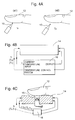
- FIGs. 4A to 4C illustrate such an embodiment that an optical fiber member for example, is embedded into a solid block of a metal to serve as a probe for measuring a physical quantity.
- a measured portion of an organism is irradiated with light from the optical fiber member so that outgoing light from the measured portion enters the optical fiber member again and is detected.
- Fig. 4A shows a step “a1” or “a2” of detecting a current substance temperature of the measured portion or a current surrounding temperature before measurement.
- step “a1” which is adapted to detect the current substance temperature
- a temperature sensor 10 is brought into contact with a finger 12 serving as the measured object, immediately before a physical quantity measurement, to detect the temperature of the finger 12 and regarding the same as a current substance temperature (t 0 ).
- step “a2" which is adapted to detect the current surrounding temperature
- the temperature sensor 10 detects the surrounding temperature around the finger 12 immediately before a measurement of the physical quantity, for regarding the same as a current surrounding temperature (T 0 ).
- Fig. 4B shows a step of controlling the temperature of a probe 14 to a target temperature level of the current substance temperature (t 0 )or the current surrounding temperature (T 0 ) detected in step "a1" or "a2" in Fig. 4A or a previously obtained physical quantity measuring temperature (T 1 ) of the measured object.
- a temperature control system 16 controls the temperature of the probe 14 to the target temperature level of the current substance temperature (t 0 ), the current surrounding temperature (T 0 ) or the physical quantity measuring temperature (T 1 ).
- Fig. 4C shows a step of measuring the physical quantity by bringing the probe 14 into contact with the measured object 12 when its temperature reaches the target level, irradiating the measured object 12 with light from an optical fiber member 15 which is embedded in the probe 14 and measuring the physical quantity of the measured object 12.
- the temperature control system 16 comprises a temperature controller, a driver and a heating/cooling element.
- Fig. 5 shows an embodiment employing a liquid such as water for example, as a probe.
- a container 20 stores water 22, for dipping the finger 12 serving as the measured object therein.
- the current substance temperature (t 0 ) or the current surrounding temperature (T 0 ) shown in Fig. 4A or the physical quantity measuring temperature (T 1 ) is employed as the target temperature level of the temperature control system 16, for controlling the temperature of the water 22 stored in the container 20 to reach the target temperature level.
- the finger 12 is irradiated with light from an optical fiber probe 25 for an optical measurement in the water 22, to measure resulting output light.
- Fig. 6 shows a concrete embodiment of the solid probe 10 shown in Fig. 4C.
- a heating Peltier element 32 and a cooling Peltier element 34 are provided on a heat-conductive metal block 30.
- the temperature control system 16 controls heating and cooling by the Peltier elements 32 and 34 through its outputs.
- a temperature sensor 36 is mounted on the block 30, and a current is fed to either Peltier element 32 or 34 so that the temperature of the block 30 reaches a target temperature level.
- the Peltier element 32 or 34 heating and cooling can be switched depending on the energization direction of the current. Therefore, the Peltier elements 32 and 34 can be replaced with a single Peltier element in the embodiment shown in Fig. 6.
- Fig. 7 shows a concrete example of a temperature control method for a liquid employed as a probe as shown in Fig. 5.
- a heater 40 and a temperature sensor 42 are dipped in water 22, which is stored in a container 20, so that a cooling water supply path 44 can supply cold water through a switching valve 46 for cooling.
- the water 22 is discharged from the container 20 through a switching valve 48, in order to adjust the water quantity in the container 20.
- the water temperature is controlled on the basis of an output of the temperature sensor 42 to reach the current substance temperature (t 0 ), the current surrounding temperature (T 0 ) or the physical quantity measuring temperature (T 1 ) which is inputted into the temperature control system 16.
- the quantity of a current supplied to the heater 40 is controlled for heating, the valve 46 is opened for supplying the cold water for cooling, while the valve 48 adjusts the water quantity.
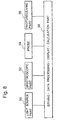
- Fig. 8 schematically shows a measuring apparatus according to the present invention.
- a spectroscopic part 52 selects a prescribed wavelength from light emitted from a light source part 50 comprising a halogen lamp for example.
- the spectroscopic part 52 is prepared from an Acousto-Optic Tunable (AOTF) for example.
- the AOTF is a spectroscopic element comprising an acoustic wave transducer on an acousto-optic crystal, which can perform spectroscopic analysis by changing an acoustic wave frequency (radio frequency (RF)) supplied from the acoustic wave transducer to the acousto-optic crystal.
- RF radio frequency
- a probe 54 is adapted to irradiate a measured portion with wavelength-selected light.
- the probe 54 comprises a set probe having a space of the same shape as the measured portion for example, so that the measured portion is fitted in and fixed to the space, and a measuring probe consisting of an optical fiber member which is mounted on the set probe for irradiating the measured portion with light.
- a photoreceiving part 56 employs a photoreceptor PbS of an electronic cooling system for example, for detecting output light from the measured portion received by the probe 54.
- the probe 54 comprises Peltier elements for heating and cooling and a temperature sensor similarly to the block 30 shown in Fig. 6, so that heating and cooling are controlled through outputs of a temperature control system.
- a driving ⁇ data processing ⁇ display and calculation part 58 comprises a data processing part, a calculation part and a display.
- the data processing part electrically drives the light source part 50, the spectroscopic part 52 and the photoreceiving part 56, controls the temperature of the probe 54, and performs necessary data preprocessing on data detected by the photoreceiving part 56.
- the calculation part performs multivariate analysis of the processed data and calculates blood-sugar concentration, for example.
- the display outputs and displays the measurement result of the calculated blood-sugar concentration or the like.
- Fig. 9 shows an embodiment comprising an integrating sphere type probe 54a.
- the integrating sphere probe 54a comprises an inlet port 62 for receiving light spectroscopically separated in a spectroscopic part 52 and reflected by a mirror 60 on a part thereof, and an opening is formed on a position of an integrating sphere 64 opposed to the inlet port 62 so that a finger 12 being the measured object can be pressed against the opening.
- the integrating sphere 64 is further provided with a detector 66 for photodetection, so that light received and detected by the detector 66 is converted to an electric signal and fed to a photometric part 68.
- the probe 54a is made of a metal and provided with Peltier elements (not shown) and a temperature sensor (not shown) which are similar to those shown in Fig. 6 for temperature control, and a temperature control system controls the temperature of the probe 54a to reach the current substance temperature (t 0 ), the current surrounding temperature (T 0 ) or the physical quantity measuring temperature (T 1 ).
Landscapes
- Health & Medical Sciences (AREA)
- Life Sciences & Earth Sciences (AREA)
- Physics & Mathematics (AREA)
- Medical Informatics (AREA)
- Surgery (AREA)
- Biophysics (AREA)
- Pathology (AREA)
- Engineering & Computer Science (AREA)
- Biomedical Technology (AREA)
- Heart & Thoracic Surgery (AREA)
- Veterinary Medicine (AREA)
- Molecular Biology (AREA)
- Optics & Photonics (AREA)
- Animal Behavior & Ethology (AREA)
- General Health & Medical Sciences (AREA)
- Public Health (AREA)
- Emergency Medicine (AREA)
- Spectroscopy & Molecular Physics (AREA)
- Investigating Or Analysing Materials By Optical Means (AREA)
- Measurement Of The Respiration, Hearing Ability, Form, And Blood Characteristics Of Living Organisms (AREA)
- Control Of Amplification And Gain Control (AREA)
Applications Claiming Priority (6)
| Application Number | Priority Date | Filing Date | Title |
|---|---|---|---|
| JP242105/97 | 1997-08-22 | ||
| JP24210597 | 1997-08-22 | ||
| JP24210597 | 1997-08-22 | ||
| JP7148798A JPH11123195A (ja) | 1997-08-22 | 1998-03-04 | 生体測定方法及び装置 |
| JP71487/98 | 1998-03-04 | ||
| JP7148798 | 1998-03-04 |
Publications (2)
| Publication Number | Publication Date |
|---|---|
| EP0897691A2 true EP0897691A2 (de) | 1999-02-24 |
| EP0897691A3 EP0897691A3 (de) | 1999-09-01 |
Family
ID=26412586
Family Applications (1)
| Application Number | Title | Priority Date | Filing Date |
|---|---|---|---|
| EP19980115291 Withdrawn EP0897691A3 (de) | 1997-08-22 | 1998-08-13 | Verfahren und Gerät zur Organismusmessung |
Country Status (3)
| Country | Link |
|---|---|
| EP (1) | EP0897691A3 (de) |
| JP (1) | JPH11123195A (de) |
| CN (1) | CN1211735A (de) |
Cited By (19)
| Publication number | Priority date | Publication date | Assignee | Title |
|---|---|---|---|---|
| US6718189B2 (en) | 1995-08-09 | 2004-04-06 | Rio Grande Medical Technologies, Inc. | Method and apparatus for non-invasive blood analyte measurement with fluid compartment equilibration |
| US6816605B2 (en) | 1999-10-08 | 2004-11-09 | Lumidigm, Inc. | Methods and systems for biometric identification of individuals using linear optical spectroscopy |
| US6862091B2 (en) | 2001-04-11 | 2005-03-01 | Inlight Solutions, Inc. | Illumination device and method for spectroscopic analysis |
| US6865408B1 (en) | 2001-04-11 | 2005-03-08 | Inlight Solutions, Inc. | System for non-invasive measurement of glucose in humans |
| US6983176B2 (en) | 2001-04-11 | 2006-01-03 | Rio Grande Medical Technologies, Inc. | Optically similar reference samples and related methods for multivariate calibration models used in optical spectroscopy |
| US7027848B2 (en) | 2002-04-04 | 2006-04-11 | Inlight Solutions, Inc. | Apparatus and method for non-invasive spectroscopic measurement of analytes in tissue using a matched reference analyte |
| US7043288B2 (en) | 2002-04-04 | 2006-05-09 | Inlight Solutions, Inc. | Apparatus and method for spectroscopic analysis of tissue to detect diabetes in an individual |
| US7126682B2 (en) | 2001-04-11 | 2006-10-24 | Rio Grande Medical Technologies, Inc. | Encoded variable filter spectrometer |
| US7613504B2 (en) | 2001-06-05 | 2009-11-03 | Lumidigm, Inc. | Spectroscopic cross-channel method and apparatus for improved optical measurements of tissue |
| US7620212B1 (en) | 2002-08-13 | 2009-11-17 | Lumidigm, Inc. | Electro-optical sensor |
| EP2371285A1 (de) * | 2003-07-22 | 2011-10-05 | Kabushiki Kaisha Toshiba | Vorrichtung zur Messung von biologischen Informationen |
| US8175346B2 (en) | 2006-07-19 | 2012-05-08 | Lumidigm, Inc. | Whole-hand multispectral biometric imaging |
| US8184873B2 (en) | 2003-04-04 | 2012-05-22 | Lumidigm, Inc. | White-light spectral biometric sensors |
| US8229185B2 (en) | 2004-06-01 | 2012-07-24 | Lumidigm, Inc. | Hygienic biometric sensors |
| US8285010B2 (en) | 2007-03-21 | 2012-10-09 | Lumidigm, Inc. | Biometrics based on locally consistent features |
| US8355545B2 (en) | 2007-04-10 | 2013-01-15 | Lumidigm, Inc. | Biometric detection using spatial, temporal, and/or spectral techniques |
| US8570149B2 (en) | 2010-03-16 | 2013-10-29 | Lumidigm, Inc. | Biometric imaging using an optical adaptive interface |
| US8781181B2 (en) | 2006-07-19 | 2014-07-15 | Lumidigm, Inc. | Contactless multispectral biometric capture |
| US8787630B2 (en) | 2004-08-11 | 2014-07-22 | Lumidigm, Inc. | Multispectral barcode imaging |
Families Citing this family (9)
| Publication number | Priority date | Publication date | Assignee | Title |
|---|---|---|---|---|
| US6574490B2 (en) | 2001-04-11 | 2003-06-03 | Rio Grande Medical Technologies, Inc. | System for non-invasive measurement of glucose in humans |
| CN1203809C (zh) * | 2002-11-22 | 2005-06-01 | 天津市先石光学技术有限公司 | 基于人体表层或表面纹理特征和接触压力的测量条件复现装置与方法 |
| KR101281169B1 (ko) * | 2007-08-24 | 2013-07-02 | 삼성전자주식회사 | 체내 성분 측정용 비침습 프로브 및 이를 포함하는비침습적 체내 성분 측정 시스템 |
| DE112008003122A5 (de) * | 2007-11-20 | 2010-09-23 | Mbr Optical Systems Gmbh & Co. Kg | Verfahren und Messeinrichtung zur Erhebung hinsichtlich der Konzentration eines Stoffes in einem Untersuchungsbereich indikativer Signale, insbesondere aus vitalem Gewebe |
| JP2012019979A (ja) * | 2010-07-15 | 2012-02-02 | Yokogawa Electric Corp | 共焦点光学系を用いた生体成分測定装置 |
| CN102885629B (zh) * | 2012-10-19 | 2018-09-04 | 北京超思电子技术有限责任公司 | 可测量体温的血氧测量仪 |
| CN108013866A (zh) * | 2016-11-02 | 2018-05-11 | 北京大学 | 一种新型体征数据检测方法和可穿戴体征检测设备 |
| CN112842331A (zh) * | 2020-12-30 | 2021-05-28 | 广东蚬壳家电有限公司 | 一种血氧仪及血氧浓度测量方法 |
| CN117598851B (zh) * | 2024-01-09 | 2025-04-22 | 浙江大学 | 可穿戴式皮肤控温散热装置及方法 |
Family Cites Families (7)
| Publication number | Priority date | Publication date | Assignee | Title |
|---|---|---|---|---|
| US3628525A (en) * | 1969-06-19 | 1971-12-21 | American Optical Corp | Blood oxygenation and pulse rate monitoring apparatus |
| DE2911601C2 (de) * | 1979-03-24 | 1982-05-13 | Hellige Gmbh, 7800 Freiburg | Meßwertaufnehmer für physiologische Meßgrößen mit einer Einrichtung zur elektrischen Beheizung |
| JPH02311702A (ja) * | 1989-05-29 | 1990-12-27 | Olympus Optical Co Ltd | 走査型トンネル顕微鏡装置 |
| JP2766317B2 (ja) * | 1989-06-22 | 1998-06-18 | コーリン電子株式会社 | パルスオキシメータ |
| US5007423A (en) * | 1989-10-04 | 1991-04-16 | Nippon Colin Company Ltd. | Oximeter sensor temperature control |
| JPH07508426A (ja) * | 1991-10-17 | 1995-09-21 | サイエンティフィック ジェネリクス リミテッド | 血液検体測定装置及びその方法 |
| US5370114A (en) * | 1992-03-12 | 1994-12-06 | Wong; Jacob Y. | Non-invasive blood chemistry measurement by stimulated infrared relaxation emission |
-
1998
- 1998-03-04 JP JP7148798A patent/JPH11123195A/ja active Pending
- 1998-08-12 CN CN98117157A patent/CN1211735A/zh active Pending
- 1998-08-13 EP EP19980115291 patent/EP0897691A3/de not_active Withdrawn
Cited By (24)
| Publication number | Priority date | Publication date | Assignee | Title |
|---|---|---|---|---|
| US6718189B2 (en) | 1995-08-09 | 2004-04-06 | Rio Grande Medical Technologies, Inc. | Method and apparatus for non-invasive blood analyte measurement with fluid compartment equilibration |
| US9487398B2 (en) | 1997-06-09 | 2016-11-08 | Hid Global Corporation | Apparatus and method of biometric determination using specialized optical spectroscopy systems |
| US6816605B2 (en) | 1999-10-08 | 2004-11-09 | Lumidigm, Inc. | Methods and systems for biometric identification of individuals using linear optical spectroscopy |
| US6862091B2 (en) | 2001-04-11 | 2005-03-01 | Inlight Solutions, Inc. | Illumination device and method for spectroscopic analysis |
| US6865408B1 (en) | 2001-04-11 | 2005-03-08 | Inlight Solutions, Inc. | System for non-invasive measurement of glucose in humans |
| US6983176B2 (en) | 2001-04-11 | 2006-01-03 | Rio Grande Medical Technologies, Inc. | Optically similar reference samples and related methods for multivariate calibration models used in optical spectroscopy |
| US7126682B2 (en) | 2001-04-11 | 2006-10-24 | Rio Grande Medical Technologies, Inc. | Encoded variable filter spectrometer |
| US7890158B2 (en) | 2001-06-05 | 2011-02-15 | Lumidigm, Inc. | Apparatus and method of biometric determination using specialized optical spectroscopy systems |
| US7613504B2 (en) | 2001-06-05 | 2009-11-03 | Lumidigm, Inc. | Spectroscopic cross-channel method and apparatus for improved optical measurements of tissue |
| US7043288B2 (en) | 2002-04-04 | 2006-05-09 | Inlight Solutions, Inc. | Apparatus and method for spectroscopic analysis of tissue to detect diabetes in an individual |
| US7027848B2 (en) | 2002-04-04 | 2006-04-11 | Inlight Solutions, Inc. | Apparatus and method for non-invasive spectroscopic measurement of analytes in tissue using a matched reference analyte |
| US7620212B1 (en) | 2002-08-13 | 2009-11-17 | Lumidigm, Inc. | Electro-optical sensor |
| US8184873B2 (en) | 2003-04-04 | 2012-05-22 | Lumidigm, Inc. | White-light spectral biometric sensors |
| US8600466B2 (en) | 2003-07-22 | 2013-12-03 | Kabushiki Kaisha Toshiba | Living body information measuring apparatus |
| US8886268B2 (en) | 2003-07-22 | 2014-11-11 | Kabushiki Kaisha Toshiba | Living body information measuring apparatus |
| EP2371285A1 (de) * | 2003-07-22 | 2011-10-05 | Kabushiki Kaisha Toshiba | Vorrichtung zur Messung von biologischen Informationen |
| US8229185B2 (en) | 2004-06-01 | 2012-07-24 | Lumidigm, Inc. | Hygienic biometric sensors |
| US8787630B2 (en) | 2004-08-11 | 2014-07-22 | Lumidigm, Inc. | Multispectral barcode imaging |
| US8175346B2 (en) | 2006-07-19 | 2012-05-08 | Lumidigm, Inc. | Whole-hand multispectral biometric imaging |
| US8781181B2 (en) | 2006-07-19 | 2014-07-15 | Lumidigm, Inc. | Contactless multispectral biometric capture |
| US8831297B2 (en) | 2006-07-19 | 2014-09-09 | Lumidigm, Inc. | Contactless multispectral biometric capture |
| US8285010B2 (en) | 2007-03-21 | 2012-10-09 | Lumidigm, Inc. | Biometrics based on locally consistent features |
| US8355545B2 (en) | 2007-04-10 | 2013-01-15 | Lumidigm, Inc. | Biometric detection using spatial, temporal, and/or spectral techniques |
| US8570149B2 (en) | 2010-03-16 | 2013-10-29 | Lumidigm, Inc. | Biometric imaging using an optical adaptive interface |
Also Published As
| Publication number | Publication date |
|---|---|
| EP0897691A3 (de) | 1999-09-01 |
| CN1211735A (zh) | 1999-03-24 |
| JPH11123195A (ja) | 1999-05-11 |
Similar Documents
| Publication | Publication Date | Title |
|---|---|---|
| JPH11123195A (ja) | 生体測定方法及び装置 | |
| US8043227B2 (en) | Non-invasive system and method for measuring skin hydration of a subject | |
| KR0170040B1 (ko) | 생물학적 매트릭스중의 글루코오스의 측정을 위한 방법 및 장치 | |
| CA2290957C (en) | Non-invasive continuous blood glucose monitoring | |
| US5795305A (en) | Process and device for non-invasive determination of glucose concentration in parts of the human body | |
| US6072180A (en) | Non-invasive infrared absorption spectrometer for the generation and capture of thermal gradient spectra from living tissue | |
| JP2704672B2 (ja) | キャリブレーションマッピングを利用した赤外線体温計 | |
| US5183042A (en) | Electromagnetic method and apparatus to measure constituents of human or animal tissue | |
| CA2387728C (en) | Test element analysis system with an infrared detector | |
| US6580934B1 (en) | Method and apparatus for determining analyte concentration using phase and magnitude detection of a radiation transfer function | |
| EP2276406B1 (de) | Gerät und verfahren zur nichtinvasiven messung einer substanz in einem körper | |
| EP1815786A1 (de) | Beobachtung von Gewebeanalyten durch Infrarotstrahlung | |
| CA2661960A1 (en) | Noninvasive measurements of chemical substances | |
| US20100309466A1 (en) | Spectroscopic determination of analyte concentration | |
| JPH07508426A (ja) | 血液検体測定装置及びその方法 | |
| US5455177A (en) | Method for analysis of a medical sample | |
| JP2022549959A5 (de) | ||
| JP2022549958A5 (de) | ||
| US8696993B2 (en) | Method of raising temperature of received object, and analyzing device | |
| Zheng et al. | Noninvasive glucose determination by oscillating thermal gradient spectrometry | |
| JP2004321368A (ja) | グルコース濃度測定装置 | |
| Diessel et al. | Glucose quantification in dried-down nanoliter samples using mid-infrared attenuated total reflection spectroscopy | |
| US20170360339A1 (en) | Apparatus and method for non-invasively determining the concentration of an analyte | |
| JPH0739531A (ja) | 皮膚用血流計 | |
| Thomas et al. | Development of Blood Glucose Monitoring System using Image Processing and Machine Learning Techniques |
Legal Events
| Date | Code | Title | Description |
|---|---|---|---|
| PUAI | Public reference made under article 153(3) epc to a published international application that has entered the european phase |
Free format text: ORIGINAL CODE: 0009012 |
|
| AK | Designated contracting states |
Kind code of ref document: A2 Designated state(s): DE FR GB IT |
|
| AX | Request for extension of the european patent |
Free format text: AL;LT;LV;MK;RO;SI |
|
| PUAL | Search report despatched |
Free format text: ORIGINAL CODE: 0009013 |
|
| AK | Designated contracting states |
Kind code of ref document: A3 Designated state(s): AT BE CH CY DE DK ES FI FR GB GR IE IT LI LU MC NL PT SE |
|
| AX | Request for extension of the european patent |
Free format text: AL;LT;LV;MK;RO;SI |
|
| RIC1 | Information provided on ipc code assigned before grant |
Free format text: 6A 61B 5/00 A, 6G 01N 27/00 B |
|
| 17P | Request for examination filed |
Effective date: 20000224 |
|
| AKX | Designation fees paid |
Free format text: DE FR GB IT |
|
| STAA | Information on the status of an ep patent application or granted ep patent |
Free format text: STATUS: THE APPLICATION HAS BEEN WITHDRAWN |
|
| 18W | Application withdrawn |
Withdrawal date: 20010620 |