EP0897966B1 - Blaues oder bläulich-grünes Aluminosilikat-Leuchtspeicherungsmaterial und Verfahren zur Herstellung - Google Patents
Blaues oder bläulich-grünes Aluminosilikat-Leuchtspeicherungsmaterial und Verfahren zur Herstellung Download PDFInfo
- Publication number
- EP0897966B1 EP0897966B1 EP98306668A EP98306668A EP0897966B1 EP 0897966 B1 EP0897966 B1 EP 0897966B1 EP 98306668 A EP98306668 A EP 98306668A EP 98306668 A EP98306668 A EP 98306668A EP 0897966 B1 EP0897966 B1 EP 0897966B1
- Authority
- EP
- European Patent Office
- Prior art keywords
- storage material
- luminous storage
- aluminium silicate
- manufacturing
- shows
- Prior art date
- Legal status (The legal status is an assumption and is not a legal conclusion. Google has not performed a legal analysis and makes no representation as to the accuracy of the status listed.)
- Expired - Lifetime
Links
Images



Classifications
-
- C—CHEMISTRY; METALLURGY
- C09—DYES; PAINTS; POLISHES; NATURAL RESINS; ADHESIVES; COMPOSITIONS NOT OTHERWISE PROVIDED FOR; APPLICATIONS OF MATERIALS NOT OTHERWISE PROVIDED FOR
- C09K—MATERIALS FOR MISCELLANEOUS APPLICATIONS, NOT PROVIDED FOR ELSEWHERE
- C09K11/00—Luminescent materials, e.g. electroluminescent or chemiluminescent
- C09K11/08—Luminescent materials, e.g. electroluminescent or chemiluminescent containing inorganic luminescent materials
- C09K11/77—Luminescent materials, e.g. electroluminescent or chemiluminescent containing inorganic luminescent materials containing rare earth metals
- C09K11/7728—Luminescent materials, e.g. electroluminescent or chemiluminescent containing inorganic luminescent materials containing rare earth metals containing europium
- C09K11/77344—Aluminosilicates
-
- C—CHEMISTRY; METALLURGY
- C09—DYES; PAINTS; POLISHES; NATURAL RESINS; ADHESIVES; COMPOSITIONS NOT OTHERWISE PROVIDED FOR; APPLICATIONS OF MATERIALS NOT OTHERWISE PROVIDED FOR
- C09K—MATERIALS FOR MISCELLANEOUS APPLICATIONS, NOT PROVIDED FOR ELSEWHERE
- C09K11/00—Luminescent materials, e.g. electroluminescent or chemiluminescent
- C09K11/08—Luminescent materials, e.g. electroluminescent or chemiluminescent containing inorganic luminescent materials
- C09K11/77—Luminescent materials, e.g. electroluminescent or chemiluminescent containing inorganic luminescent materials containing rare earth metals
- C09K11/7783—Luminescent materials, e.g. electroluminescent or chemiluminescent containing inorganic luminescent materials containing rare earth metals containing two or more rare earth metals one of which being europium
- C09K11/77924—Aluminosilicates
Definitions
- the present invention relates to a blue or bluish green aluminium silicate luminous storage material and a method for its manufacture.
- Phosphor emits light when excited by certain external stimuli such as grain energy, electrons or light.
- a persistent luminous material that can maintain emission after excitation is stopped is called a luminous storage material. Due to the needs for various types of displays and advanced functions for dark places, there is a demand for luminous storage that can handle multiple colours and maintain emissions over a long period of time. In addition, greater weather resistance is also now needed.
- Inorganic materials include sulfide or oxyacid-salt (such as strontiumaluminate) luminous material due to their storage capability.
- Sulfide phosphors include, for example, (Ca,Sr)S:Bi 3+ phosphors emitting a blue light, ZnS:Cu 2+ phosphors emitting a yellowish green light; and (Zn,Cd)S:Cu phosphors emitting a red light.
- oxyacid salt phosphors include, for example, alkali earth metal aluminate which has been activated by europium and which is expressed by the chemical formula MAl 2 O 4 . In this case, M is alkali earth metal of magnesium, calcium or strontium.
- (Ca,Sr)S:Bi 3+ phosphor since the host of (Ca,Sr)S:Bi 3+ phosphor has inadequate chemical stability and also has insufficient luminance and afterglow time as an emitter, it is now rarely used.
- (Zn,Cd)S:Cu phosphor contains Cd, which is toxic, and its luminance level and afterglow time are impractical, so it is now rarely used.
- ZnS:Cu 2+ phosphor is likely to be photodissociated and melanized by ultraviolet rays in the presence of humidity, and has an insufficient afterglow time, but due to its low price, it is now frequently used outdoors for clockfaces and evacuation guidance signs.
- Strontiumaluminate/bariumaluminate that has been mainly activated by europium is a yellowish green emitter having a maximum luminescent intensity near 520 nm/500 nm. It takes 2000 minutes or more for it to drop to 0.32 mcd/m 2 , indicating higher persistence than ZnS:Cu phosphor, which drops to this level in 200 minutes. It has been suggested, however, that this material does not meet requirements for weather resistance and multiple colours.
- a further object of this invention is to provide a manufacturing method for such a material.
- the inventors have focused on oxides containing elements in group II of the periodic table and aluminium silicate compounds and have found a new aluminium-silicate compound luminous storage material that can be obtained by using Eu 2+ , or Eu 2+ and an Ln rare earth element, to activate a reactive product of an oxide containing an element in group II and an aluminium silicate salt of a particular composition.
- the inventors have found that by optimising the content of Eu 2+ , which mainly contributes to emission, or Eu 2+ and the Ln rare earth element, or other contained elements (for example, boron or sodium contained as a flux to facilitate the growth of grains), a blue or bluish green luminous storage material can be obtained that has very high persistence, that is structurally and chemically stable, that has high weather resistance, and that has a maximum luminescent intensity of 460 nm or near 490 nm, respectively.
- the inventors have confirmed that the material meets the above object.
- An aluminium silicate luminous storage material is a blue or bluish green luminous storage material which has a composition formula expressed as follows: (1) (M 1-n-m M* n Eu m ) (Al 1-x Si 3 ⁇ 4x ⁇ 1 ⁇ 4x ) 2 O 4 or (2) (M 1-n-m-k M* n Eu m Ln k ) (Al 1-x Si 3 ⁇ 4x ⁇ 1 ⁇ 4x ) 2 O 4 and is mainly activated by Eu 2+ , in the case of (1) or Eu 2+ and one or more types of rare earth elements Ln in the case of (2).
- ⁇ is the deficiency
- M is one or more alkali earth metal elements selected from a group of magnesium, calcium, strontium and barium
- M* is one or more bivalent metal elements selected from a group of manganese, zinc and cadmium
- Ln is a rare earth element other than Eu
- (n), (m), (k) and (x) are numerical values falling within the following ranges: 0 ⁇ n ⁇ 0.2 0 ⁇ x ⁇ 0.6 0.0001 ⁇ m ⁇ 0.1 0.0001 ⁇ k ⁇ 0.1.
- the luminous storage material exhibits thermal luminescence when excited by ultraviolet rays and/or visible light between 220 and 480 nm followed by heating up to or beyond room temperature.
- a method for manufacturing the blue or bluish green light-emitting aluminium silicate luminous storage material is also provided.
- the luminous storage material is obtained as a powder product by burning together with sodium carbonate or boron oxide, a powder mixture obtained by mixing a compound containing an M element, a compound containing an M* element, a compound containing an Al element, a compound containing an Si element or silicon and a compound containing an Eu element together in the ratio expressed by the composition formula given in Expression (1), or material powders obtained by mixing the above elements and one or more types of rare earth elements Ln at the ratio expressed by Formula (2).
- the burning is desirably carried out in a reducing atmosphere at 800°C to 1400°C.
- the material powders are moulded under a load of 1 to 5000 kg/cm 2 using a metal moulding machine, and are then burned or calcinated to obtain a product, which is then moulded under pressure using the same load and sintered.
- the aluminium silicate luminous storage material according to this invention has the host components expressed by Composition Formula (1) or (2).
- the M element included in these components is partly substituted by the M* element of manganese, zinc or cadmium.
- a suitable amount of M* (molar value) for improving luminance is 0 ⁇ n ⁇ 0.2, and preferably, 0 ⁇ n ⁇ 0.05. If the substitution factor exceeds 0.2, the effect of improved afterglows and luminance decreases significantly.
- a suitable value for m the amount of Eu 2+ contained in the aluminium silicate luminous storage material is 0.0001 ⁇ m ⁇ 0.1, and preferably 0.001 ⁇ m ⁇ 0.01. Under 0.0001, the amount of ions that mainly emit light is so small as to prevent a target luminance from being obtained. In addition, if this value exceeds 0.1, density quenching may be caused by the interaction among the luminous ions, unwanted compounds may be generated, or material oxides may remain, thereby significantly reducing the luminance of the luminous storage material obtained.
- a suitable value of (k) is 0.0001 ⁇ k ⁇ 0.1, preferably between 0 and 50 mol% relative to Eu 2+ .
- the resulting luminous storage material emits a bluish green light having a maximum luminescent intensity near 490 nm, in contrast to conventional strontiumaluminate, which does not contain Si.
- a suitable amount of (x) (molar value), the content of SiO 2 or silicon included in the composition formula is 0.1 ⁇ x ⁇ 0.6, and the deficiency expressed by ⁇ occurs to the host due to the need to maintain a charge balance as the amount of Si increases.
- a more suitable range is 0.1 ⁇ x ⁇ 0.45. Beyond 0.6, the ability to improve the persistence characteristic, and thus luminance, decreases.
- boron oxide When boron oxide is added as a flux, powdered blue or bluish green aluminium silicate luminous storage material having a specified grain size (1 to 10 ⁇ m) is obtained. It is partly substituted for Al to improve the persistence characteristic, but the amount of substitution does not exceed 0.001 mol. In addition, an excessive amount of boron oxide increases the amount of unreacted materials and does not affect the luminance or persistence characteristic despite its effect as a flux on the grain growth.
- the aluminium silicate luminous storage material according to this invention exhibits thermal luminescence (fluorescence) when excited by electron beams, or ultraviolet rays and/or visible light between 220 and 480 nm followed by heating up to or beyond room temperature.
- aluminium silicate luminous storage material can be manufactured as follows:
- the materials used comprise a compound containing M, an M* compound, an Al compound, a B compound, an Si element or silicon, a compound of Eu 2+ to serve as an activating agent, and a compound containing an Ln rare earth element - that is, oxides containing these elements, or salts such as carbonate, nitrate and chloride that can be converted into oxides easily by means of sintering.
- These materials are weighed so as to achieve the composition range shown in Composition Formula (1) or (2) and are sufficiently wet- or dry-mixed.
- the mixed powders are placed in a heat-resistant reaction container such as an aluminium or a graphite crucible directly or after they have been subjected to a pressure of 1 to 5000 kg/cm 2 , and are then sinteredonce or more in a reducing atmosphere of an inert gas containing hydrogen or in a carbon reducing atmosphere at 800° to 1400°C for 1 to 12 hours.
- a heat-resistant reaction container such as an aluminium or a graphite crucible directly or after they have been subjected to a pressure of 1 to 5000 kg/cm 2
- a reducing atmosphere of an inert gas containing hydrogen or in a carbon reducing atmosphere at 800° to 1400°C for 1 to 12 hours.
- the first operation may be performed in air, but the finalsintering step must be executed in a reducing atmosphere.
- the present invention provides an aluminium silicate luminous storage material which comprises an emitter that emits a blue or bluish green light indoors, outdoors, underwater, or in other dark places when excited by electron beams, ultraviolet rays, and/or visible radiation.
- the material also has a long-lasting blue afterglow after excitation is stopped.
- the luminous storage material is mainly activated by EU 2+ , is thermally stable, and exhibits excellent chemical stability in an oxidising or reducing atmosphere.
- the present invention also provides a manufacturing method for this material.
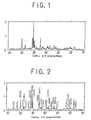
- Figure 1 is a diagram showing a powder X-ray diffraction chart of a luminous storage material having a chemical composition according to Embodiment 1.
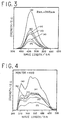
- Figure 2 is a diagram showing a powder X-ray diffraction charge of SrAl 2 O 4 for comparison.
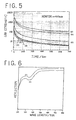
- Figure 3 is a diagram showing as (a) to (f) emission spectra (excitation: 360 nm) of a luminous storage material according to Embodiments 1 to 6 of this invention.
- FIG. 4 is a diagram showing as (a) to (f) excitation ;spectra (emission: 460 nm) according to Embodiments 1 to 6 of this invention.
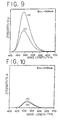
- FIG. 5 is a diagram showing as (a) to (f) temporal changes in luminescent intensity (persistence characteristic) according to Embodiments 1 to 6 of this invention.
- FIG. 6 is a diagram showing as (1) and (2) diffuse reflection spectra according to Embodiment 1 and Comparative Example 1.
- FIG. 7 is a diagram showing a powder X-ray diffraction chart of a luminous storage material having a chemical composition according to Embodiment 2.
- FIG. 8 is a diagram showing a powder X-ray diffraction chart of a phosphor having a chemical composition according to Embodiment 7.
- FIG. 9 is a diagram showing as (a) and (c) emission spectra (excitation: 360 nm) of samples according to Embodiments 7 and 8.
- FIG. 10 is a diagram showing as (b) and (d) emission spectra (excitation: 360 nm) of samples according to Comparative Examples 2 and 1.
- FIG. 11 is a diagram showing as (a) and (c) excitation spectra (emission: 490 nm) of samples according to Embodiments 7 and 8.
- FIG. 12 is a diagram showing as (b) and (d) excitation spectra (emission: 520 nm) of samples according to Comparative Examples 2 and 1.
- FIG. 13 is a diagram showing as (a) - (d) temporal changes in the luminescent intensity of samples according to Embodiment 7, Comparative Example 2, Embodiment 8, and Comparative Example 1.
- Figures 14(a) and (b) are scanning electron-microscopic photographs showing the crystal structure of a sample according to Embodiment 7 before and after burning, respectively.
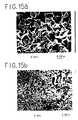
- Figures 15(a) and (b) are scanning-electron-microscopic photographs showing the crystal structure of a sample according to Comparative Example 2 before and after burning, respectively.
- composition formula is as shown in Formula (1) or (2), but is adjusted to the following formulae in the embodiments: (M 1-n-m M* n Eu m ) (Al 1-x Si x ) 2 O 4 or (M 1-n-m-k M* n Eu m Ln k ) (Al 1-x Si x ) 2 O 4
- the amount of silica used as a flux is 1/4x greater than the amount required.
- the mixed powders were dried at 40°C and molded into a disc of diameter 13 mm ⁇ under a load of 1,000 kg/cm 2 using a metal molding machine, and the disc was placed in an alumina crucible and burned in argon gas containing 3% hydrogen at 1,300°C for five hours using an electric furnace.
- the sintered compact obtained was ground using a pestle and a mortar and its phase was identified using a powder X-ray diffraction method.
- FIG. 1 shows the results of powder X-ray diffraction using CuK ⁇ rays.
- FIG. 2 shows a powder X-ray diffraction chart of synthesized SrAl 2 O 4 . As shown in the figure, each peak is indexed and belongs to a monoclinic stuffed tridymite structure. These results show that the sample obtained according to this embodiment had almost a single phase and was isomorphous with SrAl 2 O 4 .
- FIG. 3 (a) shows an emission spectrum of a sample according to Embodiment 1 when it was excited by 360-nm ultraviolet rays. This figure shows that the peak that provided a maximum luminescent intensity was a blue light emission located near 460 nm.
- FIG. 4 (a) shows an excitation spectrum.
- the sample was excited at an excitation wavelength of 250 nm for 30 seconds, and temporal changes in the luminescent intensity of a 460-nm peak (persistence characteristic) were then measured.
- FIG. 5 (a) shows the results of the measurement.
- BaSO 4 was absorbed and measured as a reference sample using diffusion reflection method.
- FIG. 6 (1) shows a diffuse reflection spectrum. This figure shows that this spectrum has the same profile as the diffuse reflection spectrum (shown in FIG. 6 (2)) of a sample containing no Si and obtained in Comparative Example 1, which is described below. Thus, the absorbing end of each sample can be assumed to be located in a region of wavelength smaller than 200 nm.
- the mixed powders were dried at 40°C and moulded into a disc of diameter 13 mm ⁇ under a load of 1500 kg/cm 2 using a metal moulding machine, and the disc was placed in an alumina crucible and burned in argon gas containing 3% hydrogen at 1300°C for three hours using an electric furnace.
- the sintered compact obtained was ground to obtain luminous storage material according to this invention that emits a blue light.
- This luminous storage material was obtained by substituting Sr 0.99 Zn 0.005 for Sr 0.995 in material with the chemical composition of Embodiment 1.
- Figure 7 shows a powder X-ray diffraction chart of the sample obtained wherein CuKa rays were used. As in Embodiment 1, the figure shows that the sample obtained according to this embodiment had almost a single phase and was isomorphous with SrAl 2 O 4 .
- FIG. 3 (b) shows an emission spectrum of the sample when its was excited by 360-nm ultraviolet rays. This figure shows that the peak that provided a maximum luminescent intensity was a blue light emission located near 460 nm.
- FIG. 4 (b) shows an excitation spectrum.
- FIG. 5 (b) shows the results of the measurement.
- the mixed powders were dried at 40°C and molded into a disc of diameter 13 mm ⁇ under a load of 2,000 kg/cm 2 using a metal molding machine, and the disc was placed in an alumina crucible and burned in argon gas containing 3% hydrogen at 1,350°C for three hours using an electric furnace.
- the sintered compact obtained was ground to obtain a luminous storage material according to this invention having a blue light emission.
- This luminous storage material was obtained by substituting Ca 0.95 for Sr 0.995 in the material of the chemical composition of Embodiment 1 and increasing the ng the content of Eu from 0.005 to 0.05.
- FIG. 3 (c) shows an emission spectrum of the sample when it was excited by 360-nm ultraviolet rays. This figure shows that the peak that provided a maximum luminescent intensity was the emission of a blue light emission near 460 nm.
- FIG. 4 (c) shows an excitation spectrum.
- FIG. 5 (c) shows the results of the measurement.
- the mixed powders were dried at 40°C and molded into a disc of diameter 13 mm ⁇ under a load of 1,000 kg/cm 2 using a metal molding machine, and the disc was placed in a graphite crucible and burned in argon gas containing 3% hydrogen at 1,250°C for five hours using an electric furnace.
- the sintered compact obtained was ground to obtain a luminous storage material according to this invention that emits a blue light.
- This luminous storage material was obtained by substituting Ca 0.79 Ba 0.20 for Sr 0.995 in the material of the chemical composition of Embodiment 1, and increasing the content of Eu from 0.005 to 0.01.
- FIG. 3 (d) shows an emission spectrum of the sample when it was excited by 360-nm ultraviolet rays. This figure shows that the peak that provided a maximum luminescent intensity was a blue light emission located near 460 nm.
- FIG. 4 (d) shows an excitation spectrum.
- FIG. 5 (d) shows the results of the measurement.
- the mixed powders were dried at 40°C and molded into a disc of diameter 13 mm ⁇ under a load of 1,000 kg/cm 2 using a metal molding machine, and the disc was placed in an alumina crucible and burned in argon gas containing 3% hydrogen at 1,350°C for four hours using an electric furnace.
- the sintered compact obtained was ground to obtain a luminous material storage according to this invention having a blue light emission.
- This luminous storage material was obtained by substituting Ba 0.98 for Sr 0.995 in the material of the chemical composition of Embodiment 1, and increasing the content of Eu from 0.005 to 0.02.
- FIG. 3 (e) shows an emission spectrum of the sample when it was excited by 360-nm ultraviolet rays. This figure shows that the peak that provided a maximum luminescent intensity was a blue light emission located near 460 nm.
- FIG. 4 (e) shows an excitation spectrum.
- FIG. 5 (e) shows the results of the measurement.
- the mixed powders were dried at 40°C and molded into a disc of diameter 13 mm ⁇ under a load of 1,000 kg/cm 2 using a metal molding machine, and the disc was placed in an alumina crucible and burned in argon gas containing 3% hydrogen at 1,350°C for three hours using an electric furnace.
- This luminous storage material was obtained by substituting Mg 0.799 Ba 0.20 for Ba 0.98 in the material of the chemical composition of Embodiment 5, and reducing the content of Eu from 0.02 to 0.001.
- FIG. 3 (f) shows an emission spectrum of the sample when it was excited by 360-nm ultraviolet rays. This figure shows that the peak that provided a maximum luminescent intensity was a blue light emission located near 460 nm.
- FIG. 4 (f) shows an excitation spectrum.
- FIG. 5 (f) shows the results of the measurement.
- the mixed powders were dried at 40°C and molded into a disc of diameter 13 mm ⁇ under a load of 1,000 kg/cm 2 using a metal molding machine, and the disc was placed in an alumina crucible and burned in argon gas containing 3% hydrogen at 1,300°C for three hours using an electric furnace.
- FIG. 8 shows a powder X-ray diffraction chart of the sample obtained wherein CuK ⁇ rays were used. As in Embodiment 1, the figure shows that the sample obtained according to this embodiment had almost a single phase and was isomorphous with SrAl 2 O 4 .
- FIG. 9 (a) shows an emission spectrum of the sample when it was excited by 360-nm ultraviolet rays. This figure shows that the peak that provided a maximum luminescent intensity was a blue light emission located near 490 nm, in contrast to the peaks in the previous embodiments.
- FIG. 11 (a) shows an excitation spectrum.
- FIG. 13 (a) shows the results of the measurement. This figure indicates that activation with both Eu and Dy provides a bluish green luminous storage material instead of a blue luminous aluminum silicate storage material.
- the mixed powders were dried at 40°C and molded into a disc of diameter 13 mm ⁇ under a load of 1,000 kg/cm 2 using a metal molding machine, and the disc was placed in a graphite crucible and burned in argon gas containing 3% hydrogen at 1,250°C for three hours using an electric furnace.
- This luminous storage material was obtained by substituting Nd 0.0025 for Dy 0.0025 in the material of the chemical composition of Embodiment 7.
- a powder X-ray diffraction chart of the sample obtained shows that the sample had almost a single phase and was isomorphous with SrAl 2 O 4 , just as in Embodiment 1.
- FIG. 9 (c) shows an emission spectrum of the sample when it was excited by 360-nm ultraviolet rays. This figure shows that the peak that provided a maximum luminescent intensity was a blue light emission located near 490 nm, as in Embodiment 7.
- FIG. 11 (c) shows an excitation spectrum.
- FIG. 13 (c) shows the results of the measurement. This figure indicates that activation with both Eu and Dy provides a bluish green luminous storage material, just as in Embodiment 7.
- the luminous storage material having the chemical composition Sr 0.9925 Eu 0.005 Dy 0.0025 Al 1.80 Si 0.20 O 4 was placed in an alumina crucible and burned in air at 850°C for six hours using an electric furnace.
- material powders corresponding to the chemical formula Sr 0.9925 Eu 0.005 Dy 0.0025 Al 2 O 4 containing no Si were placed in an alumina crucible and burned in argon gas containing 3% hydrogen at 1,300°C for three hours using an electric furnace. The sample obtained was then burned in the same conditions as described above, that is, in the air at 850°C for six hours.
- FIGS. 14(a) and (b) show scanning-electron-microscopic (SEM) photographs of a broken-out section of the sample of Sr 0.9925 Eu 0.005 Dy 0.0025 Al 1.80 Si 0.20 O 4 before and after burning
- FIGS. 15(a) and (b) show scanning-electron-microscopic (SEM) photographs of a broken-out section of the sample of Sr 0.9925 Eu 0.005 Dy 0.0025 Al 2 O 4 before and after burning.
- FIGS. 14(a) and 15(a) are both photographs of the broken-out sections of the samples prior to burning at 850°C. This figure shows that the crystal grains in the sample containing Si had grown bigger than those in the sample containing no Si and that a glass phase was formed in the grain boundary of the sample containing Si. This is because both Ba 2 O 3 and Na 2 CO 3 , which were used as fluxes, reacted with silica to generate the glass phase.
- FIGS. 14(b) and 15(b) are both photographs of the broken-out sections of the samples after burning at 850°C. These figures show that the sample containing Si consisted of grains of almost the same size which were combined together via a glass phase.
- the luminance of a bluish green light emission located near 490 nm was confirmed to remain unchanged after burning at 850°C.
- the surfaces of the grains were observed to have been thermally etched by the burning at 850°C.
- the results of powder X-ray diffraction showed few yellowish green light emissions despite the absence of structural changes.
- the sample containing no Si has been found to be corroded easily by phosphoric acid or dilute hydrochloric acid, thus becoming porous.
- the emission characteristic of the sample without Si was also significantly degraded.
- an SrAl 2 O 4 luminous storage material having a chemical composition Sr 0.995 Eu 0.005 Al 2 O 4 was produced using Eu 2+ for activation.
- B 2 O 3 and Na 2 CO 3 were added as fluxes and the following amounts of material powders were each weighed. An appropriate amount of alcohol was added and these materials were then sufficiently wet-mixed in a ball mill for 24 hours.
- SrCO 3 2.938 g Al 2 O 3 2.040 g Eu 2 O 3 0.018 g
- B 2 O 3 0.139 g Na 2 CO 3 0.318 g
- the mixed powders were dried at 40°C and molded into a disc of diameter 13 mm ⁇ under a load of 1,000 kg/cm 2 using a metal molding machine, and the disc was mm ⁇ under a load of 1,000 kg/cm 2 using a metal molding machine, and the disc was placed in an alumina crucible and burned in argon gas containing 3% hydrogen at 1,300°C for six hours using an electric furnace.
- FIG. 10 (d) shows an emission spectrum of the sample when excited by 360-nm ultraviolet rays
- FIG. 12 (d) shows an excitation spectrum
- FIG. 13 (d) shows temporal changes in the luminescent intensity of a yellowish-green peak (persistence characteristic).
- FIG. 6 (2) shows a diffuse reflection spectrum.
- an SrAl 2 O 4 luminous storage material of a chemical composition Sr 0.9925 Eu 0.005 Dy 0.0025 Al 2 O 4 was produced using both Eu 2+ and Dy 3+ for activation.
- B 2 O 3 and Na 2 CO 3 were added as fluxes and the following amounts of material powders were each weighed. An appropriate amount of alcohol was added and these materials were then sufficiently wet-mixed in a ball mill for 24 hours.
- SrCO 3 2.930 g Al 2 O 3 2.040 g Eu 2 O 3 0.018 g Dy 2 O 3 0.009 g
- the mixed powders were dried at 40°C and molded into a disc of diameter 13 mm ⁇ under a load of 1,000 kg/cm 2 using a metal molding machine, and the disc was placed in an alumina crucible and burned in argon gas containing 3% hydrogen at 1,250°C for four hours using an electric furnace.
- FIG. 10 (b) shows an emission spectrum of the sample when excited by 360-nm ultraviolet rays
- FIG. 12 (b) shows an excitation spectrum
- FIG. 13 (b) shows temporal changes in the luminescent intensity of a yellowish-green peak (persistence characteristic).
- the aluminum silicate compound which has a composition expressed by Formula (1), is a blue luminous material having a maximum luminescent intensity at 460 nm.
- the aluminum silicate compound having the composition expressed by Formula (2) is a bluish green luminous material having a maximum luminescent intensity at 490 nm. It is clear that these compounds have a persistence characteristic that is similar to or higher than that of the strontiumaluminate luminous storage material shown in the comparative examples.
- the present luminous storage material is thermally or chemically stable and has a high weather resistance.
- the luminance or persistence characteristic of this luminous storage material is unlikely to be degraded, so it can be used in severe conditions involving high temperatures and high moisture or in a solution containing acid.
Landscapes
- Chemical & Material Sciences (AREA)
- Inorganic Chemistry (AREA)
- Engineering & Computer Science (AREA)
- Materials Engineering (AREA)
- Organic Chemistry (AREA)
- Luminescent Compositions (AREA)
Claims (11)
- Blaues Aluminosilikat-Leuchtspeicherungsmaterial, aktiviert durch Eu2+, wobei das Material folgende Formel aufweist:
- Bläulich-grünes Aluminosilikat-Leuchtspeicherungsmaterial, aktiviert durch Eu2+ und ein oder mehrere Seltene-Erden-Elemente Ln, wobei das Material folgende Formel aufweist:
- Aluminosilikat-Leuchtspeicherungsmaterial nach Anspruch 2, wobei der molare Wert (k) des Seltene-Erden-Elements Ln 1 bis 50 Mol-% relativ zu Eu2+ beträgt, und wobei das Seltene-Erden-Element Dy3+ oder Nd3+ ist.
- Aluminosilikat-Leuchtspeicherungsmaterial nach einem der vorangegangenen Ansprüche, wobei der molare Wert (n) von M* im Bereich von 0 ≤ n ≤ 0,05 liegt.
- Aluminosilikat-Leuchtspeicherungsmaterial nach einem der vorangegangenen Ansprüche, wobei der molare Wert (m) von Eu2+ im Bereich von 0,001 ≤ m ≤ 0,01 liegt.
- Aluminosilikat-Leuchtspeicherungsmaterial nach einem der vorangegangenen Ansprüche, wobei der molare Wert (x) von Silizium im Bereich von 0,1 ≤ m ≤ 0,45 liegt.
- Verfahren zur Herstellung eines blauen Aluminosilikat-Leuchtspeicherungsmaterials nach Anspruch 1, umfassend das Mischen von Verbindungen, die M, M*, Al, Si und Eu enthalten, im Verhältnis von Formel 1 und das Sintern des Gemisches mit Natriumcarbonat oder Boroxid, um das Leuchtspeicherungsmaterial zu erhalten.
- Verfahren zur Herstellung eines bläulich-grünen Aluminosilikat-Leuchtspeicherungsmaterials nach Anspruch 2, umfassend das Mischen von Verbindungen, die M, M*, Al, Si, Ln und Eu enthalten, im Verhältnis von Formel 2 und das Sintern des Gemisches mit Natriumcarbonat oder Boroxid, um das Leuchtspeicherungsmaterial zu erhalten.
- Verfahren zur Herstellung nach Anspruch 7 oder 8, wobei das Sintern in einer reduzierenden Atmosphäre bei 800° bis 1.400°C durchgeführt wird.
- Verfahren zur Herstellung nach einem der Ansprüche 7 bis 9, wobei die Verbindungen in pulverisierter Form vorliegen, und wobei die Pulver unter Verwendung einer Formteilmaschine unter einem Gewicht von 1 bis 5.000 kg/cm2 geformt werden und gesintert werden, um ein Produkt zu erhalten.
- Verfahren zur Herstellung nach einem der Ansprüche 7 bis 10, wobei Boroxid als Flussmittel zugefügt wird.
Applications Claiming Priority (3)
| Application Number | Priority Date | Filing Date | Title |
|---|---|---|---|
| JP238966/97 | 1997-08-20 | ||
| JP23896697A JP3488602B2 (ja) | 1997-08-20 | 1997-08-20 | 青色ないし青緑色発光性アルミニウムケイ酸塩蓄光体及びその製造方法 |
| JP23896697 | 1997-08-20 |
Publications (2)
| Publication Number | Publication Date |
|---|---|
| EP0897966A1 EP0897966A1 (de) | 1999-02-24 |
| EP0897966B1 true EP0897966B1 (de) | 2004-04-07 |
Family
ID=17037950
Family Applications (1)
| Application Number | Title | Priority Date | Filing Date |
|---|---|---|---|
| EP98306668A Expired - Lifetime EP0897966B1 (de) | 1997-08-20 | 1998-08-20 | Blaues oder bläulich-grünes Aluminosilikat-Leuchtspeicherungsmaterial und Verfahren zur Herstellung |
Country Status (5)
| Country | Link |
|---|---|
| US (1) | US5961884A (de) |
| EP (1) | EP0897966B1 (de) |
| JP (1) | JP3488602B2 (de) |
| CN (1) | CN1091459C (de) |
| DE (1) | DE69822942T2 (de) |
Families Citing this family (15)
| Publication number | Priority date | Publication date | Assignee | Title |
|---|---|---|---|---|
| JP2000034480A (ja) * | 1998-05-13 | 2000-02-02 | Ohara Inc | 蓄光性蛍光体 |
| US6589668B1 (en) | 2000-06-21 | 2003-07-08 | Howmet Research Corporation | Graded platinum diffusion aluminide coating |
| RU2194736C2 (ru) * | 2000-12-05 | 2002-12-20 | Сощин Наум Пинхасович | Фотолюминофор со сверхдлительным послесвечением |
| GB2374602B (en) * | 2001-04-18 | 2003-04-23 | Shandong Lunbo Ind & Comm Grou | Alkali earth aluminate-silicate photoluminescent pigment which is activated by rare-earth elements |
| DE10130330A1 (de) * | 2001-06-22 | 2003-01-02 | Philips Corp Intellectual Pty | Gasentladungslampe für dielektrisch behinderte Entladungen mit blauen Leuchtstoff |
| JP2005008687A (ja) * | 2003-06-17 | 2005-01-13 | Tokyo Printing Ink Mfg Co Ltd | 耐水性蓄光顔料配合樹脂組成物とその成形品 |
| JP4502698B2 (ja) * | 2004-04-28 | 2010-07-14 | 日本製粉株式会社 | 昆虫の誘引方法、昆虫の誘引剤及び餌 |
| CN101067080B (zh) * | 2004-08-11 | 2010-12-08 | 独立行政法人物质·材料研究机构 | 荧光体及其制造方法和发光器具 |
| WO2006118922A2 (en) * | 2005-04-29 | 2006-11-09 | Defense Holdings, Inc. | Photoluminescent (pl) applications on moveable equipment |
| CN100345937C (zh) * | 2005-12-09 | 2007-10-31 | 天津理工大学 | 白光二极管硅酸盐单基质荧光体及制备法 |
| CN102863954B (zh) * | 2011-07-08 | 2014-05-21 | 海洋王照明科技股份有限公司 | 铕掺杂铝硅酸钙发光材料、制备方法及其应用 |
| CN106811800B (zh) * | 2015-11-28 | 2019-06-04 | 中国科学院新疆理化技术研究所 | 铝硅酸锂非线性光学晶体及其制备方法和用途 |
| JP2022120801A (ja) * | 2021-02-05 | 2022-08-18 | 住友化学株式会社 | 蛍光体の製造方法及び蛍光体 |
| JP2022120802A (ja) * | 2021-02-05 | 2022-08-18 | 住友化学株式会社 | 蛍光体及び蛍光体の製造方法 |
| JPWO2022196311A1 (de) * | 2021-03-15 | 2022-09-22 |
Citations (1)
| Publication number | Priority date | Publication date | Assignee | Title |
|---|---|---|---|---|
| EP0877071A1 (de) * | 1997-05-09 | 1998-11-11 | Kabushiki Kaisha Ohara | Langhaltender Phosphor |
Family Cites Families (5)
| Publication number | Priority date | Publication date | Assignee | Title |
|---|---|---|---|---|
| US3577169A (en) * | 1968-08-05 | 1971-05-04 | Sylvania Electric Prod | Coexisting crystalline solution phases activated by divalent europium |
| US3897359A (en) * | 1969-06-11 | 1975-07-29 | Matsushita Electronics Corp | Europium activated alkaline earth metal alumino silicate phosphor and method for preparing the same |
| BE789747A (fr) * | 1971-10-07 | 1973-04-05 | Philips Nv | Ecran luminescent |
| JPH01185389A (ja) * | 1988-01-21 | 1989-07-24 | Hitachi Ltd | 螢光体及びそれを用いた螢光ランプ |
| CN1126746A (zh) * | 1994-01-06 | 1996-07-17 | 肖志国 | 发光材料 |
-
1997
- 1997-08-20 JP JP23896697A patent/JP3488602B2/ja not_active Expired - Fee Related
-
1998
- 1998-08-10 US US09/132,090 patent/US5961884A/en not_active Expired - Fee Related
- 1998-08-19 CN CN98119984A patent/CN1091459C/zh not_active Expired - Fee Related
- 1998-08-20 DE DE69822942T patent/DE69822942T2/de not_active Expired - Fee Related
- 1998-08-20 EP EP98306668A patent/EP0897966B1/de not_active Expired - Lifetime
Patent Citations (1)
| Publication number | Priority date | Publication date | Assignee | Title |
|---|---|---|---|---|
| EP0877071A1 (de) * | 1997-05-09 | 1998-11-11 | Kabushiki Kaisha Ohara | Langhaltender Phosphor |
Also Published As
| Publication number | Publication date |
|---|---|
| DE69822942T2 (de) | 2005-03-24 |
| CN1091459C (zh) | 2002-09-25 |
| CN1218006A (zh) | 1999-06-02 |
| EP0897966A1 (de) | 1999-02-24 |
| DE69822942D1 (de) | 2004-05-13 |
| JP3488602B2 (ja) | 2004-01-19 |
| US5961884A (en) | 1999-10-05 |
| JPH1161116A (ja) | 1999-03-05 |
Similar Documents
| Publication | Publication Date | Title |
|---|---|---|
| EP1264873B1 (de) | Aktiviertes Seltenerde-Element Oxynitride-Phosphor und Sialon -Phosphor | |
| US7476338B2 (en) | Phosphor and manufacturing method for the same, and light source | |
| EP0897966B1 (de) | Blaues oder bläulich-grünes Aluminosilikat-Leuchtspeicherungsmaterial und Verfahren zur Herstellung | |
| EP0877071B1 (de) | Langhaltender Phosphor | |
| CN101967376B (zh) | 发光物质 | |
| US7476337B2 (en) | Phosphor and manufacturing method for the same, and light source | |
| JP5322053B2 (ja) | 蛍光体、その製造方法および発光器具 | |
| US8303847B2 (en) | Phosphor, manufacturing method of phosphor sheet and phosphor, and light emitting device using the phosphor | |
| EP1595934A2 (de) | Phosphor und sein Herstellungsverfahren und Lichtquelle und LED mit dem Phosphor | |
| TWI443854B (zh) | 包含黃綠冷光材料的照明系統 | |
| WO2005052087A1 (ja) | 蛍光体と蛍光体を用いた発光器具 | |
| EP3640206A1 (de) | Granatsilikat, granatsilikat-leuchtstoff, wellenlängentransformator mit granatsilikat-leuchtstoff und lichtemittierende vorrichtung | |
| US20060049414A1 (en) | Novel oxynitride phosphors | |
| US3676361A (en) | Ternary alkaline-earth pyrosilicate luminescent materials activated with divalent europium | |
| JP5447870B2 (ja) | コンバージョンled | |
| JP3826210B2 (ja) | 希土類複合酸化物蛍光体 | |
| JP5071714B2 (ja) | 蛍光体、その製造方法およびそれを用いた発光器具 | |
| JP3559210B2 (ja) | 耐熱・耐水性・高輝度・長残光性黄緑発光色蓄光体及びその製造法 | |
| JP3268761B2 (ja) | 耐熱・耐候性に優れた高輝度・長残光性アルミン酸塩蓄光体 | |
| JP3268760B2 (ja) | 高輝度アルミン酸ストロンチウム蓄光体 | |
| KR100733009B1 (ko) | 스트론튬-바륨 알루미네이트계 형광체 제조 | |
| KR101081579B1 (ko) | 망간 활성 알루미네이트 녹색 형광체 | |
| JP4219518B2 (ja) | ユーロピウム付活複合酸化物蛍光体 |
Legal Events
| Date | Code | Title | Description |
|---|---|---|---|
| PUAI | Public reference made under article 153(3) epc to a published international application that has entered the european phase |
Free format text: ORIGINAL CODE: 0009012 |
|
| 17P | Request for examination filed |
Effective date: 19980905 |
|
| AK | Designated contracting states |
Kind code of ref document: A1 Designated state(s): DE FR GB IT |
|
| AX | Request for extension of the european patent |
Free format text: AL;LT;LV;MK;RO;SI |
|
| AKX | Designation fees paid |
Free format text: DE FR GB IT |
|
| 17Q | First examination report despatched |
Effective date: 20020415 |
|
| GRAP | Despatch of communication of intention to grant a patent |
Free format text: ORIGINAL CODE: EPIDOSNIGR1 |
|
| GRAS | Grant fee paid |
Free format text: ORIGINAL CODE: EPIDOSNIGR3 |
|
| GRAA | (expected) grant |
Free format text: ORIGINAL CODE: 0009210 |
|
| AK | Designated contracting states |
Kind code of ref document: B1 Designated state(s): DE FR GB IT |
|
| REG | Reference to a national code |
Ref country code: GB Ref legal event code: FG4D |
|
| REF | Corresponds to: |
Ref document number: 69822942 Country of ref document: DE Date of ref document: 20040513 Kind code of ref document: P |
|
| PGFP | Annual fee paid to national office [announced via postgrant information from national office to epo] |
Ref country code: FR Payment date: 20040810 Year of fee payment: 7 |
|
| PGFP | Annual fee paid to national office [announced via postgrant information from national office to epo] |
Ref country code: GB Payment date: 20040818 Year of fee payment: 7 |
|
| PGFP | Annual fee paid to national office [announced via postgrant information from national office to epo] |
Ref country code: DE Payment date: 20040902 Year of fee payment: 7 |
|
| ET | Fr: translation filed | ||
| PLBE | No opposition filed within time limit |
Free format text: ORIGINAL CODE: 0009261 |
|
| STAA | Information on the status of an ep patent application or granted ep patent |
Free format text: STATUS: NO OPPOSITION FILED WITHIN TIME LIMIT |
|
| 26N | No opposition filed |
Effective date: 20050110 |
|
| PG25 | Lapsed in a contracting state [announced via postgrant information from national office to epo] |
Ref country code: IT Free format text: LAPSE BECAUSE OF NON-PAYMENT OF DUE FEES Effective date: 20050820 Ref country code: GB Free format text: LAPSE BECAUSE OF NON-PAYMENT OF DUE FEES Effective date: 20050820 |
|
| PG25 | Lapsed in a contracting state [announced via postgrant information from national office to epo] |
Ref country code: DE Free format text: LAPSE BECAUSE OF NON-PAYMENT OF DUE FEES Effective date: 20060301 |
|
| GBPC | Gb: european patent ceased through non-payment of renewal fee |
Effective date: 20050820 |
|
| PG25 | Lapsed in a contracting state [announced via postgrant information from national office to epo] |
Ref country code: FR Free format text: LAPSE BECAUSE OF NON-PAYMENT OF DUE FEES Effective date: 20060428 |
|
| REG | Reference to a national code |
Ref country code: FR Ref legal event code: ST Effective date: 20060428 |