EP0897997B1 - Matériau composite - Google Patents
Matériau composite Download PDFInfo
- Publication number
- EP0897997B1 EP0897997B1 EP98115821A EP98115821A EP0897997B1 EP 0897997 B1 EP0897997 B1 EP 0897997B1 EP 98115821 A EP98115821 A EP 98115821A EP 98115821 A EP98115821 A EP 98115821A EP 0897997 B1 EP0897997 B1 EP 0897997B1
- Authority
- EP
- European Patent Office
- Prior art keywords
- metal
- layer
- plastic substrate
- substrate
- containing layer
- Prior art date
- Legal status (The legal status is an assumption and is not a legal conclusion. Google has not performed a legal analysis and makes no representation as to the accuracy of the status listed.)
- Expired - Lifetime
Links
- 239000002131 composite material Substances 0.000 title claims abstract description 23
- 239000000758 substrate Substances 0.000 claims abstract description 68
- 229910052751 metal Inorganic materials 0.000 claims abstract description 56
- 239000002184 metal Substances 0.000 claims abstract description 56
- 239000004033 plastic Substances 0.000 claims abstract description 52
- 229920003023 plastic Polymers 0.000 claims abstract description 52
- 229910052719 titanium Inorganic materials 0.000 claims abstract description 16
- 229910052758 niobium Inorganic materials 0.000 claims abstract description 12
- 229910052715 tantalum Inorganic materials 0.000 claims abstract description 12
- 229910052726 zirconium Inorganic materials 0.000 claims abstract description 12
- 229910052735 hafnium Chemical group 0.000 claims abstract description 11
- 238000004519 manufacturing process Methods 0.000 claims abstract description 9
- 125000004432 carbon atom Chemical group C* 0.000 claims abstract description 7
- 150000001875 compounds Chemical class 0.000 claims abstract description 7
- 238000000576 coating method Methods 0.000 claims description 37
- 239000011248 coating agent Substances 0.000 claims description 27
- 238000006243 chemical reaction Methods 0.000 claims description 24
- 238000000034 method Methods 0.000 claims description 21
- 239000007858 starting material Substances 0.000 claims description 16
- 229910052799 carbon Inorganic materials 0.000 claims description 15
- 238000005229 chemical vapour deposition Methods 0.000 claims description 13
- 239000007789 gas Substances 0.000 claims description 13
- 125000002524 organometallic group Chemical group 0.000 claims description 12
- 230000008569 process Effects 0.000 claims description 12
- OKTJSMMVPCPJKN-UHFFFAOYSA-N Carbon Chemical compound [C] OKTJSMMVPCPJKN-UHFFFAOYSA-N 0.000 claims description 11
- 239000012159 carrier gas Substances 0.000 claims description 10
- -1 polyethylene terephthalate Polymers 0.000 claims description 8
- 239000001257 hydrogen Substances 0.000 claims description 7
- 229910052739 hydrogen Inorganic materials 0.000 claims description 7
- 150000002739 metals Chemical class 0.000 claims description 7
- 150000002902 organometallic compounds Chemical class 0.000 claims description 7
- UFHFLCQGNIYNRP-UHFFFAOYSA-N Hydrogen Chemical compound [H][H] UFHFLCQGNIYNRP-UHFFFAOYSA-N 0.000 claims description 6
- 230000008878 coupling Effects 0.000 claims description 5
- 238000010168 coupling process Methods 0.000 claims description 5
- 238000005859 coupling reaction Methods 0.000 claims description 5
- 229920000139 polyethylene terephthalate Polymers 0.000 claims description 4
- 239000005020 polyethylene terephthalate Substances 0.000 claims description 4
- 239000004952 Polyamide Substances 0.000 claims description 3
- 239000004743 Polypropylene Substances 0.000 claims description 3
- 238000000354 decomposition reaction Methods 0.000 claims description 3
- 125000002147 dimethylamino group Chemical group [H]C([H])([H])N(*)C([H])([H])[H] 0.000 claims description 3
- 238000010438 heat treatment Methods 0.000 claims description 3
- 229920002647 polyamide Polymers 0.000 claims description 3
- 229920001155 polypropylene Polymers 0.000 claims description 3
- 229920001343 polytetrafluoroethylene Polymers 0.000 claims description 3
- 239000004810 polytetrafluoroethylene Substances 0.000 claims description 3
- 229910018965 MCl2 Inorganic materials 0.000 claims description 2
- 230000009471 action Effects 0.000 claims description 2
- 229920002635 polyurethane Polymers 0.000 claims description 2
- 239000004814 polyurethane Substances 0.000 claims description 2
- 239000010936 titanium Substances 0.000 abstract description 18
- 239000000463 material Substances 0.000 abstract description 10
- 239000010955 niobium Chemical group 0.000 abstract description 10
- RTAQQCXQSZGOHL-UHFFFAOYSA-N Titanium Chemical group [Ti] RTAQQCXQSZGOHL-UHFFFAOYSA-N 0.000 abstract description 5
- VBJZVLUMGGDVMO-UHFFFAOYSA-N hafnium atom Chemical group [Hf] VBJZVLUMGGDVMO-UHFFFAOYSA-N 0.000 abstract description 3
- GUCVJGMIXFAOAE-UHFFFAOYSA-N niobium atom Chemical group [Nb] GUCVJGMIXFAOAE-UHFFFAOYSA-N 0.000 abstract description 3
- GUVRBAGPIYLISA-UHFFFAOYSA-N tantalum atom Chemical group [Ta] GUVRBAGPIYLISA-UHFFFAOYSA-N 0.000 abstract description 3
- QCWXUUIWCKQGHC-UHFFFAOYSA-N Zirconium Chemical group [Zr] QCWXUUIWCKQGHC-UHFFFAOYSA-N 0.000 abstract description 2
- 239000010410 layer Substances 0.000 description 87
- 210000002381 plasma Anatomy 0.000 description 19
- IJGRMHOSHXDMSA-UHFFFAOYSA-N Atomic nitrogen Chemical compound N#N IJGRMHOSHXDMSA-UHFFFAOYSA-N 0.000 description 18
- 239000000203 mixture Substances 0.000 description 16
- 229910052757 nitrogen Inorganic materials 0.000 description 14
- 239000000126 substance Substances 0.000 description 14
- 239000000853 adhesive Substances 0.000 description 9
- 230000001070 adhesive effect Effects 0.000 description 9
- 230000001965 increasing effect Effects 0.000 description 9
- 238000004833 X-ray photoelectron spectroscopy Methods 0.000 description 8
- 210000004369 blood Anatomy 0.000 description 8
- 239000008280 blood Substances 0.000 description 8
- 229910052760 oxygen Inorganic materials 0.000 description 8
- 238000005240 physical vapour deposition Methods 0.000 description 8
- 230000002792 vascular Effects 0.000 description 8
- 238000005516 engineering process Methods 0.000 description 7
- QVGXLLKOCUKJST-UHFFFAOYSA-N atomic oxygen Chemical compound [O] QVGXLLKOCUKJST-UHFFFAOYSA-N 0.000 description 6
- 230000000694 effects Effects 0.000 description 6
- 239000001301 oxygen Substances 0.000 description 6
- 230000008859 change Effects 0.000 description 5
- 238000003860 storage Methods 0.000 description 5
- QGZKDVFQNNGYKY-UHFFFAOYSA-N Ammonia Chemical compound N QGZKDVFQNNGYKY-UHFFFAOYSA-N 0.000 description 4
- 238000004458 analytical method Methods 0.000 description 4
- 239000012620 biological material Substances 0.000 description 4
- 238000001179 sorption measurement Methods 0.000 description 4
- 230000007797 corrosion Effects 0.000 description 3
- 238000005260 corrosion Methods 0.000 description 3
- 238000009792 diffusion process Methods 0.000 description 3
- 239000007943 implant Substances 0.000 description 3
- RYGMFSIKBFXOCR-UHFFFAOYSA-N Copper Chemical group [Cu] RYGMFSIKBFXOCR-UHFFFAOYSA-N 0.000 description 2
- 239000004696 Poly ether ether ketone Substances 0.000 description 2
- 239000004697 Polyetherimide Substances 0.000 description 2
- 239000004642 Polyimide Substances 0.000 description 2
- NRTOMJZYCJJWKI-UHFFFAOYSA-N Titanium nitride Chemical compound [Ti]#N NRTOMJZYCJJWKI-UHFFFAOYSA-N 0.000 description 2
- 125000003368 amide group Chemical group 0.000 description 2
- 229910021529 ammonia Inorganic materials 0.000 description 2
- 230000008901 benefit Effects 0.000 description 2
- 210000001124 body fluid Anatomy 0.000 description 2
- 239000010839 body fluid Substances 0.000 description 2
- 210000000988 bone and bone Anatomy 0.000 description 2
- 229910052796 boron Inorganic materials 0.000 description 2
- 239000000919 ceramic Substances 0.000 description 2
- 239000000306 component Substances 0.000 description 2
- 238000011109 contamination Methods 0.000 description 2
- 238000000151 deposition Methods 0.000 description 2
- 230000008021 deposition Effects 0.000 description 2
- 229940012952 fibrinogen Drugs 0.000 description 2
- 239000007788 liquid Substances 0.000 description 2
- 238000005259 measurement Methods 0.000 description 2
- 230000007246 mechanism Effects 0.000 description 2
- 239000002245 particle Substances 0.000 description 2
- 229920002492 poly(sulfone) Polymers 0.000 description 2
- 229920001707 polybutylene terephthalate Polymers 0.000 description 2
- 229920002530 polyetherether ketone Polymers 0.000 description 2
- 229920001601 polyetherimide Polymers 0.000 description 2
- 229920001721 polyimide Polymers 0.000 description 2
- 230000006916 protein interaction Effects 0.000 description 2
- 238000007788 roughening Methods 0.000 description 2
- 238000004439 roughness measurement Methods 0.000 description 2
- 238000004544 sputter deposition Methods 0.000 description 2
- 230000007704 transition Effects 0.000 description 2
- ZOXJGFHDIHLPTG-UHFFFAOYSA-N Boron Chemical compound [B] ZOXJGFHDIHLPTG-UHFFFAOYSA-N 0.000 description 1
- MYMOFIZGZYHOMD-UHFFFAOYSA-N Dioxygen Chemical compound O=O MYMOFIZGZYHOMD-UHFFFAOYSA-N 0.000 description 1
- 208000029836 Inguinal Hernia Diseases 0.000 description 1
- 206010022528 Interactions Diseases 0.000 description 1
- 229920012266 Poly(ether sulfone) PES Polymers 0.000 description 1
- 208000007536 Thrombosis Diseases 0.000 description 1
- ATJFFYVFTNAWJD-UHFFFAOYSA-N Tin Chemical compound [Sn] ATJFFYVFTNAWJD-UHFFFAOYSA-N 0.000 description 1
- 230000004913 activation Effects 0.000 description 1
- 239000012790 adhesive layer Substances 0.000 description 1
- 230000002965 anti-thrombogenic effect Effects 0.000 description 1
- 125000004429 atom Chemical group 0.000 description 1
- 230000009286 beneficial effect Effects 0.000 description 1
- 239000013060 biological fluid Substances 0.000 description 1
- 230000015572 biosynthetic process Effects 0.000 description 1
- 239000012503 blood component Substances 0.000 description 1
- 210000004204 blood vessel Anatomy 0.000 description 1
- 238000012512 characterization method Methods 0.000 description 1
- 239000007795 chemical reaction product Substances 0.000 description 1
- 238000004140 cleaning Methods 0.000 description 1
- 239000012459 cleaning agent Substances 0.000 description 1
- 239000000356 contaminant Substances 0.000 description 1
- 238000001816 cooling Methods 0.000 description 1
- 210000004351 coronary vessel Anatomy 0.000 description 1
- 230000007423 decrease Effects 0.000 description 1
- 238000011161 development Methods 0.000 description 1
- 238000010586 diagram Methods 0.000 description 1
- 238000001941 electron spectroscopy Methods 0.000 description 1
- 230000005284 excitation Effects 0.000 description 1
- 230000002349 favourable effect Effects 0.000 description 1
- 210000003746 feather Anatomy 0.000 description 1
- 210000003709 heart valve Anatomy 0.000 description 1
- 150000002431 hydrogen Chemical class 0.000 description 1
- 239000012535 impurity Substances 0.000 description 1
- 230000001939 inductive effect Effects 0.000 description 1
- 230000003993 interaction Effects 0.000 description 1
- 238000011835 investigation Methods 0.000 description 1
- 239000000314 lubricant Substances 0.000 description 1
- 150000002736 metal compounds Chemical class 0.000 description 1
- 238000001465 metallisation Methods 0.000 description 1
- 230000004048 modification Effects 0.000 description 1
- 238000012986 modification Methods 0.000 description 1
- 150000004767 nitrides Chemical class 0.000 description 1
- 229910052756 noble gas Inorganic materials 0.000 description 1
- 150000002835 noble gases Chemical class 0.000 description 1
- 239000005022 packaging material Substances 0.000 description 1
- 238000000623 plasma-assisted chemical vapour deposition Methods 0.000 description 1
- 229920002312 polyamide-imide Polymers 0.000 description 1
- 239000004417 polycarbonate Substances 0.000 description 1
- 229920000515 polycarbonate Polymers 0.000 description 1
- 229920000728 polyester Polymers 0.000 description 1
- 229920000642 polymer Polymers 0.000 description 1
- 229920001296 polysiloxane Polymers 0.000 description 1
- 239000011148 porous material Substances 0.000 description 1
- 238000007585 pull-off test Methods 0.000 description 1
- 239000012495 reaction gas Substances 0.000 description 1
- 230000009467 reduction Effects 0.000 description 1
- 238000011160 research Methods 0.000 description 1
- 210000004872 soft tissue Anatomy 0.000 description 1
- 238000003786 synthesis reaction Methods 0.000 description 1
- 239000004753 textile Substances 0.000 description 1
- 238000005979 thermal decomposition reaction Methods 0.000 description 1
- 230000008646 thermal stress Effects 0.000 description 1
- 150000003609 titanium compounds Chemical class 0.000 description 1
- 229910052723 transition metal Inorganic materials 0.000 description 1
- 230000001960 triggered effect Effects 0.000 description 1
- 229910052845 zircon Inorganic materials 0.000 description 1
- GFQYVLUOOAAOGM-UHFFFAOYSA-N zirconium(iv) silicate Chemical compound [Zr+4].[O-][Si]([O-])([O-])[O-] GFQYVLUOOAAOGM-UHFFFAOYSA-N 0.000 description 1
Images


Classifications
-
- C—CHEMISTRY; METALLURGY
- C23—COATING METALLIC MATERIAL; COATING MATERIAL WITH METALLIC MATERIAL; CHEMICAL SURFACE TREATMENT; DIFFUSION TREATMENT OF METALLIC MATERIAL; COATING BY VACUUM EVAPORATION, BY SPUTTERING, BY ION IMPLANTATION OR BY CHEMICAL VAPOUR DEPOSITION, IN GENERAL; INHIBITING CORROSION OF METALLIC MATERIAL OR INCRUSTATION IN GENERAL
- C23C—COATING METALLIC MATERIAL; COATING MATERIAL WITH METALLIC MATERIAL; SURFACE TREATMENT OF METALLIC MATERIAL BY DIFFUSION INTO THE SURFACE, BY CHEMICAL CONVERSION OR SUBSTITUTION; COATING BY VACUUM EVAPORATION, BY SPUTTERING, BY ION IMPLANTATION OR BY CHEMICAL VAPOUR DEPOSITION, IN GENERAL
- C23C16/00—Chemical coating by decomposition of gaseous compounds, without leaving reaction products of surface material in the coating, i.e. chemical vapour deposition [CVD] processes
- C23C16/22—Chemical coating by decomposition of gaseous compounds, without leaving reaction products of surface material in the coating, i.e. chemical vapour deposition [CVD] processes characterised by the deposition of inorganic material, other than metallic material
- C23C16/30—Deposition of compounds, mixtures or solid solutions, e.g. borides, carbides, nitrides
-
- C—CHEMISTRY; METALLURGY
- C23—COATING METALLIC MATERIAL; COATING MATERIAL WITH METALLIC MATERIAL; CHEMICAL SURFACE TREATMENT; DIFFUSION TREATMENT OF METALLIC MATERIAL; COATING BY VACUUM EVAPORATION, BY SPUTTERING, BY ION IMPLANTATION OR BY CHEMICAL VAPOUR DEPOSITION, IN GENERAL; INHIBITING CORROSION OF METALLIC MATERIAL OR INCRUSTATION IN GENERAL
- C23C—COATING METALLIC MATERIAL; COATING MATERIAL WITH METALLIC MATERIAL; SURFACE TREATMENT OF METALLIC MATERIAL BY DIFFUSION INTO THE SURFACE, BY CHEMICAL CONVERSION OR SUBSTITUTION; COATING BY VACUUM EVAPORATION, BY SPUTTERING, BY ION IMPLANTATION OR BY CHEMICAL VAPOUR DEPOSITION, IN GENERAL
- C23C16/00—Chemical coating by decomposition of gaseous compounds, without leaving reaction products of surface material in the coating, i.e. chemical vapour deposition [CVD] processes
- C23C16/02—Pretreatment of the material to be coated
- C23C16/0272—Deposition of sub-layers, e.g. to promote the adhesion of the main coating
- C23C16/029—Graded interfaces
-
- C—CHEMISTRY; METALLURGY
- C23—COATING METALLIC MATERIAL; COATING MATERIAL WITH METALLIC MATERIAL; CHEMICAL SURFACE TREATMENT; DIFFUSION TREATMENT OF METALLIC MATERIAL; COATING BY VACUUM EVAPORATION, BY SPUTTERING, BY ION IMPLANTATION OR BY CHEMICAL VAPOUR DEPOSITION, IN GENERAL; INHIBITING CORROSION OF METALLIC MATERIAL OR INCRUSTATION IN GENERAL
- C23C—COATING METALLIC MATERIAL; COATING MATERIAL WITH METALLIC MATERIAL; SURFACE TREATMENT OF METALLIC MATERIAL BY DIFFUSION INTO THE SURFACE, BY CHEMICAL CONVERSION OR SUBSTITUTION; COATING BY VACUUM EVAPORATION, BY SPUTTERING, BY ION IMPLANTATION OR BY CHEMICAL VAPOUR DEPOSITION, IN GENERAL
- C23C16/00—Chemical coating by decomposition of gaseous compounds, without leaving reaction products of surface material in the coating, i.e. chemical vapour deposition [CVD] processes
- C23C16/06—Chemical coating by decomposition of gaseous compounds, without leaving reaction products of surface material in the coating, i.e. chemical vapour deposition [CVD] processes characterised by the deposition of metallic material
- C23C16/18—Chemical coating by decomposition of gaseous compounds, without leaving reaction products of surface material in the coating, i.e. chemical vapour deposition [CVD] processes characterised by the deposition of metallic material from metallo-organic compounds
-
- Y—GENERAL TAGGING OF NEW TECHNOLOGICAL DEVELOPMENTS; GENERAL TAGGING OF CROSS-SECTIONAL TECHNOLOGIES SPANNING OVER SEVERAL SECTIONS OF THE IPC; TECHNICAL SUBJECTS COVERED BY FORMER USPC CROSS-REFERENCE ART COLLECTIONS [XRACs] AND DIGESTS
- Y10—TECHNICAL SUBJECTS COVERED BY FORMER USPC
- Y10T—TECHNICAL SUBJECTS COVERED BY FORMER US CLASSIFICATION
- Y10T428/00—Stock material or miscellaneous articles
- Y10T428/26—Web or sheet containing structurally defined element or component, the element or component having a specified physical dimension
- Y10T428/263—Coating layer not in excess of 5 mils thick or equivalent
- Y10T428/264—Up to 3 mils
- Y10T428/265—1 mil or less
-
- Y—GENERAL TAGGING OF NEW TECHNOLOGICAL DEVELOPMENTS; GENERAL TAGGING OF CROSS-SECTIONAL TECHNOLOGIES SPANNING OVER SEVERAL SECTIONS OF THE IPC; TECHNICAL SUBJECTS COVERED BY FORMER USPC CROSS-REFERENCE ART COLLECTIONS [XRACs] AND DIGESTS
- Y10—TECHNICAL SUBJECTS COVERED BY FORMER USPC
- Y10T—TECHNICAL SUBJECTS COVERED BY FORMER US CLASSIFICATION
- Y10T428/00—Stock material or miscellaneous articles
- Y10T428/31504—Composite [nonstructural laminate]
- Y10T428/3154—Of fluorinated addition polymer from unsaturated monomers
-
- Y—GENERAL TAGGING OF NEW TECHNOLOGICAL DEVELOPMENTS; GENERAL TAGGING OF CROSS-SECTIONAL TECHNOLOGIES SPANNING OVER SEVERAL SECTIONS OF THE IPC; TECHNICAL SUBJECTS COVERED BY FORMER USPC CROSS-REFERENCE ART COLLECTIONS [XRACs] AND DIGESTS
- Y10—TECHNICAL SUBJECTS COVERED BY FORMER USPC
- Y10T—TECHNICAL SUBJECTS COVERED BY FORMER US CLASSIFICATION
- Y10T428/00—Stock material or miscellaneous articles
- Y10T428/31504—Composite [nonstructural laminate]
- Y10T428/3154—Of fluorinated addition polymer from unsaturated monomers
- Y10T428/31544—Addition polymer is perhalogenated
-
- Y—GENERAL TAGGING OF NEW TECHNOLOGICAL DEVELOPMENTS; GENERAL TAGGING OF CROSS-SECTIONAL TECHNOLOGIES SPANNING OVER SEVERAL SECTIONS OF THE IPC; TECHNICAL SUBJECTS COVERED BY FORMER USPC CROSS-REFERENCE ART COLLECTIONS [XRACs] AND DIGESTS
- Y10—TECHNICAL SUBJECTS COVERED BY FORMER USPC
- Y10T—TECHNICAL SUBJECTS COVERED BY FORMER US CLASSIFICATION
- Y10T428/00—Stock material or miscellaneous articles
- Y10T428/31504—Composite [nonstructural laminate]
- Y10T428/31551—Of polyamidoester [polyurethane, polyisocyanate, polycarbamate, etc.]
- Y10T428/31609—Particulate metal or metal compound-containing
-
- Y—GENERAL TAGGING OF NEW TECHNOLOGICAL DEVELOPMENTS; GENERAL TAGGING OF CROSS-SECTIONAL TECHNOLOGIES SPANNING OVER SEVERAL SECTIONS OF THE IPC; TECHNICAL SUBJECTS COVERED BY FORMER USPC CROSS-REFERENCE ART COLLECTIONS [XRACs] AND DIGESTS
- Y10—TECHNICAL SUBJECTS COVERED BY FORMER USPC
- Y10T—TECHNICAL SUBJECTS COVERED BY FORMER US CLASSIFICATION
- Y10T428/00—Stock material or miscellaneous articles
- Y10T428/31504—Composite [nonstructural laminate]
- Y10T428/31678—Of metal
- Y10T428/31681—Next to polyester, polyamide or polyimide [e.g., alkyd, glue, or nylon, etc.]
-
- Y—GENERAL TAGGING OF NEW TECHNOLOGICAL DEVELOPMENTS; GENERAL TAGGING OF CROSS-SECTIONAL TECHNOLOGIES SPANNING OVER SEVERAL SECTIONS OF THE IPC; TECHNICAL SUBJECTS COVERED BY FORMER USPC CROSS-REFERENCE ART COLLECTIONS [XRACs] AND DIGESTS
- Y10—TECHNICAL SUBJECTS COVERED BY FORMER USPC
- Y10T—TECHNICAL SUBJECTS COVERED BY FORMER US CLASSIFICATION
- Y10T428/00—Stock material or miscellaneous articles
- Y10T428/31504—Composite [nonstructural laminate]
- Y10T428/31678—Of metal
- Y10T428/31692—Next to addition polymer from unsaturated monomers
-
- Y—GENERAL TAGGING OF NEW TECHNOLOGICAL DEVELOPMENTS; GENERAL TAGGING OF CROSS-SECTIONAL TECHNOLOGIES SPANNING OVER SEVERAL SECTIONS OF THE IPC; TECHNICAL SUBJECTS COVERED BY FORMER USPC CROSS-REFERENCE ART COLLECTIONS [XRACs] AND DIGESTS
- Y10—TECHNICAL SUBJECTS COVERED BY FORMER USPC
- Y10T—TECHNICAL SUBJECTS COVERED BY FORMER US CLASSIFICATION
- Y10T428/00—Stock material or miscellaneous articles
- Y10T428/31504—Composite [nonstructural laminate]
- Y10T428/31725—Of polyamide
- Y10T428/31765—Inorganic-containing or next to inorganic-containing
-
- Y—GENERAL TAGGING OF NEW TECHNOLOGICAL DEVELOPMENTS; GENERAL TAGGING OF CROSS-SECTIONAL TECHNOLOGIES SPANNING OVER SEVERAL SECTIONS OF THE IPC; TECHNICAL SUBJECTS COVERED BY FORMER USPC CROSS-REFERENCE ART COLLECTIONS [XRACs] AND DIGESTS
- Y10—TECHNICAL SUBJECTS COVERED BY FORMER USPC
- Y10T—TECHNICAL SUBJECTS COVERED BY FORMER US CLASSIFICATION
- Y10T428/00—Stock material or miscellaneous articles
- Y10T428/31504—Composite [nonstructural laminate]
- Y10T428/31786—Of polyester [e.g., alkyd, etc.]
-
- Y—GENERAL TAGGING OF NEW TECHNOLOGICAL DEVELOPMENTS; GENERAL TAGGING OF CROSS-SECTIONAL TECHNOLOGIES SPANNING OVER SEVERAL SECTIONS OF THE IPC; TECHNICAL SUBJECTS COVERED BY FORMER USPC CROSS-REFERENCE ART COLLECTIONS [XRACs] AND DIGESTS
- Y10—TECHNICAL SUBJECTS COVERED BY FORMER USPC
- Y10T—TECHNICAL SUBJECTS COVERED BY FORMER US CLASSIFICATION
- Y10T428/00—Stock material or miscellaneous articles
- Y10T428/31504—Composite [nonstructural laminate]
- Y10T428/31855—Of addition polymer from unsaturated monomers
Definitions
- the present invention relates to a composite material a plastic substrate and a tightly adhering thin one metalliferous layer.
- the metal-containing layer consists of at least one metal from the group consisting of Ti, Ta, Nb, Zr and Hf and a proportion of at least one of the elements C, B, N, O.
- the invention further relates to a method for the production of such a composite material.
- the invention Composites can be used in particular in the Medical technology are used.
- the coating temperatures can be significantly reduced by using lasers or by coupling in a low-pressure plasma.
- the lowest known coating temperature of the materials in question is 150 ° C in connection with the deposition of Ti (C, N) and Zr (C, N) from Ti [N (CH 3 ) 2 ] 4 and Zr [N (CH 3 ) 2 ] 4 by plasma-activated CVD (PACVD), using a pulsed direct current excitation source for the generation of the plasma (see K.-T. Rie et al., Studies on the synthesis of hard coatings by plasma-assisted CVD using metallo-organic compounds, Surface and Coating Technology 74-75 (1995), pp. 362-368). This coating was applied to wear protection on metallic substrates on which sufficient adhesive strength can be achieved without any problems.
- WO 91/08322 describes a method for chemical vapor deposition of transition metal nitrides on various Known substrates. Preferred substrate temperatures are between 200 and 250 ° C. In Example 6, polyester plates used as a substrate, kept at a temperature of 150 ° C and coated with titanium nitride. As a reaction gas ammonia must be used in this process. The Addition of the extremely reactive ammonia leads inevitably unwanted gas reactions (see: S.
- the composite materials produced must be biocompatible Behavior against soft tissue, bones, blood, etc., show sufficient corrosion resistance and moreover, typically have antithrombogenic behavior.
- the present invention succeeds, despite the extreme Differences in properties between plastic substrate and metal-containing coating, applying adhesive layers, which significantly improves the surface properties realized compared to the uncoated plastics can be and thus plastics in medical technology used for example for blood vessels and the like can be.
- the adhesive strength is such a big problem because the materials in question for the coating considerably differ in their properties from plastics. These are e.g. the coefficient of thermal expansion, the for plastics is approximately 100 times larger, and the Deformability. In particular due to the different expansion behavior There can be considerable tension in the Boundary layer come, which ultimately leads to chipping of the applied Layers. These boundary layer voltages can minimized by a smooth transition in the composition become. This succeeds through the developed according to the invention Coating process.
- polyethylene terephthalate (PET), polyurethane are particularly suitable (PUR), polytetrafluoroethylene (PTFE), polyamide (PA) and Polypropylene (PP), which has also been used to manufacture Vascular prostheses have been used (see R. Zdrahala: Small Caliber Vascular Grafts, Part I: State of the Art; Journal of Biomaterials Applications, vol. 10, April 1996, pages 309-329).
- plastics that are considered for the present purposes can come are polyether ether ketone (PEEK), polysulfone (PSU), polybutylene terephthalate (PBT), polyether sulfone (PES), polyimide (PI), polycarbonate (PC), polyetherimide (PEI), Polyamideimide (PAI) and the like or also silicones. All these plastics are at a temperature of approx. 100 ° which is coated with the metal-containing layer, stable.
- PEEK polyether ether ketone
- PSU polysulfone
- PBT polybutylene terephthalate
- PES polyether sulfone
- PI polyimide
- PC polycarbonate
- PEI polyetherimide
- PAI Polyamideimide
- the thin metal-containing one is on the plastic substrate Layer with a thickness of ⁇ 2 ⁇ m.
- the layer thickness is within a range of 5 up to 700 nm, in particular within a range from 5 to 500 nm.
- the metal-containing layer consists of a metal compound of the formula M a O b C x N y B z .
- M denotes one or more metals from the group Ti, Ta, Nb, Zr and Hf.
- a can be present in the layers some hydrogen is present.
- the condition that the value of a is different from the Substrate surface starting from a value close to 0 to Layer surface increases. This is for good liability the metal-containing layer of a substrate surface is important.
- the carbon content is at the base of the metal Layer, i.e. close to the substrate surface, particularly high. x usually assumes a value of close to 0.9.
- With increasing Layer thickness changes the composition of the metal-containing Layer considerably.
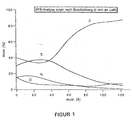
- the percentage of carbon is increasing while the proportions of metal, possibly nitrogen, Boron and oxygen increase. Which deals with the layer thickness changing composition is in Figure 1 using the example of a titanium-containing layer. How this layer structure in individual can be produced is described below become.
- the composition changes the metal-containing layer in its uppermost areas. carbon and oxygen increase while the proportions increase Slightly remove metal and nitrogen. This change is in Figure 2 also using the example of a titanium-containing layer shown.
- the layer compositions of FIGS. 1 and 2 were determined by XPS (X-ray photoelectron spectroscopy). The depth profiles were recorded by sputtering the layers with Ar + .
- Roughness measurements of the layer surfaces have shown that they are extremely smooth.
- the roughness value R a 0.001 ⁇ m was measured for the layer surfaces according to the invention.
- the layers according to the invention adhere extremely firmly to the plastic substrate. Measurements have shown tensile strengths of> 6 N / mm 2 (failure of the adhesive in the pull-off test).
- the plastic substrate Before coating impurities rid of (e.g. lubricant from the manufacturing process, of contamination from the packaging material Etc.).
- This can be done, for example, by using more liquid Cleaning agents are used, however, cleaning is advisable with the help of a low pressure plasma (see e.g. A. Mann, plasma modification of plastic surfaces for Increase in adhesive strength of metal layers, dissertation, University of Stuttgart, 1993).
- a low pressure plasma see e.g. A. Mann, plasma modification of plastic surfaces for Increase in adhesive strength of metal layers, dissertation, University of Stuttgart, 1993.
- the starting substances are not gaseous, these must be converted into the gas phase.
- the starting compounds in the reaction space becomes a Carrier gas used.
- Carrier gas come as carrier gas Nitrogen and hydrogen, as well as all noble gases.
- the carrier gases can also be reaction gases, e.g. Nitrogen. Pure oxygen is unsuitable as a carrier gas.
- a pressure of approximately 0.1 to ⁇ 50 mbar is maintained in the reactor.
- the plastic substrate to be coated in the reactor is usually heated directly.
- the temperature should not exceed 100 ° C, otherwise it will cause damage of the plastic substrate can come. Additional energy will be provided by the coupling of the plasma.
- the Starting substances in the gas space reach the Substrate surface and are there with decomposition and Reaction deposited.
- a schematic representation of the The method is shown in Figure 3. First, the Transport (1) of the starting substances using a Carrier gas. By diffusion and adsorption (2) Starting substance to the substrate surface, where a reaction (3) the starting substances take place. Volatile split off Residues are returned to the gas phase by diffusion (4) returned and then the removal takes place (5). The metal-containing reaction product, however, is on the surface deposited the substrate.
- the effect of the coupled plasma is low, and the one initially deposited on the substrate surface Substance still contains considerable amounts of carbon. These compounds have a high affinity for the surface of the plastic substrate and can partially diffuse into it, which leads to strong adhesion. With increasing Coating the substrate increases the effect of the plasma, there is more energy available, and that Reaction reactions of the starting substances always take place more complete, i.e. it's getting less and less carbon, for that but percent more metal built into the layer.
- the final is at a layer thickness of approx. 20 nm Composition of the metal-containing layer reached. With increasing Layer composition does not change more. Only after the coating process has been canceled there is still a slight change in composition the outermost part of the metal-containing layer, like the figures 1 and 2 show.
- the following diagram shows the step-by-step reaction using the starting compound Ti [N (CH 3 ) 2 ] 4 as a function of the energy available for the reaction:
- the concentration the starting compound is relative in the reaction space low to ensure that the layers grow together as early as possible and thus to achieve the smallest possible layer thickness. This results in an extremely smooth surface of the layer, causing excellent tolerance to body fluids, such as. Blood, is guaranteed.
- biocompatible surfaces can be used otherwise very good electrical conductivity non-conductive plastics are generated, which creates a Numerous new areas of application in medical technology is developed.
- the plastic substrate to be coated was on its surface cleaned in a low pressure plasma.
- nitrogen was sparged at a rate of about 5 l / h. introduced into the reactor, using a vacuum pump in the Reactor pressure of about 1 mbar was maintained.
- an external copper ring became an inductive one with 50 W.
- Ti [N (CH 3 ) 2 ] 4 was used as the liquid organometallic starting compound. Pure hydrogen flowed through the starting compound at 5 ° C. By cooling the evaporator, an excessively high concentration of the starting substance in the reaction space and thus an uneven layer structure are avoided.
- the hydrogen loaded with the starting substance flows into the reactor, in which the heated to about 100 ° C in Low pressure plasma pretreated plastic substrate (PET) is located.
- the reaction of the starting compound is controlled by additional Energy supply, namely by coupling in a low-pressure plasma triggered.
- the plasma is at a pressure in the Reaction space of approx. 1 mbar using the outside Copper rings inductively coupled at a frequency of 13.56 MHz.
- the gas becomes partial in the area of the substrate ionizes or radicals are formed. critical is that due to the reduced pressure in the gas space the gas temperature itself is only slightly increased, however, particles contained in the gas are extremely high in energy are and thus the reaction started at temperatures can be reduced significantly.
- the starting substance and the initial layer build up consists of a metal-containing compound that is still very rich in carbon is while the other components, like the metal and the nitrogen, only present in small percentages are. This leads to particularly good liability the plastic substrate, which is caused by diffusion of the initially deposited particles in the plastic reinforced becomes.
- Figure 1 shows in a layer depth of approx. 2 nm a composition consisting of approx. 40 atomic% Ti, 35 atomic% C, 15 atomic% N and 10 atomic% O. This Layer composition corresponds to the termination of the Coating process. As the reaction subsides, it changes the composition again a little, as in Figure 1 also can be seen.
- the composite material obtained was examined with XPS (X-ray photo-electron spectroscopy) for its layer composition.
- the depth profiles were recorded by sputtering the layers with Ar + . The result is shown in FIG. 1.
- the tensile strength of the metal-containing layer on the plastic substrate was also measured. Values of> 6 N / mm 2 were measured. This means that the adhesive failed during the attempt to pull it off, while the metal-containing layer adhered to the plastic substrate.
Landscapes
- Chemical & Material Sciences (AREA)
- Metallurgy (AREA)
- Chemical Kinetics & Catalysis (AREA)
- Engineering & Computer Science (AREA)
- Materials Engineering (AREA)
- Mechanical Engineering (AREA)
- General Chemical & Material Sciences (AREA)
- Organic Chemistry (AREA)
- Inorganic Chemistry (AREA)
- Materials For Medical Uses (AREA)
- Laminated Bodies (AREA)
- Chemical Vapour Deposition (AREA)
- Other Surface Treatments For Metallic Materials (AREA)
- Glass Compositions (AREA)
Claims (10)
- Matériau composite constitué d'un substrat en matière plastique et d'une couche métallique mince fermée,
caractérisé en ce que la couche métallique est ductile, adhère solidement au substrat en matière plastique, présente une épaisseur < 2 µm et est formée d'un composé de formule- M
- signifie un ou plusieurs métaux du groupe formé formé de Ti, Ta, Nb, Zr et Hf,
b = 0,025 à 0,7
x = 0,2 à 0,9
y = 0 à 0,7
z = 0 à 0,7
a + b + x + y + z = 1,
avec la condition que la valeur de a, partant d'une valeur proche de zéro à la surface du substrat, augmente vers la surface de la couche, et qu'au moins 50 % des atomes de carbone à la base de la couche soient liés à d'autres atomes de carbone au moyen de liaisons C-C. - Matériau composite selon la revendication 1, caractérisé en ce que le substrat en matière plastique est formé de téréphtalate de polyéthylène, de polyuréthanne, de polytétrafluoroéthylène, de polyamide ou de polypropylène.
- Matériau composite selon la revendication 1 ou 2, caractérisé en ce que M = Ti.
- Matériau composite selon les revendications 1 à 3, caractérisé en ce que ce qui suit s'applique aux valeurs de a, b, x, y et z :(i) à la base de la couche métallique :a = 0,025 - 0,1b = 0,025 - 0,2x = 0,8 - 0,9y = 0 - 0,1z = 0 - 0,1(ii) la valeur de a augmente quand l'épaisseur de la couche métallique augmente, et(iii) à proximité de la surface de la couche métallique :a = 0,2 - 0,9b = 0,025 - 0,7x = 0 - 0,7y = 0 - 0,7z = 0 - 0,5.
- Matériau composite selon les revendications 1 à 4, dont la couche contient, en outre, de l'hydrogène.
- Procédé de fabrication d'un matériau composite selon les revendications 1 à 5, caractérisé en ce que :a) on nettoie le substrat en matière plastique,b) on choisit un composé de départ métallo-organique ou organométallique approprié,c) on amène le composé de départ métallo-organique ou organométallique en phase gazeuse s'il n'est pas à l'état gazeux,d) on transporte le composé métallo-organique ou organométallique gazeux, en tant que composé de départ, à l'aide d'un gaz porteur, dans un réacteur dans lequel se trouve le substrat en matière plastique, à la surface duquel les composés de départ se déposent par dépôt chimique en phase gazeuse avec décomposition et réaction,e) de l'énergie étant amenée au substrat par injection de plasma et, le cas échéant, par chauffage direct, de façon à ce qu'une température de 100°C ne soit pas dépassée, l'effet du plasma permettant d'obtenir un gradient de carbone et de métal dans la direction de l'épaisseur de la couche,f) dans l'espace de réaction, on maintient une pression de 0,1 à < 50 mbar,
etg) ensuite, on stocke le matériau composite à l'air. - Procédé selon la revendication 6, caractérisé en ce qu'on utilise de l'hydrogène comme gaz porteur.
- Procédé selon la revendication 6 ou 7, caractérisé en ce qu'on utilise, comme composé métallo-organique ou organométallique,
M[N[CH3]2]4, M[N[C2H5]2]4, M[N(CH2)(C[CH3]2)]4,
((NtBu)M[N(CH3)2]2)2, ((NtBu)M[N(C2H5)2]2)2,
M(CH2 tBu)4 et/ou (C5H5)2MCl2,
où M = Ti, Zr ou Hf. - Procédé selon la revendication 8, caractérisé en qu'on utilise du Ti[N(CH3)2]4 comme composé métallo-organique ou organométallique.
- Procédé selon la revendication 6 ou 7, caractérisé en ce qu'on utilise du M[N[CH3]2]5, du M[N[C2H5)2]5 et/ou du [N[C2H5]2]3M=NtBu, où M = Ta ou Nb, comme composé métallo-organique ou organométallique.
Applications Claiming Priority (2)
| Application Number | Priority Date | Filing Date | Title |
|---|---|---|---|
| DE19736449 | 1997-08-21 | ||
| DE19736449A DE19736449A1 (de) | 1997-08-21 | 1997-08-21 | Verbundwerkstoff |
Publications (2)
| Publication Number | Publication Date |
|---|---|
| EP0897997A1 EP0897997A1 (fr) | 1999-02-24 |
| EP0897997B1 true EP0897997B1 (fr) | 2003-02-26 |
Family
ID=7839760
Family Applications (1)
| Application Number | Title | Priority Date | Filing Date |
|---|---|---|---|
| EP98115821A Expired - Lifetime EP0897997B1 (fr) | 1997-08-21 | 1998-08-21 | Matériau composite |
Country Status (5)
| Country | Link |
|---|---|
| US (1) | US6057031A (fr) |
| EP (1) | EP0897997B1 (fr) |
| JP (1) | JP4420482B2 (fr) |
| AT (1) | ATE233328T1 (fr) |
| DE (2) | DE19736449A1 (fr) |
Cited By (20)
| Publication number | Priority date | Publication date | Assignee | Title |
|---|---|---|---|---|
| DE102007009095A1 (de) | 2007-02-24 | 2008-08-28 | Gfe Nanomedical International Ag | Verfahren zur Behandlung biologischer Gewebe tierischen oder menschlichen Ursprungs wie Schweine-, Rinderperikard- oder menschlicher Leichen-Herzklappen sowie entsprechend behandeltes biologisches Gewebe |
| US7986999B2 (en) | 2006-11-30 | 2011-07-26 | Cardiac Pacemakers, Inc. | RF rejecting lead |
| US8103360B2 (en) | 2008-05-09 | 2012-01-24 | Foster Arthur J | Medical lead coil conductor with spacer element |
| US8244346B2 (en) | 2008-02-06 | 2012-08-14 | Cardiac Pacemakers, Inc. | Lead with MRI compatible design features |
| US8332050B2 (en) | 2009-06-26 | 2012-12-11 | Cardiac Pacemakers, Inc. | Medical device lead including a unifilar coil with improved torque transmission capacity and reduced MRI heating |
| US8335572B2 (en) | 2009-10-08 | 2012-12-18 | Cardiac Pacemakers, Inc. | Medical device lead including a flared conductive coil |
| US8391994B2 (en) | 2009-12-31 | 2013-03-05 | Cardiac Pacemakers, Inc. | MRI conditionally safe lead with low-profile multi-layer conductor for longitudinal expansion |
| US8666512B2 (en) | 2011-11-04 | 2014-03-04 | Cardiac Pacemakers, Inc. | Implantable medical device lead including inner coil reverse-wound relative to shocking coil |
| US8731685B2 (en) | 2007-12-06 | 2014-05-20 | Cardiac Pacemakers, Inc. | Implantable lead having a variable coil conductor pitch |
| US8798767B2 (en) | 2009-12-31 | 2014-08-05 | Cardiac Pacemakers, Inc. | MRI conditionally safe lead with multi-layer conductor |
| US8825181B2 (en) | 2010-08-30 | 2014-09-02 | Cardiac Pacemakers, Inc. | Lead conductor with pitch and torque control for MRI conditionally safe use |
| US8825179B2 (en) | 2012-04-20 | 2014-09-02 | Cardiac Pacemakers, Inc. | Implantable medical device lead including a unifilar coiled cable |
| US8954168B2 (en) | 2012-06-01 | 2015-02-10 | Cardiac Pacemakers, Inc. | Implantable device lead including a distal electrode assembly with a coiled component |
| US8958889B2 (en) | 2012-08-31 | 2015-02-17 | Cardiac Pacemakers, Inc. | MRI compatible lead coil |
| US8983623B2 (en) | 2012-10-18 | 2015-03-17 | Cardiac Pacemakers, Inc. | Inductive element for providing MRI compatibility in an implantable medical device lead |
| US9084883B2 (en) | 2009-03-12 | 2015-07-21 | Cardiac Pacemakers, Inc. | Thin profile conductor assembly for medical device leads |
| US9254380B2 (en) | 2009-10-19 | 2016-02-09 | Cardiac Pacemakers, Inc. | MRI compatible tachycardia lead |
| EP2491959B1 (fr) | 2011-02-24 | 2016-08-17 | Biotronik AG | Matériau biologique revêtu doté de propriétés améliorées pour la fabrication de prothèses de valvule cardiaque |
| US9504821B2 (en) | 2014-02-26 | 2016-11-29 | Cardiac Pacemakers, Inc. | Construction of an MRI-safe tachycardia lead |
| US9750944B2 (en) | 2009-12-30 | 2017-09-05 | Cardiac Pacemakers, Inc. | MRI-conditionally safe medical device lead |
Families Citing this family (27)
| Publication number | Priority date | Publication date | Assignee | Title |
|---|---|---|---|---|
| DE19945299A1 (de) * | 1999-09-22 | 2001-03-29 | Gfe Met & Mat Gmbh | Plasmabeschichtungsverfahren und dreidimensionales Kunststoffsubstrat mit einer metallhaltigen Beschichtung auf der Kunststoffoberfläche |
| EP1152066A1 (fr) * | 2000-05-05 | 2001-11-07 | Ingersoll-Rand Company | Films colorés de nitrure de métal et procédé d'obtention |
| DE10026540A1 (de) * | 2000-05-27 | 2001-11-29 | Gfe Met & Mat Gmbh | Gegenstand, insbesondere Implantat |
| WO2002009791A1 (fr) * | 2000-07-28 | 2002-02-07 | Blue Medical Devices B.V. | Stent intravasculaire avec revetement extensible |
| US6969539B2 (en) | 2000-09-28 | 2005-11-29 | President And Fellows Of Harvard College | Vapor deposition of metal oxides, silicates and phosphates, and silicon dioxide |
| DE10053611A1 (de) | 2000-10-28 | 2002-05-02 | Inst Textil & Faserforschung | Bioresorbierbare Nervenleitschiene |
| EP1357863B1 (fr) * | 2001-01-02 | 2010-11-10 | Advanced Ceramics Research, Inc. | Compositions et procedes destines a des applications biomedicales |
| US8470019B1 (en) * | 2001-11-30 | 2013-06-25 | Advanced Cardiovascular Systems, Inc. | TiNxOy modified surface for an implantable device and a method of producing the same |
| SE0200269D0 (sv) * | 2002-01-31 | 2002-01-31 | Ellem Bioteknik Ab | Material for implantation |
| DE10210970B9 (de) * | 2002-03-13 | 2006-06-22 | Aesculap Ag & Co. Kg | Hüftgelenk-Endoprothese |
| EP1454999A1 (fr) * | 2002-12-03 | 2004-09-08 | HARTEC GESELLSCHAFT FUR HARTSTOFFE UND DUNNSCHICHTTECHNIK MBH & CO. KG | Matériau ou article présentant un revêtement métallique |
| US7723242B2 (en) * | 2004-03-15 | 2010-05-25 | Sharp Laboratories Of America, Inc. | Enhanced thin-film oxidation process |
| DE10317793B4 (de) * | 2003-04-16 | 2007-02-22 | AHC-Oberflächentechnik GmbH & Co. OHG | Verwendung eines Gegenstands als elektrisches oder elektronisches Bauteil |
| DE20306637U1 (de) * | 2003-04-28 | 2003-06-26 | GfE Medizintechnik GmbH, 90431 Nürnberg | Weichteilimplantate wie Brustimplantat, Wadenmuskelprothese o.dgl. |
| DE20306635U1 (de) * | 2003-04-28 | 2003-06-26 | GfE Medizintechnik GmbH, 90431 Nürnberg | Chirurgische Flächeneinlage |
| FR2883287A1 (fr) * | 2005-03-16 | 2006-09-22 | Air Liquide | Precurseurs organo-metalliques et leur procede de fabrication |
| RU2281122C1 (ru) * | 2005-06-30 | 2006-08-10 | Евгений Александрович Левашов | Биосовместимые многокомпонентные наноструктурные покрытия для медицины |
| DE102005032604A1 (de) * | 2005-07-13 | 2007-01-18 | Gfe Medizintechnik Gmbh | Resorbierbares, in den Körper einsetzbares medizinisches Element, insbesondere resorbierbares Implantat |
| WO2007066546A1 (fr) * | 2005-12-06 | 2007-06-14 | Tri Chemical Laboratories Inc. | Compose de hafnium, materiau a base de hafnium formant des films minces et procede de formation de films minces a base de hafnium |
| WO2010059305A1 (fr) * | 2008-11-20 | 2010-05-27 | Cardiac Pacemakers, Inc. | Électrode repoussant les cellules comportant une surface structurée |
| EP2408513B1 (fr) * | 2009-03-17 | 2015-09-23 | Cardiac Pacemakers, Inc. | Revêtement d'électrode à fibres poreuses et procédés associés |
| US20100262244A1 (en) * | 2009-04-14 | 2010-10-14 | Warsaw Orthopedic, Inc. | Metal Coated Implant |
| DE102009037183B4 (de) | 2009-08-12 | 2012-03-22 | Bayerische Motoren Werke Aktiengesellschaft | Verfahren zur Herstellung eines Formteils, insbesondere eines Bedienteils für den Fahrgastraum eines Kraftfahrzeugs |
| JP5631728B2 (ja) * | 2010-12-28 | 2014-11-26 | 株式会社アルバック | 絶縁膜形成方法、及び絶縁膜形成装置 |
| EP3094489A4 (fr) * | 2014-01-16 | 2017-09-13 | Okinawa Institute of Science and Technology School Corporation | Conception et assemblage de films poreux de tantale à gradient d'oxyde obtenus à partir de nanoparticules sélectionnées selon la taille, et application d'implants dentaires et biomédicaux de ceux-ci |
| CN110904428A (zh) * | 2019-12-25 | 2020-03-24 | 惠州市迪思特精细化工有限公司 | 工程塑料表面金属化电镀方法 |
| WO2023032958A1 (fr) * | 2021-08-30 | 2023-03-09 | 国立大学法人大阪大学 | Stratifié doté d'une couche de résine et d'une couche métallique et son procédé de production |
Family Cites Families (12)
| Publication number | Priority date | Publication date | Assignee | Title |
|---|---|---|---|---|
| EP0174743A3 (fr) * | 1984-09-05 | 1988-06-08 | Morton Thiokol, Inc. | Procédé de dépôt de films minces de nitrures de métaux de transition |
| US4777090A (en) * | 1986-11-03 | 1988-10-11 | Ovonic Synthetic Materials Company | Coated article and method of manufacturing the article |
| DE3905417C2 (de) * | 1989-02-22 | 1997-07-10 | Sueddeutsche Kalkstickstoff | Verfahren zur Herstellung von dünnen Niob- und/oder Nioboxidfilmen |
| US5139825A (en) * | 1989-11-30 | 1992-08-18 | President And Fellows Of Harvard College | Process for chemical vapor deposition of transition metal nitrides |
| EP0487661A4 (en) * | 1990-04-20 | 1995-04-12 | Commw Scient Ind Res Org | Cell growth substrates |
| JP2764472B2 (ja) * | 1991-03-25 | 1998-06-11 | 東京エレクトロン株式会社 | 半導体の成膜方法 |
| JPH07109034B2 (ja) * | 1991-04-08 | 1995-11-22 | ワイケイケイ株式会社 | 硬質多層膜形成体およびその製造方法 |
| US5607463A (en) * | 1993-03-30 | 1997-03-04 | Medtronic, Inc. | Intravascular medical device |
| MX9603104A (es) * | 1994-02-01 | 1997-03-29 | Howmedica | Protesis de clavo femorales recubiertas. |
| AU1542895A (en) * | 1994-02-03 | 1995-08-21 | Smith & Nephew Plc | Surface treatment |
| DE19506188C2 (de) * | 1995-02-22 | 2003-03-06 | Miladin Lazarov | Implantat und dessen Verwendung |
| TW479085B (en) * | 2000-08-09 | 2002-03-11 | Murata Machinery Ltd | Three dimensional structure, and device and method for manufacturing a three dimensional structure |
-
1997
- 1997-08-21 DE DE19736449A patent/DE19736449A1/de not_active Withdrawn
-
1998
- 1998-08-20 JP JP25194998A patent/JP4420482B2/ja not_active Expired - Fee Related
- 1998-08-21 AT AT98115821T patent/ATE233328T1/de active
- 1998-08-21 US US09/137,815 patent/US6057031A/en not_active Expired - Lifetime
- 1998-08-21 DE DE59807288T patent/DE59807288D1/de not_active Expired - Lifetime
- 1998-08-21 EP EP98115821A patent/EP0897997B1/fr not_active Expired - Lifetime
Cited By (33)
| Publication number | Priority date | Publication date | Assignee | Title |
|---|---|---|---|---|
| US7986999B2 (en) | 2006-11-30 | 2011-07-26 | Cardiac Pacemakers, Inc. | RF rejecting lead |
| US8170688B2 (en) | 2006-11-30 | 2012-05-01 | Cardiac Pacemakers, Inc. | RF rejecting lead |
| US8401671B2 (en) | 2006-11-30 | 2013-03-19 | Cardiac Pacemakers, Inc. | RF rejecting lead |
| US8670840B2 (en) | 2006-11-30 | 2014-03-11 | Cardiac Pacemakers, Inc. | RF rejecting lead |
| DE102007009095A1 (de) | 2007-02-24 | 2008-08-28 | Gfe Nanomedical International Ag | Verfahren zur Behandlung biologischer Gewebe tierischen oder menschlichen Ursprungs wie Schweine-, Rinderperikard- oder menschlicher Leichen-Herzklappen sowie entsprechend behandeltes biologisches Gewebe |
| US8426199B2 (en) | 2007-02-24 | 2013-04-23 | Gfe Nanomedical International Ag | Method for the treatment of biological tissue of animal or human origin, such as porcine, bovine pericardium or human cadaver heart valves, and biological tissue treated accordingly |
| US8731685B2 (en) | 2007-12-06 | 2014-05-20 | Cardiac Pacemakers, Inc. | Implantable lead having a variable coil conductor pitch |
| US8666508B2 (en) | 2008-02-06 | 2014-03-04 | Cardiac Pacemakers, Inc. | Lead with MRI compatible design features |
| US8244346B2 (en) | 2008-02-06 | 2012-08-14 | Cardiac Pacemakers, Inc. | Lead with MRI compatible design features |
| US8103360B2 (en) | 2008-05-09 | 2012-01-24 | Foster Arthur J | Medical lead coil conductor with spacer element |
| US8688236B2 (en) | 2008-05-09 | 2014-04-01 | Cardiac Pacemakers, Inc. | Medical lead coil conductor with spacer element |
| US9084883B2 (en) | 2009-03-12 | 2015-07-21 | Cardiac Pacemakers, Inc. | Thin profile conductor assembly for medical device leads |
| US8744600B2 (en) | 2009-06-26 | 2014-06-03 | Cardiac Pacemakers, Inc. | Medical device lead including a unifilar coil with improved torque transmission capacity and reduced MRI heating |
| US8332050B2 (en) | 2009-06-26 | 2012-12-11 | Cardiac Pacemakers, Inc. | Medical device lead including a unifilar coil with improved torque transmission capacity and reduced MRI heating |
| US8335572B2 (en) | 2009-10-08 | 2012-12-18 | Cardiac Pacemakers, Inc. | Medical device lead including a flared conductive coil |
| US9254380B2 (en) | 2009-10-19 | 2016-02-09 | Cardiac Pacemakers, Inc. | MRI compatible tachycardia lead |
| US9750944B2 (en) | 2009-12-30 | 2017-09-05 | Cardiac Pacemakers, Inc. | MRI-conditionally safe medical device lead |
| US9050457B2 (en) | 2009-12-31 | 2015-06-09 | Cardiac Pacemakers, Inc. | MRI conditionally safe lead with low-profile conductor for longitudinal expansion |
| US8676351B2 (en) | 2009-12-31 | 2014-03-18 | Cardiac Pacemakers, Inc. | MRI conditionally safe lead with low-profile multi-layer conductor for longitudinal expansion |
| US8391994B2 (en) | 2009-12-31 | 2013-03-05 | Cardiac Pacemakers, Inc. | MRI conditionally safe lead with low-profile multi-layer conductor for longitudinal expansion |
| US8798767B2 (en) | 2009-12-31 | 2014-08-05 | Cardiac Pacemakers, Inc. | MRI conditionally safe lead with multi-layer conductor |
| US9199077B2 (en) | 2009-12-31 | 2015-12-01 | Cardiac Pacemakers, Inc. | MRI conditionally safe lead with multi-layer conductor |
| US8825181B2 (en) | 2010-08-30 | 2014-09-02 | Cardiac Pacemakers, Inc. | Lead conductor with pitch and torque control for MRI conditionally safe use |
| EP2491959B1 (fr) | 2011-02-24 | 2016-08-17 | Biotronik AG | Matériau biologique revêtu doté de propriétés améliorées pour la fabrication de prothèses de valvule cardiaque |
| US8666512B2 (en) | 2011-11-04 | 2014-03-04 | Cardiac Pacemakers, Inc. | Implantable medical device lead including inner coil reverse-wound relative to shocking coil |
| US8825179B2 (en) | 2012-04-20 | 2014-09-02 | Cardiac Pacemakers, Inc. | Implantable medical device lead including a unifilar coiled cable |
| US9333344B2 (en) | 2012-06-01 | 2016-05-10 | Cardiac Pacemakers, Inc. | Implantable device lead including a distal electrode assembly with a coiled component |
| US8954168B2 (en) | 2012-06-01 | 2015-02-10 | Cardiac Pacemakers, Inc. | Implantable device lead including a distal electrode assembly with a coiled component |
| US8958889B2 (en) | 2012-08-31 | 2015-02-17 | Cardiac Pacemakers, Inc. | MRI compatible lead coil |
| US8983623B2 (en) | 2012-10-18 | 2015-03-17 | Cardiac Pacemakers, Inc. | Inductive element for providing MRI compatibility in an implantable medical device lead |
| US9504822B2 (en) | 2012-10-18 | 2016-11-29 | Cardiac Pacemakers, Inc. | Inductive element for providing MRI compatibility in an implantable medical device lead |
| US9504821B2 (en) | 2014-02-26 | 2016-11-29 | Cardiac Pacemakers, Inc. | Construction of an MRI-safe tachycardia lead |
| US9682231B2 (en) | 2014-02-26 | 2017-06-20 | Cardiac Pacemakers, Inc. | Construction of an MRI-safe tachycardia lead |
Also Published As
| Publication number | Publication date |
|---|---|
| JP4420482B2 (ja) | 2010-02-24 |
| US6057031A (en) | 2000-05-02 |
| DE59807288D1 (de) | 2003-04-03 |
| ATE233328T1 (de) | 2003-03-15 |
| JPH11229146A (ja) | 1999-08-24 |
| DE19736449A1 (de) | 1999-02-25 |
| EP0897997A1 (fr) | 1999-02-24 |
Similar Documents
| Publication | Publication Date | Title |
|---|---|---|
| EP0897997A1 (fr) | Matériau composite | |
| EP0810889B1 (fr) | Implant | |
| DE68906467T2 (de) | Verfahren zur schnellen Anheftung endothelialer Zellen an eine Oberfläche sowie dadurch hergestellte Oberflächen. | |
| DE69430441T2 (de) | Katheter mit langwirkender antimikrobieller oberflächenbehandlung | |
| EP2648773B1 (fr) | Revêtement antibactérien pour un implant et procédé de production de ce revêtement | |
| EP1223993A1 (fr) | Implant enrob biocompatible | |
| DE102007047629A1 (de) | Verfahren zum Aufbringen einer hochfesten Beschichtung auf Werkstücke und/oder Werkstoffe | |
| DE2021320A1 (de) | Kuenstliches Glied bzw. Organ fuer Lebewesen | |
| DE10031198A1 (de) | Verfahren zum Beschichten implantierbarer Geräte | |
| EP1087034A1 (fr) | Procédé de revêtement par plasma et substrat tridimensionnel revêtu | |
| DE10026540A1 (de) | Gegenstand, insbesondere Implantat | |
| DE4328999C2 (de) | Medizinisches Gerät und Verfahren zu seiner Versilberung | |
| DE102016200367B3 (de) | Verfahren zum Herstellen einer dünnen Schicht aus porösem DLC, Verwendung einer PECVD-Anlage und mit porösem DLC beschichtetes Werkstück | |
| EP2526218A1 (fr) | Système assisté par plasma ou par ions pour la réalisation de revêtements adhésifs sur des fluoropolymères | |
| DE102012109272B4 (de) | Nanostrukturierte offenporige Diffusionsschicht für die kontrollierte Abgabe von Kupferionen zum gezielten Abtöten von MRE-Keimen | |
| EP1788114B1 (fr) | Procédé de fabrication d'une couche de carbone amorphe | |
| EP2692855B1 (fr) | Structuration de surface pour des applications médicales et/ou de biologie cellulaire | |
| DE19822935C2 (de) | Verfahren zum haftenden Aufbringen einer Schmierstoffschicht auf eine freiliegende und tribologisch beanspruchte Oberfläche eines Formwerkzeuges, insbesondereeines Umformwerkzeuges wie Tiefziehpressen und dgl. sowie Formwerkzeug mit auf seiner freiliegenden Oberfläche haftenden Schmierstoffschicht | |
| DE102017113758A1 (de) | Beschichtung oder mit einer Beschichtung versehener Körper sowie Verfahren zu deren Herstellung | |
| DE102024110326A1 (de) | Verfahren zur Herstellung eines Mehrschichtaufbaus, Mehrschichtaufbau und Verwendung eines Mehrschichtaufbaus | |
| DE102005054704A1 (de) | Thrombozytenabweisende Schicht, Verfahren zu ihrer Herstellung und medizinisches Instrument oder Implantat | |
| DD282391A5 (de) | Verfahren zur passivierenden und die biovertraeglichkeit erhoehenden beschichtung von polymerwerkstoffen | |
| EP1140238A1 (fr) | Revetement constitue de polymere fluore et son procede de production |
Legal Events
| Date | Code | Title | Description |
|---|---|---|---|
| PUAI | Public reference made under article 153(3) epc to a published international application that has entered the european phase |
Free format text: ORIGINAL CODE: 0009012 |
|
| AK | Designated contracting states |
Kind code of ref document: A1 Designated state(s): AT BE CH DE FR GB IT LI LU |
|
| AX | Request for extension of the european patent |
Free format text: AL;LT;LV;MK;RO;SI |
|
| 17P | Request for examination filed |
Effective date: 19990819 |
|
| AKX | Designation fees paid |
Free format text: AT BE CH DE FR GB IT LI LU |
|
| 17Q | First examination report despatched |
Effective date: 20000904 |
|
| GRAH | Despatch of communication of intention to grant a patent |
Free format text: ORIGINAL CODE: EPIDOS IGRA |
|
| GRAH | Despatch of communication of intention to grant a patent |
Free format text: ORIGINAL CODE: EPIDOS IGRA |
|
| GRAA | (expected) grant |
Free format text: ORIGINAL CODE: 0009210 |
|
| AK | Designated contracting states |
Designated state(s): AT BE CH DE FR GB IT LI LU |
|
| REG | Reference to a national code |
Ref country code: GB Ref legal event code: FG4D Free format text: NOT ENGLISH |
|
| REG | Reference to a national code |
Ref country code: CH Ref legal event code: EP |
|
| REG | Reference to a national code |
Ref country code: CH Ref legal event code: NV Representative=s name: SERVOPATENT GMBH |
|
| REF | Corresponds to: |
Ref document number: 59807288 Country of ref document: DE Date of ref document: 20030403 Kind code of ref document: P |
|
| GBT | Gb: translation of ep patent filed (gb section 77(6)(a)/1977) |
Effective date: 20030410 |
|
| ET | Fr: translation filed | ||
| PLBE | No opposition filed within time limit |
Free format text: ORIGINAL CODE: 0009261 |
|
| RAP2 | Party data changed (patent owner data changed or rights of a patent transferred) |
Owner name: GFE GESELLSCHAFT FUER ELEKTROMETALLURGIE MBH |
|
| STAA | Information on the status of an ep patent application or granted ep patent |
Free format text: STATUS: NO OPPOSITION FILED WITHIN TIME LIMIT |
|
| 26N | No opposition filed |
Effective date: 20031127 |
|
| BECA | Be: change of holder's address |
Owner name: *GFE MEDICAL A.G.ARMULFSTRASSE 126, D-80636 M?NCHE Effective date: 20040930 |
|
| BECH | Be: change of holder |
Owner name: *GFE MEDICAL A.G. Effective date: 20040930 |
|
| REG | Reference to a national code |
Ref country code: CH Ref legal event code: PUE Owner name: GFE MEDICAL AG Free format text: GFE METALLE UND MATERIALIEN GMBH#HOEFENER STRASSE 45#90431 NUERNBERG (DE) -TRANSFER TO- GFE MEDICAL AG#ARNULFSTRASSE 126#80636 MUENCHEN (DE) |
|
| REG | Reference to a national code |
Ref country code: GB Ref legal event code: 732E |
|
| REG | Reference to a national code |
Ref country code: GB Ref legal event code: 732E |
|
| REG | Reference to a national code |
Ref country code: FR Ref legal event code: TP |
|
| REG | Reference to a national code |
Ref country code: CH Ref legal event code: PFA Owner name: GFE MEDICAL AG Free format text: GFE MEDICAL AG#ARNULFSTRASSE 126#80636 MUENCHEN (DE) -TRANSFER TO- GFE MEDICAL AG#ARNULFSTRASSE 126#80636 MUENCHEN (DE) |
|
| REG | Reference to a national code |
Ref country code: CH Ref legal event code: PFA Owner name: PFM MEDICAL GFE AG Free format text: GFE MEDICAL AG#ARNULFSTRASSE 126#80636 MUENCHEN (DE) -TRANSFER TO- PFM MEDICAL GFE AG#HOEFENER STRASSE 45#90431 NUERNBERG (DE) |
|
| REG | Reference to a national code |
Ref country code: FR Ref legal event code: CD Ref country code: FR Ref legal event code: CA |
|
| REG | Reference to a national code |
Ref country code: DE Ref legal event code: R082 Ref document number: 59807288 Country of ref document: DE Representative=s name: RAU, SCHNECK & HUEBNER PATENTANWAELTE RECHTSAN, DE Ref country code: DE Ref legal event code: R081 Ref document number: 59807288 Country of ref document: DE Owner name: PFM MEDICAL TITANIUM GMBH, DE Free format text: FORMER OWNER: PFM MEDICAL GFE AG, 90431 NUERNBERG, DE |
|
| REG | Reference to a national code |
Ref country code: FR Ref legal event code: PLFP Year of fee payment: 19 |
|
| REG | Reference to a national code |
Ref country code: FR Ref legal event code: PLFP Year of fee payment: 20 |
|
| PGFP | Annual fee paid to national office [announced via postgrant information from national office to epo] |
Ref country code: LU Payment date: 20170823 Year of fee payment: 20 |
|
| PGFP | Annual fee paid to national office [announced via postgrant information from national office to epo] |
Ref country code: CH Payment date: 20170718 Year of fee payment: 20 Ref country code: GB Payment date: 20170824 Year of fee payment: 20 Ref country code: IT Payment date: 20170824 Year of fee payment: 20 Ref country code: FR Payment date: 20170823 Year of fee payment: 20 |
|
| PGFP | Annual fee paid to national office [announced via postgrant information from national office to epo] |
Ref country code: AT Payment date: 20170720 Year of fee payment: 20 Ref country code: BE Payment date: 20170823 Year of fee payment: 20 |
|
| PGFP | Annual fee paid to national office [announced via postgrant information from national office to epo] |
Ref country code: DE Payment date: 20171019 Year of fee payment: 20 |
|
| REG | Reference to a national code |
Ref country code: DE Ref legal event code: R071 Ref document number: 59807288 Country of ref document: DE |
|
| REG | Reference to a national code |
Ref country code: CH Ref legal event code: PL |
|
| REG | Reference to a national code |
Ref country code: GB Ref legal event code: PE20 Expiry date: 20180820 |
|
| REG | Reference to a national code |
Ref country code: AT Ref legal event code: MK07 Ref document number: 233328 Country of ref document: AT Kind code of ref document: T Effective date: 20180821 |
|
| REG | Reference to a national code |
Ref country code: BE Ref legal event code: MK Effective date: 20180821 |
|
| PG25 | Lapsed in a contracting state [announced via postgrant information from national office to epo] |
Ref country code: GB Free format text: LAPSE BECAUSE OF EXPIRATION OF PROTECTION Effective date: 20180820 |