EP0898202B1 - Photogénération d'amines à partir de alpha-aminoacétophénones - Google Patents
Photogénération d'amines à partir de alpha-aminoacétophénones Download PDFInfo
- Publication number
- EP0898202B1 EP0898202B1 EP97810948A EP97810948A EP0898202B1 EP 0898202 B1 EP0898202 B1 EP 0898202B1 EP 97810948 A EP97810948 A EP 97810948A EP 97810948 A EP97810948 A EP 97810948A EP 0898202 B1 EP0898202 B1 EP 0898202B1
- Authority
- EP
- European Patent Office
- Prior art keywords
- alkyl
- substituted
- phenyl
- formula
- unsubstituted
- Prior art date
- Legal status (The legal status is an assumption and is not a legal conclusion. Google has not performed a legal analysis and makes no representation as to the accuracy of the status listed.)
- Expired - Lifetime
Links
Classifications
-
- G—PHYSICS
- G03—PHOTOGRAPHY; CINEMATOGRAPHY; ANALOGOUS TECHNIQUES USING WAVES OTHER THAN OPTICAL WAVES; ELECTROGRAPHY; HOLOGRAPHY
- G03F—PHOTOMECHANICAL PRODUCTION OF TEXTURED OR PATTERNED SURFACES, e.g. FOR PRINTING, FOR PROCESSING OF SEMICONDUCTOR DEVICES; MATERIALS THEREFOR; ORIGINALS THEREFOR; APPARATUS SPECIALLY ADAPTED THEREFOR
- G03F7/00—Photomechanical, e.g. photolithographic, production of textured or patterned surfaces, e.g. printing surfaces; Materials therefor, e.g. comprising photoresists; Apparatus specially adapted therefor
- G03F7/004—Photosensitive materials
- G03F7/038—Macromolecular compounds which are rendered insoluble or differentially wettable
Definitions
- the application is directed to base-catalysed curable compositions comprising ⁇ -aminoketone compounds as latent bases, as well as to a process for curing such compositions, inter alia in combination with radically polymerizable components.
- thermosetting resins epoxy resins have found extremely wide applications due to the variety of chemical reactions and materials that can be used for curing and the many different properties that result. More specifically, their excellent mechanical and chemical properties, high adhesive strength, good heat resistance and high electrical resistance have made them extremely useful. They are widely used in such applications as adhesives, coatings, thermosets or photoresists (see for example C.A. May, Epoxy Resins, Chemistry and Technology, 2nd Ed. Marcel Dekker, New York, 1988). Curing of epoxy resins can be affected by polyaddition reactions which result in coupling as well as crosslinking.
- the most widely used agents for that purpose are active hydrogen compounds such as polyamines, polyacids, polymercaptans, polyphenols, anhydrides, isocyanates etc.. These reactions are in principle stoichiometric reactions between an active hydrogen in the curing agent and an epoxide group, so that the curing agent is usually present in relatively high concentrations. These polyaddition reactions can of course be catalyzed by appropriate catalysts. It is possible to use, for example, dicyandiamide, benzoguanamine or imidazol derivatives as catalysts for the reaction of epoxides with carboxylic acids.
- Anionic and cationic polymerization of epoxides occurs with a variety of Lewis bases and acids as well as with numerous salts and complex initiators.
- amines such as benzyldimethylamine, or 2,4,6-tris(dimethylaminomethyl)phenol and imidazole derivatives are the most useful initiators.
- Secondary amines such as piperidine, diethanolamine and imidazole derivatives, which first undergo addition to the epoxy group via their labile hydrogens and then function as initiators, have also been used.
- epoxides In the case of cationic polymerization, strong Bronsted acids, such as trifluoromethane sulfonic acid, and a wide variety of Lewis acids, the most useful of which are boron trifluoride complexes, can catalyze the cationic polymerization of epoxides.
- the unique property of the epoxides can be used in photoimaging applications if suitable photosensitive compositions are available. In principle, epoxides cannot be cured by typical free-radical chemistry, and, they can therefore only be used in radical photopolymerization systems if suitable reactive groups such as vinyl ethers or acrylates are also present. This is not always desirable.
- Photochemically initiated reactions of epoxy groups require photoinitiators which can generate the appropriate initiating species.
- Cationic photoinitiators of the onium type for instance diaryliodonium salts or triarylsulfonium salts, are well known and can be used for the photoinitiated cationic polymerization of epoxides.
- the cationic photopolymerization mechanism has real advantages such as insensitivity to oxygen, it cannot be used if basic materials are present in the UV-curable formulations. Therefore, there is a need for efficient photogenerated base catalysts which can be used for curing epoxy-containing photosensitive compositions.
- the purpose of the present invention is, first, to provide a new process for photochemically generating tertiary amine catalysts which can be used for the basic catalysis of polyadditions to epoxides and, second, corresponding compositions.
- Photogenerated base catalysts are already known in the art (e.g. Pure and Appl. Chem. 1992, 64 , 1239), and have been applied to photoresist technology (e.g. EP-A 599 571, JP-A 4330444 and EP-A 555 749).
- Amines are the most useful photogenerated bases known to date.
- some known photogenerators of amines such as substituted benzylcarbamates (examples are disclosed in J.Org. Chem.
- tertiary amines are efficient base catalysts which can be used in reactions of epoxides, but few attempts for generating them photochemically have been described.
- Photolysis of tetraalkyl ammonium salts has been proposed as a method of generating tertiary amines photochemically (Polym. Mat. Sci. Eng. 1995, 72 , 201). These compounds require long irradiation times, have an unfavourable absorption spectrum and their structure can only be varied with difficulty. Accordingly, there is a need for efficient photogenerators of tertiary amines. In order to be useful, such compounds must exhibit low reactivity with the formulation before exposure to UV light.
- the storage stability of photosensitive compositions containing them should be high, and they should not become less developable after the predrying step which is usually necessary to remove the solvent. They should have a high absorption in the near UV region in order to generate the free amine efficiently under exposure conditions commonly used in the photoimaging industry. Finally, after irradiation, the generated base should show high catalytic activity in the thermal curing reaction.
- the photolytic cleavage of specific ⁇ -aminoketone compounds in radicals and the photopolymerization process for olefinically unsaturated monomers and oligomers employing said ketone compounds is known and disclosed, inter alia, in US patents US 4 582 862, US 4 992 547 and 5 077 402.
- European Patent Application 555 749 discloses the use of latent bases in hybrid systems, i.e. systems with radically and cationically polymerizable components.
- US patent 4 943 516 discloses hybrid systems comprising a photoinitiator for the radically polymerizable components and inter alia a curing agent for the epoxy component, as well as a process for curing such compositions.
- (4-methylthiobenzoyl)-1methyl-1-morpholino-ethane is named as an example of a photoinitiator for the free radically polymerizable components.
- this invention relates to a composition, comprising
- a further object of the invention is a process for photochemically generating bases in base-catalysed polymerization reactions, characterized in that a compound of formula I, II or III as defined above is added as a latent base to the mixture to be polymerized and irradiated with light of the wavelength from 200 to 700 nm to generate the base.
- At least one compound of the formula I, II or III is present in the inventive composition. Accordingly, mixtures of compounds of the formula I, II or III may be present in the composition, e.g. 1-4, preferably one or two compounds of the formula I, II or II are present.
- C 1 -C 4 Alkyl R 14 , R 15 and R 16 can be, for example, methyl, ethyl, propyl, isopropyl, butyl, isobutyl, sec-butyl or tert-butyl.
- C 1 -C 8 Alkyl R 11 and R 13 can also be, for example, pentyl, hexyl, heptyl, octyl, 2ethylhexyl or 2,2,4,4-tetramethylbutyl.
- C 1 -C 12 Alkyl R 3 , R 4 , R 5 , R 6 , R 7 , R 8 , R 9 , R 10 , R 17 , R 18 , R 19 and R 20 can also be, for example, nonyl, decyl, isodecyl, undecyl or dodecyl.
- C 3 -C 5 Alkenyl R 3 , R 4 , R 11 , R 19 and R 20 can be, for example, allyl, methallyl, crotyl or dimethylallyl, allyl being preferred.
- C 3 -C 12 Alkenyl R 17 and R 18 can also be, for example, hexenyl, octenyl or decenyl.
- R 2 , R 5 , R 6 , R 7 , R 8 and R 9 as cycloalkyl are, in particular, cyclohexyl.
- C 5 -C 12 Cycloalkyl R 3 , R 4 , R 19 and R 20 can also be, for example, cyclooctyl or cyclododecyl.
- Phenyl-C 1 -C 3 alkyl R 3 , R 4 , R 17 , R 18 , R 19 and R 20 is, in particular, benzyl.
- C 1 -C 6 Alkylene Y can be, for example, methylene, or di-, tri-, tetra-, penta- or hexamethylene.
- C 1 -C 7 Alkylene W can be, for example, methylene, ethylene, 1,2-propylene or 1,2-hexylene.
- Alkylidene are unbranched or branched alkyl chains, having two free valences at one carbon atom Accordingly, C 2 -C 6 Alkylidene V and W can be, for example, ethylidene, propylidene, isopropylidene, butylidene, isobutylidene or hexylidene.
- Ar 2 examples are the groups phenyl, 1-naphthyl, 2-naphthyl, 2-furyl, 2-thienyl, 4-chlorophenyl, tolyl, 4-isopropylphenyl, 4-octylphenyl, 3-methoxyphenyl, 4-phenoxyphenyl, 4-phenylphenyl, 4-benzoylphenyl and 4-chloro-1-naphthyl.
- substituted alkyl R 2 are the groups 2-methoxyethyl, 3-butoxypropyl, 2-isopropoxyethyl, 4-phenoxybutyl, 2-chloroethyl, 3-chloropropyl, 2-phenylethyl or 3-phenyl-propyl.
- substituted phenyl R 2 are the groups 4-chlorophenyl, 3-methoxyphenyl, 4-tolyl or 4-butylphenyl.
- Substituted alkyl R 3 and R 4 can be, for example, 2-hydroxyethyl, 2-hydroxypropyl, 2-hydroxyisobutyl, 2-ethoxyethyl, 2-methoxypropyl, 2-butoxyethyl, 2-cyanoethyl, 2-ethoxycarbonylethyl or 2-methoxycarbonylethyl.
- Substituted phenyl R 4 can be, for example, 4-tolyl, 4-tert-butylphenyl, 4-dodecylphenyl, 3-methoxyphenyl or 3-methoxycarbonylphenyl.
- R 4 together with R 2 , is alkylene or phenylalkylene, they preferably form, together with the linking C-atom and N-atom, a 5- or 6-membered heterocyclic ring.
- R 3 and R 4 together are alkylene or interrupted alkylene, they preferably form, together with the linking N-atom, a 5- or 6-membered heterocyclic ring, for example a pyrrolidine, piperidine, morpholine, thiomorpholine or piperidone ring, which can be substituted by one or more hydroxyl, alkoxy or ester groups.
- a 5- or 6-membered heterocyclic ring for example a pyrrolidine, piperidine, morpholine, thiomorpholine or piperidone ring, which can be substituted by one or more hydroxyl, alkoxy or ester groups.
- C 2 -C 8 Alkanoyl R 10 and R 17 can be, for example, propionyl, butyryl, isobutyryl, hexanoyl or octanoyl, but preferably acetyl.
- R 11 , R 19 and R 20 can be, for example, 2-hydroxyethyl, 2-hydroxypropyl or 4-hydroxybutyl.
- Alkylene or interrupted alkylene R 12 can be, for example, ethylene, tri-, tetra-, penta-, hexa-, octa- or dodecamethylene, 2,2-dimethyltrimethylene, 1,3,3-trimethyltetramethylene, 3-oxa-pentamethylene, 3-oxa-heptamethylene, 4,7-dioxadecamethylene, 4,9-dioxadodecamethylene, 3,6,9,12-tetraoxatetradecamethylene or 4-thiaheptamethylene.
- C 1 -C 6 alkyl R 17 is interrupted by one or more O atoms, it is for example interrupted by 1-3, or one or two O atoms.
- R 14 and R 15 together are C 3 -C 7 alkylene, they are, in particular, 1,3- or 1,4-alkylene, for example, 1,3-propylene, 1,3-butylene, 2,4-pentylene, 1,3-hexylene, 1,4-butylene, 1,4-pentylene or 2,4-hexylene.
- 1,3- or 1,4-alkylene for example, 1,3-propylene, 1,3-butylene, 2,4-pentylene, 1,3-hexylene, 1,4-butylene, 1,4-pentylene or 2,4-hexylene.
- Substituted phenyl R 17 , R 18 , R 19 and R 20 can be, for example, 4-chlorophenyl, 3-chlorophenyl, 4-tolyl, 4-tert-butylphenyl, 4-nonylphenyl, 4-dodecylphenyl, 3-methoxyphenyl or 4-ethoxyphenyl.
- a -Si(C 1 -C 8 alkyl) r (phenyl) 3-r group R 17 can be, in particular, -Si(CH 3 ) 3 , -Si(phenyl) 2 CH 3 , -Si(CH 3 ) 2 phenyl, or -Si(phenyl) 3 .
- Substituted C 2 -C 6 alkyl R 17 can be, for example, 2-hydroxyethyl, 2-methoxyethyl or 2-allyloxyethyl.
- Substituted C 2 -C 12 alkyl R 18 can be, for example, 2-mercaptoethyl, 2-hydroxyethyl, 2-hydroxypropyl, 2-methoxyethyl, -CH 2 CH 2 OCH 2 CH 2 CN or -CH 2 CH 2 -OCH 2 CH 2 COOCH 3 .
- Alkoxyalkyl R 19 and R 20 can be, for example, methoxyethyl, ethoxyethyl, 2-ethoxypropyl, 2-butoxyethyl, 3-methoxypropyl or 2-hexyloxyethyl.
- C 2 -C 3 Alkanoyl R 19 and R 20 are, in particular, acetyl.
- Substituted phenyl or naphthyl R 21 can be, for example, 4-tolyl, 4-bromophenyl, 3-chlorophenyl, 4-butylphenyl, 4-octylphenyl, 4-decylphenyl, 4-dodecylphenyl, 3-methoxyphenyl, 4-isopropoxyphenyl, 4-butoxyphenyl, 4-octyloxyphenyl, chloronaphthyl, nonylnaphthyl or dodecylnaphthyl.
- R 19 and R 20 together are alkylene or interrupted alkylene, they form, together with the linking N atom, a heterocyclic ring, preferably a 5- or 6-membered ring, which can be substituted by alkyl, hydroxyl, alkoxy or ester groups.
- a heterocyclic ring preferably a 5- or 6-membered ring, which can be substituted by alkyl, hydroxyl, alkoxy or ester groups.
- examples of such rings are pyrrolidine, piperidine, 4-hydroxypiperidine, 3-ethoxycarbonylpiperidine, morpholine or 2,6-dimethylmorpholine rings.
- acids can be inorganic or organic acids.
- acids can be inorganic or organic acids.
- examples of such acids are HCI, HBr, H 2 SO 4 , H 3 PO 4 , mono- or polycarboxylic acids, for example, acetic acid, oleic acid, succinic acid, sebacic acid, tartaric acid or CF 3 COOH, and sulfonic acids, for example, CH 3 SO 3 H, C 12 H 25 SO 3 H, p-C 12 H 25 -C 6 H 4 -SO 3 H, p-CH 3 -C 6 H 4 -SO 3 H or CF 3 SO 3 H.
- Preferred compounds of the formula I are those in which Ar 1 is a group of formula IV, R 5 and R 6 are hydrogen, halogen, C 1 -C 12 alkyl or a group -OR 17 , -SR 18 , -SOR 18 , -SO 2 -R 18 , -N(R 19 )(R 20 ), -NH-SO 2 R 21 or in which
- Ar 1 is a group of formula IV, wherein R 5 is a group -OR 17 , -SR 18 , -N(R 19 )(R 20 ) or those compounds are preferred in which
- Preferred compounds of formula I are moreover those in which Ar 1 is a group of formula IV, wherein R 5 is hydrogen, halogen or C 1 -C 12 alkyl, and R 6 , R 7 , R 8 and R 9 are hydrogen, R 1 is allyl or benzyl, R 2 is C 1 -C 6 alkyl, allyl or benzyl, R 3 and R 4 are each independently of the other C 1 -C 12 alkyl, C 2 -C 4 alkyl which is substituted by C 1 -C 4 alkoxy, -CN or - COO(C 1 -C 4 alkyl), or R 3 and R 4 are allyl, cyclohexyl or benzyl, or R 3 and R 4 together are C 4 -C 6 alkylene which can be interrupted by -O-.
- R 5 is hydrogen, halogen or C 1 -C 12 alkyl
- R 6 , R 7 , R 8 and R 9 are hydrogen
- R 1 is allyl
- the compounds of formulae I, II and III can be used as latent base catalysts, i.e. as generators of bases, which are activated photochemically, in radiation curable systems.
- Systems which can be cured are those organic compounds which are capable of reacting in a base-catalyzed reaction which can, for example, be a substitution reaction, an addition reaction or a condensation reaction.
- the base is only photogenerated in exposed areas of the composition and therefore e.g. photoimageable thermosetting compositions cured by the photobase catalyst can easily be prepared without any need for an additional radical polymerization process.
- the process of the present invention is therefore useful for curing compositions which do not necessarily contain ethylenically unsaturated double bonds and provides new photoimageable thermosetting compositions cured by an anionic mechanism.
- the component (B) to be cured with the latent bases or in the described process respectively, is generally a compound which contains at least one epoxide group and at least one group which is capable of reacting with epoxides in the presence of a base.
- Component (B) can also be a mixture of at least one epoxide compound and at least one compound which is capable of reacting with epoxides in the presence of a base.
- Compounds capable of reacting with epoxides in the presence of a base are in particular carboxylic compounds, such as carboxylic acids and anhydrides and thiols. Alcohols, amines and amides, generally compounds containing an "active" H-atom are also suitable.
- Epoxide compounds which may be cured with the latent base compounds according to this invention are generally any compounds containing epoxide groups, monomeric or dimeric epoxides, as well as oligomeric or polymeric compounds having epoxide groups.
- Typical examples are epoxidized acrylates, glycidyl ethers of bisphenol A, such as 2,2-bis[4-(2,3-epoxypropoxy)phenyl]propane, phenol and cresol epoxy novolacs, glycidyl ethers of aliphatic diols, diglycidyl ether of hydrogenated bisphenol A, typically, 2,2-bis[4-(2,3-epoxypropoxy)cyclohexyl]propane, 1,1,2,2-tetrakis[4-(2,3-epoxypropoxy)phenyl]ethane, and triglycidyl isocyanurate.
- Preferred are compounds with at least two epoxide groups.
- Epoxide compounds are, inter alia, described in Ullmann's Encyclopedia of Industrial Chemistry, 5 th Edition, Vol. A9, Weinheim, New York, pages 547-553.
- carboxylic acid possessing at least one carboxylic acid group, as compound which is able to react with the epoxide, as for example, dicarboxylic acids or polymeric acids.
- carboxylic acids possessing at least one carboxylic acid group
- dicarboxylic acids or polymeric acids include malonic acid, succinic acid, glutaric acid, adipic acid, sebacic acid, phthalic acid, terephthalic acid, maleic acid, cyclohexane dicarboxylic acid, polymeric acids such as partly saponified polyacrylates, for example Carboset resins available from Goodrich USA.
- copolymers of unsaturated compounds with or without acid functions can be empoyed. Examples are partly esterified styrene-maleic anhydride copolymers, as sold under the trade name Scripset available from Monsanto. Also copolymers containing both, epoxide and acid groups, can be used in the context of the invention. Examples of suitable anhydrides are in particular dibasic anhydrides.
- phthalic anhydride methyltetrahydrophalic anhydride, tetrahydrophthalic anhydride, hexahydrophthalic anhydride, methylhexahydrophthalic anhydride, succinic anhydride, maleic anhydride, itaconic anhydride, and nadic anhydride.
- examples are, inter alia, disclosed in US 5 009 982 and JP-A 89-141904.
- Preferred are compounds with at least 2 acid groups in order to allow crosslinking.
- thiols which are suitable are monomeric, oligomeric, aliphatic or aromatic thiols.
- thiols are pentaerythritol tetra(mercaptoacetate), pentaerythritol tetra(mercaptopropionate), 4,4'-thiobisbenzenethiol, dithiothreitol, mercaptoethanol, dodecane thiol, thioglycolic acid, 3-mercaptopropionic acid, or ethyleneglycol dimercaptoacetate.
- compositions are those, wherein component (B) is a base-catalysed polymerisable or curable organic material.
- the organic material can be present in form of mono- or poly-functional monomers, oligomers or polymers.
- Preferred oligomeric/polymeric systems are the following. Examples of such binder systems which can be catalysed by bases are:
- the components of the system react at ambient or elevated temperature and form a crosslinked coating system which is suitable for many applications.
- Component (A) in the novel composition is usually present in an amount of 0.1-20 % by weight, preferably 1-10 % by weight, for example 1-5 % by weight.
- the sensitivity of the photobase generator compound to the radiation can be further increased by combining said compounds with a suitable sensitizer (C).
- suitable sensitizers are especially sensitizers from the group of carbonyl compounds having a triplet energy of 225-310 kJ/mol.
- appropriate sensitizer compounds furthermore are: xanthones, thioxanthones, phtalimides, anthraquinones, acetophenones, propiophenones, benzophenones, acylnaphthalenes, 2(acylmethylene)-thiazolines, 3-acylcoumarins and 3,3'-carbonylbiscoumarins.
- Preferred sensitizers are thioxanthones, 3-acylcoumarins and 2(aroylmethylene)-thiazolines, thioxanthones and 3-acylcoumarins are particularly preferred.
- Examples of individual compounds which can be used as component (C) according to the invention are disclosed in US 4 992 547, column 16 line 58 to column 17 line 51. These component (C) sensitizers increase the reactivity of the generated amine bases without shortening the shelf life of the compositions.
- the amount of sensitizer (C) in the composition is from 0.01 to 5 % by weight, preferably from 0.025 to 2 % by weight.
- the invention therefore also relates to systems, which additionally contain radically polymerizable compounds (D) besides component (B).
- Such compounds (D) are unsaturated compounds which may include one or more olefinic double bonds. They may be of low (monomeric) or high (oligomeric) molecular mass.
- monomers containing a double bond are alkyl or hydroxyalkyl acrylates or methacrylates, such as methyl, ethyl, butyl, 2-ethylhexyl and 2-hydroxyethyl acrylate, isobornyl acrylate, methyl methacrylate and ethyl methacrylate. Silicone acrylates are also advantageous.
- acrylonitrile acrylamide, methacrylamide, N-substituted (meth)acrylamides
- vinyl esters such as vinyl acetate, vinyl ethers, such as isobutyl vinyl ether, styrene, alkyl- and halostyrenes, N-vinylpyrrolidone, vinyl chloride and vinylidene chloride.
- Examples of monomers containing two or more double bonds are the diacrylates of ethylene glycol, propylene glycol, neopentyl glycol, hexamethylene glycol and of bisphenol A, and 4,4'-bis(2-acryloyloxyethoxy)diphenylpropane, trimethylolpropane triacrylate, pentaerythritol triacrylate or tetraacrylate, vinyl acrylate, divinylbenzene, divinyl succinate, diallyl phthalate, triallyl phosphate, triallyl isocyanurate or tris(2-acryloylethyl) isocyanurate.
- polyunsaturated compounds of relatively high molecular mass examples include acrylated epoxy resins, acrylated polyesters, polyesters containing vinyl ether or epoxy groups, and also polyurethanes and polyethers.
- unsaturated oligomers are unsaturated polyester resins, which are usually prepared from maleic acid, phthalic acid and one or more diols and which have molecular weights from about 500 to 3000.
- oligomers which carry vinyl ether groups and of polymers as described in WO 90/01512.
- copolymers of vinyl ether and maleic acid-functionalized monomers are also suitable.
- Unsaturated oligomers of this kind can also be referred to as prepolymers.
- esters of ethylenically unsaturated carboxylic acids and polyols or polyepoxides and polymers having ethylenically unsaturated groups in the chain or in side groups, for example unsaturated polyesters, polyamides and polyurethanes and copolymers thereof, alkyd resins, polybutadiene and butadiene copolymers, polyisoprene and isoprene copolymers, polymers and copolymers containing (meth)acrylic groups in side chains, and also mixtures of one or more of these polymers.
- unsaturated carboxylic acids are acrylic acid, methacrylic acid, crotonic acid, itaconic acid, cinnamic acid, and unsaturated fatty acids such as linolenic acid or oleic acid.
- Acrylic and methacrylic acid are preferred.
- Suitable polyols are aromatic and, in particular, aliphatic and cycloaliphatic polyols.
- aromatic polyols are hydroquinone, 4,4'-dihydroxybiphenyl, 2,2-di(4-hydroxy-phenyl)-propane, and also novolacs and cresols.
- polyepoxides are those based on the above-mentioned polyols, especially the aromatic polyols, and epichlorohydrin.
- Other suitable polyols are polymers and copolymers containing hydroxyl groups in the polymer chain or in side groups, examples being polyvinyl alcohol and copolymers thereof, or polyhydroxyalkyl methacrylates or copolymers thereof.
- Further suitable polyols are oligoesters having hydroxyl end groups.
- aliphatic and cycloaliphatic polyols are alkylenediols having preferably 2 to 12 carbon atoms, such as ethylene glycol, 1,2- or 1,3-propanediol, 1,2-, 1,3- or 1,4-butanediol, pentanediol, hexanediol, octanediol, dodecanediol, diethylene glycol, triethylene glycol, polyethylene glycols having molecular weights of preferably from 200 to 1500, 1,3-cyclopentanediol, 1,2-, 1,3- or 1,4-cyclohexanediol,1,4-dihydroxymethylcyclohexane, glycerol, tris( ⁇ -hydroxyethyl)amine, trimethylolethane, trimethylolpropane, pentaerythritol, dipentaerythritol and sorbitol.
- the polyols may be partially or completely esterified with one unsaturated carboxylic acid or with several different unsaturated carboxylic acids, and in partial esters the free hydroxyl groups may be modified, for example etherified or esterified, with other carboxylic acids.
- esters are: Trimethylolpropane triacrylate, trimethylolethane triacrylate, trimethylolpropane trimethacrylate, trimethylolethane trimethacrylate, tetramethylene glycol dimethacrylate, triethylene glycol dimethacrylate, tetraethylene glycol diacrylate, pentaerythritol diacrylate, pentaerythritol triacrylate, pentaerythritol tetraacrylate, dipentaerythritol diacrylate, dipentaerythritol triacrylate, dipentaerythritol tetraacrylate, dipentaerythritol pentaacrylate, dipentaerythritol hexaacrylate, tripentaerythritol octaacrylate, pentaerythritol dimethacrylate, pentaerythritol trimethacrylate, dipentaerythri
- Suitable components (D) are also the amides of identical or different unsaturated carboxylic acids with aromatic, cycloaliphatic and aliphatic polyamines having preferably 2 to 6, especially 2 to 4, amino groups.
- polyamines are ethylenediamine, 1,2- or 1,3-propylenediamine, 1,2-, 1,3- or 1,4-butylenediamine, 1,5-pentylenediamine, 1,6-hexylenediamine, octylenediamine, dodecylenediamine, 1,4-diaminocyclohexane, isophoronediamine, phenylenediamine, bisphenylenediamine, di- ⁇ -aminoethyl ether, diethylenetriamine, triethylenetetramine, di( ⁇ -aminoethoxy)- or di( ⁇ -aminopropoxy)ethane.
- Suitable polyamines are polymers and copolymers, preferably containting additional amino groups in the side chain, and oligoamides having amino end groups.
- unsaturated amides are methylenebisacrylamide, 1,6-hexamethylenebisacrylamide, diethylenetriaminetrismethacrylamide, bis(methacrylamidopropoxy)ethane, ⁇ -methacrylamidoethyl methacrylate and N-[( ⁇ -hydroxyethoxy)ethyl]acrylamide.
- Suitable unsaturated polyesters and polyamides are derived, for example, from maleic acid and from diols or diamines. Some of the maleic acid can be replaced by other dicarboxylic acids. They can be used together with ethylenically unsaturated comonomers, for example styrene.
- the polyesters and polyamides may also be derived from dicarboxylic acids and from ethylenically unsaturated diols or diamines, especially from those having relatively long chains of, for example 6 to 20 carbon atoms.
- Examples of polyurethanes are those composed of saturated or unsaturated diisocyanates and of unsaturated or saturated diols, respectively.
- Polybutadiene and polyisoprene, and copolymers thereof, are known.
- suitable comonomers are olefins, such as ethylene, propene, butene and hexene, (meth)acrylates, acrylonitrile, styrene or vinyl chloride.
- Polymers with (meth)acrylate groups in the side chain are likewise known.
- They may, for example, be reaction products of epoxy resins based on novolacs with (meth)acrylic acid, or may be homo- or copolymers of vinyl alcohol or hydroxyalkyl derivatives thereof which are esterified with (meth)acrylic acid, or may be homo- and copolymers of (meth)acrylates which are esterified with hydroxyalkyl (meth)acrylates.
- the photopolymerizable compounds can be used alone or in any desired mixture. It is preferred to use mixtures of polyol (meth)acrylates.
- Binders can also be added to the novel compositions and this is particularly expedient when the photopolymerizable compounds are liquid or viscous substances.
- the quantity of binder may, for example, be 5-95%, preferably 10-90% and especially 40-90%, by weight based on the overall solids content.
- the choice of binder is made depending on the field of application and on properties required for this field, such as the capacity for development in aqueous and organic solvent systems, adhesion to substrates and sensitivity to oxygen.
- Suitable binders are polymers having a molecular weight of about 5000 to 2000000, preferably 10000 to1000000.
- Typical examples are: homo- and copolymers of acrylates and methacrylates, for example copolymers of methyl methacrylate/ethyl acrylate/methacrylic acid, poly(alkyl methacrylates), poly(alkyl acrylates); cellulose esters and cellulose ethers, such as cellulose acetate, cellulose acetobutyrate, methylcellulose, ethylcellulose; polyvinylbutyral, polyvinylformal, cyclized rubber, polyethers such as polyethylene oxide, polypropylene oxide and polytetrahydrofuran; polystyrene, polycarbonate, polyurethane, chlorinated polyolefins, polyvinyl chloride, vinyl chloride/vinylidene chloride copolymers, copolymers of vinylidene chloride with acrylonitrile, methyl
- the unsaturated compounds can also be used as a mixture with non-photopolymerizable, film-forming components. These may, for example, be physically drying polymers or solutions thereof in organic solvents, for instance nitrocellulose or cellulose acetobutyrate. They may also, however, be chemically and/or thermally curable (heat-curable) resins, examples being polyisocyanates, polyepoxides and melamine resins.
- heat-curable resins concommittantly is important for use in such systems (also called hybrid systems), which are photopolymerized in a first stage and then crosslinked by means of thermal aftertreatment in a second stage.
- the photopolymerizable mixtures in addition to the photoinitiator, may include various additives.
- thermal inhibitors which are used to prevent premature polymerization
- examples being hydroquinone, hydroquinone derivatives, p-methoxyphenol, ⁇ -naphthol or sterically hindered phenols, such as 2,6-di-tert-butyl-p-cresol.
- copper compounds such as copper naphthenate, stearate or octoate
- phosphorus compounds for example triphenylphosphine, triethyl phosphite, triphenyl phosphite or tribenzyl phosphite.
- UV absorbers which can be added in a small quantity are UV absorbers, for example those of the hydroxyphenylbenzotriazole, hydroxyphenylbenzophenone, oxalamide or hydroxyphenyl-s-triazine type. These compounds can be used individually or in mixtures, with or without sterically hindered amines (HALS) of suitable (low) basicity, e.g. bis(1-octyloxy-2,2,6,6-tetramethylpiperidyl)succinate. Examples of such UV absorbers and light stabilizers are
- compositions according to the invention are fluorescent whitening agents, fillers, pigments, dyes, wetting agents, levelling assistants, flow improvers and adhesion promoters.
- photoinitiators (E) in addition to component (A), for example benzophenone, benzophenone derivatives, acetophenone, acetophenone derivatives, phenylglyoxalates, diketones (e.g. camphor quinone), anthraquinones, thioxanthones, acridines, electron transfer initiators, (e.g.
- borate/dye systems ⁇ -hydroxycycloalkyl phenyl ketones, dialkoxyacetophenones, ⁇ -hydroxyacetophenones, 4-aroyl-1,3-dioxolanes, benzoin alkyl ethers and benzil ketals, monoacyl phosphine oxides, bisacyl phosphine oxides, trisacylphosphine oxides, titanocenes or ferrocenium compounds, triazines and keto oximes.
- photoinitiators are: 1-(4-dodecylbenzoyl)-1-hydroxy-1-methylethane, 1-(4-isopropylbenzoyl)-1-hydroxy-1-methylethane, 1-benzoyl-1-hydroxy-1-methylethane, 1-[4-(2-hydroxyethoxy)benzoyl]-1-hydroxy-1-methylethane, 1 -[4-(acryloyloxyethoxy)benzoyl]-1-hydroxy-1-methylethane, diphenyl ketone, phenyl-1-hydroxy-cyclohexyl ketone, benzil dimethyl ketal, bis(cyclopentadienyl)bis(2,6-difluoro-3-pyrryl-phenyl)titanium, cyclopentadienyl-arene-iron(II) complex salts, for example ( ⁇ 6 -iso-propylbenzene)( ⁇ 5 -cyclopentadienyl
- compositions which, in addition to the latent base photoinitiator (A), also comprise at least one further photoinitiator for radical polymerization (E) and/or other customary additives.
- the compounds of formulae I, II and III are suitable as photobase generators. Accordingly, they can be used in a process for carrying out base-catalysed reactions.
- the process is charcterized in that a composition as described above is irradiated with light having wavelengths from 200 to 700 nm.
- the invention therefore also relates to a process for photochemically generating bases in base-catalysed polymerization reactions, characterized in that a compound of formula I, II or III as defined above is added, as latent base, to the mixture to be polymerized and irradiated with light of the wavelength from 200 to 700 nm to generate the base.
- Said process may be carried out in the presence of a sensitizer selected from the group of carbonyl compounds having a triplet energy of 225-310 kJ/mol.
- a sensitizer selected from the group of carbonyl compounds having a triplet energy of 225-310 kJ/mol.
- component (C) of the novel composition Such sensitizer compounds are described above and are referred to as component (C) of the novel composition.
- the crosslinking reaction may often be accelerated, thereby in another of it's aspects the invention therefore relates to a process for curing compositions comprising
- the photosensitivity of the novel compositions extends in general from about 200 nm to 700 nm.
- Suitable radiation is present, for example, in sunlight or light from artificial light sources. Consequently, a large number of very different types of light source are employed.
- Both point sources and arrays (“lamp carpets") are suitable.
- Examples are carbon arc lamps, xenon arc lamps, medium-, high- and low-pressure mercury lamps, possibly doped with metal halide (metal-halogen lamps), microwave-excited metal vapour lamps, excimer lamps, superactinic fluorescent tubes, fluorescent lamps, argon incandescent lamps, electronic flashlamps, photographic floodlamps, electron beams and X-rays, produced by means of synchrotrons or laser plasma.
- the distance between the lamp and the substrate to be exposed in accordance with the invention may vary depending on the intended application and the type and output of the lamp, and may be, for example, from 2 cm to 150 cm.
- Laser light sources for example excimer lasers, are especially suitable. Lasers in the visible region can also be employed. In this case, the high sensitivity of the novel materials is very advantageous. By this method it is possible to produce printed circuits in the electronics industry, lithographic offset printing plates or relief printing plates, and also photographic image-recording materials.
- the temperature for the thermal step (2) can range from ambient temperature (about 25°C) to 180°C.
- the preferred temperature range depends on the particular base-catalysed reaction. For example for acid/epoxy systems, the temperature range is from 70°C to 160° C, for epoxy/thiols reactions the temperature range is from ambient temperature to 120°C.
- the invention also relates to a process as described above, wherein the thermal curing step (2) is followed by a development step (3).
- Development means the removing of non-crosslinked parts of the composition.
- the person skilled in the art is familiar with the appropriate development methods. It is also possible to conduct the above process such, that the photochemical step (1) is followed by a development step (3), prior to the thermal curing step (2) or such, that the steps (1), (2) and (3) are followed by a second thermal curing step (4).
- An additional base catalyst other than a compound of formulae I, II or III or a precursor of such a catalyst, may of course be added to the composition as a co-catalyst for the thermal step (2).
- Such catalysts are for example imidazole derivatives, triazine derivatives, guanidine derivatives. Specific examples are 2PHZ, 2E4MZ-CNS, (Imidazole derivatives from Shikoku Chemicals.), acetoguanamine, benzoguanamine, dicyandiamide.
- thermal catalysts are described, for example in: US 4 943 516, JP 7-278266, JP 1-141904, JP 3-71137, JP 6-138655, JP 5-140251, JP 6-67430, JP 3-172317, JP 6-161108, JP 7-26183.
- the process can also be conducted in a hybrid system, namely a mixture of anionically and radically curable components.
- the composition may additionally comprise a radically polymerizable monomer, oligomer or polymer (D).
- the photobase generators according to the present invention are especially useful in applications where high thermal stability and/or good solvent resistance, low electrical conductivity, good mechanical properties are needed as is the case, for example in solder resists, conformal coatings, encapsulation of electric devices, stereolithography etc.. Furthermore they are useful for the photoimaging of compositions using a base-catalysed mechanism or dual curing (radical and anionic), wherein the ⁇ -aminoketone compounds are at the same time radical photoinitiators and photobase generators (such compositions are described above).
- compositions further to components (A) and (B) comprising at least one ethylenically unsaturated, photopolymerizable compound which is emulsified, dispersed or dissolved in water.
- Radiation-curable, aqueous prepolymer dispersions of this type are commercially available in numerous variations. This term is taken to mean a dispersion of water and at least one prepolymer dispersed therein.
- concentration of water in these systems is, for example, from 5 to 80 % by weight, in particular from 30 to 60 % by weight.
- the radiation-curable prepolymer or prepolymer mixture is present, for example, in concentrations of from 95 to 20 % by weight, in particular from 70 to 40 % by weight.
- the total of the percentages indicated for water and prepolymers in these compositions is in each case 100, to which are added the auxiliaries and additives in various amounts depending on the intended application.
- the radiation-curable, water-dispersed, film-forming prepolymers which are frequently also dissolved, are, for aqueous prepolymer dispersions, monofunctional or polyfunctional ethylenically unsaturated prepolymers which are known per se, can be initiated by means of free radicals and contain, for example, from 0.01 to 1.0 mol of polymerizable double bonds per 100 g of prepolymer, and have a mean molecular weight of, for example, at least 400, in particular from 500 to 10,000. Depending on the intended application, however, prepolymers having higher molecular weights might also be suitable.
- polyesters containing polymerizable C-C double bonds and having a maximum acid number of 10 polyethers containing polymerizable C-C double bonds, hydroxyl-containing products of the reaction of a polyepoxide containing at least two epoxide groups per molecule with at least one ⁇ , ⁇ -ethylenically unsaturated carboxylic acid, polyurethane (meth)acrylates, and ⁇ , ⁇ -ethylenically unsaturated acrylic copolymers containing acrylic radicals, as are described in EP-A-12 339. Mixtures of these prepolymers may also be used.
- polymerizable prepolymers described in EP-A-33 896 which are thioether adducts of polymerizable prepolymers having a mean molecular weight of at least 600, a carboxyl group content of from 0.2 to 15 % and a content of from 0.01 to 0.8 mol of polymerizable C-C double bonds per 100 g of prepolymer.
- thioether adducts of polymerizable prepolymers having a mean molecular weight of at least 600, a carboxyl group content of from 0.2 to 15 % and a content of from 0.01 to 0.8 mol of polymerizable C-C double bonds per 100 g of prepolymer.
- Other suitable aqueous dispersions based on specific alkyl (meth)acrylate prepolymers are described in EP-A-41 125; suitable water-dispersible, radiation-curable prepolymers made from urethane acrylates are disclosed in DE-A-2 936 039.
- Water dilutable or waterborn resist compositions are described for example in JP-A 4-169985, JP-A 4-169986, JP-A 4-169987 and JP-A 4-31361.
- These radiation-curable, aqueous prepolymer dispersions may include, as further additives, dispersion assistants, emulsifiers, antioxidants, light stabilizers, dyes, pigments, fillers, for example talc, gypsum, silica, rutile, carbon black, zinc oxide and iron oxides, reaction accelerators, levelling agents, lubricants, wetting agents, thickeners, matting agents, defoamers and other assistants which are customary in coatings technology.
- Suitable dispersion assistants are water-soluble organic compounds of high molecular mass which contain polar groups, examples being polyvinyl alcohols, polyvinylpyrrolidone and cellulose ethers.
- Emulsifiers which can be used are nonionic emulsifiers and possibly also ionic emulsifiers.
- compositions according to the invention can also be used for radiation-curable powder coatings.
- the powder coatings can be based on the described resin compositions including hybrid systems.
- a UV-curable powder coating can be formulated by mixing polymers with carboxylic acid groups with epoxides and adding the photo base generator (or mixtures thereof).
- Hybrid powder coatings can also be formulated by adding solid resins and monomers containing reactive double bonds to polymers bearing carboxylic acid groups and epoxides and the photo base generators (alone or in combination with radical initiators).
- the resins and monomers containing reactive double bonds are for example maleates, vinyl ethers, acrylates, acrylamides and mixtures thereof.
- the powder coatings may also comprise binders as are described, for example, in DE-A-42 28 514 and in EP-A-636 669.
- the powder coatings may additionally comprise white or colored pigments.
- titanium dioxide preferably rutile titanium dioxide, can be employed in concentrations of up to 50% by weight in order to give a cured powder coating of good hiding power.
- the procedure normally comprises electrostatic or tribostatic spraying of the powder onto the substrate, for example metal or wood, melting of the powder by heating, and, after a smooth film has formed, radiation-curing of the coating with ultraviolet and/or visible light, using, for example, medium-pressure mercury lamps, metal halide lamps or xenon lamps.
- the irradiation may take place while the coated articles are still warm to accelerate the curing, but also irradiation after cooling and a second heat treatment (in a different location or after assembling of different parts) is possible.
- a particular advantage of the radiation-curable powder coatings over their heat-curable counterparts is that the flow time after melting of the powder particles can be delayed if desired in order to ensure the formation of a smooth, high-gloss coating.
- radiation-curable powder coatings can be formulated to melt at lower temperatures without the unwanted effect of shortening their lifetime. For this reason, they are also suitable as coatings for heat-sensitive substrates, for example wood or plastics.
- the powder coating formulations may also include UV absorbers and other additives. Appropriate examples are listed above.
- the photopolymerizable compositions can be used for various purposes, for example as printing ink, as a clear finish, as a white finish, for example for wood or metal, as a coating material, inter alia for paper, wood, metal or plastic, as a powder coating, as a daylight-curable coating for roadmarking and the marking of buildings, for photographic reproduction techniques, for holographic recording materials, for image recording techniques or for producing printing plates which can be developed with organic solvents or with aqueous alkalis, for producing masks for screen printing, as dental filling compositions, as adhesives, including pressure-sensitive adhesives, as laminating resins, as etch resists or permanent resists, and as solder masks and photoimageable dielectric for electronic circuits for electronic circuits, for producing three-dimensional articles by mass curing (UV curing in transparent moulds) or by the stereolithography technique, for producing composite materials and other thick-layered compositions, for coating or sealing electronic components, or as coatings for optical fibres.
- adhesives including pressure-sensitive adhesives, as
- polyunsaturated monomers which may additionally include a mono-unsaturated monomer as well. It is the prepolymer here which primarily dictates the properties of the coating film, and by varying it the skilled worker is able to influence the properties of the cured film.
- the polyunsaturated monomer functions as a crosslinking agent which renders the film insoluble.
- the monounsaturated monomer functions as a reactive diluent, which is used to reduce the viscosity without the need to employ a solvent.
- novel photocurable compositions are suitable, for example, as coating materials for substrates of all kinds, for example wood, textiles, paper, ceramic, glass, plastics such as polyesters, polyethylene terephthalate, polyolefins or cellulose acetate, especially in the form of films, and also metals such as Al, Cu, Ni, Fe, Zn, Mg or Co and GaAs, Si or SiO 2 , to which it is intended to apply a protective layer or, by means of imagewise exposure, to generate a reproduced image.
- substrates of all kinds for example wood, textiles, paper, ceramic, glass, plastics such as polyesters, polyethylene terephthalate, polyolefins or cellulose acetate, especially in the form of films, and also metals such as Al, Cu, Ni, Fe, Zn, Mg or Co and GaAs, Si or SiO 2 , to which it is intended to apply a protective layer or, by means of imagewise exposure, to generate a reproduced image.
- Coating of the substrates can be carried out by applying to the substrate a liquid composition, a solution or a suspension.
- a liquid composition a solution or a suspension.
- the choice of solvents and the concentration depend principally on the type of composition and on the coating technique.
- the solvent should be inert, i.e. it should not undergo a chemical reaction with the components and should be able to be removed again, after coating, in the course of drying.
- suitable solvents are ketones, ethers and esters, such as methyl ethyl ketone, isobutyl methyl ketone, cyclopentanone, cyclohexanone, dioxane, tetrahydrofuran, 2-methoxyethanol, 2-ethoxyethanol, 1 -methoxy-2-propanol, 1,2-dimethoxyethane, ethyl acetate, n-butyl acetate and ethyl 3-ethoxypropionate.
- ketones such as methyl ethyl ketone, isobutyl methyl ketone, cyclopentanone, cyclohexanone, dioxane, tetrahydrofuran, 2-methoxyethanol, 2-ethoxyethanol, 1 -methoxy-2-propanol, 1,2-dimethoxyethane, ethyl acetate, n-butyl acetate and ethyl 3-e
- the solution is applied uniformly to a substrate by means of known coating techniques, for example by spin coating, dip coating, knife coating, curtain coating, brushing, spraying, especially by electrostatic spraying, and reverse-roll coating, and also by means of electrophoretic deposition. It is also possible to apply the photosensitive layer to a temporary, flexible support and then to coat the final substrate, for example a copper-clad circuit board, by transferring the layer via lamination.
- coat thickness The quantity applied (coat thickness) and the nature of the substrate (layer support) are dependent on the desired field of application.
- the range of coat thicknesses generally comprises values from about 0.1 ⁇ m to more than 100 ⁇ m.
- novel radiation-sensitive compositions find application as negative resists, having a very high sensitivity to light and being able to be developed in an aqueous alkaline medium without swelling. They are suitable as photoresists for electronics (electroplating resist, etch resist, solder resist), the production of printing plates, such as offset, flexographic and relief printing plates, or screen printing and/or the production of dies, for use in chemical milling or as a microresist in the production of integrated circuits.
- the possible layer supports, and the processing conditions of the coated substrates, are just as varied.
- the compounds according to the invention also find application for the production of single- or multi-layered materials for image recording or image reproduction (copies, reprographics), which may be mono- or polychromatic.
- the materials are suitable for colour proofing systems.
- formulations containing microcapsules and for the image production the radiation curing can be followed by a thermal and/or pressure treatment.
- Substrates used for photographic information recording include, for example, polyester or cellulose acetate films, or polymer-coated papers; substrates for offset printing forms are specially-treated aluminium, substrates for producing printed circuits are copper-clad laminates, and substrates for producing integrated circuits are silicon wafers.
- the layer thicknesses for photographic materials and offset printing forms are generally from about 0.5 ⁇ m to 10 ⁇ m, while for printed circuits they are from 1.0 ⁇ m to about 100 ⁇ m.
- the solvent is removed, generally by drying, to leave a photoresist coat on the substrate.
- the temperature range depends on the particular base catalyst reaction, and should be lower than the onset temperature of the uncatalysed reaction.
- imagewise exposure includes both exposure through a photomask comprising a predetermined pattern, for example a slide, exposure by means of a light beam (e.g. a laser beam) which, for example, is moved under computer control over the surface of the coated substrate, producing an image in this way, and irradiation with computer-controlled electron beams.
- a light beam e.g. a laser beam
- thermal treatment for a short time. In this case only the exposed sections are thermally cured.
- the temperatures for this post-exposure bake range from ambient temperature (about 25°C) to 200°C and depend on the particular base catalysed reaction.
- Preferred temperatures for the epoxide acid reaction are from 100-160°C and for the thiol epoxide reaction from ambient temperature to 120°C.
- the period of thermal treatment is in general from 0.25 to 10 minutes.
- the photocurable composition may additionally be used in a process for producing printing plates or photoresists similar to that described, for example, in DE-A-40 13 358.
- the unexposed areas of the photosensitive coating are removed with a developer in a manner known per se.
- aqueous-alkaline developer solutions are aqueous solutions of tetraalkyl ammonium hydroxides or of alkali metal silicates, phosphates, hydroxides and carbonates.
- wetting agents and/or organic solvents may also be added to these solutions.
- typical organic solvents which may be added to the developer liquids in small quantities, are cyclohexanone, 2-ethoxyethanol, toluene, acetone and mixtures of such solvents.
- photocuring is employed in coating metals, such as coating metal plates and tubes, cans or bottle caps, and photocuring polymer coatings, for example floor or wall coverings based on PVC.
- coating metals such as coating metal plates and tubes, cans or bottle caps
- photocuring polymer coatings for example floor or wall coverings based on PVC.
- examples of the photocuring of paper coatings are the colourless finishes of labels, record sleeves and book covers.
- compositions and compounds according to the invention can be used for the production of wave guide and optical switches wherein advantage is taken of the development of a difference in the refraction index between irradiated and unirradiated areas.
- photocurable compositions for imaging techniques and for the optical production of information carriers is also important.
- Application of the photocurable layer to metal can also be carried out by electrodeposition.
- the exposed areas are polymeric through crosslinking and are therefore insoluble and remain on the support. Appropriate colouration produces visible images.
- the support is a metallized layer
- the metal can, following exposure and development, be etched away at the unexposed areas or reinforced by electroplating. In this way it is possible to produce printed electronic circuits and photoresists.
- the invention additionally provides for the use of the above-described composition for preparing pigmented and unpigmented paints and varnishes, printing inks, powder coatings, printing plates, adhesives, dental compositions, waveguides, optical switches, colour proofing systems, composite compositions, glass fibre cable coatings, screen printing stencils, resist materials, for photographic reproductions, for encapsulating electrical and electronic components, for producing magnetic recording materials, for producing three-dimensional objects by stereolithography, and as image recording material, especially for holographic recordings.
- the composition is preferably used for the production of resist materials, solder masks, conformal coatings, protective coatings, powder coatings, overprint varnishes, glass fibre coatings, wave guides, printing plates, adhesives, inks, screen printing stencils, reinforced composite materials, optical switches, colour proof systems, magnetic recording media, dental materials, in a stereolithographic or holographic process, as well as a process for the production of resist materials, solder masks, conformal coatings, protective coatings, powder coatings, overprint varnishes, glass fibre coatings, wave guides, printing plates, adhesives, inks, screen printing stencils, reinforced composite materials, optical switches, colour proof systems, magnetic recording media, dental materials, or a process conducted as stereolithographic or holographic process.
- the compounds of formulae I, II and III are generators of bases which can be activated photochemically and show surprisingly excellent latency before exposure to UV light. They further have a high absorption in the near UV region and high catalytic activity after photocleavage of the substituted benzoyl moiety of the molecule.
- Example 1 Photobase activity: Proof of the latency of ⁇ -aminoketones before irradiation and catalytic activity after irradiation
- Samples of the formulations are applied to an aluminum plate using a 100 ⁇ m wire-wound bar coater and are dried under air at 50°C for 15 min.
- the resulting resist layers having a thickness of approximately 25 ⁇ m, are tightly covered with a polyester foil and this is covered by a standardized test negative with 21 steps of different optical density (Stouffer wedge), and finally, on top is covered by a second polyester film, and the resultant laminate is fixed onto a metal plate.
- the sample is irradiated with a 3 kW metal halide lamp (ORC SMX3000) at a distance of 60 cm for 80 seconds in a first test series, for 160 seconds in a second test series and for 320 seconds in a third test series.
- ORC SMX3000 3 kW metal halide lamp
- Example 3 (Photobase activity: proof of the latency of ⁇ -aminoketones before irradiation and catalytic activity after irradiation)
- Example 4 (Photobase activity: proof of the latency of ⁇ -aminoketones before irradiation and catalytic activity after irradiation)
- Example 5 (Photobase activity: proof of the latency of ⁇ -aminoketones before irradiation and catalytic activity after irradiation)
- Example 6 (Photobase activity: proof of the latency of ⁇ -aminoketones before irradiation and catalytic activity after irradiation)
- Example 7 (Photobase activity: proof of the latency of ⁇ -aminoketones before irradiation and catalytic activity after irradiation)
- Example 8 (Photobase activity: proof of the latency of ⁇ -aminoketones before irradiation and catalytic activity after irradiation)
- Example 9 (proof that photoimageable thermosetting compositions cured by a ionic mechanism can be obtained with the process of the invention)
- the formulations 9.(a)-9.(f) are coated on an aluminum plate with a wire-wound bar coater (50 ⁇ m wet thickness for formulations(a-c) and 36 ⁇ m wet thickness for formulation(d-f)) and dried under air at 45°C for 10 min.
- the resulting resist layers approximately 23 ⁇ m thick and 18 ⁇ m thick for formulations(a-c) and (d-f),respectively, are tightly covered with a polyester foil, and irradiated for 320 sec with a 3 kW metal halide lamp (ORC SMX3000) which is positioned at a distance of 60 cm.
- the samples are irradiated through a 21 step density wedge (Stouffer Graphic Arts) and a vacuum foil at 30°C. After irradiation the samples are heated under various post-exposure bake conditions (collected in Table 2). The samples are developed by a mixture of ethanol and methylethylketone (1:1) in an ultrasonic bath. The highest tack free step was used as a measure of the resist sensitivity. The higher the number of steps, the better is the curing effectiveness of the formulation. The obtained sensitivities are listed in the following Table 2. Evaluation of stepwedge sensitivity after 320 sec of irradiation number of achieved steps development post-exposure bake conditions [°C] [min] formulation time [sec] r.t. 0 r.t.
Landscapes
- Physics & Mathematics (AREA)
- Spectroscopy & Molecular Physics (AREA)
- General Physics & Mathematics (AREA)
- Organic Low-Molecular-Weight Compounds And Preparation Thereof (AREA)
Claims (16)
- Composition, comprenant(A) en tant que catalyseur de base latente, au moins un composé de formules I, II ou III

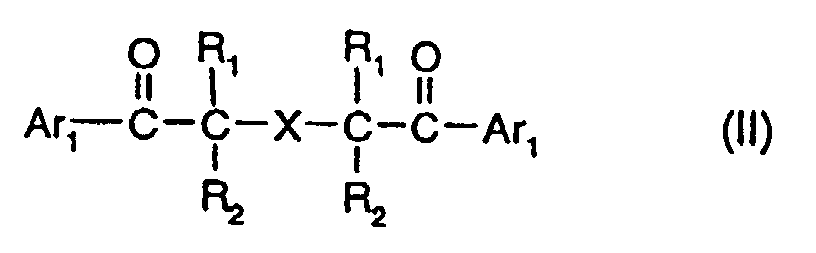 dans lesquelles
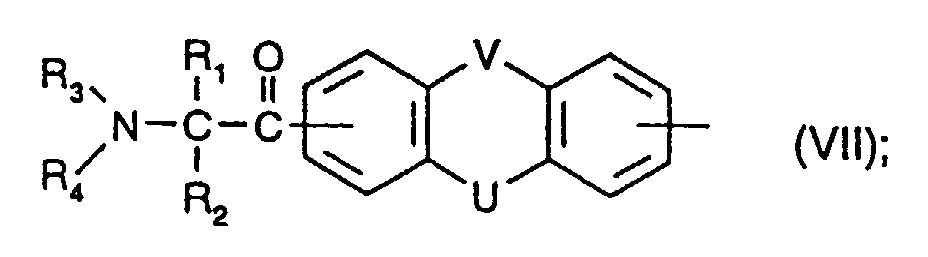
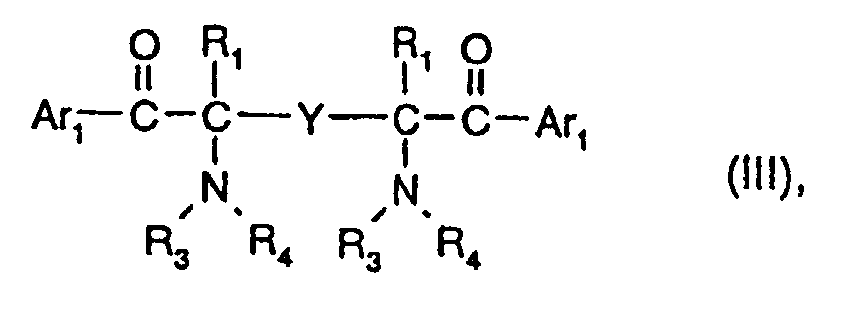 Ar1 représente un radical aromatique de formules IV, V, VI ou VII


 X représente un radical divalent de formule-N(R11)- ou -N(R11)-R12-N(R11)-;
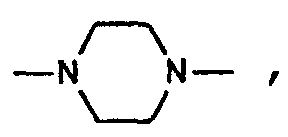 Y représente un groupe alkylène en C1 à C6, cyclohexylène ou une liaison directe;U représente un radical -O-, -S- ou -N(R17)-;V a une des significations de U ou représente un groupe -CO-, -CH2-, -CH2CH2-, alkylidène en C2 à C6 ou une liaison directe;W représente un groupe alkylène en C1 à C7 ou alkylidène en C2 à c6 non ramifié ou ramifié;R1 et R2 représentent, indépendamment l'un de l'autre,(a) un groupe alkyle en C1 à C12, qui est non substitué ou substitué par un groupe OH, alcoxy en C1 à C4, SH, CN, -COO(alkyle en C1 à C8), (alkyle en C1 à C4)-COO-, phénoxy, un atome d'halogène ou un groupe phényle, ou ils représentent un groupe cyclopentyle ou cyclohexyle(b) un radical de formuledans laquelle p vaut 0 ou 1, ou
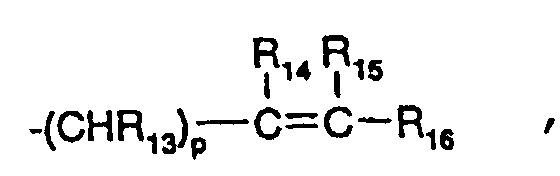 (c) un radical de formuledans laquelle q vaut 0, 1, 2 ou 3, ou
 (d) un radical de formule
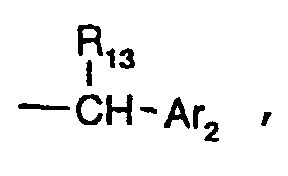 (e) un groupe phényle qui est non substitué ou substitué par un atome d'halogène, un groupe alkyle en C1 à C12 ou alcoxy en C1 à C12,(f) R1 et R2 représentent ensemble un groupe alkylène en C2 à C9 ou oxaalkylène en C3 à C9 non ramifié ou ramifié, ou forment un radical de formules
 Ar2 représente un radical phényle, naphtyle, thiényle ou furyle, dont chacun est non substitué ou substitué par un atome d'halogène, un groupe OH, alkyle en C1 à C12, ou est substitué par un groupe alkyle en C1 à C4, qui est substitué par un groupe OH, un atome d'halogène, un groupe alcoxy en C1 à C12, -COO(alkyle en C1 à C18), -CO(OCH2CH2)nOCH3 ou -OCO(alkyle en C1 à C4), ou les radicaux phényle, naphtyle, thiényle ou furyle sont substitués par un groupe alcoxy en C1 à C12 ou par un groupe alcoxy en C1 à C4, qui est substitué par un groupe -COO(alkyle en C1 à C18) ou -CO(OCH2CH2)nOCH3, ou les radicaux phényle, naphtyle, thiényle, furyle ou pyridyle sont substitués par un groupe -(OCH2CH2)nOH, -(OCH2CH2)nOCH3, alkylthio en C1 à C8, phénoxy, -COO(alkyle en C1 à C18), -CO(OCH2CH2)nOCH3, phényle ou benzoyle;n vaut de 1 à 20;m vaut 1 ou 2;R3 représente un groupe alkyle en C1 à C12, alkyle en C2 à C4 qui est substitué par un groupe -OH, alcoxy en C1 à C4, -CN ou -COO(alkyle en C1 à C4), ou R3 représente un groupe alcényle en C3 à C5, cycloalkyle en C5 à C12 ou phényl(alkyle en C1 à C3);R4 représente un groupe alkyle en C1 à C12, alkyle en C2 à C4 qui est substitué par un groupe -OH, alcoxy en C1 à C4, -CN ou -COO(alkyle en C1 à C4), ou R4 représente un groupe alcényle en C3 à C5, cycloalkyle en C5 à c12, phényl(alkyle en C1 à C3) ou phényle qui est non substitué ou substitué par un groupe alkyle en C1 à C12, alcoxy en C1 à C4 ou -COO(alkyle en C1 à C4), ou R4, conjointement avec R2, représente un groupe alkylène en C1 à C7, phényl(alkylène en C1 à C4), o-xylylène, 2-buténylène ou oxaalkylène en C2 à C3,ou R3 et R4 représentent ensemble un groupe alkylène en C4 à C7 qui peut être interrompu par un groupe -O-, -S- ou -CO-, ou R3 et R4 représentent ensemble un groupe alkylène en C3 à C7 qui peut être substitué par un groupe OH, alcoxy en C1 à C4 ou -COO(alkyle en C1 à C4);R5, R6, R7, R8 et R9 représentent, indépendamment les uns des autres, un atome d'hydrogène, d'halogène, un groupe alkyle en C1 à C12, cyclopentyle, cyclohexyle, phényle, benzyle, benzoyle ou un groupe -OR17, -SR18, -SOR18, -SO2R18, -N(R20)(R19), -NH-SO2R21 ou
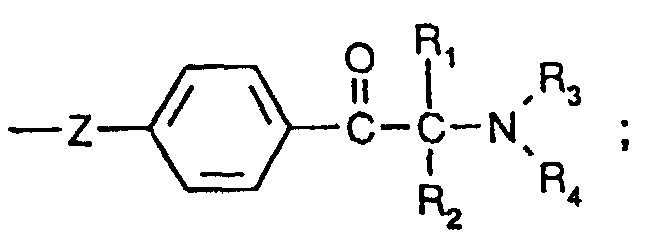 Z représente un groupe -O-, -S-, -N(R11)-, -N(R11)-R12-N(R11)- ou
 R10 représente un atome d'hydrogène, un groupe alkyle en C1 à C12, un atome d'halogène ou un groupe alcanoyle en C2 à C8;R11 représente un groupe alkyle en C1 à C8, alcényle en C3 à C5, phényl(alkyle en C1 à C3), hydroxyalkyle en C1 à C4 ou phényle;R12 représente un groupe alkylène en C2 à C16 non ramifié ou ramifié, qui peut être interrompu par un ou plusieurs radicaux -O- ou -S-;R13 représente un atome d'hydrogène, un groupe alkyle en C1 à C8 ou phényle;R14, R15 et R16 représentent, indépendamment les uns des autres, un atome d'hydrogène ou un groupe alkyle en C1 à C4, ou R14 et R15 représentent ensemble un groupe alkylène en C3 à C7;R17 représente un atome d'hydrogène, un groupe alkyle en C1 à C12, alkyle en C2 à C6 qui est substitué par un groupe -SH, -CN, -OH, alcoxy en C1 à C4, alcénoxy en C3 à C6, -OCH2CH2CN, -OCH2CH2COO(alkyle en C1 à C4), -COOH ou -O-CO-(alkyle en C1 à C4) qui est non substitué ou substitué par un groupe SH, ou R17 représente un groupe -COO(alkyle en C1 à C4), ou R17 représente un groupe alkyle en C1 à C6 qui est interrompu par un ou plusieurs radicaux -O-, ou R17 représente un groupe -(CH2CH2O)nH, alcanoyle en C2 à C8, alcényle en C3 à C12, cyclohexyle, hydroxycyclohexyle, phényle qui est non substitué ou substitué par un atome d'halogène, un groupe alkyle en C1 à C12 ou alcoxy en C1 à C4, ou R17 représente un groupe phényl(alkyle en C1 à C3) ou -Si(alkyle en C1 à C8)r(phényle)3-r;r vaut 1, 2 ou 3;R18 représente un atome d'hydrogène, un groupe alkyle en C1 à C12, alcényle en C3 à C12, cyclohexyle, alkyle en C2 à C12 qui est substitué par un groupe -SH, -OH, -CN, -COOH, -COO(alkyle en C1 à C4), alcoxy en C1 à C4, -OCH2CH2CN ou -O-CO-(alkyle en C1 à C4) qui est non substitué ou substitué par un groupe SH ou R18 représente un groupe -OCH2CH2COO(alkyle en C1 à C4), ou R18 représente un groupe alkyle en C1 à C12 qui est interrompu par un radical -S- ou -O-, ou R18 représente un groupe phényle qui est non substitué ou substitué par un atome d'halogène, un groupe SH, alkyle en C1 à C12 ou alcoxy en C1 à C4, ou R18 représente un groupe phényl(alkyle en C1 à C3);R19 et R20 représentent, indépendamment l'un de l'autre, un groupe alkyle en C1 à C12, hydroxyalkyle en C2 à C4, alcoxyalkyle en C2 à C10, alcényle en C3 à C5, cycloalkyle en C5 à C12, phényl(alkyle en C1 à C3), phényle qui est non substitué ou substitué par un atome d'halogène, alkyle en C1 à C12 ou alcoxy en C1 à C4, ou R19 et R20 représentent un groupe alcanoyle en C2 à C3 ou benzoyle,ou R19 et R20 représentent ensemble un groupe alkylène en C2 à C8, qui peut être interrompu par un radical -O- ou -S-, ou R19 et R20 représentent ensemble un groupe alkylène en C2 à C8 qui peut être substitué par un groupe hydroxyle, alcoxy en C1 à C4 ou -COO(alkyle en C1 à C4); etR21 représente un groupe alkyle en C1 à C18, phényle qui est non substitué ou substitué par un atome d'halogène, un groupe alkyle en C1 à C12 ou alcoxy en C1 à C8, ou R21 représente un groupe naphtyle qui est non substitué ou substitué par un atome d'halogène ou un groupe alkyle en C1 à C12;ou un sel d'addition acide d'un composé de formules I, II ou III;(B) au moins un composé époxyde et au moins un composé qui est capable de réagir avec des époxydes en présence d'une base; et(C) éventuellement, un sensibilisateur.
 - Composition selon la revendication 1, dans laquelle le composé capable de réagir avec des époxydes en présence d'une base est un composé carboxylique ou un thiol.
- Composition selon la revendication 1, dans laquelle le composant (A) est un composé de formule I, dans laquelleAr1 représente un groupe de formule IV, dans laquelle R5 représente un groupe -OR17, -SR18, -N(R19)(R20) ou
 R6 représente un atome d'hydrogène, d'halogène ou un groupe alkyle en C1 à C4 ou a une des significations données pour R5,R7 et R8 représentent un atome d'hydrogène ou d'halogène,R9 représente un atome d'hydrogène ou un groupe alkyle en C1 à C4,Z représente un groupe -O-, -S- ou -N(R11)-,R1 et R2 représentent, indépendamment l'un de l'autre, soit(a) un groupe alkyle en C1 à C6,(b) un radical de formuleou
 (d) un radical de formule -CH(R13)-Ar2; dans laquelle Ar2 représente un radical phényle qui est non substitué ou substitué par un atome d'halogène, un groupe alkyle en C1 à C4, méthylthio, méthoxy ou benzoyle;R3 et R4 représentent, indépendamment l'un de l'autre, un groupe alkyle en C1 à C12, alkyle en C2 à C4 qui est substitué par un groupe alcoxy en C1 à C4, -CN ou -COO(alkyle en C1 à C4), ou R3 et R4 représentent un groupe allyle, cyclohexyle ou benzyle, ou R3 et R4 représentent ensemble un groupe alkylène en C4 à C6 qui peut être interrompu par un radical -O-;R11 représente un groupe alkyle en C1 à C4, allyle, ou benzyle;R12 représente un groupe alkylène en C2 à C6;R13, R14, R15 et R16 représentent, indépendamment les uns des autres, un atome d'hydrogène ou un groupe méthyle;R17 représente un groupe alkyle en C2 à C6 non substitué ou à substitution SH, 2-hydroxyéthyle, 2-méthoxyéthyle, 2-allyloxyéthyle, allyle, cyclohexyle, phényle, benzyle ou -Si(CH3)3;R18 représente un atome d'hydrogène, un groupe alkyle en C1 à C12 non substitué ou alkyle en C2 à C12 à substitution SH, 2-hydroxyéthyle, 2-méthoxyéthyle, phényle non substitué ou à substitution SH, ou représente un groupe p-tolyle ou benzyle; etR19 et R20 représentent, indépendamment l'un de l'autre, un groupe alkyle en C1 à C12, alcoxyalkyle en C2 à C6, acétyle, allyle ou benzyle, ou R20 et R19 représentent ensemble un groupe alkylène en C4 à C6 qui peut être interrompu par un radical -O-.
 - Composition selon la revendication 1, dans laquelle le composant (A) est un composé de formule I dans laquelleAr1 représente un groupe de formule IV dans laquelle R5 représente un groupe -OR17, -SR18 ou -N(R19)(R20),R6 représente un atome d'hydrogène, un groupe chloro ou alkyle en C1 à C4, ou a une des significations données pour R5,R7 et R8 représentent un atome d'hydrogène ou un groupe chloro,R9 représente un atome d'hydrogène ou un groupe alkyle en C1 à C4,R1 représentesoit (a) un radical de formule
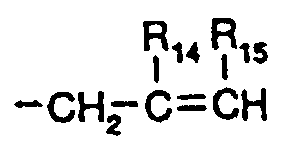 soit (b) un radical de formule -CH2-Ar2, dans laquelle Ar2 représente un radical phényle qui est non substitué ou substitué par un atome d'halogène, un groupe alkyle en C1 à C4, CH3S-, CH3O- ou benzoyle;R2 a une des significations données pour R1 ou représente un groupe alkyle en C1 à C4,R3 et R4 représentent, indépendamment l'un de l'autre, un groupe alkyle en C1 à C6, 2-méthoxyéthyle, allyle ou benzyle, ou R3 et R4 représentent ensemble un groupe tétraméthylène, pentaméthylène ou 3-oxapentaméthylène,R14 et R15 représentent un atome d'hydrogène ou un groupe méthyle,R17 représente un groupe alkyle en C2 à C6 non substitué ou à substitution SH, 2-hydroxyéthyle, 2-méthoxyéthyle, ou phényle,R18 représente un groupe alkyle en C2 à C12 non substitué ou à substitution SH, 2-hydroxyéthyle, 2-méthoxyéthyle, phényle non substitué ou à substitution SH ou représente un groupe p-tolyle, et R19 et R20 représentent un groupe alkyle en C1 à C4, 2-méthoxyéthyle, acétyle ou allyle, ou R19 et R20 représentent ensemble un groupe alkylène en C4 à C5 qui peut être interrompu par un radical -O-.
 - Composition selon la revendication 1, dans laquelle le composant (A) est un composé de formule I, dans laquelleAr1 représente un groupe de formule IV, dans laquelle R1 et R2, indépendamment l'un de l'autre, représentent un groupe alkyle en C1 à C4 ou benzyle;R3 et R4, indépendamment l'un de l'autre, représentent un groupe alkyle en C1 à C4 ou représentent ensemble un groupe morpholino;R5 représente un groupe morpholino ou alkylthio en C1 à C4; etR6, R7, R8 et R9 représentent un atome d'hydrogène.
- Procédé pour engendrer photochimiquement des bases dans des réactions de polymérisation catalysée par une base, caractérisé en ce que l'on ajoute un composé de formules I, II ou III tel que défini dans la revendication 1, en tant que base latente, au mélange à polymériser et on l'irradie avec une lumière de longueur d'onde de 200 à 700 nm pour engendrer une base.
- Procédé selon la revendication 6, dans lequel en plus de la base latente, on ajoute un sensibilisateur d'énergie de triplet choisi dans le groupe des composés carbonyle ayant une énergie de triplet de 225 à 310 kJ/mole.
- Procédé pour le durcissement de compositions comprenantdans lequel(A) un composé de formules I, II ou III tel que défini dans la revendication 1,(B) un mélange d'au moins un composé époxyde et d'au moins un composé qui est capable de réagir avec un époxyde en présence d'une base; et(C) éventuellement, un sensibilisateur,(1) on irradie ladite composition avec une lumière ayant une longueur d'onde de 200 à 700 nm pour engendrer un catalyseur de base à partir du précurseur photosensible de formules I, II ou III et(2) on la thermodurcit ultérieurement en utilisant en tant que catalyseur la base photoengendrée dans l'étape (1).
- Procédé selon la revendication 8, dans lequel l'étape de thermodurcissement (2) est suivie par une étape de développement (3).
- Procédé selon la revendication 8, dans lequel on ajoute un catalyseur de base supplémentaire ou son précurseur à la composition en tant que co-catalyseur pour l'étape thermique (2).
- Procédé selon la revendication 8, dans lequel l'étape photochimique (1) est suivie par une étape de développement (3), avant l'étape de thermodurcissement (2).
- Procédé selon la revendication 9, dans lequel les étapes (1), (2) et (3) sont suivies par une seconde étape de thermodurcissement (4).
- Procédé selon la revendication 8, dans lequel la composition comprend en plus un monomère, un oligomère ou un polymère (D) polymérisable par voie radicalaire.
- Procédé selon la revendication 8, pour la production de matières de résist, de masques de soudage, de revêtements de consolidation, de revêtements protecteurs, de revêtements de poudre, de vernissages d'impression, de revêtements de fibre de verre, de guides d'onde, de plaques d'impression, d'adhésifs, d'encres, de stencils de sérigraphie, de matières composites renforcées, de commutateurs optiques, de systèmes pour épreuve couleur, de supports d'enregistrement magnétique, de matières dentaires, ou un procédé effectué comme un procédé stéréolithographique ou holographique.
- Utilisation d'une composition selon la revendication 1, pour la production de matières de résist, de masques de soudage, de revêtements de consolidation, de revêtements protecteurs, de revêtements de poudre, de vernissages d'impression, de revêtements de fibre de verre, de guides d'onde, de plaques d'impression, d'adhésifs, d'encres, de stencils de sérigraphie, de matières composites renforcées, de commutateurs optiques, de systèmes pour épreuve couleur, de supports d'enregistrement magnétique, de matières dentaires, dans un procédé stéréolithographique ou holographique.
- Utilisation des composés de formules I, II et III, tel que défini selon la revendication 1, en tant que générateurs de photobase dans des systèmes durcissables par rayonnement.
Priority Applications (1)
| Application Number | Priority Date | Filing Date | Title |
|---|---|---|---|
| EP97810948A EP0898202B1 (fr) | 1997-08-22 | 1997-12-04 | Photogénération d'amines à partir de alpha-aminoacétophénones |
Applications Claiming Priority (3)
| Application Number | Priority Date | Filing Date | Title |
|---|---|---|---|
| EP97810593 | 1997-08-22 | ||
| EP97810593 | 1997-08-22 | ||
| EP97810948A EP0898202B1 (fr) | 1997-08-22 | 1997-12-04 | Photogénération d'amines à partir de alpha-aminoacétophénones |
Publications (2)
| Publication Number | Publication Date |
|---|---|
| EP0898202A1 EP0898202A1 (fr) | 1999-02-24 |
| EP0898202B1 true EP0898202B1 (fr) | 2000-07-19 |
Family
ID=26148057
Family Applications (1)
| Application Number | Title | Priority Date | Filing Date |
|---|---|---|---|
| EP97810948A Expired - Lifetime EP0898202B1 (fr) | 1997-08-22 | 1997-12-04 | Photogénération d'amines à partir de alpha-aminoacétophénones |
Country Status (1)
| Country | Link |
|---|---|
| EP (1) | EP0898202B1 (fr) |
Families Citing this family (19)
| Publication number | Priority date | Publication date | Assignee | Title |
|---|---|---|---|---|
| EP1285012B1 (fr) | 2000-05-26 | 2007-01-10 | Akzo Nobel Coatings International B.V. | Composition de revetement photoactivable |
| EP1341823B1 (fr) | 2000-12-13 | 2008-10-01 | Ciba Holding Inc. | Photo-initiateurs actifs en surface |
| CN1326904C (zh) * | 2000-12-27 | 2007-07-18 | 日立化成工业株式会社 | 光碱发生剂以及应用它的固化性组合物及固化方法 |
| EP1436297B1 (fr) | 2001-10-17 | 2007-04-25 | Ciba Specialty Chemicals Holding Inc. | Bases d'azote photosensibles |
| US9835498B2 (en) | 2003-11-20 | 2017-12-05 | Freshpoint Quality Assurance Ltd. | Method and system for determining the condition of a time-temperature indicator |
| KR20070085841A (ko) | 2004-11-08 | 2007-08-27 | 프레쉬포인트 홀딩스 에스아 | 시간-온도 표시 장치 |
| ATE438672T1 (de) | 2005-12-15 | 2009-08-15 | Akzo Nobel Coatings Int Bv | Mehrlagiges beschichtungssystem |
| JP5351044B2 (ja) | 2007-01-11 | 2013-11-27 | フレッシュポイント・ホールディングス・ソシエテ・アノニム | 時間−温度インジケータ |
| JP5606308B2 (ja) | 2007-04-03 | 2014-10-15 | ビーエーエスエフ ソシエタス・ヨーロピア | 光活性窒素塩基 |
| US20110190412A1 (en) * | 2008-01-28 | 2011-08-04 | Basf Se | Photolatent amidine bases for redox curing of radically curable formulations |
| US8968662B2 (en) | 2008-06-23 | 2015-03-03 | Freshpoint Quality Assurance Ltd. | Time temperature indicator |
| RU2011143809A (ru) | 2009-03-31 | 2013-05-10 | Акцо Нобель Коатингс Интернэшнл Б.В. | Радиационное отверждение покрытий |
| AU2010285107A1 (en) | 2009-08-21 | 2012-03-15 | Basf Se | Apparatus and method for a sub microscopic and optically variable image carrying device |
| CN103154066A (zh) | 2010-09-30 | 2013-06-12 | 阿克佐诺贝尔国际涂料股份有限公司 | 用于可固化涂料组合物的组分包 |
| JP5722418B1 (ja) * | 2013-12-02 | 2015-05-20 | 太陽インキ製造株式会社 | 感光性樹脂組成物、ドライフィルム、硬化物およびプリント配線板 |
| BR112017023057B1 (pt) | 2015-04-29 | 2023-03-28 | Bsn Medical Gmbh | Processo para preparação de no e processo cosmético |
| US10813831B2 (en) | 2015-04-29 | 2020-10-27 | Bsn Medical Gmbh | Medical bathing device |
| EP3548969A1 (fr) | 2016-12-05 | 2019-10-09 | Arkema, Inc. | Mélanges d'initiateurs et compositions photodurcissables contenant de tels mélanges d'initiateurs utiles pour l'impression 3d |
| US10599035B2 (en) * | 2017-04-12 | 2020-03-24 | Macdermid Graphics Solutions, Llc | Method of improving light stability of flexographic printing plates featuring flat top dots |
Family Cites Families (4)
| Publication number | Priority date | Publication date | Assignee | Title |
|---|---|---|---|---|
| EP0088050B1 (fr) * | 1982-02-26 | 1986-09-03 | Ciba-Geigy Ag | Composition colorée photodurcissable |
| DE3471486D1 (de) * | 1983-08-15 | 1988-06-30 | Ciba Geigy Ag | Photocurable compositions |
| EP0284561B1 (fr) * | 1987-03-26 | 1993-05-12 | Ciba-Geigy Ag | Alpha-aminoacétophénones comme photo-initiateurs |
| JP3190251B2 (ja) * | 1995-06-06 | 2001-07-23 | 太陽インキ製造株式会社 | アルカリ現像型のフレキシブルプリント配線板用光硬化性・熱硬化性樹脂組成物 |
-
1997
- 1997-12-04 EP EP97810948A patent/EP0898202B1/fr not_active Expired - Lifetime
Also Published As
| Publication number | Publication date |
|---|---|
| EP0898202A1 (fr) | 1999-02-24 |
Similar Documents
| Publication | Publication Date | Title |
|---|---|---|
| US6057380A (en) | Photogeneration of amines from α-aminoacetophenones | |
| US6284813B1 (en) | Alkylphenylbisacylphosphine oxides and photoinitiator mixtures | |
| AU720186B2 (en) | Molecular complex compounds as photoinitiators | |
| AU717137B2 (en) | Borate coinitiators for photopolymerization | |
| EP0956280B1 (fr) | Esters phenylglyoxaliques non volatils | |
| US6096794A (en) | Quinolinium dyes and borates in photopolymerizable compositions | |
| US6011180A (en) | Acid-stable borates for photopolymerization | |
| EP1177182B1 (fr) | Nouveaux photoamorceurs et leurs applications | |
| EP0898202A1 (fr) | Photogénération d'amines à partir de alpha-aminoacétophénones | |
| US5723512A (en) | Dimeric bisacylphosphines, oxides and sulfides | |
| US6090865A (en) | Polymerizable composition | |
| MXPA05004015A (es) | Mejora en la estabilidad al almacenamiento de fotoiniciadores. | |
| US6361925B1 (en) | Photoinitiator mixtures and compositions with alkylphenylbisacylphosphine oxides | |
| JPH1029977A (ja) | α−アミノアセトフェノン誘導体 | |
| EP1086145B1 (fr) | Photoamorceurs et leurs applications | |
| MXPA98000278A (en) | Photogeneration of amines from alpha-aminoacetophen | |
| MXPA98009065A (en) | Polymerize composition | |
| MXPA98009066A (en) | New colors of quinolinio and boratos encomposiciones fotopolimerizab |
Legal Events
| Date | Code | Title | Description |
|---|---|---|---|
| PUAI | Public reference made under article 153(3) epc to a published international application that has entered the european phase |
Free format text: ORIGINAL CODE: 0009012 |
|
| AK | Designated contracting states |
Kind code of ref document: A1 Designated state(s): AT BE CH DE DK ES FR GB IT LI NL SE |
|
| AX | Request for extension of the european patent |
Free format text: AL;LT;LV;MK;RO;SI |
|
| 17P | Request for examination filed |
Effective date: 19971212 |
|
| 17Q | First examination report despatched |
Effective date: 19990421 |
|
| GRAG | Despatch of communication of intention to grant |
Free format text: ORIGINAL CODE: EPIDOS AGRA |
|
| AKX | Designation fees paid |
Free format text: AT BE CH DE DK ES FR GB IT LI NL SE |
|
| GRAG | Despatch of communication of intention to grant |
Free format text: ORIGINAL CODE: EPIDOS AGRA |
|
| GRAH | Despatch of communication of intention to grant a patent |
Free format text: ORIGINAL CODE: EPIDOS IGRA |
|
| GRAH | Despatch of communication of intention to grant a patent |
Free format text: ORIGINAL CODE: EPIDOS IGRA |
|
| GRAA | (expected) grant |
Free format text: ORIGINAL CODE: 0009210 |
|
| AK | Designated contracting states |
Kind code of ref document: B1 Designated state(s): AT BE CH DE DK ES FR GB IT LI NL SE |
|
| PG25 | Lapsed in a contracting state [announced via postgrant information from national office to epo] |
Ref country code: LI Free format text: LAPSE BECAUSE OF FAILURE TO SUBMIT A TRANSLATION OF THE DESCRIPTION OR TO PAY THE FEE WITHIN THE PRESCRIBED TIME-LIMIT Effective date: 20000719 Ref country code: ES Free format text: THE PATENT HAS BEEN ANNULLED BY A DECISION OF A NATIONAL AUTHORITY Effective date: 20000719 Ref country code: CH Free format text: LAPSE BECAUSE OF FAILURE TO SUBMIT A TRANSLATION OF THE DESCRIPTION OR TO PAY THE FEE WITHIN THE PRESCRIBED TIME-LIMIT Effective date: 20000719 Ref country code: AT Free format text: LAPSE BECAUSE OF FAILURE TO SUBMIT A TRANSLATION OF THE DESCRIPTION OR TO PAY THE FEE WITHIN THE PRESCRIBED TIME-LIMIT Effective date: 20000719 |
|
| REF | Corresponds to: |
Ref document number: 194872 Country of ref document: AT Date of ref document: 20000815 Kind code of ref document: T |
|
| REG | Reference to a national code |
Ref country code: CH Ref legal event code: EP |
|
| REF | Corresponds to: |
Ref document number: 69702605 Country of ref document: DE Date of ref document: 20000824 |
|
| ITF | It: translation for a ep patent filed | ||
| PG25 | Lapsed in a contracting state [announced via postgrant information from national office to epo] |
Ref country code: DK Free format text: LAPSE BECAUSE OF FAILURE TO SUBMIT A TRANSLATION OF THE DESCRIPTION OR TO PAY THE FEE WITHIN THE PRESCRIBED TIME-LIMIT Effective date: 20001019 |
|
| ET | Fr: translation filed | ||
| REG | Reference to a national code |
Ref country code: CH Ref legal event code: PL |
|
| PLBE | No opposition filed within time limit |
Free format text: ORIGINAL CODE: 0009261 |
|
| STAA | Information on the status of an ep patent application or granted ep patent |
Free format text: STATUS: NO OPPOSITION FILED WITHIN TIME LIMIT |
|
| 26N | No opposition filed | ||
| REG | Reference to a national code |
Ref country code: GB Ref legal event code: IF02 |
|
| PGFP | Annual fee paid to national office [announced via postgrant information from national office to epo] |
Ref country code: SE Payment date: 20041119 Year of fee payment: 8 |
|
| PGFP | Annual fee paid to national office [announced via postgrant information from national office to epo] |
Ref country code: GB Payment date: 20041124 Year of fee payment: 8 |
|
| PGFP | Annual fee paid to national office [announced via postgrant information from national office to epo] |
Ref country code: NL Payment date: 20041125 Year of fee payment: 8 |
|
| PG25 | Lapsed in a contracting state [announced via postgrant information from national office to epo] |
Ref country code: IT Free format text: LAPSE BECAUSE OF NON-PAYMENT OF DUE FEES;WARNING: LAPSES OF ITALIAN PATENTS WITH EFFECTIVE DATE BEFORE 2007 MAY HAVE OCCURRED AT ANY TIME BEFORE 2007. THE CORRECT EFFECTIVE DATE MAY BE DIFFERENT FROM THE ONE RECORDED. Effective date: 20051204 Ref country code: GB Free format text: LAPSE BECAUSE OF NON-PAYMENT OF DUE FEES Effective date: 20051204 |
|
| PG25 | Lapsed in a contracting state [announced via postgrant information from national office to epo] |
Ref country code: SE Free format text: LAPSE BECAUSE OF NON-PAYMENT OF DUE FEES Effective date: 20051205 |
|
| PG25 | Lapsed in a contracting state [announced via postgrant information from national office to epo] |
Ref country code: NL Free format text: LAPSE BECAUSE OF NON-PAYMENT OF DUE FEES Effective date: 20060701 |
|
| EUG | Se: european patent has lapsed | ||
| GBPC | Gb: european patent ceased through non-payment of renewal fee |
Effective date: 20051204 |
|
| NLV4 | Nl: lapsed or anulled due to non-payment of the annual fee |
Effective date: 20060701 |
|
| REG | Reference to a national code |
Ref country code: FR Ref legal event code: PLFP Year of fee payment: 19 |
|
| REG | Reference to a national code |
Ref country code: FR Ref legal event code: PLFP Year of fee payment: 20 |
|
| PGFP | Annual fee paid to national office [announced via postgrant information from national office to epo] |
Ref country code: FR Payment date: 20161222 Year of fee payment: 20 Ref country code: BE Payment date: 20161222 Year of fee payment: 20 |
|
| PGFP | Annual fee paid to national office [announced via postgrant information from national office to epo] |
Ref country code: DE Payment date: 20170228 Year of fee payment: 20 |
|
| REG | Reference to a national code |
Ref country code: DE Ref legal event code: R071 Ref document number: 69702605 Country of ref document: DE |
|
| REG | Reference to a national code |
Ref country code: BE Ref legal event code: MK Effective date: 20171204 |