EP0898224A2 - Méthode et appareil pour la conception des règles à logique floue à partir de vecteurs de données d'entraínement - Google Patents
Méthode et appareil pour la conception des règles à logique floue à partir de vecteurs de données d'entraínement Download PDFInfo
- Publication number
- EP0898224A2 EP0898224A2 EP98114096A EP98114096A EP0898224A2 EP 0898224 A2 EP0898224 A2 EP 0898224A2 EP 98114096 A EP98114096 A EP 98114096A EP 98114096 A EP98114096 A EP 98114096A EP 0898224 A2 EP0898224 A2 EP 0898224A2
- Authority
- EP
- European Patent Office
- Prior art keywords
- membership
- determined
- training data
- membership function
- iteration
- Prior art date
- Legal status (The legal status is an assumption and is not a legal conclusion. Google has not performed a legal analysis and makes no representation as to the accuracy of the status listed.)
- Withdrawn
Links
Images

Classifications
-
- G—PHYSICS
- G06—COMPUTING OR CALCULATING; COUNTING
- G06N—COMPUTING ARRANGEMENTS BASED ON SPECIFIC COMPUTATIONAL MODELS
- G06N7/00—Computing arrangements based on specific mathematical models
- G06N7/02—Computing arrangements based on specific mathematical models using fuzzy logic
- G06N7/023—Learning or tuning the parameters of a fuzzy system
Definitions
- the invention relates to the automatic design of fuzzy rules from training data vectors.
- fuzzy logic As part of the so-called fuzzy logic, technical systems are described with the help of so-called if-then rules.
- the relationships between the input variables of the rules and the output variables of the rules are defined using membership functions that have a value between 0 and. for each input value and output value 1.
- the rules that correspond to combinations of membership functions are formulated by experts in some cases manual "designation, because the rules are defined by experts who can describe the technical system in detail in its behavior.
- Training data vectors are used to design rules Training data set used that describe the technical system.
- the training data can be, for example, via measuring devices, e.g. Sensors are determined and describe the real behavior of the technical system.
- a technical system can e.g. a washing machine, a rolling mill, a communication device, a communication network, etc.
- the type of technical system is not essential in the context of the invention.
- membership function types can be used be used. Under a membership function type is a kind of membership function understood that by their shape clearly is described. An overview of different membership function types can be found in [1].
- the procedures for automatic rule design are usually different cluster algorithms used.
- x 1 , ..., x n the training data vectors of the training data set, which is used for the rule design, are designated.
- the training data record contains n training data vectors.
- the element u ik is hereinafter referred to as the membership value of the k-th training data vector x k to the i-th cluster.
- FCM fuzzy C-means model
- FCM forms a fuzzy partition M fcn defined as:
- the FCM is defined as the following problem: For a given training data set X, any standard
- V ⁇ v 1 , ..., v c ⁇ ⁇ is a set of membership functions used by centers.
- PCM Possibilistic-C-Means Model
- the target function J PCM is formed according to the following rule:
- the factor K ⁇ + ⁇ ⁇ 0 ⁇ and is usually chosen as the value 1.
- a factor (u ik ) ⁇ is determined according to the following rule:
- centers of the respective membership functions are determined for both FCM-AO and PCM-AO.
- the membership functions, positioned above the determined centers v i of the membership functions, are interpreted as rules of the fuzzy system.
- the invention is based on the problem, methods and arrangements specify which rules to use automatically of any freely selectable membership function types can be determined.
- the Rules described above for controlling a Machine used.
- the machine is controlled using the determined rules.
- the membership functions are not of the selected membership function type Initialization parameters assigned, but there will be initial membership values to the training data vectors assigned to the individual membership functions.
- the remaining process steps of the method according to claim 3 are according to the process steps of the claim 1.
- rules according to the method according to claim 3 determined and for control used on a machine.
- the arrangement according to claim 11 contains a computing unit, the method steps described for claim 10 performs and a control unit for Control of a machine using the determined rules.
- the arrangement according to claim 12 has a computing unit on, which is designed such that the method according to Claim 3 is carried out.
- the arrangement according to claim 13 also has a computing unit on, which is designed according to claim 12 and also a control unit for controlling a machine using the determined rules.
- the method and the arrangement ensure that any Predefinable membership function types for the rule draft can be used. So it is not an approximation determined membership functions of the specified type according to the FCM-AO procedure or the PCM-AO procedure more required. This leads to a more accurate model of the the rules described technical system.
- the methods and arrangements can be used for description or to control various technical systems or Machines are used, for example in the area of Steel rolling machines, sewage treatment plants, chemical reactors, Etc.
- the training data vectors can via measuring devices and / or Sensors are determined and used in the context of the invention become.
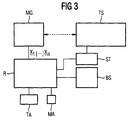
- a computer R is shown symbolically in FIG. 1.
- the computer R has a computing unit RE and a memory SP, which are interconnected via a bus BU. Further is a keyboard TA and a mouse MA provided with the Computer R are connected.
- a screen BS which is also is coupled to the computer R, a user graphically a set of possible membership function types shown as part of the automatic draft rule can be used.
- the predetermined set of possible membership function types is stored in the memory SP.
- Training data vectors x k of a training data record TDS are also stored in the memory SP and are taken into account in the context of the automatic computer-aided rule design.
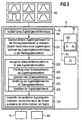
- the user chooses from the set of possible membership function types the membership function type that is in the should be used (step 101).
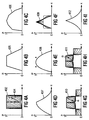
- FIG. 4a shows hypercylindrical membership function types with the center v i ⁇ and the radius r i ⁇ .
- this is a rectangular membership function type 402.
- the hypercylindrical membership function type is described by the following rule:
- FIG. 4a also shows hyperconical membership function types which correspond to triangular membership function type 404 in the one-dimensional Cartesian case, the membership functions being formed according to the following rule:
- a trapezoidal membership function type 405 is shown in Figure 4b. Membership functions of this type are created according to the following rule: where a i and d i are end points and b i and c i are intermediate points of the trapezoid. The following applies: a i ⁇ b i ⁇ c i ⁇ d i .
- a membership function type the piecewise linear membership function 406, is shown in Figure 4c.
- B-splines 408 are shown in Fig. 4e.
- B-splines contain soft piece-by-piece polynomial curves. In 2-dimensional space they are described by hit points ⁇ (t 1i , p 1i ), ..., (t ni , p ni ) ⁇ .
- a membership function type with trigonometric membership functions 409 is shown in Figure 4f. Membership functions of this type are formed according to the following rules: or
- FIG. 4g shows an exponential membership function type 410 with shape parameters and variance parameters ⁇ , ⁇ i ⁇ + ⁇ ⁇ 0 ⁇ . Membership functions of these membership function types are created according to the following rule:
- initialization parameters set by the required Shape parameters of the membership function as well as the centers membership functions are initially freely specified.
- initialization parameters it is advantageous to set the initialization parameters at the beginning of the procedure using the FCM method or FCM-AO method or also the PCM process or PCM-AO process to determine.
- the determination can be made by the user or by a Random number generator ZG.
- a maximum number of iterations and / or a change in the centers v i of the membership functions between at least one previous and the current iteration, and / or a change in the membership values u ik between at least one previous and will be used as the termination criterion of the iteration loop (103) the current iteration.
- the centers result directly from the focus values the membership functions for the respective iteration.
- a procedure for determining the focus values for the Membership functions are very different to the person skilled in the art Known methods, for example the so-called basic defuzzification-attribution method (BADD) or that Semi-linear defuzzification (SLIDE) method.
- BADD basic defuzzification-attribution method
- SLIDE Semi-linear defuzzification
- the membership functions result through the shape parameters as well as through the Centers of those in the last iteration before the iteration loop was aborted determined membership functions.
- the second embodiment differs only slightly from the first embodiment. Only the procedural step initializing and building the iteration loop is different from the first embodiment.
- initial membership values u ik for the training data vectors x k to the clusters described by the membership functions are specified (step 201).
- FIG. 3 shows a technical system TS, the behavior of which is described by training data vectors x k , which are determined via a measuring device MG, which is coupled to the technical system TS, and are stored in a memory SP of the computer R.
- One of the methods described above is carried out in the computing unit RE of the computer R.
- the technical system TS is controlled via a control unit ST Use of the rules and possibly under constant recording new measured values controlled by the technical system TS.
- the program can be translated into an executable program with the gcc version 2.7.2.1.f.1 compiler with the -lm option.
Landscapes
- Engineering & Computer Science (AREA)
- Software Systems (AREA)
- Physics & Mathematics (AREA)
- Automation & Control Theory (AREA)
- Fuzzy Systems (AREA)
- Theoretical Computer Science (AREA)
- General Physics & Mathematics (AREA)
- Computational Mathematics (AREA)
- Mathematical Analysis (AREA)
- General Health & Medical Sciences (AREA)
- Algebra (AREA)
- Artificial Intelligence (AREA)
- Biomedical Technology (AREA)
- Data Mining & Analysis (AREA)
- Evolutionary Computation (AREA)
- Life Sciences & Earth Sciences (AREA)
- Molecular Biology (AREA)
- Mathematical Optimization (AREA)
- Pure & Applied Mathematics (AREA)
- Computing Systems (AREA)
- General Engineering & Computer Science (AREA)
- Mathematical Physics (AREA)
- Health & Medical Sciences (AREA)
- Feedback Control In General (AREA)
- Management, Administration, Business Operations System, And Electronic Commerce (AREA)
Applications Claiming Priority (2)
| Application Number | Priority Date | Filing Date | Title |
|---|---|---|---|
| US912333 | 1997-08-18 | ||
| US08/912,333 US6094646A (en) | 1997-08-18 | 1997-08-18 | Method and apparatus for computerized design of fuzzy logic rules from training data vectors of a training dataset |
Publications (2)
| Publication Number | Publication Date |
|---|---|
| EP0898224A2 true EP0898224A2 (fr) | 1999-02-24 |
| EP0898224A3 EP0898224A3 (fr) | 1999-06-09 |
Family
ID=25431744
Family Applications (1)
| Application Number | Title | Priority Date | Filing Date |
|---|---|---|---|
| EP98114096A Withdrawn EP0898224A3 (fr) | 1997-08-18 | 1998-07-28 | Méthode et appareil pour la conception des règles à logique floue à partir de vecteurs de données d'entraínement |
Country Status (3)
| Country | Link |
|---|---|
| US (1) | US6094646A (fr) |
| EP (1) | EP0898224A3 (fr) |
| JP (1) | JPH11134195A (fr) |
Families Citing this family (10)
| Publication number | Priority date | Publication date | Assignee | Title |
|---|---|---|---|---|
| CA2284298A1 (fr) | 1999-09-27 | 2001-03-27 | Nortel Networks Corporation | Architectures de reseaux de communication |
| US20030179717A1 (en) * | 1999-09-27 | 2003-09-25 | Hobbs Christopher W. L. | Methods and apparatus for controlling multi-layer communications networks |
| AU2003260047A1 (en) * | 2002-08-29 | 2004-03-19 | Paul Rudolf | Associative memory device and method based on wave propagation |
| DE102009037254B4 (de) * | 2009-08-12 | 2011-12-08 | Man Diesel & Turbo Se | Verfahren und Vorrichtung zum Steuern des Beriebs einer Brennkraftmaschine |
| US20120121166A1 (en) * | 2010-11-12 | 2012-05-17 | Texas Instruments Incorporated | Method and apparatus for three dimensional parallel object segmentation |
| US8478005B2 (en) | 2011-04-11 | 2013-07-02 | King Fahd University Of Petroleum And Minerals | Method of performing facial recognition using genetically modified fuzzy linear discriminant analysis |
| US20150042243A1 (en) | 2013-08-09 | 2015-02-12 | Texas Instruments Incorporated | POWER-OVER-ETHERNET (PoE) CONTROL SYSTEM |
| US20150356056A1 (en) * | 2014-06-09 | 2015-12-10 | The Mathworks, Inc. | Methods and systems for calculating joint statistical information |
| US11461643B2 (en) * | 2017-05-09 | 2022-10-04 | Sri International | Deep adaptive semantic logic network |
| CN111526096B (zh) * | 2020-03-13 | 2022-03-15 | 北京交通大学 | 智融标识网络状态预测与拥塞控制系统 |
Family Cites Families (13)
| Publication number | Priority date | Publication date | Assignee | Title |
|---|---|---|---|---|
| US5179634A (en) * | 1989-04-14 | 1993-01-12 | Omron Corporation | System for synthesizing new fuzzy rule sets from existing fuzzy rule sets |
| JP2543242B2 (ja) * | 1990-09-03 | 1996-10-16 | 松下電器産業株式会社 | ファジィ推論装置 |
| JPH04195338A (ja) * | 1990-11-28 | 1992-07-15 | Hitachi Ltd | ファジィ推論方式 |
| JP3076399B2 (ja) * | 1991-06-12 | 2000-08-14 | 松下電器産業株式会社 | ファジィ推論ルールの自動生成装置 |
| TW297107B (fr) * | 1991-06-18 | 1997-02-01 | Meidensha Electric Mfg Co Ltd | |
| JPH0535308A (ja) * | 1991-07-25 | 1993-02-12 | Mitsubishi Electric Corp | フアジイメンバシツプ関数の同定装置及び同定方法 |
| US5463718A (en) * | 1991-11-08 | 1995-10-31 | Hitachi, Ltd. | Learning method and apparatus |
| US5608846A (en) * | 1993-01-25 | 1997-03-04 | Omron Corporation | Fuzzy rule generator |
| US5579439A (en) * | 1993-03-24 | 1996-11-26 | National Semiconductor Corporation | Fuzzy logic design generator using a neural network to generate fuzzy logic rules and membership functions for use in intelligent systems |
| US5751915A (en) * | 1993-07-13 | 1998-05-12 | Werbos; Paul J. | Elastic fuzzy logic system |
| DE4439225B4 (de) * | 1993-12-27 | 2005-01-27 | Ford Motor Company, Dearborn | Defuzzifizierungsverfahren für Fuzzy Logic-Ausgangssignale und Reglervorrichtung hierzu |
| US5758025A (en) * | 1995-06-05 | 1998-05-26 | Wu; Kung Chris | Dynamically adaptive fuzzy interval controller |
| US5822740A (en) * | 1996-06-28 | 1998-10-13 | Honeywell Inc. | Adaptive fuzzy controller that modifies membership functions |
-
1997
- 1997-08-18 US US08/912,333 patent/US6094646A/en not_active Expired - Fee Related
-
1998
- 1998-07-28 EP EP98114096A patent/EP0898224A3/fr not_active Withdrawn
- 1998-08-17 JP JP10230567A patent/JPH11134195A/ja not_active Withdrawn
Non-Patent Citations (3)
| Title |
|---|
| CHENG T W ET AL: "FAST CLUSTERING WITH APPLICATION TO FUZZY RULE GENERATION" PROCEEDINGS OF 1995 IEEE INTERNATIONAL CONFERENCE ON FUZZY SYSTEMS, INTERNATIONAL JOINT CONFERENCE OF THE 4TH. IEEE INTERNATIONAL CONFERENCE ON FUZZY SYSTEMS AND THE 2ND. INTERNATIONAL FUZZY ENGINEERING SYMPOSIUM. (FUZZY-IEEE/IFES) YOKOHAMA, MAR. 20 , Bd. 4/5, 20. M{rz 1995, Seiten 2289-2295, XP000699248 INSTITUTE OF ELECTRICAL AND ELECTRONICS ENGINEERS * |
| DELGADO M ET AL: "A FUZZY CLUSTERING-BASED RAPID PROTOTYPING FOR FUZZY RULE-BASED MODELING" IEEE TRANSACTIONS ON FUZZY SYSTEMS, Bd. 5, Nr. 2, Mai 1997, Seiten 223-233, XP000688811 * |
| PAL N R ET AL: "SEQUENTIAL COMPETITIVE LEARNING AND THE FUZZY C-MEANS CLUSTERING ALGORITHMS" NEURAL NETWORKS, Bd. 9, Nr. 5, 1. Juli 1996, Seiten 787-796, XP000592296 * |
Also Published As
| Publication number | Publication date |
|---|---|
| US6094646A (en) | 2000-07-25 |
| EP0898224A3 (fr) | 1999-06-09 |
| JPH11134195A (ja) | 1999-05-21 |
Similar Documents
| Publication | Publication Date | Title |
|---|---|---|
| DE69612928T2 (de) | Rechnersystem mit genetischen Optimierungstechniken | |
| DE69032387T2 (de) | Vorrichtung und Verfahren zum rechnergestützten Entwurf von Blechteilen | |
| DE3911465C2 (de) | Verfahren zur automatischen Konfiguration technischer Systeme aus Komponenten | |
| DE69631694T2 (de) | Genetisches Programmiersystem und Verfahren unter Verwendung genetischer Programmiertechniken | |
| EP3785177B1 (fr) | Procede et dispositif pour determiner une configuration de reseau d'un reseau neuronal | |
| DE69222707T2 (de) | Zeichenverdünnung mit Verwendung des Auftrittsverhaltens von lokal unabhängigen kompetitiven Prozessen | |
| EP0898224A2 (fr) | Méthode et appareil pour la conception des règles à logique floue à partir de vecteurs de données d'entraínement | |
| DE3855494T2 (de) | Abfragevorrichtung und -methode | |
| DE102020207792A1 (de) | Training eines künstlichen neuronalen Netzwerkes, künstliches neuronales Netzwerk, Verwendung, Computerprogramm, Speichermedium und Vorrichtung | |
| DE102019203634A1 (de) | Verfahren und Vorrichtung zum Ansteuern eines Roboters | |
| CH714206A2 (de) | Verfahren und Vorrichtungen zum Entwerfen optischer Systeme. | |
| DE69224718T2 (de) | Klassifizierungsverfahren für Rechnerarchitekturen | |
| DE112022007534T5 (de) | Verfahren und einrichtung für graph-neural-architecture-suche unter verteilungsverschiebung | |
| DE69331887T2 (de) | Verfahren zum Lernen von Mustern | |
| DE69315250T2 (de) | Neuronaler Prozessor mit Datennormalisierungsanlage | |
| DE102021212906A1 (de) | Verfahren zum Steuern eines Agenten | |
| DE3882062T2 (de) | System zum Vergleichen von Mustern. | |
| DE4121453C2 (de) | Näherungsschlußfolgerungsvorrichtung | |
| DE69426229T2 (de) | Verfahren zur parallellen Bearbeitung von Fuzzy-Logik-Inferenzregeln und übereinstimmende Schaltkreisarchitektur mit Fuzzy-Eingabe und -Ausgabe | |
| DE69802372T2 (de) | Klassifizierungssystem und -verfahren mit N-Tuple- oder RAM-basiertem neuronalem Netzwerk | |
| DE69229152T2 (de) | Modellierungsvorrichtung zur Ermittlung von Mitgliedsfunktionen für Fuzzy-Logic-Verarbeitung | |
| DE102022201574A1 (de) | Vorrichtung zum bestärkenden Lernen und Verfahren zum bestärkenden Lernen sowie Programm | |
| DE3507605A1 (de) | Schleifensteuersystem fuer digitale verarbeitungseinrichtungen | |
| DE19615683A1 (de) | Verfahren und Steuereinrichtung für eine graphische Steuerung von Abläufen in einem Netzwerkmanagementsystem | |
| DE102023203460B3 (de) | Computerimplementiertes Verfahren zum Betrieb einer Bildgebungseinrichtung, Bildgebungseinrichtung, Computerprogramm und elektronisch lesbarer Datenträger |
Legal Events
| Date | Code | Title | Description |
|---|---|---|---|
| PUAI | Public reference made under article 153(3) epc to a published international application that has entered the european phase |
Free format text: ORIGINAL CODE: 0009012 |
|
| AK | Designated contracting states |
Kind code of ref document: A2 Designated state(s): DE FR GB NL |
|
| AX | Request for extension of the european patent |
Free format text: AL;LT;LV;MK;RO;SI |
|
| PUAL | Search report despatched |
Free format text: ORIGINAL CODE: 0009013 |
|
| AK | Designated contracting states |
Kind code of ref document: A3 Designated state(s): AT BE CH CY DE DK ES FI FR GB GR IE IT LI LU MC NL PT SE |
|
| AX | Request for extension of the european patent |
Free format text: AL;LT;LV;MK;RO;SI |
|
| RIC1 | Information provided on ipc code assigned before grant |
Free format text: 6G 06F 7/00 A, 6G 06K 9/62 B |
|
| 17P | Request for examination filed |
Effective date: 19990706 |
|
| AKX | Designation fees paid |
Free format text: DE FR GB NL |
|
| 17Q | First examination report despatched |
Effective date: 20020102 |
|
| STAA | Information on the status of an ep patent application or granted ep patent |
Free format text: STATUS: THE APPLICATION IS DEEMED TO BE WITHDRAWN |
|
| 18D | Application deemed to be withdrawn |
Effective date: 20020713 |