EP0898883A2 - Verfahren zur Korrektur von Kuherkennung in einem Melkstand - Google Patents
Verfahren zur Korrektur von Kuherkennung in einem Melkstand Download PDFInfo
- Publication number
- EP0898883A2 EP0898883A2 EP98116577A EP98116577A EP0898883A2 EP 0898883 A2 EP0898883 A2 EP 0898883A2 EP 98116577 A EP98116577 A EP 98116577A EP 98116577 A EP98116577 A EP 98116577A EP 0898883 A2 EP0898883 A2 EP 0898883A2
- Authority
- EP
- European Patent Office
- Prior art keywords
- milk
- stall
- expected
- measurements
- weight values
- Prior art date
- Legal status (The legal status is an assumption and is not a legal conclusion. Google has not performed a legal analysis and makes no representation as to the accuracy of the status listed.)
- Granted
Links
Images


Classifications
-
- A—HUMAN NECESSITIES
- A01—AGRICULTURE; FORESTRY; ANIMAL HUSBANDRY; HUNTING; TRAPPING; FISHING
- A01K—ANIMAL HUSBANDRY; AVICULTURE; APICULTURE; PISCICULTURE; FISHING; REARING OR BREEDING ANIMALS, NOT OTHERWISE PROVIDED FOR; NEW BREEDS OF ANIMALS
- A01K29/00—Other apparatus for animal husbandry
- A01K29/005—Monitoring or measuring activity
-
- A—HUMAN NECESSITIES
- A01—AGRICULTURE; FORESTRY; ANIMAL HUSBANDRY; HUNTING; TRAPPING; FISHING
- A01J—MANUFACTURE OF DAIRY PRODUCTS
- A01J5/00—Milking machines or devices
- A01J5/017—Automatic attaching or detaching of clusters
- A01J5/0175—Attaching of clusters
-
- A—HUMAN NECESSITIES
- A01—AGRICULTURE; FORESTRY; ANIMAL HUSBANDRY; HUNTING; TRAPPING; FISHING
- A01K—ANIMAL HUSBANDRY; AVICULTURE; APICULTURE; PISCICULTURE; FISHING; REARING OR BREEDING ANIMALS, NOT OTHERWISE PROVIDED FOR; NEW BREEDS OF ANIMALS
- A01K11/00—Marking of animals
- A01K11/006—Automatic identification systems for animals, e.g. electronic devices, transponders for animals
Definitions
- the invention relates to automated milking parlors, and more particularly to a method for correcting improperly identified cows which may have a lost or malfunctioning identification tag, or otherwise are misidentified.
- the parlor typically has an identification sensor at the entrance and/or exit, which sensor includes a transmitter antenna and a receiver antenna for communicating with a transponder in an identification tag on a collar around the neck of the cow.
- the transponder in the identification tag includes an electronic oscillator circuit triggered by interrogating electromagnetic RF radiation from the transmitter antenna and sending back a coded identifying signal in response to the interrogating pulse, which signal is received by the receiver antenna.
- the coded identifying signal is an individual unique identification code identifying that particular cow.
- the cows initially enter the parlor at a small holding pen, and then pass serially through an entrance having the noted identification antenna system, and then into plural parallel milking stalls, with the first cow entering stall number 1, the second cow entering stall number 2, and so on.
- the identification system correlates the cow passing through the antenna system with the stall receiving such cow. In this manner, it is known which cow is in which stall, and in turn milk production can be correlated and tracked for each cow.
- the respective stall thus has an unidentified cow therein, and the computerized tracking system will think that the next trailing cow is in such stall location. For example, if the fifth cow to pass serially through the entrance has a missing tag, such fifth cow will in turn pass into stall location number 5. However, the computerized identification system will not register a fifth response coded signal until the sixth cow, and hence will correlate the sixth cow to stall location number 5, i.e.
- the computer does not see or register or identify cow number 5, and instead identifies the sixth cow as cow number 5 and thinks that such sixth cow is in stall number 5. Likewise, all succeeding cows will be misidentified by one stall location, i.e. improperly correlated to the wrong stall.
- misidentification can become a significant problem, particularly when the milkers do not know the cows well enough to correct errors.
- misidentifications may be caused when a cow enters with her tag in an unreadable position, electronic noise interference, and so on.
- the error or misidentification rate is low, e.g. less than one percent, a significant problem can arise depending upon where such error occurs in the serial flow of cows through the entrance. For example, if one of the last cows serially entering the parlor has a missing tag, then only the few cows thereafter will also be misidentified.
- the present invention addresses and solves the noted misidentification problem in a simple and effective manner.
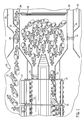
- Fig. 1 is a top plan view of a portion of a plural stall milking parlor.
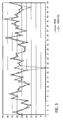
- Fig. 2 is a graph of milk weight versus stall location number, showing uncorrected milk weight data.
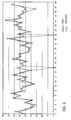
- Fig. 3 is a graph like Fig. 2, but showing corrected milk weight data in accordance with the invention.
- Fig. 4 is a graph like Fig. 2, but showing uncorrected milk weight data with two missing cow identification tags.
- Fig. 5 is like Fig. 4, but showing corrected milk weight data for one of the missing tags.
- Fig. 6 is like Fig. 5, but showing corrected milk weight data for both missing tags.
- Fig. 1 shows a milking parlor 10 for milking a plurality of cows 12.
- a double parlor is shown, including a first bank of parallel milking stalls 14, and a second bank of parallel milking stalls 16.
- the cows initially enter the parlor at holding pen 18, and then pass serially through identification station 20 or 22.
- the identification station includes a frame, such as shown at frame 12 in incorporated U.S. Patent 5,183,008, having a transmitter antenna, such as shown at 13 in the '008 patent, and a receiver antenna, such as shown at 14 in the '008 patent, for identifying a cow passing through such entry identification station.
- the cow has a collar, such as shown at 16 in the '008 patent, carrying an identification tag, such as 17 in the '008 patent, including an electronic oscillator circuit triggered by interrogating electromagnetic RF radiation from the transmitter antenna and sending back a coded identifying signal in response to the interrogating pulse, which coded signal is received by the receiver antenna, for example as further disclosed in incorporated U.S. Patent 5,028,918.
- an identification tag such as 17 in the '008 patent
- the cows pass serially through the entrance identification station 20, 22, they enter stalls 14, 16 in parallel, and are milked.
- exit gate reels 24, 26 rotate as shown in U.S. Patent 5,203,280, incorporated herein by reference, permitting exit of the cows, for example as shown at rotated exit reel 20 in Fig.
- the cows then exit serially through exit stations 28, 30, which also have an identification sensor, including a transmitter antenna and a receiver antenna, for performing a sort function by actuating an exit gate, for example as shown at exit gate 52 in the incorporated '008 patent, between a first position as shown at 32 and a second position as shown at 34, for directing the cows through respective aisles 36, 38, 40, 42, in accordance with desired sort functions.
- exit stations 28, 30, also have an identification sensor, including a transmitter antenna and a receiver antenna, for performing a sort function by actuating an exit gate, for example as shown at exit gate 52 in the incorporated '008 patent, between a first position as shown at 32 and a second position as shown at 34, for directing the cows through respective aisles 36, 38, 40, 42, in accordance with desired sort functions.
- an identification sensor including a transmitter antenna and a receiver antenna
- the weight of the milk produced by each cow is recorded.
- the produced milk weight values of respective cows are tracked, and from such history, expected milk weight values are established, all as is well known.
- produced milk weight values are compared against expected milk weight values, and a correction is performed in response to a given comparative condition therebetween.
- the correction is preferably performed when the number of produced milk weight values exceeds the number of expected milk weight values. This is a sign that one or more of the cows has a missing identification transponder tag, a malfunctioning tag, or is otherwise somehow misidentified or nonidentified.
- the correction is performed by shifting at least one or more of the expected milk weight values relative to produced milk weight values by at least one stall number to more accurately match produced milk weight values and expected milk weight values, to provide more accurate cow identification.
- produced milk weight values and expected milk weight values are charted in a graph of stall number versus milk weight, and the correction is performed by shifting at least one or more of the expected milk weight values along the axis of the stall number in the graph, to be described.
- Fig. 2 shows a graph of milk weight value in pounds on the vertical axis versus stall number or location on the horizontal axis.
- the graph includes the data points for both produced milk weight values and expected milk weight values as shown. As seen in the graph, there are 49 produced milk weight values, and only 48 expected milk weight values. On the left portion of the graph, the lines connecting the data points match up well, but there is a mismatch on the right portion of the graph.
- the present method compares expected and produced milk weight values at adjacent stalls for each cow, and inserts a special marker or phantom cow at a stall, and repeats such procedure for each cow, to determine the misidentified cow, i.e. which stall number has the cow with the missing tag or otherwise unidentified cow, to be described.
- Fig. 2 it is determined that the cow with the missing tag is in stall number 21, to be described. Accordingly, the expected milk weight values for the higher numbered stalls to the right thereof are shifted one stall number to the right, to match up with produced milk weight values for respective stalls. This is shown in Fig. 3. Because the cow at stall 21 is unidentified and not known, it has zero expected milk weight value, and the graph in Fig. 3 shows a dip to zero. The lines connecting the data points match up much better in the right portion of Fig. 3 than in Fig. 2.
- Fig. 4 shows uncorrected milk weight data, with two cows having missing identification tags.
- the left side of the graph in Fig. 4 is a good match between expected milk weight value and produced milk weight value, but the middle and right portions do not match.
- a marker or dummy cow is inserted at stall 21, and the expected milk weight value data points are shifted one stall number to the right thereof, to yield the graph in Fig. 5 which is corrected for one of the missing tags.
- the data matches well up until stall number 35, after which there is a mismatch.
- a second marker dummy cow is inserted at stall 35, and the remaining expected milk weight values are further shifted one stall number to the right, to yield the graph in Fig. 6 which is corrected for both missing tags.
- a possible misidentified or nonidentified cow is assumed in a given stall number.
- the expected milk weight value otherwise expected for such given stall number is shifted to the next stall number.
- expected milk weight values for further stall numbers are shifted to the next incremented stall number, respectively.
- the above method is performed when the number of produced milk weight values exceeds the number of expected milk weight values by one.
- a possible second misidentified or nonidentified cow is assumed in a second given stall number.
- the expected milk weight value otherwise expected for such second stall number is shifted to the next stall number.
- the shifted expected milk weight values for further stall numbers are further shifted to the next further stall number, respectively.
- identified cows are correlated to respective stall numbers, and produced milk weight values are compared against expected milk weight values.
- the correction is performed by shifting expected milk weight values relative to produced milk weight values by at least one stall number to account for an unidentified cow, and properly correlate expected milk weight value to produced milk weight value and accurately identify the cow producing same. At least one or more of the expected milk weight values are shifted by one stall number. In the case of two missing tags, a first group of one or more expected milk weight values are shifted by one stall number, and a second group of one or more expected milk weight values are shifted by two stall numbers.
- the method for determining the stall number of the cow with the missing tag, or the otherwise nonidentified or misidentified cow is described below.
- Table I the first column, Row, is stall number; the second column, Cow, is cow number; the third column, Exp, is expected milk weight value; the fourth column, Prod, is actual produced milk weight value; the fifth column, Err1, is the difference between produced milk weight value and expected milk weight value; the sixth column, Err2, is the difference between produced milk weight value and expected milk weight value of the next stall; the seventh column, Sum1, is the accumulated sum of Err1 values above this stall number; the eighth column, Sum2, is the accumulated sum of Err2 values below this stall number; the ninth column, Total, is the accumulated errors above and below this stall number.
- a stall group is a group of milking stalls that are associated with a serial parlor entry identification system, and is assumed to be numbered in order from 1 to P, where stall number 1 is the stall furthest from the parlor entrance. It is further assumed that cows assigned to or correlated to stalls starting with stall number 1, and that all stalls in the group have a cow in them. Thus, there will always be P produced milk weight values, one for each stall. However, if there are cows that were not identified, there will be no more than P-1 cows.
- the stall group may be a subset of the actual stalls in the parlor when the number of cows milked is less than the number of stalls in the parlor.
- the identification correction method steps are as follows.
- Table I shows the data before Step 7.
- Table II shows the data after Step 7.
- the present method involves responding to the noted given comparative condition between milk weight values and expected milk weight values, preferably when the number of produced milk weight values exceeds the number of expected milk weight values, by: performing a first test correction by assuming a misidentified cow in a first stall number, and shifting expected milk weight values away therefrom to a further stall number, and determining a first cumulative difference between produced milk weight values and expected milk weight values; performing a second test correction by assuming a misidentified cow in a second stall number, and shifting expected milk weight values away therefrom to a further stall number, and determining a second cumulative difference between produced milk weight values and expected milk weight values; performing a third test correction by assuming a misidentified cow in a third stall number, and shifting expected milk weight values away therefrom to a further stall number, and determining a third cumulative difference between produced milk weight values and expected milk weight values; repeating the test corrections for other stall numbers, and determining respective cumulative differences for each, such that there is a first cumulative difference for the first
- a first set of first, second, third and so on test corrections are performed, and a first group of one or more expected milk weight values are shifted by one stall number, and a second set of first, second, third and so on test corrections are performed, and a second group of one or more expected milk weight values are shifted by two stall numbers.
- the preferred method steps involve: in a given milking, correlating identified cows to respective stall numbers and assigning expected milk values, Exp, according to stall number; determining actual produced milk weight values, Prod, according to stall number; determining if the number of actual produced milk weight values is greater than the number of expected milk weight values, and if so, then assuming there is a misidentified cow, and proceeding as follows: determining the difference, Err1, between Prod and Exp for each stall number; determining the difference, Err2, between Prod and Exp of the next stall number; determining the cumulative sum, Sum1, of Err1 values preceding each stall number; determining the cumulative sum, Sum2, of Err2 values succeeding each stall number; adding Sum1 and Sum2 to provide Total for each stall number; determining the stall number having the minimum value of Total, MinTotal, and designating the misidentified cow as the one in the stall providing MinTotal.
- Expected milk weight values are incremented to a higher stall number
- the invention relates to an identification correction method in a plural stall milking parlor for milking a plurality of cows, comprising: determining expected milk measurements based on historical milk measurements of respective cows; for a present milking, comprising said historical milk measurements and said expected milk measurements; performing a correction.
Landscapes
- Life Sciences & Earth Sciences (AREA)
- Environmental Sciences (AREA)
- Animal Husbandry (AREA)
- Biodiversity & Conservation Biology (AREA)
- Birds (AREA)
- Zoology (AREA)
- Biophysics (AREA)
- Feed For Specific Animals (AREA)
- Housing For Livestock And Birds (AREA)
- Management, Administration, Business Operations System, And Electronic Commerce (AREA)
- Investigating Or Analysing Biological Materials (AREA)
Applications Claiming Priority (2)
| Application Number | Priority Date | Filing Date | Title |
|---|---|---|---|
| US922083 | 1986-10-21 | ||
| US08/922,083 US5959526A (en) | 1997-09-02 | 1997-09-02 | Milking parlor cow identification correction method |
Publications (3)
| Publication Number | Publication Date |
|---|---|
| EP0898883A2 true EP0898883A2 (de) | 1999-03-03 |
| EP0898883A3 EP0898883A3 (de) | 2000-02-02 |
| EP0898883B1 EP0898883B1 (de) | 2003-03-12 |
Family
ID=25446485
Family Applications (1)
| Application Number | Title | Priority Date | Filing Date |
|---|---|---|---|
| EP98116577A Expired - Lifetime EP0898883B1 (de) | 1997-09-02 | 1998-09-02 | Verfahren zur Korrektur von Kuherkennung in einem Melkstand |
Country Status (4)
| Country | Link |
|---|---|
| US (1) | US5959526A (de) |
| EP (1) | EP0898883B1 (de) |
| DE (1) | DE69812013T2 (de) |
| IL (1) | IL125687A (de) |
Cited By (5)
| Publication number | Priority date | Publication date | Assignee | Title |
|---|---|---|---|---|
| WO2003039247A1 (en) * | 2001-11-05 | 2003-05-15 | N.V. Nederlandse Apparatenfabriek Nedap | System for checking the presence of an identification label with animals |
| DE10351911A1 (de) * | 2003-11-07 | 2005-06-09 | Westfaliasurge Gmbh | Verfahren und Vorrichtung zur Bereitstellung von Informationen über die Melkplatzbelegung eines Melksystems |
| WO2012125264A1 (en) * | 2011-03-17 | 2012-09-20 | Technologies Holdings Corp. | System and method for milking stall assignment using real-time location |
| US8393296B2 (en) | 2011-04-28 | 2013-03-12 | Technologies Holdings Corp. | Milking box with robotic attacher including rotatable gripping portion and nozzle |
| US8402919B2 (en) | 2003-02-04 | 2013-03-26 | Delaval Holding Ab | Arrangement for housing milking animals |
Families Citing this family (24)
| Publication number | Priority date | Publication date | Assignee | Title |
|---|---|---|---|---|
| NL1002968C2 (nl) * | 1996-04-29 | 1997-11-06 | Prolion Bv | Inrichting en werkwijze voor het melken van dieren. |
| US6659039B1 (en) * | 1999-09-02 | 2003-12-09 | Kristoffer Larsen Innovation A/S | Method for controlling breeding of free-range animals |
| SE517141C2 (sv) * | 2000-06-07 | 2002-04-23 | Delaval Holding Ab | Förfarande för mjölkning där djuren rankas samt mjölkningsstall och datorprogramvara härför |
| DE10033706B4 (de) * | 2000-07-12 | 2005-02-10 | Westfaliasurge Gmbh | Verfahren und Karussell-Melkanlage zur Identifikation eines Melkplatzes sowie eines Tieres, insbesondere einer Kuh, in einer Karussell-Melkanlage |
| US7028638B2 (en) * | 2000-11-20 | 2006-04-18 | Bonsall Sandie W | Animal transportation and tracking system |
| US7055458B2 (en) * | 2002-01-31 | 2006-06-06 | Fangjiang Guo | System for the presentation of animals to be milked and method |
| ATE439762T1 (de) * | 2002-06-05 | 2009-09-15 | Osborne Ind Inc | Verwaltungssystem von lebendem inventar und verfahren zur trenngewichtfütterung |
| US6779484B2 (en) * | 2002-07-19 | 2004-08-24 | Fangjiang Guo | Milking system |
| SE522975C2 (sv) * | 2002-07-19 | 2004-03-23 | Delaval Holding Ab | Metod och arrangemang för att automatiskt verifiera mjölkproducerande djurs identiteter |
| GB0217393D0 (en) * | 2002-07-26 | 2002-09-04 | Gardner Sarah M | Wireless identity tracing system (WITS) for tracing animals and food products |
| US6814026B2 (en) * | 2002-08-02 | 2004-11-09 | Fangjiang Guo | Milking parlor and method for individually presenting animals to be milked via a translating shuttle stall |
| AU2003900325A0 (en) * | 2003-01-24 | 2003-02-06 | Aleis Trakit Pty Ltd | Identifying apparatus |
| SE528623C2 (sv) * | 2005-03-14 | 2007-01-09 | Delaval Holding Ab | Arrangemang och förfarande för mjölkning av ett flertal mjölkdjur |
| DE102005018402B4 (de) * | 2005-04-20 | 2009-10-01 | Gea Westfaliasurge Gmbh | Diagnoseverfahren sowie Diagnoseeinrichtung für ein Tieridentifikationssystem, insbesondere ein Tieridentifikationssystem einer Melkanlage und Melkanlage mit einem Tieridentifikationssystem |
| US7886691B2 (en) * | 2005-09-13 | 2011-02-15 | Wisconsin Alumni Research Foundation | Method for optimizing health and productivity of milk producing animals |
| SE530372C2 (sv) * | 2006-09-05 | 2008-05-13 | Delaval Holding Ab | Mjölkningsfacilitet och förfarande för mjölkning däri |
| US20090320758A1 (en) * | 2006-09-12 | 2009-12-31 | Marcelo Barba | Method and device for the more efficient usage of milking technology in Big, Multistation Milking Plants |
| US7755492B2 (en) * | 2007-03-22 | 2010-07-13 | Round Rock Research, Llc | Methods and systems of tagging objects and reading tags coupled to objects |
| US20090153299A1 (en) * | 2007-12-18 | 2009-06-18 | Keystone Technology Solutions, Llc | Wrapping with Antenna |
| US8317720B2 (en) * | 2008-12-24 | 2012-11-27 | Herdx, Inc. | Core-temperature based herd management system and method |
| US8169324B2 (en) * | 2009-05-20 | 2012-05-01 | Kuzniar James | System for tracking objects |
| GB2480634A (en) | 2010-05-25 | 2011-11-30 | Delaval Holding Ab | Control and monitoring system for a rotating dairy platform |
| US9485958B2 (en) * | 2014-12-29 | 2016-11-08 | Bert J. Waybright | Facility for handling lactating animals and method of operating same |
| WO2025136177A1 (en) | 2023-12-19 | 2025-06-26 | Delaval Holding Ab | Controller for examining the performance of a wireless identification system, computer-implemented method, computer program and non-volatile data carrier |
Citations (3)
| Publication number | Priority date | Publication date | Assignee | Title |
|---|---|---|---|---|
| US5028918A (en) | 1989-12-18 | 1991-07-02 | Dairy Equipment Company | Identification transponder circuit |
| US5183008A (en) | 1991-02-11 | 1993-02-02 | Dec International, Inc. | Livestock sorting system having identification sensor and gate mounted exit switch |
| US5203280A (en) | 1991-12-23 | 1993-04-20 | Dec International, Inc. | Rapid exit herringbone stall |
Family Cites Families (9)
| Publication number | Priority date | Publication date | Assignee | Title |
|---|---|---|---|---|
| US4114151A (en) * | 1976-09-14 | 1978-09-12 | Alfa-Laval Company Limited | Passive transponder apparatus for use in an interrogator-responder system |
| US4274083A (en) * | 1977-12-16 | 1981-06-16 | Eiichi Tomoeda | Apparatus for identifying moving objects |
| US4247758A (en) * | 1979-11-15 | 1981-01-27 | Rodrian James A | Animal identification and estrus detection system |
| US4463353A (en) * | 1981-08-17 | 1984-07-31 | Ralston Purina Company | Animal feeding and monitoring system |
| US4517923A (en) * | 1983-07-07 | 1985-05-21 | Key Systems, Inc. | Animal feeding system |
| US4548161A (en) * | 1983-08-08 | 1985-10-22 | Germania Dairy Automation, Inc. | Milk weight metering method and apparatus |
| US4618861A (en) * | 1985-03-20 | 1986-10-21 | Cornell Research Foundation, Inc. | Passive activity monitor for livestock |
| US4798175A (en) * | 1986-10-09 | 1989-01-17 | Alfa-Laval Agri, Inc. | Electronic identification system |
| US5322034A (en) * | 1992-05-01 | 1994-06-21 | Iowa State University Research Foundation, Inc. | Livestock record system |
-
1997
- 1997-09-02 US US08/922,083 patent/US5959526A/en not_active Expired - Lifetime
-
1998
- 1998-08-06 IL IL12568798A patent/IL125687A/en not_active IP Right Cessation
- 1998-09-02 DE DE69812013T patent/DE69812013T2/de not_active Expired - Lifetime
- 1998-09-02 EP EP98116577A patent/EP0898883B1/de not_active Expired - Lifetime
Patent Citations (3)
| Publication number | Priority date | Publication date | Assignee | Title |
|---|---|---|---|---|
| US5028918A (en) | 1989-12-18 | 1991-07-02 | Dairy Equipment Company | Identification transponder circuit |
| US5183008A (en) | 1991-02-11 | 1993-02-02 | Dec International, Inc. | Livestock sorting system having identification sensor and gate mounted exit switch |
| US5203280A (en) | 1991-12-23 | 1993-04-20 | Dec International, Inc. | Rapid exit herringbone stall |
Cited By (10)
| Publication number | Priority date | Publication date | Assignee | Title |
|---|---|---|---|---|
| WO2003039247A1 (en) * | 2001-11-05 | 2003-05-15 | N.V. Nederlandse Apparatenfabriek Nedap | System for checking the presence of an identification label with animals |
| US8402919B2 (en) | 2003-02-04 | 2013-03-26 | Delaval Holding Ab | Arrangement for housing milking animals |
| DE10351911A1 (de) * | 2003-11-07 | 2005-06-09 | Westfaliasurge Gmbh | Verfahren und Vorrichtung zur Bereitstellung von Informationen über die Melkplatzbelegung eines Melksystems |
| WO2005043988A3 (de) * | 2003-11-07 | 2009-03-12 | Westfaliasurge Gmbh | Verfahren und vorrichtung zur bereitstellung von informationen über die melkplatzbelegung eines melksystems |
| US7721675B2 (en) | 2003-11-07 | 2010-05-25 | Gea Farm Technologies Gmbh | Method for providing information on the occupancy of milking stations of a milking system |
| WO2012125264A1 (en) * | 2011-03-17 | 2012-09-20 | Technologies Holdings Corp. | System and method for milking stall assignment using real-time location |
| US8950357B2 (en) | 2011-03-17 | 2015-02-10 | Technologies Holdings Corp. | System and method for milking stall assignment using real-time location |
| US9439389B2 (en) | 2011-03-17 | 2016-09-13 | Technologies Holdings Corp. | System and method for milking stall assignment using real-time location |
| US9675042B2 (en) | 2011-03-17 | 2017-06-13 | Technologies Holdings Corp. | System and method for milking stall assignment using real-time location |
| US8393296B2 (en) | 2011-04-28 | 2013-03-12 | Technologies Holdings Corp. | Milking box with robotic attacher including rotatable gripping portion and nozzle |
Also Published As
| Publication number | Publication date |
|---|---|
| DE69812013D1 (de) | 2003-04-17 |
| IL125687A0 (en) | 1999-04-11 |
| EP0898883B1 (de) | 2003-03-12 |
| DE69812013T2 (de) | 2004-02-19 |
| IL125687A (en) | 2002-02-10 |
| US5959526A (en) | 1999-09-28 |
| EP0898883A3 (de) | 2000-02-02 |
Similar Documents
| Publication | Publication Date | Title |
|---|---|---|
| US5959526A (en) | Milking parlor cow identification correction method | |
| US7296536B2 (en) | Method and arrangement for automatically verifying identities of milk producing animals | |
| US7721675B2 (en) | Method for providing information on the occupancy of milking stations of a milking system | |
| US3557758A (en) | Animal identification and feed control means | |
| US20100246970A1 (en) | Device and a method for providing information about animals when walking through an animal passage | |
| US20060196431A1 (en) | Method and apparatus for providing at least one item of information on occupancy of a milking stall in a milking facility | |
| US20090301397A1 (en) | Process and rotary milking parlor for the identification of a milking stall and an animal, in particular a cow, in a rotary milking parlor | |
| EP1212939A1 (de) | Farmverwaltungssystem mit Videokamera zur Tierüberwachung in dieser Farm | |
| WO2001055954A2 (en) | Electronic method and system for tracking the carcass of a slaughtered animal through a processing plant | |
| EP0624313B1 (de) | Verfahren und Vorrichtung zur automatischen Beobachtung des Verhaltens von Tieren | |
| US20120319837A1 (en) | System and method for identifying and locating a cotton module transported prior to marking | |
| US20060267767A1 (en) | Diagnostic method as well as diagnostic device for an animal identification system, especially an animal identification system of a milking installation and milking installation with an animal identification system | |
| EP1212937A1 (de) | Identifizierung oder Identitätsüberprüfung aufgrund eines Milchdurchflussprofiles | |
| WO2002007505A1 (en) | A method and an apparatus for milking animals | |
| EP1213676A1 (de) | Tierverwaltungssystem | |
| US20060137615A1 (en) | Method for calibration of milk meters in a milking system | |
| CA2356865C (en) | Method and device for positioning teat cups on a milking animal | |
| US6431449B1 (en) | Method and device for the chronological remote identification and management of mobile labels in an interrogation field | |
| de Koning et al. | Cow ID-topics related to milking and milk recording. | |
| NL1009065C1 (nl) | Systeem voor plaatsherkenning en/of doorloopgangherkenning. | |
| CN113534050A (zh) | 一种传输物品识别定位设备及方法 | |
| Eradus | The development of Standards for automatic animal identification | |
| WO2025136177A1 (en) | Controller for examining the performance of a wireless identification system, computer-implemented method, computer program and non-volatile data carrier | |
| WO2025136178A1 (en) | Controller for identifying animals, computer-implemented method, computer program and non-volatile data carrier | |
| ATE311098T1 (de) | Verfahren und vorrichtung zur entdeckung einer verhaltensstörung eines milchgebenden tieres |
Legal Events
| Date | Code | Title | Description |
|---|---|---|---|
| PUAI | Public reference made under article 153(3) epc to a published international application that has entered the european phase |
Free format text: ORIGINAL CODE: 0009012 |
|
| AK | Designated contracting states |
Kind code of ref document: A2 Designated state(s): DE DK FR GB IE NL SE |
|
| AX | Request for extension of the european patent |
Free format text: AL;LT;LV;MK;RO;SI |
|
| PUAL | Search report despatched |
Free format text: ORIGINAL CODE: 0009013 |
|
| AK | Designated contracting states |
Kind code of ref document: A3 Designated state(s): AT BE CH CY DE DK ES FI FR GB GR IE IT LI LU MC NL PT SE |
|
| AX | Request for extension of the european patent |
Free format text: AL;LT;LV;MK;RO;SI |
|
| 17P | Request for examination filed |
Effective date: 20000802 |
|
| AKX | Designation fees paid |
Free format text: DE DK FR GB IE NL SE |
|
| 17Q | First examination report despatched |
Effective date: 20010621 |
|
| GRAG | Despatch of communication of intention to grant |
Free format text: ORIGINAL CODE: EPIDOS AGRA |
|
| GRAG | Despatch of communication of intention to grant |
Free format text: ORIGINAL CODE: EPIDOS AGRA |
|
| GRAH | Despatch of communication of intention to grant a patent |
Free format text: ORIGINAL CODE: EPIDOS IGRA |
|
| GRAH | Despatch of communication of intention to grant a patent |
Free format text: ORIGINAL CODE: EPIDOS IGRA |
|
| GRAH | Despatch of communication of intention to grant a patent |
Free format text: ORIGINAL CODE: EPIDOS IGRA |
|
| GRAH | Despatch of communication of intention to grant a patent |
Free format text: ORIGINAL CODE: EPIDOS IGRA |
|
| GRAA | (expected) grant |
Free format text: ORIGINAL CODE: 0009210 |
|
| AK | Designated contracting states |
Designated state(s): DE DK FR GB IE NL SE |
|
| REG | Reference to a national code |
Ref country code: GB Ref legal event code: FG4D |
|
| REG | Reference to a national code |
Ref country code: IE Ref legal event code: FG4D |
|
| REF | Corresponds to: |
Ref document number: 69812013 Country of ref document: DE Date of ref document: 20030417 Kind code of ref document: P |
|
| PG25 | Lapsed in a contracting state [announced via postgrant information from national office to epo] |
Ref country code: DK Free format text: LAPSE BECAUSE OF FAILURE TO SUBMIT A TRANSLATION OF THE DESCRIPTION OR TO PAY THE FEE WITHIN THE PRESCRIBED TIME-LIMIT Effective date: 20030612 |
|
| REG | Reference to a national code |
Ref country code: SE Ref legal event code: TRGR |
|
| PG25 | Lapsed in a contracting state [announced via postgrant information from national office to epo] |
Ref country code: IE Free format text: LAPSE BECAUSE OF NON-PAYMENT OF DUE FEES Effective date: 20030902 |
|
| ET | Fr: translation filed | ||
| PLBE | No opposition filed within time limit |
Free format text: ORIGINAL CODE: 0009261 |
|
| STAA | Information on the status of an ep patent application or granted ep patent |
Free format text: STATUS: NO OPPOSITION FILED WITHIN TIME LIMIT |
|
| 26N | No opposition filed |
Effective date: 20031215 |
|
| REG | Reference to a national code |
Ref country code: IE Ref legal event code: MM4A |
|
| PGFP | Annual fee paid to national office [announced via postgrant information from national office to epo] |
Ref country code: NL Payment date: 20130912 Year of fee payment: 16 Ref country code: SE Payment date: 20130826 Year of fee payment: 16 |
|
| PGFP | Annual fee paid to national office [announced via postgrant information from national office to epo] |
Ref country code: GB Payment date: 20130827 Year of fee payment: 16 Ref country code: FR Payment date: 20130826 Year of fee payment: 16 |
|
| PGFP | Annual fee paid to national office [announced via postgrant information from national office to epo] |
Ref country code: DE Payment date: 20130930 Year of fee payment: 16 |
|
| REG | Reference to a national code |
Ref country code: DE Ref legal event code: R119 Ref document number: 69812013 Country of ref document: DE |
|
| REG | Reference to a national code |
Ref country code: SE Ref legal event code: EUG |
|
| GBPC | Gb: european patent ceased through non-payment of renewal fee |
Effective date: 20140902 |
|
| PG25 | Lapsed in a contracting state [announced via postgrant information from national office to epo] |
Ref country code: SE Free format text: LAPSE BECAUSE OF NON-PAYMENT OF DUE FEES Effective date: 20140903 |
|
| REG | Reference to a national code |
Ref country code: DE Ref legal event code: R119 Ref document number: 69812013 Country of ref document: DE Effective date: 20150401 |
|
| REG | Reference to a national code |
Ref country code: FR Ref legal event code: ST Effective date: 20150529 |
|
| PG25 | Lapsed in a contracting state [announced via postgrant information from national office to epo] |
Ref country code: NL Free format text: LAPSE BECAUSE OF NON-PAYMENT OF DUE FEES Effective date: 20150401 |
|
| PG25 | Lapsed in a contracting state [announced via postgrant information from national office to epo] |
Ref country code: GB Free format text: LAPSE BECAUSE OF NON-PAYMENT OF DUE FEES Effective date: 20140902 Ref country code: DE Free format text: LAPSE BECAUSE OF NON-PAYMENT OF DUE FEES Effective date: 20150401 |
|
| PG25 | Lapsed in a contracting state [announced via postgrant information from national office to epo] |
Ref country code: FR Free format text: LAPSE BECAUSE OF NON-PAYMENT OF DUE FEES Effective date: 20140930 |