EP0899719A2 - Procédé d'alignement de texte avec des signaux aufio - Google Patents
Procédé d'alignement de texte avec des signaux aufio Download PDFInfo
- Publication number
- EP0899719A2 EP0899719A2 EP98115010A EP98115010A EP0899719A2 EP 0899719 A2 EP0899719 A2 EP 0899719A2 EP 98115010 A EP98115010 A EP 98115010A EP 98115010 A EP98115010 A EP 98115010A EP 0899719 A2 EP0899719 A2 EP 0899719A2
- Authority
- EP
- European Patent Office
- Prior art keywords
- segment
- text
- audio
- segments
- unaligned
- Prior art date
- Legal status (The legal status is an assumption and is not a legal conclusion. Google has not performed a legal analysis and makes no representation as to the accuracy of the status listed.)
- Granted
Links
Images





Classifications
-
- G—PHYSICS
- G10—MUSICAL INSTRUMENTS; ACOUSTICS
- G10L—SPEECH ANALYSIS TECHNIQUES OR SPEECH SYNTHESIS; SPEECH RECOGNITION; SPEECH OR VOICE PROCESSING TECHNIQUES; SPEECH OR AUDIO CODING OR DECODING
- G10L15/00—Speech recognition
- G10L15/26—Speech to text systems
Definitions
- This invention relates generally to the processing of speech signals, and more particularly to aligning digitized text to analog spoken words.
- a user may desire to locate portions of an audio file, e.g., a taped radio program, that have specific content. If the retrieval application has an aligned text transcript of the audio file, then the text file can be searched using conventual text query techniques to locate the corresponding portion in the audio file. In effect, the alignment enables direct access into the audio file by words. Audio-to-text alignment can also be used to search a video file (video) when the video includes an audio stream aligned with a text transcript, e.g., the video signal is close captioned.
- video file video
- a computerized method for aligning a text file with an audio file.
- the text file includes written words and the audio file includes spoken words. There is a one-to-one correspondence between some, but not necessarily all of the words of the text and audio files.
- the invention in its broad form, resides in a computerized method and apparatus for aligning text segments of a text file with audio segments of an audio file, as recited in claims 1 and 15 respectively.
- the language model can be in the form of trigrams that indicate the relative probabilities of one, two, and three word sequences in the text segment.
- a word list annotated with timing information is generated by recognizing spoken words from the audio segment using the vocabulary and language model.
- the speech recognizer can be any standard speech recognizer that uses acoustic-phonetic models.
- the word list is aligned with the text segment, noting that there may be several possible alignments. Dynamic programming techniques are used to determine a best possible alignment. Anchors corresponding to best alignments of the written and spoken words are chosen, and the anchors are used to partition the text segment and the audio segment into unaligned and aligned segments. These steps are repeated on the unaligned segments until a termination condition is reached.
- the termination condition can be recognized as a fully aligned text and audio segments, or when a particular unaligned segment has a duration less than a predetermined threshold.
- the vocabulary and language model is rebuilt from the unaligned segments during the next iterations.
- Figure 1 shows portions of an audio file 110, and a corresponding text file 120 that are to be aligned according to the invention.
- the text file 120 is a full or partial transcription of the spoken words of the audio file.
- the content of the audio file 110 is temporally related. That is, the analog audio signals continuously move forward at a steady rate over, perhaps, several hours. Some words (long 111) may be stretched out in time to give emphasis, other words (112) may be short in duration, depending on the diction of the speaker. Words 113 may blend into each other when the speech is slurred. This makes it difficult to distinguish the end of one word and the start of another.
- the file 110 may also include silence and other audio signals, for example, extraneous words, music, and background noise, for which there is no corresponding text.
- the audio signals may also be corrupted by other channel conditions such as distortion and compression induced aberrations.
- the characters that form the words of the text are spatially related, that is, there is no sense of time.
- Each character is typically stored as a fixed length digital string (a byte 121), and spatial separation between words, sentences, and maybe even paragraphs are usually clearly delineated using punctuation marks 122, e.g., the space character or period characters.
- the problem is to align the temporally ordered audio signals with the spatially ordered text signals as shown by arrows 130.
- the present arrangement uses an iterative top-down "divide and conquer" technique.
- the audio and text files 110 and 120 are each partitioned into smaller segments 201, 202, 203, 204, ...., 299, at "anchors" 200 during successive stages of the iterations.
- the lines of separation between segments are termed as “anchors” for purposes of this invention.
- the process completes, for example, when the two files are fully aligned, or when no additional anchors can be detected.
- the possible alignments are scored, and best alignments are selected as the anchors where the files can correctly be partitioned into aligned and unaligned segments. Because the alignment is performed in a top-down manner, there is a smaller likelihood that there will be any gross misalignments.
- the preferred method 300 begins in an analyzing step 301 by processing a current text segment 310 of the text file 120 to produce a vocabulary and language model (V-LM) 320 for the text segment 310.
- the current segment 310 can be the entire text file 110.
- the V-LM 320 can be generated using standard language analyzing tools, such the one provided with the Sphinx II speech recognizer developed at the Carnegie-Mellon University.
- the language model is in the form of trigrams 321 where the relative probabilities of all one, two, three word sequences are determined taking into consideration how often these sequences occur in the text segment 310.
- the corresponding segment of the audio file 330 is processed by the speech recognizer using the V-LM 320 and acoustic-phonetic models 325 to generate a word list 331 annotated with timing information 332, and possible confidence scores 333.
- the speech recognizer can be any standard speech recognizer.
- the Sphinx II recognizer 203 uses Hidden Markov Modeling (HHM), however, Statistical Trajectory Modeling (STM) can also be used.
- the acoustic-phonetic models 325 statistically characterize acoustic-phonetic units.
- the acoustic-models 325 are usually trained from a training corpus.
- the acoustic-phonetic models 325 can, initially, be speaker independent.
- the word list 331 sequentially stores only the words that were actually recognized in the audio segment 330. Note in contrast with the prior art, this step 302 is performed without considering what the words might be as indicated in the text segment 310.
- the timing information 332 indicates, for each recognized word, the starting time and the duration of each recognized word.
- the confidence scores 333 indicate the degree of certainty that the word is correctly recognized.
- the word list 331 and the timing information 332 are not necessarily absolutely correct, that is, the recognized spoken words of the list 331 are only a "best guess" at the spoken words of the audio segment 330, as indicated by the confidence scores 333. Some words may be missed, and other words may be misinterpreted, e.g., "way” may be recognized as "weight.”
- the recognized word list 331 is aligned with the text segment 310.
- Dynamic programming, or similar techniques can be used to align the word list 331 and the text segment 310.
- Dynamic programming techniques that determine a best one-to-one correspondence between two lists of "tokens" are well known.
- the tokens are spoken words and text words.
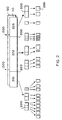
- the dashed lines 403 indicate a one-to-one correspondence where the largest number of words are aligned.
- the alignment indicated by the solid lines 404 is based on preferentially aligning longer words. It is desired to chose the "best" alignments.
- each possible alignment can be scored.
- the scoring of a particular alignment can increase whenever identical words are aligned, and decrease when different words are aligned.
- the score can be weighted to increase the score by a greater amount for "long" words, since long words probably occur at a lesser frequency. Also, long sequences of correctly aligned words can increase the score.
- step 304 alignments that are most likely to be correct are chosen as "anchors" 200 in the audio segment 330 and the text segment 310.
- An anchor 200 is defined a place where the spoken words of the audio segment are aligned with the written words of the text segment with a reasonable degree of confidence. In a preferred embodiment, any sequence of four words is assumed to be correct. If no such sequences exist, then the threshold can be reduced to three words, and then two. Other choices are possible, such as choosing only the longest correct sequence as an anchor, or considering total word lengths in determining the length of a correct sequence.
- the anchors 200 in the text segment 310 can be annotated with the corresponding timing information derived from the audio segment 330.
- the anchors 200 are used to partition the text segment 310 and the audio segment 330 into corresponding aligned segments (cross-hatched) 501 and unaligned segments 502.
- the starting times and durations of the segments 501 and 502 are known from the timing information used to annotate the segments.
- the unaligned text and audio segments 502 are reprocessed by steps 301-305 until a desired termination conditions is reached, e.g., the text and audio files are fully aligned, or no more anchors can be detected.
- a desired termination conditions e.g., the text and audio files are fully aligned, or no more anchors can be detected.
- some of the words of an anchor 200 can begin and/or terminate each unaligned segment 502 after partitioning to increase the chance that there are some words in the unaligned segment that will be correctly recognized on the next pass.
- the vocabulary and language model 320 is rebuilt only from the words of that text segment, and only that particular V-LM 320 is used to recognize words in the current audio segment 330.
- the iterations can terminate for several reasons. One is when there are no more words to align, and hence no more sub-segments. The other is when the last iteration did not find enough aligned words, so there is nothing to be gained by a further iteration.
- the iterations can be stopped sooner, depending on the precision desired. For example if the alignment is needed for indexing purposes the iterations could be stopped when the duration of a segment is short enough (for example, a few seconds).
- the present method iterates over smaller and smaller unaligned segments with a more constrained vocabulary and language model, the present method is better able to overcome noise and other difficulties in the audio stream, for example, audio streams where speech and music are overlaid.
- the method is less likely to misalign long audio streams because a top-down approach is used, a misalignment in one segment will not influence alignment in another segment.
- the method also works when the text file does not represent the whole duration of the audio file, but only part of it. Large segments in the audio file for which there are no corresponding text segments are easily handled.
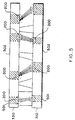
- Figure 6 shows the alignment and partitioning of segments over several iterations.
- the words of an entire segment are unaligned.
- the hashed portions 501 have been aligned.
- the unaligned portions 502 (blocks 603) are reprocessed 660 to locate further aligned portions (in blocks 604), and so forth (process 680).
- Block 605 shows that there are no more segments to align.
- the processing steps 301-305 can dynamically be adjusted in a number of ways during the iterations.
- the results of aligned portions are used to adjust the acoustic-phonetic models 325 of the recognizer 302.
- the recognizer 302 learns to better recognize the spoken words of a specific audio file.
- the aligned portions of the last pass become speech training data for the recognizer 302 so that the next pass over unaligned portions can be more robust.
- the recognizer 302 can initially be configured to work with speaker independent models. However, as the recognizer "learns" the speech of the speaker of the words of the audio file, the speech recognition acoustic-phonetic models become more speaker dependent, i.e., "better tuned.” Also, for audio files of a relatively long duration, the models can be adjusted to take into consideration channel parameters such as noise, distortion, and compression techniques used on the speech, i.e., the present method deals better with difficult audio files.
- the aligner and/or anchor choser can also be adjusted in step 630 to be more or less aggressive.
- the variables and criteria used by the dynamic programming technique of the aligner 302 can be relaxed as the recognizer improves. This means that larger sequences of aligned words will sooner be detected in subsequent iterations.
- the unaligned portions can be reprocessed with different scoring techniques, and so forth.
- the precision of the alignment can be dynamically adjusted to give reasonable results for a given application.
- an audio file 710 contains portions 701 spoken by a first speaker (Bob), and portions 702 spoken by a second speaker (Alice).
- a corresponding text file 720 is fully or partially annotated with speaker identification information, e.g., each portion of transcribed text is preceded with corresponding speaker identifications 721 and 722.
- the recognizer 302 can develop separate acoustic-phonetic models 731 and 732 for the multiple speakers. After the models are "trained, speaker recognition can automatically be performed.
- This technique can also be used to perform "automatic" closed captioning. For example, a first tape of a news program is fully or partially transcribed with the "newscaster” identification as described above. After, the recognizer 302 has been trained for a particular "set” of "newscasters," subsequent video (or audio) tapes can be transcribed to generate text files without explicit identification of the speakers. The models 325 can be adjusted as the "cast" of the news program changes.
- the present method is a top-down iterative alignment process, and not a sequential left-to-right alignment.
- the recognizer operates on time varying signal to recognize tokens, and aligns the tokens with digital versions of the tokens. Unaligned tokens are reprocessed. This technique can also be used to align other types of signals in, for example, automatic handwriting and lip reading systems.
Landscapes
- Engineering & Computer Science (AREA)
- Computational Linguistics (AREA)
- Health & Medical Sciences (AREA)
- Audiology, Speech & Language Pathology (AREA)
- Human Computer Interaction (AREA)
- Physics & Mathematics (AREA)
- Acoustics & Sound (AREA)
- Multimedia (AREA)
- Document Processing Apparatus (AREA)
- Machine Translation (AREA)
Applications Claiming Priority (2)
| Application Number | Priority Date | Filing Date | Title |
|---|---|---|---|
| US921347 | 1997-08-29 | ||
| US08/921,347 US6076059A (en) | 1997-08-29 | 1997-08-29 | Method for aligning text with audio signals |
Publications (3)
| Publication Number | Publication Date |
|---|---|
| EP0899719A2 true EP0899719A2 (fr) | 1999-03-03 |
| EP0899719A3 EP0899719A3 (fr) | 1999-10-27 |
| EP0899719B1 EP0899719B1 (fr) | 2003-10-15 |
Family
ID=25445309
Family Applications (1)
| Application Number | Title | Priority Date | Filing Date |
|---|---|---|---|
| EP98115010A Expired - Lifetime EP0899719B1 (fr) | 1997-08-29 | 1998-08-10 | Procédé d'alignement de texte avec des signaux audio |
Country Status (4)
| Country | Link |
|---|---|
| US (1) | US6076059A (fr) |
| EP (1) | EP0899719B1 (fr) |
| JP (1) | JPH11191000A (fr) |
| DE (1) | DE69818930T2 (fr) |
Cited By (4)
| Publication number | Priority date | Publication date | Assignee | Title |
|---|---|---|---|---|
| WO2001095631A3 (fr) * | 2000-06-09 | 2002-09-06 | British Broadcasting Corp | Production de sous-titres ou de legendes pour images animees |
| CN105027196A (zh) * | 2012-12-29 | 2015-11-04 | 格林伊登美国控股有限责任公司 | 自动语音识别系统中的快速词汇表外搜索 |
| WO2020214373A1 (fr) * | 2019-04-19 | 2020-10-22 | Raytheon Company | Détection d'anomalies audio |
| CN115062599A (zh) * | 2022-06-02 | 2022-09-16 | 青岛科技大学 | 一种多阶段语音与文本容错对齐的方法及装置 |
Families Citing this family (119)
| Publication number | Priority date | Publication date | Assignee | Title |
|---|---|---|---|---|
| US6850609B1 (en) * | 1997-10-28 | 2005-02-01 | Verizon Services Corp. | Methods and apparatus for providing speech recording and speech transcription services |
| US6473778B1 (en) * | 1998-12-24 | 2002-10-29 | At&T Corporation | Generating hypermedia documents from transcriptions of television programs using parallel text alignment |
| US6324499B1 (en) * | 1999-03-08 | 2001-11-27 | International Business Machines Corp. | Noise recognizer for speech recognition systems |
| US6535848B1 (en) * | 1999-06-08 | 2003-03-18 | International Business Machines Corporation | Method and apparatus for transcribing multiple files into a single document |
| US6442518B1 (en) * | 1999-07-14 | 2002-08-27 | Compaq Information Technologies Group, L.P. | Method for refining time alignments of closed captions |
| US7412643B1 (en) | 1999-11-23 | 2008-08-12 | International Business Machines Corporation | Method and apparatus for linking representation and realization data |
| US6925436B1 (en) * | 2000-01-28 | 2005-08-02 | International Business Machines Corporation | Indexing with translation model for feature regularization |
| US7047191B2 (en) * | 2000-03-06 | 2006-05-16 | Rochester Institute Of Technology | Method and system for providing automated captioning for AV signals |
| US6260011B1 (en) * | 2000-03-20 | 2001-07-10 | Microsoft Corporation | Methods and apparatus for automatically synchronizing electronic audio files with electronic text files |
| US6263308B1 (en) * | 2000-03-20 | 2001-07-17 | Microsoft Corporation | Methods and apparatus for performing speech recognition using acoustic models which are improved through an interactive process |
| US6505153B1 (en) | 2000-05-22 | 2003-01-07 | Compaq Information Technologies Group, L.P. | Efficient method for producing off-line closed captions |
| DE10042943C2 (de) * | 2000-08-31 | 2003-03-06 | Siemens Ag | Zuordnen von Phonemen zu den sie erzeugenden Graphemen |
| US6993246B1 (en) | 2000-09-15 | 2006-01-31 | Hewlett-Packard Development Company, L.P. | Method and system for correlating data streams |
| US6975985B2 (en) * | 2000-11-29 | 2005-12-13 | International Business Machines Corporation | Method and system for the automatic amendment of speech recognition vocabularies |
| US7496510B2 (en) * | 2000-11-30 | 2009-02-24 | International Business Machines Corporation | Method and apparatus for the automatic separating and indexing of multi-speaker conversations |
| WO2002080143A1 (fr) * | 2001-03-29 | 2002-10-10 | Koninklijke Philips Electronics N.V. | Synchronisation d'un curseur audio et d'un curseur de texte au cours de la correction |
| US20020152064A1 (en) * | 2001-04-12 | 2002-10-17 | International Business Machines Corporation | Method, apparatus, and program for annotating documents to expand terms in a talking browser |
| US7016829B2 (en) * | 2001-05-04 | 2006-03-21 | Microsoft Corporation | Method and apparatus for unsupervised training of natural language processing units |
| US6839667B2 (en) * | 2001-05-16 | 2005-01-04 | International Business Machines Corporation | Method of speech recognition by presenting N-best word candidates |
| US6963834B2 (en) * | 2001-05-29 | 2005-11-08 | International Business Machines Corporation | Method of speech recognition using empirically determined word candidates |
| US20030033147A1 (en) * | 2001-06-08 | 2003-02-13 | Recording For The Blind & Dyslexic Incorporated | Method and apparatus for coordinating text and audio events in a digital talking book |
| JP2005505804A (ja) * | 2001-10-12 | 2005-02-24 | コーニンクレッカ フィリップス エレクトロニクス エヌ ヴィ | 認識されたテキストの一部をマークするための音声認識装置 |
| US7146321B2 (en) * | 2001-10-31 | 2006-12-05 | Dictaphone Corporation | Distributed speech recognition system |
| US7133829B2 (en) * | 2001-10-31 | 2006-11-07 | Dictaphone Corporation | Dynamic insertion of a speech recognition engine within a distributed speech recognition system |
| KR100563680B1 (ko) * | 2001-11-27 | 2006-03-28 | 엘지전자 주식회사 | 재기록 가능 기록매체의 오디오 가사 데이터 기록 관리 및재생방법 |
| KR20030043299A (ko) * | 2001-11-27 | 2003-06-02 | 주식회사 엘지이아이 | 오디오 데이터와 부가 데이터간의 동기 기록 관리 및재생방법 |
| US6766294B2 (en) | 2001-11-30 | 2004-07-20 | Dictaphone Corporation | Performance gauge for a distributed speech recognition system |
| US6785654B2 (en) | 2001-11-30 | 2004-08-31 | Dictaphone Corporation | Distributed speech recognition system with speech recognition engines offering multiple functionalities |
| US20030128856A1 (en) * | 2002-01-08 | 2003-07-10 | Boor Steven E. | Digitally programmable gain amplifier |
| WO2003063067A1 (fr) * | 2002-01-24 | 2003-07-31 | Chatterbox Systems, Inc. | Procedes et systemes de localisation de position dans des textes imprimes et de diffusion d'informations multimedia |
| US7292975B2 (en) * | 2002-05-01 | 2007-11-06 | Nuance Communications, Inc. | Systems and methods for evaluating speaker suitability for automatic speech recognition aided transcription |
| US7236931B2 (en) * | 2002-05-01 | 2007-06-26 | Usb Ag, Stamford Branch | Systems and methods for automatic acoustic speaker adaptation in computer-assisted transcription systems |
| US7231351B1 (en) * | 2002-05-10 | 2007-06-12 | Nexidia, Inc. | Transcript alignment |
| US7398209B2 (en) | 2002-06-03 | 2008-07-08 | Voicebox Technologies, Inc. | Systems and methods for responding to natural language speech utterance |
| US20030229491A1 (en) * | 2002-06-06 | 2003-12-11 | International Business Machines Corporation | Single sound fragment processing |
| US7693720B2 (en) | 2002-07-15 | 2010-04-06 | Voicebox Technologies, Inc. | Mobile systems and methods for responding to natural language speech utterance |
| US6816834B2 (en) * | 2002-10-23 | 2004-11-09 | Jon Jaroker | System and method for secure real-time high accuracy speech to text conversion of general quality speech |
| US7539086B2 (en) * | 2002-10-23 | 2009-05-26 | J2 Global Communications, Inc. | System and method for the secure, real-time, high accuracy conversion of general-quality speech into text |
| AT6921U1 (de) * | 2002-11-28 | 2004-05-25 | Sail Labs Technology Ag | Verfahren zur automatischen übereinstimmung von audio-segmenten mit textelementen |
| US20040176139A1 (en) * | 2003-02-19 | 2004-09-09 | Motorola, Inc. | Method and wireless communication device using voice recognition for entering text characters |
| WO2004097791A2 (fr) * | 2003-04-29 | 2004-11-11 | Custom Speech Usa, Inc. | Procedes et systemes de creation d'un fichier de session de deuxieme generation |
| JP4113059B2 (ja) * | 2003-07-28 | 2008-07-02 | 株式会社東芝 | 字幕信号処理装置、字幕信号処理方法及び字幕信号処理プログラム |
| US7346506B2 (en) * | 2003-10-08 | 2008-03-18 | Agfa Inc. | System and method for synchronized text display and audio playback |
| JP3945778B2 (ja) * | 2004-03-12 | 2007-07-18 | インターナショナル・ビジネス・マシーンズ・コーポレーション | 設定装置、プログラム、記録媒体、及び設定方法 |
| US7461004B2 (en) * | 2004-05-27 | 2008-12-02 | Intel Corporation | Content filtering for a digital audio signal |
| US8504369B1 (en) * | 2004-06-02 | 2013-08-06 | Nuance Communications, Inc. | Multi-cursor transcription editing |
| US7356469B2 (en) * | 2004-08-20 | 2008-04-08 | International Business Machines Corporation | Method and system for trimming audio files |
| US20060136226A1 (en) * | 2004-10-06 | 2006-06-22 | Ossama Emam | System and method for creating artificial TV news programs |
| US7836412B1 (en) | 2004-12-03 | 2010-11-16 | Escription, Inc. | Transcription editing |
| US7693713B2 (en) * | 2005-06-17 | 2010-04-06 | Microsoft Corporation | Speech models generated using competitive training, asymmetric training, and data boosting |
| US7640160B2 (en) | 2005-08-05 | 2009-12-29 | Voicebox Technologies, Inc. | Systems and methods for responding to natural language speech utterance |
| US7620549B2 (en) | 2005-08-10 | 2009-11-17 | Voicebox Technologies, Inc. | System and method of supporting adaptive misrecognition in conversational speech |
| US7949529B2 (en) | 2005-08-29 | 2011-05-24 | Voicebox Technologies, Inc. | Mobile systems and methods of supporting natural language human-machine interactions |
| US20070055514A1 (en) * | 2005-09-08 | 2007-03-08 | Beattie Valerie L | Intelligent tutoring feedback |
| US8032372B1 (en) | 2005-09-13 | 2011-10-04 | Escription, Inc. | Dictation selection |
| US9020811B2 (en) * | 2006-10-13 | 2015-04-28 | Syscom, Inc. | Method and system for converting text files searchable text and for processing the searchable text |
| US8073681B2 (en) | 2006-10-16 | 2011-12-06 | Voicebox Technologies, Inc. | System and method for a cooperative conversational voice user interface |
| US7818176B2 (en) | 2007-02-06 | 2010-10-19 | Voicebox Technologies, Inc. | System and method for selecting and presenting advertisements based on natural language processing of voice-based input |
| JP5313466B2 (ja) * | 2007-06-28 | 2013-10-09 | ニュアンス コミュニケーションズ,インコーポレイテッド | 音声の再生に同期して音声の内容を表示させる技術 |
| US7716054B2 (en) * | 2007-06-29 | 2010-05-11 | Microsoft Corporation | Activity-ware for non-textual objects |
| US8140335B2 (en) | 2007-12-11 | 2012-03-20 | Voicebox Technologies, Inc. | System and method for providing a natural language voice user interface in an integrated voice navigation services environment |
| JP2009237285A (ja) * | 2008-03-27 | 2009-10-15 | Toshiba Corp | 人物名付与装置および方法 |
| US8589161B2 (en) | 2008-05-27 | 2013-11-19 | Voicebox Technologies, Inc. | System and method for an integrated, multi-modal, multi-device natural language voice services environment |
| US9305548B2 (en) | 2008-05-27 | 2016-04-05 | Voicebox Technologies Corporation | System and method for an integrated, multi-modal, multi-device natural language voice services environment |
| US8131545B1 (en) | 2008-09-25 | 2012-03-06 | Google Inc. | Aligning a transcript to audio data |
| US8364488B2 (en) * | 2009-01-15 | 2013-01-29 | K-Nfb Reading Technology, Inc. | Voice models for document narration |
| US8326637B2 (en) | 2009-02-20 | 2012-12-04 | Voicebox Technologies, Inc. | System and method for processing multi-modal device interactions in a natural language voice services environment |
| US20100299131A1 (en) * | 2009-05-21 | 2010-11-25 | Nexidia Inc. | Transcript alignment |
| US8332225B2 (en) * | 2009-06-04 | 2012-12-11 | Microsoft Corporation | Techniques to create a custom voice font |
| US9280969B2 (en) * | 2009-06-10 | 2016-03-08 | Microsoft Technology Licensing, Llc | Model training for automatic speech recognition from imperfect transcription data |
| US20100332225A1 (en) * | 2009-06-29 | 2010-12-30 | Nexidia Inc. | Transcript alignment |
| US8843368B2 (en) | 2009-08-17 | 2014-09-23 | At&T Intellectual Property I, L.P. | Systems, computer-implemented methods, and tangible computer-readable storage media for transcription alignment |
| US8281231B2 (en) * | 2009-09-11 | 2012-10-02 | Digitalsmiths, Inc. | Timeline alignment for closed-caption text using speech recognition transcripts |
| US8571866B2 (en) | 2009-10-23 | 2013-10-29 | At&T Intellectual Property I, L.P. | System and method for improving speech recognition accuracy using textual context |
| US9502025B2 (en) | 2009-11-10 | 2016-11-22 | Voicebox Technologies Corporation | System and method for providing a natural language content dedication service |
| US9171541B2 (en) * | 2009-11-10 | 2015-10-27 | Voicebox Technologies Corporation | System and method for hybrid processing in a natural language voice services environment |
| US8645134B1 (en) * | 2009-11-18 | 2014-02-04 | Google Inc. | Generation of timed text using speech-to-text technology and applications thereof |
| US20110153330A1 (en) * | 2009-11-27 | 2011-06-23 | i-SCROLL | System and method for rendering text synchronized audio |
| US8572488B2 (en) * | 2010-03-29 | 2013-10-29 | Avid Technology, Inc. | Spot dialog editor |
| US8392186B2 (en) | 2010-05-18 | 2013-03-05 | K-Nfb Reading Technology, Inc. | Audio synchronization for document narration with user-selected playback |
| US9615140B1 (en) | 2010-05-27 | 2017-04-04 | Edward Malinowski | Method and device for delivery of subtitle synchronized with a media stream |
| US20120047437A1 (en) * | 2010-08-23 | 2012-02-23 | Jeffrey Chan | Method for Creating and Navigating Link Based Multimedia |
| US9028255B2 (en) | 2010-10-06 | 2015-05-12 | Dominic William Massaro | Method and system for acquisition of literacy |
| US11062615B1 (en) | 2011-03-01 | 2021-07-13 | Intelligibility Training LLC | Methods and systems for remote language learning in a pandemic-aware world |
| US10019995B1 (en) | 2011-03-01 | 2018-07-10 | Alice J. Stiebel | Methods and systems for language learning based on a series of pitch patterns |
| US8855797B2 (en) | 2011-03-23 | 2014-10-07 | Audible, Inc. | Managing playback of synchronized content |
| JP5404726B2 (ja) * | 2011-09-26 | 2014-02-05 | 株式会社東芝 | 情報処理装置、情報処理方法およびプログラム |
| US9679608B2 (en) | 2012-06-28 | 2017-06-13 | Audible, Inc. | Pacing content |
| US10109278B2 (en) * | 2012-08-02 | 2018-10-23 | Audible, Inc. | Aligning body matter across content formats |
| US8804035B1 (en) * | 2012-09-25 | 2014-08-12 | The Directv Group, Inc. | Method and system for communicating descriptive data in a television broadcast system |
| US9367196B1 (en) | 2012-09-26 | 2016-06-14 | Audible, Inc. | Conveying branched content |
| US9632647B1 (en) | 2012-10-09 | 2017-04-25 | Audible, Inc. | Selecting presentation positions in dynamic content |
| US9223830B1 (en) | 2012-10-26 | 2015-12-29 | Audible, Inc. | Content presentation analysis |
| US9280906B2 (en) | 2013-02-04 | 2016-03-08 | Audible. Inc. | Prompting a user for input during a synchronous presentation of audio content and textual content |
| US20160133251A1 (en) * | 2013-05-31 | 2016-05-12 | Longsand Limited | Processing of audio data |
| US9317486B1 (en) | 2013-06-07 | 2016-04-19 | Audible, Inc. | Synchronizing playback of digital content with captured physical content |
| US9489360B2 (en) | 2013-09-05 | 2016-11-08 | Audible, Inc. | Identifying extra material in companion content |
| US20150081294A1 (en) * | 2013-09-19 | 2015-03-19 | Maluuba Inc. | Speech recognition for user specific language |
| EP4478276A3 (fr) | 2014-09-16 | 2025-01-22 | VB Assets, LLC | Commerce vocal |
| US9898459B2 (en) | 2014-09-16 | 2018-02-20 | Voicebox Technologies Corporation | Integration of domain information into state transitions of a finite state transducer for natural language processing |
| CN107003999B (zh) | 2014-10-15 | 2020-08-21 | 声钰科技 | 对用户的在先自然语言输入的后续响应的系统和方法 |
| US10614799B2 (en) | 2014-11-26 | 2020-04-07 | Voicebox Technologies Corporation | System and method of providing intent predictions for an utterance prior to a system detection of an end of the utterance |
| US10431214B2 (en) | 2014-11-26 | 2019-10-01 | Voicebox Technologies Corporation | System and method of determining a domain and/or an action related to a natural language input |
| JP6459818B2 (ja) * | 2015-07-22 | 2019-01-30 | ブラザー工業株式会社 | テキスト対応付け装置、テキスト対応付け方法、及びプログラム |
| CN106231432B (zh) * | 2016-07-29 | 2019-08-06 | 北京小米移动软件有限公司 | 分享视频的方法及装置 |
| US10331784B2 (en) | 2016-07-29 | 2019-06-25 | Voicebox Technologies Corporation | System and method of disambiguating natural language processing requests |
| US10657202B2 (en) * | 2017-12-11 | 2020-05-19 | International Business Machines Corporation | Cognitive presentation system and method |
| US10671251B2 (en) | 2017-12-22 | 2020-06-02 | Arbordale Publishing, LLC | Interactive eReader interface generation based on synchronization of textual and audial descriptors |
| US11443646B2 (en) | 2017-12-22 | 2022-09-13 | Fathom Technologies, LLC | E-Reader interface system with audio and highlighting synchronization for digital books |
| US12572509B2 (en) | 2022-01-18 | 2026-03-10 | Dell Products L.P. | Structure based file compression using sequence alignment |
| US12580047B2 (en) | 2022-01-18 | 2026-03-17 | Dell Products L.P. | Biological sequence compression using sequence alignment |
| US12353358B2 (en) | 2022-01-18 | 2025-07-08 | Dell Products L.P. | Adding content to compressed files using sequence alignment |
| US12530320B2 (en) | 2022-01-18 | 2026-01-20 | Dell Products L.P. | File compression using sequence splits and sequence alignment |
| US12511260B2 (en) | 2022-01-18 | 2025-12-30 | Dell Products L.P. | File compression using sequence alignment |
| CN114495929B (zh) * | 2022-01-26 | 2025-03-11 | 广东与众不同信息科技有限公司 | 一种语音培训识别方法及系统 |
| US12339811B2 (en) | 2022-04-12 | 2025-06-24 | Dell Products L.P. | Compressing multiple dimension files using sequence alignment |
| US12216621B2 (en) * | 2022-04-12 | 2025-02-04 | Dell Products L.P. | Hyperparameter optimization in file compression using sequence alignment |
| US11977517B2 (en) | 2022-04-12 | 2024-05-07 | Dell Products L.P. | Warm start file compression using sequence alignment |
| KR102540178B1 (ko) * | 2022-09-08 | 2023-06-05 | (주)액션파워 | 음성 인식 결과를 편집하는 방법 |
Family Cites Families (3)
| Publication number | Priority date | Publication date | Assignee | Title |
|---|---|---|---|---|
| US5333275A (en) * | 1992-06-23 | 1994-07-26 | Wheatley Barbara J | System and method for time aligning speech |
| JP2986345B2 (ja) * | 1993-10-18 | 1999-12-06 | インターナショナル・ビジネス・マシーンズ・コーポレイション | 音声記録指標化装置及び方法 |
| US5737725A (en) * | 1996-01-09 | 1998-04-07 | U S West Marketing Resources Group, Inc. | Method and system for automatically generating new voice files corresponding to new text from a script |
-
1997
- 1997-08-29 US US08/921,347 patent/US6076059A/en not_active Expired - Fee Related
-
1998
- 1998-08-10 DE DE1998618930 patent/DE69818930T2/de not_active Expired - Fee Related
- 1998-08-10 EP EP98115010A patent/EP0899719B1/fr not_active Expired - Lifetime
- 1998-08-28 JP JP10242823A patent/JPH11191000A/ja active Pending
Cited By (7)
| Publication number | Priority date | Publication date | Assignee | Title |
|---|---|---|---|---|
| WO2001095631A3 (fr) * | 2000-06-09 | 2002-09-06 | British Broadcasting Corp | Production de sous-titres ou de legendes pour images animees |
| GB2379312A (en) * | 2000-06-09 | 2003-03-05 | British Broadcasting Corp | Generation subtitles or captions for moving pictures |
| US7191117B2 (en) | 2000-06-09 | 2007-03-13 | British Broadcasting Corporation | Generation of subtitles or captions for moving pictures |
| CN105027196A (zh) * | 2012-12-29 | 2015-11-04 | 格林伊登美国控股有限责任公司 | 自动语音识别系统中的快速词汇表外搜索 |
| CN105027196B (zh) * | 2012-12-29 | 2019-01-11 | 格林伊登美国控股有限责任公司 | 自动语音识别系统中的快速词汇表外搜索 |
| WO2020214373A1 (fr) * | 2019-04-19 | 2020-10-22 | Raytheon Company | Détection d'anomalies audio |
| CN115062599A (zh) * | 2022-06-02 | 2022-09-16 | 青岛科技大学 | 一种多阶段语音与文本容错对齐的方法及装置 |
Also Published As
| Publication number | Publication date |
|---|---|
| DE69818930T2 (de) | 2005-01-13 |
| US6076059A (en) | 2000-06-13 |
| DE69818930D1 (de) | 2003-11-20 |
| EP0899719B1 (fr) | 2003-10-15 |
| EP0899719A3 (fr) | 1999-10-27 |
| JPH11191000A (ja) | 1999-07-13 |
Similar Documents
| Publication | Publication Date | Title |
|---|---|---|
| EP0899719B1 (fr) | Procédé d'alignement de texte avec des signaux audio | |
| US4803729A (en) | Speech recognition method | |
| US6442518B1 (en) | Method for refining time alignments of closed captions | |
| EP0533491B1 (fr) | Reconnaissance de mots clefs dans la parole continue utilisant deux modèles de Markov cachés | |
| US5855000A (en) | Method and apparatus for correcting and repairing machine-transcribed input using independent or cross-modal secondary input | |
| US6934683B2 (en) | Disambiguation language model | |
| US7676365B2 (en) | Method and apparatus for constructing and using syllable-like unit language models | |
| US8311832B2 (en) | Hybrid-captioning system | |
| US7275034B2 (en) | Word-specific acoustic models in a speech recognition system | |
| US6975985B2 (en) | Method and system for the automatic amendment of speech recognition vocabularies | |
| EP0965978A1 (fr) | Enregistrement non interactif pour reconnaissance de la parole | |
| JPH07199379A (ja) | 音声記録指標化装置及び方法 | |
| JP2001249684A (ja) | 音声認識装置および音声認識方法、並びに記録媒体 | |
| US10916235B2 (en) | Syllable based automatic speech recognition | |
| US5884261A (en) | Method and apparatus for tone-sensitive acoustic modeling | |
| Serrino et al. | Contextual Recovery of Out-of-Lattice Named Entities in Automatic Speech Recognition. | |
| US20170270923A1 (en) | Voice processing device and voice processing method | |
| CN100568222C (zh) | 歧义消除语言模型 | |
| Jang et al. | Improving acoustic models with captioned multimedia speech | |
| Desplanques et al. | Adaptive speaker diarization of broadcast news based on factor analysis | |
| Sandness et al. | Keyword-based discriminative training of acoustic models. | |
| Huang et al. | Task-independent call-routing | |
| Boháč et al. | Text-to-speech alignment for imperfect transcriptions | |
| Vereecken et al. | Improving the phonetic annotation by means of prosodic phrasing. | |
| Kalinli et al. | Continuous speech recognition using attention shift decoding with soft decision. |
Legal Events
| Date | Code | Title | Description |
|---|---|---|---|
| PUAI | Public reference made under article 153(3) epc to a published international application that has entered the european phase |
Free format text: ORIGINAL CODE: 0009012 |
|
| AK | Designated contracting states |
Kind code of ref document: A2 Designated state(s): DE FR GB |
|
| AX | Request for extension of the european patent |
Free format text: AL;LT;LV;MK;RO;SI |
|
| PUAL | Search report despatched |
Free format text: ORIGINAL CODE: 0009013 |
|
| AK | Designated contracting states |
Kind code of ref document: A3 Designated state(s): AT BE CH CY DE DK ES FI FR GB GR IE IT LI LU MC NL PT SE |
|
| AX | Request for extension of the european patent |
Free format text: AL;LT;LV;MK;RO;SI |
|
| RAP1 | Party data changed (applicant data changed or rights of an application transferred) |
Owner name: COMPAQ COMPUTER CORPORATION |
|
| 17P | Request for examination filed |
Effective date: 20000420 |
|
| AKX | Designation fees paid |
Free format text: DE FR GB |
|
| GRAH | Despatch of communication of intention to grant a patent |
Free format text: ORIGINAL CODE: EPIDOS IGRA |
|
| RIC1 | Information provided on ipc code assigned before grant |
Ipc: 7G 10L 15/28 A |
|
| RIC1 | Information provided on ipc code assigned before grant |
Ipc: 7G 10L 15/28 A |
|
| GRAS | Grant fee paid |
Free format text: ORIGINAL CODE: EPIDOSNIGR3 |
|
| GRAA | (expected) grant |
Free format text: ORIGINAL CODE: 0009210 |
|
| AK | Designated contracting states |
Kind code of ref document: B1 Designated state(s): DE FR GB |
|
| REG | Reference to a national code |
Ref country code: GB Ref legal event code: FG4D |
|
| REF | Corresponds to: |
Ref document number: 69818930 Country of ref document: DE Date of ref document: 20031120 Kind code of ref document: P |
|
| RIC2 | Information provided on ipc code assigned after grant |
Ipc: 7G 10L 5/06 A |
|
| ET | Fr: translation filed | ||
| PLBE | No opposition filed within time limit |
Free format text: ORIGINAL CODE: 0009261 |
|
| STAA | Information on the status of an ep patent application or granted ep patent |
Free format text: STATUS: NO OPPOSITION FILED WITHIN TIME LIMIT |
|
| 26N | No opposition filed |
Effective date: 20040716 |
|
| REG | Reference to a national code |
Ref country code: GB Ref legal event code: 732E |
|
| PGFP | Annual fee paid to national office [announced via postgrant information from national office to epo] |
Ref country code: GB Payment date: 20060825 Year of fee payment: 9 |
|
| PGFP | Annual fee paid to national office [announced via postgrant information from national office to epo] |
Ref country code: FR Payment date: 20060831 Year of fee payment: 9 |
|
| PGFP | Annual fee paid to national office [announced via postgrant information from national office to epo] |
Ref country code: DE Payment date: 20061002 Year of fee payment: 9 |
|
| GBPC | Gb: european patent ceased through non-payment of renewal fee |
Effective date: 20070810 |
|
| REG | Reference to a national code |
Ref country code: FR Ref legal event code: ST Effective date: 20080430 |
|
| PG25 | Lapsed in a contracting state [announced via postgrant information from national office to epo] |
Ref country code: DE Free format text: LAPSE BECAUSE OF NON-PAYMENT OF DUE FEES Effective date: 20080301 |
|
| PG25 | Lapsed in a contracting state [announced via postgrant information from national office to epo] |
Ref country code: FR Free format text: LAPSE BECAUSE OF NON-PAYMENT OF DUE FEES Effective date: 20070831 |
|
| PG25 | Lapsed in a contracting state [announced via postgrant information from national office to epo] |
Ref country code: GB Free format text: LAPSE BECAUSE OF NON-PAYMENT OF DUE FEES Effective date: 20070810 |