EP0899875A2 - Déphaseur intégré - Google Patents
Déphaseur intégré Download PDFInfo
- Publication number
- EP0899875A2 EP0899875A2 EP98114687A EP98114687A EP0899875A2 EP 0899875 A2 EP0899875 A2 EP 0899875A2 EP 98114687 A EP98114687 A EP 98114687A EP 98114687 A EP98114687 A EP 98114687A EP 0899875 A2 EP0899875 A2 EP 0899875A2
- Authority
- EP
- European Patent Office
- Prior art keywords
- pass filter
- filter
- low
- phase shifter
- arrangement according
- Prior art date
- Legal status (The legal status is an assumption and is not a legal conclusion. Google has not performed a legal analysis and makes no representation as to the accuracy of the status listed.)
- Withdrawn
Links
- 230000003321 amplification Effects 0.000 claims abstract description 9
- 238000003199 nucleic acid amplification method Methods 0.000 claims abstract description 9
- 230000010363 phase shift Effects 0.000 claims description 10
- 239000003990 capacitor Substances 0.000 claims description 9
- 230000001629 suppression Effects 0.000 claims description 3
- 238000010586 diagram Methods 0.000 description 4
- 239000004065 semiconductor Substances 0.000 description 4
- 238000001228 spectrum Methods 0.000 description 3
- 238000011161 development Methods 0.000 description 2
- 230000018109 developmental process Effects 0.000 description 2
- 230000009286 beneficial effect Effects 0.000 description 1
- 238000006243 chemical reaction Methods 0.000 description 1
- 230000001419 dependent effect Effects 0.000 description 1
- 238000004519 manufacturing process Methods 0.000 description 1
Images


Classifications
-
- H—ELECTRICITY
- H03—ELECTRONIC CIRCUITRY
- H03H—IMPEDANCE NETWORKS, e.g. RESONANT CIRCUITS; RESONATORS
- H03H11/00—Networks using active elements
- H03H11/02—Multiple-port networks
- H03H11/16—Networks for phase shifting
- H03H11/18—Two-port phase shifters providing a predetermined phase shift, e.g. "all-pass" filters
Definitions
- the invention has for its object a phase shifter arrangement specify that need not be compared and therefore inexpensive can be produced.
- the phase shifter arrangement has in a first signal branch a first low-pass filter and a first high-pass filter on that on a common semiconductor chip are integrated and the input side with each other and on the output side with a summation unit to form an all-pass filter for a branch signal supplied to the first signal branch are.
- a first low-pass filter and a first high-pass filter on that on a common semiconductor chip are integrated and the input side with each other and on the output side with a summation unit to form an all-pass filter for a branch signal supplied to the first signal branch are.
- phase shifter arrangement in a second signal branch, a second low-pass filter and a second high-pass filter on which are integrated on the same semiconductor chip and also on the input side with each other and on the output side with the summation unit to an all-pass filter, specifically for one supplied to the second signal branch second branch signal, are connected. Even the time constants and gain factors of the second low-pass filter and the second high-pass filter must therefore always be the same.
- the amplification factors of the low-pass filters are also advantageous and the high-pass filter of the same size from both signal branches, so that the first Branch signal in the first signal branch and the second branch signal in the second Signal branch amplified or damped by the same factor in each case become.
- the time constants of the filters from the first signal branch are different selected by those of the filters from the second signal branch. she are chosen in particular such that the difference in the phase shift in the two signal branches, d. H. the relative phase shift of the branch signals is maximum at a predetermined frequency and assumes a maximum value, which is preferably around a predetermined value Phase error is greater than 90 °.
- a preferred application of the Phase shifter arrangement according to the invention is then the suppression of mirror frequencies when converting frequencies in a mixer arise.
- a first branch signal s 1 is fed to the input E 1 of a first signal branch.
- This signal branch has a first low-pass filter TP1 and a first high-pass filter HP1, which are connected on the input side to the input E 1 and on the output side to an input of a summation unit ⁇ in which the filtered branch signals pending at the outputs of the low-pass filter TP1 and the high-pass filter HP1 TP1 or s HP1 are signed and provided with a constant prefactor k 0 for the output signal present at circuit output A.
- a k 0 (see TP1 - see HP1 ) be summed up.
- the low-pass filter TP1 and the high-pass filter HP1 are listed as first order filters.
- a TP1 ( ⁇ ) K TP1 ⁇ 1 1 + j ⁇ ⁇ ⁇ ⁇ TP1 respectively.
- the circuit arrangement from FIG. 1 can be expanded to a phase shifter arrangement ⁇ with two signal branches for two branch signals s 1 , s 2 .
- the first signal branch corresponds to the circuit arrangement from FIG. 1;
- the second signal branch has a second low-pass filter TP2 and a second high-pass filter HP2, which are connected on the input side to the input E 2 of the second signal branch on the input side and, on the output side, to one of two further inputs of the summation unit ⁇ .
- the second low-pass filter TP2 and the second high-pass filter HP2 generate the input E 2 supplied second branch signal s 2, the two filtered branch signals s TP2, s, which are supplied to the summing unit ⁇ HP2 in which are brought together, the two signal branches from the.
- the two filters TP2 and HP2 of the second signal branch differ from the corresponding filters TP1 and HP1 from the first signal branch only in their time constants, the time constants of the second low-pass filter TP2 and the second high-pass filter HP2 being the same and referred to below as ⁇ 2 .
- phase shift ⁇ 2nd ( ⁇ ) -2 ⁇ arctan ( ⁇ ⁇ ⁇ 2nd ) .
- This maximum value ⁇ Max is chosen in accordance with FIG. 3 such that it is greater than 90 ° by a predetermined phase error ⁇ .
- the phase error ⁇ then defines a ⁇ by the angular frequencies 1, ⁇ 2 limited frequency range ⁇ 1 ... ⁇ 2, in which the phase difference ⁇ by at most the phase error ⁇ deviates from 90 °.
- the band center ⁇ m of this frequency range ⁇ 1 ... ⁇ 2 is chosen such that the spectra of the branch signals s 1 , s 2 -there are band-limited signals - lie within this frequency range ⁇ 1 ... ⁇ 2 .
- the spectra of the branch signals s 1 , s 2 therefore do not have to lie exactly in the middle of the frequency range ⁇ 1 ... ⁇ 2 in order to ensure a phase error smaller than ⁇ . It is therefore not necessary to adjust the time constants ⁇ 1 , ⁇ 2 to set the band center ⁇ m and bandwidth ⁇ .
- the circuit arrangement from FIG. 2 can be used to suppress image frequencies generated in a mixer IQ.
- the mixer IQ is designed as a so-called I / Q demodulator, ie it has two identical mixing stages M1, M2, which are controlled by a band-limited input signal e HF and by one of two oscillator signals o 1 , o 2 .
- the outputs of the mixer stages M1, M2 are each connected to one of the inputs E 1 , E 2 of the phase shifter arrangement ⁇ .
- the first branch signal s 1 is generated in the first mixer stage M1 by mixing the input signal e HF with the first oscillator signal o 1 and in the second mixer stage M2 by mixing the input signal e HF with the second oscillator signal o 2 the second branch signal s 2 is generated.
- the oscillator signals o 1 , o 2 are generated by means of a two-phase oscillator LO and have the same frequency f LO and are mutually offset by 90 ° in phase.
- ⁇ f difference frequency
- one of these frequencies represents a desired useful frequency and the other an undesired image frequency.
- the signal components of the branch signals s 1 , s 2 corresponding to the difference frequency f D are also phase-shifted with respect to one another by 90 °.
- phase shifter arrangement ⁇ causes an additional phase shift of 90 ° between the branch signals s 1 , s 2 , if the sign of this phase shift is chosen appropriately in the summation unit ⁇ , the signal components of the branch signals s 1 , s 2 corresponding to the useful frequency are added in phase, which correspond to the image frequency In contrast, signal components of the branch signals s 1 , s 2 are added in phase opposition, which leads to cancellation.
- the entire circuit arrangement is integrated on a semiconductor chip, so that the greatest possible amplification of the input signal e HF is ensured in both signal branches.
- This amplification which is the same in both signal branches, together with a slight phase error of the phase shifter arrangement ⁇ is the prerequisite for effective suppression of the image frequencies.
- the low-pass filters TP1, TP2 and high-pass filters HP1, HP2 differential inputs and outputs. This causes DC voltage offsets and drift phenomena largely avoided.
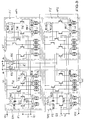
- the low pass filter TP1 consists of a filter stage F1 with a downstream amplifier stage V1 together.
- the filter stage F1 has two transistors T10, T11, the emitters of which are connected to one another via the emitter resistor RE1 and in each case via one of the current sources I10 or I11 to a first supply terminal VEE, for example at a reference potential, and the collectors of which are connected to each other via the capacitor C1 are connected via one of the two collector resistors RC10 and RC11 of the same size to a second supply connection VCC, which is connected to an operating potential.
- the bases of the transistors T10, T11 form the differential filter input connected to the input E1, to which the first branch signal s 1 is fed as an input voltage, and the collectors the differential output of the filter stage F1.
- the following applies to the time constant of this filter stage ⁇ TP1 2 * RC10 * C1 .
- the amplifier stage V1 has a differential amplifier stage with two transistors T14, T15 whose emitters are connected to one another via an emitter resistor RE10 and via one of the current sources I14 or I15 with the first Supply connection VEE are connected and their bases via one each Emitter followers T12 and T13 each connected to one of two connections which are connected to the filter output of filter stage F1 differential input of amplifier stage V1 forming.
- the differential Output of amplifier stage V1 - the collectors of transistors T14, T15 - are connected to the summation unit ⁇ .
- the latter has two identical summation resistances RS, RS ', each with a connection to the second supply connection VCC and with the each other connected to one of two summation nodes are, the summation nodes both as differential Circuit output A as well as differential inputs of the summation unit ⁇ act.
- the summation resistances they are called currents filtered intermediate signals provided by the filters TP1, TP2, HP1, HP2 added up signed.
- the output signal a then corresponds the pending between the connections of the circuit output A.
- the first high-pass filter HP1 has a filter stage F1 'and an amplifier stage V1' connected downstream of this.
- the latter is not connected between the collectors of the transistors T10 ', T11' but in series with the emitter resistor RE1 'between the emitters of these transistors T10', T11 '.
- the ratios C1 / C1 'and RC10 / RE1' must be the same, which can be achieved with high accuracy in integrated circuits. Because the emitter resistances RE1 'and RE1 are of the same size, the collector resistors RC10, RC11, RC10' and RC11 'are of the same size and the current sources I10, I11, I10' and I11 'are of the same design, the two filter stages F1, F1' also have the same gain factors.
- the negative The sign of the addition in the summation unit ⁇ is obtained through the interconnection by the connections of the differential output the amplifier stage V1 'are interchanged.
- the low-pass filters TP1, TP2 and the high-pass filters HP1, HP2 each differ only in the values of their capacitors C1 and C2 or C1 'and C2' which determine the time constants.
- the capacitance ratio C2 / C2 'and the resistance ratio RC20 / RE2' which due to the same size collector resistances RC10, RC11, RC10 ', RC11', RC20, RC21, RC20 ', RC21' and the like large emitter resistances RE1, RE1 ', RE2, RE2' is equal to the ratio RC10 / RE1 ', chosen to be the same size, in order to bring about equality in relation to the time constants ⁇ TP2 , ⁇ HP2 .
Landscapes
- Networks Using Active Elements (AREA)
Applications Claiming Priority (2)
| Application Number | Priority Date | Filing Date | Title |
|---|---|---|---|
| DE19737091 | 1997-08-26 | ||
| DE1997137091 DE19737091A1 (de) | 1997-08-26 | 1997-08-26 | Integrierte Phasenschieberanordnung |
Publications (2)
| Publication Number | Publication Date |
|---|---|
| EP0899875A2 true EP0899875A2 (fr) | 1999-03-03 |
| EP0899875A3 EP0899875A3 (fr) | 2001-04-11 |
Family
ID=7840186
Family Applications (1)
| Application Number | Title | Priority Date | Filing Date |
|---|---|---|---|
| EP98114687A Withdrawn EP0899875A3 (fr) | 1997-08-26 | 1998-08-05 | Déphaseur intégré |
Country Status (2)
| Country | Link |
|---|---|
| EP (1) | EP0899875A3 (fr) |
| DE (1) | DE19737091A1 (fr) |
Cited By (2)
| Publication number | Priority date | Publication date | Assignee | Title |
|---|---|---|---|---|
| EP2403140A3 (fr) * | 2010-06-09 | 2013-06-26 | Kabushiki Kaisha Toshiba | Déphaseur |
| EP2660973A1 (fr) * | 2012-05-02 | 2013-11-06 | Kabushiki Kaisha Toshiba | Amplificateur de Doherty |
Families Citing this family (1)
| Publication number | Priority date | Publication date | Assignee | Title |
|---|---|---|---|---|
| DE102007019745B4 (de) * | 2007-04-26 | 2009-04-23 | Texas Instruments Deutschland Gmbh | Kaskadierter Phasenschieber |
Family Cites Families (5)
| Publication number | Priority date | Publication date | Assignee | Title |
|---|---|---|---|---|
| JPS5379354A (en) * | 1976-12-23 | 1978-07-13 | Nec Corp | Primary variable entire-band-pass circuit |
| JPH06319908A (ja) * | 1993-05-17 | 1994-11-22 | Sumitomo Metal Ind Ltd | 水中堆積砂の排出方法 |
| DE4420377C2 (de) * | 1993-09-22 | 1998-08-27 | Hewlett Packard Co | Verfahren zum Erzeugen von Quadratursignalen |
| GB9424056D0 (en) * | 1994-11-29 | 1995-01-18 | Sgs Thomson Microelectronics | A satellite tuner stage |
| JPH08256187A (ja) * | 1995-03-17 | 1996-10-01 | Fujitsu Ltd | 直交変調器 |
-
1997
- 1997-08-26 DE DE1997137091 patent/DE19737091A1/de not_active Withdrawn
-
1998
- 1998-08-05 EP EP98114687A patent/EP0899875A3/fr not_active Withdrawn
Cited By (2)
| Publication number | Priority date | Publication date | Assignee | Title |
|---|---|---|---|---|
| EP2403140A3 (fr) * | 2010-06-09 | 2013-06-26 | Kabushiki Kaisha Toshiba | Déphaseur |
| EP2660973A1 (fr) * | 2012-05-02 | 2013-11-06 | Kabushiki Kaisha Toshiba | Amplificateur de Doherty |
Also Published As
| Publication number | Publication date |
|---|---|
| DE19737091A1 (de) | 1999-03-04 |
| EP0899875A3 (fr) | 2001-04-11 |
Similar Documents
| Publication | Publication Date | Title |
|---|---|---|
| DE69614813T2 (de) | Mischereinrichtung mit Beseitigung der Spiegelfrequenz | |
| EP0401771B1 (fr) | Montage de circuit pour conversion en fréquence | |
| DE69518277T2 (de) | Vorrichtung zur Beseitigung der Spiegelfrequenz eines in eine Zwischenfrequenz umgesetzten Basisbandsignals | |
| DE69623292T2 (de) | Bipolarer analogmultiplizierer für niederspannungsanwendungen | |
| EP0341531A2 (fr) | Amplificateur à large bande réglable | |
| DE3874467T2 (de) | Monolithischer mikrowellen-phasenschieber mit mehreren ausgaengen, zwischen welchen in einem grossen frequenzbereich eine konstante phasendifferenz erhalten wird. | |
| DE2616467C2 (de) | Schaltungsanordnung zur Phasenverschiebung eines Wechselspannungssignals | |
| DE69505690T2 (de) | Geräuscharmer spannungsgesteuerter mikrowellenoscillator der zweiten generation | |
| DE3875713T2 (de) | Oszillatorschaltung und quadratur netzwerk fuer radioempfaenger. | |
| DE69616201T2 (de) | Verbesserungen an oder in bezug auf kommunikationsempfänger | |
| DE69406843T2 (de) | Vierquadranten-Multiplizierschaltung und eine solche Schaltung enthaltender Empfänger | |
| EP0316607B1 (fr) | Oscillateur commandé par la tension et déphaseur intégré monolithique à semi-conducteurs | |
| DE3850188T2 (de) | Phasenschieber. | |
| DE60008030T2 (de) | Frequenzumsetzer | |
| DE60005561T2 (de) | Polyphasenfilter | |
| DE60123157T2 (de) | Frequenzumsetzer mit Unterdrückung der Spiegelfrequenzen | |
| DE69001278T2 (de) | Phasenschieber. | |
| DE10344876B3 (de) | Signalverarbeitungseinrichtung, insbesondere für den Mobilfunk | |
| DE2142661C3 (de) | Demodatorschaltung für winkelmodulierte elektrische Schwingungen | |
| EP0899875A2 (fr) | Déphaseur intégré | |
| DE3850799T2 (de) | Monolithischer Gegentakt-Einseitenbandmodulator. | |
| DE102004030039B3 (de) | Mischerschaltung | |
| DE60109645T2 (de) | Erzeugung von zwei durch 90 grad phasenverschobene signale | |
| DE69421260T2 (de) | Spannungsgesteuerte Kapazität | |
| DE2738732A1 (de) | Phasendemodulator |
Legal Events
| Date | Code | Title | Description |
|---|---|---|---|
| PUAI | Public reference made under article 153(3) epc to a published international application that has entered the european phase |
Free format text: ORIGINAL CODE: 0009012 |
|
| AK | Designated contracting states |
Kind code of ref document: A2 Designated state(s): AT BE CH CY DE DK ES FI FR GB GR IE IT LI LU MC NL PT SE |
|
| AX | Request for extension of the european patent |
Free format text: AL;LT;LV;MK;RO;SI |
|
| K1C3 | Correction of patent application (complete document) published |
Effective date: 19990303 |
|
| RAP1 | Party data changed (applicant data changed or rights of an application transferred) |
Owner name: ATMEL GERMANY GMBH |
|
| PUAL | Search report despatched |
Free format text: ORIGINAL CODE: 0009013 |
|
| AK | Designated contracting states |
Kind code of ref document: A3 Designated state(s): AT BE CH CY DE DK ES FI FR GB GR IE IT LI LU MC NL PT SE |
|
| AX | Request for extension of the european patent |
Free format text: AL;LT;LV;MK;RO;SI |
|
| RIC1 | Information provided on ipc code assigned before grant |
Free format text: 7H 03H 11/18 A, 7H 03D 7/16 B, 7H 03D 7/18 B |
|
| AKX | Designation fees paid | ||
| REG | Reference to a national code |
Ref country code: DE Ref legal event code: 8566 |
|
| STAA | Information on the status of an ep patent application or granted ep patent |
Free format text: STATUS: THE APPLICATION IS DEEMED TO BE WITHDRAWN |
|
| 18D | Application deemed to be withdrawn |
Effective date: 20020301 |